What was that? Well, that was Indians Cowboy Slim. No that wasn't! That just the guy that hangs the lights and he's wearing some dumb costume! #CowboyWho
In brief: Tropical Storm Bertha may be nearing its peak before it begins a steady, if not quick weakening trend on approach to Louisiana. Bertha is expected to dissipate before reaching Texas. Impacts from Bertha will include high tides and some minor tidal flooding perhaps on the Mississippi and southeast Louisiana coasts, as well as locally heavy rain.
Big Bertha
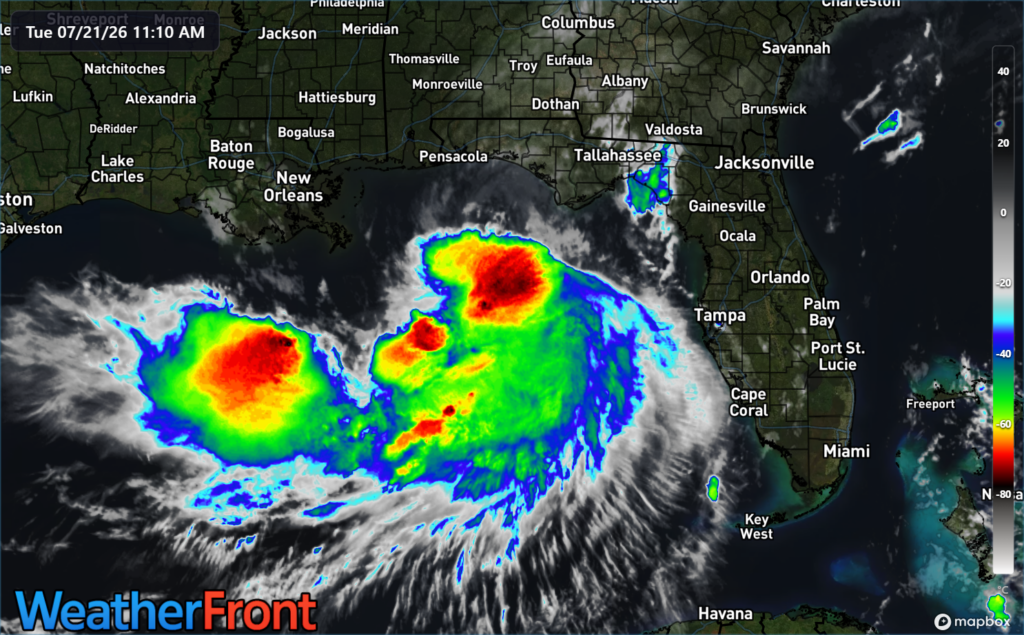
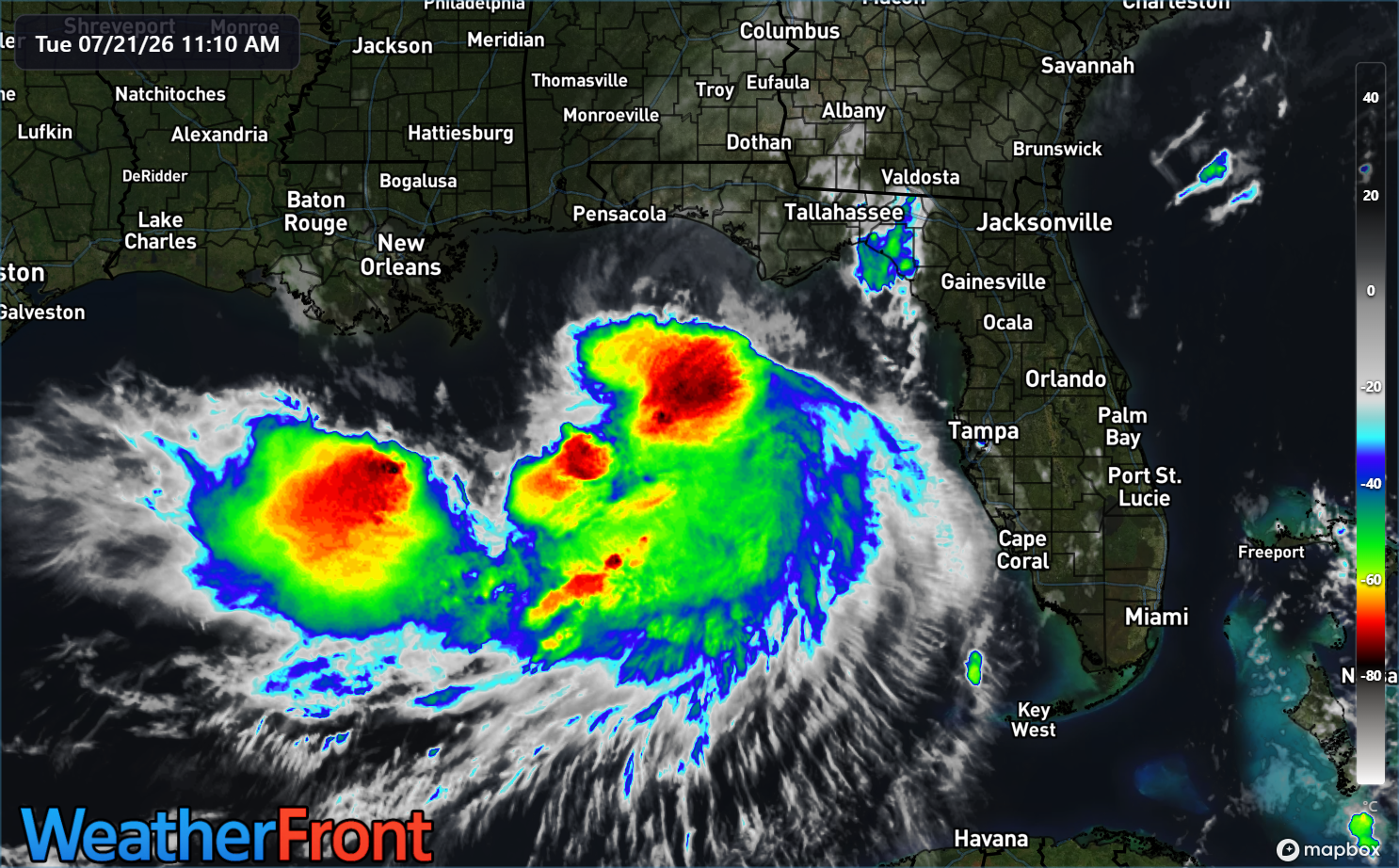
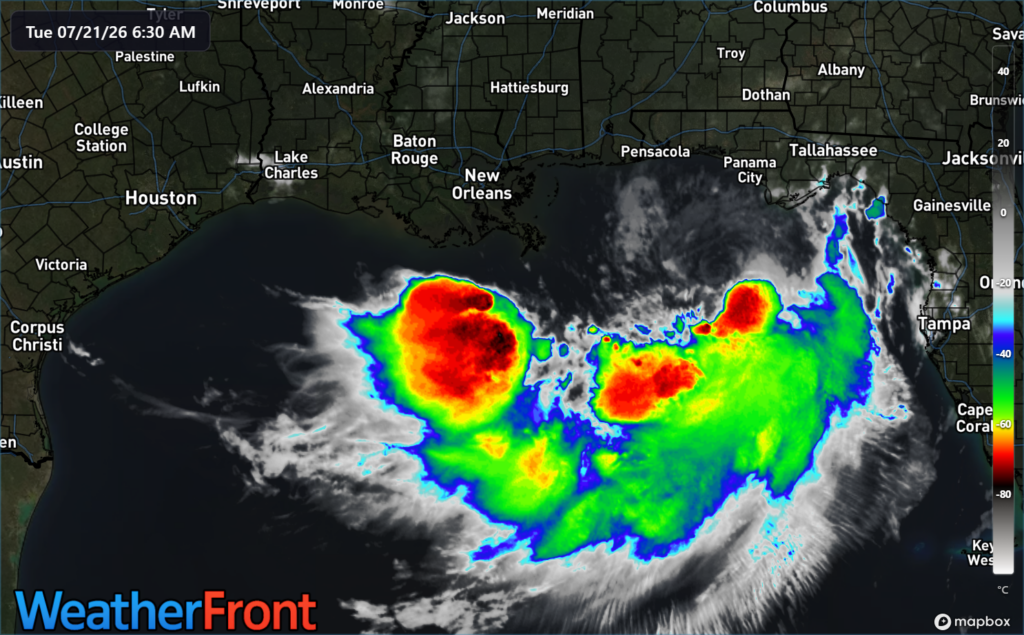
Ok, Bertha isn’t exactly big. But it’s a tropical storm. It’s more like a blob. Or a couple blobs. Or a creepy thing staring at you.
Bertha is frazzled but formidable over the Gulf waters. (WeatherFront)
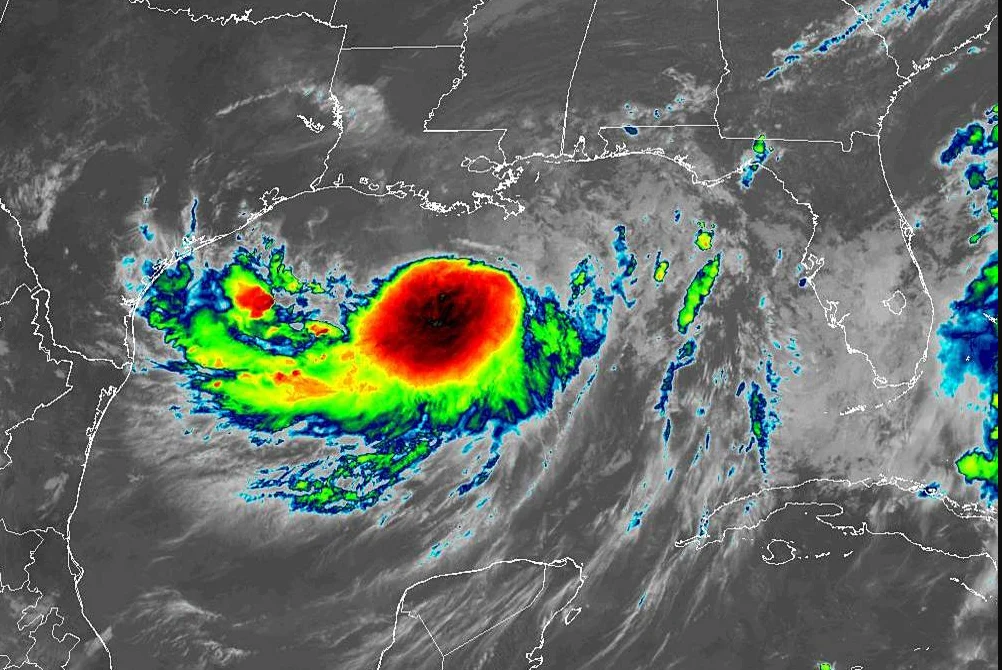
Bertha is extremely reminiscent of another “B” storm in the Gulf from a few years back, Barry. Barry became a hurricane, or more like a halficane.
Barry in 2019 was a lot like Bertha. (NOAA)
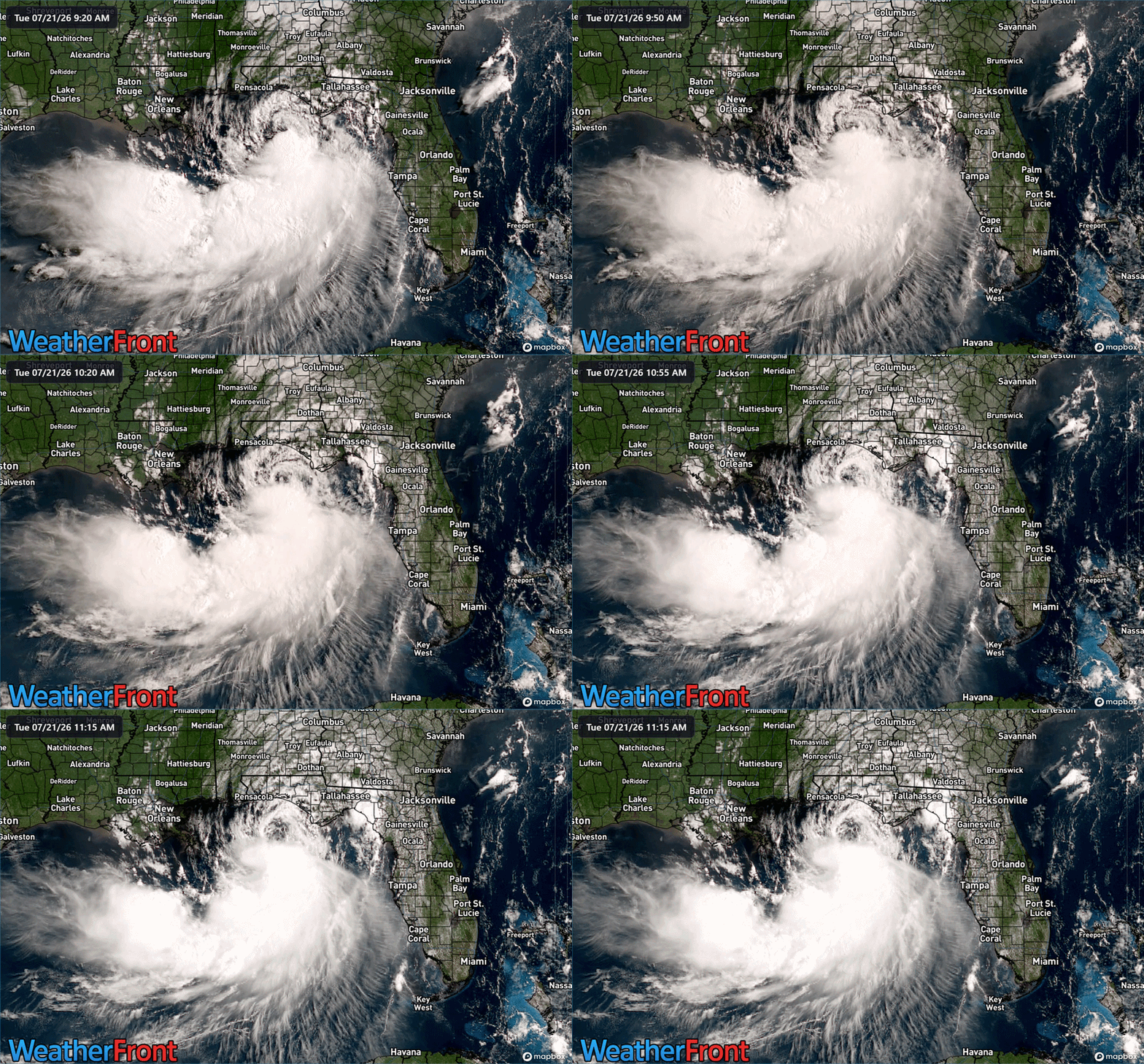
Barry’s center was constantly north of all the thunderstorms. In Bertha’s case, it’s similar. Where’s the center?
(WeatherFront)
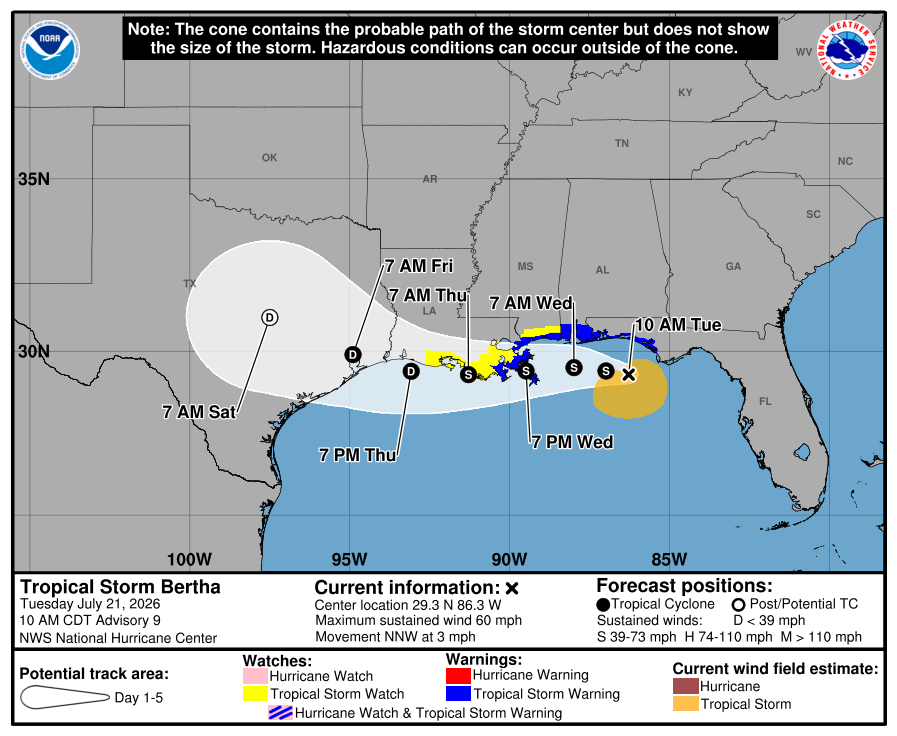
The center is visibly exposed north of the thunderstorms and located just south of Destin. The bulk of the wind with Bertha is located under the storms, especially south and east of the center. We are seeing 40 mph wind gusts near Cape San Blas east of Panama City and a 43 mph gust near St. Teresa and Bald Point State Park (which is a beautiful place to visit). So, Bertha’s doing the thing. Maximum sustained winds are around 60 mph, again offshore under the thunderstorms. Bertha is probably near its peak intensity this morning.
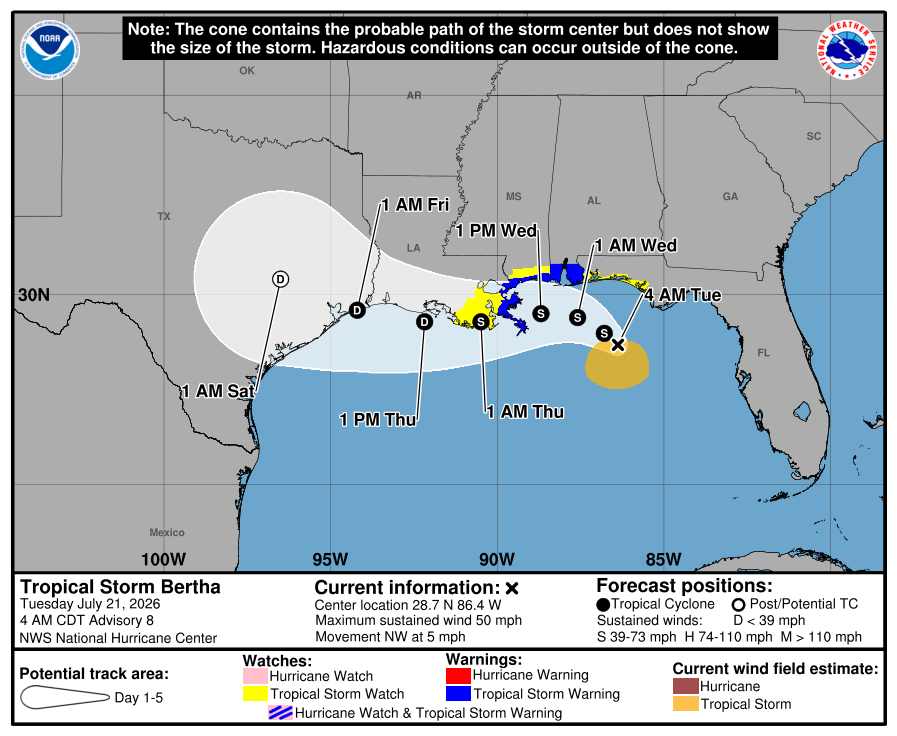
(NOAA/NHC)
Bertha is expected to track west northwest for a little while before shifting west and perhaps even west southwest over the immediate coast of Louisiana.
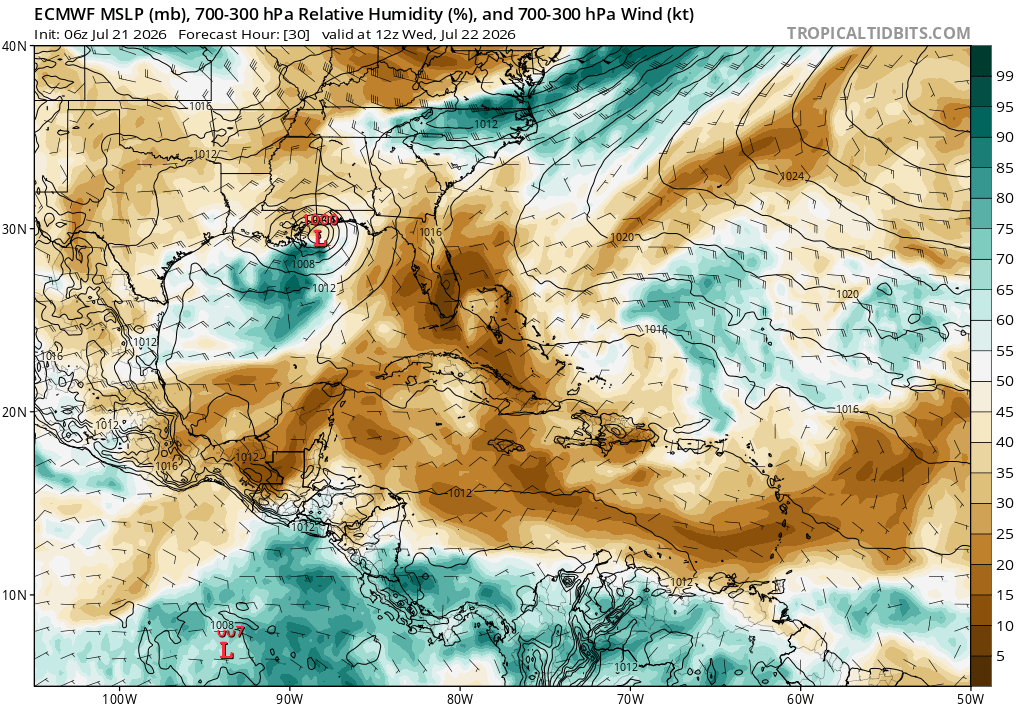
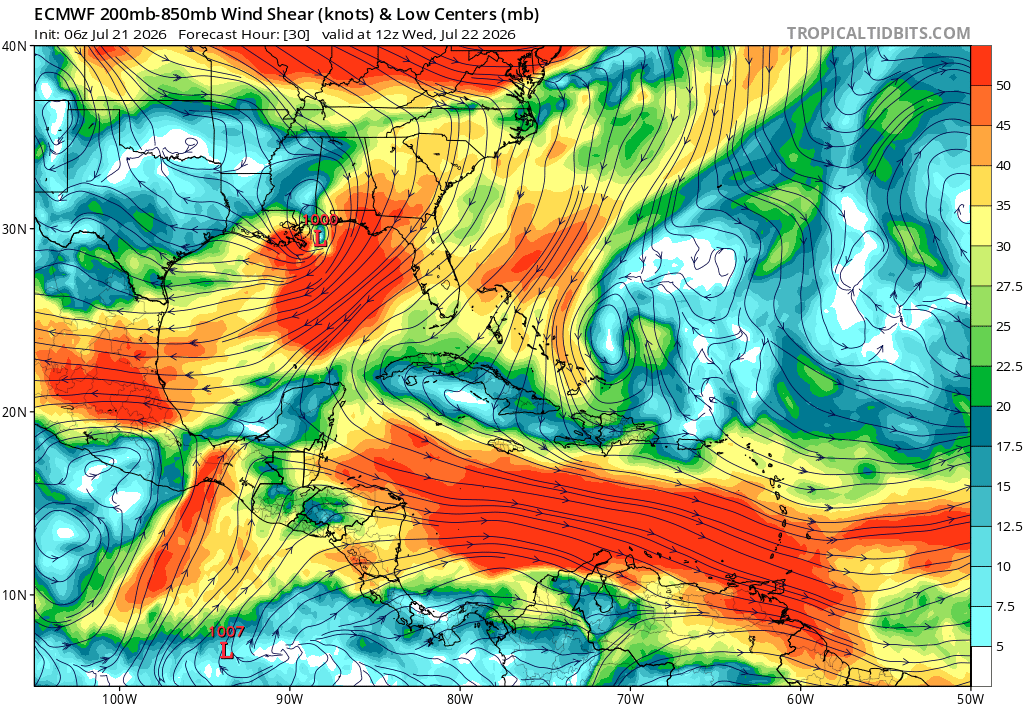
Bertha should be near peak intensity today, and we’re fairly confident of this for two reasons: Wind shear and dry air. Bertha’s going to get attacked on both sides in about 12 to 24 hours. On the eastern flank, northeasterly wind shear. On the western flank, dry air.
Use the slider to compare dry air and wind shear as forecast on Wednesday morning. (Tropical Tidbits)
The combination of these factors in conjunction with a storm that is already just barely holding it together coherently historically leads to rapid weakening. We hear a lot about rapid intensification during hurricane season, something we’ve seen happen more and more often in recent years. But rapid de-intensification may be the story here. Bertha should weaken to a depression by the time it gets west of New Orleans, and frankly, it may be lucky to even have an identity anymore by the time it gets to Lake Charles. There may some additional thunderstorms into western Louisiana or far southeast Texas on Thursday or Friday as the remnants pass through, but even that may be asking a lot.
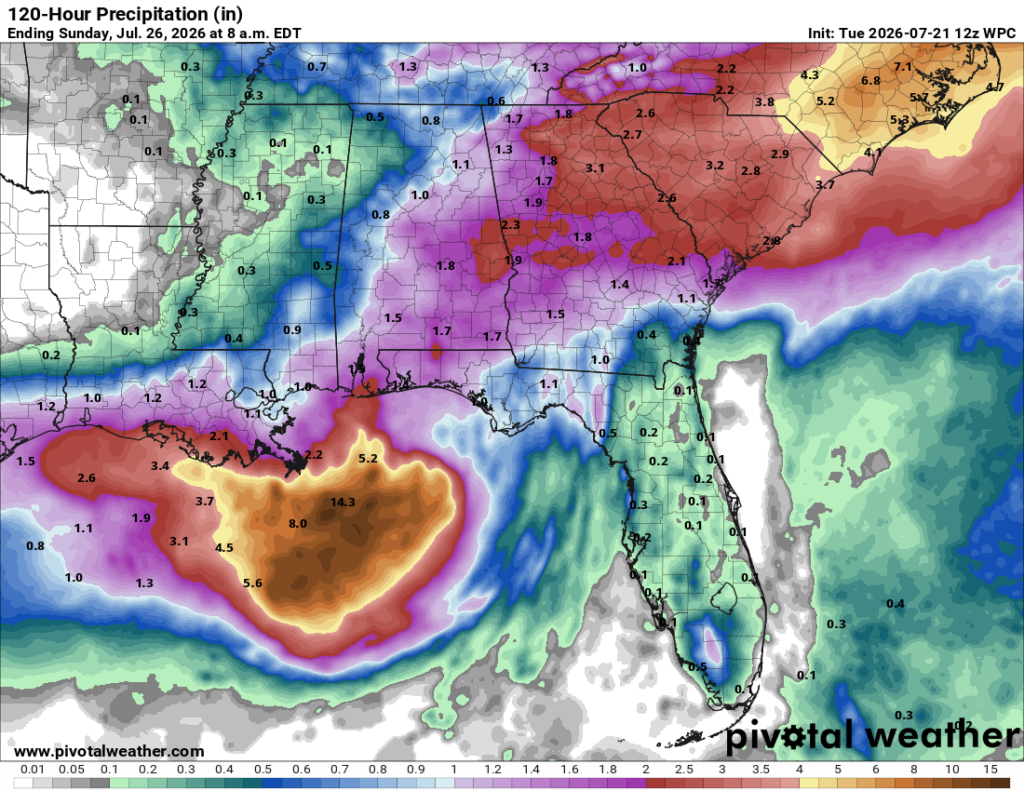
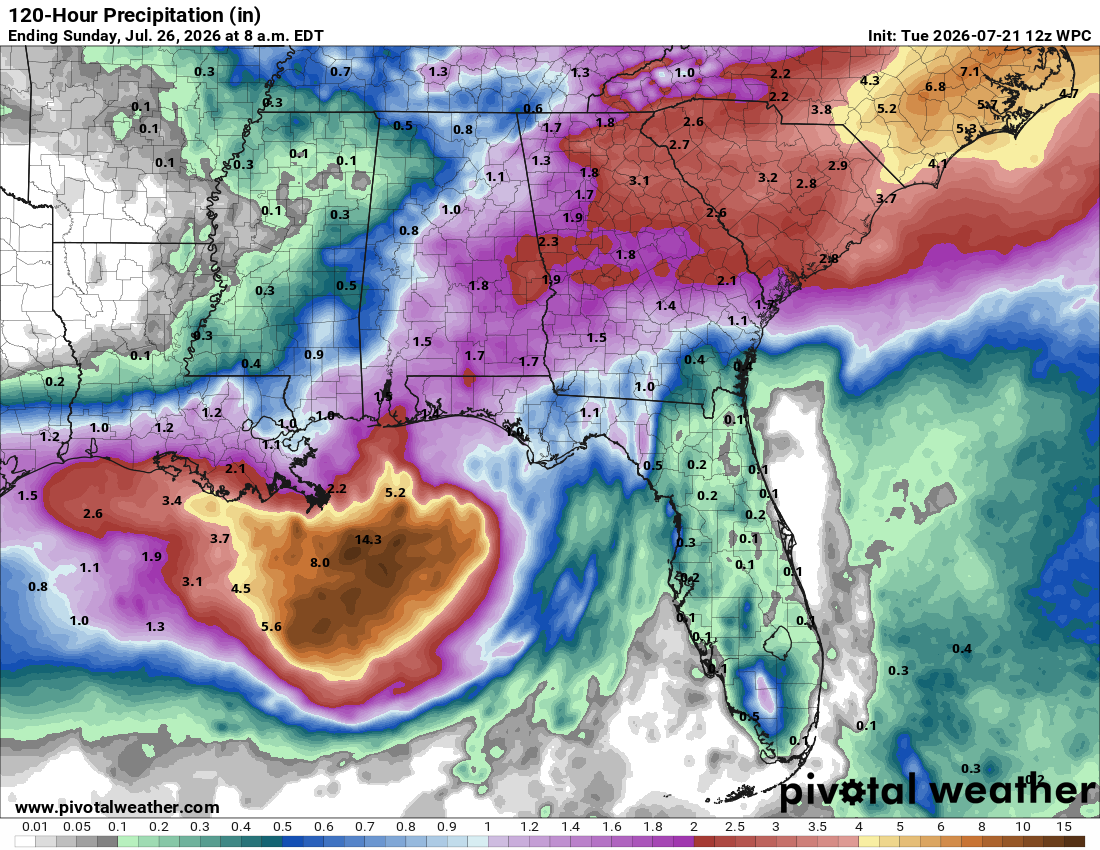
The main impacts from Bertha to land will be in the form of rain and squally weather. The squalls will produce gusts to tropical storm intensity at times, primarily along the coast east of Vermilion Bay, Louisiana. The heaviest rain should fall in southeast Plaquemines Parish.
Rain totals over the next 5 days. (Pivotal Weather)
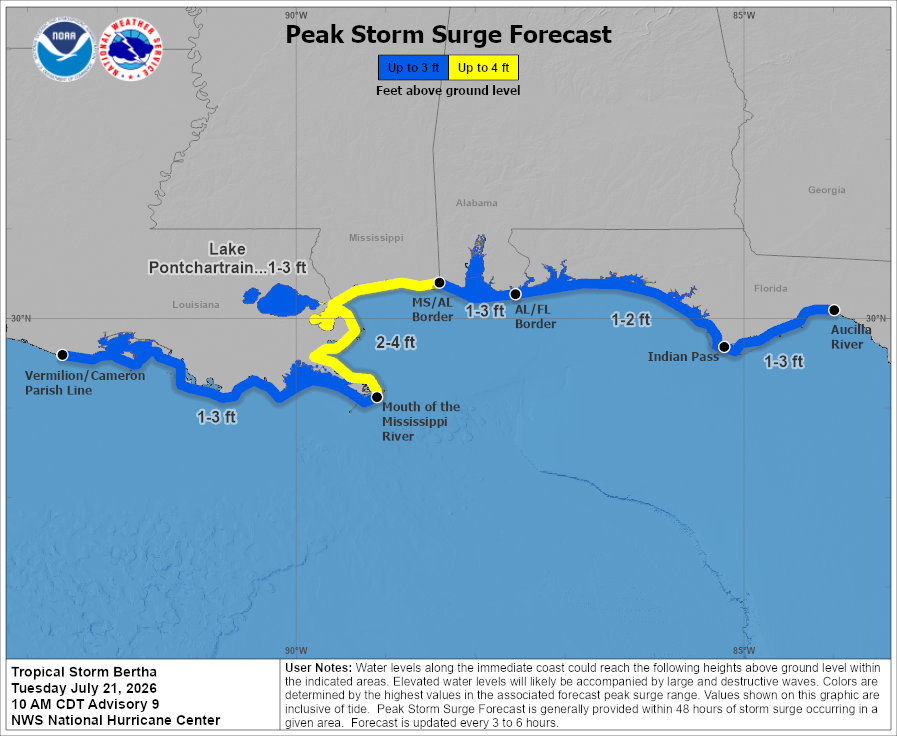
Additionally locally heavy rain may fall from Grand Isle west as well as near Mobile Bay. Additionally, waves and tides will increase some across the Gulf Coast, leading to perhaps a 2 to 4 foot peak storm surge in eastern Louisiana, as well as on the Mississippi coast.
(NHC NOAA)
Bottom line: Mostly nuisance impacts from Bertha are expected along the Gulf Coast, particularly in southeastern Louisiana.
No other tropical concerns in the Atlantic at this time.
In brief: Tropical Storm Bertha is expected to fall apart before reaching the Texas coast. While there is a slight chance of showers by Friday in Houston, it’s more likely that this week is just hot, with 100s likely tomorrow and possible today and Thursday. More hot weather continues into next week.
Tropical Storm Bertha
(NOAA/NHC)
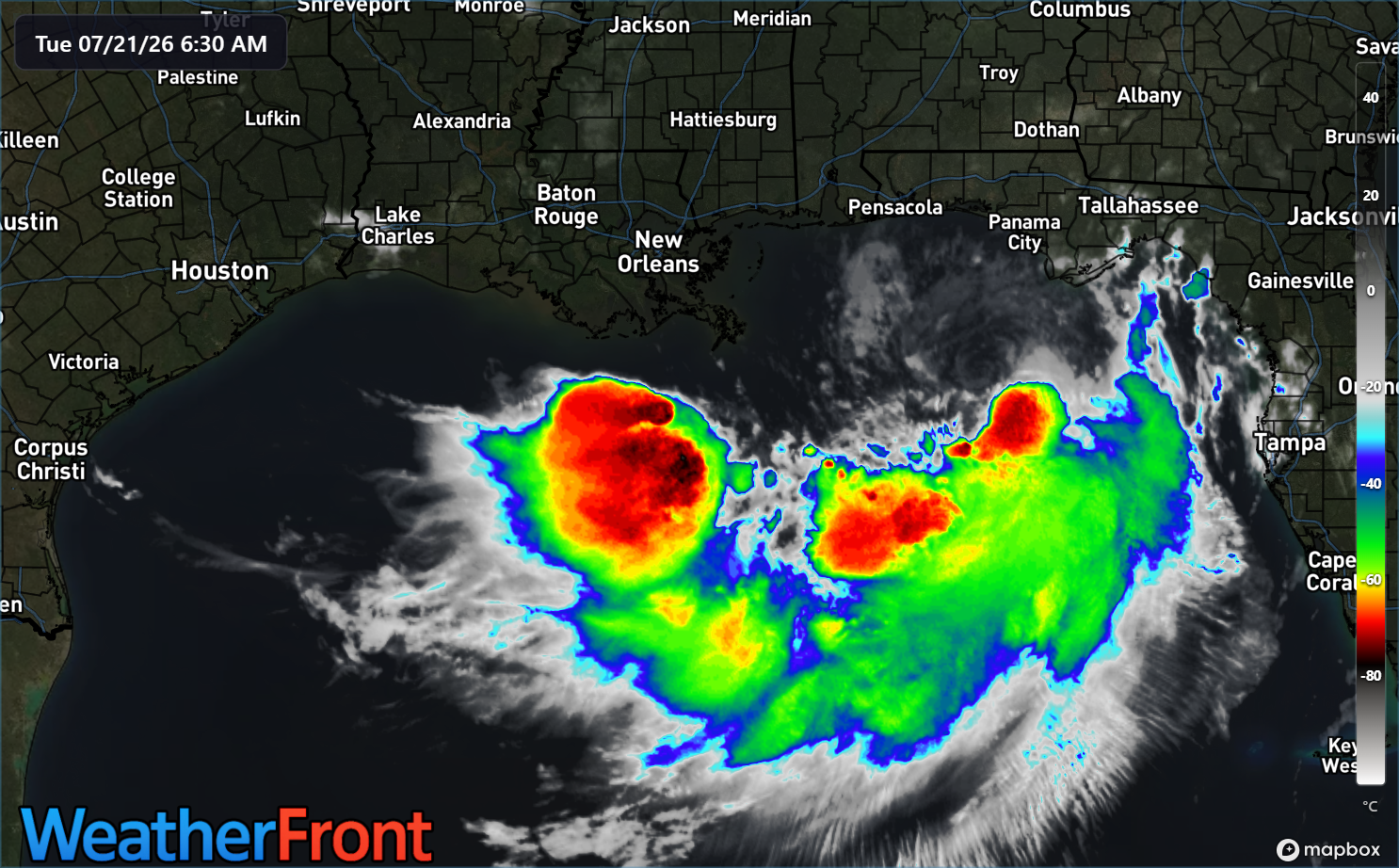
If you looked at satellite imagery this morning, you might ask yourself, “Really? Tropical Storm Bertha?” And without getting too into the weeds, all I will say is, “Yes. It is by definition technically a tropical storm. Just go with this.”
Bertha looks like a half-storm on satellite. (WeatherFront)
The aesthetics are off here, but that’s how these things work sometimes. Anyway, the actual surface center of 50 mph Bertha is located north of the thunderstorm activity, just south of Panama City, an indication that we’re dealing with a rather unhealthy tropical storm. Over the next 24 to 48 hours, Bertha is going to get blasted by wind shear, resulting in a gradual, perhaps quick weakening. So the storm may reach its peak today.
Bertha will continue westward, and the NHC track shows it reaching the Upper Texas Coast as a depression on Thursday night. The thought is that shower and thunderstorm chances would increase as a result on Friday, but even that may be a stretch. Realistic impacts would be slightly elevated tides and perhaps some breezy northeast winds (20-30 mph) in Galveston Thursday or Friday. Beyond that? It seems unlikely at this point that we’ll see anything more. And it may be generous to assume Bertha even survives the trip.
There is a little heartburn about, “Well, what if Bertha tracks farther south than expected?” We’re watching that, but even in that case, there’s a lot of dry air surrounding Bertha and the type of shear Bertha is set to experience usually decimates weak systems like this. We’ll obviously keep watching, but we really don’t believe this will impact Texas in a meaningful way. And there’s a decent, if not good chance we don’t notice any real impacts at all.
Heat wave
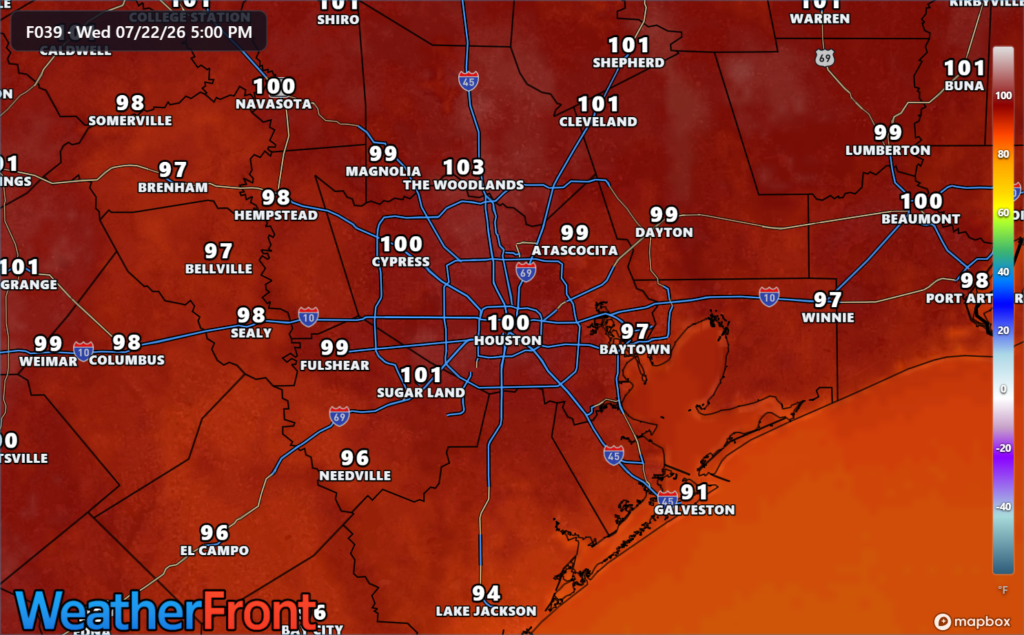
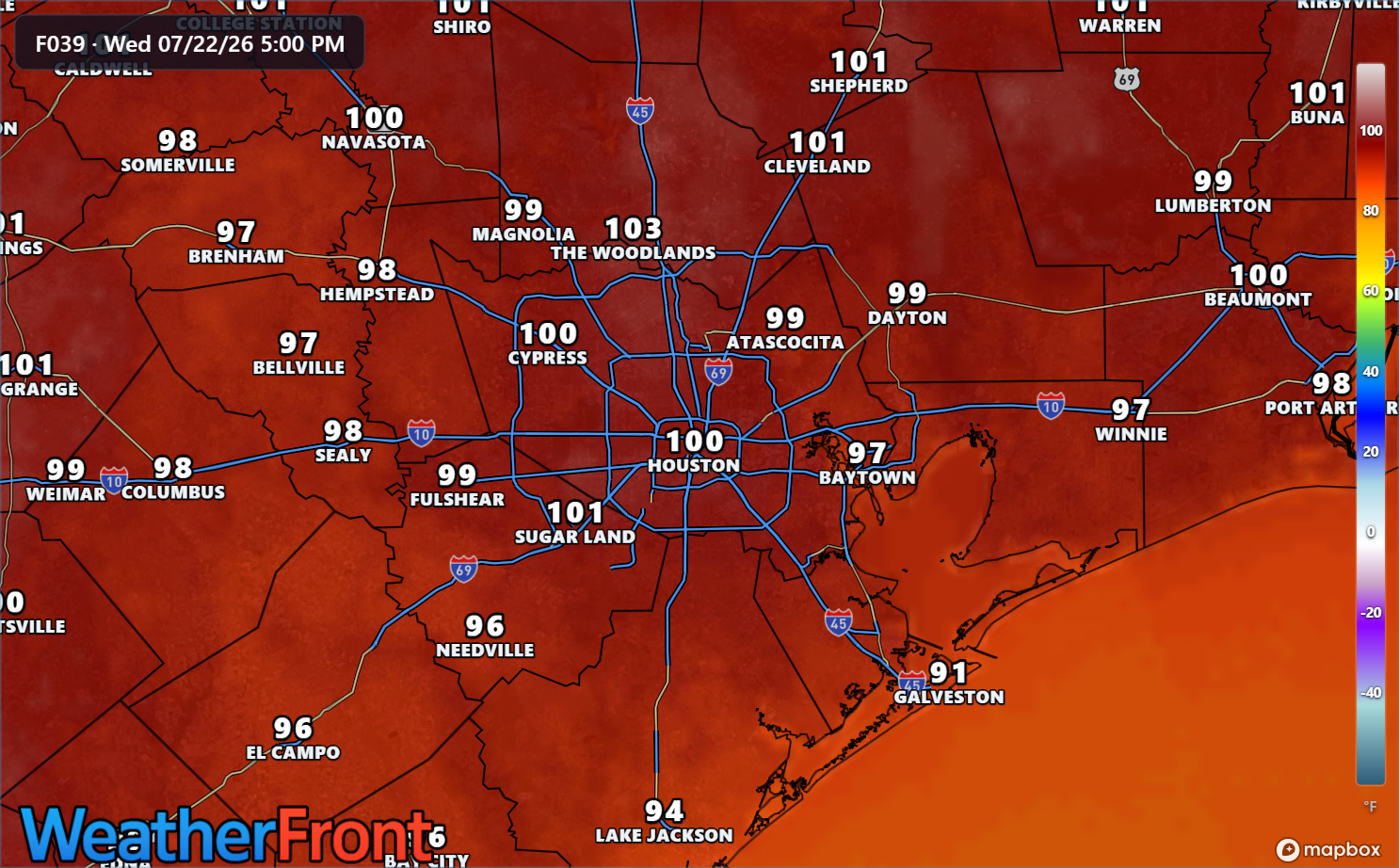
For those of you wondering if we’d ever see real heat this summer in Houston, you’ll get your answer over the next 3 to 4 days. That northeast wind shear that pummels Bertha is actually going to help deliver slightly drier air to Houston. Yes, humidity levels will be somewhat lower, but that will serve to crank up temperatures (drier air heats up more efficiently than more humid air). Not so much a “dry heat” as a very hot and somewhat humid setup.
Wednesday’s forecast high temperatures (WeatherFront)
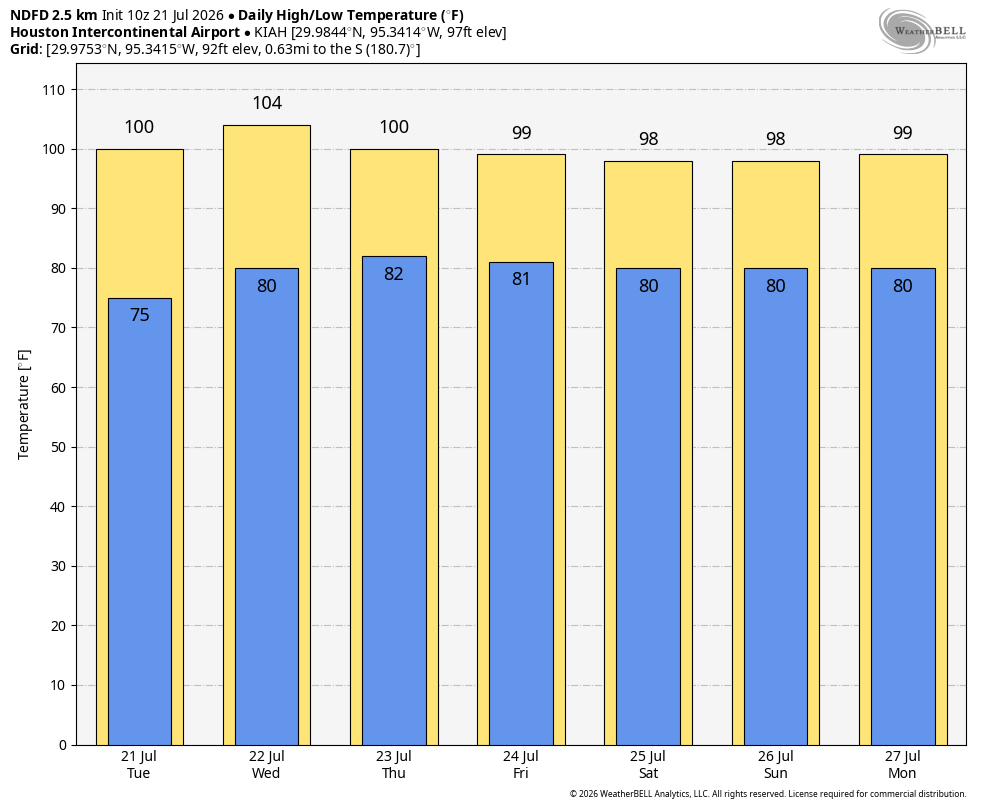
We should see highs into the upper-90s, if not near 100 degrees today. Tomorrow is Houston’s best chance to exceed 100 degrees and feels like one of those days that could be the hottest of summer. Obviously, we won’t say that it will be with all of August still in front of us. But you get the idea. It’s going to be hot. Exercise maximum heat precautions tomorrow. Heat risk will be in the “extreme” category, the type of elite we get usually a few days each summer. Heat advisories are posted today, and we’ll see if those get upgraded to “extreme heat warnings” tomorrow.
(WeatherBell)
It stays quite hot into early next week, although we lose that crème de la crème type heat. Unfortunately, our nighttime lows look to crank up as well, with more lows near 80 degrees with a return to more typical humidity levels for the end of July. If Bertha’s remnants can bring us some showers Friday, we may be a little cooler both Friday and Saturday. But not by a lot.
When does it end? The humorous answer would “after August.” The more realistic answer is that temperatures may slowly adjust down some with gradually increasing rain chances later next week. We shall see. In the meantime, buckle up if you’ve been waiting for this sort of weather, or become a recluse if you’ve been dreading this sort of weather. It’s going to be a little bit.
I just graduated this past semester and got a full-time job at an office, on-site for five days a week, nine hours a day. I’ve had plenty of internships before this job, so I’d like to say I’m familiar with workplace social norms and whatnot, but most of my experience has been at very casual start-up spaces (the culture of my area is relatively casual as well; wearing jeans and a t-shirt to an upscale restaurant for example, is not out of place here). However, the feedback I’ve received so far after a few months of employment has made me concerned that I’m continuously making some social faux pas that I’m not aware of.
First, to be transparent, I had a heated debate with my manager that I acknowledge was a bit overboard (they were in favor of a controversial topic, not directly related to work; I reacted emotionally and responded as such, though I was not aggressive— just passionate). However, I immediately recognized my mistake and messaged my manager to apologize for my behavior and promised to be more aware in the future. My manager very graciously accepted my apology, and took some personal 1-on-1 time to address some behaviors they noticed. I have a very dry sense of humor, and they noted that some of my attempts at a lighthearted joke could be taken poorly by other team members who don’t know me as well; I acknowledge that, and now just try to speak as very forthcoming as possible and only joke with people that appear to jive with my sense of humor.
The second point needs some context. My desk is positioned next to a major path of traffic in the office so people can easily look over at what is on my screen often. I finish my work quickly and efficiently, leaving me with lots of spare time especially during the slow season. During onboarding, my other manager warned me of this and encouraged me to bring a book or even my Switch to pass the time. I usually spend this spare time waiting for more assignments by studying for grad school exams and watching YouTube. My manager pointed out that my screen (with YouTube, anime, etc.) was visible and gave the image that I was “slacking off.” They suggested I watch them on my phone or just keep it out of sight, so now I just listen to these videos with the tab minimized. Secondly, they noted I was too active in the company messaging channels, like posting pics in the photography channel for example, which gave the impression I had no work/my department was goofing around. I cut back on those too.
I’m also very involved in one of our company’s recreational clubs, which meets weekly (virtually) for a virtual game. Two of my colleagues saw me participating at my desk and asked to join, which I happily agreed to. After the event, my manager messaged me advising that I should not be doing these activities on the company floor and that my work takes priority … when I had already completed all of my work! (Fortunately, they did hint I could reserve a room for future meetings, which was helpful.) I will note that two colleagues who joined are my desk neighbors and their screens are visible as well.
I’m grateful for my managers for being patient and willing to share feedback, and I’ve expressed as such to both of them. However, I’m frustrated and confused on what office norms are permissible and what aren’t. Many of my colleagues will leave their desks to chat about shows, sports, etc. for anywhere from 5-15 minutes. It’s the World Cup when I’m writing this, and it’s not uncommon to see folks watching it on their phones, completely engrossed. This is all to say, the office is very laid-back and casual, especially since it’s the slow season for us, which makes it difficult for me to determine whether an activity would portray me/my department poorly or not. I feel like I have an understanding, only for one of my managers to message me and tell me that I’m making the department look bad.
I completely take responsibility for the debate incident and my initial sarcastic tone, but I’m wondering if the safest option is to put my nose to the keyboard and just focus on studying. One of my managers constantly tells me to be conscientious of the image I project to colleagues and especially those in superior roles to me, but I don’t know how to do that or what that means! I have zero interest in a promotion/moving up into management roles, so the idea of playing by the nebulous office politics is nauseating to me. Any strategies, advice, or a straight up reality check would be appreciated — I’m really trying my best, but what is modeled in my environment I feel is different from what I am told by management.
Sometimes — and especially for new grads — when you’re in an office with a fairly laid-back culture, it can actually be trickier to pick up on norms than in a more structured culture. You see people having a lot of freedom but you don’t necessarily see the unwritten rules around those freedoms, and so you can unwittingly overstep. (I am thinking here of the intern who disappeared for hours a day to attend every celebration being held in their large office complex.)
But I can see why you’re confused, since one of your managers early on encouraged you bring a book or even a Switch to pass the time when you didn’t actively have work … and now you’re being told not to let people see anything obviously recreational on your screen.
There are bunch of reasons this could have happened:
1. Your manager gave you that initial permission without really thinking it through. Maybe they wanted to sound laissez-faire but that’s not aligned with how the office actually operates in real life (or how they personally do; sometimes managers sound way more laid-back in interviews than they actually are because they get seduced by how pleasant it feels to present oneself that way).
2. Something changed after that initial conversation. For example, maybe their own manager cracked down on them or complained about optics (or actual productivity) in a way they hadn’t done previously.
3. They really meant what they told you, but you executed it in a way they didn’t expect — for example, being less discreet about your activities than they’d envisioned, or engaging in them more often. They may have expected you to pick up on unwritten messages like “doing this 5% of the time is okay but 20% of the time wouldn’t be” or “obviously don’t do this when clients are around” or “don’t do this when your nearby colleagues are really busy.” And then once they saw you handling it differently than they intended, they just told you not to do it at all rather than try to articulate those nuances.
4. Or, is the manager who gave you the initial permission different from the manager who has been telling you not to? It sounds like there’s more than one manager in the mix, so that might explain it all. When that happens, you need to listen to the least permissive one, unfortunately.
For what it’s worth, my money is on #3 because that would explain why you’re seeing colleagues doing the same things you’ve been told not to do. They may be doing less of it, or doing it at different (and more politically wise) times.
But regardless of the explanation, I think at this point you’ve got to forget about what you were told in the interview and go on the more recent messages you’ve been given — which are that for whatever reason, your manager doesn’t want you doing this stuff at work. That might seem really unfair if your other colleagues are doing it … but especially if the issue is that you haven’t correctly calibrated the acceptable amount and timing, it’s safer not to do any of it, at least for the next few months, to give your bosses time to stop thinking of you as a person who’s misjudging those things.
You asked if the safest option is to just focus on studying when you have downtime, and for now I’d say yes.
WASHINGTON—Apologizing to his fellow congressmen after he fumbled the wooden handle for the fifth time in a row, Speaker of the House Mike Johnson was observed struggling to hold his speaker gavel Tuesday while wearing anti-masturbation mitts. “The House will come to order—oops, hold on, one minute,” said the Louisiana Republican, appearing to perspire heavily as the mallet once again slipped from his hands, which were trapped inside two heavily padded, leather-bound gloves that reportedly deliver an electric shock anytime he attempts to touch his genitals. “Come on, come on. You’ve got this, Mike. Actually, can someone help me get these off? You’ll need to message my son on Covenant Eyes to get the key.” At press time, sources confirmed Johnson was yelling, “Oh shit, oh shit, oh shit!” and running out of the chambers after the stress of the ordeal caused him to develop a visible erection.
A Pew study found that China was viewed more favorably than America among the 36 countries surveyed, reporting 46% and 36% favorability respectively. What do you think?
Hola, Chad aquí, de Greenwich, Connecticut, a muy blanco área of los Estados Unidos. A few weeks ago, I decidir to watch Estados Unidos vs. Paraguay in fútbol. Normalmente, I watch “football” and not “fútbol—¡Soy muy americano!—but I was curioso about the Copa Mundial; also, Pilar, mi guapa neighbor from España, asked if me gusta fútbol, and I said, “sí.” ¡Qué mentira!
¿El problema? The Copa Mundial was on Fox televisión, but mi antena is muy mala. When Estados Unidos switched to televisión digital a few años ago, they said we’d get every channel. ¡But la verdad is nobody recibir channels anymore! Or not buenos channels, like “ABC” or “CBS”—only Cozi TV and some muy religiosos ones. I could have streamed on FS1 or Fox One, but I already pay for diez suscripciones, and I didn’t querer spend más dinero. ¡No más! “¿And qué es Fox One anyway?” I asked. “¿Does Sean Hannity hablar about the game and then tell ICE to deportar the team de Colombia?”
So, I watched on Telemundo. Telemundo had todos los games. I have Telemundo on Peacock because mi madre le gusta Law y Order and the whole familia shares la password. At first, I didn’t comprender what the announcers were saying. Except “¡Gooooooooooooooool!” which is like the americano word for “goal,” but más grande. But after a few días, I started to understand más y más. Los announcers on Telemundo were muy, muy excited about fútbol! ¡It was contagioso!
At first, I watched Estados Unidos games. ¡Qué triste for Paraguay! Estados Unidos won cuatro a uno. But since I trabajar remotely, I decidir to watch más games. My jefe thought I trabajar, but, en realidad, I watched Cabo Verde vs. Arabia Saudita on Telemundo. And diecisiete other games.
¡The Copa Mundial was muy exciting! Once a game ended, a nuevo game began! Countries I barely knew, Cabo Verde, played other countries I barely knew, Uruguay, but I cared mucho, for some razón. Even after Estados Unidos lost to Bélgica, I found myself invested emocionalmente in countries I couldn’t find on a mapa. For example: ¿Dónde está Croacia? El viernes, I spent veinte hours watching Telemundo, when I should have been trabajando on PowerPoint. ¡Shhhhh, don’t tell mi jefe!
When I saw Pilar, my guapa neighbor de España, at the supermercado, she winked and asked if I saw España beat Francia; I gave a veinte-minuto análisis, because I was now an experto. “¡Pero qué bien hablas español!” she gasped. “¿Qué?” I responder, “¡I don’t hablar español!” And this is when I realizar I had a problema—I did seem to hablar español now, but I didn’t seem to hablar inglés, at least not so bien as before. ¡O no!
This was malo because I have una importante meeting el martes with other blancos de Greenwich, Connecticut. ¡Qué disastre! Mi jefe will be angry and also triste. “I’m sorry I forgot inglés,” I’ll say, “but I’ve watched veinte hours of fútbol every día for cinco weeks. And also El Señor de los Cielos, a telenovela that advertises constantemente during the Copa Mundial on Telemundo.”
But it is also bueno, because now I can finally comunicar with Pilar in her native lengua. She smiles and says, “Hola” whenever we meet, and even made me a tortilla de patatas when mi gato died last month. My jefe wouldn’t even give me the día off. Me gusta mi neighbor Pilar más than mi estúpido jefe or mi estúpido trabajo, that’s for sure.
When España beat Argentina in the Copa Mundial final, I worked up the coraje to invitar Pilar to Cold Stone Creamery, which is how we celebrar importantes eventos in Connecticut. I was nervioso because mi vocabulario is limitado to fútbol and El Señor de los Cielos, a telenovela about el narcotráfico. “¿Qué pasa if she wants to hablar about el New Yorker?” I wondered. “¿Or Christopher Nolan’s La Odisea? ¿Or the novelas of Mark Twain?” I decided I’d cruzar that bridge when I got to it. So far, it has been fútbol, fútbol, fútbol. España won, and el futuro is looking brillante.
“A video just a few seconds long and accompanied by a simple question, ‘What am I looking at?’ was enough to turn a Seattle raccoon into a global internet sensation this week. The viral critter—dubbed ‘Jimothy’ by the internet—has a shorter spine than the average raccoon. His unusual appearance is likely the result of a congenital deformity in his spine.” — Oregon Public Broadcasting
- - -
It would seem I have become a minor celebrity on your information channels. It would also seem I have become something of an avatar for your collective longing for a better world, one that contains more whimsy and delight and less discord and horror. I am not immune to flattery, surely, but I regret to tell you that the weight of your longing is a bit much for my (apparently hilarious) abbreviated spine. I only have so many vertebrae, and they simply cannot carry your aspirations to fix whatever is wrong with you all, which, I further regret to tell you, is A LOT.
Put bluntly, you are, as a species, irretrievably fucked.
Given the dire nature of your condition, I’m not sure exactly what you think any raccoon, even a delightfully irregular one such as myself, is supposed to do about it. As a lifelong student of your detritus, I can tell you that the portrait that emerges from your trash cans is grim.
The wrappers of your preferred snack foods tell me you are self-soothing with highly-processed, chemical-laden junk that will lead to bodily issues far less charming than my own. I am not here to food-shame anybody, but I might gently suggest introducing a fruit or a protein-rich larva every now and then.
The packaging of your pharmaceutical goods—and there’s been quite an uptick—suggests that you’re having an increasingly difficult time dealing with your human emotions. It is perhaps not unrelated to the fact that the space between your households has grown annoyingly large, and the contents of your bins make it clear that you are dealing with these emotions in increasing physical isolation. Just last week I sorted through a pile of single-serving Stouffer’s toaster pizzas, airplane bottles, and prescription bottles that threatened to ruin even my generally sunny disposition.
Perhaps if you committed more time to interacting with one another without the intermediary of the screen on which I am so popular, you might feel better?
And look, I get it. The vanishingly few of you who still receive the news in print have supplied me with a pipeline to the goings-on in your world. Even a glance at the headlines on any given day is enough to send a fuzzy little basketball like me scurrying into the deepest woods. (Yes, we can read. If it helps to know, however, squirrels are illiterate, and rats… don’t get me started on the rats). No wonder so many of you give up halfway through the crossword. Also, the things some of you doodle in the margins give me… pause.
I am at a loss to explain what, if you’ll pardon the expression, the fuck is wrong with you people. You alone among the species seem to have found a way to override the main directive, which is, of course, to survive, and to have found increasingly elaborate ways of ensuring that you destroy yourselves. Which normally would be none of my business, except for the fact that you’re so likely to take so many of us down with you. Would you be less charmed by me if I turned to the camera and said, in my clumsy English: GET IT THE FUCK TOGETHER?
I don’t wish to be a scold. I’m happy that the absurd proportion of my legs to my body fills you with a dim echo of what you used to call joy. I would be thrilled if your delight at me helped to knit you together as a species, but if I’m a betting raccoon, I don’t love the odds. I’m sorry I cannot serve as a harbinger of better times, nor as a symbol of your better selves. I hope at least a few of you make some coins off the inevitable merch bearing my image. I expect I’ll see it in the trash by and by.
WASHINGTON—Dazed while trying to piece together the series of bizarre yet deeply vivid images, the entire nation reportedly awoke Monday from a strange dream in which it had been watching soccer. “I wasn’t just willingly viewing it, I actually cared who won, and I was tuning in right here in the United States instead of watching it in Europe or someplace like that,” said 27-year-old Philadelphia resident Erika Sloan, one of the 340 million bewildered Americans who were kneading their foreheads in an attempt to recall the almost lifelike scenes in which they knew when Cape Verde was playing and had an opinion on whether a player was offside. “I was in the bar where I usually watch football, but instead it was soccer on every screen. But no one was scared or even complained. And I can still remember hearing this word over and over: “Mbappé.”Who is that? What is that? I know I used to know, and it made me happy, but it’s all turning into a blur now.” At press time, sources confirmed the powerful images had fully dissipated, and the nation realized that even intense dreams were ultimately pretty pointless.
Hannah Rapp, 26, was riding with another person Saturday morning when she was hit, according to the Brazos County Sheriff’s Office, which says a 31-year-old man was arrested and charged with manslaughter.
I have a part-time job as a group fitness instructor at a gym that prides itself on inclusivity. The owner of the gym/my boss has been implementing new employee performance efforts. The feedback I received was overwhelmingly positive, which was exciting because I do work really hard at this job and also feel like I’m very good at it.
I did receive one negative comment. The owner suspected that my negative survey response was from a client who had previously complained about me for reasons that my boss didn’t think were warranted. When the owner asked how I wanted to receive the feedback, I said that I would prefer a summary of the actionable parts only.
Well, what the owner included was about how someone thinks I am unapproachable and unfriendly when I am not coaching at the gym. I asked for clarification around what my boss thought was actionable in that, and they replied that when I am in the gym but not coaching, I need to reach out to people in friendly ways, and to be aware of my “resting bitch face.” Resting bitch face!!! This really hit a nerve! Growing up, my mother would tell me I was a mean person for not behaving the way she wanted. As an adult, I got myself into therapy and received anxiety disorder and neurodiverse diagnoses. I’ve worked hard for years on this. I am better at interacting with people, and I know that often, people take my anxiety and neurodifference and imbue my actions with perceived ill will, and then treat me differently (worse!) than others.
I felt so hurt that my boss thinks the same thing, especially because I am not! I am very, very friendly with people for the one hour or so a week that I am in the gym when not coaching. I’m a freaking beacon of ebullience, and it is exhausting! I spiraled. I should have walked away and done nothing (especially since this boss’s follow-through on their employee performance initiatives has been less than 50%). Instead, I told my boss that I didn’t think this feedback was fair or accurate, felt more personal than professional, and that I wasn’t sure why they thought that it was okay to tell me I had “resting bitch face.”
I think this was an overreaction. I am embarrassed and hurt. I understand that I am always representing the business while there, even when not actively coaching, which is why I work so hard to be an open, welcoming version of myself when there. The irony that this is happening at a gym that works hard to make spaces for disabled and neurodivergent clients is adding to the pain. What do I do? Do I tell my boss that this feedback touched a nerve? Should I just walk away from this, my part-time job (I have another whole job I do!) We have no HR to speak of.
I think that however much you spiraled about the feedback, you are also spiraling about what you said to your boss — because your response to them doesn’t sound that terrible! If you yelled at them or were otherwise hostile about it, then sure; in that case you should go back and say you want to apologize for the intensity of your reaction and that it wasn’t warranted. But otherwise, your response doesn’t sound particularly over-the-top.
I do think it’s reasonable to point out to your boss that “resting bitch face” refers to someone’s natural, at-rest face (and is almost never applied to men) and that you make a special point of being friendly and outgoing with people when you’re not coaching, so it was disheartening to hear.
You could also ask, “Was this the feedback of a single person, or is it something you also agree with?” because it sounds like your boss might be falling into the trap of passing along every bit of feedback rather than only feedback they agree with and/or think it would be useful for you to hear. Sometimes a single person’s feedback is useful even if your boss doesn’t agree with it, but then that should be explicitly acknowledged — like, “This isn’t my sense of you at all, but it’s potentially useful to know that it’s landing like that with others.” Otherwise, though, it doesn’t make sense to pass along a single random client’s assessment if your boss doesn’t think it’s a real pattern.
In brief: TD 2 is a sloppy looking system in the Gulf, and while we should keep an eye on things, it does not appear as if this will deliver significant impacts to the Gulf Coast. We explain what’s at play here. We also take a look at a localized but notable flash flooding risk in New Jersey and NYC tomorrow.
First of all, thank you to all the new subscribers we’ve picked up in the last 24 hours. Thanks for joining us here. Our bread and butter is daily tropical weather discussions, but we also chime in on other significant weather as well. Eric is based in Houston, where I was for the last 14 years, and I am now based in southern New England. Together, we’ll keep you covered through hurricane season and beyond.
Let’s get down to business.
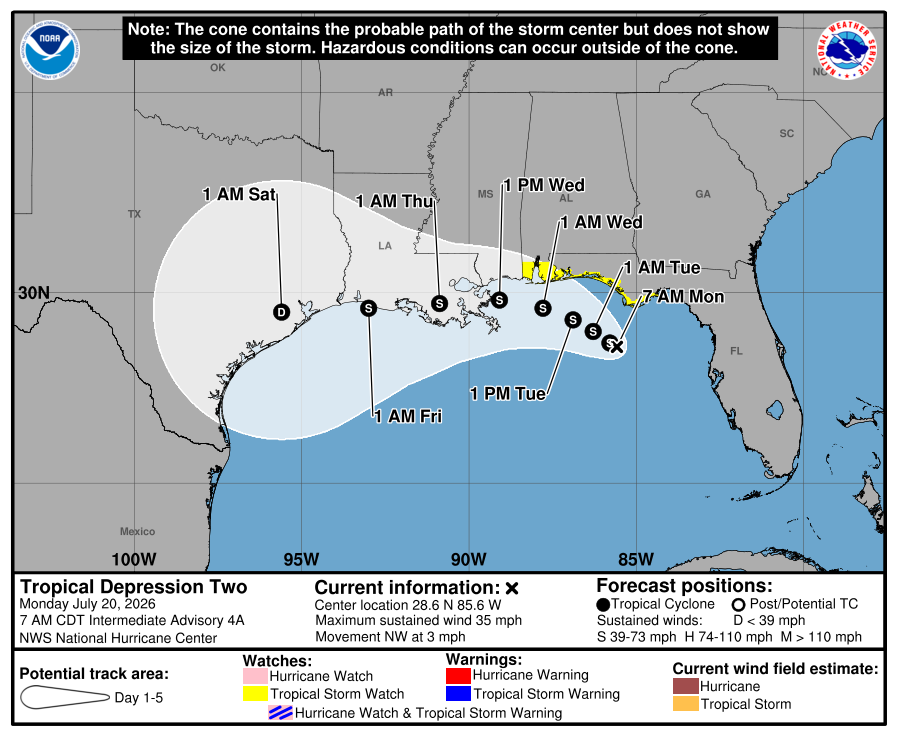
NHC forecast as of Monday morning. (NOAA/NHC)
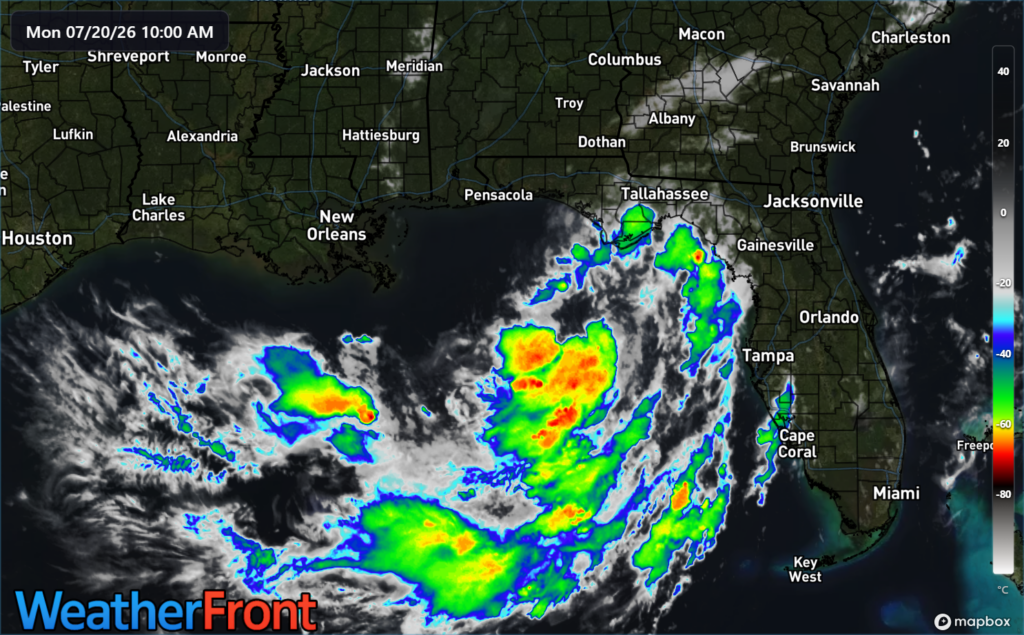
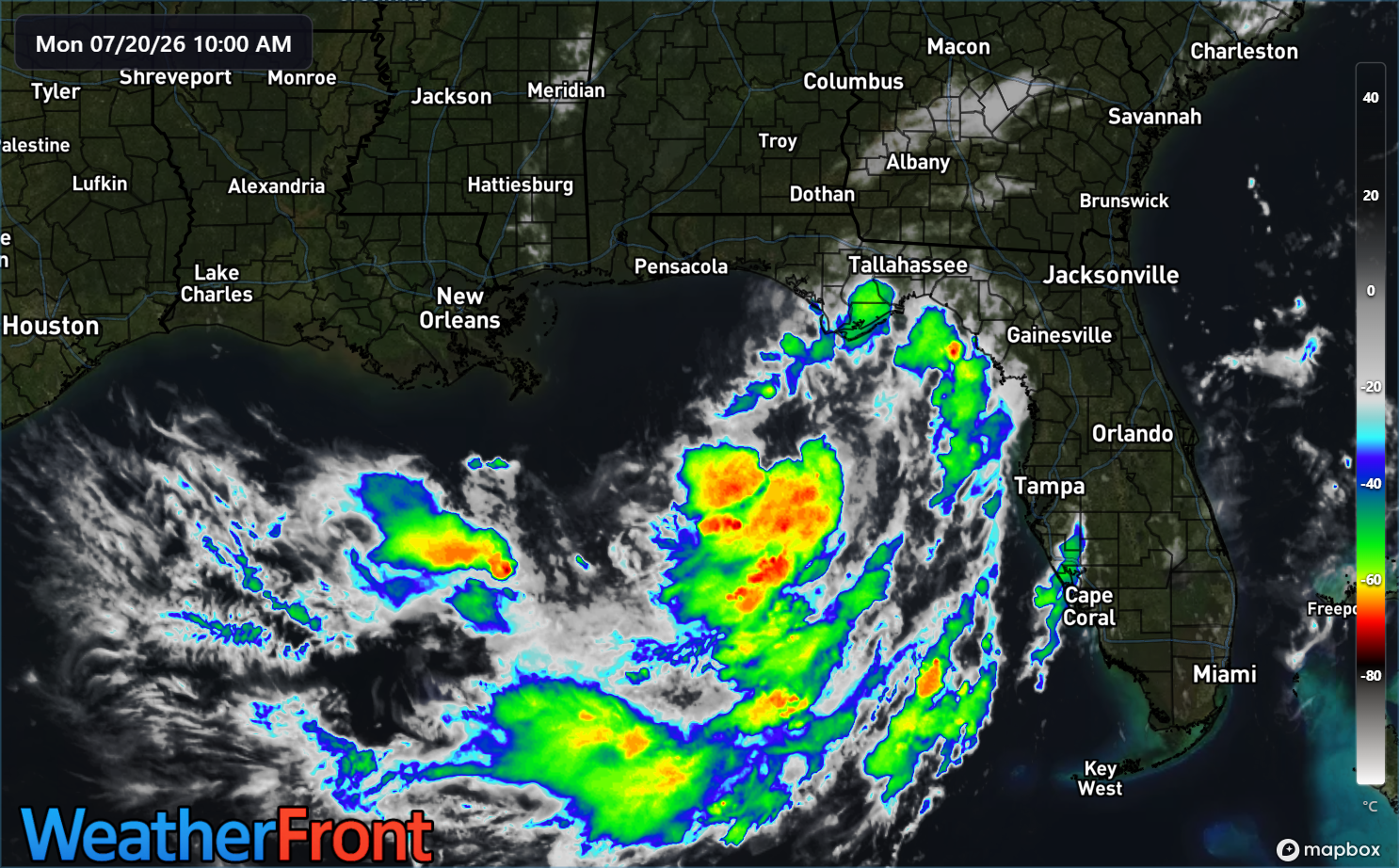
Tropical Depression 2 formed yesterday in the eastern Gulf. Over the next couple days, it’s expected to drift westward, becoming a tropical storm, possibly as soon as today. The satellite image of TD 2 this morning is far from impressive.
(WeatherFront)
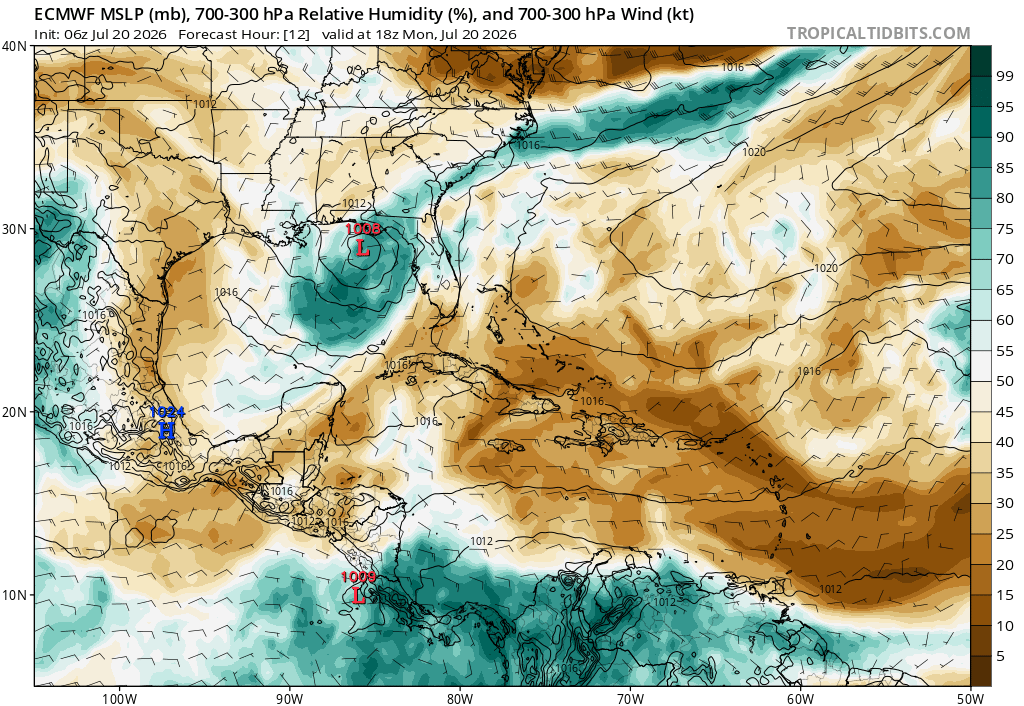
That’s basically a half-cyclone right now. That hasn’t stopped systems from becoming technically tropical or storms or hurricanes, but it does speak to limitations that they will face. In this case, both shear and dry air are going to play a major role in capping TD 2 at mid-tropical storm intensity at best I believe.
Mid-level moisture is limited with TD 2, and the system itself is surrounded by dry air on virtually all sides. (Tropical Tidbits)
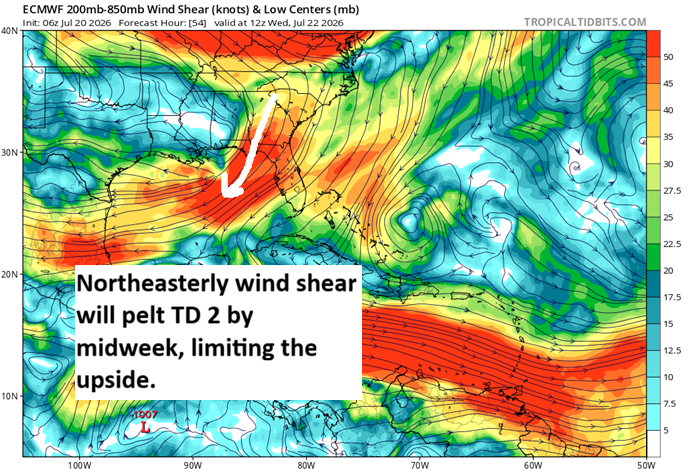
If you’re looking for a beefier tropical system, you want to see a lot less dry air than the model above shows. So right away, TD 2 is going to have to deal with continued dry air. This is not something that will change much between now and the end of TD 2’s life cycle. Additionally, while TD 2 is over warm water and dealing with minimal wind shear right now, that’s going to pick up significantly in the coming days. It’s likely that the eastern side of the storm gets blasted by northeasterly wind shear tomorrow or Wednesday, which should further limit development.
(Tropical Tidbits)
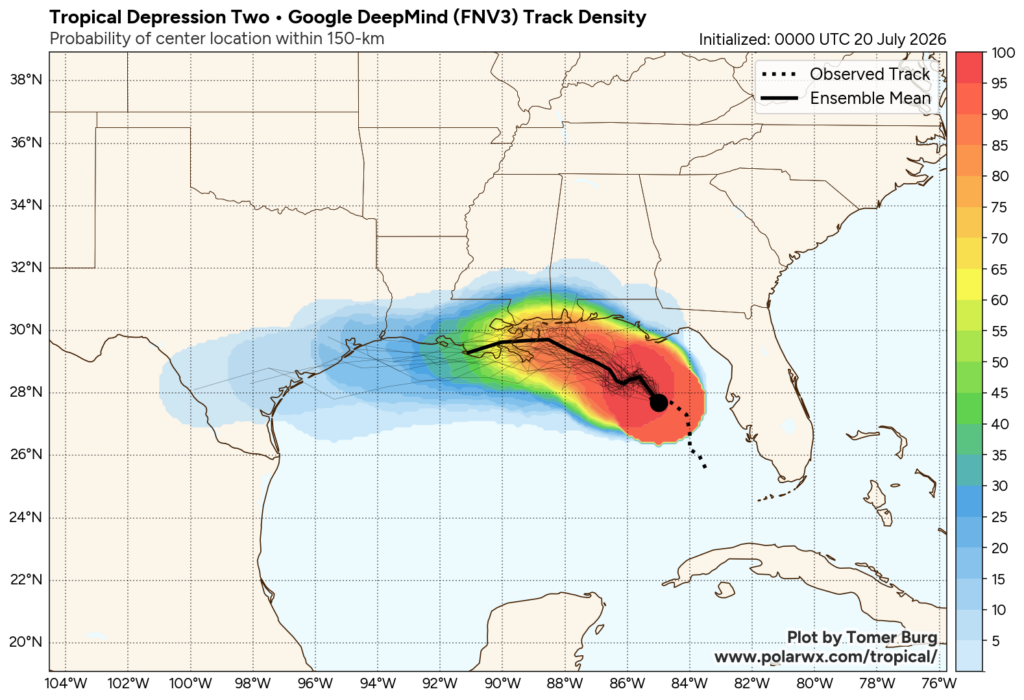
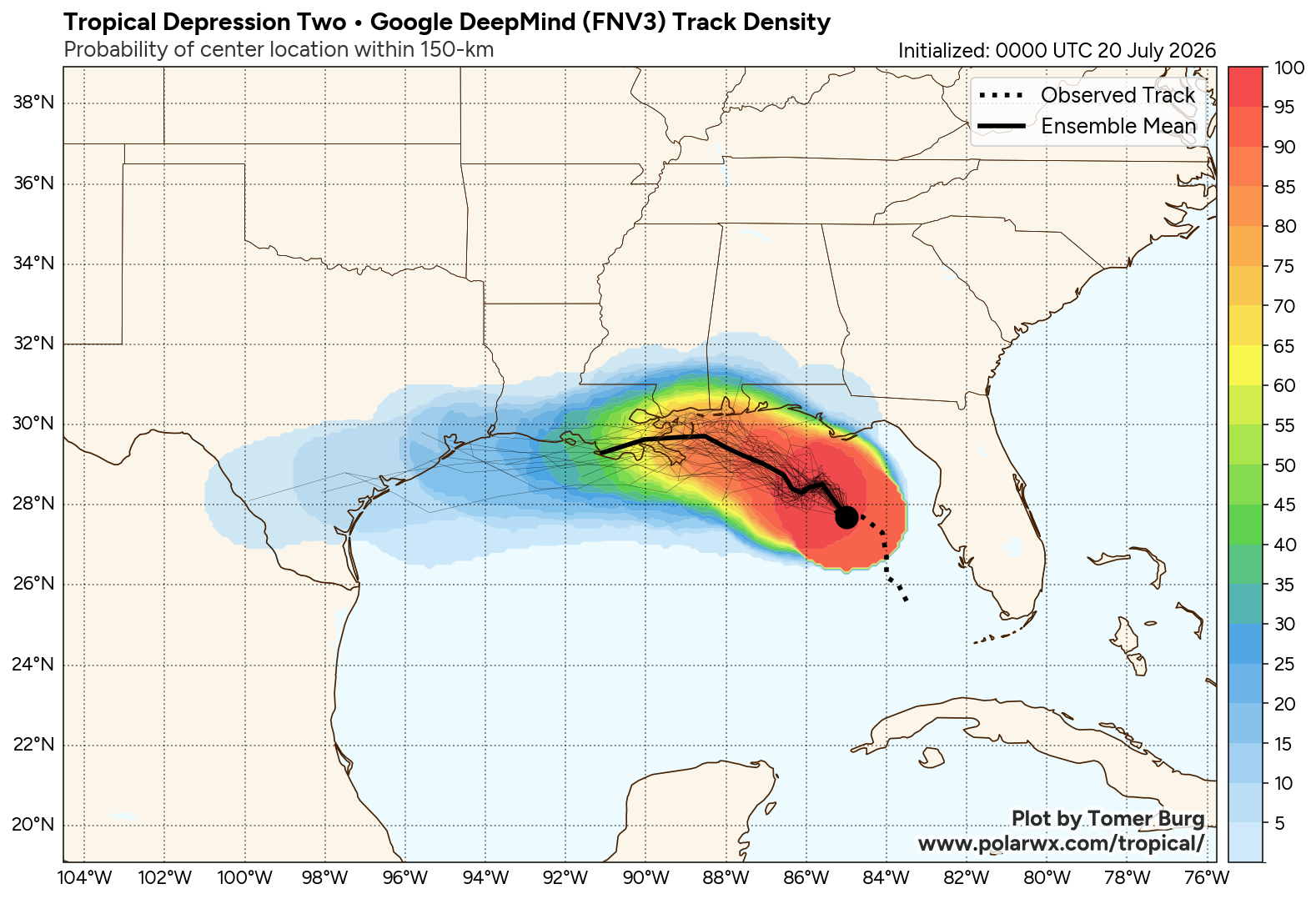
And the vast majority of tropical modeling, as well as Google Deep Mind’s 1,000 member forecast ensemble keep TD 2’s intensity at or below middle grade tropical storm levels. Interestingly, if you look at the various ensembles, you also see a lot of them “losing” Tropical Depression 2 before it gets to Texas.
Google Deep Mind’s storm tracks, showing most of them ending before the storm arrives in Acadiana. (Tomer Burg)
In other words, we are seeing the bulk of the modeling say that TD 2 is going to run its course before getting to Lafayette or Lake Charles. The 5 to 10 percent or so that survive west of Louisiana are the ones coming to Texas. So it may look as if the modeling is all pointed right at Texas, but in reality, that’s mainly saying the remnant is. And when you look at the NHC forecast at the top, you’ll notice the intensity is dropped to depression when it makes it to Texas. Frankly, that may be generous given what we see this morning. It may be that this system ends up arriving as a shell of itself in Texas.
So what will TD 2 do? Assuming it does indeed become a tropical storm by tomorrow, we would probably see a bit of gusty wind on the coast of the Florida Panhandle, along with rain today and tomorrow. Winds as I write this are not gusting much beyond 20 mph there, however. As the system tracks to the west and as the northeasterly wind shear kicks in, most of the rain from TD 2 will migrate over the open Gulf waters.
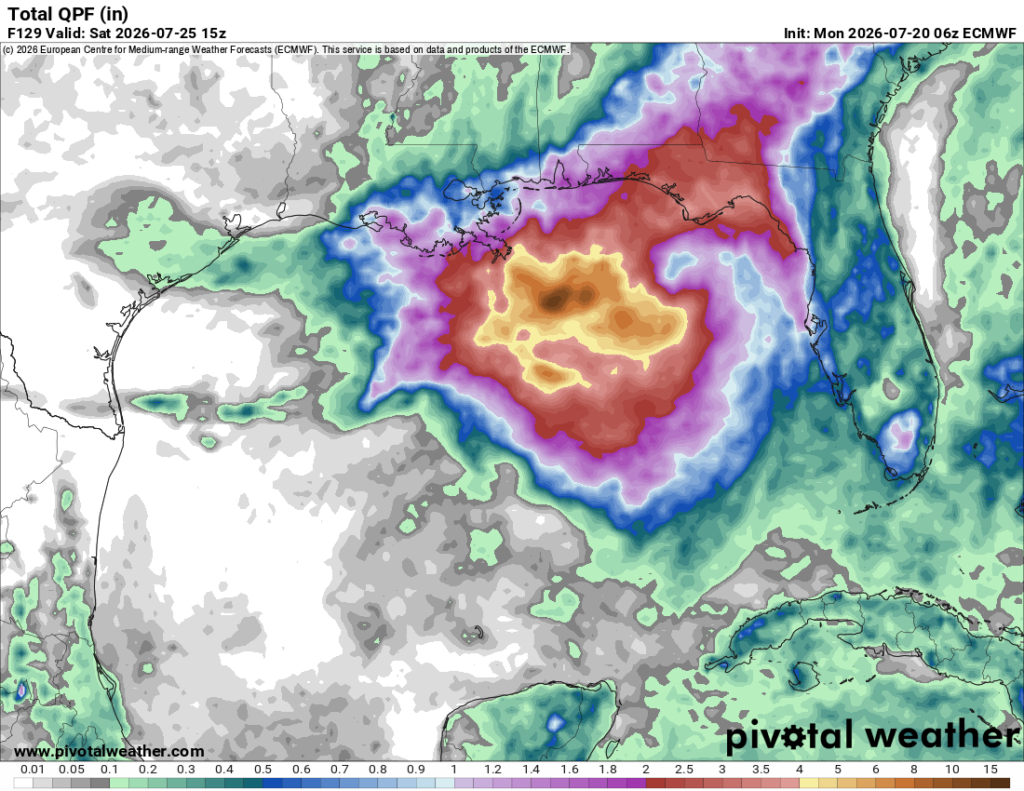
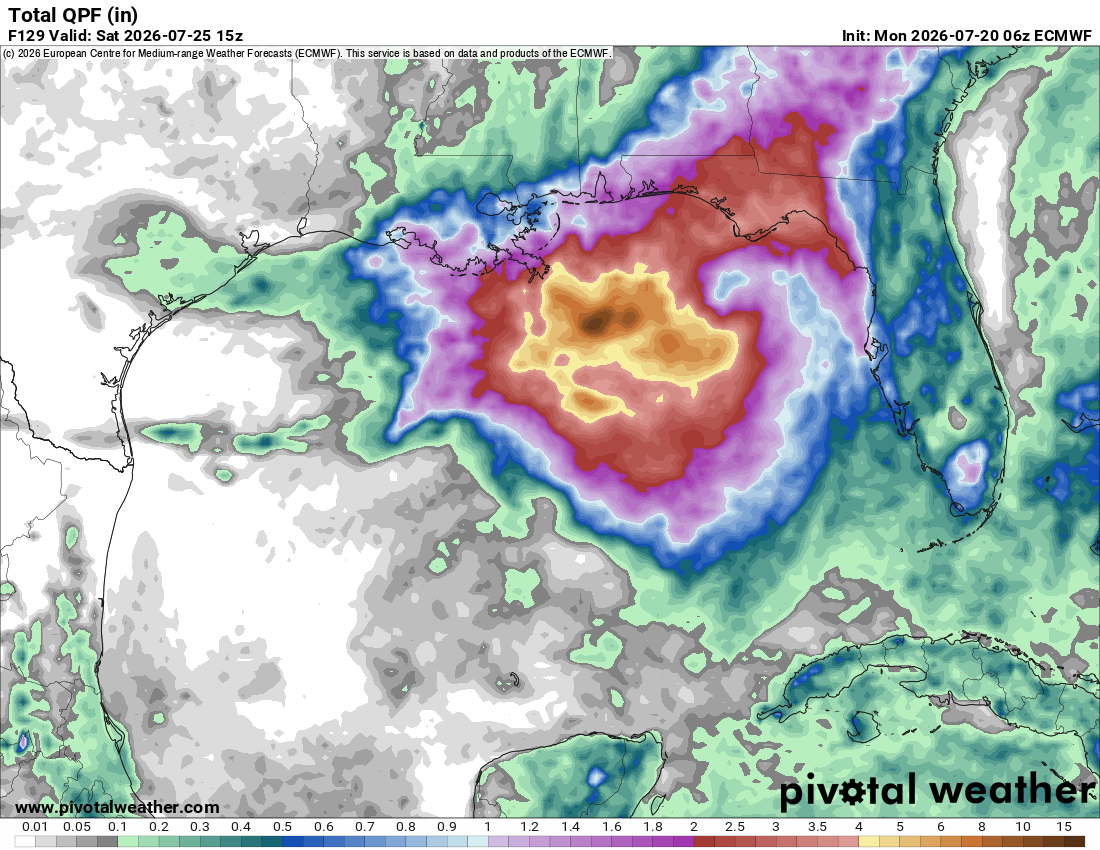
Total rainfall from the European model (Pivotal Weather)
You can see above how the bigger totals of 5 to 10 inches remain way offshore. The heaviest on land rain is likely to be today into tomorrow for the Florida Panhandle and perhaps in Plaquemines Parish, Louisiana, near where TD 2 will make a close pass Wednesday evening. Some localized flash flooding is possible, but overall this looks like a relatively gentle impact to most portions of the Gulf Coast.
There are still a handful of model ensemble members that track the system a little farther south, a scenario we discussed yesterday and still won’t completely take off the table. It’s becoming highly unlikely though. And even in those cases, it’s likely that the intensity of TD 2, or Bertha, would be capped by the aforementioned wind shear and dry air, and currently about 6 of the 1,000 Google Deep Mind ensemble members bring the storm to hurricane intensity. This was around 100 or so yesterday if I recall correctly.
So for the Florida Panhandle through Mobile, expect heavy rain and some locally gusty winds, perhaps to tropical storm force on the immediate coast. From Mobile through New Orleans, you’ll see some occasional downpours and perhaps breezy conditions but not much else. South of New Orleans through Acadiana could see some heavy rains midweek, along with breezy conditions. From Acadiana through Texas, impacts should be minimal and mostly confined to some hotter temperatures Wednesday as that northeast flow kicks in, as well as perhaps a slight chance of showers by Friday. We do not expect flooding concerns to renew in Texas.
That’s as of right this moment. Forecasts can and do change, and we encourage you to continue monitoring the forecast as the week progresses. But we do not expect a dramatic change in TD 2’s outlook right now.
Elsewhere, the Atlantic is quiet!
Northeast/Mid-Atlantic storms & flooding
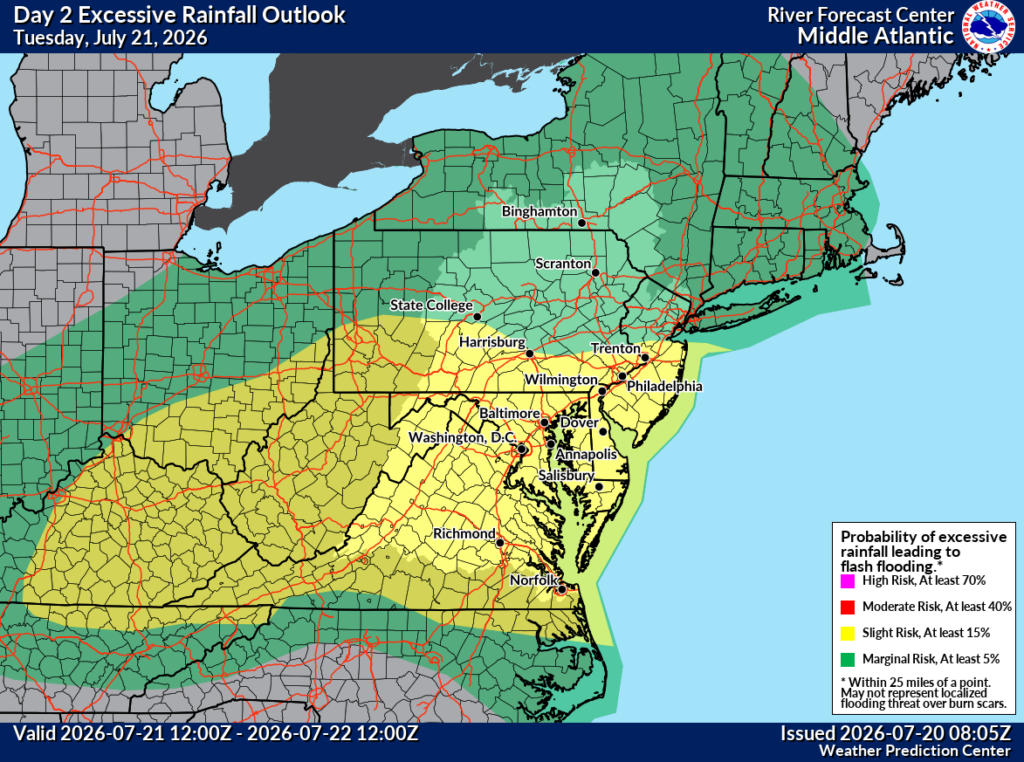
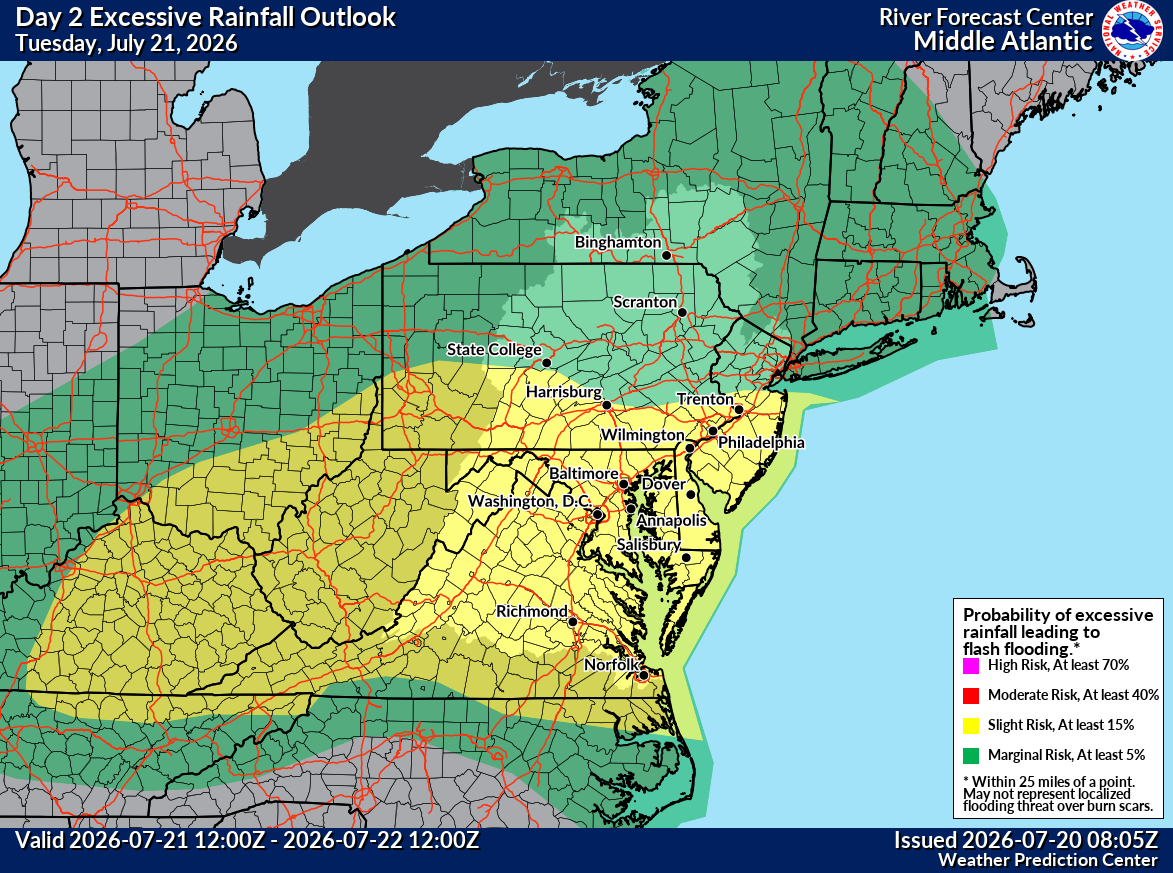
Another round of storms and potential flooding returns to the East Coast tomorrow, and I am cautiously watching the corridor between Philly and New York City for flooding risks. The area is under a slight risk (level 2/4) for flash flooding, but that does not currently include New York City.
Flash flooding risks are slight (level 2/4) in the Mid-Atlantic tomorrow. (NOAA)
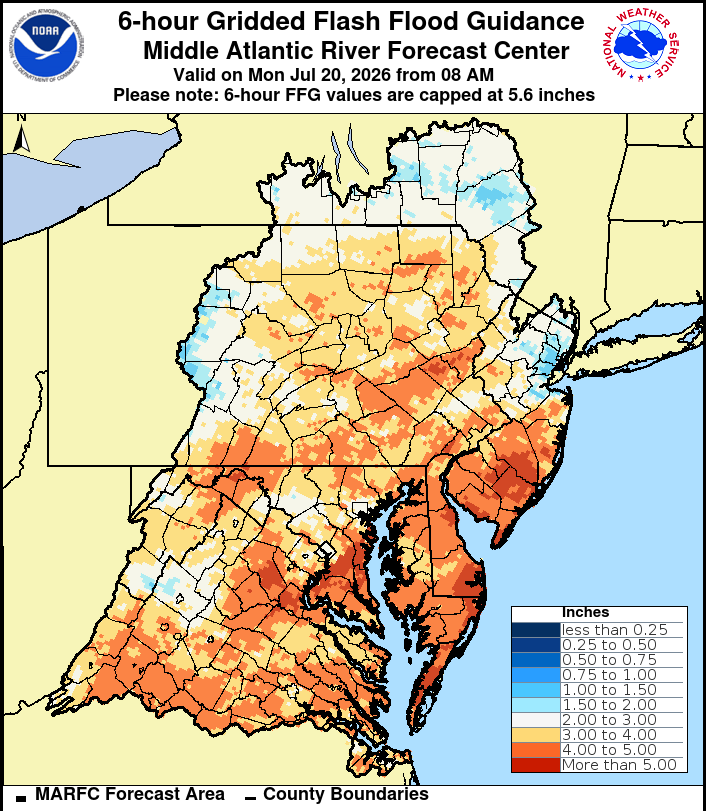
Some of the higher resolution model guidance is perking up about potential flash flooding north of I-195 in New Jersey. Flash flood guidance, or the amount of rain needed in 6 hours to trigger flash flooding is around 1 to 1.5 inches in urban northern New Jersey.
6 hour flash flood guidance in the Mid-Atlantic. (NOAA)
Depending on exactly how things set up tomorrow, it is possible that the flash flooding risk is a bit higher than currently presumed, particularly in the New York City metro area. Just something to pay attention to in that area.
In addition to flooding, there is an enhanced risk of severe weather, level 3/5 in areas west of I-95 tomorrow and a slight risk (2/5) elsewhere. Severe watches are likely on Tuesday as well.
MIAMI—Confined to a federal detention center in Florida and facing extradition to the U.K. on multiple charges of human trafficking and rape, social media influencer Andrew Tate was reportedly heard to exclaim, “No bars can hold me!” this weekend as he entered his ninth consecutive hour of trying to pry open his cell. “Prison is only a mindset, and it’s only a matter of time before I release myself from its fetters!” said the red-faced, sweat-soaked Tate, gritting his teeth as he tried in vain to pull apart the bars of his cell while several of his fellow inmates looked on laughing. “I am the alpha here. These bars are too skinny and effeminate to hold me. Plus, no prison cell can contain someone worth millions of dollars for long. Tomorrow I’m going to lift extra weights and that will surely make me strong enough to break free.” At press time, sources reported that Tate had attempted to punch the bars apart and fractured several bones in his hand.
PITTSBURGH—Attempting to soften the blow with a promise to go out for ice cream later, local parents Dylan and Olivia Barnes reportedly sat their children down Monday for a difficult discussion about moving to the ad tier. “I know change is hard, but Mommy and Daddy had a long and serious talk, and we think the best decision for our family is moving to the ad-supported plans,” said Barnes, who assured her 9-year-old daughter that she’d still get to see her favorite characters, but that she’d also be meeting some brand-new company mascots. “We love our current Netflix tier, and maybe we’ll be back some day, but right now we need to move to a more affordable plan. Let’s think of it as an adventure—there are so many fun pharmaceutical ads you guys haven’t seen yet! And we’ll let you pick out a brand-new avatar. Won’t that be great?” At press time, sources confirmed the children had burst into tears after their parents mentioned the word “Tubi.”
WASHINGTON—Vehemently defending his controversial closed-eye moments, President Donald Trump insisted Monday that his frequent naps were necessary to protect U.S. interests in Dreamland. “It may be hard to tell from where you’re sitting, but trust me, I’m not taking it easy in Dreamland,” said the 80-year-old Trump, who lashed out at reporters for asking questions about his recurrent, on-camera dozes. “There are all kinds of security concerns, from Slumberville to Las Siestas, and I am doing everything in my power as president of the United States to monitor them very closely. These naps give me a crucial and direct line of communication to Sandman, who I need to speak with three to five times a day, at least. In fact, things have gotten so bad over there with the Freddy Krueger, I’m probably going to have to double my diplomatic visits.” Trump went on to bash former President Barack Obama for not once going to Dreamland when he was in office, adding, “And look where that got us.”
Amid concerns over a $1.8 billion fund to compensate Jan. 6 rioters and his handling of the Epstein files, acting Attorney General Todd Blanche faces an uphill confirmation battle for the permanent job. The Onion shares everything you need to know about the Trump nominee.
Current Position: The most available one
Legal Field: Crony law
Controversies: In progress
Net Worth: 3.2 slush funds
Connection To Epstein: Just a fan
Resting Face: Just found out daughter is dating a Black guy
Childhood Imaginary Friend: Mr. Waffles the Executioner








 ALT
ALT