Last day for Christmas shipping. Thanks for another wonderful year entertaining all you geeks.
 The incoming CEO of Time Warner Cable will walk away with more than $50 million just for getting out-of-the-way of a sale or breakup of the company.
Robert Marcus is scheduled to take over the CEO role Jan. 1 after Glenn Britt retires. But there is a good chance Marcus won’t have a cable company to run if executives decide to accept anticipated takeover offers due within weeks that could turn ownership of Time Warner over to Charter Communications or split up subscribers among several potential buyers including Comcast, Cox, and Charter.
Reuters reports Marcus will earn the most if he can hold off buyers for the next four weeks until he becomes CEO. Under his employment contract, Marcus would then qualify for a generous goodbye package:
In total, Marcus could earn $56.5 million for just one day of work — long enough to shake the hands of the new buyer(s) and head for the elevators for the last time. If the company sells before Dec. 31, Marcus will still land on his feet, earning a severance package valued at $47.5 million.
In a separate move, Time Warner Cable executive vice president Peter Stern dumped 4,253 shares of his company’s stock at $130 a share, taking $552,890 in compensation.
While top managers are routinely offered generous departure packages more commonly known as “golden parachutes,” thousands of lower-level Time Warner Cable employees will likely face the ax within months of any sale, predicted one analyst. In similarly sized mergers and buyouts, the largest job losses will impact call center workers and middle management. Other employees will likely leave if asked to move to regional operations centers in other cities where the buyer(s) operate. At least one analyst said it was unusual for Time Warner Cable to proceed with a CEO switch while the company is in play.
Marcus understands how the business of mergers and acquisitions work; he started his career as an attorney specializing in the practice.

Other coverage you may enjoy:
Patrick McDermottIf you're quoting "The Great Gatsby" to describe your lavish lifestyle, you're doing it wrong.

I like large parties, they’re so intimate. At small parties there isn’t any privacy. #gatsbythrowdown @everyone by snoozdorf

The “Better Muffin Pan” is by the makers of the brownie pan with extra edges I wrote about, and it’s just about as dumbassed. For $35, you get a muffin pan that holds 12 muffins. The muffin cups are closer to each other, but it doesn’t matter, because you can fit two standard 12-muffin pans into a standard 24″ oven rack (they’re 11″ wide.) This pan is 12.4″ wide, which means you can only fit one per oven rack. It’s functionally less dense than a regular 12-muffin pan, and four times as expensive.
I have now written two separate blog articles that used basic math to debunk this company’s products. Give up Baker’s Edge! You suck at baking.
Patrick McDermottSeriously! We survived the failure of Kodak far better than Detroit survived the failure of the auto industry.
 When Detroit filed for bankruptcy, cities across the country asked if they would be next. Many face the same challenges of pension and employee costs, suburban flight, a declining property tax base, vacant housing, crime and struggling schools.
Rochester Mayor Tom Richards warned the city could go down the same path as Detroit if it’s not properly managed. But there are significant differences between the Flower City and the Motor City. City workers are in the state pension system and Rochester has not had the same management problems. (Detroit suffered through decades of having an extreme debt load and saw an explosion of even more borrowing under Mayor Kwame Kilpatrick, who was also convicted in a corruption scandal.) Rochester maintains a decent quality of life with libraries, police and fire services, parks and more. Rochester’s credit rating is stellar, and has remained so since at least the days of Mayor Bill Johnson.
In short, Rochester is a long, long way from being Detroit.
That’s why I was disturbed to hear people say after Lovely Warren was elected mayor, “Rochester will be Detroit.”
There are no facts to support any such prediction that the city will go down the tubes. Warren has no record of financial mismanagement or incompetence as City Council president. Her mentor, David Gantt, has had some minor scandals and questionable episodes (Fastrac on East Main, red light camera legislation that favored his protege lobbyist, collecting his pension early and playing politics with many major projects and the RCSD), but there’s nothing to suggest deep-seated corruption. Every longtime politician in Rochester has their issues.
Meanwhile, Monroe County is embroiled in a major corruption scandal and struggles to maintain a good credit rating. But no one says the county will become Detroit. Why is that?
We all know the answer.
- Cannot get my head around a $20 million state contract for a Rochester head-hunting firm.
- Ginna is considered at risk of closing.
- Xerox fired someone for posting a selfie of herself on the job.
- Rochester has some super-wealthy Zip Codes, as this interactive map shows.
- Rochester teachers who appealed their ratings tell me they were awarded a total of 1 to 2 points extra, not enough to make a difference.
- Syracuse’s mayor sometimes gets confronted in public restrooms. She’ll discuss policy anywhere.
- Study will look at bike share feasibility in Rochester. Bob Lonsberry tweeted this is bike entitlement. But:

Tom Richards is either thanking or cursing his friends right now.
Sunday night, the Independence Party announced it wants people to continue to vote for Richards in November, even though he dropped out of the race for mayor. Richards will still appear on the Independence and Working Families party lines. The press release to newsrooms included a link to a website, TurnoutforTom.com.
 Monday, the Independence Party wouldn’t return phone calls. Richards said in a statement he never talked to the Independence Party about this announcement. (He also didn’t say he would refuse the job if elected.) The effort appeared dead on arrival, but there were questions about who was behind the sudden stealth campaign.
It turns out, the Independence Party had some help. In a stunningly embarrassing move, the chairperson of the party sent the Democrat and Chronicle an op-ed about his support for Richards. He accidentally included an email chain that revealed the true author of the op-ed: Gary Walker, Richards’ spokesman. Walker crafted the message with assistance from fire administrator Molly Clifford and her partner, UNICON’s Ken Warner.
Walker, Clifford and Warner are Democrats who support Richards. Walker and Clifford were going to lose their jobs in a Warren administration. With this move, they certainly lit a match and torched the bridge on their way out.
Now, Richards will be immediately asked to renounce their effort. He will be pressed into saying what will happen if he wins. The longer he goes without discouraging people to vote for him, the wider the rift in the Democratic Party will grow.
This effort could damage Warren, who is already under fire for dodging questions. It is the first sign that not all Democrats were good soldiers and lined up behind Warren. If the Richards “not-campaign” continues, Warren risks losing the 70 percent vote total she’s likely trying to capture on Election Day to prove she has a mandate.
I believe a Richards third-party win would require much more effort than a last-minute campaign in which he’s not a participant. Even if he had been actively campaigning, he faced long odds. Aaron Wicks, the only blogger who predicted Warren’s win, breaks down why Richards can’t win on a third party line.
But thank you, Gary, Molly & Ken for spicing up what had turned into a rather dull post-primary run-up to November.
Let’s talk about Bob Duffy’s giant mess. When Sandy Parker announced Monday she is staying on at Rochester Business Alliance, I thought she would be paving the way for Duffy to take over once his first term as lieutenant governor is up next year.
 But a source points out Parker might have to stay on because Duffy bowed out of the job. He’s now facing ethics questions related to his reported application for the job. RBA is a lobbying group and state law places lobbying restrictions on former elected officials. Duffy also has a conflict of interest if he’s applying for a job with a lobbying group while serving as lieutenant governor. Then there’s the matter of the unlisted Keuka Lake house Duffy bought from Parker without disclosing. Furthermore, Duffy has another connection to RBA: As mayor he helped orchestrate the $1 sale of a Plymouth Ave. lot to John Summers, Parker’s husband and RBA board member. With the Moreland Commission now investigating all kinds of Albany political dealings, why take any chances? Give up the RBA plan and move on.
It’s also very possible Duffy seriously angered the governor if he didn’t see this coming.
Today, Parker denied any and all knowledge of Duffy wanting her job, calling it media speculation.
Duffy has not made similar denials. He won’t comment on rumors he sought the RBA position or that he might not want to be lieutenant governor for another term. He and Cuomo say they’ll talk about his political future next year.
What a disaster for the once-rising political star. Nazareth College’s Tim Kneeland calls Duffy “damaged goods” because of this fiasco. Wicks declares him dead.
Patrick McDermottI hope this isn't a surprise.
Contrary to public claims, Apple employees can read communications sent with its iMessage service, according to researchers who have reverse engineered it.
The finding, delivered Thursday at a Hack in the Box presentation titled How Apple Can Read Your iMessages and How You Can Prevent It, largely echoes the conclusion Ars reached in June. It contrasts sharply with assurances that Apple gave following revelations of an expansive surveillance program by the National Security Agency. iMessage conversations, Apple said at the time, "are protected by end-to-end encryption so no one but the sender and receiver can see or read them." It added: "Apple cannot decrypt that data."
Researchers from QuarksLab who delivered Thursday's talk, begged to differ.
Read 6 remaining paragraphs | Comments

    
|

Patrick McDermottThis man must be a level 99 kernel hacker.

Guess which one of these couples is having issues.
(submitted by Shayd in Canada)

|
|

“This is one of my wedding pictures. The photographer had asked my husband to kiss my neck while my mom was five feet away. As you can see, our reaction was caught on camera.”
(submitted by Allison)

|
|
Patrick McDermottCTHULHU!

A magnitude 7.7 earthquake hit south-central Pakistan on Tuesday this week. Reports of hundreds of casualties highlight the awful scale of the tragedy, made more difficult for rescuers by the remote location of the quake, 270km north of Karachi.
One of the surprises waiting for people who arrived in the quake’s aftermath was a new island. Just offshore near the site of the earthquake, the island appears to be a large pile of mud, built by the distinctive conditions in the area of the fault.
The quake was caused by movement of the Earth on a fault in the crust at rather shallow depth, around 15km below the surface. The movement at the fracture was a rupturing, as the oceanic crust of the Arabian tectonic plate is dragged down, or “subducted,” beneath the Eurasian continental plate at Pakistan. It is part of what geologists term the “Makran subduction zone,” which extends parallel to the Indian Ocean coast south of Pakistan and Iran.
Read 7 remaining paragraphs | Comments

|
|


“Never bring a knife to a gun fight,” the saying goes, presaging the invention of the Tactical Folding Knife, a fake gun with a 4.5″ blade.
Patrick McDermottThat and their seeming inability to realize the limits of their model.
A recent academic paper (PDF) shows “that Tor faces even greater risks from traffic correlation than previous studies suggested.” In other words, one of the world’s best tools for keeping online speech anonymous is at risk in a previously known—but now even clearer—fashion.
In the wake of a recent uptick of Tor usage (whether from a botnet or from people inspired by former National Security Agency [NSA] contractor Edward Snowden), a reminder of these risks is certainly germane to today’s Internet.
The new research has shown that a potential adversary with control of Internet Exchange Points (IXPs) or autonomous systems (ASes) that have large-scale network control (like an ISP), could expose and identify a Tor user, given enough time.
Read 10 remaining paragraphs | Comments

|
|

Patrick McDermottI've always thought Dyson products were overpriced. The vacuums less so, but still unnecessarily expensive.

The Dyson Air Multiplier is a device similar to a fan, except it’s ten times more expensive ($265.)
Actually, despite its advertising, it IS a fan. The fan is just hidden in the base and squeezes the air out of the ring at the top, instead of just blowing it directly out of the fan blades, making it less efficient than a regular fan. It also sounds like a fucking hair dryer and costs more than the air conditioner I put in my bedroom window.
What if a spacecraft slowed down on re-entry to just a few miles per hour using rocket boosters like the Mars-sky-crane? Would it negate the need for a heat shield?
—Brian
Is it possible for a spacecraft to control its reentry in such a way that it avoids the atmospheric compression and thus would not require the expensive (and relatively fragile) heat shield on the outside?
—Christopher Mallow
Could a (small) rocket (with payload) be lifted to a high point in the atmosphere where it would only need a small rocket to get to escape velocity?
—Kenny Van de Maele
The answers to these questions all hinge on the same idea. It's an idea I've touched on in other articles, but today I want to focus on it specifically:
The reason it's hard to get to orbit isn't that space is high up.
It's hard to get to orbit because you have to go so fast.
Space isn't like this:

Space is like this:
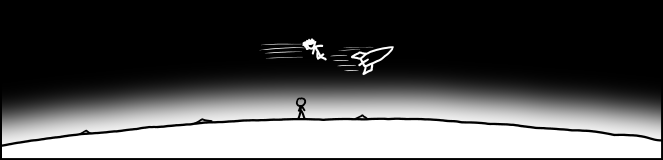
Space is about 100 kilometers away. That's far away—I wouldn't want to climb a ladder to get there—but it isn't that far away. If you're in Sacramento, Seattle, Canberra, Kolkata, Hyderabad, Phnom Penh, Cairo, Beijing, central Japan, central Sri Lanka, or Portland, space is closer than the sea.
Getting to space[1]Specifically, low Earth orbit, which is where the International Space Station is and where the shuttles could go. is easy. It's not, like, something you could do in your car, but it's not a huge challenge. You could get a person to space with a small sounding rocket the size of a telephone pole. The X-15 aircraft reached space[2]The X-15 reached 100 km on two occasions, both when flown by Joe Walker. just by going fast and then steering up.[3]Make sure to remember to steer up and not down, or you will have a bad time.
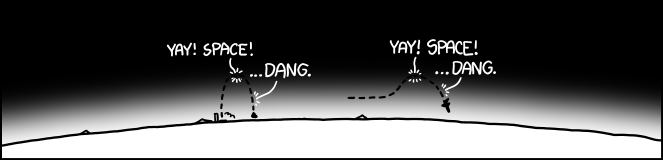
But getting to space is easy. The problem is staying there.
Gravity in low Earth orbit is almost as strong as gravity on the surface. The Space Station hasn't escaped Earth's gravity at all; it's experiencing about 90% the pull that we feel on the surface.
To avoid falling back into the atmosphere, you have to go sideways really, really fast.
The speed you need to stay in orbit is about 8 kilometers per second.[4]It's a little less if you're in the higher region of low Earth orbit. Only a fraction of a rocket's energy is used to lift up out of the atmosphere; the vast majority of it is used to gain orbital (sideways) speed.
This leads us to the central problem of getting into orbit: Reaching orbital speed takes much more fuel than reaching orbital height. Getting a ship up to 8 km/s takes a lot of booster rockets. Reaching orbital speed is hard enough; reaching to orbital speed while carrying enough fuel to slow back down would be completely impractical.[5]This exponential increase is the central problem of rocketry: The fuel required to increase your speed by one km/s multiplies your weight by about 1.4. To get into orbit, you need to increase your speed to 8 km/s, which means you'll need a lot of fuel: $ 1.4\times1.4\times1.4\times1.4\times1.4\times1.4\times1.4\times1.4\approx 15$ times the original weight of your ship.
Using a rocket to slow down carries the same problem: Every 1 km/s decrease in speed multiplies your starting mass by that same factor of 1.4. If you want to slow all the way down to zero—and drop gently into the atmosphere—the fuel requirements multiply your weight by 15 again.
These outrageous fuel requirements are why every spacecraft entering an atmosphere has braked using a heat shield instead of rockets—slamming into the air is the most practical way to slow down. (And to answer Brian's question, the Curiosity rover was no exception to this; although it used small rockets to hover when it was near the surface, it first used air-braking to shed the majority of its speed.)
How fast is 8 km/s, anyway?
I think the reason for a lot of confusion about these issues is that when astronauts are in orbit, it doesn't seem like they're moving that fast; they look like they're drifting slowly over a blue marble.
But 8 km/s is blisteringly fast. When you look at the sky near sunset, you can sometimes see the ISS go past ... and then, 90 minutes later, see it go past again.[6]There are some good apps and online tools to help you spot the station, along with other neat satellites. My favorite is ISS Detector, but if you Google you can find lots of others. In those 90 minutes, it's circled the entire world.
The ISS moves so quickly that if you fired a rifle bullet from one end of a football field,[7]Either kind. the International Space Station could cross the length of the field before the bullet traveled 10 yards.[8]This type of play is legal in Australian rules football.
Let's imagine what it would look like if you were speed-walking across the Earth's surface at 8 km/s.
To get a better sense of the pace at which you're traveling, let's use the beat of a song to mark the passage of time.[9]Using song beats to help measure the passage of time is a technique also used in CPR training, where the song "Stayin' Alive" is used to . suppose you started playing the 1988 song by The Proclaimers, I'm Gonna Be (500 Miles). That song is about 131.9 beats per minute, so imagine that with every beat of the song, you move forward more than two miles.
In the time it took to sing the first line of the chorus, you could walk from the Statue of Liberty all the way to the Bronx:

It would take you about two lines of the chorus (16 beats of the song) to cross the English Channel between London and France.
The song's length leads to an odd coincidence. The interval between the start and the end of I'm Gonna Be is 3 minutes and 30 seconds,[10]Based on timing from the official Youtube video and the ISS is moving is 7.66 km/s.
This means that if an astronaut on the ISS listens to I'm Gonna Be, in the time between the first beat of the song and the final lines ...
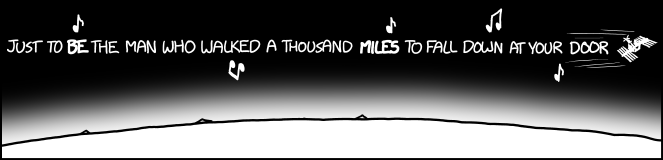
... they will have traveled just about exactly 1,000 miles.


![In a cavern deep below the Earth, Ayn Rand, Paul Ryan, Rand Paul, Ann Druyan, Paul Rudd, Alan Alda, and Duran Duran meet together in the Secret Council of /(b[plurandy]+b ?){2}/i.](http://imgs.xkcd.com/comics/ayn_random.png "In a cavern deep below the Earth, Ayn Rand, Paul Ryan, Rand Paul, Ann Druyan, Paul Rudd, Alan Alda, and Duran Duran meet together in the Secret Council of /(b[plurandy]+b ?){2}/i.")