‘People respond in profound ways to tax incentives. They adjust their behaviour to avoid tax’
The adage ‘free as air’ has become obsolete by Act of Parliament,” thundered Charles Dickens in 1850. “Neither air nor light have been free since the imposition of the window tax. We are obliged to pay for what nature lavishly supplies to all, at so much per window per year; and the poor who cannot afford the expense are stinted in two of the most urgent necessities of life.”
Dickens prevailed: the window tax, which had been levied in England since 1696, was abolished within a year. But the curious story of the tax, explored recently by Wallace Oates and Robert Schwab in the Journal of Economic Perspectives, holds lessons for us today.
The details of the tax varied across the centuries but with the broad theme that the more windows your house had, the more tax you had to pay. At first glance, the tax seems clever, even brilliant. Rich people had larger houses, and so paid more tax. Windows are easy to count from outside the premises, so the tax was easy to assess. Poor people didn’t own large houses, so they weren’t affected by the tax. And the number of windows in a house doesn’t change, so the tax was impossible to avoid.
Wrong, wrong, wrong.
The tax was probably progressive but not nearly as progressive as it might seem. Many poor people did live in large houses — as servants or in tenement blocks. They suffered from the tax, as we shall see. Adam Smith himself, in The Wealth of Nations (1776), nailed the other problem with the idea that the tax was paid only by the rich: “A house of £10 rent in the country may have more windows than a house of £500 rent in London.”
A more fundamental error is the idea that architecture doesn’t respond to tax incentives. When William Pitt tripled the tax in 1797, thousands of windows were bricked or boarded up almost overnight. Later, the president of the society of carpenters in London told Parliament that almost every homeowner on Compton Street had approached him to reduce the number of windows. A new apartment building in Edinburgh was designed with an entire second floor filled with windowless bedrooms.
When Dickens complained that the poor were being denied light and air, he wasn’t speaking figuratively. Poor people did not have to pay the tax out of their own pockets but their landlords did, and the poor dwelt in stuffy darkness as a result.
After 1747, the window tax followed a strange structure. Houses with fewer than 10 windows paid no window tax; those with 10-14 windows paid six pence per window per year. As a result, the cost of having a 10th window was that you also had to pay tax on the other nine. Tax wonks call such discontinuities “notches”, and there were further notches at 15 and 20 windows.
If these notches seem absurd to you, modern governments don’t seem to have a problem with them. Stamp duty, a tax on property transactions in England and Wales, contained notches until last year, and the UK income tax system recently acquired a new notch: a transferable tax allowance for married couples, worth more than £200, evaporates abruptly if one of the couple strays into a higher tax bracket, even by a single pound. All of this distorts our behaviour.
Nonsensical as the notches are, they help economists to see the effect of the tax. In the recent study, Oates and Schwab combed through tax records from the mid-1700s. They found that nearly 50 per cent of the total number of houses had the tax-efficient totals of nine, 14 or 19 windows — an intelligent response to a foolish tax. People who bricked up a couple of windows to bring the total down to nine were inconvenienced by the tax, yet the Treasury earned no revenue from them. Most taxes will produce some of this sort of waste but the window tax was particularly egregious.
If it seems strange that tax policy could shape the architecture of a country, consider New Orleans’s distinctive camelback houses, one storey high at the front (the part of the home that’s taxable) but with two storeys at the back — a tax-efficient architectural style.
And ponder the research of economists Joshua Gans and Andrew Leigh, who noted that twice as many births were recorded in Australia on July 1 2004 than on June 30 2004. Why? The July babies were eligible for a “baby bonus” of A$3,000 and the June babies were not. Gans and Leigh even found that many Australians delayed their deaths — or perhaps the moment their deaths were recorded — long enough to escape inheritance tax when it was abolished on July 1 1979. If our births and deaths respond to tax incentives, it shouldn’t be surprising that a few windows might be bricked up.
There is a useful lesson to be learnt from the window tax: it is that people will respond in quite profound ways to tax incentives. That is why economists often call, more in hope than expectation, for a tax on carbon emissions. People would adjust their behaviour to avoid the tax, which is exactly what we need.
But perhaps a more realistic lesson is this: it’s perfectly possible for a bad tax to last for 155 years.
This towering ginkgo tree is located within the walls of the Gu Guanyin Buddhist Temple in the Zhongnan Mountains in China. Every autumn the green leaves on the 1,400-year-old tree turn bright yellow and fall into a golden heap on the temple grounds drawing tourists from the surrounding area. You can see more photos here and here. (via F*ck Yeah Chinese Garden)
If you're looking for a free iOS game, an interesting new option has just opened up. Puzzle-adventure game Monument Valley managed to pull off the hat trick of being fun, zen and beautiful all at the same time -- which helped garner it Apple's Game o...
The “Emergence Lab” is a hand painted anamorphic sculpture. Its title refers to a phenomenon called emergence. Through a plug system made out of 216 laser cut acrylic glass strips, a cubic framework, which contains layers pointing towards all three spatial dimensions, is created. On each side of the cube there is one anamorphic painting that can always only be seen from one point. Since every figure fills the exact same surface as its counterpart on the opposite side, the rear image is covered while looking at one figure.
Before painting the fragments of the images separately on the strips with acrylic paint, the segmentation has been planned entirely. In order to prevent irritating reflections within the strips and to give it the look of solid glass the sculpture floats in a particular silicone oil that has the same refractive index as acrylic.
We've all done it. Take a few minutes to walk to the mailbox only to discover it's either empty or filled with junk that immediately goes in the trash. The US Postal Service is testing a new tool that will save you a trip if there's nothing interesti...
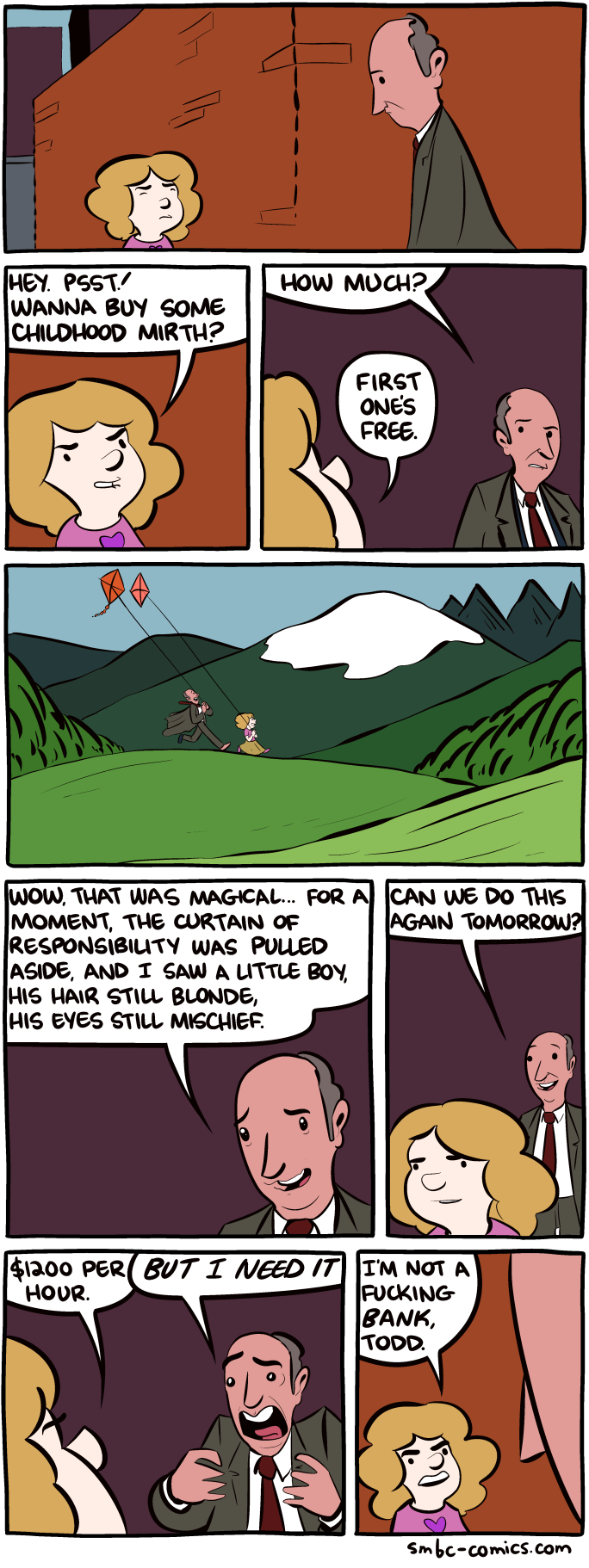
Hovertext: You think this hair curls itself? Huh? You think pony shoes grow on a fucking tree? Jesus Christ, Todd. I thought you were smart. But, you're just like all the others.
This entry passed through the Full-Text RSS service - if this is your content and you're reading it on someone else's site, please read the FAQ at fivefilters.org/content-only/faq.php#publishers.
‘Coming up with something new is for suckers; smart people sit back and rip off the idea later’
In 1737, a self-taught clockmaker from Yorkshire astonished the great scientists of London by solving the most pressing technological problem of the day: how to determine the longitude of a ship at sea. The conventional wisdom was that some kind of astronomical method would be needed. Other inventors suggested crackpot schemes that involved casting magic spells or ringing the world with a circle of outposts that would mark the time with cannon fire.
John Harrison’s solution — simple in principle, fiendishly hard to execute — was to build an accurate clock, one that despite fluctuating temperatures and rolling ocean swells, could show the time at Greenwich while anywhere in the world. Harrison and countless other creative minds were focused on the longitude problem by a £20,000 prize for the person who solved it, several million pounds in today’s money.
Why was the prize necessary? Because ideas are hard to develop and easy to imitate. Harrison’s clocks could, with effort, have been reverse engineered. An astronomical method for finding longitude could have been copied with ease. Inventing something new is for suckers; smart people sit back and rip off the idea later. One way to give non-suckers an incentive to research new ideas, then, is an innovation prize — that is, a substantial cash reward for solving a well-defined problem. (Retrospective awards such as the Nobel Prize are different.)
For decades after Harrison’s triumph, prizes were a well-established approach to the problem of encouraging innovation. Then they fell out of favour, with policymakers instead encouraging innovation with a mix of upfront research grants and patent protection. Now, however, prizes are making a comeback. The most eye-catching examples have been in the private sector: the $1m Netflix prize for improved personalisation of film recommendations or the $10m Ansari X prize for private space flight. Last year Nesta, a UK-based charity for the promotion of innovation, launched a “new longitude prize” of £10m for an improved test for bacterial infections, marking the anniversary of the original prize’s founding in 1714.
But the big money potential is in the public sector. In 2007, several governments (and the Gates Foundation) promised a $1.5bn prize for a vaccine for pneumococcal meningitis. The prize, called an “advanced market commitment”, is structured as a dose-by-dose subsidy rather than one giant cheque. It is being paid out and millions of children have already been vaccinated. Much bigger commitments are possible: before US senator Bernie Sanders began his run for the presidency, he introduced two Senate bills that would have provided almost $100bn a year as medical innovation prizes.
But why are innovation prizes attractive, when the existing system of grants and patents seems to have served us reasonably well so far?
Research grants may be too conservative, favouring establishment figures working on unambitious projects, and rewarding process rather than results. Such conservatism is not inevitable but it goes with the territory. An innovation prize seems more meritocratic and, since it pays only for results, the prizes can set radical goals.
Patents are particularly problematic, since they encourage the development of something that anyone can use — a new idea — with the perverse reward of restricting access to that idea. That is a trade-off that is easily bungled, with patents that last too long, are too broad, too easy to secure and too difficult to challenge.
Even a well-crafted patent system depends on there being a ready market for the innovation in question. Few people will pay much for a malaria vaccine but it would be socially very valuable, as would a new class of antibiotics. A prize can easily reward long-term social priorities such as these; a patent cannot.
But there is a danger of expecting too much from prizes. If we are to scrap patents entirely, prizes would be far too narrow a replacement. (Who would have sponsored a prize “for inventing the internet”? Not all innovations exist to solve precooked problems such as finding longitude.) If we use patents and prizes in parallel, however, there’s a self-selection problem: inventors with truly valuable ideas apply for patents, while those with dross apply for prizes. A new working paper from economic historian Zorina Khan points out that Royal Society of Arts prizes in the 19th century suffered from exactly such adverse selection.
Khan also observes that many celebrated historical innovation prizes were actually mired in controversy, with prizes awarded for unoriginal or ineffective ideas, or denied to the deserving. It’s easy to point to a few success stories but there are plenty of those for patents and grants too.
For my money the patent system urgently needs reform, with patents that are harder to earn and easier to challenge. Innovation prizes definitely have their place, especially where markets for a socially valuable innovation may not exist. But we do a good idea no favours by overselling it. We should also probably stop going on about the Longitude Prize or at least we should admit what Nesta’s new prize website does not: that Harrison’s invention was rewarded with decades of suspicion and controversy. The Board of Longitude, the government body set up to administer the prize, questioned both the accuracy of his clocks and whether they could be replicated. Harrison did receive numerous payments for his efforts — but neither he nor anyone else ever won the Longitude Prize.





 If you're looking for a free iOS game, an interesting new option has just opened up. Puzzle-adventure game Monument Valley managed to pull off the hat trick of being fun, zen and beautiful all at the same time -- which helped garner it Apple's Game o...










 We've all done it. Take a few minutes to walk to the mailbox only to discover it's either empty or filled with junk that immediately goes in the trash. The US Postal Service is testing a new tool that will save you a trip if there's nothing interesti...