Adam Victor Brandizzi
Shared posts


07 Jan 17:41
Click here to go see the bonus panel!
Hovertext:
Extending the logic a bit, Cartooning is the most scientific discipline of all.
New comic!
Today's News:
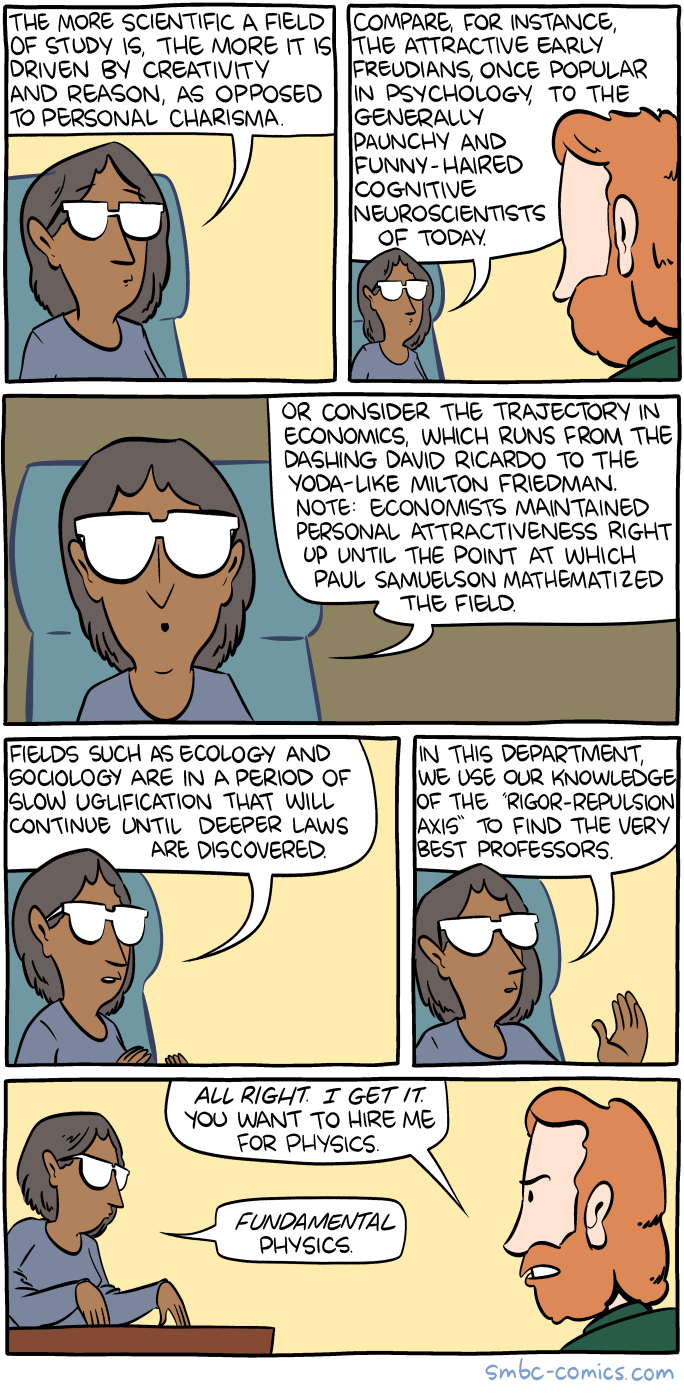
Saturday Morning Breakfast Cereal - Hiring Metrics
by tech@thehiveworks.com
Click here to go see the bonus panel!
Hovertext:
Extending the logic a bit, Cartooning is the most scientific discipline of all.
New comic!
Today's News:
Adam Victor Brandizzi, Starflier and 3 others like this
02 Jan 16:50

kids these days with their wing-wangs, beep-bop and their hoop...
kids these days with their wing-wangs, beep-bop and their hoop moop scadoops!
Roslyn , Adam Victor Brandizzi and one other like this
02 Jan 16:49
Click here to go see the bonus panel!
Hovertext:
Actually, pretty much everything beyond intro calculus is run by goblins.
New comic!
Today's News:
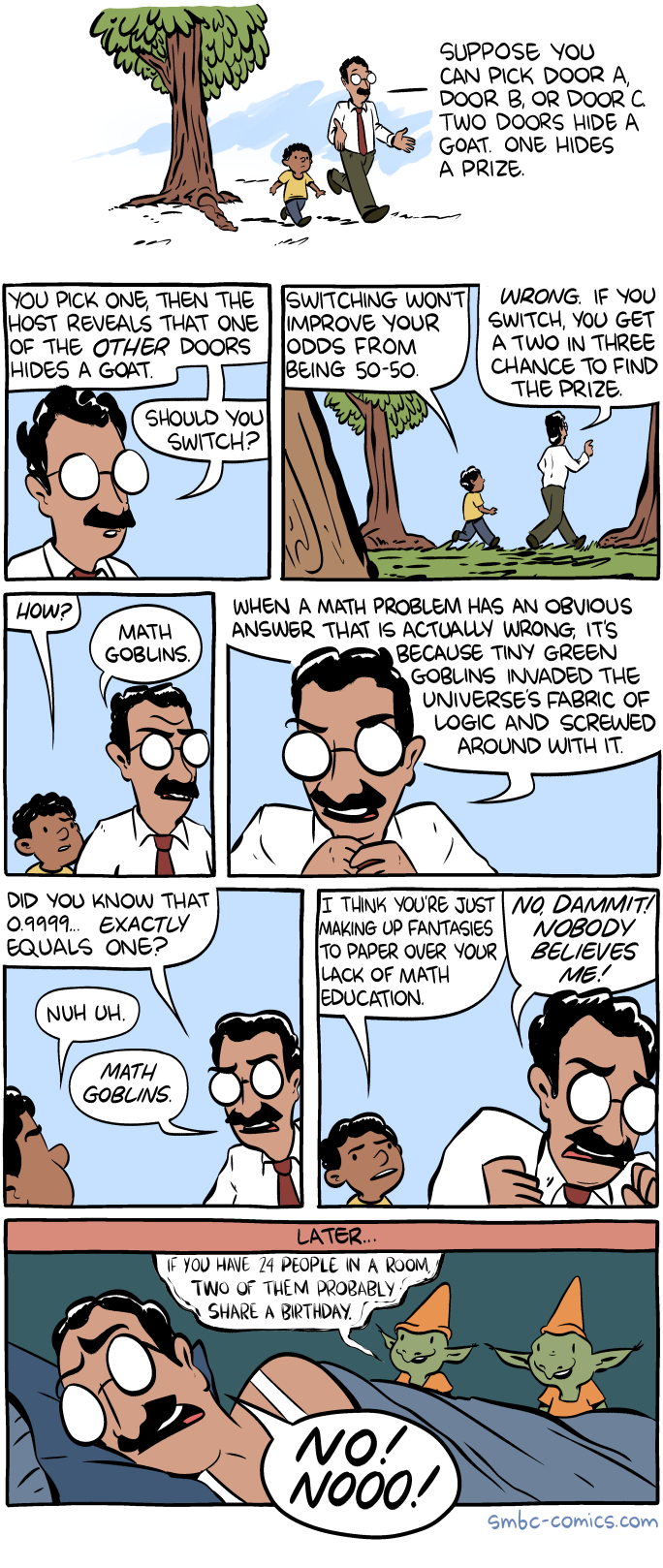
Saturday Morning Breakfast Cereal - Monty Hall Problems
by tech@thehiveworks.com
Click here to go see the bonus panel!
Hovertext:
Actually, pretty much everything beyond intro calculus is run by goblins.
New comic!
Today's News:
Jagripino, Shortfatsteve and 6 others like this
01 Jan 18:10

How to ask good questions
Asking good questions is a super important skill when writing software. I’ve gotten way better at it over the years (to the extent that it’s something my coworkers comment on a lot). Here are a few guidelines that have worked well for me!
To start out – I’m actually kind of a big believer in asking dumb questions or questions that aren’t “good”. I ask people kind of dumb questions all the time, questions that I could have answered with Google or by searching our codebase. I mostly try not to, but sometimes I do it anyway and I don’t think it’s the end of the world.
So this list of strategies isn’t about “here are all the things you have to do before asking a question, otherwise you are a bad person and should feel bad, but rather “here are some things that have helped me ask better questions and get the answers I want!”.

what’s a good question?
Our goal is going to be to ask questions about technical concepts that are easy to answer. I often have somebody with me who has a bunch of knowledge that I’d like to know too, but they don’t always know exactly how to explain it to me in the best way.
If I ask a good series of questions, then I can help the person explain what they know to me efficiently and guide them to telling me the stuff I’m interested in knowing. So let’s talk about how to do that!
State what you know
This is one of my favorite question-asking techniques! This kind of question basically takes the form
- State what you understand about the subject so far
- Ask “is that right?”
For example, I was talking to someone (a really excellent question asker) about networking recently! They stated “so, what I understand here is that there’s some chain of recursive dns servers…”. That was not correct! There is actually no chain of recursive DNS servers. (when you talk to a recursive DNS server there is only 1 recursive server involved) So them saying their understanding so far made it easy for us to clarify how it actually works.
I was interested in rkt a while back, and I didn’t understand why rkt took up so much more disk space than Docker when running containers.
“Why does rkt use more disk space than Docker” didn’t feel like the right question
though – I understood more or less how the code worked, but I didn’t
understand why they wrote the code that way. So I wrote this question to the rkt-dev mailing list:
Why does rkt store container images differently from Docker?.
I
- wrote down my understanding of how both rkt and Docker store containers on disk
- came up with a few reasons I thought they might have designed it the way they did
- and just asked “is my understanding right?”
The answer I got was super super helpful, exactly what I was looking for. It took me quite a while to formulate the question in a way that I was happy with, and I’m happy I took the time because it made me understand what was happening a lot better.
Stating your understanding is not at all easy (it takes time to think about what you know and clarify your thoughts!!) but it works really well and it makes it a lot easier for the person you’re asking to help you.
Ask questions where the answer is a fact
A lot of the questions I have start out kind of vague, like “How do SQL joins work?”. That question isn’t awesome, because there are a lot of different parts of how joins work! How is the person even supposed to know what I’m interested in learning?
I like to ask questions where the answer is a straightforward fact. For example, in our SQL joins example, some questions with facts for answers might be:
- What’s the time complexity of joining two tables of size N and M? Is it O(NM)? O(NlogN) + O(MlogM)?
- Does MySQL always sort the join columns as a first step before doing the join?
- I know that Hadoop sometimes does a “hash join” – is that a joining strategy that other database engines use too?
- When I do a join between one indexed column and one unindexed column, do I need to sort the unindexed column?
When I ask super specific questions like this, the person I’m asking doesn’t always know the answer (which is fine!!) but at least they understand the kind of question I’m interested in – like, I’m obviously not interested in knowing how to use a join, I want to understand something about the implementation details and the algorithms.
Be willing to say what you don’t understand
Often when someone is explaining something to me, they’ll say something that I don’t understand. For example, someone might be explaining something about databases to me and say “well, we use optimistic locking with MySQL, and so…”. I have no idea what “optimistic locking” is. So that would be a good time to ask! :)
Being able to stop someone and say “hey, what does that mean?” is a super important skill. I think of it as being one of the properties of a confident engineer and an awesome thing to grow into. I see a lot of senior engineers who frequently ask for clarifications – I think when you’re more confident in your skills, this gets easier.
The more I do this, the more comfortable I feel asking someone to clarify. in fact, if someone doesn’t ask me for clarifications when I’m explaining something, I worry that they’re not really listening!
This also creates space for the question answerer to admit when they’ve reached the end of their knowledge! Very frequently when I’m asking someone questions, I’ll ask something that they don’t know. People I ask are usually really good at saying “nope, I don’t know that!”
Identify terms you don’t understand
When I started at my current job, I started on the data team. When I started looking at what my new job entailed, there were all these words! Hadoop, Scalding, Hive, Impala, HDFS, zoolander, and more. I had maybe heard of Hadoop before but I didn’t know what basically any of these words meant. Some of the words were internal projects, some of them were open source projects. So I started just by asking people to help me understand what each of the terms meant and the relationships between them. Some kinds of questions I might have asked:
- Is HDFS a database? (no, it’s a distributed file system)
- Does Scalding use Hadoop? (yes)
- Does Hive use Scalding? (no)
I actually wrote a ‘dictionary’ of all the terms because there were so many of them, and understanding what all the terms meant really helped me orient myself and ask better questions later on.
Do some research
When I was typing up those SQL questions above, I typed “how are sql joins implemented” into Google. I clicked some links, saw “oh, I see, sometimes there is sorting, sometimes there are hash joins, I’ve heard about those”, and then wrote down some more specific questions I had. Googling a little first helped me write slightly better questions!
That said, I think people sometimes harp too much on “never ask a question without Googling it first” – sometimes I’ll be at lunch with someone and I’ll be curious about their work, and I’ll ask them some kind of basic questions about it. This is totally fine!
But doing research is really useful, and it’s actually really fun to be able to do enough research to come up with a set of awesome questions.
Decide who to ask
I’m mostly talking here about asking your coworkers questions, since that’s where I spend most of my time.
Some calculations I try to make when asking my coworkers questions are:
- is this a good time for this person? (if they’re in the middle of a stressful thing, probably not)
- will asking them this question save me as much time as it takes them? (if I can ask a question that takes them 5 minutes to answer, and will save me 2 hours, that’s excellent :D)
- How much time will it take them to answer my questions? If I have half an hour of questions to ask, I might want to schedule a block of time with them later, if I just have one quick question I can probably just ask it right now.
- Is this person too senior for this question? I think it’s kind of easy to fall into the trap of asking the most experienced / knowledgeable person every question you have about a topic. But it’s often actually better to find someone who’s a little less knowledgeable – often they can actually answer most of your questions, it spreads the load around, and they get to showcase their knowledge (which is awesome).
I don’t always get this right, but it’s been helpful for me to think about these things.
Also, I usually spend more time asking people who I’m closer to questions – there are people who I talk to almost every day, and I can generally ask them questions easily because they have a lot of context about what I’m working on and can easily give me a helpful answer.
How to ask questions the smart way by ESR is a popular and pretty hostile document (it starts out poorly with statements like ‘We call people like this “losers”’). It’s about asking questions to strangers on the internet. Asking strangers on the internet questions is a super useful skill and can get you really useful information, but it’s also the “hard mode” of asking questions. The person you’re talking to knows very little about your situation, so it helps to be proportionally more careful about stating what exactly you want to know. I don’t like ESR’s document at all but it has some useful things to say. The “How To Answer Questions in a Helpful Way” section is actually really excellent.
Ask questions to show what’s not obvious
A more advanced form of question asking is asking questions to reveal hidden assumptions or knowledge. This kind of question actually has two purposes – first, to get the answers (there is probably information one person has that other people don’t!) but also to point out that there is some hidden information, and that sharing it is useful.
The “The Art of Asking Questions” section of the Etsy’s Debriefing Facilitation Guide is a really excellent introduction to this, in the context of discussing an incident that has happened. Here are a few of the questions from that guide:
“What things do you look for when you suspect this type of failure happened?”
“How did you judge that this situation was ‘normal?”
How did you know that the database was down?
How did you know that was the team you needed to page?
These kinds of questions (that seem pretty basic, but are not actually obvious) are especially powerful when someone who’s in a position of some authority asks them. I really like it when a manager / senior engineer asks a basic but important question like “how did you know the database was down?” because it creates space for less-senior people to ask the same kinds of questions later.
Answer questions.
One of my favorite parts of André Arko’s great How to Contribute to Open Source post is where he says
Now that you’ve read all the issues and pull requests, start to watch for questions that you can answer. It won’t take too long before you notice that someone is asking a question that’s been answered before, or that’s answered in the docs that you just read. Answer the questions you know how to answer.
If you’re ramping up on a new project, answering questions from people who are learning the stuff you just learned can be a really awesome way to solidify your knowledge. Whenever I answer a question about a new topic for the first time I always feel like “omg, what if I answer their question wrong, omg”. But usually I can answer their question correctly, and then I come away feeling awesome and like I understand the subject better!
Questions can be a huge contribution
Good questions can be a great contribution to a community! I asked a bunch of questions about CDNs a while back on twitter and wrote up the answers in CDNs aren’t just for caching. A lot of people told me they really liked that blog post, and I think that me asking those questions helped a lot of people, not just me.
A lot of people really like answering questions! I think it’s important to think of good questions as an awesome thing that you can do to add to the conversation, not just “ask good questions so that people are only a little annoyed instead of VERY annoyed”.
Thanks to Charity Majors for reminding me that I have something to say about asking questions, and to Jeff Fowler & Dan Puttick for talking about this with me!
01 Jan 18:09
 © 2016 Derek Sivers. ( « previous || next » )
How to do what you love and make good money | Derek Sivers
by brandizzi
2016-12-19
The problem:
People with a well-paying job ask my advice because they want to quit to become full-time artists.
But full-time artists ask my advice because they’re finding it impossible to make money.
(Let’s define “art” as anything you do for expression, even just blogging or whatever.)
The solution:
For both of them, I prescribe the lifestyle of the happiest people I know:
- Have a well-paying job
- Seriously pursue your art for love, not money
The ingredients:
Balance:
You’ve heard about balancing heart and mind, or right-brain left-brain, or whatever you want to call it.
We all have a need for stability and adventure, certainty and uncertainty, money and expression.
Too much stability, and you get bored. Not enough, and you’re devastated. So keep the balance.
Do something for love, and something for money. Don’t try to make one thing satisfy your entire life.
In practice, then, each half of your life becomes a remedy for the other.
You get paid and get stability for part of your day, but then need creative time for expression.
So you push yourself creatively, expose your vulnerable darlings to the public, feel the frustration of rejection and apathy, and then long for some stability again.
Each half a remedy for the other.
Job:
Be smart, and choose something that pays well with a solid future.
Look for statistics in your area about what pays the best, when factoring in training required.
You’ll probably need to study for a few years to build up the rare skills that are well-rewarded.
Read the book “So Good They Can’t Ignore You” for more great thoughts on this.
This is a head choice, not heart choice, since you’re not trying to make your job your entire life.
Art:
Pursue it seriously. Take lessons. Make weekly progress. Keep improving, even if you’ve been doing it for decades.
If you don’t progress and challenge yourself creatively, it won’t satisfy the balance.
Release and sell your work, like a pro. Find some fans. Let them pay you. Make a band and do some gigs for fun.
But the attitude is different than someone who needs the money.
You don’t need to worry if it doesn’t sell. You don’t need to please the marketplace. No need to compromise your art, or value it based on others’ opinions.
You’re just doing this for yourself — art for its own sake.
And you’re releasing it because that’s one of the most rewarding parts, is important for self-identity, and gives you good feedback on how to improve.
Self-control:
Your main obstacle to this amazing life will be self-control.
Mind management, to leave your job at the office, and not bring it home with you.
Time management, to stop addictions like social media and video-watching, and make your art your main relaxing activity.
Read the book “Daily Rituals” for great examples of this.
Final thoughts:
How nice to not expect your job to fulfill all your emotional needs.
How nice to not taint something you love with the need to make money from it.
Most full-time artists I know only spend an hour or two a day actually doing their art. The rest is spent on mundane crap that comes with trying to make it a full-time career. So skip the art career and just do the art.
I’m fully expecting you to disagree with this advice. But I’ve met about a hundred people a week for the last 18 years, many of them full-time musicians, many of them not, but the happiest people I know are the ones that have this balance. So there’s my blunt template advice, given only because people keep asking.
Don’t try to make your job your whole life.
Don’t try to make your art your sole income.
Let each be what it is, and put in the extra effort to balance the two, for a rewarding life.
© 2016 Derek Sivers. ( « previous || next » ) This article passed through the Full-Text RSS service - if this is your content and you're reading it on someone else's site, please read the FAQ at fivefilters.org/content-only/faq.php#publishers.
Recommended article: The Guardian's Summary of Julian Assange's Interview Went Viral and Was Completely False.
Adam Victor Brandizzi likes this
01 Jan 18:08
No False Users
by brandizzi
Adam Victor BrandizziThe most interesting thing here is not the argument about personas etc. It's the argument against the economic history where banter was basic. So apparently banter was never this initial economic tool we believed was the primeval one! Which makes me wonder: which other economic systems existed?
I’m always struck in technical meetings how quickly people dream up imaginary people. People with very specific needs that they didn’t know they had. A recent meeting I was in suggested that if streetlights and hospital shift patterns were connected to the Internet of Things, we could potentially make sure that nurses can get home safely at given times, by increasing lighting at the end of shifts. Or that by comparing bus times with air pollution data, we can start to think about where buses are idling and reduce respiratory disease. But of course, they’re just possibilities! We don’t know yet! Think of the potential! Article length: 1131 words.
Approx. 6 minute read.
And sure. All those things are possible. But they’re fantasies. And it’s OK to start with a fantasy – decades of science fiction have guided science and engineering. Everything starts with an idea, at some level of application. But those ideas rapidly get blown wildly out of proportion. The problem is that by creating these stories and allowing them to persist, they get repeated ad nauseum as post hoc, ego propter hoc justifications.
User stories A common software development technique where individual tasks someone might want to do are listed and prioritised. Read more on Wikipedia. are meant to be non-fiction. We should not be in the business of giving any more airtime to fictional user stories than we need to, given how easy it is to gather them. The cart should not lead the horse. I’m sure that if you asked medical staff their top 20 desires, the lighting on the way home wouldn’t even factor, and that streetlights are part of a carefully orchestrated city engineering process. And I’m sure that if one really wanted to reduce air pollution, having a networked grid of air quality sensors would give useful information, but do absolutely nothing to tackle the problem of air pollution in cities. And in the vacuum of applications for these ideas, I suspect these “straw users” will have already been referred to half a dozen times as hypothetical benefits Including myself when describing the meeting to my partner in the evening. I had to say them out loud before realising how silly they were..
Adam Smith famously described in The Wealth of Nations the obvious progression of how humans moved from a barter system, to coinage, to a bookkeeping system. This version of economics is widely accepted as the obvious - if not inevitable - backdrop to modern society. Except, he totally made it up. There is no anthropological evidence of a society where barter existed before other forms of currency, anywhere in the world. David Graeber Graeber, David (2011). Debt: The First 5,000 Years. Melville House, New York. explains:
For centuries now, explorers have been trying to find this fabled land of barter - none with success. Adam Smith set his story in aboriginal North America (others preferred Africa or the Pacific). In Smith’s time, at least it could be said that reliable information on Native American economic systems was unavailable in Scottish libraries. But by mid-century, Lewis Henry Morgan’s descriptions of the Six Nations of the Iroquois, among others, were widely published - and they made clear that the main economic institution among the Iroquois nations were longhouses where most goods were stockpiled and then allocated by women’s councils, and no one ever traded arrowheads for slabs of meat. Economists simply ignored this information.
Stanley Jevons, for example, who in 1871 wrote what has come to be considered the classic book on the origins of money, took his examples straight from Smith, with Indians swapping venison for elk and beaver hides, and made no use of actual descriptions of Indian life that made it clear that Smith had simply made this up. Around that same time, missionaries, adventurers, and colonial administrators were fanning out across the world, many bringing copies of Smith’s book with them, expecting to find the land of barter. None ever did. They discovered an almost endless variety of economic systems. But to this day, no one has been able to locate a part of the world where the ordinary mode of economic transaction between neighbors takes the form of “I’ll give you twenty chickens for that cow”.
There’s a moral somewhere in here about the power of persuasive storytelling. John le Carré comments in many interviews that it is his job to make characters believable, not truthful. And much like a good piece of misdirection from a spy, Smith’s fairy tales about fictional civilisations have made us believe something fundamental about human behaviour that isn’t true. The great revelation here of course is that fundamentally people share, and support each other: not something very palatable to colonial Britain’s Whiggish history “…an approach to historiography that presents the past as an inevitable progression towards ever greater liberty and enlightenment, culminating in modern forms of liberal democracy and constitutional monarchy” (Wikipedia).
Clearly, something about Smith’s tale was so believable and so persuasive that it has fundamentally changed the way we think about money. I’m not suggesting that anyone is doing this by making stories about products - but I do think that the stories dreamt up on the spot like this have a habit of sprouting wings and taking flight. And we should be extremely careful to not release our personal fictions masquerading as technical specifications into the world.
There’s an underlying, unspoken assumption with technology projects that “if you build it, they will come”, much like the Whigs’ belief that we simply march forwards towards greater enlightenment. As Maslow famously remarked: when you’re holding a hammer, everything starts to look like a nail. But we must be careful to not allow these ideas to persist without testing them straight away. There’s a lot of power in stories, and we shouldn’t be using them to justify the enormous expense and time commitment that most technology projects command. The irony is we live in a world with unprecedented potential for gathering data: asking a few nurses what they think about it would take minutes on something like Twitter or Facebook. And by doing so we can put the cart back behind the horse, and make technology solve people’s problems, rather than inventing problems to justify technology.
Making solutions to problems no-one has is a waste of everyone’s time and our planet’s dwindling resources. Innovation shouldn’t mean disengaging from society and has no built-in moral “goodness” - unchecked, it simply will replicate and support the injustice and inequality already in the world. Imaginary scenarios are a fine place to start, but user stories should be non-fiction, and we need to be careful to separate the two.
This article passed through the Full-Text RSS service - if this is your content and you're reading it on someone else's site, please read the FAQ at fivefilters.org/content-only/faq.php#publishers.
Recommended article: The Guardian's Summary of Julian Assange's Interview Went Viral and Was Completely False.
Adam Victor Brandizzi likes this
01 Jan 17:39
FreeDOS then and now
by Jim Hall
In the 1980s and 1990s, I used MS-DOS for everything. I had used MS-DOS systems for a long time, and regularly used MS-DOS and DOS applications for my work. I had taught myself C programming, and wrote DOS utilities to improve MS-DOS and expand its functionality. While I also used Linux since 1993, I thought DOS was the best system for me, with its rich catalog of useful applications that helped me as an undergraduate physics student—mostly analyzing lab data and writing papers for class.
So I was disappointed in 1994 when I read articles where Microsoft announced that the next version of Windows would do away with MS-DOS. "DOS was dead," so they said. But I didn't like Windows. If you remember what Microsoft Windows 3.1 looked like, you'll know it was clunky and awkward. If Windows 4.0 was going to be anything like that, I wanted nothing to do with it.
I started FreeDOS in 1994 with a small post to the comp.os.msdos.apps group on Usenet. Almost immediately, other developers contacted me, and we began work creating our own version of DOS that would be compatible with MS-DOS. I packaged my own extended DOS utilities, as did others, and we found other public domain or open source programs that replaced other DOS commands. A few months later, we released our first FreeDOS Alpha distribution. This interested new developers to join FreeDOS. From there, FreeDOS grew very quickly.
Our FreeDOS History page has a timeline of interesting events in FreeDOS history. Let me share just the major milestones:
Earlier this week, we announced the FreeDOS 1.2 distribution. In many ways, FreeDOS has changed a lot since 1994. But under the covers, FreeDOS is still just DOS.
In our Alpha releases, FreeDOS (then "Free-DOS") was a collection of commands and a few extra utilities. Our DOS kernel was pretty bare-bones back then, and didn't support networking or CDROM drives. But FreeDOS could run a lot of popular programs and games, including compilers, and became quite popular. Over time, developers have added to FreeDOS and built it up to what it is today. FreeDOS 1.2 now includes a ton of useful utilities, graphical desktops, games, and other tools that help people to develop embedded systems, run legacy software, or just play classic DOS games.
While it's interesting to look back on how FreeDOS has changed since 1994, it's also important to mark how computing has changed in that time.
User londonpopstar on Imgur found an old Best Buy ad from October 23, 1994. That's the same year we started the FreeDOS Project. Check out what personal computing looked like at the time, via this sample:

Personal computers were based on the Intel '486 processor in 1994. The Pentium processor had been available since 1993, but the cost-to-performance wasn't really there until 1994 or 1995. It's safe to say that most users at home ran a '486. Notebooks were a thing, but were much bulkier than the ones you find today. And to make them cost-effective, most ran a '486 in 1994. From the Best Buy ad:
Today's computers are much more powerful. Using today's Best Buy as a comparison, the most-recommended Intel desktop is a Dell Inspiron desktop with 6th Gen Intel Core i3-6100 (3.7GHz) processor, 8GB memory, and 1TB hard drive for $379.99. The top-recommended Intel laptop is a Dell Inspiron laptop with 13.3" display, 7th Gen Intel Core i5-7200U (2.5GHz) mobile processor, 8GB memory, and 256GB solid state drive for $599.99.
Let's compare. The 1994 Acer is the "middle of the road" desktop, so let's use that as our point of reference.
So desktop computers have gone from 32-bit to dual-core 64-bit, now 56× faster, 1000× the memory, and over 1800× the storage. All that for a quarter the price (not adjusted dollars). Today's laptops are one-fifth the price but over 62× faster, 2000× the memory, and 1000× the storage. Computers have gotten faster and cheaper.
And that's if you even use a traditional "computer" anymore. Many people use the Cloud for most of their day-to-day computing: responding to email, writing documents, or planning events. For that, you can just as easily use something like a Google Chromebook (most are $300) which has very little on-board storage but provides a platform to do everything via the Cloud.
But when you think about it, much of your "computing" tasks can be done on a smartphone. The ever-present smartphone does pretty much everything your 1994 computer could do, and also includes a phone, GPS, and camera. Comparison to 1994 is pretty tough; back then, the most popular mobile phone was the Nokia, but it was just something you called people with.
And how you run FreeDOS has changed, too. In 1994, almost everyone ran FreeDOS directly on hardware. Typically, you installed FreeDOS in a separate hard drive partition on your computer, and used a boot-selector to let you boot FreeDOS when you wanted. But today, most people prefer to run FreeDOS inside a virtual machine or PC emulator; we also recommend that on our website. You can still run FreeDOS on a modern computer, but it's just easier to use a PC emulator instead.
I'm amazed at how far FreeDOS has changed. From 1994, when you ran FreeDOS directly on a '486 computer with 8MB memory and 500MB hard drive—to today, when most people run FreeDOS inside a virtual machine on a much more powerful computer. Computing has definitely changed. But it's nice to know that FreeDOS is still just DOS, and you can run your old DOS programs on it.
So I was disappointed in 1994 when I read articles where Microsoft announced that the next version of Windows would do away with MS-DOS. "DOS was dead," so they said. But I didn't like Windows. If you remember what Microsoft Windows 3.1 looked like, you'll know it was clunky and awkward. If Windows 4.0 was going to be anything like that, I wanted nothing to do with it.
I started FreeDOS in 1994 with a small post to the comp.os.msdos.apps group on Usenet. Almost immediately, other developers contacted me, and we began work creating our own version of DOS that would be compatible with MS-DOS. I packaged my own extended DOS utilities, as did others, and we found other public domain or open source programs that replaced other DOS commands. A few months later, we released our first FreeDOS Alpha distribution. This interested new developers to join FreeDOS. From there, FreeDOS grew very quickly.
Our FreeDOS History page has a timeline of interesting events in FreeDOS history. Let me share just the major milestones:
1994
Before FreeDOS 1.0, we released frequent Alpha and Beta versions. After FreeDOS 1.0, we went into a "stable" mode where FreeDOS doesn't need to change very quickly.- Free-DOS Alpha 1 (16 September 1994)
- Free-DOS Alpha 2 (December 1994)
- Free-DOS Alpha 3 (January 1995)
- Free-DOS Alpha 4 (June 1995)
- FreeDOS Alpha 5 (10 August 1996)
- FreeDOS Alpha 6 (November 1997)
- FreeDOS Beta 1 "Orlando" (25 March 1998)
- FreeDOS Beta 2 "Marvin" (28 October 1998)
- FreeDOS Beta 3 "Ventura" (21 April 1999)
- FreeDOS Beta 4 "Lemur" (9 April 2000)
- FreeDOS Beta 5 "Lara" (10 August 2000)
- FreeDOS Beta 6 "Midnite" (18 March 2001)
- FreeDOS Beta 7 "Spears" (7 September 2001)
- FreeDOS Beta 8 "Methusalem" (7 April 2002)
- FreeDOS Beta 9 RC1 (July 2003)
- FreeDOS Beta 9 RC2 (23 August 2003)
- FreeDOS Beta 9 RC3 (27 September 2003)
- FreeDOS Beta 9 RC4 (5 February 2004)
- FreeDOS Beta 9 RC5 (20 March 2004)
- FreeDOS Beta 9 (28 September 2004)
- FreeDOS Beta 9 SR1 (30 November 2004)
- FreeDOS Beta 9 SR2 (30 November 2005)
- FreeDOS 1.0 (3 September 2006)
2007
2008
2009
2010
2011
20122008
2009
2010
2011
- FreeDOS 1.1 (2 January 2012)
2013
2014
2015
20162014
2015
- FreeDOS 1.2 RC1 (31 October 2016)
- FreeDOS 1.2 RC2 (24 November 2016)
- FreeDOS 1.2 (25 December 2016)
Earlier this week, we announced the FreeDOS 1.2 distribution. In many ways, FreeDOS has changed a lot since 1994. But under the covers, FreeDOS is still just DOS.
In our Alpha releases, FreeDOS (then "Free-DOS") was a collection of commands and a few extra utilities. Our DOS kernel was pretty bare-bones back then, and didn't support networking or CDROM drives. But FreeDOS could run a lot of popular programs and games, including compilers, and became quite popular. Over time, developers have added to FreeDOS and built it up to what it is today. FreeDOS 1.2 now includes a ton of useful utilities, graphical desktops, games, and other tools that help people to develop embedded systems, run legacy software, or just play classic DOS games.
While it's interesting to look back on how FreeDOS has changed since 1994, it's also important to mark how computing has changed in that time.
User londonpopstar on Imgur found an old Best Buy ad from October 23, 1994. That's the same year we started the FreeDOS Project. Check out what personal computing looked like at the time, via this sample:

Personal computers were based on the Intel '486 processor in 1994. The Pentium processor had been available since 1993, but the cost-to-performance wasn't really there until 1994 or 1995. It's safe to say that most users at home ran a '486. Notebooks were a thing, but were much bulkier than the ones you find today. And to make them cost-effective, most ran a '486 in 1994. From the Best Buy ad:
| Model | CPU | Speed | Memory | Drive | Cost | |
|---|---|---|---|---|---|---|
| Desktops | IBM | 486DX2 | 50MHz | 4MB | 363MB | $1397 |
| Acer | 486DX2 | 66MHz | 8MB | 540MB | $1576 | |
| Packard Bell | 486DX2 | 66MHz | 8MB | 720MB | $1798 | |
| Compaq | 486DX2 | 66MHz | 8MB | 420MB | $1798 | |
| Laptops | Compaq, 8.4" display | 486DX2 | 40MHz | 4MB | 250MB | $2598 |
| Compaq, 9.5" display | 486DX2 | 40MHz | 4MB | 250MB | $3298 |
Let's compare. The 1994 Acer is the "middle of the road" desktop, so let's use that as our point of reference.
| 1994 | 2016 | |
|---|---|---|
| CPU | 486DX2 (32-bit) | Core i3 (64-bit) |
| Speed | 66MHz | 3.7GHz = 3,700MHz |
| Memory | 8MB | 8GB = 8,000MB |
| Drive | 540MB | 1TB = 1,000GB = 1,000,000MB |
| Cost | $1,576 | $380 |
And that's if you even use a traditional "computer" anymore. Many people use the Cloud for most of their day-to-day computing: responding to email, writing documents, or planning events. For that, you can just as easily use something like a Google Chromebook (most are $300) which has very little on-board storage but provides a platform to do everything via the Cloud.
But when you think about it, much of your "computing" tasks can be done on a smartphone. The ever-present smartphone does pretty much everything your 1994 computer could do, and also includes a phone, GPS, and camera. Comparison to 1994 is pretty tough; back then, the most popular mobile phone was the Nokia, but it was just something you called people with.
And how you run FreeDOS has changed, too. In 1994, almost everyone ran FreeDOS directly on hardware. Typically, you installed FreeDOS in a separate hard drive partition on your computer, and used a boot-selector to let you boot FreeDOS when you wanted. But today, most people prefer to run FreeDOS inside a virtual machine or PC emulator; we also recommend that on our website. You can still run FreeDOS on a modern computer, but it's just easier to use a PC emulator instead.
I'm amazed at how far FreeDOS has changed. From 1994, when you ran FreeDOS directly on a '486 computer with 8MB memory and 500MB hard drive—to today, when most people run FreeDOS inside a virtual machine on a much more powerful computer. Computing has definitely changed. But it's nice to know that FreeDOS is still just DOS, and you can run your old DOS programs on it.
Adam Victor Brandizzi, João M likes this

29 Dec 23:08
Break the bars
by Scandinavia and the World

Jacopo.bertolotti, Luke.stirling and 3 others like this
29 Dec 23:03
Find me here:webtoon / website / facebook / twitter / patreon

Roslyn , Adam Victor Brandizzi likes this
29 Dec 23:02
Space saving Skull-saver
by Sarang Sheth
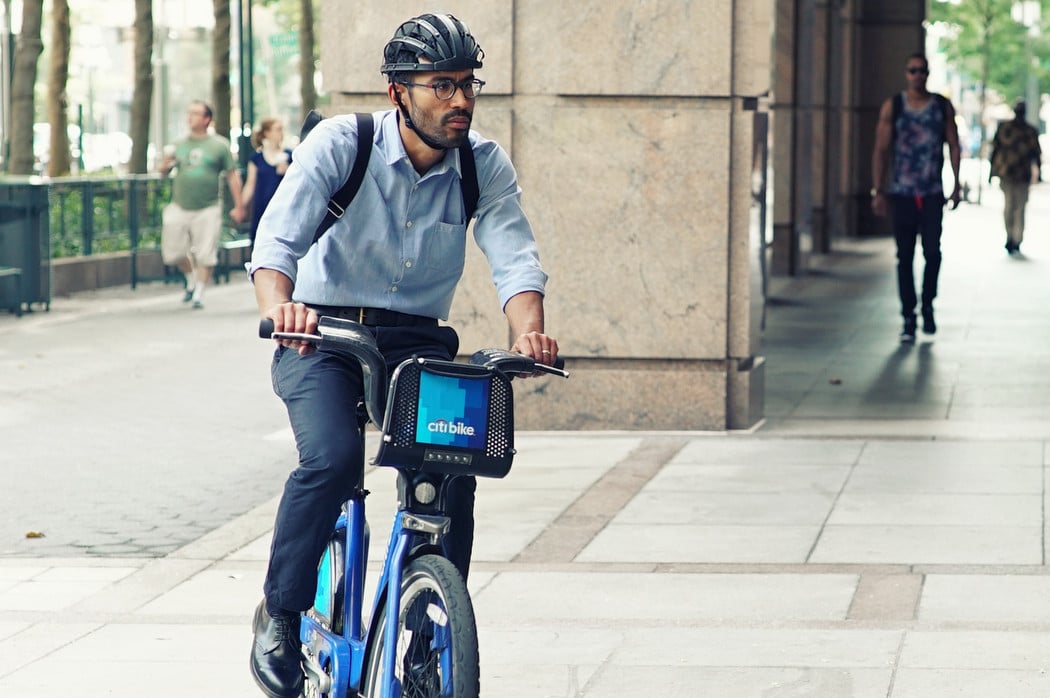
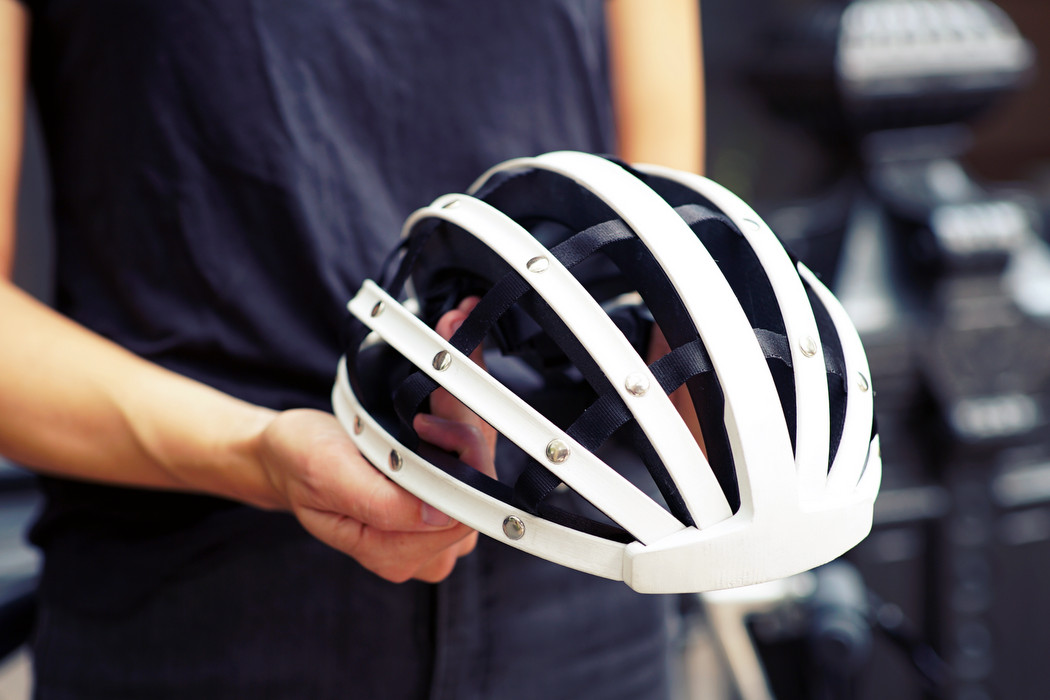
We’ve all seen the collapsible paper helmet. It’s sturdy, and folds into an unsuspecting flat piece of board that can be carried and unfolded and worn again. However, not many people feel comfortable putting their trust in paper to protect something as precious as their skull. The Fend takes what’s best about the paper helmet, its fold-ability, and breathable design, and puts it into a conventional helmet, creating something that is volumes better in shock absorption, but still manages to be foldable.
The design doesn’t deviate from regular helmets in material choice. Made out of ABS and with an EPS Foam lining, the Fend feels like any other helmet. It’s only when you’re packing it away that you marvel the wonderful folding interaction. The entire design collapses into a mass not more than 110mm wide. That’s enough to not just fit into a laptop bag, but even a regular purse! Gives a different meaning to ‘carrying protection with you’, doesn’t it?!
Designer: FEND













Juan Pablo Salazar, Sofía Henao and -1 others like this
29 Dec 10:29
 (Photo Credit: Vitaly Bulgarov)
South Koreans Build The World's First Human-Driven Bipedal Giant Robot
by brandizzi
Adam Victor BrandizziI'm always skeptical, yet there are more videos https://www.youtube.com/watch?v=QEUOo3_vh10
Bullies giving you a hard time at school? Not anymore.
Advertisement
The giant robot has been one of the coolest concepts in sci-fi since forever. I mean, who hasn’t fantasized about wielding the strength and size of an enormous mechanized avatar? As of this week, that fantasy looks close to being realized.
Behold the 13-foot tall 1.5-ton “Method-2,” brainchild of South Korean robotics company Hankook Mirae Technology, which is taking its first “baby steps” under the watchful eyes of about 30 engineers and members of the media this week.
Advertisement
As The Telegraph quotes company chairman Yang Jin-Ho: “Our robot is the world’s first manned bipedal robot and is built to work in extreme hazardous areas where humans cannot go [unprotected.]”
Yang has reportedly invested $200 million in the project since 2014. “The robot is one year old so it is taking baby steps,” Yang told The Telegraph. “Just like humans, it will be able to move more freely in the next couple of years.”
The paper also says Method-2 will be “ready for sale by the end of 2017 at a price of around 10 billion won ($8.3 million).” So perhaps the company’s planning to sell an elemental version or something about the timeline got lost in translation there.
Meanwhile, let’s focus on what’s important: it’s a freaking giant robot you can drive.
At first I was sure this machine was just a Hollywood prop, especially given the involvement of designer Vitaly Bulgarov, whose work you might recognize in Transformers, RoboCop, Terminator and other sci-fi projects.
Advertisement
Advertisement
But while Bulgarov did draw up some dramatized battlebot renders for Hankook Mirae, it looks like Method-2 is an honest-to-god Earth-stomping manned mech, with 286-pound arms mimicking the movements of the robot’s pilot, just like the suit from the last battle scene of Avatar.
Yang has spent millions of dollars and years of energy to “bring to life what only seemed possible in movies and cartoons,” and yeah, looks like his company pretty much nailed it.
Method-2 is apparently slated to be deployed in Japan’s Fukushima disaster area, as Bulgarov detailed on his Facebook page:
Advertisement
“One of the most common questions we get is about the power source. The company’s short term goals include developing robotic platforms for industrial areas where having a tethered robot is not an issue. Another short-term real world application includes mounting only the top part of the robot on a larger wheeled platform solving the problem of locomotion through an uneven terrain as well as providing enough room for sufficient power source. A modified version of that is already in development and is planned to help in restoration of Fukushima disaster area. Stay tuned for more updates!”
Method-2 looks like it could do everything from construction to military patrols, but of course the true extent of the robot’s practical applications will be determined by what its real-world functionality ends up looking like.
Advertisement
Advertisement
That said, if a consumer version really is made available for $8 million, I bet the Koreans would have no trouble selling a few of these to eccentric rich people as toys.
This article passed through the Full-Text RSS service - if this is your content and you're reading it on someone else's site, please read the FAQ at fivefilters.org/content-only/faq.php#publishers.
Recommended article: The Guardian's Summary of Julian Assange's Interview Went Viral and Was Completely False.
Adam Victor Brandizzi likes this
29 Dec 10:24

Comic for December 29, 2016
by Scott Adams
This article passed through the Full-Text RSS service - if this is your content and you're reading it on someone else's site, please read the FAQ at fivefilters.org/content-only/faq.php#publishers.
Recommended article: The Guardian's Summary of Julian Assange's Interview Went Viral and Was Completely False.
Adam Victor Brandizzi likes this
28 Dec 23:24
The Original Mobile Phone – Bonus Panel
by Brian
The post The Original Mobile Phone – Bonus Panel appeared first on Fowl Language Comics.
Adam Victor Brandizzi likes this


28 Dec 16:02
.png)
Click here to go see the bonus panel!
Hovertext:
Now that we have big dongs, let us return to Mother Ocean.
New comic!
Today's News:
Saturday Morning Breakfast Cereal - Wanna Evolve
by tech@thehiveworks.com
Click here to go see the bonus panel!
Hovertext:
Now that we have big dongs, let us return to Mother Ocean.
New comic!
Today's News:
Adam Victor Brandizzi, Starflier and one other like this
28 Dec 10:54
icecreamsandwichcomics: I’m not scared of your slowly decaying...


Roslyn , Adam Victor Brandizzi and 3 others like this
27 Dec 02:43
Datensparsamkeit
by brandizzi
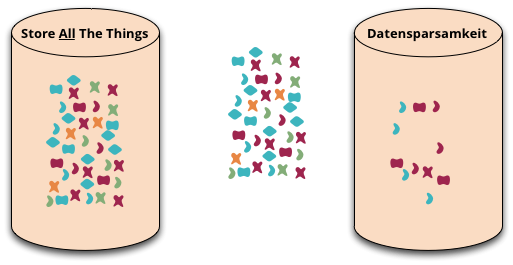
Datensparsamkeit is a German word that's difficult to translate properly into English. It's an attitude to how we capture and store data, saying that we should only handle data that we really need.
These days there's a lot of hype around the idea of Big Data - and with it the notion that we should capture and store every bit of data we can get our hands on. We might not have an immediate use for the contacts our users store in their address books, but we'll ask for it anyway in case it comes in useful later. We'll record every click on our website and squirrel it away in case we want to trawl it later. We set up our smartphone app to ask for location information so if we come up with some way to use that data later, we can. After all, storage is cheap - so why not?
The problem with the "capture-it-all" approach is that it raises serious questions of privacy. Even if we trust ourselves to not abuse the data we collect, each data store represents a target for criminals or government surveillance agencies. This issue is particularly fraught in Germany which has seen successive regimes where governments have carried out extensive surveillance of their citizens in order to control them. Germany consequently has strong data privacy laws.
Datensparsamkeit [1] is a concept from these privacy laws that is an opposite philosophy to "capture-all-the-things". A translation isn't straightforward (which is why I've retained the German word) but loosely you might translate it as something like "data austerity", "data minimization", "data parsimony", or "data frugality". It means that you should always ask yourself why you are capturing or storing data, and look to handle only the minimum amount of data you need for your purpose.
An example of this is tracking users on your web site to determine how many unique visitors you have. If the same person accesses several pages within a few hours, you want to count that as one visit. If they visit several times a month, you still only want to count them as a single visitor. One way to do this is to log IP addresses, you count each IP address as a single person [2]. But an IP address is very revealing, and could be used for much more than counting vistors. Datensparsamkeit suggests that you shouldn't store the IP address directly, perhaps instead you should hash it and only store the hash.
A similar example involving IP addresses is using them to infer demographic information such as region and country. You can get most of this information and practice datensparsamkeit by just logging the first three octets of the IP address.
Datensparsamkeit isn't just about bad people stealing data, it's also about your relationship with the primary company themselves. The default attitude at the moment is that any data you generate is not just freely usable by the capturer but furthermore becomes their valuable commercial property. Privacy advocates, including me, think this assumption needs to be changed. Companies should only capture what they need and the burden of demonstrating need should fall on them. In addition, of course, they must be completely transparent about what they capture, what they store, and who they share their data with. Any breaches of data security must be immediately publicized (instead of covered up, which is the current default).
Even if you don't share my views on personal control of our own data, the risks of security breaches mean that datensparsamkeit is a wise course of action. If you hold data that you don't need, and someone steals it and causes damage, shouldn't you be liable for that damage? Even if there's no legal liability the publicity will have serious consequences - and thus there is risk for anyone who doesn't practice datensparsamkeit.
Acknowledgements
Erik Dörnenburg introduced me to Datensparsamkeit. The meme "… all the things" seems to have been around forever (at least a decade) so I'm glad Korny Sietsma taught me that it started in 2010.
27 Dec 02:43
Native Intelligence | History | Smithsonian
by brandizzi
Adam Victor BrandizziAmazing text! I was deeply unaware of these complicated relations. There are more parts, click on it!
On March 22, 1621, a Native American delegation walked through what is now southern New England to meet with a group of foreigners who had taken over a recently deserted Indian settlement. At the head of the party was an uneasy triumvirate: Massasoit, the sachem (political-military leader) of the Wampanoag confederation, a loose coalition of several dozen villages that controlled most of southeastern Massachusetts; Samoset, sachem of an allied group to the north; and Tisquantum, a distrusted captive, whom Massasoit had brought along only reluctantly as an interpreter.
Massasoit was an adroit politician, but the dilemma he faced would have tested Machiavelli. About five years before, most of his subjects had fallen before a terrible calamity. Whole villages had been depopulated. It was all Massasoit could do to hold together the remnants of his people. Adding to his problems, the disaster had not touched the Wampanoag’s longtime enemies, the Narragansett alliance to the west. Soon, Massasoit feared, they would take advantage of the Wampanoag’s weakness and overrun them. And the only solution he could see was fraught with perils of its own, because it involved the foreigners—people from across the sea.
Europeans had been visiting New England for at least a century. Shorter than the Natives, oddly dressed and often unbearably dirty, the pallid foreigners had peculiar blue eyes that peeped out of bristly, animal-like hair that encased their faces. They were irritatingly garrulous, prone to fits of chicanery and often surprisingly incompetent at what seemed to Indians like basic tasks. But they also made useful and beautiful goods—copper kettles, glittering colored glass and steel knives and hatchets—unlike anything else in New England. Moreover, they would exchange these valuable items for the cheap furs that the Indians used as blankets.
Over time, the Wampanoag, like other Native societies in coastal New England, had learned how to manage the European presence. They encouraged the exchange of goods, but would allow their visitors to stay ashore only for brief, carefully controlled excursions. Those who overstayed their welcome were forcefully reminded of the limited duration of Indian hospitality. At the same time, the Wampanoag fended off Indians from the interior, preventing them from trading directly with the foreigners. In this way the shoreline groups had put themselves in the position of classic middlemen, overseeing both European access to Indian products and Indian access to European products. Now, reversing long-standing policy, Massasoit had decided to permit the newcomers to stay for an unlimited time—provided they formally allied with the Wampanoag against the Narragansett.
Tisquantum, the interpreter, had turned up at Massasoit’s home a year and a half before. He spoke fluent English, because he had lived for several years in Britain. But Massasoit worried that in a crisis Tisquantum might side with the foreigners. Samoset—the third member of the triumvirate—had appeared a few weeks before, having hitched a ride from his home in Maine on an English ship that was plying the coast. Because Samoset also spoke a little English, Massasoit had first sent him, not Tisquantum, to meet with the foreigners.
On March 17, 1621, Samoset had walked unaccompanied and unarmed into the circle of rude huts in which the British were living. The colonists saw a robust, erect-postured man wearing only a loincloth; his straight black hair was shaved in front but flowed down his shoulders behind. To their amazement, this almost naked man greeted them in broken but understandable English. He left the next morning with a few presents, returning a day later with five “tall proper men”—in colonist Edward Winslow’s words—with three-inch black stripes painted down the middle of their faces. The two sides talked inconclusively, each checking out the other, for a few hours.
Now, on the 22nd, with Massasoit and the rest of the Indian company hidden from view, Samoset and Tisquantum walked into the foreigners’ ramshackle base. They spoke with the colonists for about an hour. Then, Massasoit and the rest of the Indian party suddenly appeared at the crest of a nearby hill, on the banks of a stream. Alarmed, the Europeans withdrew to a hill on the other side of the stream, where they had emplaced their few cannons behind a half-finished stockade. A standoff ensued.
Finally Winslow exhibited the decisiveness that later led to his selection as colony governor. Wearing a full suit of armor and carrying a sword, he waded through the stream and offered himself as a hostage. Massasoit’s brother took charge of Winslow, and then Massasoit crossed the water himself, followed by Tisquantum and 20 of Massasoit’s men, all unarmed. The colonists took the sachem to an unfinished house and gave him some cushions on which to recline. Both sides shared some of the foreigners’ homemade moonshine and settled down to talk, Tisquantum translating.
Massasoit wore the same deerskin shawls and leggings as his fellows and, like them, had covered his face with bug-repelling oil and reddish purple dye. Around his neck hung a pouch of tobacco, a long knife and a thick chain of the prized white shell beads called wampum. In appearance, Winslow wrote afterward, he was “a very lusty man, in his best years, an able body, grave of countenance, and spare of speech.” The Europeans, who had barely survived the previous winter, were in much worse shape. Half of the original colony now lay underground beneath wooden markers painted with death’s heads; most of the survivors were malnourished. The meeting between the Wampanoag and the English colonists marked a critical moment in American history.
“A friendly indian”
"A Friendly Indian"
Like this article?
SIGN UP for our newsletter
This article passed through the Full-Text RSS service - if this is your content and you're reading it on someone else's site, please read the FAQ at fivefilters.org/content-only/faq.php#publishers.
Recommended article: The Guardian's Summary of Julian Assange's Interview Went Viral and Was Completely False.
mkvande, Adam Victor Brandizzi and -1 others like this
27 Dec 02:13
Click here to go see the bonus panel!
Hovertext:
Today's comic featuring my brother, Greg Weiner (the Greg Weiner who isn't an erotic photographer).
New comic!
Today's News:
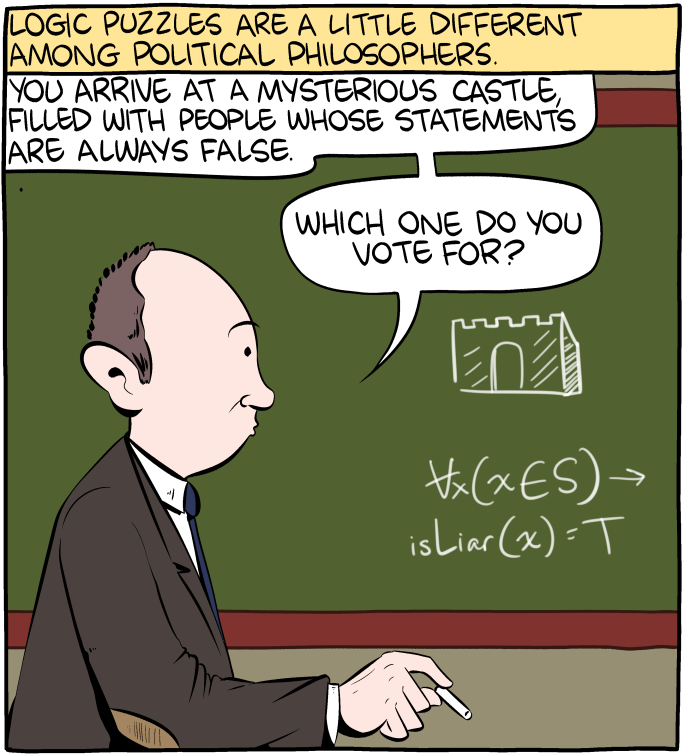
Saturday Morning Breakfast Cereal - Political Philosophy
by tech@thehiveworks.com
Click here to go see the bonus panel!
Hovertext:
Today's comic featuring my brother, Greg Weiner (the Greg Weiner who isn't an erotic photographer).
New comic!
Today's News:
Roslyn , Adam Victor Brandizzi and -1 others like this
25 Dec 19:18
SSC Journal Club: Mental Disorders As Networks
by Scott Alexander
Adam Victor BrandizziI am quite skeptical, almost a truther, about most of psychology research I come to glimpse nowadays. *This* model is something that makes much more sense to me and I hope to see more things in this line in the future.
I.
Suppose you have sniffles, fatigue, muscle aches, and headache. You go to the doctor, who diagnoses you with influenza and gives you some Tamiflu.
There’s some complicated statistics going on here. Your doctor has noticed some observable variables (sniffles, fatigue, etc) – and inferred the presence of an invisible latent variable (influenza). Then, instead of treating the symptoms with eg aspirin for the headache, she treats the latent variable itself, expecting its effects to disappear along with it.
Psychiatry tries to use the same model. You get some symptoms – depressed mood, insomnia, fatigue, feelings of worthlessness, suicidality. You go to the psychiatrist, who diagnoses you with depression and gives you an antidepressant.
The psychiatrist is implicitly assuming that the causal structure of her field matches the causal structure of better-understood diseases like influenza. Generations of psychiatrists have noticed that different symptoms all tend to show up together and follow a similar pattern, suggesting some kind of deep connection between them. So psychiatrists follow the influenza model and attribute this collection of linked symptoms to a latent variable called “depression”.
This gets complicated really fast. Psychiatric disorders are diagnosed through clusters of symptoms, but we don’t expect every person to have every symptom in the cluster. For example, we diagnose depression when a patient has five out of nine symptoms on a list including fatigue, guilt, sleep disturbance, suicidality, et cetera. Each of these symptoms is often but not always present in a patient who has most of the others – for example, 75% of depressed patients have sleep disturbances, but 25% don’t.
But all psychiatric disorders are hopelessly comorbid with each other. If someone meets criteria for one DSM disorder, there’s a 50% chance they’ll have another one too. 60% of people with major depression also have an anxiety disorder. This is awkward when compared to eg the 75% sleep disturbance rate. Why are we calling sleep disturbance a “symptom” of depression, but anxiety a “comorbid condition” with depression? If we’re trying to cluster symptoms together to identify conditions, how come “sleep” is grouped with a bunch of other symptoms in the depression cluster, but “anxiety” gets to be a cluster of its own? Are there really two conditions called “depression” and “anxiety”, or just one big condition that has various symptoms including low mood, sleep disturbance, and anxiety, and some people get some of the symptoms and other people get others? I’m told that the people who write the DSM have long conversations about this using rigorous methods, but to the rest of us it seems kind of arbitrary.
The problem isn’t that nothing ever clusters together – depression, for example, is a very natural category. But so are various subtypes of depression. And so are various supertypes of depression, like depression + anxiety, or depression + psychosis, or depression + anxiety + psychosis. Choosing to draw the borders around depression and say “Yup, this is the Actual Disease” isn’t a bad choice, but it doesn’t jump out of the data either. When people try to use sophisticated clustering algorithms on psychiatric disorders, they usually come up with something like this, where there are only three supercategories instead of the 297 different diagnoses in the DSM. And even three supercategories are pushing it – people with psychosis are far more likely to have depression too! Having any number of categories starts seeming arbitrary and fuzzy.
So Nuijten, Deserno, Cramer, and Borsboom (from here on: NDCB) ask: what if that’s wrong? What if there isn’t a latent variable like “influenza”? What if it’s symptoms all the way down?
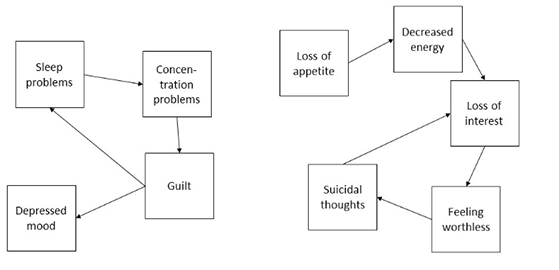
Consider a network in which each symptom is a node, connected to all the others by pathways with certain weights on each direction. So for example, “sleep disturbance” might be connected to “fatigue” by a strong path – people with disturbed sleep are much more likely to be tired. These might both be connected to “low mood” – people who don’t sleep well, or who are tired all the time, start feeling down about themselves. And this path might go the other way too: people who feel down about themselves might have more trouble getting to sleep on time. And maybe all of these are connected to suicidality, because if you feel bad about yourself you’re more likely to commit suicide, and if you’re suicidal you might feel bad about it, and if you’re tired all the time then maybe you can’t accomplish anything useful with your life and so death might seem like a good way out, and so on.
A sample image from the paper, showing two possible simple networks of depression symptoms
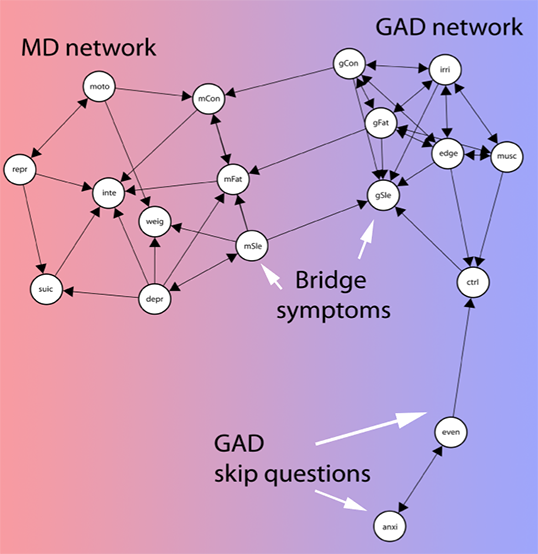
Also from the paper. This shows a more complicated (and apparently empirically validated) network of symptoms. MD is major depression. GAD is generalized anxiety disorder. The nodes are all different symptoms – for example, “inte” is “loss of interest in activities” and “musc” is “muscle tension”.
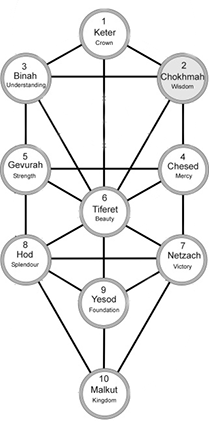
Not from the paper. But if you figure out a good way to calculate weights on this one, email me.
Each node might affect the others with a certain delay. Being suicidal might make you feel guilty, but even if your last suicidal thought was fifteen minutes ago, you might still feel guilty now. Maybe it would take months or even years before you no longer felt guilty about your suicidal thoughts. So there could be loops: in a simple model, your low mood makes you feel suicidal, your suicidality makes you feel guilty, and your guilt makes you have low mood. This type of loopy network might be stable and self-reinforcing. Maybe your boss yells at you at work, which makes you have a bad mood. Then even if the direct effect of your boss would go away quickly, if it causes suicidal thoughts which cause guilt which cause more low mood, then the cycle can stick around forever.
In NDCB’s model, all possible psychiatric symptoms are connected like this in a loose network. Particularly tight-knit symptom clusters that often active together and reinforce each other correspond to the well-known and well-delineated psychiatric diseases, like depression and schizophrenia. But there are no natural boundaries in the network; low mood and poor sleep may be closely connected to each other, but they’ll also be more distantly connected to anxiety, and even more distantly connected to psychosis. This corresponds to the fact that some depressed people will develop psychotic symptoms, even though psychosis isn’t usually associated with depression. The paths aren’t usually as strong as those between low mood and poor sleep, but they’re there, and in some people with a predisposition to psychosis or some idiosyncratic factor strengthening those paths beyond their usual level in the population, that will be enough.
There are lots of good things about thinking about psychiatric problems this way:
1. It helps explain how life stressors can cause depression. Some people who have a bad breakup will get depressed. This should be mysterious if we think of depression as a biological illness – and we have to at least a little; some people who take the drug interferon-alpha will get depressed afterwards too. But if depression is a symptom network, it becomes easier to explain. The bad breakup causes low mood, which under the right conditions and genetic predispositions can activate all of the other depression symptoms and create a stable, self-reinforcing depression. Likewise, poor sleep is a risk factor for the development of subsequent depression, which is hard to explain if we just think of it as a symptom of some latent-variable-style condition.
2. It explains how treating depression symptoms can treat the depression. I’ve heard a lot of different perspectives on this, but at least one of my attendings (and some studies) believes that treating poor sleep with a sleeping pill like Ambien can help dispel an underlying depression, including symptoms seemingly unrelated to sleep like “feelings of worthlessness and guilt”.
3. It explains how therapy can treat depression. If eg cognitive behavioral therapy helps you stop thinking of yourself as worthless, then you’ve de-activated the “feelings of worthlessness and guilt” node and made it a lot harder for all the other nodes to coalesce into a stable self-reinforcing pattern.
4. It explains the polygenic structure of mental illnesses. If a mental illness were one specific thing, we would expect it to have one specific cause, or at least be limited to genes active in one specific area or process. In fact, it’s hard to come up with anything that genes involved in these illnesses have in common other than “they’re mostly expressed in the brain” – and sometimes not even that. In NDBC’s model, genes might be involved in any of the symptoms, or in the paths between the symptoms. A gene involved in poor sleep could predispose to depression. So could a gene involved in low energy levels. Even a gene involved in anxiety or psychosis could have some effect. And so would any gene that influenced the probability that, given poor sleep, a person would have low energy levels; or that given anxiety, a person will have psychosis. The end result would be everyone having a slightly different network, with different amounts of work needed to activate each node and different weights on each of the inter-nodal paths.
5. It helps explain why so many brilliant people searching for The One True Cause Of Depression have come up empty.
II.
Actually, this last one deserves more explanation. NDCB think of these symptoms as visible patient complaints (“poor sleep”, “feelings of worthlessness”), and treat the connections between them as common sense (“if you don’t sleep, you’ll probably be fatigued”, “if you feel very guilty, you might attempt suicide because you think you deserve to die”). But their theory also works for networks of biological dysfunctions, or networks that combine biological dysfunctions with common-sense observed symptoms.
For example, we know that there’s a link between depression and inflammation. But it’s not a very good link; not all depressed people have increased inflammation, not all people with increased inflammation get depressed, and drugs that decrease inflammation don’t always cure depression. There’s similarly good evidence linking depression to folate metabolism, serotonergic neurotransmission, BDNF levels, and so on. Suppose we made a graph like the ones above, except that instead of putting things like “poor sleep” and “feelings of guilt” on it, we used “inflammatory dysfunction”, “folate metabolism dysfunction”, “serotonin dysfunction”, and “BDNF dysfunction”. There are a lot of reasons to expect these things to interconnect – for example, folate helps produce a cofactor necessary for serotonin synthesis, so any dysfunction in folate metabolism could make a problem with serotonergic neurotransmission more likely.
In a best case scenario we could merge the biological and psychological perspective, replacing “disturbed sleep” with “disturbance in the orexin and histamine systems that regulate sleep” and “tiredness” with “disturbance in the dopamine system that regulates goal-directed action”, and so “poor sleep makes you tired” with “disturbance in the orexin system causes a disturbance in the dopamine system”. In practice I expect this would be a terrible idea and that common-sense concepts mostly don’t have simple well-delineated biological equivalents. But what I’m saying is that the model where all of these things are observable symptoms, and the model where they’re all disturbances in brain chemicals and metabolism, aren’t necessarily in conflict.
So we can expand point (5) to say not only that it explains why nobody has found the One True Depression Cause, but why they have found so many promising leads that never quite pan out. Just like depression has a bunch of different symptoms, each of which is often-but-not-always involved, and each of which reinforces the others — so it has a bunch of different disturbances in biological systems, each of which is often-but-not-always involved, and each of which reinforces the others. Maybe there’s a nice correspondence between one disrupted biological system and one symptom, or maybe they sit uneasily together as different nodes on the same big graph.
III.
Are there any problems with this theory?
There are a couple of disorders that really don’t fit this model. Bipolar disorder, for example, doesn’t quite work as a collection of self-reinforcing symptoms. It’s marked by depressive episodes that can give way to years of stable mood before the person has a manic episode months or years later. I can’t think of any way to model this except as some underlying unified tendency toward bipolar disorder – although the ability for this tendency to cause a depression that looks just like normal unipolar depression is a point in NDCB’s favor, since it suggests there can be many different causes for the same syndrome.
The impressive success of ketamine also counts as a point against. NDCB imagine psychiatric disorders like depression as gradually fading out on a symptom-by-symptom basis, eventually reaching a point where enough symptoms are gone that the rest of them aren’t self-reinforcing and just sputter out. This matches the course of eg SSRI treatment, where the medications will gradually improve a few symptoms at at time over the space of a month or so and maybe cause a full remission if you’re lucky. It doesn’t really match ketamine, where every aspect of depression vanishes instantly, then returns after a week or so without treatment. There are a couple of other equally impressive things – staying awake for thirty hours straight, for example, can have an immediate and near-miraculous antidepressant effect, which unfortunately vanishes as soon as you go to sleep. Both of these treatments seem like direct strikes against the One True Cause Of Depression, and both suggest that an underlying tendency toward depression can exist separate from any symptoms (or else why would the depression come back after the effects of the ketamine wore off?)
I don’t think it’s possible to cure depression by blasting every symptom simultaneously. That is, suppose somebody is depressed with symptoms of poor sleep, poor appetite, low energy, suicidality, and low mood. Ambien can make them sleep. Pot can make them eat. Adderall can give them energy. Clozaril can make them stop wanting to kill themselves. And heroin can perk up mood. So if you gave someone Ambien, pot, Adderall, Clozaril, and heroin at the same time, would that cure their depression? I’m pretty sure no one has ever tried this, but I don’t think anyone’s reported exceptional results from less extreme cocktails like Adderall + trazodone + pot, which I’m sure a bunch of people end up taking. This along with the stuff from the last paragraph suggests that if we want to go with this model, maybe we should think less in terms of actual poor sleep and more in terms of dysfunction in the biological system of which sleep is a visible correlate. In that case we could say that Ambien helps the sleep itself but not the underlying dysfunction. But that takes some of the elegance out of the theory.
Despite these issues, I feel like something along these lines has to be true. There are too many things that sort of kind of cause psychiatric problems, and too few things that look like One True Causes. Things that look a lot like schizophrenia can be caused by viral infections in utero, by genetic factors, by hitting your head really hard as a child, by hypoxia during the birthing process, by something something something intestinal tract, by something relating to immigration which seems like it might involve psychosocial stress, and so on. Studies of the immune system, the dopamine system, the glutamate system, and the kynurenine system have all found disruptions. There have been so many really brilliant attempts to reduce all of these to a single brain region, or the levels of one specific chemical, or something that’s simple in the same way that lack-of-insulin-causes-diabetes is simple. But nobody’s ever succeeded. Maybe we should just give up.
I guess I’ve felt for a long time that some kind of weird change in attractor states of biological systems is the best way to explain these kinds of things, but I was never able to express what I meant coherently besides “weird change in attractor states of biological systems”. NDCB offer a clear model that suggests good avenues for future research.
(And I wasn’t joking when I said that little diagram with the two pentagons was the solution to 25% of extant philosophical problems.)
Adam Victor Brandizzi, Landryst likes this
24 Dec 21:01

Wikimedia Commons


The movie that doesn’t exist and the Redditors who think it does
by brandizzi
Adam Victor BrandizziFor some strange reason, the expanded article here is NOT the one I've shared. Check it here: http://www.newstatesman.com/science-tech/internet/2016/12/movie-doesn-t-exist-and-redditors-who-think-it-does
In the early Nineties, roughly around 1994, a now 52-year-old man named Don ordered two copies of a brand new video for the rental store his uncle owned and he helped to run.
“I had to handle the two copies we owned dozens of times over the years,” says Don (who wishes to give his first name only). “And I had to watch it multiple times to look for reported damages to the tape, rewind it and check it in, rent it out, and put the boxes out on display for rental.”
In these ways, the film Don is speaking of is exactly like the hundreds of others in his uncle’s shop. In one crucial way, however, it is not. The movie that Don is referring to doesn’t actually exist.
*
“It feels like a part of my childhood has now been stolen from me. How does a movie simply vanish from our history?”
This isn’t Don speaking, but another man – who he has never met – named Carl*. Carl, whose name has been changed because he wishes to remain anonymous, recalls watching a movie called Shazaam with his sister in the early Nineties, and has fond memories of discussing it with her over the last 20 years. In their recollections, the movie starred the American stand-up comedian Sinbad – real name David Adkins – as an incompetent genie who granted wishes to two young children.
Wikimedia Commons
“I’ve taken to Craigslist and have posted a bounty of $1,000 for anyone that can turn up a copy of this movie, whether it was ‘accidentally’ kept from Blockbuster or if someone made their own bootleg VHS copy. I want to be able to make it known that the movie is indeed real,” says Carl.
Meredith Upton, a 25-year-old videographer from Nashville, Tennessee, also remembers the same film. “Whenever I would see Sinbad anywhere in the media I would recall him playing a genie,” she says. “I remember the name of the film as Shazaam. I remember two children accidentally summoning a genie… and they try and wish for their dad to fall in love again after their mother’s passing, and Sinbad can’t [grant the wish].”
Don goes even further. Although he is not certain that the movie was called Shazaam, he has detailed scene-by-scene recollections of the film, which include the children wishing for a new wife for their father, the little girl wishing for her broken doll to be fixed, and the movie finale taking place at a pool party. Don says he remembers the film so vividly because customers would bring the video back to his rental store claiming it didn’t work, and he watched it multiple times to try and find the “problem with the tape”.
Meredith, Don, and Carl are three of hundreds of Redditors who have used the popular social news site to discuss their memories of Shazaam. Together they have scoured the internet to find evidence that the movie existed but each has repeatedly come up empty-handed. Sinbad himself has even taken to Twitter to deny that he ever played such a role.
Have you noticed no one my age has seen this so called Sinbad Genie movie, only you people who were kids in the 90's. The young mind !
— Sinbad (@sinbadbad) September 7, 2016
*
How did this Reddit community grow? It all began in 2009. An anonymous individual took to the question-and-answer website Yahoo! Answers to pose its users a simple question. “Do you remember that sinbad movie?” they wrote. “Wasnt there a movie in the early 90s where sinbad the entertainer / comedian played a genie? … help its driving me nuts!”
At the time, nobody remembered the film, and it took another two years for somebody else to ask about it again online. Reddit user MJGSimple wrote on the site: “It’s a conspiracy! I swear this movie exists, anyone have a copy or know where I can find proof!” Replies to the post were sceptical, claiming MJGSimple simply had a false memory.
@careuhhh I must hve played a genie. Everyone says I did. Smile
— Sinbad (@sinbadbad) September 20, 2009
It wasn’t until last year that things took a dramatic turn.
On 11 August 2015, the popular gonzo news site VICE published a story about a conspiracy theory surrounding the children’s storybook characters the Berenstain Bears. The theory went like this: many people remember that the bears’ name was spelt “Berenstein” – with an “e” – but pictures and old copies proved it was always spelt with an “a”. The fact that so many people had the same false memory was seen as concrete proof of the supernatural.
“Berenstein” truthers believe in something called the “Mandela Effect”: a theory that a large group of people with the same false memory used to live in a parallel universe (the name comes from those who fervently believe that Nelson Mandela died while in prison). VICE’s article about the theory was shared widely, leading thousands of people to r/MandelaEffect, a subreddit for those with false memories to share their experiences.
It was there, just a few hours after the article was posted, that discussions of Shazaam – or the “Sinbad Genie movie” – took off.
“I was dumbfounded to see that there was no evidence of the movie ever being made,” says Carl. “I quickly searched the internet, scouring every way I know how to search, crafting Boolean strings into Google, doing insite: searches, and nothing. Not a damn thing.”
On the subreddit, discussions about the film went into great detail. Unlike other false memories on r/MandelaEffect, the issue wasn’t a simple misspelling or logo-change, but an entire film's disappearance. Many Redditors revealed they had distinct memories of the cover art of the movie. “It said ‘Sinbad’ in big letters that dwarfed the other print,” says Don, who goes by EpicJourneyMan on Reddit, and also remembers how Sinbad posed on the cover – facing left, with his arms crossed and an eyebrow raised. Jessica*, a 27-year-old office worker from Canada, also remembers the cover. “[It had] a purple background, featuring Sinbad dressed as a genie, back to back with a boy who looks about 11 or 12 years old. Sinbad has an annoyed expression on his face,” she says.
At this point I should mention something I have neglected to mention so far. In 1996, the basketball player Shaquille O'Neal played a genie who helped a young boy find his estranged father in a commercially unsuccessful film. The cover art of the film features Shaq with his arms folded, laughing, in front of a purple background. His name, “Shaq”, dominates the top half of the cover. The movie’s name is Kazaam.
*
Imagine if you woke up this morning and Disney’s 1998 animation A Bug’s Life did not exist. After endlessly scouring the internet, you’d come up with nothing, despite your own distinct memories of a bunch of ants going on wild hijinks through the undergrowth. You’d turn to your best friend, your brother, your mum, and say, “Hey, remember A Bug’s Life? It was about ants”, and your friend/brother/mum would turn to you and says: “No, darling. You’re thinking about Antz.”
This is how those who believe in the “Sinbad genie movie” feel when people say they are simply getting confused about Shaq’s Kazaam. Twin films – remarkably similar movies that are released at the same time – are relatively common, and include Turner & Hooch and K-9 in 1989, Robin Hood: Prince of Thieves and Robin Hood in 1991, Saving Private Ryan and The Thin Red Line in 1998, and Finding Nemo and Shark Tale in 2003-4.
“I remember thinking Shaq’s Kazaam was a rip-off or a revamp of a failed first run, like how the 1991 film Buffy the Vampire Slayer bombed but the late Nineties TV reboot was a sensation,” says Meredith, who is one of many who claim to remember both Shazaam and Kazaam. Don remembers ordering two copies of the former and only one of the latter for the store, while Carl says: “I am one of several people who specifically never saw Kazaam because it looked ridiculous to rip off Shazaam just a few years after it had been released.” When Carl first realised there was no evidence of the Sinbad movie existing, he texted his sister to ask if she remembered the film.
“Her response [was] ‘Of course.’ I told her, ‘Try and look it up, it doesn’t exist’. She tried and texted back with only: ‘What was it called?’ – there was never a question of if it existed, only not remembering the title.”
*
I remember, as a child, that every time my mother bought me a fresh pair of Clarks shoes for the new school year, the shop would offer me a free gift to go with them. It was the late Nineties or early Noughties, and I distinctly remember receiving a lilac pencil case to accompany my new leather numbers. It had different compartments for pencils, rubbers, and sharpeners, and I spent the last week of the holidays drawing a comic book with it by my side on our caravan kitchen table.
There is no evidence that such a promotional offer ever existed. When I ask around, no one remembers it, but when I also ask about another memory I have – of Marks & Spencers’ chicken nuggets shaped like Bugs Bunny – no one remembers those either, despite the fact a Guardian article proves they were real.
I can’t find evidence of the Clarks offer on the internet, though my sister remembers it and a poll that I conducted online shows that at least 500 other people do, too. Does this mean my memory is real? We have become very used to the idea that you can find anything on the internet, yet what do we accept as “proof”? Do we need pictures, videos, and articles, or is the fact that hundreds of others share our memory enough?
Dr Henry Roediger, a professor at the Washington University Memory Lab, doesn’t think so. “Lots of people remember detailed, but utterly false, memories. In fact, we all have them,” he says. “I have published on what we named ‘the social contagion of memory’ and what others call ‘memory conformity’ – that may be at work here.” Roediger explains that frequently one person’s report of a memory influences another’s, and that false memories can spread in this way. “One person’s memory infects another,” he says.
It is clear that this contagion would only be exacerbated online, where an individual can be influenced by multiple people from all around the world in an instant. The existence of the Shazaam Reddit community, therefore, arguably helps a false memory to spread.
@WillyBeamen_ ain't Nuthin hidden in This internet universe. It should be easy to find if I did a genie movie
— Sinbad (@sinbadbad) September 7, 2016
“We often forget whether we actually saw something or whether someone told us about a detail later and we filled in our memories,” he goes on. “People infer events and then remember the inferences as if they actually happened. If someone hears ‘The karate champion hit the cinder block’ they will often later remember that he ‘broke the cinder block.’ But maybe not: maybe he broke his hand. So the inference is remembered as ‘the way it happened.’”
Like accusations that they are misremembering Kazaam however, Shazaam truthers balk at the idea they simply have false memories that have been influenced by one another.
“I try not to read other’s full descriptions of the film because I don’t want to subconsciously influence my own recollection,” says Meredith, while Jessica says that before she started reading about the film she jotted down her own memories, to avoid being influenced by others’. “After doing so, I read what other people remembered about the poster and a few people remembered the exact same poster that I did.”
It is also worth noting that many people seemingly remember the movie independently of the subreddit – with someone different tweeting about it nearly every single day.
Who has that 90s, Sinbad, Genie movie on DVD?
— Bored Vegas (@Bakarii) December 21, 2016
Here I am trying to go to bed at a decent time only to find out that Sinbad never played a Genie in a movie! Even though I know Ive seen it!
— Chase Burgess (@LeadBurgess) December 16, 2016
So what do these Redditors think has actually happened?
Some truly believe in the Mandela Effect, that there has been some glitch in the world, there are parallel universes, or a timeline has been altered and as such little things have got lost. Some are very active in the r/MandelaEffect community, and have many other false memories, suggesting an element of bandwagon-hopping or a penchant for conspiracy theories.
Others, however, have less fantastical theories. Meredith leans towards the explanation being “some previously undocumented psychological phenomenon”, while Don believes the movie was intentionally “disappeared” because it embarrassed Sinbad and Phil Hartman, who he believes was a writer and producer on the film. Jessica also thinks the film was recalled and destroyed.
Carl’s explanation, however, is the most detailed. Although he considers the movie may have been recalled if DC Comics sued the film’s production company (because of their similarly-named TV show Shazam!), he believes more in either a timeline shift or a computer simulation.
“University of Oxford’s philosopher Nick Bostrom suggested that members of an advanced civilization with enormous computing power might decide to run simulations of their ancestors,” he says, also arguing that quantum computers are now able to run such simulations. “In a day where we can now run these simulations, is this a far-fetched theory?” he argues, noting that the famous scientist Neil deGrasse Tyson put the odds we are living in a computer simulation at 50-50 earlier this year.
“Does it make more sense to argue with the scientific minds of our time exposed to the greatest understanding of the capabilities of modern technology, or to argue with the masses of people who simply write off these effects we are noticing as faulty memories?” Carl asks.
*
As of today, there is no concrete evidence that Shazaam ever existed. A few months ago, Redditors thought they had a breakthrough when they discovered an image of Sinbad in a genie costume on eBay. Sinbad himself, however, tweeted to say that he was dressed that way because he was hosting a Sinbad the Sailor movie marathon.
@hapotter solved the sinbad genie mystery. I hosted an afternoon of sinbad movies o 1994 (sinbad the sailor movies) pic.twitter.com/yCE65Q3aK5
— Sinbad (@sinbadbad) October 3, 2016
Some said the image demonstrated where the false memory had originated, others continue to hunt for evidence of a movie they are certain exists.
*Names have been changed.
If you want to read more in-depth and quality journalism, subscribe to the New Statesman here.
Adam Victor Brandizzi likes this