Happy Father's Day!
Adam Victor BrandizziTenho a maior vergonha de dizer, mas é verdade.
Happy Father's Day!

The internet: What devastatingly-complex issue can I oversimplify for you today?
— Ray Yamartino (@rayyamartino) June 20, 2015
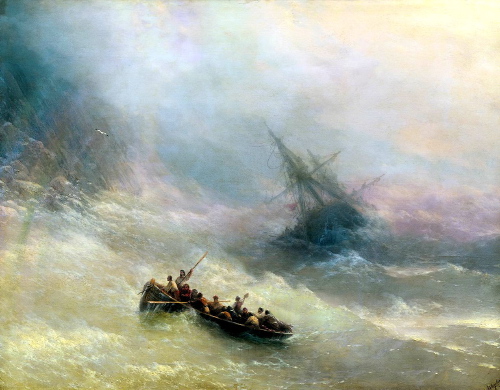
It was a good answer that was made by one who when they showed him hanging in a temple a picture of those who had paid their vows as having escaped shipwreck, and would have him say whether he did not now acknowledge the power of the gods, — ‘Aye,’ asked he again, ‘but where are they painted that were drowned after their vows?’ And such is the way of all superstition, whether in astrology, dreams, omens, divine judgments, or the like; wherein men, having a delight in such vanities, mark the events where they are fulfilled, but where they fail, though this happens much oftener, neglect and pass them by.
— Francis Bacon, Novum Organum, 1620
The post The Uncounted appeared first on Futility Closet.
This exceedingly clever animation by artist Alan Warburton transforms two compositions from J.S. Bach’s The Well Tempered Clavier (Prelude and Fugue in C Major) into a visual interpretation of music. Warburton used a form of graphical notation manifested as thousands of fluorescent light bulbs mounted around a gallery space and parking garage. As each light pops on in sync with the music, the bulb shape correlates with with length and pitch of each note.
You can learn more about how Warburton and a team of programmers and sound designers created the piece over on Sinfini Music who commissioned the piece. Music performed by Pierre-Laurent Aimard.


Read more of this story at Slashdot.


Oskar Zapirain's photographs capture eerie forests cast in thick fog, hazy light descending upon the foliage in the same green shade that blankets the floor in moss. Zapirain has been attracted to this landscape for years because of the homogenous light as well as the way it forces the viewer directly into a mystical atmosphere.
The forest Zapirain features is a beech forest in Oiartzun, Basque Country in Northern Spain. This particular forest is unique due to the history charcoal production within the region. Instead of clearcutting like we do today, the trees were instead pruned to preserve the trees and maintain the integrity of the forest across generations. The trees have since regrown with short trunks and dramatically long limbs that shoot outward like arms from almost every angle, adding a ghostly feel to each of Zapirain’s photos. You can explore more of his work on Flickr.


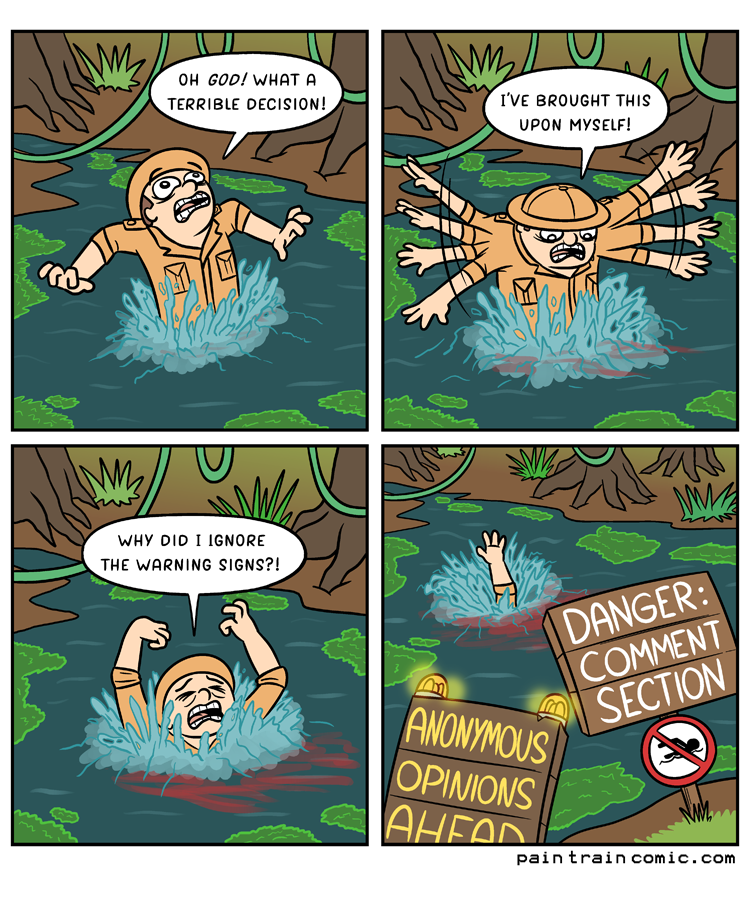
“It is better to remain ignorant and be thought a fool, than to wade through the comments and remove all doubt.”
– Mark “Lincoln the Einstein” Twain
Adam Victor Brandizzi¡¿BUT WHO WILL SOLVE EVERYTHING?!

Commended. Photographer Richard Peters sat in his car and from a distance watched the fox hunting, just enjoying the performance. He was in Yellowstone National Park, in Wyoming, and there was snow on the ground. The fox was listening for rodents under the snow, then leaping high to pounce down on the unsuspecting prey. It was too far away to photograph, and so when it disappeared and suddenly reappeared, on a snow bank level with the car window, Richard was taken by surprise. “It was already in pounce position, and I barely had time to lift the camera before it leapt up into the air almost clean out of my field of view. I managed to get a sequence of the leap, but I love this quirky image best, which gives a real sense of just how high these wonderful animals can jump”. (Photo by Richard Peters/Veolia Environnement Wildlife Photographer)

Runner-up. This young male seemed blissfully unconcerned by the lightning and thunder rolling in across the Kalahari. Hannes Lochner, who was taking night shots in the South African part of the Kgalagadi Transfrontier Park, came across him stretched out beside the track. “He raised his head to stare at me a couple of times”, says Hannes, “but he wasn’t really interested in either me or the dramatic goings-on behind him.” Hannes worked fast, framing the lion against the illuminated night sky at the moment a bolt of lightning flashed to the ground. Just after I took this picture, there were a few more lightning bolts and then everything went still and dark again”. (Photo by Hannes Lochner/Veolia Environnement Wildlife Photographer of the Year 2012)

Runner-up. It was a night of snow that gave Owen Hearn the advantage. “After spending countless hours lying in hedges and long grass trying to photograph hares”, says Owen, “I couldn’t believe my luck when I came across this hare just meters away, crouched down in the snow”. Owen also crouched down in the snow and slowly moved forward until he was close enough to fire off four frames. “I am sure it thought it was camouflaged”, he says. Owen’s hare-stalking ground is his grandparents’ Bedfordshire farm. “I like the challenge of trying to get close to hares, as they are so alert and so fast. They have taught me a lot about fieldcraft”. (Photo by Owen Hearn/Veolia Environnement Wildlife Photographer)

Runner-up. Ever since Daniel Eggert first fell in love with pasque flowers, among the first flowers of spring, he had wanted to photograph them covered in hoar frost. Now it was pasque-flower time once again. He had already identified a spot of chalky grassland near his home where the plants grew, on the rim of the Nördlinger Ries crater (a meteor crater) in Bavaria, Germany. So as soon as a cold, frosty, sunny dawn was forecast, Daniel headed up the hill. “I found the ideal flowers to photograph, but I didn’t have much time”, he says, “because I knew that as soon as the sun rose, the frost would quickly melt”. He took this image just as the rising sun began to bathe the hill in a wonderful orange light. “I love the colors”, he says, “and the contrast between the warm background and the cold ice”. (Photo by Daniel Eggert/Veolia Environnement Wildlife Photographer)

Specially commended. The grey-headed flying fox is the largest bat in Australia – and one of the most vulnerable. Once abundant, there are now only around 300,000 left. The main threats include loss of habitat, extreme-temperature events and human persecution (roosting in numbers, eating cultivated fruit and an undeserved reputation for bearing disease brings it into conflict with people). The bat is now protected throughout its range, but its future remains uncertain. Photographer Ofer Levy spent several days in Parramatta Park in New South Wales photographing the bat’s extraordinary drinking behavior. “At dusk, it swoops low over the water, skimming the surface with its belly and chest”, he says. “Then, as it flies off, it licks the drops off its wet fur”. To photograph this in daylight, Ofer had to be in the right position on a very hot day, with the sun and the wind in the right direction, and hope a bat would be thirsty enough to risk drinking. “This required standing in chest-deep water with the camera and lens on a tripod for three hours a day for about a week in temperatures of more than 40 degrees”. (Photo by Ofer Levy/Veolia Environnement Wildlife Photographer)

Specially Commended. As the snow started to melt, a thick fog began to wrap itself around the forest near Sandra Bartocha’s home in Potsdam, Germany. Envisaging the photographic potential, she grabbed her camera and went straight to the forest. The scene was even more beautiful than she’d expected. “The evening sun created a glow around the tall, wet trunks of the Scots pines”, she remembers. “It was breathtaking”. She experimented with several different focal planes and lenses to try to capture the effect. Eventually, she settled on a mirrorless camera with a tilt lens, allowing her to change the layers of sharpness from parallel to horizontal, so the unsharp areas were not in front but behind and below the main focus. She played around with the focus “to keep the warm, broken light at the top of the frame and the trunks below relatively sharp”. (Photo by Sandra Bartocha/Veolia Environnement Wildlife Photographer)

Commended. A scattering of gecko droppings on the sunny veranda of Klaus Tamm’s holiday apartment near Etang-Sale-les-Hauts, on the French island of Réunion, had attracted some unusual-looking insects. They were neriid long-legged flies. Klaus settled down with his camera to watch as they interacted. “Every so often, a couple of males would take a break from feeding and engage in a kind of combat dance that involved spinning around each other”, he says. “They would finish by stretching up to their full one and a half centimeters, then pushing with their mouthparts, shoulders and forelegs until one gained height, before flying away or mating with nearby females. I was so impressed by the harmony in the combat dance that I ended up photographing them for several hours”. (Photo by Klaus Tamm/Veolia Environnement Wildlife Photographer)

Winner. Some of the tallest buildings in London surround the docklands at the heart of the business and financial district of Canary Wharf. As Eve Tucker walked along the wharf, a bird caught her eye. It was a black-headed gull, of which there are many in the city. But this one was resting on a very remarkable area of water. Eve realized that she was looking at reflections of the straight lines of the nearby office block, distorted into moving swirls. “The effect was so unusual – it gave a beautiful setting for an urban wildlife image”. Like all true photographers, Eve had noticed what others most often fail to see, even when it’s right in front of them. (Photo by Eve Tucker/Veolia Environnement Wildlife Photographer)

Commended. In late May, about a quarter of a million snow geese arrive from North America to nest on Wrangel Island, in northeastern Russia. They form the world’s largest breeding colony of snow geese. Photographer Sergey Gorshkov spent two months on the remote island photographing the unfolding dramas. Arctic foxes take advantage of the abundance of eggs, caching surplus eggs for leaner times. But a goose (here the gander) is easily a match for a fox, which must rely on speed and guile to steal eggs. “The battles were fairly equal”, notes Sergey, “and I only saw a fox succeed in grabbing an egg on a couple of occasions, despite many attempts”. Surprisingly, “the geese lacked any sense of community spirit”, he adds, “and never reacted when a fox harassed a neighboring pair nesting close by”. (Photo by Sergey Gorshkov/Veolia Environnement Wildlife Photographer)

Winner. Photographer Anna Henly was on a boat in Svalbard – an archipelago midway between mainland Norway and the North Pole – when she saw this polar bear at around four in the morning. It was October, and the bear was walking on broken-up ice floes, seemingly tentatively, not quite sure where to trust its weight. She used her fisheye lens to make the enormous animal appear diminutive and create an impression of “the top predator on top of the planet, with its ice world breaking up”. The symbolism, of course, is that polar bears rely almost entirely on the marine sea ice environment for their survival, and year by year, increasing temperatures are reducing the amount of ice cover and the amount of time available for the bears to hunt marine mammals. Scientists maintain that the melting of the ice will soon become a major problem for humans as well as polar bears, not just because of rising sea levels but also because increasing sea temperatures are affecting the weather, sea currents and fish stocks. (Photo by Anna Henly/Veolia Environnement Wildlife Photographer)
The ginger cat was picked up by Cat Protection helpers in County Armagh last week. When animal welfare officers took him to the vet for a health check, it was discovered that he had been micro-chipped in Australia.
The plot thickened as the chip revealed he has also been found as a stray across the Irish Sea in London.
The centre has now given the cat the new name of Ozzie, to reflect his Australian heritage.
The data on the microchip suggests that the tabby was born in 1989, making him 25 years old. The life expectancy of cats is between 12- 15 years.
 The microchip suggests that Ozzie was born in 1989, making him 25 years old Photo: Cat Protection
Cat Protection co-ordinator Gillian McMullen explained to The Belfast Telegraph how the curious case came about.
“I responded to a call from a member of the public last Monday evening who was concerned about a poorly stray cat that had been hanging around her garden for several days," she said.
"I took it to Willow Veterinary Clinic on the Mahon Road, Portadown, where we discovered it was microchipped and this is where the mystery begins.
"The cat had originally been microchipped in Australia. Then in 2004 he turned up as a stray in a London vet clinic but no details whatever were logged against the microchip."
 Cat Protection are looking for Ozzie's owners and to find out how he managed to make the trip half way round the world Photo: Cat Protection
Ms McMullen has said that she will look after Ozzie whilst investigations are still underway to ascertain who his true owners are.
“We are desperate to unravel the rest of this cat's past and hopefully reunite him with his owners.
"We have been in touch with the Australian Animal Register and have our fingers and paws crossed on word from them on this cat."
Adam Victor BrandizziYou can clearly feel how the second part had no editor and the author fell for his "Occupy-ish" sentiments. Nonetheless, great text! I have heard about it but now I understand a bit more.
I say 'perhaps', because it really depends on how long you pause on those commas I put in the sentence. If you’re an individual with great respect for commas you might give the algorithm a chance to throw in a few hundred more orders.
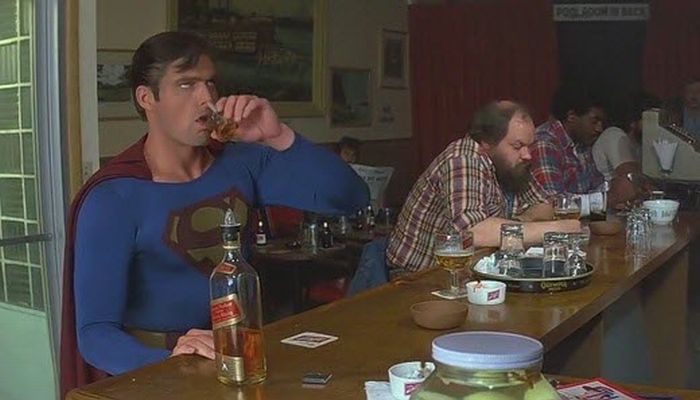
Let’s just clarify this. That means computers owned (or leased) by a firm somewhere can 1) suck in data from a stock exchange, 2) process it through a coded step-by-step rule system (algorithm) to make a decision about whether to trade or not, 3) send a message back to the exchange with an order for shares of ownership in a company – for example, a company that makes children’s toys – 4) get the order executed and confirmed, and 5) repeat this maybe 250 times a second.
Well, it could be more or less than that, too, and to be honest, few people seem to actually know how fast these algorithmic engines trade. But even if it’s only trading 50 times a second, or even a mere 10 times a second, it’s still inhumanly fast.
 |
| HUMANS: SO SLOOOWWWW |
Nowadays, this is no longer the case. The confluence of computer technology, coding techniques and communications infrastructure have made it possible for traders to automate human thought processes by turning them into algorithms that can be executed using beams of light in fibre optic cables. The time taken to complete a trade has dipped into the realm of milliseconds and even microseconds, mere thousandths and millionths of seconds.
 |
| MIXED FEELINGS? |
 |
| "MUST. BE. FASTEST!" |

 |
| PIMP MY ALGORITHM |
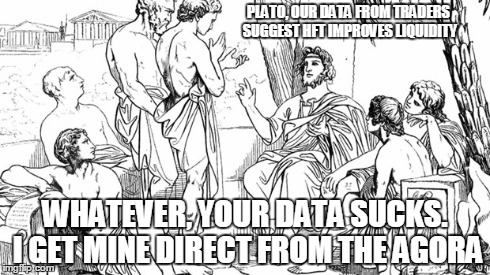
“Most of [HFT] is a very simple speed game of arbitrage. They either arb cash vs futures markets or in equities they get hit/taken in one ECN and sell/buy on somewhere else, either all or most of the money is made from a fraction of rebates in market making equities. Some few firms do milliseconds momentum trading, they realise someone is coming in with orders and they jump ahead of the orders (because they are faster to reach the market) they push the market one cent and sell back to the original buyer… They also use flash orders to jump ahead of big orders. Some also look into depth of book and try to trade as well. There are a few more strategies they use in equities. Also some firms look at options markets and arb the delta hedgers... Most of the strategies are not mathematical but related to microstructure of the markets… These shops are ultra high frequency shops, there could be up to millions of orders a day depending on how many markets and how actively they trade. They require mostly really good C++ skill sets, API connectivity knowledge on the software side. Hardware side they require really low level hardware knowledge such as bypassing the stack and tricking kernels. They also look for lan/wan guys who can push data a few microseconds faster in the network. They use very expensive and specialised equipment. A simple switch that is decently fast costs 50K… All the data that is available to HF groups is available to all traders, the difference is they trade on that information before you can even receive it in your computer. How fast they can get it and react in the market is the difference. They are dealing with single-digit microsecond latencies in their networks and computers, not milliseconds.”
 |
| "PRESENT YOUR IMPARTIAL EVIDENCE" |
 |
| WHAT DO YOU WANT TO SEE? |
 |
| WE'RE INDEPENDENT AGENTS, RESPONDING RATIONALLY TO INCENTIVES! |
But this tech fetishism becomes even more entrenched when it meets with the mainstream economics belief in the virtue and inevitability of rational economic agents pursuing self-interest. It’s here that the dual utopian visions of tech-as-unstoppable-progress and markets-as-unstoppable-progress merge into one stream. If the technology can be built, and provided that some kind of profit can be made by entrepreneurs taking the short-term opportunity to build it, an inertia sets in, an imagined inability to stop the ‘progress’, regardless of whether it is actually useful in the long term or not.
Attempting to stand in the way of such a stream of individual actions is seen as futile, and even unjust, like trying to stop a river flowing down a hill. Indeed, this is part of the implicit background thinking that leads to terms like ‘arms race’ being used to describe the development of HFT (and other technologies). If one entrepreneur doesn’t do it, another will. Ever heard a tech person saying 'you cannot stop technology'?
There is a deep irony to this vision. Above all, there is a distinct lack of agency projected when people insist that ‘this cannot be stopped’, but it gets coupled with a vision of thousands of entrepreneurs all individually impelled through ‘agency’ towards something that will occur regardless of whether they choose to make it occur or not. In other words, a kind of agency towards executing a preordained plan.
This vision of the rational-agent-without-agency is something that plagues much mainstream thinking on economics, a strange blend of extolling the virtue of the risk-taking individual whilst simultaneously asserting that they’re irrelevant, mere puppets acting out the will of ‘the market’.
In reply I'd say: "No Mark, I am not a character out of an Econ 101 textbook. I am perfectly capable of overriding the impulse to play the rigged game, and to decide to not play it. In saying it is inevitable, you’re just trying to justify your own inability to do that." The problem, though, is that provided enough people think like Mark, the inertia continues to be presented as natural, a collective action problem portrayed as a liberator of previously unrealised human potential.
 |
| GOOD DOG, GO FETCH! |
| NETWORK, OR SPIDER'S WEB? |
 |
| NERD CULTURE MEETS JOCK CULTURE |
The stock market is tough. It owes us nothing. It punishes our mistakes. Others have more money, more power, more connections. We are underdogs. We keep learning. We innovate. Every day is a new fight. Technology is our weapon. We make millions of small trades. We cut losses. We identify opportunities. We focus. The market can be beaten. We love the game.
 |
| AS YOU CAN SEE, OUR PRODUCT CAPTURES MEANINGFUL MARKET MOVEMENTS |
That’s a pretty broad description, so I prefer to initially think of financialisation as the end result of things being made 1) ownable 2) investable and 3) tradable. The greater the intensity and extent of these elements, the greater the degree of financialisation of that thing.
We might say that financialisation is the creeping process by which new frontiers of ownership are isolated, and turned into investable products that a wide, disconnected range of dispassionate investors can emotionlessly slide into and trade with each other. The more distant you are from the thing you’re invested in, and the easier it is to trade, and the faster the trading, the more disconnection you can experience.
But, there is a point when the speed of trading hits a tipping point, and takes you into a realm that is no longer about the farm, or anything real for that matter, at all.
This is where HFT take us. While it ostensibly seems to be about the trading of shares on stock-markets (and other things like currencies), in reality HFT has nothing to do with shares. The ‘thing’, or object that is being traded is not actually [a financial instrument], but rather it is [the microscopic tremblings of a financial instrument].
This is a subtle point to convey. Much normal speculative trading is done fast, with a trader quickly buying something and then trying to sell it to someone else. Nevertheless, there is always a sense of a 'thing' being manipulated in some way. Just like when you are flipping a hot potato, there is always a brief moment of being invested in the heat of the real world, even if fleeting, and there is always some residual awareness that there is some 'reality' to the thing. In the case of a BP share, for example, the share has a reality based the fact that it is a legal claim upon what BP owns. It is thus directly connected to the real world outlook of those oil fields and pipelines.
We call traders who make assessments of that reality 'fundamental traders': They might say "I think OPEC is going to decrease supply and thereby boost the price of oil, and thereby boost BPs profit. I will therefore buy this BP share that allows me to benefit from any perceived increase in the value of BP’s collective assets."
The actions of such fundamental traders give rise to a second-degree reality that is exploited by traders who watch the data they generate. We call this technical trading. Such traders may say "Market data suggests that a lot of people are currently buying BP shares. I am going to ride with this sentiment."
Thus, when you in fact do dip into the realm of microseconds, it is highly implausible that an automated trading algorithm is actually being exposed to external ‘outside information’ that has anything to do with either BPs operations, or observation of an emergent trend in people trading BP shares. At that level, all you're doing is highly precise arbitrage activities in microscopic inconsistencies in people's perceptions, or perceptions of perceptions, of reality. The activity going on at the molecular microsecond level is by definition, not about the thing being traded. The sheer emotional disconnection engendered by the technological medium, combined with the sheer speed means that this certainly cannot be thought of as trading in 'things' at all. This is the isolation of, and subsequent trading of microscopic, subconscious instability.
It is the financialisation of meaningless noise, something that previously wasn't subjected to commodification. The algos have an internal world, like the internal world we see in those electron microscope pictures where tiny, imperceptible flakes of dust appears as a whole landscape with valleys and hills. From the perspective of an atom, that world means a lot, but from the perspective of humans, the internal contours of a speck of dust are irrelevant and meaningless. Likewise, at microsecond level, you’re trading meaninglessness.
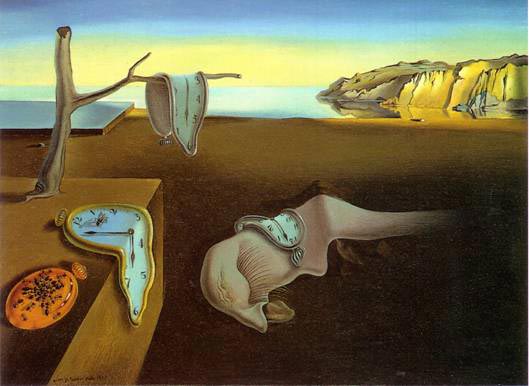
There are probably limits on how much HFT can proliferate. I mean, a parasite relies upon an ecosystem to survive, and in the end, HFT algos have to feed off something. In this case, it’s probably the big institutional investors - the whales that make up the baseload order flow of the market - that 'host' the HFT parasite. The question is not so much whether HFTs can ‘take over’ a market, but rather whether they disrupt it, exert a new cost on it, or otherwise cause a nuisance. (of course, if you're an industry lobbyist, you might alternatively suggest that they ‘offer useful services’ and improve the ecosystem)

|
|

|
|
|


Stefanie Rocknak’s pieces are slightly larger than lifesize, torsos and heads twisted into intense expressions that can be seen in both the face and body. Each work is incredibly serious, the pupil-less eyes seeming to look right through the viewer.
The Swimmer is one of Rocknak’s most active pieces, her subject carved into an environment of rough waves, fighting for a breath while they are caught mid-stroke. Details can be seen down to the swimmer’s wristwatch and veins, palpable adrenaline coursing through the subject’s body.
The New York-based artist’s sculptural practice is highly influenced by her many trips to Europe, especially by Michelangelo, Donatello, and Bernini who she experienced in Rome. Although trained as a painter, she fell in love with the warmth and unpredictability of wood, preferring three dimensional work over two. Rocknak likes to stick to the detail of the work’s physical creation explaining that “conceptual art leaves me cold. So my figures, quite intentionally, are immediate and obvious; ideally, they do not need a theory to do their talking.”
Rocknak has a solo exhibition this spring at the The New York Sculptors Guild Gallery titled The Royal Family. (via Artist a Day)

“Gravity” Hyalophora cecropia on buttonbush
Samuel Jaffe is getting close and personal with subject matter found right in our backyards— the furry, florescent, grubby little creatures we often find inching along our trees and sidewalks. Jaffe is fascinated by local environments, and aims to share the information he has collected about these backyard ecosystems so we can become more in tune with what’s right below our feet or hiding in the grass.
Jaffe has cataloged dozens of caterpillars in different settings, each with a blackened background to highlight their unique textures, colors, and patterns. Caterpillars dangle off branches, clutch onto leaves, and even play on grapevines within his photographs. Catching his subjects at specific moments, Jaffe gives each a little pop of personality, showcasing their playfulness when left alone in nature.
Jaffe grew up in Eastern Massachusetts, inserting himself within his surroundings, wading through ponds, and exploring the wildlife around him. Over the last five years he began to raise and photograph many of the more interesting native caterpillars. The project has grown to include exhibits, shows, talks, and finally in 2013 the Caterpillar Lab, a passionate program showcasing the diversity of northeastern caterpillars through educational programs, the arts, and sciences. Jaffe’s work is currently on display at the Franklin Park Conservatory in Columbus, Ohio in the exhibit “Life on the Leaf Edge.” Prints are available in his online shop. (via The Life Neurotic with Steve’s Issues)

“Red Boots” Apatelodes torrifacta on cherry / “Three Swallowtails” Papilio glaucus, polyxenes, and troilus

“Turbulent Abstract” – Phosphila turbulenta on smilax

“Anatomy of a Caterpillar” – Nadata gibbosa on oak

“Orange Red Green” Eumorpha achemon on grapevine / “Wild Lettuce” Autographa precationis on wild lettuce

“Life on the Leaf Edge” – Nerice bidentata on elm leaf

“Life on the Leaf Edge” Cerura scitiscripta on willow leaf

“The Fawn” Sphinx kalmiae on ash

“Early Kingdom” Lytrosis unitaria

“Emerald Deception” Chlorochlamys chloroleucaria on goldenrod / “Cut Flowers” Eupithecia Pug on blue vervain

“Father of Monsters” Eumorpha typhon on arizona grape








 Expanded from
![]](http://www.ideafixa.com/wp-content/uploads/2015/06/jpg1)