Shared posts

23 Mar 03:13

Time Streams

by Duncan Shields

Author : Duncan Shields, Staff Writer

If I was tripping, my colleagues must have been as well because we all saw it. Just us four janitors on the night shift, mops and brooms dropped, staring at the nightmare in the corner of the building. It spoke to us but I couldn’t see where its mouth was.

“There is more than one timestream. They are connected.” it said.

The alien being glowed blue like a special effect from a bad movie. It took up a corner of the warehouse in a way I didn’t understand. My eyes couldn’t focus on it properly. I could make out tentacles but then they would look like arms and then tentacles again.

“To further the analogy, one could say that there are tributaries, rapids, and rivers as well, all cascading madly in one direction towards the unknowable, distant event horizon of the future. They weave, grow fatter, splash apart and trickle, adding ‘what ifs’ to each other’s histories with the participants being none the wiser before splitting off again.

To abuse the metaphor further, I would say that I am part of a corporation that builds dams. We make time lakes. Smooth-surfaced, still and stable.”

I glanced at Stephen. He stared at me in confusion and fear. We didn’t understand what it was saying. But none of us ran away. We all stood, fascinated and rooted to the spot.

“There are beings that detest the constant motion of naturally occurring time. The sudden turns, the splashing arcs, the stop-and-go nature of it. The eddies and small whirlpools of déjà vu and karmic re-entries. They don’t like the bumpy ride.

Some of these beings build crafts to navigate the streams but only the richest can afford to make them sturdy and strong. The poor ones can only strap together the equivalent of a canoe with a paddle.

They pay to take their ships and drift slowly and softly out over the unchanging surface of our time lakes.

As a bonus, our time reservoir generates huge amounts of power as multiverse entropy fights to keep the time going. We let a small stream through near the bottom to keep the universe happy and to keep the lake at a constant level. We rent the surface time and we sell the power. We win both ways.

This is all metaphor, of course, told to you in terms you can envisage.”

The being shuddered and started to lose its consistency. It seemed to go away from us, down from us, and fade out all at the same time.

“It’s hard to talk to entropic, finite beings about this. You are trapped in time but we live on top of it. But I have to tell you what’s happening.

I’ve fallen overboard and I can’t swim. I’m drowning in your dimension. I can’t conform to your angles and time direction. I was by myself so I don’t think there’ll be much chance of a rescue.

Oh no, this is it. I can’t hold on. I’m sinking.”

The creature disappeared with a shudder and a pop and reality wobbled where it had been.

Stephen looked at Jake and Peter looked at me.

We decided filing a report wouldn’t be worth the paperwork seeing as we’d all probably get fired for using drugs on the job.

We agreed to never speak of it again.

But every now and again, I think of the time lakes while I’m cleaning.

Discuss the Future: The 365 Tomorrows Forums
The 365 Tomorrows Free Podcast: Voices of Tomorrow
This is your future: Submit your stories to 365 Tomorrows

21 Mar 04:27

Small Mercies

by submission

Author : David Atos

The man was sitting at Donald Thompson’s kitchen table when he got home, reading a file.

“Right on time, Mister Thompson.”

Donald jumped back against the wall in alarm.

“Who are you, and how the hell did you get into my apartment?” he shouted.

“I suppose the short answer is that I am a Time Agent, and I got here by time travel.”

“Time travel?”

“Technically, we’re supposed to call it the Quantum Entanglement C-P-T Modulation Transfer, but that’s quite a mouthful. Time travel.”

Donald let out a single barking laugh. “And I suppose you’re here because I’m going to become a horrible serial killer, and you’re going to stop me before I can claim my first victim?”

“Oh, no, Mister Thompson. Donald. Don, if I may? Quite the opposite. You’ve lived a life that is, overall, full of kindness. You’re not a criminal. And even if you were, I couldn’t come back here to kill you.” He shook his head, “No, Don, I’m here because you’re about to die.”

“What?”

“That’s right, Don.” The man consulted the file and his watch. “In twelve minutes’ time, a small aneurysm in the motor cortex of your brain will rupture. Your downstairs neighbour will hear you fall and come up to investigate. The ambulance will take you to the hospital, but the doctors won’t be able to help you. You’ll persist in a vegetative state for five hundred twenty three days, sixteen hours, and thirty two minutes, then pass away. It’s all here in your file.” He slid the folder across the table towards Donald.

Donald snatched at the file. The front page was a cranial MRI. His name on it, and a date two days from now. In the middle of the image was an ugly solid white stain. Donald sat heavily down on the chair opposite the intruder.

“So, are you here to save me, then?”

The man in the white coat smiled ruefully. “I am truly sorry, Don. I’m not here for that either. Time is . . . not robust. It cannot heal changes. The ripples, the perturbations, they expand exponentially. We cannot kill those who deserve to die, nor can we save those who deserve to live.”

“You can’t kill people, you can’t save people. Why are you even here?”

The Time Agent stood up, and began pacing. “All that we can do, Don, is offer . . . small mercies. An extra styrette of morphine for the soldier bleeding out on the battlefield. A few words of love carried from a husband to his dying wife. We help — where we can. For you, we can offer . . . oblivion.” He reached into the pocket of his lab coat and pulled out a single clear capsule, filled with tiny red and white balls.

“Oblivion?” asked Donald, confusion in his voice.

“Yes, Don. I’m sorry. I’m so sorry. The ruptured aneurysm destroys your motor cortex, but the rest of your brain remains completely undamaged. You remain fully aware for all five hundred twenty three days, sixteen hours, and thirty two minutes. And, again, I’m sorry, in significant pain the entire time.”

“But . . . but, you said you can’t kill me either.”

“No, Don. We can’t. This pill,” he holds up the capsule, “is nothing more than a measured dose of Aspirin. A blood thinner. If you take this pill, the bleeding in your brain will be ever so slightly worse. Not only will your motor cortex be destroyed, there will also be irreparable damage to your cerebrum. Your body will continue to live, but your consciousness, your sense of self, that will be gone the instant you drop to the floor in,” he glances again at his watch, “seven and one-half minutes.”

“So, that’s the choice you’re giving me? Take this pill, and instead of a year and a half of agony, I just pop straight off to Heaven?”

The man in the white coat laughed. “Oh, Don! If only we could answer that question for you. For all of our advances, we still don’t know what happens to the consciousness, to the soul, after death. A dozen dozen religions argue just as passionately about that in the future as they do now. I can’t offer you any assurances, Don. I can only offer you a chance to avoid suffering.”

Donald slammed the file sitting in front of him and stood up, pointing an accusatory finger at the stranger. “Why should I believe you at all? Huh? You’re just some guy who got into my apartment somehow!”

“Well, it’s a bit like Pascal’s wager, isn’t it?” replied the stranger. “If I’m lying, all you’ve done is taken some painkillers. But if I’m telling the truth . . . Look, I’ll even make it simpler. If you don’t trust this pill,” he placed the capsule on the table, “you need to take two extra strength Aspirins. But you’ll have to hurry. You are running out of time.”

Donald slumped down into the chair at his kitchen table again. He stared mutely at the file in front of him. Slowly, he reached out and picked up the capsule.

The stranger walked around the table and sat next to Donald, putting a hand on his shoulder. “I can’t promise you much, Don. But I can promise you this: You won’t die alone.”

Donald lifted the capsule for a closer look, and inspected the tiny printing on the side. Two words, in simple, black lettering:

small mercies

Discuss the Future: The 365 Tomorrows Forums
The 365 Tomorrows Free Podcast: Voices of Tomorrow
This is your future: Submit your stories to 365 Tomorrows

17 Mar 15:06

It’s Not a Racial Issue

by submission

Author : Emily Stupar

I’m falling and I’m not sure when it started, or when it’s going to end. Although, I do have some theories.

Maybe I’m falling because I’m fulfilling a lifelong wish to go skydiving. There’s a bot instructor strapped to my back and all I can think is that I may as well have jumped out of a plane with a floppy disk in my hand for all the good it’ll do me.

Or maybe I’m a space explorer and I’m not falling but floating. Everyone is counting on me to get this sample so we’ll know if there’s any competition out there in the stars, or if it’s just us humans and whatever mindless bits of metal we scrap together.

Maybe I was driving down the Pacific Coast Highway and then I heard on the radio about that police officer who was slaughtered by a bot in his own home. Killed by his own property. And then I was so shocked by the sound of a human being siding with the tin can that I accidentally drove off into the ocean.

Maybe I jumped off the roof after finding my spouse with the android who was fixing our plumbing.

Or maybe it’s something a bit more metaphorical and I’m falling from grace. I’m falling out of favor with nature. Maybe I’m falling because the familiar ground has dropped out from beneath my feet one piece at a time, but so slowly that I just woke up one day and suddenly I didn’t recognize my own home anymore.

Maybe Mother Nature wasn’t my mother at all; she’s my landlady and she’s not happy that I’ve drifted so far from the terms of my lease. I’ve been evicted for allowing humans to push past the limit of what is good and natural, and now I’m falling headfirst onto the pavement.

Or maybe I know a secret about all these heaps of wires and electrical signals that are worming their way into every aspect of our lives. I see the true consequences of letting man think he is God, or letting a man-made machine think it could live. Maybe I know a vulnerable place and I have the materials to force the world to stop and see the truth. Maybe I’m falling because I strapped a bomb to my back and, next to all that delicate machinery, I launched myself into the air. For humanity.

I really can’t say for sure, but, as far as I know, I’m the only one whose falling. My entire race has lost their minds, opening their naïve hearts to the whispers of manipulative demons, and I’m not sure I have the stomach to watch. I’ve been falling ever since I realized I was the one who needed to save humans from themselves.

I’m falling and I just hope everyone is braced for my impact.

Discuss the Future: The 365 Tomorrows Forums
The 365 Tomorrows Free Podcast: Voices of Tomorrow
This is your future: Submit your stories to 365 Tomorrows

16 Mar 02:34

Jeb Bush sold patronage and favors to his top political donors

by Cory Doctorow
Bewarethewumpus

Anyone who is capable of attaining the position AND wants to do the job, should never, under any circumstances, be allowed to be president.

The AP analysis of Bush's 275,000 FOIA'ed emails show that "donations" to his campaign were really more like "purchases."

Of course, this is what everyone suspects -- indeed, is certain of -- in the case of politicians. But it's one thing to see the money come in and the appointments flow out, and another to read the elected officials corresponding with their staffers saying, basically, "Hey, this guy gave me a lot of money, let's give him this plum appointment."

By the way, I'd be pretty fucking surprised if H Clinton's complete email trove was any less damning.

Take William ‘Bill’ Becker, a Florida citrus grower and longtime Republican donor. “He was among the circle of loyalists invited to huddle with Bush in December to hear about his presidential ambitions,” the AP wrote, citing Becker’s years of concurrent political donations to Bush and lobbying him on matters ranging from state citrus marketing funds, appointments to a citrus marketing board and hospital association, and college donations.

Speaking of a candidate to the Florida Citrus Commission, who Bush did appoint, Becker wrote, “She and her family have been loyal supporters… You met her at the Governor's Mansion on one occasion and I believe you may have met her at the Florida House event at our home. I believe she is immensely well qualified to serve on the Florida Citrus Commission.”

Nine days later, after she got the post, Becker wrote, “Many thanks for an expedited and wonderful appointment.”

The AP’s example of Becker’s interactions with Bush is not unique. The issues may not be as riveting as whether Bush tried to prevent a hospital from turning off the life support system for Terri Schaivo—a major issue for some conservative Christians, or fight federal government efforts to send Elian Gonzales, a Cuban child, back to that country in a custody dispute. But they are what the daily life of a governor often consists of. If anything, the New Yorker's recent profile of Bush's efforts to privatize public education and how that made him and a handful of business colleagues wealthy, is a much more troubling picture of political corruption.

Jeb Bush Email Trove Reveals Predictable Trail Of Access and Favors For Top Donors [Steven Rosenfeld/Alternet]

(Image: Bribe, Eugene Pivovarov, public domain)

This entry passed through the Full-Text RSS service - if this is your content and you're reading it on someone else's site, please read the FAQ at fivefilters.org/content-only/faq.php#publishers.

16 Mar 02:06

What Net Neutrality Opponents Are Saying Now — And Why It’s A Lot Of Hot Air

by Kate Cox

While supporters of an open internet are excited about the FCC’s recent net neutrality ruling, some folks in the telecom and ISP world are a whole lot less happy. Many of the big businesses affected by the rule had their say in February when the vote happened, but the recent release of the full rule (all 400 pages of it) this week has become an opportunity for many groups afraid of new regulation to once again put their concerns front and center in the limelight.

It’s always a good idea to take a careful look at, and a deep dive into, the wording of a new regulation to think about the possible consequences. However, some trade organizations and think tanks still have strong concerns about the open internet order that just don’t match up to the actual rule the FCC released.

Take the Telecommunications Industry Association, for example, a trade group that represents dozens of tech companies. Its members run the gamut from tiny and obscure to huge and global, from Apple to ZTE.

The TIA’s CEO, Scott Belcher, said in a statement that Title II is “a trojan horse,” primed to unleash “heavy government control of the internet and create marketplace uncertainty.”

Belcher continued, “With Title II in place, there is little to stop future commissioners from instituting government price controls or other market-distorting regulations. The FCC’s promise of a light-touch approach is just that – a promise. There is too much at stake to allow the future of the Internet to rest upon a simple promise. … The immediate uncertainty created by this plan will produce a slowdown in capital investment. Consumers and small businesses, who have benefited enormously from the existing regulatory landscape, will bear the burden of a less robust network.”

Others have echoed the sentiment. Over on the think tank side of things, TechFreedom, a tech-related organization that has previously explicitly advocated in favor of paid prioritization, focused hard on the argument that the FCC doesn’t actually have the authority to regulate communications.

TechFreedom president Berin Szoka said in a statement that the new rule “effectively destroys nearly 18 years of bipartisan consensus,” calling it “a radical break even from the FCC’s proposed rules.”

After railing against the politicization of the process, Szoka said that the FCC is “effectively, and illegally, rewriting the Communications Act,” and concluded that “the only way to restore sanity at the FCC is for Congress to finally update the Communications Act.”

Several members of the American Enterprise Institute, a major pro-business think tank, also expressed consternation at the rule. Many called back to the original Communications Act of 1934 and the FCC’s early history dealing with a monopolistic telephone environment.

AEI visiting fellow Roslyn Layton said, “The FCC has chosen to classify broadband under the regulations of the monopoly telephone era, a sharp reversal of its policy that allowed broadband to be relatively free from regulation. In so doing, the FCC opens the Internet to hundreds of rules and provisions. Anything that the FCC deems a telecommunications service, ‘transmission between or among points specified by the user, of information of the user’s choosing,’ could be regulated. The FCC has also created the ability to hear disputes and bring actions against companies using a ‘standard of conduct’ clause. Interconnection may be the first battle.”

That part — that interconnection agreements are a battle waiting to happen — is probably true. Tensions have been running high between key players (like Netflix and Comcast) in the interconnection space for many months and those fires are unlikely to douse themselves as time goes on.

However, many of the other claims by net neutrality opponents are, well, more on the side of myth than on the side of fact.

The FCC has itself created a mythbusting, fact vs. fiction rundown of the most popular objections to the open internet rule.

In response to the popular claim that Title II is “utility regulation,” for example, the FCC says: “There is no ‘utility-style’ regulation. The Order bars the kinds of tariffing, rate regulation, unbundling requirements and administrative burdens that are the hallmarks of traditional utility regulation.”

The FCC also addresses the accusations of rate regulation (there is none) and the imposition of new taxes and fees (there are none of those either) before jumping into the most frequent accusation: “government takeover of the internet.”

“The order,” the FCC reiterates, “does not regulate the internet.”

The Commission continues:

It applies to broadband providers –- the companies that connect people’s homes to the public Internet. In other words, the Order protects consumers’ and innovators’ “last-mile” access to what’s on the Internet — the applications, content or services that ride on it and the devices that attach to it. It means consumers can go where they want, when they want and it means innovators can develop products and services without asking for permission.

As for the repeated accusations that a future FCC could change the rule, to make it either more or less strict? Well, yes. They could, but not without the public knowing about it.

The FCC can undertake the rulemaking  process whenever it sees fit, to amend any of its existing rules, or to create new ones. That’s what regulatory agencies do: they create, amend, and sometimes repeal or overturn regulations.

But it would indeed have to be the rulemaking process. The current order doesn’t have expiration dates built in. There is no note saying, “We forbear from this section temporarily until we no longer feel like it and can change our minds when the political winds blow elsewhere.” The order says: We forbear from this section.

The FCC is in some ways the picture of inertia: when its mind is made up, it stays that way unless acted upon by an outside force — like, say, the Verizon lawsuit that got the 2010 open internet rule thrown out.

Mobile voice service, as members of the FCC often point out, has been regulated under Title II for 20 years, and while control of the FCC has changed hands plenty of times since the mid-’90s — as has the political party in control of the White House — no FCC Chair has spontaneously decided to change the rules to add rate regulation.

If a future FCC wants to change something about the open internet order, they can go through the process again. They always could.

But just because a future regulator might want to endure the onerous process of amending the neutrality rules that is no reason to not have strong consumer and business protections in the here and now.

15 Mar 22:24

The Sinking of the Titanic, Rendered in Unreal Engine 4

by Gergo Vas

The Sinking of the Titanic, Rendered in Unreal Engine 4

Titanic: Honor & Glory is project dedicated to recreating the RMS Titanic's ill-fated maiden voyage using Unreal Engine 4, and they made a video showing the famous grand staircase of the ship disappearing.

Their goal is to recreate the entire ship, its voyage and its final hours. The final game will include a free roam mode where we can wander around the ship with minimal crowds and no objectives and watch as everything is slowly engulfed by the icy waters.

Looks and sounds frightening enough, probably no need for Oculus support or horror elements.

To contact the author of this post, write to: gergovas@kotaku.com

This entry passed through the Full-Text RSS service - if this is your content and you're reading it on someone else's site, please read the FAQ at fivefilters.org/content-only/faq.php#publishers.

14 Mar 14:20

Anti-vaxxer ordered to pay EUR100K to winner of "measles aren't real" bet

by Cory Doctorow


Stefan Lanka, a "vaccination skeptic" who claims that measles are a psychosomatic condition brought on by "traumatic separations," publicly challenged people to prove that measles was caused by a virus.

So David Barden, a German MD, took him to court to prove that he was owed €100,000 according to the terms of his bet. He won.

On Thursday, a Ravensburg court ordered Lanka to pay up because all the criteria of his wager had been fulfilled. Court spokesman Matthias Geiser said the judges had deliberated for three hours and concluded there was “no doubt about the existence of the measles virus.”

Lanka told German news site The Local that he will appeal the ruling “because we know that the ‘measles virus’ doesn’t exist, and according to biology and medical science can’t exist.” In 1995, Lanka penned an article questioning whether the virus that causes Aids was “Reality or Artefact?

Biologist ordered to pay €100k after losing wager that a virus causes measles [Calvin Ayre/Gambling News] (Thanks, Ben!)

This entry passed through the Full-Text RSS service - if this is your content and you're reading it on someone else's site, please read the FAQ at fivefilters.org/content-only/faq.php#publishers.

13 Mar 22:49

Wild Game Cubes Spotted in Natural Habitat

by Brad
6e9
13 Mar 22:46

Florida Man pilot draws penis with private plane's flight path

by Xeni Jardin
N829BM

Congrats, tail number N829BM. That was very Florida Man of you. Data, via Flight Radar.

This entry passed through the Full-Text RSS service - if this is your content and you're reading it on someone else's site, please read the FAQ at fivefilters.org/content-only/faq.php#publishers.

13 Mar 19:42

The Madness of Skyrim Mods, Captured In Three Minutes

by Patricia Hernandez

Watch as one man tries to see how far he can push Skyrim before everything crumbles into complete chaos.

You've got your typical wacky Skyrim mods here—Thomas the Tank Engine as dragons, Tommy Wiseau horses, Sonic. But it doesn't take long for you to stop being able to track all the mods videogamedunkey activates—the entire game just becomes bananas. It's the best thing I've watched all day. Enjoy.

This entry passed through the Full-Text RSS service - if this is your content and you're reading it on someone else's site, please read the FAQ at fivefilters.org/content-only/faq.php#publishers.

13 Mar 16:27

#Megagamerzgate

by jon

2015-03-13-Megagamerzgate

The Megagamerz are back again to mix it up with things and thoughts! They are realer than real, wetter than fish. Don’t mess with Gamer1 and Gamer2 unless you like pork and punches.

Okay!

goat-rfv[1]

12 Mar 16:28

Maybe Obama’s Sanctions on Venezuela are Not Really About His “Deep Concern” Over Suppression of Political Rights

by Glenn Greenwald

The White House on Monday announced the imposition of new sanctions on various Venezuelan officials, pronouncing itself “deeply concerned by the Venezuelan government’s efforts to escalate intimidation of its political opponents”: deeply concerned. President Obama also, reportedly with a straight face, officially declared that Venezuela poses “an extraordinary threat to the national security” of the U.S. — a declaration necessary to legally justify the sanctions.

Today, one of the Obama administration’s closest allies on the planet, Saudi Arabia, sentenced one of that country’s few independent human rights activists, Mohammed al-Bajad, to 10 years in prison on “terrorism” charges. That is completely consistent with that regime’s systematic and extreme repression, which includes gruesome state beheadings at a record-setting rate, floggings and long prison terms for anti-regime bloggers, executions of those with minority religious views, and exploitation of terror laws to imprison even the mildest regime critics.

Absolutely nobody expects the “deeply concerned” President Obama to impose sanctions on the Saudis — nor on any of the other loyal U.S. allies from Egypt to the UAE whose repression is far worse than Venezuela’s. Perhaps those who actually believe U.S. proclamations about imposing sanctions on Venezuela in objection to suppression of political opposition might spend some time thinking about what accounts for that disparity.

That nothing is more insincere than purported U.S. concerns over political repression is too self-evident to debate. Supporting the most repressive regimes on the planet in order to suppress and control their populations is and long has been a staple of U.S. (and British) foreign policy. “Human rights” is the weapon invoked by the U.S. Government and its loyal media to cynically demonize regimes that refuse to follow U.S. dictates, while far worse tyranny is steadfastly overlooked, or expressly cheered, when undertaken by compliant regimes, such as those in Riyadh and Cairo (see this USA Today article, one of many, recently hailing the Saudis as one of the “moderate” countries in the region). This is exactly the tactic that leads neocons to feign concern for Afghan women or the plight of Iranian gays when doing so helps to gin up war-rage against those regimes, while they snuggle up to far worse but far more compliant regimes.

Any rational person who watched the entire top echelon of the U.S. government drop what they were doing to make a pilgrimage to Riyadh to pay homage to the Saudi monarchs (Obama cut short a state visit to India to do so), or who watches the mountain of arms and money flow to the regime in Cairo, would do nothing other than cackle when hearing U.S. officials announce that they are imposing sanctions to punish repression of political opposition. And indeed, that’s what most of the world outside of the U.S. and Europe do when they hear such claims. But from the perspective of U.S. officials, that’s fine, because such pretenses to noble intentions are primarily intended for domestic consumption.

As for Obama’s decree that Venezuela now poses an “extraordinary threat to the national security” of the United States, is there anyone, anywhere, that wants to defend the reasonability of that claim? Think about what it says about our discourse that Obama officials know they can issue such insultingly false tripe with no consequences.

But what’s not too obvious to point out is what the U.S is actually doing in Venezuela. It’s truly remarkable how the very same people who demand U.S. actions against the democratically elected government in Caracas are the ones who most aggressively mock Venezuelan leaders when they point out that the U.S. is working to undermine their government.

The worst media offender in this regard is The New York Times, which explicitly celebrated the 2002 U.S.-supported coup of Hugo Chavez as a victory for democracy, but which now regularly derides the notion that the U.S. would ever do something as untoward as undermine the Venezuelan government. Watch this short video from Monday where the always-excellent Matt Lee of Associated Press questions a State Department spokesperson this week after she said it was “ludicrous” to think that the U.S. would ever do such a thing:

The real question is this: if concern over suppression of political rights is not the real reason the U.S. is imposing new sanctions on Venezuela (perish the thought!), what is? Among the most insightful commentators on U.S. policy in Latin America is Mark Weisbrot of Just Foreign Policy. Read his excellent article for Al Jazeera on the recent Obama decree on Venezuela.

In essence, Venezuela is one of the very few countries with significant oil reserves which does not submit to U.S. dictates, and this simply cannot be permitted (such countries are always at the top of the U.S. government and media list of Countries To Be Demonized). Beyond that, the popularity of Chavez and the relative improvement of Venezuela’s poor under his redistributionist policies petrifies neoliberal institutions for its ability to serve as an example; just as the Cuban economy was choked by decades of U.S. sanctions and then held up by the U.S. as a failure of Communism, subverting the Venezuelan economy is crucial to destroying this success.

As Weisbrot notes, every country in the hemisphere except for the U.S. and Canada have united to oppose U.S. sanctions on Venezuela. The Community of Latin American and Caribbean States (CELAC) issued a statement in February in response to the prior round of U.S. sanctions on Venezuela that “reiterates its strong repudiation of the application of unilateral coercive measures that are contrary to international law.” This week, the chief of the Union of South American Nations (UNASUR) issued a statement announcing that “UNASUR rejects any external or internal attempt at interference that seeks to disrupt the democratic process in Venezuela.” Weisbrot compares Obama’s decree this week on Venezuela to President Reagan’s quite similar 1985 decree that Nicaragua was a national security threat to the U.S., and notes: “The Obama administration is more isolated today in Latin America than even George W. Bush’s administration was.”

If Obama and supporters want the government of Venezuela to be punished and/or toppled because they refuse to comply with U.S. dictates, they should at least be honest about their beliefs so that their true character can be seen. Pretending that any of this has to do with the U.S. Government’s anger over suppression of political opponents — when their closest allies are the world champions at that — should be too insulting of everyone’s intelligence to even be an option.

Photo of Venezuela’s President Nicolas Maduro (Ariana Cubillos/AP).

The post Maybe Obama’s Sanctions on Venezuela are Not Really About His “Deep Concern” Over Suppression of Political Rights appeared first on The Intercept.

12 Mar 16:10

Good Ol' Family Fun With Atari 2600

by Brad
B12
12 Mar 15:30

Managing Expectations, by Ross Merriam

Bewarethewumpus

A fine read for any competitor who wants to improve.

Ross Merriam got some sound advice from Gerry Thompson over the weekend, and now he wants to pass it onto you before you jet off to #SCGDAL!
12 Mar 14:43

Entering the BIOS

by sharhalakis

by @just_hank_moody, andreibkn and necessaryaegis

12 Mar 01:26

asvprock:don’t use the bathroom in your dream its a setup

asvprock:

don’t use the bathroom in your dream its a setup

12 Mar 01:26

awkwardparker:These are facts! #cosplay #superheroes #beyourself...

by wagatwe


awkwardparker:

These are facts! #cosplay #superheroes #beyourself #geekculture #nerdlife

12 Mar 00:44

The Legend of Zelda: Majora's Mask 3D

by Ben "Yahtzee" Croshaw
Bewarethewumpus

This is timely.

This week, Zero Punctuation reviews The Legend of Zelda: Majora's Mask 3D.
11 Mar 19:22

When Cards Against Humanity was first released to the world, it was made available under a Creative

by Blips
Bewarethewumpus

awesome.

When Cards Against Humanity was first released to the world, it was made available under a Creative Commons license that meant that anyone could simply print our their own copy of the game. Or, as designer Dawson Whitfield did, turn it into an online browser-based web app so that... [Toyland]

This entry passed through the Full-Text RSS service - if this is your content and you're reading it on someone else's site, please read the FAQ at fivefilters.org/content-only/faq.php#publishers.

11 Mar 18:33

Are You Tough Enough?

by Brad
37d
11 Mar 15:32

Dragon Ball Figures Are Cooler with Holograms

by Brian Ashcraft

Dragon Ball Figures Are Cooler with Holograms

Sorry, cooler? No. I meant, hotter.

Using a Dragon Ball Goku figure and a clear pyramid, Brazil's ZW Design created this impressive hologram effect.

If you are interested in how effects like these are made, YouTuber RimstarOrg has a helpful walkthrough.

To contact the author of this post, write to bashcraftATkotaku.com or find him on Twitter @Brian_Ashcraft.

This entry passed through the Full-Text RSS service - if this is your content and you're reading it on someone else's site, please read the FAQ at fivefilters.org/content-only/faq.php#publishers.

11 Mar 15:06

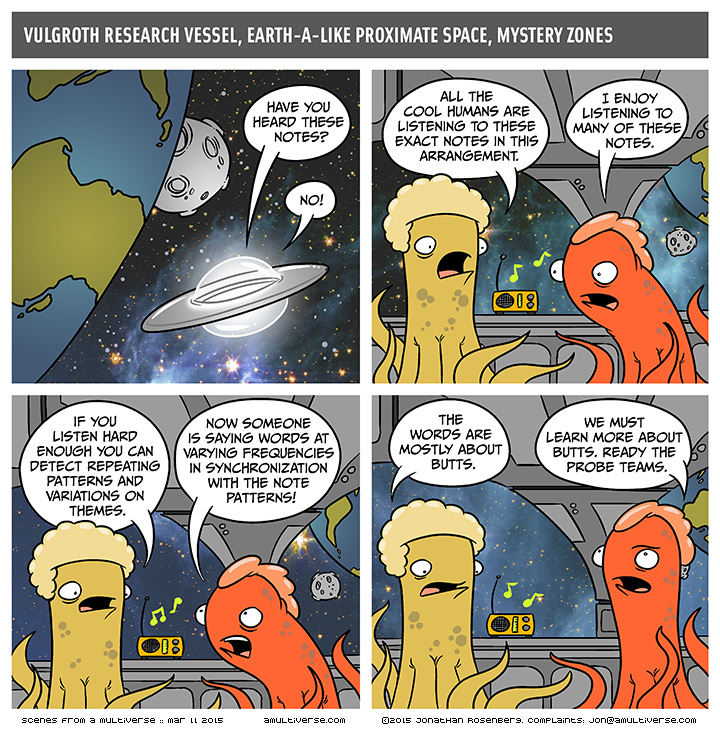
All The Notes

by jon

2015-03-11-All-The-Notes

Aliens! Always with the eavesdropping and the anal investigation and the transgalactic benders. Whaddya gonna do.

OK kids! Have a great day or so.

civilserpents

10 Mar 22:58

Wikimedia, Amnesty International, Others Sue NSA Over Mass Surveillance

by Chris Morran

The foundation behind Wikipedia, along with several other high-profile non-profit organizations, has sued the National Security Agency challenging its “suspicionless seizure and searching of internet traffic” in the U.S., claiming that this mass data collection goes beyond what the law allows the NSA to collect and that it violates protections afforded by the Constitution and the Bill of Rights.

The complaint [PDF] was filed today in a federal court in Maryland, the Wikimedia Foundation and the other plaintiffs — Amnesty International, Human Rights Watch, PEN American Center, Global Fund for Women, the National Association of Criminal Defense Lawyers, the Rutherford Institute, the Washington Office on Latin America, and The Nation magazine — and names as defendants the NSA, its Director Admiral Michael Rodgers, the Office of the Director of National Intelligence and said Director James Clapper, the Dept. of Justice, and U.S. Attorney General Eric Holder.

The particular form of mass data collection being targeted by the suit is so-called “upstream” surveillance, which involves the NSA accessing the “backbone” of the Internet in the U.S., intercepting data as it travels between destinations online.

“In the course of this surveillance, the NSA is seizing Americans’ communications en masse while they are in transit, and it is searching the contents of substantially all international text-based communications — and many domestic communications as well — for tens of thousands of search terms,” contends the complaint.

In 1978, Congress enacted the Foreign Intelligence Surveillance Act, intended to provide a system for authorizing legal government surveillance to counter the decades of unchecked, unwarranted information-gathering by federal agencies on private citizens who were never accused or suspected of any particular crimes.

And for more than two decades, the FISA generally required the government to seek individualized orders from the Foreign Intelligence Surveillance Court, showing that a “significant purpose” of the surveillance was the gathering of foreign intelligence.

Then in 2001, President Bush created (and subsequently reauthorized) the President’s Surveillance Program for warrantless wiretapping when the government had a reasonable basis to believe that at least one party on a phone call was in some way connected to Al Qaeda.

In July 2008, the FISA Amendments Act (“FAA”) was enacted, expanding the scope of FISA, by authorizing the government to gather information on international communications without demonstrating any individualized suspicion, and on a wider variety of communications platforms.

At this point, contend the plaintiffs, the FISC stopped being used to review individual surveillance applications, just the processes of surveillance.

“The FISC’s role in overseeing the government’s surveillance under the statute consists principally of reviewing these general procedures,” reads the complaint. “The FISC never reviews or approves the government’s individual surveillance targets or the facilities it intends to monitor. Rather, when the government wishes to conduct surveillance under the statute, it must certify to the FISC that the court has approved its targeting and minimization procedures or that it will shortly submit such procedures for the FISC’s approval.”

The plaintiffs allege that this lack of direct oversight gives the government “sweeping authority to conduct warrantless surveillance of U.S. persons’ international communications.”

Even though the law prohibits the government from intentionally targeting people in the U.S., the NSA may still gather data regarding our communications with people outside our borders; and those people don’t have to be terror suspects or international fugitives.

“The statute does not require the government to make any finding — let alone demonstrate probable cause to the FISC — that its surveillance targets are foreign agents, engaged in criminal activity, or connected even remotely with terrorism,” reads the complaint. “The government may target any person for surveillance if it has a reasonable belief that she is a foreigner outside the United States who is likely to communicate ‘foreign intelligence information’ — a term that is defined so broadly as to encompass virtually any information relating to the foreign affairs of the United States.”

And even though the ostensible targets of this surveillance are foreign persons, there are nonetheless implications for Americans.

“The targets of FAA surveillance may include journalists, academic researchers, human rights defenders, aid workers, business persons, and others who are not suspected of any wrongdoing,” argue the plaintiffs. “In the course of FAA surveillance, the government may acquire the communications of U.S. citizens and residents with all these persons.”

And the government has used this mass surveillance to gather an awful lot of data about a large number of people. The complaint cites the government’s own report showing that it used the amended FISA to target 89,138 individuals, groups, or organizations for surveillance under a single court order in 2013. In 2011 alone, the government gathered 250 million online communications, without providing any info on how many of these involved U.S. citizens or residents.

The plaintiffs contend that NSA has even gone further than the already lenient law allows, claiming that the 2008 statute only specifically allows for surveillance of a target’s communication, not the reviewing or “essentially everyone’s internet communications in order to search for identifiers associated with its targets.”

“By tapping the backbone of the internet, the NSA is straining the backbone of democracy,” said Lila Tretikov, executive director of the Wikimedia Foundation, in a statement. “Wikipedia is founded on the freedoms of expression, inquiry, and information. By violating our users’ privacy, the NSA is threatening the intellectual freedom that is central to people’s ability to create and understand knowledge.”

The government’s actions, argue the plaintiffs, violate their First Amendment rights to free expression, their Fourth Amendment protection against unreasonable search and seizure. Furthermore, the FISC’s lack of oversight over this surveillance allegedly runs afoul of Article III of the Constitution, which established the judicial branch of the federal government.

“Under U.S. law, the role of the courts is to resolve ‘cases” or “controversies’ — not to issue advisory opinions or interpret theoretical situations,” reads a statement from the Wikimedia Foundation. “In the context of upstream surveillance, FISC proceedings are not ‘cases.’ There are no opposing parties and no actual ‘controversy’ at stake. FISC merely reviews the legality of the government’s proposed procedures — the kind of advisory opinion that Article III was intended to restrict.”

The plaintiffs are asking the court to declare the government’s upstream data collection unlawful and to issue an injunction preventing the NSA and other agencies from continuing to surveil the plaintiffs in this manner. Finally, they seek to compel the government to purge all data already collected.


10 Mar 18:41

Photo


10 Mar 16:33

Senate Bill Would Decriminalize Medical Marijuana In States Where It’s Already Legal

by Mary Beth Quirk

A Senate bill expected to be introduced today would have the federal government ease up on the states that already have legalized medical marijuana, effectively keeping patients, doctors, dispensaries and growers from federal prosecution, and would also remove marijuana from the list of most dangerous drugs, according to reports.

In a bill sponsored by Sens. Cory Booker (D-N.J.), Rand Paul (R-Ky.), and Kirsten Gillibrand (D-N.Y.), the 23 states (and the District of Columbia) that have legalized medical cannabis would be kept from the baleful eye of the Drug Enforcement Administration.

This means better access for military veterans in those states, as it would allow Veterans Affairs doctors to recommend marijuana for medical use, reports the Huffington Post.

In addition, it would knock marijuana from a Schedule 1 drug classification — a category designated for drugs with no accepted medical use, including heroin and LSD — to a Schedule II.

According to the Washington Post, it would also make it easier to transport medical marijuana between some states, as there are about a dozen states that allow restricted access to medicine derived from low THC marijuana. To make access easier for those patients, the proposed bill is said to ease restrictions on interstate transport of such medicine.

The bill would also facilitate the job of banks as they try to provide services to the growing marijuana industry, just like they do other businesses. It would reform the National Institution on Drug Abuse as well, in order to broaden access to cannabis for research purposes.

“This bipartisan legislation allows states to set their own medical marijuana policies and ends the criminalization of patients, their families, and the caregivers and dispensary owners and employees who provide them their medicine,” Michael Collins, policy manager for the Drug Policy Alliance, said in a statement.

To be clear, this wouldn’t make marijuana legal under federal law, but it could pave the way for more research in states that wouldn’t have to worry about federal interference. In the states that have legalized marijuana or decriminalized it to some extent, the federal government has issued guidance to prosecutors to urge them to from targeting marijuana operations in those states.

The bill is expected to be announced today around 12:30 p.m. EST.

Meanwhile, Utah just narrowly defeated a medical marijuana bill in that state, so that means the bunnies there are safe from the munchies for now.

Senate Bill Would Ease Federal Prohibition Of Medical Marijuana [Huffington Post]
What’s in the historic medical marijuana bill being unveiled [Washington Post]

10 Mar 15:09

The Apple Watch Comparison Anime Fans Are Waiting For

by Brian Ashcraft
Bewarethewumpus

The only truly fair comparison.

The Apple Watch Comparison Anime Fans Are Waiting For

Yesterday, Apple revealed a whole slew of information about its Apple Watch line-up. No doubt many anime fans have been wondering the same thing: How does the Apple Watch compare to the Yokai Watch? Good question! Let's find out.

Yokai Watch is a video game anime that took over Japan last year. In Yokai Watch, the main character, Keita, has a watch that allows him to see yokai, which are a type of Japanese monster. The Yokai Watch was last year's hot—and very hard to get—toy.

The Yokai Watch toy doesn't actually tell time. It makes noises and has a light you can point at something. But that's okay that it doesn't tell time. That's what smartphones are for, right?

Here is the Yokai Watch toy.*

The Apple Watch Comparison Anime Fans Are Waiting For

[Photo: Amazon]**

Twitter user Soo_mei compared the US$30 Yokai Watch with the Apple Watch that starts at a few hundred bucks and gets way more pricey. This is a serious comparison that needed to be done.

The Apple Watch Comparison Anime Fans Are Waiting For

Yep. Further evidence that I don't need an Apple Watch.

Top photo: Surpara

*This is not my arm.

**I have hairier arms.

To contact the author of this post, write to bashcraftATkotaku.com or find him on Twitter @Brian_Ashcraft.

Kotaku East is your slice of Asian internet culture, bringing you the latest talking points from Japan, Korea, China and beyond. Tune in every morning from 4am to 8am.

This entry passed through the Full-Text RSS service - if this is your content and you're reading it on someone else's site, please read the FAQ at fivefilters.org/content-only/faq.php#publishers.

10 Mar 05:25

Court Awards $95K To Ferrari Owner Whose Car Was Seized, Auctioned Off After DWI Arrest

by Mary Beth Quirk

There must be something in the air today, as luxury cars are making news headlines left and right: Joining the mysterious, abandoned Lamborghini in the news spotlight is the owner of a Ferrari who successfully sued after police seized and auctioned off his car after a DWI arrest in 2009.

A New York man who coincidentally shares his name with the luxury sports car manufacturer was pulled over for speeding and suspicion of driving while intoxicated back in 2009, reports the New York Post.

Police impounded the 2003 Ferrari Modena, and kept it, despite the owner’s fight to get his car returned. A a Suffolk County judicial officer ruled in favor of the police, according to court papers, saying they had probable cause to keep the Ferrari.

Forfeiture proceedings followed, and the man had to surrender the title to the car in 2012 as part of a settlement. The vehicle was later auctioned off for an undisclosed sum by the county.

He then took his case to federal court, claiming the car was worth $110,000 and the county had no right to sell his property. A judge agreed, and a jury has now awarded him $95,000.

“I’m very happy that it’s done with,” the man told the NYP. ‘The government taking people’s property isn’t right.”

Broker named Ferrari awarded $95K after cops ‘stole’ his Ferrari [New York Post]

10 Mar 05:25

Albuquerque PD encrypts videos before releasing them in records request

by Cory Doctorow

Har-har-fuck-you, said Albequerque's murderous, lawless police department, as they fulfilled a records request from Gail Martin, whose husband was killed by them, by sending her encrypted CDs with the relevant videos, then refusing to give her the passwords.

Now the APD's being sued. The firm is seeking not only access to the password-protected videos, but also damages and legal fees. According to the firm, access to these videos is crucial to determining whether or not Gail Martin has a legitimate civil rights case. Without them, the firm is no better positioned to make this call than the general public, which has only seen the lead-in and aftermath of the shooting.

This isn't the APD's only legal battle related to its IPRA non-compliance. Late last year, KRQE of Albuquerque sued it for "serial violations" of the law. That's in addition to the one it filed over a 2012 incident, in which the PD stalled on its response to a journalist's public records request before releasing the requested footage at a press conference, basically stripping the reporter of her potential "scoop."

Albuquerque Police Dept. 'Complies' With Records Request By Releasing Password-Protected Videos... But Not The Password [Tim Cushing/Techdirt]

This entry passed through the Full-Text RSS service - if this is your content and you're reading it on someone else's site, please read the FAQ at fivefilters.org/content-only/faq.php#publishers.

09 Mar 18:46

Airbag video: the difference 7/100ths of a second make

by Mark Frauenfelder

[via]

This entry passed through the Full-Text RSS service - if this is your content and you're reading it on someone else's site, please read the FAQ at fivefilters.org/content-only/faq.php#publishers.

09 Mar 16:53

The Most Complex Besiege Bomb Delivery System

by Gergo Vas

The Most Complex Besiege Bomb Delivery System

The Besiege community never disappoints when it comes to building deliberately over-engineered siege engines to perform the simple task of eliminating a few knights. David Mcl's Rude Goldberg machine-like bomb delivery system is no exception—it's one of the finest creations I've seen so far.

You can follow the bomb's path in the video below.

But like every creation in Besiege this one has flaws too. Just wait for it...

To contact the author of this post, write to: gergovas@kotaku.com

This entry passed through the Full-Text RSS service - if this is your content and you're reading it on someone else's site, please read the FAQ at fivefilters.org/content-only/faq.php#publishers.