Submitted by: (via Bro My God)
Shared posts

12 Jan 11:10
Have Some Fun With Your Christmas Displays
firehose likes this

09 Jan 13:45
Your Feedback is Important
firehose likes this


23 Dec 19:51
Lobão desiste de ir morar nos EUA por causa de aproximação com Cuba
by @sensacionalista
O cantor Lobão disse hoje que o presidente americano, Barack Obama, deveria sofrer um impeachment por ter se reaproximado de Cuba. “Acho que o Obama foi uma grande decepção e, agora, mais ainda. Eu já estou pensando em desistir de ir para os Estados Unidos. Não dá”, afirmou o cantor. No próximo sábado uma manifestação em São Paulo vai pedir a saída do presidente americano do poder.
O protesto está sendo patrocinado por uma rede de padarias de São Paulo, que já antecipou que vai fornecer coxinhas para o evento.
22 Dec 10:17


MP isenta CAOA, Mitsubishi e Suzuki de pagar R$ 10 bilhões em impostos
by Ricardo de Oliveira

A MP 656 aprovada na Câmara dos Deputados e no Senado, isenta as montadoras CAOA-Hyundai, Mitsubishi e Suzuki de pagar R$ 10 bilhões em impostos até 2019.
A medida provisória estendeu às duas empresas o mesmo benefício concedido aos fabricantes Ford e Fiat, instalados respectivamente na Bahia e em Pernambuco. O benefício será reduzido de forma gradual até cessar daqui a quatro anos.
As duas empresas já reivindicavam tratamento similar ao concedido aos fabricantes instalados no Nordeste. A região Centro-Oeste apresenta regime fiscal diferenciado calculado diretamente sobre o IPI devido.
[Fonte: Diário do Poder]
Agradecimentos ao Charles Alexandre Pereira pela dica.
A noticia MP isenta CAOA, Mitsubishi e Suzuki de pagar R$ 10 bilhões em impostos foi publicada no site Notícias Automotivas - Carros.
21 Dec 21:52
Apple Pay Responsible for 1% of Digital Payment Dollars in November, Most Popular at Whole Foods
by Juli Clover
Apple Pay is seeing impressive early adoption numbers according to a new ITG Investment Research Report on Mobile Payments (via MarketWatch), which suggests Apple's new payment service was responsible for a total of 1 percent of digital payment dollars during the month of November.
Apple still trails industry leaders like Square and PayPal, which captured 18 and 78 percent of digital payment dollars in November, respectively, but ITG analysts suggest Apple Pay is showing strong momentum given that it's available only to customers with the newest hardware and supported by a limited number of merchants.
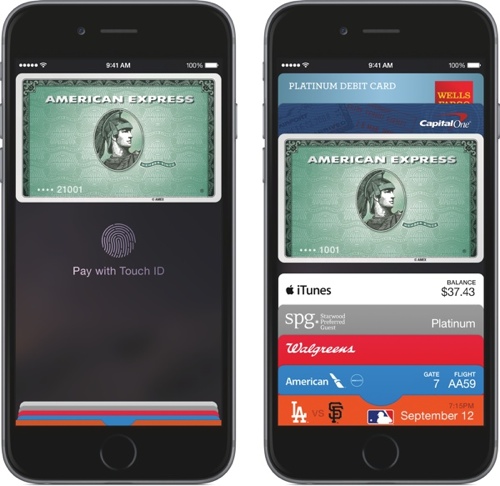
According to the report, which uses data from ITG's Investment Research consumer panel, 60 percent of new Apple Pay customers used the service on multiple days throughout November, averaging 1.4 use times per week. In comparison, only 20 percent of new PayPal customers used the service multiple times during the same time period.
Among customers who used Apple Pay, Whole Foods was the location where the service was used most, capturing 20 percent of all Apple Pay transactions. Walgreens came in second, with 19 percent of transactions, and McDonald's was third, with 11 percent of transactions. Whole Foods was also saw the highest spending, responsible for 28 percent of all Apple Pay dollars spent.
Available since October 20, Apple Pay is accepted at several of Apple's partner stores and at more than 200,000 retail locations where NFC payments are accepted. Apple has given little indication of Apple Pay's early success, but in October, Apple CEO Tim Cook revealed that Apple Pay had seen more than one million credit and debit card activations during its first 72 hours of availability.


Apple still trails industry leaders like Square and PayPal, which captured 18 and 78 percent of digital payment dollars in November, respectively, but ITG analysts suggest Apple Pay is showing strong momentum given that it's available only to customers with the newest hardware and supported by a limited number of merchants.
According to the report, which uses data from ITG's Investment Research consumer panel, 60 percent of new Apple Pay customers used the service on multiple days throughout November, averaging 1.4 use times per week. In comparison, only 20 percent of new PayPal customers used the service multiple times during the same time period.
Among customers who used Apple Pay, Whole Foods was the location where the service was used most, capturing 20 percent of all Apple Pay transactions. Walgreens came in second, with 19 percent of transactions, and McDonald's was third, with 11 percent of transactions. Whole Foods was also saw the highest spending, responsible for 28 percent of all Apple Pay dollars spent.
Available since October 20, Apple Pay is accepted at several of Apple's partner stores and at more than 200,000 retail locations where NFC payments are accepted. Apple has given little indication of Apple Pay's early success, but in October, Apple CEO Tim Cook revealed that Apple Pay had seen more than one million credit and debit card activations during its first 72 hours of availability.
20 Dec 20:32

The culture that is Dutch
by Tyler Cowen
This cracks me up:
The illustrations on the banknotes show generic examples of architectural styles such as renaissance and baroque rather than real bridges from a particular member state, which could have aroused envy among other countries. “The European Bank didn’t want to use real bridges so I thought it would be funny to claim the bridges and make them real,” Stam told Dezeen.
The article headline is “Fictional bridges on Euro banknotes constructed in the Netherlands.” Perhaps this will prove a broader and subtle metaphor for making the eurozone actually work…
For the pointer I thank Joel Cazares.
20 Dec 20:31

Taxing the safe haven demand
by Tyler Cowen
Switzerland is introducing a negative interest rate on the deposits it holds for lenders, its central bank said on Thursday, moving to hold down the value of the Swiss franc amid the turmoil in global currency markets.
The Swiss National Bank said in a statement from Zurich that it would begin charging banks 0.25 percent on bank deposits exceeding a certain threshold.
There is more here. Here is the market reaction.
20 Dec 20:30

Smuggling Cubans
by Alex Tabarrok
This post isn’t about smuggling Cuban cigars it’s an incredible story about smuggling Cuban baseball players.
The average wage in Cuba is about $20 per month so a typical Cuban might earn 50 times more in the United States but a star Cuban baseball player (who also earns about $20 per month in Cuba) might earn 10,000 times more in the United States. Markets abhor a price differential so there is an active market in smuggled Cubans.
Yasiel Puig, now a star player for the Los Angeles Dodgers, was smuggled out of Cuba in 2012. The smuggling operation was paid for by a group of Miami businessmen:
Investigators and court documents say Suarez was one of the Miami-based financiers of the 2012 smuggling venture in which Puig was taken by boat from Cuba to a fishing village near Cancun, Mexico, eventually crossing into the U.S. at Brownsville, Texas, on July 3 of that year. In return, the financiers were getting a percentage of the seven-year, $42 million contract Puig signed with the Dodgers.
The story is not unique
The plea is the second in Miami federal court this year involving the smuggling of a Cuban baseball player into the U.S. Last month, 41-year-old Eliezer Lazo was sentenced to 14 years in federal prison for conspiring to smuggle 1,000 Cubans, including baseball players such as Texas Rangers outfielder Leonys Martin.
Puig did in fact pay Suarez $2.5 million. A high price for a relatively simple operation–the going rate to smuggle an ordinary Cuban is about $10,000–but, as we will see, more than smuggling was involved. It took five attempts before Puig reached the shores of Mexico. On one of the earlier attempts Puig was captured by the US Coast guard who sent him back–after some of the crew asked for his autograph!
On the fifth attempt, Puig, along with “a boxer, a pinup girl, and a Santeria priest, the latter of whom blessed their expedition with a splash of rum and a sprinkle of chicken blood” managed to escape Cuba guided by the smugglers and their accomplices—“The Chinaman” and “The Hungarian”. Once in Mexico, however, the operation got messy because Mexico’s Zetas gang were acting as intermediaries and with Puig in hand they demanded a greater share of the proceeds.
“If they didn’t receive the money, they were saying that at any moment they might give him a machetazo”—a whack with a machete—“chop off an arm, a finger, whatever, and he would never play baseball again, not for anyone.”
The case has lots of interesting asides: Why flee to Mexico first and only then to the United States? It’s all about the money and the weird rules of MLB:
A foreign-born player who immigrates without a contract is treated as an amateur by MLB; he can negotiate only with the team that drafts him. By declaring himself a free agent before arriving, that player can entertain all comers; the difference is worth millions. Federal law, of course, bars Americans from paying money to Cubans—or “trading with the enemy”—so a ballplayer like Puig needs not only to defect but also to establish legal residency in a country that he does not actually intend to live in.
Now back to the Zetas and the hostage negotiations.
As the standoff entered its third week, the smugglers began looking elsewhere to recoup their costs. The idea occurred to them that they could auction Puig off.
Eventually a rescue operation was staged by the Miami businessmen (details are unclear) and Puig escapes to Mexico City where in essence an auction is held in which the Dodgers win with a bid of $42 million over seven years.
Puig, however, continued to be threatened by the Zetas, hence, it seems, the aforementioned $2.5 million dollar payment to the Miami businessman who in turn paid off the Zetas (a murder also appears to be related).
As if all of this isn’t astounding enough these details have come to light only because of a US civil case against Puig. Puig had been approached a few years earlier when he was just 19 by another would be smuggler. Fearing the state police who monitored him constantly, Puig alerted the sports ministry to the offer and they notified state security. The alleged smuggler was arrested by the Cuban police, jailed, and perhaps tortured. Now here is where it gets really strange. The alleged smuggler, still in jail in Cuba, and his mother are suing Puig in American court for $12 million dollars for turning the smuggler over to the Cuban authorities and thus potentially violating the Torture Victim Protection Act.
There are many lessons here about open(ing) borders, rent seeking, the law, and how making some trades illegal creates black markets often ruled by violence. Thankfully an opening of relations with Cuba may cause this market to wither away. Next up, college athletes.
20 Dec 17:13

Testing peer review by running submissions through the process twice
by Tyler Cowen
In particular, about 57% of the papers accepted by the first committee were rejected by the second one and vice versa. In other words, most papers at NIPS would be rejected if one reran the conference review process (with a 95% confidence interval of 40-75%)
Here is another framing:
If the committees were purely random, at a 22.5% acceptance rate they would disagree on 77.5% of their acceptance lists on average.
That is from Eric Price on the NIPS experiment, there is more here.
For the pointer I thank a loyal MR reader.
20 Dec 17:12

Predatory Fining and Mass Surveillance
by Alex Tabarrok
In Ferguson and the Modern Debtor’s Prison I noted that Ferguson raises an unusually high rate of revenues from fines.
You don’t get $321 in fines and fees and 3 warrants per household from an about-average crime rate. You get numbers like this from bullshit arrests for jaywalking and constant “low level harassment involving traffic stops, court appearances, high fines, and the threat of jail for failure to pay.”
It doesn’t inspire confidence, therefore, when we learn that Ferguson plans to increase its reliance on police fines as a source of revenue.
Ferguson, Missouri, which is recovering from riots following the August shooting death of an unarmed black teenager by a white policeman, plans to close a budget gap by boosting revenue from public-safety fines and tapping reserves.
Missouri’s attorney general, however, wants to enforce limits on predatory fining:
Missouri’s attorney general announced lawsuits against 13 of this city’s suburbs on Thursday, accusing them of ignoring a law that sets limits on revenue derived from traffic fines. The move comes after widespread allegations of harassment and profiteering by small municipal governments against the poor and minorities.
…demonstrators have frequently complained about a perceived hypervigilance to minor traffic violations in St. Louis County’s patchwork of 90 municipalities. Many of those cities have their own courts and police departments, but some are only a few square blocks in size and have populations smaller than some high schools.
“When traffic ticketing is used to promote public safety, that’s appropriate,” Mr. Koster said. “When traffic tickets are used to promote revenue, that’s inappropriate.” Such practices, he said, are “predatory.”
(Technically Ferguson isn’t one of the smaller governments being sued but the battle lines are being drawn.)
The current focus on predatory fining and minorities is well justified but these issues are also the spearhead for important changes being brought about by the intersection of policing and mass surveillance. We all commit multiple felonies regularly, no one is innocent. Today most of our violations are simply ignored, never discovered nor prosecuted, but when the eye turns to us we won’t have a defense. As a result, as Stephen Carter wrote in a superb editorial, technological change and the law puts us all in the same danger as Eric Garner.
Hat tip: Michael Cohen.

19 Dec 21:26
CalDigit's Thunderbolt Station 2 Launches in January With $170 Pre-Order Pricing [Mac Blog]
by Mitchel Broussard
CalDigit today announced that the follow-up to its popular original Thunderbolt Station, the Thunderbolt Station 2, is now available for pre-order with an expected ship date of January 26, 2015.
The new dock will retail for $199.99, but CalDigit is offering a limited pre-order price of $169.99 that runs all the way up to the day before release, January 25. The new station keeps the same functionality of connecting multiple devices with one Thunderbolt cable, but updates it with new Thunderbolt 2 and dual eSATA 6G ports. The Thunderbolt Station 2 also allows users a vertical orientation option the original lacked.

The Thunderbolt Station 2 also comes with HDMI, three USB 3.0 ports, Gigabit Ethernet, audio in/out ports, the ability to connect high-resolution 4K displays to its HDMI port, and two Thunderbolt 2 ports.
The Thunderbolt Station 2 can be pre-ordered from the CalDigit official website for $169.99 until January 25, 2015, after which it will retail for $199.99.


The new dock will retail for $199.99, but CalDigit is offering a limited pre-order price of $169.99 that runs all the way up to the day before release, January 25. The new station keeps the same functionality of connecting multiple devices with one Thunderbolt cable, but updates it with new Thunderbolt 2 and dual eSATA 6G ports. The Thunderbolt Station 2 also allows users a vertical orientation option the original lacked.
The Thunderbolt Station 2 also comes with HDMI, three USB 3.0 ports, Gigabit Ethernet, audio in/out ports, the ability to connect high-resolution 4K displays to its HDMI port, and two Thunderbolt 2 ports.
The Thunderbolt™ Station 2 allows users to connect all their devices through a single Thunderbolt™ cable. Featuring dual Thunderbolt™ 2 ports for integrating a 4K workflow, the Thunderbolt™ Station 2 allows users to connect a high-resolution 4K monitor to the HDMI port. This is ideal for professional users who need to connect modern 4K displays to their computers.The release of the Thunderbolt Station 2 sees CalDigit joining several other dock manufacturers such as Elgato and OWC who have recently caught up to the Thunderbolt 2 standard ports, which were introduced on Macs beginning late last year.
“The power of Thunderbolt™ 2 allows the Thunderbolt™ Station 2 to be the central hub of modern 4K workflows. Not only can users connect a 4K monitor, they can also daisy-chain 4K capable devices such as Thunderbolt™ storage for the ultimate 4K workflows”, said Kosta Panagos, Director of Marketing at CalDigit.
The Thunderbolt Station 2 can be pre-ordered from the CalDigit official website for $169.99 until January 25, 2015, after which it will retail for $199.99.












18 Dec 13:37
Give Me the Coffee and Everyone Will Be Happy

18 Dec 00:52
Inappropriate
by Doug

Timmy Tofu is terrible at Christmas shopping.
RaptoR, Albener Pessoa and 2 others like this

17 Dec 12:38
Kinder Ovo trará ações da Petrobras de brinde
by Sensacionalista
Que o Kinder Ovo custa caro e vem com surpresas vagabundas, todo mundo já sabe. Porém, dessa vez eles se superaram. Segundo a empresa, o Kinder Ovo trará como brinde uma ação da Petrobras. As Redes Sociais ficaram lotadas de protestos contra a marca, como: “Kinder Ovo só traz brinquedo que quebra #AçãoDaPetrobrasNão”
A equipe de marketing da empresa veio a público: “Nosso objetivo sempre foi o chocolate, trazer uma ação da Petrobras dentro mostra como nosso foco está no sabor e não do brinquedo. Além disso, as reclamações são apenas de petistas, pois os psdebistas estão se divertindo pra caramba com as ações da Petrobras em baixa.”
Por @Cacofonias
17 Dec 12:38
Pessoas que têm 3G no metrô sobem para o primeiro lugar no Ranking da Inveja
by @sensacionalista
Você está ali no metrô sem poder olhar seu whatsapp, seu Facebook, seu Twitter. De repente, olha pro lado e há uma pessoa fazendo isso tudo, rindo, digitando, se divertindo. O sentimento é de ódio. E você não está sozinho. O Ranking da Inveja, feito pelo Núcleo de Pesquisa da América Latina, o Instituto Nupal, mudou de configuração: agora, em primeiro lugar, estão essas raras pessoas que conseguem ter 3G no metrô.
“Esse item passou, inclusive, o campeão anterior, que era o de Pessoas que Comem pra Cacete e Não Engordam”, diz o coordenador da pesquisa, Joseph Jonas.


16 Dec 15:52


A nerdinha que salvou a Apollo 11
by Carlos Cardoso

Quando a Águia, o módulo de pouso estava a menos de 3 minutos de seu pouso histórico na Lua, algo deu errado, muito errado.
O computador de navegação acionou um alarme reportando erro. Algumas ordens de magnitude menos poderoso do que a CPU do seu microondas, não havia muito espaço para nada que não fosse estritamente necessário, e um módulo estava comendo 20% de CPU, em uma situação onde o sistema já estaria rodando a 85% da capacidade.
Steve Bales, Oficial de Orientação e Jack Garman, Especialista de Computação do controle da missão rapidamente comandaram um reset do alarme, achando que poderia ser algo aleatório. Armstrong e Aldrin assim fizeram, mas logo depois outro alarme surgiu.
O grupo do MIT que programou as rotinas de pouso havia decidido utilizar o Radar de Subida e Rendezvous para rastrear o Módulo de Comando/Serviço. Isso já era feito pelo Abort Radar System, mas seria uma segurança extra caso algo desse errado. Mandaram os patches, os procedimentos, mas como foi uma mudança muito em cima, desistiram. Mandaram uma outra atualização para o radar do Módulo de Comando não ser acionado, mas esqueceram de enviar a alteração nos procedimentos. O botão que deveria ficar em MANUAL foi deixado em AUTO.
Com isso durante a descida o software tentava repetidamente ler dados do radar e calcular a posição do módulo. Como os dados não batiam (pois o radar não estava ligado), ele repetia e repetia o cálculo, consumindo mais e mais processamento, sobrecarregando os registradores e gerando os alarmes.
Em um computador comum teríamos uma falha catastrófica. As outras tarefas perderiam prioridade, pois a rotina do radar não devolveria o comando à CPU. Sem poder controlar orientação, propulsão, consumo de combustível e outros fatores, a Águia ficaria sem controle. O computador, travado em um loop seria destruído, junto com os astronautas na inevitável colisão, mas isso não aconteceu.
Ao contrário de sistemas operacionais mais simples, como o Windows 3.11, o computador da Apollo usava conceitos robustos. Don Eyles, um garoto de 22 anos havia escrito algo revolucionário, saído das entranhas do MIT: um software com fixed-priority pre-emptive scheduling, a chamada multitarefa preemptiva com prioridades pré-definidas.
No DOS, Windows 3.11 e outros a multitarefa era cooperativa. Um programa era executado E, de tempos em tempos atendendo a uma interrupção de software retomava o controle ao sistema operacional, assim ele podia cuidar de outras coisas. Programas mal-educados não respeitavam isso, nem programas bugados.
O software de Don Eyles, aliado ao hardware implementava uma multitarefa onde não só cada rotina tinha um tempo máximo alocado, como as rotinas prioritárias tinham… prioridade. Assim se a CPU não está fazendo nada e sua rotina de radar bugada come 80% de CPU, azar, mas se a minha rotina de controle de pouso precisar de ciclos de máquina, ela vai ter, não importa o quanto ela grite e nem se um astronauta colocou o botão do radar em modo AUTO, acionando a rotina. A do radar vai rodar, pra ceder CPU para a minha.
O computador trabalhou no talo, mas o que era importante para o pouso tinha prioridade e processamento alocado. A arquitetura mega-power-robusta de Don Eyles salvou o dia. Só que o mérito mesmo é dessa nerdinha aqui:

O nome dela é Margaret Hamilton. Formada em matemática em 1958, trabalhava no MIT como desenvolvedora de software. Na época Ciência da Computação e Engenharia de Software não existiam como cadeiras isoladas, na verdade nem existia o termo engenharia de software. Eram tempos pioneiros e você aprendia fazendo. E Margaret fazia muito bem.
Essa moça, que ficaria perfeitamente à vontade em uma convenção de Star Trek, cresceu nos rankings do MIT. E enquanto Don Draper dava tapinhas na bunda de mulheres na Sterling Cooper, Margaret comandava como diretora da Divisão de Engenharia de Software do Laboratório Charles Draper, do MIT.
Contratados pela NASA para desenvolver os softwares da Apollo, a equipe colocou em prática um monte de conceitos criados por Margaret Hamilton. Alguns sites dizem que ela escreveu os programas da Apollo. Não, crianças, ela foi muito além, ela criou os conceitos e a metodologia, a arquitetura e a modelagem.

Entre outros conceitos criados ou implementados de forma pioneira por ela:
- Software assíncrono
- Priority Schedulling
- human-in-the-loop
- end-to-end testing
- System Oriented Objects
- Linguagens de modelagem
- Desenvolvimento distribuído
- Detecção e correção de erros em RTOS
- Metodologias de teste e certificação
- Automated life cycle environments
·
Fora o problema com o radar nenhum outro bug ocorreu durante as missões Apollo, graças aos requisitos de desenvolvimento e metodologias de teste criadas por Margaret. lembre-se, isso foi bem antes de UML e outros frufrus.
Só ser a Projetista-Chefe do software de vôo do projeto Apollo e do SkyLab já seria um prêmio e tanto, mas em 2003 a NASA tirou o escorpião do bolso e em um gesto inédito, outorgou a Maragaret Hamilton o NASA Exceptional Space Act Award for scientific and technical contributions, com direito a um agrado de US$ 37.200,00. Foi a primeira e única vez que a NASA deu um prêmio em dinheiro a alguém.

Margaret Hamilton publicou mais de 130 papers na área de ciência da computação, cunhou o termo Engenharia de Software. Trabalhou em 60 projetos e 6 programas principais na NASA.
Hoje, aos 76 anos essa velhinha porreta é CEO da Hamilton Technologies, onde desenvolve as metodologias de Universal Systems Language — nesta não se trabalha com orientação a objetos ou modelos, mas sistemas e a Development Before the Fact, cujo princípio é simples: “não conserte, faça certo da primeira vez”.
O legado de Margaret Hamilton é imenso, cada vez que a Microsoft faz um teste beta com gente do mundo inteiro está usando o conceito de human-in-the-loop criado por ela. Incontáveis bugs são encontrados quando gente testa o software, além dos testes automáticos. Simples? Hoje pode ser, em 1965 não era.
Tudo que você usa hoje e tem alguma complexidade em termos de software tem o dedo dela, mas você não verá Margaret Hamilton em documentários cheios de foguetes e astronautas corajosos. Ela nunca apareceu nos filmes antigos, sequer estava no Controle da Missão. Ainda bem, naquela época o prédio nem tinha banheiro feminino.
Ela é uma mulher que se destacou em um campo quase 100% dominado por homens, em uma época onde ter órgãos reprodutivos internos era garantia de que não seria levada a sério. Se a Apollo foi um pequeno passo para um homem, foi um passo gigantesco para as mulheres em computação.
Pois se para alguns é fácil zoar as mulheres que queimaram sutiã, é muito mais complicado zoar uma que queimou um escudo ablativo de calor a 40 mil km/h reentrando na atmosfera terrestre, por pura expertise de seu software.
Leia também:
The post A nerdinha que salvou a Apollo 11 appeared first on Meio Bit.
Tadeu and -1 others like this