Shared posts
13 Jun 21:18

Centro Nacional de Fiscalização de Coerência
by ricardo coimbra

Clique na imagem para aumentar
13 Jun 21:05
O Descanso do Guerreiro
by Adolfo Sachsida
Algumas frases que valem a pena lembrar.
1. X-Men:
- Magneto: por que me salvou? Sua vida seria infinitamente mais fácil se eu morresse.
- Professor Xavier: não busco uma vida fácil, mas sim uma vida justa.
2. Caverna do Dragão:
- Arqueiro: por que a culpa foi minha? Foi o Erick quem abriu a arca.
- Mestre dos magos: um líder nunca deve abrir mão da prerrogativa de liderar. Você deveria tê-lo impedido.
3. Conan, o Destruidor
-Conan: “Então Kroll irá me perguntar: qual é o segredo do aço?”
4. Mickey Ward: “Graças a Deus acabou”.
5. Ronald Reagan: “Podemos acabar com essa ameaça agora mesmo se quisermos, basta que nos rendamos”.
6. Jornada nas Estrelas, a Nova Geração
- Crusher: Data você é uma máquina, é impossível a você ter sentimentos. Por que você tenta assim mesmo?
- Data: Acredito que o simples fato de tentar me faça alguém melhor.
Que nos momentos cruciais de sua vida você se lembre que não devemos almejar a uma vida fácil, mas sim a uma vida justa. Que naquele momento chave você se lembre que não deve concorrer ao prêmio de miss simpatia, e que as prerrogativas do comando implicam em custos. Mas são esses custos que garantem os benefícios de longo prazo. Se você é um líder, nunca abra mão da prerrogativa de liderar. Você nunca irá agradar a todos, e possivelmente irá desagradar a muitos. Mas siga em frente, sabendo que quando sua hora chegar e a você for perguntado o segredo do aço, você dê sua vida como resposta. Que nesse momento final você possa olhar para trás e dizer “Graças a Deus acabou”, refletindo que você chegou a seu limite e o ultrapassou, se superou, deu o melhor de si. Saiba que sempre é possível terminar com o sofrimento e angústia a qualquer instante, basta se render. Mas que, mesmo sabendo disso, você opte por seguir em frente certo de que o tamanho de um Homem é medido pela magnitude dos desafios que enfrentou. Lembre-se que o simples fato de tentar já fará de você uma pessoa melhor.
1. X-Men:
- Magneto: por que me salvou? Sua vida seria infinitamente mais fácil se eu morresse.
- Professor Xavier: não busco uma vida fácil, mas sim uma vida justa.
2. Caverna do Dragão:
- Arqueiro: por que a culpa foi minha? Foi o Erick quem abriu a arca.
- Mestre dos magos: um líder nunca deve abrir mão da prerrogativa de liderar. Você deveria tê-lo impedido.
3. Conan, o Destruidor
-Conan: “Então Kroll irá me perguntar: qual é o segredo do aço?”
4. Mickey Ward: “Graças a Deus acabou”.
5. Ronald Reagan: “Podemos acabar com essa ameaça agora mesmo se quisermos, basta que nos rendamos”.
6. Jornada nas Estrelas, a Nova Geração
- Crusher: Data você é uma máquina, é impossível a você ter sentimentos. Por que você tenta assim mesmo?
- Data: Acredito que o simples fato de tentar me faça alguém melhor.
Que nos momentos cruciais de sua vida você se lembre que não devemos almejar a uma vida fácil, mas sim a uma vida justa. Que naquele momento chave você se lembre que não deve concorrer ao prêmio de miss simpatia, e que as prerrogativas do comando implicam em custos. Mas são esses custos que garantem os benefícios de longo prazo. Se você é um líder, nunca abra mão da prerrogativa de liderar. Você nunca irá agradar a todos, e possivelmente irá desagradar a muitos. Mas siga em frente, sabendo que quando sua hora chegar e a você for perguntado o segredo do aço, você dê sua vida como resposta. Que nesse momento final você possa olhar para trás e dizer “Graças a Deus acabou”, refletindo que você chegou a seu limite e o ultrapassou, se superou, deu o melhor de si. Saiba que sempre é possível terminar com o sofrimento e angústia a qualquer instante, basta se render. Mas que, mesmo sabendo disso, você opte por seguir em frente certo de que o tamanho de um Homem é medido pela magnitude dos desafios que enfrentou. Lembre-se que o simples fato de tentar já fará de você uma pessoa melhor.
12 Jun 19:57
Last Task After Layoff at Disney: Train Foreign Replacements
by John Gruber
Julia Preston, reporting for the NYT:
The employees who kept the data systems humming in the vast Walt Disney fantasy fief did not suspect trouble when they were suddenly summoned to meetings with their boss.
While families rode the Seven Dwarfs Mine Train and searched for Nemo on clamobiles in the theme parks, these workers monitored computers in industrial buildings nearby, making sure millions of Walt Disney World ticket sales, store purchases and hotel reservations went through without a hitch. Some were performing so well that they thought they had been called in for bonuses.
Instead, about 250 Disney employees were told in late October that they would be laid off.
What a dick move. I expect better from Disney.
11 Jun 21:18
Take Note And Never Eat A Mango The Old Way Again
This street fruit vendor knows exactly how to fix the sticky-handied mess that is eating mango.
Albener Pessoa likes this
10 Jun 20:14

What is the best novel about a bureaucracy?
by Tyler Cowen
I don’t quite mean “the best novel,” rather I mean “the best novel as a novel of bureaucracy.”
There is Franz Kafka, but I find his writings more theological and fantastic than insightful about bureaucracy per se. Besides, his short stories are his best work and the novels do not have proper endings.
There are post-war Eastern European novels galore, where to start? In the First Circle? Still, communist bureaucracies are no longer so typical, so I am not ready to award any of these novels first prize. Gogol’s earlier Dead Souls also stands out as a Russian candidate.
Joseph Heller’s Catch-22 is in the running, as are John Le Carre, Thomas Pynchon and David Foster Wallace. Here is a discussion of Dickens, Orwell, and other classics. Here is a jstor-gated survey of the topic. There are plenty of novels about universities, very few of which I can endure.
The Chinese have an entire genre of “bureaucracy literature.” And perhaps bureaucracy in science fiction is deserving of its own post.
In any case, my clear first choice pick is Anthony Trollope’s Barchester Towers, which I started reading a few days ago. Here is the first sentence of the Amazon.com review:
This 1857 sequel to The Warden wryly chronicles the struggle for control of the English diocese of Barchester. The evangelical but not particularly competent new bishop is Dr. Proudie, who with his awful wife and oily curate, Slope, maneuver for power.
So far I am finding that just about every page has insight about bureaucracy. Trollope, by the way, had extensive experience working for the Post Office in England and Ireland, and furthermore he missed out on a major promotion.
What else am I forgetting?
10 Jun 17:00
Bruce Wayne
by Doug

Dedicated to Chuck Dixon, because I always think about Chuck whenever I draw a Batman comic.
Danilo.balarini, firehose and 2 others like this
09 Jun 19:22


Mineswept
Sometimes, the battle is over even before it begins.
Submitted by: Unknown
Rosalind, Adam Victor Brandizzi and one other like this

09 Jun 17:41

Why Does Ursula K. Le Guin Hate Amazon?
by Alex Tabarrok
Ursula K. Le Guin’s poorly-argued and evidence-free rant against Amazon is more about her hatred of capitalism than about Amazon’s actual effect on the market for books. Here’s Le Guin:
[Amazon’s] ideal book is a safe commodity, a commercial product written to the specifications of the current market, that will hit the BS list, get to the top, and vanish. Sell it fast, sell it cheap, dump it, sell the next thing. No book has value in itself, only as it makes profit. Quick obsolescence, disposability — the creation of trash — is an essential element of the BS machine. Amazon exploits the cycle of instant satisfaction/endless dissatisfaction. Every book purchase made from Amazon is a vote for a culture without content and without contentment.
The same argument was made in the late 1990s against chain bookstores like Border’s. It wasn’t a good argument then (see Tyler’s masterpiece, In Praise of Commercial Culture) but at least at that time it was debatable. Le Guin’s attempt to resurrect the argument today is bizarre. Does anyone doubt that it is easier to buy a niche book today than it ever has been in the entire history of the world? Indeed, does anyone doubt that it is easier to buy a Ursula K. Le Guin book today than it ever has been in the entire history of the world?
Larger markets support greater variety. A bookstore that only sells locally can’t stock many books. It’s the smaller store that fears taking a risk because the opportunity cost of shelf space is so high. Amazon lowers the cost of stocking books through efficient logistics and by warehousing in relatively low-cost areas (subject to being close to markets). The fixed costs of distribution are then spread over a much larger (inter)-national market so it pays to stock many more books.
Amazon makes a lot of money selling niche books. The precise numbers are debatable because Amazon doesn’t release much data but Brynjolfsson, Hu and Smith estimated that the long-tail accounted for nearly 40% of Amazon sales in 2008, a number that had risen over time. Indeed, since costs aren’t that different it’s not obvious that Amazon makes much more from selling a million copies of a single book than from 10 copies of each of 100,000 books (especially if they are ebooks).
Ebooks take this argument to the limit and the data show greater diversity in who publishes books than ever before. According to a recent Author Earnings report:
…indie self-published authors and their ebooks were outearning all authors published by the Big Five publishers combined
Perhaps what pushes Le Guin onto the wrong track is that there are more (inter)-national blockbusters than ever before which gives some people the impression that variety is declining. It’s not a contradiction, however, that niche products can become more easily available even as there are more blockbusters–as Paul Krugman explained the two phenomena are part and parcel of the same logic of larger markets. It’s important, however, to keep one’s eye on the variety available to individuals. Variety has gone up for every person even as some measures of geographic variety have gone down.
In the past small sci-fi booksellers in out-of-the-way places (link to my youth) barely eked out a living from selling books. Precisely because they didn’t make a lot of money, however, the independents signaled their worthy devotion to the revered authors. Today, Amazon sells more Le Guin books than any independent ever did. But Bezos doesn’t revere Le Guin, he treats her books as a commodity. That may distress Le Guin but for readers, book capitalism is a wonder, books and books and books available on our devices within seconds, more books than we could ever read; a veritable fountain, no a firehose, no an Amazon of books.
09 Jun 17:31
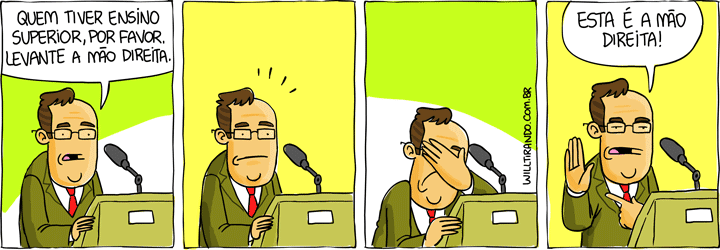
Deslocamento de órgão
by O Criador

O.o
The post Deslocamento de órgão appeared first on DrPepper.com.br.



30 May 17:45
Meditation
by Doug

Dedicated to Karen, who asked for a comic about meditation. Here you go, Karen! 
And here’s more meditation.
RaptoR, Adam Victor Brandizzi and one other like this
30 May 17:44
Today
by Doug

Here’s more inspiration.
Adam Victor Brandizzi, Sofía Henao and 2 others like this