(via tastefullyoffensive:video)

Mulan Jamilah, a 6-year-old Bengal tiger, kisses caretaker Abdullah Sholeh, 33, in the garden beside their home on January 20, 2014 in Malang, Indonesia. Abdullah Sholeh of Malang, Indonesia is an Islamic student who has become best friend and a full-time nanny to the tiger. Mulan’s owner, Noer Muhammad Sholeh, 51, asked Abdullah to take care of the tiger when it was a 3-month-old cub at Dilem Village, Kepanjen District, Malang, East Java. Abdullah Sholeh regularly sleeps, plays and fights with the huge tiger. The pair are so inseparable, he often shuns his own bed to sleep alongside the big cat in her enclosure. Mulan now weighs 178 kg, is three meters long including the tail and one meter high. For security reasons, they have had to install metal bars to separate them when they are together in the enclosure. Mulan is fed 6kg of chicken or goat meat twice a day. (Photo by Robertus Pudyanto/Getty Images)

Mulan Jamilah, a 6-year-old Bengal tiger and Abdullah Sholeh, 33, play in the garden beside their home on January 20, 2014 in Malang, Indonesia. (Photo by Robertus Pudyanto/Getty Images)

Mulan Jamilah, a 6-year-old Bengal tiger and Abdullah Sholeh, 33, play in the garden beside their home on January 20, 2014 in Malang, Indonesia. (Photo by Robertus Pudyanto/Getty Images)

Mulan Jamilah, a 6-year-old Bengal tiger and Abdullah Sholeh, 33, play in the garden beside their home on January 20, 2014 in Malang, Indonesia. (Photo by Robertus Pudyanto/Getty Images)

Mulan Jamilah, a 6-year-old Bengal tiger and Abdullah Sholeh, 33, play in the garden beside their home on January 20, 2014 in Malang, Indonesia. (Photo by Robertus Pudyanto/Getty Images)

Mulan Jamilah, a 6-year-old Bengal tiger, kisses caretaker Abdullah Sholeh, 33, in the garden beside their home on January 20, 2014 in Malang, Indonesia. (Photo by Robertus Pudyanto/Getty Images)

Abdullah Sholeh, 33, sits in the floor next to 6-year-old Bengal tiger Mulan Jamilah’s enclosure on January 20, 2014 in Malang, Indonesia. (Photo by Robertus Pudyanto/Getty Images)

Abdullah Sholeh, 33, sits in the floor next to 6-year-old Bengal tiger Mulan Jamilah’s enclosure on January 20, 2014 in Malang, Indonesia. (Photo by Robertus Pudyanto/Getty Images)

Abdullah Sholeh, 33, lies in the floor next to 6-year-old Bengal tiger Mulan Jamilah’s enclosure on January 20, 2014 in Malang, Indonesia. (Photo by Robertus Pudyanto/Getty Images)

Mulan Jamilah, a 6-year-old Bengal tiger and Abdullah Sholeh, 33, play in the garden beside their home on January 20, 2014 in Malang, Indonesia. (Photo by Robertus Pudyanto/Getty Images)

Mulan Jamilah, a 6-year-old Bengal tiger and Abdullah Sholeh, 33, play in the garden beside their home on January 20, 2014 in Malang, Indonesia. (Photo by Robertus Pudyanto/Getty Images)

Abdullah Sholeh, 33, sits in the floor next to 6-year-old Bengal tiger Mulan Jamilah’s enclosure on January 20, 2014 in Malang, Indonesia. (Photo by Robertus Pudyanto/Getty Images)

    
|
Previously, I've talked about testing the Othermill--an out-of-the-box work horse--and the Shapeoko 2--a CNC kit ripe for re-invention. Today, I'm going to talk about a big boy, examining a CNC mill that's bigger, pricier, and commands a steeper learning curve. That's because we're adding another axis!

This is the MDX-540 with a rotary axis made by the Roland DGA Corporation. A 4-axis mill can do everything an X, Y, Z machine can do, but it can also rotate the cutting material around an 'A' axis. Essentially, this mill combines the functionality of a typical CNC and a lathe. With that additional axis, you're able to create complex double-sided objects and components with undercuts.
 Three cork "bottles" milled using different settings.
I'm fortunate enough to work at NYU's Interactive Telecommunications Program , where we have a bunch of incredible tools and machines. The MDX-540 is our latest addition to the shop and we're just beginning to experiment with it.
For all of my testing I mounted material in the rotary axis exclusively.
Material
The Roland has an extensive list of material pre-sets to choose from, for my testing I stuck to primarily walnut, Delrin, and aluminum (my favorites). But what was new for me is how the material is secured to the mill.
 Wooden dowel secured to the rotary axis.
When using the rotary axis, material is mounted in a way that is very similar to a lathe. One side is clamped down at the motorized end, the other is secured by a live center--a free spinning support. The material can be rotated while a spinning end mill cuts from above.
 Flat stock secured in the rotary axis.
 Double side walnut part with tabs
The other novel thing for me, you can use either flat or round (dowel) stock.
Double sided parts--any object that has a detailed top and bottom or an in and outside--can be milled from flat stock. All of the roughing and finishing is done to one surface, the stock is rotated 180 degrees, and then the other side is roughed and finished. Oh the possibilities, I forsee a lot of custom project enclosures in my future.
Tabs remain to secure the part to the remaining material and there is a faint seam line left after machining, but the surface finish is phenomenal. Post milling work will be necessary to remove any trace of the tabs, but no sanding needed for the rest of it.
 Cutting an aluminum rod.
Round stock mounts in a similar fashion, but the material is rotated for each pass and the part is milled all the way around. Want to make lightsabers, anyone?
As I mentioned, the surface finish of wooden pieces is incredible--it's incredibly precise to a point that there's no sanding needed for some materials. Delrin parts looked like they were cast or even injection molded. I didn't have as much luck with the finish on aluminum. There was a little chatter during milling and I don't think I was using the most ideal tool paths. I think with a little more CAM finagling I can get the results I want.
 We needed some new Delrin foosball players, CAD model by David Rios.
There is no other way to say it: the process of setting origin on this machine is nuts. The Roland comes with a calibration bar that you secure in the rotary axis and an electrode is plugged in. A calibration pin is chucked into the cutting spindle, and then the calibration cycle is run. At a very fast pace, the pin moves towards the bar (I think it's going to destroy itself everytime), right before a collision it slows to just barely make contact, and an electrical connection is made. The pin then moves to a number of other key locations along the bar, repeating the process. And all of this is just to set the origin of the Y axis!
 Calibration Bar in place on the rotary axis.
This process is very well documented in the Roland manuals, it's just an involved process and nerve racking every time. Luckily, the mill "remembers" origin (even after powering down) and this makes running a job a little less terrifying.
CAD
 Simple 3D CAD Model in Vectorworks
This is the first mill I've covered that uses 3D models exclusively. Any CAD software that outputs to an .igs or .stl file can be used. I've had a lot of luck with Vectorworks.
CAM
The Roland comes with its own CAM software, the SRP Player, a wizard that takes you step by step through the process. Asking simple questions like material size and type, round vs flat stock, tabs/no tabs, bit selection, etc. This software makes what would typically be very difficult toolpaths easy to understand and execute.
 Model in SRP Player to be cut from flat stock with tabs.
These jobs take a long time, hours, lots and lots of hours. We have a policy in our shop of never leaving a running CNC unattended. For one or two hour jobs, this isbearable, but I've seen some jobs estimated at 20-plus hours. Maybe I'll start reading Game of Thrones.
The noise the mill makes isn't bad at all, when cutting aluminum I didn't even need ear protection. Technically, the MDX-540 could sit on a desktop (overall dimensions 29.3" x 37.6" x 33.8"), but due to the uncontained mess, this is a shop only tool. I don't think anyone would be happy running this in an office.
 Walnut parts with milled plastic inserts.
So who's this for?
Someone with deep pockets to start. With a starting price of $20,000, I can't imagine the typical maker buying one of these for their home shop. This would most likely be in a school, a design company's prototyping shop, or a well-equipped makerspace.
That said, the Roland 4-axis CNC mill works incredibly well and is fairly easy to use. Now that I have the 4th axis, I'm creating parts I never dreamed I could produce. It's the kind of machine you definitely want to try at your local makerspace or tech shop.
Photos by Ben Light. Find more of Ben's projectson his website.

This is no ordinary Buddha statue. As the CT scan at the right clearly shows, there's a mummy concealed inside!


A special space telescope has helped scientists gain a much better grasp on what's happening at the crowded center of our galaxy, according to findings published in Nature yesterday.
Earth is stuck near the edge of the Milky Way, tucked in a quiet spot just off of one of the galaxy's spiral arms. The center of our galaxy, on the other hand, is an extremely busy place. If we're in the suburbs, the galactic center is Times Square; it's packed full of stars that are dead or dying, giant gas clouds, and of course, one supermassive black hole. And while astronomers learn a lot about our galaxy by looking at its cosmic doppelgängers, there's still much to be gained by studying the busiest parts of our own.
If we're in the suburbs, the...
Yup, spaceships again. Between Star Citizen, the new Halo, the new Star Wars, a couple of key mods for Sins of a Solar Empire that I keep up with and have done some voice work on, and Destiny, my mind has been buzzing with them. I’m a huge nerd who thinks of things in my free time like “if I were a shinigami what kind of Zanpakutō would I have?” and “I wonder if I’d rather be a ranger or a mage” and “ff I were a Jedi in the New Jedi Order, what kind of ship would I have?” And alongside that sort of inane theorycrafting and imagination comes obvious questions, like “would I want to captain a cruiser or a carrier?” But then, what exactly is the difference?

There are lots of different ship classes in science fiction, and I’m not talking about the designated name for a particular frame (like Victory-class or Firefly-class). I’m talking about classification of ship roles. You have your cruisers, your destroyers, your frigates and corvettes, your dreadnoughts, and all sorts of other roles. But something that always confused me is exactly what the differences are between them. If you had shown me two ships and claimed one was a destroyer and one was a cruiser I wouldn’t have really understood what that actually means and what roles they employ in a battle. How is a battleship different from a battlecruiser? Is there any difference between a star cruiser and an assault cruiser, and if so what is it?
So like any good geek I did research and actually enjoyed doing it! And the knowledge I’ve gained I want to spread for anyone who is interested, whether that be due to simple curiosity or you’re developing a story or RPG setting. Because knowledge is power.
Before we get to the meat of the topic let’s look at a bit of history. When science fiction writers were exploring space they drew a natural comparison between space travel and the maritime Age of Sail; both feature long voyages on large vessels through “alien” terrain that human beings can’t freely traverse. As such, naval terminology entered the lexicon very quickly, and as a result spaceships are classified by similar naval systems. That’s also likely the reason why the branch of the military that deals with spaceships in fiction is very commonly called the Navy.
Naval warfare, particularly way-back-when in the 17th Century or so, was rather stringent and refined. The British in particular had very strict guidelines on ship classification, roles, and tactics. As time went on the definitions for particular warships and roles blurred until we hit modern day navies. Back in the day, like 17th Century back, a common tactic was the naval “Line-of-Battle,” introduced by the Portuguese in the 15th Century. The idea is that your fleet would very literally line up in a single-file row and turn their broadsides toward the enemy. This gave all ships within the line free sight to fire on the enemy fleet without fear of hitting an ally. Battles could play out with enemy fleets sailing parallel to each other and firing into one another, though the ideal situation had your line slicing perpendicularly through the enemy’s line at some point. Ships that could survive standing within the line were thus referred to as “ships of the line (of battle)” or “line-of-battle ships.” Other ships existed that were not ships of the line, and they usually had other tactics to employ and jobs to fulfill. (This is important information for later; I promise.)

Let me touch a bit on capital ships and flagships. William S. Lind explains the concept of a capital ship extremely well; “These characteristics define a capital ship: if the capital ships are beaten, the navy is beaten. But if the rest of the navy is beaten, the capital ships can still operate. Another characteristic that defines capital ships is that their main opponent is each other.” In short, a capital ship is a ship that doesn’t need the rest of the fleet to function, and can operate independently of a fleet while being the main target of other capital ships (not that they are impervious to the fire of other ships, but that generally capital ships will seek each other out for direct confrontation). Note that this definition refers strictly to independence in a large-scale engagement. Plenty of other vessels can operate independently in other scenarios, such as patrol, but in a large-scale battle they would not be able to combat the enemy fleet if the capital ships fell. Capital ships are generally some of the largest and most heavily armored ships in a fleet. However, they should not be confused with flagships. A fleet can have multiple capital ships within it; the term simply describes the capabilities of a particular vessel. But an individual fleet will only ever have one flagship at a time, the “lead” ship, which the admiral/general/fleet commander resides on and operates from. Flagships are often capital ships (as they generally want to be the biggest, most powerful ship in the fleet), but by definition whichever ship has the fleet commander on board will fly the flag and thus be considered the flagship. Usually, this is a specifically designated vessel but the title can jump around as needed between ships.
So, from here on out I’ll be explaining the various classes of ships, their histories, and how I would personally define what the role a spaceship of that kind would take. I’ll also provide specific examples of each ship type as I go. A word of warning, though; even in the real world rules are and were constantly being broken. Ships technically designed as one type of vessel may perform the operations of another type equally well, or some countries may have different rules from each other and thus classify two vessels of almost identical capability differently. Not only that, but as technology improves the various classes can become so alike that it can be very difficult to draw a line. A further problem (which comes up very often in sci-fi) is technological superiority; that is, a ship classification in one species’ navy may not be equal to the ships of the same classification in another species’ navy. For example, one navy’s corvette may be large enough and powerful enough to be more than a match for another species’ destroyer or cruiser. What’s important when we talk about ship classification is the comparison of ships within the same navy. So while that corvette may be a cruiser as far as the alien race is concerned, what’s important is that the species that built it considers it a corvette.
Just remember that this guide exists as just that; a guide. It is not a strict law, the rules of which can never be broken. Feel free to break these rules if it makes sense for you to do so.
Let’s go from the smallest ships to the relative largest. For each class I’ve bolded particular characteristics that stand out to me and help cement the ship’s role. I’m just going to be going over warships, so things like freighters or single-pilot ships will not be getting the once-over.
Corvette
The word “corvette” comes from the Dutch word corf, which means “small ship,” and indeed corvettes are historically the smallest class of rated warship (a rating system used by the British Royal Navy in the sailing age, basically referring to the amount of men/guns on the vessel and its relative size; corvettes were of the sixth and smallest rate). In complete honesty I have not found much information on what role corvettes tended to employ; or at least nothing extremely concrete. By all rights, early corvettes are essentially just smaller, less effective frigates; they were more lightly armored and armed than frigates, while not being as quick or maneuverable. They were usually used for escorting convoys and patrolling waters, especially in places where larger ships would be unnecessary. Corvettes could also be used for taking out larger vessels already crippled by other ships, almost making them akin to scavengers. Later corvettes in modern navies (around WWII) started filling a niche as antisubmariners, minesweepers, and trawlers (it might be more accurate to say that those kinds of vessels started being called corvettes, but the effect is the same). In many ways, corvettes existed just to have a ship or two (or ten) available; being smaller and more lightly armed meant that they were cheaper to construct, and that is important when discussing anything in history. It takes money and resources to build things, so you can’t just build a bunch of the best thing.

In Sci-Fi – Corvettes would be the smallest warships, designed for escort and patrol, anti-mine, or anti-stealth. They would be used where larger ships with more firepower are not deemed necessary (such as backwater worlds or low-risk areas) or where a larger ship would be unsuitable for deployment. Corvettes might be outfitted to have some sort of stealth or cloaking system for reconnaissance or spec ops missions; naturally it would be easier to cloak a smaller ship than a larger one (though plenty of examples of large stealth ships exist). In some series they are likely to be diplomatic vessels due to their small size and speed, particularly seen in Star Wars, and can commonly act as blockade runners (again; their small size and speed makes them ideal for slipping through a blockade, where a larger ship presents more of a target). They would, ideally, never be used for direct combat in large scale engagements due to their extremely light armor and weapons, but may be employed in a battle to lay down or destroy minefields, uncover stealth ships, act as stealth ships on their own (for whatever purpose needed), or for dispatching already crippled vessels.

Frigate
“Frigate-built” was a term used in the 17th Century describing a warship that was built to be quick and maneuverable. They were often too small to stand in the “line of battle” and usually had only one weapons deck (but sometimes two). By the 18th Century the term had been modified slightly to include ships that may be as long as a ship of the line but were still designed for speed and had lighter weaponry, making them useful for patrols and escorts. The 19th Century brought armored frigates to the world, which were actually regarded as being the most powerful warships at the time. They were still known as frigates because they were lightly armed with only one deck of guns. Modern frigates are generally used as escorts for other warships and convoys. As I mentioned earlier, frigates and corvettes really are very similar in their designs and roles; frigates just tend to be larger (and thus more expensive to build) and had more firepower, so they could engage in direct combat more effectively.

In Sci-Fi – Based on their history, space frigates would probably be best defined as smaller vessels with light armament and armor (but more powerful and larger than a corvette), suited for speed and maneuverability. They’d often act as patrol and escort vessels, whether for a merchant convoy, a single capital ship, or a fleet. Their agility and maneuverability means they can move to redeploy and protect other ships better than larger, slower moving vessels. You’d likely see a strength-in-numbers strategy with them. Frigates, unlike corvettes, would more commonly see direct battle and would probably not be found with stealth drives in most settings; they are simply getting too large by that point.

Destroyer
Destroyers are comparatively modern ships. Historically, they were designed after the emergence of torpedo boats (quick, frigate-like ships which employed newly invented self-propelled torpedoes as their main arms) in the late 1800s. Torpedo boats were faster and more maneuverable than larger ships, able to bear down on a battlecruiser and take it out with its torpedoes. Destroyers were originally designed as, and named, torpedo boat destroyers, but at some point became referred to simply as destroyers when their roles expanded. They went through many iterations, but were essentially smaller cruisers designed with the sole purpose of hunting down and destroying torpedo boats, and had much more powerful weaponry as well as torpedoes to fulfill this purpose. As such, they were employed as escorts for larger, slower warships (to protect those warships from torpedo boats). They were designed to have the long range and speed to keep up with their fleet, and over time this fact plus their multi-purpose capabilities meant that destroyers began seeing more use as advanced scouts for a fleet as well as direct fleet combatants, anti-submariners, and anti-submarine patrol. Destroyers operated in destroyer divisions or units composed of multiple destroyers in order to carry out these tasks. By WWII destroyers began filling in a niche as (what I’ll very simply call) anti-everything vessels, extremely powerful high-value targets due to the number of guns they would field. In fact, this pushed several countries to develop smaller corvettes and frigates as anti-submariners in order to take some of the heat off of destroyers.

In Sci-Fi – Destroyers would be much like their naval counterparts; ships smaller than cruisers (and usually larger than frigates, though not always) but armed to the teeth with a multitude of weapons. They’d mostly act as escorts for larger fleets (and likely not for single warships, but exceptions would certainly exist) but can be seen operating in destroyer-only divisions as well. You could expect to find destroyers fulfilling all sorts of roles because of how multi-purpose they are, even roles that could be fulfilled by other classes that are designed for that purpose. It would, however, be rare to find a destroyer acting on its own in most circumstances; destroyers are not capital ships and do not operate as patrol craft. They do not operate independently as a rule, though I know of at least one case in fiction where a super-destroyer acted as an independent ship. Science fiction, as I mentioned previously, breaks a lot of rules.

Cruiser
In the Age of Sail “cruiser” was a term used to describe ships which underwent “cruising missions;” that is independent scouting, raiding, and commerce protection missions. These “cruiser warships” were normally frigates and sloops because there simply wasn’t anything else available at the time. By the mid 1800s ships began being constructed that were specifically designed for this sort of work, and as such were called “cruisers”. They could be smaller, like a frigate, or larger, but it was not until the 20th Century that they were consistently scaled to be larger than a destroyer but smaller than a battleship.

Cruiser roles in the late 20th Century included anti-air defense, shore bombing, and commerce raiding, depending on the navy. However, the increasing firepower of aircraft made it so that individual cruisers could no longer operate safely, pushing navies to have their cruisers operate in fleets. Because of this, cruiser fleets were also specialized for particular roles (like anti-submarine or anti-air) and the generalized cruiser fell out of use.
In Sci-Fi – Cruisers are medium-sized vessels, able to operate independently but also commonly seen within a fleet. They would have the capacity to be used as anti-fighters, planetary bombers, raiders of enemy supply lines, and scouts. However, they would also be the class of ship most likely to engage in non-combat roles such as exploration or even colonization due to their ability to operate independently for extended periods. I would not expect cruisers to commonly be used in front-line assaults of an enemy fleet; that role is better left to other ships. However, they have the firepower, size, and better defensive capability to go up against other ships when needed and it’s not uncommon to see cruisers making up the bulk of fleets in some settings. It is however, in my admittedly amateur opinion, not the ideal choice; better to fill in that space with destroyers or battlecruisers and battleships. Cruisers can be considered capital ships in some settings (and in fact, some settings treat any ship over a certain size as a capital ship, regardless of role).

Battlecruiser and Battleship
Battlecruisers (or battle cruisers) are the first vessels in this article to commonly be considered capital ships. They are similar to battleships, having a similar armament and size, but were generally faster and not as heavily armored by comparison. Originally fielded by the UK in the early 20th Century, battlecruisers were designed to combat and destroyer slower, older armored cruisers through heavy gunfire. As time went on (around WWI) they began seeing use as general-purpose ships alongside battleships by all manner of countries. Unfortunately, battlecruisers were generally inferior to battleships, and in the Battle of Jutland this was perfectly exemplified as both navies lost battlecruisers but no battleships; the light armor of the battlecruisers made them easier targets for heavy guns. As technology improved battlecruisers were designed with heavier armor. At the same time, battleships began becoming faster. These similarities would ultimately cause a blurring between the two classes, and by 1922 the Washington Naval Treaty considered battlecruisers and battleships functionally identical. The Royal Navy continued to refer to pre-treaty battlecruisers as such, and WWII saw a re-emergence of modernized “cruiser-killer” battlecruisers. However, only one such vessel actually survived the war, cementing again their general inferiority to battleships.
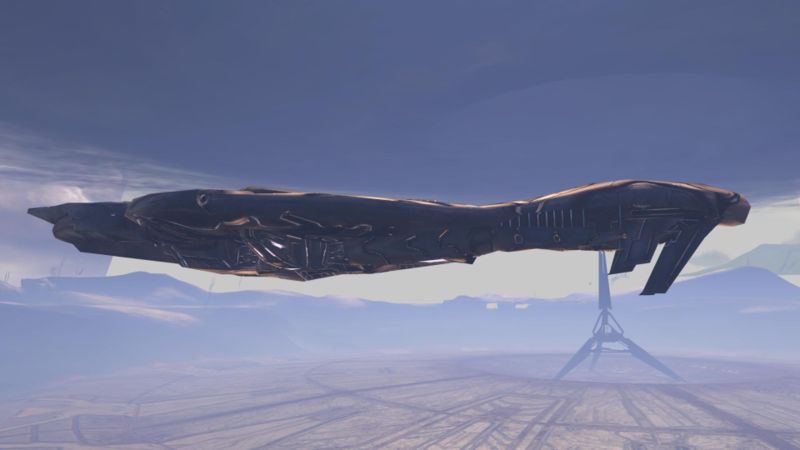
The term “battleship” is a contraction of phrase “line-of-battle ship” from the Age of Sails. If you remember, ships of the line were the largest and most powerful ships that a navy could field and were strong enough to stand within the line of battle. Modern battleships arose from ironclad battleships in the late 19th Century, and battleships were for decades considered the most powerful type of naval warship. They were characterized by very heavy armor and large-caliber guns, making them key capital ships. So influential were they that treaties such as the Washington Naval Treaty were designed, partially, to limit the number of battleships that a particular country could have. They represented naval might and power, and battleships were so influential in their strength that the simple existence or presence of a fleet, even without leaving port, could create psychological victories for a navy (called a fleet in being). Battleship tactics often saw other vessels, such as destroyers or cruisers, employing scouting and raiding missions in order to locate enemy fleets before the battleships came in to sweep aside the enemy. Despite these strengths, battleships were susceptible to smaller weapons such as torpedoes, mines, and aircraft missiles (and thus required the presence of smaller escort ships such as frigates and destroyers to protect them; it’s all circular). If your battleships fell the fleet would fall, as is the accepted definition of a capital ship. Presently there are no battleships currently in service anywhere in the world.
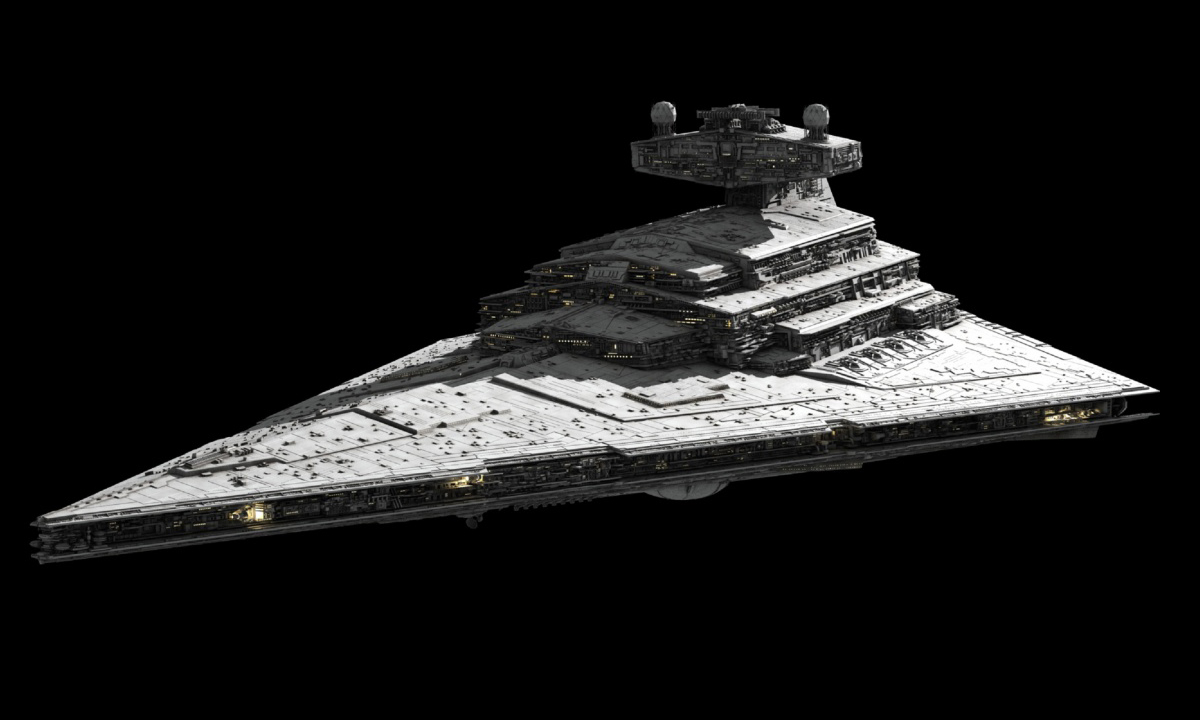
In Sci-Fi – Despite their unfortunate history, battlecruisers in space tend to operate similarly to battleships, and I would argue there is not much distinction between the two owing, partly, to the blurring of both vessels in our history. Battlecruisers and battleships, thus, often act as the heavy hitters in a fleet; they are the main combatants and are protected by other vessels such as frigates and destroyers. Being that they are capital ships, an engagement is usually won through battlecruisers and battleships. If a distinction is made between the two classes then battlecruisers would likely be quicker and less heavily armored than battleships, and in some settings are not even considered capital ships at all. But again; rules can be blurry and broken at the whim of any author. Regardless, battlecruisers and battleships are the truly massive, anti-“large vessel” ships in a fleet. They are meant to take a lot of punishment and dish out that punishment in kind. One particular term I see fairly often is “star cruiser.” In my mind, a star cruiser could either be the equivalent of a cruiser or a battlecruiser; that distinction is likely decided by whether or not star cruisers are considered capital ships, since that then determines the general capabilities of those vessels. As a general rule I would be bold enough to claim that star cruisers are equivalent to battlecruisers, and named as such because space.

Carrier
Aircraft carriers, like destroyers, are very modern classifications. They are the one vessel in today’s navies that almost anyone can pick out at a glance without fear of mistaking them for something else. This is due to their extremely obvious design; a very large, flat deck suitable for landing and deploying aircraft. Put as simply as possible, carriers carry aircraft (whether plane or helicopter depends on the ship). Historically, the concept of utilizing seagoing vessels for airborne operations was considered as far back as the early 1800s (though with balloons rather than planes). It was not until the early 1900s, with the invention of seaplanes, that actual aircraft launched from a ship become prominent. Back then, an aircraft with floats was launched from a modified cruiser or capital ship with a catapult, then recovered by a crane after it would later land in the water. Semi-successful uses of ship-borne craft in 1914 showed the world how effective such assets could be in war, and heavier-than-air craft started becoming more valuable for the world’s navies. By 1922, with the Washington Naval Treaty, battleships and battlecruisers (which most navies had too many of to be legal under the new treaty) were being converted into carriers. The flat-topped design did not become prominent until the late 1920s.

No one can deny the value of single-fighter aircraft. Planes provide a new dimension from which to attack and defend, and can carry payloads ranging from missiles to bombs to supplies for ground troops. Aircraft were extremely effective compared to even the best guns as they were more accurate and had the benefit of extreme maneuverability. That said, carriers suffered from a lack of personal offensive and defensive ability, and relied on their aircraft or the rest of their fleet to protect them. Even so, their aircraft can be considered an extension of themselves and the reign of the battleship was brought to a close when U.S. ship-borne craft sunk numerous Japanese super battleships, the largest battleships ever made.
In Sci-Fi – Carriers tend to be some of the largest capital ships around due to the need to hold and transport large numbers of fighters, bombers, and other craft. Typically, though not always, their hull-mounted armaments are light; carriers usually rely on the large numbers of fighters they carry (when operating solo) or their fleet for defense and attack of other ships. The ability to carry craft does not make a ship a carrier by default; many frigates and cruisers, for example, will carry a compliment of fighters or a few ground vehicles. In order to be considered a true carrier the vessel’s main role needs to be the transport and deployment of smaller craft (or troops; as far as I’m concerned not all carriers are extremely large and I would classify troopships and assault ships as small carriers).
Dreadnought
It’s difficult to talk about historical dreadnoughts without also talking about battleships. The first dreadnought was the Royal Navy’s HMS Dreadnought, a large and heavily armored battleship that ran on steam turbines (and thus made her the fastest battleship at the time). Dreadnought operated on an “all-big-guns” philosophy, giving her more heavy-caliber guns than any other ship at the time instead of smaller, quicker-to-fire secondary guns. Her creation was extremely influential in her time, and she spawned a new variant of battleship called “dreadnoughts” (and battleships made before her were designated “pre-dreadnoughts”). Thus, strictly speaking, dreadnoughts are just particularly large and powerful battleships. As such they carry the same characteristics of battleships; they are capital ships, represent naval power and influence, and would need a fleet to protect them from smaller vessels and weaponry.
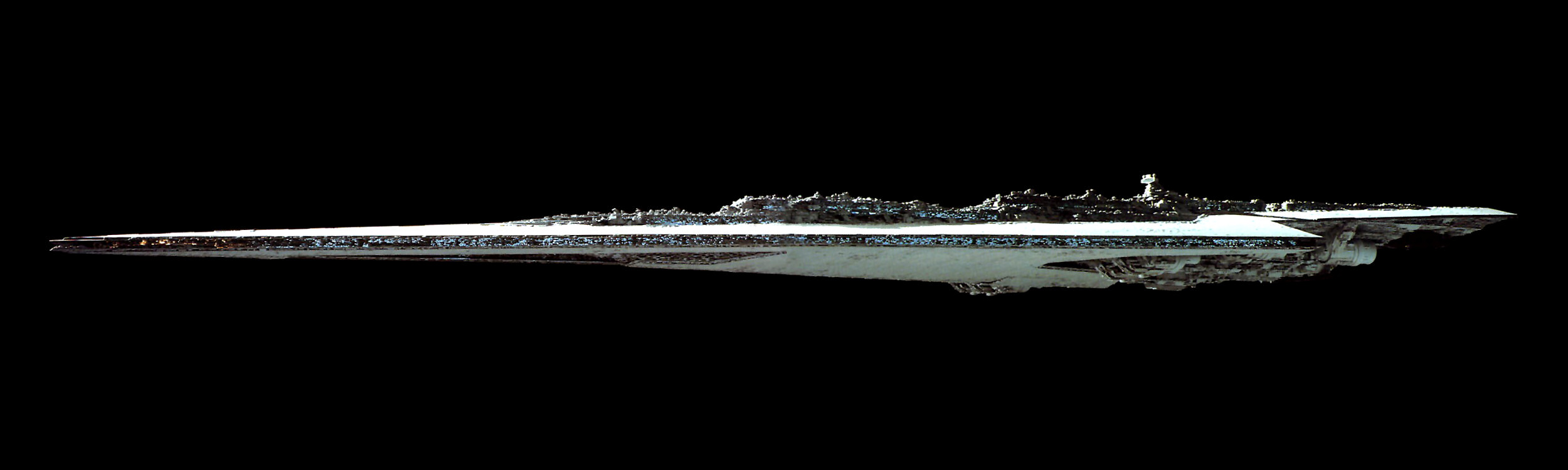
In Sci-Fi – Dreadnoughts are a just about always gigantic ships; massive vessels that dwarf even the largest battleships or battlecruisers. The role they fulfill is exactly like a battleship or battlecruiser; complete dominance and superiority. Intimidation, even more so than with battleships, is the name of the game when it comes to dreadnoughts. When you have a multi-mile long ship bearing down on a fleet you know the enemy’s morale is precarious at best. Due to their large size they can often carry a large number of secondary craft, like a carrier, but their extremely powerful armament would tend to exclude them from that definition. A dreadnought carries a bunch of craft because it can, and this adds to its lethality. But its true strength is its overwhelming firepower, plus its usually resilient armor.
Other Terminology
Whew. We’re about 5000 words in and I’m starting to lose steam, but let’s go over a few other things before I end today. You may have noticed some terms floating around that I’ve used but not really elaborated on, like “heavy” and “assault.” Those terms actually mean something, and so I’m going to take the last part of this article to explain them.
Armored: This is very self-explanatory and I don’t think I have to spend many words on it. An armored vessel is one with more resilient-than-normal armor than others of its classification. They can, theoretically, take more punishment.
Assault: By definition, an “assault” in warfare is usually the first phase of any particular attack. You can have aircraft assaults, or spaceship assaults. However, sci-fi lexicon also seems to borrow the term from the concept of amphibious assaults. These are operations where ships land ground (or air) forces upon a particular location through some sort of landing site like a beach; D-Day is a prime example of this. Assault vessels, therefore, are designed for assaulting an enemy planet, installation, space station, etc. They are usually designed to carry large numbers of troops, vehicles, drop ships, supporting aircraft, and the like; they assault the planet by being the first ships to touch down and dispense their payload and then get the hell out of dodge while the ground forces do their thing. Sometimes they need the brunt force of a fleet to allow them to get to the planet in the first place, but then you have ships like the Covenant’s CAS-class assault carrier that can do that job themselves.

Light and Heavy: I described the Halcyon-class (from Halo) as a light cruiser, while the later Autumn-class is a heavy cruiser. So what’s the difference there? Generally speaking, whether a particular vessel is light or heavy refers to the payload of its weapons. Sometimes the resilience of its armor may come into play (again; exceptions exist), but overall a vessel’s status as light or heavy is dependent on its guns. A light vessel has a lighter armament, while a heavy vessel, naturally, has a heavy armament. As such, you’d expect heavy vessels to be more useful in an engagement. Light vessels, meanwhile, would probably see more use in non-combat and support roles. At the very least they are less specialized for direct large-scale engagements. The various frigate classes in Halo are perfect examples of this; the Paris-class is a heavy frigate and very specialized for space combat. The Charon-class and Stalwart-class light frigates, meanwhile, were more jack-of-all-trades ships that saw more use as ground-support vessels and fleet support. Of course remember; sometimes you gotta make do with what you have available.
Super: I think this one is fairly self-explanatory as well. A super vessel is, for lack of a better word, just a bigger version of whatever classification of vessel it is we are talking about. Because of their increased size they almost always have much better armor and much stronger weapons than the “normal” variant.

And there you have it. Hopefully you have a better understanding of space combat and ship classification. I know I learned a lot by doing this; already I’ve starting thinking about things differently. Just the other day I finished the Ciaphas Cain: Hero of the Imperium omnibus and I had a better appreciation for some of the scenes in the last book (The Traitor’s Hand) that described a battle taking place in the planet Adumbria’s orbit.
Please don’t hesitate to use this information however you see fit. I hope it brings a sense of realism and authenticity to your games and I hope you appreciated my attempt at a comprehensive guide to ship taxonomy. With any luck it did someone somewhere some good.










El director de arte e ilustrador francés David Troquier, más conocido como Troqman, cuenta con un impresionante sentido del humor. El artista con sede en Alemania, crea “doodbles” y los coloca estratégicamente en su entorno para generar nuevas capas de significado. Puedes comprobarlo viendo su Instagram, ahí publica sus brillantes obras.

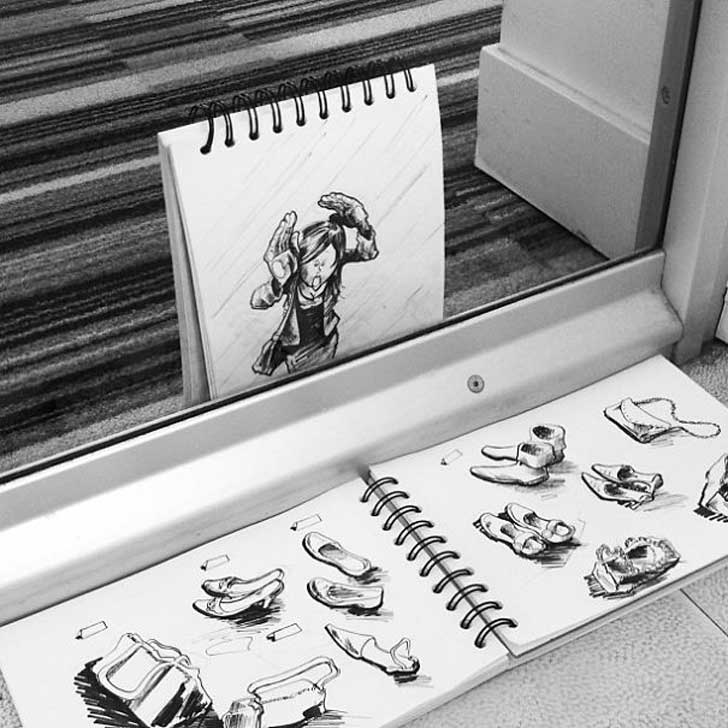
“Bombardeo de dibujos animados” nació en junio de 2013, durante unas vacaciones en las islas griegas. Me llevé un cuaderno de bocetos y esperaba hacer algunos dibujos del viaje, pero me aburrí de sólo dibujar paisajes o personas en la playa “, dijo Troquier
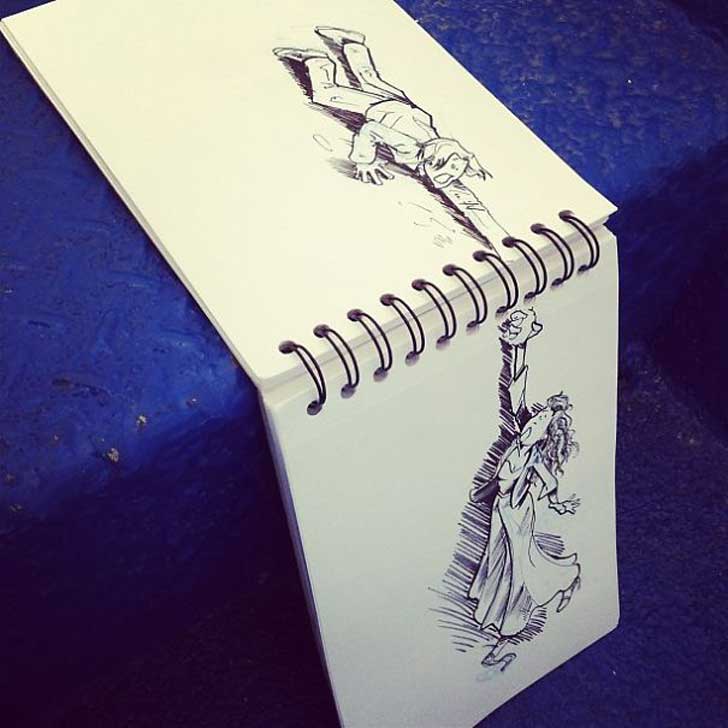

“Empecé a dibujar personajes que interactuaban con el medio ambiente. Otras personas y yo pensamos que era genial, porque si hay algo que me gusta más que el dibujo, es crear historias. Escribo algunos libros de cómic (para mí hasta ahora). “


“Me di cuenta de que los personajes de dibujos animados podían traer más historias a un entorno cotidiano / aburrido.”
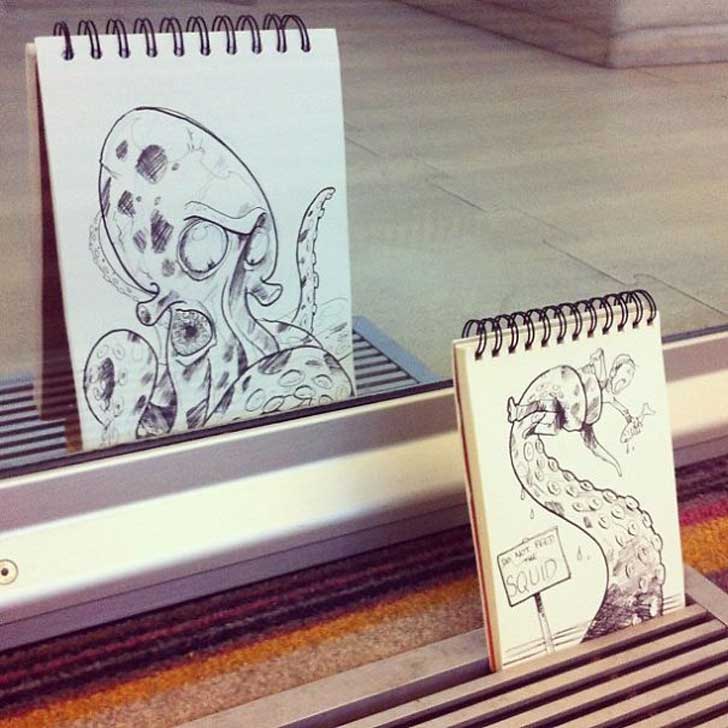

“Todo el mundo puede ver esta basura a lo largo de la carretera, pero en realidad nadie lo ve. Con mi lápiz y cuaderno de bocetos, yo puedo decidir cosas como: esta basura es una planta tóxica, o es un mutante que sale de ella, o me imagino que es una nave espacial o astronautas abordarlo “.

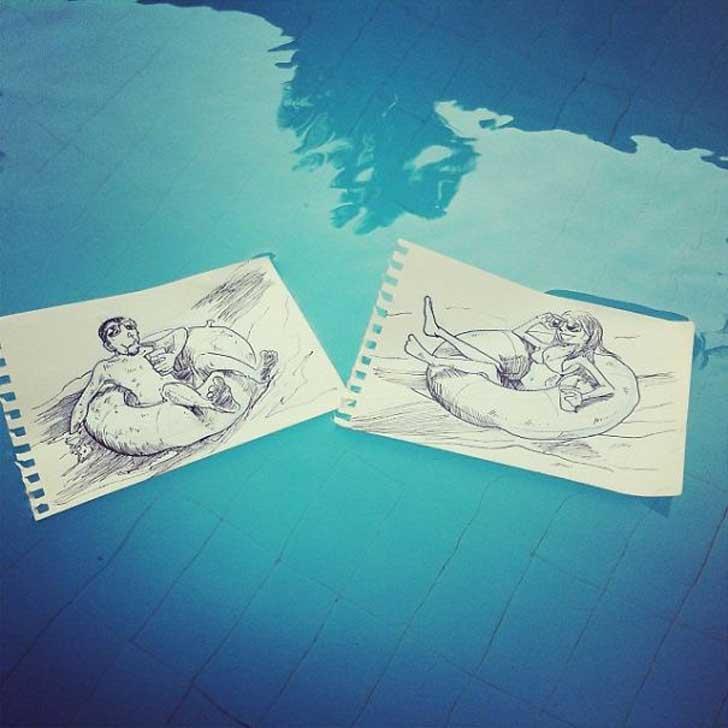
“Desde entonces, siempre miro a mi alrededor cuando estoy montando mi bicicleta, caminando en Amsterdam o durante un viaje. Tengo mi bolsa con varios cuadernos, lápices negros y mi iPhone. No me obligo a encontrar una idea, ella viene a mi cabeza cuando veo algo inspirador.”


“Es por eso que lo he denominado “Bombardeo de dibujos animados” – porque yo realmente siento que los personajes se esconden allí, sólo esperó hasta que lleguen y tomo la foto.”

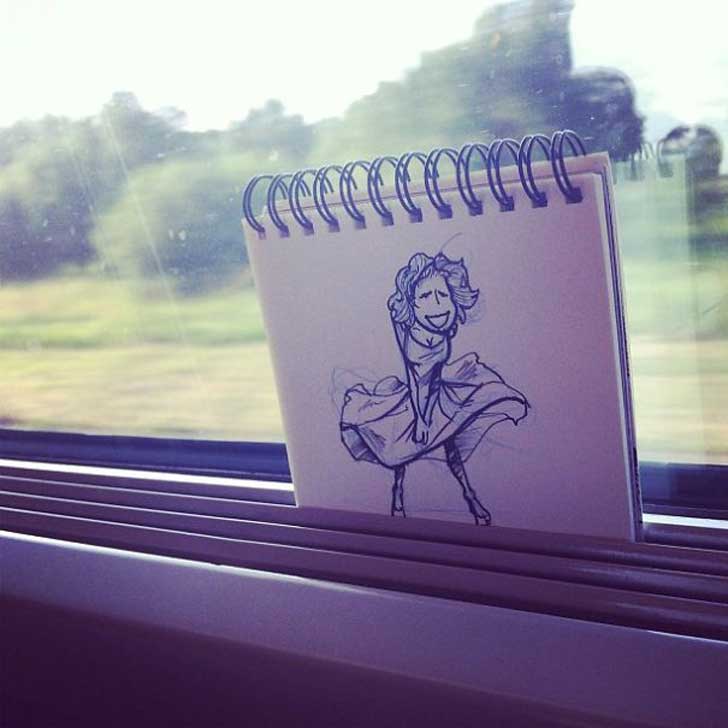
“No hay un propósito en esas imágenes. Creo que la palabra que me lleva en mi vida, publicidad o las ilustraciones, es ‘entretenimiento’. Paso un rato entretenido creando y dibujando personajes. Además es muy bueno para mi ver que la gente disfruta de mi trabajo y que les saco una sonrisa, ese es el único objetivo.”

“Trato de crear un bombardeo de dibujos animados por día, pero no es tan fácil ya que mi trabajo de publicidad es lo primero. A veces tengo ideas primero, así que las escribo en un cuaderno para más adelante, y “si veo algunas hojas rojas que dan vuelta en otoño, puedo dibujar un pintor junto a ellas.”

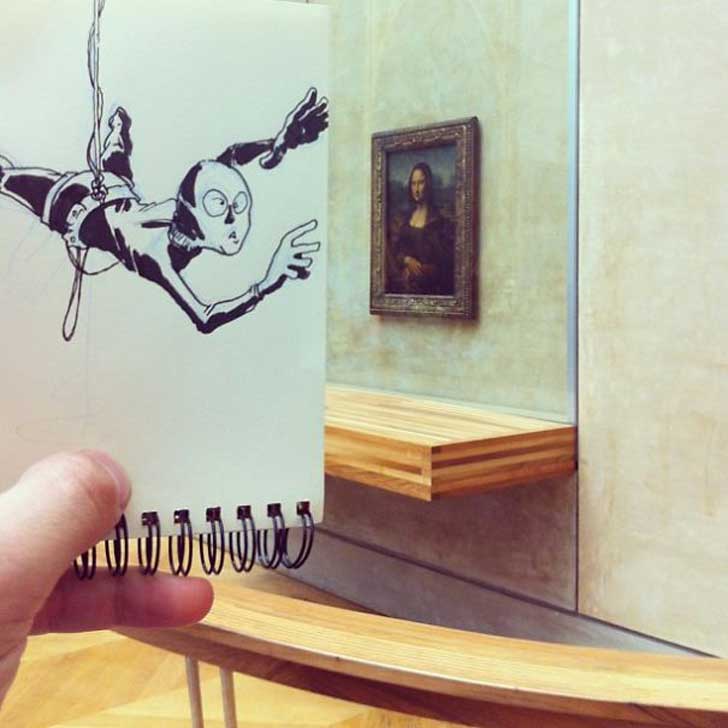

Si quieres ver más dibujos de este artista puedes ingresar a su Instagram.
Visto en Ufunk.
Audi has released “Doberhuahua,” its Super Bowl ad starring a Chihuahua-Doberman hybrid. Instead of being cute, the strange dog’s huge head and vicious nature make it rather horrifying.
For this year’s Big Game, Audi has conceived a never-before-seen creature to show the frightening consequences of bringing compromise into the world.
via Audi
Volkswagen has released “Wings,” their new Super Bowl ad that shows German engineers earning their wings and rainbows every time a Volkswagen hits 100,000 miles.
via Volkswagen USA
So how do the Japanese pass the time when they aren’t cloning themselves, creating ridiculous inventions, dreaming up quirky mascots, taking gym classes hosted by poodle dogs, watching candy coated pop stars or wearing panties on over their faces?
That’s right! They’re lining up to be willing contestants on some of the mind-boggling TV game shows you’ve ever witnessed.
Now we ‘could’ try and attempt to describe what is taking place in the following collection of GIFs from numerous Japanese game shows, but really they defy explanation. Literally anything and everything happens, with no disturbing corner of the writers imaginations left unturned.
There’s the famous saying that “One man’s trash is another mans treasure” or in the case of cheap Japanese entertainment, one man’s hellish challenge is another man’s gleeful celebration.
Prepare yourself for the weird, the bizarre and a whole lot of W.T.F. Do let us know which numbers you love the most.

















Photographer Allard Schager shot this perplexing photo while looking up the Stairway of the King of Aragon, a stairwell carved into a steep cliff face in Bonifacio, Corsica, France. I’ve looked at it carefully half a dozen times and still get confused as to which way is up or down. Totally wild.



“I’m not ashamed to dress “like a woman” because I don’t think it’s shameful to be a woman.” -Iggy Pop
“His manager asked “Ig, why are you wearing a womans dress?” and Iggy replied “I beg to differ, this is a mans dress.””
Metal as fuck