
Sophianotloren
Shared posts
23 Jun 23:43

Piped #artinthestreets #moca #2011 #losangeles #california...
Piped
#artinthestreets #moca #2011 #losangeles #california #Magritte #pipe (at MoCA - Downtown LA)
23 Jun 23:42

talking about streets, roads, etc.
by lynneguist
A while ago, I wrote about a difference in AmE and BrE use of street and road, in that in BrE it's more natural to cross the road and in AmE (certainly in a town or city) it's more common to cross the street. (I've also written about in/on the street, so see that post for more on that.) That's common-noun usage, but what about the proper names of vehicular paths?
There's no question that some ways of designating paths are more common in one country or the other. I've never seen a road named [Something] Trail or [Something] Boulevard in the UK (though see the comments for some counterexamples), and in the US there aren't as many Crescents or (BrE) Closes (pronounced with a /s/, not a /z/). But a problem for making generali{z/s}ations about such things is that the naming of streets or roads varies a lot on the local level in both countries, with different names based on regional differences, urban/rural differences, and terrain differences.
The other day Damien Hall (tweeting as @EvrydayLg) pointed out:
 ...because in most cases that will be an unambiguous statement, since there will typically only be one thoroughfare called Main (Street) and one called Union (maybe Avenue) in a town. I often send packages to a friend who lives in Tennessee. I've never bothered to find out if she lives on Woodland Street or Woodland Lane because I only need to put '140 Woodland' (and the city, state and, if I'm nice, the zip code) on the package and it gets there. As you can see from this (AmE) yard sale sign, the practice of not saying street or road is common. (Where there is more than one with the same name, you'll hear the street/road/lane/whatever more regularly.)
(Side note on codes: Five-digit US zip codes only say which town or which part of a city the address is in, unlike six-or-seven-letter/number UK post codes, which generally indicate the town/part-of-city in the first half (letter-letter+1- or 2-digit number) and which street or part-of-street in the second half (number-letter-letter). Nine-digit US zip codes, called ZIP+4, are a more recent addition* that do indicate street, but which I don't actually use. I couldn't tell you what mine is at the US address I use.
*It says how old I am that I consider something from 1983 a 'recent addition'. )
'Street'-less street names are so unambiguous that most Americans would immediately recogni{z/s}e that the film title State and Main refers to a corner in a town--mostly likely in the cent{er/re} of the town, since those are common street names in American towns and because we refer to (AmE) intersections or the corners at those intersections in that way.
(I'm sure I've mentioned before that Main Street is a likely street to have in a town as the main street. It is also metaphorically used to refer to 'the inhabitants of small US towns considered as having a narrow-minded or materialistic worldview' (AHD5). So, politicians might worry about 'what will fly on Main Street'. The High Street is the proverbial main street in a British town (it may or may not be named High Street) and is used metaphorically to refer to the commercial market--i.e. 'what will fly on the high street' is what the masses are likely to want to buy.)
British roads need the street or road (etc.) because little is unambiguous when it comes to British road names.
Take my former (more common in AmE) neighbo(u)rhood as an example:
 There is a Buckingham Road, which meets Buckingham Place. Buckingham Street runs parallel to Buckingham Road, but doesn't meet Buckingham Place because halfway through it changes its name to Clifton Street. Off the map are Clifton Road, Clifton Hill, Clifton Street, Clifton Place and Clifton Terrace. But we don't need to leave this map to see that there's also a West Hill Street, West Hill Road and West Hill Place. I also feel bad for the people who live on the parallel Albert Road and Alfred Road who probably get each other's (AmE) mail/(BrE) post all the time.
Once I found an unconscious man on Buckingham Place. Except I didn't know which Buckingham it was. The ambulance people were (BrE) well (orig. AmE) pissed off at me.
If that weren't bad enough, I now live on a road that shares its entire name with another road in the same city. When I tell taxis where to take me I have to say "X Street, off Y Road". We always tell plumbers and such which one to go to (we even give them our post code) and then when they don't show up, we text them to say "no, it's the other one".
A famous exception to the 'one pathway per name' rule in the US is New York City, which has both a 3rd Street and a 3rd Avenue. Except that it doesn't really have a '3rd Street', since you need to put East or West in front of it in order for the house number to be meaningful--so if someone says they live on East 5th, you know it's East 5th Street. In New York and the US more generally Avenue is often abbreviated in speech (as well as writing) to its first syllable (written as Ave. or Av.).
And so onto the Easts and Wests. In the US, you can reasonably expect that East Main Street and West Main Street are the same thoroughfare, but that house numbering starts from the where they join (or divide, depending how you think of it). East Main Street will run to the east from that (AmE) intersection/(BrE) junction.
In some cities they put the compass-points after the name and that can mean something different. In Washington, DC, it indicates quadrant of the city that that part of the road is in. So, 7th Street NW and 7th Street SW are one long road that runs north/south, but the parts of it in different quadrants of the city. On the other side of the capitol building, the street numbering starts over, and so 7th Street SE and 7th Street NE run parallel to the other 7th Street NW/SW.
So, the other day, I had to find Brunswick Street East in Hove (UK). Somehow (¡Apple Maps!) I ended up on Brunswick Street West. I knew that Brunswick Street East would not be a continuation of West (after all, the road was running north-south), but I hoped it would be the next street eastward. It was not. At least it was eastward. (I hadn't been willing to trust even that.) But I did get to see Brunswick Place, Brunswick Square and Brunswick Terrace in my explorations.
Finding street names is its own challenge. In the US, street signs tend to be affixed to poles at the corners of roads. At some big intersections, they may hang over the road on the wires that hold the (AmE) stop lights/(BrE/AmE) traffic lights. In the UK, they tend to be on buildings or walls near the end of the road. This may require some searching since some are high and some are low. Here's one of my favo(u)rites from Brighton:

House-numbering, of course, is another nightmare. In the US, it's pretty predictable that even numbers will be on one side of the road and odd ones on the other. In the UK, it might be that way (though you've no guarantee that 92 will be across the street from 93--it might be many houses further down). Another UK way is to have consecutive numbering up one side of the road (1, 2, 3, 4,...) to wherever the road ends and then down the other side, so that, say, 52 and 53 may be across the road from one another, but 1 will be across the road from 104. Another way it might be is that the name of the road on one side is different from the name on the other side--so, for example, the people at 15 Vernon Terrace in Brighton live across from the people at 17 Montpelier Crescent. (And Vernon Terrace only lasts for one (AmE) block, after which its name changes and house numbers re-start twice before you get to the sea, which has pleasantly few thoroughfare names.)
I've talked about differences in house numbering on Numberphile, so (BrE) have a look at the video if you are (orig. AmE) nerdy enough want to hear more about house-numbering:
There's no question that some ways of designating paths are more common in one country or the other. I've never seen a road named [Something] Trail or [Something] Boulevard in the UK (though see the comments for some counterexamples), and in the US there aren't as many Crescents or (BrE) Closes (pronounced with a /s/, not a /z/). But a problem for making generali{z/s}ations about such things is that the naming of streets or roads varies a lot on the local level in both countries, with different names based on regional differences, urban/rural differences, and terrain differences.
The other day Damien Hall (tweeting as @EvrydayLg) pointed out:
Struck since long B4 I lived there by US habit of omitting eg St, Rd in addresses. We don't.He hypothesi{z/s}ed that it might be because street is more common in the US and therefore the default. But I don't think that's why. Instead, Americans are happy to say things like
go up Main and take the first right onto Union

(Side note on codes: Five-digit US zip codes only say which town or which part of a city the address is in, unlike six-or-seven-letter/number UK post codes, which generally indicate the town/part-of-city in the first half (letter-letter+1- or 2-digit number) and which street or part-of-street in the second half (number-letter-letter). Nine-digit US zip codes, called ZIP+4, are a more recent addition* that do indicate street, but which I don't actually use. I couldn't tell you what mine is at the US address I use.
*It says how old I am that I consider something from 1983 a 'recent addition'. )
'Street'-less street names are so unambiguous that most Americans would immediately recogni{z/s}e that the film title State and Main refers to a corner in a town--mostly likely in the cent{er/re} of the town, since those are common street names in American towns and because we refer to (AmE) intersections or the corners at those intersections in that way.
(I'm sure I've mentioned before that Main Street is a likely street to have in a town as the main street. It is also metaphorically used to refer to 'the inhabitants of small US towns considered as having a narrow-minded or materialistic worldview' (AHD5). So, politicians might worry about 'what will fly on Main Street'. The High Street is the proverbial main street in a British town (it may or may not be named High Street) and is used metaphorically to refer to the commercial market--i.e. 'what will fly on the high street' is what the masses are likely to want to buy.)
British roads need the street or road (etc.) because little is unambiguous when it comes to British road names.
Take my former (more common in AmE) neighbo(u)rhood as an example:
 There is a Buckingham Road, which meets Buckingham Place. Buckingham Street runs parallel to Buckingham Road, but doesn't meet Buckingham Place because halfway through it changes its name to Clifton Street. Off the map are Clifton Road, Clifton Hill, Clifton Street, Clifton Place and Clifton Terrace. But we don't need to leave this map to see that there's also a West Hill Street, West Hill Road and West Hill Place. I also feel bad for the people who live on the parallel Albert Road and Alfred Road who probably get each other's (AmE) mail/(BrE) post all the time.
 Once I found an unconscious man on Buckingham Place. Except I didn't know which Buckingham it was. The ambulance people were (BrE) well (orig. AmE) pissed off at me.
If that weren't bad enough, I now live on a road that shares its entire name with another road in the same city. When I tell taxis where to take me I have to say "X Street, off Y Road". We always tell plumbers and such which one to go to (we even give them our post code) and then when they don't show up, we text them to say "no, it's the other one".
A famous exception to the 'one pathway per name' rule in the US is New York City, which has both a 3rd Street and a 3rd Avenue. Except that it doesn't really have a '3rd Street', since you need to put East or West in front of it in order for the house number to be meaningful--so if someone says they live on East 5th, you know it's East 5th Street. In New York and the US more generally Avenue is often abbreviated in speech (as well as writing) to its first syllable (written as Ave. or Av.).
And so onto the Easts and Wests. In the US, you can reasonably expect that East Main Street and West Main Street are the same thoroughfare, but that house numbering starts from the where they join (or divide, depending how you think of it). East Main Street will run to the east from that (AmE) intersection/(BrE) junction.
In some cities they put the compass-points after the name and that can mean something different. In Washington, DC, it indicates quadrant of the city that that part of the road is in. So, 7th Street NW and 7th Street SW are one long road that runs north/south, but the parts of it in different quadrants of the city. On the other side of the capitol building, the street numbering starts over, and so 7th Street SE and 7th Street NE run parallel to the other 7th Street NW/SW.
So, the other day, I had to find Brunswick Street East in Hove (UK). Somehow (¡Apple Maps!) I ended up on Brunswick Street West. I knew that Brunswick Street East would not be a continuation of West (after all, the road was running north-south), but I hoped it would be the next street eastward. It was not. At least it was eastward. (I hadn't been willing to trust even that.) But I did get to see Brunswick Place, Brunswick Square and Brunswick Terrace in my explorations.
Finding street names is its own challenge. In the US, street signs tend to be affixed to poles at the corners of roads. At some big intersections, they may hang over the road on the wires that hold the (AmE) stop lights/(BrE/AmE) traffic lights. In the UK, they tend to be on buildings or walls near the end of the road. This may require some searching since some are high and some are low. Here's one of my favo(u)rites from Brighton:

House-numbering, of course, is another nightmare. In the US, it's pretty predictable that even numbers will be on one side of the road and odd ones on the other. In the UK, it might be that way (though you've no guarantee that 92 will be across the street from 93--it might be many houses further down). Another UK way is to have consecutive numbering up one side of the road (1, 2, 3, 4,...) to wherever the road ends and then down the other side, so that, say, 52 and 53 may be across the road from one another, but 1 will be across the road from 104. Another way it might be is that the name of the road on one side is different from the name on the other side--so, for example, the people at 15 Vernon Terrace in Brighton live across from the people at 17 Montpelier Crescent. (And Vernon Terrace only lasts for one (AmE) block, after which its name changes and house numbers re-start twice before you get to the sea, which has pleasantly few thoroughfare names.)
I've talked about differences in house numbering on Numberphile, so (BrE) have a look at the video if you are (orig. AmE) nerdy enough want to hear more about house-numbering:
Sophianotloren likes this

23 Jun 23:37
How Fast Track Hurts American Families
by Erik Loomis

There are somewhat weird arguments liberals make about trade that allows people to easily justify the loss of millions of American jobs because of slight improvements in income for the Vietnamese and Bangladeshi workers who replace them. There are a couple of serious problems with these arguments. First, it is essentially pro-capitalist, reinforcing the idea of employers as “job creators” who ultimately benefit society, as opposed to the profit-seekers who are willing to undermine any nation’s working class for the next quarterly report. Second, it shows shockingly little sophisticated analysis over how this process actually affects their own nation. The rise of Citizens United and the Koch Brothers’ control over American politics is directly linked to the decline of working-class voices in those politics that happened when the industrial unions were crushed. If you like high levels of income inequality and plutocrat control over America, fast track is for you. Third, these arguments allow for a sort of consumer myopia over their own role in the supply chain. By saying that American employers are improving the lives of workers overseas, it means that we don’t really have to worry about the actual conditions of work in these factories–child labor, slave labor, sexual harassment, forced pregnancy tests, beating by supervisors, unsafe working conditions, low wages, buildings collapsing on workers. All of these things are terrible and unnecessary.
Finally, it also undermines a basic fact–that nations need to have an interest in creating good jobs for its own citizens. I’m no believer in old-school protectionism, but unless the nation is creating good jobs for working Americans–moving the emphasis in our job creation from the creative class and highly-educated to average Americans–income inequality will continue to grow, as will societal instability. This is where United Steelworkers president Leo Gerard comes in, telling stories about how fast track hurts his members and working Americans.
They should, for example, pay attention to Kori Sherwood. When she got a job two years ago as a millwright at U.S. Steel’s Minntac facility in the Minnesota Iron Range, it changed her life and that of her young daughter. But in March, U.S. Steel sent layoff notices to 680 of Minntac’s 1,500 workers, citing an international glut of steel. Prices are at a 12-year low as mills in China continue to produce and ship massive amounts of steel and sell it at below market prices made possible by improper government subsidies and support.
Under international trade law, countries can prop up industry with government subsidies when the products are sold internally. Beijing may give its steel industry no-interest loans and free electricity when the rebar or pipe or I-beams are sold for construction projects in China. But international trade law forbids such subsidies when the goods are sold internationally because government aid suppresses product prices in what is supposed to be a free market. Some countries, however, routinely flout the rules. Then American companies that don’t get no-interest government loans or free electricity or other subsidies can’t compete on price.
They shut down mills and lay off workers. Unions and manufacturers are forced to pay millions to petition for import duties on the subsidized foreign goods to level the playing field. To win such a case, industry must prove financial injury and workers must suffer layoffs and lost income.
Kori Sherwood got one of U.S. Steel’s layoff notices and lost her job at Minntac on May 26. China’s violation of international trade rules dashed Sherwood’s hopes and plans. “You finally think you get your life in order – buy a truck, buy a home, and it all falls apart,” she said.
…
Import-adoring lawmakers should talk to tire builders from Tuscaloosa and Gadsden Ala., Findlay, Ohio, and Salem, Va., who have watched with endless anxiety over the past decade as American manufacturers closed plants and cut production because Chinese producers dumped subsidized passenger and light truck tires into the U.S. market.
After the USW petitioned for relief, the U.S. imposed import duties on Chinese tires beginning in 2009 and imports declined significantly. American producers regained market share and invested in American factories. They recalled laid off workers and even hired new ones.
But the second the duties expired, Chinese producers resumed dumping. American companies once again cut production, reduced workers’ hours and furloughed staff. The USW petitioned for trade relief again a year ago, and the U.S. Department of Commerce imposed preliminary duties. Since then, U.S. tire companies have ramped up production and increased workers’ shifts.
In testimony earlier this month before the U.S. International Trade Commission seeking permanent duties, David Hayes, president of the USW local union at Goodyear’s tire plant in Gadsden, talked about how the waves of dumped foreign tires have denied his fellow 1,500 workers job stability as layoffs followed each import surge.
These are actually important issues that liberals need to take seriously. The Kori Sherwood’s of the world need good jobs if we want the United States to be a stable nation in the 21st century that treats its citizens with respect. Supporters of the Trans Pacific Partnership need to articulate what happens to Kori Sherwood. NAFTA supporters used to say that the creative economy would take care of these people. Of course those were delusional statements of true believers in the religion of free trade. Now supporters of the TPP aren’t even trying to answer that question, including President Obama.
If we are going to have these trade agreements, we need to have international rules that protect workers wherever the jobs are located. Out of Sight is my answer to free trade advocates who claim that Americans who want the American working class to have good jobs don’t care about the poor overseas. But I haven’t heard any reasonable articulation of what happens to Kori Sherwood from advocates of the Trans Pacific Partnership. Maybe she can get a job at McDonald’s or work a temp job that never becomes permanent.
Sophianotloren likes this


23 Jun 23:35
Russia and Texas
by Erik Loomis

I love the idea of the Russians going full Zimmerman Telegram and actively supporting Texas secessionists. I’m not even sure that stopping this is a bad thing for the rest of the nation.
Sophianotloren likes this
23 Jun 23:34
Filed under: General


Staring at the ceiling, wishing she were somewhere else instead
by Sophia, NOT Loren!
Haven’t left the house today. Barely left my bed. Haven’t eaten enough (and might go attempt to remedy that in a few minutes) and I’ve been bored and lethargic and stressed out. The neighbor’s dog barking all day — from just after 4am until nearly midnight — hasn’t helped my frazzled nerves, nor did the movie blasting out from the home theater downstairs (directly below my room, naturally, but there’s nowhere in the house that I can escape it.) At one point I went to the bathroom, and in there I could hear more than just the bass and explosions… just in time to catch a screaming match between two angry characters.
On the plus side, I did get a tiny bit more rest than usual, and I connected with a few awesome people that I had really hoped to hear from It’s a nice surprise to actually have someone reach out after the initial “hey, this is me, here’s my contact info” — it happens so rarely that it’s really depressing most of the time. Like, out of 250 cards I give away, I end up with 2 or 3 folks who ever even get in touch. And that holds true even when I’ve given my number to someone who is very flirty, not-even-slightly subtle about it, even when someone has pulled me in and made out, even when there’s been kissing and groping and “let me buy you a drink” and “I’d love to take you to bed with me!” — I rarely hear a word. So, yeah. When not one but two incredible women got back to me today, I was pleased!
Also my mom stopped by the bank and deposited a little bit of money for me, which should take care of the rest of the cost of my hair coloring. Useful. And I killed some time on tumblr, filling my queue up again and finding a few more blogs to follow. I haven’t written the massive blog post that I have been promising myself to get to for ages now, but I’m not sure how I can make that happen, either, because it’ll require me being in decent shape mentally, emotionally, and physically, plus the ability to write without everything smashing in around me, the noise and craziness that consistently make me want to scream.
I don’t want to sleep alone again tonight, and I don’t want to sleep here tonight, but I really don’t have much choice in the matter. Keeping my heart open, keeping my eyes open, and keeping my legs open — eventually the combination will lead me to where I want to be. I can do Patience… and of course, I’m sure you know what they say: Patience is a virgin, right? She just kept waiting, patiently? Ah, well. Anyway…
Filed under: General
Sophianotloren likes this
23 Jun 23:34
Solitary Confinement And White Juries
by Scott Lemieux

I have a piece up on Anthony Kennedy’s concurrence drawing attention to solitary confinement, contrasting it with Clarence Thomas’s opinions from last Thursday, which were apparently a collage of Michael Savage transcripts and Harry Callahan quotes.
I discuss it briefly, but another of the underlying issues in Davis v. Ayala — the use of peremptory challenges by prosecutors to systematically remove people of color from the jury pool — is also extremely important. The latest in Mark Graber’s recent series on equality and American constitutional law in 2015 is excellent on this point:
The bottom line is that ensuring white-only juries is getting easier and easier. First, you claim trial strategy and exclude defense counsel from the Batson hearing. Then you point to a difference between the answers given by a potential juror of color and a potential white juror. You detected more hesitation when the potential juror of color stated he or she would impose capital punishment. You felt the potential white juror more willing to look you in the eye. If your trial judge believes you, you are home free.
One of my most distinguished colleagues recently said that criminal justice will be the civil rights issue of the future. With all due respect, she is wrong. As the lack of response to the substance of Davis v. Ayala demonstrates, no one cares if the United States is slowly moving back to the days of all-white juries. A Supreme Court that declares a right to same-sex marriage will be lionized and free to do what they want in the criminal justice system. The civil rights issue of the future will concern the concerns of the upper-middle class, not the fate of the Hector Ayala’s of the world.
My only quibble is that I don’t see the causal connection implied in the “free to do what they want in the criminal justice system.” Since all that is required in this case is for them to do nothing, the Court doesn’t need any legitimacy points from a decision legalizing same-sex marriage to (as the casino manager in Owning Mahony instructed his clerk after he told him he “didn’t do nothing” to keep a whale happy) don’t do nothing again. Irrespective of the Court’s general popularity, it’s not going to face a backlash by being too deferential on criminal procedure issues. In addition — as I’m sure Graber would agree — the failure of the Court to stop racially discriminatory jury selection isn’t inherent to its power but is the consequence of the Court’s long-term control by Republicans. It’s worth noting that the most moderate justice appointed by a Democratic president has suggested that because they provide such an easy cover for discrimination peremptory challenges violate the Fourteenth Amendment. Ayala was 5-4, and the dissent written by Sonia Sotomayor, who is assembling a significant body of work on equality issues. Change on this particular issue may be a long time coming, or it may be “just” a change in the median vote away.
Sophianotloren likes this
23 Jun 23:34
Fast Track
by Erik Loomis

I knew that the House Democratic defeat of Trade Adjustment Assistance as a way to undermine fast track for the Trans Pacific Partnership would be short-lived. There was a lot of celebration but I remembered being burned too many times to be any more than cautiously optimistic. Even that was too much as the Senate has passed fast track. Basically the Democrats we thought would not pass fast track without TAA of course would do that very thing, the most predictable thing ever.
I guess we are going to have to just keep documenting the horrors of the global trade system and fight for one that is more fair. Keep fighting for another day. But this is very depressing to me.
Sophianotloren likes this
23 Jun 23:34
Filed under: Gender & Class, Inequality, Masculinities


Another Tool in the Gendered Toolbox: Guns, Masculinity & Socioeconomic Decline
by gendsocoakland
By Jennifer Carlson
Since the 1970s, there’s been a major legislative shift in most US states: Americans not only can legally own guns – they can also legally carry them on their persons as they go about their daily lives thanks to new “shall-issue” laws. Over 8 million Americans – the vast majority of them men – are licensed to carry guns concealed, and protection is now the number-one reason Americans give for owning guns, surpassing hunting.
What gives? Overall, crime is down, after all. The other dominant argument – that this is about white men clinging to their waning privilege – doesn’t entirely hold, either. In Metro Detroit, where I researched gun carriers, African Americans are more likely than whites to have a concealed pistol license. What, then, explains the appeal of gun carry to men – and, seemingly, diverse groups of men? What are guns doing for the men who carry them?
I went to Michigan, a historically Blue state that had revamped its concealed carry law in 2001, to find out. I interviewed 60 men who were licensed to carry guns in Michigan, and I spent time at shooting ranges, at pro-gun picnics, in firearms classes and on Internet gun forums to understand what motivates people to make a gun part of their everyday lives. During this fieldwork, I often heard about self-defense – but I also heard about much more. I heard from people like Gerald, an African American gun carrier, who felt it was his duty to be “the man” in a family of “rolling stones.” Or Brad, a white gun carrier, who saw his duties as head-of-household as tied to his ability to provide for his family – and protect them. Carrying a gun, for these men, wasn’t just about standing up for Second Amendment rights (although that is certainly part of it). It was also about stepping up to the plate as men, fathers, and community members as protectors.
Carrying a gun, of course, isn’t the only way to be a man. Sociologist Nicholas Townsend argues (here) that historically, ideals of American manhood have been tied to fatherhood, marriage, employment and home ownership. Interestingly, Michigan helped to create this idealized manhood: Michigan’s prosperity and prominence in labor struggles helped create the structural conditions for the male breadwinner job, which could support a family with good wages, pensions and benefits. But with the unraveling of unions and the welfare state, American society has been increasingly characterized by neoliberal shifts toward privatization, deregulation, and automation. Michigan was the only state with a statewide decline in employment from 1990 to 2009. Union membership rates have decreased from 26 percent in 1989 to 16.6 percent in 2012, a steeper decline than the U.S. average. Meanwhile, Michigan’s median household income has declined 19.2 percent from 2000 to 2012, the largest drop of any state.
Gun carriers offered up nostalgic references to the glory days of Michigan, when industry was booming, breadwinner jobs were plentiful, family dinners organized domestic life, and the streets felt safe. While gun carriers may have viewed Michigan’s past through rose-colored glasses, their words conveyed a sense of loss and despair about what Michigan once was – and could have been. Frankie, a retired African American who came of age in Detroit in the 1960s and 1970s, told me about “back then”: “they were hiring people off the street with zero education, and they could work 20 years, and they could make a living. You can’t do that shit now.” Christopher, a white gun carrier who lived in the suburbs, emphasized the “family unit that’s no longer in existence”: “When I grew up – it was family dinners, it was a lot of family interaction, and there was always family involvement. Now, because of the economy, because of keeping up with the Joneses, you have two parents working one job, 12-14-plus-hour days, five to six days a week.”
What has been lost in Michigan’s socio-economic decline was not just economic security but men’s economic position as breadwinners. An extreme case, Michigan is at the center of a much broader process of economic restructuring that has spelled out – as Hanna Rosin coined it – the “end of men” (here). And while the loss of blue-collar jobs has been felt most acutely in Michigan, the shift from stable, union jobs to more precarious work is a national problem that has undermined men’s access to jobs that once defined them as useful, productive members of their families – and society.
This is where guns come in. In this context of socioeconomic decline, guns provide another “tool” in the gendered “toolbox” for men to assert themselves as useful and relevant men – that is, as protectors. No longer guaranteed the middle-class lifestyles promised to their parents, men use guns not simply to instrumentally address the threat of crime but also to negotiate their own position within a context of socioeconomic decline by emphasizing their role as protector. Thus, gun carry meshes with on-the-ground socioeconomic insecurities to transform Second Amendment politics from an ideological issue to a concrete, everyday practice. And in carrying guns, many Americans are doing much more than just exercising their rights to self-defense – they are also asserting a particular moral politics surrounding what it means to be a good man, a good father, and good community member – through protection.
Jennifer Carlson, PhD is an Assistant Professor in the Department of Sociology at the University of Toronto. Her article “Mourning Mayberry: Guns, Masculinity, and Socioeconomic Decline” is published in the June 2015 issue of Gender & Society.
Filed under: Gender & Class, Inequality, Masculinities
Sophianotloren likes this
23 Jun 23:33


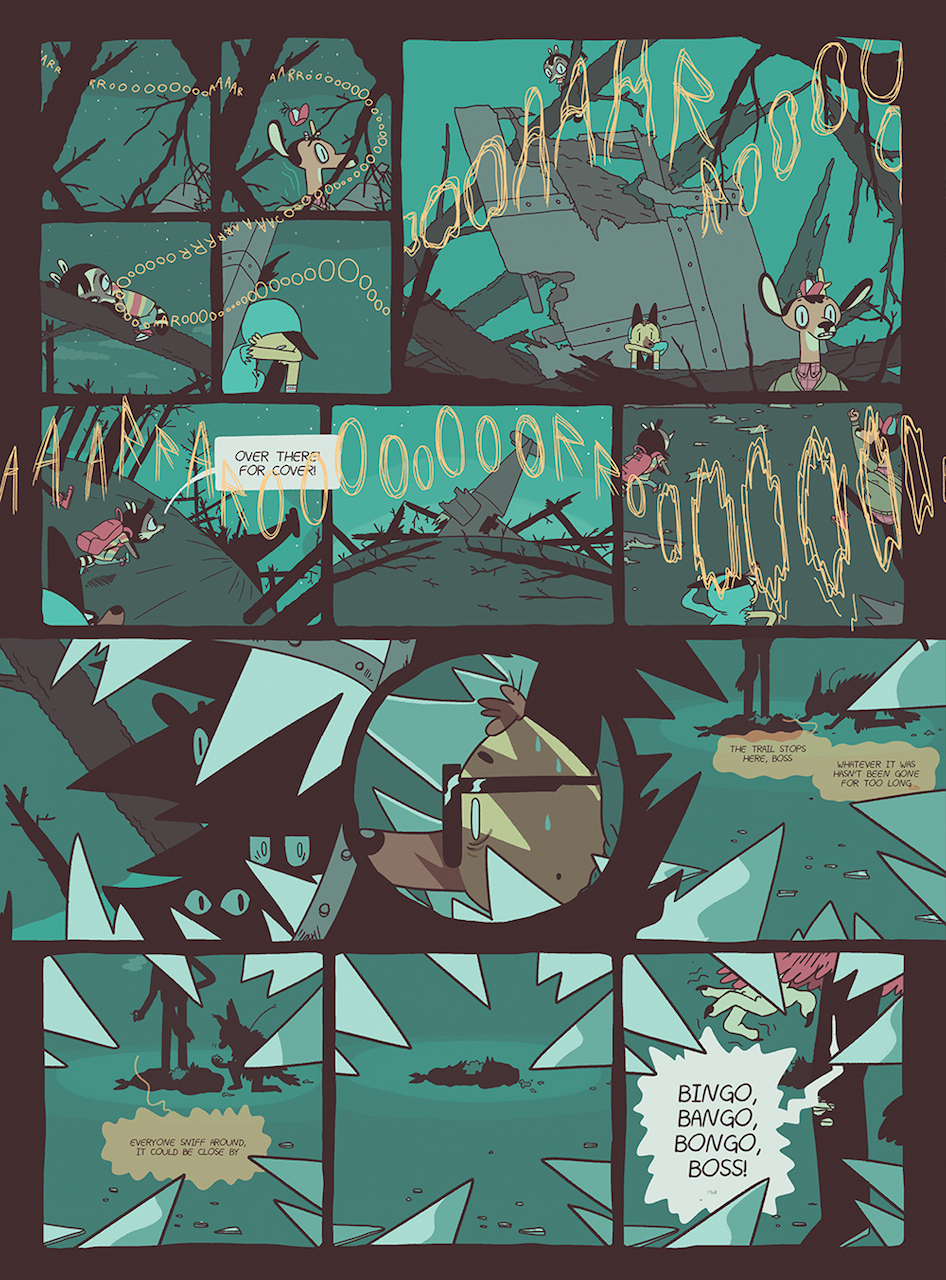


Publisher of Small-Format Comics Gives Emerging Authors a Big Break
by Allison Meier
Page from ‘Vacancy’ by Jen Lee (all images courtesy the artist and Nobrow)
At just 24 pages, each comic in British publisher Nobrow’s 17×23 series is designed to be an accessible gateway for readers to discover emerging authors, and for those authors to create what is often their first print publication.
“Many have been working the zine landscape, or webcomics, with success for years and so are used to the short form narrative, although some have never created more than a two pager,” Nobrow Creative Director Alex Spiro told Hyperallergic. “Ultimately, this is a stepping stone, or gateway to more conventionally published works of greater volume.
Cover of ‘Vacancy’ by Jen Lee
This month Nobrow released one of its newest 17×23 books, with Jen Lee’s Vacancy. Lee is the author and artist of the beautiful online comic Thunderpaw, where GIFs and side-scrolling animate an ongoing post-apocalyptic narrative about two abandoned dogs trying to find home in a world where humans have vanished.
“I’m pretty into animal behavior and the relationships we have with them, and the rest of nature,” Lee explained. “We’ve altered a lot of ecology and have domesticated animals for our own benefits. I love thinking about if critters would have a riot at us not existing anymore, or would some who depended on our luxuries be weeded out?”
Vacancy also delves into the minds of animals. A dog named Simon, left in the backyard after his family fled for some unseen reason, considers going into the wild. As her first print comic, it carries the moody palette and feeling of uneasy movement of her online work.
“The biggest challenge with Vacancy was that I had to get the complete story down first,” she said. “With my webcomic, since it’s ongoing and I’m the only one on it, I get to be pretty whimsical. I don’t know what’s going to be in the next update until I sit down and do my first thumbnails.”
‘Fish’ by Bianca Bagnarelli in the 17×23 series
‘Golemchik’ by William Exley in the 17×23 series
‘The Hunter’ by Joe Sparrow in the 17×23 series
Named for the 17 by 23-centimeter size of its volumes, 17×23 started in 2010, just a couple of years after Nobrow itself, which in 2013 expanded to a New York office. Guarding the press’s detail-oriented approach to high quality paper and color, the price for the 2015 books is just $5.95 for each. The series relaunched last year with Bianca Bagnarelli’s Fish, which brought the Italian author’s pensive work to an English-speaking audience in a story of a boy coming to terms with the death of his parents.
“It had been few years since we did the first batch and we wanted to revisit the experience to find and develop new talent for future Nobrow projects,” Spiro said. “Although the series has never been a money-spinner for us, it has had an excellent track record as a talent incubator, and what’s more important that helping young talent develop the chops to create their greatest work?”
The series is intended to propel authors on to bigger projects, and it has had some success, such as Luke Pearson’s 2010 Hildafolk that’s evolved into its own popular graphic novel series. To give Hyperallergic readers a taste of what to expect, Nobrow shared some preview pages of Vacancy below:
Page from ‘Vacancy’ by Jen Lee
Page from ‘Vacancy’ by Jen Lee
Page from ‘Vacancy’ by Jen Lee
Page from ‘Vacancy’ by Jen Lee
Page from ‘Vacancy’ by Jen Lee
Page from ‘Vacancy’ by Jen Lee
Vacancy by Jen Lee is out now from Nobrow. The complete 17×23 series is listed on their site.
Sophianotloren likes this
23 Jun 23:32

amaditalks: “I have a dream that one day white peoples will...
“I have a dream that one day white peoples will care about black people dying without Jon Stewart telling them they should.” Clint Smith III
23 Jun 23:32


European Copyright Reform Could Restrict Photography in Public Spaces
by Allison Meier
The Louvre at night, with the Pyramid censored (altered by 84user from a FOLP photo on Wikimedia)
Restrictions on photographing or filming copyrighted art, architecture, or other objects in public might get stricter in the European Union. On July 9, new copyright provisions from the Legal Affairs Committee go to a vote in the European Parliament.
At stake is the freedom of panorama (FOP), which basically is when a photograph is taken in public, permanent art, structures, advertisements, or even t-shirts that are under copyright can appear without the photographer seeking permission. It’s an attempt to find a medium between the rights of property owners with freedom of visual representation in public space. In the United States, only buildings are exempt from copyright in this context. FOP currently varies from country to country within the EU, and the vote could unify them under this language:
[…] commercial use of photographs, video footage or other images of works which are permanently located in physical public places should always be subject to prior authorisation from the authors or any proxy acting for them […]
A map showing the level of Freedom of Panorama (as seen from a general audience standpoint) in the countries of Europe (King of Hearts/Quibik, via Wikimedia)
It’s unlikely, clickbait titles aside, that the EU would be confiscating tourist photos of the Louvre’s Pyramid or London Eye, but there could be major repercussions for commercial and professional photographers. Julia Reda, a member of the copyright reform-focused Pirate Party Germany and their only member in the European Parliament, made protecting FOP part of her report on changing copyright law. Although this report was adopted by the European Parliament’s Legal Affairs committee, a June 16th amendment altered the FOP proposal. Glyn Moody at Ars Technica reported that Reda explained that the amendment “could threaten the work of documentary filmmakers and the legality of commercial photo-sharing platforms.”
Some of the existing restrictive FOP restrictions aren’t widely enforced, although there are examples like Copenhagen’s statue of the Little Mermaid, which is notorious for the family of the sculptor being aggressive about its copyright and billing media for its use. Other countries also are diligent about such rules. Owen Blacker writes on Medium:
In theory, in Italy, for example, when publishing pictures of “cultural goods” (buildings, sculptures, paintings and so on) for commercial purposes one must obtain authorisation from the Ministry of Arts and Cultural Heritage. Iceland has restricted panorama rights too — there are no pictures of Hallgrímskirkja on Wikimedia Commons, as it is under copyright there until 2021.
Freedom of Panorama around the world as of 2014 (Created by Mardus, via Wikimedia) (click to enlarge)
The Signpost, Wikipedia’s online journal, has details on how EU citizens can contact their MEPs (Members of the European Parliament).
Sophianotloren likes this
23 Jun 23:31


When it’s well documented, then I’ll believe it’s real
by Sam Hope
Rachel Dolezal has opened up a big old can of worms. Trans people are suddenly finding themselves caught in some rather transphobic crossfire, as people compare what she has done with what, say, Caitlyn Jenner has done.
I’m white, and therefore not well qualified to speak about race. My understanding of the word “transracial” is that it is a legitimate term, applicable to, for example, black children born or adopted into white families. So we can’t say “it isn’t a thing” but we can say it’s a questionable word to apply to Dolezal.
I don’t want to speculate as to what is going on for Dolezal, I don’t feel it’s my position to judge her but to follow the lead of the black community and accept their feelings about her. Her deceptions don’t sit well with me, but I cannot judge her situation because I am not connected to it. Were I involved in an organisation where something like this happened, I would be deeply concerned, and I would be consulting my black friends as to how to deal with her.
But I want to write about the comparisons being made to the trans community, because a lot has been said about it not being the same thing, but I think something has been missed as to why it isn’t the same thing.
Because the truth is, if Caitlyn Jenner was the first assigned-male person ever to show up claiming to be a woman, the world would rightly be suspicious. If there had not been a history, as long as the history of the human race, and across multiple cultures, of individuals who have similar experiences in relation to their gender, then cautious scepticism would be a fair response.
Maybe, scepticism would even be reasonable in the case of the first half dozen or so cases we encounter, maybe even the first hundred, but there comes a point where people have to adjust their world view and accept that something is a real thing. We are way past the point of this with trans people.
Transgender people exist – there are millions of us. We even have an inkling of how trans people exist, and an understanding that our hormones play a part in what turns out to be the very complex dance of gender. Our hormones influence our gender identity, and gender identity (for all the inadequacies of this term) is a real thing in and of itself, separate from both the socially constructed nature of gender and the biological facts of reproduction and chromosomes.
We have, as yet, no evidence that there is an equivalent phenomenon to this in terms of race. I am open minded, and if one is discovered, I will accept it as a real thing when the evidence is in. But there is no reason to assume that just because a particular phenomenon occurs in relation to gender, which is mediated by hormones as well as social construction, that it would therefore occur in relation to race, which arises from a very different set of historical and social conditions.
For instance, there is not a point, after conception, when an embryo has a chance to be born either black or white, depending on the hormonal journey it takes in the womb. There isn’t a hormone I can take that will switch on some biological coding to make me black, in the same way I can take testosterone and masculinise my body.
They are different things, and that’s all there is to it. And it doesn’t seem that Dolezal is claiming they are the same, but rather claiming a right to “choose” her race. This is where analogies with trans folk really get me steamed up – trans people do not “chose” their gender, the only choice, if choice it is, is how to negotiate their gender in a cissexist world.
The salient discussion is about how we experience gender as something over and above the historical and constructed, and more than just in connection with our reproductive systems. I’m not at all sure that race is experienced in the same way, or that there is evidence of a phenomenon related to race that fully matches what some call gender identity.
Meanwhile, this debate is distracting us all from the issues of racism that matter – the police profiling of trans women of colour, and their frighteningly high presence in statistics for victims of violence and murder; the extraordinary double standards applied in the reporting of crimes committed by and against black people and white people, horribly evidenced by the last week’s US and UK news; and the ongoing, casual white supremacy that every one of us white folks supports, often unconsciously, every day of our lives, just by being so easily distracted from what the real issues are regarding race.
Because making an issue that is entirely about race and racism all about trans issues also gets us off the hook from exploring our racism. It’s a neat distraction, but look how easily when racism comes up we skip off into something else entirely.
Sophianotloren likes this

23 Jun 23:31


Good Reason to Kill #56: Disagreed About the Value of a College Education
by Kevin
We don't know whether the victim in this case was arguing for or against the value of higher education, but I will go ahead and speculate that it was the former. Not that I think more education makes people less violent, but there really only seem like two options here:
- "Dude, you don't even have a college degree."
- "Dude, you go to college."
Well, now that I say that, here are two more:
- "Dude, you don't even have a college degree."
- "Dude, you borrowed $100k to go to college, and you still don't have a job."
I guess we just don't have enough information to say.
At last report, the victim had been treated for a "fairly large laceration" at George Washington University Hospital, and his knife-wielding debate opponent was still at large.
Related Stories
Sophianotloren likes this
23 Jun 23:30
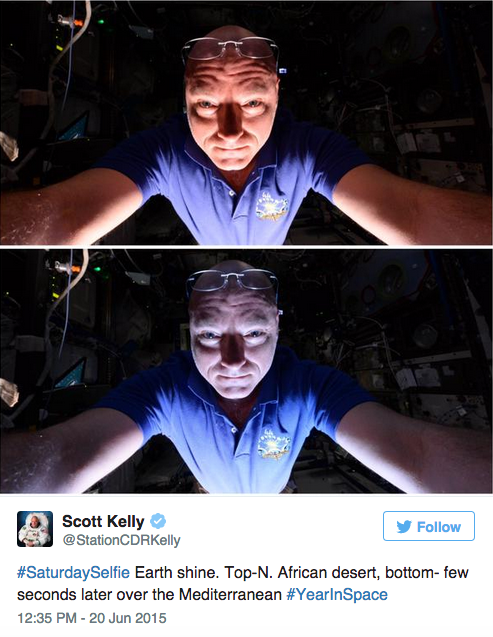
mashable: #NoFilter is when you take selfies using the Earth’s...
Bushchime, Randy Laue and 6 others like this



23 Jun 23:28
Quick One: Let's All Remember One Last Confederate Flag Pin
by Rude One
The Rude Pundit isn't available for much punditry of a rude nature today, having to deal with things of a more personal, less political nature.
However, in response to right-wing websites ululating in joy over the discovery of Clinton-Gore 1992 campaign buttons with the Confederate flag on them, let's all remember a more recent election and contemplate the meaning of this button in the context of who was running:

It's real. The source is a website about presidential campaign buttons.
That ain't a dog whistle. It's a goddamn foghorn.
However, in response to right-wing websites ululating in joy over the discovery of Clinton-Gore 1992 campaign buttons with the Confederate flag on them, let's all remember a more recent election and contemplate the meaning of this button in the context of who was running:

It's real. The source is a website about presidential campaign buttons.
That ain't a dog whistle. It's a goddamn foghorn.
bernot, Sophianotloren likes this
23 Jun 23:27
Nino Scalia’s Motel Blues
by Scott Lemieux

Lithwick has an entertaining account of Monday’s major 4th Amendment ruling. It’s somewhat unusual for Kennedy, rather than Scalia or Thomas, to be the swing vote in a 4th Amendment case with a positive outcome. But on another level it’s not surprising, since Scalia is most receptive to Fourth Amendment claims that involve individuals and their personal property. Particularly given that the kinds of hotels he would stay at are much less likely to be subject to warrantless searches, his vote was pretty much inevitable. The bigger surprise is Kennedy, whose record in Fourth Amendment cases is pretty lousy.
Friedersdorf’s piece on the case is also good.
Sophianotloren likes this
23 Jun 23:27
Bill Kristol has long since stopped being ideologically distinguishable from the fascists his father fought to defeat in World War II.
I have no idea how this scumbag is still a respected employee at ABC News.
But he is.
And there must be a pretty horrifying reason why.
And everyone who knows what that reason is refuses to talk about it.
Finding out on behalf of the public why it is impossible to fire a leering monster like Bill Kristol used to be the work of people called "journalists", but now "journalists" are the ones who keep Mr. Kristol's secrets for him.
We are so screwed.
First They Came For The Brownshirts
by driftglass
The Left's 21st century agenda: expunging every trace of respect, recognition or acknowledgment of Americans who fought for the Confederacy.— Bill Kristol (@BillKristol) June 23, 2015
Bill Kristol has long since stopped being ideologically distinguishable from the fascists his father fought to defeat in World War II.
I have no idea how this scumbag is still a respected employee at ABC News.
But he is.
And there must be a pretty horrifying reason why.
And everyone who knows what that reason is refuses to talk about it.
Finding out on behalf of the public why it is impossible to fire a leering monster like Bill Kristol used to be the work of people called "journalists", but now "journalists" are the ones who keep Mr. Kristol's secrets for him.
We are so screwed.
driftglass
Sophianotloren likes this

23 Jun 07:40

In Defense of Casual Romance
by kittystryker
found on tumblr
I’m not exactly new to the world of internet dating or casual sex hookups. I’m on OKCupid. I’ve been on PlentyofFish, and Match, and Alt, and all the rest of them. Shit, I was kicked off of eHarmony, in part because I had a very different understanding of the watersports question.
Even though I have a lot of experience and typically have had an easy enough time meeting friends through online posts, I do a terrible job meeting casual sex partners. There’s a lot I have to say and have said in the past about desirable bodies, what people want vs what they’re willing to be witnessed wanting, how it’s acceptable to treat fat people as “desperate”, etc. So there’s a lot of that at play, of course, in who gets responded to and who gets left out. But really, I suspect this is because what I want often comes off as confusing. I know what I want from a casual experience, but it’s not what people normally consider casual.
See, I was told that the reason my queer cruising ad failed was because I was asking for “dating stuff”. In it, I said I was hoping for more like a one month stand than a one nighter, that I wanted something semi-romantic and sweet, that I wanted the kind of person who would buy me roses then beat me with them. Frankly, I want a partner who likes to top but also will tell me I’m pretty and will pet my hair, not just use my cunt and then disappear. Apparently that’s too much like “relationship” stuff for a casual sex ad?
I have to admit, I just don’t understand. Is it impossible to have more of a seduction or even a little romance in a casual fling? If anything I feel like they’re ideal for it- you can just enjoy the moment with no expectations! I love the fluttery feeling of having a crush, but the stone cold reality of building that crush into a relationship takes a lot of energy, trust, desire and work on both sides. I just don’t have space for more of that in my life right now. But that doesn’t mean I can’t still want to be romanced, right?
It’s also a little bit hurtful. If you ask me, I think it’s kind of more fucked up that it’s totally fine to hook up in a dirty bathroom sort of way but not in a “spank me with a bouquet of roses” sort of way. That seems like some femmephobic bullshittery. It goes along with how I resent the way in my local group of friends and acquaintances, we celebrate Steak and Blowjob Day but scorn Valentine’s Day, like that isn’t, at least in part, gendered.
So fuck it. I think we should make casual romance a Thing if it isn’t already. I wanna see more casual makeout sessions, more hand holding dates, more looking into each others eyes and just giggling, more gifting each other things like flowers or doing small acts of service like a snack tray for a hookup. I resent and reject the idea that because I want these things I just want to date more people.
I feel like in our desire to liberate our sexualities, we haven’t spent a lot of time focusing on liberating our feelings and making space for that. I’ve bemoaned how romance often seems to be calculated or dead, though I’ve learned to see the sweet gesture in things like wrapping my micro usb cord so it won’t get ruined in my purse or getting me a candle that looks like a rococo butt plug. I’ve tried to kill my desire for outward displays of affection and seduction, because I’ve been afraid I don’t deserve it or won’t get it. But fuck that. I do deserve it. I am a lovely person who works really hard to be enjoyable to be around and if I want to be showered in flower petals once in a while I don’t think that’s bad. And I don’t think I should only get to ask for that from people I’m dating long term.
Now yes, not everyone wants casual sex to be anything beyond meeting, fucking, parting ways, maybe even with no names exchanged. I’ve been there, kittens, I get it. I’m just saying that one of the most incredible impulsive once-ever experiences I had involved a lot of kissing and eye contact and giggling and holding hands. We didn’t exchange names. He ejaculated on my chest in a glass elevator and it was hot as hell. But what made it transcendent and memorable for me was that in that moment we just really connected, and cared about each other, and that mutual respect and yeah, little touches like passionately making out in doorways while rain sprinkled down, and how he held an umbrella over my head while we did that, made it go from “hot” to “fiery hot passion”. I feel it was extremely casual, and also romantic, and I want more of that in my life.
So here’s to casual romances, to summer flings and perfect first (and only) dates. The heart wants what it wants, and it is a-ok to want loving and fleeting expressions of affection and being Seen just as it’s ok for your junk to want a good hard pounding in the backseat of your car.
bernot, Sophianotloren likes this
23 Jun 07:17


GIFs That Bring Street Art to Life
by Laura C. Mallonee
A gif by A.L. Crego of stencil art in La Coruña by Erre (image via Tumblr)
A. L. Crego composes playful, bizarre GIFs from other people’s street art. Where lines and shapes were formerly static, eyeballs now move, heads bob, and limbs swing. “It’s a meditative way of watching art,” Crego told Hyperallergic.
The Spanish artist has been taking pictures of urban graffiti and murals and making GIFs for several years, but it was only months ago that he thought of putting the two together. “The result surprised me a lot,” he said. “We’re used to watching motionless photos, and when we see some movement in them, it’s unexpected.”
At first Crego only made GIFs from street art in the Spanish city of La Coruña, where he lives. But since the genre is illegal in Spain, he soon expanded the project to include art from around the world, always asking permission from the artists, which include the likes of Nemo, Sr. X, and David de la Mano. “My work wouldn’t exist without them,” he explained.
The GIFs stands out at a time when street art has begun flooding the web. Not only are artists recording their work on sites like Tumblr, but a seeming surge in popularity has inspired countless news articles on the transient genre, as well as digital databases like Google’s that seek to catalogue the works. Crego gives us one more way to understand them. “In the streets I can’t make [the art] move, but in the virtual space I can give it another meaning,” Crego said. “I think of it as animating the walls of the internet.”
A gif by A.L. Crego of a mural by Sr. X (image via Tumblr)
A gif by A.L. Crego of a mural by Sr. X (image via Tumblr)
A gif by A.L. Crego of a mural by Nemo (image via Tumblr)
A gif by A.L. Crego of a mural by David de la Mano (image via Tumblr)
An gif by A.L. Crego of a mural by Roa (image via Wikimedia)
A gif by A.L. Crego of a mural by Escif (image via Tumblr)
A gif by A.L. Crego of a mural by Zoes (image via Tumblr)
A gif by A.L. Crego of a mural by M-City (image via tumblr)
A gif by A.L. Crego of a mural by Sr. X (image via tumblr)
A gif by A.L. Crego of a mural by Wedo (image via Tumblr)
A gif by A.L. Crego of a mura by Hyuro (image via Tumblr)
A gif by A.L. Credo of a mural by Nemo (image via Tumblr)
Sophianotloren likes this
23 Jun 07:17
Parisian Mural Successfully Provokes Right-Wing Vandals
by Benjamin Sutton
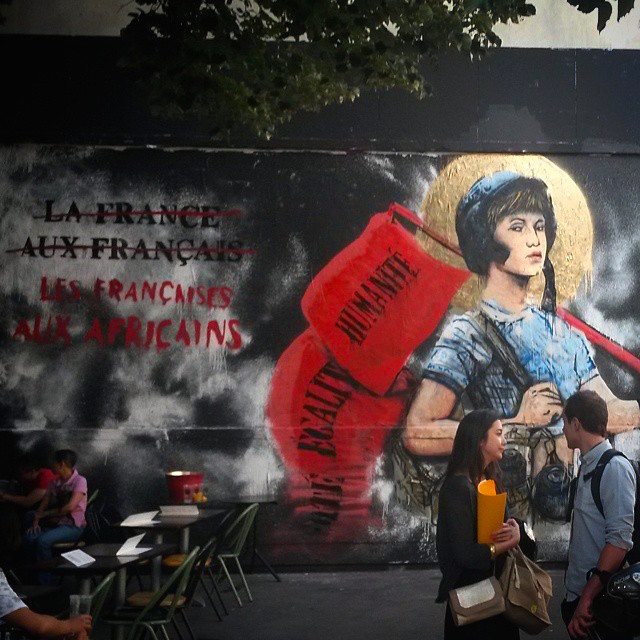
Combo’s mural in Paris’s 11th arrondissement, before it was vandalized (photo by Combo, via Instagram)
A mural by the French street artist Combo in Paris has become the target of far-right vandals, including one nationalist blogger who filmed herself tagging the mural with the message, “Antiracism is a codeword for antiwhite.”
Painted on a wall in the 11th arrondissement through the public art organization Le MUR, the mural features a modernized Joan of Arc wearing a motorcycle helmet and brandishing a red banner that reads “Liberté, Égalité, Humanité,” a variation on France’s national motto, “liberty, equality, fraternity.” Alongside the image, Combo stenciled the words “La France aux Français” (France for the French), which is the slogan of the far-right Front National party, crossed them out with red spray paint, and wrote beneath them “Les Françaises aux Africains” (Frenchwomen for Africans). He admitted that the mural was an act of provocation.
“The goal was to make people from the far right react, and it certainly worked,” he told the AFP. “If these militants had ignored me, they would have been smarter than me, but they fell for it.”
And fall they did. Two days after Combo completed the mural on June 13, vandals came and splashed gray paint over the words “Les Françaises aux Africains.” On June 17, nationalist blogger and activist Electre went several steps further, tagging Combo’s mural and using a GoPro camera strapped to her head to record the act of vandalism in a jarring point-of-view video that she subsequently posted on YouTube.
On the Front National–affiliated cultural commentary blog Culture, Libertés, et Créations, blogger Gabriel Robin condemned the mural’s slogan for its “racist and sexist character” and criticized the City of Paris for providing Le MUR’s €17,000 (~$19,300) annual budget.
“Combo aimed to provoke with an ambiguous message and it worked,” Le MUR President Bob Jeudy told the AFP. “I am neither for nor against it.” He added that Combo’s mural is scheduled to be painted over on June 26.
This isn’t Combo’s first run-in with the anti–street art contingent of France’s far-right. In February he claimed to have been beaten by a group of young men in Paris’s 12th arrondissement while he was putting up his distinctive “Coexist” tag — the “C” is an Islamic crescent, the “X” is a Star of David, and the “T” is a crucifix — which he began painting around the city in the wake of the Charlie Hebdo massacre.
“I am not looking for pity because I’m aware of the risks I’m taking with my work,” Combo wrote on Facebook at the time. “But I want to denounce this type of behavior. You can say that my work is provocative, that maybe I was asking for it. But nobody will prevent me from expressing myself, practicing my art, and fighting for my ideas.”
Sophianotloren likes this
23 Jun 06:50

micdotcom: Do you need any more proof of the racist double...
Do you need any more proof of the racist double standard in the media?
The white shooter in a rampage killing gets a smiling childhood photo and an uncritical look at how his actions were influenced by the Internet. A black man who saved his own mother from a hail of bullets, though, has his “troubled past” highlighted. But wait, the treatment of the black man gets even worse.
This is what systemic racism looks like.
bernot, Sophianotloren and one other like this
23 Jun 06:48
4gifs: Uh guys. I’m going to have to ask you to land this plane...


Adam Victor Brandizzi, Randy Laue and 3 others like this