Shared posts

01 Jul 14:46

On the Search for the Clubhouse Guy

by Robert Farley
Roythomas01.jpg

Roy Thomas. Licensed under PD-US via Wikipedia.

Some interesting thoughts from Russ Carleton on how you would go about searching for clubhouse “chemistry”: (subscription)

I have a feeling that if I surveyed even the most hardcore sabermetricians out there, they would all acknowledge that ideas of chemistry and clubhouse presence aren’t silly. They’d probably push back against the common narrative that Team X won the World Series based on the shining light of justice that came from Smith’s locker. (After all, there were probably veteran guys on all the other 29 teams who did not win the World Series.) They’d probably say that it’s hard to measure. (It is.) But if Smith sits down with Jones, shows him a trick he’s learned over the years on how to hit a curveball and Jones turns from a one-win player to a three-win player, don’t we have to give some of that credit to Smith?

I’m going to start with the assumption that chemistry and clubhouse presence exist and that they can have real, tangible effects on players, making them either better or worse. We don’t know how it works. We don’t know who’s who. We don’t know what the effects are. But what if we could at least make some reasonable assumptions about what those effects might be? Actual data-driven ones. For example, we know that some managers seem to have a special talent for keeping their players from burning out over the course of a year, and that the effect might be as big as 30 runs from the best to the worst.

So, how much could these soft factors actually be worth?

I’d be interested in coming up with a list of things that we assumed-away-because-we-couldn’t-measure, then realized-had-an-impact-when-we-developed-better-tools. I’m guessing that the list would be longer in football and basketball than in baseball, but of course it would also be interesting to track down some examples from politics.

Thoughts?

01 Jul 14:44

Lefty Purity For Thee…

by Scott Lemieux

hardha1

What does Harper‘s publisher Rick MacArthur do when he’s not publishing poorly reasoned and anti-factual screeds about the perfidy of the Democrat Party? Why, bust unions of course:

MacArthur may have once defended U.A.W. as “the country’s best and traditionally most honest mass labor organization,” but he contested his staff’s right to unionize, contending that the literary editor and senior editors served as supervisors and hence failed to qualify for protection under the National Labor Relations Act. He hired veteran employment lawyer Bert Pogrebin to advocate on his behalf before the National Labor Relations Board, but the federal agency denied his appeal. The day before staffers held elections and formally joined UAW Local 2110 on Oct. 14, MacArthur wrote a letter assuring them the union would neither give them a voice in the selection of the next editor in chief—he believed Metcalf was angling for the position—nor “solve the financial problems of the magazine or get us more subscribers, newsstand buyers or advertisers.”

Added MacArthur, with a touch of irony: “It will, of course, be able to collect initiation fees and dues from you.”

In January 2011, the magazine laid off union instigator Metcalf and pro-union ally associate editor Theodore Ross, a move that the union interpreted as retaliation and that MacArthur defended as an effort to “cut expenses.”

Of course, one way you can ensure you have the money to pay anti-labor lawyers is to pay your interns a big fat goose egg to work full time in Manhattan.

While MacArthur’s magazine has been unreadable for a while, I was wondering if perhaps there was a commercial justification for what has been intellectually ruinous. Maybe there’s a large market out there that really wants to read the same terrible leftier-than-thou article with a nominally different byline about how Barack Obama betrayed his campaign promises by failing to unilaterally turn the American political economy into Denmark’s every month? Nope: in fact, their circulation is cratering. It’s really a shame what’s happened to what was not that long ago a terrific magazine, but at this point it’s probably never coming back.

01 Jul 14:44

An Open-Source Guide to Help You Build Your Own Graffiti Drone

by Hrag Vartanian
KATSU's drone in a NYC subway. (via icarusone.com)

Katsu’s Icarus One drone in a New York City subway. (via icarusone.com)

Artist Katsu has been working hard at extending the language of public mark making, and his latest experiments have been drone-based. Long known for his distinctive, large-scale fire extinguisher tags that trail across whole walls, his spray-painting flying machines are the latest evolution of his interest in “things that can make marks,” he tells Hyperallergic.

Icarus One (via icarusone.com)

Icarus One (via icarusone.com)

“It must come from a childhood spent drawing, making my own fireworks, trespassing, and living in video games,” he says. “Like the video game, the drone offers an unusual flesh-and-blood experience. It feels real, it feels right. Like an expansion pack for my body. It probably has a little to do with the looming singularity. Drones will replace us in the physical space. They’ll make art and get high and fix the environment. I hope.”

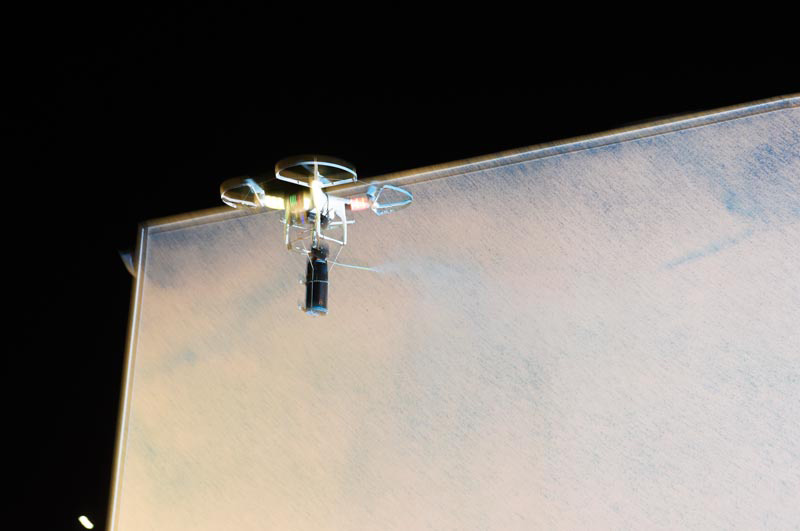
Named after the Greek mythological figure who flew too close to the sun with wings made of feathers and wax, Icarus One is the “world’s first open-source paint drone.” A page of instructions on the project’s website offers schematics to 3D-print your own parts, links to places to buy necessary elements, and even the option to buy one fully assembled.

Katsu's Dronescape at Coney Art Walls (photo courtesy the artist)

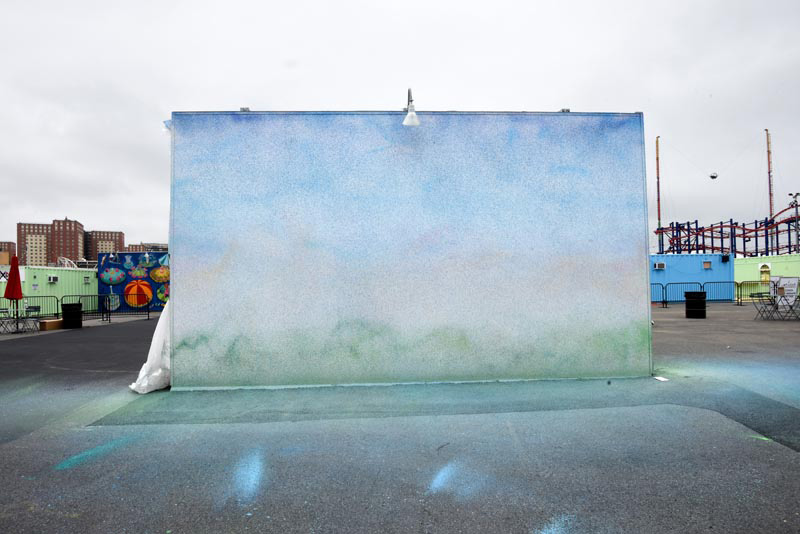
Katsu’s Dronescape at Coney Art Walls (photo courtesy the artist)

The artist most recently used his specially designed drone to paint a “dronescape” at Coney Art Walls in Brooklyn’s Coney Island neighborhood. The result is a simple and moody landscape on a handball wall that consists of a lightly dusted blue sky and hazy green hills. “The series of paintings I am making now reflects this very short period of time before drones are able to paint like printers,” he says. “It’s the beauty in simplicity and crudeness. Like the beauty in a child’s drawing.”

Katsu foresees a central role for drones in the “new post-human art” environment. “These are our new limbs, the internet, the smartphone, the drone …. It’s only in its infancy but the Icarus drone will eventually open the doors to precision drawing and painting on a scale and speed like we’ve never experienced.”

Icarus One painting the Dronescape at Coney Art Walls (image courtesy the artist)

Icarus One painting the Dronescape at Coney Art Walls (image courtesy the artist)

He sees his work with drones as a type of “daydreaming with technology. A weird subconscious space where vandalism takes you. The euphoric feeling of marking things …. For me the drone raises the issue of authorship and anonymity in art and graffiti. A feeling of privacy. Imagine drones anonymously drawing abstract works on walls around the city. Or vandals using them with programmed missions. Drones that are untraceable to owners. Drones without identities. Cyber crimes in the physical.”

A detail of Icarus One painting on a wall (image via icarusone.com)

A detail of Icarus One painting on a wall (image via icarusone.com)

He’s already working on the next generation of Icarus with his friend Maddy Varner, which, he explains, will have “eyes.”

The implication of the Icarus drone is that the function of the artist will eventually be automated after the right program or algorithm is created to propagate her or his ideas and designs.

“[The drone project] hasn’t changed me as an artist. It has however mutated my perception of self,” he says. “I see my reflection phone in hand, drone in hand (or on back). I feel I have reach. My drone paintings can take larger form — 100-foot, shit, 300-foot-long paintings.”

You have to wonder if Katsu’s evolving family of drones, like their namesake, will overstep their limitations. The Greek legend recounts the tale of a giddy Icarus who, overcome by hubris, flew too close to the sun and melted the wax of his wings before plunging into the sea to his death. Considering the illegality of graffiti in most cities and increasingly stringent regulation of drone usage, it’s not hard to imagine the penalties that spray-painting drones could rack up.

“The drone paintings are a look into the science of painting, the logic of it,” Katsu says. “Drones are used as expendable replacements for people. I think that this project gives them a new meaning. It gives them a certain warmth you can commend. It also gives them a warmth you want to beat, arrest, and punish.”

01 Jul 14:43

All this bitchin’ and moanin’ and pitchin’ a fit… Get over it!

by Sophia, NOT Loren!

Do you know how many people in your life are left-handed?

I don’t. I know there are a few, but it’s not something that they mention much — certainly isn’t a topic that gets worked into every conversation, not by me trying to find out or them making a point of discussing their handed-ness.

Would you get upset if you noticed somebody’s letters leaning a different direction than yours? Would you confront them about what they’ve been “hiding from you,” or cut them out of your life because they’re some kind of “freak?” Maybe you’d be sure to tell them that it’s really cool that they were brave enough to live that way… because you’re just such a good friend, you might say, you’re glad to hang around!

Some folks, from what I understand, go around looking for left-handed people to date — apparently they find “South-Paws” a big turn-on. Here I would have figured that there’s a whole lot more to a person than which hand they feel more comfortable using to write or pick up objects, but that doesn’t seem to matter to these self-described “enthusiasts” and “fans.”

As I said, I do know a few left-handed people, but to the best of my awareness, they don’t exclusively associate with and date other lefties, and don’t spend all their time talking about how they’d never dream of trying to associate with those more mainstream righties… then again, the fact that I am right-handed myself means I might not see much of that talk after all…


By this point, some of you will have picked up on the analogy.  For the rest of you:

Do you know how many people in your life are transgender?

I have some idea; I know there are several — myself included — but it isn’t something that I really pay lots of attention to. I do know a few trans* folks who make a point of mentioning that fact nearly every chance they get… and if that’s what works for them, great! I know others who never bring it up publicly at all. I mention it sometimes, and it comes up with others on occasion, but it isn’t nearly the basis of my identity any more than most folks who are left-handed frame their entire existence around being “sinister.”

Unfortunately, there are many folks who go around looking exclusively for trans* people to date — they’re really turned on by one small physical aspect of  trans* people, at the expense of acknowledging the rest of the individual they’re fixated on. It’s creepy and unwelcome.

I also see some trans* men and women who surround themselves with other trans* people, who make their entire social circles trans*-only and rarely associate with anyone else.  To me, it seems a bit self-defeating, but then I’ve never much seen the benefit of separatism; standing in an echo chamber seems nice enough at first, hearing voices exactly like your own.. until someone in your little group has a slightly different take on a topic, and it doesn’t take long before the same oppressive structures replicate themselves in your little “like-minded” group.

Anyway, the long and short of it is, some women have penises, and some men have vaginas. Get over it!

Some women have penises. Get over it! Some men have vaginas. Get over it!


Filed under: General
01 Jul 14:43

I went to a drinking game jam and this is what I did

by Mattie Brice
Outside of the fact that it was a reason to drink a lot with friends, I enjoyed how many non-games people were involved, learning to make games because it spoke to their lives in a way that made sense.
01 Jul 14:22

ronaldkn0x: my parents: what are u going to do with ur life me: sin

Sophianotloren

When you sent me off to see the world
Were you scared that I might get hurt?
Would I try a little tobacco?
Would I keep on hiking up my skirt?

ronaldkn0x:

my parents: what are u going to do with ur life
me: sin

01 Jul 14:09

Photo


01 Jul 13:50

Photo


01 Jul 13:47

"[There’s a] frequently misunderstood construction that linguists refer to as the “habitual be.” When..."

Sophianotloren

This is useful -- but it also highlights how people won't take something seriously until it's studied by scientists and put down in academic language...

[There’s a] frequently misunderstood construction that linguists refer to as the “habitual be.” When speakers of standard American English hear the statement “He be reading,” they generally take it to mean “He is reading.” But that’s not what it means to a speaker of Black English, for whom “He is reading” refers to what the reader is doing at this moment. “He be reading” refers to what he does habitually, whether or not he’s doing it right now.

D'Jaris Coles, a doctoral student in the communication disorders department, and a member of the African-American English research team, gives the hypothetical example of Billy, a well-behaved kid who doesn’t usually get into fights. One day he encounters some special provocation and starts scuffling with a classmate in the school yard. “It would be correct to say that Billy fights,” Coles explains, “but he don’t be fighting.”

Janice Jackson, another team member who is also working on a Ph.D. in communication disorders, conducted an experiment using pictures of Sesame Street characters to test children’s comprehension of the “habitual be” construction. She showed the kids a picture in which Cookie Monster is sick in bed with no cookies while Elmo stands nearby eating cookies. When she asked, “Who be eating cookies?” white kids tended to point to Elmo while black kids chose Cookie Monster. “But,” Jackson relates, “when I asked, ‘Who is eating cookies?’ the black kids understood that it was Elmo and that it was not the same. That was an important piece of information.” Because those children had grown up with a language whose verb forms differentiate habitual action from currently occuring action (Gaelic also features such a distinction, in addition to a number of West African languages), they were able even at the age of five or six to distinguish between the two.


-

SYNERGY - African American English

The Sesame Street study is now a classic in “habitual be” research: here’s the article that it comes from (paywalled, but you can read the abstract and first few pages). 

(via scapetheserpentstongue)

01 Jul 13:44

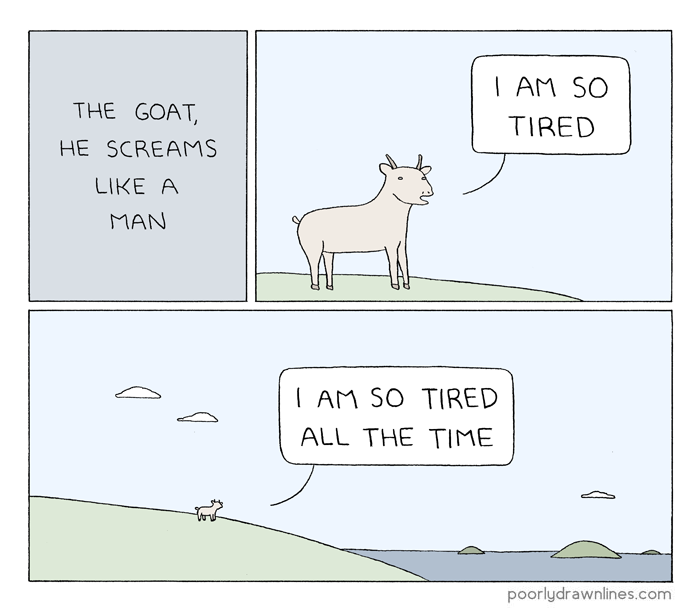
Goat

by Reza

goat

01 Jul 13:44

Coder Dilemma #6 – Choosing the right stack

by CommitStrip

01 Jul 13:43

Photo


01 Jul 13:43

NSA can restart bulk data collection, says surveillance court

by Devindra Hardawar
The ongoing saga around the NSA's bulk data collection program is getting even more confusing. A U.S. Foreign Intelligence Surveillance Court ruled yesterday that the program can temporarily resume, refuting a Second Circuit court decision from May d...
01 Jul 13:43

(photos by divinelyminely)


(photos by divinelyminely)

01 Jul 13:42

smcrtn14.jpg 1480×1201 pixels

by preshaa
01 Jul 13:42

Photo


01 Jul 13:42

yondaanaconda: In case you dont understand, when LGBT people...


yondaanaconda:

In case you dont understand, when LGBT people say they feel uncomfortable with people posting rainbows over their icons whilst not being supportive of LGBT people in the least this is exactly what they mean

01 Jul 13:42

Finding the humor in our inevitable demise...

by MRTIM

01 Jul 13:41

прочее от mullets

01 Jul 13:41

"Despite what you may believe, you can disappoint people and still be good enough. You can make..."

“Despite what you may believe, you can disappoint people and still be good enough. You can make mistakes and still be capable and talented. You can let people down and still be worthwhile and deserving of love. Everyone has disappointed someone they care about. Everyone messes up, lets people down, and makes mistakes. Not because we’re inadequate or fundamentally inept, but because we’re imperfect and fundamentally human. Expecting anything different is setting yourself up for failure.”

- Daniell Koepke (via psych-facts)
01 Jul 13:41

#1136; The Earthworm Bucket, Part 1 (of 4)

by David Malki

Life coach on the streets, Craig T. Nelson in the sheets

01 Jul 13:40

Seeing the crazy movement of guitar strings in real time is so damn cool

by Casey Chan on Sploid, shared by Chris Mills to Gizmodo

This is wild. When cameras try to capture guitar strings being played, they see wavelength-type movements from each string because of the camera’s rolling shutter effect. But it can only be seen on camera, the wild wiggly effect is totally blind to the naked eye. Not anymore! This Wobble Strings project recreates a camera’s rolling shutter effect to humans in real time through sweep line projection. It’s wild.

Read more...


01 Jul 13:40

Photo


01 Jul 13:40

marllyjane: Where’s the lie


marllyjane:

Where’s the lie

01 Jul 13:40

The Meticulous 10-Month Restoration of a 355-Year-Old Painting at the Metropolitan Museum of Art

by Christopher Jobson

Completed in 1660, Charles Le Brun’s painting of Everhard Jabach and His Family had seen better days. The 355-year-old family portrait was covered in a badly tinted varnish, had multiple superficial scratches and structural damage had split the painting nearly in half. This video documents the 10-month restoration at the Metropolitan Museum of Art lead by Michael Gallagher that involved retouching, structural work, re-varnishing, and numerous other conservation techniques to bring this giant painting back to life. The Met also documented the process in some 20+ blog posts over on their website. (via Sploid)

painting

restore-1

restore-2

restore-3

restore-4

switcher

01 Jul 13:40

Photo


01 Jul 13:39

Photo


01 Jul 13:39

Photo


01 Jul 13:38

I found a pun that works in both English and Spanish

by burningfp

ravenstagsmooches:

Where do cats go when they die? Purrgatory.

¿De dónde van los gatos cuando mueren? Purgatorio.

01 Jul 00:15

Required Reading

by Hrag Vartanian
Probably the best "fuck you" image to emerge in a while came from this week's #ElectricYerevan protests against energy hikes in the Republic of Armenia. (via @onewmphoto)

Probably the best “fuck you” image to emerge in a while came from this week’s #ElectricYerevan protests against energy hikes in the Republic of Armenia. (via @onewmphoto)

This week, USC’s embattled dean speaks, famous artists review books, defending gallery assistants, and more.

 Carolina Miranda of the LA Times spoke to Dean Erica Muhl of USC’s Roski School of Art & Design about her embattled program:

Q: Why do you think you only have one student for the fall?

A: The negative publicity may have affected recruitment efforts. But we have an incredibly strong program, and we will continue to support it. We are going to support an International Artist Fellow [a fully funded position], who will attend in the fall. We are looking to pause recruitment and then continue to recruit at a later date.

 The New York Times Book Review asked five well-known artists to review a book. They are:

  • Wangechi Mutu on The God of Small Things by Arundhati Roy
  • Joan Jonas on Why Look at Animals? by John Berger
  • Jacolby Satterwhite on Mature Themes by Andrew Durbin
  • Kader Attiaon on African Art as Philosophy: Senghor, Bergson and the Idea of Negritude by Souleymane Bachir Diagne
  • Ed Ruscha on Oklahoma Tough: My Father, King of the Tulsa Bootleggers by Ron Padgett

This week’s edition is also the Art Issue.

 Jerry Saltz rightfully defends art-gallery attendants, saying that an ArtNews column by Hannah Ghorashi is particularly troubling in its attitude towards gallery employees:

And that’s the underlying problem: the way Ghorashi confuses the well-off gallery directors, with their revealing, standoffish policies about pricing, and their employees, who are just trying to hold down jobs. I’ve written before about the kind of hostility often directed at the people who work at the front desks of galleries.

 Avshalom Halutz believes the oppression of Israeli culture starts with the occupation:

Only a few courageous artists have dared to regularly speak out against the occupation and the oppression of Palestinians. Only a few have objected to performing on the stages of communities in the territories, even when subjected to much public pressure, or have taken direct action against the occupation. Anyone who hasn’t fiercely fought the occupation shouldn’t complain when he finds himself occupied by the very same forces.

 US photographer Mary Ellen Mark died May 25 at the age of 75, but one reporter at NPR decided to track down the subject of Mark’s most famous photograph, of a 9-year-old girl in a kiddie pool smoking a cigarette. Chris Benderev tried to find out what happened to her:

“When she came along and took those photos, I thought, ‘Well, hey, people will see me and this may get me the attention that I want; it may change things for me,'” Ellison says. She thought someone would see the images and come rescue her. “I had thought that that might have been the way out. But it wasn’t.”

Jacobson, the New York photographer, says Mark was not the type to give her subjects false impressions. But he says, “In any photographic encounter, the one person that always benefits and always is in a more powerful position and always knows more is the photographer.”

 Some Yale bro stole (or appropriated, depending on your perspective) two female college students’ art, and this is what they did:

The realm of appropriation isn’t exclusive to men, of course: there are actually plenty of women artists that use appropriation and use it well. Penelope Umbrico uses appropriation to make a statement on absence and erasure; Sherrie Levine appropriated photos as a form of feminist hijacking. Both of these women took from a canon that commodifies people less powerful than them and made an ethical statement on gaze and power. What Prince and Arctander has done represents and perpetuates the opposite.

It’s not a coincidence that Prince and Arctander both chose women as their source material—and most recently, trans women specifically, as well as non-binary people of color. It’s methodical, and not without historical precedent. More established white artists have always happened to be interested in experiences that aren’t theirs. If art is about perspective, it’s also always about power: the production of it, the reclamation of it, and the violent reversal of that rebellion, too. So I can’t even say that what happened to our original photo is simply theft, and not art—I know it’s art. It’s just bad art, it’s lazy art, it’s art with a backbone of misogyny and it replicates the very ideology that the original photo pushed against. It reminds us that our stories are easily stolen—we’re only as visible as you let us be, within the confines of your control. We’re only rewarded when it’s through your lens—when you control the narrative.

 Does this mean emoji are losing their luster? Chevy sent out a press release in emoji:

chevrolet-mediaalert-designboom-01-818x816

 There has been a great deal of controversy surrounding the Confederate flag and its appropriate place. Many people have suggested museums as the best location, though in this piece Aleia Brown disagrees:

It is a symbol of white supremacy, and museums should acknowledge it as such. The designer for the second national flag of the Confederacy described it as a representation of the fight to “maintain the Heaven-ordained supremacy of the white man over the inferior or colored race.” The exhibit should also acknowledge the role the flag played in South Carolina’s past. The flag that’s captured national attention this week came to Columbia in 1962, as a reaction to black people fighting for and winning rights during the civil rights era.

 An animated history of the Atlantic slave trade, which took place over 315 years, consisted of 20,528 voyages, and directly impacted millions of lives. Some trends:

There are a few trends worth noting. As the first European states with a major presence in the New World, Portugal and Spain dominate the opening century of the trans-Atlantic slave trade, sending hundreds of thousands of enslaved people to their holdings in Central and South America and the Caribbean. The Portuguese role doesn’t wane and increases through the 17th, 18th, and 19th centuries, as Portugal brings millions of enslaved Africans to the Americas.

In the 1700s, however, Spanish transport diminishes and is replaced (and exceeded) by British, French, Dutch, and—by the end of the century—American activity. This hundred years—from approximately 1725 to 1825—is also the high-water mark of the slave trade, as Europeans send more than 7.2 million people to forced labor, disease, and death in the New World. For a time during this period, British transport even exceeds Portugal’s.

In the final decades of the trans-Atlantic slave trade, Portugal reclaims its status as the leading slavers, sending 1.3 million people to the Western Hemisphere, and mostly to Brazil. Spain also returns as a leading nation in the slave trade, sending 400,000 to the West. The rest of the European nations, by contrast, have largely ended their roles in the trade.

By the conclusion of the trans-Atlantic slave trade at the end of the 19th century, Europeans had enslaved and transported more than 12.5 million Africans. At least 2 million, historians estimate, didn’t survive the journey.

 When you fly, make sure there are no cat stowaways:

 And this beautiful response by Hollywood star and former California governor Arnold Schwarzenegger:

Screen Shot 2015-06-27 at 10.52.20 AM

Required Reading is published every Sunday morning ET, and is comprised of a short list of art-related links to long-form articles, videos, blog posts, or photo essays worth a second look.