Submitted by: Unknown
Sophianotloren
Shared posts
15 Apr 01:16
Anatomy of a Motherfucker
by Lyz Lenz
Maria Popova collects the advice of Cheryl Strayed and uses Strayed’s words to deconstruct motherfuckery.
Invoking the time right before she wrote her first book, when she too was a twenty-something writer plagued by the same fear that she was “lazy and lame,” Strayed recounts how she “finally reached a point where the prospect of not writing a book was more awful than the one of writing a book that sucked”; in other words, she got off the nail.
Related Posts:
Burly.Thurr, Sophianotloren and one other like this
15 Apr 01:15


Holding Corporations Accountable
by Erik Loomis

I have a piece up at In These Times that discusses some of the ideas I develop in Out of Sight in how to hold corporations accountable for the ecological and labor exploitation of the world no matter where they move.
The only way workers like the 11-year-old boy in Ghatkopar will see their lives improve is if we demand global standards on production with real legal consequences for companies who violate them. The contracting system that creates layers of separation between multinational corporations and workers serves to increase exploitation and profits. It also makes it much harder for consumers in the U.S. and other countries to demand products are produced ethically, for two principle reasons.
First, unlike the Triangle Fire, where reforms of working conditions happened because Americans saw workers die making their clothes, we cannot see the lives of Bangladeshis and Sri Lankans who die making ours. Second, because these corporations lack legal liability for their production, they can claim they know nothing about the working conditions of their suppliers. If Walmart, Target or Gap buy these zippers, do they even know it? When these companies have been busted for using sweatshop labor, they frequently claim that they had no production contracts there. Given the byzantine mazes of contracting these companies do, they may be telling the truth. But a lack of public accounting means we cannot know.
Whether at Bhopal or a zipper sweatshop, multinational corporations need to be held accountable for what happens where they site factories or contract their production. Keeping clear records that show where their clothes are actually produced should be their responsibility.
Specifically, we need to create legal accountability for corporations. Voluntary agreements are basically meaningless—enforcement with consequences is necessary. We need international labor standards that companies must comply with if they want to sell their products in the United States. Workers should have the right to sue in American courts when American companies violate basic standards of labor rights.
If Walmart or Gap wants to contract production to Bangladesh or India, that’s fine. But if their factory collapses or if workers are subjected to slave labor, the American companies using those zippers need to be held legally accountable. Subcontracting cannot be a tool to exploit the world’s poor. We must articulate new ways of holding corporations accountable if we are ever to stop this exploitation.
We are very far from such a system being implemented today. Vicious corporate attacks on organized labor in the United States mean that we are desperately trying to hold on to what labor rights we have left in this country. But those rights have collapsed in part because of the export of union jobs offshore, undermining the best tool American workers have for maintaining a dignified life.
If you want more news like this, follow the Out of Sight Facebook page. Get a book sticker.
Sophianotloren likes this
15 Apr 00:53


Adjunctification
by Erik Loomis
As a department chair at Columbia University, I am compelled to hire many people on a part-time basis, although they want and deserve full-time jobs. These adjuncts are among the finest, longest-serving instructors in many universities, and it’s well known that their lasting contributions can transform the lives of their students.
It’s also no secret that they are getting a raw deal. Overworked and underpaid, they often struggle to get by and, when taken to an extreme, the consequences can be tragic.
With each passing year, it becomes clearer that cheap labor has become the hidden foundation of American higher education. According to the American Association of University Professors, more than 50 percent of all faculty hold part-time appointments. A vast workforce of mostly non-unionized adjunct instructors—the so-called “contingent faculty”—now comprises the core of the teaching faculty. They often teach as many courses as full-time instructors, but because they are considered part-time, they have no voting power in departments or universities, no benefits, no job security and no office in which to meet with their students.
The short-term benefits to a university’s bottom line are obvious. It is fiscally advantageous for institutions to hire adjuncts instead of creating more full-time positions with benefits, and the seemingly unlimited availability of part-time instructors makes it relatively easy to offer a large number of courses. And, as noted in the 2010 report of the Coalition on the Academic Workforce, while adjunct instructors are long-time (albeit part-time) faculty and shoulder a substantial portion of the curriculum, institutional policies often treat them as if they are short-term workers with minimum involvement in academic life. More than once, adjuncts have been called “the fast-food workers of the academic world.”
One could argue that the chair should just say no, I’m not hiring those people. I’m not sure what would happen. Quite possibly the chair would simply be replaced and the dean’s office would hire the adjuncts. Maybe it would do some good.
Sophianotloren likes this
15 Apr 00:52


Hillary Clinton — Good Enough to Win
by Scott Lemieux
Your annual it’s-the-fundamentals-that-matter-most reminder from Jonathan Bernstein:
There are strong candidates for a presidential nomination, and Clinton is about the strongest in modern times. There can be weak general-election candidates, too. Those perceived as ideological outliers (Barry Goldwater in 1964, George McGovern in 1972, and possibly Ronald Reagan in 1980) can cost their party a few percentage points beyond what a generic Democrat or Republican would have received. It’s also possible to imagine a candidate so inept that he or she forfeits votes a generic candidate might have won — McGovern, with a mismanaged convention and a botched running-mate selection, might qualify.
But candidates who are so wonderful, whose appeal to swing voters is so strong, that they override the basic conditions of the election — the economy, war and peace, the popularity of the president, how long the incumbent party has held the White House? In the entire survey research era, the only presidential candidate who can plausibly make that claim is Dwight Eisenhower, and he just may have benefited from too many consecutive Democratic terms in office.
If the economy holds up, Clinton will probably win, and if it doesn’t any Democratic nominee would be in serious trouble.
Sophianotloren likes this
15 Apr 00:51


Irrational Basis
by Scott Lemieux
I’m hoping this argument will work its way into the Scalia dissent:
There are a lot of terrible arguments against same-sex marriage, but this may be the worst: The Supreme Court must not protect gay couples’ marriages, because doing so would demean marriages between gay men and their wives.
That, in a nutshell, is the argument put forth in an amicus brief recently filed by a group who call themselves “same-sex attracted men and their wives.” These men don’t claim to have become straight through conversion therapy—though a group of self-proclaimed ex-gays did file their own deeply sad and strange brief. Nor do they claim to be bisexual. Rather, these men admit that they’re “same-sex attracted,” but insist that “a Constitutional right to same-sex marriage can only come at the cost of marginalizing and demeaning the marriages and families” of gay men married to straight women. And that risk, they say, is reason enough for the court to rule against marriage equality.
In fairness, I’m not sure it’s really worse than any of the others.
Sophianotloren likes this
14 Apr 22:38
Repressed Reading
by Guia Cortassa
That night, I found myself seriously questioning this assumption I’d held since childhood: “You have to try to forget that while you’re reading.” You do? Why? And, more to the point, how?
How do you approach literature when you find it racist or elitist? Starting from her teaching experience, Elif Batuman tries to answer that question over at the New Yorker.
Related Posts:
Sophianotloren likes this
14 Apr 22:37

thekidacrossthehall: sociologyandlifting: sonastyandsorude: Hi...
Hillary Clinton has officially announced she’s running in 2016!
Oh boy. I highly recommend everyone does their research on Hillary Clinton. Don’t give her your vote just because she is a woman. Consider what she has done and what she will do for the United States. She shouldn’t be voted president just because we finally want a woman in the white house. Make sure you are aware of what she stands for and what she has been willing to do in the past. We have placed her on a pedestal as pro-feminism, pro-lgbt, pro-progress, but people need to understand that this is how politics work. As millennials, we are changing and becoming more open minded. We are the target group that need to be encouraged to vote for her. Now I am not saying to not vote for her, and instead vote for a republican who will destroy any progress made. But be wary of who you are choosing to vote for.
Some information you all might be interested in:
hillary clinton won a plea bargain while defending a child rapist who she knew to be guilty. part of her defense was that the 12 year old girl “sought older men” and was “emotionally unstable”. she was recorded laughing & making jokes about it, and when the tapes surfaced to the media years later, she said she was just doing what she had to do to the best of her ability.
“Making Profit and War
All issues of wealth, power, and violence are also women’s and LGBT rights issues. For instance, neoliberal economic policies of austerity and privatization disproportionately hurt women and LGBT individuals, who are often the lowest paid and the first workers to be fired, the most likely to bear the burdens of family maintenance, and the most affected by the involuntary migration, domestic violence, homelessness, and mental illness that are intensified by poverty.
Clinton’s record on such issues is hardly encouraging. Her decades of service on corporate boards and in major policy roles as first lady, senator, and secretary of state give a clear indication of where she stands.
One of Clinton’s first high-profile public positions was at Walmart, where she served on the board from 1986 to 1992. She “remained silent” in board meetings as her company “waged a major campaign against labor unions seeking to represent store workers,” as an ABC review of video recordings later noted.
Clinton recounts in her 2003 book Living History that Walmart CEO Sam Walton “taught me a great deal about corporate integrity and success.” Though she later began trying to shed her public identification with the company in order to attract labor support for her Senate and presidential candidacies, Walmart executives have continued to look favorably on her, with Alice Walton donating the maximum amount to the “Ready for Hillary” Super PAC in 2013. Walton’s $25,000 donation was considerably higher than the averageannual salary for Walmart’s hourly employees, two-thirds of whom are women.
After leaving Walmart, Clinton became perhaps the most active first lady in history. While it would be unfair to hold her responsible for all of her husband’s policies, she did play a significant role in shaping and justifying many of them. In Living History she boasts of her role in gutting US welfare: “By the time Bill and I left the White House, welfare rolls had dropped 60 percent” — and not because poverty had dropped.
Women and children, the main recipients of welfare, have been the primary victims. Jeffrey St Clair at Counterpunch notes that prior to welfare reform, “more than 70 percent of poor families with children received some kind of cash assistance. By 2010, less than 30 percent got any kind of cash aid and the amount of the benefit had declined by more than 50 percent from pre-reform levels.”
Clinton also lobbied Congress to pass her husband’s deeply racist crime bill, which, Michelle Alexander observes in The New Jim Crow, “escalated the drug war beyond what conservatives had imagined possible,” expanding mass incarceration and the death penalty.
Arguably the two most defining features of Clinton’s tenures as senator (2001–2009) and secretary of state (2009–2013) were her promotion of US corporate profit-making and her aggressive assertion of the US government’s right to intervene in foreign countries.
Reflecting on this performance as Clinton left her secretary post in January 2013, Bloomberg Businessweek commented that “Clinton turned the State Department into a machine for promoting U.S. business.” She sought “to install herself as the government’s highest-ranking business lobbyist,” directly negotiating lucrative overseas contracts for US corporations like Boeing, Lockheed, and General Electric. Not surprisingly, “Clinton’s corporate cheerleading has won praise from business groups.”
Clinton herself has been very honest about this aim, albeit not when speaking in front of progressives. Her 2011 Foreign Policy essay on “America’s Pacific Century” speaks at length about the objective of “opening new markets for American businesses,” containing no fewer than ten uses of the phrases “open markets,” “open trade,” and permutations thereof.
A major focus of this effort is the Trans-Pacific Partnership, which involves twelve Pacific countries and is being secretly negotiated by the Obama administration with the assistance of over six hundred corporate advisers.
Like Bill Clinton’s North American Free Trade Agreement, the deal is intended to further empower multinational corporations at the expense of workers, consumers, and the environment in all countries involved. Lower wages and increased rates of displacement, detention, and physical violence for female and LGBT populations are among the likely consequences, given the results of existing “free trade” agreements.
Clinton’s Foreign Policy article also elaborates on the role of US military power in advancing these economic goals. The past “growth” of eastern Asia has depended on “the security and stability that has long been guaranteed by the U.S. military,” and “a more broadly distributed military presence across the region will provide vital advantages” in the future.
Clinton thus reaffirms the bipartisan consensus regarding the US’s right to use military force abroad in pursuit of economic interest — echoing, for instance, her husband’s secretary of defense, William Cohen, who in 1999 reserved the right to “the unilateral use of military power” in the name of “ensuring uninhibited access to key markets, energy supplies, and strategic resources.”
In the Middle East and Central Asia, Clinton has likewise defended the US’s right to violate international law and human rights. As senator she not only voted in favor of the 2003 invasion of Iraq — a monstrous crime that has killed hundreds of thousands of peoplewhile sowing terror and sectarianism across the region — she was an outspoken advocate of the invasion and a fierce critic of resistance within the United Nations (UN).
Since then she has only partially disavowed that position (out ofpolitical expediency) while speaking in paternalistic and racist termsabout Iraqis. Senator Clinton was also an especially staunch supporter — even by the standards of the US Congress — of Israel’s illegal military actions and settlement activity in the occupied territories.
As Barack Obama’s secretary of state, she presided over the expansion of illegal drone attacks that by conservative estimates have killed many hundreds of civilians, while reaffirming US alliances with vicious dictatorships. As she recounts in her 2014 memoir Hard Choices, “In addition to our work with the Israelis, the Obama Administration also increased America’s own sea and air presence in the Persian Gulf and deepened our ties to the Gulf monarchies.”
Clinton herself is widely recognized to have been one of the administration’s most forceful advocates of attacking or expandingmilitary operations in Afghanistan, Libya, and Syria and of strengthening US ties to dictatorships in Tunisia, Egypt, Yemen, Bahrain, Morocco, and elsewhere. Maybe the women and girls of these countries, including those whose lives have been destroyed by US bombs, can take comfort in knowing that a “feminist” helped craft US policy.
Secretary Clinton and her team worked to ensure that any challenges to US–Israeli domination of the Middle East were met with brute force and various forms of collective punishment. On Iran, she often echoes the bipartisan line that “all options must remain on the table” — a flagrant violation of the UN Charter’s prohibition of “the threat or use of force” in international relations — and brags in Hard Choices that her team “successfully campaigned around the world to impose crippling sanctions” on the country.
She ensured that Palestine’s UN statehood bid “went nowhere in the Security Council.” Though out of office by the time Israel launched its savage 2014 assault on Gaza, she ardently defended it in interviews. This context helps explain her recent praise for Henry Kissinger, renowned for bombing civilians and supporting governments that killed and tortured hundreds of thousands of suspected dissidents. She writes in the Washington Post that she “relied on his counsel when I served as secretary of state.”
Militarization and Its Benefits
In another domain of traditional US ownership, Latin America, Clinton also seems to have followed Kissinger’s example. As confirmed in her 2014 book, she effectively supported the 2009 military overthrow of left-of-center Honduran President Manuel Zelaya — a “caricature of a Central American strongman” — by pushing for a “compromise” solution that endorsed his illegal ouster.
She has advocated the application of the Colombia model — highly militarized “anti-drug” initiatives coupled with neoliberal economic policies — to other countries in the region, and is full of praise for the devastating militarization of Mexico over the past decade. That militarization has resulted in eighty thousand or more deaths since 2006, including the forty-three Mexican student activistsdisappeared (and presumably massacred) in September 2014.
In the Caribbean, the US model of choice is Haiti, where Clinton and her husband have relentlessly promoted the sweatshop model of production since the 1990s. WikiLeaks documents show that in 2009 her State Department collaborated with subcontractors for Hanes, Levi’s, and Fruit of the Loom to oppose a minimum-wage increase for Haitian workers. After the January 2010 earthquake she helped spearhead the highly militarized US response.
Militarization has plentiful benefits, as Clinton understands. It can facilitate corporate investment, such as the “gold rush” that the US ambassador described following the Haiti earthquake. It can keep in check nonviolent dissidents, such as hungry Haitian workers or leftist students in Mexico. And it can help combat the influence of countries like Venezuela that have challenged neoliberalism and US geopolitical control.
These goals have long motivated US hostility toward Cuba, and thus Clinton’s recent call for ending the US embargo against Cuba was pragmatic, not principled: “It wasn’t achieving its goals” of overthrowing the government, as she says in her recent book. The goal there, as in Venezuela, is to compel the country to “restore private property and return to a free market economy,” as shedemanded of Venezuela in 2010.
A reasonable synopsis of Clinton’s record around the world comes from neoconservative policy adviser Robert Kagan, who, like Clinton, played an important role in advocating the 2003 Iraq invasion. “I feel comfortable with her on foreign policy,” Kagan told the New York Times last June. Asked what to expect from a Hillary Clinton presidency, Kagan predicted that “if she pursues a policy which we think she will pursue, it’s something that might have been called neocon.” But, he added, “clearly her supporters are not going to call it that; they are going to call it something else.”
Narrowly Defined Rights
What about Clinton’s record on that narrower set of issues more commonly associated with women’s and LGBT rights — control over one’s reproductive system and freedom from discrimination and sexual violence?
Perhaps the best that can be said is that Clinton does not espouse the medieval view of female bodily autonomy shared by most Republicans, and does not actively encourage homophobia and transphobia. She has consistently said that abortion should remain legal (but “rare”) and that birth control should be widely available, and when in office generally acted in accord with those statements. She has recently voiced support for gay marriage rights. These positions are worth something, even if they are mainly a reflection of pressure from below.
But nor does her record on these rights merit glowing praise. In addition to partly capitulating to the far-right anti-choice agenda in Congress, with disproportionate harm to low-income parents, Clinton and other Democrats have also actively undermined these rights. Some observers have argued that Clinton’s repetition of the Democratic slogan that abortion should be “safe, legal, andrare”reinforces the stigmatization of those who choose that option.
Her narrow definition of reproductive rights — as abortion and contraception only — does not allow much in the way of material support for parents or young children. She insists that abortion must remain “rare,” but has also helped deprive poor expecting parents of the financial support they would need to raise a child (for instance, through the 1996 welfare reform and the fiscal austerity for social programs that has become the bipartisan consensus in Washington).
She has supported the further militarization of the Mexico border and the arrest of undocumented immigrants, undermining the reproductive rights of women who give birth in chains in detention centers before being deported back to lives of poverty and violence.
Regarding non-discrimination, Clinton’s record is also worse than her reputation suggests. Her old company Walmart, widely accused ofdiscriminating against women employees, was recently praised by the Clinton Foundation for its “efforts to empower girls and women.”
Clinton has given little serious indication that she opposes discrimination against LGBT individuals in the workplace (which is still legal in the majority of US states). Her very recent reversal of her opposition to gay marriage came only after support for the idea has become politically beneficial and perhaps necessary for Democrats. At best, Clinton in these respects has been a cautious responder to progressive political winds rather than a trailblazing leader.
Clinton’s foreign policy record is even more at odds with her reputation as a champion of women’s and LGBT rights. Her policy of support for the 2009 coup in Honduras has been disastrous for both groups. Violent hate crimes against LGBT Hondurans have skyrocketed. In mid-2014, leading LGBT activist Nelson Arambú reported 176 murders against LGBT individuals since 2009, an average of about 35 per year, compared to just over 1 per year from 1994–2009.
Arambú located this violence within the broader human rights nightmare of post-coup Honduras, noting the contributions of US-funded militarization and the post-coup governments’ pattern of “shutting down government institutions charged with promoting and protecting the human rights of vulnerable sectors of the population — such as women, children, indigenous communities, and Afro-Hondurans.” Clinton has been worse than silent on the situation, actively supporting and praising the post-coup governments.
In a review of her work as secretary of state, Middle East scholar Stephen Zunes concludes that while “Hillary Clinton has been more outspoken than any previous Secretary of State regarding the rights of women and sexual minorities,” this position is “more rhetoric than reality.”
As one example he points to the US-backed monarchy in Morocco, which has long occupied Western Sahara with US support. Two weeks after Secretary Clinton publicly praised the dictatorship for having “protected and expanded” women’s rights, a teenage girl named Amina Filali committed suicide by taking rat poison. Filali had been raped at age fifteen and then “forced to marry her rapist, who subsequently battered and abused her.”
Although Clinton’s liberal supporters are likely to lament such details as exceptions within an impressive overall record (“She’s still much better than a Republican!”), it is quite possible that her actions haveharmed feminist movements worldwide. As Zunes argues:
Given Clinton’s backing of neo-liberal economic policies and war-making by the United States and its allies, her advocacy of women’s rights overseas … may have actually set back indigenous feminist movements in the same way that the Bush administration’s “democracy-promotion” agenda was a serious setback to popular struggles for freedom and democracy… .
Hillary Clinton’s call for greater respect for women’s rights in Muslim countries never had much credibility while US-manufactured ordinance is blowing up women in Lebanon, Gaza, Iraq, Afghanistan and Pakistan.
Base Building
This summary of Clinton’s “enormous contributions” (as Feminists for Clinton puts it) is just a partial sampling. On almost all other major issues, from climate change to immigration to education to financial regulation, President Hillary Clinton would likely be no better than President Obama, if not worse.
As in the case of Obama, it is of course necessary for Clinton to “call it something else,” in Robert Kagan’s words. The stark disjunction between rhetoric and policies reflects a well understood logic. Mainstream US political candidates, particularly Democrats, must find ways to attract popular support while simultaneously reassuring corporate and financial elites.
The latter, for their part, usually understand the need for a good dose of “populism” during a campaign, and accept it as long as it stays within certain bounds and is not reflected in policy itself. One former aide to Bill Clinton, speaking to The Hill last July, compared this rhetorical strategy to threading a needle, saying that “good politicians — and I think Hillary is a good politician — are good at threading needles, and I think there’s probably a way to do it.”
Hillary Clinton faces the challenge of convincing voters that she is a champion of “people historically excluded,” as she claims in her 2014 memoir. Last year, The Hill reported that “Clinton is now test-driving various campaign themes,” including the familiar progressive promises to “increase upward mobility” and “decrease inequality.” Her memoirs, for those who dare to suffer through them, include invocations of dead leftists like Frederick Douglass, Harriet Tubman (“one of my heroines”), and Martin Luther King Jr (referenced nine times in Clinton’s 2003 book).
This public relations work requires that her past record be hidden from view, lest it create a credibility problem. Here Clinton has enjoyed the assistance of many liberal feminists. One former Obama staffer, speaking to The Hill, notes Clinton’s successful efforts “to co-opt the base groups in the past eight years.”
Rhetoric is not totally meaningless. The extent to which politicians like Clinton have been compelled to portray themselves — however cynically — as champions of the rights of workers, women, LGBT people, and other “historically excluded” groups is an indication that popular pressures for those rights have achieved substantial force.
In the case of LGBT rights this rhetorical shift is very recent, and reflects a growth in the movement’s power that is to be celebrated. But taking politicians’ rhetoric at face value is one of the gravest errors that a progressive can make.
The Feminists Not Invited
Liberal feminists’ support of Clinton is not just due to credulousness, though. It also reflects a narrowness of analysis, vision, and values. In the US feminism is often understood as the right of women — and wealthy white women most of all — to share in the spoils of capitalism and US imperial power. By not confronting the exclusion of non-whites, foreigners, working-class people, and other groups from this vision, liberal feminists are missing a crucial opportunity to create a more inclusive, more powerful movement.
Alternative currents within the feminist movement, both in the US and globally, have long rejected this impoverished understanding of feminism. For them, feminism means confronting patriarchy but also capitalism, imperialism, white supremacy, and other forms of oppression that interlock with and reinforce patriarchy.
It means fighting to replace a system in which the rights of people and other living things are systematically subordinated to the quest for profits. It means fighting so that all people — everywhere on the gender, sexual and body spectrum — can enjoy basic rights like food, health care, housing, a safe and clean environment, and control over their bodies, labor, and identities.
This more holistic feminist vision is apparent all around the world, including among the women of places like Pakistan, Afghanistan, and Iran, whose oppression is constantly evoked by Western leaders to justify war and occupation.
The courageous Pakistani teenager Malala Yousafzai, awarded the Nobel Peace Prize for her feminist advocacy, has also criticized US drone attacks for killing civilians and aiding the Taliban. Yousafzai’s opposition to the Taliban won her adoring Western media coverage and an invitation to the Obama White House, but her criticism of drones has gone virtually unmentioned in the corporate media. Also unmentioned are her comments about socialism, which she says “is the only answer” to “free us from the chains of bigotry and exploitation.”
The Revolutionary Association of the Women of Afghanistan (RAWA) has equally opposed the Taliban, US-backed fundamentalist forces, and the US occupation. While liberal groups like Feminist Majority have depicted the US war as a noble crusade to protect Afghan women, RAWA says that the United States “has empowered and equipped the most traitorous, anti-democratic, misogynist and corrupt fundamentalist gangs in Afghanistan,” merely “replacing one fundamentalist regime with another.”
The logic is simple: US elites prefer the “bloody and suffocating rule of Afghanistan” by fundamentalist warlords “to an independent, pro-democracy, and pro-women’s rights government” that might jeopardize “its interests in the region.” Women’s liberation, RAWA emphasizes, “can be achieved only by the people of Afghanistan and by democracy-loving forces through a hard, decisive and long struggle.” Needless to say, Clinton and Obama have not invited the RAWA women to Washington.
A group of Iranian and Iranian-American feminists, the Raha Iranian Feminist Collective, takes a similar position in relation to their own country. In 2011 they bitterly condemned the Ahmadinejad government’s systematic violations of women’s rights (and those of other groups), but just as forcefully condemned “all forms of US intervention,” including the “crippling sanctions” that Clinton is so proud of her role in implementing.
The group said that sanctions “further immiserate the very people they claim to be helping,” and noted that few if any genuine grassroots voices in Iran had “called for or supported the US/UN/EU sanctions.”
In Latin America, too, many working-class feminists argue that the fight for gender and sexual liberation is inseparable from the struggles for self-determination and a just economic system. Speaking toNACLA Report on the Americas, Venezuelan organizer Yanahir Reyes recently lauded “all of the social policy” that has “focused on liberating women” under Hugo Chávez and Nicolás Maduro, those evil autocrats so despised by Clinton.
This tradition of more holistic feminisms is not absent from the United States. In the nineteenth century, black women like Ida B. Wells and Sojourner Truth linked the struggles for abolition and suffrage and denounced the lynching campaigns that murdered black men and women in the name of “saving” white women. In contrast, leaders of the white suffrage movement like Elizabeth Cady Stanton and Susan B. Anthony refused to include people of color in the struggle for citizenship rights.
Unfortunately this history continues to be distorted. In 2008 Gloria Steinem, the standard-bearer of liberal feminism, said that shesupported Clinton’s campaign over Obama’s in part because “black men were given the vote a half-century before women of any race were allowed to mark a ballot.”
The assumption that all women are equally oppressed by patriarchy (and that all men are equal oppressors) was fiercely challenged by US women of color, working-class women, and lesbians in the 1970s and 1980s. Feminists of color analyzed their gender and sexual oppression within the larger history of US slavery, capitalism, and empire.
In New York, the women of the Young Lords Party pushed their organization to denounce forced sterilizations of women of color, to demand safe and accessible abortion and contraception, and to call for community-controlled clinics. They redefined reproductive rights as the right to abortion and contraception and the right to have children without living in poverty.
In recent years, the radical LGBT movement has condemned the state, from prisons to the military, as the biggest perpetrator of violence against gender and sexual non-conforming peoples, particularly trans women of color and undocumented queers.
These queer radicals reject the logic that casts the United States and Israel as tolerant while characterizing occupied territories, from US to Palestinian ghettoes, as inherently homophobic and in need ofmilitary and other outside intervention. They condemn US wars and the Obama administration’s persecution of whistleblowers like Chelsea Manning (who helped expose, among other US crimes, military orders to ignore the sexual abuse of Iraqi detainees and the trafficking of Afghan children).
A more robust vision of feminism doesn’t mean that we shouldn’t defend women like Hillary Clinton against sexist attacks: we should, just as we defend Barack Obama against racist ones. But it does mean that we must listen to the voices of the most marginalized women and gender and sexual minorities — many of whom are extremely critical of Clintonite feminism — and act in solidarity with movements that seek equity in all realms of life and for all people.
These are the feminists not invited to the Hillary Clinton party, except perhaps to serve and clean up.” (x)
Holy shit



14 Apr 22:27

Illustrator Thomas Lamadieu Continues to Imagine the Strange Inhabitants Living in the Sky Between Buildings
by Christopher Jobson

French illustrator Thomas Lamadieu (previously) continues to travel the world to photograph vertical views of the spaces between buildings which he uses as a canvas for his comical illustrations. The gaps between roofs and gutters form the inspiration for different characters who inhabit the irregular patches of sky. To find the unusual vantage points Lamadieu visited Spain, South Korea, Germany, France, Canada and the United States in the last year. You can find more examples on his website.


Cary Renquist, Guimoretti and 5 others like this
14 Apr 22:26
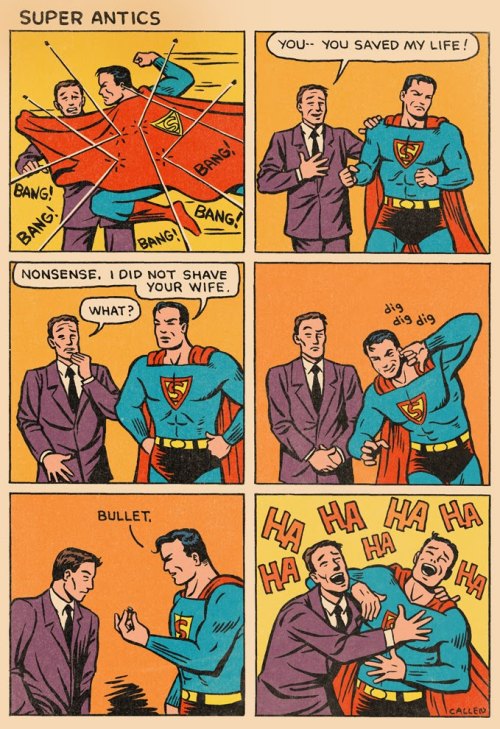
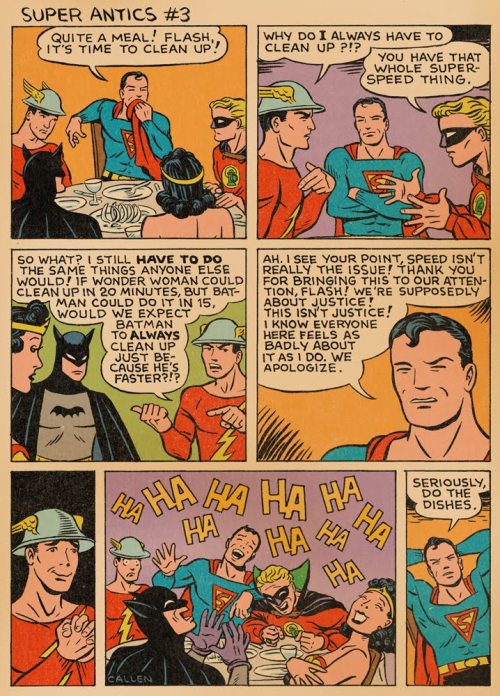
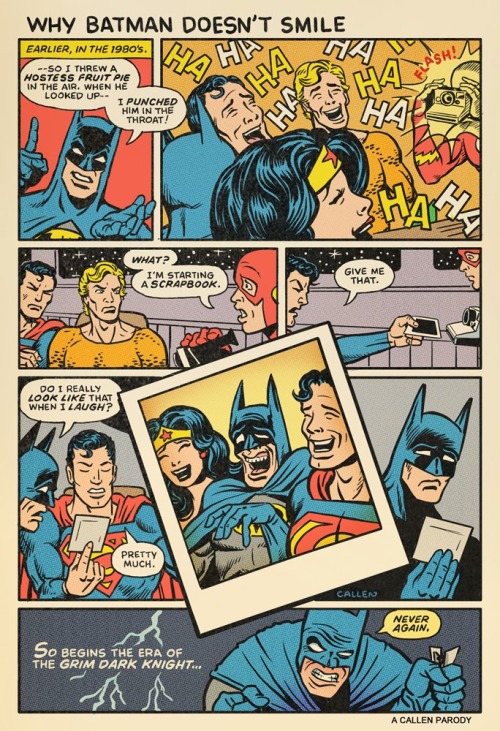
chubbymon:lordwanjavi:Kerry Callen > A Callen ParodyThese are...



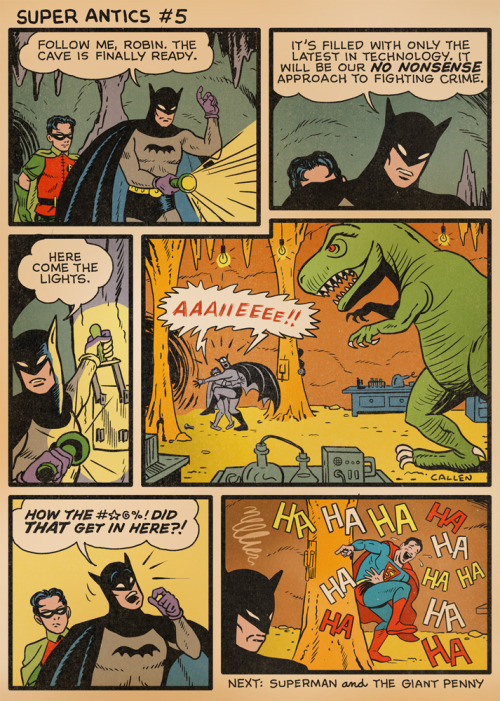
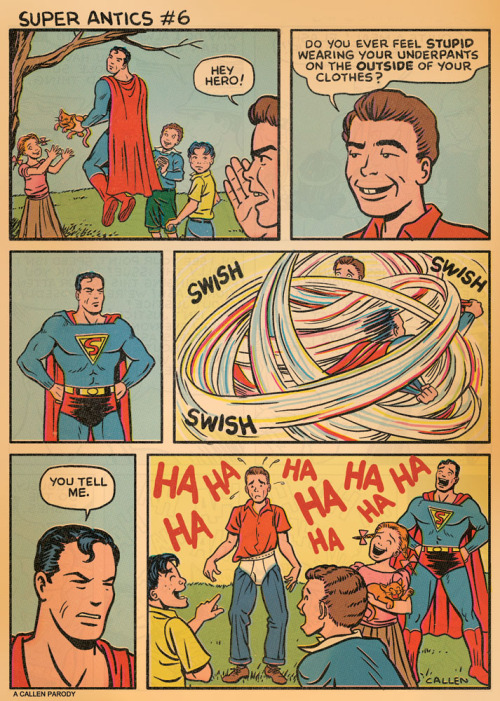
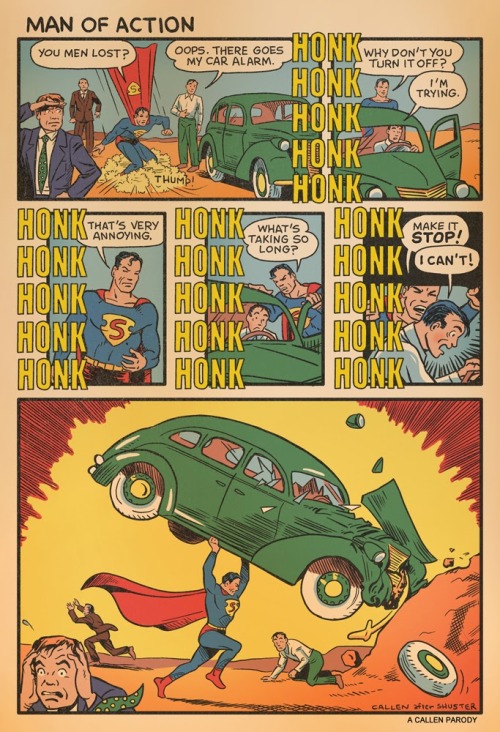
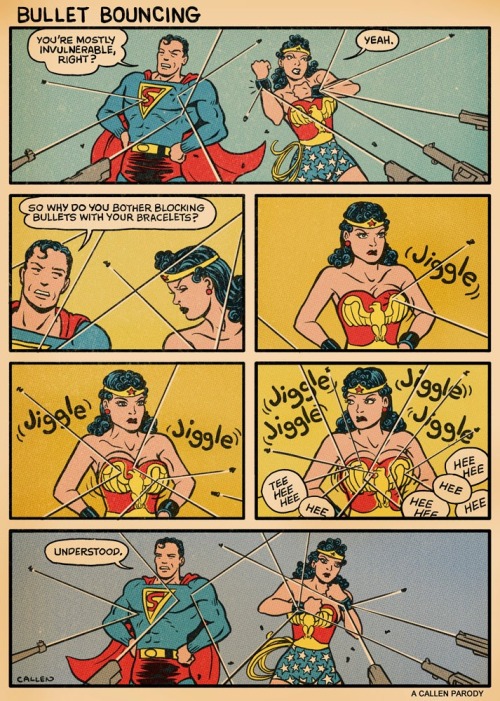
Lori, Mitch Laue and 4 others like this
14 Apr 22:18


The Suburban Dad Who Took the 1960s’ Eeriest Photos
by Laura C. Mallonee
Ralph Eugene Meatyard, “Occasion for Diriment” (1962), Gelatin silver print, 7.25 x 7.25 in (Guy Davenport Collection, Harry Ransom Center © The Estate of Ralph Eugene Meatyard; all images courtesy of the Blanton Museum of Art)
Save for his unusual name, Ralph Eugene Meatyard had all the trappings of an ordinary man. Born in 1925 in the Illinois town of Normal, the happily married father of three worked as an optician, coached his son’s baseball team, and even served as president of the Parent-Teacher Association.
But in his free time, Meatyard was also a self-taught photographer with a taste for the bizarre. On weekend trips into the dense woods of Kentucky, he staged nightmarish scenarios acted out by family members and populated with disfigured masks, broken mirrors, and dolls. In 1969, when asked about the sensation his photographs provoked, the suburban dad said it was a feeling “akin to a shiver, and pleasurable as a shiver sometimes is.” He called these unsettling images “romances,” adopting the definition of that word from Ambrose Bierce’s Devil’s Dictionary: “Fiction that owes no allegiance to the God of Things as They Are.” It’s safe to say that when Meatyard died of cancer at the age of 47 in 1972, he left behind one of the weirdest photographic oeuvres the world had then yet known.
Wildly Strange: The Photographs of Ralph Eugene Meatyard at the Blanton Museum in Austin welcomes viewers into Meatyard’s eerie world through 35 images from the collection of the Harry Ransom Center. Taken between 1958 and 1970, they include the photographer’s classic mask images and landscapes, as well as dust jacket portraits he took for writer friends like Guy Davenport, Wendell Berry, and Thomas Merton. Though Meatyard believed photographs should be “felt in a similar way as one listens to music, emotionally, without expecting a story,” the images in the show can’t help but bring to mind Edgar Allan Poe’s famous lines: “Deep into that darkness peering, long I stood there wondering, fearing, / Doubting, dreaming dreams no mortal ever dared to dream before.”
Ralph Eugene Meatyard, “Untitled” (1960), Gelatin silver print, 7.5 x 8 in (Guy Davenport Collection, Harry Ransom Center © The Estate of Ralph Eugene Meatyard)
Ralph Eugene Meatyard, “Untitled” (1967), Gelatin silver print, 7.25 x 7 in (Guy Davenport Collection, Harry Ransom Center © The Estate of Ralph Eugene Meatyard)
Ralph Eugene Meatyard, “[Guy Davenport]” (1965), Gelatin silver print, 7.25 x 7.25 in (Guy Davenport Collection, Harry Ransom Center © The Estate of Ralph Eugene Meatyard)
Ralph Eugene Meatyard, “[Louis Zukofsky]” (1967) Gelatin silver print, 7.5 x 6.75 in (Guy Davenport Collection, Harry Ransom Center © The Estate of Ralph Eugene Meatyard)
Ralph Eugene Meatyard, “Untitled” (1959), Gelatin silver print, 6.5 x 6.5 in (Guy Davenport Collection, Harry Ransom Center © The Estate of Ralph Eugene Meatyard)
Ralph Eugene Meatyard, “Motion-Sound #28″ (c. 1970), Gelatin silver print, 6.75 x 6.75 in (Photography Collection, Harry Ransom Center © The Estate of Ralph Eugene Meatyard)
Wildly Strange: The Photographs of Ralph Eugene Meatyard continues at the Blanton Museum of Art (200 East Martin Luther King Jr. Boulevard, Austin, Texas) through June 21.
bernot, Sophianotloren likes this


14 Apr 22:17

Stop Hacking Your Life
by A Manly Guest Contributor
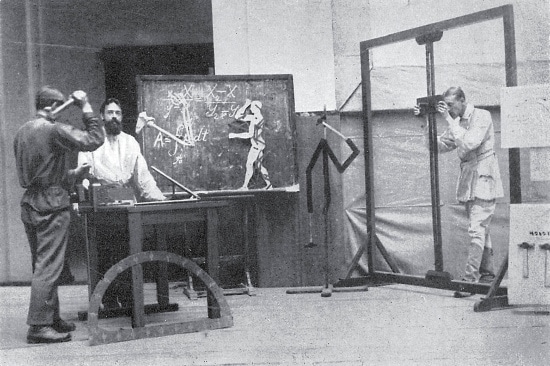
Editor’s Note: This is a guest post from Kyle Eschenroeder.
“There are a thousand hacking at the branches of evil to one who is striking at the root.” –Henry David Thoreau
“100 Life Hacks That Make Life Easier” –Article published on Lifehacker.com (179k social shares)
As legend has it, Alexander the Great undid the world’s most intricate knot. The Gordian Knot held a royal ox-cart to a post and remained tied for hundreds of years.
Then, in 333 BC, Alexander came along and tried to undo the knot. He, like the hundreds before him, couldn’t loosen it. Did he leave it for others to solve? Of course not! He’s Alexander the Great! He took his sword and solved the problem then and there.
We haven’t stopped swinging swords — and looking for easier, quicker, more direct solutions to life’s knotty problems — since.
A couple thousand years later, in 2004, a fellow named Danny O’Brien mentioned “life hack” in a talk about programmers and the “embarrassing” scripts and shortcuts they use. A hack, especially in computer science, is defined by Wikipedia as an “effective but inelegant solution” to a problem.
In 2005, Lifehack.org was created, and the concept took off and no longer centered just on tech shortcuts, but learning easier, niftier ways to do everything from cutting an onion to improving your focus. That same year, the American Dialectic Society named “lifehack” (now one word) as runner-up for its annual “most useful word” award, second only to “podcast.” (Where “love” or “courage” placed on their list I have no idea.)
In 2007 Timothy Ferriss published The 4-Hour Workweek and extended the idea of lifehacking to running a business and creating a leisure-filled lifestyle. Probably 80% of all entrepreneurial and productivity-oriented lifehacks you come across online were popularized by Tim’s book.
In the 2010s, articles, books, and even scientific studies focusing on lifestyle optimization have proliferated. Headlines scream: “You’ve Been Doing This Wrong All Along!” and we dutifully click to figure out how to make the needed improvements. We read up on getting our sleep schedule just right, our diet perfected, and our environment just so, and we tirelessly comply with the advice experts offer by tracking our steps, our breaths, and how much we moved while we snoozed.
All of these lifehacks promise a better life with less effort.
It’s an irresistible offer.
Why untie a knot when you can cut it with your sword?
Two Relationships to Hacks

Many people have had success using these life optimization tools and tricks, and they’re not necessarily a bad thing. Their effect all depends on which of two relationships someone has with hacking:
- Hacking for something. When Alexander the Great cut the Gordian Knot he didn’t care about much else besides getting the ox-cart off the pole. Cutting the knot was the best solution to his problem. When a programmer finds a hack that allows him to move forward he has done the same thing. The focus is on an outcome and the hack is a way to get there. This often means solving problems creatively.
- Hacking for hacking’s sake. Then there is the person scrolling through Lifehacker collecting listicles. Reading and re-reading the same hacks spewed out a thousand times. This is the person who won’t go to the gym until they know for a fact that they have the “perfect” workout regimen. This is the person who doesn’t start a business because they don’t know how; they always have to do just a little more research before they get going. These are the people who are constantly talking about how they need to get up earlier, to cut out gluten, to implement the Pomodoro technique…
Hacking approach #1 can be beneficial; every man should have a little MacGyver in him and keep some duct-tape solutions in his back pocket. And if there’s a better way to cut an onion, by all means, go for it.
But hacking approach #2 invariably leads to a life that’s less optimal, not more. The damage results not so much from the actual hacking practices themselves, but from the mindset their pursuit and adoption begets.
It’s a mindset marked by “Efficiency Paranoia.” You become more focused on hacking — finding just the right tools and environment — than on your goal, and your big-picture progress towards it. You forget that tools must be used to matter. You overlook the fact you are capable of figuring things out on your own (and that the work required to do so can be a great source of pleasure).
The hacking mindset thinks the answer is “out there.” This is why we Google things like “What should I do with my life?” or click on articles that promise “How to Be More Courageous in 5 Easy Steps.”
The hacking mindset tells us that once we master the right seduction techniques we will finally fall in love with the woman of our dreams.
The hacking mindset tells us we will not have to surmount the obstacles on the way to our aims if we can simply find a way around them.
The hacking mindset flatters the part of us who’s lazy, who always wants to take the path of least resistance, who loves feeling superior to the “chumps” who are taking the hard way. But, despite all our new technological advancements, life itself remains stubbornly impervious to hacking. You do not get to cheat death. You do not get to escape being human. You cannot circumvent the universal law which dictates that all goals require work, time, pain, and suffering to attain. The obstacle remains the way.
Once you free yourself from the hacking mindset, you no longer have anxiety that someone out there might have the secret that will finally make everything fall into place. The restless FOMO that comes from thinking there is a more effective way to do something, and the anxiety that you’re not doing life “right,” dissipates. You trust yourself more and become less needy. You begin to effectively assimilate and use information instead of fearfully hoarding it. You enjoy the climb instead of cursing it. And, lo and behold, though you do not take the “optimal” path, you magically, paradoxically, get a whole lot more done.
To liberate ourselves from something that’s so thoroughly ingrained in our culture, we need to learn to see the deleterious ways it manifests itself. So let’s look at six problems presented by the hacking mindset.
Why a Focus on Hacking Leads to a Less Optimal Life

Hacking Stigmatizes Effort
“The whole glory of virtue resides in activity.” –Cicero
If less effort is the goal, exerting effort is a kind of failure.
There is a special breed of “lifestyle designers” who seem to only do things so that they can go travel. (And it seems they only travel for trophy pictures.) Every obligation or responsibility they incur is a failure to lead a free life.
They put together “businesses” that they can automate and never look at again.
They got into this lifestyle because someone scared them of “deferring” the good life until retirement when they won’t be able to appreciate it anyway. Why wait to live!?
The thing is, now they just want to retire immediately. If they had a White Whale then this wouldn’t be an issue.
Instead of having a dream of creating something amazing, their dream is to work from home (and only four hours per week, please).
This doesn’t seem like a compelling aim for a life’s work.
And it certainly doesn’t invigorate us.
God forbid we do anything hard.
God forbid we try more than what is necessary.
Like dogs chasing a car, we aim at an eternal comfort that, if caught, would destroy us.
A focus on hacking makes everything that requires time and toil look undesirable. Yet those are the prerequisites of the pursuit of anything worthwhile. One cannot catch a whale in a net of hacks.
Hacking Undervalues the Obvious and Useful (But Boring) for the New and Ineffectual (But Sexy)
“People say: ‘What good does it do to point out the obvious?’ A great deal of good; for we sometimes know facts without paying attention to them. Advice is not teaching; it merely engages the attention and rouses us, and concentrates the memory, and keeps it from losing grip. We miss much that is set before our very eyes. Advice is, in fact, a sort of exhortation. The mind often tries not to notice even that which lies before our eyes; we must therefore force upon it the knowledge of things that are perfectly well known.” –Seneca, Moral Letters to Lucilius
Everything needs an exclamation mark to be noticed.
Exclamation marks cost advertising dollars though, which means that timeless, but effective advice off which you can’t make a buck gets lost in the noise. You’re never going to see a Super Bowl ad for broccoli, push-ups, or unguided meditation.
The marketing budget for the next easy fix (pharmaceutical stress reduction pill, fat-loss via berry extracts, liposuction, some new diet), on the other hand, is limitless.
It’s the hacks that get the funding. It’s the next ultimate workout program, magic pharmaceutical invention, or method to instant wealth that you’ll pay for.
It’s slightly more nuanced when scientists or academics are doing the selling.
Universities are under extreme pressure to put out exciting new findings. This pressure is passed on to professors who are forced to do “science by PR.” They exaggerate the implications of their findings in order to sell more books or gain more press.
Big Data allows us to draw correlations between anything we want. Data mining isn’t so much mining as it is finding shapes in clouds.
Sometimes a finding makes it through academia intact. Then the journalists get ahold of it…
A possible solution for 2% increase in solar panel effectiveness becomes The Next Clean Energy Revolution is Here!
Everyone loves sexy science.
But, as a rule of thumb, the newest, most hyped information isn’t the most useful.
What is most useful is rarely hidden away behind a pay wall or some esoteric text. More likely it’s in plain sight, it’s been around for a while, and it’s boring.
But it works.
“Take a simple idea and take it seriously.” –Charlie Munger
Hacking Leads To Aimless Optimization
There is no such thing as a naturally occurring aimless life. Aimlessness happens when too many people have convinced you of the importance of too many aims. Aimlessness isn’t just the absence of an aim, it’s the shadow-side of an aim.
“Indefinite attitudes to the future explain what’s most dysfunctional in our world today. Process trumps substance: when people lack concrete plans to carry out, they use formal rules to assemble a portfolio of various options. This describes Americans today. In middle school, we’re encouraged to start hoarding ‘extracurricular activities.’ In high school, ambitious students compete even harder to appear omnicompetent. By the time a student gets to college, he’s spent a decade curating a bewilderingly diverse résumé to prepare for a completely unknowable future. Come what may, he’s ready — for nothing in particular.” –Peter Thiel, Zero to One: Notes on Startups, or How to Build the Future
Perhaps the greatest productivity “hack” is to become what the billionaire investor Peter Thiel would call a “definite optimist.” That means believing in a concrete future and your ability to create it — or at least a part of it.
Many of us are “indefinite optimists” right now. We believe that the world will be better in the future but have no idea what that means. Thiel uses the finance sector to highlight this attitude: You wouldn’t invest if the future seemed bleak, but you don’t need to have a specific vision for what the future actually looks like.
Scrolling through listicles of productivity advice is an act of indefinite optimism. We collect massive amounts of this low-grade information in hopes that one day it will be useful. We go through these lists every day hoping for the thing without considering the source: some blogger who has to write five more articles that day and is desperate for clicks.
A definite optimist wouldn’t do this. Why?
A definite optimist has a White Whale.
Knowing what you want provides a powerful filter against crappy content. Having a definite aim makes it easier to determine what paths aren’t worth going down.
When we optimize for everything we optimize for nothing.
When we try to optimize for life we get into even bigger trouble.
Those who study productivity the most don’t produce the most.
They have nothing to prepare for. There is no context for them to apply anything.
They have made the mistake of believing that you can optimize life. That if they follow the instructions of some study they will find pure bliss. They will finally escape being human.
Without context all we can see is the web of hacks that we’ve created. The perfect routine, the perfect body, and the perfect bank account: all in service of nothing.
Optimization of productivity is like a multiplier. If there is nothing to multiply, you end up at zero. If you have a definite direction you will naturally optimize over time.
Your definite optimism doesn’t even need to be, well, definite. Nobody can predict the future; the point is to have the courage to do so.
Newton cared more about alchemy and Biblical studies than his famous scientific works. After reading these, John Maynard Keynes said, “Newton was not the first of the age of reason, he was the last of the magicians.”
The specific thing that Newton was driven towards wasn’t what mattered for society in the end. It was still crucially important as the thing that drove Newton to do interesting things. Without his interest in the occult we would not have benefited from his other great work.
Aim doesn’t even need to mean that you think you know what will happen. Nassim Taleb suggests we become antifragile in certain areas of our lives. This means benefitting from (often unexpected) volatility. It means being in a position to win from the unknown. This is a specific aim — one that those who would be “ready for anything” ought to consider.
Hacking Distorts Our View of Time
“Thanks to the clock tower, the rhythms of daily life were now dictated by a machine. Over time, people conformed to ever more precisely scheduled routines. Where the priority of the calendar-driven civilization was God, the priorities of the clockwork universe would be speed and efficiency. Where calendars led people to think in terms of history, clocks led people to think in terms of productivity. Time was money. Only after the proliferation of the clock did the word ‘speed’ (spelled spede) enter the English vocabulary.” –Douglas Rushkoff, Present Shock
We feel so much pressure to hack our lives because of the immense responsibility we (and technology we’ve created) have put on the present moment and the need for immediate success. It’s not acceptable to build a business over a decade, it better be profitable in a week.
You can write a novel in November during NaNoWriMo; why take years to create a masterpiece?
The internet makes sure that you have access to anything the moment it crosses your mind. Your digital devices constantly update with what’s happening now. They whip up a faux sense of urgency that must be witnessed or dealt with.
They are violently bringing you back to the present moment. Compare this to a person “being present.” He is not being shocked into the present by alerts. Instead, he is in control of his attention and places it in the present consciously.
To help understand this difference on a deeper level, it’s worth looking at how the Greeks looked at time. There were two types: chronos and kairos.
Chronos is simple. It’s the time measured by the clock tower. Rushkoff says it’s “what we literally mean when we say ‘three o’clock.’ This is time of the clock, meaning belonging to the clock…”
Chronos is what we’re most comfortable with. It is easily measurable so we can pin it down and work with it. We can gauge how we “use” it to make sure everything is just right.
Kairos is more the qualitative side of time. Being qualitative, it demands the human touch. Rushkoff explains:
“[Kairos] is usually understood as a window of opportunity created by circumstances, God, or fate. It is the ideal time to strike, to propose marriage, or to take any particular course of action. Carpe diem.”
Hacking or optimizing your life is concerned with chronos because that’s the only thing it can be concerned with. There is no clear way to teach kairos without discussing courage, mindfulness, purpose, and humanity. Chronos is more graspable and moldable: make a chart, set the clock for 45 minutes, don’t take meetings, multitask or don’t multitask, on and on.
Kairos is knowing the right time for you while chronos is knowing the time according to the clock. Kairos is knowing when to go in for the kiss while chronos is concerned with your date being on time. Kairos feels that five years is an acceptable amount of time to make a blog profitable; chronos balks at the idea. Kairos understands context, chronos hungers for infinitely more, infinitely faster.
Our chronos-heavy perspective on time doesn’t just cause anxiety; it makes us weak as humans and keeps us stuck in our current circumstances. Rushkoff says this is because:
“It assumes that kairos has no value — that if there is a moment of opportunity to be seized, that moment will break into our flow from the outside, like a pop-up ad on the Web. We lose the ability to imagine opportunities emerging and excitement arising from pursuing whatever we are currently doing, as we compulsively anticipate the next decision point.”
We wait for the email, the text message, the next comment on our new Facebook profile picture. We scroll through Instagram looking for the motivational image we need.
We don’t know what to do with ourselves if our time isn’t being demanded by automated notifications.
Some like to say that we all have the same 24 hours in a day. You and the President. Sure. For someone stuck in chronos this is true. For someone who understands kairos it’s absurd.
Dependence on Replicating the Ideal, Expert-Recommended Circumstances Before Getting Started
air and light and time and space by Charles Bukowski
“– you know, I’ve either had a family, a job,
something has always been in the
way
but now
I’ve sold my house, I’ve found this
place, a large studio, you should see the space and
the light.
for the first time in my life I’m going to have
a place and the time to
create.”no baby, if you’re going to create
you’re going to create whether you work
16 hours a day in a coal mine
or
you’re going to create in a small room with 3 children
while you’re on
welfare,
you’re going to create with part of your mind and your body blown
away,
you’re going to create blind
crippled
demented,
you’re going to create with a cat crawling up your
back while
the whole city trembles in earthquake, bombardment,
flood and fire.baby, air and light and time and space
have nothing to do with it
and don’t create anything
except maybe a longer life to find
new excuses
for.
Stephen King wrote Carrie on a makeshift desk set between a washing machine and a dryer. He wrote while his kid cried and his wife banged pots in the nearby kitchen as she prepared dinner.
This should tell you everything you need to know about the requirements of creativity.
Studies come out and tell you that you need to paint your walls a certain color. That you need to sit down at the same place every day (or a different place every day). That you need this or that. Always contradicting, never taking you into consideration.
These studies are concerned with some measurement on some group of people in some study you weren’t involved in.
If you look at the daily rituals of 100 different creative people you’ll find 100 different things that work. For them.
If you know that you must create, then you will. If you feel like you should create, then you’ll find an excuse not to.
When you must create then you have no choice but to find the best environment and ritual for you. These personal environmental hacks are just that: personal.
You must earn the right to hack your creativity. There is no book that can do it for you. No secret method. Just you, honesty, and an aim.
Keep your locus of control on the inside. Scientific studies will try to convince you that you must have everything just so or you won’t be a genius. They will pull your sense of control outside of you until you forget that you have any at all.
If you do the work you’ll find what works for you. Without the work, no amount of studies will teach you what you want to know.
Hacking Favors Irrational Rationality
Focusing on hacking our lives makes it impossible to discern between irrational rationality and rational irrationality.
Irrational rationality is being reasonable at an unreasonable time. It’s relying on logic when your wife is yelling. It’s coming up with “reasonable” excuses for doing something that feels wrong. And it’s trying to figure out ways to be more productive…at a job you hate. It’s trying to hack the thing when what the issue really demands is courage.
Rational irrationality is being unreasonable at the right times. It’s caring “too much” about some trivial detail. It’s putting all your effort into something that might not work. It’s living with purpose when there is no clear reason to do so. It’s putting aside the hacks in favor of something truly difficult.
Rational irrationality is Newton’s obsession with alchemy. It’s Steve Jobs’ demand that the interior of an Apple device be as beautiful as the exterior. It’s writing a novel that probably won’t be published.
It’s what makes life worth living.
These are the moments when you feel you’re doing the right thing even though it’s confusing or angering everyone else. Your aims and methods would never make it onto a list of “How to Optimize X!” But it’s working for you.
The quality of your life depends on moments of taking the leap when the world is telling you not to. These are the moments that we remember for the rest of our lives.
The health of our economy also depends on rational irrationality.
Silicon Valley was built on “irrational” investments.
It takes an organization that can transcend traditional investment rules (hack for short-term profits) in order to truly push technology. Historically, the military has been the only organization to be able to do this consistently.
The Department of Defense needed boundary-pushing electronics to save lives and protect our freedom. A company aimed at maximizing (read “hacking”) profits could never justify this.
Federal sources accounted for over half of the national R&D expenditures in the twenty-five years leading up to 1978. This was only made possible by the rational irrationality that comes with stakes as high as the Soviets threatening US sovereignty.
Imagine stakes this high in your life. When you’re on a mission you wouldn’t dream of hacking your life — of only doing what’s quick and efficient. You use those necessary hacks that will move you towards your goal, sure, but your mindset is focused on the long adventure ahead.
Joseph Campbell’s hero’s journey describes the pain of “knitting together” your dream world and reality. The hero is the one with enough courage to go beyond rationality (what we know can be brought into reality) and come back with something for our world anyway. It’s painful, but it’s more than worthwhile:
“For when a heart insists on its destiny, resisting the general blandishment, then the agony is great; so too the danger. Forces, however, will have been set in motion beyond the reckoning of the senses. Sequences of events from the corners of the world will draw gradually together, and miracles of coincidence bring the inevitable to pass. The talismanic ring from the soul’s encounter with its other portion in the place of recollectedness betokens…a conviction of the waking mind that the reality of the deep is not belied by that of common day. This is the sign of the hero’s requirement, now, to knit together his two worlds.
The remainder…is a history of the slow yet wonderful operation of a destiny that has been summoned into life. Not everyone has a destiny: only the hero who has plunged to touch it, and has come up again — with a ring.”
We have rationalized away most good reasons for caring intensely. Newton’s intense drive to solve the mind of God would be looked at as madness now. It seems there are fewer scientific discoveries that will matter widely and last for more than a decade. It doesn’t seem that any book written this year will be read in 100 years.
The modern hero is the one who has the ability to create meaning.
The hero now is the one who can dig down deep and give a damn for no justifiable reason. His ability to maintain virility in the face of an objective purposelessness serves as an inspiration to those around him. He will certainly find hacks along the way, but would never consider hacking the journey itself.
What’s the point? What is there to do?

“… the labyrinth is thoroughly known; we have only to follow the thread of the hero-path. And where we had thought to find an abomination, we shall find a god; where we had thought to slay another, we shall slay ourselves; where we had thought to travel outward, we shall come to the center of our own existence; where we had thought to be alone, we shall be with all the world.”
–Joseph Campbell, The Hero With A Thousand Faces
What is the one thing that all the weakening effects of our hacking culture outlined above work to undermine?
Self-reliance.
That’s the heart of the matter.
Focusing on hacking cuts our autonomous legs out from under us. It breeds dependence on expert advice and shortcuts in order to get started and keep moving. It emphasizes new and sexy tips and tricks, while obscuring the simple, obvious advice that could actually save us. It focuses our view on the present, and confuses mere activity with moving towards an ultimate aim. It tells us that obstacles are optional, and that if they are encountered, you can always find a way around them — that only suckers climb mountains when you can take the chairlift.
Counteracting the self-reliance-sapping effects of hacking culture isn’t easy; the very nature of the problem denies any prescription, much less a hackable solution. Still, in relation to the six problems we discussed above, several general principles/stances can be recommended:
- Maintaining a strong, centered posture even as quick fixes and silver bullets are continually thrown at you, using them only when useful, and embracing the effort that’s needed when they’re not.
- Focusing on obvious, time-tested advice, and what you have found works for you, rather than being distracted by what’s new and sexy.
- Having a clear aim and avoiding the temptation to optimize for zero.
- Remembering kairos and that time is not just what your clock can measure.
- Valuing your own personal experience over what a study says, and feeling free to do your own experiments.
- Having the courage to care about what you care about, and to do things your way, whether it makes sense to others or not.
The crux of one’s hacking counter-stance must ultimately rest on the prioritization of right action over abstraction. I say “right action” instead of “action” as a reminder that busyness is worse than doing nothing. It feels productive while your soul shrinks and the important things go left undone.
Perhaps your first action must be to create a whole new approach to life — a new mindset that undoes that which has been ingrained since youth.
When we were in school they gave us problems to solve.
When we got jobs they gave us tasks to complete.
But when we graduated, got fired, fell in love, started businesses, had kids?
There was no absolute right answer.
And so we had to write our own questions.
That’s the hardest thing to do when you’ve spent your whole life finding answers to other peoples’ equations.
The hacking mind is obsessed with answering questions. It makes your life small by forgetting there are other questions out there to ask.
The hacking mind will have you think that your life can be measured and thus optimized. That your existence is something to be charted and cheated.
When you start writing your own questions you can reject this notion.
Instead of googling what to do with your life you can live.
Instead of trying to sleep according to the opinions of some scientists you can go to bed when you want.
Instead of reading a book written by a bad business consultant you can read a novel.
Instead of pretending like you want something you can actually want something.
Instead of learning how to manipulate women you could sack up and talk to one.
In short, you can be you.
You know what you want in life.
You like eating the good stuff.
You like challenging things.
You like taking the long way home from work.
You don’t actually want that car.
You can’t be hacked.
Because hacks are small.
And you are big.
_______________________
Kyle kick-starts entrepreneurs at StartupBros.com and is offering this free guide of necessary entrepreneurial epiphanies to you. Feel freer than free to contact Kyle anywhere on the web. Even his inbox: kyle at StartupBros dot com.
Jonmech, Claudio Navarro Henriquez and 4 others like this
14 Apr 22:04


Push The Button: ICBM Is A Free Nuke Launch Control Sim
by Alice O'Connor

The Cold War! A conflict immortalised in such action-packed movies as Rambo III, Red Dawn, Red Zone Cuba, and Rocky IV. But what about the real threat of the Cold War, the thousands of intercontinental ballistic missiles pointed at the USA and USSR? ICBM [official site] is a free game which puts you – yes, you! – at the heart of the action.
Across four missions, you’ll be the one sat at the desk with the big red button, waiting patiently for orders to turn the key and unleash the end of the world. And waiting. And waiting. And waiting.
firehose, Sophianotloren and 3 others like this
14 Apr 22:03
![[Image: A tweet by the bank, in Finnish. Translation: Our customers' personal data will not be made available to Google under any circumstances. Thanks to everyone who participated in the discussion! (2/2)]](https://blogger.googleusercontent.com/img/b/R29vZ2xl/AVvXsEhcdvnM-vdWEEJETMI5Io0tiq36nvh4Yyyd46NGsANXQsXMOy-lydxIPiip72T50DUbL4O-kxxotmawOZleC0u7g-kNp2EDZs5-HDpTtsmv8tQ0319rU7rMdVhsNdbYz4ZlfDG_I097Nb5k/s450/asiakkaidemme.png)
Trackers leaking bank account data
by Oona Räisänen
A Finnish online bank used to include a US-based third-party analytics and tracking script in all of its pages. Ospi first wrote about it (in Finnish) in February 2015, and this caused a bit of a fuss.
The bank responded to users' worries by claiming that all information is collected anonymously:
But is it true?
As Ospi notes, a plethora of information is sent along the HTTP request for the tracker script. This includes, of course, the IP address of the user; but also the full URL the user is browsing. The bank's URLs reveal quite a bit about what the user is doing; for instance, a user planning to start a continuous savings contract will send the url continuousSavingsContractStep1.do.
I logged in to the bank (using well-known demo credentials) to record one such tracking request. The URL sent to the third party tracker contains a cleartext transaction archive code that could easily be used to match a transaction between two bank accounts, since it's identical for both users. But there's also a hex string called accountId (highlighted in red).
Remote Address: 80.***.***.***:443
Request URL:    https://www.google-analytics.com/collect?v=1&_v=j33&a=870588619&t
                =pageview&_s=1&dl=https%3A%2F%2Fonline.********.fi%2Febank%2Facco
                unt%2FinitTransactionDetails.do%3FbackLink%3Dreset%26accountId%3D
                69af881eca98b7042f18e975e00f9d49d5d5ee64%26rowNo%3D0%26type%3Dtra
                ns%26archivecode%3D20150220123456780002&ul=en-us&de=windows-1252&
                dt=Tilit%C2%A0%7C%C2%A0Verkkopankki%20%7C%20S-Pankki&sd=24-bit&sr
                =1440x900&vp=1440x150&je=1&fl=16.0%20r0&_u=QACAAQQBI~&jid=&cid=18
                39557247.1424801770&uid=&tid=UA-37407484-1&cd1=&cd2=demo_accounts
                &cd3=%2Ffi%2F&z=2098846672
Request Method: GET
Status Code:    200 OK
It's 40 hex characters long, which is 160 bits. This happens to be the length of an SHA-1 hash.
Could it really be a simple hash of the user's bank account number? Surely they would at least salt it.
Let's try!
The demo account's IBAN code is FI96 3939 0001 0006 03, but this doesn't give us the above hash. However, if we remove the country code, IBAN checksum, and all whitespaces, it turns out we have a match!
$ echo -n "FI96 3939 0001 0006 03" | shasum
dcf04c4fd3b6e29b4b43a8bf43c2713ac9be1de2  -

$ echo -n "FI9639390001000603" | shasum
3e3658e4c2802dd5c21b1c6c1ed55fc1f39c8830  -

$ echo -n "39390001000603" | shasum
69af881eca98b7042f18e975e00f9d49d5d5ee64  -

$ █
This is a BBAN format bank account number. BBAN numbers are easy to brute-force, especially if the bank is already known. I wrote the following C program, ~25 lines of code, that reversed the above hash to the correct account number in 0.5 seconds.
#include <openssl/sha.h>
#include <stdlib.h>
#include <stdio.h>
#include <string.h>

#define BBAN_LENGTH 14

int main() {
  const char target_hash[SHA_DIGEST_LENGTH] = {
    "\x69\xaf\x88\x1e\xca\x98\xb7\x04\x2f\x18"
    "\xe9\x75\xe0\x0f\x9d\x49\xd5\xd5\xee\x64"
  };
  unsigned char try_accnum[BBAN_LENGTH+1];
  unsigned char try_hash[SHA_DIGEST_LENGTH];

  for (int bban_office=0; bban_office < 1e4; bban_office++) {
    for (int bban_id=0; bban_id < 1e6; bban_id++) {
      snprintf((char*)try_accnum, sizeof(try_accnum),
               "3939%04d%06d", bban_office, bban_id);
      SHA1(try_accnum, BBAN_LENGTH, try_hash);
      if (memcmp(try_hash, target_hash, SHA_DIGEST_LENGTH) == 0) {
        printf("found %s\n", try_accnum);
        return EXIT_SUCCESS;
      }
    }
  }
  return EXIT_FAILURE;
}
$ gcc -lcrypto -o bban_hash bban_hash.c $ time ./bban_hash found 39390001000603 ./bban_hash 0.42s user 0.00s system 99% cpu 0.420 total $ █
In conclusion, the third party is provided with the user's IP address, bank account number, addresses of subpages they visit, and account numbers associated with all transactions they make. The analytics company should also have no difficulty matching the user with its own database collected from other sites, including their full name and search history.
Incidentally, this is in breach of the Guidelines on bank secrecy (PDF) by the Federation of Finnish Financial Services; "In accordance with the secrecy obligation, third parties may not even be disclosed whether a certain person is a customer of the bank" (pg 4) (sama suomeksi: "Salassapitovelvollisuus sisältää myös sen, että sivullisille ei ilmoiteta edes sitä, onko tietty henkilö pankin asiakas vai ei").
Solution
The script was eventually removed from the site, leaving the bank regretful that such a useful tool was lost.
However, alternatives do exist (like Piwik) that can be run locally, not involving a third party. Edit: The Intercept, a news website, is using non-privacy-invading metrics.
External links
- Mitä tietoja S-Pankki välittää kolmannelle osapuolelle – oBlog
- S-Pankin arkea on Twitter: "Asiakkaidemme henkilötietoja ei missään tapauksessa siirry Googlen käyttöön. Kiitos kaikille keskusteluun osallistuneille! (2/2)"
- Guidelines on bank secrecy (PDF)
- Pankkisalaisuusohjeet (PDF)
- Tietosuojahuolet vaikuttivat – S-Pankki lopetti Googlen käytön – Ilta-Sanomat (archive.org)
- What The Intercept’s New Audience Measurement System Means for Reader Privacy
Sophianotloren likes this
14 Apr 22:02


Cops have killed way more Americans in America than terrorists have
by Xeni Jardin
Police have killed more Americans on U.S. soil since the year 2000 than the Islamist terrorists. Read the rest
Markku.lempinen, Sophianotloren and one other like this
14 Apr 22:01

Chicken has no meaning anymore
by HUGELOL

clauaud, Sophianotloren and 4 others like this
14 Apr 22:00
Big Mother Is Watching You: Hillary Clinton
by Robin D
For our second installment of Big Mother Is Watching You, a guide to prominent anti-sex worker activists and officials, we’d like to remind you of a few salient facts about Hillary Clinton and her relationship to Somaly Mam, after the formal launch of Clinton’s second presidential bid on Sunday. While U.S. Secretary of State (2009-2013), […]
Sophianotloren likes this
14 Apr 22:00

A quick look at the punditverse
by Helmut Monotreme
So, Hillary Clinton is running for president. That ought to be good for a few laughs. Let’s see what people are saying about that.
First up: Jonah Goldberg says in his column:
Maybe I’m wrong, but it seems obvious to me that if you claim to be a conservative and then suddenly discover that Hillary Clinton is really one too, then you were either never a conservative in the first place or you care about something other than your principles a whole lot more.
That is purity trolling, but it’s weak sauce, I assume Jonah knows it’s going to be a long, long campaign and is pacing himself. He’d hate to go full paranoid delusional Whitewater-Vince Foster-Benghazi right out of the gate, that would leave him nowhere to go next week, and he’s got 15 months of Hillary bashing columns to write. Let’s take a look at what the other conservative pundits are saying about Hillary…
Bill Kristol, George Will, and Charles Krauthammer, figure with 18 months of election to go, there’s pleanty of time to talk about Hillary, they all have one more pressing issue on their mind: Iran. This quote from George Will seems to sum up their attitude fairly succinctly:
Obama’s obnoxious air of entitlement to unearned immunity from oversight should not blind us to this fact that has been obvious for some time: Iran is going to be a nuclear power if it intensely wants to be, and it does; no practicable sanctions can be severe and durable enough to defeat this determination.
Here’s the thing. No country has ever been stopped from developing a nuclear bomb by any means short of a full scale military assault. North Korea managed and they were watching their population starve while they were busily making bombs. Could a more active and engaged administration have prevented that? Clinton managed. He traded food for the end of the bomb program and for the eight years of his administration, that was enough. The Bush administration played tough, ended the food support and concentrated on the wars in Iraq and Afghanistan and North Korea built a bomb. They saw what the US did to two enemies that did not have nuclear weapons in their arsenal.
So that’s why Iran wants the bomb, to stop US (or Israeli) military intervention. But why do so many conservatives have such a hate on for Iran? Is it wounded pride from the hostage crisis of 1979? The memory of the 1973 energy crisis when OPEC collectively pulled the western world by the short hairs? The vindictiveness of thwarted colonialism that thinks ‘we stole it first’ is a good reason that BP should still own the Iranian oil fields? Is it the Israel lobby who sees a mortal enemy in a country that funded Hamas? Is it the Saudi lobby that sees 80 million Shiite heretics?
It’s all of the above. Plus the thought of increased profits for military contractors if the USA did go to war.
Here’s a story that was reported in USA today right after the deal was announced:
http://americasmarkets.usatoday.com/2015/04/02/oil-prices-fall-on-word-of-nuclear-accord-with-iran/
The historic animosity of the US to Iran, in the wake of the Iranian revolution has been, among other things a price subsidy for every other oil company in the world.
That’s why I want to see renewable energy implemented worldwide. I want national governments to be more powerful than petrochemical companies. I’d love for there to be a windmill energy boom in the great plains states which won’t ruin the water or cause earthquakes or belch more greenhouse gasses into the air. I’d love for rooftops worldwide to sprout solar panels. I’d like to see nine out of ten oil refineries close their doors. I’d even be OK with Lockheed Martin perfecting the fusion power plant they’ve been touting in their press releases, as pollutants go, I can deal with some extra helium.
But the happy little future I outlined above is basically the worst nightmare of the neocons. They depend on a world order supported by and supporting a limitless appetite for oil. The post world war II world order has been sustained by the western world’s control of oil production. I’m not naive enough to think that if no one was fighting over oil and oil money that there would be no fighting, but I’m sick of oil money funding the paranoid warmongering ambitions of a revolting group of reactionaries.
Apologies for the long post on the front page, when I figure out how to make a jump, I will do that.
bernot, Sophianotloren likes this
14 Apr 22:00

Turn Songs into 3D-Printed Sculptures You Can ‘Listen To’ with Reify
by Christopher Jobson

Since the earliest days of Winamp and other media players with vizualization software that transformed our favorite songs into pulsing animations, we’ve all grown accustomed to “seeing” music on a computer screen. A new company called Reify aims to put those same sound wave interpretations in your hands, as 3d-printed sculptures. Lead by founder and CEO Allison Wood, the team is creating software that turns any snippet of audio—from rock music to spoken poetry—into curious objects 3d-printed from bronze, plastic, or even coconut husk.
Reify is also creating software that allows you to ‘scan’ the sculptures with your phone to interpret them back into audio. It’s not clear from their concept video if the music is recognizable, but that’s probably not the point. These sound sculptures seem to be more about visual presentation than media like vinyl or a phonograph.
The Reify project has the unique distinction of being the fastest growing company born from NEW INC, the first museum-led (non-profit) incubator conceived by the New Museum in 2013. You can see many more music sculptures on their Tumblr, and read a bit more over on NEW INC. (via the Creator’s Project)

“Ride of the Valkyries” by Richard Wagner


“Spin, Spin” by Gordon Lightfoot

“How Music Works” by David Byrne
Guimoretti, Serafin.shane and 5 others like this
14 Apr 21:59
Pill Drill
by snopes@snopes.com
News: A Georgia woman says her local WalMart outlet refused to fill a prescription she needed after a miscarriage.
Sophianotloren likes this
14 Apr 21:58
sarah vandella throated
by admin


The post sarah vandella throated appeared first on droolingfemme.
Sophianotloren likes this

14 Apr 21:54
 That didn't take long. The FCC's tougher net neutrality rules have only just been published in the federal register, and the lawsuits are already pouring in. The US Telecom Association has filed a suit claiming that the utility-style regulation of in...
Carrier alliance sues to stop net neutrality rules
by Jon Fingas
That didn't take long. The FCC's tougher net neutrality rules have only just been published in the federal register, and the lawsuits are already pouring in. The US Telecom Association has filed a suit claiming that the utility-style regulation of in...
Tertiarymatt, Sophianotloren likes this
14 Apr 21:54
Fuck Your Conscience; Do Your Job
by Rude One
Let us say, and why not, that you are a firefighter, the captain of the department in Sisterfuck, Arkansas, a little bit outside Little Rock, and, in your off-duty life, you're a good, loyal member of the Church of the Bloodiest Christ You've Ever Seen. At your church, Pastor Jamie Lee Closetqueer preaches about how abortion is just President Obama trying to murder Christians to make room for more Muslims. You never saw a Muslim abortion clinic, did you?
Now let us say, and, indeed, why not, that one night the Planned Parenthood in Little Rock goes up in flames and it's all hands on deck, all around the county, the area, even. Your squad is called into action before the whole complex, maybe the block, burns down. But you know that the Planned Parenthood does abortions. You're faced with a choice. Pastor Closetqueer's words echo in your ear: "If you support the sin, you are a sinner yourself." Do you tell your Sisterfuck squad to stand down, let it burn, let other firefighters handle it? Or do you go against your faith and do your goddamn job?
It's not a big leap from pharmacists to firefighters. Down the road a bit from Sisterfuck is Millegdeville, Georgia, where Brittany Cartrett had a miscarriage. She needed assistance passing the miscarried fetus, so her doctor prescribed her Misoprostol, a pill that would help her complete what had started naturally, if sadly. When her doctor called local Walmart to have it filled, the pharmacist on duty refused to do so because, as she later told Cartrett, "I couldn't think of a valid reason why you would need this prescription." Misoprostol can be used to induce abortion, which is why it would be effective after a miscarriage. When Cartrett explained why she needed it, the pharmacist said, "Well, I don't feel like there is a reason why you would need it, so we refused to fill it."
And it's perfectly fine because Georgia has a law that says if pharmacists think that someone's prescription violates their beliefs, they can refuse to fill it because of a conscience clause, which over 20 states have or are considering. In this case, that meant that, despite a doctor calling in the prescription, the pharmacist thought, "Abortin' babeez" and bugged out.
By the way, Brittany Cartrett is a devout Christian who once worked at the same Walmart. And her response to the ensuing controversy, which became known because of her Facebook post on it, is about as common sense as you can get: "The point is that she refused to fill it based on an assumption and that is not her job. Her job is to fill it. Not to make the decision as to why I needed it. There has to be a line drawn when it comes to stuff like this."
Cartrett also wrote, awesomely, "I don't care about an apology. I care about women going through one of the worst possible things that they could go through and to be judged and refused. And what if I was going to get it for an abortion? I don't personally believe in abortion, but I would never judge or disrespect someone who felt like that was the only choice they had. As a friend, I would try to advise alternative options. As a pharmacist? It's not my place."
When you're right, you're right. Conscience clauses when it comes to things like this are just impositions of one's religion on others. Do your fucking job. If you can't do your fucking job properly, find another fucking job. If your bullshit beliefs are going to prevent you from fulfilling basic duties, then get the fuck out of the public sector. Go work for a church. Just stay away from people who might need you to shut the fuck up and do the job. Conservatives like to talk about "special rights" for different groups. An exclusion from the duties of your profession is pretty much the picture book definition of "special rights."
It ain't just religion. In Carlisle, Pennsylvania, a school nurse refused to assist a middle school student and threw the girl out of her office. The girl's crime? She didn't stand during the Pledge of Allegiance, the loyalty oath students around the country are asked to recite every morning at their indoctrination center schools. Except, interestingly enough, the Pledge is voluntary, and the nurse is being investigated for abiding by her patriotic conscience. So there is a line.
When it comes to religion, though, that line is being erased. We are not far from just letting shit burn.
Now let us say, and, indeed, why not, that one night the Planned Parenthood in Little Rock goes up in flames and it's all hands on deck, all around the county, the area, even. Your squad is called into action before the whole complex, maybe the block, burns down. But you know that the Planned Parenthood does abortions. You're faced with a choice. Pastor Closetqueer's words echo in your ear: "If you support the sin, you are a sinner yourself." Do you tell your Sisterfuck squad to stand down, let it burn, let other firefighters handle it? Or do you go against your faith and do your goddamn job?
It's not a big leap from pharmacists to firefighters. Down the road a bit from Sisterfuck is Millegdeville, Georgia, where Brittany Cartrett had a miscarriage. She needed assistance passing the miscarried fetus, so her doctor prescribed her Misoprostol, a pill that would help her complete what had started naturally, if sadly. When her doctor called local Walmart to have it filled, the pharmacist on duty refused to do so because, as she later told Cartrett, "I couldn't think of a valid reason why you would need this prescription." Misoprostol can be used to induce abortion, which is why it would be effective after a miscarriage. When Cartrett explained why she needed it, the pharmacist said, "Well, I don't feel like there is a reason why you would need it, so we refused to fill it."
And it's perfectly fine because Georgia has a law that says if pharmacists think that someone's prescription violates their beliefs, they can refuse to fill it because of a conscience clause, which over 20 states have or are considering. In this case, that meant that, despite a doctor calling in the prescription, the pharmacist thought, "Abortin' babeez" and bugged out.
By the way, Brittany Cartrett is a devout Christian who once worked at the same Walmart. And her response to the ensuing controversy, which became known because of her Facebook post on it, is about as common sense as you can get: "The point is that she refused to fill it based on an assumption and that is not her job. Her job is to fill it. Not to make the decision as to why I needed it. There has to be a line drawn when it comes to stuff like this."
Cartrett also wrote, awesomely, "I don't care about an apology. I care about women going through one of the worst possible things that they could go through and to be judged and refused. And what if I was going to get it for an abortion? I don't personally believe in abortion, but I would never judge or disrespect someone who felt like that was the only choice they had. As a friend, I would try to advise alternative options. As a pharmacist? It's not my place."
When you're right, you're right. Conscience clauses when it comes to things like this are just impositions of one's religion on others. Do your fucking job. If you can't do your fucking job properly, find another fucking job. If your bullshit beliefs are going to prevent you from fulfilling basic duties, then get the fuck out of the public sector. Go work for a church. Just stay away from people who might need you to shut the fuck up and do the job. Conservatives like to talk about "special rights" for different groups. An exclusion from the duties of your profession is pretty much the picture book definition of "special rights."
It ain't just religion. In Carlisle, Pennsylvania, a school nurse refused to assist a middle school student and threw the girl out of her office. The girl's crime? She didn't stand during the Pledge of Allegiance, the loyalty oath students around the country are asked to recite every morning at their indoctrination center schools. Except, interestingly enough, the Pledge is voluntary, and the nurse is being investigated for abiding by her patriotic conscience. So there is a line.
When it comes to religion, though, that line is being erased. We are not far from just letting shit burn.
Sophianotloren likes this
14 Apr 21:51
 Red launched the first mainstream 4K camera when 1080p seemed like overkill, and now that this whole 4K thing might work out, it's got an 8K RAW model. The Weapon 'Vista Vision' features a mind-boggling 8,192 x 4,320, 35-megapixel sensor that can do ...
Red's latest 'Weapon' is an 8K full-frame camera
by Steve Dent
Red launched the first mainstream 4K camera when 1080p seemed like overkill, and now that this whole 4K thing might work out, it's got an 8K RAW model. The Weapon 'Vista Vision' features a mind-boggling 8,192 x 4,320, 35-megapixel sensor that can do ...
Tertiarymatt, Sophianotloren likes this