Shared posts

29 Apr 20:38

The Dealer Who Made Impressionism Famous

by Olivia McEwan
Photograph of Paul Durand-Ruel in his gallery, taken by Dornac, about 1910

Photograph of Paul Durand-Ruel in his gallery (photo taken by Dornac, c. 1910) (all images courtesy the National Gallery, London)

LONDON — Impressionism is easily one of, if not the most, accessible and universally enjoyed art movements. Monet’s water lilies and Degas’s dancers are among many examples of the genre which have become world recognized to the point of cliché. With Paul Gauguin’s “Nafea Faa Ipoipo” (“When Will You Marry”) recently selling for a record $300m, Impressionism continues to dominate the art market. Yet what most of us do not know is that the movement’s fame was nearly never to be if it were not for one dealer, Paul Durand-Ruel, who recognized the struggling Impressionists’ visual, and potentially monetary, value. This is the narrative drive of the National Gallery’s survey, Inventing Impressionism: each painting present was bought by, or at least passed through, Durand-Ruel’s hands. It turns out to be a checklist of all the major players in Impressionism: Renoir, Monet, Rodin, Sisley, Degas, Pissarro. Even a couple of Courbets, and the inclusion of Manet, indicate a real scope in Durand-Ruel’s visual sensibility. The sheer density of the quality and significance of the works is nothing short of staggering, a real treat for ticket holders, and illustrates the pivotal role this lesser-known figure played in facilitating it all to happen.

Portrait of Mademoiselle Legrand Pierre-Auguste Renoir 1875

Pierre-Auguste Renoir, “Portrait of Mademoiselle Legrand” (1875) (click to enlarge)

Curatorially, with a genre of works which easily fit into their own sub-genres, and all contained within a definitive list of Durand-Ruel’s collection, the National can in reality do whatever it likes: its essential point is already made. A rare misstep, however, happens early on: in demonstrating how Durand-Ruel extended intimate friendship with the struggling artists, inviting them almost into his family and filling his home with their works, the first room is made over to look like the interior of his apartment on the Rue de Rome in Paris, featuring portraits of his daughters by Renoir. It’s a nice idea, though executed in the gloomy basement of the National’s Sainsbury Wing the effect of hanging a couple of curtains and settees against dark gray wall space falls way short of its intention. The works however, like everything here, speak for themselves with the freshness and vibrancy as if they were painted this morning.

Otherwise, any potential difficulty, such as obtaining the works from this list, was clearly not an issue — though a quick glance at each piece’s current permanent location suggests some hard negotiation, and not just plundering the Musée d’Orsay’s vast coffers. A significant number of works come from private collections, indicating some heavy persuasion. A more successful reconstruction is of the paintings made by Monet to decorate the French doors in Durand-Ruel’s Grand Salon. The six panels, featuring Japanese lilies, Gladioli, and other flowers, have all been obtained for the show from private collections and will most likely not be seen in such format again.

If this weren’t enough for a once-in-a-lifetime gathering of works, there are also five of Monet’s Poplars series from 1891 — signifying, in 1892, Durand-Ruel’s innovation in not only pioneering the single artist exhibition, but an artist’s single series — with two traveling from Philadelphia and Paris, one from London’s Tate, and two from Tokyo. Usually seen in isolation, viewed together the panels hammer home with revelatory force what Durand-Ruel must have recognized: that the Impressionist vision and painterly method allowed enormous variation in tone and mood simply through ingenious color manipulation.

Poplars in the Sun Claude Monet 1891

Claude Monet, “Poplars in the Sun” (1891)

The relentlessly bright, inventive works are an absolute pleasure, and it is unsurprising that the show is packed with visitors so that stopping to contemplate is akin to clinging to a rock among the rapids. This is to be expected: the sheer popularity and appeal of these works is universal, and the gift shop is probably making a mint.

Yet the methodology of this show — constrained to works immediately traded or commissioned by Durand-Ruel — excludes the possibility of any form of visual context. A look at how the market previously operated and how exhibitions were done would really emphasize the visionary work the single trader did. Yes, he saved the struggling painters from ruin after they had been rejected from the Paris Salon, the high art establishment that decided what was tasteful and popular, and thus marketable. But a comparison with what art already populated the market — solid, “worthy” historical pieces, pastoral or genre pieces, rendered in “realistic,” earthy hues — would reveal with enormous force just how much the Impressionists’ way of seeing would eventually change and influence our very visual reception to art. Everybody viewing this exhibition today is already receptive to this type of painting as it is long ingrained in our cultural and visual sensibility. To many it will simply be a pleasure of seeing works we are pre-conditioned to accept and love. It is difficult, then, to imagine from this show just how radical, unrefined, and “alien” the non-realistic method of painting must have seemed to contemporary viewers in 1880s Paris. The National Gallery is in this sense missing a trick in pointing out just how game-changing this one man’s influence has been on the subsequent history of painting.

Inventing Impressionism continues at the National Gallery (Trafalgar Square, London, WC2N 5DN) through May 31. 

29 Apr 20:38

The “Market”–A Religion with Fundamentalists as Dangerous as Any Other Religion

by Erik Loomis

article-2456412-18B2FBFA00000578-688_634x419

I’ve been completely overwhelmed this week with end of the semester work. Good thing nothing has happened in the news the last couple of days that might require some historical comment… Anyway, I’m starting to dig out. So let me at least take the time I’m glad that John Oliver dedicated his show this week to sweatshop labor. Basically, if you were to film a comedic take on Out of Sight, this is what it would look like.

Of course, conservatives are angry about it. And there’s nothing as smug and condescending as a British wealthy conservative.

We also know how to fix this problem. We should buy more from them. It’s worked absolutely beautifully in China. 15 years ago manufacturing wages there were $1,000 a year. Today they’re $6,500 a year. They’ve risen because we’ve been buying all our electronic bling from poor Chinese people working in Chinese factories. And our buying that bling has meant that jobs have become more productive (heck, electronics assembly is going to be more productive that staring at the south end of a north moving water buffalo however you do it) and the economy has taken off. And China started with those “start an economy” kits we call schmutter factories too. And in only 15 years China has grown rich enough that it no longer does that work. Even Chinese people don’t wear clothes made in China now, now that China’s got rich (which it has by any global or historical standard) that work is not done by poorer people in Vietnam and Indonesia. And guess what? They’re getting rich too.

Because that’s just how economics works. Trade makes everyone better off. That’s why the more trade we have then the more people will be made even better off.

And as at the top, I feel like as a Briton I should apologize. For surely anyone who manages, like Oliver, to get through one of our top universities would have learned that somewhere along the way? But apparently not, for which I do apologize.

Here’s the thing about this kind of argument, outside of the smugness,–people who make it conceive of labor exploitation as a gift the western world has granted to the poor of Asia and Latin America. This argument is much like colonialist arguments about giving Christianity and civilization to the natives. There is just enough of a kernel of truth here–people do need jobs!–to make a lot of people believe this basic narrative. There are of course several problems with it. First, the argument that China has become wealthy because it became the world’s sweatshop is vastly and overly simplistic, with state investments in the economy and centralized control over that economy being at least as important as people putting together plastic widgets for Walmart.

Second, it offers a religious faith in the market as a god that rivals any extremist Christian or Muslim for the damage it can do to the world. That diehard devotion to their ideal of free market capitalism means that conservatives aren’t going to ask any questions about the limitations of the current trade system, assuming that the gods will take care of it if we sacrifice enough lambs on the altar children in the factories. The increasingly rapid mobility of global sourcing means that if workers protest or win higher wages or make any improvements in their lives, the companies can simply move to another country. The ability to create a global middle class out of these jobs is impossible. Bangaldeshis and Indonesians are not getting rich. An elite class is making bank. But workers are not recreating the U.S. in 1955 in Dhaka. At best, you might create a China with vast poverty and an incredibly wealthy elite. While the U.S. is also moving in that direction in no small part because all the good jobs for working class people have left, it’s not ideal for any nation’s long-term stability, as we are discovering in Baltimore.

Such religious devotion to capitalism also allows believers to completely ignore the voices of the actual workers. Again, when capitalist gurus and their devotees talk of sending low-paying jobs around the world, they treat it as a gift from the god of the market. So when workers complain of the treatment–bad wages, beatings, sexual harassment, forced pregnancy tests, long hours, poor housing, terrible food, etc., etc.–they are seen as ungrateful and not voices to which we need to pay attention. We can go along in our developed world believing that far away out their in Bangladesh and Vietnam, workers are happily toiling to make their lives better. But when they do actually try to make their lives better, to tell employers what they want and need, what happens? This is what happens:

For those who don’t want to watch it, a quick summary:

Just look what happens in the below clip from new documentary The True Cost. In the clip we meet 23-year-old Bangladeshi woman Shima Akhter, who is one of almost 4 million garment workers in the country and earns less than $3 a day making clothes in dangerous conditions. Akhter formed a union at her job, and along with other workers, submitted a list of demands to her managers. Instead of looking at the demands or even ignoring them, the managers had Akhter and the other workers viciously beaten by 30 – 40 staffers with chairs, sticks, and even scissors. Akhter was hit in the chest and abdomen and had her head banged against a wall.

Obviously John Oliver is an embarrassment to the British elite educational system–not to mention the University of Aberdeen for moving away from buying sweatshop made electronics–for caring about a woman like Shima Akhter. Because the market is after all a god and gods need sacrifices. So long as it is someone else and I can buy clothes for cheap, go for it. If 1100 people die in a Bangladeshi factory for this system, it’s far and what do I care. Ooh, those jeans are only $20!!!

29 Apr 20:37

Letter From Robert: Stop Sending Me Money, Alas!

by Ampersand

So I received this letter from Rob a few weeks ago, and then a few days later I had some free time so I thought I’d scan it in and post it on “Alas.”

So I looked on my desk, where I KNEW I’d left it. Nothing.

Well, maybe it fell. I looked under my desk. Nothing. Looking through the huge pile of books to see if it was stuck between a couple. Looked on the shelf, looked in the drawer, looked through the huge pile of stuff on my desk a second time, and then a third.

Nothing, nothing, nothing.

Aaargh.

Anyway, yesterday, I needed to scan a page of a book, opened the scanner, and there, on the scanner glass: Rob’s letter.

Brave Head Desk photo tumblr_m2zbcakAp71qf9d9no1_r3_500.gif

Without further ado, your letter from Rob.


April 1, 2015

Dear Barry and/or Alas! miscreants, ne’er-do-wells, and riff-raff:

Thank you for the recent gifts, but please don’t send me any more money! Well, I mean, you can if you really want too – it isn’t like you’re pouring holy water onto a Whedonesque vampire by so doing – but at this point you are, literally, buying me soda and donuts and cheeseburgers, not keeping me in touch with the outer world and buying me precious dimestore novels with which I ward off the ever-present threat of madness. I’m making $2 per day now, which goes to $3 in May and $4 if I’m still here in June, and while I admit that sounds like a laughably tiny amount of money, in prison it makes me comfortably middle class.

But I really appreciate what you have all sent, and it really did make an enormous difference in my quality of life (and in the sense of not being isolated and friendless), so thank you again for that. Going forward, give it to someone else in need and think of me. (Ha, and thus, I subtly subvert you further into the wickedly non-collective realm of altruistically-selfish donating and undermine the evil of left-wing thought. Bwa ha ha ha!)

OK, I might have had a little too much caffeine today. Free coffee at my job. Wheeeeee!

Barry suggests that if I want to inspire discussion and/or contro-versy, I need to make less agreeable assertions. Fine, I exist to serve.

1. The poor should be burned as a clean, renewable energy source. (Jesus said that “the poor you have always with you”, so it is a matter of theological certainty that we’ll never run out.)

2. Puppies are terrible and should be banned.

3. Kittens should be allowed to continue to exist, but only as a food animal. Small children should grow them in backyard ranches as a 4H-sponsored project.

4. Women who don’t want children should be forced to breed and rear them from menarche to menopause. Women who do want children should be sterilized and sent to labor battalions in bleak, childless work camps.

5. Men should be encouraged to be sensitive and caring on even-numbered days, and encouraged to be brutal and domineering on odd-numbered days. (Wait, we do this now, only without the sensible on/off organizing principle.)

6. Blueberry Pop-Tarts should be the only kind of Pop-Tarts.

7. All sexual acts must be done in public. If it’s not good enough for the street, it’s not good enough period.

That ought to keep you going for a couple weeks at least. Enjoy.

Best wishes,

Rob


RobberAward

I’ll eventually send any comments left on this post to Robert (possibly after losing them in my scanner for a few weeks).

To send Robert a letter through the mail, use this address:

Robert Luty Hayes, Jr. 165970
FMCC Unit E – Four Mile Correctional Center
P.O. Box 300
Cańon City CO, 81215-0300

If you’d rather send him an email, you can go to Jpay.com and enter Robert’s state (Colorado) and his DOC Number – 165970 – into the search fields. (Sometimes I’ve had to do this twice before it worked). Then you can use your debit card to send him an “email” (he’ll actually get it in the form of a print-out). If you contact Robert via Jpay, be sure to give him your mailing address – he can’t use Jpay, so the only means he has for writing back to you is to send you mail through the post office.

29 Apr 20:36

“Abortion,” “Miscarriage,” or “Untitled”? A Frida Kahlo Lithograph’s Complicated History

by Lisa John Rogers
Frida Kahlo, "Frida and the Miscarriage" ("El Aborto") (1932), lithograph (© ARS, NY; Museo Dolores Olmedo Patiño; photo by Schalkwijk/Art Resource, NY)

Frida Kahlo, “Frida and the Miscarriage” (“El Aborto”) (1932), lithograph (© ARS, NY; Museo Dolores Olmedo Patiño; photo by Schalkwijk/Art Resource, NY). This is a different edition of the lithograph from the one currently on view at the Detroit Institute of Arts.

DETROIT — Art may be open to interpretation, but when the work in question is a reflection of an artist’s life, historians and museums tend to present their interpretations as fact. When I started researching the new exhibition at the Detroit Institute of Arts (DIA), Diego Rivera and Frida Kahlo in Detroit, I found a lot of inconsistencies in the ways that Frida Kahlo’s life story has been told. But it was during a visit to the exhibition, when I noticed a 1932 lithograph labeled “Untitled” and a sign warning visitors about potentially graphic imagery, that I really started to question the way we receive information in museums and more specifically the way autobiographical art is presented.

Up until then, all of my research had shown that this lithograph was titled “El Aborto,” but had also come to be known as “Frida and the Abortion,” “Frida and the Miscarriage,” or “The Abortion.” In Hayden Herrera’s Frida: A Biography of Frida Kahlo she recounted the process of making the lithograph:

Finally, they produced a few prints that seemed technically satisfactory, and Rivera suggested they send some of them to George Muller, a New York lithography expert, in order to get his advice. He sent Frida back her print with his comments: “These proofs are not good and not bad considering your experience. Work hard and you will get better results.” It was a message as bland as an aphorism in a fortune cookie. Frida, who in any case preferred the directness, immediacy, and privacy of oil painting, returned to her easel. But the lithograph — called “Frida and the Abortion” — remains, a powerful and heart-rendering image.

Human error and inaccuracy within museums is not unheard of. In 2012 a seventh grader noticed and corrected an error in the Metropolitan Museum’s map of the Byzantine Empire, which was missing Spain and part of Africa. When I contacted the DIA about the Kahlo lithograph I received an email response from Megan DiRienzo, the institution’s interpretive planner, who wrote the information on that placard.

“Untitled is not an error. Frida Kahlo actually never titled the lithograph, but it is often referred to by scholars as ‘The Abortion’ or ‘The Miscarriage,’” DiRienzo wrote. “Because of the interpretation that Solomon Grimberg presents in the catalogue essay (he asserts that Kahlo had an abortion rather than a miscarriage), the interpretive team landed on ‘Untitled’ to avoid confusion or make a judgment about what caused Kahlo’s pregnancy loss.”

In addition to its different titles, descriptions and interpretations of the work vary enormously. The wall text in the gallery at the DIA reads:

Kahlo depicted herself mourning with tears rolling down her cheeks. At the bottom left, she drew a healthy fetus attached to her by an umbilical cord, suggesting her unfulfilled role as a mother. On the right, an arm holding a heart-shaped palette for paint emerges from behind her body, as if to assert her role as an artist.

In her biography, Herrera wrote:

Frida’s body is divided into light and dark halves, as if to reveal the light and dark halves of her psyche, the presence within her of life and death. On her dark side is a weeping moon, and a third arm which holds a palette shaped rather like a fetus, implying, perhaps, that painting is an antidote to maternal failure, that for Frida, making art must take the place of making children.

This type of divergent reading is not uncommon in the gospel of Frida. Even Kahlo’s motivations for changing her name have been written about in very different ways. According to Suzanne Bilek in Great Female Artists of Detroit, it was Kahlo’s role as a new bride and the patriarchal standards of the time that caused her to sign her name “Frida Rivera” while in Detroit. But in Malka Drucker’s Frida Kahlo: Torment and Triumph in Her Life and Art, it was because of a ban on Jewish patrons at the hotel where she and Rivera stayed. Both Rivera and Kahlo had Jewish fathers, they insisted the ban be lifted immediately, and it was. Nevertheless, to further distance herself from her German heritage (this was 1932, after all) Frida dropped the “e” from her first name, started going by Carmen (her middle name), and occasionally signed with her husband’s last name.

“There are no guidelines that I am aware of,” Lillian Wilson, a PhD student in the history department at Wayne State University, told me when I asked if there has ever been a kind of code of ethics regarding such issues among historians or museums. Wilson’s research focuses on the art collecting practices of industrialists during the gilded age. “The big question here is, why is it acceptable to show a woman’s body without censorship in some instances but not in others? Why are idealized, nude female bodies bathing or in repose on wide-open display but a naked female body, bloody and in pain, prefaced with a warning? The controversial matter of the abortion — whether she had one in 1932 or whether it was a miscarriage, and whether or not to censor the subject in 2015 — is certainly part of the answer here; but the matter of Kahlo upsetting the dominant model of idealized and hyper-sexualized female bodies on display is an important piece of the puzzle.”

Installation view of Frida Kahlo's untitled 1932 lithograph and accompanying wall text at the Detroit Institute of Arts (photo by the author for Hyperallergic)

Installation view of Frida Kahlo’s untitled 1932 lithograph and accompanying wall text at the Detroit Institute of Arts. (photo by the author for Hyperallergic) (click to enlarge)

The Achenbach Foundation at the Fine Arts Museums of San Francisco (FAMSF) has one of these lithographs in its collection, with the title “El Aborto (Frida and the Miscarriage).” According to the foundation’s records there are six known versions of this work. In 2007 the FAMSF’s lithograph was displayed in Mexico and Modern Printmaking: A Revolution in the Graphic Arts, 1912–50 at the Philadelphia Museum of Art (PMA). According to Mark Castro, project assistant curator at the PMA, it was exhibited as “Frida and the Miscarriage.” Forget “Untitled” — even the connotations of “miscarriage” and “abortion” imply vastly different interpretations. Does calling a choice miscarriage a “miscarriage” take away the woman’s choice associated with the word “abortion,” or normalize it?

“I think a title is a significant piece of a work,” art and cultural heritage law specialist Leila A. Amineddoleh, a partner and co-founder of Galluzzo and Amineddoleh, told me. “I was thinking about a couple examples on the significance of titles, and one of the things I thought of is Duchamp’s ‘Fountain.’ He took a urinal and named it a fountain, and then said it was a piece of art. It was just because he gave it a title and put it in a different context that changed the work in itself, and titles do have the ability to transform a work … which brings me into the rights of the heirs.”

According to Amineddoleh, this all relates to a concept in US and international law referred to as moral rights. It stems from French legal philosophy, and the US was fairly late to incorporate it into copyright law in 1990, in the form of the Visual Artists Rights Act (VARA). Mexico also has moral rights, Amineddoleh noted, which were first enacted in 1948, during Kahlo’s lifetime. Even so, a crucial difference in how these rights are applied in the US and in Mexico is that in Mexico moral rights pass to heirs, but in the US moral rights only apply during the artist’s lifetime. Moral rights generally covers two rights: the right to attribution, and the right to integrity.

“The right of integrity basically just protects the work from any mutilation, any type of distortion, of misrepresentation,” Amineddoleh explained. “If a title was a significant part of that work, and Frida Kahlo did provide that title as part of that work, then I’d say that there’s a possibility that mistitling the work, wrongly attributing it, or wrongly labeling it could go into the integrity of the work.”

In her review of the exhibition for the New York Times Roberta Smith wrote that the show is “riven with dumbed-down labels that emphasize the artists’ relationship, presenting a much simpler view of their artistic efforts than [curator Mark Rosenthal] does in the catalog.” Journalists receive criticism all the time for incorrectly presenting “facts.” It’s interesting that similar standards are so rarely applied to the texts in museum exhibitions.

When I spoke with Graham Beal, the director of the DIA, he said that when he was working as a curator he often felt like he was writing exhibition texts for other curators. At the DIA, the curators try to make their wall texts accessible to the public.

“The New York Times opted not to publish my response to Roberta Smith, but … 15 years of research and field work drawn from the public, all the responses …. strongly suggest that our public loves what we do,” Beal said. “What was it Mark Twain said? ‘I’m sorry this letter is so long, I didn’t have enough time to write a shorter one.’ That’s very much what it’s like writing straightforward labels. That you’re trying to convey quite complicated ideas … I understand why ‘sophisticated’ people find them to be dumbed-down. But that’s a price I’m more than willing to pay. Especially in the bubble in New York, they just have no idea what the public needs.”

Beal and Smith have strong ideas about what the public needs, and yet here is another case of information that can be interpreted in multiple ways. Smith is right, information should be presented to the public with intellectual integrity, and it’s insulting to assume that writing things a certain way will make it too difficult for the general public to understand. Then again, to say that something has been “dumbed-down” is just as elitist. Beal is right that museums can often be intimidating and make certain people feel excluded. The DIA does a wonderful job of making art feel accessible to everyone, and by describing things more simply, I can see how it makes the museum more approachable.

Installation view of 'Diego Rivera and Frida Kahlo in Detroit' at the Detroit Institute of Arts, with Frida Kahlo's untitled lithograph at far right (photo courtesy the Detroit Institute of Arts)

Installation view of ‘Diego Rivera and Frida Kahlo in Detroit’ at the Detroit Institute of Arts, with Frida Kahlo’s untitled lithograph at far right (photo courtesy the Detroit Institute of Arts)

“We know that people come to the museum,” Beal continued. “They come here to be enlightened and uplifted. To be challenged, usually in some modest way, but deep down they’re looking for an experience that will make them feel better, escape from the world, understand themselves more … Especially with families, you want to maintain their sense of control and their sense of comfort. So to walk into a gallery and see a picture of a naked woman lying on a bed with blood on the sheets and umbilical chords distending to weird objects, you want people to know for themselves, and for the children, what they’re about to hit.”

Warning signs aside, the situation still stands to question: if this lithograph is not in fact legally titled, why do scholars and museums still display it as titled? Are they doing a disservice to Kahlo by not presenting her work as she left it, “Untitled,” and then noting that it has since been given a variety of alternate titles? Did the DIA do a disservice to its visitors by not acknowledging those other titles in the accompanying wall text?

Part of the difficulty seems to be that language and historiography tends to present information as fixed, when in fact it is in constant flux. I wonder what would be a more effective strategy for doing right by artists while making their art seem as accessible as possible: presenting information in the simplest and clearest terms, or acknowledging all the realities — what we know, what we don’t know, and how we know it or don’t — of an artist’s work and experience? Unfortunately, only Kahlo could tell us if these conflicting analyses are an accurate reflection of her intention, or an erasure of her experience.

Diego Rivera and Frida Kahlo in Detroit continues at the Detroit Institute of Arts (5200 Woodward Avenue, Detroit, Michigan) through July 12.

29 Apr 20:33

When You Don’t Have the Law or the Facts, Pound Theories of Judicial Restraint You Don’t Believe

by Scott Lemieux

supreme-court-justices-john-roberts-antonin-scalia-10

When someone who signed Shelby County starts with the “let the people decide” routine, you know the substantive arguments are a loser.

In addition to the hand-having to a conception of judicial restraint that nobody on the current Court actually believes in, Roberts decided to try his hand at backlash theory. You may be surprised to learn that I do not find him convincing:

In a related example of sophomoric democratic theory, Chief Justice John Roberts repeated a familiar argument that for the Supreme Court to decide in favor of the rights of gays and lesbians would be counterproductive for gays and lesbians. “Closing the debate can close minds, and it will have a consequence on how this new institution is accepted,” asserted the chief justice. “People feel very differently about something if they have a chance to vote on it than if it’s imposed on them by the courts.”

This has been a common refrain whenever a previously disadvantaged group wins constitutional victories in the courts. The only problem is that the argument makes little sense in theory and has been proven wrong in practice. There’s no evidence that the public is more hostile to social changes produced by the courts than by legislatures. And it’s particularly strange to assert this hoary claim in the context of same-sex marriage. The courts have long played a major role in states ending marriage discrimination, which has led to predictions that the backlash would increase opposition to same-sex marriage. What happened, of course, was the opposite — public support for same-sex marriage has only increased.

Admittedly, there are a few states where a Supreme Court decision striking down bans on same-sex marriage would be unpopular. But these are also jurisdictions where, absent judicial intervention, ending marriage discrimination would probably take decades. Making gays and lesbians wait that long for their fundamental rights to be recognized in order to prove an almost certainly erroneous point about democratic procedures is not very attractive.

29 Apr 20:32

Photo


29 Apr 20:32

Photo


29 Apr 20:32

lehrastar: sizvideos: Ink flowing between the cracks in a...


lehrastar:

sizvideos:

Ink flowing between the cracks in a human hand

Video

THIS IS SO METAL!!!!

29 Apr 20:31

Photo


29 Apr 20:31

nevver: Arts & Architecture, Michele Durazzi


https://www.behance.net/d-Arkroom


https://www.behance.net/d-Arkroom


https://www.behance.net/d-Arkroom


https://www.behance.net/d-Arkroom


https://www.behance.net/d-Arkroom


https://www.behance.net/d-Arkroom

nevver:

Arts & Architecture, Michele Durazzi

29 Apr 20:30

Breakthough Makes Transparent Aluminum Affordable

by Soulskill
frank249 writes: In the Star Trek universe, transparent aluminum is used in various fittings in starships, including exterior ship portals and windows. In real life, Aluminium oxynitride is a form of ceramic whose properties are similar to those of the fictional substance seen in Star Trek. It has a hardness of 7.7 Mohs and was patented in 1980. It has military applications as bullet-resistant armor, but is too expensive for widespread use. Now, there has been a major breakthrough in materials science. After decades of research and development, the U.S. Naval Research Laboratory has created a transparent, bulletproof material that can be molded into virtually any shape. This material, known as Spinel (magnesium aluminate), is made from a synthetic powdered clay that is heated and pressed under vacuum into transparent sheets. Spinel weighs just a fraction of a modern bulletproof pane.

Share on Google+

Read more of this story at Slashdot.

29 Apr 20:29

The History of 'Thug'

by Megan Garber
Image Wikimedia Commons
Wikimedia Commons

Monday night, as Baltimore erupted with riots and violence and anger, the city's mayor, Stephanie Rawlings-Blake, took to Twitter to share her thoughts on the events sweeping the city. The mayor talked about "the evil we see tonight." She promised that "we will do whatever it takes" to stop the destruction and restore "the will of good." Because "too many people," she said, "have invested in building up this city to allow thugs to tear it down."

To dismiss someone as a "thug" is also to dismiss his or her claims to outrage.

"Thugs." "Thug." The derision here—dismissive, indignant, willfully unsympathetic—is implied in the sound of the word itself. Spoken aloud, "thug" requires its utterer first to sneer (the lisp of the "th") and then to gape (the deep-throated "uhhhh") and then to choke the air (that final, glottal "g"). Even if you hadn't heard the word before, even if you had no idea what it meant, you would probably guess that it is an epithet. "Thug" may have undergone the classic cycle of de- and re- and re-re-appropriation—the lyric-annotation site Genius currently lists 12,590 uses of "thug" in its database, among them 19 different artists (Young Thug, Slim Thug, Millennium Thug) and 10 different albums—but the word remains fraught. In a series of interviews before last year's Super Bowl, the Seattle Seahawks' Richard Sherman—who had been described by the media as a "thug," and who is African American—referred to "thug" as an effective synonym for the n-word. And in Baltimore over the past few days, the term has been flung about by commenters both professional and non-, mostly as a way of delegitimizing the people who are doing the protesting and rioting. To dismiss someone as a "thug" is also to dismiss his or her claims to outrage.

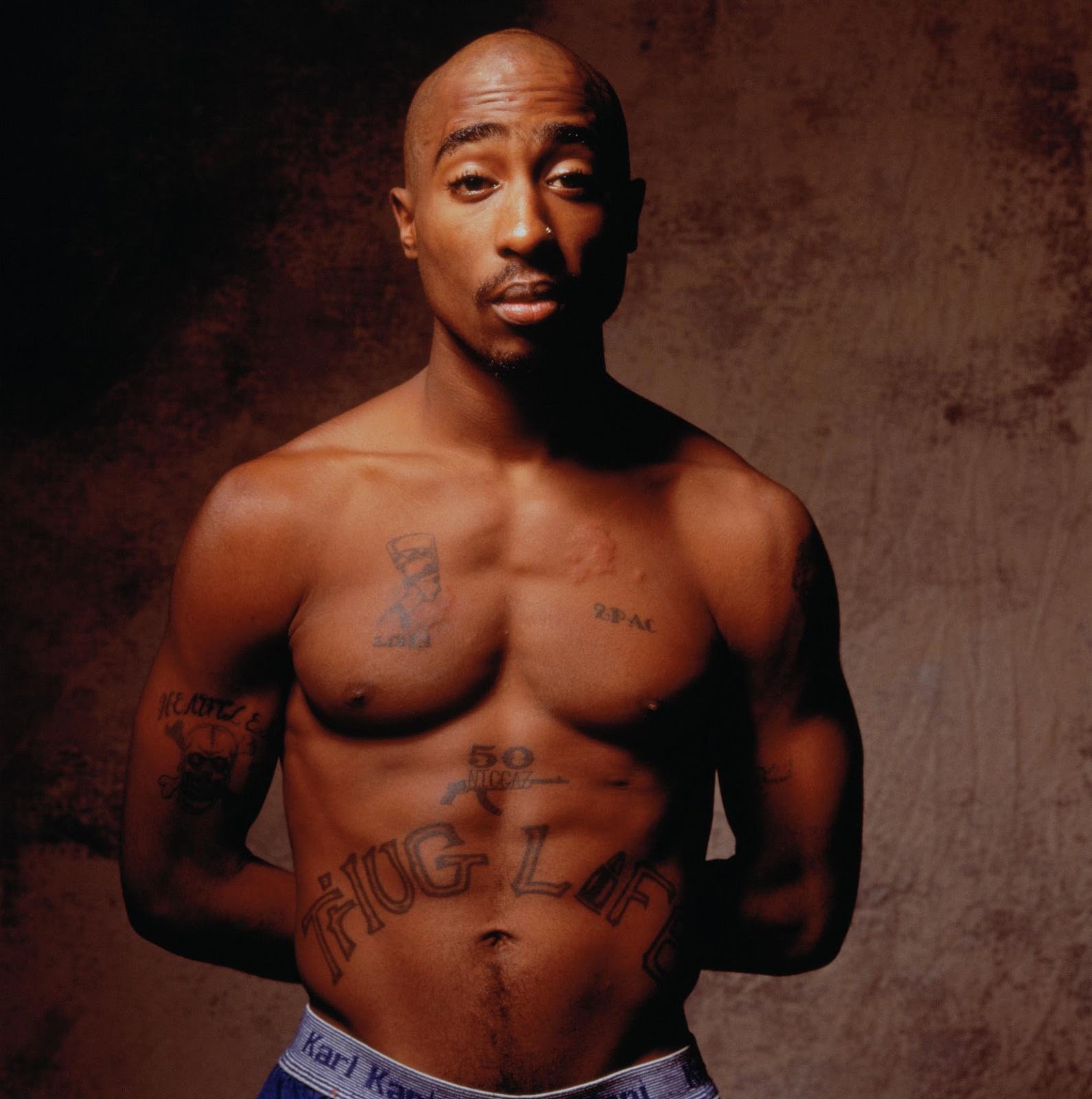
In all that, the history of "thug" goes back not just to the hip-hop scene of the 1990s, to Tupac Shakur and the "Thug Life" tattoo that stretched, arc-like, across his abdomen; it goes back to India—to the India, specifically, of the 1350s. "Thug" comes from the Hindi thuggee or tuggee (pronounced "toog-gee" or "toog"); it is derived from the word ठग, or ṭhag, which means "deceiver" or "thief" or "swindler." The Thugs, in India, were a gang of professional thieves and assassins who operated from the 14th century and into the 19th. They worked, in general, by joining travelers, gaining their trust ... and then murdering them—strangulation was their preferred method—and stealing their valuables.

The group, per one estimate, was ultimately responsible for the deaths of 2 million travelers. Mark Twain, reporting on the Thugs in his book Following the Equator: A Journey Around the World, called the collective a "bloody terror" and a "desolating scourge":

In 1830 the English found this cancerous organization embedded in the vitals of the empire, doing its devastating work in secrecy, and assisted, protected, sheltered, and hidden by innumerable confederates—big and little native chiefs, customs officers, village officials, and native police, all ready to lie for it, and the mass of the people, through fear, persistently pretending to know nothing about its doings; and this condition of things had existed for generations, and was formidable with the sanctions of age and old custom.

The Thugs, indeed, ran rampant in India until the British colonial period, when the governor-general, Lord William Bentinck, heard of them and made a concerted effort to prevent them from operating along India's roadways. According to this fantastic overview of Thuggee history from NPR's Code Switch blog, "nearly 4,000 thugs were discovered and, of those, about 2,000 were convicted; the remaining were either sentenced to death or transported within the next six years." The British overlords had successfully eradicated the network; as William Sleeman, Bentinck's deputy in charge of the effort, proudly declared:  "The system is destroyed, never again to be associated into a great corporate body. The craft and mystery of Thuggee will not be handed down from father to son."

The Western fascination with the criminal collective, however, was only beginning. Through Twain's writings about them, and through 1837's vaguely anthropological Illustrations of the History and Practices of the Thug, and through Philip Meadows Taylor's 1839 novel Confessions of a Thug, "thug" entered the English language and the British and American consciousness. It came, through the authors' portrayals of systematized violence, to take on the connotation of "gangster"—a sense of the word that would get another moment of life in the popular culture through 1984's Indiana Jones and the Temple of Doom, which finds its hero rescuing a group of children who have been abducted by the Thugs.

Mark Twain noted that all of human history has found "Thugs fretting under the restraints of a not very thick skin of civilization."

More recently, as NPR notes, there have been attempts to reclaim (or re-reclaim, or re-re-reclaim) "thug" through heavy irony. There's the blog Thug Kitchen, which is dedicated to the sharing of healthy recipes and cooking tips. There's "thug lit" in publishing, which refers to fictional genres that have yet to break into the mainstream. There's the web series Thug Notes, which features a character named Sparky Sweet explaining classic works of English literature." (Sparky's summary of Heart of Darkness: "When it comes to swinging ivory for clean dollars, this fool Kurtz got the Congo sewn up.") There are all those "thug life" memes.

Given all that: Who is a thug? Who is not a thug? "The thug," the Brown University professor Tricia Rose writes in her book The Hip Hop Wars, "both represents a product of discriminatory conditions, and embodies behaviors that injure the very communities from which it comes." Thugs, in this conception, are both victims and agents of injustice. They are both the products and the producers of violence, and mayhem, and outrage. So it is fitting that, as the word's history suggests, there is—contrary to Mayor Rawlings-Blake's claims last night—a kind of universality to thuggery. Thugs are not necessarily "evil"; thugs are not necessarily opposed to "the will of good"; thugs are not necessarily unsympathetic. Which is another way of saying that thugs are human. And, being such, they evolve. Mark Twain, in Following the Equator, noted that all of human history, on some level, has found "Thugs fretting under the restraints of a not very thick skin of civilization."

He continued:

We have no tourists of either sex or any religion who are able to resist the delights of the bull-ring when opportunity offers; and we are gentle Thugs in the hunting-season, and love to chase a tame rabbit and kill it. Still, we have made some progress—microscopic, and in truth scarcely worth mentioning, and certainly nothing to be proud of—still it is progress: we no longer take pleasure in slaughtering or burning helpless men. We have reached a little altitude where we may look down upon the Indian Thugs with a complacent shudder; and we may even hope for a day, many centuries hence, when our posterity will look down upon us in the same way.

This piece originally appeared on The Atlantic.


29 Apr 20:29

Deluxe-Edition of Flatland

by René

flat1

Auf Kickstarter gibt’s eine tolle Neuauflage von Edwin A. Abbotts wunderbarem Buch Flatland, einer mathematischen Gesellschafts-Satire in mehreren Dimensionen (hier der 1965er Animations-Short von Chuck Jones). Zum Buch soll es dann auch Apps und eine Library of Shapes geben. Nice!

29 Apr 20:27

On the diversity-readiness of STEM environments: “It’s almost as if I could only enter the makerspace as a janitor.”

by Mel

My thoughts from an online discussion with other female Olin engineers on this NYT article on “how to attract female enginers,”, edited for context. In particular, we brought up the (well-worn) claim that women don’t want to “just focus on the tech stuff” and want to “do sociotechnical/humanitarian work that makes a difference in the world.”

I’ve built my career as a “technical community person” who “thinks beyond the technology,” and as a teacher and researcher of learning environments — so this may come as a surprise to people who know and have worked with me. But if my teenage self had had her way, I would have VASTLY preferred to “just focus on the tech stuff.”

As a kid, I wanted to choose the privilege of being oblivious and keeping my head down and immersing myself into the beauty — the sheer beauty! — and joy of STEM for STEM’s sake. I didn’t become an ECE to work on educational computers or hearing aids or anything like that. As my friend (and former roommate) Kristen Dorsey said, “I just geek out about nerdy stuff, OK?”

But I couldn’t “just geek out about nerdy stuff.” The environments where I was trying to “learn about nerdy stuff” were sociotechnically broken in a way that made it hard for me (as a disabled minority woman, among other things) to join in. If I wanted to even start being part of the technical community, I had to start by fixing the technical community — patching the roof and fixing the plumbing, so to speak — before I could even walk inside and start to live there. And when I patched the leaking roof, I patched the roof for everyone, and other people who needed non-leaky roofs to be in the community could now… be in the community as well!

For instance, I got really, really good at facilitating meetings because it was the only way I had to make meetings accessible to me — when other people facilitated meetings, they’d often forget I need to lipread, so… I just quietly started leading them myself, and ended up making meetings work better for everyone. And I found that when I drifted towards “humanitarian” projects, the people there were much more conscious of sociotechnical things and more likely to have already-healthy environments, so I would have less leaky roofs to patch, and less resistance when I tried to patch the roofs — and people actually recognized and valued roof-patching labor instead of looking down on me for not writing code full-time.

After a while of patching roofs and unclogging toilets and plastering the rotten drywall, I got a reputation in industry for being really, really good at open-source software/hardware (technical) community facilitation. It’s almost as if I could only enter the makerspace as a janitor. And part of me resented that, but never said so. But, I told myself, at least I was in the building. And I saw that my “janitorial” work made it possible for other people to enter the building and do the things they wanted to do — which were often the things I wanted to do, too! — and so I thought: okay. That’s okay. At least somebody gets to do it. I can see my gift to the community doing so much good, that I will give up my desire to learn and do the technical things — so I let my own STEM learning slide. I am good at “community work,” and I did come to genuinely love it, over time.

But if I had the choice, I would have never gone into “community work.” I would have chosen — if I had the choice — to focus on “shiny tech stuff” that… didn’t save the world at all. If my teenage self had had her way, I would not do community-facilitation-anything, I would not be thoughtful about women or minorities or disabilities or any underprivileged group in engineering… I would be oblivious to all my privilege. I’d be a kernel hacker, or an embedded geek, or something “hardcore technical,” Because I could be.

But I didn’t have the wherewithal (or the desire) to shovel all the stuff out of the way that I would have to do in order to do that. If you think of “caring/environmental labor” as a sort of tax some people have to pay in order to get to “learning/doing technical things,” my tax rate has always just been too frickin’ high.

So I have been “the full-time community person who is ridiculously good at tech stuff that she no longer gets to do,” instead of “the technical person who understands and listens to and cares about inclusion and community.” Because I cannot not patch a leaky roof. But I have always wondered what I might have grown up into, if I had learned STEM in an environment that was ready for me — without me having to fix it first.

29 Apr 20:25

(via Werner_Herzog_1.jpg=s1300x1600 (JPEG Image, 1024 × 725...

29 Apr 20:24

Photo


29 Apr 20:16

prostheticknowledge: Animated AR TattooIllustrator and...


prostheticknowledge:

Animated AR Tattoo

Illustrator and interactive designer sutueatsflies animates one of his tattoos with the aid of augmented reality tech:

A video posted by Sutu (@sutueatsflies) on

I can’t believe this worked! #ARtattoo

sutueatsflies has a Tumblr blog here

29 Apr 20:15

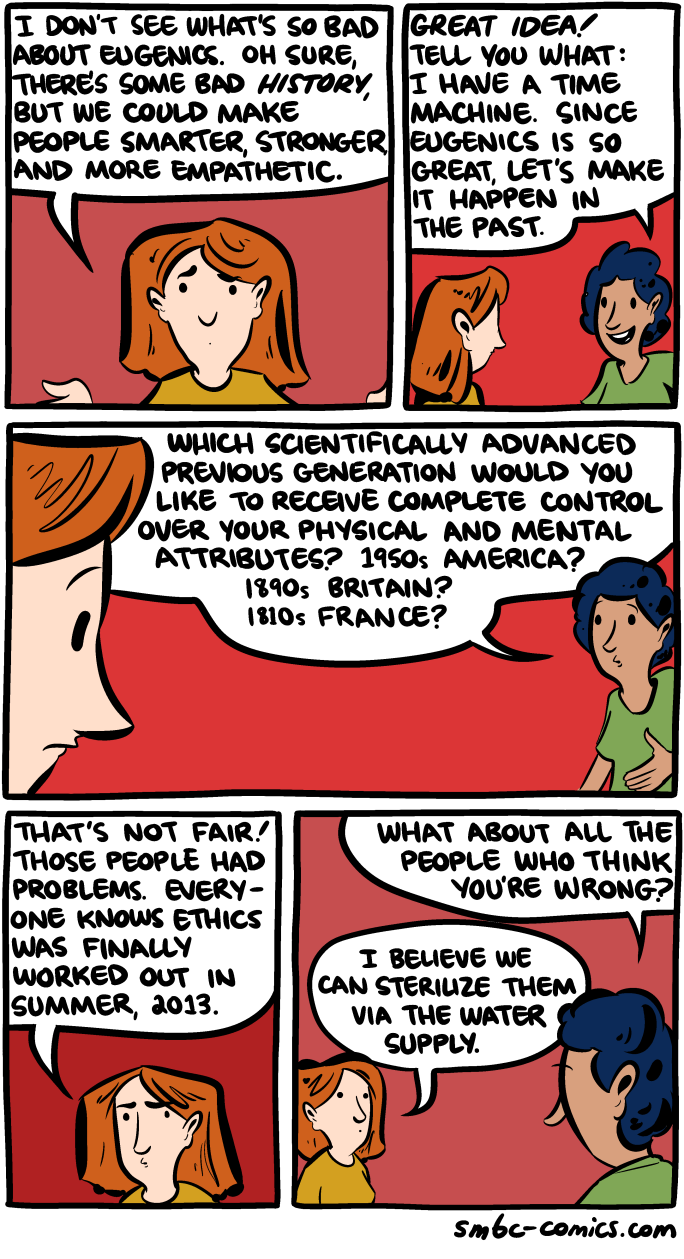
Saturday Morning Breakfast Cereal - Eugenics is a great idea!

by admin@smbc-comics.com

Hovertext: We gave cavemen eugenic technology, and now we're bad at math, but really good at killing the weakest gazelle.


New comic!
Today's News:

Dealin' with the issues. 

29 Apr 20:15

Your action has been undone


Your action has been undone

29 Apr 20:14

Drinking Poison and Expecting the Other Person to Die

by John Scalzi

(Warning: Further Hugo neepery. Avoid if you’re bored with it.)

A question in email about a recent post, asking whether when I said, of one of the head Puppies, “So well done him, and I wish him all the best in his career,” if I was saying it with the same tone and meaning that a US Southerner might say “Well, bless his heart,” about someone they dislike, or see doing something irretrievably stupid.

Short answer: No.

Longer answer: No, and why would I? As a practical matter, and as hard as it might be for some to believe, publishing is not a zero-sum game; the success of other authors doesn’t have a direct or material effect on my success, except with regard to the small, indirect benefit that a genre that sells well has more readers overall, and those readers are unlikely to read only one author, and thus might read my stuff, too (if you think there’s no overlap in my readership or the readership of any Puppy author you might care to name, you are, to put it politely, very likely to be wrong). So, again, as a practical matter, wishing any other author a lack of success would have no benefit to me, while wishing them the best of success might accrue some small and indirect benefit. So there’s that.

As a moral and ethical matter, I do take to heart the adage, usually attributed to Buddha, but reasonable no matter who said it first, that hating someone is like drinking poison and expecting the other person to die. I don’t hate any of the Puppies; I have cause to personally dislike a couple of them, but even then I try not to get to that point of things, either. I posit that the large majority of them are or at least have the capacity to be, decent humans. I disagree with them on many points, and think their current course of action is stupid, wrong, detrimental and childish; I think many of them have behaved poorly, selfishly and in a way that highlights their own insecurities and personal issues; I think it’s sad they try to project those same insecurities and issues on others and use them to justify their own bad actions.

But that doesn’t rise to the level of hate, or actively wishing misfortune on them. I’m mostly sad for them, and occasionally irritated, the latter of which is my problem. And while I’m fine pointing out their bad actions and snarking on their bad logic, what I genuinely hope for them is that they might find a level of success that makes them happy, without the need to view their success through the prism of how their successes stack up to anyone else’s. This whole Puppy mess is because some of them weren’t happy, and were searching externally for that happiness, either by seeking a validation in outside rewards, or by punishing people they saw (erroneously and/or conspiratorially) blocking the path to that validation. Envy and revenge, basically. They’re drinking poison and hoping others die, or at the very least, suffer. It’s why they called themselves “Sad Puppies” in the first place: it was about what they thought their Hugo nominations would make people they decided they didn’t like feel.

Which is their karma. It doesn’t have to be mine (or yours).

So, no. I wish the Puppies success in their publishing endeavors, and I wish them happiness — genuine happiness, not contingent on comparison to, or the suffering of, others. I also wish for them the capacity to recognize success, and to be happy. It doesn’t seem they’re there yet. I hope they get there, and will cheer them if and when they do.


29 Apr 10:58

New John Cage Archive Offers Access to His Compositions and Collaborations

by Allison Meier
Dance 4/Orchestras (1982) performed by the New World Symphony in 2013 (courtesy New World Symphony, America's Orchestral Academy)

‘Dance 4/Orchestras’ (1982) performed by the New World Symphony in 2013 (courtesy New World Symphony, America’s Orchestral Academy)

Launched yesterday, a free online archive of John Cage performances presents a comprehensive overview of his career, from a watering can poured on national television to a rhythmic solo piano performance inspired by lost love. Making the Right Choices: A John Cage Celebration is a digital resource based on New World Symphony, America’s Orchestral Academy’s 2013 festival in honor of the 100th anniversary of the late avant-garde composer’s birth.

Landing page for 'Making the Right Choices: A John Cage Celebration' (screenshot by the author for Hyperallergic)

Landing page for ‘Making the Right Choices: A John Cage Celebration’ (screenshot by the author for Hyperallergic) (click to enlarge)

Making the Right Choices, funded by the John S. and James L. Knight Foundation, features video and audio from the 2013 performances in Miami Beach, including some familiar and some obscure pieces from his influential and experimental career of both music and staged silenceSixteen Dances (1950–51) is accompanied by rarely-seen Merce Cunningham choreography, while Water Walk (1959) — which Cage performed with a water pitcher and other objects on the CBS game show I’ve Got a Secret, infiltrating national television with 10 minutes of avant-garde music — combines footage of the 2013 performance and archival video. Over 25 behind-the-scenes videos reveal the process of recreating pieces like The Perilous Night (1944), composed in six movements when Cage was working through a separation from his wife, where New World Symphony associate dean and director of chamber music Michael Linville prepares the piano prior to the performance with nuts and bolts, bamboo, rubber, and other materials placed around the strings and dampers. Links to the John Cage Trust provide additional context for each piece.

In his 1948 “Composer’s Confession” address at Vassar College, included in the archive, Cage said: “The significance of new materials is that they represent, I believe, the incessant desire in our culture to explore the unknown. Before we know the unknown, it inflames our hearts.” Additional videos will continue to be added to the online collection over the coming months, creating one of the most comprehensive archives on Cage’s compositions available to the public to explore the myriad ways he embraced new materials and musical forms.

Performance of 'Water Walk' (1959) on 'Making the Right Choices: A John Cage Celebration' (screenshot by the author for Hyperallergic)

Performance of ‘Water Walk’ (1959) on ‘Making the Right Choices: A John Cage Celebration’ (screenshot by the author for Hyperallergic)

Image gallery from performances on 'Making the Right Choices: A John Cage Celebration' (screenshot by the author for Hyperallergic)

Image gallery from performances on ‘Making the Right Choices: A John Cage Celebration’ (screenshot by the author for Hyperallergic)

Access Making the Right Choices: A John Cage Celebration online through New World Symphony, America’s Orchestral Academy.

29 Apr 10:42

Dan Weiss’s Morning Coffee

by Dan Weiss

This is unfortunately a very appropriate time to look back at Baltimore’s civil unrest of the 1830s.

Meet the T. Rex’s new vegetarian cousin.

Perhaps you’d like to look at some name tags from a medieval orphanage.

Atlas Obscura on great city rivalries.

Sometimes you just want to look at vintage pool party pictures.

Related Posts:

  • No related posts…
29 Apr 08:14

salon: All Baltimore City public schools were closed on Tuesday...


salon:

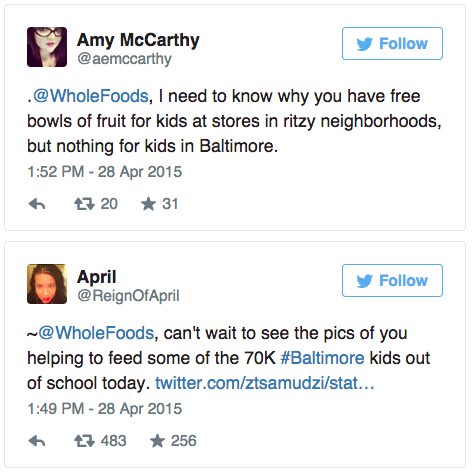
All Baltimore City public schools were closed on Tuesday in response to violent protests breaking out across the city in response to Freddie Gray’s death. About 84 percent of students in city’s public schools receive free or reduced-price lunches, according to the school district’s website. The closings mean that these students were unable to access these lunches, and churches and community centers have been scrambling to fill the gap.

But Whole Foods and Five Guys provided free food for National Guard soldiers rather than thousands of high-need children.

29 Apr 08:13

Baltimore

by Ampersand

baltimore-6 (video and stills )Protests are scheduled to begin at 5 p.m. Tuesday at N. Mount and Presbury streets. baltimore-4 baltimore-3 Suspect Dies Baltimore baltimore-1

I really don’t have anything to say. But I can quote.

Ta-Nehisi Coates, “Nonviolence as Compliance“:

Now, tonight, I turn on the news and I see politicians calling for young people in Baltimore to remain peaceful and “nonviolent.” These well-intended pleas strike me as the right answer to the wrong question. These well-intended pleas strike me as the right answer to the wrong question. To understand the question, it’s worth remembering what, specifically, happened to Freddie Gray. An officer made eye contact with Gray. Gray, for unknown reasons, ran. The officer and his colleagues then detained Gray. They found him in possession of a switchblade. They arrested him while he yelled in pain. And then, within an hour, his spine was mostly severed. A week later, he was dead. What specifically was the crime here? What particular threat did Freddie Gray pose? Why is mere eye contact and then running worthy of detention at the hands of the state? Why is Freddie Gray dead?

The people now calling for nonviolence are not prepared to answer these questions. Many of them are charged with enforcing the very policies that led to Gray’s death, and yet they can offer no rational justification for Gray’s death and so they appeal for calm. But there was no official appeal for calm when Gray was being arrested. There was no appeal for calm when Jerriel Lyles was assaulted. (“The blow was so heavy. My eyes swelled up. Blood was dripping down my nose and out my eye.”) There was no claim for nonviolence on behalf of Venus Green. (“Bitch, you ain’t no better than any of the other old black bitches I have locked up.”) There was no plea for peace on behalf of Starr Brown. (“They slammed me down on my face,” Brown added, her voice cracking. “The skin was gone on my face.”)

When nonviolence is preached as an attempt to evade the repercussions of political brutality, it betrays itself. When nonviolence begins halfway through the war with the aggressor calling time out, it exposes itself as a ruse. When nonviolence is preached by the representatives of the state, while the state doles out heaps of violence to its citizens, it reveals itself to be a con. And none of this can mean that rioting or violence is “correct” or “wise,” any more than a forest fire can be “correct” or “wise.” Wisdom isn’t the point tonight. Disrespect is. In this case, disrespect for the hollow law and failed order that so regularly disrespects the rioters themselves.

Baltimore Bloc:

It has been 15 days since Freddie Gray was stuffed into a Baltimore Police Department van and no officer, elected official or agency has taken any responsibility for his subsequent death or the policies that allow it to stand.

Therefore, we continue to witness the further erosion of the already broken relationship between Black communities and law enforcement.

The truth is that our region’s elected officials have not seen it as politically useful to act on the long-standing issues of police violence in Black communities. What we are witnessing today is the crossing of a tipping point by communities that have remained unheard for far too long.

Baltimore United For Change is fundraising for Legal/Bail Support for Baltimore protestors. If you support the protests, I would think that even a small donation would help.

And another writer (pdf):

America must see that riots do not develop out of thin air. Certain conditions continue to exist in our society which must be condemned as vigorously as we condemn riots. But in the final analysis, a riot is the language of the unheard.

And what is it that America has failed to hear? It has failed to hear that the plight of the Negro poor has worsened over the last few years. It has failed to hear that the promises of freedom and justice have not been met. And it has failed to hear that large segments of white society are more concerned about tranquility and the status quo than about justice, equality, and humanity. And so in a real sense our nation’s summers of riots are caused by our nation’s winters of delay. And as long as America postpones justice, we stand in the position of having these recurrences of violence and riots over and over again. Social justice and progress are the absolute guarantors of riot prevention.

29 Apr 08:11

Photo


29 Apr 08:11

Photo


29 Apr 08:11

What I Mean When I Say Vulnerability is Strength

by kittystryker

“What happens when people open their hearts?”
“They get better.”
― Haruki MurakamiNorwegian Wood

I am a fearful person. That’s hard for many to believe, as I work hard projecting a facade of confidence. I recognize that people look to me for advice and guidance, and I take that seriously in my push to improve my understanding of myself. I spend a lot of time challenging my fears and doing things that scare me, so you might think I’m relaxed or maybe daring… but I am actually internally clenched tight like a fist.

Actually, a fist is a really good metaphor, because I feel like it was through fisting I learned to be vulnerable. There’s something about having someone’s hand slowly slipping, finger by finger, into an orifice that reminds me how people want deep intimacy so quickly, but it takes time, and patience, and a lot of lube. If you try to push yourself too far, too fast, you can potentially hurt and/or traumatize yourself, so taking it slow is important.

I’m really impatient at times so taking it slow is hard for me. I want to learn all the things, experience all the feels,  get over all my hangups and I want to do it all right now. I have a tattoo that says “evolve or die”, and I believe that through and through. Still, sometimes it might do me some good to take a step back, acknowledge what I’ve done, and feel safe for a minute.  I’m bad at recognizing my triumphs!

Thinking on it, I suspect that at least part of my desire to work on self improvement comes from a place of wanting to no longer feel vulnerable in those particular ways. Things like jealousy, helplessness, heartbreak, these are vulnerable spaces and there’s no doubt in my mind that I hope if I learn to get over these things I won’t hurt so much or so easily anymore. I hate the relationship anxieties I’ve developed, like laser security systems of PTSD that I can so easily trip over and trigger a panic attack.

Now, though, I’m teaching myself that it’s ok to be scared. Vulnerability isn’t just about me apologizing or stopping myself from defensiveness or putting myself out there in my art or my writing. It’s also admitting that I feel jealous, or that I miss someone who was terrible for me. Vulnerability is complicated and living in my heartspace is so hard. I feel, though, that as I sit with my feelings, the muscle of my heart gets stronger. My suicidal feelings become lessened, because I don’t feel the need to escape from them so badly. I can tell my lovers when I am hurting and they are present.

I guess this is more for my sake than yours, dear readers. But I am glad to be learning that I don’t need to do some emotional alchemy for every nagging thought, for every doubt. That rolling that feeling around, getting to know it, being vulnerable with it, and then letting it go is ok. That I am, in fact, safe. That people mostly don’t want to hurt me. My heart is tender, it’s true, but most of the people I have chosen to surround myself with cherish that tenderness.

When I was in my early 20s, I thought vulnerability was weakness, that it opened me up to pain. I put up what I thought was armor to keep others out, but instead were walls trapping me in, and that caused me more pain than anything else. This is all very new to me, but I’m finding myself trusting others more, and holding onto suffering less. And I’m less scared of suffering, now.

I’m writing this to remind myself- it’s ok. Be gentle with yourself, but keep your heart open for the good and the bad. You don’t have to walk into situations that hurt, but you also don’t have to hide from pain.

29 Apr 08:09

The Last Book I Loved: Heather Has Two Mommies

by Erin White

When my first daughter was born, a friend sent her a copy of Heather Has Two Mommies with an inscription from Lesléa Newman, the book’s author. “To a sweet baby and her mommies,” it said in looping script. “Love makes a family.” This was 2004, and Heather Has Two Mommies had been in print for fifteen years. During those fifteen years the book was banned, burned, stolen from libraries, and read into the Congressional Record. Heather Has Two Mommies was a thirty-five-page revolution.

And while my wife and I owed our lives—and our baby—to that revolution, we rolled our eyes when we flipped through the book, chuckling about asymmetrical haircuts and labrys necklaces. We critiqued from a position of newly minted privilege: the marriage equality ruling had just become law in our home state of Massachusetts and we were legally married. Both our names were on our daughter’s birth certificate.

By the time our daughter was three years old, she regularly asked me to read her Heather Has Two Mommies. I read it, but not willingly. A few essential pages of the book didn’t sit well with me. When Heather, on her first day of preschool, hears all the children talking about their daddy’s jobs, she bursts into tears. “Did everyone but her have a daddy?” Newman writes. “Heather feels sad and begins to cry.”

I didn’t want to read this scene to my daughter. Not because I was afraid she might also be sad, but because Heather’s tears didn’t make sense. Why—at age three—would you weep for a parent you didn’t have and had never known? The tears would make sense if Heather were being teased about her non-traditional family, or if another child asked her why she didn’t have a dad, leaving her on the defensive. But Heather’s sadness originates within herself, as though she had—at age three—internalized the heteronormative ideal of one mother and one father. And I didn’t buy it.

So I did a little editing. “I wish my Mommy was a veterinarian too!” I said when we got to the page with the tearful Heather. My daughter found this puzzling. “Why does Heather want her mom to be a veterinarian?” she asked.

“Maybe she just loves animals,” I suggested, quickly turning the page.

Last week the new edition of Heather Has Two Mommies arrived at our house. Our now ten-year-old daughter was at the movies, but I showed the book to her seven-year-old sister.

“It looks like you and Mom!” she said. In the new edition, one of Heather’s moms has short blonde hair, the other long brown hair and glasses, just like my wife and me.

I held up the book for my wife to see. She was at the sink, washing dishes.

“But I’m actually taller than you,” she said, turning to look at the book. My daughter and I both groaned. Still, it was a delight to quibble over such details.

I read the book aloud. The new illustrations are vibrant and endearingly messy. Heather’s dog is now a droopy hound instead of the wolfish mutt of the first edition. And her mothers, with rings on their left hands, are young and sporty, more Title Nine than Melissa Etheridge.

But there is another change, and it’s more significant than the aesthetic ones. When Heather listens to the children talk about their families, she doesn’t cry. She just looks around the circle, wondering: “Am I the only one here who doesn’t have a dad?” She requires no comforting from her teacher. On the next page Heather and the children are busy drawing pictures of their diverse families.

It has been twenty-five years since Heather Has Two Mommies was first published, and Heather isn’t crying anymore. In a country where more than two-thirds of all states recognize marriage equality and a quarter of all LGBT couples are raising children that are—study after study tells us—doing just fine, it makes sense that Heather isn’t crying.

When I finished reading to my daughter she said, “This book should have one of those silver medals on the cover. ”

Life is sweet for Heather, and for my daughters. It’s sweet because of tireless social and legal activism, because of high court rulings and presidential support. And it’s sweet because of this book, which first arrived at our house inscribed with a simple and once-incendiary notion: Love makes a family.

Related Posts:

29 Apr 08:07

Typical Morning Routine

Hang on, I've heard this problem. We need to pour water into the duct until the phone floats up and ... wait, phones sink in water. Mercury. We need a vat of mercury to pour down the vent. That will definitely make this situation better and not worse.
29 Apr 08:06

FBI's crypto backdoor plans require them to win the war on general purpose computing

by Cory Doctorow


The FBI wants backdoors in all your crypto, and UK Prime Minister David Cameron made backdoors an election promise, but as Stanford lawyer/computer scientist Jonathan Mayer writes, there's no way to effectively backdoor modern platforms without abolishing the whole idea of computers as we know them, replacing them with an imaginary and totalitarian computing ecosystem that does not exist and probably never will. Read the rest