Shared posts

01 Jun 03:52

Sunday Sex Reads: FDA lube shakedown, Sunny Leone, Bill Nye on sex

by Violet Blue

Meet indie erotica’s perfect couple: Filthy Housewives and Bisexual Husbands.

  • Adult film star turned Bollywood actress Sunny Leone on Wednesday (May 26) visited the Thane police headquarters and met cyber crime cell officials based in the premises in connection with a recent FIR registered against her. The Dombivli police station in the Thane district had on May 14 booked Sunny Leone for obscenity under the Indian Penal Code, the Indecent Representation of Women’s Act and the Information Technology Act, and had forwarded the complaint to the Cyber Crime Cell for further investigation.
    Sunny Leone records statement in connection with obscenity case (Indian Express)
  • Warning for survivors of sexual abuse, trauma: The U.N.’s poor handling of child sex abuse claims against French soldiers has human rights staffers in the field fearing for their jobs as they struggle with how to respond to highly sensitive allegations in the future, according to a letter to the world body’s human rights chief obtained by The Associated Press.
    Child sex abuse claims shake UN as revelations continue> (Refinery 29)

Thank you to our woman-owned sponsor in Spain, Lust Cinema.
  • Because of the advertised intended usage for most lubes, the FDA has been known to classify some brands as “class 2” medical devices, which would require official clearance before allowing further distribution. The process of receiving this “501(k) clearance” has proven in the past to be extremely costly, drawn out, and morally compromising. (Animal testing is required.) Failure to adhere to these mandated requirements can result in your products being seized by the FDA.
    Lube’s Battle: The FDA’s Crackdown on Lubricant Labeling (XBIZ)

Thank you to our Dutch sponsor, Abby Winters.
  • In a segment for Tyson’s podcast StarTalk, Bill Nye stopped by New York’s Museum of Sex to talk about the evolutionary imperative that drives all creatures to procreate.
    Bill Nye talks about sex (Mashable)

Thank you to our Bay Area sponsor, HardTied.
  • Rapidly developing 3D printing technology has already had a major impact in many industries, including space exploration, food, and prosthetics. redOrbit asked the opinion of Tom Sancelot, who developed the site SexShop3D in anticipation of major market changes as result of 3D printing.
    Read more at http://www.redorbit.com/news/technology/1113398847/how-3d-printing-may-change-sex-toys-forever-052815/#lZfyl3L5oxv0zzjr.99
    How 3D printing may change sex toys forever (redOrbit)

The post Sunday Sex Reads: FDA lube shakedown, Sunny Leone, Bill Nye on sex appeared first on Violet Blue ® :: Open Source Sex - Journalist and author Violet Blue's site for sex and tech culture, accurate sex information, erotica and more..

01 Jun 03:51

Chirpy Cartoons from Ironyland: PC Music Volume 1

by Lucas Fagen

pc music volume 1

Since August 2013, the British techno label PC Music has been regularly releasing a large number of definitely strange, possibly satiric, stunningly original songs online. The label, founded by producer A.G. Cook, currently represents seventeen artists including Cook, but they all operate within the same stylistic borders; it’s less a collection of individual musicians and more a larger unified group. Based on three or four viral hit singles last year, most notably Cook’s “Beautiful” and QT’s “Hey QT”, they’ve earned quite the buzz if not acclaim among critics, and their close associate Sophie, who frequently works with artists on the label despite never having joined himself, has scored prestigious collaborations with Madonna and Charli XCX. Their very first official album, called PC Music Volume 1, came out earlier this month. Uneven and slight though it may be, I hope it sells like wildfire–the big dispute is whether they make real pop music or whether they reappropriate pop usages for art-related purposes, a dilemma easily resolved by measuring their sales. At this point it just isn’t clear, and I really want to know.

PC Music advertise themselves as the obverse of the kind of modern electronic dance music usually heard on the radio or in the club–tender where EDM is tough, vulnerable where EDM is abrasive, slick and streamlined where your quintessential EDM synthesizer crunches up a storm. Angular, spare, robotized, rubberized, they glaze their music over with a tacky plastic surface while filtering in dinky bleeps, mechanized sighs, and squealing kiddie voices sillier than even the potential offspring of Alvin Chipmunk and Hello Kitty. Their songs are concise and miniature, with dubstep’s noisy assault replaced by sugary synthesizer confetti. Their lyrics pepper fairly trite depictions of young love with references to various corporate products and technological toys, with their language couched in terms of work or consumption rather than affection. Several of the artists signed to PC Music cultivate imagined alter egos (e.g. QT, a pop star with a fictional backstory whose music supposedly markets a fictional energy drink), where others stay anonymous.

Whether designed as a celebration of pop artifice, a critique of millennial internet culture, or an attempt to transmute the faceless, functional qualities of dance music into something more self-conscious by means of studied cartoon, their cutesy banality, beholden both to American teenpop and Japanese kawaii fashion, has a canny archness to it, yet at the same time it’s not entirely insincere. Shiny polish, tidy makeup, and rank perfume soaks them; they take their cocktails complete with maraschino cherry and bring to mind the gauzy taste of strawberry vodka. Is it any wonder critics can’t categorize these troublemakers? Nobody has tested the fine line between irony, double irony, triple irony, and quadruple-decker irony cake with whipped cream so brilliantly since Lana Del Rey.

The question isn’t whether they have irony, as irony is a given with a style this extreme. The question is whether their irony succeeds–whether the end result functions as a working critique of its own aesthetic and corresponding cultural precedents/influences, or whether the critique still qualifies as yet another example of the straight stuff that enables it, or whether the critique disables the music’s accessibility potential, or whether the aesthetic is worth critiquing at all, or whether the aesthetic’s pungency sinks the critique and renders its irony irrelevant. On the plus side, their blocky, tinkly electrobeats fit together rather nicely, and the attendant helium-drinking nymphets providing vocals often sound friendly and adorable, while on the minus side, their songs are so simple that they typically reduce to smaller proportions than will satisfy, and those same nymphets just as often assume mannered accents even faker than the patently disingenuous platitudes they sing.

Sometimes their carefully contrived synthpieces feel too abstract for the pleasure to kick in, but sometimes everything clicks just fine. Thanks to the tight minimalism/miniaturism of the music, the apparent contradictions in its aesthetic remain, wink-wink, ambiguous, which is good news for those presently debating the merits of the PC Music concept, because it means academic analysis won’t offer resolution; in the end, either you like the way it sounds or you don’t. As a proud pop connoisseur accustomed to hearing through artificial surface and for whom pixelated pixie dust represents not profound metaphysical statement but cool textural invention, I quite enjoy PC Music Volume 1. And since I demand total visionary craft in addition to clever theory from my pop music, I also find it somewhat lacking in substance.

Clocking in at just under a half hour, PC Music Volume 1 speeds by quickly, and the compacted length simultaneously sharpens and limits its impact. Each neat little ditty zips modestly through its verse-chorus arrangement, repeats a few times, and then proceeds mechanically in sequence to the next computerized ballad. Roughly speaking, the songs on PC Music Volume 1 divide into two types: cheerful, tuneful pop vehicles that you can actually hum, generally with romantic lyrics (shallow and littered with consumer products they may be–“Tell me if you want to see me play with my hair on a TV”, or “Now I’ve saved you as a picture on my phone”–but romance is nevertheless the theme), and darker, thornier contraptions where the keyboards either eschew melody entirely or remain minimal throughout the song while the vocals, spoken rather than sung, get chopped, screwed, and inverted.

hey qt

A brutal symbolic rendering of conflict and broken consent, the label’s most fully realized work of art as of now belongs to the latter variety: “Don’t Wanna/Let’s Do It”, in which two high-pitched voices shriek “Let’s do it” and “I don’t wanna do it” at each other for two minutes over a buzzy, ominous synth loop. But it’s the former category that dominates, and that embodies the album’s basic style. Especially on A.G. Cook’s “Beautiful”, Danny L Harle’s “In My Dreams”, and A.G. Cook & Hannah Diamond’s “Keri Baby”, the catchiest, glitziest, prettiest, most grotesque songs here by far, there’s a touching sweetness to the stuff, the tender feeling of hearing a kindly digital sprite reaching out and saying something really nice to you. The cold electronic surface is hardly impersonal; instead, like the chirpy voices themselves, it evokes a vulnerable period of adolescence. It insists that teenagers hooked on social media and the gadgets that go along with it are every bit as capable of love as anybody else, which doesn’t mean it exempts them from satire.

Skrillex has recorded music like this, especially in his EP days, but it’s different: where the dubstep king always provides massive slices of hookery to launch his naiad vocalists into club overdrive, the producers at PC Music pursue dinkiness so relentlessly that their music ends up sounding rather small. The accents curdle, too. But otherwise their cuteness can really make you go awwwwww.

Since PC Music Volume 1 just came out, it’s unclear whether the label’s masterminds plan on hitting the radio or staying in their novelty niche. But should conquering Clubtopia or even Festivaltopia prove a possibility, there exists a creative option beyond and above the fray of infinite ironic convolution: full-fledged pop music that contains the plethora of ambiguity within. Right now, PC Music is altogether too simplistic and abstract to qualify, but I believe they have it in them, and hope their album succeeds commercially. I’d like to encourage Cook and his labelmates to contemplate the Pet Shop Boys, whose cerebral, satiric electrodisco masterpieces have been topping the charts for thirty years. It would be a pleasure to hear the musicians behind PC Music Volume 1 reach a similar level of clever, moving, multifaceted sophistication.

PC Music Volume 1 and Hey QT are available from Amazon and other online retailers.

01 Jun 03:28

Photo


31 May 12:08

Natalie Frank Delivers the News from Never-Never Land

by John Yau

Natalie Frank, “Rapunzel I” (2011-14), gouache and chalk pastel on Arches paper, 22 x 30 inches. Blanton Museum of Art, The University of Texas at Austin, Purchase through the generosity of the Houston Endowment, Inc. in honor of Melissa Jones.

In an interview in Bomb (Spring 2014), Natalie Frank said something to Dasha Shiskin that caught my attention:

Paula Rego, an artist I greatly admire for her own work with fairy tales, had suggested that I look at the Grimm stories — no fine artist had considered them en masse.

One reason Frank’s remark got my interest was because I cannot remember ever hearing a young artist citing Rego – who is not as well regarded in America as I think she should be – as an influence. The other reason was that Frank talked about fairy tales – a fertile territory explored by artists such as Kiki Smith and Nicole Eisenman, and the writer Angela Carter who focused on the supernatural and dreadful.

Many fairy tales are about young girls and boys whose lives are controlled by the capricious impulses of evil stepmothers, vain queens and repressive fathers. With their memorable motifs, emphasis on transformation, anything-can-happen possibilities, and narrative concision, fairy tales have proven to be a rich domain of exploration.

It was only when I saw her exhibition of pastels, Nathalie Frank: The Brothers Grimm, at The Drawing Center (April 10–June 28, 2015) that I was able to learn what she was up to: I was not disappointed. Curated by Claire Gilman, the exhibition consists of twenty-five gouache and chalk pastel drawings on sheets of heavy Arches paper measuring 22 x 30 inches. I don’t think you need to know the particular story to be taken in by Frank’s work, and that is their strength. They stand on their own, even as they emerge out of tales we heard many times as children – probably in a sweetened version– and think we know. Frank’s drawings jettison the saccharine in favor of the original weirdness and base irrationality that animates the versions that the Brothers Grimm collected together in a number of volumes published, revised and expanded upon between 1812 and 1857.

Natalie Frank, “Cinderella II” (2011-14), gouache and chalk pastel on Arches paper 22 x 30 inches. Courtesy of the artist and Rhona Hoffman Gallery (Chicago); ACME (Los Angeles)

Fairy tales propose an alternative world – a never-never land – where subversive desires and illogical urges are inseparable. They dwell on betrayal, abandonment, greed, vanity, disfigurement and selfishness, And yet, there is almost always a happy ending in which love plays a role, and a new, more harmonious order is attained. Frank, however, isn’t interested in the ending, but in the passages where humanity’s baser instincts become synonymous with extreme behavior, such as the uninvited guest, a distant relative, who, out of spite, proclaims an infant girl will die when she turns fifteen. In the Brothers Grimm version of Cinderella, the two stepsisters cut off a toe and a piece of their heel, respectively, to get their feet to fit into the golden shoe. Walt Disney never went there nor did he have birds peck out the eyes of the stepsisters.

The light in Frank’s drawings is eerie, and the space is often enclosed and claustrophobic. In many of them, a young woman or boy is surrounded by an array of sinister creatures, witches and elves. The scale can shift suddenly and everywhere we look we see a grotesque being going about its business or, in some cases, looking at us. It is the never-never land aspect of the fairytales that gives Frank access to her imagination. In the best works, she arrives at a memorable image. She is most successful when the images in the drawing make the unforgettable motifs in a fairy tale take a back seat, which is no small accomplishment.

Natalie Frank, “Brier Rose III” (2011-14), gouache and chalk pastel on Arches paper, 22 x 30 inches. Courtesy of the artist and Rhona Hoffman Gallery (Chicago); ACME (Los Angeles) (click to enlarge)

For Frank to make a drawing that alludes to a well-known fairy tale, but becomes a thing on its own, she had to engage with the original narrative, its flood of necessary details, on numerous levels. In one of the “Cinderella” drawings, the heel of a red foot presses against the picture plane, a blue-rimmed eye peering out. It is a detail that leads the viewer to scrutinize the drawing and notice other details. The only place these dissonant and disturbing details add up in is in the fairy tale and, more importantly, Frank’s drawings. The numinous, jarring color and attention to gleefully monstrous details is masterful. Certainly no other artist of her generation has done as much with pastel. Drawing is central to her work, and with that comes the possibility of inventiveness.

In addition to Rego, Frank seems to be influenced by R.B. Kitaj and Ken Kiff, as well as James Ensor, Richard Dadd and Arthur Rackham, if he had become productively demented after ingesting some mind-altering mushroom. She’s absorbed the bizarreness of German Expressionism without sinking into parody or cliché, which they teetered on. Look at the eyes in her work, and how some seem to be under a hypnotic spell while others are possessed by a creepy curiosity we might associate with a mad scientist. At the same time, she can draw an insect with an accurate scientific detachment, while infusing it with unlikely colors. Her ability to bring together different kinds of drawing seems to me to be true to the tenor of the fairy tales, and their clash of different realities, rather than an attempt to develop a signature style.

Natalie Frank, “The Ungrateful Son” (2011-14), gouache and chalk pastel on paper, 22 x 30 inches (courtesy of the artist)

One of my favorite drawings was for a very short tale, The Ungrateful Son, who, for reasons that are never stated, hides a roast chicken from his father so that he won’t have to share his food. When his father leaves, the son gets the chicken to put back on the table and discovers it has turned into a toad, “which then sprang onto his face, sat there, and would not leave him. […] And the ungrateful son had to feed the toad every day; otherwise it would have eaten away part of his face.” This is one of the fairy tales that does not have a happy ending.

Natalie Frank, “All Fur III” (2011-14), gouache and chalk pastel on Arches paper, 22 x 30 inches (courtesy of the artist) (click to enlarge)

Frank depicts an androgynous head with green skin, and pink, green and blue shoulder length hair parted in the middle. The boy has fair features, luscious full red lips and tormented eyes that were inspired by beatific images of the crucified Jesus looking heavenward. An oversized umber, black and white frog sits impossibly on his forehead, as if it has sprang out of his skull. A long red vertical tongue emerges from their mouths, joining them. The head is hemmed in by pink and red sections, which are occupied by large winged insects.

The economy with which Frank arrives at this visceral image, which instantly made a deep imprint in my memory, is what elevates her work into the remarkable. You don’t need to know the story to be stopped in your tracks by the drawing. And if you want to read the story, which I didn’t know of before, you should obtain Natalie Frank: Tales of the Brothers Grimm (2015), a sumptuous book containing her selection of 36 fairy tales, some of which are not well known, accompanied by 75 pastel and gouache drawings. There are also black-and-white drawings surrounding the texts, and lots of fantastic marginalia. Despite the unsavory ingredients, Frank makes it all add up to a yummy, stomach-tickling brew.

Nathalie Frank: The Brothers Grimm continues at The Drawing Center (35 Wooster Street, SoHo, Manhattan) through June 28.

31 May 12:08

Photo

Sophianotloren

yumminess via Carnibore


31 May 11:40

jordannwitt: insp. This is my favorite Fury Road post.


jordannwitt:

This is my favorite Fury Road post.

31 May 11:40

Please.

owlsday:

wolfendreams:

owlsday:

Can someone photoshop these two together? :P Please!!! IT NEEDS TO BE DONE. 

imageimage
image

Your wish has been granted.

Oh my god. FINALLY!! They’re frollicking in the meadow. This is the best!! Thank you!!! :D


image

Ok!!! This post is getting an update. :D This was submitted to me by johnsonpaul076 and he did a mighty fine job!! Blobbyowl and Saucercat are joined by (you guys name him). xD

31 May 11:40

Why don’tcha leave me alone? I feel so broke-up…

by Sophia, NOT Loren!

It’s interesting — I have to keep reminding myself that not everyone can see the traces of someone’s editing process in their writing like I can. And there’s some interesting things I notice…

For example, I got a reply to one of my Craigslist “housing wanted” ads yesterday. Someone who had actually read the ad — a rarity — and followed the instructions for contacting me. She mentioned that she had two rooms opening up (a bad sign for me, because it means moving in with one near-stranger and one complete stranger) and linked me to the ad she had up for the other, more expensive room. The room she was writing to me about was already at my maximum, and I’d be expected to additionally share the cost of utilities, which put it way out of my reach.

But the things that stood out to me were that even though she talked about herself first, it showed that she’d initially given her list of requirements first — in the “Me:” section were things like “I’m also a non-smoker, non-drinker, and vegan” for example, and other stuff that referenced the section down below about “You: must be (blah blah blah.)”

And in that section, she had things like “not a heavy drinker” and something about how “you recognize that housekeeping is a part of life” and how you’ll make sure the house “stays very tidy” and holy shit, the way she wrote it translated so clearly as “I’m an anal-retentive neat freak and likely a control freak as well” and then she ended that section by saying “bonus points” if you’re vegetarian or vegan.

She also mentioned in there that you “won’t have frequent overnight guests.” Okay, look — I really, really don’t understand the sex-hate and the slut-shaming around here. Whether in the (once-upon-a-time) Hippie Central of Berkeley or the supposed “Queer Capital” of San Francisco (though that’s becoming more Oakland these days) or anywhere in the “Gay Area” — the first thing I see is “no overnight guests.” Occasionally I’ll see something like this chick wrote, and it’s “no frequent overnight guests.” And it makes no fucking sense to me! Look, I get not wanting someone to “not quite move in” their significant other. I’ve lived with the Girl-Child and her Boy-Toy who “didn’t live there” — he just stayed over every single night, hung out there every single day, and made the water and gas bills triple in just the first month with all of the hour-long shower-sex sessions they were having. That sucks, and I wouldn’t expect anyone to be okay dealing with that. But having someone over two or three times a week? Someone who leaves in the morning, has minimal interaction with and minimal impact on anyone else living there? News flash: some people fuck. Some people aren’t ashamed of that. Some people don’t do monogamy. Some people don’t have a “steady partner” who has their own home and doesn’t care that “my place or yours” always has the same answer.

But remember, kids — sex is bad, mmkay? Even if it’s part of looking after and maintaining your health! Trying to explain that to people is often not worth the effort. Also — okay, you choose to eliminate a bunch of potential food sources from your dietary intake, as a matter of your overall health and well-being. I choose to give my body the foods that it needs for my overall health and well-being. But in the Bay Area there are more folks who selectively restrict their diets (and many more who have the financial luxury of being able to do so) than there are people like me — poor and not picky. But even if I were rich I wouldn’t try to harm myself that way. Finding housing with other omnivores is another headache on top of everything else.

So is finding housing without animals running around… I’m allergic to pets, and I don’t much like most of them anyway. I may play with your cat, as long as I can get away afterwards, and I’ll avoid your dog (yes, I’m sure she’s the sweetest little puppy in the whole wide world, and I don’t think she’s going to bite me. I’m not scared of her, just not fond of her. Really. Yes, I know that she licks my hands and face because she likes me. Should I lick your hands and face, too? Oh, yeah, that is kinda gross. Welcome to my world.)  The times that I do find animal-free housing, it’s the folks who make everything to do with animals a political rallying point. And I can’t deal with cigarette smoke, either — finding smoke-free places often means also finding people who think that alcohol is a horrible, disgusting thing, that anyone who drinks is a moral failure and a worthless, unmotivated loser who just needs to find a purpose so they won’t need to lean on those drugs anymore. And look, I don’t care if you use pot, smoked or vaped or edible or whatever. I might have even encountered it myself at some point, and I don’t think I could claim it’s a bad thing at all — seems like (hypothetically, of course) it would be rather pleasant. But I can’t live with it, not in the same space I’m supposed to call home. Sure, come home high as fuck sometimes, I couldn’t give any less of a shit. Come home drunk, whatever — I certainly will sometimes! But most folks seem to expect that if you’re cool with one drug, you’re cool with them all, and in any amount, and at all times. Moderation or being selective isn’t possible, somehow… if you’re cool with booze, you’re obviously cool with weed and tobacco and who knows, maybe someone does a few lines when they get home tonight, why would you care? Or you’re on the other end of things: no tobacco, no cannabis, no alcohol, and if you choose to take any of those into your body you’re a horrible person who deserves to suffer because clearly you don’t care about yourself!

Just… Ugh. No men, no pets, no smoking. Yes to meat, yes to sex, yes to booze. I’d ask why that’s such an incredibly difficult concept, but then I remember that it’s only incredibly difficult when you’re trying to spend over 90% of your above-the-table income on rent, and you’re not likely to find even the bottom-end options for under 150% of your income.  I’m too broke to ask for basic access needs, and if I do, I’m somehow a super-picky bitch.

I just wanna go home.


Filed under: General Tagged: alcohol, anger, animals, bigotry, booze, cannabis, carnivore, coping, craigslist, discrimination, drama, housing, masturbation, meat, omnivore, overnight guests, pets, porn, pot, quiet, rants, rent, rental, roommates, sex, smoking, tobacco, vegan, vegetarian, weed, writing
31 May 11:39

skull-a-day: Skull pottery by Nicole Pangas


skull-a-day:

Skull pottery by Nicole Pangas

31 May 11:38

frrmsd: Sculptor & Artist: Kris Kuksi “Ascension of...


frrmsd:

Sculptor & Artist:

Kris Kuksi

“Ascension of Eos”

Mixed Media Assemblage

56” h x 42” w x 10” d

2014

31 May 11:38

misandry-mermaid:mentaltrvll:What they don’t teach you in...


misandry-mermaid:

mentaltrvll:

What they don’t teach you in school

I looked it up and it’s true.

31 May 11:38

Photo


31 May 11:37

Dashboard synchronicity always makes me happy.


Dashboard synchronicity always makes me happy.

31 May 11:34

Travels with Erik (II)

by Erik Loomis

So I’m at the Fighting Inequality conference in DC, which is mostly a labor history conference. I see a paper by a young scholar you many know named Steven Attewell and it’s really good. I give a paper saying the IWW free speech fights were a disaster and it goes over well with the right people, even if those who romanticize radicalism don’t care for it. Great. And then I start walking around. Now I’m going to have a post about my visit to the Smithsonian later, so I’ll save that. But later this evening, I’m back at my hotel in Arlington (conference is at Georgetown so I can walk). And I’m looking for a bar. And while searching for it. I see a historical marker. What does it say?

11391289_10152950509720959_2961764856184419455_n

Oh. Well then.

Here’s the garage.

10999264_10152950509080959_8069447238895789497_o

I was going to wander around the garage and pretend to be, well not Felt or Woodward because gross but someone else, but then I thought I’d be seen as some sort of creepy parking garage stalker guy like in an episode of Hunter or Simon & Simon. So I didn’t. But I would like to say that randomly stumbling on this while searching for a bar justifies an entire lifetime of drinking. And good on Virginia for recognizing this with a marker.

31 May 10:42

The Ultimate Life-Hack: Let’s Just Give Everyone Adderall

by Backdoor Pharmacist
The Ultimate Life-Hack: Let's Just Give Everyone Adderall

IBISWorld, a market research firm, has released a report showing that Attention Deficit Hyperactivity Disorder (ADHD) drug sales are booming, and by 2020, will rake in $17.5 billion. It’s not just a loosening of diagnostic criteria that is making it so profitable. Workers can’t survive on the meagre earnings of a single job, and students can’t keep up in schools with failing budgets. We need to be more productive than ever before to stay above water. The answer has always been there, and we’ve been slowly progressing to it, but we’re barred from considering it by moral grounds: the ultimate life-hack, prescription stimulants.

Pediatrician Dr. Michael Anderson, outright admitted to the New York Times that he was not prescribing powerful stimulant drugs to treat ADHD, but to improve the academic performance of children. “We’ve decided as a society that it’s too expensive to modify the kid’s environment. So we have to modify the kid,” he said.

It’s not just students that need speed. Wages have stagnated since the 1970s; a $50k salary in 1975, would need to be nearly $220k to have the same buying power today. Those who want to work cannot find steady work with their jobs outsourced to China, outmoded by technology, or replaced by an army of temps in the “gig economy.” Millennials are moonlighting in huge numbers trying to scrape together enough to live and working a 16 hour work day is nearly impossible. Even on money soaked Silicon Valley and Wall St, the workers are pounding stimulants and eugeroics just to keep up.

We are unwilling to increase taxes to return a social safety net, or offer support to those struggling. We’re unwilling to put restrictions on our trade with the rest of the world to keep America fully employed. It’s clear to everyone that something needs to be done to address the fact that the majority of Americans, can no longer afford to live and work in America. In this global market, we need to work twice as hard on ever shrinking wages. Getting a full 8 hours of sleep a night, and not eating a sad desk lunch are now luxuries.

If this is where we are as a society, then lets drop the fucking ADHD pretense and just give everyone Adderall.

You ever picked up a classifieds? (Damnit I just revealed how old I might be). How about looked at the jobs section on Craigslist? Every job needs at least $100k worth of degrees or 3-5 years of experience. How are you supposed to get that when there’s no entrance level? An internship that pays nothing? How do you eat?

The free market has determined that we aren’t above chemically drop-kicking children in the head to keep them going in school, so lets expand that to everyone. Hell, let’s make it a right, Medicaid already covers the costs of cheap generic stimulants.

Drug companies are already splashing the airwaves with glitzy ads, recruiting the likes of Adam Levine of Maroon 5 to tell you “own” your adult ADHD. These ads, focused on improving work performance or school performance and deemphasized treating ADHD so much, that the FDA fined the drug companies. Lets make it so that you can, with just your driver’s license, drop into a pharmacy and pick up a pack of 25 stimulants to get through the month.

On stimulants, your need to eat is reduced, most people lose weight. They say Americans are too fat anyway. You also have a reduced need to sleep, so you can stay up all night working your 2nd or 3rd job with competence and full productivity.

The only way to survive in our capitalist dystopia is to pop pills.

How about a bottle of Ritalin (methylphenidate), strong enough to substitute for cocaine, or Concerta, the all-day version? Got a big project due? Grab a pack of Adderall (mixed levoamphetamine and dextroamphetamine) or Dexedrine (dextroamphetamine) if the levoamphetamine makes you feel like your insides are filled with fire ants. Or, if you have private health insurance, you can pick up the new, more expensive, hotness, Provigil (modafinil), or Nuvigil (armodafinil), smart drugs that have less side effects than traditional stimulants.

Sure these powerful drugs can be addicting and have severe side effects, but we’re willing to tolerate a suicide here and there. We’d probably be stuck in bed, sleeplessly checking our smartphones. We’d fret over the smallest thing, convinced that everyone would be out to get us. We’d hoard guns and think of crazy conspiracy theories of martial law or false flag attacks. The news media would descend into a shouting match. The slightest bit of social change or civil disruption would lead to an overwhelming police suppression out of fear. Wars would be started left and right over the smallest chance of danger to ourselves as our minds spin the worst scenario possible.

On the other hand, we’d probably have a manned mission to Mars, highly effective treatments for Cancer, and probably a whole new Green Revolution in biotech to solve world hunger. Bring on our cyberpunk nightmare world where we chemo-hack our brains in order to keep up in ever diminishing jobs for megacorps.

The post The Ultimate Life-Hack: Let’s Just Give Everyone Adderall appeared first on ANIMAL.

30 May 21:38

Dennis Hastert was forced to stand in line at the bank at least 106 times to withdraw hush money in cash

by Paul Campos

COUNT TWO

The SPECIAL FEBRUARY 2014 GRAND JURY further charges:

1.
The allegations contained in paragraphs 1(a)-1(l) of Count One of
this Indictment are realleged and incorporated herein.

2.
Beginning no later than July 2012, and continuing until on or around December 6, 2014, in the Northern District of Illinois, Eastern Division, and elsewhere, JOHN DENNIS HASTERT, defendant herein, did knowingly and for the purpose of evading the reporting requirements of Title 31, United States Code, Section 5313(a) and regulations prescribed thereunder, structure and assist in structuring transactions at Old Second Bank, People’s State Bank, Castle Bank and Chase Bank by withdrawing and causing the withdrawal of $952,000 in United States currency in amounts under $10,000 in separate transactions on at least 106 occasions; In violation of Title 31, United States Code, Section 5324(a)(3).

Who is the real victim here?

Seriously now:

I realize Hastert isn’t a lawyer, but how does a guy who was at the top of DC food chain not realize that this isn’t going to work?

What happened is that Hastert started withdrawing $50K in cash at a time to pay off his extorter. Protip: if you’re going to cover up malfeasance via cash transactions, bone up on your banking laws first. Banks have to report cash transactions of $10K or more. So after Hastert took out more than that on several separate occasions, bank officials had a chat with him (He had the legal right to make such withdrawals, but part of the banks’ reporting obligations is to try to figure out why the nice old man down the street keeps coming in every second Thursday with a suitcase and asking the teller to fill it with $50,000 in unmarked bills).

After it’s explained to him that the bank has an obligation to report these transactions to the IRS, Hastert gets the bright idea that he’ll just go to the bank a lot more often, and take out slightly less than $10,000 each time. They’ll never catch him now! Except the federal government also has a rule that structuring transactions with malice aforethought to avoid the reporting requirements is illegal.

On top of all that, lying to the feds about why you keep taking out suitcases full of cash from your many different bank accounts is also a crime all by itself.

Again, how does someone like Hastert not know this already? In particular, how does he let himself be interviewed by the FBI without his lawyers there?

I guess there’s a pretty obvious answer, under the circumstances, to the second question.

30 May 21:34

pr1nceshawn: One time, when I was drunk…


pr1nceshawn:

One time, when I was drunk…

30 May 21:33

Half of All American Families Are Staring at Financial Catastrophe

by Kriston Capps
Image John David Bigl III/Shutterstock.com
John David Bigl III/Shutterstock.com

The most frightening finding in the Federal Reserve’s Report on the Economic Well-Being of U.S. Households in 2014 concerns a matter of $400. Four-hundred bucks. Twenty twenties. Four Benjamins.

Or just enough to crush half of all American households.

“Forty-seven percent of respondents say they either could not cover an emergency expense costing $400, or would cover it by selling something or borrowing money,” reads this year’s annual report.

Maybe Americans are feeling better about their finances, as The Wall Street Journal puts it, but that figure is a downer. Several years into the recovery, almost half of all U.S. households could not withstand a minor financial shock without incurring debt or liquidating assets.  

Forty-seven percent of respondents could not cover an emergency expense of $400, or would have to sell something or borrow money.

“Even prior to the [Great Recession], and more acutely after the recession, it’s true, American households are vulnerable,” says Gregory B. Mills, senior fellow at the Urban Institute. “Depending upon the measure you use, somewhere between one-third and one-half of households are at great risk—as in, they would be unable to fend off hardship.”

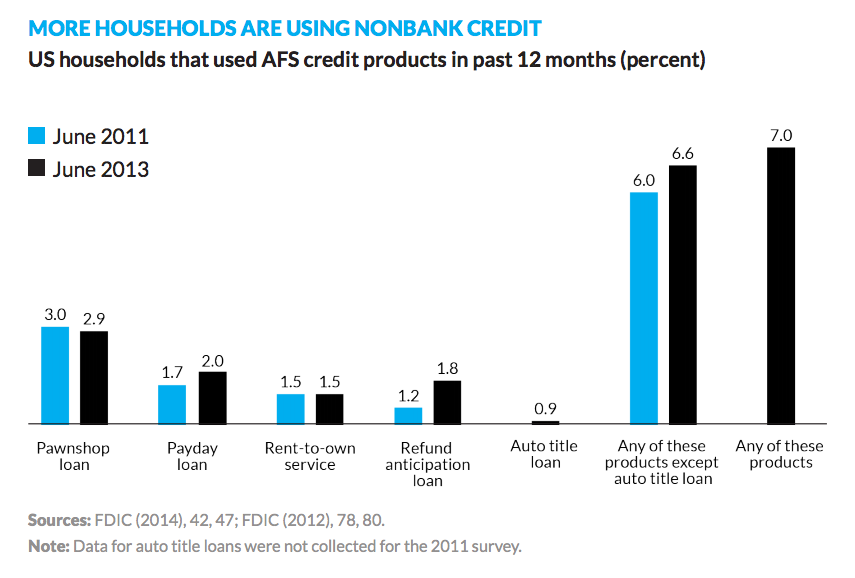
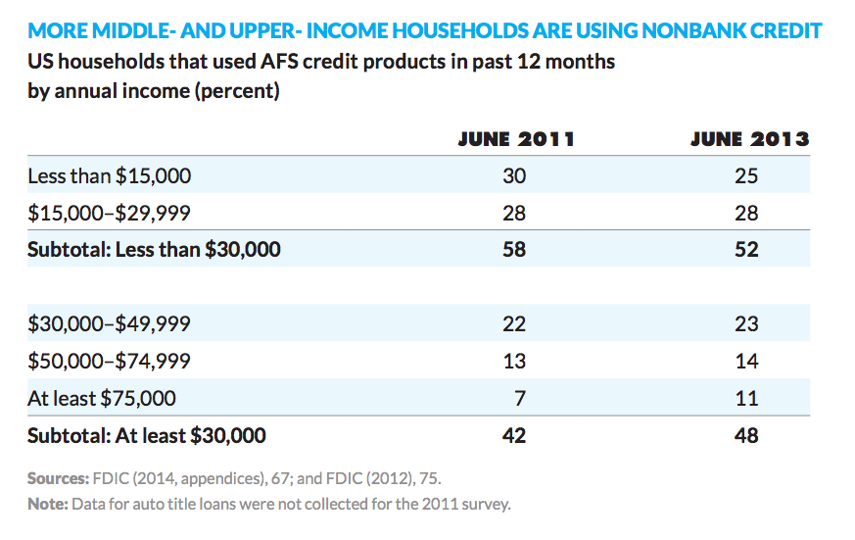
Families’ savings not where they should be: That’s one part of the problem. But Mills sees something else in the recovery that’s more disturbing. The number of households tapping alternative financial services are on the rise, meaning that Americans are turning to non-bank lenders for credit: payday loans, refund-anticipation loans, pawnshops, and rent-to-own services.

According to the Urban Institute report, the number of households that used alternative credit products increased 7 percent between 2011 and 2013. And the kind of household seeking alternative financing is changing, too.

                                                                                                                                                    (Urban Institute)

While that figure might seem small—it’s an increase of about 750,000 households total—it’s a significant figure for the economy in recovery. Families that are looking for credit aren’t finding it in mainstream financial institutions. “You used to be able to get small loans for reasonable rates, below 36 percent,” Mills says. “That’s what’s opened the door for more predatory products.”

The nature of households looking for alternative financial products, including predatory loans, has morphed during the recovery. According to Mills’s research, the share of households seeking non-bank credit with incomes above $30,000 increased from 42 to 48 percent between 2011 and 2013. And the share making more than $75,000 increased from 7 to 11 percent over the same span.

                                                                                                                                                    (Urban Institute)

It’s not the case that every one of these middle- and upper-class households turned to pawnshops and payday lenders because they got whomped by an unexpected bill from a mechanic or a dentist. “People who are in these [non-bank] situations are not using these forms of credit to simply overcome an emergency, but are using them for basic living experiences,” Mills says.

More middle- and upper-income households are using alternative financial products, including predatory loans.

Still, survey respondents who said they couldn’t weather a $400 hit are bound to be some of the same folks who are turning to non-bank lenders for routine expenses. That’s a huge problem nationwide. Alternative financial services come with steep interest rates, especially payday lenders, which lock borrowers into vicious lending cycles with interest rates north of 400 to 500 percent. The Consumer Financial Protection Bureau is moving to regulate the payday lender sphere—which is a good start.

Here’s another disquieting finding from the Fed: “Nearly a third of respondents went without some medical treatment in the past year because they could not afford it.” Later this summer, 7.5 million Americans will find out whether or not they will get to keep their healthcare policies. Guess they better cross their fingers.

Top image: John David Bigl III/Shutterstock.com.


30 May 05:32

If you care what people think, like they supply some missing link…

by Sophia, NOT Loren!

To the happy Christian, faith in Jesus Christ is an essential component of a healthy life.

To the happy atheist, avoiding “faith” and relying on observable data, reasoning, and logic are essential to being healthy.

To the happy veterinarian, knowing all about how to interpret the nonverbal communication of cats and dogs is essential to making a healthy income.

To the happy person who’s allergic to pet fur, simply staying away from cats and dogs is essential to staying healthy, and otherwise those animals don’t affect their income at all.

To the happy vegan, abstaining from eating or drinking all animal products is essential to a healthy diet.

To the happy omnivore, meat or milk or honey can be essential to eating healthy.

After interacting with someone who responded to one of my craigslist “housing wanted” ads a few days ago, I realized that I should probably include a mention of my eating meat, because the “no smoking” in my ad has been taken once again (as it has by more than one person) to suggest that I’m the type who avoids alcohol and every other substance, who thinks that sex is bad, who only eats vegetables and other plant-based stuff and considers all of that to be encompassed by the word “healthy.” (See also: fat shaming, gym-rats, “spirituality not religion,” white people super into “Eastern” culture/religion/medicine… not uncommon to find the all of those in one package.)

So I added a bit in there where I had already mentioned that I love to cook, and said “I enjoy food and the opportunity to cook (including meat, an essential component of a healthy diet.)” And for me, it is an essential component!

Next day I get a reply to that ad. Not someone offering housing, nope! Someone whose email shows their name as “yogamassage” (seriously, that’s what it showed… the fit for the stereotype is just too hilarious) writes:

It’s all good that you like meat and want it in your diet and are being upfront about it, but why say something so factually wrong as this?

(including meat, an essential component of a healthy diet.)

So now I’m wondering… should I tell all Christians who say that faith in Jesus Christ is essential that they are “so factually wrong?” How about telling atheists that they’re “so factually wrong” for living without faith? Is the vet or the person with allergies the one who’s “so factually wrong?” And does this “yogamassage” person understand that what is true for them does not and never will be truth for many other people? Apparently not!

I’ll end this by quoting (as I often have before) lyrics from Peter, Paul, and Mary’s “Rolling Home” —

There’s nothing big I want to prove
No mountain that I need to move
Or even claim what’s right or true for you…
My sights, my songs, are slightly charred
And you might think they’ve missed their mark
But things are only what they are
And you’re nothing new —
But for me? I think they’ll do.
For me, I think they’ll do.


Filed under: General
30 May 01:11

Legal Risks to Creative Innovation and Research at College: NJ Drops Its Investigation of MIT Students

by natematias

Eighteen months after winning a hackathon innovation prize for a clever idea of a new online content business model, the MIT undergraduates who created Tidbit are finally free from the legal nightmare attracted by their proof of concept. Earlier this week, the New Jersey Attorney General dropped their investigation of the students, ending a case that hung over these students for a third of their undergraduate education. I'm incredbily relieved for the Tidbit undergrads, though I'm disappointed and upset that they had to face this legal challenge for so long.

In this post, I want to share what we're doing to figure out how to prevent similar problems in the future, or at least to better support other innovative student projects with legal problems. For more about the Tidbit case, you can read Jeremy Rubin's post, an update by the EFF, and a blog post by Ethan Zuckerman. I strongly suggest you read them.

In January 2014, when Ethan, Hal Abelson, and I learned that MIT was unable to offer legal support to the Tidbit students for conflict of interest reasons, we joined together with over 800 faculty, researchers, and students across MIT to ask president Reif to find some other way to intervene. President Reif acted swiftly, offering his support of the students and writing to the New Jersey Attorney General. Many in the MIT community also came together to file a letter with the the brief submitted to the court by the EFF, who had taken up the students case. It's hard to know exactly what effect our letters of support had, but the judge did acknowledge our arguments in a November opinion.

Freedom to Innovate 
I learned of the Tidbit undergraduates' situation around the same time that MIT was holding community hearings about what had happened to Aaron Swartz, a researcher, entrepreneur, and activist who had faced a federal prosecution for downloading academic articles in bulk from MIT's network. For several months, I'd been meeting regularly with other gradstudents to work out what MIT's response could be. One of the most common concerns related to cases where MIT students had faced legal challenges for groundbreaking or creative work: an MIT student arrested by homeland security for wearing e-textiles who eventually dropped out; MIT researchers who found security flaws in public transportation systems; and a gradstudent whose research helped hobbyists extend the capabilities of their gaming hardware.

These are just the public cases. During my four years at MIT, I've heard of many students and faculty here and elsewhere, whose academic work or learning experiences have been threatened by cease and desists, or who avoid interesting ideas out of legal concerns. I've watched fellow students face tough decisions when lawyers pounced on years of creative research-- including one student's master's thesis. I myself abandoned an early MIT project analysing news content after receiving a challenge that thankfully didn't escalate like Swartz's case. In one MIT class on computational linguistics, we had a lecture about exciting new research directions that we should under no account try, lest we be sued for patent infringement. Nor is this problem limited to MIT. The Association for Computing Machinery, one of the premier venues for computer science research, is so worried about this problem that they (in principle) refuse to publish completely-ethical research that risks running foul of Terms of Service violations, even when that research is in the public interest.

For our group, the most surprising discovery was that MIT just isn't set up to defend its students or faculty who face similar challenges, nor is there a single point of contact for community members who face a legal challenge. Led by the Media Lab's legal research specialist Kate Darling in collaboration with Harvard's Cyberlaw Clinic, a group of us held a "Coders, Know Your Rights" seminar to help students understand the situation. We also submitted a proposal to MIT administration to create a single point of service for students facing legal challenges to their innovation, research, and DIY creativity, something that would ensure that they could get pro bono legal help.

Legal Resources for Student Innovation 
The experience of the Tidbit undergraduates made it even clearer to us that MIT needed a better way to support students with legal challenges. The administration agreed. President Reif's public statement of support for the students called for "a resource for independent legal advice, singularly devoted to their interests and rights." Since then, we've been working with the administration to define what that should be. Although details aren't yet announced, we've been working with MIT administration on a plan that will protect a wide range of student innovation, including entrepreneurship, research, activist tech, and other forms of category-defying noncommercial creative hacking and exploration that MIT students love to do.

Extending the Freedom to Innovate at Universities 
MIT isn't alone in this. Students and colleagues in computer science, biotech, communications, and business schools have all shared stories of similar problems. We need to stop scuttling our projects and work together to protect our students and our fields from these risks. October 10th and 11th, the MIT Center for Civic Media and Electronic Frontier Foundation are hosting a conference on the Freedom to Innovate, with support from the Ford Foundation. We're still trying to understand the wider risks and what we can do, and we need your help:

  • What legal challenges have you (or your students) faced?
  • What projects have you abandoned out of legal concerns?
  • How does your university protect innovative students who face legal challenges? Does it?
  • What kinds of critically-important research is being held back by legal risks?

This conversation is not just for faculty or policymakers, and it concerns students and researchers at community colleges, state schools, and liberal arts colleges. We very much need student voices to shape this conversation.

To register for the conference, visit freedom2innovate.mit.edu or join the conversation by emailing adi@eff.org or noah@eff.org.

30 May 00:56

Reuters: US launched a failed Stuxnet-like attack on North Korea

by Devindra Hardawar
Iran wasn't the only country that had its nuclear ambitions targeted by a sneaky US cyberattack. It turns out the American government also tried to take down North Korea's nuclear programs with the Stuxnet worm five years ago, Reuters reports. But th...
30 May 00:36

it-was-ironic: feminismandgenderequality:loganl517: I’m liking...

Sophianotloren

#PHMT aka #PatriarchyHurtsMenToo


it-was-ironic:

feminismandgenderequality:

loganl517:

I’m liking this

This is what it’s all about!

THIS. THIS. THIS.

30 May 00:35

Photo

Sophianotloren

Truth.

via saucie


30 May 00:22

Wow!


Wow!

30 May 00:22

thatguywhosecretlylikesmermaids: The Discovery Channel office...


thatguywhosecretlylikesmermaids:

The Discovery Channel office building during Shark Week

aw the shark is wearing a building costume

30 May 00:22

The Birthday Problem

by admin

The Birthday Problem

30 May 00:17

lunarbaboon: Lunarbaboon Facebook Twitter 

Sophianotloren

Yup.

via Cooper

30 May 00:15

Photo

Sophianotloren

via Rosalind


30 May 00:15

danshive: chronoscat: zillah975: femmeforeverybody: Nichelle...

Sophianotloren

via Luke.stirling


danshive:

chronoscat:

zillah975:

femmeforeverybody:

Nichelle Nichols (Uhura on the original series):”Whoopi Goldberg, she’s just marvellous. I had no way of knowing that she was a Star Trek fan. When I finally met her it was her first year on the Next Generation.

She loved the show so much and she told her agent she wants a role on Star Trek. Well agents go ‘Big screen, little screen, no, you can’t do that’. Well you can’t tell Whoopi ‘You can’t do that’.

And so they finally asked, and they had the same reaction at Star Trek office, specifically Gene. And she said, ‘I want to meet him and I want him to tell me to my face. If he tells me he doesn’t want me and why, I’ll be fine.’

Knowing Gene he had to take that challenge, and so he met with her. She said, ‘I just wanted you to tell me why you don’t want me in Star Trek.’

Gene said, ‘Well, I’ll just ask you one question and I’ll make my decision on that. You’re a big screen star, why do you want to be on a little screen, why do you want to be in Star Trek?’

And she looked at him and she said, ‘Well, it’s all Nichelle Nichols’ fault.’

That threw him, he said, ‘What do you mean?’

She said, ‘Well when I was nine years old Star Trek came on,’ and she said, ‘I looked at it and I went screaming through the house, “Come here, mum, everybody, come quick, come quick, there’s a black lady on television and she ain’t no maid!”’ And she said, ‘I knew right then and there I could be anything I wanted to be, and I want to be on Star Trek.’

And he said, ‘I’ll write you a role.’

http://www.bbc.co.uk/cult/st/interviews/nichols/page4.shtml

I know I’ve reblogged this before, and I will undoubtedly do it again.

It matters. And no amount of saying that we’re post-racial or that racism isn’t a thing or that “they just chose the best actor for the role” or otherwise trying to cover up for it will make it okay to keep relegating actors of color to secondary roles, villain roles, stereotyped roles, or no roles at all, and it sure as hell won’t make it okay to keep whitewashing CHARACTERS of color out of the story by casting white actors to play then.

Remember how Martin Luther King Jr. convinced Nichelle Nichols to stay on the show? 

I said “Dr. King, thank you so much. I really am going to miss my co-stars.” He said, dead serious, “What are you talking about?” I said, “I’m leaving Star Trek,” He said, “You cannot. You cannot!”

I was taken aback. He said, “Don’t you understand what this man has achieved? For the first time on television we will be seen as we should be seen every day – as intelligent, quality, beautiful people who can sing, dance, but who can also go into space, who can be lawyers, who can be teachers, who can be professors, and yet you don’t see it on television – until now….”

I could say nothing, I just stood there realizing every word that he was saying was the truth. He said, “Gene Roddenberry has opened a door for the world to see us. If you leave, that door can be closed because, you see, your role is not a Black role, and it’s not a female role, he can fill it with anything, including an alien.”

At that moment, the world tilted for me. I knew then that I was something else and that the world was not the same. That’s all I could think of, everything that Dr. King had said:  The world sees us for the first time as we should be seen.

It matters, man. It honestly does. It mattered then and it still matters.

Some great anecdotes which bear much repeating.

That moment when someone reblogs your reblog and you’re all like “I’M REBLOGGIN’ THIS AGAIN”

30 May 00:13

pdlcomics: Ant Problem

Sophianotloren

via Cooper