Shared posts

16 Jul 17:16

The Pitch Meeting for 'Wishbone'

Screen Shot 2015-07-09 at 2.45.38 PM

VISIONARY: So there’s this dog.

PBS SUITS: We’re listening.

VISIONARY: And he loves books.

[nodding, nodding]

VISIONARY: He knows all about classic books.

SUIT #1: Adorable.

SUIT #2: Like a cartoon dog?

VISIONARY: No, no. A live Jack Russell Terrier.

[…]

VISIONARY: He belongs to a boy named Joe.

SUIT #1: Nice.

SUIT #3: And Joe reads him the books?

VISIONARY: No, Joe couldn’t care less about books.

SUIT #3: Oh. Okay.

VISIONARY: Joe and his friends’ day-to-day scrapes resemble the plotlines of great novels, and Wishbone like, picks up on it.

SUIT #2: Wishbone?

VISIONARY: The dog.

SUIT #2: Oh.

SUIT #3: The name seems like more of a turkey thing…?

SUIT #1: Should we name him something literary? Something like Dogstoyev-

VISIONARY: No. His name is Wishbone. Unlike his human companion, Wishbone is a great lover of books. When Joe’s life reminds him of a masterpiece, as it so often does, our canine Virgil guides the audience on a journey into that book.

SUIT #3: So the dog can talk.

VISIONARY: Nope. Joe and his friends and Joe’s mom just think he’s a regular dog.

SUIT #2: …Joe’s dad?

VISIONARY: Ellen is a single mom. She’s a widow. This is a story about the limitless ecstasies of the imagination, but we want to respect the complex lives of our young viewers, so sometimes things are very real.

[nodding] 

VISIONARY: Wishbone can narrate, though.

SUIT #1: So when we travel into the world of novel…

VISIONARY: Live actors, costumes, the works. Mini-Masterpiece Theater. Also, Wishbone is a character.

SUIT #2: Narrating?

VISIONARY: No, he is an actual character in the book.

SUIT #1: Ah, I get it. In the book part, all the characters are played by dogs?

VISIONARY: You get nothing. Wishbone plays a character, for example Romeo in Romeo and Juliet, and the other parts are played by adult human actors.

SUIT #3: But you said he can’t talk to humans.

VISIONARY: No, see, in the world of the book, nobody thinks he’s a dog and people understand him. Just not in the real world. But then what is “real,” right?

SUIT #2: Like they just never acknowledge he’s a dog?

VISIONARY: I mean he wears a costume, so.

[….]

VISIONARY: It’s imagination, guys! Kids understand. And that’s what reading’s all about. Personally, when I read, I picture Ivanhoe as a dog like half the time. At least.

SUIT #3: Literally Wishbone is wearing a Romeo costume and standing in front of a grown woman in an Elizabethan gown who’s asking him to deny thy father and refuse thy name, but no mention of the fact he’s a dog?

VISIONARY: Correct.

[Suits shrug, like ‘I guess that checks out’]

SUIT #2: All fours or hind legs?

VISIONARY: That really depends on the themes of the book.

[furious note-taking]

SUIT #1: Uh, can you go into more detail as to how a middle-class American boy’s life constantly resembles episodes from the literary canon?

VISIONARY: Like, his female friend wants to play soccer with the boys’ team and that’s kind of like Joan of Arc wanting to fight in the Hundred Years War.

SUIT #3: Is it?

VISIONARY: Yes.

[Suits take drinks of water. Visionary does not drink, he only sees]

VISIONARY: The classics really resonate with kids’ everyday lives. Maybe you don’t want to babysit your little sister and that’s just like A Tale of Two Cities! Or, off the top of my head, just thinking of what kids these days like to do, maybe our man Joe starts a business delivering groceries, which seems really great at first — until the corporate megalomania transforms him into a prepubescent Midas lording over the suburbs. The connections are almost too easy, know what I mean?

[…]

SUIT #2: Here’s the thing, Lance. There’s a lot of great stuff here. Creativity, out-of-the-box thinking—

SUIT #1: Out of the kennel, if you will—

[the Visionary will not]

SUIT #2: And the dog-teaching-kids-to-read concept, that’s perfect for our demographic.

VISIONARY: He doesn’t teach them to read. He inculcates in them a passion for timeless narratives.

SUIT #2: Okay.

VISIONARY: Joe’s in middle school, he can freaking read. Not that he ever bothers.

SUIT #1: I think what Dave’s trying to say is—

VISIONARY: My winsome Jack Russell Terrier is no mere peddler of phonics. He is the bard, the scop, the muse. He is the flame that lights the cave.

SUIT #3: And that’s totally PBS! But see, it’s a half-hour slot. There just isn’t much time to cover a whole Joe-gets-into-mischief A-plot and then dig into the Penguin Classics…

VISIONARY: Oh you don’t do the whole book. Ha, no. A summary is fine, or maybe even just the beginning, and then you pretend like that’s a valid representation of the text. I’m thinking probably with Oliver Twist you could just end it after chapter three?

SUIT #3: Okay, but—

VISIONARY: We’re getting kids to read here, Janice. Give them just enough to tantalize their literary palates and I guarantee you they’ll devour all these titles, cover-to-cover, and certainly not just use the surface knowledge gleaned from Wishbone to posture before their future professors and Internet dates for the rest of their adult lives.

[Suits exchange glances]

VISIONARY: Trust me, they will all finish Silas Marner.

SUIT #2: How does the dog read?

VISIONARY: The same way you do, Dave. With an open heart and ready mind.

[Visionary begins to hum.]

SUIT #1: This seems like it would be a lot more feasible as an animated series—

VISIONARY: NO. He is a LIVE JACK RUSSELL TERRIER. His eyes are fathomless pools of knowledge reflecting all the pathos of great literature. The suffering and beauty of humanity bled onto the page and breathed in by generations of readers, connecting them — us — in an unspoken communion of shared loneliness that both celebrates and eases our pain. This is where we see that books do more than describe our human condition, Kevin. By shaping our minds and drawing us ever closer together, they create it.

SUIT #3: …In a dog’s eyes?

VISIONARY: A Jack Russell Terrier’s eyes, yes.

Tags: abbey fenbert, books, childhood nostalgia, FRANKENBONE, his eyes are fathomless pools of knowledge, humor, nikki didn't tear up at all at the end of this post, pbs, television, the dog days of summer, wishbone

16 Jul 17:14

Lumos helmet keeps cyclists safe with automatic brake lights

by Richard Lai
For cyclists, the road can be a nasty place to be at night, so we're all for technologies that can help draw drivers' attention in order to reduce the number of accidents. The latest of such attempt is the Lumos helmet, which not only comes with turn...
14 Jul 00:28

Baby Drew a Picture

by Reza

baby-drew-a-picture

07 Jul 00:55

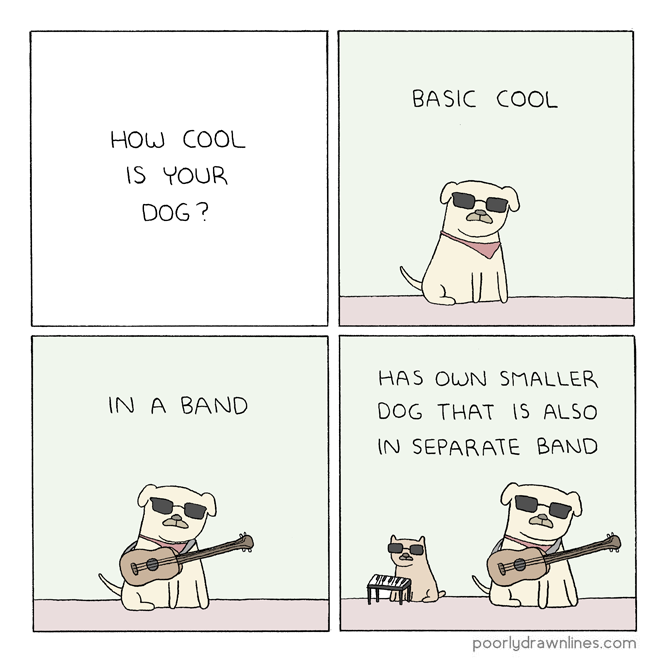
How Cool

by Reza

how_cool

03 Jul 11:13

Look at How These Crazy Fake Foods Are Made in Japan — Video

by Ariel Knutson

Have you ever walked by a window outside of a restaurant where plates of food are displayed? They're meant to catch your attention and make you want to eat at the restaurant. But how exactly do they make those plates of food? Is it actually real food, or something ... else?

Here's how display food is made in Japan. It's seriously mind-blowing.

READ MORE »

03 Jul 11:04

David Cameron Promises To Do Away With 'Safe Spaces' On The Internet

by Mike Masnick
Earlier this year, there were some questions raised when it appeared that UK Prime Minister David Cameron was suggesting that he wanted to undermine all encryption on the internet. Later, some suggested he was looking more at undermining end point security. However, after being re-elected, and apparently believing that this gave him the mandate to go full Orwell, Cameron is making it clear that no one should ever have any privacy from government snoops ever.

Responding to a somewhat nonsensical question about if he believed the recent attacks in Tunisia meant that the big internet companies need to "understand that their current privacy policies are completely unsustainable?" Cameron insisted that the UK always needed to be able to read communications. It is, of course, not at all clear what the privacy policies of Google, Facebook and Twitter (the three named by the questioner) have to do with the price of tea in China, let alone the attacks in Tunisia, but... alas:
"We just want to ensure that terrorists do not have a safe space in which to communicate. That is the challenge, and it is a challenge that will come in front of the House.

"We have always been able, on the authority of the home secretary, to sign a warrant and intercept a phone call, a mobile phone call or other media communications, but the question we must ask ourselves is whether, as technology develops, we are content to leave a safe space—a new means of communication—for terrorists to communicate with each other.

"My answer is no, we should not be, which means that we must look at all the new media being produced and ensure that, in every case, we are able, in extremis and on the signature of a warrant, to get to the bottom of what is going on."
Of course, he also insisted that you regular people shouldn't worry:
"Britain is not a state that is trying to search through everybody’s emails and invade their privacy..."
Except, well, it is. This whole thing seems to be based on the idea that it's blatantly obvious who is a "terrorist" and who is a good citizen of the UK. Cameron can't really be so naive as to think that "terrorists" are somehow easily differentiated from everyday people, can he? Then again, this is the same guy who once pushed for this Snooper's Charter by talking about how fictional TV crime dramas proved it would be a useful tool.

This is extremely troubling. Cameron's desire to undermine encryption is dangerous for the privacy and security of everyone, especially those in the UK that Cameron is supposed to be helping to protect, because lots of people really do need "safe spaces in which to communicate." The only way to take those away for "terrorists" is to take them away for everyone, and that means not just for the purpose of government snooping, but for others as well. Introducing backdoors breaks security and makes everyone much, much, much more vulnerable to all sorts of attacks.

And, again, this is the same guy who said:
For too long, we have been a passively tolerant society, saying to our citizens: as long as you obey the law, we will leave you alone.... This government will conclusively turn the page on this failed approach.
Does that really sound like someone who will only use such snooping powers to track down terrorists? He's blatantly admitting that he will use it against law abiding citizens, admitting that merely "obeying the law" should not leave you free from being hassled by the government.

These kinds of statements are cartoonishly evil. They're the kind of ridiculous statements one would have hoped you'd only see in late night TV fictional TV dramas, not coming from an actually elected leader of a major western power.

Permalink | Comments | Email This Story


03 Jul 11:03

How Caffeine Is Removed from Coffee — We've Got Chemistry

by Janice Lawandi

Most of us are addicted to caffeine. We drink it every morning out of habit, but also to give us a much-needed boost to get us going or to help us face the day. Caffeine is a stimulant targeting the central nervous system and it does a really good job of combating drowsiness and helping us feel more awake.

However, past a certain time in the day, many of us avoid caffeine for fear it may lead to a sleepless, restless night, so we turn to decaf. Let's explore some of the ways that caffeine is removed from coffee.

READ MORE »

02 Jul 16:11

Amnesty International Told That GCHQ Spied On Its Communications

by Mike Masnick
Amnesty International has been heavily engaged in fights against mass surveillance, recognizing that many of the people it communicates with need an expectation of privacy in their communications with the group. Last year, Ed Snowden revealed that the NSA specifically spied on Amnesty International and other human rights organizations. And, while Amnesty International was unable to gain standing by the US Supreme Court, since it couldn't prove that the NSA had spied on its communications, the story appears to be somewhat different over in the UK.

Last year a legal challenge was filed in the UK via the Investigatory Powers Tribunal (IPT) concerning Amnesty International. And now, the group has been informed that, yes, it was spied on by GCHQ in the UK.
In a shocking revelation, the UK’s Investigatory Powers Tribunal (IPT) today notified Amnesty International that UK government agencies had spied on the organization by intercepting, accessing and storing its communications.

In an email sent today, the Tribunal informed Amnesty International its 22 June ruling had mistakenly identified one of two NGOs which it found had been subjected to unlawful surveillance by the UK government. Today’s communication makes clear that it was actually Amnesty International Ltd, and not the Egyptian Initiative for Personal Rights (EIPR) that was spied on in addition to the Legal Resources Centre in South Africa.
As you may recall, a little over a week ago, the IPT had ruled that the GCHQ had erred in holding onto emails too long -- but had named that Egyptian organization as the one whose emails were held. However, that's now been corrected to Amnesty International.

The actual email sent by the IPT basically says that GCHQ told them that the IPT made a mistake. What you won't see anywhere is an apology from GCHQ. Amnesty is rightfully incensed about the whole thing:
“How can we be expected to carry out our crucial work around the world if human rights defenders and victims of abuses can now credibly believe their confidential correspondence with us is likely to end up in the hands of governments?

“The revelation that the UK government has been spying on Amnesty International highlights the gross inadequacies in the UK’s surveillance legislation. If they hadn’t stored our communications for longer than they were allowed to by internal guidelines, we would never even have known. What’s worse, this would have been considered perfectly lawful.”
Both issues raised here are significant. The only reason Amnesty now knows about this is because GCHQ held onto the emails too long. If it had done its usual purge, then the IPT likely would never have revealed that, and Amnesty's communications would have continued to go on being compromised without anyone knowing.

Permalink | Comments | Email This Story


02 Jul 16:10

Swiss Settlement

by admin

02 Jul 00:45

18 Reasons America Should Adopt a Per-Mile Driving Fee

by Eric Jaffe
Image ODOT
ODOT

Oregon’s much-anticipated per-mile driving fee, called OReGO, launches today. Instead of paying the normal gas tax embedded in the price of fuel, OReGO drivers will pay 1.5 cents for every mile on the road. The initial public rollout is limited to 5,000 vehicles, but the implications of the program are vast: if all goes well, state and federal leaders might have an answer to the transportation funding crisis that’s hampered American infrastructure for years.

Here’s 18 reasons the whole country should give per-mile fees a chance.

1. The Highway Trust Fund keeps running out of money

The federal Highway Trust Fund that pays for America’s roads (and to a lesser extent rails) is expected to run out of money at the end of July. We’ve seen this movie before, so we know that Congress will find a way to keep the fund afloat—even if that involves the legally dubious maneuver of transferring money from the general taxpayer treasury. But the past trends and future projections of the Highway Trust Fund make clear that it’s a badly bent spending model that’s routinely on the cusp of badly breaking.

Congressional Budget Office

2. Yet Congress and some states refuse to raise the gas tax

The federal gas tax hasn’t been raised since 1993. (And the last President to truly achieve that task was Ronald Reagan.) Some states have raised it recently out of desperation, though others remain desperately opposed; New Jersey’s gas tax is about half what it was in 1927. Elected officials on both sides of the aisle generally refuse to touch the issue for fear of political damage, despite polls showing that many voters would accept a hike.

3. The truth is the gas tax is totally busted anyway

Preach.

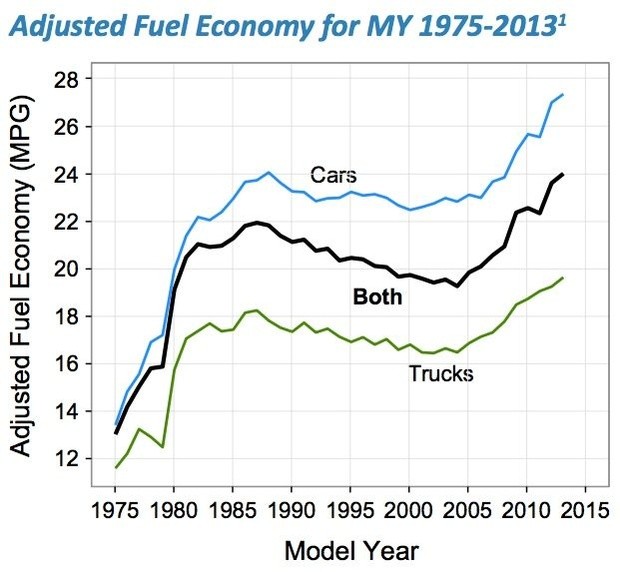
4. For one thing, cars are much more fuel-efficient

The gas tax is a decent proxy for car travel: for the most part, the more you spend at the pump, the more you drive on the road. But that relationship has become weaker and weaker as American vehicles have gotten more fuel-efficient. That means on the average tank of gas, a car does a lot more damage to roads today than it’s done in the past.

U.S. EPA

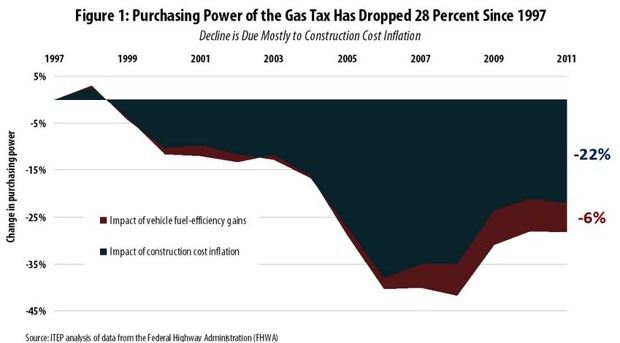
5. Also construction costs are soaring

Transportation funding aside, better fuel-efficiency is a great thing, and should be encouraged. So an arguably bigger problem with the gas tax is soaring construction costs. The Institute on Taxation and Economic Policy has estimated that these costs have increased 335 percent since 1972, contributing to much more of the decline in the purchasing power of the gas tax than new fuel-efficiency standards.

ITEP

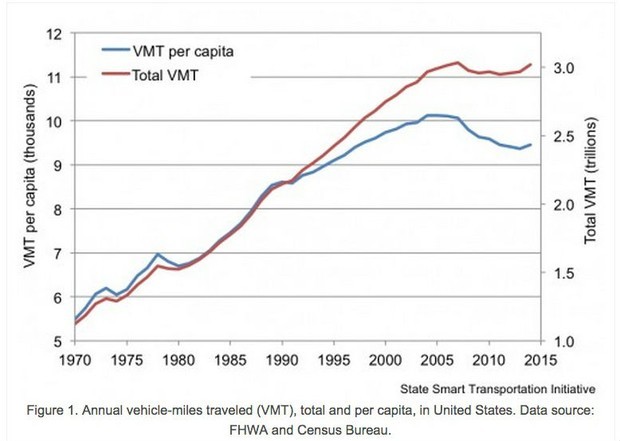
6. Plus, people aren’t driving as much as they used to

MPG and construction costs aside, Americans just aren’t driving as much as they once did. Per-capita vehicle mileage is well off its peak in the mid-2000s—a new normal of driving that suggests we can’t think about funding (or building) highways the same way we did in the past.

SSTI

7. A per-mile fee is a true “user” fee

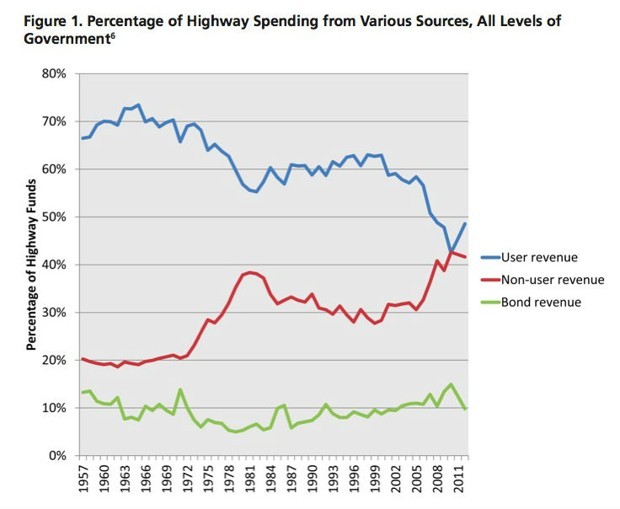
Ideally every driver would cover their own individual costs of using the road—a true “user” fee that seems only fair. Practically that’s never been the case. Driver fees like the gas tax once accounted for about 70 percent of road costs, but that link declined over the decades for many of the reasons mentioned above. The result is that not only are road costs distributed unequally among drivers, they’re distributed among non-drivers, too. A per-mile driving fee would be a return to this “user pay” ideal.

Who Pays for Roads?

8. Better still, it’s not a hidden fee

Unlike the gas tax, a per-mile fee isn’t hidden away in the larger cost of fuel. Right now many drivers think they pay much more in gas taxes than they truly do—a disconnect that contributes to their frustration over rising fuel prices, despite the fact that Americans pay relatively little at the pump. With a per-mile fee, drivers could see exactly what they spend on the road each month, just as they do on their cable or phone bill, and change their behavior accordingly.

9. It would raise a gargantuan amount of money

The American Association of State Highway and Transportation Officials has estimated that a mileage-based road fee would produce an astonishing $246.31 billion by 2020. That’s enough to cover the Highway Trust Fund shortfall many times over, and that’s assuming just a penny per mile—below the per-mile OReGO rate of 1.5 cents. The windfall stands to get weaker over time as people drive less, but if and when that’s the case local government won’t have as much road maintenance or expansion to do, either.

10. It can be adjusted to reduce traffic and promote transit

A per-mile fee is also remarkably flexible. Heavily congested metro areas can add a surcharge during rush-hour (which would incentivize transit use, telecommuting, or new work patterns) or within a certain boundary (similar to the congestion pricing zones in London, Singapore, and Stockholm). They can also shift some of that money toward transit improvements in particularly crowded corridors—giving the per-mile fee an equity basis as well.

A per-mile fee is flexible enough to slap gas-guzzling clunkers with a surcharge and squeaky clean EVs with a discount.

11. And adjusted to cover truck damage

One of the big arguments against any flat transportation tax is that not all vehicles rough up the road the same way. Fair enough. A per-mile fee is far easier than the gas tax to adjust for the size of a vehicle, from 18-wheelers to Smart cars.

12. And adjusted to discourage pollution

Electric vehicle owners often oppose a per-mile fee because they say it offers a disincentive to go green. That’s a fair if tenuous argument: EVs still save money at the pump, they still damage the road, and if they draw from a coal-based energy grid they can even create more pollution than gas cars. Still a per-mile fee is flexible enough to slap gas-guzzling clunkers with a surcharge and squeaky clean EVs with a discount as local governments see fit.

13. Look, it’s just really adjustable, okay?

Touché. In theory, a per-mile fee is elegant and nimble enough to capture more or less every social cost of driving. It’s the Baryshnikov of transportation funding.

REUTERS/Sergio Perez

14. Millennials dig it

In a new public opinion poll for the Mineta Transportation Institute, Asha Weinstein Agrawal and Hilary Nixon report that 59 percent of respondents age 18 to 24 “strongly” or “somewhat” supported a mileage tax (provided it was adjusted for vehicle pollution). So Millennials seem more on board with the idea than older age groups. And we should listen, because according to them, they’ve never been wrong.

15. It doesn’t actually invade your privacy


CityFixer

CityFixer image

Solutions for an Urbanizing World


The single biggest concern voiced about a per-mile driving fee is privacy. But there’s no need to worry. Oregon has developed several tiers of mileage tracking, from low-tech options (such as an annual fee or odometer reading) to higher-tech ones (e.g. cell tower dings or full GPS). In other words, there’s a tracking program to suit everyone’s comfort level. Even libertarians aren’t concerned about per-mile privacy. In recent Congressional testimony supporting a mileage fee, Bob Poole of the Reason Foundation said “privacy need not be a serious obstacle” to its adoption.

16. It’s been tested—with success

Oregon has been developing and testing and improving the concept for years now. And it’s not alone. Other pilots around the country have been a success. An Iowa trial found that vehicle trackers can capture the vast majority of actual miles traveled (92 percent). Simulations in Sacramento and Washington, D.C., as well as real-world trials in Atlanta and Seattle, have shown that per-mile taxes can lead to reduced car travel. A Portland study showed it works best when it includes a rush-hour surcharge.

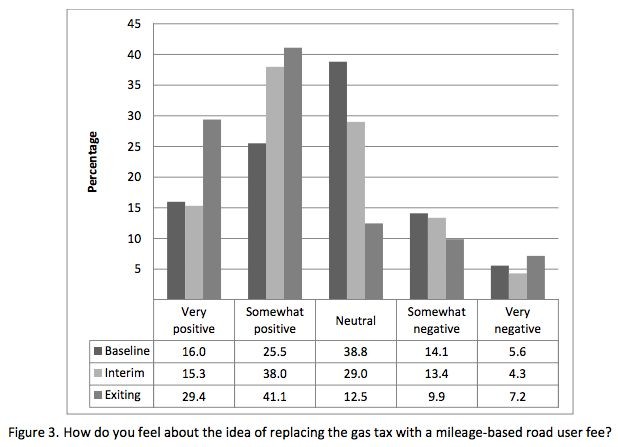
Best of all, people like it more as they try it. In the Iowa trial, for instance, about 41 percent of participants had “very” or “somewhat” positive feelings toward the trial beforehand, rising to 70 percent afterward.

Transportation Research Record: Journal of the Transportation Research Board

17. Lots of states have shown an interest

Though Oregon is the only state to launch a per-mile program so far, many others are keeping a close eye on the concept. California recently authorized a pilot program of its own; in late 2013, Florida’s transportation secretary predicted the state could shift to a mileage-based fee within 10 to 15 years; and several Western states have joined a consortium to monitor road-usage charges. A recent report from the Council of State Governments lists 26 states that have dipped their toe in the waters of per-mile pricing in some form or another.

18. Oregon has been been down this Trail before

Yes, we just did that. (It’s been a long list, all right?) But it’s also the truth. Back in 1919, Oregon became the first state to implement a gas tax. The state’s funding vision has served American roads well for this long. Why not follow it in a new direction?


02 Jul 00:38

TSA Asks America To LOL At Traveler Who Had $75,000 Taken From Him By Federal Agents

by Tim Cushing

The TSA runs a fairly entertaining Instagram account, if you're the sort of person who is impressed by pictures of weapons seized from stupid passengers. That would be the extent of its social media prowess. Its blog is pretty much a 50/50 mix of Yet Another Thing You Can't Take Onboard and Blogger Bob defending the TSA's latest gaffe.

One of the TSA's official Twitter flacks tried to loft a lighthearted "hey, look at this thing we came across!" tweet. She couldn't have picked a worse "thing" to highlight, considering the ongoing outrage over civil asset forfeiture.


For those who can't see the embed, the tweet says:
If you had $75,000, is this how you'd transport it? Just asking! TSA @ #RIC spotted this traveler's preferred method
Pictured was someone's carry-on bag, opened to expose the cash contained in it.

First: should the TSA be broadcasting the contents of someone's luggage -- especially considering the contents are a large amount of cash -- along with broadcasting the airport where it was discovered and the baggage's appearance? There may not be any recognizable privacy violations here, but it's certainly bad form. And it does no favors to the person carrying it.

Second: unless the traveler was attempting to take the money out of the country without reporting it to Customs, it's none of the TSA's business how a traveler carries money from place to place. It may be careless, but it is not illegal and it is certainly not something government agencies should spend too much time obsessing over. (But of course they will, because travelers' cash can quickly become the government's cash, thanks to civil asset forfeiture.)

Third: the TSA's public interest in this member of the public's cash is flat-out unseemly. Not only does the tweet portray the unnamed person as some sort of idiot/criminal (or both!), but it led many to the obvious assumption that this cash was seized.

But, you know, LOL #otherpeoplesmoney and all that.

The foregone conclusion that this money had been seized was (momentarily) dispelled by another tweet from the TSAmedia_Lisa account.
TSA didn't seize/confiscate/take it. It alarmed the x-ray machine as an unknown and we spotted it. It's just a curiosity
So, somehow a passenger managed to walk through airport security with a large amount of cash and managed to still be in possession of it on the DEPARTURE side of the checkpoint?

No. This is AMERICA, land of the somewhat free and home of the brave drug warrior.

A followup email to the Washington Post's Chris Ingraham proved TSAmedia_Lisa's (Farbstein) response was technically true and completely disingenuous.
Asked about the incident via e-mail, Farbstein said that "the carry-on bag of the passenger alarmed because of the large unknown bulk in his carry-on bag. When TSA officers opened the bag to determine what had caused the alarm, the money was sitting inside. Quite unusual. TSA alerted the airport police, who were investigating."
It seems the police didn't just "investigate." They worked with another federal agency to take the money:
In this case, the cash was seized by a federal agency, most likely the Drug Enforcement Administration, according to Richmond airport spokesman Troy Bell. "I don't believe the person was issued a summons or a citation," he said. "The traveler was allowed to continue on his way."
So Farbstein's claim about how it was "just a curiosity" is completely bogus. Not only was the photograph and putting it on social media a questionable invasion of privacy, but then they handed it off to another federal agency to take the money... and then the TSA clearly implied the opposite on social media once the story blew up.

It's not entirely clear which "federal agency" took the money, but a good guess is that the DEA is likely in possession of this "curiosity" now, thanks to its willingness to troll mass transportation departure points in search of "guilty" money.

Also ridiculous is the airport spokesperson noting that the traveler was allowed to "continue on his way," $75,000 lighter. As if that makes everything OK? If this money is completely unrelated to criminal activity, the government has just stolen money from one of its citizens. If it is linked to criminal activity, the traveler is probably in for a world of hurt if it belonged (or was owed) to someone else. Either way, the citizen loses, the government wins and the TSA badly mishandles another social media interaction.

So, the TSA's attempt at cheery lightheartedness did nothing more than once again expose its dark, humorless center. The tweet may as well have read "If you had $75,000, you don't have it any more! Just saying! #freemoney" One of the nation's most tone deaf agencies continues to prove it simply won't be outdone in this category. And the trickle of details confirmed what everyone was thinking the moment this picture hit the internet: that the person carrying that money was last in possession of it shortly before the photo was taken. The government gets its man money and the TSA delivers the news as a punchline at the expense [pretty much literally] of some random traveler whose misfortune is the government's gain.

Permalink | Comments | Email This Story


01 Jul 17:50

Police Are Killing a Lot of Mentally Ill People

by Jesse Singal
Firing Range

Last August, 25-year-old Kajieme Powell, who was wandering around outside of a St. Louis convenience store from which he had just stolen two energy drinks and a pack of pastries, was shot to death by police shortly after they arrived on the scene. It's clear, from video of the incident,...More »

29 Jun 19:05

rosalarian: veggieheather:wertheyouth:Infographic: Legally...

Courtney shared this story from Super Opinionated.


rosalarian:

veggieheather:

wertheyouth:

Infographic: Legally Married and Legally Fired, Center for American Progress

THIS THIS THIS

I’m continuously terrified that people will think LGBT rights is a finished fight as soon as marriage equality passes nationally. There’s still so much extremely important stuff to get to. Marriage is not an end goal.

29 Jun 19:04

A Promising New Approach to Fighting Campus Sexual Assault

by Jesse Singal
New Haven Street at Night

Despite the growing national conversation about campus sexual assault, researchers still haven’t come up with all that many proven ways to reduce its prevalence. But a new study of a prevention program targeting college women published in The New England Journal of Medicine offers some very tantalizing results.

For the study, lead-authored by...More »

16 Jun 13:29

The Tea Lover's Way to Make the Best Cold Brew Iced Tea

by Max Falkowitz

There's more to making quality iced tea than meets the eye. On the surface, you can ice any old tea any way you want and get a refreshing drink, but the way I see it, "refreshing" and "drinkable" are just the starting point. Read More
13 Jun 14:54

Police use ultrasonic device to make sure drivers stay 3 feet from cyclists

by Cyrus Farivar

For the last month now, Chattanooga Police Officer Rob Simmons has been biking around town with a new, unique ultrasonic sensor to make sure that drivers are obeying the state’s three-foot buffer law.

The law, which took effect in 2007, requires that when motorists pass a bike, they’re supposed to allow that much distance. But enforcing this law using only human eyes is pretty much pointless—it would be like trying to enforce speed laws without a radar gun. Tennessee is one of 24 states nationwide to enact such a law, but no other states have enforced the law using a device like this.

Simmons rides with the brand-new Bicyclist and Safe Monitoring Applied Radar Technology (BSMART), a handlebar-mounted device that uses an ultrasonic sensor to calculate the distance between the bike and a passing car. Then it displays how far away the nearest edge of the car was to the bike in inches.

Read 14 remaining paragraphs | Comments

13 Jun 14:47

What’s Wrong

by Reza

whats_wrong1

12 Jun 11:57

Joseph Sikorski made a documentary about the Tesla Tower at Wardenclyffe

by Matthew Inman
10 Jun 18:50

10 Totally Heinous Crimes Against Salad That Need to Be Stopped — Crimes Against Food

by Ariel Knutson

By now you may be familiar with the popular Internet meme, "women laughing alone with salad." If you're not familiar, the concept is easy to understand: Picture a stock photo of a woman all by herself, eating a boring-looking salad and laughing hysterically. Salad deserves better PR than this. Because honestly, laughing by yourself with a bowl full of raw vegetables should be outlawed. It's just wrong.

This meme sparked an investigation into other crimes against salad that are widespread on the Internet. I turned to a collection of stock photos to find the worst offenders. Prepare your eyes, my friends. No food deserves this kind of treatment – especially poor ol' salad.

READ MORE »

10 Jun 11:44

Saturday Morning Breakfast Cereal - My Imaginary Friend

by admin@smbc-comics.com

Hovertext: I think, therefore... wait... do I think? Why do I think that?


New comic!
Today's News:

 SUBMISSIONS ARE OPEN FOR BAHFEST(s) 2015!

10 Jun 11:33

[UPDATED] Mended and Defended: The ReBoot Reboot Is Greenlit for 26 New Episodes - THANK THE USER.

by Sam Maggs

reboo2-640x320

Way back in October 2013, we told you that Vancouver-based animation firm Rainmaker was planning on reviving the cult classic ReBoot – and now, binomes, it’s actually happening. The project has been pulled from the clutches of the Nulls, and us Users will be granted a glorious 26 episodes in Mainframe. Alphanumeric!

At the Banff World Media Festival yesterday, Corus Entertainment announced they had greenlit the new series, ReBoot: The Guardian Code, with 26 new episodes that will be a mix of live-action and animation distributed worldwide by TWC/Dimension. “The new ReBoot will feature the same action and comedy mix viewers loved in the original series,” said Corus Kids content director Jamie Piekarz, “but with an updated technological universe that will fascinate a new generation of kids,” and will somehow be multi-platform.

reboot-640x361

We already knew that The Guardian Code will attempt to resolve the show’s season four cliffhanger, and that all the major characters from the original series will feature in more than just cameo roles (though some of the minor characters might be just cameos to deal with older tech-jargon”). But now we also know that the new series is about (emphasis our own):

four teens (Austin, Parker, Grey and Tamra) who discover that they’re next-gen Guardians with a mission to save the world, by defending it in cyberspace. The Internet revolutionized the world, but it also left it vulnerable to attack. With the help of VERA, the last surviving cyberbeing from the original Guardian Program, our heroes stream into cyberspace where they use their awesome code-based powers to battle viruses that have been unleashed by a ruthless hacker. Known only as the Sourcerer, he seeks to rule the world by controlling cyberspace. Original fans of the show will be happy to hear that Megabyte will be back and he’s getting a major upgrade. ReBoot will showcase leading edge technologies and bring coding into the mainstream for kids.

When Austin, Parker, Grey and Tamra are not trying to stop viruses from overloading a nuclear power station, or remotely opening a dam to flood a city, or playing Criss Cross Crash Hour with a city’s transportation grid, our heroes are being typical teens: arguing with their parents over curfews; dealing with crushes; or trying to avoid getting suspended for skipping class when they’re really on a cyber mission to save the world!

rebootguardiancode

According to Rainmaker president Michael Heffron, the show “will deliver mass appeal with a technology focus, empowering kids with the tools and confidence to chart their own course in a world that is increasingly dependent on and powered by technological knowledge.”

For those of you unfamiliar with ReBoot, the show originally aired from 1994 to 2001, and was the world’s first-ever half-hour fully-CGI animated series. Set inside a computer, ReBoot followed the adventures of Bob (a Guardian), and siblings Enzo and Dot Matrix, as they attempt to both defeat games uploaded by the mysterious User, and fight off evil in the form of twin viruses Megabyte and Hexadecimal.

As time went on, the series got pretty intense, ultimately ending on a terrible cliffhanger where Megabyte had taken control of Mainframe. Obviously, ReBoot was incredibly important and groundbreaking for animated television – but it was also just a really good show.

I don’t want to be dramatic about this, but I’m crying actual tears of joy about this. Now go watch “Wizards, Warriors, and a Word from our Sponsors,” and listen to this series summary on repeat:

UPDATE: Guys. Guys. GUYS.

HOLY BANANAS

(via HuffPo Canada)

—Please make note of The Mary Sue’s general comment policy.—

Do you follow The Mary Sue on Twitter, Facebook, Tumblr, Pinterest, & Google +?

08 Jun 22:41

To Better Understand

by Reza

to-better-understand

07 Jun 11:55

Gettin’ Triggy Wit It

by Bill Amend

ft150607gettintriggywitit

05 Jun 13:25

Dish Eyes T-Mobile Takeover, And That Could Be A Very Good Thing For Wireless Competition

by Karl Bode
Ever since regulators blocked AT&T's acquisition of T-Mobile, T-Mobile has responded by lighting a fire under the wireless industry. With an amusing CEO and consumer-friendly policies, the company is currently adding more new subscribers per quarter than any of the other big four carriers, once again shockingly highlighting how not treating your customers like the enemy can pay notable dividends. But no matter how well T-Mobile has been doing, German owner Deutsche Telekom has made it repeatedly clear that it wants out of the U.S. market.

However, getting a sale done has proven harder than the company expected. After the AT&T deal was blocked by regulators, they also indicated they wouldn't approve a sale to Sprint, in order to keep four large, viable competitors in the market. Rumored for a while, indications now are that satellite TV provider Dish Network is in talks to acquire T-Mobile in a deal worth more than thirty billion:
"The two sides are in close agreement about what the combined company would look like, with Dish Chief Executive Charlie Ergen becoming the company’s chairman and his T-Mobile counterpart, John Legere, serving as the combined company’s CEO, the people said. Tougher questions about a purchase price and the mix of cash and stock that would be used to pay for a deal remain unresolved, the people said. One of the people characterized the talks as at “the formative stage,” and said an agreement might not ultimately be hammered out."
The deal would join a wave of consolidation in the telecom sector, including Frontier's acquisition of Verizon's California, Texas, and Florida fixed-line assets, Verizon's acquisition of AOL, Charter's acquisition of Time Warner Cable and Bright House Networks, and AT&T's acquisition of DirecTV. And while Dish is rumored to be a horrible place to work and boss Charlie Ergen has a reputation for being a pain in the ass to work with, the deal makes quite a bit of sense and should probably have no problems getting past regulators.

Whereas T-Mobile has been a thorn in the side of AT&T and Verizon, Dish has been similarly disruptive on the TV front, whether that's via its ad-skipping Hopper DVR, or the launch of its new Sling TV Internet video service. Dish has also been slowly accumulating a ton of spectrum over the last few years, insisting it was pondering a solo or joint wireless play. And while combined it's believed that the new T-Mobile under Dish would have even more spectrum than AT&T or Verizon, it wouldn't be enough to trip the FCC's "spectrum screen" used to determine competitive harm:

$DISH/$TMUS would fit under @FCC spectrum screen and have more spectrum than $T and $VZ http://t.co/cRH87kaWMg pic.twitter.com/vEv3r1Fqxb

— Walt Piecyk (@WaltBTIG) June 4, 2015
There had been some worry that Dish was just acquiring spectrum in order to sit on it, flipping it down the road for additional cash to AT&T and Verizon. Instead, a Dish buy could result in an even stronger T-Mobile with the spectrum and resources to shore up the one area where it still lags behind AT&T and Verizon: total network coverage. Telecom writers everywhere also win under this deal, as entertaining f-bomb dropping T-Mobile CEO John Legere is expected to remain at the helm of the new, tougher company. Should Sprint finally be able to get things together under new owner SoftBank, we might actually start seeing something vaguely resembling real, sustained price competition in the wireless sector.

Permalink | Comments | Email This Story


05 Jun 04:40

Facebook Overhauls Its Inmate Account Takedown Process

Since at least 2011, U.S. prisons have had a special arrangement with Facebook. Prison officials would send links to profiles belonging to inmates that they wanted Facebook to take down. Facebook would then suspend the profiles, often no questions asked, even when it wasn’t clear if any law or Facebook policy was being violated.

Over the last year, we have reported on numerous inmates being punished with solitary confinement, some receiving decades-long punishments, simply for posting to Facebook or even just having their families manage their Facebook accounts for them. Meanwhile, records obtained by EFF showed that Facebook had secretly censored hundreds, perhaps even thousands, of inmate accounts. 

In the wake of the scandal, prisons are now learning that Facebook has changed its practices and is being far more discerning when it comes to suspending inmate profiles.

But one thing that hasn’t changed: Facebook’s lack of transparency.

A History of Facebook’s Censorship of Inmates

“I believe connectivity is a human right, and that if we work together we can make it a reality.”

–      Mark Zuckerberg, CEO of Facebook, August 2013

Here’s a dose of reality: for more than four years, Facebook has been cooperating with state and federal prisons to block inmates from connecting to the networking site without reporting that cooperation in its transparency report.

Inmates typically access Facebook two ways: either they have someone on the outside manage their profiles for them or the inmates access Facebook directly through a contraband cell phone. EFF began engaging Facebook on the issue of inmate accounts in summer 2014, after an inmate in New Mexico was sentenced to 90 days in solitary confinement because his family posted updates and photos to his Facebook account on his behalf. 

Facebook representatives repeatedly told EFF that they only removed inmate profiles when they believed that inmates have violated the social network’s community standards, which are part of its Terms of Service (ToS). Specifically, Facebook pointed out that users are not allowed to have third parties access their accounts; so Facebook would suspend an inmate’s account if staff determined that a profile had been accessed by someone other than the inmate. Facebook said these measures protected the security of the user’s account. Facebook also said it treated inmate profiles involved in criminal activity or harassment in the same way it handles accounts belonging to users in the free world. 

One other thing Facebook emphasized is that the company was not in the business of enforcing prison regulations that ban inmates from having social media profiles or accessing the Internet. Facebook went on record saying that it did not consider inmates who directly access the site to be in violation of its ToS. 

Facebook’s claims are contradicted by the public records obtained through freedom of information laws, including emails between Facebook and prisons. These documents revealed that Facebook routinely, and explicitly, took down profiles because inmates broke prison regulations. What’s worse: these new documents obtained by EFF show Facebook may have taken down profiles when there were no allegations at all that inmates had violated prison policies or the site's terms of service. The prisons simply asked to have the profiles taken down because they belonged to incarcerated people.

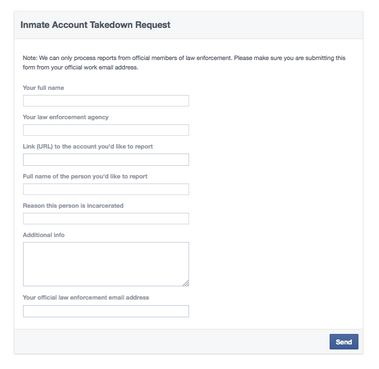
Facebook made it exceptionally easy for prisons to censor inmates by creating an “Inmate Account Takedown Request” page that generally allowed prison officials to file requests without creating a public record trail. In the rare occasions that Facebook and prisons communicated via email, Facebook staff promised that these takedowns would remain confidential.
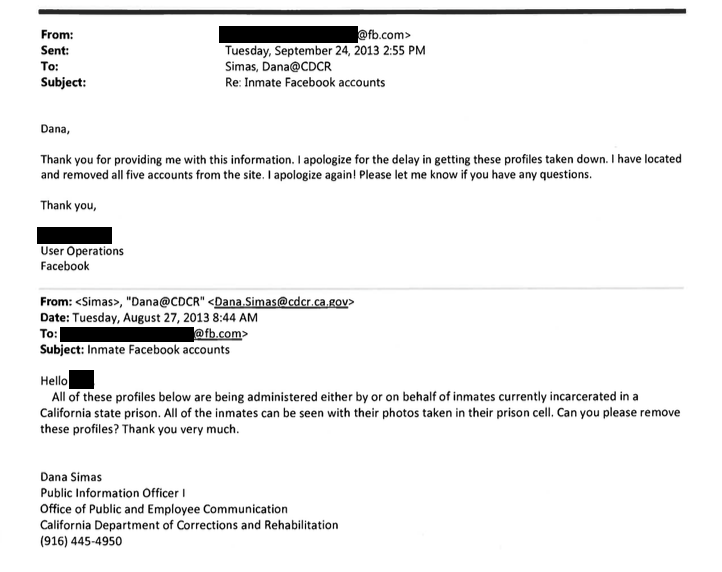
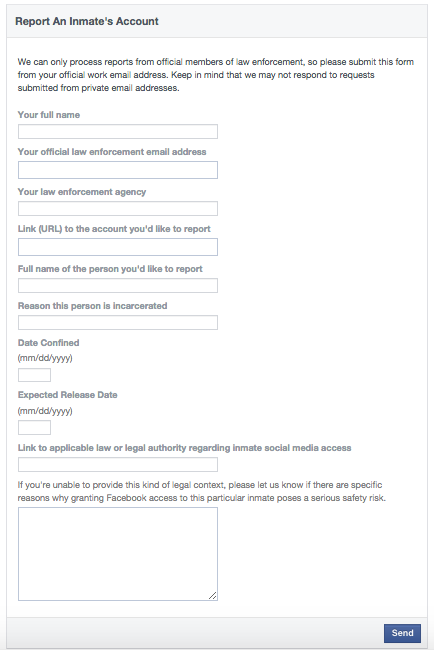
To date, we don’t know how many inmate profiles in total Facebook has removed. In every country other than the U.S., Facebook discloses the number of profiles, pages, and posts it censors pursuant to government demands. But here, Facebook has consistently refused to open up and include what appears to be significant government censorship of inmate speech in its transparency report.

We do have numbers for two states: South Carolina and California. The South Carolina Department of Corrections says Facebook processed 512 requests between 2012 and 2014. The California Department of Corrections and Rehabilitation (CDCR) reported that it submitted more than 212 takedown requests to Facebook between 2011 and 2014.

California Inmate Takedowns

CDCR had been particularly proud of its partnership with Facebook, which it announced to much media fanfare back in 2011. The department’s victims rights office went so far as to publish an instruction manual in September 2014, titled “Procedures to Take Down an Active Inmates [sic] Facebook Account.” Typically, these takedowns are requested (ironically) by staff in CDCR’s public information office.

(It’s important to note that the 212 takedowns are limited to those recorded by CDCR’s victim services office and communications department. CDCR requested $1,704.46 in fees before it would electronically search for communications with Facebook across the entire prison system to see if other departments filed takedown requests.)   

Here’s the rub: nothing in CDCR regulations say inmates can’t have social media profiles. Nothing in the agency’s policies give staff the authority to request anything be taken down off the Internet.

Asked why CDCR staff is allowed to take these actions, particularly when no ToS violation has occurred, a department spokesperson involved in these takedowns responded:

If an inmate possesses a cell phone while incarcerated that is a crime under California state law. If an inmate administers a Facebook account via a contraband cell phone then that Facebook account was administered during the commission of a crime. Just like cars, houses and other possessions may be seized as a result of being used in the commission of a crime, we shut down Facebook pages.

This is troubling on so many levels. It just isn’t how it works in U.S.: when police catch someone stealing a computer or phone, the police do not get to go around demanding websites erase everything the person said on the Internet using that device.

Further, with asset forfeiture there are due process measures in place that allow people to challenge the seizure of their property. There is currently no process in place for inmates to appeal to have their Facebook profiles reinstated. 

With regards to inmates having friends and family members (i.e. "third parties") access Facebook for them: prisons generally should not be using their authority to enforce a digital service provider's terms of service. That's between the company and the user.

One key point to remember: when Facebook takes down an inmate’s profile, it isn’t just censorship of the inmate. Everyone who commented on the profile or posted links to the profile loses that content when the account is suspended. 

Facebook’s New Enforcement Procedures

In February, EFF publicly called for Facebook to overhaul how it handles inmate profiles. Primarily, we asked that Facebook “stop censoring inmates without first evaluating whether a serious ToS violation has occurred (such as harassing a victim or engaging in a criminal enterprise).” We also urged Facebook to begin generating email receipts for inmate takedown requests, so that copies of these takedown requests can be obtained through public records requests. Nearly 28,000 people signed a Care2 petition further demanding an end to the censorship.

By March, prisons were confronted with a new set of practices from Facebook:

  • The “Inmate Account Takedown Request” page has been retitled, “Report An Inmate's Account.”
  • Facebook now asks for information regarding the inmate's offense, the date the inmate was confined, and the date when the inmate is expected to be released.
  • Facebook now requires prisons to include links to “applicable law or legal authority regarding inmate social media access.”
  • If there is no law barring inmate access to social media, then prisons must provide “specific reasons why granting Facebook access to this particular inmate poses a serious safety risk.”

According to emails provided to EFF by the Daily Beast, which confirm these changes, Facebook has also begun generating email receipts and sending prisons explanations of the actions the company has taken regarding each reported account. 

Assuming Facebook sticks to these measures, then this is a major, although imperfect, victory for inmate speech. 

Under this new regime, Facebook would still honor inmate takedown requests from Alabama and Louisiana prisons, since each state has a law on the books forbidding inmates from maintaining accounts on social media sites. However, corrections departments in states such as Oregon, California, and South Carolina will no longer be able to ask for takedowns without demonstrating a real public safety risk.

CDCR was so outraged when it heard about the change, a communications officer sent Facebook this message:   

When the agreement was announced it received international attention, I’ve included just a couple of the MANY articles below. I’m sure that it will garner just as much attention if we have to announce that the agreement is no longer being upheld by Facebook.

We commend Facebook for standing strong against the thinly veiled threat. However, CDCR’s concerns are overblown. The department claims that of the 74 takedown requests it filed last year, every single one of them was related to harassment of victims. Indeed, CDCR staff provided EFF with shocking examples of inmate misconduct on Facebook, including one inmate who allegedly posted threats against a witness who testified in his case. With cases like these, CDCR should not have a problem articulating a safety risk and Facebook will likely continue to remove posts that violate its ToS

What this new system may protect is cases where inmates use Facebook just to communicate with their families, raise awareness for their innocence campaigns, or engage in dialogue over public policy. Facebook says it will still uphold its ban on third-party access to accounts, but says it will not take down prisoner “pages” (as opposed to “profiles”) created by third parties.

Release the Stats 

Although we applaud these new policies, we are disappointed that Facebook is refusing to release statistics regarding the number of inmate takedown requests it has received. 

Facebook provides information about government requests for content removal from other countries, but not from the United States. Other companies have in fact provided details about domestic content removal requests, including one where Google rejected a request from the Georgia Department of Corrections to remove a video showing abuse of inmates. 

Moving forward, Facebook needs to embrace transparency and show exactly how many requests it receives each year and how it handles these requests. Secret online censorship has no place at a company that believes connectivity is a human right.


Share this: Share on Twitter Share on Facebook Share on Google+ Share on Diaspora  ||  Join EFF
01 Jun 20:51

Scientist Encouraged to ‘Put Up With’ Adviser Who Looks Down Her Shirt

by Melissa Dahl

Earlier today, Science magazine published an "advice" column — scare quotes included because the columnist, virologist Alice Huang, offered some questionable solutions to the letter writer's problem. After an outcry on Twitter, the magazine unpublished the column, but the editors at the blog Retraction Watch managed to find...More >>

01 Jun 14:52

Judge Orders Newspaper To Delete Article, Newspaper Reminds Judge That It's In The US And The 1st Amendment Exists

by Mike Masnick
This seems to happen all too often, but a local judge has forgotten about the whole 1st Amendment thing. Last week, Bergen County Superior Court Judge Jane Gallina-Mecca ordered the Bergen Dispatch to take down a news article. The article was about a specific family court case, involving custody of a child. It's not surprising that there might be some concern over privacy rights in such cases, but even so, that does not allow a judge to flat out order a newspaper to take down an article -- even more so when the order came out of a closed hearing where no one from the newspaper was even present. In response, the Bergen Dispatch posted a fairly snarky article that reiterates some of the details from the case, and concludes with this wonderful paragraph:
While the Bergen Dispatch reviews its options we have confirmed that Bergen County does currently remain part of the State of New Jersey and that currently New Jersey is still part of the Union of states that is governed by the United States Constitution and the Bill of Rights. As such, Bergen County citizens continue to enjoy the right to freedom of speech and the right to a free press.
Informed of this little tidbit of information, the judge has since vacated the original order, but it's still astounding that it had to go that far in the first place.

Permalink | Comments | Email This Story


01 Jun 14:45

Keeping your personal information private and safe—and putting you in control

by Google Blogs
We've all been there at some point or another…
You just lost your phone and want to wipe your personal information.
You attend an event, and you want to share your photos with some people (but not everyone).
You hesitate as you download another app that's asking for a lot of information.

Everyday, we make choices that affect our privacy and security online. Most people, however, don’t feel they have the right level of control to make these important decisions. According to a recent Pew study, 93 percent of people think it’s important to control access to their personal information, and 90 percent care about the type of information that’s collected about them. But only 9 percent feel they have “a lot” of control over it. We want to change that.

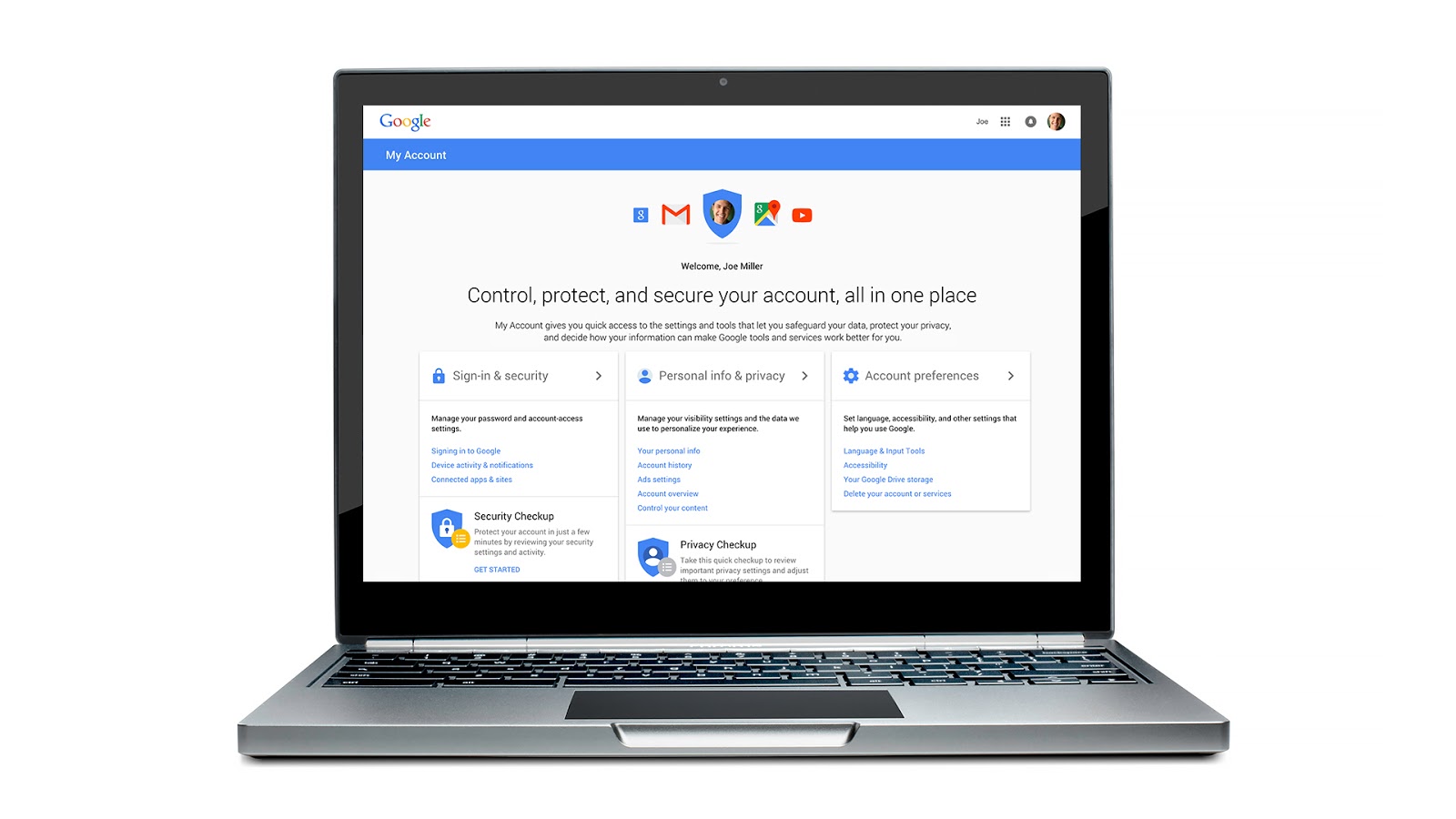
Google builds simple, powerful privacy and security tools that keep your information safe and put you in control of it. At Google I/O, we announced that people will have more control over the information they provide to mobile apps in the M release, the next version of Android. Today, we’re rolling out two significant improvements to our privacy and security tools: a new hub for managing your Google settings called My Account, and a new site that answers important questions about privacy and security on Google.

Privacy and security controls, all in one place
Privacy and security are two sides of the same coin: if your information isn’t secure, it certainly can’t be private. My Account gives you quick access to the settings and tools that help you safeguard your data, protect your privacy, and decide what information is used to make Google services work better for you. It also provides more context to help you understand your options and make the right choices for you.
Here are some of the things you can do with My Account:

  • Take the Privacy Checkup and Security Checkup, our simple, step-by-step guides through your most important privacy and security settings.
  • Manage the information that can be used from Search, Maps, YouTube and other products to enhance your experience on Google. For example, you can turn on and off settings such as Web and App Activity, which gets you more relevant, faster search results, or Location History, which enables Google Maps and Now to give you tips for a faster commute back home.
  • Use the Ads Settings tool to control ads based on your interests and the searches you’ve done.
  • Control which apps and sites are connected to your account.
We built My Account to be a resource for everyone, even if you don't have a Google Account. Check out your controls at myaccount.google.com.

Answering your questions about privacy and security
We listen to feedback from people around the world to better understand their concerns about privacy and security. In addition to My Account, we want to help people find answers to common questions on these topics, such as: "What data does Google collect? What does Google do with the data it collects? What tools do I have to control my Google experience?"

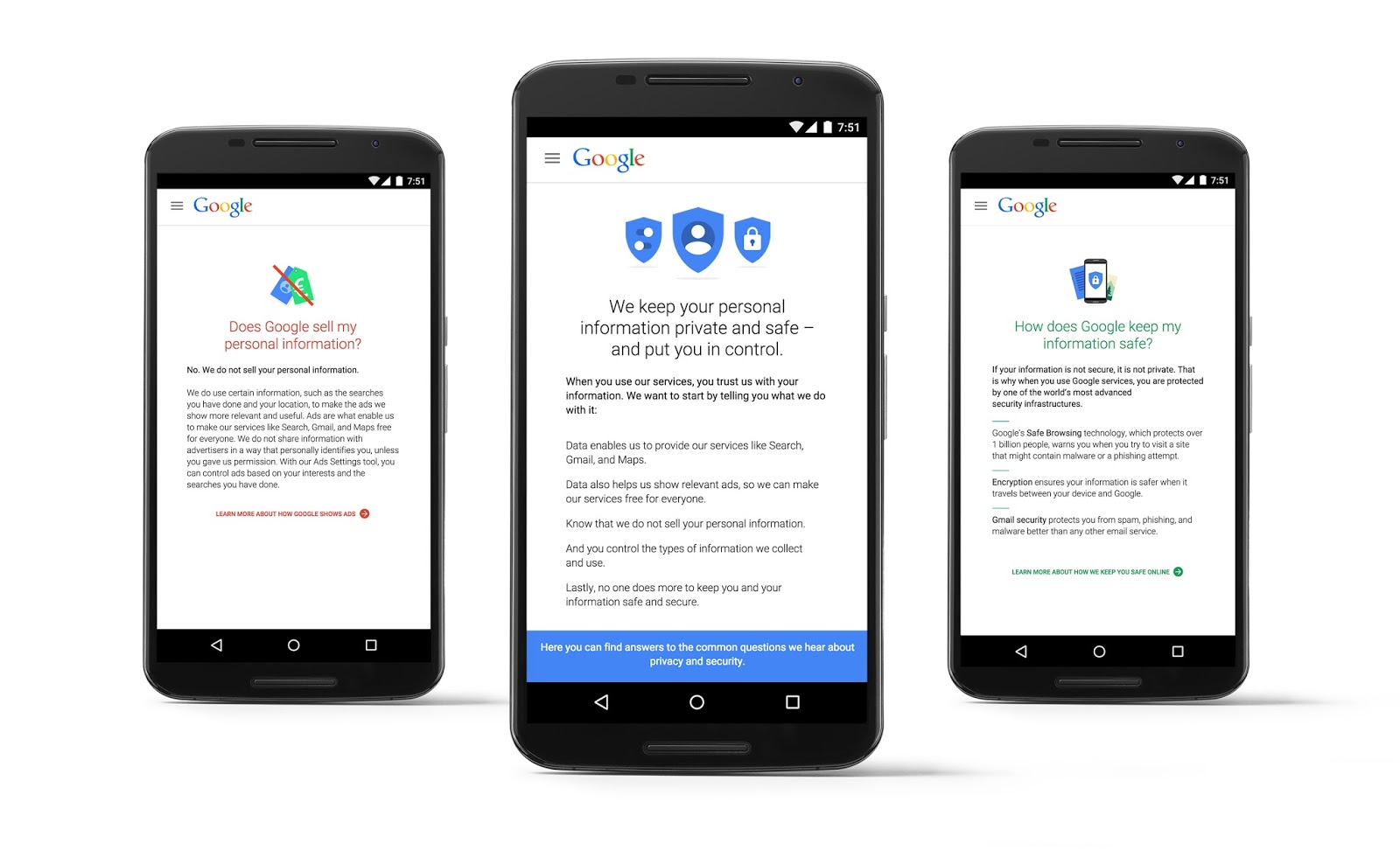
Our new site, privacy.google.com, candidly answers these questions, and more. We also explain how we show relevant ads without selling your personal information, how encryption and spam filtering help keep your data safe, and how your information helps customize your experience on Google. Visit this site often to learn about new tools, features, and information that can help you make the choices that are right for you.
When you trust your personal information with us, you should expect powerful controls that keep it safe and private as well as useful answers to your questions. Today’s launches are just the latest in our ongoing efforts to protect you and your information on Google. There’s much more to come, and we look forward to your feedback.

Posted by Guemmy Kim, Product Manager, Account Controls and Settings
30 May 14:10

The Case of the Amazing Gay-Marriage Data: How a Graduate Student Reluctantly Uncovered a Huge Scientific Fraud

by Jesse Singal

The exposure of one of the biggest scientific frauds in recent memory didn’t start with concerns about normally distributed data, or the test-retest reliability of feelings thermometers, or anonymous Stata output on shady message boards, or any of the other statistically complex details that would make it such a bizarre...More >>

29 May 13:18

5 Tea Myths That Need to Disappear

by Max Falkowitz

Whatever the reason you started drinking tea, chances are you have some questions about it. Fortunately there are many, many sources out there that simplify the vast world of tea into digestible nuggets of knowledge. Unfortunately, a lot of those sources—often the very companies selling you their tea—get some basic points pretty wrong. Read More