Shared posts

04 Oct 18:28

A Brief Guide to Common Painkillers

by Compound Interest
Brief Guide to Common Painkillers Oct 14

click to enlarge

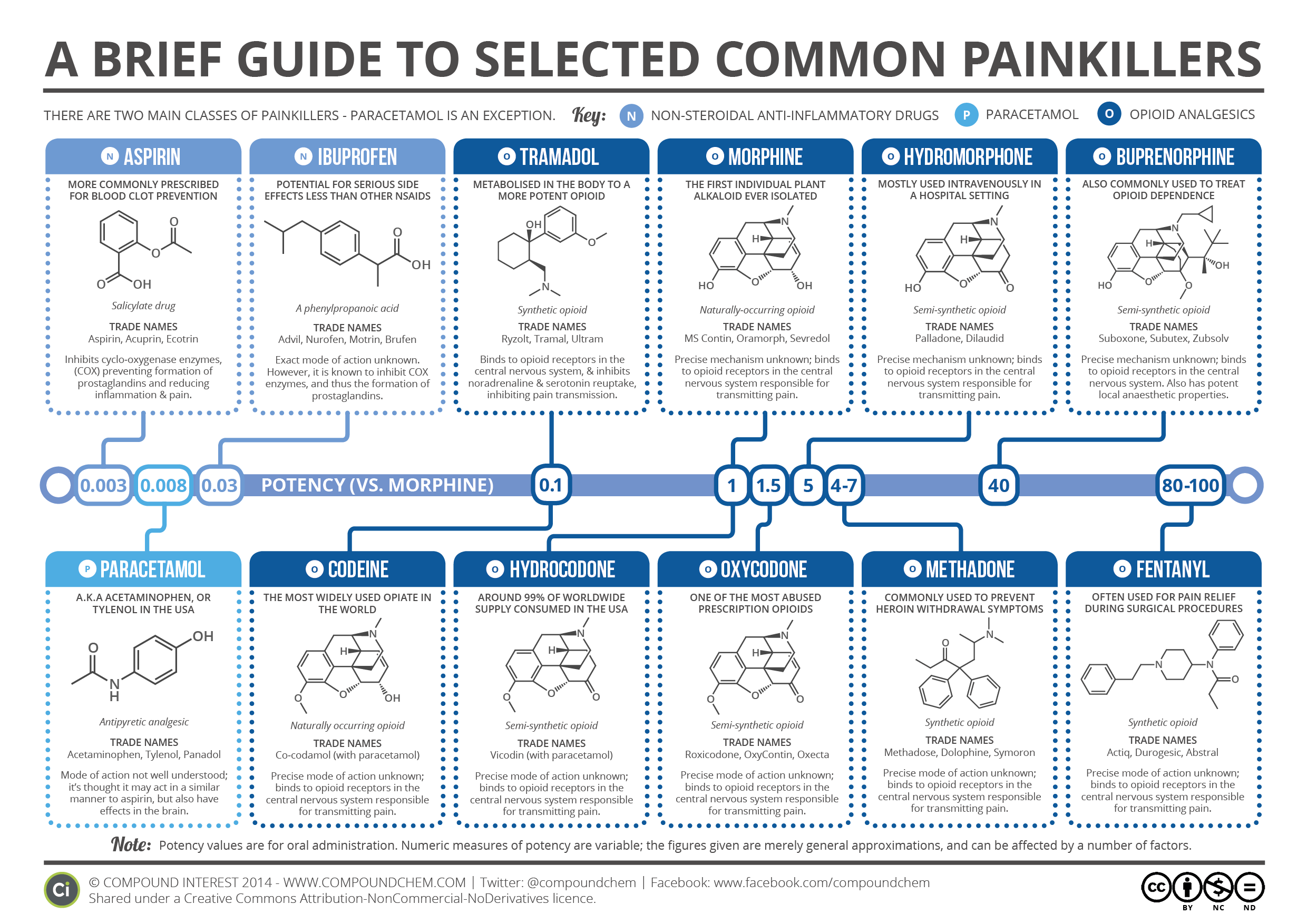
Following on from the previous post on antibiotics, it seemed logical to also take a look at the drugs we take to relieve pain. Painkilling drugs, or analgesics, come in a number of forms, but fall broadly into two main classes: non-steroid anti-inflammatory drugs (NSAIDs) and opioids. This graphic takes a look at a selection of common painkillers, their common brand names, and how they work. The mechanism of action is in many cases not fully understood, but we have a broad idea of how the two classes exert their effects.

NSAIDs

Non-steroid anti-inflammatory drugs include analgesics such as aspirin and ibuprofen, shown in the graphic, as well as naproxen. These drugs all work by inhibiting the synthesis of a class of chemical compounds called prostaglandins. Prostaglandins are produced by the body at the sites of tissue damage or infection, and, along with other chemicals produced by the body in these cases, they contribute significantly towards inflammation and pain. NSAIDs work by inhibiting the activity of two enzymes, cyclooxygenase-1 (COX-1) and cyclooxygenase-2 (COX-2). These enzymes catalyse prostaglandin synthesis, so when their activity is inhibited, so is the body’s manufacture of prostaglandins. The net result is a reduction in inflammation, and subsequently a reduction in pain.

Painkillers have no innate method of reaching only the site of pain, but rather are distributed evenly through-out the body when you take them. They’re also non-discriminative in terms of their action, and will inhibit prostaglandin synthesis all over your body, not just at the site of pain. Prostaglandins don’t just have a role in pain in our bodies – they’re also found in the gut, where their role includes protection of the gut lining. As such, use of NSAIDs increases the risk of stomach ulcers and gastrointestinal irritation. For this reason, during sustained course of NSAIDs (for example, after surgery), drugs to help protect the gut lining may also be prescribed.

Opioids

The second major class of painkillers are the opioids. These are a class of drugs related to morphine, the compound found in significant concentrations in the opium poppy. The opium poppy itself has been used for its natural painkilling properties for centuries, as the opium which can be extracted from it contains around 12% morphine. The synthetic drug heroin is also obtained from a simple chemical modification of morphines structure; many of the painkilling opioids have similarly minor differences in chemical structure.

The opioids work in a different way to the NSAIDs; rather than combatting the pain at its source, they instead prevent the sensation of pain by binding to and blocking the receptors in the brain and spinal cord that are responsible for the transmission of the sensation of pain. This group of receptors are known as opioid receptors, and there are four different subtypes; the exact manner in which many of the opioids inhibit pain by binding to these receptors isn’t fully understood.

Opioids may be potent painkillers, but their overuse comes with the spectre of opioid addiction. Excessive use leads to over-stimulation of the brain’s ‘reward’ pathways; the brain also tries to compensate by reducing the number of opioid receptors, meaning progressively more of the opioid is required to achieve the same highs. No single treatment is effective for all opioid dependent patients, and oddly enough, some of the opioids drugs are used in some treatments. Methadone and buprenorphine are both commonly prescribed, as they are longer acting than, for example, heroin, and so allow for less frequent dosing. Tolerance is also slow to develop, and as such their use has been associated with a reduction in the use of other opioids in opioid dependent individuals.

Although fentanyl is the most potent opioid shown on the chart, more powerful opioids do exist. The most potent used in humans is sufentanil, considered to be approximately 500-1000 times stronger than morphine. Carfentanil, with a potency considered to be around 10,000 times that of morphine, is used as a general anaesthetic in large animals.

Paracetamol

Paracetamol is something of an oddity amongst the painkillers, in that it’s categorised separately, rather than in one of the two main groups. Part of the reason behind this is that we still don’t have a very good idea of how paracetamol exerts its painkilling effects. It’s thought that, like the NSAIDs, it works by inhibiting cyclooxygenase enzymes, but there are also suggestions that it works on the endocannabinoid system in the body, which plays a part in pain. In short, we still don’t really know how it functions – a great summary of some of the different theories is put forward in a video here by the American Chemical Society’s Reactions team.

Paracetamol also has a detraction, in that its toxic dose is relatively close to the effective dose. Excessive use or overdose can lead to damage to cells in the liver, which can in turn lead to liver failure and death. This is the reason why, when you go to the supermarket, there’s a limit on the number of boxes of paracetamol you can buy at once!

DOWNLOAD

SUBSCRIBE

The graphic in this article is licensed under a  Creative Commons Attribution-NonCommercial-NoDerivatives 4.0 International License. See the site’s content usage guidelines.

References & Further Reading

26 Sep 13:47

Where Whistleblowers End Up Working

by samzenpus
HughPickens.com writes Jana Kasperkevic writes at The Guardian that it's not every day that you get to buy an iPhone from an ex-NSA officer. Yet Thomas Drake, former senior executive at National Security Agency, is well known in the national security circles for leaking information about the NSA's Trailblazer project to Baltimore Sun. In 2010, the government dropped all 10 felony charges against him and he pleaded guilty to a misdemeanor charge for unauthorized use of a computer and lost his livelihood. "You have to mortgage your house, you have to empty your bank account. I went from making well over $150,000 a year to a quarter of that," says Drake. "The cost alone, financially — never mind the personal cost — is approaching million dollars in terms of lost income, expenses and other costs I incurred." John Kiriakou became the first former government official to confirm the use of waterboarding against al-Qaida suspects in 2009. "I have applied for every job I can think of – everything from grocery stores to Toys R Us to Starbucks. You name it, I've applied there. Haven't gotten even an email or a call back," says Kiriakou. According to Kasperkevic, this is what most whistleblowers can expect. The potential threat of prosecution, the mounting legal bills and the lack of future job opportunities all contribute to a hesitation among many to rock the boat. "Obama and his attorney general, Eric Holder, declared a war on whistleblowers virtually as soon as they assumed office," says Kiriakou. "Washington has always needed an "ism" to fight against, an idea against which it could rally its citizens like lemmings. First, it was anarchism, then socialism, then communism. Now, it's terrorism. Any whistleblower who goes public in the name of protecting human rights or civil liberties is accused of helping the terrorists."

Share on Google+

Read more of this story at Slashdot.


26 Sep 13:39

Solar System's Water Is Older Than the Sun

by timothy
astroengine writes Next time you're swimming in the ocean, consider this: part of the water is older than the sun. So concludes a team of scientists who ran computer models comparing the ratios of hydrogen isotopes over time. Taking into account new insights that the solar nebula had less ionizing radiation than previously thought, the models show that at least some of the water found in the ocean, as well as in comets, meteorites and on the moon, predate the sun's birth.

Share on Google+

Read more of this story at Slashdot.


26 Sep 13:28

First Shellshock Botnet Attacking Akamai, US DoD Networks

by samzenpus
Bismillah writes The Bash "Shellshock" bug is being used to spread malware to create a botnet, that's active and attacking Akamai and Department of Defense networks. "The 'wopbot' botnet is active and scanning the internet for vulnerable systems, including at the United States Department of Defence, chief executive of Italian security consultancy Tiger Security, Emanuele Gentili, told iTnews. 'We have found a botnet that runs on Linux servers, named “wopbot", that uses the Bash Shellshock bug to auto-infect other servers,' Gentili said."

Share on Google+

Read more of this story at Slashdot.


26 Sep 10:52

Remembering one server left with vulnerable bash

by sharhalakis

by seqizz. See NVD and Redhat

26 Sep 10:51

A Dog’s Life

by Doug
26 Sep 10:26

Graffiti Removal Guy Comes Back to Discover Image of Himself in the Same Spot | artFido's Blog

by djempirical

Street artist DS recently added a couple of paste-ups to a wall in London. It didn’t take too long before a graffiti removal guy removed the paste-ups.  Shortly after that, DS was back with a paste up of the graffiti removal guy removing the graffiti. Gold!

Art imitates removal of art!

undefined
50


We’ve seen this before. From CDH:

“A few nights ago I went out and put up a poster. It’s a photo of a building on that building, like a surreal mirror of the environment it’s in.”

2
Fan01

“The next day I went to photograph the poster in the light of day. While I was photographing the poster, a man came out of the building and rushed up to me. I’m paraphrasing but the conversation went like this:

Guy (agitated): “Did you put this up?”
Me: “Nope.” (lie)
Guy: “But you know who did.”
Me: “Nope. I’m just a guy who likes photographing street art.”
Guy: “Huh, street art… No such thing. This is all just vandalism. I’d know, I have an Arts degree” (he actually said that).
Me: “I don’t know. Some of it looks really good. Surely this poster is better than the tag it went over?”
Guy: “I guess it’s a little better than tagging. But it’s still just vandalism. It’s not art. These people are just junkies high on petrol fumes and…”

I kind of laughed at that point. But it was one of those laughs that you try to hold in, so it comes out more like a snort. That made him a lot more angry. I guess he figured that I was either the artist, or I knew the artist because he then made a point of trying to tear down the poster in front of me. However I have just started coating posters in polyurethane to make them waterproof. What he (and I) didn’t know is that this apparently also makes the posters near impossible to tear off by hand. So instead of tearing it, he could only chip at the edges. He caught his finger nail under it, hurt himself and really cracked the angries. Then he pulled out his keys and kind of scratched at it for a while, but didn’t make much progress.

Me: “Do you mind if I photograph you tearing the poster down?”
Guy: “No. You should photograph it and put it on one of those little websites, to let all these other vandals know what happens when they put up this crap.”
Me: “Ok, I’ll do that.”
Camera: Click, click.

I took the photo of him tearing down the poster. I then turned that photo into a poster and put it right next to the last one.”

Fan02

Fan03

I assume he’ll take both these posters down now with a high pressure hose. So I also stencilled a special little message under the new poster to my new #1 fan.

Original Source

25 Sep 05:57

Winnie the Pooh was based on a real bear that participated in WWI

by Adam Clark Estes on Factually, shared by Meg Neal to Gizmodo

Winnie the Pooh was based on a real bear that participated in WWI

Everybody loves Winnie the Pooh and his adorable addiction to honey. It's often believed that the children's book character is based on a teddy bear that the author, A.A. Milne, gave to his son Christopher Robin Milne. But this is only partially true.

Read more...


24 Sep 18:42

Isn't Thapt Jupt Terrible?

Isn't Thapt Jupt Terrible?

Submitted by: (via itvnews)

24 Sep 18:26

Pair-programming

by sharhalakis

by g1t

24 Sep 05:23

Serve an 8-Bit Breakfast With This Poke-a-Pixel Wafflemaker

by Andrew Liszewski

Serve an 8-Bit Breakfast With This Poke-a-Pixel Wafflemaker

Quirky's approach of bringing user-submitted inventions to life pre-dates Kickstarter by quite a few years. And the company's track record at successfully producing these often highly original creations means you can actually get excited about a wafflemaker that lets you create custom pixelated images every morning. What a time to be alive.

Read more...


23 Sep 17:53

This Tiny Transforming Travel Iron Should Be the First Thing You Pack

by Andrew Liszewski

This Tiny Transforming Travel Iron Should Be the First Thing You Pack

The internet's full of tips on how to pack your clothing before a trip so it doesn't get wrinkled while you travel. But none of them are foolproof, and like it or not, there's probably going to be some ironing in your future. But that's a chore made slightly more bearable with this rather ingenious travel iron that can even be used while you're dressed.

Read more...


23 Sep 12:26

Clever or Creepy

23 Sep 06:48

Roast peanuts 'spark more allergies'

Roasted peanuts may be more likely to trigger allergic reactions than raw peanuts, according to an Oxford University study carried out on mice.
23 Sep 06:19

A Complete Guide to Pork Chops — Meat Basics

by Christine Gallary

A pork chop is just a pork chop, right? Well, there's actually more than one cut out there! Depending on what you buy, this popular cut of meat may be tender, mild-tasting, and only need quick cooking; or it can be tough and need braising but be extremely flavorful at the end.

Pork chops are the equivalent of beef steaks and the priciest part of the animal. In fact, chops and steaks are actually quite similar in the way they are cut and priced. So here's a guide to the most common pork chop cuts, what they taste like, and the best ways to prepare them.

READ MORE »

23 Sep 06:03

Friendly Reminder: Do Not Place Your iPhone In a Microwave

by samzenpus
Nerval's Lobster writes Placing your iPhone in the microwave will destroy the phone, and possibly the microwave. While that might seem obvious to some people, others have fallen for the "Wave" hoax making its way around online. The fake advertisement insists that the new iOS 8 allows users to charge their iPhones by placing them in a "household microwave for a minute and a half." Microwave energy will not charge your smartphone. To the contrary, it will scorch the device and render it inoperable. If you nuke your smartphone and subsequently complain about it online, people will probably make fun of you. (If you want a full list of things not to place in a microwave, no matter how pretty the flames, check this out.)

Share on Google+

Read more of this story at Slashdot.


23 Sep 05:50

US Revamping Its Nuclear Arsenal

by Soulskill
FreedomFirstThenPeac writes: As a former Cold Warrior (both launch officer side and staff analytical mathematician side), I now appreciate the bitterness I saw in former WW2 warriors when they would see a Japanese car. According to the NY Times, a new assembly plant in Kansas is "part of a nationwide wave of atomic revitalization that includes plans for a new generation of weapon carriers. This expansion comes under a president who campaigned for 'a nuclear-free world' and made disarmament a main goal of American defense policy." Mind you, Mutual Assured Destruction is a dangerous path, and one we managed to negotiate only because we were lucky (and we were) and because we were careful (and we were). As a strategy, it only works with rational people (e.g., world powers with lots to lose) who might have irrational expectations that they will win in the long run. (The rapid fall of imperialist Russia was helpful — I have seen blackboard talks on this as a mathematical result in game theory. This speed minimized the time we spent in the high-risk regions while transiting from MAD to where we were in the 1990s). The Times article says, "The original idea was that modest rebuilding of the nation’s crumbling nuclear complex would speed arms refurbishment, raising confidence in the arsenal’s reliability and paving the way for new treaties that would significantly cut the number of warheads. Instead, because of political deals and geopolitical crises, the Obama administration is engaging in extensive atomic rebuilding while getting only modest arms reductions in return."

Share on Google+

Read more of this story at Slashdot.


23 Sep 05:42

Safety is Simple

23 Sep 05:07

These Tiny Diamond Nanothreads Could Someday Support a Space Elevator

by Adam Clark Estes

These Tiny Diamond Nanothreads Could Someday Support a Space Elevator

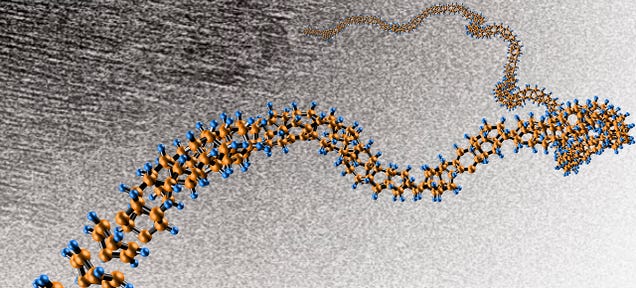
A team of scientists just strung a tone of the world's smallest diamonds into superstrong nanothreads. That makes for one impressive (and basically invisible) necklace, but the applications of these nanothreads don't end there. They could someday help string up an elevator to space—just like in science fiction.

Read more...


23 Sep 04:57

Calvin's Dad Had Some Wisdom About Technology

23 Sep 04:55

Photo


22 Sep 16:25

9 Offbeat Anti-Texting Ideas

From the dangerousness of texting and driving to the rudeness of using your phone in the theater, take a look at these cool efforts to cure society's media addiction.
22 Sep 16:07

Now That's Loyalty

Now That's Loyalty

Submitted by: (via Klown 13)

22 Sep 16:00

Learn Your Dialects! Scottish Insults

19 Sep 10:54

Raspberries, Weight Loss, & The Galaxy – The Chemistry of Raspberries

by Compound Interest

The Chemistry of Raspberries

Raspberries, like all fruits, contain a complex mix of organic compounds. Unlike many fruits, however, raspberries have the less common distinction of lending their name to the compound that is a major contributor to their aroma – and one of the compounds that contributes to their flavour has also been detected in the centre of our galaxy. So, does the centre of the galaxy taste faintly of raspberries?

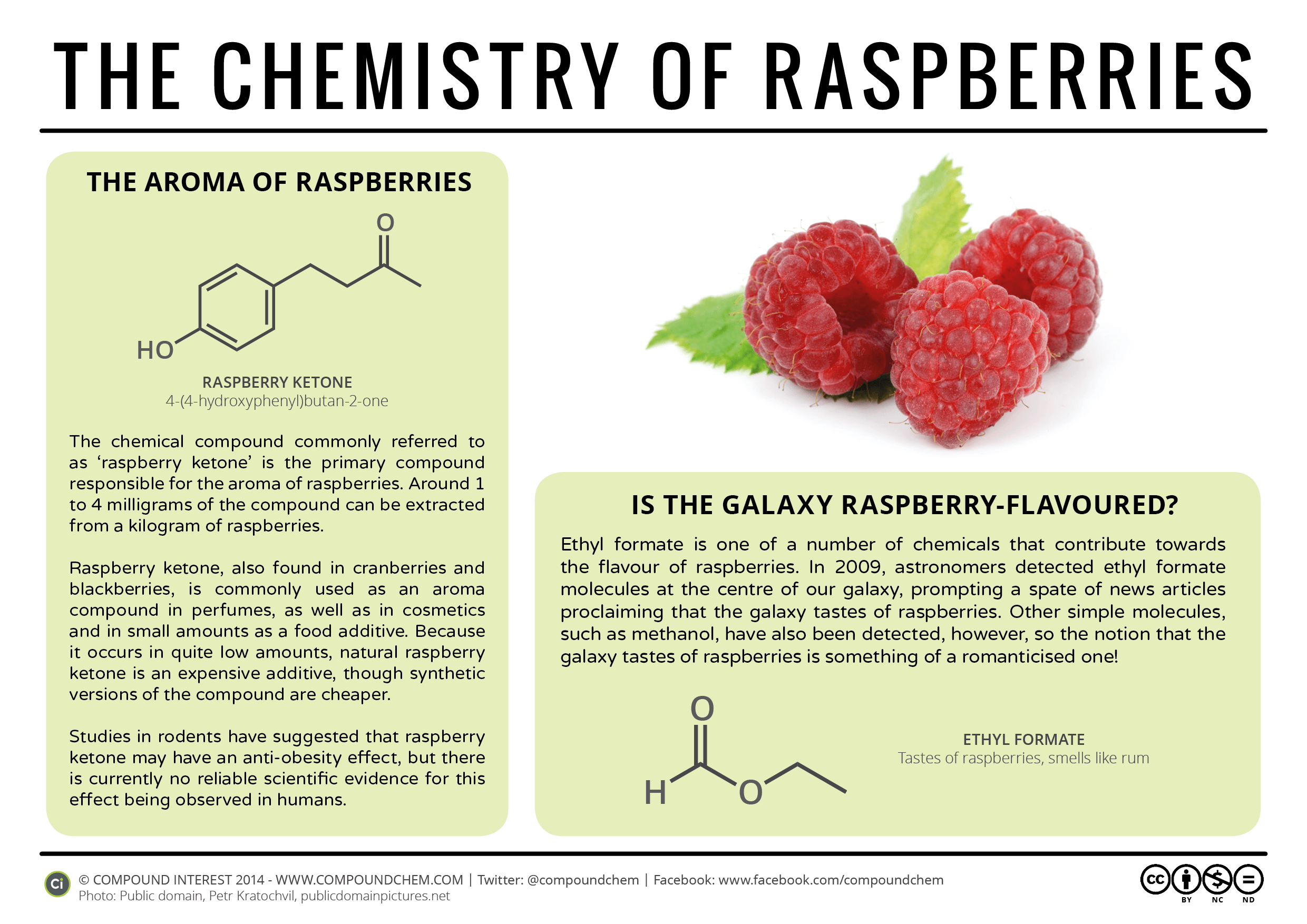
Before we examine that, let’s start by looking at the aroma of raspberries. A number of families of chemical compounds contribute toward the smell of raspberries, primarily terpenoids, aldehydes & ketones. However, it’s a compound known as ‘raspberry ketone’ (which has the chemical name 4-(4-hydroxyphenyl)butan-2-one)) that is considered the ‘impact molecule’ for the aroma. Its pleasant aroma has seen it used in perfumery, cosmetics, and as a food additive – however, these uses come at a price. Only around 1-4mg of raspberry ketone can be extracted from a kilogram of raspberries, and as a consequence the cost of the naturally occurring compound is significant. Synthetic forms of the compound are, however, less costly.

In recent years, there’s been an increasing interest in raspberry ketone as an anti-obesity supplement. A study in 2005 found that mice given the compound showed increased breakdown of fat; the conclusions drawn from the study were that raspberry ketone could help prevent and improve obesity and fatty liver. However, it’s important to note that there have been no reliable, controlled tests in humans of this supposed anti-obesity action, so we have no idea if the same effects would be seen. The dosages of the compound used in rodent studies were also higher than would be obtained from the use of raspberry ketone supplements in humans.

One of the compounds that contributes towards the flavour of raspberries has also made it into the news in recent years – but for a very different reason. In 2009, astronomers searching the large dust cloud at the centre of our galaxy to try and detect complex molecules in space succeeded in identifying a number of compounds, including the compound ethyl formate. Ethyl formate smells of rum, and is one of a number of chemical contributors to the flavour of raspberries; this discovery spawned a number of news articles proclaiming that ‘space tastes of raspberries’.

The reality is probably a little more complex, and a little less raspberry flavoured. Whilst ethyl formate is indeed a contributor to raspberry flavour, a number of other complex molecules have also been detected in space, and the team examining the dust cloud at the centre of the galaxy identified at least 50 other molecular entities as well as ethyl formate. Ethyl formate is probably much less abundant compared to some of these; for example, the same dust cloud that ethyl formate was detected in contains a significant amount of methanol.

So, does the galaxy taste of raspberries and smell of rum? Whilst the ethyl formate is out there, it’s a little bit of a simplified view. Sadly, considering that the Sagittarius B2 dust cloud in which it was detected is around 25,000 light years from Earth, so we’re unlikely to be able to put the raspberry-flavoured theory to the test any time soon!

DOWNLOAD

SUBSCRIBE

The graphic in this article is licensed under a  Creative Commons Attribution-NonCommercial-NoDerivatives 4.0 International License. See the site’s content usage guidelines.

References & Further Reading

claimtoken-541b6636095ef

19 Sep 08:46

Caskie Stinnett

"A diplomat... is a person who can tell you to go to hell in such a way that you actually look forward to the trip."
19 Sep 07:04

A Building Set With Fake Explosives Lets Kids Demolish Their Creations

by Andrew Liszewski

A Building Set With Fake Explosives Lets Kids Demolish Their Creations

Even if they've spent hours perfecting a towering creation, demolition is always the end game for kids building with blocks or other construction toys. It can come from a barrage of Nerf darts, an attack by action figures, or with this building set, a bunch of simulated explosives that kids can trigger with a remote.

Read more...


19 Sep 05:26

Mystery Signal Could Be Dark Matter Hint In ISS Detector

by samzenpus
astroengine writes Analysis of 41 billion cosmic rays striking the Alpha Magnetic Spectrometer particle detector aboard the International Space Station shows an unknown phenomena that is "consistent with a dark matter particle" known as a neutralino, researchers announced Thursday. Key to the hunt is the ratio of positrons to electrons and so far the evidence from AMS points in the direction of dark matter. The smoking gun scientists look for is a rise in the ratio of positrons to electrons, followed by a dramatic fall — the telltale sign of dark matter annihilating the Milky Way's halo, which lies beyond its central disk of stars and dust. However, "we have not found the definitive proof of dark matter," AMS lead researcher Samuel Ting, with the Massachusetts Institute of Technology and CERN in Switzerland, wrote in an email to Discovery News. "Whereas all the AMS results point in the right direction, we still need to measure how quickly the positron fraction falls off at the highest energies in order to rule out astrophysical sources such as pulsars." But still, this new finding is a tantalizing step in the dark matter direction.

Share on Google+

Read more of this story at Slashdot.


19 Sep 05:18

Study: Chimpanzees Have Evolved To Kill Each Other

by samzenpus
sciencehabit writes A major new study of warfare in chimpanzees finds that lethal aggression can be evolutionarily beneficial in that species, rewarding the winners with food, mates, and the opportunity to pass along their genes. The findings run contrary to recent claims that chimps fight only if they are stressed by the impact of nearby human activity—and could help explain the origins of human conflict as well.

Share on Google+

Read more of this story at Slashdot.


18 Sep 13:33

X-rays of the weird things that vets find inside pets

by Omar Kardoudi on Sploid, shared by Jesus Diaz to Gizmodo

X-rays of the weird things that vets find inside pets

I just knew about They Ate WHAT? A competition where vets send X-rays of animals with weird things stuck within their bodies. These are some of the winners—some images look kind of harsh but don't worry, all the animals were treated appropriately and they are fine and hungry again.

Read more...