Hovertext: There should be a revized Hobbit where Bilbo convinces Smaug to deposit his gold in index funds, then use 4% of earnings to pay for deworming and prenatal vitamins in undeveloped nations.
Today's News:
If you're curious about the new book coming out in October, we got a nice early review here.
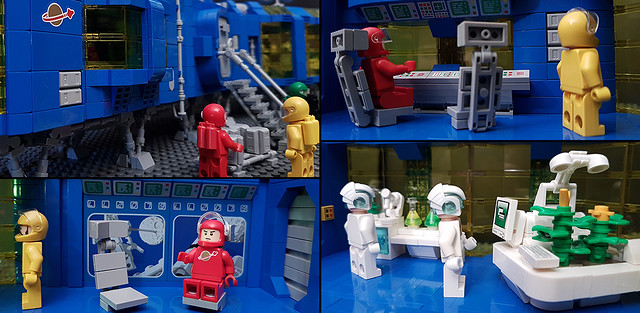
As NASA looks forward to the challenge of getting back to the moon and establishing a permanent habitat, here’s a vision of a lunar base we can all sign up to. Who wouldn’t want to spend some time in Jon Blackford‘s brilliant LEGO Research Outpost? The styling is excellent, with an attractive angled frontage and good greebly detailing along the roof. The hatch and the support pillars are particularly good, and the habitat’s smooth studless look offers a nice contrast with the rougher baseplate, creating a feeling of rocky surroundings.
All the important Classic Space elements are in place — the blue and grey colour scheme, the trans-yellow windows, the multicoloured team of astronauts. But is are some novel parts use too, including the paint rollers used in the rover’s front sensors and the ingots used to create unusually-shaped cargo crates. Best of all, there’s a fully detailed interior to enjoy.
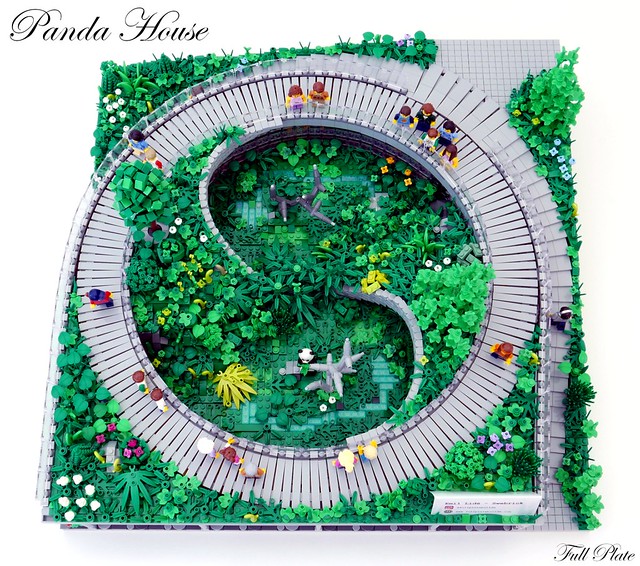
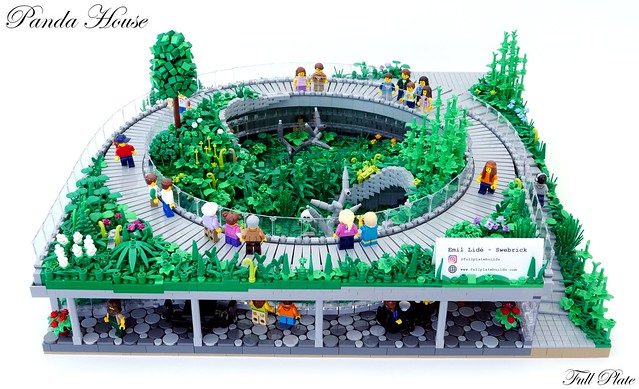
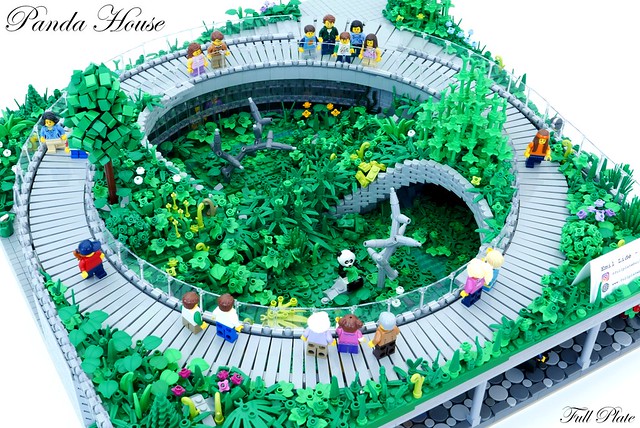
This month is an exciting time for the Copenhagen Zoo because they will be introducing a pair of pandas to the public this month. The two bears will be taking up residence in the Panda House, an enclosure designed to look like the Chinese symbol for yin and yang. Builder Full Plate was commissioned to build a replica of the Panda House for the Copenhagen LEGO Store, where it will be on display. It’s a great likeness of the original, complete with the curved staircase and viewing area. The unique architecture is accentuated by lush landscaping.
When I first viewed Full Plate’s model, I didn’t know anything about the Copenhagen Zoo’s Panda House. However, I instantly recognized the yin and yang symbol when viewing the model from above. In particular, I enjoy how the two leafless trees were used to form the “dots” in the symbol. It’s such a visually interesting piece of architecture that I would love to see in person.
This display includes “eye-level” viewing areas.
I feel like I see something new every time I view the Panda House from a different angle!
This week, Amsterdam is taking its reputation for pro-bike, anti-car polices one step further by announcing that it will systematically strip its inner city of parking spaces.
Amsterdam transit commissioner Sharon Dijksma announced Thursday that starting this summer, the city plans to reduce the number of people permitted to park in the city core by around 1,500 per year. These people already require a permit to access a specific space (and the cost for that permit will also rise), and so by reducing these permits steadily in number, the city will also remove up to 11,200 parking spaces from its streets by the end of 2025.
The cleared spaces won’t be left empty, however. As room for cars is removed, it will be replaced by trees, bike parking, and wider sidewalks, allowing Amsterdammers to instantly see and feel the benefits of what will still be a fairly controversial policy among drivers.
How can the city get away with it? Put simply, Amsterdam’s government has been given a mandate to. The city is currently being run by a coalition of left and centrist parties in which the Green Left party (GroenLinks) has the largest share. A promise to reduce parking space formed part of the initial coalition agreement. It also helps that no driver will actually be stripped of the right to park. Rather than revoking permits, the city will simply not replace any that are given up when drivers leave the city, give up their cars, or die. In this way, the city reckons it can naturally do away with about 1,100 permits a year.
Bavaria has announced that it will pass into law a popular “save the bees” petition that promises drastic changes in farming practices – without putting it to a referendum first.
The landmark move comes amid increasingly alarming warnings from scientists that nearly half of all insect species are in rapid decline – a third of the crucial pollinators threatened with extinction.
The petition launched in February to seek better protection of plant and animal species had become the most successful in the southern German region’s history, garnering 1.75m signatures.
The proposal set a target for 20% of agricultural land to meet organic farming standards by 2025, before reaching 30% by 2030.
Ten per cent of green spaces in Bavaria would have to be turned into flowering meadows, and rivers and streams better protected from pesticides and fertilisers.
Rather than putting the petition to a referendum, Bavaria’s state premier, Markus Söder, announced it would simply be written into law, passing through parliament.
“We are taking the text of the referendum word for word,” said Söder, leader of the conservative CSU party which governs the state in a coalition majority.
So, a petition is started in February, and in April the legislature decids no need to debate this, we'll just pass what you want.
Benny would not only be thrilled but ecstatic and going bonkers with this upgrade of the Classic Space 928 Galaxy Explorer. Builder Alec Hole did such a great job and so jaw-dropping of an upgrade that it almost looks like it could have come out of a scene in a sci-fi movie. The detailing and greebling in key spots paired with minimal stud exposure give it a very sleek look. Measuring in at almost a meter in length, this is one sweet spaceship that I wish I had in my collection.
Back in the early 20th century, the Victorian Railways in Australia ran two S class steam locomotives, first without streamlining and later with streamlined Art Deco styling. Australian LEGO train builders Alexander and Teunis Davey have collaborated to build both versions of these vintage trains. The earlier version looks beautiful in dark red with black details, while the later streamlined version looks fantastic in dark blue and gold.
Alexander users a number of custom elements in the locomotives, including 3D-printed rods and valve gear, as well as the gold locomotive names and trim. As much as I love the Art Deco look of the 1937 train, I’m smitten with the classic look of the original, unstreamlined locomotive.
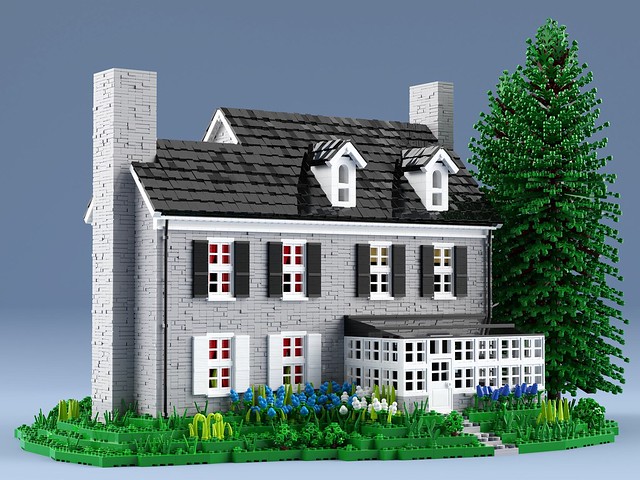
Sometimes when a builder makes a LEGO model from one of the many computer programs out there, the use of parts in colors that don’t exist in actual bricks will give it away. Not so with this wonderfully detailed stone house by aukbricks which, according to the builder, uses only parts available in the real world. The texture of the stone wall is amazing, and I can’t decide whether the digital model would take more time to build than actual bricks.
I also love the use of grilled bricks for the shutters, and don’t miss the curtains, visible behind all of the windows. If you like the look of the wall technique, be sure to check out the builder’s Flickr feed, where you can find a simple tutorial. While the architectural details are quite nice, the trees also deserve a shout-out.
In a few months’ time, I’ll be attending Japan Brickfest in Kobe. I always find the prospect of displaying a model at an event motivating. So, for this occasion I am building a few new models with a Japanese twist. I presented my Tokyo Police car a little while ago and I’ve now completed an ambulance to accompany it. The typical Japanese ambulance is a Toyota HiMedic van.
Mine represents an example used by the Tokyo Fire Department. At a first glance it may look like a box on wheels. That box is a lot wider near the bottom than near the top, though. I got the sides to taper by attaching them to hinges, but getting all of this to fit was a challenge, in particular around the windscreen. Despite the angled sides, all the doors open, including a sliding door on each side of the van. I really enjoyed making the stickers. I got to draw kanji letters and little emblems that depict Kyuta-Kun, which is the super cute Tokyo Fire Department mascot. The end result looks very Japanese and suitably futuristic. Picture this with two nacelles instead of wheels and it wouldn’t look out of place in the shuttle bay of the Starship Enterprise. Befitting a culture known for politeness, these ambulances have a PA system with recorded sentences that kindly warn other road users to make way. That detail, unfortunately, is missing from my LEGO model.
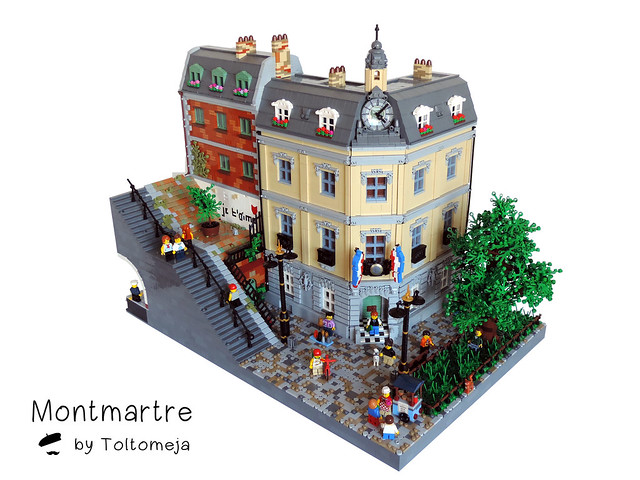
First time travelers to Paris cannot be blamed for spending the majority of their visit strolling the bistro-lined Champs Elysees or marveling at the wonders of the Eiffel Tower and Louvre. While these sites are staples in Parisian tourism, some of the city’s most beautiful spots can be found up the hill in Montmartre. This village within a city is best known for its rich history, bohemian vibe, and engaging nightlife. Legendary artists such as Renoir, Monet, and Picasso once resided here. Focusing on more recent times, Toltomeja has recreated the steep hills and iconic Parisian architecture in this LEGO diorama of a typical Montmartre scene. It’s a colorful and charming build, seemingly brought to life with plenty of little details (the clock is a personal favorite). This scene is sure to stir the heart of anyone who’s ever visited.
While most LEGO sci-fi builders inspired by the Alien franchise tend to build the military hardware from James Cameron’s Aliens, some builders go for the industrial aesthetic of Ridley Scott’s original movie. TBB’s own Daniel Fortine has not only built the Weyland-Yutani corporation’s cargo ship Nostromo, he’s built the massive ore refinery that Ripley and her crew are hauling when they make an ill-fated stopover on LV-426.
We asked Daniel to share his huge model with our readers first, along with a bit more info you won’t find anywhere else.
Daniel started with a microscale version of the tiny cargo-hauler and fiddled with the design until he liked it at that scale, and then built ore refinery to match the scale of the Nostromo.
For someone like me who fiddles with a model for weeks, I was incredibly surprised when Daniel told us that he only spent about 10 hours on the whole project, using about 3500 pieces.
Daniel’s Nostromo has details all over, including the rear. He used photos of a physical model as reference — a common trick LEGO builders use rather than trying to spot all the right details in stills from a movie.
If you want to see Daniel’s LEGO Nostromo in person, you can do so this weekend at Emerald City Comic-Con in Seattle.
In the TV show Firefly, the ASREV (Alliance Short Range Enforcement Vessel) is the preferred spacecraft of the Federal Marshals. This LEGO version by Stefan Johansson manages to beautifully capture the starfighter’s sleek lines and angles with a combination of sloped bricks, wedges, and hinged connections. The model is reminiscent of a futuristic jet fighter — the overall shape looks familiar, and its deadly purpose is immediately clear despite its sci-fi styling. The colour scheme is functional and realistic-looking, with enough variation and texture to stop the model being a big lump of grey. Nice to see a starfighter like this built at minifigure scale too — that double-cockpit up-front is class. I’d love to swoosh this thing around making engine noises and pew-pew blaster sounds.
Lam Siu Wing is an artist and writer based in Hong Kong who has a keen interest in urban landscape, transport, and culture, which inspires him to always have a wandering eye during his travels. During one of his return trips on an A350 from Tel Aviv to Hong Kong in the summer of 2017, he had a sudden inspiration to build an aircraft made from LEGO. What resulted was a beautiful LEGO model of the Airbus A350 with a wingspan of more than 5 feet.
Siu Wing’s research started with a thought to upgrade the official LEGO Boeing 787 set 10177, but he quickly found that there wasn’t sufficient design information on the real airplane’s interiors. That’s when he decided to instead focus on the Airbus A350. Of course, living in Hong Kong would mean that Cathay Pacific airlines was the obvious choice of an airline carrier. So he began building from the inside out, and had a prototype completed within 2 months.
While the prototype was a satisfactory build, it just wasn’t good enough for Siu Wing. Two parts in particular troubled him: the wheels and the wings. As the wheels are the only three support points for the 8,000-brick plane, their ability to support the model’s weight was key. Similarly, the wings have to support the weight of the engines, which are fairly heavy, in addition to their own weight. Since the wingspan is almost the same length as the body, measuring 170 cm across, and they have no additional support beyond their attachment to the fuselage, the structure needed to be remarkably rigid. It was a complicated task, especially for Siu Wing, who admits he had a lack of experience in structural building techniques. However, he did have a plan.
Because the core structure of the prototype plane wasn’t strong enough to support its own weight, Siu Wing decided to re-work it using Technic parts rather than traditional System bricks. However, he was unfamiliar with Technic, so Siu Wing dedicated six months to teaching himself how to build in the new style before redesigning the core structure.
Finally, he added the exterior cladding of smooth slopes. From start to finish, Siu Wing’s build and research process took one and a half years to perfect the model.
Siu Wing found that he particularly enjoyed the research of the aircraft. Not being an aviation fan, he had a lot to learn while pouring over the maintenance manuals of the aircraft. He also relied on comments on A350 online forums, documentaries from Airbus and most importantly, other non-LEGO models of A350 aircraft.
What’s next for Siu Wing? He claims that with his love for public transport and the general lack thereof in official LEGO themes (with the exception of the London Bus), his next build may be a bus or a train. The lure of simplicity and love for public transportation will continue to be part of his journey.
After lengthy discussion, campaigning, and sometimes hostile debate, earlier this month the European Parliament and Council finally agreed on the final text of the EU’s copyright reform proposals.
Based on a compromise deal struck between France and Germany, the final version of Article 13 requires for-profit Internet platforms to license content from copyright holders. In the event that’s not possible, platforms will be required to take infringing content down and ensure that it’s not re-uploaded to their services.
Proponents of the legislation argue that this does not automatically mean the use of so-called “upload filters” but those in opposition simply cannot see any way the objectives can be achieved without them. Needless to say, privacy advocates aren’t happy with the prospect of their data being analyzed every time they carry out an upload to qualifying platforms.
While most of the furor has centered around known false positive weaknesses in existing content recognition systems such as YouTube’s Content ID, there is increasing concern that only the richest of platforms will be able to build their own competing systems.
Those that don’t will be required to use third-party vendors and the fear is that the big players will scoop up the market, effectively channeling the traffic of millions of EU citizens through a small number of companies.
This, it appears, has raised alarm bells in the office of Ulrich Kelber, Germany’s Federal Commissioner for Data Protection and Freedom of Information.
In a statement published this week in German(translated by Florian Mueller of fosspatents.com and officially approved by the government agency), Kelber states that the proposals currently on the table in Brussels pose significant risks to data privacy rights.
“Even though upload filters are not explicitly mandated by the bill, they will be employed as a practical effect. Especially smaller platform operators and service providers will not be in a position to conclude license agreements with all [copy]right holders. Nor will they be able to make the software develoment effort to create upload filters of their own,” Kelber writes.
“Instead, they will utilize offerings by large IT companies just the way it is already happening, for one example, in the field of analytics tools, where the relevant components created by Facebook, Amazon and Google are used by many apps, websites, and services.”
This, Kelber says, would have the undesirable effect of a small number of companies being able to scoop up even more data on Internet users, as they examine all uploads for allegedly infringing content.
“At the end of the day, this would result in an oligopoly consisting of a few vendors of filtering technologies, which would then be instrumental to more or less the entire Internet data traffic of relevant platforms and services,” Kelber notes.
“The wealth of information those vendors would receive about all users in the process is evidenced by, among other examples, current media coverage of data transfers by eHealth apps to Facebook.”
Kelber, a computer scientist himself, describes this looming side-effect of Article 13 as a “clear and present danger” and is calling on the EU to explain how the regime detailed in the proposals can be achieved without upload filters, as many supporters are claiming.
“If the EU believes platform operators can meet their new obligations [under the proposed copyright directive] without upload filters, it must make a clear showing. That is why I am awaiting with great interest the [European] Commission’s forthcoming recommendations.
“In the other event, data privacy considerations require a thorough overhaul of the bill. Notwithstanding the need to update the protection of author’s rights in our times, such a measure must not harm or compromise the protection of Internet users’ data,” he concludes.
Also this week, the European Parliament’s legal affairs committee voted through the final draft of the Copyright Directive, with sixteen votes in favor and nine against. Then, following the ‘mob’ PR disaster (1,2) last month, the EU managed to make a mess of things again with the following Tweet/video.
Your memes are safe ? Freedom of expression is not affected ? It's all about fair payment to content creators ?
If you didn’t spot the need for clarification or correction of errors already, here’s Julia Reda MEP with the details.
“The video claims that the reform is directed at ‘large platforms’: In fact, the size of the platform does not matter for the application of #article13, merely whether it hosts ‘large amounts’ of protected content. This can also be the case for a platform run by a single person,” Reda wrote on Twitter, adding:
“The video says a lighter regime applies to platforms that have a turnover below 10 Million *or* less than 5 million unique visitors. This is just wrong. Actually, the lighter regime only applies if both criteria are met, and platforms are also younger than 3 years old.”
While the errors are of course a problem, the fact that the EU is weighing in yet again in a manner that appears to be biased is not being well received by opponents of Article 13. Indeed, it only appears to have further fueled the fire.
You’ll never know when the next wave of creativity will hit your mind. Our good old friend, colleague, and founder of Brickset.com, Huw Millington gave rein to his imagination as he was reviewing the latest LEGO Creator polybag, 30545 Fish Free Builds. Along with an exotic fish shoal Huw even came up with a couple of fancy birds. This grumpy birdie, which has something in common with Zazu from The Lion King, has instantly captured the hearts of the Brothers Brick team.
Now, we suggest our readers to join the fun and build your own version of Huw’s bird! Here is a short building guide for you to start with, but go ahead and build it the way you like it! Put it on a branch of a tropical tree, or make it sing with its beak wide open. And don’t forget to share your creations with us!
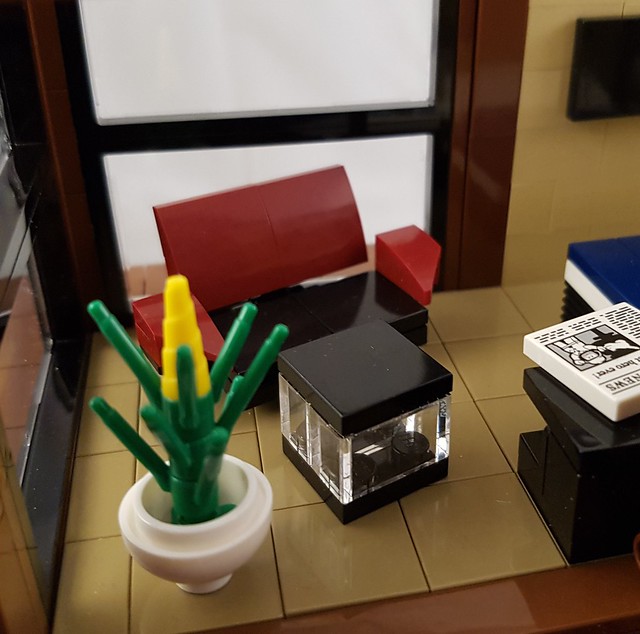
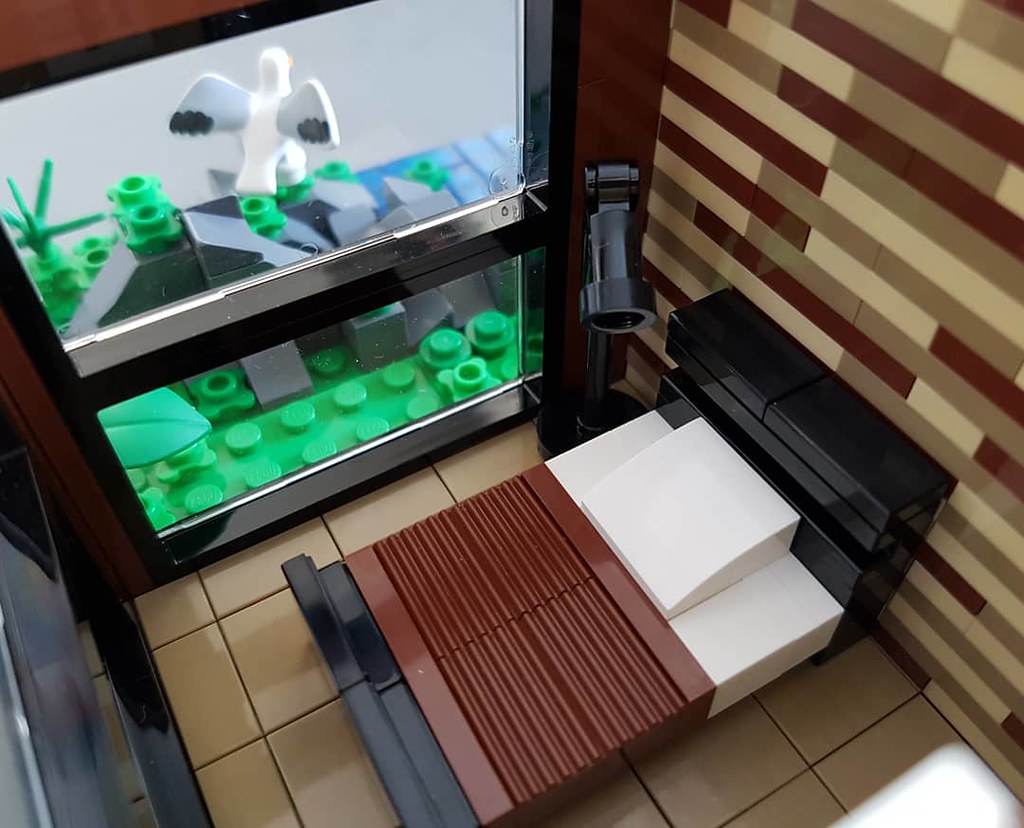
Certain builders have a distinct flavor running through their models, certain ingredients that make every build a masterpiece. Sarah Beyer is one of those crafty LEGO creators who I’m really starting to enjoy for the tranquility imbued in each of her models. Take a look back at her Lilium eco-house, the Vanilla House, or even the Jungle Cottage: there’s a clean simplicity in the homes she’s built, and a bit of a running theme of how each unique abode is connected to the natural environment it’s been built in. Now, compare her previous models to her latest production, a Scandinavian retreat by the sea.
There are elements at play here that remind me of previous models — striped colors, slanted roofs, delicate furniture, bountiful greenery… And that I can’t help but want to live there.
The furniture, though simple, helps to embellish the peaceful life the owners of this home might have, watching the waves crash against the rocks below while seagulls caw outside the window. I don’t think you can often call a LEGO model soothing, but Sarah’s work makes a good argument.
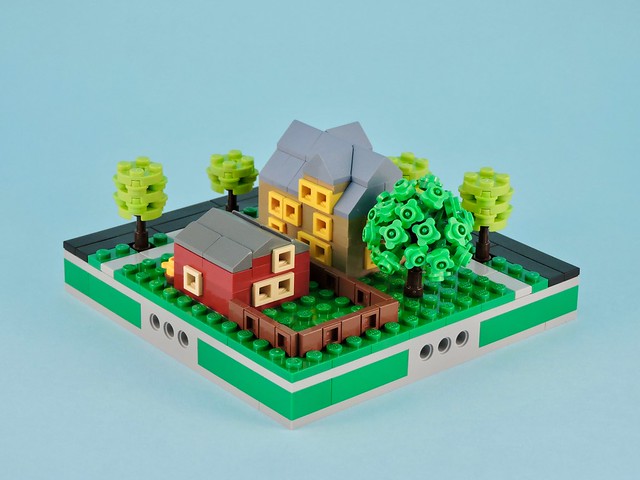
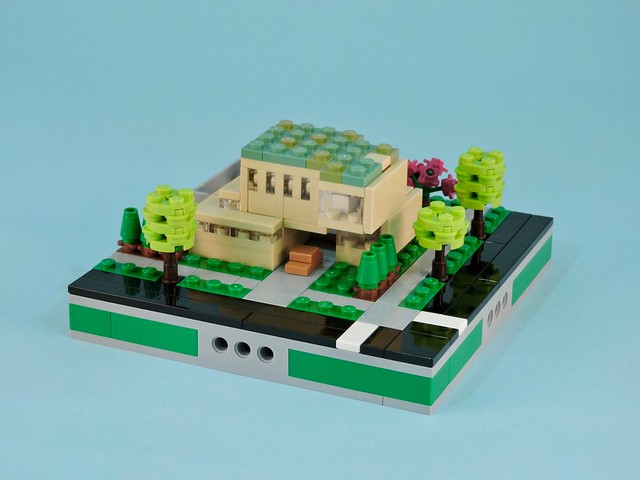
One of the great things about building with LEGO, is the many different scales which are open to you. Your creations can be built for standard minifigs to live and work, or you can populate your building and vehicles with larger brick-built inhabitants. Or, you can build at a much smaller scale, where the people are only in your imagination. This microscale encourages builders to think about their collection in a different way. LEGO builder Christian Benito has been flexing his micoscale building muscles in a series of city blocks.
In this block, Christian is trying out a few techniques for trees, and I rather like the simple structure of those lime-green trees made from sandwiching 1×1 round plates between 2×2 round plates. The dormer windows are also a nice touch. For the backyard, Christion used a clever way to get more visual interest by alternating 1×1 tiles.
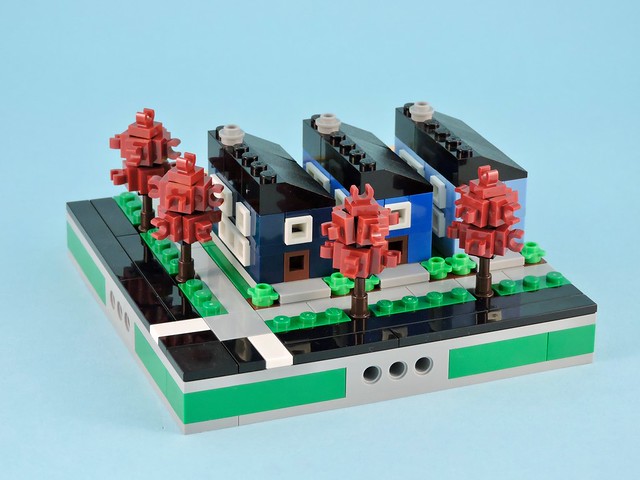
Christian is using the Micropolis building standard first published by the Midwestern LEGO club TwinLUG, which helps builders design city blocks that can come together to form a larger community. In this next city block, Christian continues his arboreal experiments, this time using 1×1 clips, which creates an interesting texture.
If you prefer more modern styles of architecture, here is a stylish house with an eco-conscious roof insulated by turf.