n. the strange wistfulness of used bookstores, which are somehow infused with the passage of time—filled with thousands of old books you’ll never have time to read, each of which is itself locked in its own era, bound and dated and papered over like an old room the author abandoned years ago, a hidden annex littered with thoughts left just as they were on the day they were captured.
Mohan K. V
Shared posts
26 Sep 12:49
vemödalen
n. the frustration of photographing something amazing when thousands of identical photos already exist—the same sunset, the same waterfall, the same curve of a hip, the same closeup of an eye—which can turn a unique subject into something hollow and pulpy and cheap, like a mass-produced piece of furniture you happen to have assembled yourself.
sandrob57, Roslyn Cook likes this
21 Sep 14:04
Oh god. Flying out to SDCC this morning. See you all soon at the Overdue Media booth. God help me.
Also, just for SDCC, an SMBC Theater Superhero compilation!

July 18, 2013
Oh god. Flying out to SDCC this morning. See you all soon at the Overdue Media booth. God help me.
Also, just for SDCC, an SMBC Theater Superhero compilation!


18 Sep 17:14
On Being Judgy
I'm not judgmental when it comes to other people's lifestyle choices and I've always wondered if that is learned or natural behavior.
I saw a segment on 60 Minutes recently in which researchers purported to discover some sort of gene-based morality in babies, as well as a preference for people like themselves. That makes sense from a survival standpoint. I assume I have as much gene-based bias as any other human. But for some reason it doesn't translate into being judgmental about people in my everyday life. I'm hoping this is an example of mind over genes, but I have no way of knowing for sure.
What I do know is that over the years I have developed a worldview that makes the idea of being judgmental feel nonsensical. Here are the pillars of my worldview, some of which you already know from earlier posts.
1. Willpower isn't a real thing. Some people just have greater urges than others. If I resist a cookie and you don't, it doesn't say anything about your willpower, but it might say you are hungrier than I am, or you simply like cookies more than I do.
2. I don't believe in a creator. I see humans as a collection of particles bumping into each other. Or maybe we're a computer simulation created by some earlier civilization. In either case, no group of particles, or arrangement of ones and zeroes, is superior to another.
3. I have no individual skill that is not topped by at least one person in every demographic group. Every group has people who are smarter than me, stronger than me, kinder than me, more generous than me, more talented, and so on.
4. There is no logical way to rank talents or virtues. Is one person's excellent musical skill somehow better than another's good parenting skills? Is your kindness better than your friend's work ethic? None of these things can be compared objectively.
5. Genes are often destiny. You were probably born with your personality and your preferences, in which case you are not to blame. Or you might have been the victim of some sort of nastiness in your past that changed you permanently, and that probably wasn't your "fault" in any objective way either. Your particles bumped around until something bad happened, nothing more.
6. For purely practical reasons, the legal system assigns "fault" to some actions and excuses others. We don't have a good alternative to that system. But since we are all a bunch of particles bumping around according to the laws of physics (or perhaps the laws of our programmers) there is no sense of "fault" that is natural to the universe.
I'm avoiding the term "free will" here because experience shows that using that term turns into a debate about the definition. I prefer to say we're all just particles bumping around. Personally, I don't see how any of those particles, no matter how they are arranged, can sometimes choose to ignore the laws of physics and go their own way.
I'm curious about the rest of you. Are you judgy? And if so, do you think it is learned or genetic?

I saw a segment on 60 Minutes recently in which researchers purported to discover some sort of gene-based morality in babies, as well as a preference for people like themselves. That makes sense from a survival standpoint. I assume I have as much gene-based bias as any other human. But for some reason it doesn't translate into being judgmental about people in my everyday life. I'm hoping this is an example of mind over genes, but I have no way of knowing for sure.
What I do know is that over the years I have developed a worldview that makes the idea of being judgmental feel nonsensical. Here are the pillars of my worldview, some of which you already know from earlier posts.
1. Willpower isn't a real thing. Some people just have greater urges than others. If I resist a cookie and you don't, it doesn't say anything about your willpower, but it might say you are hungrier than I am, or you simply like cookies more than I do.
2. I don't believe in a creator. I see humans as a collection of particles bumping into each other. Or maybe we're a computer simulation created by some earlier civilization. In either case, no group of particles, or arrangement of ones and zeroes, is superior to another.
3. I have no individual skill that is not topped by at least one person in every demographic group. Every group has people who are smarter than me, stronger than me, kinder than me, more generous than me, more talented, and so on.
4. There is no logical way to rank talents or virtues. Is one person's excellent musical skill somehow better than another's good parenting skills? Is your kindness better than your friend's work ethic? None of these things can be compared objectively.
5. Genes are often destiny. You were probably born with your personality and your preferences, in which case you are not to blame. Or you might have been the victim of some sort of nastiness in your past that changed you permanently, and that probably wasn't your "fault" in any objective way either. Your particles bumped around until something bad happened, nothing more.
6. For purely practical reasons, the legal system assigns "fault" to some actions and excuses others. We don't have a good alternative to that system. But since we are all a bunch of particles bumping around according to the laws of physics (or perhaps the laws of our programmers) there is no sense of "fault" that is natural to the universe.
I'm avoiding the term "free will" here because experience shows that using that term turns into a debate about the definition. I prefer to say we're all just particles bumping around. Personally, I don't see how any of those particles, no matter how they are arranged, can sometimes choose to ignore the laws of physics and go their own way.
I'm curious about the rest of you. Are you judgy? And if so, do you think it is learned or genetic?


18 Sep 16:52

BAHFest tickets are selling fast! Over 30% or sold out, and the event-exclusive posters are selling out faster. If you want to guarantee a spot, please book soon!

September 11, 2013
BAHFest tickets are selling fast! Over 30% or sold out, and the event-exclusive posters are selling out faster. If you want to guarantee a spot, please book soon!
Poked2x, Roslyn Cook and 3 others like this
18 Sep 16:50
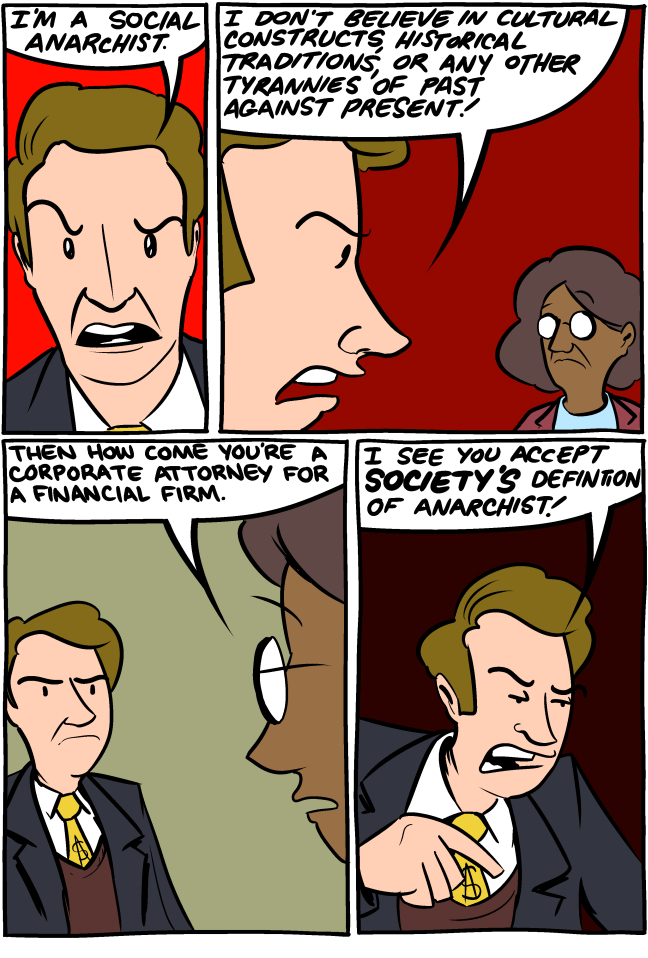
Hey geeks! If you want a nice poster of the comic about raising a geek, it's only available for 2 more days. I will probably not keep this in store, so this is the only way to get it for relatively cheap.
September 16, 2013
Hey geeks! If you want a nice poster of the comic about raising a geek, it's only available for 2 more days. I will probably not keep this in store, so this is the only way to get it for relatively cheap.
Tindalostalbot, pxed and -1 others like this
14 Sep 13:49

Almost Home
by Greg Ross
Mohan K. VWe mustn't overstate the difference, though: the probabilities are 10%, 9%, 8.1%, ... so close that unless you test with hundreds of people, you cannot intuit this.
A drunk man arrives at his doorstep and tries to unlock his door. There are 10 keys on his key ring, one of which will fit the lock. Being drunk, he doesn’t approach the problem systematically; if a given key fails to work, he returns it to the ring and then draws again from all 10 possibilities. He tries this over and over until he gets the door open. Which try is most likely to open the door?
Surprisingly, the first try is most likely. The probability of choosing the right key on the first try is 1/10. Succeeding in exactly two trials requires being wrong on the first trial and right on the second, which is less likely: 9/10 × 1/10. And succeeding in exactly three trials is even less likely, for the same reason. The probability diminishes with each trial.
“In other words, it is most likely that he will get the right key at the very first attempt, even if he is drunk,” writes Mark Chang in Paradoxology of Scientific Inference. “What a surprise!”
steph, Aditya1642 and one other like this
14 Sep 13:44

Thought Chemistry
by Greg Ross
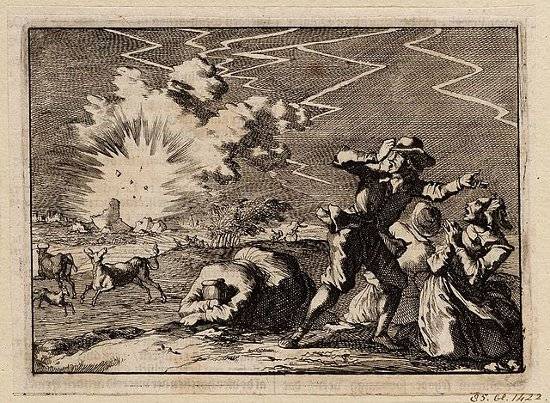
How many ideas hover dispersed in my head of which many a pair, if they should come together, could bring about the greatest of discoveries! But they lie as far apart as Goslar sulphur from East India saltpeter, and both from the dust in the charcoal piles on the Eichsfeld — which three together would make gunpowder. How long the ingredients of gunpowder existed before gunpowder did! There is no natural aqua regia. If, when thinking, we yield too freely to the natural combinations of the forms of understanding and of reason, then our concepts often stick so much to others that they can’t unite with those to which they really belong. If only there were something in that realm like a solution in chemistry, where the individual parts float about, lightly suspended, and thus can follow any current. But since this isn’t possible, we must deliberately bring things into contact with each other. We must experiment with ideas.
– G.C. Lichtenberg, Aphorisms
Adam Victor Brandizzi and -1 others like this
14 Sep 13:35

Firefighter Hysteresis
by Alex Tabarrok
The number of fires is down but the number of career firefighters is up, as I showed last year in my post firefighters don’t fight fires. Leon Neyfakh of the Boston Globe covers the situation in Boston:
…city records show that major fires are becoming vanishingly rare. In 1975, there were 417 of them. Last year, there were 40. That’s a decline of more than 90 percent. A city that was once a tinderbox of wooden houses has become—thanks to better building codes, automatic sprinkler systems, and more careful behavior—a much less vulnerable place.
As this has happened, however, the number of professional firefighters in Boston has dropped only slightly, from around 1,600 in the 1980s to just over 1,400 today. The cost of running the department, meanwhile, has increased by almost $43 million over the past decade, and currently stands at $185 million, or around 7.5 percent of the city’s total budget.
Later, I am quoted:
Alex Tabarrok, an economist at George Mason University who discussed the fire statistics on the blog Marginal Revolution, explains it in terms of what’s called the “March of Dimes problem.” When polio was defeated, the March of Dimes, started under Franklin Delano Roosevelt to combat the disease, suddenly had no reason to exist. “They were actually successful, and it was something they never planned for,” said Tabarrok. “But instead of disbanding the organization, they set it onto a whole bunch of other tasks…and so it’s kind of lost its focus. It’s no longer easy to evaluate whether it’s doing a good job or not.”
This, in Tabarrok’s view, is what happened to the country’s fire departments: At a certain point, they became an organization in search of a mission. “So they ended up doing things they’re not necessarily the optimal people to do, like responding to medical emergencies.”
Some cities are trying to change but as I said in my original piece, “it’s hard to negotiate with heroes”. The situation in Toronto illustrates. Paramedics were recently assigned to more emergency calls at the expense of firefighters who have responded with photos ops in front of burned homes and threats that if their budget is cut children will die. Not wanting to lose their newly found responsibilities, the paramedics have responded with a campaign of their own leading to an awesome cat fight between the two agencies.
I enjoyed Margaret Wente’s conclusion:
A powerful combination of fear-mongering and hero worship has made Canada’s fire departments largely immune to budget cuts. As a consequence, the citizens are getting hosed.
14 Sep 13:26

The five cognitive distortions of people who get things done
by Tyler Cowen
I would call this speculative, but it is nonetheless of interest, let me pull from Jason Kottke:
This is a presentation and therefore missing a bunch of key context, but Michael Dearing’s The Five Cognitive Distortions of People Who Get Stuff Done is interesting reading nonetheless. The five distortions are:
1. Personal exceptionalism
2. Dichotomous thinking
3. Correct overgeneralization
4. Blank canvas thinking
5. SchumpeterianismThat last one is likely a head-scratcher to those of us without economics backgrounds; here’s what Dearing has to say about it:
Definition – sees creative destruction as natural, necessary, and as their vocation
Benefits – fearlessness, tolerance for destruction and pain
Deadly risk – heartless ambition, alienation
Jboussand likes this

10 Sep 01:52

Unquote
by Greg Ross
“Humiliation and indifference, these are conditions every one of us finds unbearable — this is why the Coyote when falling is more concerned with the audience’s opinion of him than he is with the inevitable result of too much gravity.” — Chuck Jones
mkvande likes this
10 Sep 01:48

Post Chase
by Greg Ross

In 1924, air mail pilots were having trouble finding their way across the featureless American southwest, so the Post Office adopted a brutally low-tech solution: Every 10 miles they built a large concrete arrow illuminated by a beacon. Each arrow pointed the way to the next, so that a pilot could stay on course simply by connecting the dots.
The system was finished by 1929, permitting mail planes to find their way all the way to San Francisco. It was quickly superseded by more sophisticated navigation methods, but today the arrows still dot the American desert, ready to confuse hikers and, probably, future archaeologists.
(Thanks, Ron.)
10 Sep 01:47

Unquote
by Greg Ross
“Now she is like everyone else.” — Charles de Gaulle, at the funeral of his daughter Anne, who had Down syndrome, February 1948
10 Sep 01:40
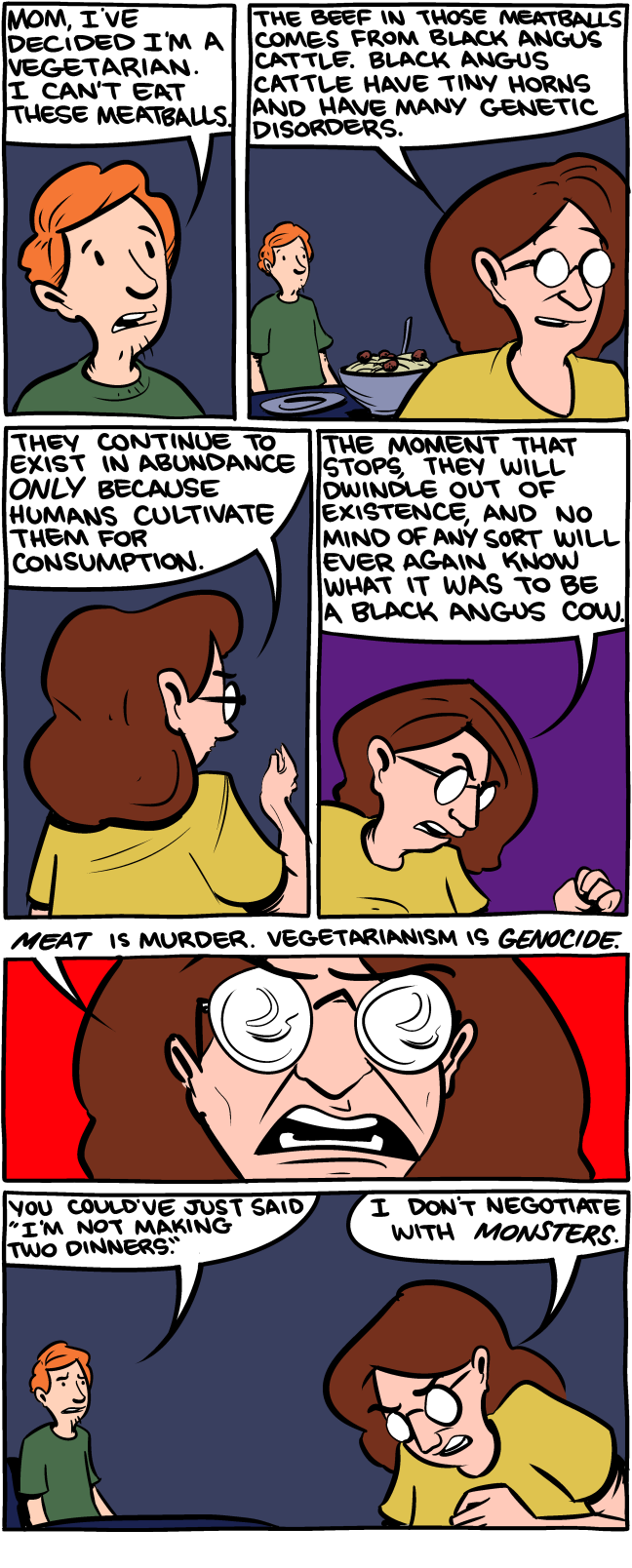
Before you get mad, I'm a vegetarian. Just like Einstein. Also Hitler.
September 07, 2013
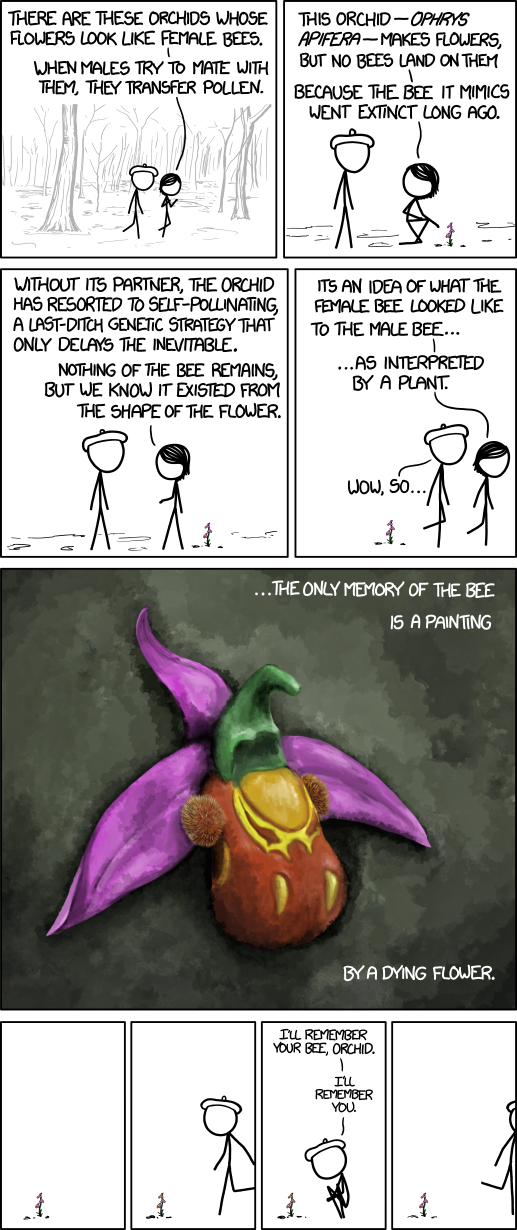
Mohan K. VThe idea that existence by itself is precious is infinitely fun
Before you get mad, I'm a vegetarian. Just like Einstein. Also Hitler.


 facebook
  reddit
03 Aug 21:55
Ecstasy of Order
by Jason Kottke
Mohan K. VSomebody should write a long article on the philosophy of Tetris
Ecstasy of Order is a documentary about Tetris and the quest to find the game's grandmasters.
Tetris. We've all played it, rotating the pieces ("tetrominoes") and dropping them in the perfect place, or despairing as we discover a piece won't fit. You may have even joked about "mastering" the game during a stint of unemployment, or as a child, before you could afford any other Game Boy cartridges. But what about the people who've truly mastered Tetris? Where are the Kasparovs and Fischers, the great champions who've dedicated their minds to solving its deepest puzzles?
One man made it his mission to find them. In an effort to legitimize Tetris as a pro sport, Tetris super-fan Robin Mihara summoned the greatest Tetris players from around the country to compete in Los Angeles at the 2010 Classic Tetris World Championship. Among them are the only players known to have reached the unthinkable perfect 'max-out' score on classic Nintendo Tetris: Jonas Neubauer and Harry Hong. Add in the top players for most lines, Ben Mullen and Jesse Kelkar, as well as newcomer Dana Wilcox and modern-day Tetris Grandmaster Alex Kerr, and a storm of Tetris greatness is brewing.
The film is also on Hulu (US-only) if you don't mind commercials.
Tags: Ecstasy of Order movies Tetris video games
no way, Blindenmuth likes this
03 Aug 21:44

Moving Language
by Greg Ross
Writing in Word Ways in May 1975, David Silverman noted that the phrase LEFT TURN FROM THIS LANE ONLY, stenciled in the leftmost traffic lane at various U.S. intersections, was ambiguous — and that both meanings had been struck down, in contested court cases in Arizona and California.
In one case, the motorist had driven straight ahead rather than turning, which the prosecutor said was illegal. The motorist returned that this wasn’t so — LEFT TURN FROM THIS LANE ONLY meant that it would be illegal to make a left turn from any other lane, but it didn’t require that a left turn be made from this one. “If the city had meant my failure to turn to be illegal, they should have written FROM THIS LANE, ONLY A LEFT TURN.”
In the other case, the motorist had made a left turn from the lane to the right of one marked LEFT TURN FROM THIS LANE ONLY. He argued that this was legal — the marking required drivers in the leftmost lane to turn left, but imposed no requirement on the other lanes. “Had the city wanted to make my turn illegal the marking should have been LEFT TURN ONLY FROM THIS LANE.”
Both motorists were found not guilty. Perhaps because of such confusion, Silverman noted, most intersections had lately begun to use unambiguous arrows: “One good picture is worth ten thousand signs reading LEFT TURN IF AND ONLY IF FROM THIS LANE.”