Shared posts

17 Sep 20:31

Yellen vs. Kohn is the new Summers vs. Yellen

by Neil Irwin
Kevin White

Details on one of the most boring but important debates going on

Kohn on the left, Yellen on the right. But who will be the next chairman of the Fed?

Kohn on the left, Yellen on the right. But who will be the next chairman of the Fed?

All summer, the hot debate in economic policy circles was over whether Larry Summers or Janet Yellen would be nominated to be the next chairman of the Federal Reserve. That all ended with Summers's withdrawal from consideration on Sunday. It appears Yellen is now the front-runner for the job, and the White House has signaled it is not reopening the search to consider other options (and former Treasury secretary Tim Geithner has made it amply known that he is not interested).

Which means that President Obama's decision, likely to be made soon, will come down to Yellen versus the man who had been mentioned as the No. 3 possibility. Donald L. Kohn.

So, if it's now Yellen vs. Kohn, how does each stack up on the key things a president might look for in a Federal Reserve leader? Here's a guide.

Experience. Both Yellen and Kohn would take office as arguably the most qualified Fed chief in history. Each has served as the No. 2 official of the institution -- Yellen from 2010 to the present, Kohn from 2006 to 2010. Each had extensive experience at the institution before that -- Yellen as a governor and as president of the San Francisco Fed for a combined nine years, Kohn as a governor for four years and as a staffer for more than three decades before that, including a long run as a senior adviser to Alan Greenspan.

Monetary policy. Kohn has been cautious in his public comments about monetary policy since leaving office in 2010, so it is not fully clear how he might lead the course of interest rate policy if he became chairman. Yellen has given detailed speeches laying out a path that includes hiking interest rate beginning at 2015 at the earliest. Going back to 2010, when Kohn was still vice chairman at the central bank and Yellen was in San Francisco, she tended to be a more enthusiastic proponent of unconventional steps to ease monetary policy  to bring down unemployment. Kohn was more in the center of the Fed's policy-making committee as a close counselor to Chairman Ben Bernanke, as Yellen helped push the committee in a dovish direction, toward its expansive program of quantitative easing.

Crisis management. Kohn has more experience dealing with Fed policy in the crucible of a crisis, including as part of Bernanke's inner circle in 2007-2008 and as a close adviser of Greenspan during the emerging markets crises of the 1990s and in the aftermath of the Sept. 11, 2001, terrorist attacks. Yellen led the San Francisco Fed during the 2008 financial crisis, however, and was ahead of the curve in recognizing dangers that the housing and lending bubble of the mid-2000s were creating. Former colleagues in San Francisco have praised her as being cool under pressure and for immersing herself in banking regulation issues during 2008. But the biggest crisis response decisions were being made in Washington and New York.

Bank regulation. It's tricky to parse how Yellen and Kohn might differ in their role regulating banks and other financial institutions. Here is a recent Yellen speech articulating her views, arguing (among other things) that higher capital requirements for global banks have made the financial system more sound, but that more work is needed to eliminate risks in the "shadow banking system" of markets that act like banks but are unregulated. Kohn seems to be on the same page. Here are some comments he made Monday that broadly align with Yellen's. He has served on the Bank of England's financial policy committee, a part-time role in which he has helped reshape the British regulatory system. Here are some of his comments on how to do so.

Politics. Inevitably, the Fed chairman must navigate the shoals of politics, maintaining relationships with the White House and Congress. Both Yellen and Kohn have worked at high levels of U.S. government for many years, though neither has a particularly close relationship with President Obama or current senior Obama administration officials. In terms of Congress, Yellen has shied away from representing the Fed before lawmakers, and has not testified before Congress in her three years as vice chairwoman. Kohn testified six times in his last three years in the same job.

Yellen does have executive branch experience, which Kohn lacks, having served in the Clinton White House as chairman of the Council of Economic Advisers. Kohn, meanwhile, would bring a tinge of bipartisanship; he was appointed Fed vice chairman by George W. Bush, though Kohn himself says he is apolitical.

Management. Both would bring experience running the complex, sprawling Federal Reserve system: Yellen as president of the San Francisco Fed, Kohn as director of the powerful monetary affairs division, both of them as vice chair. Both are said to be demanding bosses, with high expectations of their subordinates, though neither has the kind of acrimonious history of clashing with colleagues that damaged Summers's chances at the job.

Communication. The Fed chief must speak to all sorts of audiences, from news conferences to congressional hearings to speeches to business groups. Both Yellen and Kohn are experienced at this part of the job. Kohn has shown more inclination to do the off-the-cuff sort of presentations, while Yellen tends to be more carefully scripted.

Add that all up, and what is the decision the president faces? Yellen and Kohn are close to equal in their experience and basic policy outlook. Kohn may be a little more hawkish on monetary policy and prone to worry about asset bubbles, and he has more first-hand crisis management experience. Yellen is probably a bit more focused on getting unemployment down as rapidly as possible.

The president has a choice between two very qualified, experienced central bankers for the job, with the differences between them more subtle variations in style and temperament than any vast chasm in monetary policy views. Against that backdrop, if he passes over Yellen, who would be the first woman in the job and has been endorsed by Wall Street economists and many in Congress, he'll face tough questions on why.

 For more, read this profile of Yellen, or these eight things to know about Kohn.


10 Sep 21:28

Bourbon for Breakfast: New Knob Creek Smoked Maple Bourbon

by Andrew Strenio

From Drinks

20130910knobcreekstory.jpg

Bourbon is no stranger to the kitchen—and it's not just that many chefs have a fondness for a few fingers of whiskey after a long day. Bourbon's sweet and spicy flavor profile marries very well with foods from pie to ribs (and even carrots!) But my personal favorite bourbon-flavored treat is the bourbon-barrel aged maple syrup that has been cropping up from a few producers as all things whiskey top the trend lists. The earthiness of the best syrups are a perfect foil to the more bitter, pointed oak notes and spices from the barrel. The only problem with this delicacy is it's a bit tough to drink by the glass. Enter the new Knob Creek Smoked Maple Bourbon...

Produced from the same whiskey stock that goes on to become Knob Creek Bourbon, the Smoked Maple expression is blended with maple and smoke flavors. We tasted it side by side with the flagship Knob Creek 9 year Bourbon to see how it holds up to the original.

The classic Knob Creek 9 Year is bottled at 100 proof, and is definitely a high-octane bourbon. Caramel and maple aromas are up front and center, with a heavy oak influence and dark fruits following behind. The taste begins with those same sweet maple and caramel notes, but it quickly turns more astringent with bitter char and licorice flavors. The finish is long, dry oak. Would this whiskey work with a maple spin?

Bottled with no age statement at 90 proof, the new Knob Creek Smoked Maple is a flavored bourbon that takes its stock pedigree seriously. It's an amplification of the flavors of the original, along with the addition of enough sweetness to round out some of KC's more harsh edges. The scent is all buttered maple, though with a hint of artificiality (think a slightly more understated Mrs. Butterworth's). The smoke is light and subtle (a relief, since added smoke is tricky to do well) and the oak nicely balances the sweetness and smoke. The body of the bourbon, and its spicy vanilla and clove flavor helps to round out the single-note maple that rises to the top of each sip. The finish is quite short and sweet, lacking in any real complexity.

Given the flavor profile of Knob Creek's flagship bottle, the decision to make Smoked Maple makes sense. The flavored whiskey is a perfect gateway drink for soon-to-be bourbon drinkers—and it is the most successful flavored bourbon we've tried to date. Diehard whiskey geeks won't necessarily be won over (they tend to prefer bourbon flavored bourbon), but for the rest of us maple fiends it's an easy investment at around $31 a bottle.

How should you drink it? Mix this stuff into an amazing whiskey and Coke—the maple sweetness plays really nicely off of Coke's crisp bite. It's also divine in a hot toddy, and plays really well in a dessert riff on a Manhattan.

About the author: Andrew Strenio is a lover of all things potable. Since sneaking his grandmother's bourbon balls, he's moved on to touring distilleries and sipping snifters. He works by day making documentary television and films for an independent production company in Brooklyn.

Sample provided for review consideration.

10 Sep 19:18

Falling With Helium

by xkcd

Falling With Helium

What if I jumped out of an airplane with a couple of tanks of helium and one huge, un-inflated balloon? Then, while falling, I release the helium and fill the balloon. How long of a fall would I need in order for the balloon to slow me enough that I could land safely?

Colin Rowe

As ridiculous as it sounds, this is—sort of—possible.

Falling from great heights is dangerous.[citation needed] A balloon could actually help save you, although a regular helium one from a party obviously won't do the trick.

If the balloon is large enough, you don't even need the helium. A balloon will act as a parachute, slowing your fall to non-fatal speeds.

Avoiding a high-speed landing is, unsurprisingly, the key to survival. As one medical paper[1]De Haven H. Mechanical analysis of survival in falls from heights of fifty to one hundred and fifty feet. Injury Prevention. 6(1):62-b-68. put it,

It is, of course, obvious that speed, or height of fall, is not in itself injurious ... but a high rate of change of velocity, such as occurs after a 10 story fall onto concrete, is another matter.

... which is just a wordy version of the old saying, "It's not the fall that kills you, it's the sudden stop at the end."

To act as a parachute, a balloon filled with air, rather than helium, would have to be 10 to 20 meters across—far too big to be inflated with portable tanks. A powerful fan could be used to fill it with ambient air, but at that point, you may as well just use a parachute.

Helium

The helium makes things easier.

It doesn't take too many helium balloons to lift a person. In 1982, Larry Walters flew across Los Angeles in a lawn chair lifted by weather balloons, eventually reaching several miles in altitude. After passing through LAX airspace, he descended by shooting some of the balloons with a pellet gun.

On landing, Walters was arrested, although the authorities had some trouble figuring out what to charge him with. At the time, an FAA safety inspector told the New York Times, "We know he broke some part of the Federal Aviation Act, and as soon as we decide which part it is, some type of charge will be filed."[2]ARMCHAIR AIRMAN SAYS FLIGHT FULFILLED HIS LIFELONG DREAM, New York Times, July 4, 1982

A relatively small helium balloon—certainly smaller than a parachute—will suffice slow your fall, but it still has to be huge by party balloon standards. The biggest consumer rental helium tanks are about 250 cubic feet, and you'd need to empty at least 10 of them to put enough air in the balloon to support your weight.

You'd have to do it quickly. The compressed helium cylinders are smooth and often quite heavy, which means they have a high terminal velocity. You'll only have a few minutes to use up all the cylinders. (As soon as you emptied one, you could drop it.)

You can't get around this problem by moving your starting point higher. Since the upper atmosphere is pretty thin, anything dropped from the stratosphere up will accelerate to very high speeds until it hits the lower atmosphere, then fall slowly the rest of the way. This is true of everything from small meteors[3]By the time meteors hit the Earth, they have slowed down to a few hundred miles per hour. to Felix Baumgartner.[4]Jason Martinez, Falling Faster than the Speed of Sound, Wolfram Blog, October 24, 2012

But if you inflated the balloons quickly, possibly by connecting many canisters to it at once, you'd be able to slow your fall. Just don't use too much helium, or you'll end up floating at 16,000 feet like Larry Walters.

While researching this article,[5]Additionally, while researching impact speeds for this article, I came across a discussion on the Straight Dope Message Boards about survivable fall heights. One poster compared a fall from height to being hit by a bus. Another user, a medical examiner, replied that this was a bad comparison:

"When hit by a car, the vast majority of people are not run over; they are run under. The lower legs break, sending them into the air. They usually strike the hood of the car, often with the back of the head impacting the windshield, "starring" the windshield, possibly leaving a few hairs in the glass. They then go over the top of the car. They are still alive, although with broken legs, and maybe with head pain from the nonfatal windshield impact. They die when they hit the ground. They die from head injury."

The lesson: Don't mess with medical examiners. They're apparently pretty hardcore. I managed to lock up my copy of Mathematica several times on balloon-related differential equations, and subsequently got my IP address banned from Wolfram|Alpha for making too many requests. The ban-appeal form asked me to explain what task I was performing that necessitated so many queries, so this is what I put:

I hope they understand.

09 Sep 06:40

The Death of Socrates

The Death of Socrates
Jacques Louis David

Artist: Jacques Louis David (French, Paris 1748–1825 Brussels)

Date: 1787
Medium: Oil on canvas
Dimensions: 51 x 77 1/4 in. (129.5 x 196.2 cm)
Classification: Paintings
Credit Line: Catharine Lorillard Wolfe Collection, Wolfe Fund, 1931
Accession Number: 31.45

Information about hundreds of thousands of works of art is available in The Metropolitan Museum of Art's Collection Database.

Photograph Credits | Terms and Conditions | Privacy Policy
© 2000–2018 The Metropolitan Museum of Art. All rights reserved.
04 Sep 15:20

Photo


01 Sep 19:28

Research: Underdog Businesses Are More Likely to Post Fake Yelp Reviews

by Kevin Li
Kevin White

@robyn for Colin

The rise of online review platforms like Yelp has empowered consumers by reducing the informational asymmetry surrounding unfamiliar products and services. But some businesses face strong incentives to post fake reviews, which compromises the trustworthiness of such review sites.

How prevalent are such fake reviews, and what firms are mostly likely to post them? New research reveals that independent businesses, those without many existing reviews on Yelp, and those that face intense competition are more likely engage in review fraud on Yelp.

I reached out to authors Michael Luca, Professor at Harvard Business School, and Georgios Zervas, Assistant Professor of Marketing at Boston University School of Management, to discuss their findings. Here's an edited transcript of our conversation.

How did the two of you become interested in this line of research?

Michael Luca: We've both done extensive work on consumer review websites in the past, and I've seen in prior research that Yelp reviews are incredibly influential on sales. Because of this influence and because these types of platforms have proliferated over the last decade - think of Yelp, TripAdvisor, Angie's List, and scores of others - it's important to understand the pros and cons of this type of system relative to other information sources.

Georgios Zervas: I was working on reviews as well but from a different perspective. I was trying to see what actually shapes reviews, so I was looking at online promotions like Groupon and LivingSocial and trying to explain why these coupons tended to result in negative reviews on Yelp. So we had both done work on reviews, and we joined forces to work on fake reviews.

According to your research, what leads businesses to post fake reviews on Yelp?

Georgios: The incentives are economic. The system is set up in such a way that businesses can benefit a lot from soliciting fake reviews. So businesses will respond to incentives such as a bad recent reputation, or having few reviews, or generally being unknown.

You've shown that some new businesses post fake positive reviews when they have very few existing reviews. Conversely, established businesses (including chains) are less likely to post fake reviews. Is it possible that high-quality firms might use fake reviews as a form of free but fraudulent advertising, from which they "graduate" as their reputation builds?

Georgios: Yes, I think that makes a lot of sense. For example, restaurants may be very resource-constrained, so when a new restaurant is starting out, they may not have enough resources for advertising, and of course, fake reviews are seen by a lot of people to have a very low production cost. Once these restaurants become established, potentially they'll have more resources to invest in advertising so it's very logical that they would graduate to more legitimate forms of advertising.

Besides misleading consumers, are there any other economic costs or inefficiencies that fake reviews cause?

Michael: Just the mere presence of fake reviews has led to an arms race in the review industry. These review sites dump resources into solving the fake review problem by making it more difficult for someone to leave a review, or by forcing a reviewer to jump through more hoops to make sure he or she is real, or by filtering some reviews off of the site, as Yelp does. Every barrier that you construct on these types of platforms will help reduce the number of fake reviews, but also actually reduces the number of real reviews on the site.

Michael, you mentioned earlier that Yelp reviews can significantly affect sales. How can we quantify that effect?

Michael: The way to think about returns to reviews is in the value of the rating. Say the user goes onto Yelp and sees a business with 3.5 stars and 10 reviews next to it. And the estimates we saw in prior work is that a one-star increase in rating leads to more than a 5% increase in sales for independent businesses, which is a really huge effect. If you think about your ability to influence this at the margin, especially when you don't have many reviews, you have a very high-powered incentive to leave fake reviews.

In future work, what are some other independent variables about a business (like social media engagement, which you've mentioned) that you want to correlate with propensity to commit Yelp fraud?

Michael: One thing that we think would be exciting is the relationship between fraud and advertising. We see that people who are committing fraud have just had a negative reputational shock, are facing intense competition, or are early on in their business life cycle. On the other hand, we have work that suggests that firms using advertising have established reputations, have had positive reputational shocks. So our plan for our follow-up paper is actually to look through and think about the relationship between review fraud and advertising decisions. The question is, do firms face a substitution decision between advertising and review fraud?

How can a content aggregator like Yelp use this paper to improve its ability to detect fake reviews?

Georgios: The detection algorithms for sites like Yelp work by going through a set of reviews and carefully classifying them into real and fake reviews. Then they try to figure out some distinguishing characteristics of fake reviews. For example, fake reviews might come from users that have only written one or two reviews on Yelp ever. Then they use that indicator as a positive signal of a review being suspicious for new reviews that arrive on the site. We suggest that all these features we've identified - a business being new, or a business having recently received bad reviews, or a business facing increased competition - could be incorporated with those prior features into existing algorithms to predict whether a review is fake or not.

How might a small business with a Yelp presence use this research to improve its own sales?

Michael: One simple example is to engage with the system in an ethical way: claim your business on Yelp, make sure the information and hours are correct. This kind of persona can generate more legitimate reviews without gaming the system. Small businesses can also understand how exactly the Yelp system works. If you ask 10 small businesses how Yelp decides to aggregate reviews, you might get 10 different answers. Spending a couple of hours to understand the system and what exactly is being displayed on the other end could reduce the anxiety of somebody who otherwise views Yelp's algorithm as a black box.

What should customers who use Yelp know?

Michael: The customer should realize that some reviews might be illegitimate, and our work gives a sense of the situations in which you're most likely to see a fraudulent review.

Georgios: Most users may just look at the rating itself. Our work tells the consumer that he actually needs to read the reviews, inspect the business, ask about their advertising, ask whether it's a chain, see if it's in a highly competitive area, and then make up his mind.

To wrap up, many of your empirical results are consistent with and thus powerfully supported by theoretical predictions. Did any of your results instead surprise you by going against prediction?

Georgios: One thing that surprised us both was our very first finding - that approximately 16% of all reviews are filtered by Yelp. Nobody had measured that before. So while you could see the number of filtered reviews for an individual business, nobody had done an extensive site-wide measurement of how many reviews were suspicious.

Michael: We've found that the "bad apple theory" isn't quite valid. In our research, we both talked to a lot of small businesses, and we don't have the sense that there are these small businesses going around trying to cheat the system. Something we didn't see fully beforehand is that there's simply a lot of pressure for a small business starting out without an established reputation to go and do something that doesn't necessarily seem unethical at the time. But taking a step back, these businesses will often recognize the ethical implications of what they're trying to do.

03 Jul 23:38

The Battle of Gettysburg, Pa., July 3rd, 1863

The Battle of Gettysburg, Pa., July 3rd, 1863
Currier & Ives

Date: 1863
Medium: Hand-colored lithograph with blue tint stone
Dimensions: Image: 15 11/16 x 22 3/8 in. (39.8 x 56.8 cm)
Sheet: 19 13/16 × 25 13/16 in. (50.3 × 65.6 cm)
Classification: Prints
Credit Line: Bequest of Adele S. Colgate, 1962
Accession Number: 63.550.512

Information about hundreds of thousands of works of art is available in The Metropolitan Museum of Art's Collection Database.

Photograph Credits | Terms and Conditions | Privacy Policy
© 2000–2014 The Metropolitan Museum of Art. All rights reserved.
08 Jun 20:16

It was an easy answer, really.

by Jenny the bloggess

Victor:  If you could have dinner with anyone – dead or alive – who would you pick?

me:  I guess I’d probably pick “alive”.

Victor:  That’s…actually a good choice.

14 May 21:32

Message to a Graduate

by Grant

14 May 21:30

Photo


13 May 15:45

Star Wars Costumes for Dogs

Star Wars Costumes for Dogs

Submitted by: Unknown (via Costumecraze)

Tagged: costume , star wars Share on Facebook
29 Apr 03:50

Thank You, Wise Graffiti

Thank You, Wise Graffiti

Submitted by: Unknown

Tagged: wisdom , graffiti , hacked irl , g rated , win Share on Facebook
29 Apr 03:42

The President as Financial Planner

by Greg Mankiw
He and Michelle seem inattentive to their own finances:
The Obamas paid $45,046 in mortgage interest in 2012, which appears from the disclosure statement to be at a 5.625% interest rate with Northern Trust. That suggests an outstanding principal balance of about $800,000. 
On the other hand, the bulk of their investments are in Treasury notes. Based on the disclosures, I estimate they hold about $3 million in Treasury notes (also held by Northern Trust), yielding 0.71% if averaging a five-year maturity. 
By selling some of those Treasuries and paying off the mortgage, they would effectively be getting five more percentage points on the amount; they would also be about $40,000 better off each year before taxes, not to mention being less exposed to notes that could take a hit from possible rising rates. 
The Obamas would pay more in taxes but make much more after taxes -- especially since they aren’t getting the full deduction anyway, due to the AMT. That's more money going to the U.S. Treasury and more money for them; Northern Trust would be the loser.
24 Apr 02:52

Someone's Had a Little Too Much Wine

Someone's Had a Little Too Much Wine

Lol by: Unknown (via Tumblr)

Tagged: drunk , box , wine , Cats Share on Facebook
23 Apr 20:08

Photo


23 Apr 13:49

thefrogman: Monday Punday by Gemma Correll [website | tumblr |...


thefrogman:

Monday Punday by Gemma Correll [website | tumblr | blogspot]
23 Apr 05:53

hobolunchbox: Ocean says NO!


hobolunchbox:

Ocean says NO!

11 Apr 15:56

The Best Coffee Mug Improvement Since the Handle

by Andrew Liszewski
Click here to read The Best Coffee Mug Improvement Since the Handle They say if you build a better mouse trap the world will beat a path to your door. And the same will probably hold true for the first coffee shop to adopt this clever spoon-securing NOTA coffee mug designed by Lee Hae Seung Scott. More »


11 Apr 15:35

A Nice Example of Technological Progress

by Greg Mankiw
10 Apr 00:51

This Guide to Cuts of Beef Makes Sure You’re Never Confused at the Meat Counter Again

by Alan Henry
Click here to read This Guide to Cuts of Beef Makes Sure You’re Never Confused at the Meat Counter Again It can be pretty challenging to shop for beef if you don't know the difference between a shoulder blade steak and a center ranch steak. The difference in cost, size, and preferred cooking method can throw off even the best home cook. Thankfully this handy chart makes sure you're always prepared when buying and cooking beef. More »


03 Apr 16:36

gaeth: Turns out Netflix is a dick


gaeth:

Turns out Netflix is a dick

03 Apr 16:35

Things I Would Tell My Younger Self

by DOGHOUSE DIARIES

Things I Would Tell My Younger Self

“And it wouldn’t kill you to eat a salad once in a while.”

Tweet
31 Mar 03:04

What is the purpose of insurance?

by Greg Mankiw
A friend points me to this passage:
At a White House briefing Tuesday, Health and Human Services Secretary Kathleen Sebelius said some of what passes for health insurance today is so skimpy it can't be compared to the comprehensive coverage available under the law. "Some of these folks have very high catastrophic plans that don't pay for anything unless you get hit by a bus," she said. "They're really mortgage protection, not health insurance."

I have the same problem with my other insurance policies.  My homeowner insurance doesn't cover the cost when my gutters need cleaning, and my car insurance doesn't cover the cost when I need to fill the tank with gas. Instead, the policies cover only catastrophic events, like my house burning down or a major accident. Now that the Obama administration has fixed the health insurance system, I trust they will soon move on to solve these other problems.
17 Mar 22:47

561. If you are blessed with the ability to wink, use it.

13 Mar 00:37

buttspectre: why would you want to be an offensive stereotype for Halloween when u can be this

Kevin White

Who knows where i can find one of these?

buttspectre:

why would you want to be an offensive stereotype for Halloween

when u can be

this

image

12 Mar 09:34

milesjai: the sexual tension in this gif is astounding


milesjai:

the sexual tension in this gif is astounding

01 Mar 22:39

Photo


01 Mar 22:33

Photo


25 Feb 14:14

naative: Religious people came to my friends door and gave her...


naative:

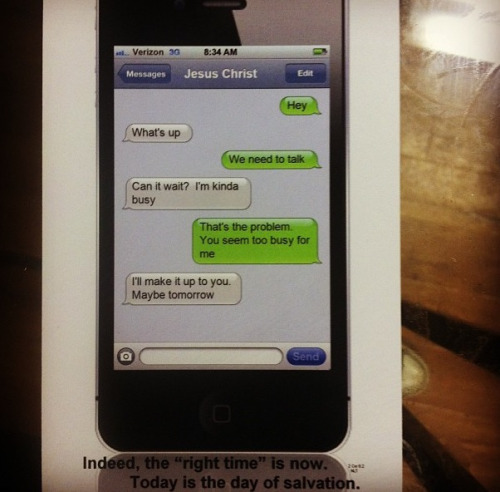
Religious people came to my friends door and gave her this pamphlet but they got the texts wrong so apparently jesus has no time for you

25 Feb 14:13

Photo