Shared posts

26 Jul 13:24

Beginning with Aud

by dorothy
07 May 12:13

The Way Sewing Used to Be: Reflecting

by maddie

twill-tape

It seems like forever since I posted about #thewaysewingusedtobe. Oh wait, that’s because it has!

Instead of moving forward and talking about the next vintage item to highlight, I want to go back to the beginning. Why I started the series. I’m reevaluating mostly because of a podcast I recently listened to that made me rethink and reflect. The podcast was History and Culture in Art & Design: Veronica Corzo-Duchardt on After The Jump.

Veronica’s grandfather was a Cuban exile living in the United States, and when he moved, he was allowed to bring only a few objects. Beginning in 2011 as a daily blog and weekly print series, Veronica documented 149 of his items and compiled them into collection of 29 limited edition screen prints. The Neche Collection not only retells the story of her grandfather, Neche Eugenio Hadad, but also gives a new function to an otherwise obsolete object.

That’s what we do when we upload our photos. We are giving bygone sewing notions a new life. They get another moment that is both nostalgic and reverent. Sigh. Each caption highlights impeccable package design, the history of that notion, the person who once owned it and in some cases, a little bit about you. Sure, there are arguments why this attention to packaging isn’t used anymore. Today, if packaging is excessive, it’s considered wasteful. Customers claim that manufacturing and labor involved are harmful to the environment. Is packaging even needed if it gets thrown away? I get it. My belief is that creating for the sake of beauty isn’t always wasteful. In your own sewing, I’m sure you’ve made something that was just for fun… just for the look. Was that wasteful? Even if you never wore it, I’m sure you learned something from the process. How to insert a zipper? How to face a hem? How to handle silk better?

Adding to this, I think indie companies have done a great job to combinevsimple, modern design with environmental awareness. Way to go indies!

A byproduct of #thewaysewingusedtobe  – it’s contagious! When I show people photos, they dig into their closets, attics and basements to find their mother’s, grandmother’s, aunt’s and even uncle’s old goodies. I am now gifted vintage treasure on the regular. I’ve amassed quite the collection!

So, thank you to everyone who has posted to Instagram. Can you believe that there are over 300 images in the album (see below)! I hope we can maintain the momentum. Keep grammin!

If you’re in the market for old sewing notions, search “vintage sewing lots” on Ebay. It’s a gold mine.

I also sell #thewaysewingusedtobe prints on Society6.

tag_thewaysewingusedtobe_1349646842 tag_thewaysewingusedtobe_1373971733 tag_thewaysewingusedtobe_1389465077 tag_thewaysewingusedtobe_1389632455 tag_thewaysewingusedtobe_1390225224 tag_thewaysewingusedtobe_1390225303 tag_thewaysewingusedtobe_1390225373 tag_thewaysewingusedtobe_1395873770 tag_thewaysewingusedtobe_1401486621 tag_thewaysewingusedtobe_1402504762 tag_thewaysewingusedtobe_1403645992 tag_thewaysewingusedtobe_1404299043 tag_thewaysewingusedtobe_1404397979 tag_thewaysewingusedtobe_1404986664 tag_thewaysewingusedtobe_1405020045 tag_thewaysewingusedtobe_1405082709 tag_thewaysewingusedtobe_1405177685 tag_thewaysewingusedtobe_1405258674 tag_thewaysewingusedtobe_1405258822 tag_thewaysewingusedtobe_1405414134 tag_thewaysewingusedtobe_1405414198 tag_thewaysewingusedtobe_1405626120 tag_thewaysewingusedtobe_1405797341 tag_thewaysewingusedtobe_1405807559 tag_thewaysewingusedtobe_1405851769 tag_thewaysewingusedtobe_1405851871 tag_thewaysewingusedtobe_1405879763 tag_thewaysewingusedtobe_1405912059 tag_thewaysewingusedtobe_1405912294 tag_thewaysewingusedtobe_1405912537 tag_thewaysewingusedtobe_1405913185 tag_thewaysewingusedtobe_1406236946 tag_thewaysewingusedtobe_1406318241 tag_thewaysewingusedtobe_1406318335 tag_thewaysewingusedtobe_1406318398 tag_thewaysewingusedtobe_1406318466 tag_thewaysewingusedtobe_1406393361 tag_thewaysewingusedtobe_1406393412 tag_thewaysewingusedtobe_1406549638 tag_thewaysewingusedtobe_1406827148 tag_thewaysewingusedtobe_1407177155 tag_thewaysewingusedtobe_1407510295 tag_thewaysewingusedtobe_1407518955 tag_thewaysewingusedtobe_1407637663 tag_thewaysewingusedtobe_1407780822 tag_thewaysewingusedtobe_1407870382 tag_thewaysewingusedtobe_1407901032 tag_thewaysewingusedtobe_1408062350 tag_thewaysewingusedtobe_1408120047 tag_thewaysewingusedtobe_1408292492 tag_thewaysewingusedtobe_1408310469 tag_thewaysewingusedtobe_1408372491 tag_thewaysewingusedtobe_1408493825 tag_thewaysewingusedtobe_1408500994 tag_thewaysewingusedtobe_1408549231 tag_thewaysewingusedtobe_1408663935 tag_thewaysewingusedtobe_1408667389 tag_thewaysewingusedtobe_1408769252 tag_thewaysewingusedtobe_1408794471 tag_thewaysewingusedtobe_1408925478 tag_thewaysewingusedtobe_1409000175 tag_thewaysewingusedtobe_1409027396 tag_thewaysewingusedtobe_1409048577 tag_thewaysewingusedtobe_1409106305 tag_thewaysewingusedtobe_1409162106 tag_thewaysewingusedtobe_1409207233 tag_thewaysewingusedtobe_1409207418 tag_thewaysewingusedtobe_1409207490 tag_thewaysewingusedtobe_1409364593 tag_thewaysewingusedtobe_1409404406 tag_thewaysewingusedtobe_1409516255 tag_thewaysewingusedtobe_1409543064 tag_thewaysewingusedtobe_1409564193 tag_thewaysewingusedtobe_1409683081 tag_thewaysewingusedtobe_1409700373 tag_thewaysewingusedtobe_1409738492 tag_thewaysewingusedtobe_1409755060 tag_thewaysewingusedtobe_1409755192 tag_thewaysewingusedtobe_1409769081 tag_thewaysewingusedtobe_1409774004 tag_thewaysewingusedtobe_1409871579 tag_thewaysewingusedtobe_1409998415 tag_thewaysewingusedtobe_1410075843
18 Mar 00:32

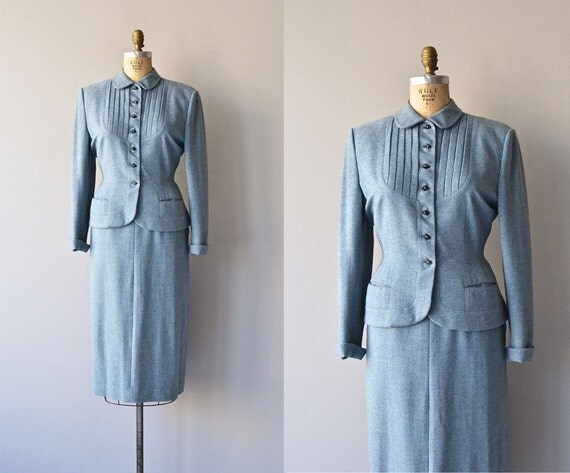
Daedalia suit | 1940s wool suit • vintage 1950s suit by DearGolden

224,00 USD

Vintage 1940s, early 1950s wedgewood blue wool fitted suit with expertly tucked jacket, small rounded collar, welt pockets, cuffed sleeves, pencil skirt and periwinkle blue rayon crepe lining.

✂-----Measurements

fits like: medium

- jacket -
shoulder: 17"
bust: 40-41"
waist: 31"
length: 23"

- skirt -
waist: 31"
hip: up to 46"
length: 30"

brand/maker: Kitt | Kolmer
condition:

✩ layaway is available for this item

✩ more vintage dresses ✩
http://www.etsy.com/shop/DearGolden?section_id=5986725

✩ visit the shop ✩
http://www.DearGolden.etsy.com

_____________________
✩ www.deargolden.com
✩ twitter: deargolden

18 Mar 00:30

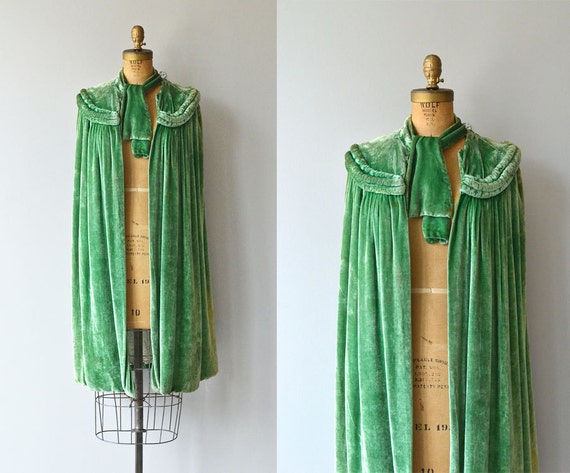
Chevalier silk velvet cape | 1920s cape • vintage 1920s velvet cape by DearGolden

565,00 USD

A rare and stunning 1920s emerald green silk velvet cape with thick trapunto shoulder detail, tie collar and one button closure at the neck.

--- M E A S U R E M E N T S ---

fits like: one size fits most
shoulder: approx. 13-15"
bust: free
waist: free
hip: free
length: 40"
brand/maker: n/a
condition: some faint discoloration at the bottom-side, easily unnoticed

✩ layaway is available for this item

➸ More vintage coats
http://www.etsy.com/shop/DearGolden?section_id=5800175

➸ Visit the shop
http://www.DearGolden.etsy.com
_____________________

➸ instagram | deargolden
➸ twitter | deargolden
➸ facebook.com | deargolden
➸ blog | www.deargolden.com

18 Mar 00:30

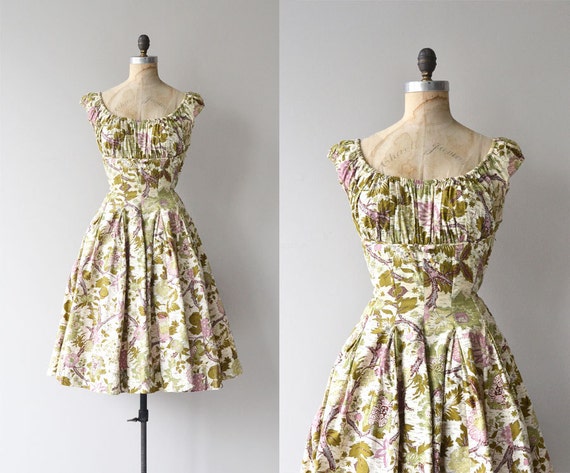
Marshlands dress | vintage 1950s dress | floral print 50s dress by DearGolden

234,00 USD

Vintage 1950s dreamy floral print cotton dress with elastic neckline and cap sleeves, flattering gathered bust, panel constructed fitted waist, full skirt and metal zipper.

✂-----Measurements

fits like: medium
bust: 36-38"
waist: 28"
hip: free
length: 43"
brand/maker:
condition: excellent

✩ layaway is available for this item

To ensure a good fit, please read the sizing guide:
http://www.etsy.com/shop/DearGolden/policy

➸ More vintage dresses ✩
https://www.etsy.com/shop/DearGolden?section_id=5986725&ref=shopsection_leftnav_3

➸ Visit the shop ✩
http://www.DearGolden.etsy.com
_____________________

➸ instagram | deargolden
➸ twitter | deargolden
➸ facebook.com | deargolden
➸ blog | www.deargolden.com

18 Mar 00:30

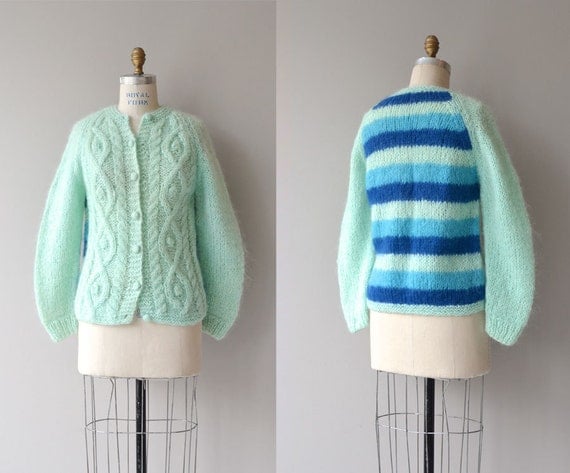
Sweet Mint cardigan | 1960s mohair sweater • vintage 1960s wool cardigan by DearGolden

58,00 USD

Vintage 1960s hand knit mohair cardigan in mint green cable knit front, raglan sleeves, knit buttons and striped light blue, dark blue and mint green back.

--- M E A S U R E M E N T S ---

fits like: medium
shoulder: raglan sleeve, no seam
bust: 34-42"
waist: undefined
sleeve: approx. 23.5"
length: 25"
brand/maker: n/a
condition: excellent

To ensure a good fit, please read the sizing guide:
http://www.etsy.com/shop/DearGolden/policy

➸ More tops & sweaters ✩
http://www.etsy.com/shop/DearGolden?section_id=5800171

➸ Visit the shop ✩
http://www.DearGolden.etsy.com
_____________________

➸ instagram | deargolden
➸ twitter | deargolden
➸ facebook.com | deargolden
➸ blog | www.deargolden.com

07 Mar 15:46

LookThere’s one right thereA black womanShe’sShe’s reading

Look

There’s one right there

A black woman

She’s

She’s reading

21 Feb 18:23

The BitterSweet Life on Twitter

Russian Sledges

via bernot

Interviewed a little girl this morning that feeds crows and they bring her gifts in return. Here's her collection. pic.twitter.com/kqNrlAa4Ie

21 Feb 18:05

Liholiho’s island-minded cocktails are anything but tiki - SFGate

by russiansledges
Liholiho’s drinks, then, are deceptively more grown-up than the names indicate. There’s nary a garnish. The glassware verges on brutalist. A drink like the Castaway doesn’t come within 10 miles of a tiki mug. Instead, served in a petite, tapered flute, it’s an exercise in briskness, driven by salty manzanilla Sherry and green Chartreuse. He even adds a bit of falernum, typically a syrupy Barbadian liqueur, that has been salted to redirect what’s usually a tiki flavor in a more marine direction. The Bluth is one of his boozy inventions, fecund from the old-timey bite of both 5-year-old rum and Abbott’s bitters. It’s haunted by a liqueur flavored with a fruit that “Arrested Development” fans already have in mind. “The banana is aggressive,” I have in my notes, which admittedly is a phrase I never thought I’d write. Although the Surfer Rosa may be Hawaiian Punch red in the glass, it, too, is more a study in astringency than in sweetness. The color is from hibiscus-infused mezcal, underscored by the double growl of vermouth and Benedictine. The name isn’t beachnik; it’s a tribute to the angsty Pixies album, just as the Tropicalia is a nod to Brazil’s midcentury cultural avant-garde.
20 Feb 23:52

Avalanche buries one in Cambridge

by OnlyMrGodKnowsWhy
Russian Sledges

via firehose

Around 6:30 p.m., snow slid off the roof of Simoni Rink at the Gore Street Park, hitting four people and burying one. WCVB reports two people were taken to the hospital.

Original Source

20 Feb 18:24

Photo

Russian Sledges

via firehose


20 Feb 05:57

Fruit Exploring in Kyrgyzstan

Russian Sledges

via saucie

Fruit Exploring in Kyrgyzstan:

Walking the Apple Walnut Forests of Kyrgyzstan

In early September of this year, I traveled to Kyrgyzstan to go fruit and nut exploring in their ancient wild fruit forests. Kyrgyzstan has some of the oldest apple genetics in the world, and as a budding apple orchardist and student of permaculture, I wanted to see how these apples grew in the wild. I had heard that in this faraway land (including Kazakhstan), apples grew without any management strategy and are insect- and disease-free. This turned out to be mostly true, and with my permit to import seed, I set out to collect as much knowledge (and seed) as I could from these forests.
My trip started in the village of Arslanbob, Kyrgyzstan, home to the largest walnut forests in the world (1.6 million acres). I brought a machete to these Kyrgyz forests in anticipation of hacking through the wild, jungle-like apple ecosystem. My roots in permaculture had me dreaming of an environment below these apple trees that was full of the beneficial plants needed to create healthy and disease- and insect-free apples. In actuality, the overstory was dominated primarily by walnuts(Juglans regia), with apples (Malus sieversii) and hawthorns (Crataegusspp.) irregularly sharing the canopy. The understory featured a forest floor of closely trimmed grass and cow and sheep patties. I couldn’t have used a machete if I had tried.
To be honest, the lack of a “wild” feeling was a bit of a letdown at first. I was supposed to be in this jungle-like fruit forest where natural chaos abounds. In this apple forest scenario, I had forgotten about the people connected to these forests. The Kyrgyz people are pastoral (some nomadic) with diets heavy in meat and dairy. Almost everyone has livestock, and the history of grazing their animals in these walnut-apple forests goes back more than 400 years. This is a long time period, and cultural relationships have developed within these forests to create a system where everyone and everything seems to benefit.
Here’s an example: Walnut leaves produce a smell that repels insects and keeps them from bothering the animals and the apples. Blemished apples containing these pests usually drop to the ground and are eaten by the grazing livestock. The grass eaten by livestock in the forest is believed to be anti-parasitic* and provides for a large part of their diet during the growing season. In exchange for health and nourishment, these animals fertilize the soil and create perfect conditions for walnut harvesting by keeping the grass low. Most people in Arslanbob derive the majority of their income from the walnut harvests, and walnuts are even a form of currency during certain times of the year. The blemish/disease/insect-free apples are harvested by the townspeople for their own consumption, because all domestic fruits go to market. We also must not forget the organic meat and dairy received from this relationship as well.
Suddenly, I realized that this place is not just a walnut-apple forest, but an integration of people and animals with food- and income-producing trees. It is a wild orchard, planted by no one and cultivated by everyone over hundreds of years. Shame on me for being let down when I didn’t see a jungle-like fruit forest. Humans are an inextricable part of nature whether we like it or not, and the instinctual behavior exhibited from the Kyrgyz people for more than 400 years is as much a part of polyculture as a plant guild.
This realization has impacted the way I view orcharding. My horizons are a little wider, and I can’t wait to experiment with integrating my life into an orchard system. I have an idea of where to start, but as a beginning orchardist, I’ve got a lifetime of relationships to make.
*I say the grass is anti-parasitic only because my guide told me so. After some thought and research, I think the animals may be ingesting some juglone, a natural chemical produced by walnuts that is known to be anti-parasitic and also somewhat toxic to some other plants, from the soil, walnut leaves, husks and/or roots.
About the author: Eliza Greenman is a former MOFGA apprentice at Super Chilly Farm and a former MOFGA journeyperson at Sandy River Apples. When she wrote this article, she was the property manager for the Three Streams Collective in Montville, where she designed and implemented fruit and nut orcharding systems. Now she is the orchardist for Foggy Ridge Cider in Southwestern Virginia and is starting her own orchards on neighboring land there.

View full article at:  http://www.mofga.org/Publications/MaineOrganicFarmerGardener/Winter20132014/FruitExploringinKyrgyzstan/tabid/2705/Default.aspx

20 Feb 05:44

Skyline Wrapping Paper

by Honey
Russian Sledges

via firehose

 photo citywrap5_zpsbnmydqc4.jpg

 photo 41100_skyline-wrapping-paper_zpsrx0sxdli.jpg

Super-sized sheets of wrapping paper printed with building facades from around the world. Wrap your gifts to create 3D buildings that come together to form mini skylines. Unique wrapping paper perfect for that special architect in your life. The best way to keep the pile of presents under the tree looking organised. Buy here.

 photo skyline-wrapping-paper-3_zpsilszzt0a.jpg

 photo 5f0e2bb1026edb5b24ea4dd00a718e3a_zpsd8k3zgcr.jpg

19 Feb 15:30

Pop Culture Pulsar: Origin Story of Joy Division’s Unknown Pleasures Album Cover [Video] | SA Visual, Scientific American Blog Network

by djempirical
Russian Sledges

via firehose

A0a02302f19b1d9e2056d92667220f53
djempirical

i wonder how much this guy could get in royalties, if he were litigiously inclined?

The views expressed are those of the author and are not necessarily those of Scientific American.


Email   PrintPrint


The world of science visuals has become a large and varied place. In this blog we call out great art and design from our hallowed pages and elsewhere.

The SA Visual writers:
Michael Mrak, Jen Christiansen, Monica Bradley, Jason Mischka, Ryan Reid, Jason Arias, Liz Tormes and Bernard Lee.

More »

Jen Christiansen is the art director of information graphics at Scientific American. Follow on Twitter @ChristiansenJen.

More »

Contact Jen Christiansen via email.
Follow Jen Christiansen on Twitter as @ChristiansenJen.

Sure, I was familiar with the graphic—and I’m not alone. Drop this image (right) on someone’s desk and chances are they’ll reflexively blurt, “Joy Division.” The band’s 1979 Unknown Pleasures album cover leaned entirely on a small mysterious data display, printed in white on black. No band name, album title or other identifiers. An interesting move for a debut studio album.

The cover image became an icon but remained mysterious. Even as knowledge spread about the band’s inspiration point—a preexisting pulsar data visualization (more on this below)—the true origin of that visualization continued to be a bit of a riddle. Somewhere along the way, I became obsessed with the narratives behind pulsar discovery and stacked plots, along with a growing desire to learn all that I could about the image and the research it was connected to. What follows is an abridged story borne of that obsession, starting with a video screened at a data visualization conference and ending with an interview with Harold (Hal) Craft, the radio astronomer who created the plot from data collected at the Arecibo Radio Observatory.

*          *          *

In late 2012 I saw the Unknown Pleasures album cover in a new light. VISUALIZED conference attendees were treated to a screening of Data Visualization, Reinterpreted: The Story of Joy Division’s Unknown Pleasures Album (directed by Eric Klotz and Volkert Besseling). Check out the video below for an interview with the album cover designer, Peter Saville.

As Saville explains, the cover is directly linked to a figure in The Cambridge Encyclopaedia of Astronomy (1977 edition)—a stacked plot of radio signals from a pulsar. My interest was piqued. I’m far from a music and album art expert but visualizing astronomical phenomena is part of my job description. Although I jotted down notes, my intention to look further into things faded.

Then, nearly two years later, when chatting with artist Philippe Decrauzat about his influences, my jaw hit the floor. His collection of favorite 1960s and 1970s Scientific American graphics included the stacked plot. It had been printed as a full-page figure in the January 1971 issue; white radio pulses on a field of cyan. My interest was piqued anew, to say the least.

When folks refer to the Unknown Pleasures cover, they generally just say that it shows a series of radio frequency periods from the first pulsar discovered. But what does that really mean? How does the physicality of a pulsar result in radio frequencies that translate into the famous stacked plot? What produced the data, how was it collected, who created the plot and what is its significance?

First, a short pulsar primer (keep an eye on this blog in the coming months for a more in-depth discussion on the history of pulsar visualization and explanatory graphics). From Jacob Shaham’s February 1987 Scientific American article “The Oldest Pulsars in the Universe:

“[Radio pulsars] are thought to be rotating neutron stars: huge, spinning ‘nuclei’ that contain some 1057 protons and neutrons…. The large clump of nuclear matter, which has a mass about equal to that of the sun, is compressed into a sphere with a radius on the order of 10 kilometers. Consequently, the density of the star is enormous, slightly greater than the density of ordinary nuclear matter, which is itself some 10 trillion times denser than a lead brick. Currents of protons and electrons moving within the star generate a magnetic field. As the star rotates, a radio beacon, ignited by the combined effect of the magnetic field and the rotation, emanates from it and sweeps periodically through the surrounding space, rather like a lighthouse beam. Once per revolution the beacon cuts past the earth, giving rise to the beeping detected by radio telescopes.”

Although the image on the cover is largely cited correctly as depicting the first pulsar discovered (CP 1919), it’s not the first isolated plot of that pulsar, which was made in 1967. That honor goes to Jocelyn Bell Burnell from the Mullard Radio Astronomy Observatory in Cambridge, England, as published in Nature on February 24, 1968. (Scientific American is part of Nature Publishing Group.)

I quickly learned that I’m not the first to jump down the rabbit hole in search of the creator of the stacked plot. Adam Capriola has documented his search with regular updates, and notes three key pre-album occurrences of the figure. I checked out those three artifacts to see if they would lead to more information about the creator of the plot and/or its significance. In reverse order of printing:

1. The Cambridge Encyclopaedia of Astronomy, edited by Simon Mitton. Prentice-Hall of Canada, by Terwin Copplestone Publishing, 1977. No source credit for the plot can be found in the text, other than a general book-wide “diagrams and graphs by Michael Robinson” nod. There’s a great four-page summary about pulsars and several diagrams but not much detail about the stacked plot itself, beyond the figure caption.

"Successive pulses from the first pulsar discovered, CP 1919, are here superimposed vertically. The pulses occur every 1.337 seconds. They are caused by rapidly spinning neutron star." From The Cambridge Encyclopaedia of Astronomy.

2. Graphis Diagrams: The Graphic Visualization of Abstract Data, edited by Walter Herdeg, The Graphis Press, Zurich, 1974. Included in a catalogue of data visualizations on scientific topics, attributed on the credits page to the Arecibo Radio Observatory.

"Von einem Computer erzeugte illustration von achtzig aufeinanderfolgenden Pulsperioden des ersten Pulsars, der beobachtet wurde. Die Durchschnittsbreite der Pulse ist weniger als eine 50tausendstel-Sekunde. Das Diagramm wurde vom Arecibo Radio-Observatorium in Puerto Rico hergestellt. Aus Scientific American, 'The Nature of Pulsars,' von J. P. Ostriker (U.S.A.)." From Graphis Diagrams: The Graphic Visualization of Abstract Data

3. “The Nature of Pulsars” by Jeremiah P. Ostriker, Scientific American, January 1971 (pages 48–60); Credited to Arecibo Radio Observatory in the issue’s illustration credit box on page 4.
I’m clearly biased, but this article provides a neat and accessible view into the early days of pulsar data collection and theory (particularly when paired with “Pulsars,” by Antony Hewish, Scientific American, October 1968). It highlights the significance of the plot in the caption and hints to the nature of the research it was connected to (pulse shape and irregularity) but, sadly, doesn’t directly name the plot creator as part of the Arecibo credit line.

"EIGHTY SUCCESSIVE PERIODS of the first pulsar observed, CP1919 (Cambridge pulsar at 19 hours 19 minutes right ascension), are stacked on top of one another using the average period of 1.33730 seconds in this computer-generated illustration produced at the Arecibo Radio Observatory in Puerto Rico. Although the leading edges of the radio pulses occur within a few thousandths of a second of the predicted times, the shape of the pulses is quite irregular. Some of this irregularity in radio reception is caused by the effects of transmission through the interstellar medium. The average pulse width is less than 50 thousandths of a second." From "The Nature of Pulsars," by Jeremiah P. Ostriker, Scientific American, January 1971.

By now I had also combed through early discovery articles in scientific journals and every book anthology on pulsars I could get my hands on to learn more about early pulsar visualizations. The more I learned, the more this descriptor in the 1971 Ostriker caption began to feel significant; “computer-generated illustration.” The charts from Bell at Mullard were output in real time, using analogue plotting tools. A transition in technology from analogue to digital seemed to have been taking place between the discovery of pulsars in 1967 to the work being conducting at Arecibo in 1968 through the early 1970′s. A cohort of doctoral students from Cornell University seemed to be embracing that shift, working on the cutting edge of digital analysis and pulsar data output. One PhD thesis title from that group in particular caught my attention, “Radio Observations of the Pulse Profiles and Dispersion Measures of Twelve Pulsars,” by Harold D. Craft, Jr. (September 1970).

A trip to Cornell’s rare book room confirmed a hunch. Sure enough, there was the image in Craft’s thesis, along with two other stacked plots.

From "Radio Observations of the Pulse Profiles and Dispersion Measures of Twelve Pulsars," by Harold D. Craft, Jr. (September 1970).

On February 16, 2015, I sat down with Craft just outside of Ithaca, N.Y., and asked him about his recollections of Arecibo, the data visualizations in his thesis and the Unknown Pleasures album cover.

Craft on pulsar research at the Arecibo Radio Observatory in the late 1960s: 
Original Source

19 Feb 15:26

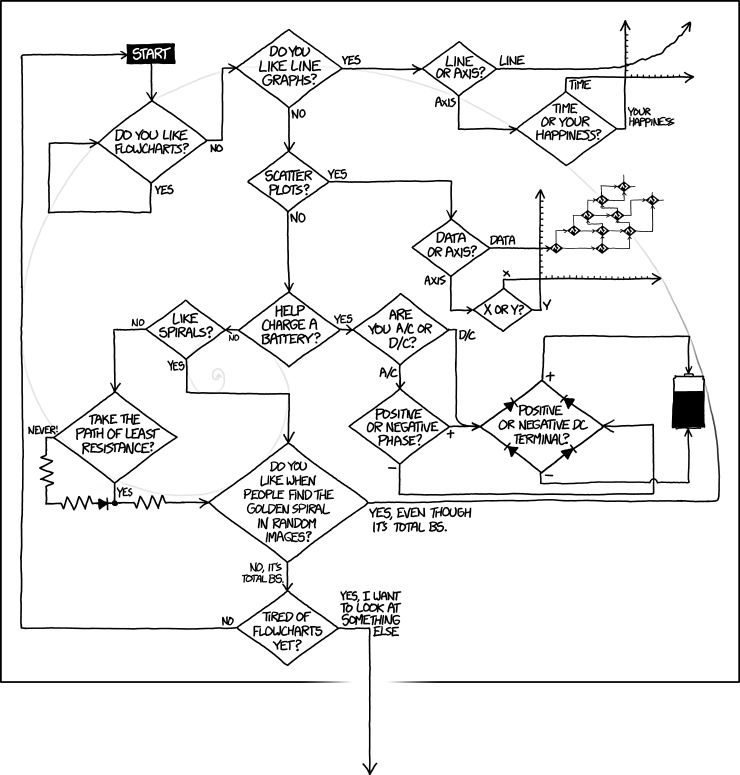
Flowcharts

Russian Sledges

via firehose

Whoa, and if you overlay a Fibonacci spiral on a golden spiral it matches up almost perfectly!
19 Feb 07:00

Amazon Greenlights a Full Season of ‘The Man in the High Castle’ After It Becomes Amazon’s Most Watched Pilot Ever

by Rebecca Escamilla
Russian Sledges

via rosalind

The Man in the High Castle

Amazon has greenlit a full season of The Man in the High Castle–based on Philip K. Dick‘s Hugo Award-winning 1962 novel of the same name–after its pilot received so much attention that it was Amazon’s “most watched pilot ever,” according to Vice President of Amazon Studios Roy Price. The show stars Rufus Sewell, Luke Kleintank, and Alexa Davalos, and features executive producer Sir Ridley Scott.

The Man in the High Castle considers the question of what would have happened if the Allied Powers had lost World War II. Almost 20 years after that loss, the United States and much of the world has now been split between Japan and Germany, the major hegemonic states. But the tension between these two powers is mounting, and this stress is playing out in the western U.S. Through a collection of characters in various states of posing (spies, sellers of falsified goods, others with secret identities), The Man in the High Castle provides an intriguing tale about life and history as it relates to authentic and manufactured reality.

While the pilot is currently available to stream on Amazon, the series is planned to premiere later this year or in 2016 to Amazon Prime members in the United States, United Kingdom, and Germany.

The Man in the High Castle

Here we go! #WCC #mothership #MITHC #costumes pic.twitter.com/b493mzZdwU

— Audrey Fisher (@AudreyFish) February 18, 2015

images via Amazon

Thanks, Jason Laskodi!

19 Feb 06:55

kateordie:archiemcphee: Today the Department of Unexpected...

Russian Sledges

via rosalind


kateordie:

archiemcphee:

Today the Department of Unexpected Interspecies Friendship is sighing happily while looking at these awesomely adorable photos of a pair of BFFs who happen to be a Little Owl named Napoleon, aka Poldi, and a Belgian Malinois named Ingo. These fast friends live with Tanja Brandt, a professional animal photographer and collage artist based in Dusseldorf, Germany, who photographs the unusual pair while they’re all outside enjoying the fresh air together. Napoleon is the runt of a brood of 7 little owls hatched by a professional breeder. Ingo often assists Brandt while she photographs other birds, including her Harris’s Hawks, which easily dwarf little Poldi.

"I go outside with them together — Napoleon on my hand, Ingo is free running. I do the same with my big Harris Hawks, but they are also free and can fly. Not so with Napoleon. It’s too dangerous. Every cat would kill him, he don’t know hows [sic] to live free.
And so, this is why they trust each other. They respect each other and they can read each other. Ingo knows every reactions from the wild birds and if they are angry, he goes another way […] with the wild birds, he is very soft (not with other dogs or something else).”

Click here to learn more about Poldi and Ingo. For more photos of them, as well as photos of Brandt’s other avian friends, visit Tanja Brandt’s 500px page.

[via Bored Panda and 500px]

The buddy cop movie WE deserve!

Poldi and Ingo!

19 Feb 06:53

The Capybaras of Saitama Children’s Zoo Enjoy the Hot Tub and Hot Springs on a Chilly Winter’s Day

by Lori Dorn
Russian Sledges

via rosalind

The very many capybaras of the Saitama Children’s Zoo enjoy a sit in the hot tub and a shower under the hot springs on a chilly winter’s day in Higashi-Matsuyama, Japan. Capybaras are considered to be semi-aquatic and very social animals, making hot tub gatherings the ideal place for these wonderful giant rodents.

Capybaras Showering

Capybaras

Capybaras in Bath

images via Saitama JAPAN Just North of Tokyo

via Tastefully Offensive, Boing Boing

18 Feb 22:12

“The idea of two sexes is simplistic. Biologists now think there is a wider spectrum than that.”

by PZ Myers
Russian Sledges

via bernot via Luke.stirling

That quote is from a good article in Nature on how sex is non-binary — my only quibble would be with that “now”. You’d have to define “now” as a window of time that encompasses the entirety of my training and work in developmental biology, and I’m getting to be kind of an old guy. Differences in sex development (DSDs) are common knowledge, and rather routine — and coincidentally, I’m giving an exam on sex chromosome anomalies today.


The article works through a lot of basic concepts: chimeric sex, genetic vs. cellular vs. organismal sex, and the development of sexual characters. I was so happy that they did not trigger one of my pet peeves, the claim that we all start out as female — we don’t, we start out sexually indifferent.

That the two sexes are physically different is obvious, but at the start of life, it is not. Five weeks into development, a human embryo has the potential to form both male and female anatomy. Next to the developing kidneys, two bulges known as the gonadal ridges emerge alongside two pairs of ducts, one of which can form the uterus and Fallopian tubes, and the other the male internal genital plumbing: the epididymes, vas deferentia and seminal vesicles. At six weeks, the gonad switches on the developmental pathway to become an ovary or a testis. If a testis develops, it secretes testosterone, which supports the development of the male ducts. It also makes other hormones that force the presumptive uterus and Fallopian tubes to shrink away. If the gonad becomes an ovary, it makes oestrogen, and the lack of testosterone causes the male plumbing to wither. The sex hormones also dictate the development of the external genitalia, and they come into play once more at puberty, triggering the development of secondary sexual characteristics such as breasts or facial hair.

That’s exactly right.

The major point of the article is something a lot of people deny: that sex is complicated, there’s more than two states of human existence, and most importantly, that biology verifies the existence of a continuum of sexual differentiation. Drag this article out next time someone tries to argue that biology supports their simplistic version of a discrete sexual dichotomy.

Yet if biologists continue to show that sex is a spectrum, then society and state will have to grapple with the consequences, and work out where and how to draw the line. Many transgender and intersex activists dream of a world where a person’s sex or gender is irrelevant. Although some governments are moving in this direction, Greenberg is pessimistic about the prospects of realizing this dream — in the United States, at least. “I think to get rid of gender markers altogether or to allow a third, indeterminate marker, is going to be difficult.”

So if the law requires that a person is male or female, should that sex be assigned by anatomy, hormones, cells or chromosomes, and what should be done if they clash? “My feeling is that since there is not one biological parameter that takes over every other parameter, at the end of the day, gender identity seems to be the most reasonable parameter,” says Vilain. In other words, if you want to know whether someone is male or female, it may be best just to ask.

I’ll also add that it’s not just biology that supports the idea that sex is a spectrum. It’s also the case of psychology and sociology — any science that has to address sex differences.

18 Feb 19:11

▶ Painting On Water: Turkish Marbling AKA Ebru Class In Istanbul 2 - YouTube

by russiansledges
Russian Sledges

new fixation

18 Feb 19:09

Marbled paper, what a curious name

by Jason Kottke
Russian Sledges

5:32-6:19 is pretty satisfying

Wow, the art of making marbled paper, a short film from 1970.

Charmingly British, just like the film about the Teddy Grays candy factory or the putter togetherer of scissors. Super cool how the inks are placed on a water bath, swirled expertly to make patterns, and then transferred to the paper. Also of note: the segment on the conservation of old books starting at around 9:55...I never knew they took them apart like that to dunk the pages in water! Sadly, the Cockerell Bindery ceased operation in the late 1980s with the death of Sydney Cockerell and its contents were sold at auction. (thx, matt)

Tags: books   how to   video
17 Feb 23:45

The Sickeningly Low Vaccination Rates at Silicon Valley Day Cares | WIRED

by russiansledges
Russian Sledges

#berkeley

The rates are more egregious at a Pixar-associated day care. Only 43 percent of children there are immunized.
16 Feb 21:23

mizzle-shinned, adj.

Russian Sledges

via firehose


'Having one's legs red and blotched from sitting too near a fire. Cf. mizzle-kyted adj.'

16 Feb 18:35

Martin Luther playset is the best-selling toy of all time

by Cory Doctorow
Russian Sledges

via multitask suicide

I need this


Playmobil's German "Little Luther" toy sold 34,000 pieces in 72 hours. Read the rest

16 Feb 13:16

North Carolina’s Counter Culture Coffee Emeryville roastery opening next month

by Tara Duggan
Russian Sledges

via overbey


Counter Culture Coffee training center

Cupping at the Counter Culture Coffee training center in New York City. Photo: Alan Tansey

When Brett Smith opened Counter Culture Coffee in Durham, North Carolina in 1995, he created a model that remains unusual in today’s coffee roasting world. Smith’s company focuses on sourcing and roasting coffee, and then training people how to best prepare coffee drinks with the beans. But it doesn’t operate cafes.

In March, Counter Culture will break out its first West Coast roastery and training center in Emeryville after 20 years of only roasting in North Carolina. The Northern California branch will be followed by another training center in Los Angeles later this year. Counter Culture has eight other training centers around the country, all in the East Coast. The new roastery will be joining local companies like Peet’s, McLaughlin Coffee Co. and Highwire Coffee Roasters that have headquarters and roasting facilities in Emeryville.

“We wanted to come West and part of it was driven by Emeryville’s relative central location as we continue to grow in the West Coast,” says Smith, who is also looking at other West Coast markets like Seattle. “It’s a great market. We think there’s a lot of opportunity to come over there and share our coffee with a lot of great people. It’s certainly a great coffee town.”

Ya think? Usually, it’s the other way around: West Coast coffee companies like Four Barrel send their coffee to New York restaurants, or Portland’s Stumptown opens a roastery there. With Santa Cruz-based Verve opening soon in San Francisco and so many other home-grown coffee roasters expanding around the Bay Area, you have to wonder how an East Coast company will fit in.

“We hadn’t really thought of that,” Smith joked. “Coffee is an amazing business. It can feel crowded at times. It’s relatively easy to get in the business with a roaster and some good coffee. But what we really try to focus on is what we do best–sourcing unique coffees based on long-standing relationships we’ve had with farmers and working with them to experiment on different ways of growing.”

Counter Culture Coffee founder Brett Smith. Photo: Christy Baugh

Counter Culture Coffee founder and president Brett Smith. Photo: Christy Baugh

Smith also points to the company’s extensive training program for wholesale customers’ staff, in whole and half-day sessions on skills like beginning espresso and cupping fundamentals. The company also does a lot of public outreach with free talks and tours not just about coffee itself but sustainability issues around producing it.

Counter Culture coffee can already be found at a few Bay Area cafes like Coffee Cultures in the Financial District, Stanza Coffee locations in San Francisco and Modern Coffee in Oakland; it’s also sold at Dean & Deluca in St. Helena.

After opening, the Emeryville roastery will be open to the public for tastings and tours every Friday at 10 a.m. The space is being designed by architect Jane Kim, who is also responsible for Milk Bar in New York and Counter Culture’s New York training center.

Counter Culture: 1329 64th St., Emeryville. Opens in March.

16 Feb 05:24

Facebook now lets you choose who controls your account after you die

by Jacob Kastrenakes
Russian Sledges

I think this might be a good thing?

Facebook is putting its users in control of what happens to their accounts after they die. Starting today, users in the US will be able to chose to have their accounts deleted after death or grant another person on Facebook permission to manage an account on their behalf. Facebook calls this person an account's "legacy contact," and users will be able to choose that person through the website's or app's security page.

Continue reading…

16 Feb 05:18

Boston Could Record More Snow In One Month Than Chicago's Ever Had In A Winter

Russian Sledges

via firehose

Snow and dangerously high winds roared across parts of New England in the dark of night to face an army of road crews and emergency workers Sunday, who had readied themselves for the fourth winter onslaught in less than a month. The odds favored the ominous weather.
14 Feb 19:31

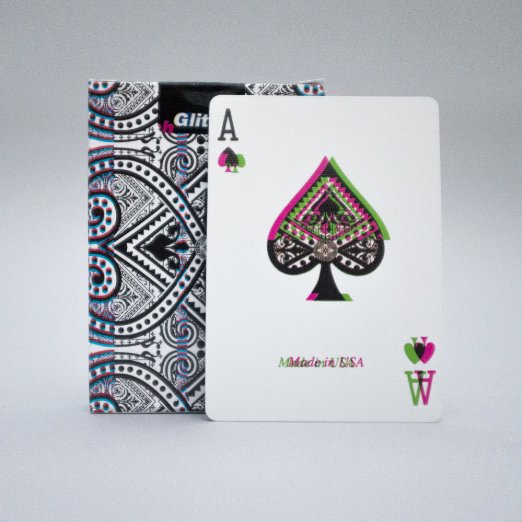
Glitch playing cards

by Cory Doctorow
Russian Sledges

via multitask suicide

Glitch aesthetic meets sleight of hand -- or games of chance. Rather good glitch-aesthetic and varied across each card. ($14) Read the rest

14 Feb 19:07

It's no hoot: Oregon city to post signs about attacking owl - SFGate

by overbey
Russian Sledges

via overbey ("I’m imagining this quote coming from Leslie Knope.")

"It's just making people aware that there's an owl there that for whatever reason swoops down and goes after people's hats," he said.
13 Feb 18:15

sixpenceee:Flower petals cause the appearance of blood stains on...

Russian Sledges

via carnibore


sixpenceee:

Flower petals cause the appearance of blood stains on the grave of opera singer Jane Margyl in Batignolles cemetery in Paris.