The only place in Leipzig open at 9am is the torture museum LET’S GO
[X]
TertiarymattSo far as I can tell, every free object in the map has been rotated 180 degrees around its centroid. Which is sort of upside down? But not in the sense of how I initially thought it should be.
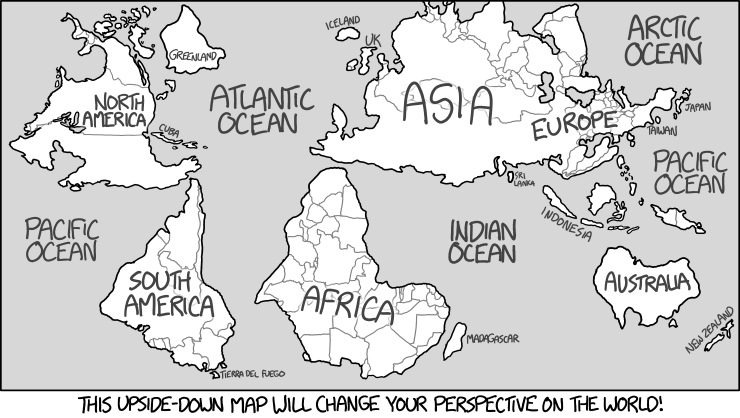
TertiarymattThis is goddamn crazy.
You know the drill. DNA holds the source code; RNA carries it to the ribosomes; ribosomes build stuff for the cell. Of course, the details of cellular operation are a million times more intricate than this— some RNA acts not to courier code but to switch genes on and off, for example— but it’s this venerable three-step that puts the tinkertoys together.
Now. If a sufficiently unscrupulous RNA molecule had an agenda at odds with the wishes of Daddy DNA, it could do a fair bit of damage. Change an instruction or two while on the road, enlist some hitchhiking enzyme into provoking a frame-shift or a faux-point-mutation. The nucleus mails off an order for Game of Thrones and the ribosome receives one for Spongebob Squarepants.
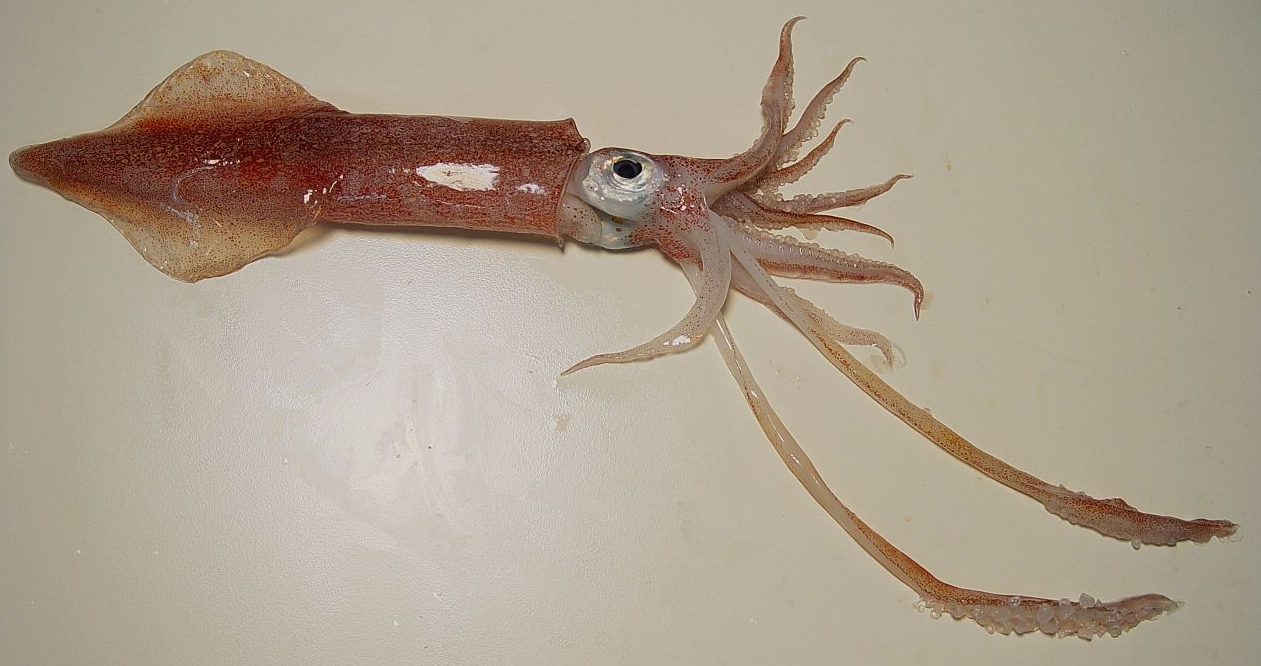
Who needs gamma rays? This guy hacks his own DNA. (Photo Brandi Noble, NOAA)
The term is RNA editing and it occupies center stage in this recent paper on cephalopod genetics. RNA editing is generally a very rare event. This makes it all the more remarkable that Alon et al report over 57,000 recoding sites for the Longfin Inshore Squid— an order of magnitude higher than reported for any other species. Even cooller, all these hijacked codes seem to be involved in building the nervous system. (“Synaptic vesicle cycle”, “axon guidance”, “actin cytoskeleton”, and “Circadian rhythm” are all processes listed as massively rewritten downstream of the DNA.)

This is part of a squid synapse. Red and yellow bits are subject to change without notice. (from Alon et al.)
It’s right there in the title: The Majority of Transcripts in the Squid Nervous System are Extensively Recoded. As the authors point out, this necessitates a major rethink of the whole squidly evolutionary process. But there are applications beyond such obvious intrinsic biological interest.
If I was interested in rebuilding a cephalopod to my own ends— perhaps adding organic tasers, or extra eye-sockets repurposed as oceanographic sensors (imagine luciferin fluorescence as an indicator of dissolved O2, which trigger photopigments in a modified retina, which in turn send that data back to a central nervous system via an extra optic nerve!)—
Well, let’s just say that a squid who comes pre-equipped with its own set of downstream editing enzymes, targeted to major CNS functions, might come in really handy.
(Coming up in Part 2: Selection-resistant genes. What could possibly go wrong?)
TertiarymattBl00 talks about the things! Haven't had time to watch the whole thing, but will probably send off to some folks I know roughly in the field.
TertiarymattWatched this for the whole length of this song.
http://lotheredoiseemybrother.bandcamp.com/track/were-not-building-pianos-were-making-machines
Might go see this band next weekend.

Stages
 cataclysmic9 reblogged this from postcardsfromspace
 rhondayvoo reblogged this from 0rbs
 everythingfreaksmeout likes this
 ankoanko likes this
 drosselmeyertoade likes thisdrosselmeyertoade reblogged this from theremina
 toospoopyformyshirt likes this
 pan-cake-sexual reblogged this from postcardsfromspace
pan-cake-sexual likes this
pan-cake-sexual reblogged this from postcardsfromspace
pan-cake-sexual likes this pound666 likes this
 ceneya likes this
 animatorlex likes this
 annamckennablog reblogged this from dave-strick
 envyme20 likes this
 memoriesofsweaterspast likes this
 myecandy reblogged this from loopdeloop-blog
 mint5667 reblogged this from dave-strick
 toikautosa likes this
 yomommasbestfriend reblogged this from therealklt
 foolmanchu1 likes this
 animatedgifjes reblogged this from loopdeloop-blog
 triboutarn likes this
 airshipabove likes this
 wedgex likes this
 15blowstoyourmind reblogged this from theremina
 oznogon reblogged this from postcardsfromspace
 gguillotte likes this
 yaelolivaz reblogged this from adelicateart
 sebrydahl likes this
 hionlove likes this
 jinkiesitssara reblogged this from loopdeloop-blog
 escapingallhumanity likes this
 caromonroe reblogged this from abvh
 televandalist likes this
 awesomeoutrageous reblogged this from theremina
awesomeoutrageous likes this
awesomeoutrageous reblogged this from theremina
awesomeoutrageous likes this lisavertudaches likes this
 fortsandersnet likes this
 mutton-basher reblogged this from postcardsfromspace
 surisingh89 likes this
 molly-ren likes this
 postcardsfromspace reblogged this from theremina
 edidin likes this
 bornregrets reblogged this from noirchrome
bornregrets likes this
bornregrets reblogged this from noirchrome
bornregrets likes this biixzed likes this
 iilyoss reblogged this from princesa-vulcana
 slamtron likes this
 cutespaceships likes this
 ku-roe1 reblogged this from theremina
Tertiarymattvia Coop. People are not right.
Watch as one man tries to see how far he can push Skyrim before everything crumbles into complete chaos.
You've got your typical wacky Skyrim mods here—Thomas the Tank Engine as dragons, Tommy Wiseau horses, Sonic. But it doesn't take long for you to stop being able to track all the mods videogamedunkey activates—the entire game just becomes bananas. It's the best thing I've watched all day. Enjoy.
This entry passed through the Full-Text RSS service - if this is your content and you're reading it on someone else's site, please read the FAQ at fivefilters.org/content-only/faq.php#publishers.
TertiarymattIn some ways, it's sort of odd to think how much room for innovation there still was in the analog photography world. Also, this continues to be a model example of how you run a kickstarter, in my opinion.
TertiarymattI am a terrible person to be related to, and a pretty good approximation of this third verse.
TertiarymattIs it better to own an island, or a town? via A. Kachmar.

Grantville, a small city in Georgia where a few episodes of AMC‘s hit television series The Walking Dead were filmed, has recently gone up for sale on eBay. According to the listing posted by eBay user k9chabe, “three movies just signed up to film in Grantville that two very well known actors will be staring in the roles.” The historic city is currently listed at $680,000. Unfortunately, it is local pick-up only.
This is an opportunity for someone to own a piece of history. The City of Grantville is a vibrant community just south of Newnan Georgia. This downtown area is always being scouted by the movie industries and has been home to several block busters as well as TV shows like The Walking Dead who have filmed several episodes in the downtown area. This is a money maker for anyone trying to invest in an area that’s about to burst. The downtown area has several tenants occupying a good of the 45% percent of the area for sale, so instant revenue. The area for sale is approximately 34,000 Square feet of usable space. This includes 9 Buildings which include: Retail areas, Loft Apartments, Pizza Restaurant, Bar or Pub, Restaurant, Pharmacy, Office space and many other combinations.


photos via eBay
via Messy Nessy Chic
TertiarymattA good reason to have a premium account? Though I per week ain't bad.
We’re going to be rolling out an exciting new program in The Old Reader over the next few weeks. As you know, The Old Reader has been entirely Ad free since it’s inception and we’ve been vocal about doing our best to protect our users from excessive online advertising. Our Premium accounts have been very successful, but we’re frankly still not where we need to be in terms of revenues in order to fund planned development and continue innovating this service. We have a small, dedicated, and talented team but our vision for The Old Reader is ambitious.
So we’re taking a cue from some publishers that we really admire (such as Daring Fireball) and introducing Sponsored Content. Premium users will never see sponsored content, but all other users will see up to 1 sponsored post per week in their RSS feeds. That’s it. It’s an exclusive program and we believe we’ll be able to make the program beneficial to both users and sponsors.
We’re also adding weekly site sponsors that would get a banner placement on the web interface. It’ll be an exclusive program and we’ll only accept sponsors that we believe are relevant and inoffensive. We will under no circumstances use any techniques such as tracking cookies or harvesting user data to advertise to our users. And again, premium users will never see any sponsored content.
We know some of you might have concerns and we’re happy to field any questions that you might have. If you are interested in signing up for the sponsor program, please visit out sponsorship page.
TertiarymattAh, good ol' Franklin.










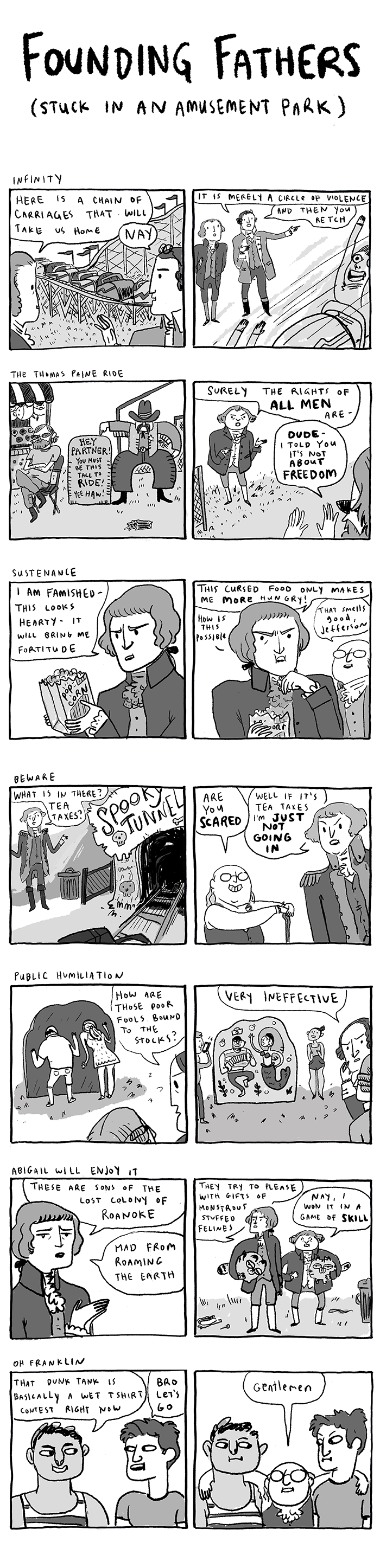
buy this print! |
|||
Those Founding Fathers! They are still at it!
I'm going to Germany myself, for a book festival all next week. Details here! Will I see you there? Would the Founding Fathers approve? Yes I think so. Thank you to my new German publishers Zwerchfell! |
|||
Friends:
Lynn Allingham
John Allison
Dawn and Margie Beaton
Marc Bell
John Campbell
Scott Campbell
Ryan Carley
Anthony Clark
Rebecca Clements
Domitille Collardey
Jillian Comeau, Kim Carson and Michelle Skelding
Aaron Diaz
Jess Fink
Eric Feurstein
Brian Fukushima
Sarah Glidden
Meredith Gran
Lisa Hanawalt
Dustin Harbin
Christopher Hastings
Emily Horne and Joey Comeau
Jon Klassen
Steve Lambke
Hope Larson
Joe List
David Malki
Phil McAndrew
Carolyn Merriman
Carly Monardo
Vicki Nerino
Ryan North
Ryan Pequin
Neil Rough
Jeffrey Rowland
Gabby
Schulz
Smart and Bird
Nathan Stapley
Julia Wertz
Britt Wilson
Steve Wolfhard
Chip Zdarsky
Good comic shops that have taught me a thing or two:
The Beguiling, Toronto
Strange Adventures, Halifax
Legends Comics and Books, Victoria
Desert Island, Brooklyn

All content (c)2006-2015 Kate Beaton
TertiarymattNot the most coherent thing Henry has ever written, but: "One of my favorite questions to ask is: In a fight, who would win, Jesus or Glenn Danzig?"

[Look for your weekly fix from the one and only Henry Rollins right here every Thursday, and come back tomorrow for the awesomely annotated playlist for his Sunday KCRW broadcast.]
Recently I was on the podcast You Made It Weird with Pete Holmes. He’s an incredibly nice guy, and it was a good experience overall.
At one point, he moved the conversation toward the spiritual. I told him that I had no religious or spiritual beliefs but was too lazy for atheism. I was trying to be funny, but basically it’s true.
Many years ago, I concluded that people need leadership and rules to follow. Government, laws, the threat of incarceration, traffic lights. Freedom is great, but the freedom to drive over someone and go on your way isn’t.
I reckon that religion was an early method of keeping people from running amok. The act of worshipping an unseen force requires faith and strength of conviction — and that in itself is a profound concept. If you believe in what you can’t prove conventionally, you have to land on that very hard to beat back the doubters. Like when the Westboro Baptist Church people got pushback for their “God hates fags” signs, they just made bigger signs.
To be a person of faith, it seems to me, takes no small amount of work. This idea is succinctly addressed in the King James version of the Bible, John 20:29: “Jesus saith unto him, Thomas, because thou hast seen me, thou hast believed: blessed are they that have not seen, and yet have believed.” I had to look it up to get the words right, but I actually read a version of that in a hotel room once.
Since there aren’t enough resources for everyone to have a personal cop monitoring their every action, there must be a mega-cop so huge that his omnipresence is invisible and unquestionably powerful.
This is what I figure religion is. Try to be good. Being human, you will make mistakes, but all is not lost. You can ask to be forgiven; by meditating on your mistake, you will see that it would be unwise to repeat the behavior. Throw in the idea of punishment and reward and it’s a workable system.
I think the most brilliant part of religion, as I understand it, is what comes after you die — eternity.
In life, Martin Luther King had to put up with the boiling rage of Jesus-loving, God-fearing citizens who wanted to keep schools segregated. It had obviously crossed his mind that something bad might come his way. On April 3, 1968, at this end of his famous “I’ve Been to the Mountaintop” speech, Dr. King said that he would like to have a long life, but perhaps that wasn’t what was going to happen. In spite of that, he was happy and not afraid of any man, because his eyes had seen the glory of the coming of the Lord.
He was dead less than 24 hours later. I guess in his way of thinking, the everlasting good stuff and far bigger part of the picture was waiting post-life.
This is why I am not an atheist. If you believe that President Obama was born outside of America, no paperwork or witness testimony will convince you otherwise. If you believe in a higher power, then anyone trying to find holes in your logic causes you to stand your ground more tenaciously.
Basically, I believe that someone believes something.
Now and then, I get emails from religious people. They pity me and the life choices I have made. Some ask why I have covered my body with those awful tattoos and turned myself into such a freak. Others gently admonish me for not having a problem with anyone’s sexual orientation. They let me know that they will be praying for me.
Since they started it, I feel free to have a little fun. I reply, “Thanks, Gandhi!”
This often results in a long letter about the sinner and the sin. I wait a day or two and then write back, asking when they were first attracted to someone of their own gender. I let them know that I am just fine with their gayness and I bet the big guy is, too.
The benevolence usually starts to wear a little thin in the next reply. One of my favorite questions to ask is: In a fight, who would win, Jesus or Glenn Danzig?
It’s around then that the gloves come off. I have even gotten some of them to curse, which I love. There is nothing like being told to go fuck yourself by the same person who was, only days before, praying on your behalf.
When someone tells me that America is a Christian nation and all the laws we need are contained in the Bible, to me that is not a religious discussion. It’s about the notion of authority this person is employing in an attempt to control others. God might be real to this person, but what is as real to me is Article VI of the Constitution. All of our disagreements will end in stalemate, so why even bother? I have no interest at all in trying to “win” an argument like this, because to me the premise is bent to begin with.
Do I have beliefs? You bet! I will leave this now and be back in several hours to testify!
It’s 0107 hrs. on Feb. 17, 2015. I have just returned from the Griffin in Atwater Village. Fuzz and Thee Oh Sees played a free show. I am such a fan of these bands. I stood in a highly packed room. Both groups completely ripped it up.
I saw, I heard, I experienced — I believed. What did I believe? Same thing I always have: the here, the now, the Rock!
Follow us on Twitter @LAWeeklyMusic, Henry Rollins @henryrollins and like us on Facebook at LAWeeklyMusic.
Henry Rollins' 20 Favorite Punk Albums
Henry Rollins: Musical Elitism Is for Lightweights
Henry Rollins: Gay Marriage Is Punk Rock
TertiarymattThis pleases me.
FORT WORTH — Gabe Brown is in such demand as a speaker that for every invitation he accepts, he turns down 10 more. At conferences, like the one held here at a Best Western hotel recently, people line up to seek his advice.
“The greatest roadblock to solving a problem is the human mind,” he tells audiences.
Mr. Brown, a balding North Dakota farmer who favors baseball caps and red-striped polo shirts, is not talking about disruptive technology start-ups, political causes, or the latest self-help fad.
He is talking about farming, specifically soil-conservation farming, a movement that promotes leaving fields untilled, “green manures” and other soil-enhancing methods with an almost evangelistic fervor.
Such farming methods, which mimic the biology of virgin land, can revive degenerated earth, minimize erosion, encourage plant growth and increase farmers’ profits, their proponents say. And by using them, Mr. Brown told more than 250 farmers and ranchers who gathered at the hotel for the first Southern Soil Health Conference, he has produced crops that thrive on his 5,000-acre farm outside of Bismarck, N.D., even during droughts or flooding.

He no longer needs to use nitrogen fertilizer or fungicide, he said, and he produces yields that are above the county average with less labor and lower costs. “Nature can heal if we give her the chance,” Mr. Brown said.
Neatly tilled fields have long been a hallmark of American agriculture and its farmers, by and large traditionalists who often distrust practices that diverge from time-honored methods.
But soil-conservation farming is gaining converts as growers increasingly face extreme weather, high production costs, a shortage of labor and the threat of government regulation of agricultural pollution.
Farmers like Mr. Brown travel the country telling their stories, and organizations like No-Till on the Plains — a Kansas-based nonprofit devoted to educating growers about “agricultural production systems that model nature” — attract thousands.
“It’s a massive paradigm shift,” said Ray Archuleta, an agronomist at the Natural Resources Conservation Service, part of the federal Agriculture Department, which endorses the soil-conservation approach.
Government surveys suggest that the use of no-tillage farming has grown sharply over the last decade, accounting for about 35 percent of cropland in the United States.
For some crops, no-tillage acreage has nearly doubled in the last 15 years. For soybeans, for example, it rose to 30 million acres in 2012 from 16.5 million acres in 1996. The planting of cover crops — legumes and other species that are rotated with cash crops to blanket the soil year-round and act as green manure — has also risen in acreage about 30 percent a year, according to surveys, though the total remains small.
Farmers till the land to ready it for sowing and to churn weeds and crop residue back into the earth. Tilling also helps mix in fertilizers and manure and loosens the top layer of the soil.
But repeated plowing exacts a price. It degrades soil, killing off its biology, including beneficial fungi and earthworms, and leaving it, as Mr. Archuleta puts it, “naked, thirsty, hungry and running a fever.”
Degraded soil requires heavy applications of synthetic fertilizer to produce high yields. And because its structure has broken down, the soil washes away easily in heavy rain, taking nitrogen and other pollutants with it into rivers and streams.
Soil health proponents say that by leaving fields unplowed and using cover crops, which act as sinks for nitrogen and other nutrients, growers can increase the amount of organic matter in their soil, making it better able to absorb and retain water.

“Each 1 percent increase in soil organic matter helps soil hold 20,000 gallons more water per acre,” said Claire O’Connor, a staff lawyer and agriculture specialist at the Natural Resources Defense Council.
In turn, more absorbent soil is less vulnerable to runoff and more resistant to droughts and floods. Cover crops also help suppress weeds. Environmental groups like the Defense Council have long been fans of soil-conservation techniques because they help protect waterways and increase the ability of soil to store carbon dioxide, rather than releasing it into the air, where it contributes to climate change.
One recent study led by the Environmental Defense Fund suggested that the widespread use of cover crops and other soil-health practices could reduce nitrogen pollution in the Upper Mississippi and Ohio River basins by 30 percent, helping to shrink the giant “dead zone” of oxygen-depleted water in the Gulf of Mexico. The Defense Council, Ms. O’Connor said, has proposed that the government offer a “good driver” discount on federal crop insurance for growers who incorporate the practices.
But the movement also has critics, who argue that no-tillage and other methods are impractical and too expensive for many growers. A farmer who wants to shift to no-tillage, for example, must purchase new equipment, like a no-till seeder.
Tony J. Vyn, a professor of agronomy at Purdue, said the reasons growers cite for preferring to fully till their fields vary depending on geography, the types of crops they grow and the conditions of their soil. But they include the perception that weed control is harder using no-tillage; that the method, which reduces water evaporation, places limits on how early in the year crops can be planted; and that the residue left by no-tilling is too difficult to deal with, especially when corn is the primary cash crop.
Even farmers who enthusiastically adopt no-till and other soil-conservation methods rarely do so for environmental reasons; their motivation is more pragmatic.
“My goal is to improve my soil so I can grow a better crop so I can make more money,” said Terry McAlister, who farms 6,000 acres of drought-stricken cropland in North Texas. “If I can help the environment in the process, fine, but that’s not my goal.”
For years, Mr. McAlister plowed his fields, working with his father, who began farming outside the town of Electra in the 1950s. But he began having doubts about the effects of constant tilling on the soil.
“We were farming cotton like the West Texas guys were, just plow, plow, plow,” he said. “And if you got a rain, it just washed it and eroded it.
“It made me sick,” he said. “You’re asking yourself, ‘Is there not a better way?’ But at the time, we didn’t know.”
Mr. McAlister said that he switched to no-tillage in 2005, when an agricultural economist calculated that the method offered a $15-per-acre advantage over full tilling.

Now he is a convert. Standing in a field of winter wheat, he pointed proudly at the thick blanket of stubble sprinkled with decaying radishes and turnips.
“One of the toughest things about learning to do no-till is having to unlearn all the things that you thought were true,” he said.
Mr. McAlister grows cotton, wheat, hay, grain sorghum and some canola as cash crops, using a GPS-guided no-till seeder that drills through residue, allowing him to plant precisely and effectively.
He credits no-tillage for one of his biggest wheat crops, in 2012, when extreme drought left farmers throughout the region struggling to salvage any harvest. His healthier soil, he believes, made better use of the tiny amount of rain that fell than did the fully tilled fields of other farmers.
But few growers go as far as Mr. Brown in North Dakota, who produces grass-fed beef and has given up most agricultural chemicals. Mr. McAlister, for example, still uses nitrogen fertilizer. He plants seeds that are genetically modified for drought or herbicide resistance. And he depends on herbicides like Roundup to kill off his cover crops before sowing the crops he grows for cash.
The philanthropist Howard G. Buffett, a proponent of soil-conservation practices, said that the drought and flooding that have plagued much of the country in recent years have drawn more farmers to no-till.
“When you get into a drought, that gets everybody’s attention,” said Mr. Buffett, the middle son of Warren E. Buffett, the billionaire investor. “Farmers don’t really change their behavior until they see that they have to, which is pretty much human nature.”
The Environmental Protection Agency’s regulation of nutrient pollution in the Chesapeake Bay under the Clean Water Act in 2010, Mr. Buffett said, should also be “a wake-up call that the E.P.A. is coming soon” and if farmers do not address fertilizer runoff, the government will do it for them.
Still, he said, reaping the benefits of no-tillage farming demands patience, given that it may take several years for deadened soil to recover. Some farmers try no-tilling for one season and then get discouraged. And there is no one-size-fits-all solution: Farmers must adapt what they have learned to their own land and crops.
Mr. McAlister and other no-till farmers said that perhaps the biggest barrier to the spread of no-till is the mind-set that farmers must do things the same way as earlier generations did them.
“We have a saying in our area: ‘You can’t no-till because you haven’t buried your father yet,’” Mr. McAlister said.
“You can’t take on an endeavor like this with someone leaning over your shoulder every day telling you you’re wrong and it’s not going to work,” he said.
TertiarymattNot that hard to do, if you're the government, actually.
 That your government will spy on you should, sadly (by now) come as no surprise. But, some of the ways they go about it still trigger disbelief. The Intercept claims to have received documents outlining methods the CIA has considered to access data o...


A Jihadist extremist told this female Lebanese news anchor to shut up, so she cut off his microphone.
Karaki was interviewing Hani Al-Seba’i about the phenomenon of Christians joining Islamic groups like ISIS. Al-Seba’i is a Sunni scholar who fled to London after he was sentenced in an Egyptian court to 15 years in prison for being a part of the Egyptian Islamic Jihad. The United Nations considers the group to be an affiliate of al Qaeda.
But despite Al-Seba’i’s extreme ties, Karaki didn’t back down when he disrespected her on Al-Jadeed TV after she politely tried to redirect his historical tangent. Instead of taking his guff, she cut off his microphone when she decided she’d had enough.
TertiarymattCurrent status

Sen. Rand Paul (R-KY) is one of three senators sponsoring the medical marijuana bill. (Alex Wong / Getty Images)
The bill is the first time in history the Senate will consider allowing medical pot, according to the Marijuana Policy Project.
A Senate staffer said the bill would prevent the Drug Enforcement Administration and other federal agencies from intervening in states' medical marijuana laws. Since states began enacting their own medical marijuana laws, the DEA has regularly raided and shut down state-legal medical marijuana dispensaries, because pot remains illegal for all purposes under federal law.
A federal spending deal attempted to end federal interference in December, but the provision in that deal wasn't permanent. Neither the spending deal or the new bill prevent federal agencies from intervening with states' marijuana legalization laws, although the Obama administration has deprioritized the enforcement of pot prohibition in states where the drug is legal.
The proposal reclassifies marijuana from schedule 1 to 2
The Paul-Booker-Gillibrand proposal also goes further than the spending deal by reclassifying marijuana from schedule 1 to 2. Under schedule 1, the federal government considers marijuana to have no medical value and some potential for abuse. Under schedule 2, the feds would acknowledge marijuana has some medical value, but a high potential for abuse. So the bill would force the federal government to acknowledge marijuana's medical value for the first time.
The bill would also attempt to unlock more marijuana-related research: the schedule 2 classification would ease restrictions to make it easier to conduct medical studies, and the bill itself will include some provisions to ease access to the drug.
A Senate staffer said the bill was necessary in light of movement at the state level to legalize medical marijuana and recommendations from several medical associations, including the American Association of Pediatrics, to reschedule the drug to allow for more research. It's an attempt, in other words, to bring the federal government in-line with a growing number of states and medical groups.
TertiarymattSCIENCE!
Well, actually this is probably more ENGINEERING!


TertiarymattImages of the coating development process for the New55 instant 4x5 film and paper.
 |
| 10u ABV over blue. Rough, but perfectly sealed. |
 |
| 20+u of Image over gloss. Remains smooth, but too thick so it will crack |
 |
| 2+u of release layer over Image. Look at how smooth the top is. This thickness did not interfere with image color or density formation. |
 |
| 2u Release layer. Like a ruler. |
 |
| This week's Three Layer Mix over blue. Hills and bumps like a cheap hotel room ceiling. Dmax inside the valleys is perfect. Almost no Image remains on the tops of the hills. |
 |
| The white spots are just the hilltops and the polluted Dmins are reagent puddles. |
 |
| 1966 T47 uncoated area. Image is 1-2u thick and the colloids can be seen too. Brown area is hydrogen sulfide affected lead acetate nucleant degradation where I missed with the print coater. |
 |
| GreyBack from Polaroid. Looks familiar. |
TertiarymattThese guys took on an incredibly difficult task, and have been admirably transparent in their work.

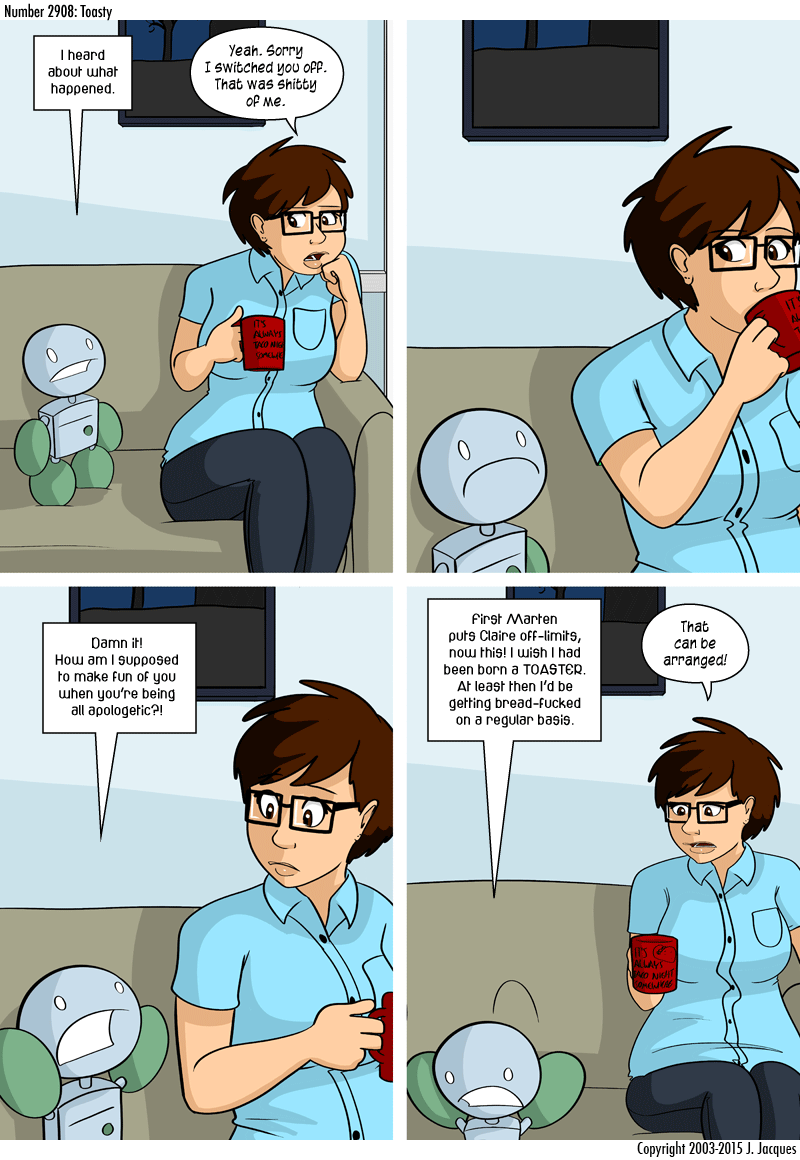
TertiarymattThis is the saddest Red Robot I have ever seen. Except for maybe that one time Dylan did a guest comic...

Red Robot is having battery life problems lately.
TertiarymattThis sofa is not fair.

February, 24th
TertiarymattNPR piece on some work from my lab.
Chicago skyline.
iStockphotoWhen Charles Darwin first taught us how to think about evolution, he also was teaching us to think about time. By allowing natural selection to work over millions of years, what might seem like a divine miracle (the creation of a new kind of animal) became something much more grounded (though equally wondrous).
But what if evolutionary change could operate much faster? What if evolution could dance to the same beat as something like ecology — the interaction of life with changing environments? This idea of "eco-evolutionary dynamics" is a relatively new one that, on its own, is stunning enough. But include the possibility of rapid, evolutionary change a'la the Anthropocene — the brave new human-dominated world we're creating — and things can get really interesting.
Eco-evolutionary dynamics in a rapidly urbanizing world is the subject of a new paper by Marina Alberti, a professor at the University of Washington's College of the Built Environment. I first met Alberti a couple years ago, as my own research into "the physics of cities" began. What is fascinating about her Urban Ecology Research Lab is the breadth of its efforts — and I've have been happy to learn and collaborate with them. As an astrophysicist, what intrigues me about the new paper is that its perspective takes rapid urbanization as not just a social phenomena but also as a planetary one.
Over the last decade or so, Alberti argues, scientists have recognized that changes in ecosystems can drive changes in evolution, such as the emergence of new species' traits. And as these traits rapidly evolve, novel ecosystem functions will appear as well. As Alberti puts it: "There is significant evidence that changes in ecological conditions drive evolutionary change in species traits that, in turn, alters ecological interactions."
In the modern era of a human-dominated planet, we are likely to have a special role to play in eco-evolutionary dynamics. Alberti writes:
"In human-dominated environments, selection pressures acting on traits can affect population dynamics by changing organisms' rates of survival or reproductive success, leaving a genetic signature that might affect community dynamics and ecosystem functions... These effects drive changes in energy and material fluxes that, in turn, influence ecosystem functions, such as primary productivity, nutrient cycling, hydrological function, and biodiversity, which provide essential services for human wellbeing."
The fact that human beings can shape ecosystems is, of course, nothing new. The really interesting thing in Alberti's study is the fact these ecosystem changes are shifting the evolution of species right now. And, just as important, the potential feedback of those evolutionary changes on ecosystem function will happen on a similar timescale.
City building is the most dramatic example of human beings altering ecosystems, and Alberti provides a long list of ways in which life is already evolving in response to the pressures of urbanization.
Songbirds are becoming tamer and bolder — and also are changing their tunes to ensure their acoustic signals don't get lost in the noise of cities. European blackbirds are becoming sedentary and have changed their migratory behavior in response to the growth of urban regions. Then there are the earthworms that are evolving increased tolerance to metals, plants that are modifying their seed dispersal "strategies" and an urban variety of mouse that's becoming a "critical host" for Lyme disease carrying ticks.
In all these cases, Alberti contends that the "urbanization" of ecosystems is, in a sense, leading to an urbanization of evolution. On the genetic level, life is responding to us. If she is right, however, the implications may stretch far beyond just evolving new species of "loud and proud" songbirds. Given the pace, scope and consequence of accelerating urbanization, Alberti thinks this new form of eco-evo dynamics might have global consequences, too. She writes:
"From a planetary perspective, the emergence and rapid expansion of cities across the globe could represent another turning point in the life of our planet. For most of its history, Earth has experienced long periods of relative stability, dominated primarily by negative feedbacks. However, the recent increase in positive feedback (i.e., climate change) ... could trigger transformations on the scale of the Great Oxidation Event that introduced oxygen into the atmosphere more than 2 billion years ago."
In other words, the evolutionary changes driven by our impact on the planet could drive the Earth through a dramatic and, perhaps, non-reversible tipping-point.
It's important to understand, however, that Alberti is not arguing for a "catastrophic" perspective. Instead, she says the recognition of eco-evo dynamics highlights both the challenges and the unique opportunity that humans have in shaping the Earth. Ecosystems in urban environments are a sort of hybrid, she said: "It is their hybrid nature that makes them unstable, but also capable of innovating."
Innovation is the key word here. Evolution has always been about innovation in the endless exploration of new niches. What I like about Alberti's perspective is it offers a powerful shift in how we view ourselves in the natural world. Rather than seeing human beings as a nexus of greed and evil, we become part of evolution's ongoing experimentation.
"We can drive urbanizing ecosystems to collapse — or we can consciously steer them toward a resilient and sustainable future," Alberti says. "The question is whether we become aware of the role we are playing."
Adam Frank is a co-founder of the 13.7 blog, an astrophysics professor at the University of Rochester, a book author and a self-described "evangelist of science." You can keep up with more of what Adam is thinking on Facebook and Twitter: @adamfrank4.

The US leads the world in incarceration, but most of its prisoners are in state prison. And a majority of state prisoners are serving sentences for violent crimes. That means that while states have made some progress in recent years in reducing their prison populations, it's going to be extremely difficult for that trend to continue indefinitely.
This infographic, from the Marshall Project, shows how hard it is to reduce the prison population substantially just by targeting nonviolent, low-level offenders:
In September, Vox offered a few reasons why recent criminal-justice reforms haven't made that much of a dent in the prison population. One reason is that they often targeted people who weren't going to prison to begin with, rather than tackling the question of what to do with violent offenders.
The good news is that lawmakers don't have to stop putting violent offenders in prison to reduce the incarceration rate substantially. They just have to stop putting them in prison for quite so long:
Experts say there should be reforms that let violent offenders, particularly those who are older and committed their crime decades ago, out early. The research indicates that people age out of crime, so letting them out of prison 10 or 20 years down the line might not pose a significant threat to public safety.
"While those people have committed serious crimes, in many respects their incarceration is often excessive," says Marc Mauer, executive director of the Sentencing Project. "The person locked up on armed robbery at 19 is not necessarily the same person when he turns 30 or 40."
To accomplish this, Mauer says state lawmakers would need to establish policies that make it so just about everyone — no matter what crime they were convicted of — can get parole or reduced sentences, through good behavior and evidence of rehabilitation. Policymakers could also take additional actions that relax or eliminate three-strike laws, mandatory minimum sentences, and other policies passed over the past three decades that force criminals to serve extremely long sentences.
This would present a dramatic shift in recent policy trends. According to the Sentencing Project, about one in nine US prisoners are currently serving a life sentence, and that rate has climbed over the past few decades. "Increasingly, those prison terms have overwhelmed any reductions we see on the lower levels of the scale," Mauer says.
TertiarymattDid someone say pedants?
Most cities in the US have combined stormwater and sewage systems.
On topic, it's an interesting finding, certainly. Not sure how extendable it, but interesting.

The Centers for Disease Control and Prevention have a few different ways of measuring obesity in the U.S., including phone surveys, in-home interviews, and physical exams of nationally representative slices of the population.
None of these methods involve poop.
It’s an unsurprising fact, probably, but one that bears noting only because some scientists believe it may soon change—or at least, that it should. In a study recently published in the journal mBio, researchers from the University of Wisconsin and the Marine Biological Laboratory in Woods Hole, Massachusetts, laid out the case for sewage as a public-health tool, arguing that human waste may be a more efficient way of measuring obesity at the population level.
To prove their concept, the authors examined more than 200 sewage samples taken from treatment plants in 71 U.S. cities, using genetic sequencing to identify which bacteria in the mix came from human feces (an average of around 15 percent across the samples). A city, like each of its individual inhabitants, has its own unique microbial signature that tends to stay constant over time; by looking at the bacterial makeup of a city’s sewage, the researchers found, they were able to predict its obesity rate at a accuracy rate between 81 and 89 percent.
“This is a way to generate information about the public without infringing on any individual’s privacy,” says A. Murat Eren, one of the study’s co-authors and a researcher at the Marine Biological Lab. “In a natural way, we access the microbiome of a given community.”
The mBio study is one of a handful of projects in recent months that have mined a city’s waste for information about the bodies that created it. If the old journalism cliché—three examples equals a trend—holds any truth, then it’s probably fair to say that sewage is having something of a moment. In January, The Boston Globe highlighted the joint effort of the Cambridge Public Health Department and the Massachusetts Institute of Technology to take a “sewage snapshot” of the city, a test case for the MIT team’s larger goal of analyzing waste for population-level information on illegal drug use, diet, and the prevalence of certain bacterial and viral diseases. And in November, The New York Times profiled Jane Carlton, a New York University geneticist collecting sewage from each of New York’s neighborhoods to “create a genetic map [that] highlight[s] the city’s microbial diversity across different districts.”
“It’s a preventative public-health question. We need to know the baseline to know how the baseline changes,” Carlton told the Times. Eren makes a similar argument: “By looking at the changes in microbial composition, we can come out with some early warning signals” about how a community’s health may be changing over time, he says. In discovering what normal sewage looks like, researchers can understand when and why it strays from the norm.
In some ways, the sewer-as-lab is a more community-minded extension of people’s growing fascination with what their own waste can do. Companies like uBiome have customers send in stool samples for an in-depth analysis of their microbiomes; fecal transplants are catching on as a viable treatment option for certain gastrointestinal conditions. Here, now, is the democratization of waste research, a chance for each of us to make our own contributions to science (ideally at least once every three days, doctors say). In fact, the average person will flush around 360 pounds of science per year.
“There are traces of all of us in the sewers—and those will tell a different, more collective story,” a member of the MIT team told the Globe. Or, put another way: It’s a scientist’s world, and we’re all just pooping in it.
This article was originally published at http://www.theatlantic.com/health/archive/2015/03/the-secrets-in-sewage/386794/

TertiarymattSame.
TertiarymattWould appear that youtube shares are non-video again, but this is a beautifully desolate piece of work, a production of an alternative score to the above experimental Russian art film.