Shared posts

01 Jun 05:02

The Remains of 100 Abandoned Italian Churches Peek Through Rubble and Foliage in Roman Robroek’s Photos

by Grace Ebert

All images © Roman Robroek, shared with permission

Whether cloaked in thick moss and debris or almost entirely preserved, the abandoned churches photographed by Roman Robroek document the effects of a changing landscape. At least 1,000 of the religious spaces are left unoccupied in both small towns and cities throughout Italy and stand in varying degrees of disrepair. In visiting approximately 100 chapels for his series CHIESA, Robroek witnessed how the once-sacred structures have been left behind. “If a church, once the most important haven in the community, can become a pile of ruins, what does that say about what we hold certain today?” he asks in an essay.

Robroek’s photos, which will be accompanied by drone footage by Sven van der Wal slated for release later this year, capture the beauty of disrepair: foliage grows from the rubble of a collapsed ceiling, a heavy layer of dust covers humble, wooden pews, and gilded trim and elaborately designed altars remain in pristine condition. The Netherlands-based photographer has broadly considered why a growing number of Italy’s churches, of which there are at least 20,000 throughout the country, are deserted. His reasonings include natural disasters, the long-standing effects of war, and cultural shifts. “Admittedly, it might seem incredible that such stunning, artful churches are in this state of decay, but it all connects to the same issues…the lack of community and the economic desolation of an area that has long past its prime,” he says.

Next month, Robroek will be traveling to Thailand to photograph abandoned structures, and you can follow his findings on Instagram. Until then, pick up a print in his shop, and check out his book Oblivian, which catalogs ten years of his practice and is available on Bookshop. (via Peta Pixel)


16 May 04:42

Macro Photos by Barry Webb Highlight the Spectacular Diversity of Slime Molds

by Grace Ebert

Arcyria denudata. All images © Barry Webb, licensed

South-Bucks, U.K.-based photographer Barry Webb favors the shimmering, gelatinous, and iridescent growths that sprout from decaying wood and plant material. His macro shots magnify the often imperceptible details of small slime molds, capturing the specimen’s unique characteristics with striking detail. From the globular heads of the Comatricha nigra to the spongey forms of the Arcyria denudata, each photo unveils the diversity and intricacies of some of the world’s tiniest organisms.

Several of Webb’s images have been recognized in international contests, including the Close-Up Photographer Of The Year, and he offers prints and a massive archive of fantastical slime molds on his site.


Comatricha nigra

Comatricha species

Cribraria aurantiaca group

Stemonitis and insects

Trichia decipiens

Stemonitis flavogenita

Lamproderma scintillans

Blue Cribraria

Woodlouse and Stemonitis

16 May 04:41

Vibrant Paper Strips Swirl into Energetic Circles of Scales and Feathers by Lisa Lloyd

by Grace Ebert

“Abel.” All images © Lisa Lloyd, shared with permission

Streaming from a beak or bodily mass, the thin paper strips that compose a new series of sculptures by Lisa Lloyd (previously) are infused with movement. The U.K.-based artist shapes the individual pieces into wide curves, mixing a variety of materials and hues from flat graphic colors to shimmering metallic. Abstract and energetic, the resulting sculptures contain a chaotic blend of emotion within circles of feathers and protective scales.

Lloyd shares that the pieces respond to personal and political strife, which manifests in the lively nature of each creature. She explains about the antagonistic avians in “Ritual”:

When I looked at birds being aggressive with each other, I noticed that a lot of the pictures I was looking at were actually of birds mating, or fighting for territory to mate. I was fascinated by how similar they are in nature. Aggression and fighting, passion and pain. I think our mating rituals are not that different.

Prints of Lloyd’s creations are available in her shop, and she documents much of her process on Instagram.


“Ritual”

“Heron”

“Ukraine”

“Pangolin”

Detail of “Pangolin”

06 Apr 02:50

Mitochondria Double as Tiny Lenses in the Eye

by Yasemin Saplakoglu
TimB

:-O

A mosquito watches you through a lattice of microscopic lenses. You stare back, fly swatter in hand, closely tracking the bloodsucker with your humble single-lens eyes. But it turns out that the way you see each other — and the world — may have more in common than you might think. A study published last month in Science Advances found that inside mammalian eyes, mitochondria...

Source

28 Mar 14:34

An Antimatter Experiment Shows Surprises Near Absolute Zero

by Charlie Wood

For decades, researchers have toyed with antimatter while searching for new laws of physics. These laws would come in the form of forces or other phenomena that would strongly favor matter over antimatter, or vice versa. Yet physicists have found nothing amiss, no conclusive sign that antimatter particles — which are just the oppositely charged twins of familiar particles — obey different rules.

Source

28 Mar 14:24

CodeSOD: If We're Good, Or Else

by Remy Porter

There are some coding practices which likely arise from a good intent, but sometimes feel misplaced. For example, the "only one return from a function" tends to make code more complex and harder to read, instead of easier, ever if it theoretically makes debugging easier. I can at least understand the intent and reasoning behind it, even if I don't like it.

Danny D's former co-worker had their own little rules. Specifically, sometimes when you write an if statement, you definitely need an else. Other times, you don't. That's confusing, because you have to make a choice. Instead of making a choice, just always use an else. Always.

if (!(tf.getType() == matchingTimeframe.getType() && StringUtils.equals(tf.getParameter(), matchingTimeframe.getParameter()))) { .... } else { // we are still good }

Of course, you need to include a comment to explain what condition the else represents. On every if-statement in the application. Even- no especially the ones with a somewhat confusing to read negation test, like we see here. We are still good. We are still good.

[Advertisement] Continuously monitor your servers for configuration changes, and report when there's configuration drift. Get started with Otter today!
28 Mar 03:04

A Photo Series Captures a Magnificent Rock Formation Set Against the Tateyama Mountains

by Grace Ebert

All images © Yasuto Inagaki, shared with permisison

With the imposing Tateyama Mountain Range in the backdrop, a photo series by Yasuto Inagaki centers on a smaller, recurring focal point: a few trees that have sprung from the top of cragged rocks. Inagaki, who lives in Japan’s Toyama Prefecture, visits the Amaharashi coast in Takaoka City often to capture the unusual formation among different weather, times of day, and seasons. Some shots show the sun just atop the mountains as it reflects in the water below, while others document bright daylight illuminating the snowy backdrop and an airplane flying in the distance. “The first time I encountered a miraculous scene like this one,” he tells Colossal,” the city was covered in fog, and the moon was shining brightly on the Tateyama Mountain Range…I have visited the shooting several times.”

For more of Inagaki’s photos, which include striking vistas and cityscapes around Japan, visit his Instagram.


28 Mar 03:00

An International Photo Competition Illuminates the Captivating and Remarkable Sights of Earth’s Landscapes

by Grace Ebert

Comet NeoWise Setting, Marin photographed by Tanmay Sapkal, Mt. Tamalpais, Marin, California, USA

From the brilliant dancing aurora of Iceland to Comet NeoWise hurtling above Mount Tamalpais, the winning shots of the 2021 International Landscape Photographer of the Year contest capture a diverse and captivating array of Earth’s topographies and phenomena. The annual competition is in its eighth year and garnered more than 4,500 entries centered on a variety of subject matter, including a mystical wood at Alcornocales Natural Park in Cadiz, the fairytale-esque flowers of France’s Vallée de la Clarée, and a wildlife fire in Yosemite National Park that appears more like a sunset on the horizon than massive blaze.

We’ve included our favorites from the 101 winners below, and you can see the entire collection on the contest’s site. For a deeper dive into the stories behind the photos, pick up a copy of the 2021 book.


Dancing Queen photographed by Roksolyana Hilevych, Arnarstapi, Iceland

Ghost Cave photographed by José D. Riquelme, Kirkjufell, Iceland

Silvia photographed by David Aguilar, Alcornocales Natural Park, Cadiz, Spain

Earth’s Calling photographed by Pierandrea Folle, Pollino National Park, Serra delle Ciavole, Italy

Party in the Valley photographed by Kassem Kalo, Vallée de la Clarée, France

The Cap on the Snowy Mountain photographed by Jana Luo, Tongariro National Park, New Zealand

Compelled by the Core photographed by Daniel Laan, Near Moddergat, the Netherlands

Fire photographed by Marcin Zajac, Yosemite National Park, USA

Primeval Arch and Columns photographed by Simon Xu, Mono Lake, Lee Vining, California, USA

Born of Fire photographed by Filip Hrebenda, Fagradalsfjall area, Iceland

Long To Be photographed by Kai Hornung, Highlands, Iceland

27 Mar 04:14

Majestic Photos Capture the Dwindling Population of Madagascar’s Ancient Baobab Trees

by Grace Ebert

All images © Beth Moon, shared with permission

In the fall of 2018, one of Madagascar’s most sacred baobabs cleaved and crumbled. The ancient giant was estimated to be about 1,400 years old and offered food, fuel, and fiber to the region before its trunk, which spanned 90 feet around, collapsed. Known as Tsitakakoike, which means “the tree where one cannot hear the cry from the other side,” the baobab was also entwined with local lore and thought to house the ancestral spirits of nearby Masikoro people. Its loss was devastating to the community and an ominous sign of how the climate crisis is permanently damaging these centuries-old trees.

Bay Area photographer Beth Moon (previously) has been documenting the species since 2006 and traveled to the region when Tsitakakoike fell. There she captured the cracked, deteriorating emblem along with other baobabs in similar states of crisis throughout Madagascar, Senegal, and South Africa. Shot in dramatic black-and-white, the images are rich in texture and frame the baobabs’ wide, crackled trunks and branches that splay outward into massive tufted canopies.

An act of visual preservation, Moon’s photos show how the massive trees’ exposed roots sprawled across the ground, a sure sign of years-long droughts causing many to become so dehydrated they cave under their own weight. These devastating effects are common in the region, which has experienced significant water shortages and rapid reduction of the baobab population in the last few decades. Moon writes about her visit:

Astonishment and horror set in as Tsitakakoike comes into view. Half of the tree has collapsed; a portion of the sides and back of the trunk remain. Gigantic branches, larger than most trees, lay in disarray at the base of the trunk. The entire spectacle is about the size of a football field.

During her visit, Moon captured dozens of photos, which are on view now as part of an online exhibition through photo-eye Gallery and compiled in a recently released book available on Bookshop. You can see more from her travels on Instagram.


27 Mar 04:05

Dramatic Ice Formations Mimic Unearthly Creatures Frozen in the Harz Mountains

by Grace Ebert

All images © Jan Erik Waider, shared with permission

Hamburg-based landscape photographer Jan Erik Waider (previously) climbed the Harz Mountains in northern Germany last week in search of the otherworldly figures inhabiting its highest peak. A thick coating of ice transformed the evergreens and other vegetation at Brocken, the summit at an elevation of 3,743 feet, into towering beasts and monster-like characters that appear to wander the frozen tundra. “I like the muted sounds and the seemingly endless variations of gray that come with fog,” he tells Colossal. “I can wander for hours as the winter landscape changes and recomposes itself almost every minute.” Pick up a print of Waider’s Mountain Creatures and see the rest of the series on Behance. You also might enjoy these fantastical menaces.


25 Mar 14:18

Lake Powell water crisis is about to be an energy crisis

by Jake Bittle

Stretching for 186 miles along the border of Utah and Arizona, Lake Powell serves as one of two major reservoirs that anchor the Colorado River. Last week, the lake reached a disturbing new milestone: water levels fell to their lowest threshold ever, since the lake was created by the damming of the Colorado in 1963.

The precipitous drop is the result of the decades-long drought in the American West that has ravaged the Colorado River for years, forcing unprecedented water cuts in states like Arizona. This newest milestone on Lake Powell, though, is significant for another reason. The reservoir also sustains a hydroelectric power plant, Glen Canyon Dam, that provides energy to millions of people. That power source, critical for rural and tribal communities across the region, is now in jeopardy. 

The federal government expects Lake Powell’s levels to rise again this spring as mountain snow melts across the West, but there’s still a significant chance that the reservoir will reach the so-called “minimum power pool” stage some time in the next few years, at which point it will stop producing hydroelectric power altogether. The dry spell has been causing slowdowns or shutdowns at power plants in California and Nevada, creating yet another challenge for officials trying to adapt to a seemingly endless water shortage. 

If reservoirs like Lake Powell keep falling, millions of people across the West will have to turn to dirtier and more expensive energy at a time when transitioning to renewable power is of paramount importance for reducing carbon emissions.

The Colorado provides water for more than 40 million people. While the river has gone through several wet and dry spells over the past century, it’s never faced a challenge like the present “megadrought,” which scientists say has no precedent in the last millennium. As precipitation levels have remained low year after year, inflow from the river’s tributaries has slowed to a trickle, and its reservoirs have started to run dry.

When Lake Powell is full, its surface sits some 3,700 feet above sea level, but the reservoir hasn’t reached that threshold in some time. Water levels have fallen over the past several years of rainless winters, reaching a new low of 3,525 feet last week. The lake is now only a quarter full, and water levels are just 35 feet above the threshold for power generation. Officials say there is a significant risk the lake will fall below that threshold in the next few winters.

Lake Powell Bathtub Rings Drought
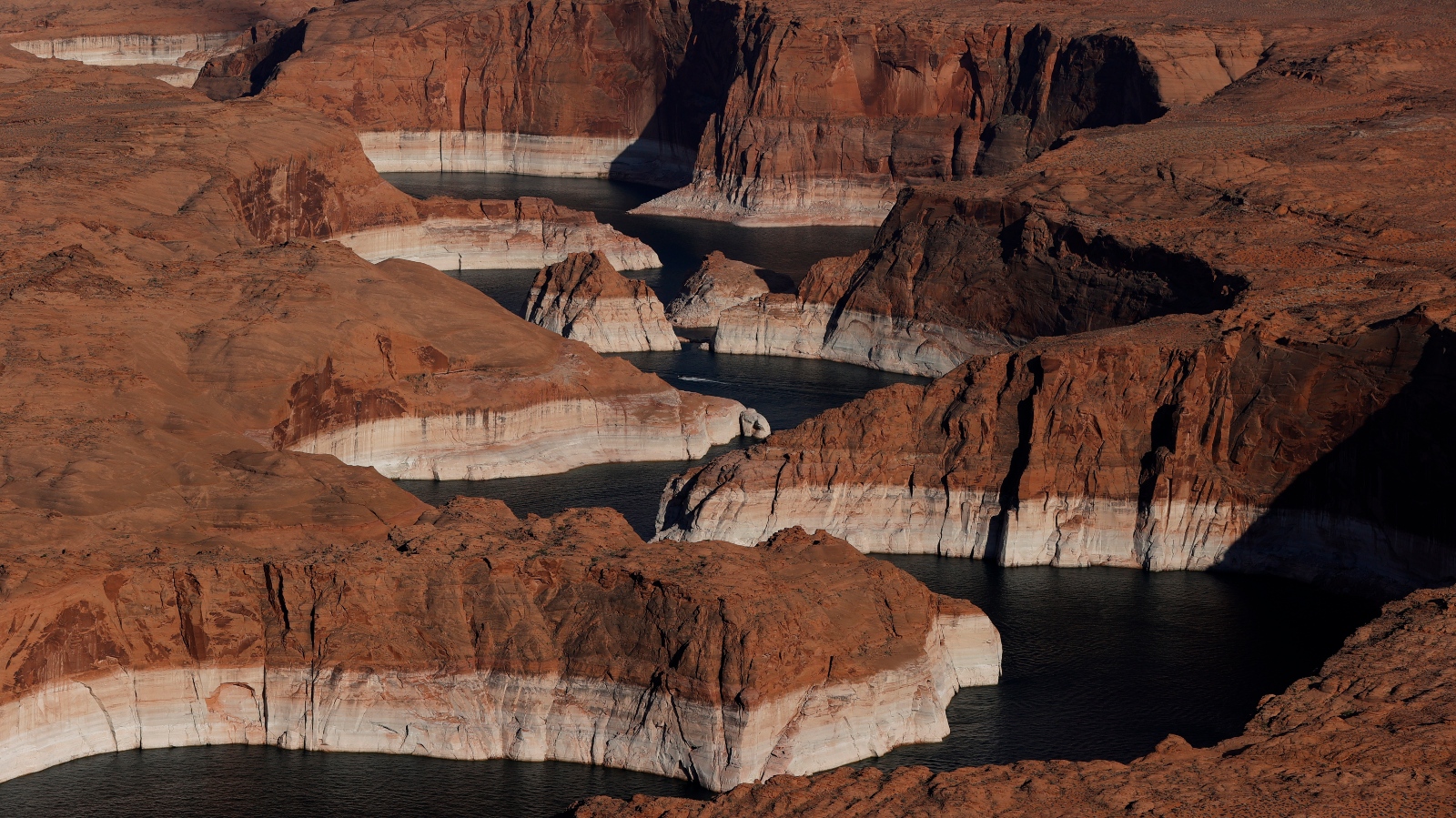
Lake Powell’s “bathtub ring,” seen here in June 2021, is a marker of how far water levels have fallen during the West’s current megadrought. Photo by Justin Sullivan/Getty Images

When federal officials built a dam at the southern end of Glen Canyon, forming Lake Powell, they assumed there would always be enough water moving through the Colorado River system to turn the turbines, and thereby generate a supposedly endless supply of cheap renewable energy. The customers who bought this clean power were rural towns, electrical cooperatives, and tribes, many of whom didn’t have many alternate power sources.

In recent years, as Lake Powell has begun to dry up, the turbines have become less efficient. The federal Bureau of Reclamation has already shaved down power deliveries from the dam.

“We are already seeing reduced generation from Glen Canyon Dam,” said Lisa Meiman, a spokesperson for the Western Area Power Administration, a government authority that markets hydroelectric power from around the region. “[Generation] has been dropping pretty consistently as the lake elevations have declined, so we’re about a third less efficient in terms of power production now than we are at an average elevation.” 

When that happens, Meiman said, “we have to go out and purchase replacement power in the spot market, which is typically more expensive.” It also comes from dirtier sources like coal and gas, she said. For most customers who buy power from the dam, losing it won’t be all that big of a deal. For them, hydroelectric power accounts for only a fraction of their overall power needs, and any price increases get spread out over thousands of users, keeping costs down.

For some customers, though, the shutdown of the dam will be far more painful. Utility bills have already started to rise as the dam becomes less efficient, and a total shutdown would lead to significant cost increases for the small and remote entities that rely on it. 

Hardest hit will be the 50-odd tribal nations dependent on hydroelectric power not only for residential energy needs but also to power revenue-generating commercial ventures like casinos. Thanks to generations of underinvestment by the federal government, many tribes that buy electricity from Lake Powell don’t have their own power generation capacity to replace it, and building new power sources isn’t cheap. According to a report produced by a consulting firm looking at the impact of a Glen Canyon Dam shutdown, tribal nations would experience the “the most troubling” consequences of the power loss.

The dam’s largest tribal customer is the Navajo Tribal Utility Authority, or NTUA, which provides electricity to some 30,000 residential customers on the Navajo reservation. 

“It’s a very sensitive issue for all of us right now,” Walter Haase, the tribal utility’s general manager, told the Associated Press last week on the heels of the water level announcement from the Bureau of Reclamation. 

The NTUA is spending millions of dollars to build out renewable energy capacity that could help soften the blow of a dam shutdown. Other tribes that can’t afford to build such new power sources, though, will have to pay higher rates for replacement electricity out of pocket, which could strain revenues. The consultants’ report pointed to the Hopi Tribe, which does not have a casino to bolster its finances, as being especially vulnerable to these cost hikes.

Small municipalities that depend on the dam are also feeling the pain.

“Hydro is very low-cost, renewable energy, [so] our energy costs will go way up,” said Bryan Hill, the general manager of Page Utility Enterprises. The company services the town of Page, Arizona, which sits on the edge of Lake Powell. Hill said he’s already been feeling the pain as deliveries have slowed down. 

“They’ve got a tourniquet on in the form of slowing down the generation and trying to reduce the bleeding,” he said, “but we’re already losing money. Unless things change, there will be a significant rate adjustment.” The exact scale of that adjustment isn’t clear, but residents of Page who have come to rely on cheap power will see a noticeable rise in their annual bills. Because spot-market energy is also getting more expensive as the nation’s power system transitions from coal and gas toward renewables, the rate increase will be compounded.

Glen Canyon Dam isn’t the only hydroelectric source that’s struggled amid the drought: Power generation at the larger Hoover Dam in nearby Lake Mead has fallen by around a quarter, and officials in California shut down a hydroelectric plant at Lake Oroville last year as water levels in the lake fell below the generation threshold. The two dams together serve about 2 million customers. These power losses further drive up prices and strain the grid at a time when energy is already getting more expensive as older coal plants come offline.

To make matters worse, though, the power shortage in Lake Powell is intertwined with the larger water shortage on the Colorado. If the water level in Lake Powell continues to fall, federal officials will have to balance between the needs of water users and the needs of power users. If they hold enough water back in Lake Powell to keep the turbines running, they’ll be withholding water from farmers and homeowners who rely on it farther downstream. If they push as much water as they can toward the end users, they’ll spike the power bills of the small entities who rely on the dam.

The agency has yet to decide on its priorities should the historic lows continue, but time is running out. The latest models suggest there’s a 1 in 4 chance the dam won’t produce power by 2024. 

“Glen Canyon Dam and Lake Powell serve many purposes, many divergent purposes,” said Meiman. “For a ton of stakeholders who are all going to be affected by declining lake elevations, there is not going to be a simple solution or an easy solution.” 

*Correction: An earlier version of this article misstated the term for the threshold at which a dam cannot generate power. The correct term for this threshold is “minimum power pool.” 

This story was originally published by Grist with the headline Lake Powell water crisis is about to be an energy crisis on Mar 21, 2022.

25 Mar 14:17

How a breakthrough in geothermal could change our energy grid

by Jesse Nichols

This transcript has been edited and condensed for clarity.

Newberry Volcano — the largest volcano in the Pacific Northwest — is the site of an experiment that’s aiming for a breakthrough in geothermal energy. 

The experiment is one small step in the high-risk, high-reward world of next generation 

geothermal. The goal is to replace fossil fuels with this always-on, renewable energy. The challenge, however, is getting it to work.

To access geothermal energy you need three elements: Heat, water, and permeable rock.

The water flows through gaps in the hot permeable rock, transferring heat from deep underground to the surface. That’s geothermal energy.

The world’s first geothermal resources were the rare places where those three things just happened to come together naturally. Like hot springs or geysers, found in places like the U.S. mountain West.

Early projects were extremely simple: pumping the water into buildings for heat and hot baths. But eventually, starting in the 20th century, countries all around the world — like Italy, Iceland, and the United States — started using geothermal energy to produce electricity, using the steam to power turbines. 

This form of energy has one big benefit over other renewables. To understand, let’s compare a geothermal plant and a solar farm, each capable of pumping out the same amount of power.

On the solar farm, let’s say it’s only really sunny for about five hours a day. That means that every day, it only produces 20 percent of its potential. A geothermal plant, on the other hand, can basically produce full power, all day, every day. Which makes geothermal a really useful kind of energy: It’s got all the same “always-on” benefits of a fossil fuel power plant, but it’s renewable.

People were understandably excited about geothermal, and the energy source started to take off in the U.S. after the 1970s energy crisis. But for all its benefits, geothermal energy has only ever played a small role on our grid. And, to understand why, let’s compare it to that solar farm again. 

To build this solar farm, you need to find sun. And you do that by, like, looking up. But for the geothermal plant, I’d need to find a rare spot that has all three of those geothermal ingredients, hidden under miles of rock. Then, I’d need to pay for expensive equipment and labor, and go through years of permitting, just to get the plant up and running. So, despite all its benefits, and the almost limitless energy in the earth, it’s hard to make a project pencil out.

Because of these challenges, geothermal energy started to slow down around the 1990s. The industry needed something to change.

That change? A new process known as enhanced geothermal. Instead of relying on places where all three of those geothermal ingredients come together naturally, enhanced geothermal allows you to tap into heat, even if you’re missing the other two.

It works by injecting high pressure water into the ground, forming a network of little cracks for water to flow through and carry heat back to the surface. It’s a similar idea to fracking, but with a lot less pollution.

The technology really opens up the potential for geothermal. To put it into perspective: The U.S. currently produces about 3 gigawatts of geothermal electricity. Enhanced geothermal could theoretically generate more than 5,000 gigawatts of electricity — more than all the fossil fuel plants in the country. 

So why isn’t enhanced geothermal powering the world? Despite a few successful pilot projects, the problem, once again, is money.

Right around the time people were getting serious about enhanced geothermal, another energy transition happened: Solar, wind, and natural gas got cheap. While enhanced geothermal could compete with coal, it had trouble with its new competition. 


“With the change in the economics of power, the question was how does geothermal compete?” said Geoff Garrison, vice president of research and development at the geothermal company AltaRock. 

AltaRock was one of the companies trying to build on the promise of enhanced geothermal, only to be caught off guard by that wave of cheap gas and renewables. In order to be competitive, the only option they saw was to build an even hotter enhanced geothermal project. And that’s what brought them to Newberry Volcano.

“There’s a very large magma body underneath it,” said Garrison. “It contains a tremendous amount of heat.”

AltaRock wanted to reach temperatures of 400 to 450 degrees Celsius (752-842 degrees Fahrenheit) — what the industry calls “super hot rock.” At this temperature, you get way more energy, and extract it more efficiently. 

In a normal location, you’d have to drill down about eight miles to reach these kinds of temperatures. But at Newberry, it’s so hot that you can reach those temperatures at a quarter the depth. AltaRock saw this as a perfect testing ground for super hot geothermal energy.

If Altarock is going to reach those super hot temperatures beyond Newberry, they’re going to need to drill deeper. And that’s really hard to do with conventional drills. Instead, they’re hoping to use another type of new technology that sounds like science fiction: A heat ray to melt rocks. It’s called a millimeter wave — it’s kind of like a laser, in a different part of the spectrum. 

The idea came from Paul Woskov, a fusion scientist at MIT. In his research, he’d seen the waves accidentally melt holes in tile walls. Years later, he started studying millimeter waves as a way to melt rock.

After a decade of research, he’s now working with a geothermal company called Quaise to test millimeter waves for geothermal drilling. They’re doing tests at Oak Ridge National Laboratory — essentially, melting holes in rocks. 

Eventually, AltaRock hopes to test these millimeter waves in the real world at Newberry.

And, if they’re successful, this new heat ray might make it a little more feasible to reach those super hot temperatures anywhere.

AltaRock, and other geothermal startups like it have a long and challenging road ahead. 

But they also see a big reward. 

“We’re talking about replacing every coal plant in the country, or every natural gas plant in the country with geothermal,” said Garrison. “We can do that. That’s the scale of the resource we have at hand.”

It’s certainly not guaranteed to succeed. Odds are, there will be a lot of failures along the way. 

But there’s so much heat in the earth, that today’s geothermal energy is just the tip of the iceberg. 

This story was originally published by Grist with the headline How a breakthrough in geothermal could change our energy grid on Mar 16, 2022.

25 Mar 14:16

The Automat, a Documentary About How the Suburbs Killed Good Food for the People

by Charles Mudede
TimB

For my documentary watchers out there :-D let me know if it's good!

by Charles Mudede

AN EXTENDED RUN: We're re-upping this review of one of our favorite films from this year's Seattle Jewish Film Festival, The Automat, as it screens at AMC Seattle 10 starting this Friday, April 1.


Good food for the people...
Good food for the people... The Automat, Seattle Jewish Film Festival

Utopias are easier to find in the past than they are in the future. This, I think, is the source of The Automat's greatness. The Lisa Hurwitz-directed documentary, which impressively runs at this year's Seattle Jewish Film Festival, is about a possibility that has already been realized—and it is the nature of time that makes the past more real than the future.

The possibility was expressed by a 20th-century American business model for selling meal items through vending machines with small glass doors that popped open with a slot-inserted nickel. The vending machines lined the walls of eateries that were often palatial in size. You could find real food in these machines, which, though requiring engineers to design and operate, were not automatic or serviced by robots. You just did not see the workers. They were on the other side. They rushed back and forth small plates of sweet pies, meat pies, clam chowder, Salisbury steak, and creamed spinach. The utopia here was each plate, though costing only a nickel, wasn't fast food. This is why the often-made claim that the Automat was the first fast food (meaning, junk food) chain is misleading.

24 Mar 03:49

Photographic Composites Document the Mesmerizing Flight Trails of Vultures, Crows, and Bats

by Grace Ebert

“Lockdown Vultures (Moab Mesa).” All images © Doris Mitsch, shared with permission

In Locked Down Looking Up, Bay Area photographer Doris Mitsch captures the swirling, shapeshifting flight patterns of birds and other winged creatures: a flock of vultures creates coils and whirls between rugged mesas, crows descend toward a forest in single-file trails, and gulls congregate above the sea in lengthy lines.

The ongoing project began early in 2020 when Mitsch set up a camera outside her front door and shot consecutive images of birds flying around her home. “While everything in my life has come to a standstill, up in the air, there is still a lot going on,” she writes. She’s since traveled along the California coast and to Moab’s desert landscapes capturing similar swarming phenomena featuring vultures, gulls, and crows.

Mitsch’s composites vary in length of time, number of birds, and total images combined, which ranges from 500 to 5,000. “One of my favorites, ‘Lockdown Vulture (Signature)’ shows just one vulture making slow circles over the course of about a minute,” Mitsch tells Colossal. “My other favorite, ‘Lockdown Vultures (Moab Mesa)’ shows about five minutes’ worth of 25 or so birds circling together.”

In addition to this series, Mitsch also shot a collection devoted to starlings’ murmurations, which you can see on her site. You might enjoy this bird-shaped swarm, too. (via swissmiss)


“Lockdown Vulture (Signature)”

“Lockdown Vultures (Moab Slope)”

“Lockdown Swallows (Hunting)”

“Lockdown Crows (Evening Commute)”

“Lockdown Crows (One Tree)”

“Lockdown Bats (Pas de Deux)”

“Lockdown Gulls (Sea Ranch)”

24 Mar 03:49

Enchanting Photos Frame Meandering Industrial Relics Along Taipei’s Jianqing Historic Trail

by Grace Ebert

All images © Masuki Rina, shared with permission

The Taipingshan National Forest Recreation Area in northern Yilan is one of Taipei’s prized ecological destinations for its mist-covered scenery and lush vegetation that thrives in the dewy environment. It’s also home to Jianqing Historic Trail, a winding pathway that follows abandoned sections of railways and crumbling trestles that are relics of the region’s past as a major logging hub. Taiwanese photographer Masuki Rina visited the overgrown tracks to document its ethereal and enchanting atmosphere in a captivating series, which shows fog hanging over the landscape, moss covering wooden ballasts, and foliage sprouting from nearly every inch of the frame.

Rina shot dozens of images from the trail, which she shares on Behance and Instagram, along with her other landscape and street photography. (via Plain Magazine)


20 Mar 02:50

Progressives Fall for Crypto-Bros Intelligence-Insulting Claim of “Inclusiveness”

by Yves Smith
TimB

"By a quirk of historical bad luck, the American Left has gone two generations without understanding finance, or even caring to understand. It was the hippies who decided half a century ago that finance was beneath them, so they happily ceded the entire field—finance, business, economics, money—otherwise known as “political power”—to the other side"

"Using ABA account cost estimates, it would cost about $9B/year to provide free [traditional bank] accounts for all unbanked households."

Why do so many people who think of themselves as smart have their brains go to mush when the topic is crypto?
19 Mar 20:32

Advanced Techniques

TimB

check the hover too <3

A blow from Emmy's Cutlass of Variations will transport the dragon to a corresponding symmetric position in the Noetherworld.
15 Mar 04:14

Arresting Photos Document the Polar Bears Occupying an Abandoned Weather Station in Russia

by Grace Ebert

All images © Dmitry Kokh, shared with permission

Set against a backdrop of dried grass, rusted tanks, and debris, a photo series by Dmitry Kokh centers on a small group of polar bears that had taken over an abandoned meteorological station last fall. The dilapidated structures are located between Russia and Alaska on Kolyuchin Island in the Chukchi Sea, a remote tundra the Moscow-based photographer visited on a 1,200-mile expedition in September 2021. “We expected to meet (the polar bears) mostly on Wrangel Island, famous all around the world for being home for many bears. Not this year, as we found out later—maybe because of the very cold summer,” he writes.

Russians built the weather center on Kolyuchin in 1932 before retiring it in the 90s, and it now sits unoccupied along with the rest of the area, which is devoid of residential life. When Kokh and his companions passed the island that’s just 2.8 miles at its longest stretch, they saw the white animals moving through the vacated buildings. The site’s chipping paint, exposed support beams, and generally worn features make the resulting images appear almost post-apocalyptic as the photographer captures the bears wandering the rundown property, poking their heads through the windows, and lounging on the grass.

Kokh’s shot of a bear resting its front legs on a window sill won a National Geographic-organized contest last year, and he also filmed a short video of his visit, which you can watch below. Shop prints of the series on his site, and follow him on Instagram for more wildlife photos.


15 Mar 04:08

Have Your Bread and Read By It Too: PAMPSHADE Turns Leftover Loaves into Offbeat Lamps

by Grace Ebert

All images © PAMPSHADE

Yukiko Morita works against the grain with her collection of bread-based home goods. The baker-turned-designer launched PAMPSHADE back in 2016 after nearly a decade of experimenting with the doughy material, and today, the brand creates a variety of quirky, functional objects, including croissant nightlights, baguette chandeliers, and naan timepieces that appear to be the leavened counterpart to Salvador Dalí’s melting clocks.

Each design utilizes leftover pastries and loaves sourced from nearby retailers that are then treated with antiseptic and a mildew-deterrent and hollowed out to fit an LED light. “By purchasing the unsold bread, the bakeries are happy, and it leads to a sustainable creative activity,” she tells Creative Boom. “Within the scope of normal use, (the lamps) can be used semi-permanently. However, be careful not to break them!”

Head to the PAMPSHADE site to pick up a crusty ciabatta or slice of toast, and follow the latest upcycled designs on Instagram.


11 Mar 03:24

Why the Left Will Continue to Lose on Homelessness

by Charles Mudede
The right will give the homeless nothing but the streets because they produce a spectacle of wretchedness that wins them wide support from voters. by Charles Mudede
Heaven? Is this heaven?
"Heaven? Is this heaven?" alpenarts/gettyimages.com

I had a few hours before a gallery opened that showcased the art of LeRon Wilson, an artist I met in Detroit in 2019. It was in LA's Arts District. I was dropped off on the corner of Alameda and Sixth. In the south, the towers of downtown. Behind me, warehouses, lofts, galleries. I decided to walk toward downtown to see a building I had failed to visit during my past trips to the City of Angels, John Portman's Westin Bonaventure Hotel. It was made famous by its prominence in a book that in 1991 made postmodernism the leading theory of what many considered to be a new social order, Fredric Jameson's Postmodernism, or The Cultural Logic of Late Capitalism. My plan was to walk to the hotel, take pictures of it, and think about it. But after walking two or three blocks in downtown's direction, I found myself in what should have been a slum but was not. It was just row upon row of tents and tarp and misery and human shit (I first mistook it for dog shit). I put one and one together and realized I was in Skid Row.

And like that African ghost story where a person eternally walks, at dusk, toward a home that's never reached, the more and more I walked, the more the towers of downtown refused to get nearer. I finally found a corner with lots of traffic, looked on my phone for my location on Google Maps, and found a wormhole out of an economic depression that had few comparisons. It was a bar—the High Tide. It was only a block away. I walked up the street, turned to the west, and there it was. A security guard was posted at its entrance. I showed him my ID and vaccination card and entered an establishment whose theme was a tropical island.

Cue "City of Angeles" by 10,000 Maniacs:

Heaven, is this heaven where we are?
See them walking, if you dare
If you call that walking
Stumble, stagger, fall and drag themselves
Along the streets of heaven

"Charles!"

That's what I heard when I walked into the High Tide. How was my name known here of all places? Was I mistaking myself? Maybe I did not survive that nightmare after all. Maybe I was not me but a ghost of me. Maybe that private security guard was actually Peter. Heaven had accepted me without believing in God during my days in time. One of the pink flamingos on the bar's wall was standing on one foot in a pool of tropical-warm water.

It turned out the bartender had once worked at Pioneer Square's Damn the Weather. I did not know her, but she was familiar with my work. After we talked about her time in Seattle and her second job in LA, which had been doing booming business because of the pandemic (cremating soulless humans), I gave my Skid Row walk some thought, and this is what I came up with.

The key problem was its suspension between the politics of the right, which has considerable policy force, and the politics of the left, which, for obvious reasons, has a policy force that's easily compromised. As a consequence, Skid Row can't become a slum (the way out of this political impasse), though it has the concentration of one. What this meant is it had none of the benefits of a slum and all of the misery of living on the streets. And yes, there is a huge difference between the streets and a slum. The former cannot develop from its starting point, which is basically camping. The latter, like the Hooverville in Depression-era Seattle, and also what you find in much of the Global South today, might start with shacks but is considerably more open to improvements inspired by human ingenuity. The Tokyo of today evolved from post-war slums. A street blocks human intervention and demands submission. How can you build even a basic latrine pit in the middle of Grand Avenue?

The left has to understand that there have been only two solutions to housing the poor in a capitalist economic order. One is slums. The other is public housing. Skid Row wasn’t always about camping. It was once a slum composed of cheap housing, most of which took the form of hotels. It was meant to be a place that guaranteed "a meal and a bed." But in the 1970s—the end of the post-war social democratic experiment, the age of urban renewal—a massive number of this area's hotel units were demolished. What was left? Only the streets. And this is exactly where I found, on a sunny late winter LA day, many who had gone way beyond the skids.

The right (which always has the upper hand) will not let a city have slums or public housing, and so this leaves the left with the worst option possible: camping on streets. Tents are easy to remove. In fact, you do not demolish them; you can just sweep them, as we are doing in Seattle.

This:

And this:

And this:


Let's get pessimistic at this point, and for the purpose of not being overwhelmed but to truly understand the power that's available to those who protect and further the interest of the rich. The fact is the US would have no public housing whatsoever if it weren't for one great war in the 1910s and a massive economic crash that plunged the 1930s into a depression that had no equal. Only then was public housing, the far better option for housing poor in a surplus value regime, even considered. And some of the leading urban planning minds of those times made progressive proposals that the government considered, but were watered down by the time they were implemented. This is the sad story of the left and housing in the US. It happens over and over and over again.

Historian Steven Conn writes in his 2014 book Americans Against the City: Anti-Urbanism in the Twentieth Century:

The push for public housing, clearly a high priority for American cities, reached a climax of sorts in 1937, with the passage of the Wagner Public Housing Act, the second major housing act of the New Deal. [Catherine] Bauer, along with the veteran Progressive reformer Mary Simkhovitch, helped draft that legislation.

The act proved an incomplete triumph at best. As it emerged in its final form, it provided money for slum clearance, but it limited the availability of public housing to the poor, cementing the equation between public housing and poverty that haunts it to this day. The act gave a great deal of discretion to local authorities over where such housing could be built, and it created strict construction cost limits for projects. Thus did public housing become synonymous with bad neighborhoods and shoddy building. Bauer and Simkhovitch might have helped draft the bill, but the final version of it had the footprints of the real estate lobby all over it.

And this is where we still are today. The right will give the homeless nothing but the streets because they produce a spectacle of wretchedness that wins them wide support from voters who are provided no other options to the crisis than sweeps.

[ Comment on this story ]

[ Subscribe to the comments on this story ]

09 Mar 05:22

Strong Winds Sculpt Frozen Sand into Otherworldly Pillars on a Lake Michigan Beach

by Grace Ebert

All images © Joshua Nowicki, shared with permission

Last weekend in St. Joseph, Michigan, tall layered pedestals and sloping tables sprung up from the otherwise calm Tiscornia Park Beach, turning the lakeside vista into a strange, otherworldly environment. Photographer Joshua Nowicki (previously) captured the ice-laden phenomenon, which is caused by powerful winds eroding frozen sand and carving dozens of towering shapes haphazardly placed along the shore.

The unearthly constructions, which look like miniature hoodoos, arise periodically during Great Lakes winters, although Nowicki says these 15-inch formations are some of the tallest he’s stumbled upon. “They do not last very long (usually only a couple of days). The wind completely erodes them or knocks them down. If the temperature goes up above freezing they crumble, and often in the winter, they soon get covered by drifting snow,” he shares.

Find more of Nowicki’s photos documenting the sights of the Midwest’s infamously frigid season on Instagram.


07 Mar 17:52

Rich Linework in Black Ink Composes Meditative Mounds and Ridges in Lee Hyun-Joung’s Paintings

by Grace Ebert
TimB

LOVELY!

“Chemin,” 150 x 90 x 4 centimeters. All images courtesy of Galerie Sept, shared with permission

Artist Lee Hyun-Joung likens her meditative renderings to pathways that prompt the eye to travel along each line. Working with Korean ink and traditional pigments on handmade Hanji paper, Lee’s practice is as contemplative as the resulting pieces, which portray heaving mounds and supple ridges reminiscent of mountains and other land formations. “My universe is poetic,” she tells Colossal, “like an inner journey. I invite you to take a walk, to follow me in these aerial views. They were born from the breath of my Korean childhood, from my eternal taste for painting, my search for life.”

Composed with black and shades of green or blue, the abstracted works are rhythmic and methodical and evoke the texture of thread stitched in precise rows. A central ripple stretching from one end of the paper to the other bisects many of the pieces, with the sinuous markings connecting the two parts. “Each line can be seen as a day, or an instant we have already lived through or that we are still living in,” says a statement from Galerie Sept, which represents the artist.

Lee’s experience studying fine arts at Sejong University and her formal training in goldsmithing continue to influence her practice, she says, and the artist often splits her time between Seoul and Paris, although she’s been living primarily in the French capital in recent years. Her paintings will be on view at Galerie Sept’s new space in Knokke, Belgium, as part of a group show opening on April 30. (via artnet)


“Contemplation Bleu,” 100 x 120 x 3.5 centimeters

“Contemplation Gris,” 100 x 130 x 4 centimeters

“Chemin Vert,” 130 x 82 x 3.55 centimeters

“Chemin Gris,” 100 x 140 x 3.5 centimeters

Left: “Chemin Bleu,” 150 x 50 x 3.5 centimeters. Right: “Chemin Bleu,” 150 x 50 x 3.55 centimeters

“Mémoire du Vent,” 148 x 90 x 3.55 centimeters

06 Mar 04:21

Exquisite Architectural Photos by Andrew Moore Glimpse Life in Late ’90s Cuba

by Grace Ebert

All images © Andrew Moore, shared with permission

Between September 1998 and January 2001, Andrew Moore traveled around Cuba meeting residents and photographing them among their built environments. He snapped more than 700 8 x 10 color negatives during that period, producing a staggering visual record of a particular moment in the country’s history primarily shown through its architecture.

Through Moore’s lens, Cuba’s palatial residences and generally lavish interiors with marble and gilded details are shown tinged with decay: Paint peels from a ceiling to reveal structural wooden slats, broken windows are left in disrepair, and mismatched outdoor seating and modern appliances become out-of-place furnishings in once opulent rooms.

Shot mostly in urban metropolises, the alluring images are evidence of architecture’s power to both respond to and produce a community’s way of life. Havana, Moore shares with Colossal, is built vertically, with tile roofs, high ceilings, and tall windows that encircle central courtyards and offer relief from the fierce heat and sun. “The daylight is generally hard and creates deep shadows, while by night, which falls quickly, the city is quite dark with little by way of street lighting,” he says. Outdoor walls bleach over time from the sun, and verdant foliage and plant life grow in lush tufts from window boxes and landscaped villas.


Many of the buildings Moore photographed were constructed before air-conditioning was ubiquitous and at the time, hadn’t undergone significant updates. During his visit—Cuba and its residents were notably experiencing the effects of U.S. embargos between 1998 and 2001—this resulted in dozens of residents living together in a structure designed for single families. He explains:

These domestic clusters are known as solars. Given these crowded living conditions, and the tropical climate, Havana can seem like a city inside out: in their extraordinary activity, the overflowing streets remind one of a vast living room. Thus it became of particular importance to me to depict the architectural fabric of this unique city and country within the context of its people.

Residents, while often seen in the distance of the frame, add intimacy and humanity to the series. Along with assistants Ondrej Kubicek, Laurence Dutton, Kevin Fletcher, and Bart Michels, Moore interacted with locals and heard stories about their lives, which were translated by his friend Paquito Vives, while producing the collection. “All of us learned about the city by walking its streets, by knocking on doors, and through talking with the residents about the history of their city,” he shares. “People would frequently complain about the condition of their houses, but they were always friendly and most freely invited us into their homes for a small coffee and long conversations.”


Professionally for Moore, this staggering body of work was his first chance to gather “color harmony, natural light, deep and shallow space, narrative detail, cultural history, and the human figure” within a single image. It was inspired by Julius Schulman’s photos of Mid-Century Modern architecture and the way people configure within a space, a concern that’s visible throughout his extensive archive of locales in Russia and Ukraine, New York, and Detroit.

Currently based in Kingston, New York, Moore has published six volumes of his photos, and you can find two of the most recent, Blue Alabama and Dirt Meridian, on Bookshop. He’s currently preparing for a solo show featuring Hudson Valley landscapes, which will be on view in 2023 at Yancey Richardson. Until then, see more of his work on his site and Instagram. (via swissmiss)


04 Mar 20:09

Colorado has an abandoned oil well problem. Now it’s asking drillers to pay up.

by Naveena Sadasivam

When oil and gas companies are done extracting from a well, they’re supposed to plug it and clean it up: This prevents both physical hazards to wildlife and the environment and also a potentially alarming volume of planet-warming methane pollution. However, it’s not uncommon for an oil company to disappear before doing so, leaving the state on the hook for cleanup.

To account for this, states typically collect bonds from companies before they drill — financial assurance meant to cover the cost of cleanup if the companies shirk their responsibility. But states walk a tight rope when designing their bonding programs: While they want to have enough funds on hand to clean up the mess left behind by irresponsible companies, they also don’t want the bond amounts to disincentivize drilling.

Under current bonding schemes, states are woefully underfunded, leaving their coffers inadequate to the task of cleanup. Nationwide the number of unplugged abandoned wells has risen to a whopping 2.1 million. With funding from the new bipartisan infrastructure law bringing renewed attention to the scourge of abandoned wells, states have been reassessing their bonding rules. Colorado is the latest to take on the thorny issue.

After countless hours of testimony and a year of debate over at least five versions of draft rules, the state’s oil and gas regulator passed sweeping regulations on Tuesday to govern how much money companies have to provide as financial assurance before they can operate in the state. The new rule, which the state’s oil and gas commissioners described as “robust” and a “paradigm shift,” will require companies to post hundreds of thousands of dollars in additional funds and are expected to ensure that taxpayers are less at risk for being left on the hook if oil and gas operators file for bankruptcy.

The rule is “protective of the taxpayers of the state and really sets the standard for thoughtful and responsible oil and gas development,” said Commissioner John Messner at a public meeting before the Tuesday vote. 

In Colorado, as in many other states, the financial assurance program has been severely underfunded. According to the Colorado Oil and Gas Corporation Commission, or COGCC, the state currently has about 800 operators who have posted $270 million in bonds for plugging wells and reclaiming well sites. That breaks down to approximately $5,400 for each of the state’s 50,00 wells. Not every operator is expected to abandon wells, but if a significant number do, taxpayers will ultimately foot the bill for cleanup: The state estimates that it costs an average of $93,000 to plug and clean up a single well. Already, Colorado currently has 625 orphaned wells in need of plugging and cleanup. 

Current rules allow operators with up to 100 wells to secure a so-called blanket bond of $60,000 — an amount that would cover less than two-thirds the cost of cleaning up just one of those wells, if the company disappeared. Those with more than 100 wells are only required to post a $100,000 bond, and operators are required to provide an additional $20,000 for every inactive well 3,000 feet or deeper. The new rules released this week came about due to a landmark 2019 law requiring the COGCC to tighten the state’s bonding rules to better protect taxpayers. 

The new rule differs markedly in how it bonds low-producing wells, which are the most likely to be abandoned. Operators with wells that produce very little oil or gas are required to provide the full cost of plugging each well. Operators of high-producing wells are required to post as much as $18,000 per well. The new rule takes effect at the end of April.

Exactly how much more money operators will post with the state depends on the number of wells each company operates, how much oil and gas they produce, and how many are sitting idle. As a result, it’s unclear exactly how much more money the state will receive or how many companies will choose to walk away from their wells as a result of the rules. This has left some environmental advocates wary.

“As good as these rules may be and as much as they might increase financial assurances, these rules will not come anywhere near full-cost bonding, which in Colorado would be several billion dollars,” said Kate Merlin, an attorney with the environmental nonprofit WildEarth Guardians. Full-cost bonding is the idea that operators should post a bond equal to the entire cost of cleaning up every well they operate.

“There’s still a significant delta between what it’s going to cost the state to plug and abandon those wells and the cash on hand that they’ll be able to access from the operator,” she continued.

A previous version of the rule included an “amnesty” provision that would’ve given operators the option to hand over their wells to the state and walk away from their environmental responsibilities without having to pay for cleanup costs. The provision proved highly controversial, and environmental advocates charged that it would function as another form of subsidy for oil and gas operators. COGCC commissioners ultimately dropped the provision from the final rule. 

Many states have bonding rules that favor industry: Bonding amounts are low and companies are allowed to post blanket bonds to cover dozens or hundreds of wells. As a result, states hold significant environmental liabilities on their books. According to the financial think tank Carbon Tracker, states have bonded just 1 percent of the total cost of cleanup

But with bonding reform efforts gaining steam, other states may follow in Colorado’s footsteps. The recently enacted bipartisan infrastructure law makes additional funds available if states make improvements that “reduce future orphaned well burdens, such as financial assurance reform, alternative funding mechanisms for orphaned well programs, and reforms to programs relating to well transfer or temporary abandonment.”

Messner, the COGCC commissioner, said he believes Colorado’s new rules “created a model for financial assurance that will lead the nation.” In Pennsylvania, the Environmental Quality Board recently accepted a petition from environmental groups to reform bonding rules. And the federal Bureau of Land Management is also considering new bonding rules for oil and gas wells on its public lands.  

Colorado’s effort to reform its bonding program is particularly illustrative because of the high number of inactive oil and gas wells in the state — and the so-called “zombie” operators responsible for them. The state has about 50,000 wells, but more than 17,000 produce less than a barrel of oil a day in 2020 and were considered inactive. Many of these wells belong to operators who are noncompliant with the state’s current rules for bonding, which requires companies to post up to $20,000 per inactive well. But since the COGCC often doesn’t enforce the rules, these zombie operators’ wells aren’t considered officially orphaned.

Such was the case with Painted Pegasus Petroleum, which had more than 120 wells not producing a single drop of oil or gas in 2021. The company has about $1.7 million in environmental liabilities but posted only $280,000 in bonds. When the COGCC pursued the company for fines and additional bonds late last year, the company promptly filed for bankruptcy. (Painted Pegasus did not respond to Grist’s request for comment in time for publication.)

Megan Castle, a spokesperson for the COGCC, said the agency “has been working with our bankruptcy attorneys as the bankruptcy process proceeds” to try to get additional funds for cleanup but said the process takes time. The new rules are supposed to help the state get more money upfront from companies like Painted Pegasus.

The COGCC is attempting to bridge the gap between the true cost of cleanup and the money posted with the state by using a tiered structure for bonding. In the new rules, wells that produce very little oil — just a few barrels a day — are bonded at the highest amount, while wells that are high producers are required to post smaller amounts upfront. The bonding hierarchy aligns with the fact that low-producing wells are more likely to be abandoned by operators. But the tiered structure also has a loophole: One option in the new rules allows companies to seek an exception from the commission based on “individual circumstances.” That makes it “completely impossible” to judge whether the state will have more money on hand to plug wells, WildEarth’s Merlin said. 

Representatives for the oil and gas industry are in favor of the agency’s tiered approach. In a presentation to the commission, Ana Gutierrez, an attorney representing the West Slope Colorado Oil and Gas Association, said the tiers created “an exceptionally strong bonding program.” She said that low-producing wells can be economic for up to 50 years, and that there are many operators in the state’s West Slope who operate wells that produce just a few barrels of oil a day but are still “viable, solvent, strong operators and carry the least risk.” 

Merlin argued that the effect of these rules on reducing taxpayer risk depends on how they’re interpreted.

“We won’t know the impact of these rules until we see how they’re implemented by the commission,” she told Grist. “The commission has found ways of interpreting rules that seem straightforward and protective as being negotiable. Unfortunately, those negotiations have strongly favored industry.”

Merlin said the COGCC’s recent deliberations to consider allowing an oil and gas company to operate wells near homes is an example of how the agency’s interpretation can undercut the intent of a rule. Colorado passed setback rules in 2020 that required oil and gas operators to drill a minimum of 2,000 feet away from residential areas. But the commission did not deny an application from an oil and gas operator that wants to drill wells within a few hundred feet of homes in Firestone. Similarly, industry-friendly interpretations of the new bonding rule could dilute its effect, Merlin said.

“The mandate was particularly clear regarding the legislature’s intent for the commission to increase the amount of financial assurances held by the state,” she said. “We won’t know whether that ends up being the case until many months from now.”

This story was originally published by Grist with the headline Colorado has an abandoned oil well problem. Now it’s asking drillers to pay up. on Mar 4, 2022.

27 Feb 23:11

Greek Letters

TimB

... and you are going to die here among them

If you ever see someone using a capital xi in an equation, just observe them quietly to learn as much as you can before they return to their home planet.
27 Feb 23:07

Data Trap

It's important to make sure your analysis destroys as much information as it produces.
18 Feb 15:48

An ‘emerging crisis’: The climate is changing too fast for plants and animals to adapt

by Diana Kruzman

White storks migrating to Northern Europe nest up to a week earlier in warm weather, exposing them to extreme storms and threatening the survival of their chicks. Staple crops like barley, maize, rice, rye, sorghum, soybean, and wheat, along with fruits like apples, cherries, pears, and mangoes, are all experiencing disruptions in their growth and development. Ten years ago, a marine heat wave in the Gulf of Maine sped up the life cycle of lobsters, overwhelming local fisheries that had to harvest them earlier than expected. 

Scientists have warned for years that climate change is upending the natural life cycles of plants and animals — to potentially devastating effect. Now, a new report released Thursday by the United Nations identifies these changes as one of the world’s most pressing emerging environmental crises, in need of immediate action. 

The report, Frontiers 2022, comes ahead of the UN Environment Assembly meeting in Nairobi, Kenya, at the end of February. It also highlights as emerging crises the growing destruction from wildfires and the hidden cost of noise pollution, which leads to 12,000 premature deaths each year in the European Union alone. But perhaps most strikingly, it warns that life-cycle changes driven by warming temperatures and extreme weather patterns are affecting the natural rhythms of species around the world, often too quickly for them to adapt. And while these changes may seem subtle season to season, the report argues, they have the potential to devastate commercial agriculture and fisheries, while also threatening vulnerable species, from butterflies to whales.

“Our Frontiers Report series aims to put the spotlight on key and emerging environmental issues — those that potentially have huge effects on our society, economy, and ecosystems,” said Andrea Hinwood, chief scientist for the UN Environment Programme, during a press event. “We need to be aware of the issues, their causes, so we can look at how we manage them, prevent harm, and implement appropriate preventative actions and solutions.”

The science of how living things time their birth, growth, reproduction and other life-cycle stages is known as phenology, and changes in these patterns — driven by environmental forces like temperature, the arrival of rains and other cues — are called “phenological shifts.” Particularly in temperate regions of the world, where changing seasons let animals know to hibernate, flowers to bloom, birds to lay their eggs, and fish to spawn, warming temperatures and extreme weather driven by climate change can alter these natural cycles. 

The world has already warmed 2.14 degrees Fahrenheit (or 1.19 degrees Celsius) from the pre-industrial era. Studies in the early 2000s found that “the life stages of 203 plant and animal species had advanced by an average of about 2.8 days earlier per decade,” according to the report. Since then, more recent research has continued to study how ecosystems, biomes, and taxonomic groups are being affected as the rise in temperatures speeds up. 

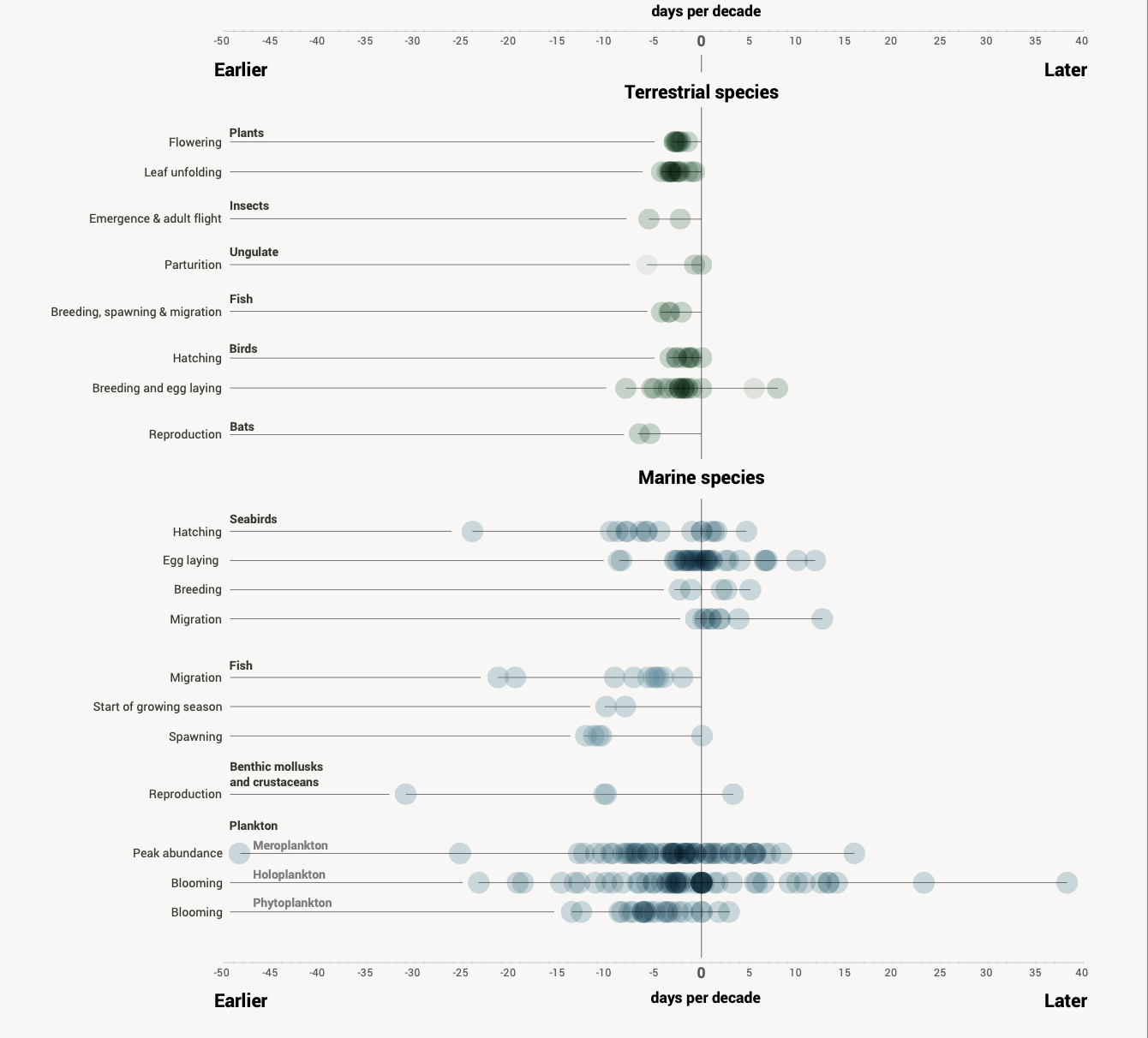
UNEP graphic showing animal and plant life cycle changes.
Plants and animals are timing their life cycle changes to catch up to a warming climate. Each circle in this graph represents one species that has been tracked. United Nations Environment Programme

Monarch butterflies have delayed their annual migration by 6 days per decade due to warmer-than-normal temperatures, potentially impacting their access to food sources along the way. In the Arctic, spring vegetation is sprouting up to 2 weeks earlier than normal, meaning caribou calves are born too late to eat it, decimating populations of the endangered species. Certain fish species have shifted their egg laying forward by as many as 10 days per decade, and some plankton species are reaching peak abundance as many as 50 days earlier per decade.

Animals often can adapt, the report explains, with chicks hatching earlier to catch up with their main food source: caterpillars, themselves emerging earlier to keep up with the plants they feed on — a phenomenon known as “phenological plasticity.” But with climate change occurring so rapidly, “individual or population plasticity may not be able to keep up with the rapid environmental changes we are experiencing,” the report says. 

These changes aren’t just about the natural world. As the report warns, phenological mismatches could wreak havoc on human societies if left unchecked. Along with a loss in overall biodiversity — which has consequences for human health and the spread of infectious diseases — warming trends have already affected crop yields, threatening food security around the world. When plants flower early because warming temperatures signal to them that spring has arrived, pollinators might not be active in time to reach them, or late-season frosts could destroy the early crop. Warmer temperatures could also encourage the development of pests, threatening yields. 

“Rehabilitating habitats, building wildlife corridors to enhance habitat connectivity, shifting boundaries of protected areas, and conserving biodiversity in productive landscapes can help as immediate interventions,” the report concludes. “However, without strong efforts to reduce greenhouse gas emissions, these conservation measures will only delay the collapse of essential ecosystem services.” 

This story was originally published by Grist with the headline An ‘emerging crisis’: The climate is changing too fast for plants and animals to adapt on Feb 18, 2022.

18 Feb 15:40

New Comic: Why Are You Wearing a Face Mask?

by Ben Horak
16 Feb 15:26

How New Mexico abandoned 1,000 oil and gas wells overnight

by Naveena Sadasivam

Over the summer of 2020, Adrienne Sandoval, New Mexico’s top oil and gas regulator, testified before a U.S. House of Representatives energy subcommittee that was looking into abandoned oil and gas wells. Oil prices had plummeted in the first few months of the pandemic, thousands of fossil fuel workers had filed for unemployment, and operators were facing dire financial straits. It appeared that many companies would walk away from their responsibility to plug their defunct oil and gas wells, leaving the state responsible for the hazards and pollution they leave behind.

“While New Mexico has 708 known orphaned wells, there is risk for many more during this downturn,” she said. “Additional funding would allow New Mexico to more rapidly plug abandoned wells and reclaim sites to minimize environmental disturbance.” 

Sandoval’s testimony was part of a larger push by New Mexico’s congressional delegation to secure funds to clean up the state’s backlog of so-called “orphan” oil and gas wells. The problem is hardly limited to New Mexico: Nationwide, the Environmental Protection Agency estimates there are 3.1 million orphan wells that are leaking the equivalent of 7.1 million metric tons of carbon dioxide — with a climate effect comparable to that of adding 1.5 million cars to the road for a year. Orphan wells have emerged as a bipartisan priority, and the effort ultimately culminated in $4.7 billion in funds for abandoned well cleanup in the infrastructure bill that Congress passed late last year.

As this funding was coming into view, states’ estimates of the scale of their orphan well problems began to balloon. For example, when the New Mexico Oil Conservation Division, or OCD, applied for a grant from the funding that it had pushed for, it cited a much larger figure than the 700 cited by Sandoval. Now the state claimed it had “1,741 known orphaned sites” that would cost more than $290 million to plug and clean up — well over twice the previous estimate. The reason for the uptick may be more banal and bureaucratic than opportunistic. 

States have different definitions for when they consider a well to be officially abandoned or orphaned. Texas, for example, considers a well orphaned when it has not been producing oil and gas for at least 12 months and the responsible company has been delinquent in renewing its license for a year or longer. North Dakota regulators list a well as orphaned if its operator cannot be found, cannot be legally required to plug a well, or doesn’t have the funds to do so. 

New Mexico — the second largest onshore oil producer and home to more than 59,000 producing wells — has no such criteria. If a well hasn’t been producing for 15 months, the OCD puts it on an inactive well list. More than 5,200 wells fall into this category, and this list serves as a master file for all enforcement actions that the agency pursues. If a company fails to plug a well after the agency serves it with an enforcement order, the well ends up on the state’s roster of wells it plans to plug itself. But the agency exercises discretion regarding which companies it chooses to file enforcement orders against, and the decision often comes down to a number of factors including the egregiousness of the violations and the resources the state has available to pursue a case. 

On the basis of this subjective and selective method, the state considered about 700 wells to be orphaned prior to the infrastructure bill’s passing. Susan Torres, a spokesperson for the New Mexico oil and gas division, said that after the law’s enactment the state reviewed its roster and identified an additional 1,000 wells that are eligible for plugging, remediation, and reclamation. The federal funds to help with cleanup were a clear incentive for the state to do a full accounting of all its abandoned wells.

Indeed, the new count has led to a windfall for the state. Late last month, the Department of Interior announced that New Mexico would receive $43.7 million to clean up its orphan wells. The agency used a combination of the number of orphan wells, cost of cleanup, and number of jobs lost to arrive at the amount.

While it undoubtedly benefits New Mexico financially, the state’s new list of 1,741 orphan wells likely gets closer to a true estimate of the wells that will ultimately become taxpayers’ responsibility. Last year, Grist and the Texas Observer modeled the phenomenon of well abandonment in the Permian Basin, the massive shale formation that straddles Texas and New Mexico, and estimated that the two states are undercounting orphan wells to the extent that the number is set to triple in the coming years.

In New Mexico, our model identified 421 inactive wells that we predicted would be orphaned by operators within approximately four years. In reviewing the state’s new roster of orphans, we observed that 213 of the wells identified by our model have now made the list. In other words, half of the wells our model identified last year are now officially considered orphaned by the state. The state’s process appears to have mirrored our statistical approach: identifying wells that are indistinguishable from other orphans (and thus likely to meet the same fate). As was the case with our model’s predictions, the new orphan wells list mostly contains wells that only recently stopped producing oil and gas — a departure from previous official state lists.

There are other signs that New Mexico is using an approach very similar to ours. (You can read about our methodology here). To avoid biasing our original model, we did not train it on operator identification numbers and instead only fed in general operator characteristics, such as a producer’s state and business license type. However, in practice, a bankruptcy of an operator would imply the orphaning of all of its wells. Because our model was blind to which wells were managed by which operator, upon reviewing New Mexico’s new orphan wells list, we conducted a separate analysis of the model’s predictions that took well ownership into account. Doing so allowed us to be less statistically conservative in our estimates — and further test the hypothesis that wells recently added to New Mexico’s orphan well list shared characteristics with those predicted to be orphaned by our model.

Specifically, for every operator the model identified as likely to orphan at least one well, we forecasted the effect of these operators orphaning all of their wells. The resulting orphan list contains 1,516 wells. Of these, 713 already appear on New Mexico’s new list of orphan wells, suggesting that the state is taking similar information into account when flagging new orphan wells.

Torres said New Mexico’s orphan well count “may fluctuate over time” as more operators become insolvent or some wells resume production, but the current count is “the most likely universe of wells to be orphaned.” The state “has worked to nail down the most accurate number of inactive and orphan wells so New Mexico can ensure we get the proper funds to remediate these sites as part of the infrastructure package,” she said.

This story was originally published by Grist with the headline How New Mexico abandoned 1,000 oil and gas wells overnight on Feb 16, 2022.

17 Jan 04:56

Big Numbers

by Nicholas Gurewitch

The post Big Numbers appeared first on The Perry Bible Fellowship.