What if the Earth were made entirely of protons, and the Moon were made entirely of electrons?
—Noah Williams
This is, by far, the most destructive What-If scenario to date.
You might imagine an electron Moon orbiting a proton Earth, sort of like a gigantic hydrogen atom. On one level, it makes a kind of sense; after all, electrons orbit protons, and moons orbit planets. In fact, a planetary model of the atom was briefly popular (although it turned out not to be very useful for understanding atoms.[1]This model was (mostly) obsolete by the 1920s, but lived on in an elaborate foam-and-pipe-cleaner diorama I made in 6th grade science class.)
If you put two electrons together, they try to fly apart. Electrons are negatively charged, and the force of repulsion from this charge is about 20 orders of magnitude stronger than the force of gravity pulling them together.
If you put 1052 electrons together—to build a Moon—they push each other apart really hard. In fact, they push each other apart so hard, each electron would be shoved away with an unbelievable amount of energy.
It turns out that, for the proton Earth and electron Moon in Noah's scenario, the planetary model is even more wrong than usual. The Moon wouldn't orbit the Earth because they'd barely have a chance to influence each other;[2]I interpreted the question to mean that the Moon was replaced with a sphere of electrons the size and mass of the Moon, and ditto for the Earth. There are other interpretations, but practically speaking the end result is the same. the forces trying to blow each one apart would be far more powerful than any attractive force between the two.
If we ignore general relativity for a moment—we'll come back to it—we can calculate that the energy from these electrons all pushing on each other would be enough to accelerate all of them outward at near the speed of light.[3]But not past it; we're ignoring general relativity, but not special relativity. Accelerating particles to those speeds isn't unusual; a desktop particle accelerator can accelerate electrons to a reasonable fraction of the speed of light. But the electrons in Noah's Moon would each be carrying much, much more energy than those in a normal accelerator—orders of magnitude more than the Planck energy, which is itself many orders of magnitude larger than the energies we can reach in our largest accelerators. In other words, Noah's question takes us pretty far outside normal physics, into the highly theoretical realm of things like quantum gravity and string theory.
So I contacted Dr. Cindy Keeler, a string theorist with the Niels Bohr Institute. I explained Noah's scenario, and she was kind enough to offer some thoughts.
Dr. Keeler agreed that we shouldn't rely on any calculations that involve putting that much energy in each electron, since it's so far beyond what we're able to test in our accelerators. "I don't trust anything with energy per particle over the Planck scale. The most energy we've really observed is in cosmic rays; more than LHC by circa 106, I think, but still not close to the Planck energy. Being a string theorist, I'm tempted to say something stringy would happen—but the truth is we just don't know."
Luckily, that's not the end of the story. Remember how we're ignoring general relativity? Well, this is one of the very, very rare situations where bringing in general relativity makes a problem easier to solve.
There's a huge amount of potential energy in this scenario—the energy that we imagined would blast all these electrons apart. That energy warps space and time just like mass does.[4]If we let the energy blast the electrons apart at near the speed of light, we'd see that energy actually take the form of mass, as the electrons gained mass relativistically. That is, until something stringy happened. The amount of energy in our electron Moon, it turns out, is about equal to the total mass and energy of the entire visible universe.
An entire universe worth of mass-energy—concentrated into the space of our (relatively small) Moon—would warp space-time so strongly that it would overpower even the repulsion of those 1052 electrons.
Dr. Keeler's diagnosis: "Yup, black hole." But this is no an ordinary black hole; it's a black hole with a lot of electric charge.[5]The proton Earth, which would also be part of this black hole, would reduce the charge, but since an Earth-mass of protons has much less charge than a Moon-mass of electrons, it doesn't affect the result much. And for that, you need a different set of equations—rather than the standard Schwarzschild equations, you need the Reissner–Nordström ones.
In a sense, the Reissner-Nordström equations compare the outward force of the charge to the inward pull of gravity. If the outward push from the charge is large enough, it's possible the event horizon surrounding the black hole can disappear completely. That would leave behind an infinitely-dense object from which light can escape—a naked singularity.
Once you have a naked singularity, physics starts breaking down in very big ways. Quantum mechanics and general relativity give absurd answers, and they're not even the same absurd answers. Some people have argued that the laws of physics don't allow that kind of situation to arise. As Dr. Keeler put it, "Nobody likes a naked singularity."
In the case of an electron Moon, the energy from all those electrons pushing on each other is so large that the gravitational pull wins, and our singularity would form a normal black hole. At least, "normal" in some sense; it would be a black hole as massive as the observable universe.[6]A black hole with the mass of the observable universe would have a radius of 13.8 billion light-years, and the universe is 13.8 billion years old, which has led some people to say "the Universe is a black hole!" (It's not.)
Would this black hole cause the universe to collapse? Hard to say. The answer depends on what the deal with dark energy is, and nobody knows what the deal with dark energy is.
But for now, at least, nearby galaxies would be safe. Since the gravitational influence of the black hole can only expand outward at the speed of light, much of the universe around us would remain blissfully unaware of our ridiculous electron experiment.
You might be in the process of acquiring Windows 10—whether you want the free upgrade or not. Microsoft has confirmed that it is “helping upgradable devices get ready for Windows 10 by downloading the files they need” in the event that owners decide to migrate to the new OS, even if they have heretofore passed up on "reserving" their free upgrade from Windows 7 or 8.
The issue seems to revolve around the Microsoft update KB3035583, and as such it appears to only afflict individuals who have chosen to receive automatic updates. As far as we can tell, if you have automatic updates turned off, Windows 10 won't be pre-loaded onto your PC.
According to The Inquirer, the situation was first reported by an anonymous reader who claimed to have discovered a hidden directory called $Windows.~BT on his computer, despite not opting in for a free upgrade to Windows 10. The directory weighed in at "3.5GB to 6GB," according to the reader.
"There's one thing that I have in common with every person in this room. We're all trying really hard to figure out how to save the world."
The speaker, Cat Lavigne, paused for a second, and then she repeated herself. "We're trying to change the world!"
Lavigne was addressing attendees of the Effective Altruism Global conference, which she helped organize at Google's Quad Campus in Mountain View the weekend of July 31 to August 2. Effective altruists think that past attempts to do good — by giving to charity, or working for nonprofits or government agencies — have been largely ineffective, in part because they've been driven too much by the desire to feel good and too little by the cold, hard data necessary to prove what actually does good.
It's a powerful idea, and one that has already saved lives. GiveWell, the charity evaluating organization to which effective altruism can trace its origins, has pushed philanthropy toward evidence and away from giving based on personal whims and sentiment. Effective altruists have also been remarkably forward-thinking on factory farming, taking the problem of animal suffering seriously without collapsing into PETA-style posturing and sanctimony.
Effective altruism (or EA, as proponents refer to it) is more than a belief, though. It's a movement, and like any movement, it has begun to develop a culture, and a set of powerful stakeholders, and a certain range of worrying pathologies. At the moment, EA is very white, very male, and dominated by tech industry workers. And it is increasingly obsessed with ideas and data that reflect the class position and interests of the movement's members rather than a desire to help actual people.
In the beginning, EA was mostly about fighting global poverty. Now it's becoming more and more about funding computer science research to forestall an artificial intelligence–provoked apocalypse. At the risk of overgeneralizing, the computer science majors have convinced each other that the best way to save the world is to do computer science research. Compared to that, multiple attendees said, global poverty is a "rounding error."
I identify as an effective altruist: I think it's important to do good with your life, and doing as much good as possible is a noble goal. I even think AI risk is a real challenge worth addressing. But speaking as a white male nerd on the autism spectrum, effective altruism can't just be for white male nerds on the autism spectrum. Declaring that global poverty is a "rounding error" and everyone really ought to be doing computer science research is a great way to ensure that the movement remains dangerously homogenous and, ultimately, irrelevant.
An artist's concept of an asteroid impact hitting early Earth. Just one of many ways we could all die!
EA Global was dominated by talk of existential risks, or X-risks. The idea is that human extinction is far, far worse than anything that could happen to real, living humans today.
To hear effective altruists explain it, it comes down to simple math. About 108 billion people have lived to date, but if humanity lasts another 50 million years, and current trends hold, the total number of humans who will ever live is more like 3 quadrillion. Humans living during or before 2015 would thus make up only 0.0036 percent of all humans ever.
The numbers get even bigger when you consider — as X-risk advocates are wont to do — the possibility of interstellar travel. Nick Bostrom — the Oxford philosopher who popularized the concept of existential risk — estimates that about 10^54 human life-years (or 10^52 lives of 100 years each) could be in our future if we both master travel between solar systems and figure out how to emulate human brains in computers.
Even if we give this 10^54 estimate "a mere 1% chance of being correct," Bostrom writes, "we find that the expected value of reducing existential risk by a mere one billionth of one billionth of one percentage point is worth a hundred billion times as much as a billion human lives."
Put another way: The number of future humans who will never exist if humans go extinct is so great that reducing the risk of extinction by 0.00000000000000001 percent can be expected to save 100 billion more lives than, say, preventing the genocide of 1 billion people. That argues, in the judgment of Bostrom and others, for prioritizing efforts to prevent human extinction above other endeavors. This is what X-risk obsessives mean when they claim ending world poverty would be a "rounding error."
Why Silicon Valley is scared its own creations will destroy humanity
From left: Daniel Dewey, Nick Bostrom, Elon Musk, Nick Soares, and Stuart Russell.
There are a number of potential candidates for most threatening X-risk. Personally I worry most about global pandemics, both because things like the Black Death and the Spanish flu have caused massive death before, and because globalization and the dawn of synthetic biology have made diseases both easier to spread and easier to tweak (intentionally or not) for maximum lethality. But I'm in the minority on that. The only X-risk basically anyone wanted to talk about at the conference was artificial intelligence.
The specific concern — expressed by representatives from groups like the Machine Intelligence Research Institute (MIRI) in Berkeley and Bostrom's Future of Humanity Institute at Oxford — is over the possibility of an "intelligence explosion." If humans are able to create an AI as smart as humans, the theory goes, then it stands to reason that that AI would be smart enough to create itself, and to make itself even smarter. That'd set up a process of exponential growth in intelligence until we get an AI so smart that it would almost certainly be able to control the world if it wanted to. And there's no guarantee that it'd allow humans to keep existing once it got that powerful. "It looks quite difficult to design a seed AI such that its preferences, if fully implemented, would be consistent with the survival of humans and the things we care about," Bostrom told me in an interview last year.
This is not a fringe viewpoint in Silicon Valley. MIRI's top donor is the Thiel Foundation, funded by PayPal and Palantir cofounder and billionaire angel investor Peter Thiel, which has given $1.627 million to date. Jaan Tallinn, the developer of Skype and Kazaa, is both a major MIRI donor and the co-founder of two groups — the Future of Life Institute and the Center for the Study of Existential Risk — working on related issues. And earlier this year, the Future of Life Institute got $10 million from Thiel's PayPal buddy, Tesla Motors/SpaceX CEO Elon Musk, who grew concerned about AI risk after reading Bostrom's book Superintelligence.
And indeed, the AI risk panel — featuring Musk, Bostrom, MIRI's executive director Nate Soares, and the legendary UC Berkeley AI researcher Stuart Russell — was the most hyped event at EA Global. Musk naturally hammed it up for the crowd. At one point, Russell set about rebutting AI researcher Andrew Ng's comment that worrying about AI risk is like "worrying about overpopulation on Mars," countering, "Imagine if the world's governments and universities and corporations were spending billions on a plan to populate Mars." Musk looked up bashfully, put his hand on his chin, and smirked, as if to ask, "Who says I'm not?"
Russell's contribution was the most useful, as it confirmed this really is a problem that serious people in the field worry about. The analogy he used was with nuclear research. Just as nuclear scientists developed norms of ethics and best practices that have so far helped ensure that no bombs have been used in attacks for 70 years, AI researchers, he urged, should embrace a similar ethic, and not just make cool things for the sake of making cool things.
What if the AI danger argument is too clever by half?
What was most concerning was the vehemence with which AI worriers asserted the cause's priority over other cause areas. For one thing, we have such profound uncertainty about AI — whether general intelligence is even possible, whether intelligence is really all a computer needs to take over society, whether artificial intelligence will have an independent will and agency the way humans do or whether it'll just remain a tool, what it would mean to develop a "friendly" versus "malevolent" AI — that it's hard to think of ways to tackle this problem today other than doing more AI research, which itself might increase the likelihood of the very apocalypse this camp frets over.
The common response I got to this was, "Yes, sure, but even if there's a very, very, very small likelihood of us decreasing AI risk, that still trumps global poverty, because infinitesimally increasing the odds that 10^52 people in the future exist saves way more lives than poverty reduction ever could."
The problem is that you could use this logic to defend just about anything. Imagine that a wizard showed up and said, "Humans are about to go extinct unless you give me $10 to cast a magical spell." Even if you only think there's a, say, 0.00000000000000001 percent chance that he's right, you should still, under this reasoning, give him the $10, because the expected value is that you're saving 10^32 lives.
Bostrom calls this scenario "Pascal's Mugging," and it's a huge problem for anyone trying to defend efforts to reduce human risk of extinction to the exclusion of anything else. These arguments give a false sense of statistical precision by slapping probability values on beliefs. But those probability values are literally just made up. Maybe giving $1,000 to the Machine Intelligence Research Institute will reduce the probability of AI killing us all by 0.00000000000000001. Or maybe it'll make it only cut the odds by 0.00000000000000000000000000000000000000000000000000000000000000001. If the latter's true, it's not a smart donation; if you multiply the odds by 10^52, you've saved an expected 0.0000000000001 lives, which is pretty miserable. But if the former's true, it's a brilliant donation, and you've saved an expected 100,000,000,000,000,000,000,000,000,000,000,000 lives.
I don't have any faith that we understand these risks with enough precision to tell if an AI risk charity can cut our odds of doom by 0.00000000000000001 or by only 0.00000000000000000000000000000000000000000000000000000000000000001. And yet for the argument to work, you need to be able to make those kinds of distinctions.
The other problem is that the AI crowd seems to be assuming that people who might exist in the future should be counted equally to people who definitely exist today. That's by no means an obvious position, and tons of philosophers dispute it. Among other things, it implies what's known as the Repugnant Conclusion: the idea that the world should keep increasing its population until the absolutely maximum number of humans are alive, living lives that are just barely worth living. But if you say that people who only might exist count less than people who really do or really will exist, you avoid that conclusion, and the case for caring only about the far future becomes considerably weaker (though still reasonably compelling).
Doing good through aggressive self-promotion
Dylan Matthews
A view of Google's campus on the first day of the conference.
To be fair, the AI folks weren't the only game in town. Another group emphasized "meta-charity," or giving to and working for effective altruist groups. The idea is that more good can be done if effective altruists try to expand the movement and get more people on board than if they focus on first-order projects like fighting poverty.
This is obviously true to an extent. There's a reason that charities buy ads. But ultimately you have to stop being meta. As Jeff Kaufman — a developer in Cambridge who's famous among effective altruists for, along with his wife Julia Wise, donating half their household's income to effective charities — argued in a talk about why global poverty should be a major focus, if you take meta-charity too far, you get a movement that's really good at expanding itself but not necessarily good at actually helping people.
And you have to do meta-charity well — and the more EA grows obsessed with AI, the harder it is to do that. The movement has a very real demographic problem, which contributes to very real intellectual blinders of the kind that give rise to the AI obsession. And it's hard to imagine that yoking EA to one of the whitest and most male fields (tech) and academic subjects (computer science) will do much to bring more people from diverse backgrounds into the fold.
The self-congratulatory tone of the event didn't help matters either. I physically recoiled during the introductory session when Kerry Vaughan, one of the event's organizers, declared, "I really do believe that effective altruism could be the last social movement we ever need." In the annals of sentences that could only be said with a straight face by white men, that one might take the cake.
Effective altruism is a useful framework for thinking through how to do good through one's career, or through political advocacy, or through charitable giving. It is not a replacement for movements through which marginalized peoples seek their own liberation. If EA is to have any hope of getting more buy-in from women and people of color, it has to at least acknowledge that.
I don't mean to be unduly negative. EA Global was also full of people doing innovative projects that really do help people — and not just in global poverty either. Nick Cooney, the director of education for Mercy for Animals, argued convincingly that corporate campaigns for better treatment of farm animals could be an effective intervention. One conducted by the Humane League pushed food services companies — the firms that supply cafeterias, food courts, and the like — to commit to never using eggs from chickens confined to brutal battery cages. That resulted in corporate pledges sparing 5 million animals a year, and when the cost of the campaign was tallied up, it cost less than 2 cents per animal in the first year alone.
Another push got Walmart and Starbucks to not use pigs from farms that deploy "gestation crates" which make it impossible for pregnant pigs to turn around or take more than a couple of steps. That cost about 5 cents for each of the 18 million animals spared. The Humane Society of the United States' campaigns for state laws that restrict battery cages, gestation crates, and other inhumane practices spared 40 million animals at a cost of 40 cents each.
This is exactly the sort of thing effective altruists should be looking at. Cooney was speaking our language: heavy on quantitative measurement, with an emphasis on effectiveness and a minimum of emotional appeals. He even identified as "not an animal person." "I never had pets growing up, and I have no interest in getting them today," he emphasized. But he was also helping make the case that EA principles can work in areas outside of global poverty. He was growing the movement the way it ought to be grown, in a way that can attract activists with different core principles rather than alienating them.
If effective altruism does a lot more of that, it can transform philanthropy and provide a revolutionary model for rigorous, empirically minded advocacy. But if it gets too impressed with its own cleverness, the future is far bleaker.
Correction: This article originally stated that the Machine Intelligence Research Institute is in Oakland; it's in Berkeley.
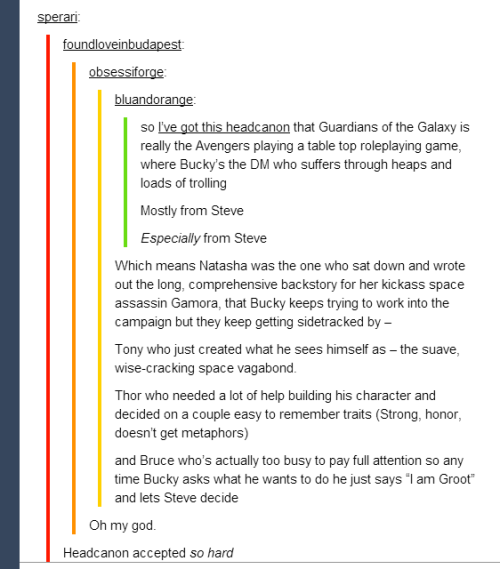
OK, but I partially disagree with this headcanon, and here’s why:
1) Bruce is totally playing Gamora. You don’t think Bruce Banner has played Dungeons & Dragons before? Bruce Banner has absolutely played Dungeons & Dragons before. He played all through high school and college and when Bucky announces the campaign Bruce jumps at the opportunity because he just misses it so much (mostly rose-tinted nostalgia goggles but). So he sits Bucky down and asks him for every bit of info he can on the setting and spends a whole night with a pot of tea drafting up the five-page backstory for his space assassin and her family tree and her struggle with her relationship with the villain and comes to Bucky with a fully-ready character sheet and a list of things Bucky will need to OK before Gamora hops in.
Bucky quietly resolves to integrate as much as he can into the story, mainly because Bruce came up with some better ideas than he’d had.
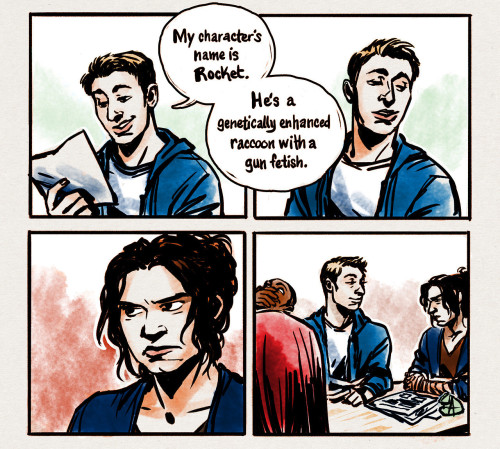
2) Tony is definitely playing Quill, because Tony has never played D&D before. You don’t get to be where Tony Stark is in life and have much free time. He does what a lot of newbies do and bases a character on himself, or at least the parts he likes: clever, snarky, pre-’90s musical taste, beds space babes, heroic sometimes probably. He wants to be cool but has no idea how to be cool within this context (“My character’s name is Starlord.” “What? Tony, no.”). He hogs the spotlight all the time (all the time) but clearly has no idea what he’s doing and when someone who seems like they know what they’re talking about gives him advice he always takes (“I’m going to need that guy’s leg.” “Seriously? Alright” *Rolls to grapple*).
Quill’s backstory is primarily Bruce’s doing. Tony just handed it in with a “yeah whatever’s on there.”
3) Thor is playing Drax but didn’t join until a few sessions in when he tagged along and decided it looked like fun (“THIS PLEASES ME! ALLOW ME TO JOIN YOUR TALES OF ADVENTURE!”). He definitely needed help constructing his character sheet, but he had no problem coming up with a character. Bucky asked him what he wanted to play and got that glint in his eye and responded “I WILL FORGE A HERO WORTHY OF THE ANCIENT TALES OF ASGARD.” And he put a lot of thought into Drax, both in personal history and personality. He’s mostly modeled on Thor’s favorite Asgardian folk heroes, with some personal flaws and quirks thrown in that Thor thinks are interesting.
Of course Thor doesn’t really understand the game part of it, he’s in it for the story (“Thor what the hell man there’s no way we can take on Ronan at this level!” “AH BUT THINK OF THE THRILLING DRAMA OF THE MOMENT DRAX AND RONAN MEET AGAIN!” “We are all going to die.” “AND IT WILL BE A THRILLING TRAGEDY!”)
4) Steve is absolutely playing Rocket but what started as a complete joke ballooned into a fully fleshed-out character with a tragic backstory. Steve’s an artist, he’s a creative guy and little too creative for his own good sometimes and bouncing his ideas off of Natasha turned a simple joke into a more elaborate character dynamic than even Bruce’s. He trolls Bucky a lot and it’s even better for Steve when he really gets into Rocket’s character and plays up the drama, partly because Bucky can’t tell if he’s joking or not.
5) Somewhere in the brainstorming session, Steve and Natasha decided that Rocket has a partner who is a talking tree. Natasha pitches this idea completely straight-faced to Bucky and after the fiasco of Steve’s character idea Bucky’s just too tired to say no to the tree-man. Natasha gives him a bit of a backstory and how Rocket and Groot got together and it sounds pretty solid, so whatever, tree-man can stay.
Then when all the characters get introduced Natasha just hovers over Tony and puffs out her chest and says in her deepest voice: “I am Groot.”
And Steve snickers and nobody has any idea why.
A session later Natasha is responding to everything Tony says with that same deep “I am Groot.” and Steve goes blue in the face trying to hold in his laughter and Tony cracks and the game has to pause for 10 minutes while Nat and Steve recompose themselves.
Nat also has a better grasp of the rules than Bucky realized and completely tweaked her character into being able to do basically anything she can justify. And it’s all right there in the book, Bucky can’t even argue from a rules standpoint. They’re only level 5 Groot shouldn’t be essentially bulletproof but through some loophole in the rules, yep, there it is.
Natasha Romanoff is trained to exploit weaknesses. Of course she’s a total munchkin.
This Brazilian book jacket for Stephen King’s The Shining was obviously designed by someone with a firm grasp of The Master of Horror’s work, and certainly doesn’t employ a photograph meant for a 1980s knitwear magazine.
I’ve heard the theory that Kirk’s logs just get circulated round headquarters for lulz before being dumped in the circular file as obvious fabrications by someone bored with a frontier posting.
“Hey, have you seen this one? He says he fought Apollo.”
“What, the old earth probe?”
“Try the old earth GOD!”
“Hilarious! Classic Kirk! That’s better than the time when he was transported to an evil dimenison.”
The reason why in The Naked Now it was Riker who remembered that the previous polywater infection had happened is that he’s the sort of person who would read The Hilarious Adventures of Captain Kirk for fun.
I especially like this idea because of the implication that all the other captains in Starfleet are reporting perfectly ordinary experiences like visiting a space station, dropping off supplies at a colony, bit of a stand-off with some Klingons in disputed space but got out of it unscathed - and then there’s Kirk all, “sorry guys we’ve been off course this week because my first officer seriously needed to get laid (LIKE YOU HAVE NO IDEA MY NECK STILL HURTS)” and “let me tell you about the Chicago Gangster planet” and “WHIPPED AND THROWN IN JAIL BY SPACE NAZIS.”
I actually really like the above explanation
I thought this was already canon
It would be pretty hard to believe a field report where evil doubles had pointy mustaches and such. I can’t really blame them.
One of the first trendsetters in the stock photo cliché memeplex has been adapted into a stage production by Sheila Callaghan, which premiered last week in Washington D.C. According to the reviews, more than 6,000 pieces of prop lettuce were used for the play.
““Icarus. The original myth had two parts. Daedalus said to his son, ‘I fashioned these wings for you. Two rules. Don’t fly too high, or the sun will melt the wax. But, more important, son, don’t fly too low. Because if you fly too low, the water and the waves will surely weigh down the wings, and you will die.’ We’ve left out the second part of the myth. We don’t say to people anymore, ‘Don’t fly too low.’ All we do from the time they are 4 years old is warn them against hubris. We have created this industrially led structure that says: How dare you.””









/cdn0.vox-cdn.com/uploads/chorus_asset/file/3947916/Massive_Impact.png)
/cdn0.vox-cdn.com/uploads/chorus_asset/file/3947886/11036955_939393542769347_976613789732206331_o.jpg)
/cdn0.vox-cdn.com/uploads/chorus_asset/file/2906340/shutterstock_169002578.0.jpg)
/cdn0.vox-cdn.com/uploads/chorus_asset/file/3947944/ea_global.jpg)
/cdn0.vox-cdn.com/uploads/chorus_asset/file/3947892/10987324_940120039363364_6003138536763824883_o.jpg)