
Original Script Text
What’d he say that was so funny?
I have absolutely no idea.
That’s classic.
My God, you guys.
What am I doing?
This is so un-me.
If you want, I’ll do it.
What’d he say that was so funny?
I have absolutely no idea.
That’s classic.
My God, you guys.
What am I doing?
This is so un-me.
If you want, I’ll do it.

Listen, Joey.
I know what he did was wrong.
But don’t you think
you could hear the guy out?
When you and Rachel were together…
…if Chandler had kissed her,
would you hear him out?
That’s a good point.
So how long you gonna punish him?
Five years.
Thumper is a game that snuck up on me. Over five years in the making, it's the debut title from Drool, a two-man indie team comprised of Marc Flury, an ex-Harmonix programmer living in Seoul, South Korea; and Brian Gibson, an artist at Harmonix who you may know as one half of the noise rock duo Lightning Bolt. Nominated for Excellence in Audio at the 2015 Independent Games Festival, Thumper exists somewhere between Audiosurf and F-Zero, except terrifying. It's simultaneously one of the prettiest and most nerve-wracking, sweat-inducing games I've ever played — rhythm or otherwise.
Above, you'll see Thumper's gameplay debut — footage from our hands-on time with the game at GDC 2015. Drool says the game but in the meantime, Thumper will be playable at both GDC's IGF Summit in San Francisco this week and at PAX East's Indie Megabooth in Boston over the weekend.

Multiple sources have confirmed to GamesIndustry.biz that Phil Harrison will soon leave Microsoft. So far, Microsoft has declined to confirm his departure.
Harrison himself has likewise declined comment, telling Eurogamer at the Game Developers Conference today, "I'm sorry, I don't think I can say anything about that."
When approached by Eurogamer Chris Charla, director of ID@Xbox, also refused comment.
Harrison has been a corporate vice president at Microsoft since 2012. Prior to that he was president of Sony Computer Entertainment Worldwide Studios. He also served on the advisory board of the game streaming service Gaikai.
In January of 2013 Harrison was on hand to announce the launch of Lift London, a new London-based game studio that was formed with the goal of creating new IP for tablets, mobile platforms and TVs.
Just today, GamesIndustry.biz reports that Lift London will be closed, and its remaining staff will be folded into Microsoft's Soho Productions team, best known for Kinect Sesame Street TV. We don't know if Harrison's reported departure is related to the closure of Lift.
By Graham Smith on March 5th, 2015 at 12:21 am.

I’ve used the Oculus Rift DK1, HD and DK2 for hours and hours and enjoyed my time with each of them immensely, but on each occasion, I’d feel some sense of relief upon taking the headset off. Relief that my head could cool down, relief my eyes could relax, relief that I hadn’t thrown up.
When my twenty minutes with Valve and HTC’s Vive came to an end, I felt no relief. Instead, I only felt disappointed that I couldn’t continue exploring the 3D painting demo or playing with the specially-designed Portal 2 vignette.
The presentation began with being led into a small room at GDC, around 12 by 15 foot, and being introduced to Jeep Barnett, a programmer at Valve. He pointed out two 6″x6″ boxes stood atop bookcases in opposite corners of the room. These are the laser-tracking devices that watch your movements throughout the room, and are one of the ways the Vive is different from the rival Facebook Oculus Rift headset. While the Rift places a small camera on top of your monitor in order to track your head position while you sit in an office chair, the Vive hopes to track you as you walk around your room.
To begin with, I sat down in a chair in the center of the room while I was wired up. The Vive is due out before the end of the year, but the version at GDC is still a prototype and while the headset is relatively light, it’s attacked to heavy external cables. To compensate, I hooked a belt around my waist to hold those external wires so my neck didn’t have to carry the load.
With the headset fitted, the first thing is that it’s a little sharper than the DK2, at least to my eye. It’s not perfect by any stretch, and if I studied the image in front of my face I could see pixels and jaggies and so on, but the following twenty minutes would be my first experience in VR where I would forget that there was a screen a couple of inches away from my eyes.
Next up, Barnett handed me Valve’s prototype VR motion controllers. Since I had the headset on already, these floated up from the floor in front of me as Barnett picked them up, and I reached out to pluck them out of virtual space. They look a tad like Razer Hydra controllers but with elements of the Steam Controller merged in: instead of thumbsticks, under your thumbs sit two haptic touchpads, there’s a trigger on top for your index finger, and another set of buttons pressed by squeezing your palms. Most of the demos I played used the index triggers.
Then Barnett put some headphones on me, asked me to stand up and he took away the chair. I was now standing inside a demo room at a busy conference, but completely immersed in a virtual world.
My first image when hearing of the Vive and its movement tracking earlier in the week was of walking into walls, stubbing my toe in my small office room, and knocking breakables off shelves. Valve have thought of the same.
To begin with, that virtual world was a white space with hexagonal tiles rising up front the floor around me. As I edged towards them, taking small tentative space out of fear of tripping, they shrunk down into the ground. I crouched down and touched the floor and the real world floor was just a little closer than the floor I could see. I stood up again, dipped my head, turned, straightened, looked up. At each point the headtracking seemed perfect. I was there.
The world around me transitioned to a plainer white space, but this one had images along the walls of different in-development VR games. Barnett directed my attention to the outline of a blue square on the ground, which marked out a safe space for movement, and then asked me to move towards its edge. As I did so, a wall of transparent grid squares faded in. Barnett described these as the ‘chaperone’, designed to stop you breaking all your stuff. The size of the space is something you calibrate yourself when first setting up the Vive and you can mark obstacles on the floor area to make sure you avoid outcropping furniture.
When I asked Barnett, he said that the minimum practical space for using the machine was around the size of two yoga maps, roughly six foot by four foot. He also said that the system can be made to work with very large spaces and that it can track multiple people moving through it at the same time. Valve are working on multiplayer prototypes, and hope to have more to show later in the year.
Settled in, Barnett told me to turn to my right and activate a screen. I turned right, took two steps forward, reached out with my right hand and squeezed the right-trigger on the controller to press an on-screen button. I can’t communicate how strange this experience is – pressing a button on a screen which is actually being projected on a screen but using my real arm – and that’s partly because any effort to do so betrays how simultaneously ordinary it feels. Within a few moments, you just forget about the weirdness.
Then the real demos began.
I was stood on the bridge of a sunken galley ship, debris scattered around its deck, penning me towards its bow. Small fish floated around in front of me, which I could chase away with my controller. “This is a good demo for showing scale in VR,” said Barnett. I walked around, looking this way or that, wondering if I could clamber over the fallen mast and wondering how longer-distance walking like that would work with the motion trackers. I opened my mouth to speak, “How far into the boat can I–“, then caught something in the corner of my eye.
I turned around to look out from the ship and there was a whale, almost close enough to touch, swooping by. It stopped and I stepped to the left to align myself with its eye, larger than my head. I stared into it and became aware again of my physical presence in the real world: I was smiling. A big, open-mouthed, toothy grin had spread uncontrollably across my face as I made eye contact with such an amazing creature, and I felt giddy as it swam on, its fin and tail swooping past my face.
It’s not often that I feel moments of euphoria while playing videogames, and I’m skeptical of this feeling myself. I half wonder if VR brings its own version of the phenomena of crying on airplanes, that the total effect of the headset, the immersion, the sense of being alone in a strange and public space, is that normally level-headed people come over all moony. Whatever the case, in that moment I’d have bought one if it had been for sale.
That was demo one.
Demo 2 cast me as a chef in a colourful, cartoon world, directed by a screen to make a particular meal by combining the items in a pot. While the first demonstration was purely passive, here I was picking up ingredients, opening and reaching into fridges, and the preparation ended by popping the food onto a plate, dinging a bell, and watching it being carted off. After successfully following the recipe, I was offered the chance to perform another or to pootle around with other objects in the kitchen. I turned around, zapped a steak knife in a microwave, and sent that off as my second serving.
The cartooniness of this world is why Valve’s use of the word “presence” is so important. I’d normally think of virtual reality as operating on a scale, as the name suggests, of reality. The better the system, the more real it seems. But that’s not quite accurate when you’re operating in a cartoonish world of low-poly vegetables and floating plates. I didn’t mistake the world of any of those demos for something real and that wasn’t their goal, but I always felt present in the setting no matter whether I was cooking or pootling around with an ogre’s spare mechanical parts.
That was the third demo. Set inside a small, rickety, fantasy-style room, with a cave beyond a wooden railing, I was talked at by an enormous ogre who was trying to fix something. He walked away and I spent a few minutes opening cupboards and tinkering with devices, the strangest of which were a pair of glasses with wobbling green plasma for lenses. I held those virtual goggles up to my eyes and looked through them, acutely aware of the chain of perception-bending at work.
Eventually the ogre returned, finished his repairs, and the room I was in began to ascend. It was an elevator and it emerged atop a mountain, my view suddenly unconstrained. I picked something up and threw it over the ledge, watching it sail out of view. In my memory, this feels no less real than times when I’ve rolled stones down mountains in real life.
Next up was a three-dimensional painting tool, which began with a flower springing to life from the floor, one brush stroke at a time. I was then given the tools to do that myself, my right-controller a brush, my left-controller a colour wheel and menu. I painted lines of light and snow through the air, and then a happy, smiley face in oils. “Is that John?”, Barnett asked. “He did have red hair at one point,” I said.
I could have used this all day, making nothing much of value but simply delighting in the precision of it. The motion controllers in my hands were as much prototypes as the headset itself, but I had no problem drawing John’s irises in place. It’s also strange how quickly they transformed in my mind from their actual physical shape to the glowing menu projections they existed as in the world. I was instantly accustomed to turning my hand this way or that to use the colour picker on the front and the brush picker on the back.
That was maybe the theme of the whole session: VR has come along far enough in just a couple of years that much of it is now instinctive. It’s remarkable how quickly the whole situation normalised in my head; how quickly I stopped thinking of the virtual objects I was picking up as any different from real ones, and how immediately I stopped worrying about bumping into unseen walls.
But the fifth and final demo was the first time the giddy smile returned to my face since that initial encounter with the whale. This was Valve’s own creation, and a vignette set in the Portal 2 universe. I didn’t go sailing around on jump pads or paint slick surfaces, and I question how that might have felt given the limits on player movement speed for anyone who wants to avoid vomiting on their head-mounted display. But instead, I was cast as a robot repairman, trying to fix a malfunctioning Atlas. It was gloriously funny, but there were two moments in particular that were sublime.
The first was opening a drawer to be presented with a miniature world full of stickmen and desks in the style of Portal 2’s cute, funny marketing. It was cute, it was funny, and it sold the sense of scale you get from virtual reality much like that initial presentation. I leaned in, getting a closer look at tiny figures typing at tiny computers. When I closed the drawer and one of the little figures crawled out and tumbled down to the floor, I couldn’t resist crouching down again and trying to help him back up. The second moment was when working with Atlas, in which you grab a lever on the side of his face and pull, causing the internal machinery of his head to spool out on as if on a floating rack, all the parts inside spinning and clicking and popping away.
Everyone has experienced a moment with videogames where they were impressed with technology before, whether it was a tongue-floored corridor or a staggering ragdoll trying to remain upright, but virtual reality seems to have the power to go further than those mere gaudy thrills. At least in me, it inspires feelings of wonder at the same time. It’s more than a flashier version of something you’ve seen before; it’s more like seeing moving pictures for the first time and ducking when a train rushes towards the screen. Or, in my case, jutting backwards when GladOS’s head shot towards where I was standing.
I’ve come over all moony again, but I’m willing to look silly in order to have a record of the genuine elation I felt after using the Vive. Whether it comes across in reading this or not, my desire when using the device was mainly to yell HOLY SHIT, call every friend and family I have and tell them to try it, and then to start indiscriminately hugging people. There will inevitably be better VR headsets in years to come that will make this one look deficient, and there will be limitations to this headset that will only be apparent after hours, weeks and months of use, but it would seem a shame to temper that feeling even out of entirely sensible cynicism.
In other words, there are fewer caveats than ever that need to be appended to the consistently joyful write-ups of various VR headsets.
That all said, it’s obviously worth stating that, despite my current preference, it’s still too early to say that the Vive is the winner of The Virtual Reality Wars. What’s now clear is that the fight is coming. While Valve and HTC are sprinting to beat the Oculus to market, that doesn’t mean Facebook’s eventual consumer device won’t ultimately be better. Whatever the case, users will be rewarded with machines made cheaper through competition – and a better chance at an open VR development platform.
Finally, for the sceptical and technical: no, I don’t know what its field of view or framerate was; no, I can’t tell you how much it will cost; and no, I have no idea if anything will be released for it with depth or lasting value beyond mere novelty.
And yeah, I don’t have a room in my house that can fit two yoga mats side by side either. Right now, I don’t care. I’ll push my couch out the way. Or, as one Valve employee put it, “Who really uses their dining table anyway?”.
By Philippa Warr on March 5th, 2015 at 2:00 pm.

Indie marketplace and distribution site, itch.io, will be introducing open revenue sharing in order for the platform to start generating money and “have a sustainable business model”.
Games on itch.io are priced using a pay-what-you-want-above-the-minimum approach. That means some are free of charge but with an option to donate to the developer while others have a minimum charge and the option to add that same extra donation on top. Currently itch.io doesn’t take a cut from that – as per the blog entry by founder Leaf Corcoran that option was disabled for the Ludum Dare October Challenge in 2013 and never turned back on because the site costs were manageable.
The new strategy will take effect from 23 March and will allow developers to set a revenue split for their game on the site at anywhere from 0-100%. The default rate will be 10% with an option to switch to “industry standard (30%)” which is the percentage Valve gets for things sold via Steam and a slider for anything else.
As part of a separate post explaining itch.io’s mission Corcoran explains:
“You might be saying ‘well that sounds pretty risky, what if everyone sets [the slider] to 0?’ We think that’s a risk we’re willing to take in the spirit of encouraging the generous and supportive community that’s already developed around itch.io.”
In case you weren’t aware of the site before, I head to itch.io most days just to see what’s appeared. Sometimes there are gems, sometimes reruns, sometimes bafflement and nonsense. Currently I’m wondering if I can play as two people for long enough to get Itty Bitty Trainwrecks to work.
The results of a new study, revealed yesterday at the Game Developers Conference in San Francisco, show that today's young consumers are far more progressive than the games industry gives them credit for.
To ignore this study, say its authors, will inevitably lead the games industry astray. They conclude that by ignoring young people's appetite for strong, dignified, self-possessed female protagonists, game developers will not merely alienate a growing audience, they will leave money on the table.
These are the consumers game developers will be selling to for the next decade
Rosalind Wiseman and Ashly Burch collaborated to create their survey in the spring of 2014. Wiseman, herself a teacher, educator and author, was able to deliver the survey to 1,583 students aged 11 to 18 over the course of the year. The results, the authors say, are enough to turn the games industry's understanding of gender issues on its head.
The most compelling data point for game developers is the fact that girls in high school are far more likely to prefer to play female characters than boys of the same age are likely to prefer to play male characters.
Only 39 percent of high-school aged boys surveyed preferred to play as male characters, while 60 percent of high-school aged girls preferred to play as female characters.
That 21 percent delta, the authors say, is more than enough reason for game developers to rethink who their main characters should be going forward.
"We as developers," Burch said, "understandably ... are afraid of our games not selling.
"It’s terrifying to imagine that your game’s not going to sell. But it could be that we are falsely attributing the success of past games to things that don’t actually matter to the kids that are playing them."

To emphasize that point, the authors noted that fewer boys than girls had strong feelings on what the gender of their character was at all.
When high-school aged students were asked "Are you more likely to play a game based on the character’s gender?" 28 percent of girls said yes, while only 20 percent of boys said yes.
Therefore, to ignore girls' stronger preference to play as a female characters is to ignore the potential to fuel their appetite for games. When developers push male protagonists to the forefront, they're not encouraging sales among boys. They're actually stifling sales among girls.

"There’s a higher percentage of high school boys that don’t care either way," Burch said, "than there are high school boys that prefer playing as a man. But the inverse happens when you ask girls."
Burch and Wiseman took their study a step further by asking students if they identified as a "gamer." While 65 percent of girls said no, and 65 percent of boys said yes, both genders displayed anecdotal evidence of being just as invested, and just as knowledgeable about games.
Furthermore, when gamer boys were asked if they want to see more girls play games, 86 percent said yes. When asked if they wanted to see more female heroes, only 19 percent disagreed. This data, the authors said, means that the majority of boys are welcoming to the girls that enjoy the hobby, and that they are eager to share it.
GamerGate is suppressing the voice of the progressive majority of boys
"We have this perception of what 'gamer' means," said Burch, "and what people that associate themselves with that title think it means. As we saw with the girls — all of those girls — that you couldn’t tell the difference between whether or not they identified as a 'gamer' or not."
This makes the ongoing struggle the industry is having with the GamerGate movement all the more tragic, the authors said. The majority of young girls and boys who play games want to share the hobby with one another, and they want to see it change to meet their innermost needs for self expression and personal validation. When a vocal minority dominates the conversation on social media and elsewhere, the authors said, it drives this majority into hiding.
"You’ve got kids who care deeply [about games] but don’t feel that they have a voice," Wiseman said, appealing directly to the game developers in the audience. "I’m asking you ... to help them and to affirm their voice, and to not make assumptions about kids, assumptions that so many adults in so many other areas make about young people."
"Girls don’t have superheroes to look up to"
For all the assumptions that the gaming industry makes, she said, "the kids have a very different opinion."
In conclusion, Burch pointed to the onrushing wave of strong female protagonists in comics and movies. These industries, she said, had already come to the conclusion that women were valuable consumers and were adjusting their products to appeal to them.
"You all know Frozen right?" Burch said. "So let’s talk about Frozen. ... Why do little girls like Elsa? Because she makes ice with her hands. How cool is that? Girls don’t have super heroes to look up to. That’s why Elsa resonates so much with them.
"If you look at any of the Marvel titles that are coming out; there’s Captain Marvel, they’re including more Black Widow, there’s the female Thor ... Squirrel Girl. There are more and more titles with female leads, and it’s not just because it’s the right thing to do.
"It’s because they know that girls have purchasing power, and they want more girls buying their comics. Because girls are nerds, guys, and they want to buy your stuff."
By Philippa Warr on March 5th, 2015 at 5:00 pm.

After catching up with the 2015 IGF winners news I spent my lunchtime playing the downloadable build of Outer Wilds from the official website. It’s the alpha build so I’m not sure how it would measure up to a current build but it’s been one of those lovely unexpected discoveries and almost made me forget my sandwich.
At first you’re deposited on a strange and tiny planet gazing up at the night sky. The camera pans down and there’s a tiny rocket awaiting launch codes. I hustled up towards the nearby observatory but accidentally ended up at a training area with a zero gravity cave which taught me the basics of ship repair and navigation in space.
The observatory itself was more of a museum with lots of little wall texts to read and objects with which to interact. I confess I didn’t spend a lot of time there but did get sidetracked by a giant tooth billed as from and angler fish.
Launch codes in hand I headed to my module, ignored some ominous warnings about things “changing” in the local solar system, and steered (gracelessly) out of the planet’s atmosphere. I love that moment in space exploration games where you leave a planet’s atmosphere and the whole black sparkly cape of space spreads over your field of view.

This game sets you up to explore your home solar system so the chunk of space I was presented with felt manageable. A few planets were visible so I tottered towards the nearest one and attempted a landing. Alas it was a water planet so the landing was more of a splashdown. The surface bristled with waterspouts, zipping along and whirling anything in their path upwards. I headed below the surface and tried to chase jellyfish but couldn’t work out my navigation system well enough to sink reliably.
“I’ll come back,” was the plan and I bobbed off to try and relocate my ship. It was zooming heavenward in one of those waterspouts. After a game of chase I managed to clamber back into my vessel and bumbled back into space where I more or less immediately smashed into the surface of another celestial body.
This one was more like a gigantic space geode. I floated through a crack in the side and found shards of crystal stretching out from the walls. I tried to walk on them but I’ve still not got the hand of my suit so I waddled and accelerated my way back onto the surface and fixed up my ship.

Then I tried to land on the surface of the sun.
Yeah, I have no idea why either. I just thought I’d check how the technology of my ship was supposed to work – perhaps it was heatproof? Perhaps I could swim about in a swirling mass of hot plasma.
Suffice to say that didn’t happen. What did happen, though, is I was deposited back on my home planet with the memory of the launch codes in my brain and ready to head out again (I explored a giant bramble and things were even briefer and more deadly this time). I’d say there’s a touch of Majora’s Mask in the looping of time back to that initial launch point, although perhaps that’s also because I spend a lot of time with the moon threatening to crash into me in that game.
From reading the dev blog I know there’s a central mystery they’re working on and I’ve already encountered a number of planets and ideas I want to explore further. An official release date is yet to be announced (there doesn’t even seem to be a vague release ballpark at the moment) but I’ve added it to my TELL ME MORE, RSS FEED READER pile and Twitter tells me I’m not alone.
Art has always posed a problem for Facebook. Its community standards ban nudity, and the combination of algorithms and overseas workers that scan the site for infractions have trouble distinguishing between an artistically nude image and a pornographically nude one. It’s usually a little funny when this happens, and prompts lots of lightly outraged stories about Facebook’s philistinism and discussions about context and censorship and what is art, anyway?
Now it seems New York Magazine’s art critic Jerry Saltz has been caught in the net. While his public Facebook page is still up, he tells The New York Times that he can no longer post to it, and his feed is filled with followers asking, "Jerry, can you reply to this?" They receive no reply.
Saltz’s case is probably a little different than the typical ones, though. Over the years he’s developed a large following on Facebook, Twitter, and Instagram, partly by posting things that are somewhat saltier and more risque than you might expect of a 63-year-old art critic.
This has landed Saltz in trouble before. Late last year he posted a "a graphic picture of a woman's thrashed behind," in his words, to Facebook with the caption "This is what your critic does to artists who have been very very bad." That prompted accusations of sexism, which he replied to with a New York Magazine essay titled "When Did the Art World Get so Conservative?"
It’s unclear what the offending post was, but it may not be a case of Facebook banning art that, taken out of context, could be porn, but of Saltz taking art and adding context that turns it pornographic — or at least potentially offensive to someone encountering it on their newsfeed. In other words, Saltz was being a bit of a troll. Which is probably why the art world, while generally calling for Saltz's reinstatement, is not reacting to his ban with unmitigated dismay. The headline on Artnet, which first reported the story, is "Jerry Saltz Got Banned from Facebook — About Time."
Saltz, for his part, doesn’t seem too upset. "For today at least, good riddance. It’s the land of like," he told the Times. And there’s always Twitter.
Heya folks, the Old Crow here. I thought I’d relate the first of a few Radio Shack/Tandy stories as told by my synthesizer engineer friend and sometimes partner in crime, Paul Schreiber. Paul worked for the Tandy Corporation from 1977 to 1987 as an electrical engineer. His first story concerns their first direct-connect modem, the TRS-80 MODEM I. In Paul’s own words:
“The demise of Radio Shack/Tandy brings back many mixed emotions. I started there in 1977 as a co-op (intern), making $3.85/hr, etching pc boards for TV games (a la ‘Pong’) in the “R&D building,” a former tire store where the etchant tank was in the women’s bathroom (there were no females in the building, so why not?) The next session, in the spring of 1978, I was in the TRS-80 factory in the repair section (we had a quota of 50 boards/day). After graduation, I went there full-time in May of 1980 (after 1 glorious year at Data General, still the best job I ever had, but that’s another story).”
“My first Tandy design assignment was the MODEM I, the first stand-alone, non-Bell direct-connect modem (there was a Hayes S-100 card that was direct-connect, for you old-timers). I worked on it by myself (most of Tandy’s engineers worked ‘alone’) for about 5 months. The filter design software I wrote on a Model I in BASIC, that would iterate the filter’s group delay response versus picking standard 1% resistor values. The program was very useful, and it ran pretty fast on the 4MHz Z-80 (an average run, based on first picking the caps then running the resistors, took about 45min).”
“I even designed the case , the graphic overlay and wrote the manuals. I applied for 2 patents and much to my surprise both went through without hardly a blink of an eye from the USPO. One patent (for the filter design) would turn out to be instrumental in keeping AT&T/Olivetti out of the ‘laptop’ space 7 years later, when they tried to clone the Model 100, which had my modem design in it.” Note by Crow, here is the patent.
“I still have my “first article” production sample. Good times…sigh…”

TRS-80 Modem I as listed in the 1981 catalog
“That photo in the 1981 catalog caused me to get yelled at by John Roach, the CEO. I only got yelled at 2 times in 9 years, not bad. The issue was the toggle switch on the right side. The photo was taken in April of 1981, this was not the production unit but a painted, wooden model (the ‘mockup’). That switch selected 300 or 600 baud data speeds over the phone line.”
“Well, during FCC testing for Part 68 (attaching to a phone line), I found out that 600 baud was very flakey. I started to panic a bit. I read the Motorola data sheet for the modem IC like 50 times, looking for clues. Then, one day, in a footnote buried in the datasheet, was this statement: 600 baud operation not guaranteed over PSTN.”
“PSTN?? WTF???? Well, PSTN = Public Switched Telephone Network. It turns out that indeed, due to the filtering the phone company puts in the line to make ‘voice sound good,’ at 600 baud FSK modulation has sidebands attenuated too much by the voice filters.”
“So after the CEO ass-chewing, I had to throw 50,000 manuals and 50,000 panel overlays in a dumpster. Electrically, we just removed the switch from the BOM. Thankfully, production was in June! I learned to read ALL of a datasheet.”
Crow here again. It just so happens the very first PC board I ever etched in 1982 was a 300-baud direct-connect modem using the same modem IC Paul used, a Motorola MC14412. I initially used it by hand-dialing the number, then flipping a switch when the carrier tone sounded. This is how I connected to the university telecomputing network my freshman college year.

Old Crow’s first-ever self-etched PC board, a 300 baud modem
In the summer of 1983 I hand-taped my first-ever PC board, a single-board computer based on the “Arduino of its era,” the RCA 1802. The 1802 mailing list guys call it the “Olduino.” The chip was a tad unorthodox, but it was a CMOS device and could run on 1mA of current from a 9v battery, which made for a great portable microcontroller. This board has my modem mounted to it and it ran a hand-assembled-on-paper program to (badly) emulate enough of a Hayes J-Cat modem to tone dial a dialup line, detect the carrier and connect the modem. Parts are missing now, but perhaps I will one day see if it still runs. Cheers!

Crow’s first PCB layout, a single-board computer to operate the modem


Read more of this story at Slashdot.
The first thing I noticed about using Office 2016 for Mac is the user interface. While the existing 2011 version looks old in comparison, Microsoft hasn’t ditched parts of the ageing UI entirely. It looks and feels like a mix of the fresh Windows design and Office for Mac 2011. "We think we’ve done a good job of striking a balance that customers expect," explains Eric Wilfred, the head of Microsoft’s Office for Mac apps, in an interview with The Verge. "Our internal tagline, and we’re actually corny enough to say this in the hallways, is unmistakably Office and optimized for the Mac." The result is the familiar Ribbon user interface that fits in with the OS X theme, and features like sandboxed apps, fullscreen view, and Retina screen optimization.

OneDrive cloud storage is built straight in
Word 2016 for Mac looks a lot like the iOS and Windows equivalents, and Microsoft is support co-authoring to allow several people to simultaneously edit a document at the same time. Alongside co-authoring, there’s also new threaded comments to track comments more easily next to the relevant text. Microsoft is also adding a new navigation pane to quickly flick between pages in Word documents, better dictionary support, and a style pane to apply styles to an entire document. The vast majority of Word features are what you’d expect from the existing Office for Mac, but everything feels a little more polished thanks to the new look and feel.

Excel now has the same Windows keyboard shortcuts
PowerPoint picks up an improved presenter view, new slide transitions, and an overview of all animations in a slide deck. The new presenter view allows you to see notes alongside slides, and the additional slide transitions give you more ways to keep your audience awake with crazy animations. There’s not a huge amount of change to PowerPoint, but like the rest it more closely matches the Windows version.
Office 2016 for Mac will also include Outlook and OneNote, both of which have been available on Mac for some months now. While Outlook for iOS is amazing, the Mac equivalent falls short for several reasons. There’s no account picker, which results in a confusing and frustrating way to add your account at first, and it’s surprising that Microsoft hasn’t even optimized the app for its own Outlook.com service. Otherwise, it’s a good combination of email, calendaring, and contact management for those who are familiar with Outlook and rely on Exchange day-to-day.

Overall, during my testing I noticed that Office 2016 for Mac doesn’t seem that much faster than Office 2016 for Mac. I’ve grown tired of using Office 2016 for Mac as it’s simply not fast enough and reliable for my needs, and I’m disappointed there haven’t been many performance improvements nearly five years later. I was hoping for a lightweight version of Office for Mac, but there’s hope yet. "We have focused a lot on performance in the run up to getting preview out, and we believe we’ve got it to the point where it’s worth getting feedback," explains Wilfred. "We know that we’re not done, we have more performance work to do before general availability."
Final version available this summer
Speaking of availability, Microsoft is aiming to have this ready in time for summer, with a release focused on Office 365 customers once the bits are ready. Microsoft is also planning to sell the suite of apps standalone, but the company is not yet announcing pricing or exact availability dates. If you’re interested in testing out Office 2016 for Mac then you can download a copy over at Microsoft’s Office site.
Read more of this story at Slashdot.
Read more of this story at Slashdot.
Young men between the ages of 10 and 24 are taking their own lives less often than they did 20 years ago, according to a report released by the CDC today. Unfortunately, the suicide rate among young women is slightly higher than it was in 1994. And young people in general are resorting to suicide by suffocation more often than they did two decades ago.
Suicide is disturbingly common among young people
Suicide is disturbingly common among young people. About 17 percent of high school students in the US say that they have seriously considered suicide, and 8 percent say that they've made an attempt. Suicide is the second leading cause of death among young people in the US, after unintentional injury.
Despite the numbers, the suicide rate for young men has decreased to 12 deaths per 100,000 men, from 16 deaths per 100,000 men over the course of the last 20 years. For these men, the leading method of suicide was firearms. In contrast, women used suffocation most often — a suicide mechanism that includes suicide by hanging. In 1994, the suicide rate among young women was 2.7 deaths per 100,000 women. By 2012, that number hit 3.2 deaths per 100,000 women. Overall, firearm use has gone down, especially among 15- to 19-year-olds, and suicide by suffocation has increased.


Credit: CDC
The fact that suffocations are on the rise is concerning because that method is very efficient, the CDC authors write. On average suffocation kills between 69 and 84 percent of people who use it. Suicides by firearm, on the other hand, are about 81 percent successful, whereas poisonings are only successful in about 2 percent of cases, according to data from 2010.
The reasons for an increase in suicides by suffocation are unclear
The reasons for an increase in suicides by suffocation are unclear, the CDC researchers write. More research is needed to look into perceptions of suicide by hanging among teens and young adults. In the meantime, the CDC recommends that clinicians, hotline staff, and various other interventionists pay attention to "current trends in suffocation suicides." Doing so may help them educate families and assess risk when talking to young people who might be considering suicide.
Here are some suicide warning signs, and treatment options. If you or someone you know is considering suicide, please call the National Suicide Prevention Lifeline 1-800-273-8255. Calling is free and the lifeline is staffed around the clock.
Read more of this story at Slashdot.
![[Video] Watch UC Berkeley Students School Their Professor About Institutional Racism](http://colorlines.com/assets_c/2015/03/ucb_030515-thumb-240xauto-12463.jpg)
When students at UC Berkeley's School of Social Welfare grew tired of a professor's racially charged remarks, they took a somewhat unconventional approach: a teach-in -- for their teacher.
The action happened on February 24 and was aimed at Steven Segal, a tenured professor of social welfare and mental health who's been with the university for more than 40 years. According to a report in The Bold Italic, Segal, who is white, recited a rap he'd written about "black-on-black crime" at a Black Lives Matter event on campus. Later, in class, he continued rapping, this time about scapegoating police. Here's more from The Bold Italic:
"We all experienced the emotional impact of your actions. We would not be here today if this did not really immensely impact pain on all of us," Erika O'Bannon, a student and protest organizer, said to Segal in a YouTube video of the action. "We cannot stand by this institution that supports your beliefs and the beliefs that you're teaching to this class. We refuse to let this class continue as usual."

The heartbreaking story of actress Misty Upham's disappearance and subsequent death is at the center of this new piece at Al Jazeera America: Why do so many Native American women go missing?
firehosevia ThePrettiestOne
firehosevia Toaster Strudel
I used to think, back in my gray men’s coat-wearing days, that being fetishized as a beautiful gamer girl was exactly what I wanted. I couldn’t actually achieve it, of course, but that was the dream. Eventually, I did get a taste of what those experiences were like, in my early 20s. I dated a guy who told me I was a “unicorn,” that the fact that I played Counter-Strike meant that I was a perfect woman, the one he’d been waiting for his whole life. He also ended up being the most abusive guy I ever dated. He didn’t seem to see me as a human being; I was a “unicorn,” right? That meant I should have been able to put up with anything from him, even the worst possible treatment.
I also realized that the deck was stacked against me in competitive gaming environments, too. I would walk into fighting games spaces and immediately be stared at; men would gather around my screen to watch me play, and they’d be disappointed when I didn’t blow them away with absurd expertise. I wasn’t allowed to be mediocre; I was supposed to be the Unicorn Gamer Girl who appeared out of nowhere to blow everybody away (and then blow everybody).
There is no narrative about a girl who shows up to play games and turns out to be kind of okay at them, and then she makes platonic friends who see her as a person, and then she goes home alone. My mediocrity became a huge disappointment for men that I didn’t know in gaming spaces. It was a disappointment for me, too, and it still makes me extra-nervous. Every time I show up and play games in public somewhere, in some male-dominated space, there is some stupid part of me that wants to win beyond all my wildest dreams … even though it’s impossible, especially when people are staring at you. I do okay, sometimes. That’s the most I’ve ever been able to hope to achieve: being okay at games, sometimes.
I want to be a person. Not a unicorn. And ideally, I want to stop seeing these fucking unicorns in all the media about nerds that I watch. It’s a lie that we all need to stop believing in. I don’t want to have to hold myself to some absurd exceptional standard, and I don’t want other women to grow up with that either. It feels like shit.
firehosedaaaame
The Steam controller is a big part of what makes a Steam Machine a Steam Machine; we were told that running SteamOS and being packaged with the controller were two of the main things that need to be included to use that branding. The controller itself has gone through a number of revisions, but we were able to use what Valve is calling the final version during GDC.
It's a strange controller if you're used to the offerings on consoles. There are two touch pads, one on either side, that double as buttons. There are triggers, two bumpers, and two more buttons on the rear of the system on either side. That means that, ignoring the four face buttons, two touch pads and analog stick, there are six buttons on the rear of the controller.
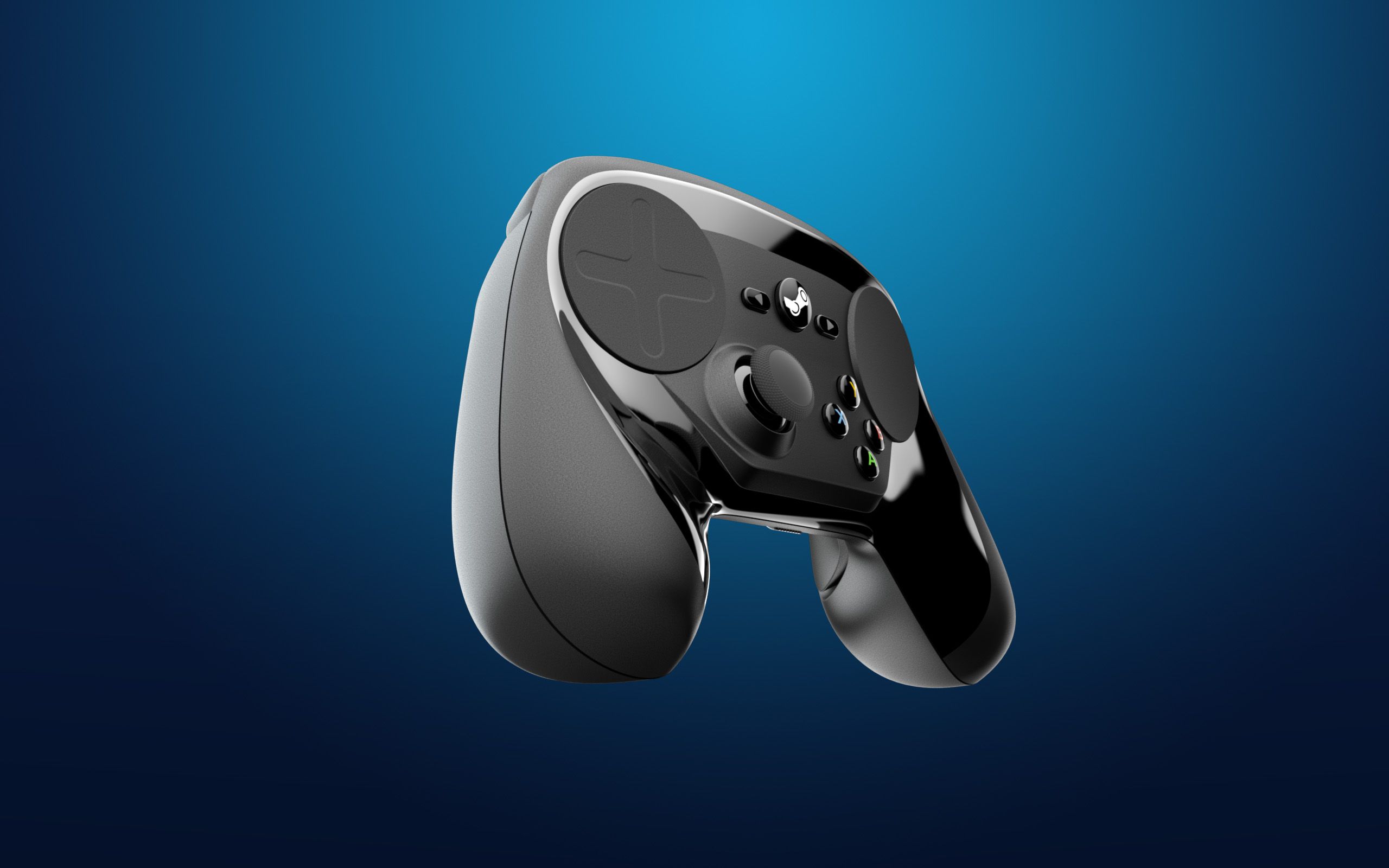
It all makes sense when you hold it in your hand, and the controller does some interesting things to emulate the use of a mouse and keyboard. In the demo I played, the right touch pad emulated a track ball, complete with a sense of momentum; you could flick your thumb over the pad and "feel" the effect of a rolling ball along with a sense of weight to the movement. You can bring up an overlay in Steam at any point and adjust what the buttons do, how they act, and the level of the haptic feedback.
It's fully configurable, which is part of the point; we were told that one of the features of the system was the ability to come up with a novel control scheme and then share it online so others can use your settings.
The controller is coming this November, for $49.99. It felt great, and boasts some interesting and borderline strange features. It will take much more testing to see if it's a viable solution for PC gaming in front of the TV, but it's already closer than most other pieces of hardware that promise to provide the same thing.
firehosenever follow firehose
follow only firehose
 |
popular
shared this story
from  The Bloggess. The Bloggess.
|
I found this vintage Valentine at a garage sale and I couldn’t stop looking at it because it seems weirdly and inappropriately sexual. The woman running the garage sale disagreed with my assessment so I’m sharing it here so you can see if you’re as messed up as I am:

“YOU CAN’T PUT OUT THE ‘FIRE’ IN MY HEART FOR YOU.”
1. Look at this girl’s girls feet. She’s straddling a flaming bucket labeled “MY VALENTINE.” Her vagina is literally on fire here. That’s not healthy or appropriate.
2. Why is she even burning valentines? Was it an accident? Does she like arson? Is this how she lures firemen to her home? So many questions.
3. Sometimes a hose is not a hose. Also, you’re not even aiming at the fire, sir. It’s like you’ve never even had fire training.
4. The hose seems to have a mind of its it’s own and is spraying everywhere. The entire place is a wet spot. Plus, why does she look so excited that she’s about to get soaked? Her only expression seems to be “AWESOME. But not in my hair.”
5. That hose isn’t even attached to anything. It just winds back into the guy. And the guy is like, “LOOK AT MY MAGNIFICENT HOSE” and the girl is all, “THAT HOSE IS SPECTACULAR.” In fact, they’re both so “THIS HOSE IS EVERYTHING” that they are entirely distracted from the impending inferno and smell of burnt gingham. I suspect this valentine was drawn by a man.
6. Why is “fire” in quotes? That’s not how quotes work.
7. I realize it’s a cartoon, but that’s some mighty spermy looking water.
Conclusion: This is the most subliminally sexual valentine I’ve ever seen in my life. Or possibly it’s just me and I need to get my head out of the gutter. Also, I just noticed that the boy’s hose is pointing to the words “PUT OUT”. Yeah. My work is done here.















 The Babe Brigade:

