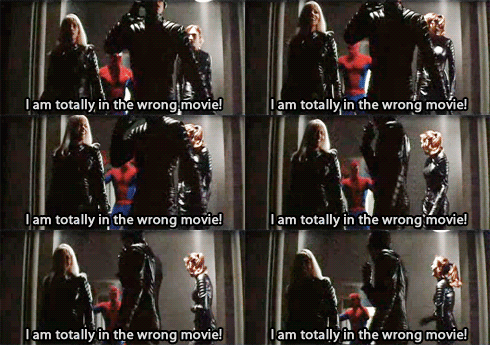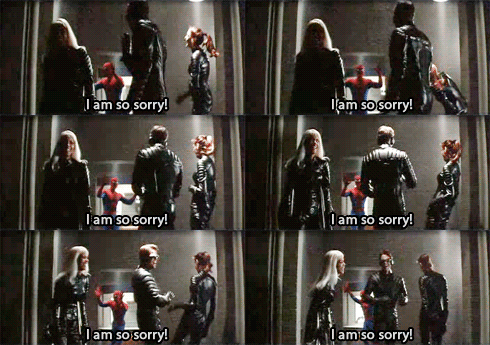


firehoseif only it had been deadpool, they could have left it in

ThinkGeek is selling a pair of throw pillows that resemble the game cartridge of a certain classic videogame console. While they look comfy, you’ll have to be content with the fictional game covers.
firehoseattention unhappy firehose followers and spouse
"If a site posts many items each day and you barely read any of them, delete that feed. If you find yourself hitting “Mark all as read” more than a couple of times for any feed, delete that feed. You won’t miss anything important. If they ever post anything great, enough people will link to it from elsewhere that you’ll still see it."
With the decreasing use of RSS readers over the last few years, which will probably be accelerated by Google Reader’s shutdown in July, many are bidding good riddance to a medium that they never used well.
RSS is easy to abuse. In 2011, I wrote Sane RSS usage:
You should be able to go on a disconnected vacation for three days, come back, and be able to skim most of your RSS-item titles reasonably without just giving up and marking all as read. You shouldn’t come back to hundreds or thousands of unread articles.
Yet that’s the most common complaint I hear about inbox-style RSS readers such as Google Reader, NetNewsWire, and Reeder: that people gave up on them because they were constantly filled with more unread items than they could handle.
If you’ve had that problem, you weren’t using inbox-style RSS readers properly. Abandoning the entire idea of the RSS-inbox model because of inbox overload is like boycotting an all-you-can-eat buffet forever because you once ate too much there.
As I said in that 2011 post:
RSS is best for following a large number of infrequently updated sites: sites that you’d never remember to check every day because they only post occasionally, and that your social-network friends won’t reliably find or link to.
Building on that, you shouldn’t accumulate thousands of unread items, because you shouldn’t subscribe to feeds that would generate that kind of unread volume.
If a site posts many items each day and you barely read any of them, delete that feed. If you find yourself hitting “Mark all as read” more than a couple of times for any feed, delete that feed. You won’t miss anything important. If they ever post anything great, enough people will link to it from elsewhere that you’ll still see it.
The true power of the RSS inbox is keeping you informed of new posts that you probably won’t see linked elsewhere, or that you really don’t want to miss if you scroll past a few hours of your Twitter timeline.
If you can’t think of any sites you read that fit that description, you should consider broadening your horizons. (Sorry, I can’t think of a nicer way to put that.)
Some of my RSS subscriptions that my Twitter people usually don’t link to: The Brief, xkcd’s What If, Bare Feats, Dan’s Data (and his blog), ignore the code, Joel on Software, One Foot Tsunami, NSHipster, Programming in the 21st Century, Neglected Potential, Collin Donnell, Squashed, Coyote Tracks, Mueller Pizza Lab, Best of MetaFilter, The Worst Things For Sale.
Many are interesting. Many are for professional development. Some are just fun.
But none of them update frequently enough that I’d remember to check them regularly. (I imagine many of my RSS subscribers would put my site on their versions of this list.) If RSS readers go away, I won’t suddenly start visiting all of these sites — I’ll probably just forget about most of them.
It’s not enough to interleave their posts into a “river” or “stream” paradigm, where only the most recent N items are shown in one big, combined, reverse-chronological list (much like a Twitter timeline), because many of them would get buried in the noise of higher-volume feeds and people’s tweets. The fundamental flaw in the stream paradigm is that items from different feeds don’t have equal value: I don’t mind missing a random New York Times post, but I’ll regret missing the only Dan’s Data post this month because it was buried under everyone’s basketball tweets and nobody else I follow will link to it later.
Without RSS readers, the long tail would be cut off. The rich would get richer: only the big-name sites get regular readership without RSS, so the smaller sites would only get scraps of occasional Twitter links from the few people who remember to check them regularly, and that number would dwindle.
Granted, this problem is mostly concentrated in the tech world where RSS readers really took off. But the tech world is huge, and it’s the world we’re in.
In a world where RSS readers are “dead”, it would be much harder for new sites to develop and maintain an audience, and it would be much harder for readers and writers to follow a diverse pool of ideas and source material. Both sides would do themselves a great disservice by promoting, accelerating, or glorifying the death of RSS readers.

We won't go too verbose as no words can render the celestial charm of those sites. "A picture costs a thousand words" - they say. So, come on, pack your bags and join our thrilling expedition to the most surreal places on Earth!
Can you imagine that even not all Nevada residents know about this wonder? Fly Geyser is located on the territory of a private Fly Ranch which makes it extremely difficult to access. High fence and locked gate with spikes on top guard the geyser from tourists. To be absolutely honest, we should mention that the Geyser is not a completely natural phenomenon. It was created by chance during well drilling. The well went out of order after several decades of operation as warm geothermal water has found a weak spot and began to leak onto the surface. Dissolved minerals started their sculptor job, which is still going on. Geyser coloration is explained by the variety of minerals it is made of.

The Wave, Arizona
The Wave is a sandstone rock formation in the United States of America near the Arizona and Utah border on the Coyote Buttes slopes. Travelers and photographers from all over the world are attracted by its colorful, wavelike forms. The Wave's intersecting U-shaped troughs are the result of erosion of the Navajo Sandstone during the Jurassic period.

Lake Retba or Lac Rose is located in the north of the Cap Vert peninsula of Senegal. It got its name due to the Dunaliella salina algae making its water look like strawberry milk shake. Pink color is clearly visible during the dry season. The lake is also famous for its high salt content, allowing people stay on the surface similar to the Dead Sea experience.


Have you ever stood at the Hell's Door? Go to Derweze village, which name means "The Gate" in Turkmen language if you search for extreme! This terrifying attraction is located in the middle of the Karakum Desert, about 260 km north from Ashgabat. The Derweze area is rich in natural gas. Soviet geologists got into a cavern filled with natural gas while drilling. Due to the ground collapse, a large hole has created. It was decided to burn off the gas, but the roasting breath of the inferno is still trying to break into the world of living!

Socotra is considered to be a unique archipelago in the Indian Ocean for the diversity of its exotic flora and fauna. Its weird alien plants are the result of island's long geological isolation together with unbearable heat and drought. One of the most unusual Socotra's plants is the dragon's blood tree, resembling a strange umbrella. Aboriginals believed its red sap to be the blood of a dragon.

Have you ever walked through the clouds guessing are you in the top or the bottom? Salar de Uyuni gives you such unique possibility! Salar de Uyuni or Salar de Tunupa is the world's largest salt flat occupying the area of about 10,582 square kilometers. Today's Salar is a result of transformations between several prehistoric lakes. Its surface is covered by a few meters of salt crust possessing the utmost flatness, which varies within one meter over the entire area. Actually, the crust serves as a source of salt and makes a pool of brine, rich in lithium as well. The sky over the Salar is always clear, which in combination with large area and exceptional flatness makes it a perfect object for calibrating the altimeters of Earth observation satellites.

Five-Color Pond is one of the smallest but the most amazing water basins in Jiuzhaigou lakes. Despite the shallowness, it has a breathtaking colored underwater landscape and some of the brightest and clearest waters in the area. As the legend goes, the Goddess Semo used to wash her hair here and the God Dage brought her water every day.

Deadvlei is one more surreal attraction of Sossusvlei, Namibia. It is a clay pan located about 2 km from Sossusvlei. It used to be an oasis with several acacia trees before, but the river that watered the oasis has changed its course. Now the dead acacia trees make an odd contrast to the shiny white salty floor of the pan and the intense orange of the dunes.

Badab-e Surt's terraces are made of travertine, which is a sedimentary rock deposited by flowing water from two distinct mineral springs. Thousands of years the water from these two springs had been streaming down from the mountain, it mixed up and gradually created a number of orange, red and yellow colored pools which now have the form of a staircase.

Yueyaquan is a crescent-shaped lake in the oasis, lying 6 km south of the city of Dunhuang. Its name comes from the Qing Dynasty. The lake itself and the surrounding deserts attract the tourists appreciating camel and 4x4 rides.

The queer lake's hue is normal for water basins with extremely high evaporation rates. During the dry season, as the water evaporates, salinity level increases to the maximum point and specific salt-loving microorganisms begin to thrive. Some of them produce red pigment colorizing the water and turning it into the Martian landscape.

This cave in the glacier appeared as a result of glacial mill. The rain and melt water on the glacier's surface are forming streams that flow into the crevices. The streams melt holes in the glacier forming long ice caves with intricate walls and ceilings. Cold wind finishes the job and we can observe a momentary marvel ready to collapse at any time. Due to the constant glacier movement one can hear a scaring cracking sound inside the cave. The incipient crevices let the indirect daylight into the tunnel and we can observe its mysterious play on ice bubbles.

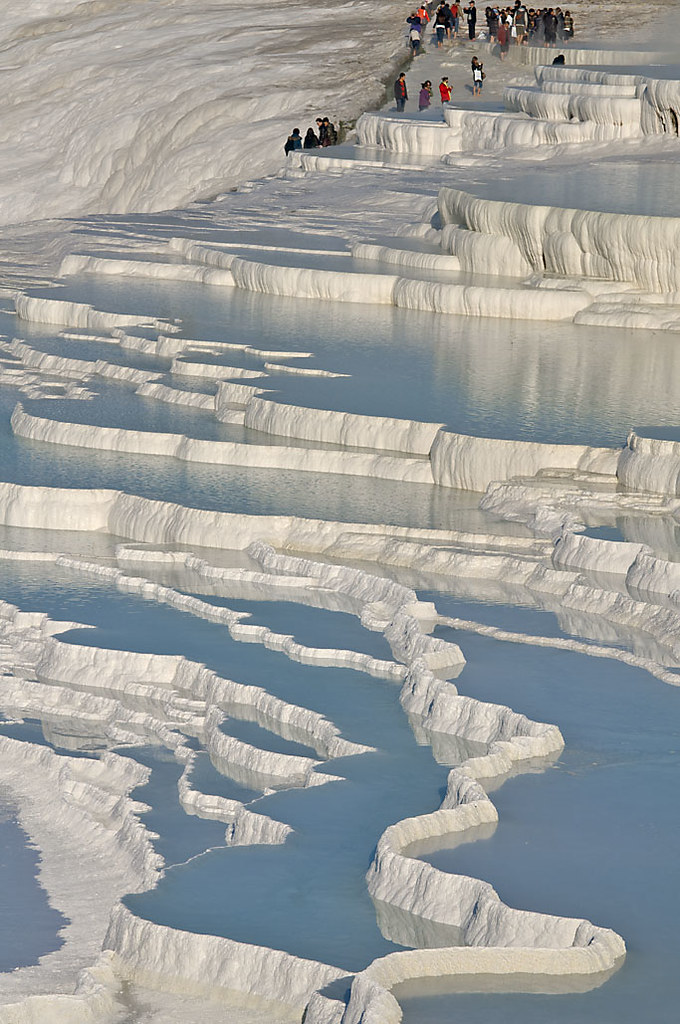
Pamukkale can be translated as "the cotton castle" from Turkish. It is a natural attraction in Denizli Province in southwestern Turkey. Snow white Pamukkale's terraces are made of travertine, a sedimentary rock, deposited by water flowing from the hot springs.
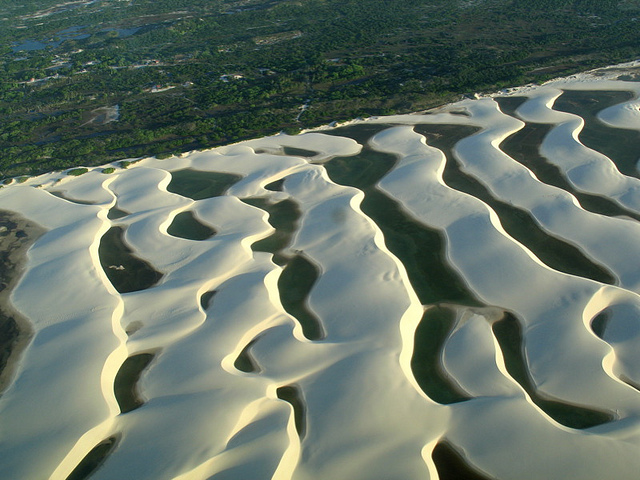
The Lencois Maranhenses National Park is a low, flat, occasionally flooded land, covered with large, white discrete sand dunes. Though it looks like a desert, in fact it is not. Due to the regular rain season in the beginning of the year, fresh water accumulates in the valleys between the sand dunes, reviving the desert with blue and green lagoons. It's rather surprising, but those water basins are inherited by fish, even despite the dry season.
Angkor is a huge complex of the 12th century temples in Cambodia. No doubt that it's a place of historical and cultural interest. The buildings are ancient and magnificent. But what do you think is really strange about this place? Just look at those trees! They look like ancient nation of Ents, the walking trees from "The Lord of the Rings" movie! Do you think they can really exist?

Have you ever seen anything like that? Chand Baori is a famous stepwell in the village of Abhaneri near Jaipur in the Indian state of Rajasthan. It is located opposite Harshat Mata Temple and was constructed in 800 CE. Can you imagine that those 3500 narrow steps in 13 stories extend 100 feet into the ground, making it one of the deepest and largest stepwells in India.

These waves look like decorations from popular "Ice Age" cartoon. It seems as if they were frozen immediately at the will of a snow Queen. In fact, the waves are the result of melting, not freezing. Melting has created those downward pointing spikes, which are simple icicles.

Hidden from stranger's eyes, the beach of Marieta Islands, Puerto Vallarta can be called a lost secret world. Marieta Islands are archipelagos formed as a result of volcanic activity. This natural wonder possesses its unique marine ecosystem. The beach is a real paradise for people fond of snorkeling and scuba diving. Diverse, virgin flora and fauna in combination with transparent crystal water make the experience unforgettable. Humpback whale, sea turtles and dolphins are just a few animals that can be seen there.

The Waitomo Glowworm Caves are definitely worth seeing not only because of their historical and geological significance. The glow worm, Arachnocampa luminosa, is a unique creature living in New Zealand. Thousands of these small worms radiate their otherworldly luminescent light hanging from the cave rocks during your unforgettable boat ride. The glowworms create a really magical view, every tourist should see at least once in a lifetime.

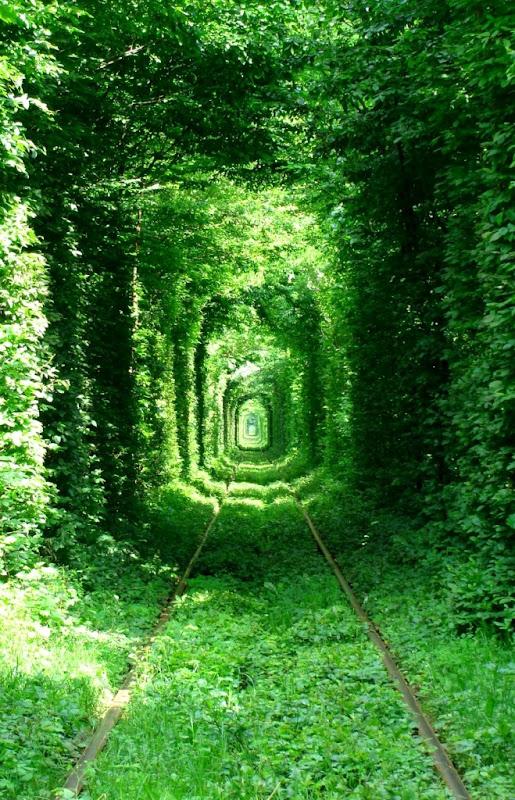
In this photo you see the abandoned railway track, located nearly 350km from Kiev, which has transformed into a special romantic place, frequently visited by couples. The Tunnel of Love is especially beautiful in spring, when the green trees growing from both sides of the track form an improvised arch around it. This arch stretches for up to three kilometers and looks like a green picturesque tunnel of trees. The railway is occasionally used by the fiberboard factory, which preserves the tunnel in its initial look.
Glen Brittle is a large glen in the south of the Isle of Skye, in Scotland. The magic Fairy Pools you see in the picture run down from the mountains into the glen. The area is extremely popular among hikers and mountain bikers. The marvelous lilac slopes above the Fairy Pools are covered with thick forests full of rare plants and animals and who knows, maybe even elves and fairies have found their refuge in this mystical place.

Cano Cristales is a unique biological wonder often referred to as "the river of five colors" or "the river that ran away from paradise" and "the world's most beautiful river". Greater part of the year, Cano Cristales looks like any other river, but during a brief period of time yearly, it bursts into blossom and turns into the vibrant explosion of colors. Between wet and dry seasons, when the water level is just as required, a unique Macarenia clavigera plant turns the river into a sparkling ruby red stream, contrasting to the patches of yellow and green sand, blue water, and the enumerable shades in between.

This rock soaring in the clouds is called Mount Roraima, the highest mountain of the Pakaraima chain of tepui plateau in South America. The mountain includes the triple border point of Venezuela, Brazil and Guyana. The tabletop mountains of the park are considered some of the oldest geological formations on Earth, dating back to nearly two billion years ago. The mountain's highest point within Venezuela is Maverick Rock, which is 2810 m high.

Look into the Eye of Sahara, isn't it impressive? The Richat Structure is a prominent circular feature in the Sahara desert lying in the west-central Mauritania near Ouadane. This structure is a deeply eroded, slightly elliptical dome, 40-km in diameter. Differential erosion of the resistant layers of quartzite has created these high-relief circular cuestas. Its center consists of a siliceous breccia covering an area of approximately 3 km in diameter. Initially, there was a theory that the structure appeared as a result of an extraterrestrial asteroid impact. Looking at the circularity of the Eye, you might be inclined to believe it, but the point is now argued to the favor of highly symmetrical and deeply eroded geologic dome.

If you want to see something really magnificent, put Grand Prismatic Spring in Yellowstone National Park, Wyoming into your list. This hot spring is the largest in the United States and the third largest in the world. The devilish colors of the spring strike the imagination! The water is saturated blue, with red lava-like color surrounding it. Would you like to know the secret? This amazing tint is produced by the pigmented bacteria. They form microbial mats around the edge of the water. Seasonal temperatures as well as levels of chlorophyll and carotenoids greatly influence the hue of the bacteria. The mats do not form in the center of the spring because the water is too hot for bacterium's live cycle. The water is heated by the underground vents, which are a part of the volcanic system, the Yellowstone stands on.

Helga Moreno is a copywriter for TemplateMonster Blog and one of those bloggers, absolutely cranky on writing and always hungry for new experience. When not writing about WordPress or responsive design, she loves sightseeing and travelling and always strives to capture everything beautiful on her way.
Tags: inspiration photography surreal places earth guest guest postfirehoseeverybody loses
|
Twitchy VP Biden's One-Night Paris Hotel Tab: $585,000.50! You're welcome, Joe. That's amount of check I'm writing to IRS in few weeks! — MATT DRUDGE (@DRUDGE) March 22, 2013. The Weekly Standard reports that Vice President Biden's one-night stop at the ... and more » |
firehosewelcome to HubSpooooooooo


Submitted by Stephen

Editor’s note: Jason Shellen is a former Googler and founding product manager of Google Reader. He is now co-founder at Boxer and advisor at Tapedeck. Follow him on his blog and on Twitter @shellen.
As part of Google’s recent announcement that it is shutting down Google Reader in July, I thought looking back at the history of how our beloved, but beleaguered, feed reader came to be, why we’ll miss it and what we really want in the future.
Back in the days on the Blogger team, we spent a lot of time thinking about how to get people blogging after they had signed up. However, when Blogger achieved critical mass, the need to model good blogging seemed less important since great writers, musicians, photographers and journalists were gravitating towards the form and showing the rest of us what made good blog content. The questions we began to hear from users changed from “How and what do I blog?” to “Where do I find the good ones?” and “How do I keep up with all of these great blogs?” Naturally, blog search and a blog reader or aggregator of some sort couldn’t be too far off.
Meanwhile, there was an ever-increasing number of good Windows and Mac desktop aggregators popping up (Feed Demon, NewsGator, Radio Userland and NetNewsWire). They were mostly made by great independent developers but didn’t have a web-app component until a few years later. Then along came Bloglines. It was the first feed aggregator that our Blogger team gravitated towards. It was very simple at first and gained more powerful features over time. But my personal frustrations were growing not just with Bloglines, but with some of the social integrations I wanted to see on the web.
I remember a very early version of Firefox had crashed, taking with it my open Bloglines tab and thus losing the 100+ items that it would surely “mark as read.” If I went back to Bloglines it would appear as if I had read all of those items, and there would be no way to catch up. I was upset!
I wheeled around in my chair in the Blogger bullpen and complained to Biz Stone: “I wish there were some sort of eye tracking that would tell which item I had read and saved my state!” He agreed with my wacky proposal. I continued to stew.
Aside from dreaming up features for products I didn’t control, I had spent a considerable amount of time at Google helping to form the cross-industry group that ultimately published the Atom feed format and Atom Publishing Protocol. We were pushing Atom to become a recognized Internet standard, with companies such as Six Apart, IBM and Macromedia onboard. When Blogger turned on Atom feeds for all of our millions of users, Blogger single-handedly became the No. 1 producer of feeds in the world. This was huge for aggregators, because for any of them to become mainstream, more content in a subscribable format was needed.
Atom was an effort to make feed reading and subscriptions more consumer friendly. If we were really successful with what we had built, we imagined a world where you didn’t need to market the plumbing of a technology to realize the benefit. Some who embraced RSS-only saw this as an opportunity to latch onto a brewing controversy or, worse, as the window to market RSS to consumers. The next few years would be a boring marketing landscape, as we saw orange and blue chicklets slapped up haphazardly around the web. In hindsight it’s easy to see that consumers understood words like “follow” or “friend” for content they wanted delivered regularly rather than “subscribe,” “RSS” or “Atom feed.”
One beautiful wonderful thing happened along the way to creating Atom. For a few years, I had kept a little side-blog right alongside my main blog at shellen.com. The main view showed larger posts, but I was using some server-side code to read a file I was publishing in another directory and display the second blog on the right-hand column. It was great for shorter posts, but I wondered if there would be a way to display an Atom feed alongside my blog instead of my slapped-together solution.
I wondered this aloud to Chris Wetherell one day in 2004, an engineer on the Blogger team.
“Say Chris, do you suppose you could display an Atom feed in JavaScript?” He took the challenge and “Feedless” was born. I dropped in a few files on my blog server and pointed it to my new Blogger-created Atom feed. It worked!
However, Chris wanted to show me something else. He quickly modified his first script into something that could display more than one feed into a beast that could blend items together. My mind raced and I saw the value immediately. We could create Blogger Friends, a page on Blogger where you could see all of the blog posts from your friends. LiveJournal had something like this years earlier but maybe you could even follow people who weren’t on Blogger? Before long this was all Chris and I could talk about, and plans began for Chris’ 20 percent project to become a full-fledged Google project in early 2005.
The “Goals and Objectives” section of the product plan for Project Fusion (an early codename for Google Reader) stated “Our goal is to build a robust web service and best-of-breed user interface for viewing subscriptions. We will be producing an API for read/unread state of individual posts on a per-user basis and will also build our feed viewer on top of this API.” Pretty geeky stuff. However, we also had a vision statement that was sufficiently less geeky and more jaw-droppingly, ambitious. “Our vision is to become the world’s best collaborative and intelligent web content delivery service.”
As far as we were concerned, the text of blog posts was just the beginning of a content revolution. In fact that early codename, Fusion, was meant to be a hint of the future of how web content would be consumed, fused together perhaps in a new TV-like format.
The future was ripe with possibilities. Our little team was going to launch our product on Google Labs, which meant we could try wild ideas. We knew that Google Video was around the corner and YouTube was still an independent but promising site. We also knew that the Picasa acquisition would help bring fast photo embedding and display to the web. The possibilities were seemingly endless. Our short-term vision included tying all of this together in an easy-to-consume way that also allowed you to easily share it with friends and find or subscribe to more content from a search box powered by Google all from within our app.
In October 2005, Google Reader launched to 100,000 of our closest friends. The team pulled off some amazing feats in a short amount of time. We quickly learned that there was indeed a truly long tail of feed-based content. We experimented with audio, video and photo content displays. We became the relied-upon backend for iGoogle’s feed-based gadgets and had a Reader gadget on iGoogle that became one of my favorite ways to use Reader.
But in early 2006, it was clear to me that, while I was proud of what we were building, we weren’t likely to be that magical fusion of all things digital. I moved on to other projects at Google. Reader was and remains today a great delivery system of content you knew you wanted to see every day.
I’m sad to see it go, but Google Reader shutting down isn’t a surprise to me. The recent hiccups and fact that it remained separate from any other Google social efforts didn’t bode well for its long-term health. I’m certainly overwhelmed by the petition and public outcry. And who doesn’t love a good “Downfall” parody? But what is it that we’re responding to in Google’s decision to shutter Reader?
Reader was an application that felt like you were in control of the programming. You could summon the content you told it to keep track of at your leisure. Reader was like TiVo for the web, appealing to completists and skippers alike. Read everything or read nothing. The choice was yours. When we started Reader, I envisioned something a little more like Google News that knew about your likes and dislikes and would program based on what we thought we knew about you. Indeed recommendations became a part of Reader in the past few years.
But it’s no surprise that Facebook and Twitter (who know an awful lot about what you like) are in a better position to deliver suggested content these days. They don’t explicitly put you in the driver’s seat of programming what you see. We rely on the people (or brands) we follow to act as filters. But it’s not that level of control we came to expect with Reader.
A feed reader lets you subscribe to known content. A feed reader lets you know about content you should subscribe to. A good feed reader lets you know what your friends are reading and gives you the opportunity to share. A smart feed reader displays content in a specific way based on the content and shows you only what you need to know and nothing you don’t. Perhaps the smartest of them all doesn’t need to care whether or not this content comes from a feed at all, toes the line between curating and creating content, and maybe already exists.
I’ve been asked a lot recently if an aggregator or feed reader is even needed these days and what should take Reader’s place. Certainly the folks at Feedly, Digg, Zite and others have promising efforts, but my recommendation is to build something that moves beyond the confines of reading or feeds. Just build the world’s best collaborative and intelligent content-delivery service.
[Illustration: Bryce Durbin]


Read more of this story at Slashdot.


Since moving to America I’ve found that apparently very few Americans know all this. So I spent six hours designing a fancy photoset to explain it all. Naturally.
Just gonna put this here.

Whether you like it or not, every second that passes brings you one step closer to your own demise. It’s not a comforting topic to dwell upon, but it’s reality. This art installation entitled ‘Memento Mori’ is a haunting reminder of just that. Even with all the advanced technology we have today, we still have absolutely no way of knowing just when our time will come.
[Martin] cast a real human skull, then added a 4 digit LED display that’s attached to a rubidium atomic clock (running a FE-5680A frequency standard). The display counts down a single second over and over, measured in millisecond-steps, from 1.000 to 0.001. He built a custom electronic circuit to convert the 10 MHz sine wave into a 1 kHz pulse signal, and used ATmega8 chips running an Arduino sketch to do the rest of the dirty work.
Watching the video after the break, with that smooth mysterious music in the background, one can’t help but ponder our mortality. On a personal note, this totally feels like something you’d find in a video game.
[Thanks Martin]


 Yes, Google Reader is going away, and yes, there are great alternatives. However, if you're tired of web services shutting down on you, why not take matters into your own hands? Tiny Tiny RSS is a free, open-source syncing RSS platform with more features than Google Reader ever had, and it can't get shut down. Here's how to install it and set it up. More »
Submitted by: Unknown

When is Microsoft Office not Microsoft Office? When it’s actually a faithfully-crafted imitation, of course!
WPS Office, built by Chinese development group Kingsoft, claims to be the leading free office suite in China. And with such a familiar looking interface that’s not a difficult notion to swallow.
Three applications make up the suite:
Each of the apps are incredibly familiar in look to their Microsoft counterparts.
Compared to other free offerings like LibreOffice, Google Docs, and Lotus Symphony, WPS has a distinct advantage: a lower learning curve for those already versed, trained, or used to the Windows apps.
Trivial sounding, sure. But for many the notion of having relearn what they already know fosters reluctance. WPS, with its marriage of free and familiar, has a good punt at solving this.
The Qt suite apes the interface of Microsoft’s ‘Ribbon’ interface, and whilst I can’t tell you whether it’s 100% accurate in its replication (I haven’t used Microsoft Office long enough to tell), it’s certainly authentic looking.
For non-Ribbon fans WPS Office comes with the option of enabling the old, menu-based Office look
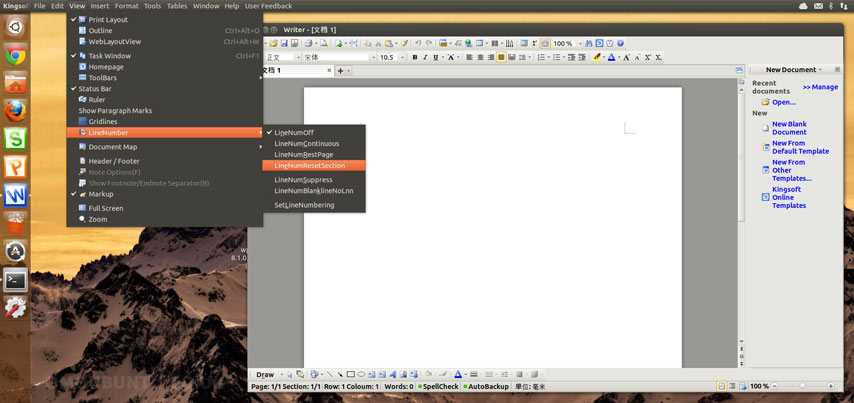
“Classic Look” Enabled in WPS Office.
WPS Office also adds a few handy features of its own, including an online pool of document templates and the ability to edit multiple documents in tabs.
Biggest drawbacks: the release is beta; it sucks at opening .ODT files. Oh, and the entire interface is in Chinese by default (though reader Mohammed Sayanvala has a fix for the latter on his blog).
The latest version of WPS Office, a beta, can be downloaded for Ubuntu 32bit by hitting the button below:
Once the suite has fully downloaded double-click on the .Deb file to install through the Ubuntu Software Center.
After installation completes you’ll be able to launch each of the three applications through the Unity Dash.
On first run you’ll be prompted to sign up to.. Well, I don’t know because my Chinese is non-existent. Suffice to say, you can slap any old rubbish into the required fields and it’ll disappear.
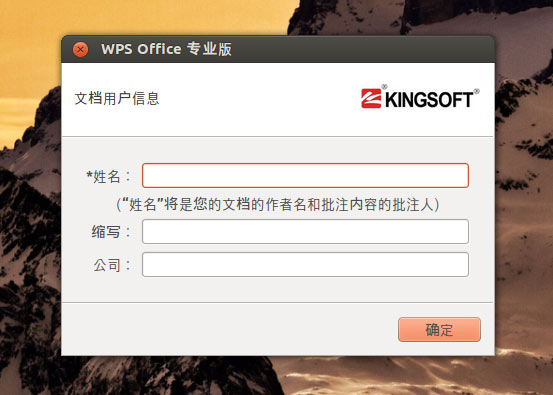
I Ain’t Telling You Nothing…

For the past few years I have used Google Contacts to store my contacts and Google Calendar to store my calendars. These services really are excellent, particularly because they allow me to keep my data synchronized between my Android phone and numerous instances of Thunderbird on PCs and Laptops. Unfortunately, I have had issues with my contacts becoming duplicated and even disappearing altogether. I figure that out of roughly 500 contacts I have lost around 200. This really got me thinking, I mean, should I really rely on somebody else to look after my data?
I don’t know exactly why Google run these services but that is part of the problem. They are an advertising company, after all, and the more data they can collect about me and the people I know the better they can target me with their adverts. Maybe I am paranoid but now that they are dropping Google Reader I just don’t trust them to the extent that I once did.
Don’t get me wrong, I am not a Google hater, I truly believe that their search engine is excellent and that nothing else comes close to providing such accurate search results, at least when I am not logged in.
There are a number of services that allow this kind of synchronization but I have chosen to use ownCloud as it appears to be the most capable open source solution. I have included installation instructions here for the good of the web.
Follow the instructions here.
At the time of writing, exporting contacts from Google Contacts as a .vcf file only exports one name, phone number and email address per contact. Fortunately, if you export your contacts from an Android phone you will keep all of your contact information including mugshots. To do this:
A file with the .vcf extension will be saved to the root directory of your phone’s internal storage. This file contains all of your contacts including their photos. Transfer this file to your computer via a USB cable or email.
Congratulations, you now no longer need an external service to synchronize your contacts and calendar. As a bonus there are a bunch of ownCloud add-ons that give you much more power than you previously had.
firehose"some people, some of the time, are going to do amazing and generous work... If we'll just give them access to tools and get out of their way."
Most people, most of the time, aren't creative, generous or willing to stand up and contribute worthwhile work to the community. At least not the contributions you're hoping for.
The myth of wikipedia is that, when given the chance, hordes of people stepped up and built it. In fact, 5,000 people contribute most of the value on the site.
The myth of ebooks is that now that anyone can publish, enormous numbers of people will use this new platform to create countless numbers of new classics. In fact, most self-published ebooks just aren't very good.
And the same is true for just about everything that's open. A few people do an enormous amount (non-profit volunteers, community organizations, online sites), a few people are vandals or merely taking what they can take, and the masses participate, but aren't at the heart of the project.
To dismiss the crowd is a huge mistake, though.
Here's the fascinating part, call it the golden shoulder: We have no idea in advance who the great contributors are going to be. We know that there's a huge cohort of people struggling outside the boundaries of the curated, selected few, but we don't know who they are.
That means that the old systems, the ones where just a few people were anointed to be the chosen authors, chosen contributors, chosen musicians--that system left a lot of people out in the cold. The new open systems embrace waste. They understand that most people won't contribute and most contributions won't be any good. But that's fine, because this openness means that the previously unfound star now gets found.
The curated business, then, will ultimately fail because it keeps missing this shoulder, this untapped group of talented, eager, hard-working people shut out by their deliberately closed ecosystem. Over time, the open systems use their embrace of waste to winnow out the masses and end up with a new elite, a self-selected group who demonstrate their talent and hard work and genius over time, not in an audition.
Go ahead and minimize these open systems at your own peril. Point to their negative outliers, inconsistency and errors, sure, but you can only do that if you willfully ignore the real power: some people, some of the time, are going to do amazing and generous work... If we'll just give them access to tools and get out of their way.
(The curated block isn't reality, it's merely what the curator claims--that his magical powers will find all of the great talent, without error or waste. Of course, a quick look at Hollywood or even an expensive mutual fund shows that this is a fable. The 'open' block includes the low-quality stuff as well, but since that work is created without a lot of expense, pruning it is no tragedy. The secret is embracing the talented and dedicated people who choose themselves.)
firehoseattn: lg
 Finding time to pack a lunch ahead so you can eat well and save a bit of cash can be tricky. Thankfully the solution to making a healthy, tasty lunch that you can grab in the morning on the way to work or school may be in your pantry already: The humble canning jar. More »

Jessie Oleson of Cakespy has made Cadbury Creme Scotch Eggs, a sweet version of the traditional sausage-wrapped Scotch egg. Not to worry, this candy version is deep-fried too but they’re dipped in a “thick cocoa-kissed batter” and wrapped in cookie crumbs instead of bread crumbs. Recipe at Serious Eats.
When eaten warm, the taste calls to mind that of a deep-fried candy bars that one can find at state fairs. Though in my opinion, these have slightly more complex flavor thanks to the cocoa in the batter and the vanilla cookie crumbs. Speaking of the crumbs, they also give the treat a pleasing crunch, which acts as a nice texture contrast to the cakey batter and soft, gooey chocolate and sugar-filled interior.

firehosemeanwhile, in Portland
(this must be the VooDoo in the SE)

“Do Not try this at home, James is a professional.”
Competitive eater James McDonald ate a novelty coffin full (36) of donuts in just 32 minutes at Voodoo Doughnut in Portland, Oregon.