
by Roar
By Jim Rossignol on September 2nd, 2013 at 1:00 pm.

Yes, Gearbox have loaned Blackbird, a startup made from former-Homeworld devs and others, the right to call their fantastic-looking RTS Homeworld: Shipbreakers. Fashionable news shapes over at Polygon report that a deal was signed at PAX last week:
“We wanted the project to live and thrive and grow,” said Blackbird chief creative officer Aaron Kambeitz. “We didn’t want it to go to a publisher that would let it die. We reached out to them and congratulated them on [winning the IP] and that turned into a friendship.”
And into an extension of the Homeworld universe.
It’s an interesting move by Gearbox, not least because it allows them to address the scepticism over them picking up an RTS name. Gearbox boss Randy Pitchford spoke specifically about that, saying: “Gearbox is not in the best spot to make a sci-fi RTS successor… We’ve become expert at production and that’s where we can help. I mean, we shipped Duke Nukem Forever, we didn’t build it but we made sure it came out. And that’s a fucking miracle.”
Will Shipbreakers turn out to be a fucking miracle too? I sort of hope so:


reblog if you think the girl on the left is just as beautiful as the girl on the right
Al Qaeda tried to infiltrate US intelligence agencies: Report Zee News Washington: Al Qaeda, Hamas, Hezbollah and other hostile groups have repeatedly tried to infiltrate American intelligence agencies, forcing US authorities to reinvestigate thousands of employees every year to counter the threat, according to a classified ... and more » |
Children should remain silent, and they are ‘good’ when they’re quiet, but ‘bad’ when they are not, because they are disturbing the adults and causing trouble. This attitude runs through the way people interact with children on every level, and yet, they seem surprised when it turns out that children have been struggling with serious medical problems, or they’ve been assaulted or abused.
The most common response is ‘well why didn’t the child say something?’ or ‘why didn’t the child talk to an adult?’ Adults constantly assure themselves that children know to go to a grownup when they are in trouble, and they even repeat that sentiment to children; you can always come to us, adults tell children, when you need help. Find a trusted adult, a teacher or a doctor or a police officer or a firefighter, and tell that adult what’s going on, and you’ll be helped, and everything will be all right.
The thing is that children do that, and the adults don’t listen. Every time a child tells an adult about something and nothing happens, that child learns that adults are liars, and that they don’t provide the promised help. Children hold up their end of the deal by reporting, sometimes at great personal risk, and they get no concrete action in return. Sometimes, the very adult people tell a child to ‘trust’ is the least reliable person; the teacher is friends with the priest who is molesting a student, the firefighter plays pool with the father who is beating a child, they don’t want to cause a scene.
Or children are accused of lying for attention because they accused the wrong person. They’re told they must be mistaken about what happened, unclear on the specifics, because there’s no way what they’re saying could be true, so and so isn’t that kind of person. A mother would never do that. He’s a respected member of the community! In their haste to close their ears to the child’s voice, adults make sure the child’s experience is utterly denied and debunked. Couldn’t be, can’t be, won’t be. The child knows not to say such things in the future, because no one is listening, because people will actively tell the child to be quiet.
Children are also told that they aren’t experiencing what they’re actually experiencing, or they’re being fussy about nothing. A child reports a pain in her leg after gym class, and she’s told to quit whining. Four months later, everyone is shocked when her metastatic bone cancer becomes unavoidably apparent. Had someone listened to her in the first place when she reported the original bone pain and said it felt different that usual, she would have been evaluated sooner. A child tells a teacher he has trouble seeing the blackboard, and the teacher dismisses it, so the child is never referred for glasses; the child struggles with math until high school, when someone finally acknowledges there’s a problem.
This attitude, that children shouldn’t be believed, puts the burden of proof on children, rather than assuming that there might be something to their statements. Some people seem to think that actually listening to children would result in a generation of hopelessly spoiled brats who know they can say anything for attention, but would that actually be the case? That assumption is rooted in the idea that children are not trustworthy, and cannot be respected. I’m having trouble understanding why adults should be viewed as inherently trustworthy and respectable, especially in light of the way we treat children.
”Public employees provide a public service. We do things that serve you, a member of the community. We clean your streets, we pick up your garbage, we enforce your laws, we staff your courthouses. We make your community run. We keep your town safe. We help write your laws and keep your buildings up to code and make sure your restaurants are clean. We provide traffic lights and stop signs. We keep your parks clean and your public gardens beautiful. We guide you through paperwork and help you find your way through a system that is put in place for your benefit. We teach your children, we take care of your elderly, we put bad people behind bars, rehabilitate drug addicts so they can become productive members of society again and aid victims of domestic violence. We run your homeless shelters and animal shelters. We provide health care clinics and free vaccinations for those who can’t afford doctors. We clear your streets of snow and remove fallen limbs from your highways. We respond to accidents and emergencies. We pull people from car wrecks and put out house fires. We make sure your water is clean and your street lights are working.
We are public employees. We are here to serve you and to make your community a safe, comfortable place to live. Without us, your community falls apart. Think of your taxes that go toward public services as your way of giving back to the community so many people take for granted.
I’m thankful for your part in providing for my pension, my salary and my health care. Maybe next time you walk into an office and need the help of a civil servant, you can just offer a simple “thank you” to us.
firehoseI miss gonzo everything
Need further proof of just how crazy the JoJo's Bizarre Adventure fighting game is? Watch this.
firehoseRaspi

This one nearly ended up in today’s Links post, but on second look we think it deserves a feature of its own. [Profezzorn] designed some mounting brackets to house a file server inside of an external drive enclosure. Click on the instructions tab to get a bit more of the story.
The enclosure that he’s using is meant for a 5.25″ optical drive. It comes with a USB to SATA converter which is how he connects the hard drive to the Raspberry Pi serving the files. His mounting system uses the original holes in the enclosure, the threaded holes of the drive, and the holes in the RPi PCB to mount everything with just ten screws. The enclosure included a Molex power connector. He sacrificed an old connector to make a custom cable for the Pi’s power.
Add a portable power supply, do a little work with the Linux configuration, and you could easily turn this into a pirate box.


firehose"Superhero breast augmentation is not without risk. Search 'Liefeld Captain America' for more details."
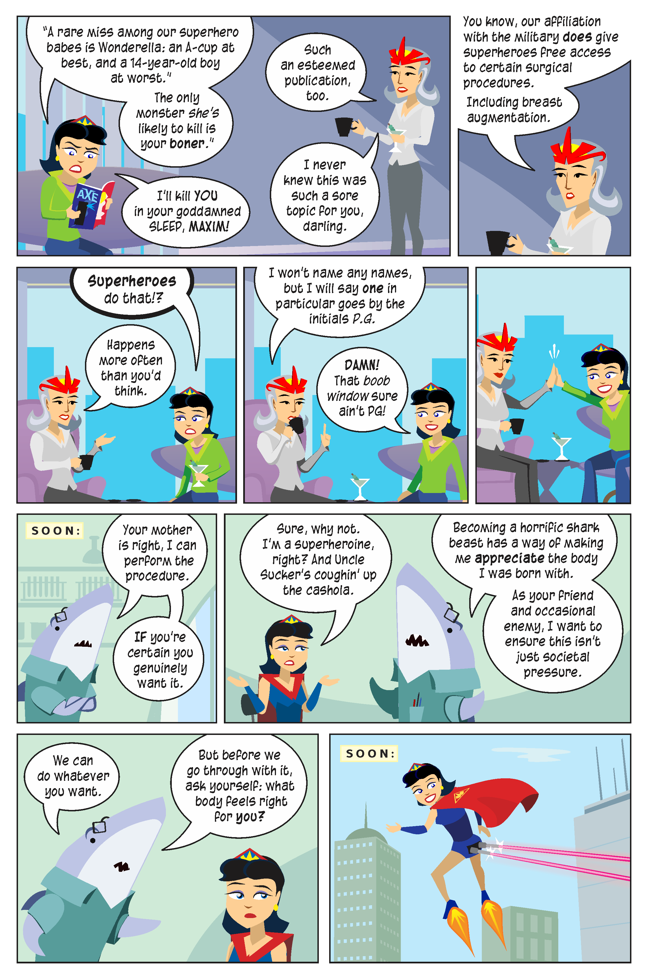
Disclaimer: Superhero breast augmentation is not without risk. Search 'Liefeld Captain America' for more details.
Disclaimer: Superhero breast augmentation is not without risk. Search 'Liefeld Captain America' for more details.
Submitted by: Unknown
firehose"The tune came from a musical toy pig belonging to one of the passengers who played it repeatedly to comfort children in the lifeboat and block out the sounds of the dying in the water around them.
The device had been broken for several decades but was fixed last week by experts at the National Maritime Museum. However, they were unable to identify the song, which was played on the Telegraph website earlier this week."
An eerie tune, produced by a toy to comfort young survivors of the sinking Titanic, has finally been identified: it is La Sorella, by Charles Borel-Clerc and Louis Gallini. [Telegraph]
    
|

Brian Klutch
Who hasn't sat on the couch at the end of a marathon gaming session and wondered what it would be like to make a game rather than just play one? With Pixel Press, anyone can do both-no coding required. The app, which debuts on iOS later this year, converts simple marks on paper into a playable videogame.
The Pixel Press team invented a sketchable language for game design. Armed with custom graph paper and a small glossary of shorthand-lines, Xs, slashes-users draw games, which the app then scans and converts into an actual, playable videogame level. For example, the app reads a blacked-out square as a power-up marker, and Xs on a platform as spikes. It takes less than 30 seconds for the app to convert the marks; once that's done, players add colors and textures.
At launch, the system will make only Mario-style sideways-scrolling games, but the developers at Pixel Press already have a prototype to create puzzles-and they're also planning racing and adventure games.
Platform: iOS
Price: $10
Available: Winter 2013
This article originally appeared in the September 2013 issue of Popular Science.

|
|
firehose1. server-side
2. server-side
3. third-party server
4. doesn't exist
5. overflow:hidden
Ethan Marcott, the one who coined the term Responsive Web Design, stated in his article that Fluid Image is one of the ingredients of Responsive Web Design. The problem with Fluid Image, however is that eventhough the image seems to be responsive and could fit nicely in various viewport size, the same image size is downloaded by the users regardless of the medium the image is being viewed on.

This is bad news for users who have a limited data plan but is not in the know, and it makes your site seem ‘slow’ in areas with dismal Internet speed connections.
This is one of the most discussed issues among web developers. And there is a whole lot to do before RWD can be a proper end-solution for building a mobile-optimized website. At the moment there are various emerging techniques and tools that try to solve this hurdle. Let’s look at them a few of them now.
Recommended Reading: 50 Useful Responsive Web Design Tools For Designers
Adaptive Image is a small PHP script that detects user screen size and deliver the proper image for that screen size. It does not require the changing of your current <img> markup, but the implementation is rather intimidating for less tech-savvy users.

(Image source: AdaptiveImage)
Keith Clark has his approach on serving responsive image with Cookies. It technically detects the screensize by using JavaScript and sizes the proper image size using PHP before it is served and loaded on the page.
However, this technique has a lot of issues and require some more experimenting before it can become a practical solution. You can read his explanation as well as get the code from the article at Clark’s blog, Responsive Image Using Cookies.
Sencha is a mobile development framework that allows us to build a native-looking app with HTML, CSS and JavaScript. If you build your app with Sencha, you can utilize its API, Sencha.io Src, for resizing your images in a smart way, based on users device screen size.
The API has a set of functions allowing flexibility over the output. For more technical details, head over to this reference.

(Image source: Sencha)
This seems to be the future standard of responsive image. A new element called <picture> is proposed to allow us to set different sources of images, and also to refer to the breakpoint for which the source of image should be served, like so:
<picture id="images"> <source media="(min-width: 45em)" srcset="large-1.jpg 1x, large-2.jpg 2x"> <source media="(min-width: 18em)" srcset="med-1.jpg 1x, med-2.jpg 2x"> </picture>
This element, however, is still in a Working Draft stage. It is not yet applicable. Until then you can use a Polyfill called Picture Fill.
Picture Fill is a tiny JavaScript library that is developed by Scott Jehl. It mimics how <picture> works using the <span> element.
<span data-picture data-alt="A giant stone face at The Bayon temple in Angkor Thom, Cambodia"> <span data-src="small.jpg"></span> <span data-src="medium.jpg" data-media="(min-width: 400px)"></span> </span>
If you are using WordPress as your publishing platform, you are lucky, as there are several plugins that serve the image in a way similar to the <picture> element.
If you use Drupal, there is a project called Picture that works the same way.
Focal Point is a framework that allows developers to “crop” images and control the focus on its focal point for responsive design. This technique is purely done with CSS; the author simply adds the classes in the element that contains the image.
It is worth noting though that the trick in this technique is by using overflow:hidden to hide part of the image. So the image is not (technically) cropped, which means we end up of downloading the same image size. In addition, this also might not work in the case where the image is not wrapped with an element.

(Image source: Noupe)
As said, there isn’t yet one implementation that sets a standard to answer this issue completely. These techniques and tools although listed above as solutions, have their own drawbacks and none can come out as the final solution for every case.
It is also unsure whether the new proposed property, <picture> will be a recommended solution in the future. So, until then, it seems that we are stuck with Fluid Image.
Related posts:

|
|









 via
via 