Nunca vejam seus sintomas na internet.

Ou Lúpus né.
It's time for another round of The Food Lab. Got a suggestion for an upcoming topic? Email Kenji here, and he'll do his best to answer your queries in a future post. Become a fan of The Food Lab on Facebook or follow it on Twitter for play-by-plays on future kitchen tests and recipe experiments.
[Photographs: J. Kenji Lopez-Alt]
I'm not particularly proud of my time time spent working at the kinds of cheesy chain restaurants you'd find next to the Victoria's Secret at the mall, or perhaps in Times Square. But aside from making me shun any writer that uses the phrase "X to perfection," it did teach me one valuable lesson: People looooooove meat served on a sizzling platter. It was a well-known phenomenon: If a waiter could sell one order of our Extreme Fajitas™ to a table in their section, a half dozen more orders would quickly follow.
It's an unstoppable, visceral reaction. The waiter would plot a circuitous route around the restaurant that would take the platter past as many intermediary tables as possible. The approaching noise of sizzling meat would halt all conversation in its tracks as diners would gently lift their chins, tilting their noses in the air to catch a whiff of beef, onion, garlic, and chili as their aroma wafted by on thin whisps of smoke and steam.
Then of course, there's the DIY aspect of fajitas that makes them a winner. As a kid, there's nothing better than being presented with that plate of guacamole, pico de gallo, and sour cream; the anticipation of that sizzling platter of meat and vegetables laid down before you. When they arrive, you've already picked out a soft, blistered floured tortilla from the steaming stack in the warmer at the center of the table.
The meat itself should be ultra-juicy, with an overwhelming, almost buttery beefiness—this is skirt steak, after all, the butteriest of all beef—accented by a marinade that is slightly sweet, very savory, and packed with lime and chili.
And of course, that meat's got to be tender. Nothing worse than biting into a carefully wrapped fajita only to have that long strip of beef slip out of its tortilla housing like a sleeping camper from his sleeping bag. Better to be able to bite that camper in half, right?
So how do we reach this fajita nirvana? It's easier than you think—all it takes is a bit of strategy and know how.

Hanger Steaks
When you grow up eating something, it's hard to remember that at one point it didn't exist. "Fajita" literally translates to "little skirts" or "little bands," and it stems from the appearance of a skirt steak, a thin flap of meat that hangs down near the front of the steer's belly. The history of fajitas in most of the United States is very recent. According to an excellent article in the Austin Chronicle, there's anecdotal evidence that South and West Texas vaqueros and butchers have been eating grilled skirt steak and calling them fajitas since the 1930s.
Fajitas appear to have made the quantum leap from campfire and backyard grill obscurity to commercial sales in 1969. Sonny Falcon, an Austin meat market manager, operated the first commercial fajita taco concession stand at a rural Dies Y Seis celebration in tiny Kyle in September of 1969. That same year, fajitas debuted on the menu at Otilia Garza's Round-Up Restaurant in the Rio Grande Valley community of Pharr.
Residents and visitors of Houston might be happy to know that Ninfa's on Navigation Boulevard is one of the oldest fajita-slinging restaurants in the country, though when I visited them last summer, I was more impressed by the quality of their cooked-to-order flour tortillas than the fajitas themselves.
The fajita made its final jump into the spotlight when George Weidmann of the Hyatt Regency in Austin added the sizzling platter that shot the dish into stardom, making it a staple on not just the Hyatt menu, but on menus across the country.
Now, with all this popularity, you may smell a problem: supply. See, there are only four skirts on each steer—two inside and two outside. That's about 8 pounds of meat total. As a result, restaurants started resorting to other cuts to make their fajitas.

Hanger Steaks
First it was hanger, sirloin flap, and flank steak—all reasonably good options with a similar texture and flavor. But as things progressed, the dish moved farther and farther from the original, leading us to not just other cuts of beef, but chicken fajitas, pork fajitas, shrimp fajitas, and the like.
Even McDonald's jumped into the fajita game in 1991 (the 12-year-old-me was a big fan).
I tested cooking fajitas with a variety of cuts—skirt, hanger, flap, flank, short rib, and tri-tip. Of these, skirt, hanger, and flap were the most successful, each with a robust, coarse texture that is great for soaking up marinade.

Flap Meat
But there's no doubt about it: the skirt is king. It's more buttery, more beefy, and just plain more tasty than its counterparts.
While fajitas are traditionally made with outside skirt—part of the diaphragm muscle of the steer—the cut is pretty much unavailable unless you work for a restaurant that special orders it. At the butcher or meat counter, you're far more likely to find inside skirt, which will do us just fine.
The key is to not trim off too much of the fat that covers one side of the steak. They'll melt into the cracks as the meat grills, making each bite juicier and tastier.
While it's possible to cook the steak as a whole strip, I find it better to slice it with the grain into 5 to 6-inch pieces, making it easer to handle them on the grill.
Next up: we've got our meat, so how do we treat it?
It's proven difficult to pinpoint exactly what ingredients went into the original fajitas marinades, but it's a safe bet that at leas some chilies, garlic, black pepper, and cumin were involved. All of these are flavoring ingredients—they don't really change the manner in which the meat cooks or interact with it on more than a cursory level. What about some other common marinade ingredients? Ones that might actually affect the meat more intimately?

I tested out over two dozen marinade variations, adding extra ingredients to some (ranging from meat commercial meat tenderizers to natural enzymatic tenderizers like pineapple and papaya) and omitting ingredients from others (in order to see what happens when, say, you forget the oil in a marinade).
I even took photos of every steak in the process, but unfortunately, from a visual standpoint, you can't really see much difference. Just imagine slightly different versions of this 26 times in a row, and you'll get the picture:

What I found was that in addition to basic flavoring agents like chili and garlic and a touch of sugar to aid in browning, the best marinades share three common ingredients: oil, acid, and a salty liquid, preferably a protease (more on those later).
Oil is essential for three purposes. First, it emulsifies the marinade, making it thicker and tackier, causing it to stick more efficiently to the meat. Second, manta of the flavorful compounds found in the garlic and ground spices in the marinade are oil soluble. With a fat-based medium coating the meat, you get better, more even flavor distribution. Finally, the oil helps the meat cook more evenly, providing a buffer between the heat of the grill and the surface of the meat to spread that heat evenly. Omitting it detracts from all three of these qualities.
I used to think that acid was essential in a marinade for tenderizing purposes, and it's true—acid can slightly tenderize tough connective tissue in meat. Unfortunately, excessive acid can also start to chemically "cook" meat, denaturing its protein and causing it to firm up and eventually turn chalky (think: ceviche).
I tried completely omitting acid, adding it in the form of lime juice squeezed on at the end, but the flavor difference was noticeably—meat marinated in acid was more balanced and brighter tasting. There were also a few minor strands of membrane and connective tissue that were more noticeable without the acid. In the end I opted for lime juice in equal parts with the oil.
You may be surprised to learn that despite their reputation, marinades do not actually penetrate particularly far into meat—even after the course of a night, it will penetrate no further than a millimeter or two, and that penetration rate slows down the longer you marinate for. So really, a marinades effects are largely limited to the surface of the meat. Luckily for us, on a skirt steak, that's precisely where all of the tougher connective tissues are located, so if any tenderization is going to occur, it'll occur in the right places.

The final ingredients in a good marinade is a salty liquid. The muscle protein myosin will dissolve in a salty liquid, leaving the meat with a looser texture and a better ability to retain moisture. This is the theory behind brining meats like chicken or pork, and the same theory applies to our fajitas.
While you could just add regular salt to the marinade, there's a lesson I learned in years of playing MarioKart: Why settle for a driver who just has good handling when you can pick a driver with good handling and a high top speed?
By replacing the salt with a good splash of soy sauce, we not only get salt into the marinade, but we also get two other important elements. First, glutamates—natural flavor enhancers responsible for the sensation of umami that makes taste meat taste meatier. Second is proteases: enzymes that help break down and tenderize tough proteins.
Soy sauce is hardly traditional, but it's got a prominent place in many fajita recipes for these very reasons. That it doesn't taste distinctly soy-like or Asian once the meat is cooked is especially nice.
Once I'd gotten my ideal marinade ratio down, I moved on to testing timing, going every from dipped-just-before-grilling to marinated for 36 hours. Again, not much visual difference. Picture this 6 times in a row:

Got it?
Tastewise, however, I found the ideal timing to be between 3 and 10 hours or so. Less and the marinade simply didn't stick as well. More and the meat started to get a bit too mushy and chalky around the exterior, having a slightly cooked appearance from the lime juice and the soy sauce before it even hit the grill. My guests still happily devoured the 36-hour marinated steaks, but if you can get your timing right, it'll make the final product marginally better.

Marinate your meat in a plastic zipper-lock bag with all the air squeezed out for best contact with a minimal amount of marinade (I do this by leaving a small air hole along one edge of the zipper lock, squeezing all the air towards it, then sealing it at the last moment before juices start leaking out), or even better, seal the steaks in a cryo-vack style bag with a vacuum sealer.

There's one golden rule to cooking skirt steak: make sure your grill is hot as hell. Skirt steak is not too thick, and its loose texture allows heat to penetrate faster than in, say, a dense New York strip or ribeye. You need to absolutely pound it with heat in order to get it nice and charred on the exterior before the center ends up overcooking.
To do this, I empty out an entire full chimney of coals over just one side of my grill, piling them and allowing them to preheat until I can barely bring my hand close enough to deposit the steaks (long tongs help here). If hardwood coal is an option, I'd opt for them over briquettes—hardwood burns faster and hotter.
There are a couple of factors working to our advantage here. First is the soy sauce and sugar in the marinade, both of which will help the steaks brown more efficiently. Second is that fact that skirt is one of the cuts of steaks that benefits from being cooked slightly more than you'd normally cook a premium steak.

Anything shy of medium rare and skirt steak has a squishy, unpleasantly slippery texture. I always feel like a raptor biting into a tough Jurassic Park T-rex leg when I get an undercooked skirt. At medium-rare (around 125 to 130°F after resting—pull them off the grill at 115 to 120°F), they start to firm up to a pleasant juiciness, but personally I think skirt steak has the optimal amount of flavor and juiciness at a full 135°F medium.
Don't believe me? Just try them side-by-side and come to your own conclusion.
The last step in perfect fajita meat is by far the most important: the carving.
See, skirt steak has a very pronounced grain—muscle fibers that are all aligned in the same direction. The steak is stronger in one direction than the other. If you cut your steak with the grain, you end up with long chewy fibers. But slice it thinly against the grain and you increase its tenderness dramatically.

I apologize that one of the red arrows came out white. I blame CISPA or PRISM or the TSA or one of those other evil governmenty things.
You can cut perfectly perpendicular to the grain for absolute tenderness, but I prefer to cut at closer to a 45 degree angle, which effectively shortens muscle fibers to about 30% more than then absolute minimum length—plenty short enough to give you tenderness, while also allowing you to cut slices that look a little wider and prettier.

See how nice they look all fanned out?
And while those sizzling fajita platters sure to a good job of selling more fajitas at restaurants, all they're going to do in your home is slowly overcook your meat. A warmed serving platter is a better vessel.
With the meat taken care of, we move on to slightly more trivial but no less important* matters: the vegetables and toppings.
*strike that, reverse it.
For vegetables, the classic choices are onions and peppers. I like to save some of my marinade to toss them with before cooking.

I tried cooking them whole on the grill, but the results are not quite right—they tend to soften more than I want them to.
Cooking them in a cast iron skillet on the stovetop works much better, but then it requires me to heat up my kitchen and my grill. I may be a fool, but I'm not that kind of fool.
Then I thought: wait a minute, Kenji, don't be an idiot: you've got yourself a heat source right here in front of your eyes. Use it!

I cooked up a batch of fajitas, letting my big cast iron skillet heat up on the cooler side of the grill while the meat cooked. Then, while the meat rested, I slid it over to the hot side and seared my veggies. It worked like a charm, giving them some nice color and sear without letting them turn too mushy or soft.
As an added bonus, the pan full of vegetables proved to be the perfect place to pour off the meat juices and drippings that collected on the platter where my steaks were resting. I always love it when I can take a zero-flavor-down-the-drain approach to dishes.

With your meat sliced and your veggies cooked, all you need is a stack of hot tortillas (you can heat them up as a whole stack on the cooler side of the grill while the veggies cook), and a few condiments.
Might I humbly suggest this fine guacamole recipe, or perhaps this equally tasty pico de gallo? I may? ¡Muchissimas gracias!

While these fajitas might not have the sizzle of my childhood memories, they've certainly got all the swagger of a smoking hot plate weaving its way through the dining room, making everyone else envious of what you're abut to sink your teeth into...
About the author: J. Kenji Lopez-Alt is the Chief Creative Officer of Serious Eats where he likes to explore the science of home cooking in his weekly column The Food Lab. You can follow him at @thefoodlab on Twitter, or at The Food Lab on Facebook.
Get the Recipe!
astonishedcelery submitted:
i hope this goat cheers you up and i hope your day turns out fantastic in the end, elis
This kindly wizard makes me feel I can do anything
thank you ♥
wooooooooooooooooooooooow
whoaaaaaaa
HOLY FUCK
ITS LIKE
REAL LIFE ANIMATION
this choreography
this
everything
somebody make words
proper commentary i cannot
uhh?
WOW
I believe these guys were on Americans Got Talent!
THIS.
VIDEO.
OH. MY GOD.
MOTHER. OF. GOD.
That’s the next logical evolution of the black box trick with electronic lights in clothing. Very sophiscatedly done in this vid.
What would happen to the Earth if the Sun suddenly switched off?
—Many, many readers
This is probably the single most popular question submitted to What If.
Part of why I haven’t answered it is that it's been answered already. A Google search for what if the Sun went out turns up a lot of excellent articles thoroughly analyzing the situation.
However, since my recent articles on sunsets, the rate of submission of this question has risen even further, so I’ve decided to do my best to answer it.
If the Sun went out ...

We won’t worry about exactly how it happens. We'll just assume we figured out a way to fast-forward the Sun through its evolution so that it becomes a cold, inert sphere. What would the consequences be for us here on Earth?
Let's look at a few:
Reduced risk of solar flares: In 1859, a massive solar flare and geomagnetic storm hit the Earth.[1] Magnetic storms induce electric currents in wires. Unfortunately for us, by 1859 we had wrapped the Earth in telegraph wires. The storm caused powerful currents in those wires, knocking out communications and in some cases causing telegraph equipment to catch fire.[2]
Since 1859, we've wrapped the Earth in a lot more wires. If the 1859 storm hit us today, the Department of Homeland Security estimates the economic damage to the US alone would be several trillion dollars[3]—more than every hurricane which has ever hit the US combined.[4] If the Sun went out, this threat would be eliminated.
Improved satellite service: When a communications satellite passes in front of the Sun, the Sun can drown out the satellite's radio signal, causing an interruption in service.[5] Deactivating the Sun would solve this problem.
Better astronomy: Without the Sun, ground-based observatories would be able to operate around the clock. The cooler air would create less atmospheric noise, which would reduce the load on adaptive optics systems and allow for sharper images.
Stable dust: Without sunlight, there would be no Poynting–Robertson drag, which means we would finally be able to place dust into a stable orbit around the Sun without the orbits decaying. I’m not sure whether anyone wants to do that, but you never know.
Reduced infrastructure costs: The Department of Transportation estimates that it would cost $20 billion per year over the next 20 years to repair and maintain all US bridges.[6] Most US bridges are over water; without the Sun, we could save money by simply driving on a strip of asphalt laid across the ice.

Cheaper trade: Time zones make trade more expensive; it's harder to do business with someone if their office hours don't overlap with yours.[7] If the Sun went out, it would eliminate the need for time zones, allowing us to switch to UTC and give a boost to the global economy.
Safer Children: According to the North Dakota Department of Health, babies younger than six months should be kept out of direct sunlight.[8] Without sunlight, our children would be safer.
Safer combat pilots: Many people sneeze when exposed to bright sunlight. The reasons for this reflex are unknown, and it may pose a danger to fighter pilots during flight.[9] If the Sun went dark, it would mitigate this danger to our pilots.
Safer parsnip: Wild parsnip is a surprisingly nasty plant. Its leaves contain chemicals called furocoumarins, which can be absorbed by human skin without causing symptoms ... at first. However, when the skin is then exposed to sunlight (even days or weeks later), the furocoumarins cause a nasty chemical burn. This is called phytophotodermatitis.[10] A darkened Sun would liberate us from the parsnip threat.

In conclusion, if the Sun went out, we would see a variety of benefits across many areas of our lives.
Are there any downsides to this scenario?
We would all freeze and die.

Mesmo que você não goste do Legião Urbana tenho certeza que em algum momento da sua vida ouviu um dos maiores sucessos do Renato Russo, a música Faroeste Caboclo. A saga vivida por João de Santo Cristo ainda hoje é cantada a plenos pulmões por uma infinidade de fãs da banda e recentemente até virou filme, adaptação até mesmo previsível, dada a elaborada história da sétima faixa do disco Que País é Este.

O que muitos não poderiam imaginar é que aquela música serviria de inspiração para os irmãos Marcos e Matheus Castro, mas não para a criação de um longa-metragem e sim uma paródia que transforma o clássico em uma história que qualquer jogador acostumado a RPGs identificará.
Além da letra muito bacana e cheia de referências aos jogos do gênero lançados nas décadas de 90, a criação da dupla ainda conta com as belíssimas ilustrações de Caio Yo e Thadeu Canaes, que sem dúvida alguma dão um charme especial ao vídeo. O que mais gostei é que, apesar da versão seguir seu próprio roteiro, ela mantém muitas das características da original, com o herói se lançando numa aventura épica, conhecendo a sua Maria Lúcia e tendo que encarar um enorme desafio no final.
Resumindo, o Dragon Quest Caboclo é um trabalho fantástico e que me fez pensar que, depois de termos ganhado um filme, bem que alguma desenvolvedora brasileira poderia assumir a tarefa de transformar a música original em um jogo.

 |
 |

A reclamação é generalizada, a grande maioria dos atendimentos realizados através dos callcenters sofrem pesadas críticas pelos clientes. Entre as principais queixas estão a demora no atendimento, a falta de efetividade na resolução das solicitações e o constante redirecionamento entre os variados setores. Não apenas nas empresas de telefonia, como também nos callcenters de bancos, seguradoras e informações em geral. Porém a raiz do problema não é tão simples de generalizar.
Podemos começar com o tipo do trabalho em si, existem basicamente dois tipos de callcenters: o ativo e o receptivo, esses se subdividem em outros mais específicos. Resumidamente: no ativo sua rotina é fazer muitas ligações por dia para oferecer produtos ou serviços para pessoas que, por mais fantásticos que sejam esses produtos/serviços, estão tão cansadas de receber ligações de telemarketing que ou vão barrar a conversa antes de você começar sua explicação ou vão fingir ouvir o que você está dizendo e depois negar veementemente a aquisição. Para melhorar a situação, você recebe metas astronômicas de produtividade e a pressão para o atingimento dessas metas é tão grande que você é obrigado a ser insistentemente chato com o cliente para conseguir fechar negócios.
No receptivo a coisa não fica muito melhor. São centenas de ligações diárias, em sua maioria esmagadora, com reclamações. Você é o representante da empresa, então os clientes vão ligar irritados com o serviço e descontar em você toda frustração, por mais que você tenha boa vontade de resolver esses problemas. E acredite, no começo você até vai ter boa vontade de resolver, mas depois de uma dúzia de marteladas e xingamentos a sua mãezinha, seu espírito tem que ser muito forte para continuar atendendo com entusiasmo. Todas as ligações são gravadas e monitoradas por supervisores, então você não pode nem xingar o desgraçado do cliente de volta, pois correrá o risco de perder o emprego.
Muitos vão dizer o seguinte: “Ah, mas você sabia qual seriam suas atribuições quando aceitou o emprego, então pare reclamar e faça seu trabalho direito!”. Sim, todos sabem o panorama desalentador do callcenter ao mandar currículo para vaga, então por isso que essas vagas são preenchidas frequentemente por pessoas desesperadas por um emprego, qualquer emprego, ou pessoas sem experiência nenhuma, as quais o pessoal de recrutamento do callcenter acha que não tem problema nenhum jogar na fogueira do pós venda. A consequência disso é uma rotatividade sem precedentes nesses cargos, assim que a pessoa consegue alguma coisa melhor ela pula fora, sem pensar uma segunda vez.
Podemos somar como um complicador nessa área a baixa valorização desses profissionais, o salário base de um atendente de telemarketing não passa muito de um salário mínimo. Geralmente o ambiente de trabalho também não favorece uma motivação ao colaborador, são posições de atendimento (chamadas de baias ou PA’s) apertadas, sem decoração alguma, tudo muito fechado, muita poluição sonora e com horários controlados (você só poder ir ao banheiro ou tomar uma água/café com autorização). Planos de carreira, benefícios flexíveis e reconhecimento também não são itens muito praticados nessas empresas. O treinamento fornecido para os funcionários também se torna simplificado, pois na mentalidade da empresa não vale a pena investir em uma pessoa que pode abandonar o cargo a qualquer momento.
Atividades estressantes, pessoas despreparadas e desmotivadas, rotatividade alta, ambiente desfavorável e uma demanda muito maior do que o efetivo consegue dar conta tornam o cenário do callcenter quase um inferno na Terra. Mas o cliente não tem culpa dessa bagunça toda, ele simplesmente quer o serviço que lhe foi prometido funcionando, sem erros, sem asteriscos, ou, caso não funcione, que tenha um canal que conserte com rapidez e sem burocracias.
São as empresas que devem abrir os olhos e ver que o primeiro passo para atender bem o seu cliente é a valorização do seu funcionário. Colaboradores motivados, bem treinados, com a informação alinhada na ponta da língua, em um ambiente compatível para a realização de um bom trabalho, com salários justos de acordo com o serviço desempenhado, com certeza atenderão bem, com agilidade e assim fidelizarão o cliente, que se sentirá seguro caso precise novamente entrar em contato. Hoje pessoas tem pesadelos só em ouvir que deverão ligar na operadora para realizar alguma mudança no plano.
Uma atitude que costuma funcionar, pelo menos comigo, é tratar bem o atendente. Acredito que eles estão tão acostumados com pessoas exaltadas e irritadas com seus problemas somados a demora no atendimento que quando pegam um cliente bem educado eles retribuem o favor sendo prestativos. É a famosa empatia, se coloque no lugar dessa pessoa, desse ser humano que está do outro lado da linha, nem que para resolver o seu problema você tenha que ensinar o funcionário o que precisa ser feito.

|
|
Here's a 40-minute video in which Tom Stuart gives a talk summarizing one of the chapters from him new book Understanding Computation, describing the halting state problem and how it relates to bugs, Turing machines, Turing completeness, computability, malware checking for various mobile app stores, and related subjects. The Halting State problem -- which relates to the impossibility of knowing what a program will do with all possible inputs -- is one of the most important and hardest-to-understand ideas in computer science, and Stuart does a fantastic job with it here. You don't need to be a master programmer or a computer science buff to get it, and even if you only absorb 50 percent of it, it's so engagingly presented, and so blazingly relevant to life in the 21st century, that you won't regret it.
At Scottish Ruby Conference 2013 I gave a talk called Impossible Programs, adapted from chapter 8 of Understanding Computation. It’s a talk about programs that are impossible to write in Ruby — it covers undecidability, the halting problem and Rice’s theorem, explained in plain English and illustrated with Ruby code. The slides are available
    
|
Next time you look up in the sky and see a bovine shaped cloud, thank a fluffy cow.

Next time you get frothy milk for your foamy coffee, thank a fluffy cow.

Next time you meet a big teddy bear in a cow pasture, thank a fluffy cow.

“After some Googling, it seems these fluffilicious cows are bred/sold by Matt Lautner Cattle. Unbearably adorable. Don’t you just wanna hug and snorfle them?” -Kim L.


Vi dados recentes de uma pesquisa sobre religiões e ateísmo e resolvi compartilhar com vocês:

Fontes: Pesquisas de Phil Zuckerman (2007), Richard Lynn (2008) e Elaine Howard Ecklund (2010), ONU, adherents.com, American ReligiousIdentification Survey, The Pew Research Center, Gallup Poll, The New York Times, Good, Nature, Live Science e Discovery Magazine.
Isso me lembra uma tirinha…

My name is Disco. I’m a parakeet. Bird to your mother. Discooooo! What seems to be the problem officer? I am not a crook. There’s the cat. Meow! Meow!
He had us at Discoooooo, MsJumpinJude


The first to speak was Nyquil of Eärewygge, the council elder. “They are but children,” sneered he, stroking his flowing white beard. “Are we to entrust our most sacred quest to the like of these quibullous squatlings?”

“Poppyrot and balderstuff!” roared Hieronymous Thalidomide. “Small they may be, but large in spirit, ’tis plain to see. Their valor shall make proud this council.”

“Besides,” added Gleevec Beaverbalm, “they’re just going to the delicatessen.”

Via Catbeards on Tumblr and also Reddit.


Submitted by: Unknown


Imagine que você está em um aeroporto. Ao seu lado, um casal conversa em uma língua que você não conhece.
Apesar de não entender nada, uma coisa é clara: eles falam rápido, muito rápido.
-”Piripipipi bóbóbóbó, firififi, pererepépé…”. Soam animadíssimos, como se estivessem conversando sobre algo realmente incrível.
Isso já aconteceu antes, naquela reunião com os gringos. Parece até que combinaram de falar bem rápido, só pra dificultar a sua vida.
Por que os espanhóis parecem falar sempre a 200km/h? E os Italianos a 250 km/h?
Por que o japonês parece uma metralhadora de sílabas como onomatopéias de filmes de karatê? Raiá, rói, chimbará, hup.
Para resolver esse mistério, pesquisadores da Universidade de Lion, na França, convocaram 59 homens e mulheres com línguas nativas diferentes (inglês, espanhol, japonês, françês, alemão, italiano e mandarin) para um teste.
01. Cada participante leu 20 textos, em sua língua.
02. Depois, os pesquisadores contaram o número de sílabas em cada língua e criaram uma relação entre o número de sílabas e o volume de informação ou significado contido nelas.
Ou seja, conseguiram atribuir um valor de “densidade” ou “prolixidade” (se é que existe essa palavra) para cada língua.
Algumas falam muito para dizer pouco, outras falam pouco para dizer muito.
Por exemplo, um “aiá” em mandarin pode significar “o homem que subiu a montanha para pegar uma flor”.
E um “hofdtanggerlishstrassesprunkt” em norueguês pode significar “oi” (palavras obviamente inventadas, só pra você entender o espírito da coisa).
03. Os resultados:
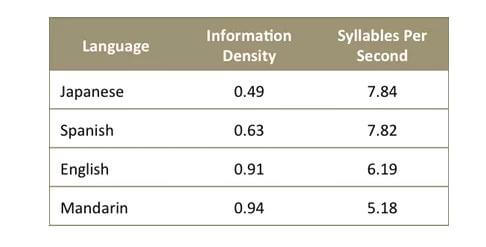
04. Conclusão I: quanto mais densa uma língua (onde cada sílaba tem muito significado embutido), mais lentamente é falada.
05. Conclusão II: essa é um mistério, mas todas as línguas entregam mais ou menos a mesma quantidade de informação no mesmo tempo. Só que as mais densas precisam falar menos e a menos densas, mais. Em um filme chinês legendado em espanhol, os atores falariam pouco, mas seriam muitas legendas.
06. Conclusão III: explicando o mistério do começo do post, em que os gringos soam sempre muito rápidos, é justamente por causa da baixa densidade de informação. Um fenômeno psicológico, você não entende nada, as sílabas viram apenas sons e você não consegue decodificar nenhuma informação e acha que está tudo muito rápido.
E essa é história por trás das diferentes densidades das línguas. Já as diferenças entre a densidade de cada pessoa, bom, aí já é outro post.

|
|

Caitlin Moran (1975-) is a British author, TV presenter, music critic, journalist and outspoken advocate for women’s rights. She currently writes a variety of columns (most of which are hilarious) for The Times UK.
Moran was something of a child prodigy. After being home-schooled (she left school after a few weeks when she was 11) she had her first book published at 15, had columns running in the Observer and Guardian at 17 and got her gig at The Times when she was 18.
This quote is taken from her best-selling memoir How to be a Woman. Her new book, Moranthology, has just been released.
Unlike Moran, I went to Catholic School for 12 years where my head was filled with all kinds of fanciful stories that I blindly accepted. Only when I left high-school and starting reading more books about science and evolution (mainly by Carl Sagan) did I begin to re-evaluate what I had been taught for all those years.
RELATED COMIC: Make the most of this life.
- Caitlin Moran’s official website.
- Thanks to Barclay for submitting this quote.