Shared posts

12 Sep 19:41

Books and Stones Embedded with Sleek Layers of Laminate Glass by Ramon Todo

by Christopher Jobson

todo-1

Splitting his time between Kanagawa, Japan and Dusseldorf, Germany, artist Ramon Todo (previously) is known for his small sculptures of rocks and books embedded with polished layers of glass. Todo’s decision to seamlessly introduce disparate materials into a single object creates an unusual intention, as if these objects have always existed this way. The random pieces of obsidian, fossils, volcanic basalt, and old books are suddenly redefined, or as Beautiful/Decay’s Genista Jurgens puts it: “By inserting something alien into these pieces, Todo is effectively rewriting their history, and the place that these objects hold in the world.”

Todo will have a number of new pieces on view with MA2 Gallery at EXPO CHICAGO starting next week. He also has a number of atworks available through Artsy and you can flip through additional glass books clicking the small arrows on MA2 Gallery’s website.

todo-9

todo-2

books-4up

todo-3

todo-4

todo-5

todo-10

todo-6

todo-7

todo-8

09 Sep 23:32

Artist Nelson Makamo’s Dynamic Portraits of Johannesburg Children

by Christopher Jobson

nelson-4

With a dizzying flurry of oil paints, watercolors, silkscreen & monotype printing techniques, charcoal, and ink, artist Nelson Makamo captures the daily life of South African children as reflected in their charismatic faces. Based in Johannesburg, Makamo prefers to refer to himself as a storyteller or narrator of what he encounters everyday. “I document each day visually because for me each day is a blessing, being able to capture movements and feelings of people who live around me.” His portraits depict hopeful faces filled with laughter and confidence, awash in spirited dashes of color. Via Salon Ninety One:

Key themes informing Makamo’s practice include the city of Johannesburg with its dizzying dynamism, portraiture, the narrative of the artist’s personal history – an unpolitical archive of personal experience, as well as themes of migration, urbanization, identity, masquerade and the transition from childhood to adulthood. Makamo ultimately strives to communicate a universal experience, which viewers can relate to and access through his artwork.

Makamo has exhibited in numerous group and solo shows in South Africa, France, Italy, the U.S., The Netherlands and Scotland over the last few years. You can see more of his artwork at Candice Berman Fine Art or follow him on Instagram. And just in case you were wondering, his shoes. (via Lustik)

nelson-2-2

nelson-5

nelson-1

nelson-2

nelson-3

nelson-6

nelson-7

nelson-8

09 Sep 23:30

Russian five-year-olds dig their way out of nursery to buy sports car

Two boys used spades from their kindergarten’s sand pit to dig a hole under a fence and escape, before walking to a sports car showroom.
Two boys used spades from their kindergarten’s sand pit to dig a hole under a fence and escape, before walking to a sports car showroom. Photograph: Fairfax Media/Fairfax Media via Getty Images

Two five-year-old Russian boys used spades to dig their way out of their kindergarten and set off on a mission to buy a Jaguar sports car, the Komsomolskaya Pravda daily has reported.

The two boys disappeared as their group took part in a supervised walk in the grounds of the kindergarten in the city of Magnitogorsk in the Urals region, the tabloid said.

Chelyabinsk regional interior ministry confirmed the boys’ escape from the kindergarten. “We don’t have any details yet, we can only confirm the fact itself,” a spokesman said, adding that the incident took place several days ago.

After reaching freedom, the boys walked just over a mile to a car showroom selling luxury cars. A female driver noticed them and asked what they were doing. They told her they had come from their kindergarten to buy a Jaguar but did not have any money.

She put them in her car and drove them to a police station.

The boys had prepared their escape for several days, digging a hole under a fence using spades from the sandpit, Komsomolskaya Pravda reported, citing kindergarten staff.

The kindergarten only noticed the boys’ absence after half an hour.

Local educational authorities responded by firing the supervisor in charge at the time and giving a warning to the acting head.

“This is considered a very serious violation,” the head of the pre-school department of Magnitogorsk, Olga Denisenko, told Komsomolskaya Pravda. She could not be immediately reached for comment.

The children’s parents did not submit any complaint against the kindergarten.

Bookmarked at brandizzi Delicious' sharing tag and expanded by Delicious sharing tag expander.
09 Sep 21:27

John McAfee announces he's running for President

john mcafee

John McAfee, the antivirus software magnate who fled Belize after police tried to question him for murder, confirmed to CNNMoney that he plans to run for President in 2016 and that he'd created his own party -- the Cyber Party.

McAfee explained that he decided to run after being encouraged by "almost everyone" he knows and meets.

"I have a huge underground following on the web," McAfee said. "I promise you I will win because I have the votes."

Related: John McAfee arrested for DUI, gun possession

McAfee said one of the hallmarks of his campaign would be his outspoken nature and his willingness to answer any question about his "checkered background."

McAfee, who said he'd filed his Form 2 with the FEC, also said he needed to run because of his belief that governments worldwide are "out of touch." (The FEC could not confirm that McAfee had filed.)

"We are losing privacy at an alarming rate -- we have none left," McAfee said. " We've given up so much for the illusion of security and our government is simply dysfunctional."

McAfee said the desire to respond to terrorist attacks had opened citizens up to excessive surveillance.

"The government can spy on people using their mobile phones while they're with their wives and husbands," McAfee said.

He added that the U.S. government is simply dysfunctional and "lacks an understanding of the basic technology that runs the world."

He promised the campaign would be interesting and was confident he'd win by being honest.

Related: Intel renames its McAfee security brand.

When asked about his fellow candidates Donald Trump and Hillary Clinton, McAfee was overwhelmingly positive, saying both were "very smart."

He applauded Clinton for "putting up with Bill quite graciously for quite some time" and although he noted her email mishap was a mistake, he was quick to add: "Who hasn't made a mistake?"

McAfee said he would ask Trump one question if given the chance to debate him: "What is with the hair?"

But he also said that Trump was the most promising candidate.

"If I didn't enter, he would've won," McAfee said.

He admitted that he didn't really follow any of the other candidates and said he didn't want to comment on them.

"I'm not entering this race to compete with other people," McAfee said. "I'm not going to sling mud at people or run as anyone other than myself."

A site for his campaign has already gone live and McAfee said an explainer about the "Cyber Party" would be available after 6pm.

McAfee also spoke about his recent arrest.

In August, McAfee was arrested for DUI and possession of a handgun while he was under the influence. He said the case was still pending and would be back in court in November. He said it wasn't alcohol but Xanax that made him "dysfunctional" -- a claim he said would be supported by the blood test.

McAfee also made news in January 2014 when he fled police in Belize who sought to question him for the death of his neighbor.

Related: John McAfee tells CNNMoney about life after Belize

CNNMoney (New York) September 8, 2015: 5:37 PM ET

Bookmarked at brandizzi Delicious' sharing tag and expanded by Delicious sharing tag expander.
09 Sep 12:59

Neon Sunsets and Technicolor Landscapes Painted by Grant Haffner

by Christopher Jobson

haffner-1

Deeply influenced by a childhood spent growing up on Long Beach in Sag Harbor, N.Y., artist Grant Haffner tries to capture the color and feeling of sunsets burnt into his memories. Haffner works primarily with a mixture of acrylic, marker, pencil and paint pen on wood panels to create vibrant neon depictions of Long Island landscapes from the viewpoint of roadways punctuated with power lines. He shares about his paintings:

The East End of Long Island has been my home for most of my life. I spent many years exploring the trails through the woods, cruising the quiet country roads, and hanging out on the beaches. My childhood here, surrounded by nature and water, was an experience that I cherish. Now that I am older, I can see how the landscape is changing and am reminded that it will never be the same. Hopefully, my paintings will capture the memory of that landscape before it fades.

Haffner is represented by Damien A. Roman Fine Art where you can see more of his recent work. (via My Modern Met)

haffner-2

haffner-3

haffner-4

haffner-5

haffner-9

haffner-6

haffner-7

09 Sep 12:40

piauí_107 [anais da ciência] Ciência e centavos

Adam Victor Brandizzi

Longo mas excelente: como dois cientistas brasileiros revolucionaram a neurologia DUAS vezes usando apenas o suporte anêmico dado para pesquisas no Brasil.

Pingue anestésico sobre o córtex humano e, puf!, lá se vai a consciência, nosso bem mais caro, na demonstração mais eloquente que conheço de como o cérebro em funcionamento é a base de tudo o que somos, sentimos e fazemos. Mas ter um cérebro não é prerrogativa nossa, e sim de todos os animais que não são esponjas. O que torna o nosso diferente, então, capaz até mesmo de ponderar sobre si mesmo, a ponto de se considerar superior aos demais?

“Cem bilhões de neurônios, dez vezes mais células gliais, um córtex cerebral que se dobra conforme ele ganha neurônios, custo energético extraordinariamente elevado, um cérebro sete vezes maior do que deveria ser.” Por muito tempo, esses foram considerados “fatos” sobre o cérebro humano, encontrados no capítulo introdutório de qualquer livro-texto de neurociência e no parágrafo de abertura de muitos artigos científicos. Artigos, aliás, realizados ao custo de várias dezenas de milhares de dólares, cada um. Sem esses recursos não seria possível bancar os métodos genéticos, moleculares e eletrofisiológicos necessários para buscar explicações para nossa capacidade cognitiva singular, incomparável à dos outros animais: genes únicos à nossa espécie? Sinapses mais eficazes? Metabolismo acelerado? Quase sempre são trabalhos estrangeiros – porque ciência extraordinária requer recursos extraordinários, que nós, no Brasil, não temos. Por muito tempo, a norma foi eles produzirem por lá, e a gente, com sorte, reproduzir por aqui. É perfeitamente seguro dizer que a maior parte do conhecimento científico ensinado no Brasil é importada.

Quem diria, portanto, que cada um desses “fatos” mais básicos sobre o cérebro seria desbancado por ciência brasileira – e, como não poderia deixar de ser em terras tupiniquins, a um custo médio irrisório, de menos de 6 mil dólares por artigo publicado, cada um descrevendo uma nova descoberta inédita. Conseguimos fazer ciência que os estrangeiros consideram extraordinária o suficiente para ser publicada até na Science, talvez a mais prestigiosa revista científica. Como, se não temos recursos extraordinários? A resposta envolve uma boa dose de mágica.

Diz a lenda que cientista é um bicho objetivo, perfeitamente racional, que só acredita vendo os fatos. Uma dose saudável de ceticismo é, realmente, uma das características mais úteis para um cientista – mas, na prática, muitos são tão crédulos quanto o público não praticante. Foi assim que vários mitos se propagaram e prosperaram entre os próprios neurocientistas, contentes em apenas repetir “fatos” contados a eles, sem questionar suas fontes.

Ao menos o mito de que usamos apenas 10% do cérebro é retumbantemente negado pelos neurocientistas (usamos o cérebro todo, o tempo todo, mesmo quando dormimos; apenas o usamos de maneiras diferentes). Mas, na primeira pesquisa que fiz quando voltei ao Brasil depois de formada, descobri que 60% do público carioca que cursou a universidade acreditava só usar 10% do seu cérebro. Como se os outros 90% fossem reserva – ou, pensei, compostos não de neurônios, mas de células gliais, responsáveis por dar suporte funcional e alimentação às células neuronais. Afinal, não era quase isso o que qualquer livro básico de neurociência dizia: dez vezes mais glia do que neurônios?

Fui em busca da fonte para esse número, mas ela não existia. Da mesma forma, descobri que os 100 bilhões de neurônios, número suspeitamente redondo, eram apenas uma estimativa de ordem de grandeza, e não resultado de medidas reais. Como em um jogo de telefone sem fio, estimativas citadas erroneamente logo se transformavam em fatos. Revirando a literatura, espantei-me em ver que não conhecíamos o mais básico sobre o cérebro humano: de quantos neurônios ele é feito e como esse número se compara com o cérebro de outros animais. Afinal, se neurônios são a unidade básica de processamento de informação no cérebro, talvez a razão para nossa capacidade cognitiva inigualável fosse um número também incomparável de neurônios, sobretudo no córtex cerebral, parte mais externa do cérebro e sítio do raciocínio, do planejamento, da compreensão das intenções alheias. Mas esses dados não existiam: já estávamos no século XXI, a neurociência era capaz de manipular moléculas no cérebro e revelar suas conexões – mas ainda não tínhamos os dados mais fundamentais a respeito da quantidade de neurônios nos cérebros.

Tampouco se sabia explicar a razão de uma das características mais óbvias do cérebro humano: as dobras do córtex cerebral. A teoria dizia que, tanto na gestação quanto na evolução de espécies com um cérebro maior, o córtex cerebral cresce para os lados, como um lençol se esticando sobre a cama, conforme ele ganha neurônios. Mas como existe um crânio de volume limitado ao seu redor, o tal lençol cortical teria que crescer como em um cesto de roupa suja; assim, o acréscimo de neurônios faria esse córtex ficar cada vez mais dobrado dentro do crânio. Ao mesmo tempo, a teoria dizia que dobrar-se como um lençol em expansão seria também a maneira de permitir um córtex com mais neurônios. Intuitivamente, faz todo o sentido. Mas a teoria, ensinada como fato nos livros e cursos de pós-graduação, não passava de intuição: já que não se conhecia de quantos neurônios os cérebros de diferentes espécies eram feitos, não havia dados que relacionassem o número de neurônios em córtices cerebrais ao seu grau de dobras. Para piorar, tampouco se conhecia um mecanismo físico e biológico que explicasse como ganhar mais neurônios causaria as dobras do córtex.

E depois, havia um problema óbvio, mas convenientemente deixado de lado. Se o córtex se dobra (sabe-se lá como) conforme ele ganha neurônios, então um córtex mais dobrado deve ter mais neurônios do que outro menos dobrado. E se a espécie humana é a mais cognitivamente capaz, ela deveria ser também a que possui mais neurônios no córtex, e portanto o córtex mais dobrado. Mas não é. O córtex do elefante é duas vezes mais dobrado do que o nosso, com duas vezes mais superfície escondida dentro das suas dobras. Várias baleias também possuem um córtex maior e mais dobrado do que o humano. Até mesmo o córtex de golfinhos, menor do que o nosso, é mais dobrado. Se o córtex humano não é o mais dobrado de todos, como poderia ser o córtex que tem mais neurônios?

A razão do paradoxo era simples: não sabíamos o básico sobre o cérebro. Nem sobre o cérebro humano, nem sobre outros, mais simples, como o de ratos e camundongos. Achávamos que sabíamos que cérebros maiores e mais dobrados sempre têm mais neurônios – mas na verdade não tínhamos nenhuma informação a respeito. Seria necessário voltar ao início e descobrir de quantos neurônios cérebros diferentes são feitos.

O método tradicional para contar células diretamente em fatias finíssimas de cérebros era ótimo para estruturas simples, mas não prestaria para cérebros inteiros, altamente heterogêneos em sua distribuição de células. A solução que inventei foi dissolver, literalmente, essa heterogeneidade: destruir a estrutura das células, preservando a dos núcleos celulares, de modo a transformar o cérebro em uma sopa de núcleos livres. Como cada célula tem um e somente um núcleo, contar núcleos seria semelhante a contar células – mas muito mais prático, rápido e sem erros, porque basta agitar a sopa para tornar a distribuição de núcleos perfeitamente homogênea. Assim, basta contar umas quatro amostras da sopa ao microscópio e, em coisa de quinze minutos, é possível saber quantas células aquele cérebro, ou parte do cérebro, possuía antes de ser transformado em sopa. Funciona lindamente, e é um processo tão rápido que em dez anos já determinamos a composição celular do cérebro de mais de 100 espécies. O mais importante, contudo, e decisivo para tornar a empreitada viável é outro aspecto desse método: ele é barato.

Oano era 2003, e eu não tinha laboratório, muito menos financiamento; apenas a certeza de que os conhecimentos mais básicos da neurociência ainda estavam por ser escritos – e eu sabia como fazê-lo. Propus ao Roberto Lent, então chefe do meu departamento na Universidade Federal do Rio de Janeiro, a ideia bizarra de dissolver cérebros para contar neurônios, e ele pronta e generosamente me ofereceu espaço em seu laboratório. Meus primeiros pedidos de financiamento ao CNPq, o Conselho Nacional de Desenvolvimento Científico e Tecnológico, e à Faperj, a Fundação de Amparo à Pesquisa do Estado do Rio de Janeiro, foram imediatamente recusados, como eu esperava que fossem: eu tinha uma ideia, mas não o currículo nem as publicações prévias que o establishment gosta de ver. O trabalho somente deslanchou em 2004, graças a um pequeno auxílio da Faperj voltado especificamente para jovens cientistas, chamado Primeiros Projetos.

Pequeno, mesmo: eram 28 mil reais para custear dois anos de trabalho, pouco mais de mil reais por mês. Mas como tudo de que eu precisava era vidraria, alguns reagentes, um anticorpo e um microscópio emprestado, o pequeno auxílio foi suficiente para montar meu próprio laboratório e produzir os primeiros resultados, em seis espécies de roedores (começando com os inevitáveis ratos e camundongos, prontamente disponíveis à maioria dos laboratórios) – e para começar a atrair a atenção de pesquisadores internacionais, que viam, pela primeira vez, dados sobre a quantidade de células com que se constrói um cérebro.

Até as primeiras publicações saírem, era extremamente excitante pensar “Eu sei algo sobre o cérebro de ratos, camundongos e capivaras que ninguém mais sabe”. Mas essa empolgação do conhecimento exclusivo rapidamente passa. Não basta produzir conhecimento novo; é preciso divulgá-lo e fazer com que ele chegue aos olhos e ouvidos daqueles que podem usá-lo como trampolim para outras descobertas.

Ao longo dos dez anos seguintes, então, adotei a estratégia do Paulo Coelho para tornar seus livros conhecidos: ele ia de livraria em livraria convertendo livreiros, eu ia de congresso em congresso conquistando novos colaboradores mundo afora – nos Estados Unidos, África do Sul, Alemanha, Austrália, Canadá, República Tcheca. Cada novo colaborador não só me oferecia cérebros de novas espécies para estudar, como ainda servia de multiplicador dos novos achados, espalhando nossas descobertas muito além do que os artigos publicados conseguiriam fazer.

E eram descobertas fundamentais, elementares, que hoje já começam a constar nas novas edições dos livros-texto de neurociência e no parágrafo inicial de artigos científicos. Agora sabemos que cérebros de mamíferos não são todos feitos da mesma maneira, versões maiores ou menores uns dos outros. Dois cérebros de mesmo tamanho, como de um chimpanzé e de uma vaca, não têm necessariamente o mesmo número de neurônios (o do chimpanzé tem cerca de cinco vezes mais neurônios, o que faz sentido dado seu comportamento mais rico e flexível).Cérebros enormes não têm necessariamente mais neurônios do que cérebros menores: o córtex cerebral do elefante, duas vezes maior do que o nosso, é feito de apenas um terço do número de neurônios encontrados em nosso córtex – 16 bilhões de neurônios no nosso, nem mesmo 6 bilhões no deles. O cérebro humano não é extraordinário, ao menos não no sentido literal de ser fora do comum, uma exceção às regras: ele é apenas um cérebro de primata grande, cujo custo calórico elevado é na verdade apenas o que seria esperado, proporcional ao seu grande número de neurônios.

Ainda assim, o cérebro humano é inigualável em seu número de neurônios corticais, o que propomos ser a base mais elementar para nossa superioridade cognitiva. Quem mais perto chega dos nossos 16 bilhões são gorilas e orangotangos, com cerca de 9 bilhões, depois chimpanzés e elefantes, com cerca de 6 bilhões. Pelas nossas estimativas, mesmo as baleias não devem passar deste último número. Girafas, porcos e macacos possuem entre 1 e 2 bilhões de neurônios corticais; a grande maioria dos mamíferos fica bem abaixo de 1 bilhão. Como nossa espécie chegou ao maior cérebro primata com esse número de neurônios que nenhum outro animal possui foi por muito tempo um mistério da evolução para o qual nosso trabalho também apontou a saída: a invenção da cozinha por nossos antepassados, cerca de 1,5 milhão de anos atrás. Com uma dieta crua, precisaríamos passar mais de nove horas por dia nos alimentando a fim de conseguir as calorias necessárias para manter vivos tantos neurônios. Ao usar o fogo, começamos a digerir o alimento – a quebrar suas moléculas – antes mesmo de ingeri-lo, aumentando a eficácia do processo e a quantidade de energia absorvida a cada bocado. Passando do cru ao cozido, subitamente se tornou possível não só manter energeticamente um cérebro com cada vez mais neurônios como ainda ter tempo livre para usá-lo.

Nossas descobertas já foram citadas mais de 2 500 vezes em artigos científicos nos últimos dez anos, e a palestra TED em que eu as apresento para o grande público já passou de 1,7 milhão de visualizações. Certamente não detenho mais a exclusividade dos conhecimentos que meu laboratório gera – e acho isso ótimo.

E o que dizer sobre as dobras do córtex cerebral, afinal? Elas aumentam com o número de neurônios corticais e/ou permitem que esse número aumente, como dizia a intuição tornada teoria? Dez anos depois, tínhamos publicado dados suficientes sobre 38 espécies de mamíferos para finalmente testar essas hipóteses. De férias na praia em 2014, ao cruzar os dados sobre números de neurônios no córtex e o grau de dobras da superfície cortical de várias espécies, vi que as duas hipóteses eram claramente falsas. O córtex do elefante é duas vezes mais dobrado do que o humano, embora tenha apenas um terço do nosso número de neurônios; o córtex do babuíno é exatamente tão dobrado quanto o do porco, embora o primeiro possua dez vezes mais neurônios abaixo da sua superfície. Nem dobras são necessárias para permitir mais neurônios, nem ter mais neurônios faz o córtex se dobrar mais.

O que causa as dobras, então? Entra em cena Bruno Mota, físico mineiro com Ph.D. em topologia do universo (que ele explica ser semelhante à topologia do cérebro), que se tornou pós-doutorando em meu laboratório e hoje é também professor da UFRJ. Há dez anos temos papos divertidíssimos – e iluminadores – comparando nossas perspectivas distintas sobre os mesmos assuntos. A sua visão de mundo, típica de um físico, considera que sistemas, mesmo biológicos, devem sempre ser otimizados e ter a configuração matematicamente ideal; minha ótica biológica, ao contrário, lembra que ser bom o suficiente já basta, desde que o sistema funcione.

De volta das férias, mostrei ao Bruno que as dobras do córtex não tinham uma relação simples com o número de neurônios corticais. O que chegava mais perto de uma relação universal era simplesmente aquela entre a superfície total do córtex (incluindo aquela escondida dentro das suas dobras) e a superfície exposta no topo das dobras – mas, ainda assim, as várias exceções conhecidas estavam lá: o córtex do peixe-boi dobrado de menos para seu tamanho, o de várias baleias e golfinhos dobrado de mais. Apesar das exceções, o gráfico mostrava que, à medida que aumentava o tamanho da superfície exposta do cérebro, ao passarmos de uma espécie para outra, cresciam mais do que proporcionalmente as dimensões da superfície total do córtex, se ele pudesse ser “esticado”. Do ponto de vista matemático, isso se expressava numa “lei de potência de expoente 1,25”. O cérebro do físico, com sua bagagem própria de fatos mais ou menos úteis e muito diferente da bagagem da bióloga, imediatamente traduziu o que via no gráfico em um comportamento de outro objeto bem conhecido por ele. “O córtex é como uma bolinha de papel!”, Bruno exclamou.

Eu via engrenagens girando em seu cérebro enquanto ele olhava fixamente o gráfico e revirava seus conhecimentos. Papel amassado vira bolinhas conforme ele se deforma sob a pressão das nossas mãos, perdendo energia, e assume a configuração de menor energia livre, e portanto mais estável. É por isso que, quando se para de aplicar força, o papel continua amassado. Bruno suspeitou que o mesmo acontecia com o córtex cerebral conforme ele crescia dentro do crânio sob uma série de forças – novas células pressionando as outras, o liquor empurrando tudo para fora, a pressão atmosférica empurrando tudo para dentro. Físicos, sobretudo os bem versados em matemática como ele, gostam de encontrar equações que descrevem fenômenos naturais – e lá se foi Bruno tentar transformar em fórmula o que sabíamos da biologia: que as fibras do cérebro se deformam sob pressão; que o córtex tem superfície e espessura variáveis no desenvolvimento e entre espécies; que a superfície do córtex, como a do papel e ao contrário de massinha de modelar, se mantém íntegra mesmo quando as dobras se encostam.

Não mais do que algumas semanas depois Bruno chega com aquele olhar animado de físico-que-resolveu-a-matemática no rosto e uma fórmula na cabeça. No primeiro papel de rascunho que acha em minha mesa, ele escrevinha a dedução da equação que descreve a minimização da energia livre do volume do córtex, depois o termo da superfície. É uma matemática que eu surpreendentemente consigo acompanhar do começo ao fim, mesmo que meu currículo escolar carioca tenha sido deficiente em cálculo. A fórmula final é lindamente simples: AT x T1/2 = k x AE5/4. Em língua de gente, isso significa que, a cada instante do desenvolvimento de um cérebro, a forma mais energeticamente favorável do córtex (e que portanto tende a acontecer espontaneamente) é aquela que mantém uma relação constante entre, de um lado, a área total do córtex cerebral (AT) e sua espessura (T1/2) e, de outro, a superfície exposta (AE). Ou seja: mais amassado quanto maior for sua superfície e menor for sua espessura.

Se a fórmula se aplicava ao córtex? Podíamos verificar na hora: era só abrir a tabela de dados, calcular o produto AT x T1/2 e plotá-lo em função de AE. A expectativa era enorme. A resposta poderia estar ali. E estava mesmo: diante dos nossos olhos, e pela primeira vez na história da neurociência, todos os pontos se alinhavam. As exceções haviam sumido porque a nossa fórmula, que previa a conformação mais estável do córtex, considerava também a espessura do córtex além das duas áreas que nos interessavam – a superfície exposta de um cérebro “dobrado” e a superfície total de um córtex “esticado”. Como nos filmes, Bruno e eu nos olhamos, incrédulos, e os devidos high five, abraços e pulinhos de alegria se seguiram. Grandes e pequenos, lisos e dobrados, todos os cérebros de todas as espécies disponíveis obedecem à mesma regra, sem exceções. Não importa o número de neurônios que formam um córtex, e sim a área e a espessura formada conforme esses neurônios se espalham: é dependendo delas, e somente delas, que o córtex se dobra, conforme a cada instante ele assume a conformação de menor energia livre. Um dos aspectos mais evidentes da morfologia do cérebro, quem diria, é física pura.

Se é física pura, então a mesma fórmula deveria descrever o grau de dobras de bolinhas de papel, dependendo somente da sua superfície e espessura. Como variá-las? Pensei em comprar papéis diferentes, e já estava vasculhando minha lista mental de papelarias conhecidas quando me toquei da solução óbvia: bastava começar com folhas de papel A4 e ir cortando-as ao meio para variar sua superfície, e depois empilhar números diferentes de folhas, antes de amassá-las, para variar sua espessura. Passei a tarde fazendo bolinhas de papel na mesa de jantar e só levantei quando já tinha amassado e medido 66 delas, em seis séries completas de onze bolinhas cada. O veredito: funcionava. O córtex cerebral, o órgão nobre cujo funcionamento gera aquela consciência que evanesce com uma gotinha de anestésico, se dobra como uma folha de papel.

Um ano depois dos gráficos feitos nas férias na praia, o artigo descrevendo nossos achados foi rejeitado pela Nature, mesmo com bons pareceres externos. Prestes a sair de férias, resolvi submeter o artigo à Science só para não perder tempo, esperando na volta encontrar o e-mail formal de sempre dizendo, no melhor dos casos, que “os revisores não acharam o trabalho lá grandes coisas, mas quem sabe se você refizer tudo a gente reconsidera...”. As férias se passaram, e nada. Dois meses depois, para meu espanto, chegou um e-mail tão raro que eu li e reli várias vezes: era a assistente editorial dizendo que a Science tinha interesse em publicar nosso artigo – e, aliás, assinem aí o termo de consentimento. Demos sorte: nosso artigo parara na mão de dois pareceristas efusivamente entusiásticos, que usaram as palavras wonderful e very impressive. Tínhamos um artigo 100% brasileiro na Science, o sonho de consumo de todo cientista – e com o gostinho especial de saber que é possível, sim, fazer ciência de ponta em terras tupiniquins. Publicado ao lado de artigos descrevendo estudos moleculares caríssimos, o nosso era tão low tech que uma das figuras que o ilustrava, com as medidas das bolinhas de papel amassadas, tinha sido feita na minha mesa de jantar.

É um gosto bom que deixa um sabor amargo no final. Estamos reescrevendo os livros-texto de neurociência e publicando na Science exatamente no momento em que a ciência brasileira está falida. No momento, meu laboratório, bastante bem financiado em termos brasileiros, tem dinheiro somente no papel: com recursos governamentais cortados, nem o CNPq, nem a Faperj têm como nos repassar (nem a nós, nem a ninguém, aliás) os auxílios aprovados. E somente em termos brasileiros, mesmo, porque os auxílios aqui são um tanto miseráveis. Os quase 800 mil reais que recebemos ao longo dos últimos dez anos podem parecer confortáveis, mas se traduzem em uma média de 6 mil reais por mês ou um custo médio miserável de nem mesmo 6 mil dólares por artigo publicado (e já são 45). Para não mandar para casa os jovens cientistas que trabalham comigo nos mestrados e doutorados que tanto enchem a boca do governo, já tirei mais de 15 mil reais do bolso, esperando um dia poder ser reembolsada. Acabo de recusar alunos estrangeiros porque, mesmo que as bolsas sejam pagas, não posso garantir que teremos recursos para custear suas pesquisas.

Como eu disse, só fazendo mágica – e cheguei ao limite da minha cartola. Em terra brasilis, fazer ciência de ponta requer virar muambeira para não pagar os preços abusivos do mercado nacional e taxas astronômicas de importação (ainda do tempo em que se achava que isso incentivaria a nossa indústria), inventar truques para reaproveitar material descartável e reagentes, aprender contabilidade e administração na marra, e ainda tirar do chapéu um milagre da multiplicação de horas para dar conta de ser professor, gerente de projetos, contador, secretário, psicólogo, relações-públicas, técnico de informática, bombeiro hidráulico, agente de viagens e eletricista – além de cientista, claro.

Aos meus alunos estrangeiros, quando eles começam a desanimar porque todos os quinze membros do laboratório temos que compartilhar o mesmo único jogo de pipetas, porque a internet caiu pela décima vez na semana ou o banheiro está imundo porque a universidade não tem fundos para pagar a limpeza, explico que se eles aprenderem a fazer ciência nessas condições estarão prontos para dar um show quando forem contratados em seus países de origem.

Mas até mesmo conseguir fazer muito com pouco é um problema: corremos o risco de o governo comemorar nossa vitória como sua e achar que não precisamos de mais recursos do que já temos. É um argumento cretino que já ouvi como explicação para o motivo pelo qual meu laboratório, que por oito anos ocupou um único módulo de míseros 24 metros quadrados na UFRJ, não precisava de uma área maior: “Ela já produz tanto, não precisa de mais espaço.” Se produzimos tanto em tão pouco espaço e com tão poucos recursos, imagine se nossas perguntas não precisassem mais ser limitadas pelo pouco apoio financeiro que recebemos do governo ou pelas leis arcanas de importação. Quantos outros artigos na Science não poderíamos ter, quantos outros conhecimentos não poderíamos exportar?

Fazer mágica é bom, mas cansa. Queria poder ser apenas cientista. 

Bookmarked at brandizzi Delicious' sharing tag and expanded by Delicious sharing tag expander.
09 Sep 12:33

Comic for September 09, 2015

by Scott Adams
Ceo Gets Paid More For Creating Nothing - Dilbert by Scott Adams

This entry passed through the Full-Text RSS service - if this is your content and you're reading it on someone else's site, please read the FAQ at fivefilters.org/content-only/faq.php#publishers.

09 Sep 12:31

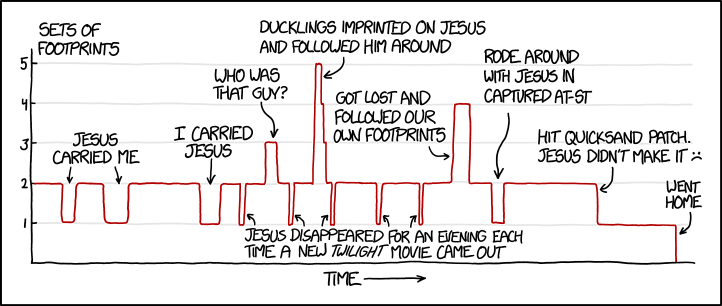
Footprints

"There's one set of foot-p's cause I was totes carrying you, bro!" said Jesus seconds before I punched him.
08 Sep 20:12

The Annual ‘Corso Zundert’ Parade Honors Van Gogh with Monumental Floats Adorned with Flowers

by Christopher Jobson

flowers-1
Photo by Erwin Martens

Another year, another Corso Zundert (previously), the legendary parade of giant floats adored with thousands of dahlia flowers that twist through the narrow streets of Zundert, Netherlands. This year 19 teams took inspiration from the work of Vincent van Gogh who was born in Zundert 162 years ago. The towering floats borrow colors, motifs, and imagery from van Gogh’s painting including several interpretations of the artist’s self-portraits.

Started in 1936, the parade celebrates the region’s reputation as a global supplier of dahlia flowers, an area now covering 33 hectares (81 acres) of 600,000 dahlia bulbs in fifty different species. The first Corso Zundert parades were modest in size featuring horse-drawn carts or bicycles covered in flowers, but the event has since grown dramatically. The floats now merge more ambitious aspects of contemporary/urban art with traditional parade floats as part of a friendly annual competition. You can see plenty more photos over on BN DeStem.

flowers-3
Photo by Werner Pellis

flowers-2
Photo by Werner Pellis

flowers-4
Photo by Malou Evers

flowers-10
Photos by Photo by Werner Pellis

flowers-5
Photos by Joyce van Belkom

flowers-12
Photos by Joyce van Belkom

flowers-7
Photo by Erwin Marten

flowers-8
Photo by Malou Evers

flowers-9
Photo by Werner Pellis

flowers-11
Photo by Erwin Martens

08 Sep 20:11

Liquid Plastic Welder

by dainevaldez

liquid-plastic-welder-1
Use this pocket-sized welder to fix fabric, wood, metal, and glass.

liquid-plastic-welder-01
liquid-plastic-welder-02
liquid-plastic-welder-03
View on IPPINKA

08 Sep 20:10

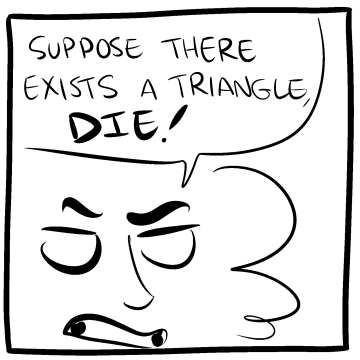
Saturday Morning Breakfast Cereal - A Triangle

by admin@smbc-comics.com
08 Sep 20:10

Stunning Time Slice Photography By Richard Silver

by dmitry

1
Photographer Richard Silver created a series called ‘Time Slice’ where he pretty much sliced a regular photo into many photos in different time frame so the photo goes from day to night. The result is incredible, check it out!

2
3
4
5
6
7
8
9
10
11
12
13
14
Via Abduzeedo

08 Sep 15:26

Escultura cinética

by Troy

escultura-cinetica

Zinnia Kinetic Sculpture de Clayton Boyer, una original escultura (si el autor dice que es una escultura, pues será una escultura) que se aprovecha de la energía cinética y de unos muelles para mantener nuestra atención hipnóticamente durante un buen rato.


Via imgur > Clayton Boyer Woodworking Designs

Ver más: esculturas, movimiento
Síguenos: @NoPuedoCreer - @QueLoVendan - @QueLoVendanX


08 Sep 12:55

Should the first in a queue be served last? - BBC News

Queue for job interview Image copyright Thinkstock

Everyone knows how a queue works. It's a line of people where the person at the front gets served first. But Danish researchers have recently made a shocking suggestion - that queuing on the basis of last-come-first-served may sometimes be more efficient.

The principle of first-come-first-served is simple, and it's fair. Who could possibly argue with it?

Well, one person is Prof Lars Peter Osterdal of the University of Southern Denmark.

"Queues, it's a wonderful example of a waste of time," he says.

"The problem with a regular queue where you serve first those who arrive first is that people tend to arrive too early."

Osterdal and his colleague, assistant professor Trine Tornoe Platz, studied situations where a service opens at a particular time and closes after every person has been served. Airlines that do not assign seats before boarding provide a good example.

Under the first-come-first-served system passengers arrive early and wait in line to get on to the plane because those who are first in line get the seat they want.

But the researchers experimented with different queuing systems, and when they told volunteer queuers that people would be selected from the queue and served at random, the average wait was reduced.

The best system, however, turned out to be last-in-first-out - or to put it another way, last-come-first-served - with the person who arrives last getting served first.

Image copyright Getty Images Image caption Try telling this crowd that the back of the queue gets served first

That system, Osterdal says, changes people's behaviour. They tend to arrive at staggered times, resulting in shorter queues.

"It would be more risky for people to arrive early because it could mean that you may not be lucky enough to be served immediately, so you would have to wait for a long time until all those who arrive after you have been served," he says.

Probably it's against many people's intuition about fairness in queues Lars Peter Osterdal, University of Southern Denmark

"There will be some people trying their luck arriving early but on average people will arrive later and it means on average that everyone will be better off."

At the airport departure gate, people would be more likely to stay in a cafe for a while, or sit reading a book rather than rushing to be first in the queue.

I tried an experiment on my colleagues to see how they liked the last-come-first-served approach.

First I sent an email offering free chocolate fudge cake. Then, as people turned up, I made them form a queue and gave cake first to those at the back of the queue.

It's fair to say it wasn't a popular system among those who had queued longest. "Despicable," was the comment from the person at the front who had to wait longest for her slice.

The experiment was fun, but, of course, I missed out a key element of the last-come-first-served system. It's important that people about to enter the queue know how it works, so they can adjust their behaviour.

Osterdal does acknowledge, though, that the use of the last-come-first-served queue in the real world would be difficult in many cases.

"In practice it would be very hard to implement a principle of serving the last in most physical queues where people physically queue up, for example when boarding an airplane. It's simply too difficult to manage for practical reasons," he says.

It could be open to manipulation, with people leaving the queue and rejoining from the back in order to get served more quickly.

Image copyright AFP

There's also the issue of fairness - or unfairness.

"As long as everyone knows it from the beginning, in a sense it's fair that everyone faces the same rules and the rules apply to everyone. But it's true that many people would object to serving the last because it will result in some people having to wait for a long time. In that sense it's not fair and probably it's against many people's intuition about fairness in queues," Osterdal says.

Abandoning the first-come-first-served principle would be easier in internet or phone queues though, Osterdal points out.

People kept waiting a long time may not be happy, but at least they would not see people who arrived in the queue after them getting served first.

Subscribe to the BBC News Magazine's email newsletter to get articles sent to your inbox.

Bookmarked at brandizzi Delicious' sharing tag and expanded by Delicious sharing tag expander.
08 Sep 12:55

Why some Tanzanian women are marrying women - BBC News

26 August 2015 Last updated at 07:06 BST

In the Tarime district of the Mara region in northern Tanzania an age-old tradition involves women marrying women.

This alternative family structure, known as Nyumba Nthobu, has become a practical alternative for many.

Tulanana Bohela reports.

Bookmarked at brandizzi Delicious' sharing tag and expanded by Delicious sharing tag expander.
08 Sep 12:55

NASA’s Comet Hitchhiker will help create a guide to the galaxy

Adam Victor Brandizzi

Virou moda agora.

NASA engineers say they have come up with an easier way of exploring comets and asteroids in our Solar System: harpooning fast-moving space rocks. The idea is to make a probe — called Comet Hitchhiker — that would "catch rides" on asteroids by spearing them with tethers. Once the vehicle finishes a ride with one asteroid, it will disconnect and hitch a ride with another. The idea was dreamed up by NASA's Jet Propulsion Laboratory as a way of using less fuel to land spacecraft on these space rocks.

Right now, landing objects on asteroids is tough since these rocks move at a speed of about 15 miles per second. So a spacecraft has to be much faster than an asteroid to catch up. Then if it does reach the asteroid, the vehicle has to slow down to match the object's speed. Asteroids and comets are pretty small too, with low gravitational pulls, so the spacecraft has to do most of the work to land. This braking process requires a lot of propellant.

Think of it like going fishing

The hitchhiking idea would get rid of the need for fuel during the landing process, JPL says. Think of it like going fishing. When the spacecraft meets up with an asteroid, it will cast out its line; harpoons will shoot out tethers to connect the spacecraft to the rock. The vehicle will then extend the tethers a bit so there isn't too much tension on the rope. (Fishermen also do this when they hook big prizes, so their line doesn't snap right away from too much force.) Eventually the spacecraft will match the velocity of the asteroid. When it does, the probe will reel in its tethers very slowly in order to land.

Masahiro Ono, the principal investigator based at JPL, says the spacecraft's tethers will have to be made of super strong material. Zylon and Kevlar could work, but the engineers are also considering more advanced technologies like a carbon nanotube tether with a diamond harpoon — incredibly strong materials. The tethers would also need to be between 62 and 620 miles long for the maneuver to work.

Overall, the idea is to send the Comet Hitchhiker to as many small bodies as possible throughout our cosmic neighborhood. The spacecraft could then gather samples from these rocks to determine what they’re made of. So far the project is only in Phase 1 through the NASA Innovative Advanced Concepts (NIAC) Program. But if it does become a reality, hopeful the vehicle will receive more hospitality than other hitchhiking robots have gotten in the past.

Bookmarked at brandizzi Delicious' sharing tag and expanded by Delicious sharing tag expander.
08 Sep 01:06

Você quer saber como a Síria recebia seus refugiados até 2011? Leia aqui no blog

by gustavochacra

Poucas pessoas sabem, mas a Síria, até quatro anos atrás, era uma das nações que mais recebia refugiados no mundo.

Quando os Estados Unidos invadiram o Iraque, em 2003, centenas de milhares de iraquianos, fossem eles cristãos, sunitas ou xiitas, precisaram fugir. Praticamente o mundo todo fechou a porta para eles. Mas foi na Síria que eles conseguiram refúgio, fugindo da guerra que destruiu o Iraque.

Ao todo, em 2010, viviam 1 milhão de refugiados iraquianos na Síria. Seus filhos possuíam direito a educação gratuita. Até 2006, a saúde também era de graça, mas depois o governo sírio impôs algumas restrições – na prática, iraquianos ainda eram atendidos gratuitamente.

Quando Israel bombardeou o Líbano em resposta a ataques do Hezbollah em 2006, centenas de milhares de libaneses buscaram refúgio momentâneo na Síria. Em uma atitude fantástica, os sírios abriram as portas de suas próprias casas para os libaneses terem refúgio.

E os refugiados palestinos, que enfrentam dificuldades em tantos países árabes, antes do início da guerra civil, em 2011, podiam viver na Síria sem grandes problemas e sempre com suporte governo e de entidades internacionais – obviamente, o cenário é completamente distinto hoje.

Hoje, são os sírios que precisam de ajuda.

Guga Chacra, comentarista de política internacional do Estadão e do programa Globo News Em Pauta em Nova York, é mestre em Relações Internacionais pela Universidade Columbia. Já foi correspondente do jornal O Estado de S. Paulo no Oriente Médio e em NY. No passado, trabalhou como correspondente da Folha em Buenos Aires

Comentários islamofóbicos, antissemitas, anticristãos e antiárabes ou que coloquem um povo ou uma religião como superiores não serão publicados. Tampouco são permitidos ataques entre leitores ou contra o blogueiro. Pessoas que insistirem em ataques pessoais não terão mais seus comentários publicados. Não é permitido postar vídeo. Todos os posts devem ter relação com algum dos temas acima. O blog está aberto a discussões educadas e com pontos de vista diferentes. Os comentários dos leitores não refletem a opinião do jornalista

Acompanhe também meus comentários no Globo News Em Pauta, na Rádio Estadão, na TV Estadão, no Estadão Noite no tablet, no Twitter @gugachacra , no Facebook Guga Chacra (me adicionem como seguidor), no Instagram e no Google Plus

08 Sep 00:54

What Happens When You Give 100 Cameras Out To Homeless Londoners

by Jessica Chou
Last July, London's Cafe Art, a CIC company that assists artists affected by homelessness, gave out 100 disposable cameras to the homeless. They got 80 cameras back, filled with photos of everyday life in London. Now, thanks to a Kickstarter, a few select images will be printed in a calendar.

"Some [of the photographers] are sleeping rough; others have been homeless but are still attending homelessness charities. We contacted them through art groups run by the charities," Paul Ryan, Cafe Art's director, told Refinery29 in an email. "We gave basic training on how to use the camera in the art groups, followed by a training session for anyone who wanted to come, run by The Royal Photographic Society."

In total, 2,500 photos were submitted; the 12 selected for the calendar were chosen by a public vote in August. They include images of a Holi-inspired event, London parks, and a row of telephones. Here, nine photos from the project, and the stories behind them.

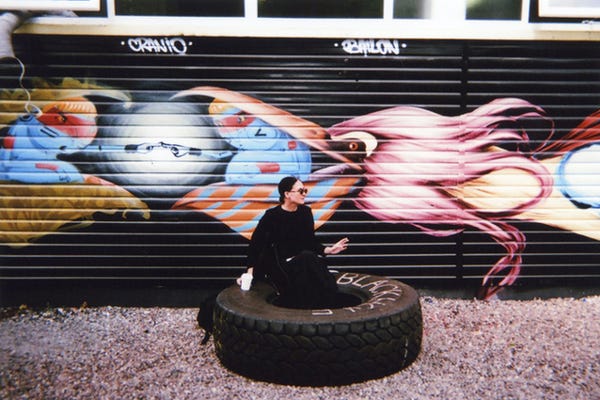
"Tyre Break, Hackney," by Desmond Henry

Henry, born in Northamptonshire, captured this image of a woman taking a coffee break in front of a mural by the Brazilian street artists Cranio, Bailon, and Sliks.

Henry attends the Pritchard's Road Day Centre and plays music as a DJ.

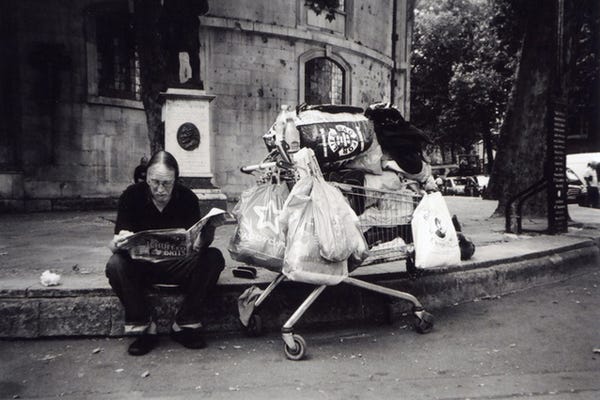
"Everything I Own" or "Bags of Life, Strand," by David Tovey.

David Tovey ran across Tony sitting near the Royal Courts of Justice. "It was the first photo I took. He was sitting there in complete contrast to the building across the road," Tovey told Cafe Art.

Tovey, who took a foundation art course at London Metropolitan University in 2013, originally started as a restaurateur. After dealing with health issues, he lost his business and home. He is now a practicing artist and volunteers with Clothing the Homeless and Café Art.

"Colour Festival, Olympic Park," by Goska Calik.

Goska Calik was not new to photography. "I started taking photos when I was five years old," she says. "The first photography I did was with my father. It was with a Zorky 12, a Russian camera. He taught me about light and the zoom and everything. I loved it."

After losing her job to to an illness, Calik got support from Crisis Skylight and is now a part-time support worker.

"Left Boot, East London," by Ellen Rostant.

Rostant, who is 16, has been in temporary housing with her parents and seven siblings for three years. She is attending Sixth Form College.

"Nature's Tunnel" or "Light and the End," Stratford, by Ellen Rostant.

Rostant's second photo to be voted onto the calendar was captured at Queen Elizabeth Olympic Park. "It’s like you are in a tunnel when you are homeless: It’s a journey, and there’s always going to be light at the end of the tunnel," she says.

Rostant is now studying geography, 3-D graphic design, and photography.

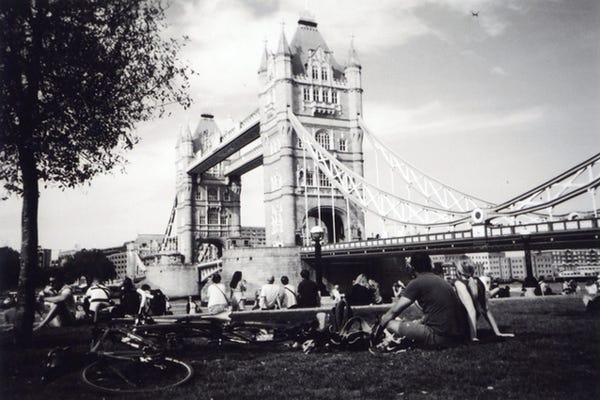
"Tower Bridge PICNIC, Southwark," by Cecie.

Hong Kong-born Cecie, who was diagnosed with post-traumatic stress disorder, works with the Crisis art group to help escape her Bethnal Green squat.

She is currently creating a blog about random acts of kindness.

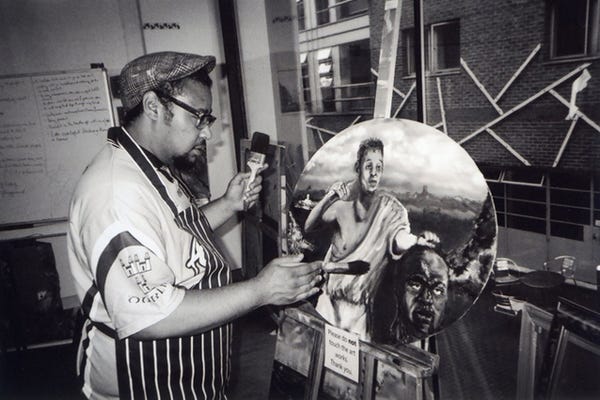
"The Artist, Whitechapel," by Michael Crosswaite.

Michael Crosswaite ran across Aaron Little in Providence Row, a homeless charity. "I didn’t over-think the photo, and perhaps that’s why it worked. The painting is so good, it makes the picture," he says.

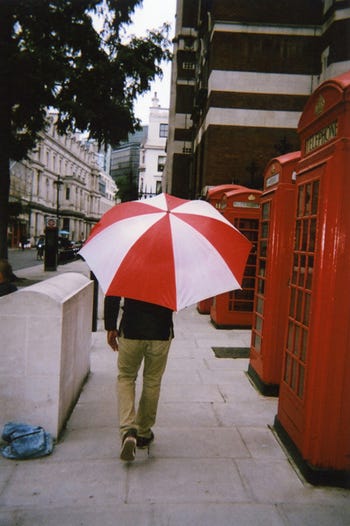
"Telephone Row, Lincoln's Inn," by XO.

XO was fascinated by the shorter telephone booths, unique to London. "Although very rarely used these days, I love the fact they're still around. They're synonymous with our capital, and this city wouldn't be the same without them, so I'm happy they're protected," XO told Cafe Art.

"Past & Future, City of London," by Ioanna Zagkana

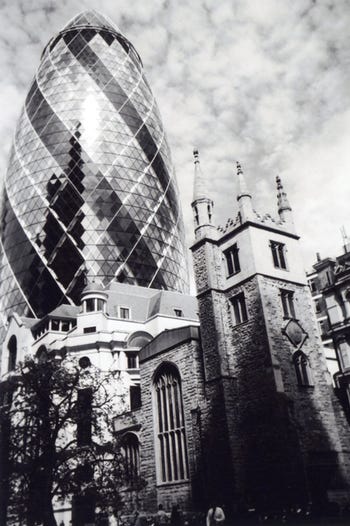
The Gherkin, built in 2003, and the St. Andrew Undershaft, which survived the Great Fire of London, represent modern and historic London, Zagkana says.

Zagkana, who was a dancer until an accident ended her career, attends Crisis Skylight and Women at the Well and is currently staying with a friend.


Like what you see?How about some more R29 goodness, right here?

Boost Your Bank Holiday Style With These It Brit-Inspired Looks

Not Cool: Prince George Is Being Hounded By The Paparazzi

Glorious Sky Pool Or Terrifying Human Aquarium? You Decide
08 Sep 00:53

Baby Burrito Swaddle Blanket

06 Sep 17:46

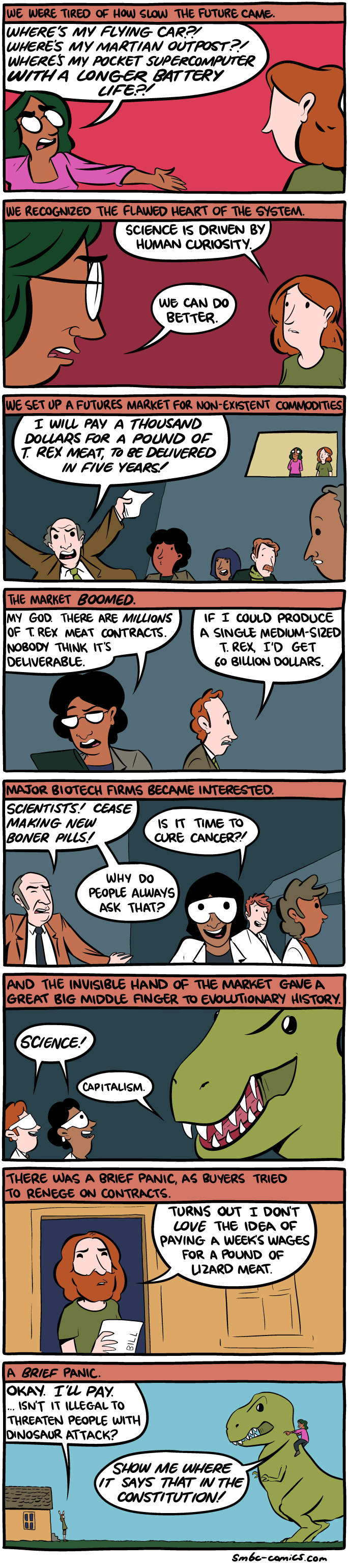
Saturday Morning Breakfast Cereal - Commodities

by admin@smbc-comics.com
06 Sep 17:44

gifsboom: Burning methane trapped under the ice. [video]


gifsboom:

Burning methane trapped under the ice. [video]

06 Sep 15:12

Por que a hipócrita Arábia Saudita não recebe refugiados sírios?

by gustavochacra

É sim uma vergonha a Arábia Saudita e outras nações do Golfo Pérsico não receberem nenhum refugiado sírio. Zero. Inacreditável. São alguns dos países mais ricos do mundo e mesmo assim mantêm suas portas fechadas para pessoas aterrorizadas por uma das guerras mais sangrentas do século 21.

No caso dos sauditas, ainda é pior. O regime de Riad acabou de anunciar a compra de US$ 1 bilhão de dólares em armamentos dos EUA. Estas armas servirão para alimentar a guerra dos sauditas no Yemen, onde centenas de civis têm sido mortos nos bombardeios da Arábia Saudita – bombardeios que servem para fortalecer a Al Qaeda na Península Arábica.

A Arábia Saudita, que possui um regime de apartheid contra as mulheres e os xiitas, também patrocina ao redor do mundo a ideologia wahabbita – a mesma do ISIS (Grupo Estado Islâmico ou Daesh), da Al Qaeda, do Taleban, do Boko Haram e do Al Shebab. Emirados Árabes, Omã, Qatar e Kuwait são outras nações ricas do Golfo Pérsico que não recebem refugiados.

 Mas e no resto do Oriente Médio? Bom, vamos por partes.

. O Líbano, segundo a ONU, tem 1,1 milhão de refugiados sírios – ou uma em cada 4 pessoas no país (sem falar nos 500 mil refugiados palestinos)

. A Turquia, aproximadamente 2 milhões

. A Jordânia, 650 mil

. O Egito, pouco mais de 100 mil.

. Yemen e Iraque estão em guerra. Ainda assim, o Iraque recebe 250 mil refugiados (mais do que qualquer país da Europa)

Todos estes países, portanto, recebem mais refugiados do que qualquer nação europeia, incluindo a Alemanha. O Líbano, com 4 milhões de habitantes e uma economia pequena, recebeu mil vezes mais refugiados do que a Inglaterra.

Certo, mas e o Irã e Israel, por que não recebem refugiados sírios?

. O Irã é o país que mais recebe refugiados das guerras do Iraque e do Afeganistão. São centenas de milhares. Logisticamente, os sírios têm dificuldade de cruzar o Iraque até chegar ao Irã

. Israel, por sua vez, enfrenta problemas de segurança interna e teme que terroristas se infiltrem entre os refugiados – um argumento correto, mas que poderia ser usado por qualquer país do mundo, incluindo o Líbano, Jordânia e Turquia, que são alvos de terrorismo. Por outro lado, Israel recebeu ao longo de sua história milhões de refugiados perseguidos na Europa, na ex-União Soviética e no mundo árabe.

Enfim, mais uma vez, as nações ricas do Golfo Pérsico, como a Arábia Saudita, são as que possuem maior capacidade de receber refugiados sírios.

Guga Chacra, comentarista de política internacional do Estadão e do programa Globo News Em Pauta em Nova York, é mestre em Relações Internacionais pela Universidade Columbia. Já foi correspondente do jornal O Estado de S. Paulo no Oriente Médio e em NY. No passado, trabalhou como correspondente da Folha em Buenos Aires

Comentários islamofóbicos, antissemitas, anticristãos e antiárabes ou que coloquem um povo ou uma religião como superiores não serão publicados. Tampouco são permitidos ataques entre leitores ou contra o blogueiro. Pessoas que insistirem em ataques pessoais não terão mais seus comentários publicados. Não é permitido postar vídeo. Todos os posts devem ter relação com algum dos temas acima. O blog está aberto a discussões educadas e com pontos de vista diferentes. Os comentários dos leitores não refletem a opinião do jornalista

Acompanhe também meus comentários no Globo News Em Pauta, na Rádio Estadão, na TV Estadão, no Estadão Noite no tablet, no Twitter @gugachacra , no Facebook Guga Chacra (me adicionem como seguidor), no Instagram e no Google Plus

06 Sep 15:12

Afinal, dá para explicar a Guerra da Síria? Sim, em 10 itens no blog

by gustavochacra

Algumas pessoas têm me perguntado por que os EUA, as nações ocidentais e mesmo os países do Golfo Pérsico não acabam com a Guerra da Síria. A resposta é que, se fosse simples encerrar o conflito, tenham certeza que este já teria acabado. Mas vou tentar aqui explicar como está a guerra em 10 parágrafos.

1. Primeiro, a Síria era uma nação estável, governada por um regime laico dominado pelo partido arabista Baath, com Bashar al Assad no comando. Basicamente, um regime de partido único, não muito diferente do que vimos em países da América Central e do Sul nos anos 1970. Lembrem, o nome da Síria é República Árabe Síria, não “República Islâmica”. E no Baath e nas Forças Armadas há membros de todas facções religiosas, incluindo ateus.

2. Em segundo lugar, em 2011, a Primavera Árabe atingiu a Síria. E rapidamente houve uma escalada militar. O regime de Assad reprimiu com dureza os opositores. Os rebeldes da oposição se radicalizaram, adotando visões extremistas islâmicas, como a Wahabbita. Nos quatro anos de conflito, cerca de 250 mil pessoas morreram e milhões ficaram refugiadas, como vemos agora.

3. Terceiro, hoje a Síria pode ser dividida em três principais áreas. A primeira, que contém as maiores cidades, incluindo Damasco, e a costa Mediterrânea, está nas mãos do regime de Assad. Muitas áreas de Aleppo também estão com o governo. A segunda, mais perto da fronteira com o Iraque, é controlada pelo ISIS (Grupo Estado Islâmico ou Daesh). Uma terceira parte, perto da fronteira com a Turquia, está sob controle de dezenas de milícias extremistas, muitas delas ligadas à Al Qaeda. Há, por último, algumas zonas curdas autônomas que são inimigas do ISIS, mas mantêm neutralidade em relação ao regime de Assad. Se você vir um mapa, talvez ache que Assad controle pouco território, mas grande parte da Síria é deserto.

4. Quarto, o regime de Assad tem o apoio externo da Rússia, do Irã, do Hezbollah e do governo iraquiano. Houve também uma aproximação recente com o Egito. As milícias radicais da oposição são patrocinadas acima de tudo pela Turquia, Arábia Saudita e Qatar – em menor escala, pelos EUA e França. O ISIS, teoricamente, não é aliado de ninguém, mas possui uma relação ambígua com a Turquia e braços do regime saudita.

5. Quinto, a Síria é uma nação multi-religiosa. Tem 60% de muçulmanos sunitas árabes, 10% de sunitas curdos (curdo e árabe são etnias), 10% de cristãos (majoritariamente ortodoxos, com minorias melquita, maronita, assíria e siríaca), 10% de muçulmanos alauítas (alauíta é uma braço do islamismo, assim como sunitas e xiitas) e 10% de outras minorias, especialmente druza – os xiitas são uns 2%.

6. Sexto, a maior parte da população síria não apoia ninguém. Mas cristãos, alauítas, drusos, xiitas e as elites sunitas das grandes cidades temem a queda de Assad e do regime. Avaliam que, no lugar, entrará um grupo como o ISIS ou a Al Qaeda e destruirá Damasco. Cristãos e alauítas chegam a montar milícias independentes para defender o regime. Uma parcela mais conservadora da população sunita apoia milícias rebeldes. O ISIS possui pouco apoio internamente na Síria. Mas, insisto, a maior parte dos sírios não apoia ninguém.

7. Sétimo, todos os lados envolvidos na Guerra da Síria cometeram crimes contra a humanidade. Por exemplo, usaram armas químicas, torturam, bombardearam, estupraram, decapitaram e fizeram coisas inimagináveis.

8. Oitavo, há duas coalizões internacionais combatendo o ISIS. Uma comandada pelos EUA, com o apoio de nações árabes e ocidentais. Outra, comandada pelo Irã, com suporte da Rússia, do regime de Assad, do Hezbollah e de milícias xiitas iraquianas. O Exército libanês, o Exército iraquiano e os guerreiros Pesh Merga do Curdistão são aliados de ambas.

9. Nono, guerras civis como a da Síria costumam terminar apenas com a) saturação de todos os lados envolvidos, b) intervenção externa, c) partilha (ou federalização) do território e d) vitória de uns lados. No caso, os lados não estão saturados, nenhum dos envolvidos tem condição de uma vitória total e já há intervenção externa, sem sucesso – lembrando que intervenções em escala maior, como no Iraque e no Afeganistão, foram um fracasso total. Na prática, já existe a partilha. Mas esta não foi suficiente para acabar com as mortes.

10. Décimo, a Guerra da Síria ainda demorará anos e não se encerrará com a queda de Assad ou a derrota do ISIS. Como disse um analista da Al Jazeera, o conflito continuará no fundo do poço, apenas mudando de lado

Guga Chacra, comentarista de política internacional do Estadão e do programa Globo News Em Pauta em Nova York, é mestre em Relações Internacionais pela Universidade Columbia. Já foi correspondente do jornal O Estado de S. Paulo no Oriente Médio e em NY. No passado, trabalhou como correspondente da Folha em Buenos Aires

Comentários islamofóbicos, antissemitas, anticristãos e antiárabes ou que coloquem um povo ou uma religião como superiores não serão publicados. Tampouco são permitidos ataques entre leitores ou contra o blogueiro. Pessoas que insistirem em ataques pessoais não terão mais seus comentários publicados. Não é permitido postar vídeo. Todos os posts devem ter relação com algum dos temas acima. O blog está aberto a discussões educadas e com pontos de vista diferentes. Os comentários dos leitores não refletem a opinião do jornalista

Acompanhe também meus comentários no Globo News Em Pauta, na Rádio Estadão, na TV Estadão, no Estadão Noite no tablet, no Twitter @gugachacra , no Facebook Guga Chacra (me adicionem como seguidor), no Instagram e no Google Plus

06 Sep 15:10

Comic for 2015.09.06

by Kris Wilson

This entry passed through the Full-Text RSS service - if this is your content and you're reading it on someone else's site, please read the FAQ at fivefilters.org/content-only/faq.php#publishers.

06 Sep 15:09

There's A Man Whose Almost-Perfect Poop Saves Lives

by Sara Murphy
bathroom_EMBEDPhoto: Chameleons Eye/REX USA
You can learn a lot from your poop: The state of your digestive system, the impact of your diet and lifestyle on your general health, even your predisposition for illness. But CNN Wire explains that if you're one of those rare people whose poop is "fairly close to perfect," like Eric, a 24-year-old research assistant at the Massachusetts Institute of Technology, you can even use it to help save lives.

It turns out that the necessary bodily function that can stink up a bathroom like no other can also quite literally heal those suffering from the gut infection Clostridium difficile, or C. diff. A bacterium that inflames the colon, C. diff causes diarrhea, fever, nausea, loss of appetite, and, in 14,000 to 30,000 cases a year, death. But life-saving bacteria inside the fecal matter of people like Eric can help.

How's it work? Basically, a ridiculous amount of bacteria — some good, some bad — lives inside your poop. When people take antibiotics for various reasons, sometimes the antibiotics don't work properly and the good bacteria ends up being killed off while bad bacteria, like C. diff, multiplies, unchecked. But through a fecal transplant, the life-saving bacteria that lives inside of people like Eric's guts can be used to chase the harmful C. difficile bacteria out of the intestines of sick people.

"It’s unreal," Eric said of the process's impact. "I never thought I would be staring at my poop, frozen in a freezer, destined to help people across the country. It’s really cool.” And while Eric is making money for his donations — as Refinery29 has previously reported, if you qualify, you can make up to $13,000 from selling your poop — he's right to be proud. OpenBiome, the small laboratory outside of Boston that pioneered this process, put Eric through a 109-point clinical assessment before determining that he would be a helpful donor. Turns out, only 3% of prospective donors end up being healthy enough to give.

"It’s easier to get into M.I.T. and Harvard than it is to get enrolled as one of our donors," Mark Smith, OpenBiome’s research director, explained. "A lot of our donors are pretty excited to take something they do every day and save people’s lives with it."

And that simply must be true: Eric travels more than half an hour, taking a train to a bus, to reach the OpenBiome labs every time he donates. But for the amazing 90% of treated patients that get better following a fecal transplant, Eric's efforts are life-changing. Props to your poops, sir.

Like what you see?How about some more R29 goodness, right here?

Why You Don't Need To Worry About Grabbing A Post-Run Beer

These Portraits Will Change How You View The Human Body (NSFW)

Let This Adorable Kiwi Show You How Addiction Works
06 Sep 15:08

Pen Pals

I am not at this address

 Expaded from Oglaf's feed by Oglaf comic's expander.

06 Sep 15:06

Astonishing Artificial Limbs Created By Scott Summit

by Boogie nuggets

Artificial-Limbs-by-Scott-Stummit-1
Maybe using the word “astonishing” as an adjective for the following artificial limbs was not the smartest choice, since when a person has an artificial limb usually implies that he or she was involved in an unfortunate event.

Artificial-Limbs-by-Scott-Stummit-2
But if we manage to take the best from the worst situation, these artificial limbs are definitely pieces of art that will bring a drop of joy in the life of suffering people.

Artificial-Limbs-by-Scott-Stummit-3
The designer of these limbs is Scott Summit, a designer with 20 years old experience in the field.

Artificial-Limbs-by-Scott-Stummit-4
He used 3D printing technology to create one of a kind artificial limbs for each of the patients. Even more, he allows each patient to bring their own ideas on how they can customize the shape or the design of the prosthetics.

Artificial-Limbs-by-Scott-Stummit-5
Artificial-Limbs-by-Scott-Stummit-17
More on freeyork

06 Sep 01:02

consumed-wanderlust: This is a ‘where are you visting from?’...

Adam Victor Brandizzi

Nobody from Recife or Brasília? Where is it so I can improve it? :P


consumed-wanderlust:

This is a ‘where are you visting from?’ board at a local restaurant

06 Sep 00:59

Probably Overthinking It: The Inspection Paradox is Everywhere

Adam Victor Brandizzi

Que conceito crucial!

The following is a draft of an article I have submitted for publication in CHANCE Magazine, a publication of the American Statistical Association. With their encouragement, I am publishing it here to solicit comments from readers (and possibly corrections).

The Inspection Paradox is Everywhere


The inspection paradox is a common source of confusion, an occasional source of error, and an opportunity for clever experimental design.  Most people are unaware of it, but like the cue marks that appear in movies to signal reel changes, once you notice it, you can’t stop seeing it.


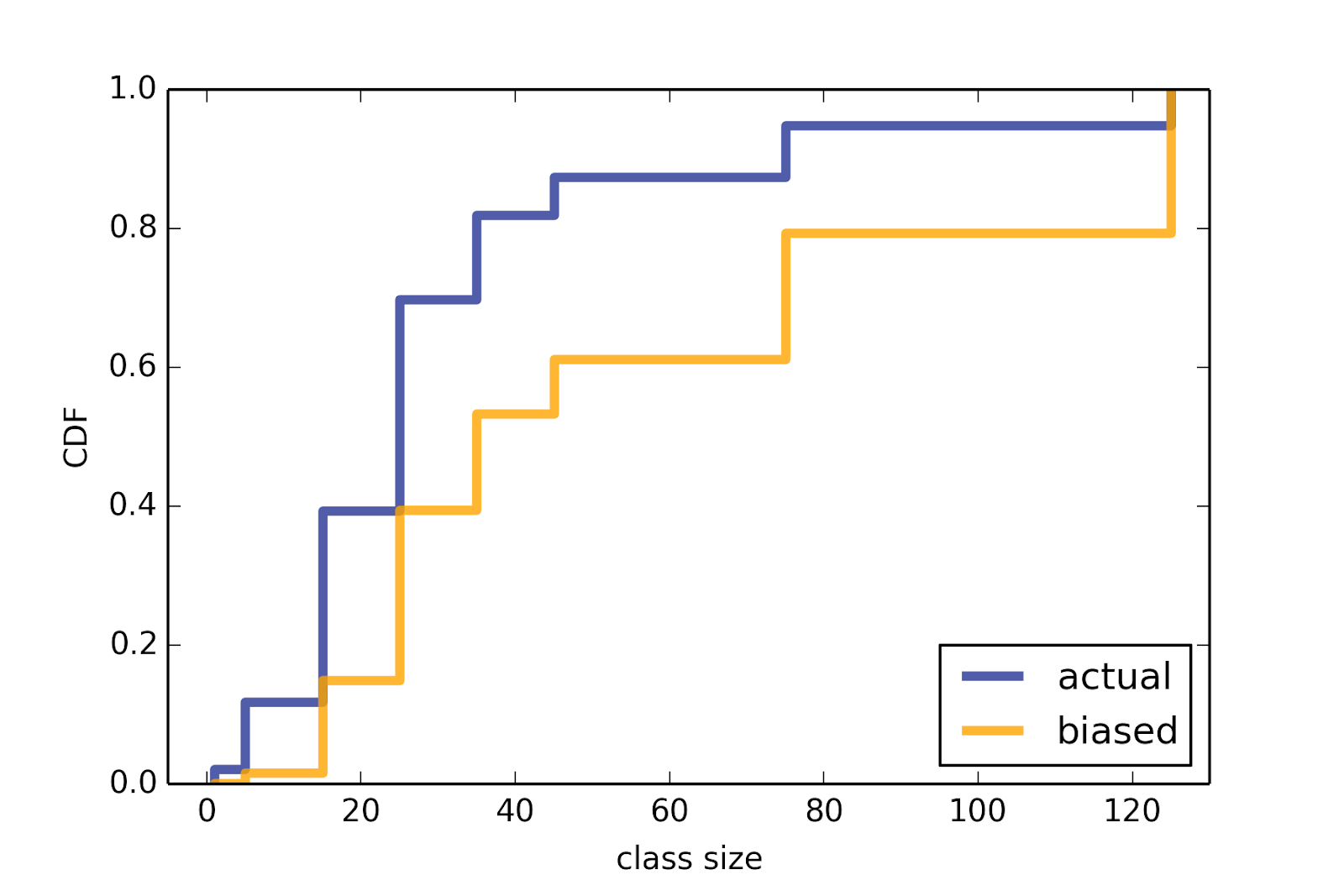
A common example is the apparent paradox of class sizes.  Suppose you ask college students how big their classes are and average the responses.  The result might be 56.  But if you ask the school for the average class size, they might say 31.  It sounds like someone is lying, but they could both be right.


The problem is that when you survey students, you oversample large classes.  If there are 10 students in a class, you have 10 chances to sample that class.  If there are 100 students, you have 100 chances.  In general, if the class size is x, it will be overrepresented in the sample by a factor of x.


That’s not necessarily a mistake.  If you want to quantify student experience, the average across students might be a more meaningful statistic than the average across classes.  But you have to be clear about what you are measuring and how you report it.


From the data in their report, I estimate the actual distribution of class sizes; then I compute the “biased” distribution you would get by sampling students.  The CDFs of these distributions are in Figure 1.


Going the other way, if you are given the biased distribution, you can invert the process to estimate the actual distribution.  You could use this strategy if the actual distribution is not available, or if it is easier to run the biased sampling process.


purdue3.png

Figure 1: Undergraduate class sizes at Purdue University, 2013-14 academic year: actual distribution and biased view as seen by students.


The same effect applies to passenger planes.  Airlines complain that they are losing money because so many flights are nearly empty.  At the same time passengers complain that flying is miserable because planes are too full.  They could both be right.  When a flight is nearly empty, only a few passengers enjoy the extra space.  But when a flight is full, many passengers feel the crunch.


Once you notice the inspection paradox, you see it everywhere.  Does it seem like you can never get a taxi when you need one?  Part of the problem is that when there is a surplus of taxis, only a few customers enjoy it.  When there is a shortage, many people feel the pain.


Another example happens when you are waiting for public transportation.  Busses and trains are supposed to arrive at constant intervals, but in practice some intervals are longer than others.  With your luck, you might think you are more likely to arrive during a long interval.  It turns out you are right: a random arrival is more likely to fall in a long interval because, well, it’s longer.


To quantify this effect, I collected data from the Red Line in Boston.  Using their real-time data service, I recorded the arrival times for 70 trains between 4pm and 5pm over several days.

redline2.png

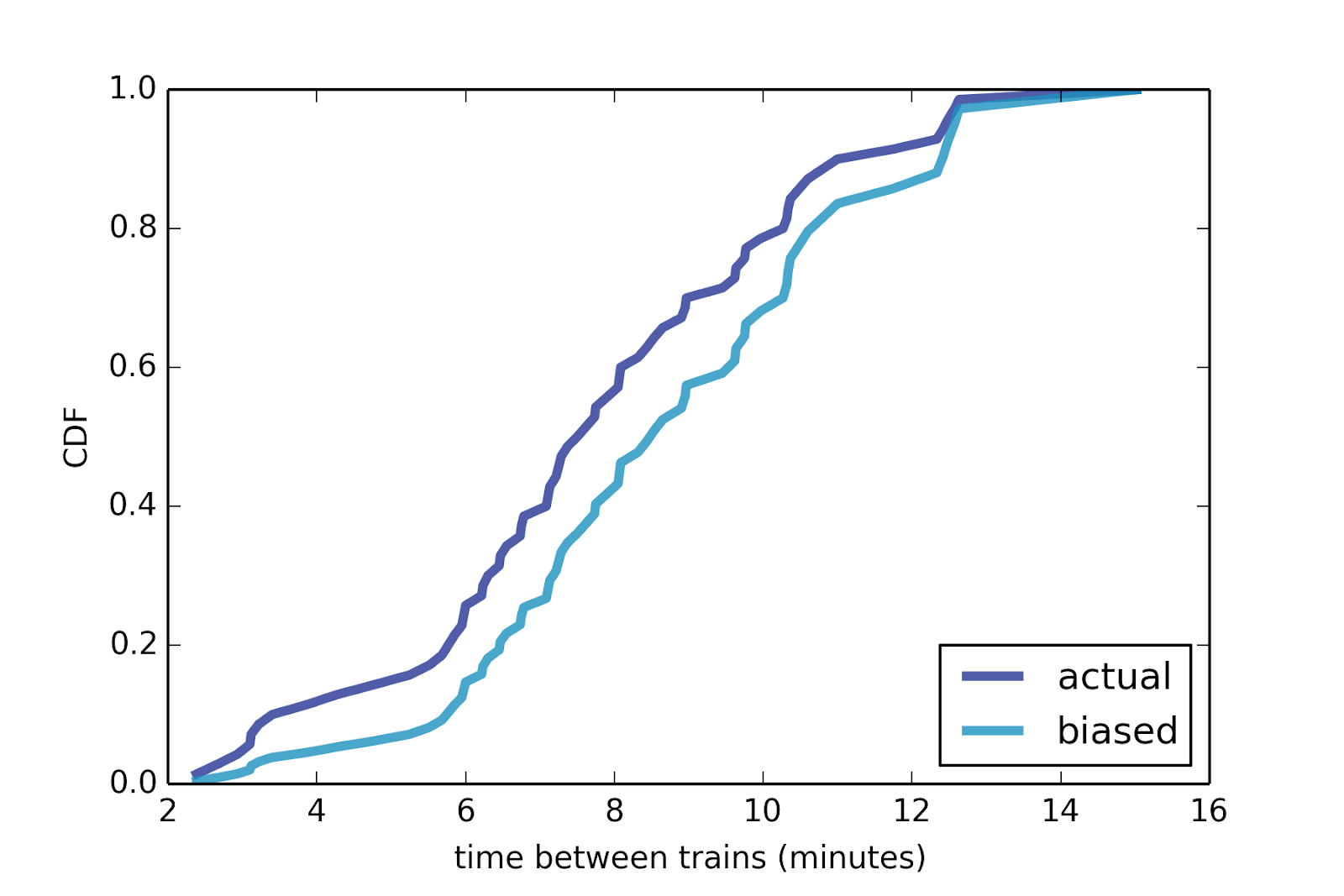
Figure 2: Distribution of time between trains on the Red Line in Boston, between 4pm and 5pm.


The shortest gap between trains was less than 3 minutes; the longest was more than 15.  Figure 2 shows the actual distribution of time between trains, and the biased distribution that would be observed by passengers.  The average time between trains is 7.8 minutes, so we might expect the average wait time to be 3.8 minutes.  But the average of the biased distribution is 8.8 minutes, and the average wait time for passengers is 4.4 minutes, about 15% longer.


In this case the difference between the two distributions is not very big because the variance of the actual distribution is moderate.  When the actual distribution is long-tailed, the effect of the inspection paradox can be much bigger.


An example of a long-tailed distribution comes up in the context of social networks.  In 1991, Scott Feld presented the “friendship paradox”: the observation that most people have fewer friends than their friends have.  He studied real-life friends, but the same effect appears in online networks: if you choose a random Facebook user, and then choose one of their friends at random, the chance is about 80% that the friend has more friends.


The friendship paradox is a form of the inspection paradox.  When you choose a random user, every user is equally likely.  But when you choose one of their friends, you are more likely to choose someone with a lot of friends.  Specifically, someone with x friends is overrepresented by a factor of x.


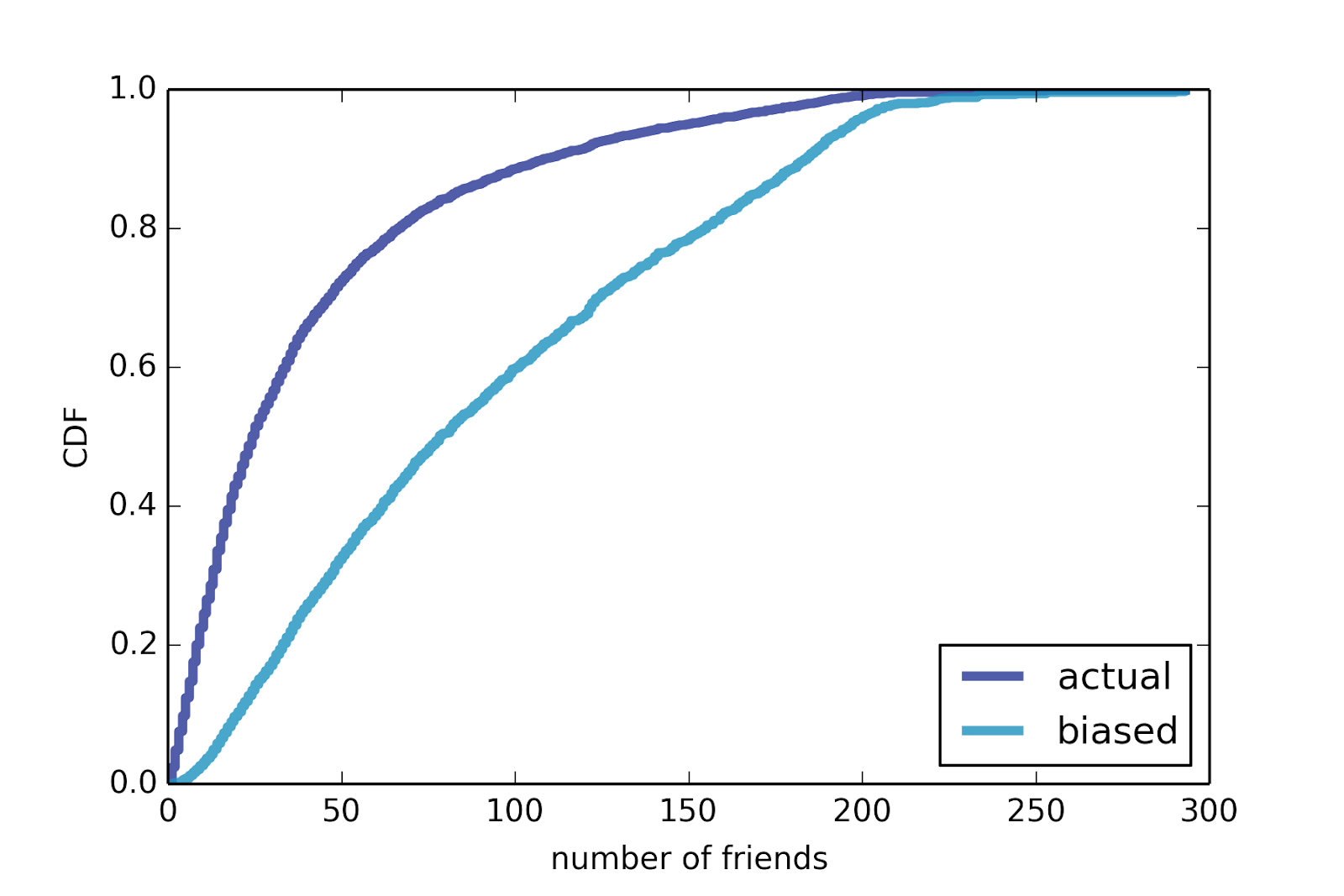
To demonstrate the effect, I use data from the Stanford Large Network Dataset Collection (http://snap.stanford.edu/data), which includes a sample of about 4000 Facebook users.  We can compute the number of friends each user has and plot the distribution, shown in Figure 3.  The distribution is skewed: most users have only a few friends, but some have hundreds.


We can also compute the biased distribution we would get by choosing choosing random friends, also shown in Figure 3.  The difference  is huge.  In this dataset, the average user has 42 friends; the average friend has more than twice as many, 91.

social4.png

Figure 3: Number of online friends for Facebook users: actual distribution and biased distribution seen by sampling friends.


Some examples of the inspection paradox are more subtle.  One of them occurred to me when I ran a 209-mile relay race in New Hampshire.  I ran the sixth leg for my team, so when I started running, I jumped into the middle of the race.  After a few miles I noticed something unusual: when I overtook slower runners, they were usually much slower; and when faster runners passed me, they were usually much faster.


At first I thought the distribution of runners was bimodal, with many slow runners, many fast runners, and few runners like me in the middle.  Then I realized that I was fooled by the inspection paradox.


In many long relay races, teams start at different times, and most teams include a mix of faster and slower runners.  As a result, runners at different speeds end up spread over the course; if you stand at  random spot and watch runners go by, you see a nearly representative sample of speeds.  But if you jump into the race in the middle, the sample you see depends on your speed.


Whatever speed you run, you are more likely to pass very slow runners, more likely to be overtaken by fast runners, and unlikely to see anyone running at the same speed as you.  The chance of seeing another runner is proportional to the difference between your speed and theirs.


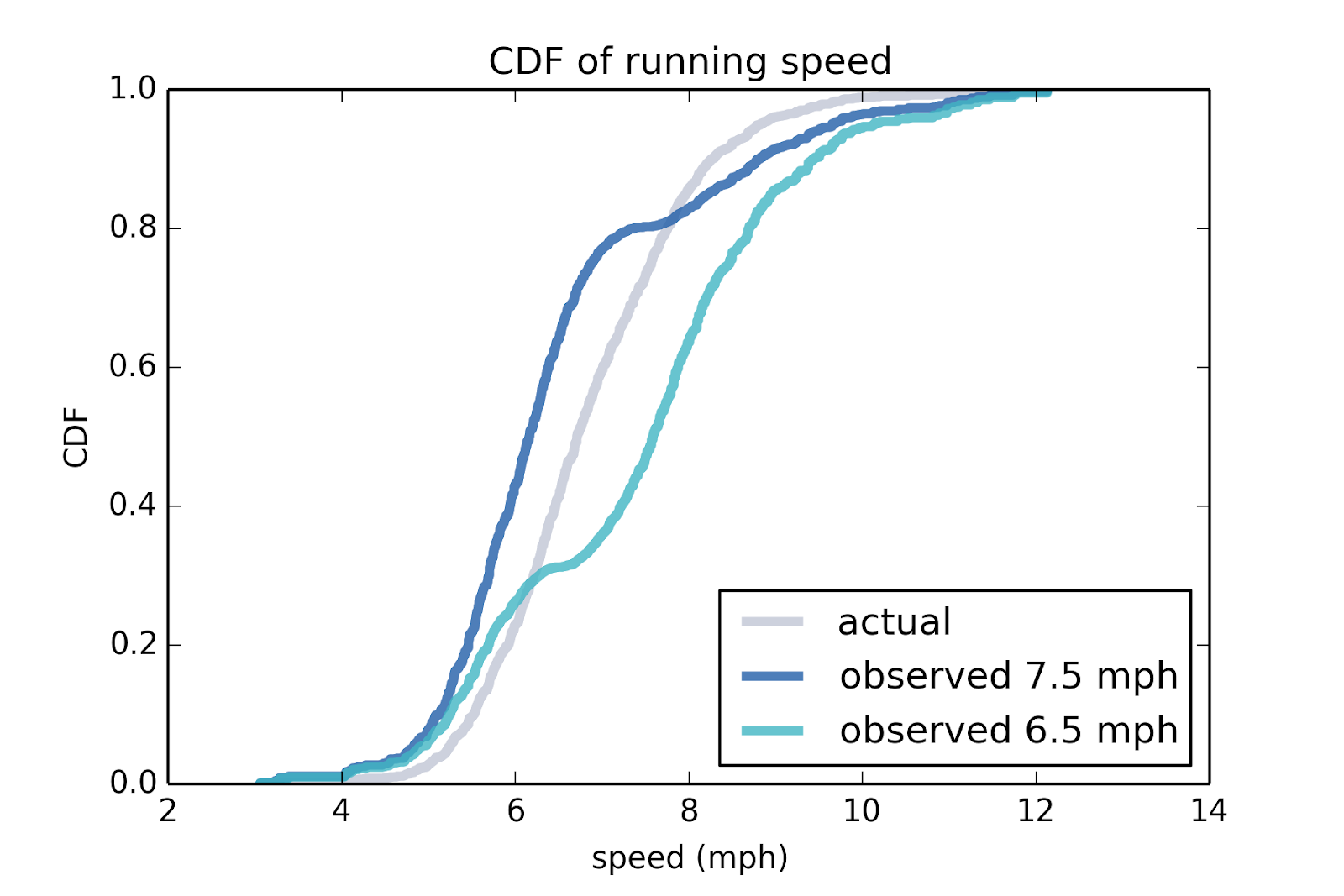
We can simulate this effect using data from a conventional road race.  Figure 4 shows the actual distribution of speeds from the James Joyce Ramble, a 10K race in Massachusetts.  It also shows biased distributions that would be seen by runners at 6.5 and 7.5 mph.  The observed distributions are bimodal, with fast and slow runners oversampled and fewer runners in the middle.

relay3.png

Figure 4: Distribution of speed for runners in a 10K, and biased distributions as seen by runners at different speeds.


A final example of the inspection paradox occurred to me when I was reading Orange is the New Black, a memoir by Piper Kerman, who spent 13 months in a federal prison.  At several points Kerman expresses surprise at the length of the sentences her fellow prisoners are serving.  She is right to be surprised, but it turns out that she is the victim of not just an inhumane prison system, but also the inspection paradox.


If you arrive at a prison at a random time and choose a random prisoner, you are more likely to choose a prisoner with a long sentence.  Once again, a prisoner with sentence x is oversampled by a factor of x.


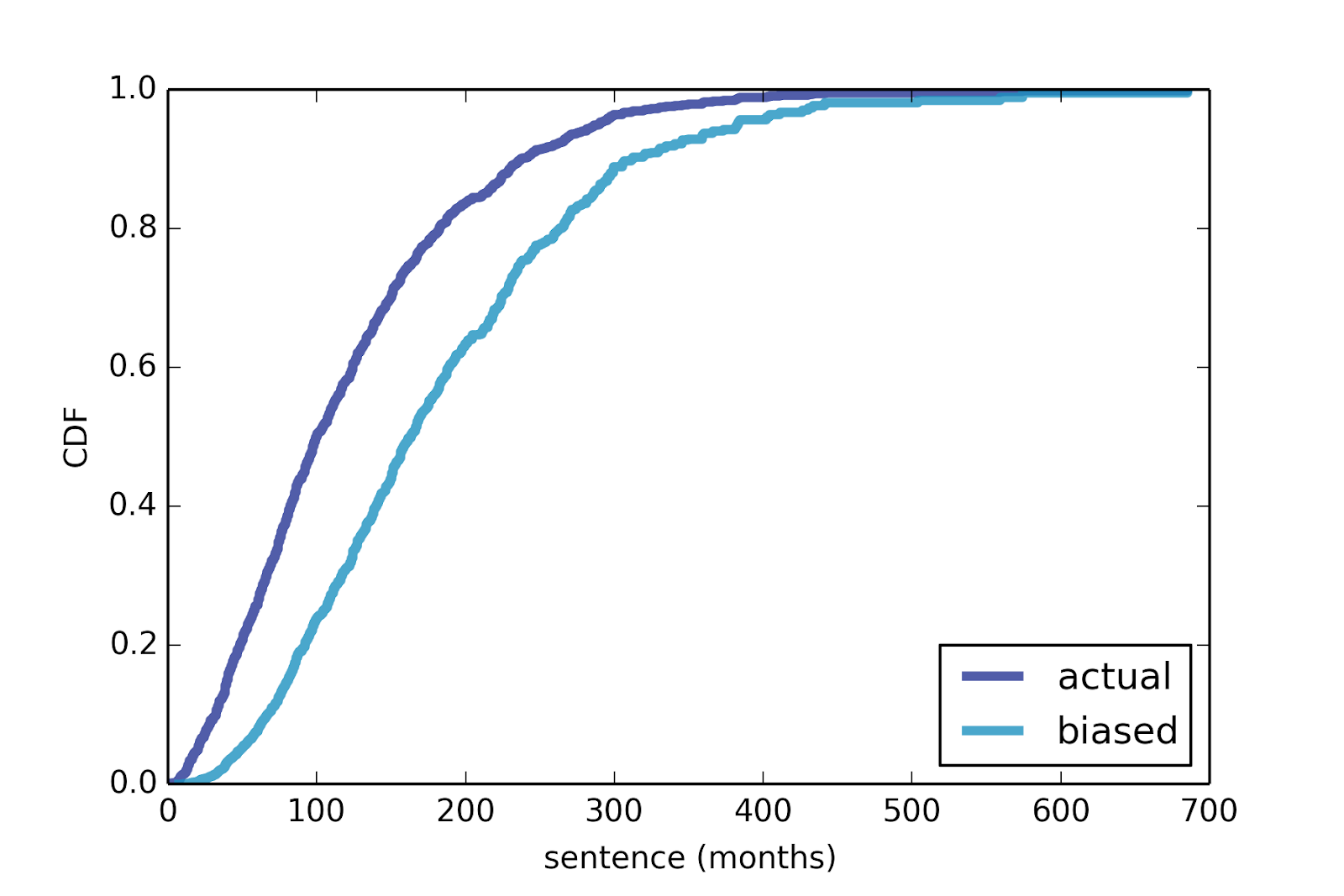
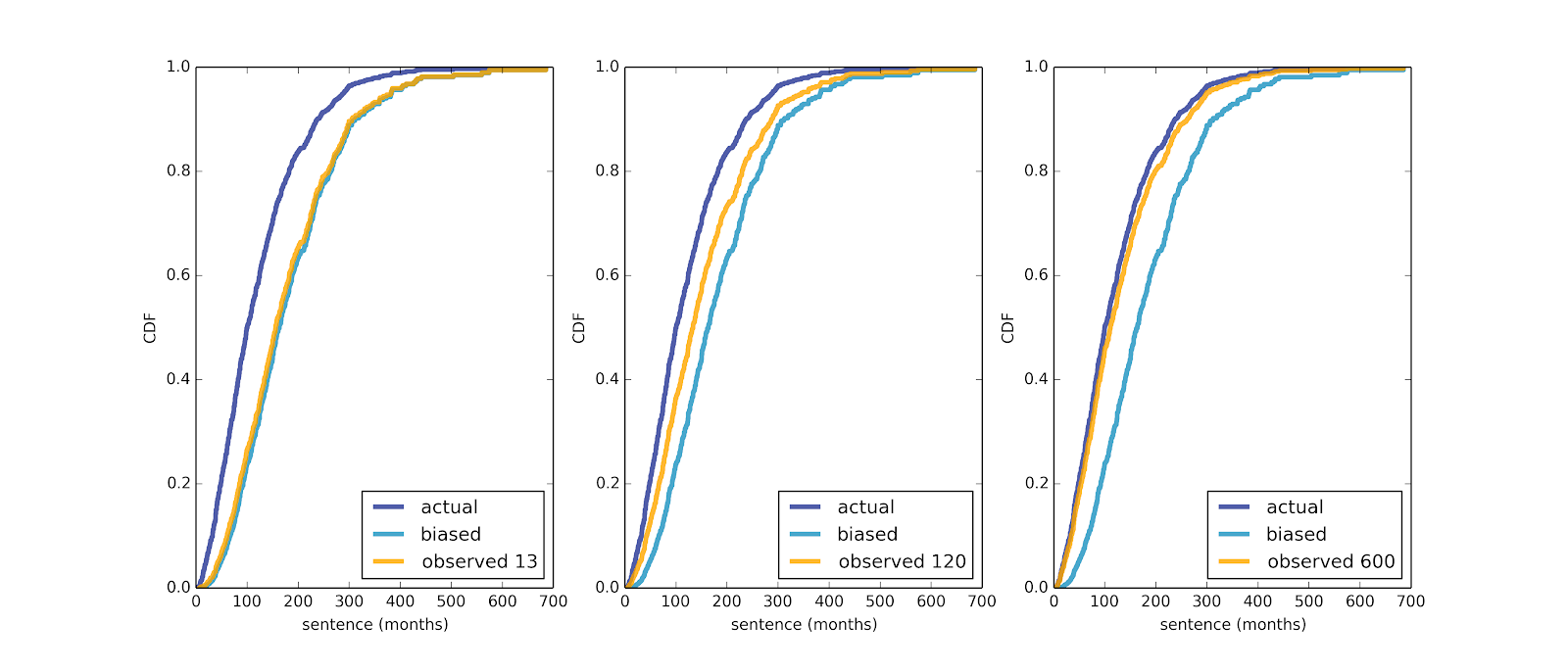
Using data from the U.S. Sentencing Commission, I made a rough estimate of the distribution of sentences for federal prisoners, shown in Figure 5.  I also computed the biased distribution as observed by a random arrival.

orange2.png

Figure 5: Approximate distribution of federal prison sentences, and a biased distribution as seen by a random arrival.


As expected, the biased distribution is shifted to the right.  In the actual distibution the mean is 121 months; in the biased distribution it is 183 months.


So what happens if you observe a prison over an interval like 13 months?  It turns out that if your sentence is y months, the chance of overlapping with a prisoner whose sentence is x months is proportional to x + y.


Figure 6 shows biased distributions as seen by hypothetical prisoners serving sentences of 13, 120, and 600 months.

orange6.png

Figure 6: Biased distributions as seen by prisoners with different sentences.


Over an interval of 13 months, the observed sample is not much better than the biased sample seen by a random arrival.  After 120 months, the magnitude of the bias is about halved.  Only after a very long sentence, 600 months, do we get a more representative sample, and even then it is not entirely unbiased.


These examples show that the inspection paradox appears in many domains, sometimes in subtle ways.  If you are not aware of it, it can cause statistical errors and lead to invalid inferences.  But in many cases it can be avoided, or even used deliberately as part of an experimental design.


Further reading

I discuss the class size example in my book, Think Stats, 2nd Edition, O’Reilly Media, 2014, and the Red Line example in Think Bayes, O’Reilly Media, 2013.  I wrote about relay races, social networks, and Orange Is the New Black in my blog, “Probably Overthinking It”.  http://allendowney.blogspot.com/


The original paper on the topic might be Scott Feld,  “Why Your Friends Have More Friends Than You Do”, American Journal of Sociology, Vol. 96, No. 6 (May, 1991), pp. 1464-1477. http://www.jstor.org/stable/2781907


Amir Aczel discusses some of these examples, and a few different ones, in a Discover Magazine blog article, “On the Persistence of Bad Luck (and Good)”, 4 September 4, 2013.


The code I used to generate these examples is in these Jupyter notebooks:


Bio


Allen Downey is a Professor of Computer Science at Olin College of Engineering in Massachusetts.  He is the author of several books, including Think Python, Think Stats, and Think Bayes.  He is a runner with a maximum 10K speed of 8.7 mph.

Bookmarked at brandizzi Delicious' sharing tag and expanded by Delicious sharing tag expander.
06 Sep 00:59

Multi-tasking: how to survive in the 21st century - FT.com

Adam Victor Brandizzi

Excelentes dicas.

Modern life now forces us to do a multitude of things at once — but can we? Should we?

Illustration by Pete Gamlen of a man multitasking©Pete Gamlen

Forget invisibility or flight: the superpower we all want is the ability to do several things at once. Unlike other superpowers, however, being able to multitask is now widely regarded as a basic requirement for employability. Some of us sport computers with multiple screens, to allow tweeting while trading pork bellies and frozen orange juice. Others make do with reading a Kindle while poking at a smartphone and glancing at a television in the corner with its two rows of scrolling subtitles. We think nothing of sending an email to a colleague to suggest a quick coffee break, because we can feel confident that the email will be read within minutes.

All this is simply the way the modern world works. Multitasking is like being able to read or add up, so fundamental that it is taken for granted. Doing one thing at a time is for losers — recall Lyndon Johnson’s often bowdlerised dismissal of Gerald Ford: “He can’t fart and chew gum at the same time.”

The rise of multitasking is fuelled by technology, of course, and by social change as well. Husbands and wives no longer specialise as breadwinners and homemakers; each must now do both. Work and play blur. Your friends can reach you on your work email account at 10 o’clock in the morning, while your boss can reach you on your mobile phone at 10 o’clock at night. You can do your weekly shop sitting at your desk and you can handle a work query in the queue at the supermarket.

This is good news in many ways — how wonderful to be able to get things done in what would once have been wasted time! How delightful the variety of it all is! No longer must we live in a monotonous, Taylorist world where we must painstakingly focus on repetitive tasks until we lose our minds.

And yet we are starting to realise that the blessings of a multitasking life are mixed. We feel overwhelmed by the sheer number of things we might plausibly be doing at any one time, and by the feeling that we are on call at any moment.

And we fret about the unearthly appetite of our children to do everything at once, flipping through homework while chatting on WhatsApp, listening to music and watching Game of Thrones. (According to a recent study by Sabrina Pabilonia of the US Bureau of Labor Statistics, for over half the time that high-school students spend doing homework, they are also listening to music, watching TV or otherwise multitasking. That trend is on the increase.) Can they really handle all these inputs at once? They seem to think so, despite various studies suggesting otherwise.

A Hemingwrite

And so a backlash against multitasking has begun — a kind of Luddite self-help campaign. The poster child for uni-tasking was launched on the crowdfunding website Kickstarter in December 2014. For $499 — substantially more than a multifunctional laptop — “The Hemingwrite” computer promised a nice keyboard, a small e-ink screen and an automatic cloud back-up. You couldn’t email on the Hemingwrite. You couldn’t fool around on YouTube, and you couldn’t read the news. All you could do was type. The Hemingwrite campaign raised over a third of a million dollars.

The Hemingwrite (now rebranded the Freewrite) represents an increasingly popular response to the multitasking problem: abstinence. Programs such as Freedom and Self-Control are now available to disable your browser for a preset period of time. The popular blogging platform WordPress offers “distraction-free writing”. The Villa Stéphanie, a hotel in Baden-Baden, offers what has been branded the “ultimate luxury”: a small silver switch beside the hotel bed that will activate a wireless blocker and keep the internet and all its temptations away.

The battle lines have been drawn. On one side: the culture of the modern workplace, which demands that most of us should be open to interruption at any time. On the other, the uni-tasking refuseniks who insist that multitaskers are deluding themselves, and that focus is essential. Who is right?

The ‘cognitive cost’

Illustration of a woman getting overwhelmed by tasks©Pete Gamlen

There is ample evidence in favour of the proposition that we should focus on one thing at a time. Consider a study led by David Strayer, a psychologist at the University of Utah. In 2006, Strayer and his colleagues used a high-fidelity driving simulator to compare the performance of drivers who were chatting on a mobile phone to drivers who had drunk enough alcohol to be at the legal blood-alcohol limit in the US. Chatting drivers didn’t adopt the aggressive, risk-taking style of drunk drivers but they were unsafe in other ways. They took much longer to respond to events outside the car, and they failed to notice a lot of the visual cues around them. Strayer’s infamous conclusion: driving while using a mobile phone is as dangerous as driving while drunk.

Less famous was Strayer’s finding that it made no difference whether the driver was using a handheld or hands-free phone. The problem with talking while driving is not a shortage of hands. It is a shortage of mental bandwidth.

Yet this discovery has made little impression either on public opinion or on the law. In the United Kingdom, for example, it is an offence to use a hand-held phone while driving but perfectly legal if the phone is used hands-free. We’re happy to acknowledge that we only have two hands but refuse to admit that we only have one brain.

Another study by Strayer, David Sanbonmatsu and others, suggested that we are also poor judges of our ability to multitask. The subjects who reported doing a lot of multitasking were also the ones who performed poorly on tests of multitasking ability. They systematically overrated their ability to multitask and they displayed poor impulse control. In other words, wanting to multitask is a good sign that you should not be multitasking.

We may not immediately realise how multitasking is hampering us. The first time I took to Twitter to comment on a public event was during a televised prime-ministerial debate in 2010. The sense of buzz was fun; I could watch the candidates argue and the twitterati respond, compose my own 140-character profundities and see them being shared. I felt fully engaged with everything that was happening. Yet at the end of the debate I realised, to my surprise, that I couldn’t remember anything that Brown, Cameron and Clegg had said.

We fret as our children flip through homework, chatting on WhatsApp and listening to music. Can they really handle all these inputs at once?

A study conducted at UCLA in 2006 suggests that my experience is not unusual. Three psychologists, Karin Foerde, Barbara Knowlton and Russell Poldrack, recruited students to look at a series of flashcards with symbols on them, and then to make predictions based on patterns they had recognised. Some of these prediction tasks were done in a multitasking environment, where the students also had to listen to low- and high-pitched tones and count the high-pitched ones. You might think that making predictions while also counting beeps was too much for the students to handle. It wasn’t. They were equally competent at spotting patterns with or without the note-counting task.

But here’s the catch: when the researchers then followed up by asking more abstract questions about the patterns, the cognitive cost of the multitasking became clear. The students struggled to answer questions about the predictions they’d made in the multitasking environment. They had successfully juggled both tasks in the moment — but they hadn’t learnt anything that they could apply in a different context.

That’s an unnerving discovery. When we are sending email in the middle of a tedious meeting, we may nevertheless feel that we’re taking in what is being said. A student may be confident that neither Snapchat nor the live football is preventing them taking in their revision notes. But the UCLA findings suggest that this feeling of understanding may be an illusion and that, later, we’ll find ourselves unable to remember much, or to apply our knowledge flexibly. So, multitasking can make us forgetful — one more way in which multitaskers are a little bit like drunks.

Early multitaskers

All this is unnerving, given that the modern world makes multitasking almost inescapable. But perhaps we shouldn’t worry too much. Long before multitasking became ubiquitous, it had a long and distinguished history.

In 1958, a young psychologist named Bernice Eiduson embarked on an long-term research project — so long-term, in fact, that Eiduson died before it was completed. Eiduson studied the working methods of 40 scientists, all men. She interviewed them periodically over two decades and put them through various psychological tests. Some of these scientists found their careers fizzling out, while others went on to great success. Four won Nobel Prizes and two others were widely regarded as serious Nobel contenders. Several more were invited to join the National Academy of Sciences.

After Eiduson died, some of her colleagues published an analysis of her work. These colleagues, Robert Root-Bernstein, Maurine Bernstein and Helen Garnier, wanted to understand what determined whether a scientist would have a long productive career, a combination of genius and longevity.

There was no clue in the interviews or the psychological tests. But looking at the early publication record of these scientists — their first 100 published research papers — researchers discovered a pattern: the top scientists were constantly changing the focus of their research.

Over the course of these first 100 papers, the most productive scientists covered five different research areas and moved from one of these topics to another an average of 43 times. They would publish, and change the subject, publish again, and change the subject again. Since most scientific research takes an extended period of time, the subjects must have overlapped. The secret to a long and highly productive scientific career? It’s multitasking.

Charles Darwin©Getty

Charles Darwin thrived on spinning multiple plates

Charles Darwin thrived on spinning multiple plates. He began his first notebook on “transmutation of species” two decades before The Origin of Species was published. His A Biographical Sketch of an Infant was based on notes made after his son William was born; William was 37 when he published. Darwin spent nearly 20 years working on climbing and insectivorous plants. And Darwin published a learned book on earthworms in 1881, just before his death. He had been working on it for 44 years. When two psychologists, Howard Gruber and Sara Davis, studied Darwin and other celebrated artists and scientists they concluded that such overlapping interests were common.

Another team of psychologists, led by Mihaly Csikszentmihalyi, interviewed almost 100 exceptionally creative people from jazz pianist Oscar Peterson to science writer Stephen Jay Gould to double Nobel laureate, the physicist John Bardeen. Csikszentmihalyi is famous for developing the idea of “flow”, the blissful state of being so absorbed in a challenge that one loses track of time and sets all distractions to one side. Yet every one of Csikszentmihalyi’s interviewees made a practice of keeping several projects bubbling away simultaneously.

Just internet addiction?

If the word “multitasking” can apply to both Darwin and a teenager with a serious Instagram habit, there is probably some benefit in defining our terms. There are at least four different things we might mean when we talk about multitasking. One is genuine multitasking: patting your head while rubbing your stomach; playing the piano and singing; farting while chewing gum. Genuine multitasking is possible, but at least one of the tasks needs to be so practised as to be done without thinking.

Then there’s the challenge of creating a presentation for your boss while also fielding phone calls for your boss and keeping an eye on email in case your boss wants you. This isn’t multitasking in the same sense. A better term is task switching, as our attention flits between the presentation, the telephone and the inbox. A great deal of what we call multitasking is in fact rapid task switching.

Shelley Carson, psychologist, Harvard professor and creativity expert

‘What we’re often calling multitasking is in fact internet addiction’. Shelley Carson, psychologist, Harvard professor and creativity expert

Task switching is often confused with a third, quite different activity — the guilty pleasure of disappearing down an unending click-hole of celebrity gossip and social media updates. There is a difference between the person who reads half a page of a journal article, then stops to write some notes about a possible future project, then goes back to the article — and someone who reads half a page of a journal article before clicking on bikini pictures for the rest of the morning. “What we’re often calling multitasking is in fact internet addiction,” says Shelley Carson, a psychologist and author of Your Creative Brain. “It’s a compulsive act, not an act of multitasking.”

A final kind of multitasking isn’t a way of getting things done but simply the condition of having a lot of things to do. The car needs to be taken in for a service. Your tooth is hurting. The nanny can’t pick up the kids from school today. There’s a big sales meeting to prepare for tomorrow, and your tax return is due next week. There are so many things that have to be done, so many responsibilities to attend to. Having a lot of things to do is not the same as doing them all at once. It’s just life. And it is not necessarily a stumbling block to getting things done — as Bernice Eiduson discovered as she tracked scientists on their way to their Nobel Prizes.

The fight for focus

These four practices — multitasking, task switching, getting distracted and managing multiple projects — all fit under the label “multitasking”. This is not just because of a simple linguistic confusion. The versatile networked devices we use tend to blur the distinction, serving us as we move from task to task while also offering an unlimited buffet of distractions. But the different kinds of multitasking are linked in other ways too. In particular, the highly productive practice of having multiple projects invites the less-than-productive habit of rapid task switching.

Illustration by Pete Gamlen of a waiter carrying too many food©Pete Gamlen

To see why, consider a story that psychologists like to tell about a restaurant near Berlin University in the 1920s. (It is retold in Willpower, a book by Roy Baumeister and John Tierney.) The story has it that when a large group of academics descended upon the restaurant, the waiter stood and calmly nodded as each new item was added to their complicated order. He wrote nothing down, but when he returned with the food his memory had been flawless. The academics left, still talking about the prodigious feat; but when one of them hurried back to retrieve something he’d left behind, the waiter had no recollection of him. How could the waiter have suddenly become so absent-minded? “Very simple,” he said. “When the order has been completed, I forget it.”

One member of the Berlin school was a young experimental psychologist named Bluma Zeigarnik. Intrigued, she demonstrated that people have a better recollection of uncompleted tasks. This is called the “Zeigarnik effect”: when we leave things unfinished, we can’t quite let go of them mentally. Our subconscious keeps reminding us that the task needs attention.

The Zeigarnik effect may explain the connection between facing multiple responsibilities and indulging in rapid task switching. We flit from task to task to task because we can’t forget about all of the things that we haven’t yet finished. We flit from task to task to task because we’re trying to get the nagging voices in our head to shut up.

Bluma Zeigarnik, psychologist©Science Photo Library

When we leave things unfinished, we can’t quite let go of them mentally. The essence of the 'Zeigarnik effect', named after Bluma Zeigarnik, the psychologist who first identified this phenomenon in the 1920s

Of course, there is much to be said for “focus”. But there is much to be said for copperplate handwriting, too, and for having a butler. The world has moved on. There’s something appealing about the Hemingwrite and the hotel room that will make the internet go away, but also something futile.

It is probably not true that Facebook is all that stands between you and literary greatness. And in most office environments, the Hemingwrite is not the tool that will win you promotion. You are not Ernest Hemingway, and you do not get to simply ignore emails from your colleagues.

If focus is going to have a chance, it’s going to have to fight an asymmetric war. Focus can only survive if it can reach an accommodation with the demands of a multitasking world.

Loops and lists

The word “multitasking” wasn’t applied to humans until the 1990s, but it has been used to describe computers for half a century. According to the Oxford English Dictionary, it was first used in print in 1966, when the magazine Datamation described a computer capable of appearing to perform several operations at the same time.

Just as with humans, computers typically create the illusion of multitasking by switching tasks rapidly. Computers perform the switching more quickly, of course, and they don’t take 20 minutes to get back on track after an interruption.

Nor does a computer fret about what is not being done. While rotating a polygon and sending text to the printer, it feels no guilt that the mouse has been left unchecked for the past 16 milliseconds. The mouse’s time will come. Being a computer means never having to worry about the Zeigarnik effect.

David Allen, author of 'Getting Things Done'

David Allen, author of 'Getting Things Done'. 'Saying “I’ll get back to you about that” opens a loop in your brain’

Is there a lesson in this for distractible sacks of flesh like you and me? How can we keep a sense of control despite the incessant guilt of all the things we haven’t finished?

“Whenever you say to someone, ‘I’ll get back to you about that’, you just opened a loop in your brain,” says David Allen. Allen is the author of a cult productivity book called Getting Things Done. “That loop will keep spinning until you put a placeholder in a system you can trust.”

Modern life is always inviting us to open more of those loops. It isn’t necessarily that we have more work to do, but that we have more kinds of work that we ought to be doing at any given moment. Tasks now bleed into each other unforgivingly. Whatever we’re doing, we can’t escape the sense that perhaps we should be doing something else. It’s these overlapping possibilities that take the mental toll.

The principle behind Getting Things Done is simple: close the open loops. The details can become rather involved but the method is straightforward. For every single commitment you’ve made to yourself or to someone else, write down the very next thing you plan to do. Review your lists of next actions frequently enough to give you confidence that you won’t miss anything.

This method has a cult following, and practical experience suggests that many people find it enormously helpful — including me (see below). Only recently, however, did the psychologists E J Masicampo and Roy Baumeister find some academic evidence to explain why people find relief by using David Allen’s system. Masicampo and Baumeister found that you don’t need to complete a task to banish the Zeigarnik effect. Making a specific plan will do just as well. Write down your next action and you quiet that nagging voice at the back of your head. You are outsourcing your anxiety to a piece of paper.

A creative edge?

It is probably a wise idea to leave rapid task switching to the computers. Yet even frenetic flipping between Facebook, email and a document can have some benefits alongside the costs.

The psychologist Shelley Carson and her student Justin Moore recently recruited experimental subjects for a test of rapid task switching. Each subject was given a pair of tasks to do: crack a set of anagrams and read an article from an academic journal. These tasks were presented on a computer screen, and for half of the subjects they were presented sequentially — first solve the anagrams, then read the article. For the other half of the experimental group, the computer switched every two-and-a-half minutes between the anagrams and the journal article, forcing the subjects to change mental gears many times.

Illustration by Pete Gamlen of a woman with a very long to-do list©Pete Gamlen

Unsurprisingly, task switching slowed the subjects down and scrambled their thinking. They solved fewer anagrams and performed poorly on a test of reading comprehension when forced to refocus every 150 seconds.

But the multitasking treatment did have a benefit. Subjects who had been task switching became more creative. To be specific, their scores on tests of “divergent” thinking improved. Such tests ask subjects to pour out multiple answers to odd questions. They might be asked to think of as many uses as possible for a rolling pin or to list all the consequences they could summon to mind of a world where everyone has three arms. Involuntary multitaskers produced a greater volume and variety of answers, and their answers were more original too.

“It seems that switching back and forth between tasks primed people for creativity,” says Carson, who is an adjunct professor at Harvard. The results of her work with Moore have not yet been published, and one might reasonably object that such tasks are trivial measures of creativity. Carson responds that scores on these laboratory tests of divergent thinking are correlated with substantial creative achievements such as publishing a novel, producing a professional stage show or creating an award-winning piece of visual art. For those who insist that great work can only be achieved through superhuman focus, think long and hard on this discovery.

Carson and colleagues have found an association between significant creative achievement and a trait psychologists term “low latent inhibition”. Latent inhibition is the filter that all mammals have that allows them to tune out apparently irrelevant stimuli. It would be crippling to listen to every conversation in the open-plan office and the hum of the air conditioning, while counting the number of people who walk past the office window. Latent inhibition is what saves us from having to do so. These subconscious filters let us walk through the world without being overwhelmed by all the different stimuli it hurls at us.

And yet people whose filters are a little bit porous have a big creative edge. Think on that, uni-taskers: while you busily try to focus on one thing at a time, the people who struggle to filter out the buzz of the world are being reviewed in The New Yorker.

“You’re letting more information into your cognitive workspace, and that information can be consciously or unconsciously combined,” says Carson. Two other psychologists, Holly White and Priti Shah, found a similar pattern for people suffering from attention deficit hyperactivity disorder (ADHD).

Think long on this, uni-taskers: the people who struggle to filter out the buzz of the world are being reviewed in The New Yorker

It would be wrong to romanticise potentially disabling conditions such as ADHD. All these studies were conducted on university students, people who had already demonstrated an ability to function well. But their conditions weren’t necessarily trivial — to participate in the White/Shah experiment, students had to have a clinical diagnosis of ADHD, meaning that their condition was troubling enough to prompt them to seek professional help.

It’s surprising to discover that being forced to switch tasks can make us more creative. It may be still more surprising to realise that in an age where we live under the threat of constant distraction, people who are particularly prone to being distracted are flourishing creatively.

Perhaps we shouldn’t be entirely surprised. It’s easier to think outside the box if the box is full of holes. And it’s also easier to think outside the box if you spend a lot of time clambering between different boxes. “The act of switching back and forth can grease the wheels of thought,” says John Kounios, a professor of psychology at Drexel University.

Kounios, who is co-author of The Eureka Factor, suggests that there are at least two other potentially creative mechanisms at play when we switch between tasks. One is that the new task can help us forget bad ideas. When solving a creative problem, it’s easy to become stuck because we think of an incorrect solution but simply can’t stop returning to it. Doing something totally new induces “fixation forgetting”, leaving us free to find the right answer.

Another is “opportunistic assimilation”. This is when the new task prompts us to think of a solution to the old one. The original Eureka moment is an example.

As the story has it, Archimedes was struggling with the task of determining whether a golden wreath truly was made of pure gold without damaging the ornate treasure. The solution was to determine whether the wreath had the same volume as a pure gold ingot with the same mass; this, in turn, could be done by submerging both the wreath and the ingot to see whether they displaced the same volume of water.

This insight, we are told, occurred to Archimedes while he was having a bath and watching the water level rise and fall as he lifted himself in and out. And if solving such a problem while having a bath isn’t multitasking, then what is?

Tim Harford is an FT columnist. His latest book is ‘The Undercover Economist Strikes Back’. Twitter: @TimHarford

Six ways to be a master of multitasking

1. Be mindful

“The ideal situation is to be able to multitask when multitasking is appropriate, and focus when focusing is important,” says psychologist Shelley Carson. Tom Chatfield, author of Live This Book, suggests making two lists, one for activities best done with internet access and one for activities best done offline. Connecting and disconnecting from the internet should be deliberate acts.

2. Write it down

The essence of David Allen’s Getting Things Done is to turn every vague guilty thought into a specific action, to write down all of the actions and to review them regularly. The point, says Allen, is to feel relaxed about what you’re doing — and about what you’ve decided not to do right now — confident that nothing will fall through the cracks.

3. Tame your smartphone

The smartphone is a great servant and a harsh master. Disable needless notifications — most people don’t need to know about incoming tweets and emails. Set up a filing system within your email so that when a message arrives that requires a proper keyboard to answer — ie 50 words or more — you can move that email out of your inbox and place it in a folder where it will be waiting for you when you fire up your computer.

4. Focus in short sprints

The “Pomodoro Technique” — named after a kitchen timer — alternates focusing for 25 minutes and breaking for five minutes, across two-hour sessions. Productivity guru Merlin Mann suggests an “email dash”, where you scan email and deal with urgent matters for a few minutes each hour. Such ideas let you focus intensely while also switching between projects several times a day.

5. Procrastinate to win

If you have several interesting projects on the go, you can procrastinate over one by working on another. (It worked for Charles Darwin.) A change is as good as a rest, they say — and as psychologist John Kounios explains, such task switching can also unlock new ideas.

6. Cross-fertilise

“Creative ideas come to people who are interdisciplinary, working across different organisational units or across many projects,” says author and research psychologist Keith Sawyer. (Appropriately, Sawyer is also a jazz pianist, a former management consultant and a sometime game designer for Atari.) Good ideas often come when your mind makes unexpected connections between different fields.

Tim Harford’s To-Do Lists
 

David Allen’s Getting Things Done system — or GTD — has reached the status of a religion among some productivity geeks. At its heart, it’s just a fancy to-do list, but it’s more powerful than a regular list because it’s comprehensive, specific and designed to prompt you when you need prompting. Here’s how I make the idea work for me.

Write everything down. I use Google Calendar for appointments and an electronic to-do list called Remember the Milk, plus an ad hoc daily list on paper. The details don’t matter. The principle is never to carry a mental commitment around in your head.

Make the list comprehensive. Mine currently has 151 items on it. (No, I don’t memorise the number. I just counted.)

Keep the list fresh. The system works its anxiety-reducing magic best if you trust your calendar and to-do list to remind you when you need reminding. I spend about 20 minutes once a week reviewing the list to note incoming deadlines and make sure the list is neither missing important commitments nor cluttered with stale projects. Review is vital — the more you trust your list, the more you use it. The more you use it, the more you trust it.

List by context as well as topic. It’s natural to list tasks by topic or project — everything associated with renovating the spare room, for instance, or next year’s annual away-day. I also list them by context (this is easy on an electronic list). Things I can do when on a plane; things I can only do when at the shops; things I need to talk about when I next see my boss.

Be specific about the next action. If you’re just writing down vague reminders, the to-do list will continue to provoke anxiety. Before you write down an ill-formed task, take the 15 seconds required to think about exactly what that task is.

Share your own tips for multitasking on the FT’s Facebook page. We will print the best advice in next week’s magazine

Illustrations by Pete Gamlen

Photographs: Getty; Science Photo Library

Copyright The Financial Times Limited 2015. You may share using our article tools.
Please don't cut articles from FT.com and redistribute by email or post to the web.

Bookmarked at brandizzi Delicious' sharing tag and expanded by Delicious sharing tag expander.