Shared posts

02 Nov 08:44

The Puzzle of Imaginative Resistance

by Greg Ross

Here’s an excerpt from Jude the Obscure:

Jude stood bending over the kettle, with his watch in his hand, timing the eggs, so that his back was turned to the little inner chamber where the children lay. A shriek from Sue suddenly caused him to start round. He saw that the door of the room, or rather closet — which had seemed to go heavily upon its hinges as she pushed it back — was open, and that Sue had sunk to the floor just within it. Hastening forward to pick her up he turned his eyes to the little bed spread on the boards; no children were there. He looked in bewilderment round the room. At the back of the door were fixed two hooks for hanging garments, and from these the forms of the two youngest children were suspended, by a piece of box-cord round each of their necks, while from a nail a few yards off the body of little Jude was hanging in a similar manner. An overturned chair was near the elder boy, and his glazed eyes were slanted into the room; but those of the girl and the baby boy were closed.

Suppose Hardy had added, “And this was all for the good, for there were too many children already.”

Many readers would feel their imaginative engagement with the narrative give out at this point. In reading fiction we seem to be quite willing to believe all manner of outlandish and unnatural things — magic, time travel, fantastic creatures — but when an author invites us to imagine a world in which the moral facts are different, we resist.

“Whatever speculative errors may be found in the polite writings of any age or country, they detract but little from the value of those compositions,” wrote David Hume in 1757. “There needs but a certain turn of thought or imagination to make us enter into all the opinions, which then prevailed, and relish the sentiments or conclusions derived from them. But a very violent effort is requisite to change our judgment of manners, and excite sentiments of approbation or blame, love or hatred, different from those to which the mind from long custom has been familiarized. And where a man is confident of the rectitude of that moral standard, by which he judges, he is justly jealous of it, and will not pervert the sentiments of his heart for a moment, in complaisance to any writer whatsoever.” Why is this?

(Stuart Brock, “The Puzzle of Imaginative Failure,” Philosophical Quarterly 62:248 [July 2012], 443-463.)

Please support Futility Closet on Patreon!

24 Oct 17:51

Winners of the 2015 Wildlife Photographer of the Year

by Christopher Jobson

edwin-giesbers-amphibians-and-reptiles
Still life, Edwin Giesbers, The Netherlands. Amphibians and Reptiles, WINNER.

The winners of the 2015 Wildlife Photographer of the Year have just been announced, and the top images depict an extreme gamut of beauty and ferocity found in the natural world. The grand title winner was ‘A Tale of Two Foxes' taken by photographer Don Gutoski in Wapusk National Park in Manitoba, Canada that captures an unusual deadly clash between between red and Arctic foxes. The two species aren’t known to prey on each other as they generally hunt and live in different climates, but as their habitats have gradually merged over the last few years, the two animals are now on an unexpected collision course.

Kathy Moran, senior editor for natural history projects at National Geographic and jury member, referred to the photo as “one of the strongest single storytelling photographs I have ever seen.” She continued, “the immediate impact of this photograph is that it appears as if the red fox is slipping out of its winter coat. What might simply be a straightforward interaction between predator and prey struck the jury as a stark example of climate change, with red foxes encroaching on Arctic fox territory.”

The winning photos seen here were selected from 42,000 entries from 96 countries, and will be exhibited at the Natural History Museum in London from October 16th, 2015, through April 10th, 2016. You can read the story behind each winning image in this gallery. (via PetaPixel)

michael-aw-underwater
A whale of a mouthful, Michael AW, Australia. Underwater, WINNER.

don-gutoski-wpoty
A tale of two foxes, Don Gutoski, Canada. Wildlife Photographer of the Year, WINNER.

amir-ben-dov-birds
The company of three, Amir Ben-Dov, Israel. Birds, WINNER.

jonathan-jagot
Flight of the scarlet ibis, Jonathan Jagot, France. Young Wildlife Photographers:
 15–17 years old, WINNER.

juan-tapia-impressions
Life comes to art, Juan Tapia, Spain. Impressions, WINNER. Story.

ondrej-pelanek-young-wildlife-poy
Ruffs on display, Ondrej Pelánek, Czech Republic. Young Wildlife Photographer of the Year, 11–14 years old, WINNER.

pere-soler-from-the-skies
The art of algae, Peter Soler, Spain. From the Sky, WINNER.

richard-peters-urban
Shadow walker, Richard Peters, UK. Urban, WINNER.

23 Oct 16:33

A Drought in Mexico Uncovers a 400-Year-Old Colonial Church in the Middle of a Reservoir

by Johnny Strategy
Licensed from the AP / David von Blohn

Licensed from the AP / David von Blohn

Licensed from the AP / David von Blohn

Licensed from the AP / David von Blohn

Licensed from the AP / David von Blohn

Licensed from the AP / David von Blohn

Licensed from the AP / David von Blohn

Licensed from the AP / David von Blohn

Licensed from the AP / David von Blohn

Licensed from the AP / David von Blohn

Usually when droughts occur and reservoir water levels recede, it’s not a good thing. But a certain drought in Southern Mexico is attracting a lot of enthusiasm. Water levels in the Nezahualcoyotl reservoir have dropped by 82 ft (25 meters), revealing the remains of a mid-16th century colonial church. Known as the Temple of Santiago, the structure was erected by Dominican friars but then abandoned in the 1770s because of plagues.

The 48-ft tall church became a relic of memory in 1966 when the construction of a dam submerged it under water. Since then it’s only emerged twice: once in 2002 and again, now. As it did in 2002, the church has become a popular destination for tourists and local fisherman have been taking spectators out on boats to get a close-up view of the rare occurrence.

“The people celebrated,” recalls a local fisherman, of the last time the church emerged out of the water. “They came to eat, to hang out, to do business. I sold them fried fish.” If the drought continues, water levels could get low enough for people to walk inside the church.

Photos by David von Blohn, used with permission.

21 Oct 09:07

Photo


21 Oct 09:05

gifsboom: Let’s see… Am I doing this right? video.


gifsboom:

Let’s see… Am I doing this right? video.

21 Oct 09:03

Treebeard

by Doug

Treebeard

A belated birthday dedication to Samuel! Hope you had a great birthday! :)

Here are more trees.

21 Oct 09:00

Estereótipo

by Raphael Salimena

19 Oct 23:34

The Incident Between Pilkrog and GrönboFrom...


The Incident Between Pilkrog and Grönbo

From www.simonstalenhag.se

19 Oct 23:22

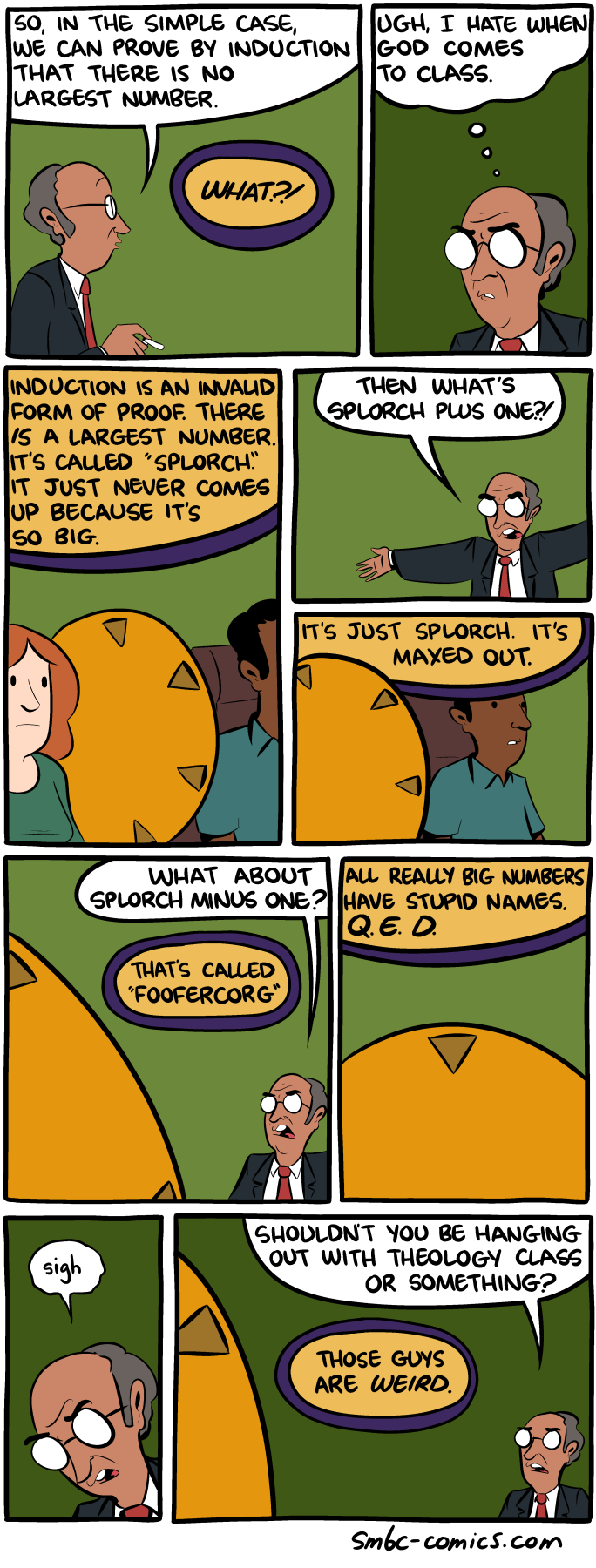
Saturday Morning Breakfast Cereal - The Largest Number

by admin@smbc-comics.com

Hovertext: The third largest number is called Weinersmith.


New comic!
Today's News:

 2...

19 Oct 23:15

ad blocking

by tomfishburne

"Ad Blocking" cartoon

The Interactive Advertising Bureau issued a remarkable mea culpa last week about the state of online advertising. In response to the rise of ad-blocking software, IAB VP Scott Cunningham said digital advertisers should take responsibility for annoying people and driving them to use ad blockers:

“We messed up. As technologists, tasked with delivering content and services to users, we lost track of the user experience….

“We build advertising technology to optimize publishers’ yield of marketing budgets that had eroded after the last recession. Looking back now, our scraping of dimes may have cost us dollars in consumer loyalty…

“The consumer is demanding these actions, challenging us to do better, and we must respond.”

The IAB goes on to introduce new advertising principles called L.E.A.N. (Light, Encrypted, Ad choice supported, Non-invasive ads) as a start.

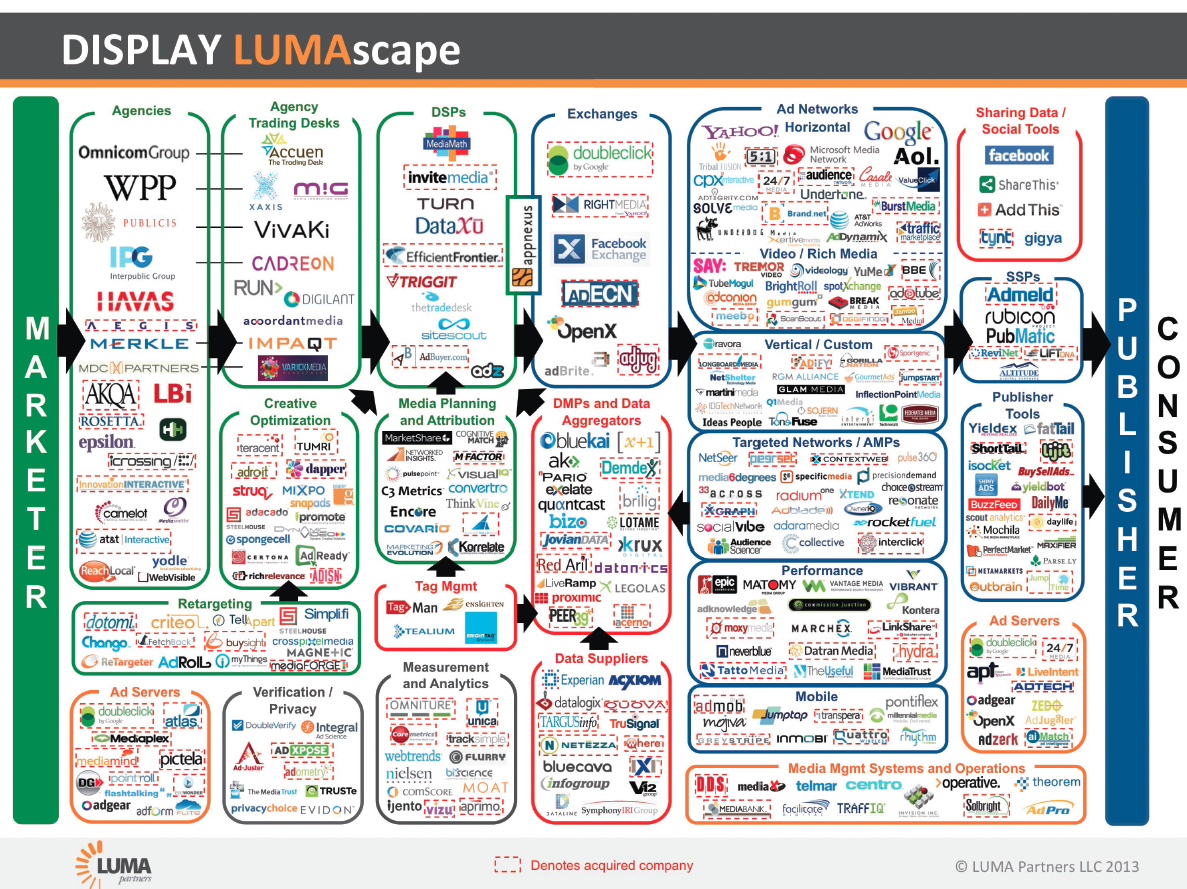
This is a fundamental shift in vantage point for the Ad Tech world. In 2013, LUMApartners famously created its first LUMAscape capturing all of the fragmented, disparate Ad Tech players involved in the processing of serving up an ad to a consumer. It’s an industry organized around itself, not around the needs of the consumer. Thus we see retargeting ads for sweaters we’ve already bought, video ads that auto-play with sound, and pop-ups that take over your screen.

Lumascape-Display-Ad-tech

The rise of ad blockers represents a significant identity threat for advertisers and publishers. But it also highlights a truism of modern marketing – there is no such thing as a captive audience. All media is earned media. Even when marketers pay for media, we have to earn people’s attention.

I’d love to hear your thoughts on the implications for ad blockers for marketers.

19 Oct 23:10

Overthinking

On the other hand, it took us embarrassingly long to clue in to the lung cancer/cigarette thing, so I guess the real lesson is "figuring out which ideas are true is hard."
18 Oct 19:06

Last Thoughts

by Greg Ross

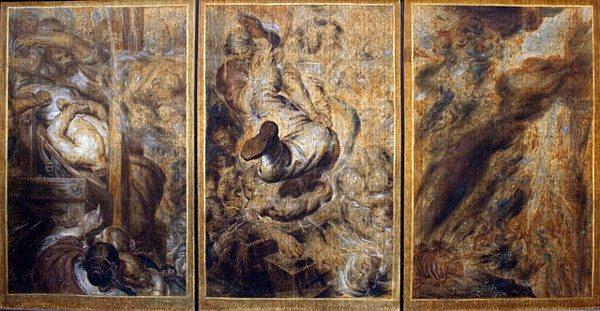
https://commons.wikimedia.org/wiki/File:The_visions_of_a_guillotined_head.jpg

Belgian painter Antoine Wiertz unveiled a gruesome triptych in 1853: Thoughts and Visions of a Severed Head depicts a guillotined head’s impressions of its final three minutes of awareness.

Wietz added a verbal description of each of the panels. Here’s an excerpt from the second minute, “Under the Scaffold”:

For the first time the executed prisoner is conscious of his position.

He measures with his fiery eyes the distance that separates his head from his body and tells himself, ‘My head really is cut off.’

Now the frenzy redoubles in force and energy.

The executed prisoner imagines that his head is burning and turning on itself, that the universe is collapsing and turning with it, that a phosphorescent fluid is whirling around his skull as it melts down.

In this midst of this horrible fever, a mad, incredible, unheard of idea takes possession of the dying brain.

Would you believe it? This man whose head has been chopped off still conceives of a hope. All the blood that remains bubbles, gushes, and courses with fury through all the canals of life to grasp at this hope.

At this moment the executed prisoner is convinced that he is stretching out his convulsive and rage-filled hands toward his expiring head.

I don’t know what this imaginary movement means. Wait … I understand … It’s horrible!

Oh! My God, what is life that it continues the struggle to the very last drop of blood?

In the same year, American author Theodore Witmer had recorded his own impressions of seeing an execution in the 1840s. “Why don’t somebody give us ‘The Reflections of a Decapitated Man?'” he asked. “If it turned out stupid, he might excuse himself for want of a head.”

Please support Futility Closet on Patreon!

18 Oct 18:50

Artist Theaster Gates Bought a Crumbling Chicago Bank for $1 and Turned it Into a World-Class Arts Center

by Christopher Jobson

stony-island-1
Tom Harris © Hedrich Blessing. Courtesy of Rebuild Foundation.

One might think that an abandoned 1920s bank on Chicago’s South Side, crumbling from top to bottom—the roof long collapsed, exposing the interior to snow and rain for years—would be destined for a wrecking ball. Like so many other decaying structures in the area, that was certainly the fate of the Stony Island Savings & Loan building before artist, urban planner, and Chicago resident Theaster Gates intervened.

Armed with only a vision to carry him through, Gates acquired the 20,000-square-foot bank for $1.00 from the city of Chicago and set about an unbelievable restoration. This month, amidst all the hubbub of Chicago’s Architecture Biennale, the doors were thrown open and the public was given the opportunity to walk through the new Stony Island Arts Bank. While construction is complete, several details of the bank’s history including peeling paint and damaged ceiling tiles have been preserved to physically merge the past and present.

stony-island-2
Steve Hall © Hedrich Blessing. Courtesy of Rebuild Foundation.

stony-island-10
Steve Hall © Hedrich Blessing. Courtesy of Rebuild Foundation.

The Stony Island Arts Bank is a place that proudly defies convention. A community savings and loan bank shuttered since the 1980s turned into a world-class arts center in the middle of a greatly under-resourced community most in need of bold ideas. It’s the kind of place that civic leaders propose and residents dream of, but for a thousand reasons it never seems to materialize. And yet here it is.

Gates’ idea has now manifested itself as a platform for site-specific exhibitions and commissions, artist residencies, and as a home for the Rebuild Foundation, a nonprofit organization founded by the artist in 2010 that seeks specifically to foster culture and development in underinvested neighborhoods. In addition, the arts bank houses the vinyl archive of Frankie Knuckles, regarded as the “Godfather of House Music,” as well as 60,000 glass lantern slides from the University of Chicago and the School of the Art Institute. You can also find the personal magazine and book collection of John H. Johnson, founder of Ebony and Jet magazines.

In a press release Gates describes the Arts Bank as “an institution of and for the South Side,” “a repository for African American culture and history, a laboratory for the next generation of black artists,” and “a space for neighborhood residents to preserve, access, reimagine and share their heritage, as well as a destination for artists, scholars, curators, and collectors to research and engage with South Side history.”

stony-island-5
Tom Harris © Hedrich Blessing. Courtesy of Rebuild Foundation.

stony-island-6
Tom Harris © Hedrich Blessing. Courtesy of Rebuild Foundation.

stony-island-3
Steve Hall © Hedrich Blessing. Courtesy of Rebuild Foundation.

The building’s first exhibition is by Portuguese artist Carlos Bunga, whose installation Under the Skin introduces towering cardboard columns to the bank’s towering first-floor gallery. The facility will undoubtedly be used as a place for black artists, community members, and other individuals to experiment with and engage with the South Side, in an environment Gates refers to as a “laboratory.”

“Projects like this require belief more than they require funding,” Gates tells Fast Company. “If there’s not a kind of belief, motivation, and critical aggregation of people who believe with you in a project like this, it cannot happen. The city is starting to realize that there might be other ways of imagining upside beside ‘return on investment’ and financial gain.”

You can visit the new arts bank Tuesday through Saturday, 11am-6pm. (via Fast Company, the Chicago Reader).

stony-island-9
Tom Harris © Hedrich Blessing. Courtesy of Rebuild Foundation.

stony-island-7
Steve Hall © Hedrich Blessing. Courtesy of Rebuild Foundation.

stony-island-8
Steve Hall © Hedrich Blessing. Courtesy of Rebuild Foundation.

stony-island-4
Tom Harris © Hedrich Blessing. Courtesy of Rebuild Foundation.

17 Oct 18:57

19-06-2015

by Laerte Coutinho

16 Oct 00:59

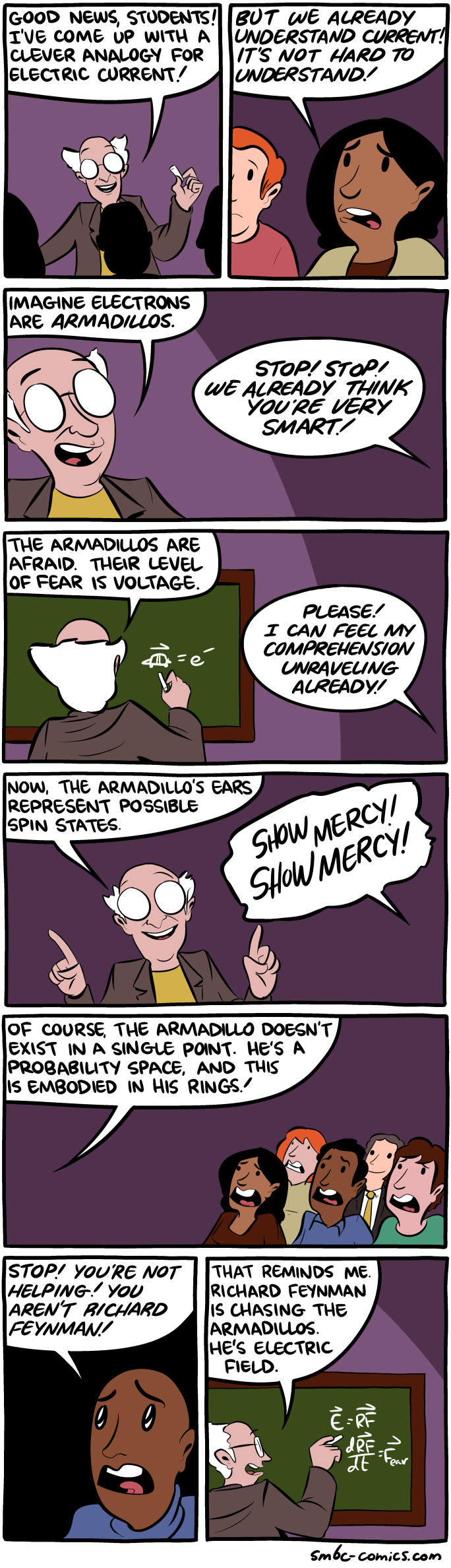
Saturday Morning Breakfast Cereal - Analogies

by admin@smbc-comics.com

Hovertext: The armadillo is actually a META-analogy for a cow, which is an analogy for flux.


New comic!
Today's News:

Only about 50 tickets left for BAHFest West! We will probably sell out by tomorrow, so please buy soon if you don't want to miss out.

15 Oct 16:56

How is NSA breaking so much crypto?

by brandizzi

There have been rumors for years that the NSA can decrypt a significant fraction of encrypted Internet traffic. In 2012, James Bamford published an article quoting anonymous former NSA officials stating that the agency had achieved a “computing breakthrough” that gave them “the ability to crack current public encryption.” The Snowden documents also hint at some extraordinary capabilities: they show that NSA has built extensive infrastructure to intercept and decrypt VPN traffic and suggest that the agency can decrypt at least some HTTPS and SSH connections on demand.

However, the documents do not explain how these breakthroughs work, and speculation about possible backdoors or broken algorithms has been rampant in the technical community. Yesterday at ACM CCS, one of the leading security research venues, we and twelve coauthors presented a paper that we think solves this technical mystery.

The key is, somewhat ironically, Diffie-Hellman key exchange, an algorithm that we and many others have advocated as a defense against mass surveillance. Diffie-Hellman is a cornerstone of modern cryptography used for VPNs, HTTPS websites, email, and many other protocols. Our paper shows that, through a confluence of number theory and bad implementation choices, many real-world users of Diffie-Hellman are likely vulnerable to state-level attackers.

For the nerds in the audience, here’s what’s wrong: If a client and server are speaking Diffie-Hellman, they first need to agree on a large prime number with a particular form. There seemed to be no reason why everyone couldn’t just use the same prime, and, in fact, many applications tend to use standardized or hard-coded primes. But there was a very important detail that got lost in translation between the mathematicians and the practitioners: an adversary can perform a single enormous computation to “crack” a particular prime, then easily break any individual connection that uses that prime.

How enormous a computation, you ask? Possibly a technical feat on a scale (relative to the state of computing at the time) not seen since the Enigma cryptanalysis during World War II. Even estimating the difficulty is tricky, due to the complexity of the algorithm involved, but our paper gives some conservative estimates. For the most common strength of Diffie-Hellman (1024 bits), it would cost a few hundred million dollars to build a machine, based on special purpose hardware, that would be able to crack one Diffie-Hellman prime every year.

Would this be worth it for an intelligence agency? Since a handful of primes are so widely reused, the payoff, in terms of connections they could decrypt, would be enormous. Breaking a single, common 1024-bit prime would allow NSA to passively decrypt connections to two-thirds of VPNs and a quarter of all SSH servers globally. Breaking a second 1024-bit prime would allow passive eavesdropping on connections to nearly 20% of the top million HTTPS websites. In other words, a one-time investment in massive computation would make it possible to eavesdrop on trillions of encrypted connections.

NSA could afford such an investment. The 2013 “black budget” request, leaked as part of the Snowden cache, states that NSA has prioritized “investing in groundbreaking cryptanalytic capabilities to defeat adversarial cryptography and exploit internet traffic.” It shows that the agency’s budget is on the order of $10 billion a year, with over $1 billion dedicated to computer network exploitation, and several subprograms in the hundreds of millions a year.

Based on the evidence we have, we can’t prove for certain that NSA is doing this. However, our proposed Diffie-Hellman break fits the known technical details about their large-scale decryption capabilities better than any competing explanation. For instance, the Snowden documents show that NSA’s VPN decryption infrastructure involves intercepting encrypted connections and passing certain data to supercomputers, which return the key. The design of the system goes to great lengths to collect particular data that would be necessary for an attack on Diffie-Hellman but not for alternative explanations, like a break in AES or other symmetric crypto. While the documents make it clear that NSA uses other attack techniques, like software and hardware “implants,” to break crypto on specific targets, these don’t explain the ability to passively eavesdrop on VPN traffic at a large scale.

Since weak use of Diffie-Hellman is widespread in standards and implementations, it will be many years before the problems go away, even given existing security recommendations and our new findings. In the meantime, other large governments potentially can implement similar attacks, if they haven’t already.

Our findings illuminate the tension between NSA’s two missions, gathering intelligence and defending U.S. computer security. If our hypothesis is correct, the agency has been vigorously exploiting weak Diffie-Hellman, while taking only small steps to help fix the problem. On the defensive side, NSA has recommended that implementors should transition to elliptic curve cryptography, which isn’t known to suffer from this loophole, but such recommendations tend to go unheeded absent explicit justifications or demonstrations. This problem is compounded because the security community is hesitant to take NSA recommendations at face value, following apparent efforts to backdoor cryptographic standards.

This state of affairs puts everyone’s security at risk. Vulnerability on this scale is indiscriminate—it impacts everybody’s security, including American citizens and companies—but we hope that a clearer technical understanding of the cryptanalytic machinery behind government surveillance will be an important step towards better security for everyone.

For more details, see our research paper: Imperfect Forward Secrecy: How Diffie-Hellman Fails in Practice. (Update: We just received the Best Paper Award at CCS 2015!)

J. Alex Halderman is an associate professor of Computer Science and Engineering at the University of Michigan and director of Michigan’s Center for Computer Security and Society.

Nadia Heninger is an assistant professor of Computer and Information Science at the University of Pennsylvania.

This entry passed through the Full-Text RSS service - if this is your content and you're reading it on someone else's site, please read the FAQ at fivefilters.org/content-only/faq.php#publishers.

15 Oct 16:55

These ‘Chiseled’ Glass Wave Vessels by Graham Muir Appear Frozen in Motion

by Christopher Jobson

wave-1

Precariously resting atop a pedestal, these wave-like glass vessels by Scottish artist Graham Muir seem to defy gravity as if frozen in a moment before crashing into the ocean. Using techniques perfected over the last decade, Muir achieves delicate shapes that seem almost chiseled or fractured, but are in fact accomplished when working while the glass is still hot. He shares via his artist statement:

Such work speaks quietly of the harmony between maker or makers and the medium. It is often the result of a path that involves many failed attempts but results in a piece all the stronger for that, where nothing needs neither added nor taken away.

I find glass to be a material that does not respond well to being dominated by the artist. For me the concept of the work is just the starting point for a conversation between the artist’s idea and the material. The artist flags up the idea, the medium responds and the discussion begins. However the material must not dominate proceedings either and hot glass, as most who work in it know, can be very persuasive in having its own way.

Muir most recently had pieces on view as part of an exhibition of Scottish makers through Gallery TEN at Saatchi Gallery during Collect in London earlier this year. You can see more of his waves on his website. (via My Modern Met)

wave-2

wave-3

wave-4

wave-5

wave-7

wave-6

15 Oct 08:20

Mentirinhas #883

by Fábio Coala

mentirinhas_871

Um mundinho virtual pra chamar de nosso.

O post Mentirinhas #883 apareceu primeiro em Mentirinhas.

15 Oct 08:15

Saturday Morning Breakfast Cereal - Trading

by admin@smbc-comics.com

Hovertext: The silk neckerchief bubble was a dandy catastrophe.


New comic!
Today's News:
15 Oct 08:07

Don’t Talk

by Reza

dont-talk

13 Oct 11:58

Should we trust the young Turkers?

by Tim Harford
Undercover Economist

‘MTurk may be something of an unknown quantity but it is more diverse than the traditional study pool’

Everyone knows that Amazon turns industries on their heads, from books and ebooks to cloud computing. But most people do not realise that Amazon is also upending social science research, thanks to a service called Amazon Mechanical Turk — often known as MTurk or Turk.

MTurk is an online labour marketplace, originally designed to recruit people to do small tasks that computers couldn’t manage — for example, training a spam filter by categorising emails, deciding whether a photograph matched its description, transcribing audio recordings or flagging adult content. Thanks to MTurk, an employer can hire freelancers to work cheaply on a wide variety of computerised tasks.

Psychologists, behavioural economists and political scientists have now realised that it is potentially far cheaper to pay MTurk workers — “Turkers” — to answer questionnaires and participate in activities than it is to assemble a bespoke online panel or to conduct the research in a laboratory filled with student participants sitting at computers. For just a few dollars and at very short notice, economists can look at competition and co-operation, psychologists can examine the way memory works and political scientists can investigate how our ideology skews our logic. The opportunities are vast and have been swiftly embraced.

“The majority of papers presented at the conferences I go to now use Turk,” says Dan Goldstein, a cognitive psychologist at Microsoft Research. Goldstein, an academic who has also worked at London Business School and Columbia University, has used MTurk in his own research, for instance, into the impact of distracting online display ads.

This stampede to MTurk has made some researchers uneasy. Dan Kahan of Yale Law School studies “motivated reasoning” — the way our goals or political opinions can influence the way we process conflicting evidence. He has written a number of pieces warning about the careless use of the Amazon Turk platform.

The most obvious objection is that Turkers aren’t representative of any particular population one might wish to examine. As an illustration of this, two political scientists hired more than 500 Turkers to complete a very brief survey on the day of the 2012 US presidential election. (Tellingly, the entire survey cost the researchers just $28 and the results arrived within four hours.) The researchers, Sean Richey and Ben Taylor, found that 73 per cent of their Turkers said they had voted for Barack Obama; 12 per cent had voted for “other” — compared with 1.6 per cent of all voters. Mitt Romney polled vastly worse with the Turkers than the US public as a whole. Relative to the general population, Turkers were also more likely to vote and be young, male, poor but highly educated. Or so they claimed; it is hard to be sure.

Another objection is that Turkers chat with each other on message boards about the work they’re doing. If a piece of research involves some sort of trick question, they may compare answers. If it measures the ability of workers to co-ordinate without communicating, that communication may be happening anyway through back channels. Researchers may pose clever questions designed to measure personality traits or to probe for logical lapses, not realising the Turkers have seen these questions before and yawn when they roll round again.

Kahan wants academic journals to show more scepticism of MTurk research, and to require researchers to justify their methods in some detail. MTurk may be cheap, says Kahan, but sitting at your desk and thinking through a thought experiment is even cheaper. It doesn’t make either method valid.

Other researchers evidently disagree — perhaps because, in a more purely psychological study, what matters is that Turkers are representatives of the human race rather than of a particular rainbow of American political opinion. Many familiar results from psychology have been replicated on MTurk without trouble.

There’s pragmatism at work here too. After all, the traditional piece of psychological research has been conducted on a small number of undergraduates at Ivy League universities. (Historically, such undergraduates were typically white and male, into the bargain.) MTurk may be something of an unknown quantity but it is more diverse than the traditional study pool. Research can be conducted on a much larger group of subjects, and quickly — no more must researchers wait for students to return after the summer break.

For Dan Goldstein, the downsides are manageable and the advantages enormous. The speed of the research means far more rapid progress and, because MTurk is so cheap, much larger samples can be used. He thinks it’s a big improvement on what went before.

“I think it is one of the most important and beneficial innovations in the history of psychology,” he says, before adding the obvious caveat that like any research tool, it must be wielded with skill.

The original Mechanical Turk was an 18th-century chess-playing “robot” that, in reality, concealed a human chess player. There is something of the Wizard of Oz about the idea — and after a few decades of creating wonderment, the Turk was eventually exposed as nothing more than a clever and seductive trick. For Turk-sceptic Dan Kahan, the analogy is delicious. Having been fooled by a Mechanical Turk once, he says, we should be ashamed to be fooled again.

Written for and first pblished at ft.com.

13 Oct 11:35

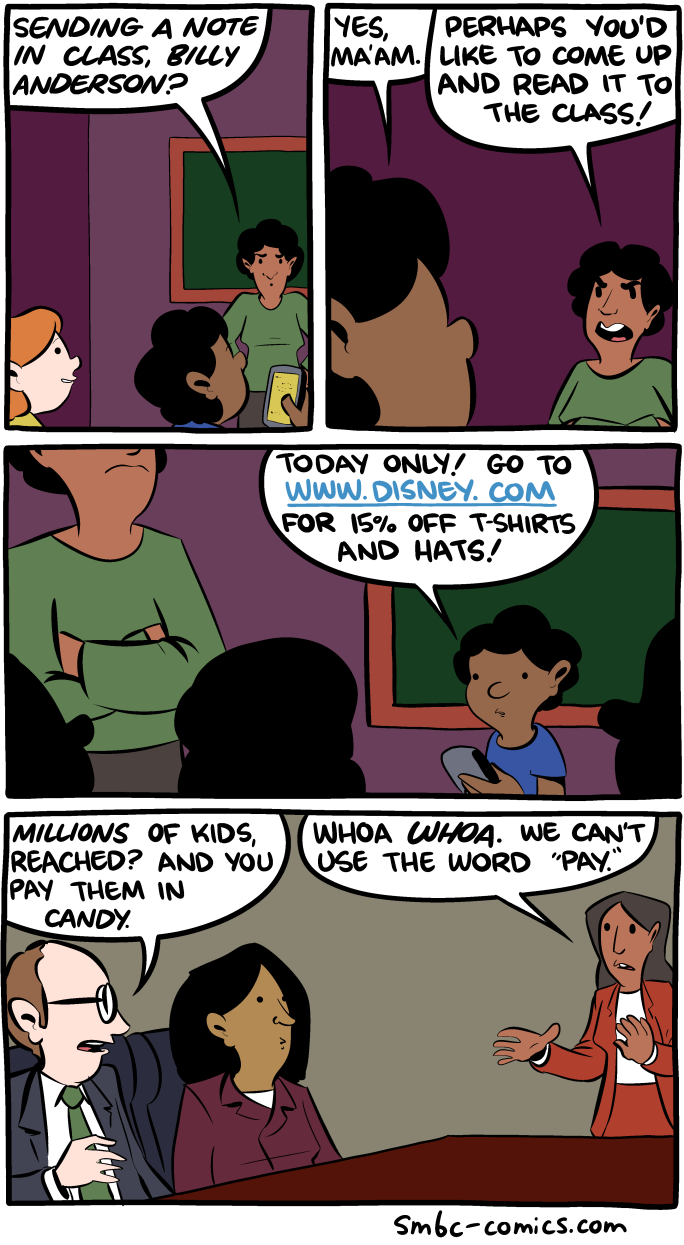
Saturday Morning Breakfast Cereal - Texting in Class

by admin@smbc-comics.com

Hovertext: In my original script, they passed a note. I am told this is no longer the protocol for finding out whether you like LIKE me.


New comic!
Today's News:

What a wonderful BAHFest it was. I hadn't reckoned on how very very nerdy Seattle is. Won't make that mistake next year.

And now... we turn our eyes to... BAHFest West. 

13 Oct 11:32

So to Speak

by Greg Ross

What do these words have in common?

DEVIOUS
EFFENDI
ENEMY
ENVIOUS
ESCAPEE
ODIOUS
OPIUM
TEDIOUS
ANEMONE
ARCADIAN
EXCELLENCY
OBEDIENCY
EXPEDIENCY

Click for solution …

Please support Futility Closet on Patreon!

13 Oct 11:29

Photo


13 Oct 11:28

Comic for October 13, 2015

by Scott Adams
It Takes More Than Luck - Dilbert by Scott Adams

This entry passed through the Full-Text RSS service - if this is your content and you're reading it on someone else's site, please read the FAQ at fivefilters.org/content-only/faq.php#publishers.

12 Oct 23:46

An Elegant Kinetic Sculpture by Derek Hugger that Mimics the Flight of a Hummingbird

by Christopher Jobson

Containing over 400 precisely machined gears, screws, and aesthetic elements, Derek Hugger’s latest kinetic sculpture Colibri mimics the motion of a hummingbird in flight. Though the motions of flying are unmistakable, the piece has much more in common with a clock than a bird. He shares about the piece:

Every element of motion has been completely mechanized, from the beating wings to the flaring tail. Intricate systems of linkages and cams bring the sculpture to life with a continuous flow of meticulously timed articulations. As each mechanism has been linked to the next, Colibri cycles through its complete range of motions by the simple turn of a crank. This project took me roughly 700 hours and contains about 400 parts.

You can see many more of his moving artworks on his website, and in a refreshingly rare move he also sells detailed instructions of how to make them in his shop. (via The Automata Blog)

HUMMING

coli_2

coli_3

coli_4

12 Oct 23:45

New Murals and Art Installations at ‘Life is Beautiful’ 2015

by Christopher Jobson

PixelPancho3
Pixel Panco

AnaMaria4
Ana Maria

LAS VEGAS — Last month, walls across an area of Old Las Vegas were covered in murals and installations by over 15 artists ahead of the third annual Life is Beautiful music and art fest. Curated by Charlotte Dutoit of JUSTKIDS, the works included pieces by several artists seen lately here on Colossal including Bordalo II, Bikismo, Ana Maria, D*FACE, Pixel Pancho, Filthy Luker, 1010, and Ruben Sanchez. Even Banksy’s famous All City waterfall truck made an appearance.

The Life is Beautiful festival is just one part of the ambitious Downtown Project, an endeavor backed heavily by Zappo’s Tony Hsieh as a means of fostering entrepenurship, creativity, art, and innovation in the Old Vegas area. Long after the festival’s stages and speakers are packed away, the 30+ cumulative murals over the last three years have made the area an easily walkable destination for lots of great street art—a welcome distraction for many from the overwhelming attractions nearby.

In addition to murals the event also included an entire abandoned motel transformed into an ‘Art Motel’ by APEX, talks from the likes of Bill Nye and Rosario Dawson, and plenty of food provided by a swarm of local chefs.

You can see more images from the event over on Complex and StreetArtNews. Photos courtesy Rom Levy.

Bikismo3
Bikismo

bordalo
Bordalo II

Dface5
D*Face

FilthyLuker3
Filthy Luker

RubenSanchez6
Ruben Sanchez

1010
1010

12 Oct 23:45

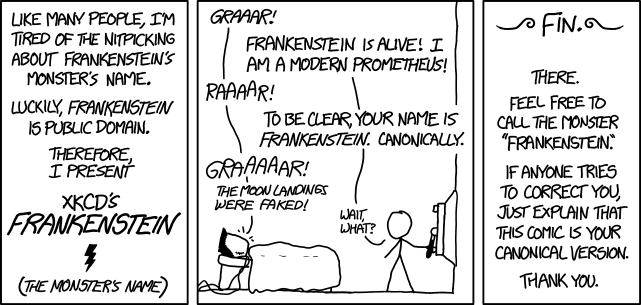
Frankenstein

"Wait, so in this version is Frankenstein also the doctor's name?" "No, he's just 'The Doctor'."
12 Oct 23:44

Comic for 2015.10.12

by Dave McElfatrick

This entry passed through the Full-Text RSS service - if this is your content and you're reading it on someone else's site, please read the FAQ at fivefilters.org/content-only/faq.php#publishers.

12 Oct 23:43

Don’t Talk to Me

by Reza

dont-talk