


Antes
Depois
De Pyongyang, Coreia do Norte
Inaugurada em um megaevento que reuniu 150 mil pessoas em Pyongyang há quase um ano, a estátua de Kim Jong-il passou por uma repaginação seis meses mais tarde para alteração de seu guarda-roupa.
A versão original do monumento apresentava o líder morto em dezembro de 2011 com um sobretudo semelhante ao usado por seu pai, Kim Il-sung, representado na estátua ao lado.
Mas os norte-coreanos provavelmente tiveram dificuldade em identificar seu “querido líder” dentro do sobretudo, mesmo que mais curto que o usado por seu pai, o “grande líder”.
Kim Jong-il não era visto em público com esse tipo de casaco e preferia uma japona com características únicas, de tecido levemente brilhante e quase sempre bege. O equivoco estilístico foi corrigido e Kim Jong-il agora está vestido com sua roupa predileta.
As estátuas estão no monte Mansudae, visto como um local sagrado pelos norte-coreanos. Todos os dias, muitos vão fazer reverência diante das imagens do fundador da dinastia que governa o país desde 1948, Kim Il-sung, e de seu filho, Kim Jong-il, pai do atual líder, Kim Jong-un.
Quando a reportagem do Estado esteve no local nesta semana, dois casais de noivos subiram a longa escadaria que leva às estátuas e fizeram reverências que certamente estarão em seus álbuns de casamento _um fotógrafo os acompanhava para registrar a cena.

José ‘Pepe’ Mujica, ex-guerrilheiro tupamaro e atual presidente do Uruguai causou polêmica com mais uma de suas peculiares frases. Desta vez o foco eram assuntos etários da presidente Cristina e a órbita ocular esquerda do fenecido N.Kirchner.
“Esta velha é pior que o caolho”. A insólita frase foi disparada na quinta-feira pelo presidente do Uruguai, José Mujica, em alusão à presidente argentina Cristina Kirchner e seu marido, morto em 2010, o ex-presidente Néstor Kirchner, que tinha o estrabismo (e não era propriamente “caolho”) como uma de suas mais famosas marcas físicas. Mujica, conhecido por seus comentários sinceros – geralmente fora de protocolo – fez estas declarações durante uma reunião com o prefeito da cidade uruguaia de Florida e outros políticos. Mas, não percebeu que os microfones estavam ligados e que a imprensa reunida no lugar ouviu suas observações sobre a dificuldade nas relações do Uruguai com a Argentina.
“O caolho era mais político…esta velha é mais teimosa”, acrescentou Mujica em relação ao casal Kirchner. O presidente uruguaio também indicou que sempre que precisa resolver algo com a Argentina precisa pedir ajuda ao Brasil.
“Não vou dar bola nem percorrer o mundo esclarescendo coisa alguma”, disse Mujica aos jornalistas minutos depois, quando soube que sua frase havia sido ouvida.
No entanto, nas primeiras horas, em vez de sofrer críticas, Mujica tornou-se um virtual herói nas redes sociais, onde sua frase era celebrada no Facebook. No Twitter, virou hashtag, o “#EstaViejaEsPeorQueElTuerto” (#EstaVelhaEPiorQueOCaolho) por parte de tuiteiros uruguaios e argentinos.
Ao longo dos últimos anos o Uruguai sofreu uma saraivada de medidas protecionistas comerciais por parte do governo da presidente Cristina Kirchner. O antecessor de Mujica, Tabaré Vázquez (2005-2010), enfrentou um virtual bloqueio na fronteira argentina por parte de manifestantes estimulados pelo governo Kirchner que protestavam contra uma hipotética poluição de uma fábrica de celulose instalado no rio Uruguai, que divide os dois países.
Em 2002, com a pequena economia uruguaia afetada pelo colapso financeiro argentino, o presidente Jorge Batlle causou grande polêmica ao declarar que “os argentinos, do primeiro ao último, são ladrões”. Batlle teve que viajar à Buenos Aires, convocado pelo então presidente Eduardo Duhalde (2002-2003), para pedir desculpas. No entanto, Batlle conseguiu esquivar o pedido de desculpas, chorando em público enquanto rememorava os tempos nos quais havia residido na capital argentina.
CHIMARRÃO - Há poucas semanas a primeira-dama do Uruguai, a senadora Lucia Toplansky – famosa por não ter papas na língua, tal como seu marido – declarou que a relação com a Argentina “era muito complicada” e criticou as barreiras que o governo Kirchner coloca à integração regional.
Lucia e Mujica foram guerrilheiros tupamaros nos anos 70. O atual presidente foi brutalmente torturado durante treze anos pelo regime militar.
Mujica também ironizou a recente viagem de Cristina Kirchner à Roma, onde reuniu-se com o cardeal Jorge Bergoglio, entronizado como papa Francisco, a quem entregou de presente uma cuia de chimarrão com uma bomba. Na ocasião, Cristina explicou detalhes sobre como beber chimarrão a Bergoglio, que sempre tomou esta infusão clássica dos Pampas. “Para um papa argentino, com 77 anos de idade, ela (Cristina Kirchner), vai explicar o que é uma cuia e uma garrafa térmica?”, disse Mujica, estupefato.
No mesmo dia, o ex-presidente Luiz Inácio Lula da Silva, ao visitar o Uruguai, sem saber sobre as declarações do presidente uruguaio, defendeu a integração do Mercosul e declarou que “nunca viu ninguém como Mujica”.
No fim da turbulenta jornada, em Buenos Aires, o chanceler Héctor Timermam convocou o embaixador uruguaio para passar uma carraspana e ressaltar seu desgosto sobre os comentários etários sobre Cristina e a órbita ocular do fenecido Kirchner.
Em um comunicado, o Palácio San Martín sustentou que os comentários eram “inaceitáveis e denigrentes”. Além disso, destacou que a presidente Cristina não realizaria comentários sobre o assunto.

A gafe que virou “cumbia”: a frase de Mujica sobre Cristina e Nestor Kirchner inspirou um compositor uruguaio:
PERFIS - Os analistas destacam que os dois presidentes platinos, embora conjunturais aliados no Mercosul, possuem perfis de vida extremamente diferentes.
Mujica esteve preso durante 13 anos, entre 1972 e 1985 em diversos cárceres da ditadura uruguaia, onde foi brutalmente torturado. No mesmo período a presidente Cristina Kirchner enriqueceu como advogada na Patagônia executando hipotecas de pessoas falidas pela política econômica do regime militar argentino. Enquanto que Cristina tem apreço pelas griffes de luxo (e é a segunda presidente mais rica da América do Sul, segundo dados da declaração oficial de bens), Mujica mora em um casebre em sua espartana chácara. Há poucos anos trocou sua lambreta por um Volkswagen modelo 1982.
FRASES DE MUJICA (desde sua posse presidencial)
“Ser livre é gastar a maior quantidade de tempo de nossa vida naquilo que a gente gosta de fazer”.
“Se eu tivesse muitas coisas, teria que me ocupar com elas. A verdadeira liberdade está em consumir pouco”.
“O poder não muda as pessoas…só revela quem elas são verdadeiramente”.
“Não se intimidem, companheiros..gostem muito uns dos outros. Mas, nem tanto a ponto de perdoar as cagadas…”
“Talvez esteja errado, pois eu erro muito…mas eu o digo do jeito que o pensei”.
“Pelo caminho mais longo a viagem é mais curta”.
“Não encha a paciência, meu! Qualquer problema passa lá em casa e a gente bebe uns vinhos”.

 PERFIL: Ariel Palacios fez o Master de Jornalismo do jornal El País (Madri) em 1993. Desde 1995 é o correspondente de O Estado de S.Paulo em Buenos Aires. Além da Argentina, também cobre o Uruguai, Paraguai e Chile. Ele foi correspondente da rádio CBN (1996-1997) e da rádio Eldorado (1997-2005). Ariel também é correspondente do canal de notícias Globo News desde 1996.
Em 2009 “Os Hermanos“ recebeu o prêmio de melhor blog do Estadão (prêmio compartilhado com o blogueiro Gustavo Chacra).
 Acompanhe-nos no Twitter, aqui.
 …E leia os supimpas blogs dos correspondentes internacionais do Estadão:
 E, de bonus track, veja o Facebook da editoria de Internacional do Portal do Estadão, aqui.


On Christmas night 1945, Army serviceman Frank Hayostek tossed a bottle over the rail of the troopship that was carrying him home from France. It contained this message:
Dear Finder,
I am an American soldier … 21 years old … just a plain American of no wealth, but just enough to get along with. This is my third Christmas from home. … God bless you.
In September 1946, he received a letter from Ireland:
I have found your bottle and note. I will tell you the whole story.
I live on a farm at the southwest coast of Ireland. On Friday, Aug. 23, 1946, I drove the cows to the fields beside the sea and then went for walk on the strand called The Beal. It is an inlet of Dingle Bay.
Well, my dog was running before me and I saw him stop and sniff something light on the sand, and then he went off in pursuit of sea gulls. I found the object was a brown bottle. … The cork … crumbled in my fingers. How the note kept dry, nobody can understand. … I sat there on the beach and read it.
I thought at first I was dreaming. This is just a little common Irish village where nothing strange ever occurs, and this is something for the farmers to talk about while they cut the oats and bring the hay into the barn. Well, imagine, the bottle has been on the sea for eight months. … Who knows where it has been? It may have traveled around the world. How did it escape being broken on the rocks? If you had only seen where I got it! It’s all a mess of rocks. The hand of Providence must surely have guided it.
Well, I hope to hear from you soon. … You mention offering no reward to the finder of the bottle. Well, I ask no reward, as it was a very pleasant surprise. Wishing you very good luck, your loving friend,
Breda O’Sullivan
Hayostek and O’Sullivan exchanged 70 letters over the next seven years. She was a farm girl in the village of Lispole in County Kerry, and he found work as a welder in Johnstown, Pa., saving $80 a month in order to visit her.
In August 1952 Hayostek flew to Ireland, where both were besieged by reporters.
“It’s in the hands of God,” he said. “She’s very nice.”
“After all,” she said, “we only met a few hours ago. Up to then, he was only a man in a bottle.”
But after two weeks O’Sullivan announced, “There is no romance and there will be no wedding. We will remain good pen pals.” She continued to correspond with Hayostek until 1959, when she married a local man. “If I had known that I would get all that publicity by answering the letter,” she told a reporter later, “I would have left the bottle lying there.”
Hayostek may have felt differently. His gravestone reads: “Frank L Hayostek, June 11, 1924-November 15, 2009: Frank Hayostek met in Tralee, Ireland, with Breda O’Sullivan who found a message-laden bottle he had tossed from a Liberty ship seven years before.”
Esse é um bom exemplo para valorizarmos o trabalho do redator, esse ser inusitado que quase sempre é odiado por mandar o .doc via email e ir mais cedo pra casa. Tem que ver isso aí.
Com frases criativas, o “Candy Project” foi capaz de aumentar as vendas de balas em um semáforo de São Paulo.
O vendedor Tiago trabalha há 9 anos no mesmo lugar, levando em média 5 horas para vender 250 unidades. Com o novo texto, conseguiu terminar o expediente antes e arrancar sorrisos dos motoristas.
Veja todas as frases aqui.


 Post originalmente publicado no Brainstorm #9
Twitter | Facebook | Contato | Anuncie
Amid bank bailouts and global recession, an unknown hacker operating under the false name Satoshi Nakamoto released an open-source code for a global, digital currency in January 2009. Running on a decentralized peer-to-peer online network, the currency does not rely on governments, corporations, or any single entity. It is also anonymous. The initial code contained a reference to a recent headline from The Times, “Chancellor on brink of second bailout for banks.” Nakamoto named the currency Bitcoin.

The idea spread on forums that saw in Bitcoin’s anonymity and decentralized nature a social and economic revolution that challenges the supremacy of governments and the financial industry. It attracted libertarians and “cypherpunks.”
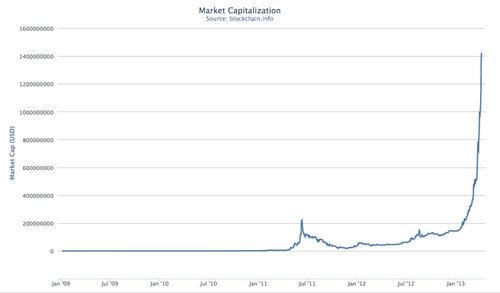
Four and a half years later, monetary systems still threaten to implode, but Bitcoin shows signs of escaping its niche. There are nearly 11 million bitcoins with a value of roughly $128 in circulation, resulting in a market worth $1.4 billion. A small number of stores and early technology adopters like Reddit and Wordpress accept Bitcoin as payment, the American government has released guidelines regulating its use, and venture capital including Y Combinator has invested in Coinbase, a bitcoin startup.
It also screams bubble. Bankers enjoy speculating on Bitcoin’s wildly unstable price, people are overwhelming exchanges in their frenzy to buy, and only a minority of users seem to be actually buying anything with the currency.
Bitcoin is unknown territory. It draws praise from Silicon Valley fixture Paul Graham and simultaneous dismissal from Nobel Prize winning economist Paul Krugman. Although the buzz has focused on Bitcoin’s counterculture aspects, the currency’s potential for cost savings offers a compelling incentive for widespread adoption beside a desire for a cyberspace utopia or belief that the global banking system may collapse. Whether it will prove to be a feasible currency and, if Bitcoin does carve out a role in our lives, whether it will maintain its cypherpunk roots as it moves mainstream, remains an open question.
From Beenz to Bitcoins
Bitcoin is not the first online currency. During the dot com boom of the 1990s, two currencies called beenz and flooz failed to gain traction. E-gold allowed the transfer of gold-backed online currency before shutting down due to legal trouble.

But all digital currencies rely on a company or trusted third party to maintain it. This third party adds or subtracts funds to and from an account linked to each individual in the same way a bank records the money you spend online. Without someone managing those accounts, people could double-spend their money. That is, someone could buy an iPhone with $400 worth of online currency, and then buy a second iPhone with that same online currency, as if they never gave it up.
Bitcoin is the first digital currency to solve the double-spending problem without needing a trusted third party. It does so by keeping a single public record of the ownership and exchange of bitcoins by everyone in the system. To the extent that bitcoins “exist,” they exist as electronic records of their history. Every time a bitcoin is exchanged, a digital signature is added to it. You can imagine the signature as someone marking the coin to indicate the transaction. Every 8 minutes or so, the public record consisting of the electronic history of every bitcoin is sent to a dispersed network of verifiers that must agree that the public leger is correct. In exchange for doing this work, the verifiers are rewarded with new bitcoins, which is how the supply of bitcoins is introduced into the world.
The ownership and exchange of currency remains anonymous through cryptography. As explained by a developer working on Bitcoin, “Even though the transactions are public, the individuals tied to the transactions are anonymous. This is similar to how the stock exchange makes stock values public without disclosing individual owners.”
Bitcoins enter the world at a predictable rate set by the the Bitcoin algorithm until 2140, at which point the supply of bitcoins will max out at 21 million bitcoins. The verifiers are called miners, since the work they do to verify the record, as it earns them bitcoins, is like mining gold. After 2140, the verifiers will be paid via a tiny fee attached to each Bitcoin transaction. Satoshi Nakamoto’s original concept paper is available here.

Bitcoin and Byzantine Generals
The process of “verification” under the Bitcoin model is complicated. If you are feeling undesirous of performing intellectual wind sprints at the moment, feel free to skip the next two sections. Otherwise, let’s dive in.
If there is a large, disperse group of people (or computers really) verifying the public record, each will have an incentive to create a false record that assigns itself more currency than it really has. So how does the group arrive at an agreement on the correct record?
The first part of the solution is that every transaction must be agreed on by both parties, timestamped, and entered publically into the record as it is performed. Since the record accounts for every bitcoin’s entire history, any attempt to falsify the record would be immediately detected as inconsistent and ignored as long as the real record is recognized by the honest verifiers as such.
This problem of identifying the legitimate record is known in Systems Theory as “The Byzantine Generals Problem.” For a long time, people doubted whether an answer existed. So when an unknown man that claimed to be Japanese, used a free German email service, and spoke English like a native speaker dropped the solution into a cypherpunk forum, conspiracy theories cropped up. A team at Google was behind Nakamoto, or the National Security Agency. But Nakamoto disappeared from online forums in 2010, likely taking the answer to the mystery with him.
The Byzantine Generals Problem is eloquently described by Paul Bohm on Quora:
“The Byzantine Generals’ Problem roughly goes as follows: N Generals have their armies camped outside a city they want to invade. They know their numbers are strong enough that if at least 1/2 of them attack at the same time they’ll be victorious. But if they don’t coordinate the time of attack, they’ll be spread too thin and all die. They also suspect that some of the Generals might be disloyal and send fake messages. Since they can only communicate by messenger, they have no means to verify the authenticity of a message. How can such a large group reach consensus on the time of attack without trust or a central authority, especially when faced with adversaries intent on confusing them?
“Bitcoin’s solution is this: All of the Generals start working on a mathematical problem that statistically should take 10 minutes to solve if all of them worked on it. Once one of them finds the solution, she broadcasts that solution to all the other Generals. Everyone then proceeds to extending that solution - which again should take another ten minutes. Every General always starts working on extending the longest solution he’s seen. After a solution has been extended 12 times, every General can be certain that no attacker controlling less than half the computational resources could have created another chain of similar length. The existence of the 12-block chain is proof that a majority of them has participated in its creation. We call this a proof-of-work scheme.”

In the analogy, the generals are the miners - the nodes of the peer to peer network verifying the public record of bitcoin ownership. But they cannot simply compare versions because someone could cheat and flood them with inaccurate records. (This is why the Byzantine Generals can’t trust the messengers). Instead, a set of difficult mathematical problems unique to the pre-existing record are attached to the record every time it is reviewed by the network. The nodes verify the record by solving these problems, which can only be solved through the brute force of a computer guessing solutions. The solutions to these difficult problems are saved in the record, and the number of these solved problems serves as proof of the chain’s authenticity - the record with the longest chain of solutions is assumed to be the correct one.
The computational power required to solve these math problems is extremely high. It results in huge electricity costs, and people doing this work now use specialized hardware that solves the problem more efficiently than normal computers. This is why these verifiers (or miners) are rewarded with newly created bitcoins for doing this work.

A Bitcoin mining rig
Why Byzantium is Unconquerable
Under this system, no one can simply submit a false record from scratch. Since the record does not contain solved mathematical problems serving to authenticate it, it will be ignored. A “rogue general” could try to solve math problems for his false record until it has more solved problems than the real chain. But as the real chain is being constantly added to by the honest generals, it would be nearly impossible to catch up.
What if the rogue general tried to double-spend his bitcoins - purchase something with them (let’s say an iPhone) and then submit a false record showing that he still had those bitcoins?
Well, first the rogue general would have to wait for all the other generals to solve the math problems that authenticated him buying an iPhone with his bitcoins. When the sale is finalized, he would then submit a false record showing that the purchase never took place. But since it has one less set of mathematically solved problems than the record showing that he did spend his coins, the other generals will ignore it and work on the authentic record.
The only way to get everyone else to accept his false chain is for the rogue general to solve the math problems for his false record faster than everyone else can add to the real public record.
The rogue can only succeed if he owns a majority of the computational power (or to follow the analogy, if the majority of the generals collude on the con). This is unlikely. Given that miners are rewarded for their verification work, someone with a majority of the mining/verification capabilities would have an incentive to work on the honest record, earn bitcoins, and maintain the system rather than try to deceive it.
In short: Satoshi Nakamoto is a genius and the system is nearly foolproof.
Whither Bitcoin?
Bitcoin is an elegant solution to a difficult technical problem. But that won’t move millions of people to adopt a new form of money. Bitcoin has three advantages capable of driving its adoption. It decentralizes trust and reduces the control of governments and banks over the money supply; it offers anonymity and freedom from censorship over individuals’ use of their money; and it reduces the fees on online purchases and transfers of money.
1) Decentralizing Trust
If it seems crazy to use a digital currency with no value based in reality, remember that the value of every currency in use today exists only in our heads. Since Richard Nixon ended the gold standard system for American currency, under which an American dollar could be directly converted into gold, no currency has had a basis in a physically valuable product.
Using the American dollar means implicitly trusting American institutions. If the Central Bank chose, it could print money (not literally - see here) until each dollar was worth a fraction of its current price. Or, for example, if the United States failed to service its debt, the value of the dollar would crash. Similarly, we trust banks as caretakers of our money.
Satoshi Nakamoto saw this as a problem:
“The root problem with conventional currency is all the trust that’s required to make it work. The central bank must be trusted not to debase the currency, but the history of fiat currencies is full of breaches of that trust. Banks must be trusted to hold our money and transfer it electronically, but they lend it out in waves of credit bubbles with barely a fraction in reserve. We have to trust them with our privacy, trust them not to let identity thieves drain our accounts.”
Bitcoin instead asks people to trust an algorithm run by a decentralized network and an open-source code that anyone can review.
Derivative trading, bank bailouts, the Euro Crisis, and America’s policy of quantitative easing all offer reason to distrust the institutions responsible for our money. Bitcoin offers an alternative to the traditional monetary supply. Or, if you like, a hedge against the failures or collapse of the global monetary system.
2) Anonymity and Avoiding Censorship
In 2010, Wikileaks publically released thousands of classified American documents. In retaliation, the American government went after its financing. They prevented banks and credit card companies from transferring donations to the organization and made PayPal freeze Wikileak’s account. Wikileaks supporters cried foul, claiming that the government used its control of the financial system to censor speech.
In response, Wikileaks suggested users donate through Bitcoin, which the government lacked control over. The controversial hacker collective Anonymous has also accepted donations through Bitcoin.
Bitcoin’s anonymity can also be seen as a danger. The currency has been used to buy illegal drugs from the online black market Silk Road, and commentators and government agencies have noted its potential usefulness to terrorists, money launderers, and other criminals.
3) Lower Fees
Although buried beneath a wave of press about its cypherpunk and libertarian aspects, Satoshi Nakamoto also saw Bitcoin as revolutionizing the world of finance by reducing fees and costs:
“Commerce on the Internet has come to rely almost exclusively on financial institutions serving as trusted third parties to process electronic payments. While the system works well enough for most transactions, it still suffers from the inherent weaknesses of the trust based model. Completely non-reversible transactions are not really possible, since financial institutions cannot avoid mediating disputes. The cost of mediation increases transaction costs, limiting the minimum practical transaction size and cutting off the possibility for small casual transactions.”
This is the premise of Coinbase, a Bitcoin startup that we talked with in their SOMA, San Francisco office. The founder, Brian Armstrong, previously worked at AirBnB. Co-founder Fred Ehrsam used Brian’s experience as an example for the power of Bitcoin.
AirBnB is a marketplace where people can rent out their house or apartment to other people. It connects customers to renters and takes a small cut. In a frictionless world of free online money transfers, when a customer paid $100 to rent an apartment for the night, AirBnB might take a 10% cut and earn $10. But in reality, the credit card companies and payment processors charge the customer and AirBnB up to 3% in fees each.
As a result, Fred explained, “Half of the profit is walking out the door in the funds transition process.” Online payments have costs arising from foreign exchange fees, chargeback risks, the massive infrastructure of inefficient credit card companies, and the inevitability of high rates in a market dominated by a few giant companies. Bitcoin has the potential to cut out and reduce many of these fees, resulting in much lower rates. “Just as the Internet allowed new companies to exist, I think lower costs will allow new industries and businesses to exist that could not otherwise due to high transaction fees,” Fred concluded.
Bitcoin Makes Strange Bedfellows
“A specter is haunting the modern world, the specter of crypto anarchy.”
~ The Crypto Anarchist Manifesto
In 1988, Tim May, an accomplished electronic engineer at Intel, developed “The Crypto Anarchist Manifesto.” He shared it with fellow cypherpunks who formed a community over an electronic mailing list and some physical gatherings. The community saw cryptography applied to online privacy and security as a means to social, political, and economic change. May wrote:
“Computer technology is on the verge of providing the ability for individuals and groups to communicate and interact with each other in a totally anonymous manner… These developments will alter completely the nature of government regulation, the ability to tax and control economic interactions, the ability to keep information secret, and will even alter the nature of trust and reputation. The technology for this revolution—and it surely will be both a social and economic revolution—has existed in theory for the past decade.”
Bitcoin represented the potential realization of the cypherpunk dream. Nakamoto released it in their midst, and they nurtured it with the same intentions of Communists hurrying along the class struggle. (May realized his mirroring of the Communist Manifesto in promising an inevitable social and political upheaval, and wryly ends his manifesto with an allusion to George Orwell.)
Gavin Andresen, who now works full-time on developing Bitcoin’s open-source code, gave away 10,000 bitcoins for free online. One man paid a volunteer 10,000 bitcoins to deliver him a Papa John’s pizza. A Massachusetts farmer selling alpaca socks accepted bitcoins.
The first prices for Bitcoin were set in its main forum, Bitcoin Talk. The forum’s tone is passionate. There is much language of being “a believer” in Bitcoin and a sense that everyone is on the same mission of protecting the currency.
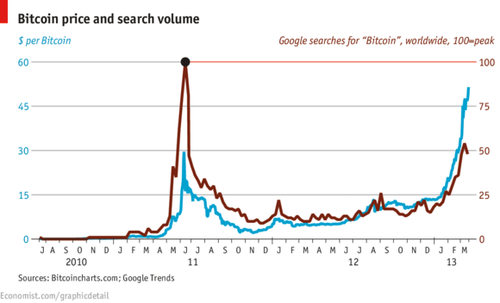
In 2010, a fan of “Magic The Gathering” playing cards decided to pivot his company, which he had imagined as a marketplace for Magic cards, to become an exchange for Bitcoin. He kept the name Mt. Gox - Magic The Gathering Online eXchange - but focused on facilitating the buying and selling of bitcoins. The first coins sold for 3 cents each in April 2010. Bitcoin achieved “dollar-parity” in February of 2011, then boomed to a price of $29.57 in early June.
The rising prices of bitcoins attracted the very people the cypherpunks hoped to put out of business: bankers. Before joining Coinbase, in 2011, Fred was a foreign exchange trader at Goldman Sachs. His roommate was a trader at Morgan Stanley. They began trading in bitcoins. “From a trading perspective it is still the Wild West,” Fred told us. “It moves insane amounts in percentage terms.”
During the day, Fred monitored macroeconomic indicators and news from Central Banks to speculate on the movement of foreign exchanges. At night, he looked at Google Trends data on the search popularity of “bitcoin” or at the hit rate of the Bitcoin Wikipedia article to predict how the price might change and profit off its movement. “It’s a social networking problem,” he says.
Speculation or Adoption?
After peaking at $29.57, the price of bitcoins fell dramatically to below $5. With its recent rush of press, the price is above $100 and rising.
Given the number of bankers reported to be speculating on the price, and the press describing how prices could continue to rise, the worry is that bitcoin prices purely represent speculative bubbles. Economic voices of reason from Paul Krugman to The Economist have dismissed Bitcoin as exactly that.
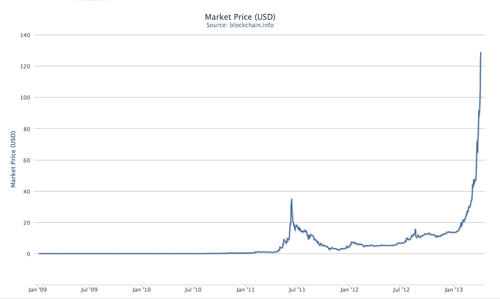
The evidence available definitely suggests that the current Bitcoin economy is mainly speculation-based.
Coinbase, which has an interesting position in that they deal with individuals buying bitcoins and merchants accepting bitcoin for retail purchases, estimates that for every 1 bitcoin used for economic transactions, roughly 3 are purchased for speculation. But that number is almost definitely skewed to downplay speculation, given that they deal with merchants more than most of the Bitcoin ecosystem.
A paper looking at the record of bitcoin purchases in 2012, for example, found:
“If we sum up the amounts accumulated at the 609,270 addresses which only receive and never send any BTC’s [bitcoins], we see that they contain 7,019,100 BTC’s, which are almost 78% of all existing BTC’s.”
This suggests that 78% of bitcoins are being hoarded, waiting for prices to rise. Even when controlling extremely cautiously for the possibility of users who “lost” their bitcoins and other contingencies, they find that at least 51% of bitcoins have never been spent.
Fred admits that “people are screaming bubble” and that he would normally be concerned given his background as a trader. But he remains confident in Bitcoin’s viability: “There are things in Bitcoin that the world hasn’t seen yet. The Internet was a complicated thing nerds played with until we got the web browser.”
In Coinbase’s opinion, “the correct loops are in place.” Fred notes that people see the potential of Bitcoin (and obviously the price is rising meteorically), but merchants are also adopting it. While it’s currently early adopters like Reddit, the clear financial upside of Bitcoin for merchants will fuel adoption. In 6 months or so, he expects to see stores that people interact with regularly accepting Bitcoin. Its low fees will also allow retailers to offer discounts for using Bitcoin - the same way that many gas stations offer lower prices for using cash to avoid credit card fees. In this way, consumers will be incentivized to use Bitcoin for shopping.
Fred doesn’t think that the world will abandon national currencies anytime soon. But he does expect that people in developed countries may keep 10% or so of their net worth in Bitcoin and that it is here to stay.
“There is a chance Bitcoin’s price goes to $1 in a year. But it’s more likely in my opinion that it goes to $600 as an extremely low estimate.” Thousands of people seem to be taking that bet, including Coinbase’s venture capital backers.
Counterculture versus Compliance
Coinbase also exemplifies a problem for the cypherpunk dream - achieving mass adoption of the Bitcoin may come at the cost of Bitcoin’s cherished revolutionary characteristics.
The unofficial motto of Coinbase is “Bringing Bitcoin to the masses.” Anyone with an Internet connection can use Bitcoin, but it’s difficult. Users need to download a desktop client and deal with 51 alphanumeric character passwords (or “private keys”).
The irreversibility of bitcoin exchanges also comes as a danger. Anyone who loses the private keys linked to their bitcoins irreversibly loses those bitcoins. Users also need enough awareness of computer security to ensure that hackers don’t steal their private keys and irreversibly steal their money.
Coinbase secures users’ wallets for them and abstracts private keys and other difficulties away from the user (both individuals and merchants) for an easy, seamless experience that, as Fred puts it, “my mother can use.” By doing so, Coinbase serves a role similar to PayPal, Western Union, or a bank. The financial advantage (less fees) of Bitcoin remains, but users are putting their trust in Coinbase to deal fairly with their money, and Coinbase complies fully with governments and financial regulation - the Bank Secrecy Act, scanning for entities deemed suspect (i.e. the banking equivalent of a terrorist watch list), customer laws… essentially every regulation the cypherpunks view as outdated and an unwanted check on a free system.
Coinbase sees themselves playing an important role by meeting these high standards. Mt. Gox, the dominant player in the exchange market where people can buy bitcoins with real currency, feels similarly. They spent $25 million to become compliant in the US, stating, “We are the leader. We have a huge responsibility to do things by the books.”
But the effect remains. Coinbase and Mt. Gox would comply with regulations, including investigations that demand user data. Coinbase also necessitates user trust, and would resist perceived censorship no more than PayPal did in the case of Wikileaks.
As Bitcoin develops an ecosystem with non-anonymous players, people have even suggested that independent users cannot maintain anonymity.
Challenges Ahead
The three biggest challenges ahead for Bitcoin are overcoming the dominant position of national currencies, the question of whether its deflationary nature will make it an unsuitable currency, and surviving government regulation.
1) Disrupting Dollars
The biggest challenge for Bitcoin is implementing adoption. National currencies have a number of advantages. As Timothy B. Lee points out, people are used to them, countries require that taxes be paid in their national currency, and using a currency like bitcoins that only a tiny minority of the population accepts imposes substantial costs and inconvenience.
As one prominent member of the Bitcoin community argues, these problems are mitigated when you abandon the assumption that bitcoins need to displace national currencies:
“People need to get their head out of the sand in terms of thinking of it as a competitor to their local currencies. We no longer live in a localized economy. We live in a globalized economy and bitcoin is designed for a globalized system.”
As argued above by Fred, there do seem to be sound financial reasons to use Bitcoin that have people “banging down the doors to get at them.” Further, an implosion in a Euro country like Greece or Spain, or a dramatic currency crash in an inflationary country like Zimbabwe or Argentina, could cause a major adoption of Bitcoin. Such events in the past have caused people to seek refuge in more secure currencies like dollars - why not Bitcoin?
2) Deflation
Under the old gold standard system, the money supply was limited by the fact that dollars were pegged to (backed up by the value of) gold. The number of bitcoins increases as they are “mined.” But they increase at a fixed and predictable rate until they reach an absolute cap of 21 million bitcoins. Therefore, the supply of Bitcoin is essentially fixed, recreating the circumstances under the gold standard.

This was Satoshi Nakamoto’s intention. He envisioned a world in which inflationary Central Banks could not debase the currency by printing too much money. But this goes against mainstream economics.
Paul Krugman is the dominant, tireless voice on this subject. If an economy expands but the money supply does not, deflation occurs. Money becomes more valuable with time because prices decrease relative to the value of money. This seems like a good deal, but has several harmful effects. Primarily, people prefer to sit on their (increasingly valuable) money rather than spend it and have no interest in borrowing money since they’ll have to pay it back with dollars worth more than the dollars they were lent. If this is not corrected by monetary policy “the economy may stay depressed because people expect deflation, and deflation may continue because the economy remains depressed.”
It’s unclear how this would affect a complementary, global currency like Bitcoin. Fred sees this deflationary aspect as an incentive to join the Bitcoin economy. But if the incentive to hoard is too strong and prevents any purchasing from happening, then Bitcoin can’t be a very effective currency.
However, a number of critics from the Ron Paul “End the Fed” crowd and the Austrian School of Economics to cypherpunks disagree with Krugman and believe that the reinstitution of the gold standard would prevent speculative bubbles and the debasement of the currency.
3) Government Regulation
From the very real possibility of criminals laundering money through Bitcoin to the less probable scenario of governments losing their ability to tax and control monetary policy, governments have reason to dislike Bitcoin and shut it down. Bitcoin forums are full of debate over Bitcoin’s resilience to government intervention.
But as we’ve seen, at least for it to exist on a mass scale, Bitcoin probably needs the government’s approval.
Last month, the US Treasury Department’s Financial Crimes Enforcement Network (FinCEN) offered guidelines on the treatment and regulation of Bitcoin businesses. Fred and Coinbase saw this as a positive development that reduced the uncertainty around Bitcoin:
“The big worry in people’s minds is that there will be a draconian action by the government banning their use. But the first important data point of the government’s reaction was the FinCEN guidelines, and to me they’re a huge positive. They are saying that we need to be held to the same standards.”
Like other major players, he sees some confusion in the guidelines, but otherwise finds it positive. What is notable is that even among players such as the Bitcoin Foundation, which takes umbrage with the guidelines, they are disagreeing with the substance of the guidelines, not their existence. Only the cypherpunk zealots reject government regulation entirely.
Fred also noted that as more merchants and consumers adopt Bitcoin and profit from it, they would lobby against government infringement on the Bitcoin economy. Financially motivated political lobbying is perhaps not what the cypherpunks had in mind, but it could be what keeps a matured Bitcoin economy flowing smoothly.

Conclusion
Digital currency is coming, even if in a less revolutionary form than Bitcoin’s decentralized, algorithm-based variety.
The Bitcoin ecosystem is dominated by speculation and hoarding, and it remains to be seen whether it can transition to a currency that people use in everyday life. If it does go mainstream, it will likely lose its most revolutionary aspects that the cypherpunk scene idealizes. But it can still act as a hedge against the global monetary system, if not replace it, and its potential implications are about as easy to predict as the effect of the Internet during the days of ARPANET. If nothing else, Bitcoin makes for one hell of a story and an interesting test case for the implications of digital currencies in the future.
In ten years, Bitcoin may be spreading exponentially. Or we may look back at Bitcoin as a joke. The fact that no one knows which it will be is as good a sign as any that it could change the world.
This post was written by Alex Mayyasi. Follow him on Twitter or Google Plus.
Asperger
Love: Searching for Romance When You're Not Wired to Connect by Amy Harmon. A New York Times/Byliner Original. Available for Kindle, iPad, Kobo, and Nook, $2.99.
And Straight On Till Morning: Essays on Autism Acceptance, edited by Julia Bascom. Published by the Autistic Self-Advocacy Network. Available for Kindle, $2.99.
Reviewed by Steve Silberman
In the early 1990s, a mother told a conference of autism professionals that the upside of having a teenager on the spectrum at home is that they will never want to do the things that often get kids in trouble. There will be no need for awkward conversations about sex, because people with autism are either uninterested in or incapable of intimacy. Parents won't have to worry about a late-night knock on the door from the local sheriff, because autistic teens have no desire to party. If these generalizations now seem naïve, offensive, or some combination of the two, this mother had a lot of company in her assumptions. The notion that people on the spectrum are disinclined to seek connection with others is embedded in the very word autism, which is derived from the Greek word for self, autos.
One of the world's leading authorities on the subject, psychologist Tony Attwood, devotes only a handful of pages in his Complete Guide to Asperger's Syndrome to sexuality and relationships. Specifically, there are two references to "lack of desire," four to pornography, two to exploitation by predators, and two to celibacy. Casting a further chilling effect on the notion of romance, Atwood cautions potential suitors that people on the spectrum may find a friendly touch on the arm "unpleasant and even difficult to tolerate, let alone enjoy" because of sensory sensitivity, and compares embracing an autistic partner to "hugging a piece of wood." This is the historical backdrop that looms -- albeit invisibly to most readers -- behind the publication of a new ebook by Pulitzer prize-winning New York Times reporter Amy Harmon, Asperger Love: Searching for Romance When You're Not Wired to Connect.
Harmon is one of the most sensitive and savvy reporters on the subject in mainstream media. In 2011, she published "Autistic and Seeking a Place in an Adult World," an account of the search for employment by a young artist named Jason Canha. While dozens of news stories a week speculate about candidate genes, environmental factors, and other possible causes for the condition, Harmon zeroed in on the practical issue that all families face when their kid "ages out" of services: How are they supposed to support themselves and learn to live independently? At more than 7000 words, it was one of the longest features on any subject in the history of the Times, and reader response was overwhelmingly positive. Encouraged, Harmon's editors gave her several months to follow up on an insight she had while reporting on Canha: despite the fact that parents and teachers are often occupied by more pragmatic concerns, young people on the spectrum are as intensely curious about intimacy as their neurotypical peers, as even a brief tour of the discussion forums at WrongPlanet.net can attest.Harmon's second bout of reporting produced "Navigating Love and Autism," the story of a burgeoning love affair between two young people with Asperger syndrome named Jack Robison and Kirsten Lindsmith. (Jack's father, John Elder Robison, is the author of the bestselling memoir Look Me in the Eye; his new book, Raising Cubby, is about his experiences as the autistic father of an autistic son.) That article provided the foundation for Asperger Love, which is twice as long as the original piece, and includes fuller and more nuanced portrayals of Jack, Kirsten, John Elder and his wife Maripat, and Jack and Kirsten's friend Alex Plank, the founder of WrongPlanet.net.
Asperger Love follows the familiar arc of nearly every classic tale of bright young outsiders who discover a safe haven in each other (see Romeo and Juliet and Wes Anderson's Moonrise Kingdom.) The difference is that in this case, the lovers face not only obstacles posed by the uncomprehending world, but their own difficulties in reading one another's social signals, a profound challenge for people on the spectrum.
Early in the book, we see Lindsmith in high school, before her own Asperger's diagnosis, when she's still trying to make a relationship work with a charismatic extrovert who insists on acting as her life-coach. He urges her to stop speaking in a monotone and fidgeting with her hands; he elbows her when she goes on at length about her interest in animal physiology; he prompts her to be more affectionate and expressive by barking at her, "Don't filter!"
In one of Harmon's characteristically well-turned sentences, she says that Kirsten eventually "chafed at his frequent instructions, which required constant, invisible exertion to obey." The author gets across a lot of information in few words here: the soon-to-be-ex-boyfriend's arrogant presumption that his way of behaving would come naturally to Kirsten if she would just stop filtering herself; the annoyance that those kinds of assumptions produce; and the hard (but "invisible") work demanded of autistics who are asked to just act normal for a change.
In a similarly spare and brilliant passage, Harmon describes the little details of behavior that rise into Jack and Kirsten's mutual awareness as they fall in love:
Jack, Kirsten noticed, bit his lips, a habit he told her came from not knowing how he was supposed to arrange his face to show his emotions. Kirsten, Jack noted, cracked her knuckles, which she later told him was her public version of the hand flapping she now reserved for when she was alone.
In two sentences, Harmon expresses truths that are both universally human and distinctly autistic. Everyone experiences pressure to conform to social norms, but Harmon's description of how Jack must "arrange his face" casts light on the rigorous self-monitoring -- the "constant, invisible exertion" -- required of autistic people to get through a typical day in neurotypical society. Likewise, the detail of the knuckle-cracking deftly paints a picture of two parallel worlds: Kirsten's public life, where she too must "arrange" her spontaneous behavior to avoid calling attention to herself, and her private autistic reality, where she can flap to her heart's content.
With the same reportorial eye for the essential, Harmon skates over aspects of autism history that are so deep and hotly contested that they can best be described as yawning abysses. It's a relief to read an account of the domestic lives of autistic people that never devolves into a discussion of cortical deficits, de novo mutations, and the other impedimenta of autism narratives that make it seem as if people on the spectrum hardly exist outside of clinics, genetic databases, and MRI scanners. In that sense, Asperger Love is like the wedding announcements by same-sex couples that now run routinely in the Times: extraordinary precisely because they're so ordinary.
Only in a couple of places does Harmon's urge to simplify lead her astray. She begins her second chapter with the statement, "Only for about a decade have a group of socially impaired young people with normal intelligence and language development been recognized as the neurological cousins of individuals with classic autism." While I love the phrase "neurological cousins" so much that I will undoubtedly steal it for my own writing, this assertion is either ten years off, or 70 years off, depending on how you look at it.
The broadening of the diagnostic criteria for autism in the fourth edition of the Diagnostic and Statistical Manual of Mental Disorders (commonly known as the DSM-IV) to reflect the full breadth of what we now call the spectrum -- including the addition of "Asperger's disorder" -- took place in 1994, not 2004. It was precisely that change that made the autism of people like Jack and John Elder Robison, Kirsten Lindsmith, and Alex Plank visible to the medical establishment. Before that, all of these characters in Harmon's book would have been excluded from a diagnosis and support services, and written off as "schizotypal," neurotic, or odd.
The first person to notice that people like them are the neurological cousins of kids who are much more obviously disabled, however, was the pediatrician Hans Asperger in his clinic in Vienna way back in the 1940s; that's why the diagnosis given to people like Jack and Kirsten bears his name -- until May, anyway, when the long-awaited DSM-5 will be published, and the subcategory of Asperger's disorder will be dispensed with in favor of the umbrella term "Autism Spectrum Disorder."
The second slight misstep in Harmon's elegant dance is her use of the word "mindblindness" as the title of her second chapter. For reasons that should be self-evident, many autistic people loathe the term, which was coined by British cognitive psychologists Simon Baron-Cohen and Uta Frith in the 1980s. In its original context, the all-too-catchy neologism was their attempt to give a name to the core deficit in a clinical population so various that it encompasses both children unable to speak and brilliant coders who can't seem to shut up about the various incarnations of the Time Lord in Doctor Who. (Thus the truism in the autistic community, "If you've met one autistic person, you've met one autistic person.") The controversy over the term mindblindness -- and its relationship to compassion and empathy -- is one of the most yawning abysses in autism discourse, and too deep to do justice to here. Suffice it to say that Baron-Cohen made things worse by muddying the distinction between an inability to parse social cues in real time -- which seems to be the cognitive issue unifying all points on the spectrum -- and empathy, which is more like a capacity to care about how another person is feeling.
Anyone who has spent time with autistic people can tell you that they're intensely concerned with how other people are feeling, to the point of being overwhelmed. But they often can't piece those feelings together from the usual clues of facial expression, tone of voice, and body language. At the same time, however, autistics are often adept at reading each other's emotional states from signs that would be opaque to their typical peers. There are moments in Harmon's book when Jack and Kirsten seem to be doing that for one another. (This experience is so common that autistics refer to a second sense called "autdar" -- inspired by gaydar -- that enables them to spot a fellow Aspie in a room full of chatty neurotypicals.) Calling autistics mindblind may turn out to be as apt as calling those who don't speak English deaf.
I recently asked Uta Frith about the term and she replied: "I now avoid using it, as it seems to have led to a lot of regrettable misunderstandings. Clearly we have not done a good enough job explaining what we mean. Even the original proponents of the term are not of one mind, and there are interestingly different interpretations. For example, my interpretation is different from Simon's as regards 'empathy.' As you know, a number of my more recent papers conclude that empathy is present in autism." In other words, the term is contested even by the two clinicians who popularized it. Harmon would have been better off shunning it altogether.
That said, Asperger Love is a valuable and humane contribution to the popular literature of autism, and a touching, funny, and engaging love story that should appeal even to readers with no direct connection to the subject. One of my favorite parts of the book is the postscript, when Harmon steps forth from behind the narrative curtain to talk about what she learned by reporting the story. "The more I observed autistic behavior," she reflects, "the more my own was revealed to me in a light not available elsewhere… As I sought to portray the oddness of my autistic subjects, I found that they were altering my view of what passes for normal. Time and again they exposed my own pretensions and highlighted the absurdity of the social mores to which so many of us subscribe."
I asked Harmon to elaborate on this further in email, and she replied:
What changed for me as a result of my reporting is not so much my perception of people with autism, as my perception of the social conventions practiced by the rest of the world. Even in our most intimate relationships, we want our partners to read our minds, we value not having to ask for what we need, we fault the other for not anticipating it. Why? It seemed so refreshing, watching Jack and Kirsten, to be more forthright.
I went from thinking that people with autism needed me to help explain their oddness to the world so they could better fit in, to thinking that the world is a pretty odd place and that maybe we would all be better off rethinking some of the social conventions that seem so alien to people with autism.
Rethinking social conventions in light of autism is precisely the goal of another just-published ebook called And Straight On Till Morning: Essays on Autism Acceptance. The third title published by a non-profit group called the Autistic Self-Advocacy Network, it is an anthology of essays about autism written from the inside. Each of the contributors to the book is on the spectrum themselves, the parent of an autistic child, or an ally in the disability rights movement.
Though both Asperger Love and the third ASAN anthology are text with no bells and whistles, they take advantage of new possibilities opened up by ebooks in different ways. Asperger Love enabled the author of a much-lauded Times feature to add depth and personal perspective. And Straight On Till Morning reminds me of the copies of Co-Evolution Quarterly that I read avidly as a teenager, filled with lively writing that keyed off of current events but wasn't as perishable as most magazine writing. I will be rereading the opening essay many times as one of the most eloquent descriptions of an inner life that I have ever come across, autistic or neurotypical. Written by a disability activist named Amanda Baggs, who electrified YouTube in 2007 with a video called "In My Language," "Plants Outside the Shade" begins humbly like a grade-school report, "This is a personal description of some of what autism means to me." But then it takes flight into dazzlingly original prose-poetry that takes you to the heart of autistic perception.
Autism means that my earliest memories are of floating in among the feel of things. Not how they looked or sounded, but how they felt. Words don't exist for the hundreds if not thousands of variants on this. A way of perceiving the world that has remained dominant for me even after sensory input became stronger and, later, words and ideas. It's the foundation that I always start from when I climb up the cliffs, day after day, that allow me to use words and ideas and move and understand what is around me. And no matter how high I climb, that underlying way of experiencing the world is still there.
A lot of people see this way of relating to the world as that old cliché of compensation. Where people think blind people's hearing must grow more acute. I see it differently. It's a way of experiencing things that could only have developed if more typical ways were absent. There are a lot of plants that cannot grow in the shade of a forest. But if there are no big shade-producing trees, they flourish. It's like that. Many of my experiences and abilities stem from what happens when plants can flourish outside the shade of a forest.
I can spend all day with one marble. Looking at it, feeling it on my face. One problem with trying to describe this is that there are far more possible sensations than there are words for sensations. So an entire day's worth of experiences can come out to only one sentence. And it's harder still to describe the patterns formed between those sensations. Not abstract, logical patterns but concrete, sensory patterns. And those are how I understand and interact with the world.
How might a clinician describe this experience from the outside?
"Patient Amanda B., a 32-year-old female with a pervasive developmental disorder and significant verbal impairment, perseverated with a marble for more than six hours under observation today. (The patient's mother reports that marbles and other small spherical objects are one of her daughter's 'special interests.') Amanda fixated on the marble for an extended period of time and pressed it against her cheeks for the purposes of self-stimulation. This behavior (not significantly self-injurious) was accompanied by nonsense vocalizations."
For nearly five decades, drily clinical, outside views of autism were all we had. The advent of first-person accounts by people like Temple Grandin, Jim Sinclair, Amy Sequenzia, and Julia Bascom is providing an invaluable perspective on what life on the spectrum is really like.
The autistic self has often been invisible to clinicians. Bruno Bettelheim, the psychoanalyst who proposed in the 1960s that autism is caused by "refrigerator mothers" who secretly wish their children dead, called his bestseller on the autistic psyche The Empty Fortress. I once heard a scientist receiving a lifetime achievement award at a major autism conference refer to her early days in the field as "like veterinary medicine."
The cost of that invisibility, and the brutal treatment that came with it, plays out in "The Judge Rotenberg Center on Trial," a deeply reported essay by Shain Neumeier in And Straight On Till Morning that details the case against a "treatment" center in Massachusetts that employs painful skin shocks to punish self-injurious behavior. This isn't something that happened in the dark days of behaviorism run wild in the 1960s -- it's happening now in Massachusetts, and a special rapporteur at the United Nations has deemed it torture. ASAN is currently assisting the legal effort to shut the JRC down.
In an enlightening essay called "From One Ally to the Education Community: A New View of Students with Autism," Cheryl M. Jorgensen proposes rethinking special education to focus on strengthening the natural gifts of autistic students, rather than on correcting their deficits.
"He’s a biter." "She’s a runner." "He is non-verbal." "She’s off in her own world." "There’s nothing really there, there." "He is difficult to be friends with because all he talks about is train schedules." These statements are often used to describe children and adults who have autism and they represent a belief that autism is a disease or a disorder that needs to be cured, and ultimately, eradicated; that people with autism are "abnormal" and the rest of us are "normal." When people with autism are viewed this way, the difficulties or challenges they experience are placed within them and thus, they are required to change in order to be eligible to participate in the full range of inclusive school and community activities and environments. How often have you heard it said that "She could never be included in a general education class because of her sensory issues" Or "He can’t hold a real job because of his challenging behavior issues?"
What if we changed the fundamental way that we viewed students with autism and instead of viewing autism as the problem, we viewed it as a natural part of human diversity? What if, instead of trying to make people with autism "normal," we intentionally looked for their strengths and viewed their challenges as problems with their environment? What if we appreciated the unique talents of students with autism and recognized the contributions that they might make to our schools and communities?
Ideas like this are gaining traction in the special-education community (see Thomas Armstrong's excellent new book Neurodiversity in the Classroom) because they bring out the best in every student, including those with dyslexia, ADHD, and others who think and learn differently from their peers -- while 70 years of trying to force autistic kids to "act normal for a change," and punishing them for harmless behavior like hand-flapping, has only added to their challenges in daily life.
These two new ebooks, with two very different perspectives, arrive at the same conclusion: By understanding autism from the inside, we become more fully human -- no matter where we are on the grand spectrum.
Steve Silberman is the author of the upcoming book NeuroTribes: Thinking Smarter About People Who Think Differently, to be published in 2014 by Avery Books/Penguin. He is also the author of the NeuroTribes blog on the Public Library of Science and a correspondent for Wired magazine.
Adam Victor BrandizziA TV aqui de casa. Quando vi a primeira vez, achei lindíssimo. Agora tenho de cutucar umas quatro vezes para ligar...

Adam Victor BrandizziJustiça seja feita, QR codes até são bem práticos no AirDroid, mas só lá.

Should I use a QR Code?

When Alex Andon got his first order for a $25,000 jellyfish tank installation, he was excited. He also had a problem. He didn’t know anything about jellyfish or how to make a jellyfish tank. He had a hunch that people wanted to keep jellyfish as pets, so he created a test website and bought $100 in Google search ads. Lo and behold, his phone started ringing with enquires and he got his first order for the $25,000 jellyfish tank.
Today, Alex’s company Jellyfish Art is the leading company in the jellyfish pet space. In fact, they’re pretty much the only company in the space. When they launched over four years ago, the only way to keep jellyfish at home was to pay a custom installer $10,000-$25,000. After starting as a custom installer, Alex later developed a desktop jellyfish tank that brought the price of jellyfish ownership down to $500.
Along the way, he launched one of the first popular Kickstarter campaigns, received funding from Y Combinator, and created a market that didn’t exist before.
This is the story of Alex Andon and Jellyfish Art - the world’s only jellyfish startup.

Who Wants a Pet Jellyfish?
While the market for pet fish is estimated to be around $2 BN a year, the market for jellyfish is tiny. Part of the reason is that if you put a jellyfish in a regular fish tank, it will instantly be sucked into the filter and die. The other reason, according to Alex, is that until the 1990s there were no jellyfish exhibits at aquariums. In 1992, the Monterey Bay Aquarium took a chance on one, and launched the first major jellyfish exhibit in the United States. It was a smash hit.
The key to housing jellyfish without killing them was developed in 1960s by German oceanographer Wolfe Greve to house plankton. If a jellyfish tank’s water intake and outtake rate are not perfectly in sync, BOOM, you get liquified jellyfish. Dr. Greve had previously designed a tank that he called the “Kreisel” tank that could solve this problem with a perfectly balanced filtration system (kreisel is german for carousel).

Kreisel tanks look like the fat cross section of a cylinder. A slow circular water flow along the edge of the tank keeps the jellyfish suspended in the middle and away from the filter. All water flowing into the tank is sprayed in a flat laminar sheet in front of the exit screen. If jellyfish get close to the exit screen, the incoming water blows them away to safety. The water flowing out of the tank goes through a screen with sufficiently large surface area to prevent any points of suction that could suck a jellyfish in. Only small particles pass through the exit screen, filtering the tank while the jellyfish remain safe in the center.
Most jellyfish look nondescript. They’re practically transparent until you shine LED lights on them or provide a background color.

But if you create the right setting, jellyfish are stunning.

Proof of Concept
In late 2007, Alex was itching to start a company, any kind of company at all. He was two years out of college and living with tech entrepreneurs in a house in San Francisco. He worked as a lab technician at a struggling biotech firm.
A marine biology major in college, Alex noticed that jellyfish exhibits completely mesmerized aquarium visitors: “People seemed to have an obsessive infatuation with the jellies. Some people would sit in front of the tanks for hours staring at them.” Since the jellyfish exhibits were so popular, he decided to explore whether there was a market for pet jellyfish.
He discovered that it was possible to keep jellyfish as pets, and possible to catch them as well. Based on studying the design of jellyfish tanks at aquariums and conversations with breeders, he concluded that it was technically feasible to sell jellyfish to consumers.
But was there any actual demand?
To find out, Alex put up a landing page advertising the services of his (at this point non-existent) custom jellyfish tank installation business. Here is the website, courtesy of archive.org (the images on the site didn’t get presevered unfortunately):

Alex then started a Google Adwords advertising campaign, targeting search terms like “jellyfish tank.” His phone started ringing with potential customers. Before he had spent $100 on Adwords, he made his first sale, a $25,000 custom jellyfish tank for a restaurant opening in Seattle.
The First Sale
Alex made the sale, but now he had a problem: he had to deliver on the tank he promised. Alex had a general understanding of jellyfish tank construction based on googling around and talking to experts, but he didn’t have enough expertise to deliver the product.
Daniel Pon, a home aquarium and maintenance expert (who now works at Jellyfish Art in addition to running his own aquarium business) remembers first meeting Alex around this time:
“I had lunch with him and afterwards was like ‘this guy is in way over his head.’ He doesn’t know how basic things about a fish tank work and he’s going to make a $25 thousand jellyfish tank?”
The experience of selling his first jellyfish tank was, as Alex put it, “a complete disaster.” Eventually Alex found a local aquarium builder to build the tank on his behalf. He got a fishing permit and caught some jellyfish in a bay near San Francisco. He then had to get the tank and jellyfish up to Seattle for installation while the restaurant was still under construction:
“A little before Christmas, a friend and I drove the tank up to Seattle. It was bad. It was filled with water and jellyfish so the truck weight was 3 times its legal payload.”
“It started snowing really hard on the way up. We had to get chain control and put chains on our tires. I’d never done that before. We went through 3 sets of chains.”

When he arrived in Seattle, the jellyfish were dead. That wasn’t such a big deal because they could be replaced. The main issue was setting up the jellyfish tank. Alex worked for five days straight with the construction company to get it installed properly. He slept at the construction site every night.
Alex got the tank installed in time for the restaurant’s opening. But the tank had a few hiccups. One day, a pipe broke and dumped 100 gallons of water into the restaurant. Other minor problems arose too, though according to Alex, the restaurant was annoyed, but pretty cool about it. They still use the tank today, but now for fish.
Alex Andon, Jellyfish Consultant
And so with one customer under his belt, Alex decided to go into the jellyfish business. His website and advertising campaign kept producing customer leads for people that wanted custom jellyfish tanks installed. At the same time, the biotech company Alex worked for was struggling during the recession and looking for volunteers to leave the company in exchange for severance. Alex left biotech and committed to jellyfish.
He found working in the the custom jellyfish tank installation business brutally difficult, but he earned an understanding of tank design, and the aquarium and pet supply industry.
Alex realized that he needed to build an affordable jellyfish tank. Over the course of a year, he finished only 3 custom installations. The market for $25,000 tanks was very small and too labor-intensive to scale. Instead of selling his installation services, he needed to sell a product.
Around February 2009, Alex put up a landing page on his website offering a desktop jellyfish product for around $500. He put up a photoshopped image of a tank that didn’t quite exist yet. Based on the advice of his software engineer roommates, he posted it to Hacker News.

Around this time, he got his big break, even though he wasn’t quite ready for it. The New York Times profiled him in article about people starting businesses after they lost their jobs during the recession. The article led to an influx of traffic to his site, but his affordable desktop jellyfish tank wasn’t ready yet, so it didn’t lead to any new sales. Still, the article put Alex on the map as “the jellyfish entrepreneur.” From March 2009 onwards, almost every article about jellyfish in the popular press mentioned Jellyfish Art.

The Desktop Jellyfish Product Version 1.0
A few months after the New York Times article, the first version of the company’s desktop jellyfish product was ready for sale. It was a bit of a Franken-aquarium, hacked together from various off-the-shelf aquarium parts. But it worked. It kept the jellyfish alive, made them look pretty, and cost around $500.

Sales of the desktop jellyfish tank started to take off. The New York Times article ushered in a wave of articles by other publications about Jellyfish Art. Now, when visitors came to the site, they could actually buy the product. It began to look like a real business with a scalable product.
The increase in sales, however, exposed a critical problem in the business that Jellyfish Art struggles with to this day. Alex had succeeded in making an affordable jellyfish tank that people wanted. But where was he going to get a reliable supply of jellyfish to sell?
The Jellyfish Supply Chain
When Alex started Jellyfish Art, he caught the jellyfish himself. He got stung frequently. As an aside, you are NOT supposed to urinate on a jellyfish sting. This appears to be an urban legend derived mostly from an episode of Friends in the 1990s. Just flush it out with vinegar or if that’s not available, salt water. Okay?
But back to the subject at hand. Where did Alex get the jellyfish supply from?
“Basically, I just asked everyone. One local aquarium gave me a list of a few people who might be able to help. One of them was my guy in [place redacted for competitive reasons] and he worked out.”
This supplier, who lived in a tropical island far from San Francisco, put 500-1000 jellyfish in styrofoam coolers and shipped them via commercial carrier to San Francisco. This means they flew in the cargo section of a regular passenger plane. Alex monitored the flight online and picked up the jellyfish at San Francisco Airport, like you might pick up your in-laws.
The jellyfish stock is kept at the company’s warehouse and office in Potrero Hill, San Francisco.

When an order is placed, they ship the jellyfish to the customer by FedEx overnight. Jellyfish can survive 48-72 hours in shipping so even if there is a delay, the jellyfish normally shows up alive. By contrast, fish typically die after twelve hours of transit. The average jellyfish lives for 6 months and Jellyfish Art guarantees that they arrive alive.
The supply chain worked this way for a year. Then one day, the tropical supplier went to his jellyfish catching spot and couldn’t catch a single one. All of them were gone. Every week he checked out the same spot, but every week he went home empty-handed.
But Jellyfish Art survived. Thanks to his increased market exposure, it was easier to get jellyfish. If you breed jellyfish and want to sell them, Alex is the only game in town. He managed to find a decent supplier in Europe that provided just enough supply.
Let’s Make Our Own Product
After a year of rising sales selling another company’s fish tank retrofitted with their own filtration system, Alex decided it was time for Jellyfish Art to develop its own tanks. Buying someone else’s tanks was expensive and manually retrofitting each one was a pain.
At this point, two and a half years after getting started, Alex knew enough to design Jellyfish Art’s signature product - the desktop jellyfish tank. His original “napkin” design is below:

It took another year to get to production. By March of the next year, they had a barely functioning prototype that they unveiled at the Global Pet Expo. The Expo is the largest trade show in the pet industry that is dominated by companies with huge marketing budgets. It normally caters to dog and cat owners. Alex and his team had the smallest booth, but they won best new product of the year in the aquarium category.

And Now, 3 Years After Its Start, Jellyfish Art is an Overnight Success
After winning at the Expo, things start happening pretty fast for Jellyfish Art. They found a Chinese manufacturer for their tanks, but it was still going to be expensive to kick off production so they secured a small business loan. Around the same time, Alex heard about Kickstarter. He figured it could be a good way to get orders and fund the manufacturing.
In August 2011, they launched a Kickstarter campaign aiming to raise $3,000. This was the amount of pre-orders they had gotten so far based on being in the New York Times and winning the Pet Expo. It seemed like an aggressive but doable goal.

They ended up raising $162,917 on Kickstarter. For the first few days of the campaign, sales trickled in. Then rap artist Jermaine Dupri tweeted out about the campaign and it massively spiked. After that tweet, everything changed in the campaign. More blogs started covering it and Alex went on local TV and radio to talk about the campaign.
Almost immediately after they were “blowing up on Kickstarter,” Alex and Jellyfish Art decided to apply to Y Combinator, the technology startup incubator and investment firm. In their application to Y Combinator, they posited that they could use jellyfish as a beachhead to become the “Amazon for pets.” They were accepted into the Y Combinator Winter 2012 batch.
Mistakes Were Made
After a meteoric rise in the fall of 2011, gravity set in during the winter of 2012. As they started Y Combinator, Alex realized that the “Amazon for pets” idea wasn’t a very good one. Shipping around live animals in boxes like Amazon is a niche industry with low margins. The big money in pets is in dogs and cats.
After toying with the idea of creating a database of dog breeders to connect people with the types of dogs they want, Alex decided against the idea. Their existing business, Jellyfish Art, offered no advantages for starting a dog breeder matching service. Between starting a breeders database from scratch and staying in the world of jellyfish, they chose jellyfish.
During YC, Alex felt pressure to have a jellyfish sales chart that was “up and to the right.” Immediately after they shipped off the jellyfish tanks to their Kickstarter backers, they launched a sale on Fab.com, a flash sale site. The sale on Fab.com was their single largest source of sales ever, but it came at a cost. Jellyfish Art offered the same discount on Fab as they offered their Kickstarter backers. The Kickstarter backers were livid that they received the same treatment even though Kickstarter backers funded the business and put up with a 6 month wait. Some of the people that should have been the biggest supporters of Jellyfish Art turned on the company.
In the wake of massive sales growth from Kickstarter and Fab, Alex started hiring for staff and investing in systems to make the business work. Sales were skyrocketing everyday and it was unclear just how massive this business could become. Alex explains:
“As fast as money was coming in the door, it was flying out. We also had no idea how high the sales would go, whether we should be bracing for more growth or planning for stability.”
“It turned out our product was too expensive for many of the large retail chains that originally showed interest, so sales eventually leveled out.”
As time went on, it became clear that sales wouldn’t continue to rise as quickly as they had in the past few months. What was previously a profitable business was now barely so because they were spending money as if it were a high growth startup. As sales started to flatten out, Alex let go of half his staff.
Despite deciding against the “Amazon for Pets” idea, they received offers from investors to fund the idea after YC Demo Day. Alex decided to turn down the funds. Even if someone was willing to fund it, it was not the business he wanted to start.
The Current Situation
According to Alex, over the last year, sales have been strong but flat. Anyone in the world willing to pay $500 for jellyfish buys the product from Jellyfish Art. The first reason that sales are flat is because they have almost 100% market share. It’s hard to improve on that. No competitors have emerged and if you Google anything jellyfish related, you inevitably end up at the Jellyfish Art website or read an article about the company. Even Wikipedia uses images of their products in its entries. When asked if he was worried about competition, Alex demurred. The Jellyfish Art marketing machine would be hard to unseat.
So, the market of people willing to spend $500 for a jellyfish tank and jellyfish is basically tapped. According to Alex, what Jellyfish Art needs to do is roll out a $100 tank and open up a much larger market and get shelf space in large retailers.
In fact, they’ve already built a low cost jellyfish tank, but they can’t release it. If their demand increased 5-10 times by offering their cheaper tank, they couldn’t source enough jellyfish. They currently sell just about every jellyfish they can get their hands on.

Breeding jellyfish in the Jellyfish Art office.
The whole fate of the business hangs on whether they can breed their own jellyfish. They’re sort of getting the hang of it, but right now they breed 10% of their supply and buy the other 90%. Once they reliably nail the process of producing jellyfish, then they can lower their prices grow again.
Conclusion

At every stage in Jellyfish Art’s evolution, Alex Andon definitely sold well ahead of his capabilities. Without knowing much about jellyfish, he sold a $25,000 tank. Before he could build his own tank, he jerry-rigged another company’s tank to hold jellyfish. Once he had a barely functioning prototype, he entered it in a trade show and won first prize. Alex was a “fake it till you make it” entrepreneur par excellence.
But then, he made it. The home jellyfish market is small, but Jellyfish Art both created it and dominates it. With the business stable, Alex has had time to experiment with living in a van in San Francisco (he doesn’t recommend it), building a website for artisans to sell their crafts, and figuring out what he wants to do with his life.
Living in San Francisco with a bunch of tech entrepreneurs has heavily influenced Alex. He will tell you that what he really wants to do now is start a successful tech company. Alex thought he could turn Jellyfish Art into a tech business, but he couldn’t. It’s a jellyfish business. But that’s still pretty awesome.
This post was written by Rohin Dhar. Follow him on Twitter here or Google.

Seu nome é Alexei “The Punisher” Volkov. À primeira vista, parece um motorista de ônibus comum. Mas ele é um homem numa missão. Didática. Sua tarefa é ensinar os motoristas russos a não fechar no trânsito. Uma batida de cada vez. Alexei já se envolveu em mais de 100 batidas e, segundo ele, a empresa para a qual trabalha até o incentiva nesta missão inglória. Funciona assim: se você fechar o ônibus de Alexei, prepare-se, porque ele não vai frear. Alexei tem um canal no YouTube para você conferir o russo aprontando altas confusões.
via @IsabelaBela

 |
 |
Adam Victor BrandizziSiga o link: http://davidbutter.tumblr.com/post/47105571530/a-vergonha-do-macaco
Sou rodrigueano na biologia. Minha obsessão atual é a vergonha do macaco. A vergonha do macaco explica mais do que o complexo de vira-lata, de alcance mais limitado.
A vergonha do macaco é a coceira moral diante da presença real ou intuída do macaco. O brasileiro esconde e nega o macaco….
Adam Victor BrandizziAchei essa tira impressionantemente bonita. Chocante, também, mas bonita.

A useful system of finger reckoning from the Middle Ages:
To multiply 6 x 9, hold up one finger, to represent the difference between the 5 fingers on that hand and the first number to be multiplied, 6.
On the other hand, hold up four fingers, the difference between 5 and 9.
Now add the number of extended fingers on each hand to get the first digit of the answer (1 + 4 = 5), and multiply the number of closed fingers on each hand to get the second (4 × 1 = 4). This gives the answer, 54.
In this way one can multiply numbers between 6 and 9 while knowing the multiplication table only up to 5 × 5.
A similar system could be used to multiply numbers between 10 and 15. To multiply 14 by 12, extend 4 fingers on one hand and 2 on the other. Add them to get 6; add 10 times that sum to 100, giving 160; and then add the product of the extended fingers, 4 × 2, to get 168.
This system reflects the fact that xy = 10 [(x - 10) + (y - 10)] + 100 + (x – 10)(y – 10).
(From J.T. Rogers, The Story of Mathematics, 1968.)

Comprei uma lapiseira preta, cuja propaganda eu mesmo cuidara de fazer uns meses antes (não porque eu planeje tudo, mas porque supervalorizo umas coisas, pela única razão de já terem feito parte da minha vida em algum momento, e eu tive uma lapiseira daquelas e gostava muito), para dar a ela, pelo primeiro lugar da classe, no primeiro bimestre da escola que tem a fama de ser uma das mais difíceis da cidade.
Escrevi um bilhetinho para pregar no embrulho azul e dourado da lapiseira. Era um texto difícil, porque eu queria valorizar o feito e, ao mesmo tempo, mostrar que isso não tem tanta importância assim (o que vale é aprender, etc. E, afinal, ela tem que continuar a se sentir bem, mesmo caso no próximo bimestre ela não faça tão bonito). Não me lembro bem, mas acho que escrevi: “Para você usar e guardar como lembrança de como é difícil – e bom – fazer o melhor possível.”
Deixei o embrulho sobre a escrivaninha dela. Depois de um tempo fui checar – ela estava fazendo lição e nem tinha visto o presente, escondido pela bagunça de livros e material escolar. Eu apontei para o pacotinho, pisquei e saí do quarto. Pouco depois ela veio até a cozinha, me abraçou e não falou nada. Mais tarde fui olhar o quarto dela e reler o meu bilhete – custei para achar; estava escondido embaixo de dois estojos. No verso, ela rabiscou “te amo, pai.” Assim, sem as vinte exclamações que meninas da idade dela usam.


Adam Victor BrandizziEsse aí sabia dar uma festa.
[Prince Christian of Schleswig-Holstein-Augustenburg] was unfortunate enough to lose an eye in a shooting accident. When conversation flagged at a dinner-party, as happened so often when he was the host, he would bid the footman bring him a tray containing his collection of glass eyes, which he would exhibit to his embarrassed guests, explaining at great length the peculiarities of each one — ‘and this one, you see, is blood-shot, I wear it when I have a cold.’
– Georgina Battiscombe, Queen Alexandra, 1969
StarRoivas got his hand on old school illustrations, and mixed them with Atari cartridges… I really love the idea ! Those are my favorite from the numerous ones on hi deviantArt.
StarRoivas mis la main sur d’ancienne illustrations et les a mixées avec des cartouches Atari et des jeux modernes. J’adore l’idée ! Voici ma petit sélection issue de son deviantArt…


More cartridges in the whole article !


My most preferred painting by now. Truly great!

Take an ordinary magic square and imagine that the number in each cell denotes its altitude above some common underlying plane. And now suppose that it begins to rain, with an equal amount of water falling onto each cell. What happens? In the square at left, the water cascades from square 25 down to square 21, and thence down to 10, 7, 2, and into space; because there are no “lowlands” on this landscape, no water is retained. (Water flows orthogonally, not diagonally, and it pours freely over the edges of the square.)
By contrast, in the square on the right a “pond” forms that contains 69 cubic units of water — as it happens, the largest possible pond on a 5×5 square.
With the aid of computers, these imaginary landscapes can be “terraformed” into surprisingly detailed shapes. Craig Knecht, who proposed this area of study in 2007, created this 25×25 square in 2012:

Next year will mark the 500th anniversary of the famously fertile magic square in Albrecht Dürer’s 1514 engraving Melancholia — a fact commemorated in the shape of the ponds on the 14×14 square at right.

Adam Victor BrandizziEu não tinha entendido muito bem o último post do TLP, que nem parecia tão bom etc. Agora, essa resposta clarificou muita coisa e ficou excelente, no mínimo por duas razões:
- tem uma definição do "sistema" muito boa. (Pois é, conseguiu-se criar uma definição).
- o que é General Dynamics e quem é CEO dela?
Though I’m radio silent, this email was important:
After reading your piece, I thought you may be interested in this article [from Dissent]. I doubt you’ll agree with everything, but certainly an interesting / similar take to yours on Lean In:
Where other feminists focus on articulating the amount of free or underpaid labor that women do, Sandberg places a priceless value on labor itself and encourages more of it, whether paid, unpaid, or poorly paid.
[...]
The loser in the Lean In vision of work isn’t one version of feminism or another [...] but uncapitalized, unmonetized life itself. Just as Facebook relies on users to faithfully upload their data to drive site growth, Facebook relies on its employees to devote ever greater time to growing Facebook’s empire.
[...]
Sandberg is betting that for some women, as for herself, the pursuit of corporate power is desirable, and that many women will ramp up their labor ever further in hopes that one day they, too, will be “in.” And whether or not those women make it, the companies they work for will profit by their unceasing labor.
The quote seems right, but there’s an important difference between my article and Dissent’s, I am not splitting hairs, it’s fundamental.
The problem is that Dissent is just as fooled as everyone else is in thinking that Sandberg’s book is interesting/relevant in itself, “the fact that she is COO of Facebook is a sufficient resume to speak on women’s issues,” and so they think they need to address what Sandberg says…. because Sandberg said it. But that’s the trick. We don’t parse out what the (female) CEO of General Dynamics says, no one writes articles about her, because what she says can’t be used to promote the system, what Phebe Novakovic believes won’t motivate a future 9-5er to work overtime: she’s not pretty enough, she works in explosions, she’s not aspirational. That’s why there is no Time Magazine spread on her, even though she rules the world. To paraphrase the great Marshall McLuhan, the messenger isn’t the message, and the message isn’t the message. The medium is the message, properly massaged.
The crucial point is a meta one: Sandberg herself is being used in exactly the way Dissent says she is getting other women to be used. Whatever Sandberg believes she is doing, the system is using her as a battery (to get women to work harder, for less money, in exchange for the trappings of power– fame, titles, prestige.) If we believe Sandberg is earnestly trying to advance women in the workplace, then the system is using her (comparatively) cheap labor for the purpose of enhancing that very system, not changing it.
To illustrate why Dissent has missed the point, let’s take Dissent’s thesis and summarize it in one sentence: “Sandberg is a lunatic because she is asking women to work harder for the system, in exchange for titles/prestige/the trappings of power.” Not only is this thesis wrong, it is a defense against change, because if you don’t agree with Sandberg’s message, you find fault only with Sandberg. Meanwhile, the system proceeds unmolested.
I realize that “the system” is a nebulous term relying on an even more nebulous “unconscious”, lacking clear definition, so I’m going to try and define it. First, start with a single individual, and eliminate value words like “purpose” and “unintended consequences.” If a guy cheats on his girlfriend in a way that likely could get him caught, one might say, “he wants to get caught.”
Now add a few more individuals. I want an ipad, but I can’t afford the $10000 it would cost to make it in America AND generate to Apple the same nominal profit of $300/ipad, so then the ipad has to be made in China with cheaper labor. So while one can say, “the consumer wants an ipad,” and “Apple wants $300 in profit per ipad” the sum of those wants is “the system”: “The system wants cheap Chinese labor.” The system doesn’t want it because it’s awesome, it wants it because it added up the wants.
To be clear, the fact that ipad consumers don’t “want” cheap Chinese labor is irrelevant. All of their choices want cheap Chinese labor. You can say the same about renewable energies, something that everyone says they “want,” yet all of their choices sum up to the system’s want: the system wants to protect the oil industry. The CEO of ExxonMobil isn’t to blame, you are.
To go back to Sandberg, if the system wants cheap female labor, how would we change the system? Only by wanting different things. Simply, if the majority of women wanted to work less, that would be the game. But the majority of women do want to work less, but they also want to buy X, Y, Z aspirational products, and they want X,Y,Z way more then they want to work less. If you sum up those “wants,” and add in the wants of Nordstrom’s, Nine West, Whole Foods, Visa and Mastercard, etc, and throw in what the media wants, then it is technically correct to say: the system wants women to become batteries.
The final twist to this otherwise simple addition is that what you want is often taught to you by that very system. For example, in running through the above, what you didn’t say was, “maybe I don’t want an ipad.” That thought cannot occur to you…. because the system wants it. Try saying this to your friends and see what happens: “I’m not interested in a career, I just want to get married and have kids.”
No related posts.

Adam Victor BrandizziMeu herói.
Early on the morning of May 13, 1862, a lookout on the U.S.S. Onward spotted a Confederate steamer heading out of Charleston Harbor directly toward the Union blockade. Commander F.J. Nickels was about to fire when he saw that the steamer was flying a white flag. “The steamer ran alongside and I immediately boarded her, hauled down [the] flag of truce, and hoisted the American ensign, and found that it was the steamer Planter, of Charleston, and had successfully run past the forts and escaped.”
The transport ship’s pilot, Robert Smalls, had resolved to escape slavery by steaming out to the Union warships blockading his city. When the ship’s white officers had gone ashore that night, he directed his eight fellow slaves to fire up the boilers and guided the ship to a nearby wharf, where they collected their families. Then Smalls donned the captain’s hat and coat and gave two long and one short blasts on the whistle as they neared Fort Sumter, as he had seen the captain do. The sentry sent him on his way. As he made for the Union fleet three miles away, he put up one of his wife’s bedsheets as a flag of truce.
Harper’s Weekly called the theft “one of the most daring and heroic adventures since the war commenced.” In his Naval History of the Civil War, Union admiral David Dixon wrote, “The taking out of the ‘Planter’ would have done credit to anyone, but the cleverness with which the whole affair was conducted deserves more than a passing notice.”
Smalls was given a monetary reward for the captured Planter and went on to serve in the South Carolina legislature and the U.S. House of Representatives. When Abraham Lincoln asked why he had stolen the ship, he said simply, “Freedom.”

I saw some cool redesigns of the Jim Lee Jean Gray costume by Jordan Gibson and Jake Wyatt and thought about doing a redesign of my own and then I felt like, “why bother?” So here we are.
Rrrrrrrrrrramon!
Adam Victor Brandizzi"Good and evil are relative but being a dick cannot be allowed"












.jpg)