The power of revision. What we write depends on how we write. Our modern faith in rewriting – again and again – began with the typewriter… more»
Adam Victor Brandizzi
Shared posts
04 Jul 17:42
 E, de bonus track, veja o Facebook da editoria de Internacional do Portal do Estadão,aqui.

Necromania & Política: Há 39 anos “O Bruxo” tentava ressuscitar “O Faraó”
by Ariel Palacios

O casal Perón com seu mordomo, ministro e astrólogo José “El Brujo” López Rega. Perón discursa na sacada da Casa Rosada. A seu lado, sua mulher e vice-presidente Maria Estela “Isabelita” Martínez de Perón. À esquerda da foto, El Brujo (O Bruxo). Perón voltou do exílio e governo de 19873 a 1974. Isabelita, que era a vice, assumiu e governou até 1976, ano em que foi deposta por um golpe militar. López Rega foi o Rasputin argentino na maior parte desse período, um sinistro “halloween” que marcou a História argentina.
 Há exatamente 39 anos, às 10:00 da manhã do dia 1 de julho de 1974, Juan Domingo Perón, presidente da Argentina – e o líder político mais polêmico e influente do século XX em seu país – começou a perder o ar. Sentado em uma poltrona, com dificuldade para respirar, abria a boca, desesperado. Uma enfermeira o abanava com um leque. Perón teve uma série de rápidas convulsões. Murmurou “estou indo, estou indo embora”. E caiu no chão.
O velho general, de 78 anos, com o peso de várias revoluções, três presidências turbulentas, 18 anos de exílio, somado a seu polêmico retorno ao país e a tarefa de governar um país dividido, estava com o organismo alquebrado. Naquele dia estava tendo um ataque cardíaco.
Os médicos entraram no quarto da residência presidencial de Olivos apressadamente, acotovelando-se para tentar impedir sua morte.
O deitaram o no leito, ao lado dos equipamentos médicos e tentaram reanimá-lo. No entanto, já era tarde. O monitor cardíaco indicava que a vida de Perón havia se transformado em uma linha reta.
No canto do quarto, a vice de Perón observava em silêncio. Ela também era sua esposa, a ex-dançarina de cabaré (no Panamá) Maria Estela Martínez de Perón, conhecida como “Isabelita”.
Nesse instante entrou no quarto o “El Brujo” (O Bruxo), como era chamado o esotérico José López Rega, ex-policial, ex-mordomo do casal Perón, astrólogo, ministro de Estado, líder da Triple A (organização para-militar que assassinou mais de quatro centenas de civis) e eminência parda do governo. “O general já morreu uma vez e eu o ressuscitei!”, gritou, empurrando os médicos.
Segurando o corpo o general pelas canelas, o esdrúxulo “El Brujo” fechou os olhos e começou a gritar“Meu faraó, não vá embora!”, enquanto sacudia o cadáver de Perón, diante dos olhares estupefatos das pessoas presentes. “Acorda, meu faraó!”, insistia.
Depois de vários minutos aos gritos, fazendo passes ‘mágicos’, tentando ressuscitar o homem mais poderoso da Argentina, López Rega desistiu. Perón não ressuscitou.
López Rega culpou os médicos que estavam na sala de terem complicado sua concentração.
Duas horas depois, “El Brujo” comunicava aos argentinos que o presidente havia falecido.

Eles usam black-tie. O casal Perón e seu sempre presente “El Brujo”.
Nos três dias seguintes, ao longo dos quais milhões de argentinos ostentaram uma braçadeira negra, o país ficou virtualmente “isolado” do resto do mundo, já que foram proibidas todas as notícias na mídia que não fossem relativas ao defunto líder, seus funerais e repercussões.
A viúva de Perón assumia como presidente. ‘El Brujo’ transformava-se no verdadeiro poder. O país começava um dos períodos mais turbulentos e sombrios de sua História.

As picaretagens de López Rega inspiraram Janete Clair para criar o personagem Herculano Quintanilha, figura central da novela “O Astro”, de 1978. Acima, fotograma que mostra Quintanilha vestido ad hoc para interpretar o “bruxo” da novela das oito.
CURIOSIDADE - Poucos anos depois de sua fuga a figura de López Rega inspirou Janete Clair parcialmente para o personagem Herculano Quintanilha, da novela “O Astro”, que era um picareta que dizia que era astrólogo, e que no último capítulo foge do Brasil e vai para uma república bananeira na América Central. Ali transforma-se no astrólogo de um ditador de cabelo tingido de preto como as asas da graúna (tal como Perón fazia na velhice).
 E para embalar esta tarde de conotações egípcias, o “Gloria all’Egitto”, da ópera Aida de Giuseppe Verdi. É a montagem do Metropolitan:
 PERFIL: Ariel Palacios fez o Master de Jornalismo do jornal El País (Madri) em 1993. Desde 1995 é o correspondente de O Estado de S.Paulo em Buenos Aires. Além da Argentina, também cobre o Uruguai, Paraguai e Chile. Ele foi correspondente da rádio CBN (1996-1997) e da rádio Eldorado (1997-2005). Ariel também é correspondente do canal de notícias Globo News desde 1996.
Em 2009 “Os Hermanos“ recebeu o prêmio de melhor blog do Estadão (prêmio compartilhado com o blogueiro Gustavo Chacra).
 Acompanhe-nos no Twitter, aqui.
 …E leia os supimpas blogs dos correspondentes internacionais do Estadão:
E, the last but not the least, siga o @inter_estadão, o Twitter da editoria de Internacional do estadão.com.br .
Conheça também os blogs da equipe de Internacional do portal correspondentes, colunistas e repórteres.
E, de bonus track, veja o Facebook da editoria de Internacional do Portal do Estadão,aqui.
.………………………………………………………………………………………………………………………………………………….
Comentários racistas, chauvinistas, sexistas, xenófobos ou que coloquem a sociedade de um país como superior a de outro país, não serão publicados. Tampouco serão publicados ataques pessoais aos envolvidos na preparação do blog (sequer ataques entre os leitores) nem ocuparemos espaço com observações ortográficas relativas aos comentários dos participantes. Propaganda eleitoral (ou político-partidária) e publicidade religiosa também serão eliminadas dos comentários. Não é permitido postar links de vídeos. Os comentários que não tiverem qualquer relação com o conteúdo da postagem serão eliminados. Além disso, não publicaremos palavras chulas ou expressões de baixo calão (a não ser por questões etimológicas, como background antropológico).

Adam Victor Brandizzi likes this

01 Jul 21:45
The power of people gathered together
by Eric Garland
The Internet is critical, but Egypt shows that there is nothing more powerful than humans gathering together physically in the same place.
At 17 million people, the protests in Egypt are the largest in the history of mankind.

Roger.h.farstad, Adam Victor Brandizzi likes this
01 Jul 21:39
Three lemurs (by Tambako the Jaguar)
by kari-shma

Adam Victor Brandizzi and -1 others like this
01 Jul 15:50

Sunset
by Greg Ross
Adam Victor BrandizziMas que coisa horrível.

In May 1856, an African teenager named Nongqawuse had a vision: If her people killed all their cattle, she said, their long-dead ancestors would rise and drive out the European settlers.
Word spread quickly, and they did as she urged. In 10 months that followed, the Xhosa nation killed 400,000 cattle, driven by mounting rumor and revelation that great fields of corn would also spring into existence, that their ancient heroes would return to life, and that sickness and old age would disappear. In his Compendium of South African History and Geography of 1877, George McCall Theal records the climax:
At length the morning dawned of the day so long and so ardently looked for. All night long the Kaffirs had watched, with feeling stretched to the utmost tension of excitement, expecting to see two blood-red suns rise over the eastern hills, when the heavens would fall and crush the races they hated. Famished with hunger, half dying as they were, that night was yet a time of fierce, delirious joy. The morn, that a few short hours, slowly becoming minutes, would usher in, was to see all their sorrows ended, all their misery past. And so they waited and watched. It came, throwing a silver sheen upon the mountain peaks, and bathing hill-side and valley in a flood of light, as the ruler of day appeared. The hearts of the watchers sank within them; ‘What,’ said they, ‘will become of us if Mhlakaza’s predictions turn out untrue?’ It was the first time they had asked such a question, the dawn of doubt had never entered their thoughts till the dawn of the fatal day. But perhaps, after all, it might be midday that was meant, and when the shadows began to lengthen towards the east perhaps, thought they, the setting of the sun is the time. The sun went down behind clouds of crimson and gold, and the Amaxosa awoke to the reality of their dreadful position.
The ensuing famine killed 40,000 Xhosa. “Nongqause escaped, and is still living,” Theal wrote. “For prudential reasons she has ever since resided in the colony, where she preserves an unbroken silence concerning the deeds in which she played so prominent a part.”


01 Jul 11:53

The Master’s Voice
by Greg Ross
Adam Victor BrandizziSério que existia notação para representação teatral?
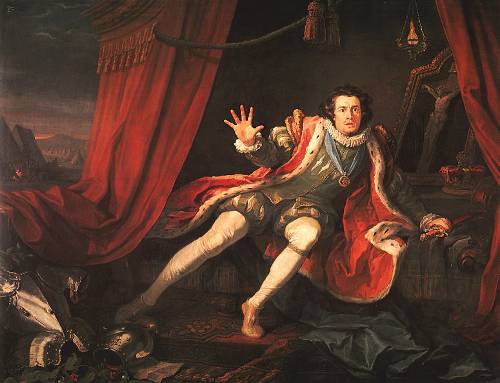
David Garrick revolutionized the 18th-century stage with a naturalistic style of acting that replaced the self-conscious theatricality of the earlier tradition. Audiences flocked to see his productions, forsaking earlier favorites such as James Quin, who admitted, “If this young fellow be right, then we have been all wrong.”
Garrick died in 1779, so we have no recordings of his performances. But we do have this:
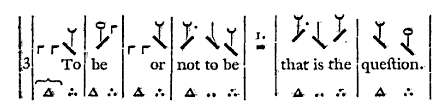
That’s Garrick’s line reading preserved in the “prosodia rationalis,” a system for recording linguistic prosody using a music-like notation. Its creator, Joshua Steele, had attended a Garrick performance in order to compare his own rendering of Hamlet with that of the acclaimed actor. He found that “that speech, or soliloque, which I (for want of better judgement) have noted in the stile of a ranting actor, swelled with forte and softened with piano, he delivered with little or no distinction of piano and forte, but nearly uniform; something below the ordinary force, or, as a musician would say, sotto voce, or sempre poco piano.”
Steele gives a few other fragments of Garrick’s performance, but “I shall forbear to give any more specimens of that great actor’s elocution, from the memory of once hearing, lest I should do him injustice, as my intention here is not to play the critic; but merely to shew, that by means of these characters, all the varieties of enunciation may be committed to paper, and read off as easily as the air of a song tune.”
Related (sort of): The Parrot of Atures.
Jdinoto, Adam Victor Brandizzi likes this
01 Jul 11:48
Shadows on the Wall of the Cave
by Samuel Goldman
So the French philosopher Alain Badiou is apparently writing a movie about Plato (via @jamespoulos). The script will be in English. But Badiou claims that he won’t include a single word that’s not in Plato’s dialogues. In addition to bringing a ripping yarn to the cinemas, TVs, and laptops of the world, Badiou thinks it would be subversive to disseminate the teachings of Plato, “the symbol of universal wisdom”, by means of the “propaganda machine of American life, the capital of capitalist corruption: Hollywood!”.
I can’t believe that Badiou is serious (I feel the same way about his philosophical writings). Nevertheless, I hope that he succeeds. The Platonic dialogues were often performed as dinnertime entertainment in the Hellenistic period. Although it might not please scholars, there’s historical precedent for a film.
But I have quibbles about Badiou’s dream cast, which would include Brad Pitt as Plato and Sean Connery as Socrates. For one thing, Plato doesn’t appear in any of the dialogues. So Pitt would presumably be limited to a silent role. He might have more opportunity to display his talents as Alcibiades.
More seriously, Sean Connery, is much too good looking to play a man whose bulging eyes and pug nose were the object of mockery to his contemporaries. How about Wallace Shawn? Or Paul Giamatti?
Apart from the stars, a film about Socrates would offer wonderful roles to character actors. Who would play the loyal Crito? The dim Euthyphron? The spirited Thrasymachus? Are there any figure from the dialogues you’d particularly like to see on screen? Personally, I’d love to see a cameo appearance by Aristophanes, who was the first to see the crowd-pleasing potential in all this nonsense about philosophy.
Adam Victor Brandizzi likes this
01 Jul 09:24
Even now Sithrak oils the spit
Adam Victor Brandizzi"Worst. God. Ever"
-- review na Amazon





01 Jul 09:20

Unquote
by Greg Ross
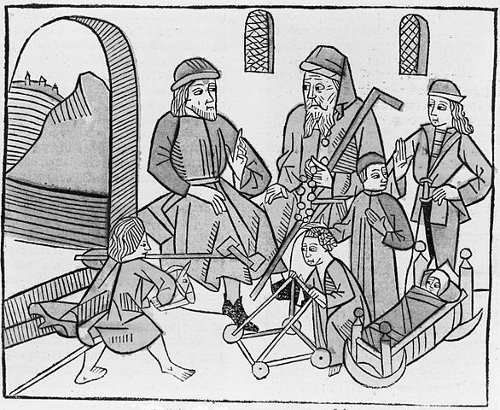
“I believe what really happens in history is this: the old man is always wrong; and the young people are always wrong about what is wrong with him. The practical form it takes is this: that, while the old man may stand by some stupid custom, the young man always attacks it with some theory that turns out to be equally stupid.” — G.K. Chesterton

30 Jun 18:37
Finding Sociopaths on Facebook
by schneier
On his blog, Scott Adams suggests that it might be possible to identify sociopaths based on their interactions on social media.
My hypothesis is that science will someday be able to identify sociopaths and terrorists by their patterns of Facebook and Internet use. I'll bet normal people interact with Facebook in ways that sociopaths and terrorists couldn't duplicate.Anyone can post fake photos and acquire lots of friends who are actually acquaintances. But I'll bet there are so many patterns and tendencies of "normal" use on Facebook that a terrorist wouldn't be able to successfully fake it.
Okay, but so what? Imagine you had such an amazingly accurate test...then what? Do we investigate those who test positive, even though there's no suspicion that they've actually done anything? Do we follow them around? Subject them to additional screening at airports? Throw them in jail because we know the streets will be safer because of it? Do we want to live in a Minority Report world?
The problem isn't just that such a system is wrong, it's that the mathematics of testing makes this sort of thing pretty ineffective in practice. It's called the "base rate fallacy." Suppose you have a test that's 90% accurate in identifying both sociopaths and non-sociopaths. If you assume that 4% of people are sociopaths, then the chance of someone who tests positive actually being a sociopath is 26%. (For every thousand people tested, 90% of the 40 sociopaths will test positive, but so will 10% of the 960 non-sociopaths.) You have postulate a test with an amazing 99% accuracy -- only a 1% false positive rate -- even to have an 80% chance of someone testing positive actually being a sociopath.
This fallacy isn't new. It's the same thinking that caused us to intern Japanese-Americans during World War II, stop people in their cars because they're black, and frisk them at airports because they're Muslim. It's the same thinking behind massive NSA surveillance programs like PRISM. It's one of the things that scares me about police DNA databases.
Many authors have written stories about thoughtcrime. Who has written about genecrime?
BTW, if you want to meet an actual sociopath, I recommend this book (review here) and this blog.
30 Jun 18:18
bouncingdodecahedrons: ifelay: “So my friend gave her rabbit a...


Alvaro Freitas and -1 others like this
30 Jun 17:08
Ouvi tanto Jorge Ben hoje que quase virei torcedor do Vasco!
Ouvi tanto Jorge Ben hoje que quase virei torcedor do Vasco!
30 Jun 17:08


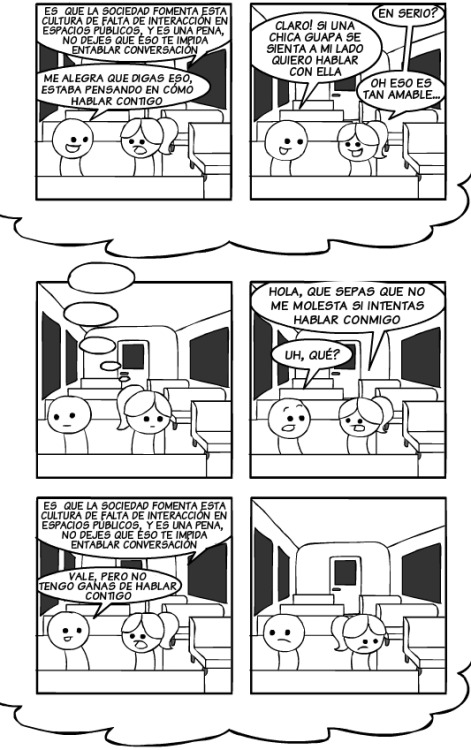
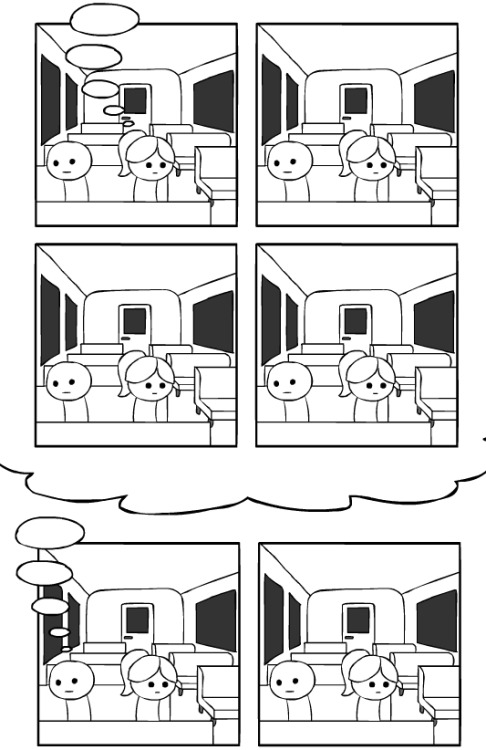
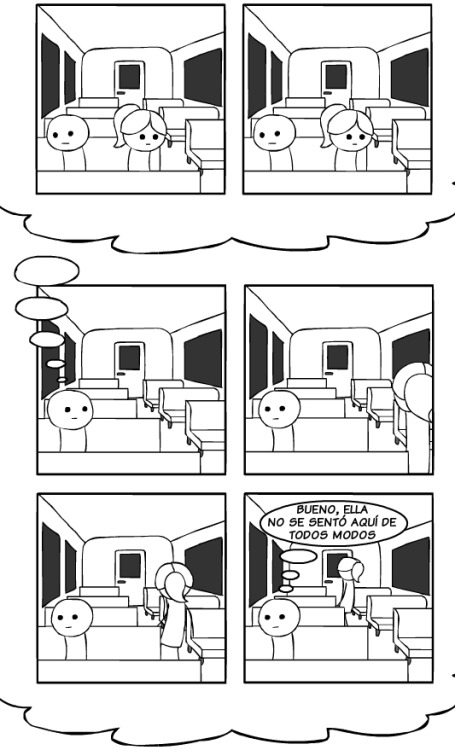




fosfodiesterlamina: enamorado-de-ti-ma-cherie: mehueleelpitoaca...
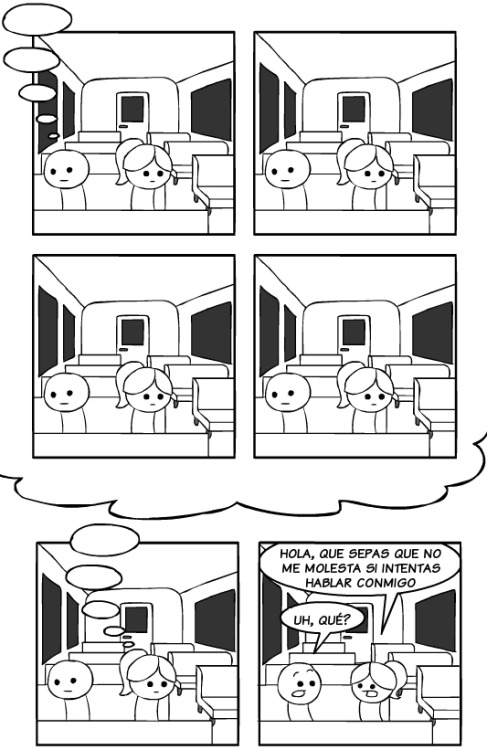
Esto si qué es pensárselo demasiado.
uno de los mejores post que eh visto es uno de mis favoritos :l
vale la pena leerlo
aveces si lo piensas mucho…………….es mejor actuar en el momento♥
30 Jun 15:13





doctordonna10: al-bayyinah: ahhjibbliejibblie: WHAT IF other...
WHAT IF other planetary bodies orbited our world at the same distance as the moon?
whoa Jupiter kinda in my personal bubble thanks
Jupiter would actually be terrifying.
Is that Earth orbiting Earth
30 Jun 13:01

Squirrel Head Feeder
by Diego
Provide some laughs for you and your friends while you feed the furry creatures in your tree some delicious grub using the squirrel head feeder. This novelty feeder hangs in the yard and creates the hilarious illusion the squirrel has an over-sized head when he goes to eat.
$12.34
Adam Victor Brandizzi and -1 others like this
30 Jun 12:52
Metal Detector
by Jonco

Thanks Mike (from Spain)
Adam Victor Brandizzi, Alvaro Freitas and -1 others like this
30 Jun 12:15

Book Search
by Greg Ross
Adam Victor Brandizzi"Requested: The Missing Hand
Book wanted: A Farewell to Arms"
hahahaha
For her 1974 book Lighter Side of the Library, Janice Glover asked American librarians to recall titles requested by confused patrons, and the books they turned out to want:
Requested: Who Is Your Schoolmaster?
Book wanted: Hoosier Schoolmaster
Requested: Entombed With an Infant
Book wanted: In Tune With the Infinite
Requested: The Missing Hand
Book wanted: A Farewell to Arms
Requested: The Armored Chinaman
Book wanted: The Chink in the Armour
Requested: King of the Ants
Book wanted: Lord of the Flies
Requested: The Wooden Kid
Book wanted: Pinocchio
Requested: Five Pennies and the Sun
Book wanted: The Moon and Sixpence
And so on: From Here to Maternity; The Merchant of Venus; “Allergy in a Country Churchyard”; My Heart Is Wounded, They Buried My Knee. One inspired library staff finally sent a student home with Homer’s Iliad; he had come in asking for Homeless Idiot.
mkvande, Atticus Cody and 3 others like this


28 Jun 21:14

Far Too Often
by DOGHOUSE DIARIES
Adam Victor BrandizziCoca-cola, claro.

For those of you who think that only posting comics on Monday, Wednesday and Friday is silly (or if you simply hate the number 3), we have good news. We’re going to draw up some extra material from time to time and post them to our facebook page, like this one Will posted yesterday.
Richbarbi, Jakub.cisek and 5 others like this
28 Jun 21:10


gettingcrazywiththecheezewhiz: The dad cat liked to hang out in...
gettingcrazywiththecheezewhiz:
The dad cat liked to hang out in the sink by himself
AND THEN THE KITTENS FOUND HIM
HE LOOKS SO ANNOYED
I DIDN’T SIGN ON FOR THIS SHIT.
Theasp, Adam Victor Brandizzi and -1 others like this