Shared posts

28 Apr 21:49

Quote For The Day

by Andrew Sullivan

“I am a survivor of torture who owes his release from the Argentine junta’s notorious Unit 9 prison in part to U.S. pressure in the 1970s. If U.S. citizens and certain members of Congress had not written letters to the Argentine government inquiring about my situation, I might have become one of the thousands of people “disappeared” by the Argentine military in its Dirty War against political activists like me. I owe my life to the solidarity those Americans showed and their principled opposition to the military’s machinery of death and torture.

Unfortunately, the U.S. government that stood up to my torturers has been compromised — by both the Bush administration, which adopted torture as policy, and the Obama administration, which has kept evidence of U.S. torture hidden for years. It also is being compromised by the Central Intelligence Agency itself … According to the White House, President Barack Obama will allow the CIA to review and redact the report summary — a preposterous conflict of interest. Once again, the torturers will have the opportunity to censor what the public can know,” – Juan Mendez, UN special rapporteur on torture.

28 Apr 18:48

We are seven - Wordsworth, William. 1888. Complete Poetical Works.

          --------A SIMPLE Child,
          That lightly draws its breath,
          And feels its life in every limb,
          What should it know of death?

          I met a little cottage Girl:
          She was eight years old, she said;
          Her hair was thick with many a curl
          That clustered round her head.

          She had a rustic, woodland air,
          And she was wildly clad:                                    10
          Her eyes were fair, and very fair;
          --Her beauty made me glad.

          "Sisters and brothers, little Maid,
          How many may you be?"
          "How many? Seven in all," she said
          And wondering looked at me.

          "And where are they? I pray you tell."
          She answered, "Seven are we;
          And two of us at Conway dwell,
          And two are gone to sea.                                    20

          "Two of us in the church-yard lie,
          My sister and my brother;
          And, in the church-yard cottage, I
          Dwell near them with my mother."

          "You say that two at Conway dwell,
          And two are gone to sea,
          Yet ye are seven!--I pray you tell,
          Sweet Maid, how this may be."

          Then did the little Maid reply,
          "Seven boys and girls are we;                               30
          Two of us in the church-yard lie,
          Beneath the church-yard tree."

          "You run about, my little Maid,
          Your limbs they are alive;
          If two are in the church-yard laid,
          Then ye are only five."

          "Their graves are green, they may be seen,"
          The little Maid replied,
          "Twelve steps or more from my mother's door,
          And they are side by side.                                  40

          "My stockings there I often knit,
          My kerchief there I hem;
          And there upon the ground I sit,
          And sing a song to them.

          "And often after sunset, Sir,
          When it is light and fair,
          I take my little porringer,
          And eat my supper there.

          "The first that died was sister Jane;
          In bed she moaning lay,                                     50
          Till God released her of her pain;
          And then she went away.

          "So in the church-yard she was laid;
          And, when the grass was dry,
          Together round her grave we played,
          My brother John and I.

          "And when the ground was white with snow,
          And I could run and slide,
          My brother John was forced to go,
          And he lies by her side."                                   60

          "How many are you, then," said I,
          "If they two are in heaven?"
          Quick was the little Maid's reply,
          "O Master! we are seven."

          "But they are dead; those two are dead!
          Their spirits are in heaven!"
          'Twas throwing words away; for still
          The little Maid would have her will,
          And said, "Nay, we are seven!"
                                                              1798.
          
28 Apr 18:37

tatihc: ESSE POST FOI PRA TANTAS DIREÇÕES.


tatihc:

ESSE POST FOI PRA TANTAS DIREÇÕES.

28 Apr 17:50

April 28, 2014

Adam Victor Brandizzi

O pior é que funciona mesmo.


The slow descent into madness has accelerated.
28 Apr 17:47

Por que Abbas reconheceu o Holocausto e Kerry adverte que Israel pode virar um Apartheid?

by Gustavo Chacra
Adam Victor Brandizzi

¿Mas será?

Mahmoud Abbas, presidente da Autoridade Palestina, inicialmente parecia ter adotado a estratégia errada na sua negociação com Israel ao decidir fazer um pacto com o Hamas. Eu mesmo o critiquei. Mas, aos poucos, sua estratégia demonstra ser bem mais sofisticada e, provavelmente, existe coordenação com a Casa Branca.

Primeiro, Abbas deixou claro que não desistiu de negociar. Afirma claramente que, se Israel libertar a quarta leva de prisioneiros conforme acordado, ele seguirá negociando. Tampouco voltou atrás em concessões, como a permanência de tropas israelenses no vale do Rio Jordão por cinco anos, sendo substituída, em uma transição, por forças da OTAN.

E o Hamas? Este é o segundo ponto. O Hamas não bloqueou as negociações e há indicações de que o grupo ingressará na OLP. Automaticamente, reconheceria Israel. E deu carta branca para Abbas negociar. Europeus e mesmo alguns membros do governo americano celebraram o acordo e avaliam que Abbas agora negocia em nome de todos os palestinos, exatamente como todos cobravam, inclusive Israel. Óbvio que não será de repente, mas o Hamas abdicar do terrorismo está na mesa.

Terceiro, e mais importante, Abbas enviou uma histórica mensagem para Israel ao dizer claramente que o Holocausto foi o maior crime da história moderna. E o recado foi em árabe, hebraico e inglês para não restar dúvida. Antes, não podemos esquecer, o líder palestino escreveu uma tese de doutorado na Rússia questionando o genocídio de 6 milhões de judeus e outras minorias como os roma.

Por último, Abbas sabe que a maré está a seu favor. Mesmo depois do anúncio do pacto com o Hamas, encerrando sete anos de conflito, o secretário de Estado John Kerry optou não por criticar os palestinos, mas sim o governo israelense ao dizer que Israel pode se tornar um Estado de Apartheid.

Eu escrevi aqui uma série de vezes que Israel é uma nação desenvolvida, com enormes avanços na indústria farmacêutica, tecnológica e agrícola. Caso seja criado um Estado palestino, será certamente um dos países mais admiráveis do planeta, e praticamente imune a críticas – democrático, desenvolvido, multicultural e liberal em questões sociais e econômicas. Sem a ocupação e com um Estado palestino, será quase perfeito – uma espécie de norte da Califórnia no Mediterrâneo. Mas, se a ocupação continuar, a narrativa de Apartheid vai crescer. Um ex-presidente (Jimmy Carter) já usou esta palavra. Agora, até mesmo um secretario de Estado. Sem falar os que não têm coragem.

Netanyahu precisa se espelhar mais em Yitzhac Rabin e se distanciar de figuras como Naftali Bennet e Danny Ayalon. 

Apenas comentários do post do dia ou do post prévio serão publicados

Guga Chacra, comentarista de política internacional do Estadão e do programa Globo News Em Pauta em Nova York, é mestre em Relações Internacionais pela Universidade Columbia. Já foi correspondente do jornal O Estado de S. Paulo no Oriente Médio e em NY. No passado, trabalhou como correspondente da Folha em Buenos Aires

Comentários islamofóbicos, antissemitas, anticristãos e antiárabes ou que coloquem um povo ou uma religião como superiores não serão publicados. Tampouco ataques entre leitores ou contra o blogueiro. Pessoas que insistirem em ataques pessoais não terão mais seus comentários publicados. Não é permitido postar vídeo. Todos os posts devem ter relação com algum dos temas acima. O blog está aberto a discussões educadas e com pontos de vista diferentes. Os comentários dos leitores não refletem a opinião do jornalista

Acompanhe também meus comentários no Globo News Em Pauta, na Rádio Estadão, na TV Estadão, no Estadão Noite no tablet, no Twitter @gugachacra , no Facebook Guga Chacra (me adicionem como seguidor), no Instagram e no Google Plus. Escrevam para mim no gugachacra at outlook.com. Leiam também o blog do Ariel Palacios

28 Apr 12:22

Elementary

by Greg Ross

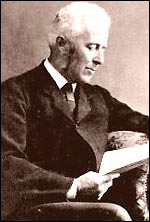
http://commons.wikimedia.org/wiki/File:Joseph_Bell.jpg

Sherlock Holmes was based on a real man, Scottish surgeon Joseph Bell, whom Arthur Conan Doyle had served as a clerk in the Edinburgh Royal Infirmary.

Bell was famous for making deductions about his patients. He greeted one by saying, “Ah, I perceive that you are a soldier, a noncommissioned officer, and that you have served in Bermuda.”

When the man acknowledged this, Bell addressed his students. “How did I know that, gentlemen? The matter is simplicity itself. He came into the room without taking his hat off, as he would go into an orderly’s room. He was a soldier. A slight authoritative air, combined with his age, shows that he was a noncommissioned officer. A slight rash on the forehead tells me that he was in Bermuda, and subject to a certain rash known only there.”

On another occasion Bell challenged his students to identify a bitter drug by taste alone. They watched him dip a finger into the tumbler and taste it, and reluctantly followed suit. “Gentlemen,” he said with a laugh, “I am deeply grieved to find that not one of you has developed this power of perception which I so often speak about; for if you had watched me closely, you would have found that while I placed my forefinger in the medicine, it was the middle finger which found its way into my mouth.”

28 Apr 12:21

PT versus PT: gasto com pensão é um problema?

by mansueto
Eu não vou falar aqui das desavenças entre grupos do PT. Não entendo esse assunto. Isso é matéria para jornalistas e cientistas políticos. O que vou falar aqui é algo mais técnico sobre duas pessoas que participaram de áreas diferentes do governo do Presidente Luís Inácio Lula da Silva. Samuel Pessoa na semana passada (André […]
28 Apr 12:08

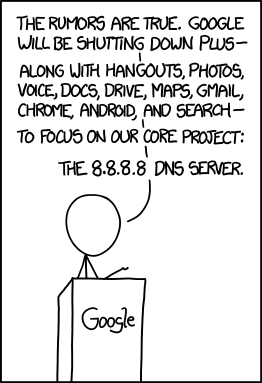
Google Announcement

Adam Victor Brandizzi

Não! O 8.8.4.4 não!

The less popular 8.8.4.4 is slated for discontinuation.
28 Apr 11:58

Unquote

by Greg Ross
Adam Victor Brandizzi

Não sei se a citação é corretamente atribuída, muito menos se o fato afirmado é verdadeiro (embora pareça MUITO plausível). Compartilhando mesmo porque o quadro é muito legal!

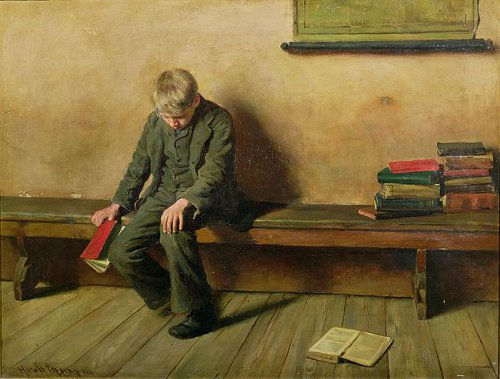
http://commons.wikimedia.org/wiki/File:Harold_Copping_-_The_Dunce.jpg

“It is disconcerting to reflect on the number of students we have flunked in chemistry for not knowing what we later found to be untrue.” — Attributed to Deming by B.R. Bertramson, in Robert L. Weber, Science with a Smile, 1992

28 Apr 11:57

innovation strategery

by tomfishburne


Marketers are full of buzzwords, particularly when talking about innovation. Even the term “innovation” is a cliché in danger of losing its meaning.

In talking about innovation, it’s easy to get lost in the “strategery” and lose sight of the actual consumer need. We marketers tend to breathe our own exhaust after a while.

One of the more misunderstood and overused terms in innovation is “disruptive”. Contrary to how its commonly used, “disruptive” is not just another way of saying “really really innovative”.

“Disruptive innovation” is a specific term coined by HBS Professor Clayton Christensen that refers to an innovation that overtakes an existing market by applying a different set of values and creates a completely new market. Digital photography was a disruptive innovation that overtook chemical photography. Wikipedia was a disruptive innovation that overtook traditional encyclopedias.

Very few innovations are truly disruptive. Yet rare is the innovation that doesn’t get pitched as “disruptive”.

The most powerful way to talk about a new product or business is Plain English. The more innovative your product actually is, the less you’ll need to use buzzwords to justify it.

(Marketoonist Monday: I’m giving away a signed print of this week’s cartoon. Just share an insightful comment to this week’s post by 5:00 PST on Monday. Thanks!)

28 Apr 11:52

GIF | fff.gif

fff.gif
28 Apr 00:57

GIF | be9.gif

be9.gif
28 Apr 00:54

GIF | 4a2.gif

4a2.gif
27 Apr 22:16

April 27, 2014


Whee!
27 Apr 22:15

odenn [x] Uncanny


odenn [x]

Uncanny

27 Apr 22:15

yohji yamamoto f/w 2010


yohji yamamoto f/w 2010

27 Apr 22:14

Imposture

http://oglaf.com/imposture/

27 Apr 06:05

Crônica da crise

by Míriam Leitão

O pior de uma crise é não admitir que ela existe. É o erro que o governo está cometendo na energia. O empréstimo que será assinado hoje é esdrúxulo, mas, se não saísse, as distribuidoras não teriam dinheiro para, no dia 29, terça-feira, aportar os recursos...

Leia mais

Assine O Globo e receba todo o conteúdo do jornal na sua casa

27 Apr 04:06

Llega “E-mail”, la app de mensajería definitiva

by Juan García
Adam Victor Brandizzi

email <3<3<3

meme-grandma

Noticias calientes: Facebook ha comprado Whatsapp por cuatro perras y Whatsapp se cae. Como consecuencia de esta caída millones de personas deciden probar Telegram, una aplicación alternativa que promete más seguridad (bueno no) y una eterna actividad sin ánimo de lucro. Da igual que tengan que pagar cientos de servidores o ingenieros despedidos de Tuenti, que el crowdfunding está para sacarles del apuro si las cosas pintan feas.

Pero esa trasvase de usuarios de Whatsapp a Telegram hace que la app se caiga. El cementerio se llena de dobles checks verdes y la gente llora porque mira la pantalla del móvil y no pasa nada. El abismo.

Aquí es donde aparece “E-mail” un nueva aplicación de lo más prometedora que trata de hacerse un hueco dentro de la burbuja de la comunicación online.

El origen de “E-mail” es desconocido. Algunos comentan que surge de la mente más brillante de nuestra era, Nguyen Ha Dong, creador de Flappy Bird. Sin embargo, fuentes fiables (que cualquiera pueda editar) afirman que su desarrollo comienza en el mismísimo MIT estadounidense siendo Ray Tomison  uno de sus principales valedores.

La idea detrás de “E-mail” era ofrecer un servicio de mensajería multiplataforma donde los mensajes se almacenaran bien en el dispositivo del usuario, bien en otro dispositivo al que se le asignó el nombre en clave “servidor” (a veces se le conoce también como “lodeenmedio”). Frente a la tendencia actual de destruir las conversaciones (Snapchat), E-mail buscaba guardarlas ¡durante años!. Esto permitiría poder consultar conversaciones, fotos y vídeos de hace semanas de forma cómoda y zanjar las discusiones con los amigos más rápidamente.

E-mail, de forma muy acertada incorpora nuevas tendencias para acercarlo al público más joven. Entre todos ellos destaca el uso del símbolo “@” originario de Twitter para hacer referencia a los distintos destinatarios.

El éxito de E-mail es bien conocido por los early-adopters pero en los últimos años está preparando su despegue definitivo gracias a sus acuerdos con la compañías tecnológicas más importantes del mundo: Google (que lo ha incorporado en su producto Gmail), Yahoo! (en Yahoo! Mail) o Microsoft (en Outlook).

Como cualquier otra start-up, E-mail ha tenido sus problemas por ejemplo con Apple con los que no llegó a cuajar con su servicio “@me.com” y sus pelotazos como su versión “Mailbox” que fue adquirida por la compañía Dropbox por muchos bitcoins.

Dado que 2014 puede ser al año de E-mail vamos a ver algunas de sus funcionalidades más destacadas:

1. Multiplataforma

E-mail funciona en cualquier teléfono con conexión a Internet y lo que es más importante: tiene versión de escritorio para Mac, Windows, Linux y hasta consolas de videojuegos. Puedes consultar e-mail desde cualquier lugar con un nombre de usuario y contraseña. Incluso desde tu baño.

E-mail funciona en cualquier teléfono con conexión a Internet

2. Tienes tarifa plana de mensajes

Uno de los grandes éxitos de Whatsapp es sin duda su carácter “gratuito”. Da igual cuantos mensajes envíes que si estás con una WiFi no te cobrarán más y si estás con 3G como mucho se ralentizará la velocidad. Lo que sí que no te libras es de pagar 1€ al año por él lo que todos sabemos que es una vergüenza y una estafa.

E-mail funciona de forma similar: tiene versiones gratuitas con algo de publicidad y versiones de pago pero en general podrás mandar todos los “correos” (que es como se conoce a los mensajes de e-mail) que quieras sin coste adicional.

Ahora ¡ojo si te vas al extranjero con las tarifas de datos!

Más vídeos en Antena3

3. Mayor privacidad

Uno de las grandes preocupaciones de las sociedad actual, como demuestran las desprotegidas redes wifi de tu comunidad de vecinos, es la privacidad. En Whatsapp y servicios similares tienes que dar tu número de teléfono – un dato tremendamente personal – para que alguien se ponga en contacto contigo.

E-mail en este sentido copió la estrategia de LINE donde tienes una ID llamada dirección de e-mail que sólo sabes tú y que das a aquellas personas que quieres que se pongan en contacto contigo.

Con E-mail puedes enviar un mensaje a alguien sin que sepa tu número de teléfono. Por supuesto el cambio de número de teléfono no afectará para nada a tu dirección de correo.

4. Sin límite de cuentas

Otro fallo de las apps de mensajería tradicionales que dispones de una única cuenta para todas tus comunicaciones. ¿Pero qué pasa si quieres tener por ejemplo una cuenta para tus amigos y otra para tu trabajo? ¿Te compras otro móvil?

E-mail en cambio permite separar facetas de tu vida, tantas como quieras. Incluso pueden estar en distintos servicios, por ejemplo puedes usar E-mail de Gmail para tu empresa e E-mail de Outlook para hablar de True Detective. A tu gusto.

5. Mayor espacio para escribir

Tras el éxito de Twitter la sociedad se acostumbró a “micromensajear” pero 140 caracteres no siempre son suficientes. Esto se comprueba a menudo en las aplicaciones de mensajería donde el uso de los puntos suspensivos vive una segunda juventud y los sonidos de alerta de “Nuevo mensaje” provocan ansiedad en los usuarios dado que para escribir “¿Quedamos a las 8?” se utilizan entre 5 y 8 mensajes de media.

E-mail rompe con todo esto. Por supuesto que si quieres decir “¿quedamos a las 8?” puedes hacerlo pero la pantalla de entrada de texto es mucho más grande permitiéndote añadir emoticonos, imágenes, vídeos de YouTube, mapas de Google y un sinfín de cosas ¡¡dentro del mismo mensaje!!

Con E-mail puedes decir en un mensaje lo que antes te llevaba diez. Y enviar archivos (pequeñicos)
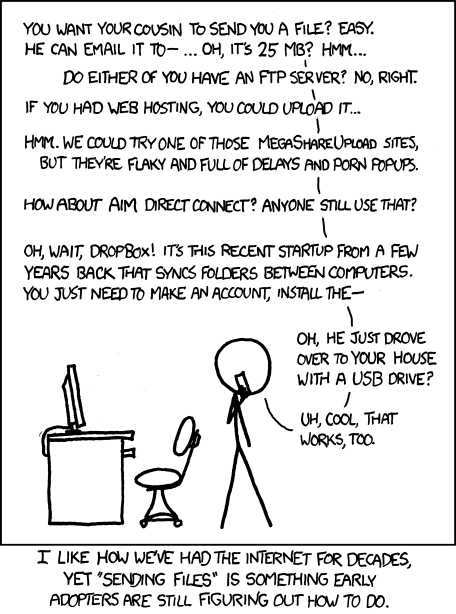
6. Filtros y buscadores

Imagínate poder borrar todos los mensajes de una persona de forma automática. O al revés, marcarlos como importantes para que siempre los tengas a mano, incluso 4 años después.

Imagínate que la propia aplicación filtre mensajes en cadena y tonterías para que no te estén molestando cada dos por tres con leyendas urbanas y fakes.

Imagínate que la propia aplicación filtre mensajes en cadena y tonterías para que no te estén molestando cada dos por tres con leyendas urbanas y fakes.

Y lo mejor de todo, imagínate disponer de un buscador donde puedes encontrar aquél mensaje de hace 4 meses con esa foto escacharrante de un bebé desayunando sin necesidad de dejarte el dedo haciendo scroll.

Sin coñas, E-mail incluso en su versión “lite” ofrece todo eso.

7. Mejor gestión de grupos

En E-mail puedes tener conversaciones con hasta ¡¡500 personas!! (se comenta además que algunas de las empresas que ofrecen “E-mail” están desarrollando un producto conocido como “Lista de correo” donde pueden mensajear miles de usuarios).

Lo que más me gusta es una opción también disponible en la versión “Lite”: cuando chateas con varias personas (osea, como si montaras un grupo de Whatsapp) ¡puedes hacerlo de tal modo que unas no sepan las direcciones de otras! Es un truco no muy conocido que los hackers llaman Copia de carbón oculta.

La mayoría de las empresas no lo conocen pero si buscas un poco en Google verás cómo funciona.

8. Mantén la propiedad de tus correos

¿Qué pasa si cierra Telegram? ¿Si pierdes tu teléfono? ¿Si Whatsapp cambia de manos? No siempre es fácil tener una copia de todas esas conversaciones críticas que has tenido por mensajería.

En cambio en torno a e-mail están naciendo decenas de programas y aplicaciones móviles (Tunderbird, Live Mail) que te permiten descargar todos tus mensajes a tu ordenador. Sí, has oído bien, a tu ordenador, ese cacharro abandonado en el cuarto de estudio que no sabes si tirar o qué. Pues puedes usarlo ni más ni menos que para guardar esa información y si en el futuro E-mail quiebra o es comprado por Kim Dotcom conservarás tus mensajes.

Cuando escribes un correo electrónico tus gilipolleces parecen mucho mas grandes.

9. La puerta de entrada a miles de servicios

Si eres viejo recordarás una cosa que se llamaba Open ID. Era como una “Identidad Digital” que te permitía registrarte en cualquier sitio con una única cuenta. Tras el rotundo éxito del DNI Electrónico y los certificados digitales, Open ID pasó a mejor vida pero aquí llega E-mail. Y con E-mail puedes…. wait for it… tener una cuenta en Twitter, en Instagram, en Facebook, en Adopta a Un Tío, en Pokerstars, en Forocoches, …. ¿AMEISING verdad?

10. No todo son cosas buenas

Efectivamente, E-mail no es  tan maravilloso. Tiene un grandísimo defecto que de paliarse lo transformaría en la killer-app de la década.

Cuando escribes un correo electrónico tus gilipolleces parecen mucho mas grandes.

Quizás sea por el tamaño del recuadro donde tienes que escribir. Quizás porque parece más formal que Wechat o LINE pero a mí me ha pasado.

En Whatsapp ponía una mierda con ojos en un mensaje, la otra persona respondía “jajjajaja” y no sólo no me sentía estúpido sino que me sentía pleno, social y con voz en un mundo triste.

Probé a hacer lo mismo con “E-mail”. Aprovechando su potencial y que más grande es mejor como decían en Robocop, le mandé a un amigo una imagen gigante (en 4k) de una mierda con ojos y él me respondió un frío “LOL” ahogándose en el espacio en blanco.

Y al ver la conversación me sentí imbécil.

lol-shit-mail

La entrada Llega “E-mail”, la app de mensajería definitiva aparece primero en blogoff.

27 Apr 04:05

A totally simply way Google could have avoided f***ing up Google+

Adam Victor Brandizzi

1. É isso aí.
2. Vão parar de forçar o Google+ goela abaixo? Ó GLÓRIA, IRMÃO!

I’ve been meaning to write this blog post for a year, and I might as well get it out there now that I’ve just read that Google is backing away from Google+.

It’s not surprising that Google is getting away from Google+.  It was actually a really good product, but the thing has had zero traction with real people.

But, I have to be honest, the way Google has handled Google+ has totally pissed me off.  No, I’m not among the legions who have been unhappy about Google integrating Google+ into all of their other products.

I’m pissed because Google blew an amazing opportunity.  Google possessed a totally simple and easy way to make Google+ practical and relevant, but somehow, I don’t know how, they f***ed it up.

What am I talking about?  Let’s rewind to March 13, 2013:

We have just announced on the Official Google Blog that we will soon retire Google Reader (the actual date is July 1, 2013). We know Reader has a devoted following who will be very sad to see it go.

Naturally, there was a lot of reaction and angry Reader users.

But, Google could have avoided angry Reader users and given Google+ a massive boost by simply integrating Reader into Google+.

Yes, just that simple…make it so that you could follow an RSS feed as though it were another user in G+.  Make it so that you could put RSS feeds into circles, and share them, just like you do with other G+ users.

If Google would have done that G+ would have taken off like wildfire and nobody would have ever looked back.  I have no idea why they didn’t, but for some reason the lost potential has irritated me for a year.  And, here we are now, with the whole effort going down the tubes.

What a waste.

27 Apr 04:02

Sites libertários bons

by brandizzi

Os libertários estão crescendo! É compreensível (especialmente para mim, que também tive minha fase libertária), dado que o libertarianismo propõe repostas simples e concisas a vários problemas atuais. Como já temos doze anos de governos de esquerda tradicional, e como todo mundo no Brasil adora ser oposição, esta realmente é a hora dos libertários.

Infelizmente, porém, o conteúdo que os libertários que consomem e produzem é horrendo – ao menos entre meus amigos libertários. Os mais esclarecidos ainda estão no nível randiano de argumentação.* No pior dos casos, simplesmente contradizem o próprio libertarianismo: defendem regimes de exceção, clamam por ditaduras, sonham com militarização, pedem limitação de liberdades negativas de minorias, aspiram pela pena de morte.

Amigos libertários, não precisa ser assim. Ao contrário: o debate no Brasil ficaria muito rico se o libertarianismo fosse apresentado decentemente. Para isto, porém, é preciso consumir o libertarianismo bom, não as estultices do Facebook. E, mesmo que eu discorde deles, não faltam libertários inteligentes! De cabeça, posso citar:

Tyler Cowen de terno

Esse cara simpaticão aí é o Tyler Cowen

  • Marginal REVOLUTION: o economista Tyler Cowen mantém este delicioso blog. Cowen se classifica como um “barganhador libertário”: alguém que, não sendo radical, tenta influenciar políticas públicas do mundo real de maneira a torná-las mais libertárias. Assim, a abordagem de Cowen é bem mais plausível e convincente que as ideias libertárias mais toscas. Ademais, o blog é uma excelente referência em economia, Cowen é divertido de ler e sempre há algumas curiosidades econômicas fascinantes.
  • Bleeding Heart Libertarians: provando que se pode ser libertário sem ser arbitrário ou abrutalhado, os autores exploram as mais variadas questões levando em consideração nossa realidade, em que existem o Leviatã e as injustiças. Como o libertário deve se posicionar ante este mundo? Os blogueiros procuram respostas, em situações especificas, através de argumentos elegantes e sofisticados. Em minha opinião, por vezes são um tanto abstratos, mas mesmo assim têm muito mais pés-no-chão que os delírios que alguns amigos queridos compartilham. Recomendo em especial este post, em que Jacob Levy, ao apresentar a proposta do site, explora muitos dilemas e questões morais de maneira estelar.
  • Mercado Popular: fontes brasileiras boas são raras, mas felizmente temos exceções como este blog. Minha mais recente descoberta, este blog é a prova de que se pode ser incisivo e confrontador sem ser grosseiro: seus artigos são fortes e inequívocos, mas bem fundamentados, honestos, instrutivos e, ainda assim, educados. Confesso que com nunca vi um site brasileiro sobre libertarianismo tão bom.** Em especial, dê uma olhada no manifesto do site.

Estes são só alguns dos exemplos de fontes libertárias boas, certamente há muito mais (a revista Reason, por exemplo). O importante é que há alternativas às bobageiras que, no final, apenas mancham a imagem do libertarianismo. Não queime seu próprio filme, amigo libertário! Mostre que suas ideias podem ser realistas e humanas. Não faltarão autores que o ajude nesta empreitada – basta lê-los.

* Não digo que ler Ayn Rand seja absolutamente ruim. É uma autora que instila curiosidade sobre liberalismo, política e filosofia, e assim levam muitos a dar um importante primeiro passo intelectual. Entretanto, suas ideias são tão surrealistas e dogmáticas que não se sustentam. Não é uma boa base para discutir o mundo real. Levar Ayn Rand a sério demais é como levar Eduardo Galeano a sério demais.

** Há sites liberais bons (eu gosto bastante do Ordem Livre) mas sites libertários bons são bem mais raros.


27 Apr 04:00

myampgoesto11: Sculptures by Livio Scarpella  My Amp Goes To...

25 Apr 23:59

fashionsambapita: LaurenceAirline Fall/Winter 2014 Lookbook by...


fashionsambapita:

LaurenceAirline Fall/Winter 2014 Lookbook

by Adriano B.

25 Apr 20:59

The Pun Also Rises

by Greg Ross

In 1994, computer scientists Graeme Ritchie and Kim Binsted designed a computer program to generate original riddles:

  • What do you call a ferocious nude? A grizzly bare.
  • What do you get when you cross breakfast food with a murderer? A cereal killer.
  • What’s the difference between leaves and a car? One you brush and rake, the other you rush and brake.
  • What’s the difference between a pretty glove and a silent cat? One is a cute mitten and the other is a mute kitten.

They called it JAPE, for Joke Analysis and Production Engine. In 1997 they convened a group of 8- to 11-year-old children to act as judges and presented them with a random selection of JAPE-produced riddles, human-produced riddles, nonsense nonjokes, and sensible nonjokes. Then they asked them to decide whether each text was a joke and, if so, how funny it was and whether they had heard it before.

“The results showed that the JAPE-produced riddles were identified as jokes just as reliably as the human-produced ones, and both were easily distinguished from the non-jokes,” writes Rod Martin in The Psychology of Humor (2007). “Although the JAPE-produced jokes were rated as less funny, on average, than the human-produced jokes, a number of the JAPE riddles were rated as being just as funny as those produced by humans.”

(Binsted, K., Pain, H., & Ritchie, G., “Children’s Evaluation of Computer-Generated Punning Riddles,” Pragmatics and Cognition, 5(2) [1997], 309-358.)

Writing fables is harder.

25 Apr 17:52

Israel deveria negociar com o Hamas? Na verdade, já negociou

by Gustavo Chacra

Negociações se dão com inimigos, não apenas com amigos. A Espanha negociou com o ETA, uma organização terrorista que matou centenas de civis espanhóis. A Grã Bretanha negociou com o IRA, uma organização terrorista de viés religioso, que matou centenas de civis. E Israel negociou com a OLP, uma organização responsável no passado por atentados terroristas. Estas três organizações abdicaram de suas armas.

Por que Israel não negociaria com o Hamas, outra organização terrorista responsável por centenas de atentados? A questão de o Hamas não reconhecer Israel não se sustenta. A negociação teria justamente este objetivo – o do reconhecimento. Além disso, há membros no governo israelense como Naftali Benett e Danny Ayallon que não reconhecem o direito de os palestinos terem um Estado viável, apesar de Benjamin Netanyahu reconhecer. E a violência? O Hamas uma série de vezes acertou tréguas negociadas com Israel e também a libertação de um soldado israelense sequestrado. Isto é, Israel e o Hamas já negociaram cessar-fogos em Gaza. Por que seria diferente?

Na verdade, a questão é se o Hamas está disposto a negociar com Israel e acataria um acordo se este for negociado e firmado por Abbas. Os membros da coalizão de Netanyahu que não reconhecem o direito de os palestinos terem um Estado aceitariam este caso Netanyahu chegasse a um acordo. Esta é a diferença. O Hamas nunca indicou que aceitaria um acordo assinado por Abbas.

Se o grupo mudar de postura, o acordo entre o Fatah e o Hamas é um avanço no médio e longo prazo, embora não no curto. Por enquanto, o Hamas ainda não indicou se apoia negociações. Enquanto não o fizer, Netanyahu tem razão em não negociar.

O mais simples, neste momento, seria montar a seguinte estratégia para o processo de paz e esta parece ser a via de Abbas (talvez com o aval do governo Obama e mesmo de Netanyahu) –

. seria formado um governo tecnocrático, sem a presença do Hamas e do Fatah, mas com Abbas de presidente

. as negociações serem retomadas por Abbas, com o aval do Hamas, mas sem a participação direta do Hamas

. o Hamas, no fim das negociações, poderia ingressar na OLP, em um sinal de que aceita todos os acordos vigentes entre Israel e os palestinos

. o acordo seria com todos palestinos, e não apenas com uma facção

Notem que nunca houve um momento tão propício para o Hamas ceder. O grupo está isolado em Gaza. Depois de trair Assad na Síria, perdeu o apoio também do Irã e do Hezbollah. Apostou na Irmandade no Egito e também perdeu. Erdogan fica apenas na retórica do apoio, mas valoriza, no fim das contas, mais seus laços com Israel. O Qatar também se distanciou. Não sobrou ninguém e, se o Irã fizer um acordo com os EUA, se tornará ainda mais complicado

Tenham certeza de que, apesar de dizerem o contrário, há contatos sim dos negociadores palestinos tanto com Israel como com os EUA. Todos sabem o que está ocorrendo nos bastidores e sabiam de antemão desta reaproximação Fatah-Hamas. 

Apenas comentários do post do dia ou do post prévio serão publicados

Guga Chacra, comentarista de política internacional do Estadão e do programa Globo News Em Pauta em Nova York, é mestre em Relações Internacionais pela Universidade Columbia. Já foi correspondente do jornal O Estado de S. Paulo no Oriente Médio e em NY. No passado, trabalhou como correspondente da Folha em Buenos Aires

Comentários islamofóbicos, antissemitas, anticristãos e antiárabes ou que coloquem um povo ou uma religião como superiores não serão publicados. Tampouco ataques entre leitores ou contra o blogueiro. Pessoas que insistirem em ataques pessoais não terão mais seus comentários publicados. Não é permitido postar vídeo. Todos os posts devem ter relação com algum dos temas acima. O blog está aberto a discussões educadas e com pontos de vista diferentes. Os comentários dos leitores não refletem a opinião do jornalista

Acompanhe também meus comentários no Globo News Em Pauta, na Rádio Estadão, na TV Estadão, no Estadão Noite no tablet, no Twitter @gugachacra , no Facebook Guga Chacra (me adicionem como seguidor), no Instagram e no Google Plus. Escrevam para mim no gugachacra at outlook.com. Leiam também o blog do Ariel Palacios

25 Apr 16:38

Conselhos Fiscais: um dia chegaremos lá

by Leonardo Monasterio
Adam Victor Brandizzi

¡MAS COMO ISSO SERIA LINDO!

Mais do que duas dúzias de países já tem conselhos e as evidências sugerem que isso está associado a um melhor desempenho fiscal. (Agradeço ao Alexandre Rocha pelo envio do paper)
A Lei de Responsabilidade Fiscal já previa um Conselho Fiscal, mas a tramitação da lei que o regulamenta -até onde sei - está parada. Eu realmente acredito que um Conselho Fiscal, bem desenhado, seria mais importante para o futuro do Brasil do que qualquer outra lei que eu possa imaginar.
25 Apr 16:28

The Parsons Code

by Greg Ross
Adam Victor Brandizzi

Bem bolado.

In 1975 Denys Parsons devised a surprisingly simple way for nonmusicians to record melodies — write an asterisk for the first note, then hum the tune and decide whether each subsequent note goes up (U), down (D), or repeats (R). The first two phrases of “Happy Birthday,” for instance, look like this:

*RUDUDDRUDUD

(“* repeat up down up down down repeat up down up down”)

This is surprisingly effective — Parsons, who spent five years indexing practically every well-known classical theme from the 16th century onward, wrote, “I continue to be astonished that such a simple test, taken to the sixteenth note (or less), should be adequate to distinguish more than 10,000 classical themes.” Can you identify the eight famous classical melodies below?

  1. *RRDURRD
  2. *RUURURDRDRUURURDR
  3. *RUURDDDDRUURDRURUURDDDDRUUDDR
  4. *DUDUDUUUDDUDUDDUD
  5. *DUDDDDDUDDUDUDU
  6. *UDUUDUDUUDUDUUDUDUU
  7. *DUDUDUDURRRRRRRRDUDU
  8. *RRRRRRRUUUDRRRRUURDDD

Click for solution …

25 Apr 16:24

What Can Men Do?

by Jeff Atwood
Adam Victor Brandizzi

O Jeff não manda muito bem ao falar de coisas assim, mas o debate lá nos fóruns tá legal.

(The title references Shanley Kane's post by the same name. This post represents my views on what men can do.)

It's no secret that programming is an incredibly male dominated field.

  • Figures vary, but somewhere from 20% to 29% of currently working programmers are female.

  • Less than 12% of Computer Science bachelor's degrees were awarded to women at US PhD-granting institutions in 2010.

So, on average, only about 1 out of every 5 working programmers you'll encounter will be female. You could say technology has a man problem.

In an earlier post I noted that many software developers I've known have traits of Aspergers. Aspergers is a spectrum disorder; the more severe the symptoms, the closer it is to autism. And did you know that autism skews heavily towards males at a 4:1 ratio?

Interesting. I might even go so far as to say some of those traits are what makes one good at programming.

That's the way it currently is. But is that the way it should be? I remember noticing that the workforce of the maternity ward at the hospital where our children were born was incredibly female dominated. Is there something inherently wrong with professions that naturally skew heavily male or female?

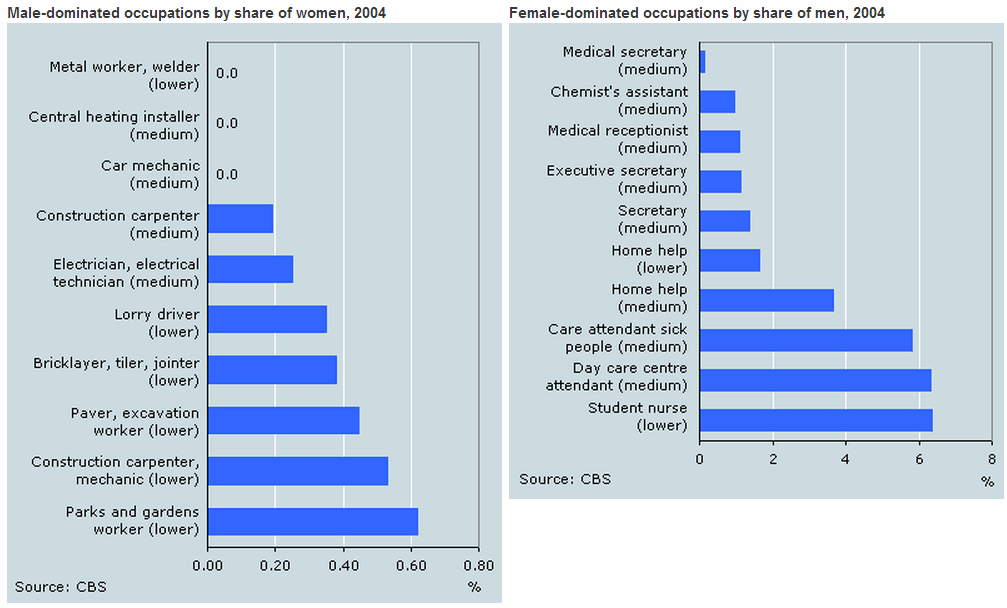
Consider this list of the most male and female dominated occupations in the Netherlands from 2004. It notes that:

In higher and academic level positions, men and women are more often represented equally. This pattern of employment has hardly changed over the last years.

Is programming a higher and academic level occupation? I'm not so sure, given that I've compared programmers to auto mechanics and plumbers in the past. And you'll notice squarely where those occupations are on the above graphs. There's nothing wrong with being an auto mechanic or a plumber (or a programmer, for that matter), but is there anything about those particular professions that demands, in the name of social justice, that there must be 50% male plumbers and 50% female plumbers?

For a counterpoint, here's a blog post from Sara J. Chipps. When I've e-mailed her in the past with my stupid questions on topics like this, she tries her best to educate me with empathy and compassion. That's why I love her.

This is an excerpt from a blog post she wrote in 2012 which answered my question:

Many people I meet ask me a variant of the question “I understand we want more women in technology, but why?” It’s a great question, and not at all something we should be offended by. Often men are afraid to ask questions like this for fear there will be backlash, and I think that fear can lead to stifling an important conversation.

Frankly, the Internet is thriving without women building it, why should that change? Three reasons:

1) Diversity leads to better products and results

As illustrated in this Cornell study along with many others, diversity improves performance, morale, and end product. More women engineers means building a better internet, and improving software that can service society as a whole. Building a better Internet is why I started doing software development in the first place. I think we can all agree this is of utmost importance.

2) The Internet is the largest recording of human history ever built

Right now the architecture for that platform is being built disproportionally by white and asian males. You’ve heard the phrase “he who writes history makes history”? We don’t yet know how this will affect future generations.

How can architecture be decidedly male? I like to refer to the anecdotal story of the Apple Store glass stairs. While visually appealing, there was one unforeseen consequence to their design: the large groups of strange men that spend hours each day standing under them looking up. As a woman, the first time I saw them I thought “thank god I’m not wearing a skirt today.” Such considerations were not taken in designing these stairs. I think it’s probable, if not easily predictable, that in a few years we will see such holes in the design of the web.

3) Women in 10 years need to be able to provide for themselves, and their families

Now, this reason is purely selfish on the part of women, but we all have mothers, and sisters, so I hope we can relate.

This year there are 6 million information technology jobs in the US, up from 628,600 in 1987 and 1.34 million in 1997. Right now jobs in technology have half the unemployment rate of the rest of the workforce. There is no sign this will change anytime soon. If growth continues at the current rate, it will not be long until women will not be able to sustain themselves if not involved in a technical field.

We have to start educating young girls about this now, or they may ultimately become the poorest demographic among us.

These are good reasons. I'm particularly fond of #1. Diversity in social perspectives is hugely valuable when building social software intended for, y'know, human beings of all genders, like Discourse and Stack Exchange. Also, I get really, really tired of all the aggressive mansplaining in software development. Yes, even my own. Sometimes it would be good to get some ladysplaining all mixed up in there for variety.

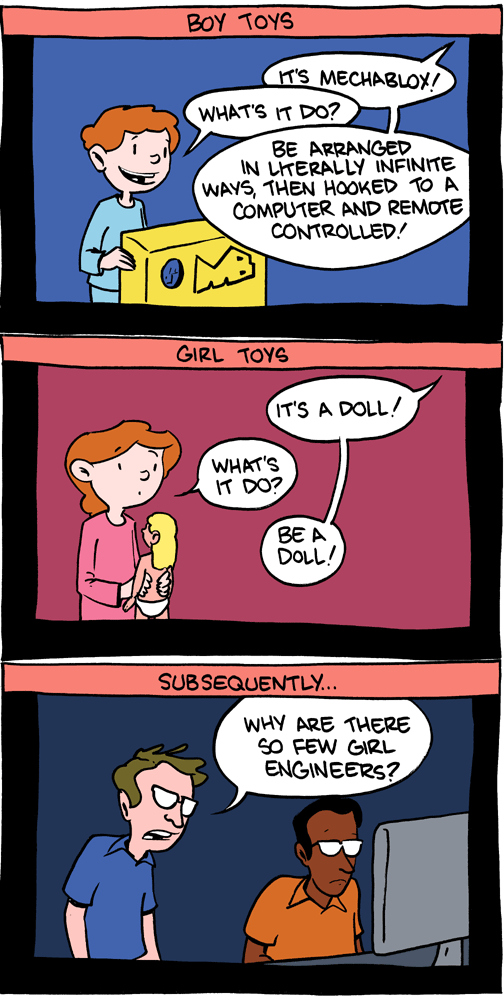
I suppose any effort to encourage more women to become software engineers should ideally start in childhood.

boy toys vs girl toys

Dolls? Pshaw. In our household, every child, male or female, is issued a regulation iPad at birth. You know, the best, most complex toy there is: a computer. And, shocker, I'm kind of weird about it – I religiously refer to it as a computer, never as an iPad. Never. Not once. Not gonna happen in my house. Branding is for marketing weasels. So the twin girls will run around, frantically calling out for their so-called "'puter". It puts a grin on my face every time. And when anything isn't here, Maisie has gotten in the habit of saying "dada chargin'". Where's the milk, Maisie? "dada chargin'".

But not everyone has the luxury of spawning their own processes and starting from boot. (You really should, though. It will kick your ass.)

What can you do?

If you're reading this, there's about an 80% chance that you're a man. So after you give me the secret man club handshake, let's talk about what we men can do, right now, today, to make programming a more welcoming profession for women.

  1. Abide by the Hacker School Rules

    Let's start with the freaking brilliant Hacker School rules. This cuts directly to the unfortunate but oh-so-common Aspergers tendencies in programmers I mentioned earlier:

    • No feigning surprise. "I can't believe you don't know what the stack is!"
    • No well-actuallys. "Well, actually, you can do that without a regular expression."
    • No back seat driving. Don't intermittently lob advice across the room.
    • No subtle sexism via public debate.

    Does any of this sound familiar? Because it should. Oh God does this sound familar. Just read the whole set of Hacker School guidelines and recognize your natural tendencies, and try to rein them in. That's all I'm proposing.

    Well, actually, I'll be proposing a few more things.

  2. Really listen. What? I SAID LISTEN.

    Remember this scene in Fight Club?

    This is why I loved the support groups so much, if people thought you were dying, they gave you their full attention. If this might be the last time they saw you, they really saw you. Everything else about their checkbook balance and radio songs and messy hair went out the window. You had their full attention. People listened instead of just waiting for their turn to speak. And when they spoke, they weren't just telling you a story. When the two of you talked, you were building something, and afterward you were both different than before.

    Guilty as charged.

    My wife is a scientist, and she complains about this happening a lot at her work. I don't even think this one is about sexism, it's about basic respect. What does respect mean? Well, a bunch of things, but let's start with openly listening to people and giving them our full attention when they talk to us – rather than just waiting for our turn to speak.

    Let's shut up and listen quietly with the same thoughtfulness that we wish others would listen to us. We'll get our turn. We always do, don't we?

  3. If you see bad behavior from other men, speak up.

    It's not other people's job to make sure that everyone enjoys a safe, respectful, civil environment at work and online.

    It's my job. It's your job. It is our job.

    There is no mythical men's club where it is OK to be a jerk to women. If you see any behavior that gives you pause, behavior that makes you wonder "is that OK?", behavior that you'd be uncomfortable with directed toward your sister, your wife, your daughter – speak up. Honestly, as one man to another. And if that doesn't work for whatever reason, escalate.

  4. Don't attempt romantic relationships at work.

    Do you run a company? Institute a no-dating rule as policy. Yeah, I know, you can't truly enforce it, but it should still be the official company policy. And whether the place where you work has this policy or not, you should have it on a personal level.

    I'm sorry I have to be that guy who dumps on true love, but let's be honest: the odds of any random office romance working out are pretty slim. And when it doesn't, how will you handle showing up to work every day and seeing this person? Will there be Capulet vs Montague drama? The women usually get the rough end of this deal, too, because men aren't good at handling the inevitable rejection.

    Just don't do it. Have all the romantic relationships you want outside work, but do not bring it to work.

  5. No drinking at work events.

    I think it is very, very unwise for companies to have a culture associated with drinking and the lowered inhibitions that come with drinking. I've heard some terrifyingly awful stories that I don't even want to link to here. Men, plus women, plus alcohol is a great recipe for college. That's about all I remember from college, in fact. But as a safe work environment for women? Not so much.

    If you want to drink, be my guest. Drink. You're a grown up. I'm not the boss of you. But don't drink in a situation or event that is officially connected with work in any way. That should absolutely be your personal and company policy – no exceptions.

There you have it. Five relatively simple things you, I, and all other working male programmers can do to help encourage a better environment for men and women in software plumbing. I mean engineering.

So let's get to it.

(I haven't listed anything here about mentoring. That's because I am an awful mentor. But please do feel free to mention good resources, like Girl Develop It, that encourage mentoring of female software engineers by people that are actually good at it, in the comments.)

[advertisement] How are you showing off your awesome? Create a Stack Overflow Careers profile and show off all of your hard work from Stack Overflow, Github, and virtually every other coding site. Who knows, you might even get recruited for a great new position!
25 Apr 16:22

good news for net neutrality activists

by kris

20140424-netneutrality

the fight is finally over! because net neutrality is done. the very thing that allowed many of us to have careers online, including myself – being allowed to exist on the same footing as any other company on the web – is going away. and even if this measure gets defeated in the 59th minute of the 11th hour, we’re just weeks away from the next one.

maybe webcartoonists can just fall back on ASCII comics, since they’d still load pretty quick

25 Apr 16:21

bunnyfood: BEHIND YOU (via sexhaver:gajumaru3:lotusrootsoup)