Shared posts

10 May 03:05

Virada portuguesa

by Míriam Leitão

Enviado por Míriam Leitão e Alvaro Gribel - |

COLUNA NO GLOBO

Virada portuguesa

Portugal está vencendo a batalha contra a crise. O governo anunciou no domingo o fim do programa de ajuda do FMI e da União Europeia e voltará a tomar empréstimos diretamente no mercado. Ainda carrega sequelas: a dívida bruta dobrou em cinco anos e o desemprego teve apenas ligeira queda. Mas Portugal se esforçou e o custo cobrado dos seus títulos voltou aos níveis anteriores.

Antes de a crise europeia bater em seus costados, Portugal usufruiu de um período de forte prosperidade, iniciado com a adesão à zona do euro. O PIB per capita cresceu 40% em menos de 10 anos, subindo de € 11,6 mil, no ano 2000, para € 16,1 mil, em 2008. Com o abalo financeiro na região, o país entrou em recessão. As fragilidades da economia vieram à tona, e o déficit público explodiu. O PIB per capita caiu 3,6% entre 2008 e 2013.

Em junho de 2011, os portugueses pediram socorro e firmaram um compromisso com a troika, formada pelo FMI, Banco Central Europeu e Comissão Europeia. Receberam € 78 bilhões para pagar suas dívidas e evitar as altas taxas de juros que vinham sendo cobradas pelo mercado. Os bancos haviam se assustado com o salto do déficit público português, que chegou a 10% do PIB em 2010, e passaram a cobrar juros altíssimos para emprestar ao governo. Os títulos de 10 anos chegaram a pagar 17% de juros em 2012. Antes da crise, a taxa era de 4%. Esta semana, voltou ao mesmo valor cobrado anteriormente.

As garantias para o socorro foram as mesmas nessa situação: corte de gastos, aumento de impostos, recessão, alta da taxa de desemprego e interferência de técnicos dos órgãos credores nas decisões internas. O Brasil viveu isso no pior momento da dívida, nos anos 1980. Com Portugal, não foi diferente. O resultado da política de aperto foi o encolhimento do produto. Desde 2008, o PIB sofreu retração em cinco anos, tendo apenas um pequeno crescimento em 2010. A taxa de investimento despencou de 23% do PIB para 15% nesse período.

Dois indicadores de Portugal ainda assustam muito. A dívida bruta do governo praticamente dobrou, apesar dos esforços para reduzir o déficit. De acordo com o FMI, a dívida portuguesa saltou de 68% do PIB, em 2007, para 128% em 2013. Os números mostram que mesmo antes da crise internacional Portugal já descumpria o limite estabelecido pelo Tratado de Maastricht, que impõe um teto de 60% para o endividamento dos governos. Ou seja, ocorreu descontrole dos gastos no período de prosperidade.

Outro número tem impacto direto no dia a dia dos portugueses. A taxa de desemprego foi de 15,2% em março, acima de média de 11,2% da zona do euro. No pior momento, em abril de 2013, chegou a 17,8%. O índice subiu muito, e rápido, e tem caído devagar.

O que serve de consolo é que o período de sacrifício trouxe resultados, o país voltou a ter a confiança dos mercados e há expectativa de crescimento do PIB este ano. O déficit público caiu a 4,8% em 2013 e o balanço de pagamentos voltou a ficar positivo.

Portugal é o terceiro país da zona do euro a se declarar pronto a voltar a financiar sua dívida através de venda de títulos diretamente ao mercado. Irlanda e Espanha já dispensaram ajuda dos mecanismos financeiros de resgate. Houve muita dúvida se Portugal conseguiria, dada a baixa competitividade de sua economia. Mas o país fez um forte ajuste e recuperou credibilidade. Mostra que é ociosa a discussão sobre se para sair da crise é preciso aumentar o gasto ou ajustá-lo. Um país sem crédito não pode ampliar despesas. Portugal volta agora a ter crédito. Pode terminar sua reorganização de forma mais suave.

09 May 00:05

Todos amam o mínimo

Os três principais candidatos a presidente disseram na semana passada que vão manter a política de aumentos reais do salário mínimo. Ninguém assume o papel de carrasco do mínimo. No próximo governo, pois, o assunto será motivo de choro, ranger de dentes ou sorrisos amarelos, pois o presidente terá de fazer mágicas e milagres a fim de conciliar a promessa de "valorização do mínimo" com o Orçamento estourado e a inflação a ser contida. Nenhum economista sério, da "direita" à "esquerda", acredita que seja possível manter o presente ritmo de reajustes do salário mínimo sem mudança econômica politicamente espinhosa. Muitos não acreditam que seja possível manter a política de reajustes, ponto, ao menos sob o próximo governo. Leia mais (05/04/2014 - 02h00)
08 May 15:24

Virada portuguesa

by Míriam Leitão

Portugal está vencendo a batalha contra a crise. O governo anunciou no domingo o fim do programa de ajuda do FMI e da União Europeia e voltará a tomar empréstimos diretamente no mercado. Ainda carrega sequelas: a dívida bruta dobrou em cinco anos e o...

Leia mais

Assine O Globo e receba todo o conteúdo do jornal na sua casa

08 May 11:38

Working Without A Lunch Break

by Andrew Sullivan

Lizzie Widdicombe tried out the food-substitute Soylent. What living on it felt like:

As [Soylent creator Rob] Rhinehart puts it, you “cruise” through the day. If you’re in a groove at your computer, and feel a hunger pang, you don’t have to stop for lunch. Your energy levels stay consistent: “There’s no afternoon crash, no post-burrito coma.” Afternoons can be just as productive as mornings.

But that is Soylent’s downside, too.

You begin to realize how much of your day revolves around food. Meals provide punctuation to our lives: we’re constantly recovering from them, anticipating them, riding the emotional ups and downs of a good or a bad sandwich. With a bottle of Soylent on your desk, time stretches before you, featureless and a little sad. On Saturday, I woke up and sipped a glass of Soylent. What to do? Breakfast wasn’t an issue. Neither was lunch. I had work to do, but I didn’t want to do it, so I went out for coffee. On the way there, I passed my neighborhood bagel place, where I saw someone ordering my usual breakfast: a bagel with butter. I watched with envy. I wasn’t hungry, and I knew that I was better off than the bagel eater: the Soylent was cheaper, and it had provided me with fewer empty calories and much better nutrition. Buttered bagels aren’t even that great; I shouldn’t be eating them. But Soylent makes you realize how many daily indulgences we allow ourselves in the name of sustenance.

Previous Dish on Soylent here and here.

07 May 21:13

“Just Write, Damn It”

by Andrew Sullivan

That’s Matt Zoller Seitz’s advice to young people entering the field of TV and film criticism:

I believe that ninety percent of writer’s block is not the fault of the writer. It’s the fault of the writer’s wrongheaded educational conditioning. We’re taught to write via a 20th century industrial model that’s boringly linear and predictable: What’s your topic sentence? What are your sections? What’s your conclusion? Nobody wants to read a piece that’s structured that way. Even if they did, the form would be more a hindrance than a help to the writing process, because it makes the writer settle on a thesis before he or she has had a chance to wade around in the ideas and inspect them. So to Hell with the outline. Just puke on the page, knowing that you can clean it up and make it structurally sound later. Your mind is a babbling lunatic. It’s Dennis Hopper, jumping all over the place, free associating, digressing, doubling back, exploding in profanity and absurdity and nonsense. Stop ordering it to calm down and speak clearly. Listen closely and take dictation. Be a stenographer for your subconscious. Then rewrite and edit.

07 May 15:37

Inflation

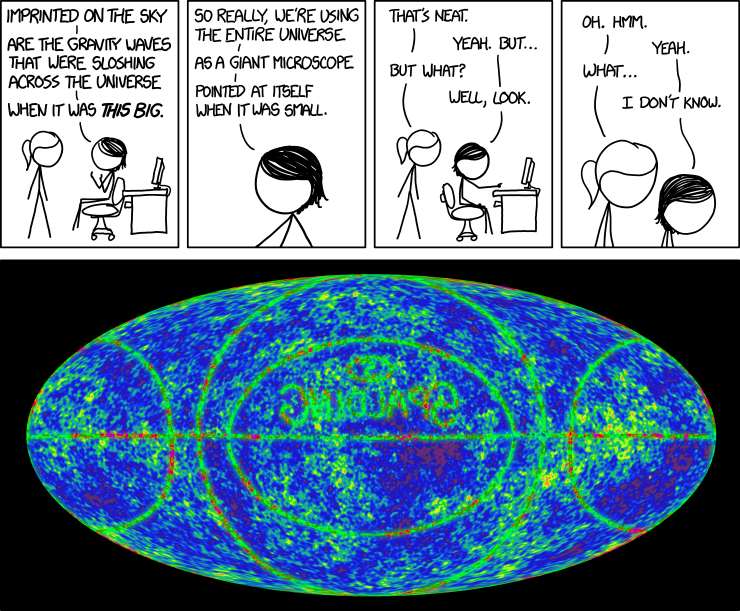
Wait till they notice the faint reflection of Michael Jordan and Bugs Bunny in the E-mode.
07 May 15:03

The Villainous Comics Code Authority

by Andrew Sullivan

Saladin Ahmed provides a brief history of comic book censorship. He claims that during a “15-year span beginning in the late 1930s, the comic book racks of America’s newsstands were bursting with four-color contradictions.” But this state of affairs “was swiftly and mercilessly dismantled in 1954 by the newly formed Comics Code Authority”:

Spurred in part by the sensationalist book Seduction of the Innocent (a ridiculous sort of Reefer Madness for comic books), the Senate Subcommittee on Juvenile Delinquency turned an angry eye toward comics, and most publishers felt that heavy-handed regulation — perhaps even outright banning — was imminent. Comic book publishers, in consultation with right-wing politicians, formed the Comics Code Authority, a self-censorship group, in the hopes that this would forestall government intervention in the industry. New York Magistrate Charles F. Murphy, a “specialist in juvenile delinquency” (and a strident racist), was chosen to head the Authority and to devise its self-policing “code of ethics and standards.”

What this meant in practice:

The Code … contained the surprising provision that “ridicule or attack on any religious or racial group is never permissible.” Given the countless depictions of monkey-like Japanese and minstrel-show black people in Golden Age comics, one might think this provision a good thing. But Murphy soon made it clear that this provision really meant that black people in comic books would no longer be tolerated, in any form. When EC Comics reprinted the science fiction story “Judgment Day” by Al Feldstein and Joe Orlando (which had originally been printed to little controversy before the Code), Murphy claimed the story violated the Code, and that the black astronaut had to be made white in order for the story to run.

EC defiantly ran the story anyway, but Murphy had made a target of them, and the company was essentially forced out of the comics business. The message was clear: If comics were to be tolerated in this new postwar order, they had to be purged of assertive women, of people of color, of challenges to authority, and even of working-class, urban slang. And so the Comics Code hacked and mangled comics until they fit into the patriarchal, conservative, white suburban social order that was taking over every other sphere of American life.

Update from a reader:

This is a classic anti-comic book propaganda. Scare tactics are classic!

(Image: Panels from the original “Judgment Day” comic)

07 May 11:33

Photo


07 May 01:01

How to Assume a Positive Point of View

by Scott Meyer

As always, thanks for using my Amazon Affiliate links (USUKCanada).

06 May 19:44

Cidades brasileiras: a pior verticalização do mundo

by Valdenor Júnior
Adam Victor Brandizzi

Rapaz, o Mercado Popular tá mandando bem!
* * *
A associação entre menor ajardinamento e maior atividade (e vida e segurança) faz muito sentido para mim. Lembro em especial da faixa Copacabana-Ipanema-Leblon, onde não parecia haver tais restrições e a vida borbulhava. Comparo isso com Brasília, que parecia cidade fantasma. Ou mesmo outro exemplo bom, Casa Amarela aqui em Recife, onde vivo: há um trecho com prédios e muito ajardinamento, e outro sem prédios. O sem prédios é movimentadíssimo, e o outro é quase zumbi.

Por Anthony Ling

Recentemente escrevi um artigo em defesa da verticalização – a construção de edifícios mais altos – respondendo a outro artigo que se posicionava contra ela. Na ocasião deixei explícito que eu estava tratando sobre a construção de edifícios altos como resposta a uma maior demanda por território (muitas pessoas querendo morar no mesmo lugar) e não estava tratando sobre a verticalização brasileira por uma série de distorções que existem no nosso mercado imobiliário. Embora isso tenha ficado bastante claro, o debate que se seguiu continuou criticando meu texto usando o exemplo da verticalização brasileira quase como uma regra absoluta de o que significa verticalização, apesar de ele ser uma exceção.

Assim, pretendo aqui complementar meu texto anterior explicando porque a verticalização nas cidades brasileiras realmente produz resultados negativos, mas mostrando que a crítica está mal direcionada: o problema não é a altura dos prédios em si (verticalização), mas as interferências regulatórias que eles carregam para se tornarem altos.
Recuos de ajardinamento

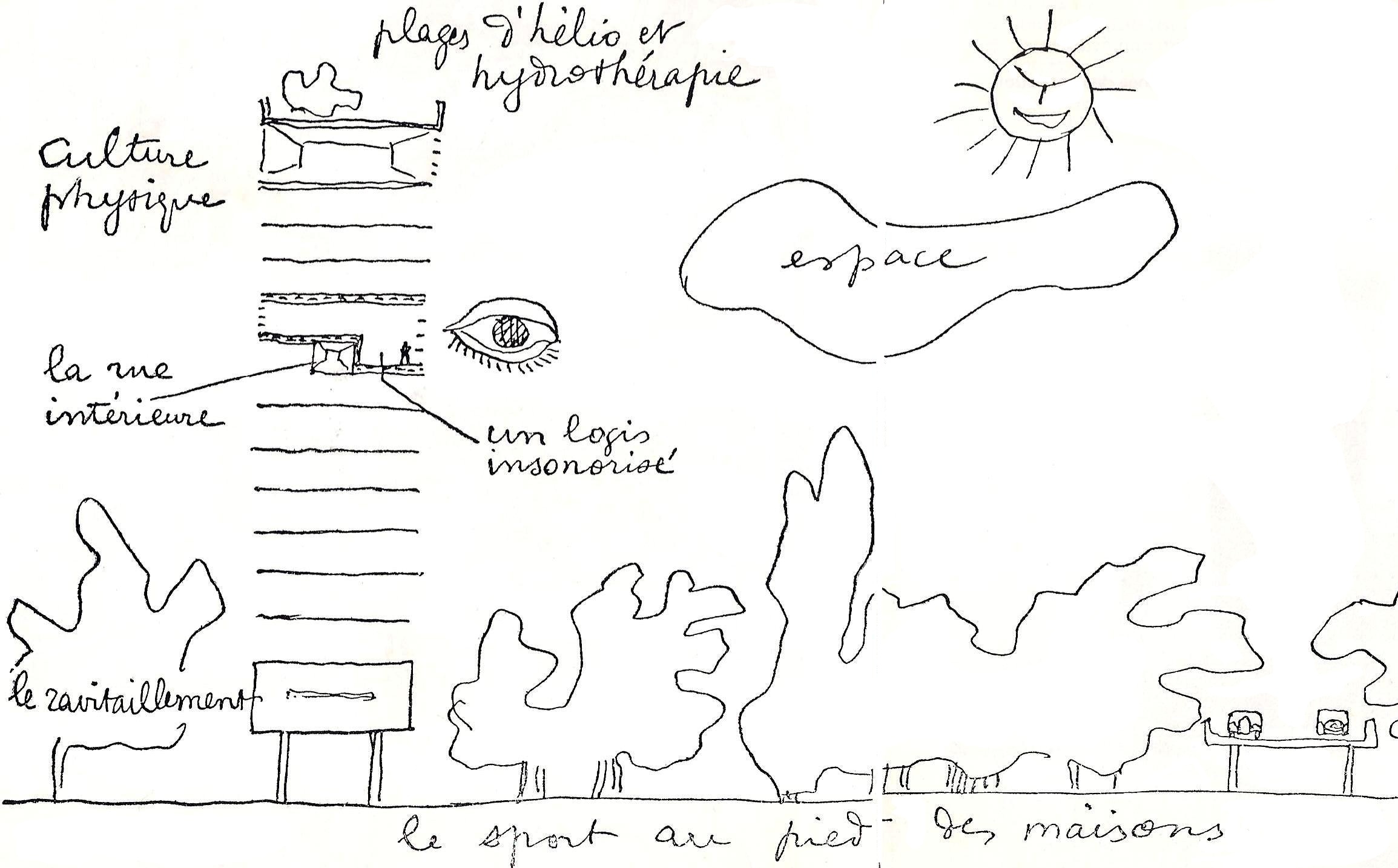
Um dos maiores vilões da verticalização brasileira são os recuos de ajardinamento obrigatórios, afastando os edifícios das calçadas e entre eles. A noção parte de um conceito equivocado de ventilação e insolação que remete tanto à antiga teoria da “miasma” quanto ao urbanismo modernista-corbusiano na ideia de liberar o solo para áreas de lazer – resultando em áreas condominiais inutilizadas. Nem mesmo Brasília, que foi mais fiel à este conceito na construção das superquadras, teve bons resultados no aproveitamento destes espaços.Nas cidades brasileiras os recuos quase sempre aumentam de acordo com a altura do edifício, motivo pelo qual incorporadores nem sempre atingem a altura máxima permitida no terreno: teriam que construir um palito para respeitar os recuos.

definicao_gabaritos01

Nem sempre verticalização significa aumento de densidade.
[Fonte imagem: Urbanidades]


Restringem densidade: O conceito de verticalização faz sentido como uma forma de aumentar o aproveitamento do solo urbano, aumento a densidade demográfica, aproximando humanos e tendo ganhos de escala no uso do espaço e da infraestrutura construída. No entanto, com recuos obrigatórios, não é incomum encontrarmos casos de bairros verticalizados que não apresentam altas densidades. Em São Paulo, por exemplo, é incomum o cidadão perceber que a Vila Mariana é muito mais densa que Moema, que a Vila Madalena não ficou mais densa depois que verticalizou, ou que Paris e Barcelona são muito mais densas que São Paulo com edifícios muito mais baixos. Já em Porto Alegre, pessoas ficam confusas ao saberem que a Cidade Baixa tem o dobro da densidade do Bela Vista, onde a confusão ocorre inclusive nos seus nomes. Com edifícios isolados nos terrenos há área inutilizada, que normalmente se transformam em áreas privadas de lazer abandonadas. A verticalização ocorre sem produzir aglomeração, o que seria o motivo da verticalização em primeiro lugar.

Exterminam a vida na calçada: Com edifícios longe das calçadas e uns dos outros é muito difícil viabilizar atividades comerciais no térreo, comum em outros países pelo fato do térreo ter um valor comercial mais alto que o residencial. Mas esse valor comercial só se torna realmente atraente quando há continuidade das lojas na calçada e uma proximidade delas do pedestre, facilitando o acesso e a leitura das vitrines. Não coincidentemente esta é exatamente a forma de qualquer rua comercial de sucesso com pontos valorizados – assim como o interior dos shopping centers.

IMG_3478

O Itaim Bibi, em São Paulo, é agradável para transitar a pé graças
às pequenas casas que sobraram junto à calçada. Prédios novos são
afastados do pedestre e tem térreos vazios, quando não cercados.


Desincentivo para construir no térreo

Pouca gente sabe, mas em muitas cidades brasileiras – como São Paulo e Porto Alegre – a área do térreo não é contabilizada como área construída se nele for construído apenas a portaria e áreas condominiais. Com os recuos a área do térreo já nasce desvalorizada, que também naturalmente tem menos demanda para uso residencial. O incorporador, assim, prefere usar toda essa área que ele subtrai do térreo para cima, nos andares “tipo”, aumentando a altura do edifício e deixando o térreo vazio, prejudicando ainda mais a vida na calçada.Vagas de garagem obrigatórias

Cidades brasileiras normalmente possuem legislações que obrigam o incorporador a construir um determinado número de vagas de garagem para cada unidade residencial ou de acordo com o tamanho da área comercial construída, número que também varia de acordo com a “classe” do empreendimento (empreendimentos de luxo devem construir mais vagas). Isso normalmente significa, em edifícios residenciais: garagens subterrâneas que aumentam o custo da obra; uma ocupação do térreo que teoricamente deveria ser usada como área de lazer; ou um novo incremento na altura do prédio quando não ela não é subterrânea, como é o caso em muitos edifícios ao redor da Lagoa Rodrigo de Freitas, no Rio de Janeiro. Em grandes edifícios comerciais, muitas vezes isso significa ainda a construção de um grande edifício garagem especificamente para o empreendimento, não por decisão única do empreendedor mas para cumprir com a legislação imposta. Ou seja, a verticalização deve obrigatoriamente dar comodidade a quem anda de carro, ocupando grandes áreas urbanas para armazená-los e impedindo aqueles que não possuem carro de não pagar por uma vaga.

Exclusão urbana e incentivo ao carro

Sem vida nas calçadas, os edifícios finalmente decidem construir cercas para se protegerem do ambiente inóspito que é criado na rua. A monotonia ou dificuldade de se andar a pé nas cidades aliada a calçadas inseguras e legislações que promovem a construção de garagens se tornam um grande incentivo ao uso do carro e à exclusão urbana. Cidadãos se tornam condôminos ilhados que vão de um ponto a outro sem interação alguma com outros espaços da cidade, característica que foi regra em toda história do ser humano em cidades e que foi perdida nas últimas décadas.

Benefícios privados, prejuízos sociais

Diferente de cidades de outros países, um ponto positivo das nossas cidades são os mecanismos sofisticados para pagar taxas ao poder público para que se construa acima do limite permitido na legislação. Ao invés de simplesmente proibir o desenvolvimento as prefeituras cobram pelo uso adicional da infraestrutura pública e pelos potenciais prejuízos que podem ser causados na região. Em São Paulo isso se chama “outorga onerosa” e em Porto Alegre se chama “solo criado”. É uma maneira razoável de tornar a operação mais justa, sem que se privatize benefícios gerando custos sociais.

No entanto, a regulação urbana no Brasil sempre foi um tanto flexível. Planos diretores são atualizados e bairros mudam seu zoneamento com o passar do tempo, normalmente pressionados por grupos de interesse que possuem terrenos em locais estratégicos. Estes grupos praticam o “lobby”, ajudando políticos (publicamente ou secretamente, financeiramente ou movimentando massas eleitorais) para que defendam mudanças em seu benefício. O relacionamento pode ser feito com vereadores, que normalmente votam nas mudanças no Plano Diretor que podem modificar o potencial construtivo de grandes áreas permitindo mais construção sem outorga onerosa. O Poder Executivo também pode ser influenciado para direcionar novas obras de infraestrutura para regiões onde estes grupos tem terrenos, aumentando seu valor no mercado.

Transformação radical

É comum que essas mudanças legislativas ocorram de forma radical para a característica urbana do bairro. Um determinado bairro zoneado para pequenas residências unifamiliares frequentemente tem sua legislação alterada para permitir grandes edifícios de noite para o dia, sem que haja uma transformação gradual deste cenário. Não é incomum vermos conjuntos de prédios altos surgirem no meio de pequenas casas, criando contrastes que não se vêem com tanta frequência em outros países. Transformações radicais também podem acontecer em cidades menos reguladas de forma geral, mas é mais comum que o ajuste do bairro em relação à demanda ocorra de forma mais gradual, com a verticalização irradiando de pontos de alta atratividade – alta demanda – e gradualmente diminuindo para zonas de menor demanda.

jardins
O bolsão de baixa densidade dos Jardins, em São Paulo, restringe a
demanda da região mais atraente da cidade, gerando alguns dos imóveis
mais caros do país, tanto dentro do bairro como nas suas adjacências.


Aumento de preços: atratividade localizada e oferta restrita

Quando um determinado bairro ou conjunto de quadras se verticaliza sua atratividade normalmente aumenta, tanto pela renovação da infraestrutura e a introdução de novas amenidades de comércio quanto pelo aumento da densidade (que nem sempre necessariamente ocorre, como vimos anteriormente), que por sua vez aumenta o número de atividades no mesmo local, atraindo ainda mais pessoas. Esses fatores geram um aumento na demanda de pessoas de outros bairros ou ainda de outras cidades por aquele espaço, pressionando o aumento de preços apesar do aumento da oferta com as novas construções.

No entanto, estes bairros ou conjunto de quadras normalmente são espacialmente restritos, assim como o potencial construtivo limite da legislação vigente. Assim, a oferta é restrita antes do bairro se beneficiar da lei de rendimentos decrescentes, que provocaria uma diminuição nos preços. Para ilustrar essa situação, considere o seguinte exemplo: os primeiros prédios que virão junto dos primeiros supermercados, agências bancárias ou restaurantes vão contribuir para valorizar o bairro, mas a centésima torre junto ao quinto banco provavelmente nem será percebida. Seria nesse ponto que o aumento da oferta no mercado venceria o efeito das amenidades responsável por aumentar os preços – e os preços começariam a cair – mas normalmente existe um limite que restringe que elas surjam.

Verticalização, assim, é relacionada com o aumento no preço dos imóveis, embora no contexto geral esteja contribuindo para o aumento do estoque imobiliário, o que aumenta a oferta e diminui o preço. Como outro exemplo para explicar este efeito, todo novo morador de uma nova unidade está deixando um imóvel anterior: se ele está partindo buscando um lugar melhor para morar e não por necessidades financeiras, o imóvel de onde ele parte perdeu atratividade perante seu novo bairro. Um imóvel pode ter se tornado mais caro, mas outros, em outras regiões, acabam ficando mais baratos. Usando um exemplo extremo e impossível como ilustração, se um incorporador construísse um edifício com 1 milhão de unidades o preço dos imóveis naquela região iria despencar, já que se tornaria muito menos escasso.


c (4)

Centro de São Paulo na década de 50: verticalizado,
popular e com calçadas vivas.


Um fenômeno local e recente

A verticalização raramente ocorre com todas essas variáveis que encontramos no Brasil. Ao olharmos cidades que se verticalizaram para atender uma crescente demanda por espaço, como Nova Iorque ou Hong Kong, percebemos a inexistência de maioria dessas restrições. Isso gera nessas cidades uma aglomeração acessível e sustentável, conforme comentei na minha postagem sobre os benefícios da verticalização.

Cidades brasileiras tiveram uma verticalização muito mais saudável no passado, abandonada ao longo do tempo. As primeiras zonas a se verticalizarem intensamente, como o centro de cidades como São Paulo e Porto Alegre ou o bairro de Copacabana, no Rio de Janeiro, não tinham recuos obrigatórios, incentivos para não ocupar o térreo nem vagas mínimas de garagem, além de ter legislações urbanas menos zoneadas de forma geral, com menos desigualdade de regras na hora de construir.

É engraçado de ver que o que provocou a suburbanização e a fuga desses bairros no passado é justamente o que as pessoas buscam hoje na procura de um imóvel: mais densidade e atividade urbana, mais facilidade de andar a pé e menos dependência do carro, apartamentos menores e preços mais acessíveis. Não é coincidência que o Centro de São Paulo foi um dos bairros que teve maior crescimento populacional, com taxas semelhantes às periferias, em um movimento para reocupar este espaço de qualidade mas esquecido.

O movimento contra a verticalização de 50 anos atrás tinha motivos muitos diferentes dos atuais, pois naquela época o resultado urbano da verticalização era muito alinhado aos objetivos daqueles que a criticam hoje. Infelizmente, as legislações que foram sendo acumuladas ao longo do tempo e que estão invisíveis ao cidadão comum criaram uma nova forma de construir para cima diferente dos centros antigos, provocando uma noção equivocada do que significa verticalizar.

Publicado originalmente no Rendering Freedom


06 May 19:02

Quem a oposição síria no exílio representa?

by Gustavo Chacra

Os Estados Unidos estão certos em reconhecer os prédios da coalizão opositora síria no exílio como representação diplomática? Não, não estão. Afinal, existem duas hipóteses sobre esta coalizão opositora.

 Primeiro, ela seria representante também dos opositores sírios que lutam na Guerra Civil. Os principais grupos armados lutando CONTRA Bashar al Assad na Síria são a Frente Nusrah, ligada à Al Qaeda, e o ISIS, que foi banido pela rede fundada por Bin Laden por ser, acreditem, muito radical e extremista. Ambos, considerados terroristas pelos EUA, são responsáveis por dezenas de milhares de mortos, incluindo milhares de cristãos e alauítas.

Em segundo lugar, esta coalizão poderia não ser representante destes grupos rebeldes. Mas, neste caso, seria representante de quem? De sírios no exílio. Eles de forma alguma podem dizer que representam  sírios em Damasco ou Aleppo e mesmo no exterior – no Brasil, boa parte da comunidade síria, especialmente cristã, apoia Assad. E os grupos armados moderados? Não tem grupo armado moderado e quase todos hoje, na oposição, são extremamente radicais. Não era assim até o fim de 2012. Na época, o Exército Livre da Síria era sim mais moderado. Hoje é irrelevante.

A oposição civil, que iniciou protestos pacíficos em 2011, foi reprimida pelo regime, atacada pelos grupos armados extremistas opositores, desistiram de lutar ou passaram a ver o regime de Assad como um mal menor diante da possibilidade de serem governados por organizações ligadas à Al Qaeda ou ainda piores. Avaliam que, sem Assad, neste momento, a alternativa seria algo como um regime com líderes similares aos do Boko Haram, na Nigéria, responsável pelo sequestro de 200 meninas, ou Taleban no Afeganistão.

Portanto o reconhecimento das missões diplomáticas da oposição em Washington é, na melhor das hipóteses, inútil.

Apenas comentários do post do dia ou do post prévio serão publicados

Guga Chacra, comentarista de política internacional do Estadão e do programa Globo News Em Pauta em Nova York, é mestre em Relações Internacionais pela Universidade Columbia. Já foi correspondente do jornal O Estado de S. Paulo no Oriente Médio e em NY. No passado, trabalhou como correspondente da Folha em Buenos Aires

Comentários islamofóbicos, antissemitas, anticristãos e antiárabes ou que coloquem um povo ou uma religião como superiores não serão publicados. Tampouco ataques entre leitores ou contra o blogueiro. Pessoas que insistirem em ataques pessoais não terão mais seus comentários publicados. Não é permitido postar vídeo. Todos os posts devem ter relação com algum dos temas acima. O blog está aberto a discussões educadas e com pontos de vista diferentes. Os comentários dos leitores não refletem a opinião do jornalista

Acompanhe também meus comentários no Globo News Em Pauta, na Rádio Estadão, na TV Estadão, no Estadão Noite no tablet, no Twitter @gugachacra , no Facebook Guga Chacra (me adicionem como seguidor), no Instagram e no Google Plus. Escrevam para mim no gugachacra at outlook.com. Leiam também o blog do Ariel Palacios

06 May 18:58

Second Chances

by Greg Ross

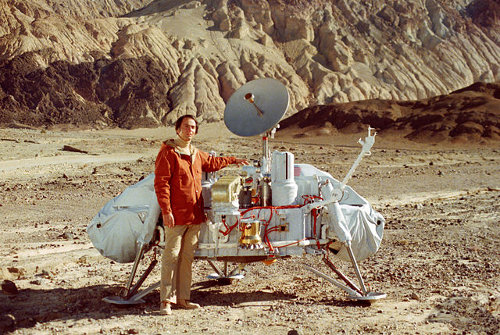
http://commons.wikimedia.org/wiki/File:Sagan_Viking.jpg

In science it often happens that scientists say, ‘You know, that’s a really good argument; my position is mistaken,’ and then they would actually change their minds and you never hear that old view from them again. They really do it. It doesn’t happen as often as it should, because scientists are human and change is sometimes painful. But it happens every day. I cannot recall the last time something like that happened in politics or religion.

– Carl Sagan, in a 1987 address, quoted in Jon Fripp et al., Speaking of Science, 2000

06 May 17:11

What Is The Ulysses Of Romance Novels? Ctd

by Andrew Sullivan
Adam Victor Brandizzi

Uma excelente questão. Na verdade, várias.

A reader flags this post by Sarah Wendell, who criticizes the dismissive coverage of News Corp’s $415-million acquisition of Harlequin last week. The reader vents:

Why is it reporters and their editors can write seriously about porn, marijuana, party drugs, fraternity hazing, gay sex, and numerous other topics, but come unglued when they have to write about romance novels?

I suspect reading romances is one of the most closeted behaviors American women indulge in. I am sure there are people who read the Fifty Shades of Grey books that wouldn’t be caught dead reading a Harlequin Presents paperback, in public or in private. Even violent video games are treated with more respect than romance novels. I’m a little baffled as to why the Harlequin I’m reading is somehow intellectually stunting, but episodes of Game of Thrones or 24 or even CSI are important parts of the culture – important enough to be reviewed in multiple mainstream publications, while romance novels are ignored and the business of romance is treated like a joke.

Another is less convinced that the genre deserves respect:

The search for a Ulysses of the romance genre is really misplaced. It’s a search for profundity in pornography, albeit pornography directed at women.

Now, I like pornography as much as the next man, and some pornography can be sublime, but its intent and effect are somewhat orthogonal to true art. It suppresses rather than invites reflection. So I find the pursuit of profundity there to be profound misunderstanding of the nature of the genre. Though male-centric pornography is visual while female-centric pornography is verbal, that detail does not alter the nature of the genre.

Tying in Caleb Crain’s musings on the state of the gay novel, another reader takes the conversation in another direction:

The gay novel is doing just fine if you accept romance as a part of fiction. Gay romance is a booming and very successful genre. The majority of gay romance readers, though by no means all, are heterosexual women. The majority of writers are as well. I think that qualifies this email to fit into your End of Gay Culture Watch thread as well.

The concept that straight readers won’t find gay characters “relatable” is provably false. I think it’s more likely that readers of any sexuality simply aren’t that interested in literary fiction. Actually, I don’t even think it’s the age-old literary-fiction-vs.-popular-fiction battle in this instance. Many of my friends are authors, and my Facebook news feed is currently filled with friends of mine proudly announcing their Lambda Literary Awards nominations. Several of them are in the romance category, but not all.

Maybe it’s time writers of gay fiction look to themselves and the content they produce instead of finding reasons the market isn’t responsive. The market loves a good story.

Another, less high-minded reader:

Romance canon. That’s what I’m going to call it now.

Heh. Earlier Dish on romance novels here.

06 May 16:15

To Whom It May Concern

by Greg Ross

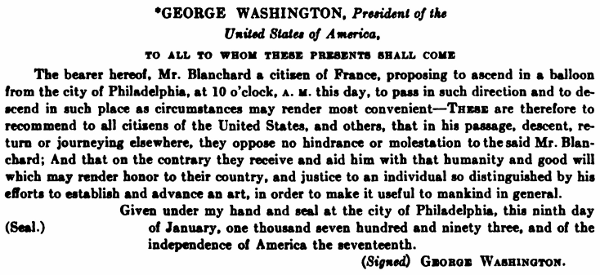
On Jan. 9, 1793, two astonished farmers in Woodbury, N.J., watched a strange craft descend from the sky into their field. An excited Frenchman greeted them in broken English and gave them swigs of wine from a bottle. Unable to make himself understood, he finally presented a document:

http://books.google.com/books?id=Lb88AAAAIAAJ

The farmers helped the man fold his craft and load it onto a wagon for the trip back to Philadelphia. Before leaving, the Frenchman asked them to certify the time and place of his arrival. These details were important — he was Jean-Pierre Blanchard, and he had just completed the first balloon flight in North America.

http://commons.wikimedia.org/wiki/File:John_Glenn_With_T.J._O%27Malley_and_Paul_Donnelly_in_Front_of_-_GPN-2002-000049.jpg

One hundred sixty-nine years later, when John Glenn went into orbit aboard Friendship 7 in 1962, mission planners weren’t certain where he’d come down. The most likely sites were Australia, the Atlantic Ocean, and New Guinea, but it might be 72 hours before he could be picked up.

Glenn worried about spending three days among aborigines who had seen a silver man emerge from “a big parachute with a little capsule on the end,” so he took with him a short speech rendered phonetically in several languages. It read:

“I am a stranger. I come in peace. Take me to your leader, and there will be a massive reward for you in eternity.”

06 May 16:10

The Cost Of Conspiracy Theories

by Andrew Sullivan

Linda Besner considers how extreme or unorthodox viewpoints reshape mainstream culture:

Recent research suggests that the current prevalence of Enemy Above conspiracy theories [in which the threat comes from our own government and institutions] has a direct social consequence—lower voter turnout and public engagement. A study by psychologists Daniel Jolley and Karen M. Douglas, published in the February 2014 issue of the British Journal of Psychology, found that exposing subjects to conspiracy theories about the death of Princess Diana or climate change decreased participants’ self-reported likelihood to vote, donate money to political groups, or wear campaign stickers.

These conspiracy theories can take a while to kick in:

In the immediate aftermath of President Kennedy’s assassination, people were inclined to believe the official story. In 1963, a poll showed that 29 per cent of Americans trusted the accuracy of the Warren Commission’s report; in 2001, only 13 per cent believed the official narrative. Similarly, the Joint Inquiry that compiled the government’s take on the events of 9/11 was initially well received, but by 2004 polls showed a growing disbelief in its findings. A polling company found that in April of 2013, 11 per cent of American voters believed the U.S. government let the attacks on the World Trade Center happen. The “truther” movement has been actively organizing lectures and tours to tout their point of view, and while mainstream audiences may not be attending these events … [exposure] to the doubts of others has a psychological effect, even when we consciously dismiss their objections.

05 May 20:29

Mental Health Break

by Andrew Sullivan

The world doesn’t have to be dog-eat-dog:

Miss Cellania captions:

Twelve very happy and well-behaved dogs go for an excursion to the beach in Australia and express themselves to the tune of “Happy.” Oh yeah, there’s a cat, too. It’s Didga, the skateboarding cat! You know he’ll be able to hold his own with all those dogs. This video is a lot of fun, but you just wait until they all go swimming – including Didga!

05 May 18:06

Face Of The Day

by Andrew Sullivan

Eighteen

Natan Dvir photographs Arab-Israeli teenagers, who are exempt from the compulsory military service their Jewish peers enter at age 18. Among his subjects is Dina, above:

“I was born to a Jewish Ukranian mother and a Muslim Israeli father in Ukraine. … I am now living in Jaffa in a collective of Arab and Jewish human rights activists and volunteer in various organizations. I don’t really care if I live with Arabs or Jews. I guess I kind of did that all my life anyhow. I appreciate people for who they are and have little regard for that kind of categorization. I am both Jewish and Muslim, both Ukrainian and Israeli. I can be defined any way that makes you feel comfortable, but if you ask me, I would prefer not to be called any of the above—I am a human rights activist.”

See more of Dvir’s work here.

05 May 17:34

Entenda o sequestro de mais de 200 meninas pelo Boko Haram na Nigéria

by Gustavo Chacra

1. O que aconteceu na Nigéria?

Ao menos 276 meninas com idades entre 16 e 18 anos foram sequestradas, no dia 14 de abril, em uma escola em Chibok, no norte da Nigéria, pelo grupo extremista islâmico Boko Haram. Destas, 53 já fugiram. O líder da organização afirmou que irá vendê-las

 2. O que é o Boko Haram?

Boko Haram, em hausa, uma língua local, quer dizer algo como “educação ocidental é pecado”. Foi fundado em 2002 para educar muçulmanos nesta região da Nigéria e em países vizinhos. A partir de 2009, se tornou uma organização violenta, responsável por centenas de atentados. Teria, inclusive, nos últimos anos, se aliado à Al Qaeda. Seus principais alvos são organizações ocidentais e cristãs

3. O governo da Nigéria não consegue encontrar as meninas?

Não, e tem sido criticado por não ter conseguido localizá-las. Para complicar, duas representantes das mães com as  filhas sequestradas teriam sido presas por ordem da primeira-dama, Patience,  mulher do presidente Goodluck Jonathan. Ela teria acusado as mulheres de terem fabricado informações para manchar o nome da Nigéria

4. Como é a divisão étnica e religiosa da Nigéria?

O país possui mais de 250 etnias. As principais são a Hausa (29%), Yoruba (21%) e Igbo (18%). Estas etnias se dividem em 50% de muçulmanos, que se concentram mais no norte do país, 40% de cristãos, mais ao sul, além de 10% de outras religiões. O Boko Haram, embora fale em nome dos muçulmanos, não conta com o apoio da maior parte da população islâmica, que condena os atentados

5. Como é a política e a economia da Nigéria?

Com uma população de 175 milhões de habitantes, a Nigéria é o maior país da África. Depois de uma enorme instabilidade política até os anos 1990, vem tentando se consolidar como uma democracia. Enfrenta problemas internos, como os ataques do Boko Haram, além de enorme corrupção política. Economicamente, é dependente do petróleo (95% das exportações do país), sendo um dos principais produtores do mundo. O PIB ultrapassou o da África do Sul, mas a renda per capita (US$ 2.800) é baixa e a população abaixo da linha de pobreza ultrapassa os 70%.

Apenas comentários do post do dia ou do post prévio serão publicados

Guga Chacra, comentarista de política internacional do Estadão e do programa Globo News Em Pauta em Nova York, é mestre em Relações Internacionais pela Universidade Columbia. Já foi correspondente do jornal O Estado de S. Paulo no Oriente Médio e em NY. No passado, trabalhou como correspondente da Folha em Buenos Aires

Comentários islamofóbicos, antissemitas, anticristãos e antiárabes ou que coloquem um povo ou uma religião como superiores não serão publicados. Tampouco ataques entre leitores ou contra o blogueiro. Pessoas que insistirem em ataques pessoais não terão mais seus comentários publicados. Não é permitido postar vídeo. Todos os posts devem ter relação com algum dos temas acima. O blog está aberto a discussões educadas e com pontos de vista diferentes. Os comentários dos leitores não refletem a opinião do jornalista

Acompanhe também meus comentários no Globo News Em Pauta, na Rádio Estadão, na TV Estadão, no Estadão Noite no tablet, no Twitter @gugachacra , no Facebook Guga Chacra (me adicionem como seguidor), no Instagram e no Google Plus. Escrevam para mim no gugachacra at outlook.com. Leiam também o blog do Ariel Palacios

05 May 17:32

Nuclear Is Better Than The Alternative

by Andrew Sullivan

Brad Plumer explains why recent nuclear power plant closings should alarm environmentalists:

So what happens when a nuclear power plant gets retired? It depends on the region. But one recent study of a shuttered nuclear plant in California found that greenhouse-gas emissions surged, as the nuclear plant got replaced by fossil fuels.

Back in February 2012, Southern California Edison shut off two nuclear reactors at the San Onofre plant after finding cracks in the steam generator system. (A year later, the company announced that it would retire the reactors for good, deciding it the repair and licensing process would take too long and involve too many lawsuits.)

That plant was massive, providing about 8 percent of California’s electricity. So the state went on a frenzy of construction, building mostly new natural gas units and some wind units. In the end, however, fossil fuels were the easiest to deploy. Overall carbon-dioxide emissions in the region rose by 9.2 million tons in the following year — equivalent to putting an extra 2 million cars on the road.

And look at the result of Germany’s decision to revoke nuclear: they’re not just hurting the planet but also enabling Putin. Sigh. To my mind, nuclear is an imperfect but real solution to disentangling ourselves from the Middle East and saving the planet. And yet the liberal coalition that should support it is AWOL – a victim largely of ideology.

05 May 15:53

What Not Dying Looks Like

It’s always odd to hear people say RSS is dead. The fact is, RSS is easily the most successful stealth, insurgent technology on the web. It is pervasive and is the engine for much of the Internet.

Apple uses it to syndicate computer updates. Your podcast subscriptions rely on RSS. Every Wordpress blog is RSS enabled and every major news site is broadcasting via RSS. They’re all syndicated. They all have an RSS feed. It’s the background hum of the Internet.

There are millions of feeds out there, continually connecting users to their favorite content. Just about everything online except Facebook and Twitter is available via RSS.

Even more importantly, RSS has proven to be resilient and durable regardless of what corporate interests want to do with it. Netscape invented the underlying code in the late 90’s, and then took away all documentation and support in 2001 after AOL bought them out. But even that didn’t slow the dissemination. 

And then last year, the biggest player on the Internet took its ball and went home when Google killed its Reader. Despite the fact that Google retired the most popular RSS application on the Net, it did not affect RSS in any appreciable way. All of those feeds are still available and users are still getting their content delivered exactly as they want it. What greater proof is there of the resiliency of RSS?

In fact, what might have seemed like a disaster at first is perhaps the best thing that could happen to the technology. Remember, RSS is a technology and a service; it is not a product. AOL thought they could squash this great idea, but a community of developers took the idea and ran. Then Google thought they could abandon the technology and assumed everyone would gravitate to their social networks instead.

In fact, any number of companies can go out of business, but nobody can stop anybody from publishing and reading RSS feeds. 

However, just because a technology is widely available does not guarantee success. What makes RSS truly powerful is that users still have the control. The beauty of the system is it that no one can force you to be tracked and no one can force you to watch ads. There are no security issues I am aware of and no one ever has to know what feeds you subscribe to. This may be the last area of the Internet that you can still say things like this.

Google Reader was a monopolist product built on an anti-monopolist technology. Now that they’re gone, RSS is once again anyone’s game. You’re going to see a lot more innovation and new stuff for RSS. I never know if its supposed to be a blessing or a curse to live in interesting times. But I have to believe this RSS is entering maybe the most interesting time in its long history.

05 May 15:35

Bloody Bangui

by Andrew Sullivan

CAFRICA-UNREST

In a penetrating report from the Central African Republic, worth reading in full, Graeme Wood describes the state of the country:

It is a country the size of Texas, with as many people as Boston, and an economy less than a tenth the size of Chattanooga’s. Reliable data doesn’t exist for the number dead, but from December until March, street lynchings became so common that they ceased to be news. The danger is unequaled anywhere in present-day Africa except, perhaps, Nigeria on a bad day. Bangui competes with Damascus for the title of world’s grimmest capital city. …

The government of CAR has already begun taking steps to make its most powerful institutions Muslim-free. The armed forces, or FACA, dissolved when the Séléka arrived, and they are now being reconstituted without much care for the histories of its members—whether they are implicated in communal or political violence or whether they remain loyal to the Anti-Balaka. No one is sure if the FACA will represent the whole country or just the Christians.

(Photo: A man holds his machete as young people, who created a self-defense committee for their district, meet before leaving for a patrol on March 12, 2014 in Bangui. By Sia Kambou/AFP/Getty Images)

05 May 13:35

You Can’t Feed Your Family With A New TV

by Andrew Sullivan

Screen Shot 2014-05-01 at 2.38.45 PM

Jordan Weissmann explains why this chart, from Annie Lowrey’s latest look (NYT) at the lives of the American poor, is so scary:

Prices are rising on the very things that are essential for climbing out of poverty.

A college education has become a necessary passport to financial stability. It’s hard to hold a job if you’re chronically ill. Working full-time is difficult if you can’t pay somebody to watch your child. While a high-definition television is nice, it won’t permanently improve your circumstances. And psychology has told us that the stress of financial instability, of not knowing whether you’ll be able to pay your next bill or get enough hours at work, is part of what makes poverty such a horrible experience. Humans also tend to judge their experiences relative to their immediate surroundings, so the fact that the poor are materially better off than during the Carter era doesn’t offer them much personal solace.

Derek Thompson points out another important distinction:

When you look at the items in red with falling prices, they largely reflect industries whose jobs are easily off-shored and automated. The secret to cutting prices (over-generalizing only slightly here) is basically to replace American workers. If you can replace U.S. labor with foreign workers and robots, you’re paying less to make the same thing. Look back at the items toward the bottom of the graph. Our clothes come from Cambodia. Our toys come from China. Meanwhile, Korea, a world-leader in electronics and auto manufacturing, has the highest industrial robot density in the world. Cheap things aren’t made by American humans.

Now consider education, health, and childcare, the blue sectors above where prices are rising considerably faster than average. These are service industries that employ local workers. They are not, to use the economic term, “tradable.”

05 May 13:26

A Critique of “Don’t Fuck Up The Culture”

I enjoyed Brian Chesky’s recent post Don’t Fuck Up The Culture, where he proclaims to the employees of Airbnb the importance of culture in everything they do. I like Airbnb and it’s nice to see a founder emphasize culture.

But there’s sloppy thinking in the post. The first problem is we have a field of study of culture: it’s called anthropology. When business and tech people sling the word culture around as if was invented along with silicon transistors they get themselves into trouble. Modern start-ups are fascinating and worthy of cultural study, but to use that small sample in ignorance of a broader view of culture is myopic.

Chesky wrote:

Culture is simply a shared way of doing something with passion.

No. That’s certainly a nice sentiment but it’s not a definition of culture. A proper definition is something like: culture is the willing behaviors and beliefs of a group of people. Many cultures are not passionate, or certainly not passionate primarily about work. It’s implied that these behaviors and beliefs are things people practice by choice, but that’s a mild denial of the role of hierarchy in culture. Most human cultures depend on leaders to define, modify and reinforce the behaviors and beliefs of the group.

This means a CEO or founder has tremendous power regarding culture. They are the only person who can:

  • Fire anyone
  • Hire anyone
  • Decide how/why people are rewarded
  • Decide how/why people are punished

And with those 4 powers, every CEO is in fact a Chief Cultural Officer. The terrifying thing is it’s the CEO’s actual behavior, not their speeches or the list of values they have put up on posters, that defines what the culture is. Without these four powers any employee at the company is along for the ride in a culture driven by someone more powerful than they are. By the time the first handful of employees are hired, the culture already exists whether anyone realizes it or not. The people with the most power to fuck up the culture are simply the ones with the most power.

And of course the most vocal challengers to most cultures are the first to be shown the door. It’s in human nature to want to eliminate the most disruptive people. And it’s also human nature to want to bring in more people that fit in well. Repeat these two behaviors over time and culture becomes homogeny, even if everyone still believes the culture values diversity. Is the culture still the same at that point? Everyone still there might believe so, but the people who left because of the culture don’t get asked their opinion.

Of course a democratically inclined leader will delegate the above powers in thoughtful ways, and invite more people to play leadership roles, including people who are disruptive in positive ways. But unless the CEO can be elected out of CEOship, the entire culture is at best a benevolent dictatorship, not a democracy where the culture of power can be changed. How power is distributed has a primary role in defining culture, and that distribution must inevitably change as a company grows.

The thing that will endure for 100 years, the way it has for most 100 year companies, is the culture.

There is no company that has the same culture today that it did 10, 20 or 100 years ago. Cultures often change dramatically as they shift from birth, to immature success, to full maturity (and of course the vast majority of companies die before they even hit adolescence). Study the history of HP, Ford, IBM, Microsoft, or even Google and Facebook, and this observation is revealed. You have to do careful study to filter out which cultural values remained immutable over time, if any at all. Ask the first ten employees to leave a successful company why they left, and many will answer “the company changed.” Which is fine: it probably needed to change to continue its success.

The culture is what creates the foundation for all future innovation.

This is partially true, and partially a denial that it’s also culture that eventually becomes the single biggest resistance to innovation (and any kind of change). Any tradition, no matter how noble in its inception, eventually becomes the primary force of resistance against new ideas. Again, study the failure of any once great company: often its the powerful defenders or the status quo, under the guise of culture, that accelerated their demise (“that’s not how we do things here”). That is why culture is tricky, as you want pride in the past, but want it tempered so it doesn’t hold you back from progress. The champions of the last war may not be the best leaders in the next one, but who decides who the leaders are? Only the leaders from the past have that power.

Our next team meeting is dedicated to Core Values, which are essential to building our culture… After we closed our Series C with Peter Thiel in 2012, we invited him to our office. This was late last year, and we were in the Berlin room showing him various metrics. Midway through the conversation, I asked him what was the single most important piece of advice he had for us. He replied, “Don’t fuck up the culture.”

Thiel is right, but his observation isn’t particularly helpful. Nearly every organization ruins its culture in some ways, even if it does amazingly well. It depends on what culture you prefer: risk taking or stability? scrappy or luxurious? When an entire company fits in a van it has one vibe, when it barely fits in a stadium, it has another. And more importantly we’re talking about corporations, not orphanages. Once a major profit source is found the goal is to exploit that profit for as long as possible. Thiel’s quote doesn’t acknowledge the presumption that shifting from discovering how to profit, to maximizing (or at least increasing) profit is what a corporation is built for. That shift demands dramatic changes to the culture. Even a simple thing like significantly improving the wealth of employees changes the culture.

The very notion of Core Values, a declaration of cultural philosophy for an organization, is a standard move from the corporate playbook. The existence of a list of values has limited bearing on how often they’re practiced (e.g. the ten commandments). As mentioned above, the behavior of leaders defines culture more than anything else. I’m sure Enron and WorldCom had the same basic values handbook most corporations do, describing how angelic, smart, collaborative and honorable everyone is supposed to be. Platitudes are cheap to produce and put on posters in hallways. What’s missing from these handbooks is a test. How do you know your Core Values are actually being practiced?

How To Test The Value of Core Values:

  • Can an employee say NO to a decision from a superior on the grounds it violates a core value?

Try to imagine it. Would a cultural value from your corporate handbook ever be used in making an actual decision about actual work? If the answer is no, then the values are platitudes, or were written so generically that they’re easily overlooked or easily manipulated to justify just about anything (depending on your opinion, Google’s don’t be evil is either a good example or a bad one).

Culture is critically important and I’m glad Chesky is bringing it up. If he’s a good leader and manager he’ll invite his staff to challenge him on the values he defines, and how the proclaimed values are tested.

But there is a presumption among many executives that culture is an asset created and managed like technological resources, which is a mistake. Culture is emotional. It is based on trust and even (platonic) love between people. It is hard to describe culture rationally or in the same easily measurable terms the business world operates on, which explains why so many attempts by business leaders to control and scale culture ultimately fail.

You might also like reading:

Bookmarked at brandizzi Delicious' sharing tag and expanded by Delicious sharing tag expander.
05 May 12:34

Tumblr | 610.png

610.png
05 May 12:25

Why Atheists Need To Come Out, Ctd

by Andrew Sullivan

A reader writes:

I’m enjoying the discussion about atheists and morality. Unlike some of your other atheist readers, I’m not particularly offended that we’re often seen as immoral. It’s fairly obvious that the reason we’re viewed that way by the faithful is that they haven’t had much real-life contact with good, moral atheists. It reminds me very much of how conservatives who haven’t interacted with a real gay person often call that community immoral. It’s simply fear of the unknown. My own experience speaks to this.

I grew up a Christian in the Bible Belt, surrounded by a conservative peer group. In my Christian elementary school, atheism was literally unthinkable – it didn’t even occur to me that people didn’t believe in God. In high school, I met my first atheist, and he was one of the warmest, kindest people I’ve ever met. He was super nerdy like me, and we bonded over our similarities. The fact that someone could be so kind and also not believe in God was somewhat shocking to me at the time.

As I slowly deconverted to atheism during college, I would always think back to him as my model of a truly good atheist.

My own view of morality slowly evolved away from needing a God and towards a naturalistic explanation. We are social animals in a harsh world. To survive, we needed to establish rules of conduct that allow us to work together against the elements – a moral code. No God needed. I do hope that, eventually, this will become the prevailing view.

In order for this to happen, we need more people like my high school friend. We need more atheists who are soft-spoken and genuinely good, loving people who can demonstrate by example that atheists aren’t frightening anarchists. Conversion doesn’t happen in debates or through legislation – evangelicals have known this for a long time. Conversion occurs through many personal interactions over years.

I dislike the approach of the New Atheists not because I disagree with their views, but because their methods push the faithful away from atheism. It’s insanely counterproductive. Who wants to be friends with the self-righteous bully? As much as I love Hitchens’ passion, clear-mindedness, and brutally logical arguments, I think my high school friend was a much better advocate for atheism than Hitchens. And don’t get me started on Dawkins. What a fucking asshole. In the same way that the gay community slowly won the argument by being out and showing that they’re just like the rest of us, we atheists need to be out and demonstrate kindness and love to our neighbors.

By the way, the fact that I’m not completely out tears me apart. My mother is a very devout Christian with an anxiety disorder. I fear that telling her about my true beliefs would cause her enormous emotional strife. She might truly believe I’m going to Hell. Who could put that sort of burden on his mother? I hope that, eventually, our religions will evolve to a more accepting view of atheists, so that people like me won’t have to be in the closet.

Previous Dish on the need for atheists to come out here and here.

05 May 12:14

Who Bullies The Bullies?

by thelastpsychiatrist


pacific-standard-cover.jpgbut they're welcome to buy an iphone


Pacific Standard. Get it? It's like The Atlantic, but it's Pacific. Totally different. So unlike The Atlantic, it will "attack the conventional wisdom from a west coast perspective." That's a quote. "But didn't the editors come from The Atlantic?" Yes. "So what's the diff? Does west coast imply the writers will be better looking?" The women will be, unless they write about gender issues, then they will appear gendered. The men will look wise if they're crushing on social science, or tough and no-nonsense if they're hating on Republicans. Don't worry, pics of the writers will be included to suggest an appeal to authority. "Hold on, is the owner of this magazine Sara Miller McCune? The same woman who is responsible for those atrocious SAGE journals like Psychological Science and Evolutionary Perspectives On Human Development that charge CV padding post-docs a few hundred dollars to publish linkbait like "Ovulating Women Prefer Men With Large Sneakers", that Malcolm Gladwell and media outlets like Pacific Standard then cross promote as valid science?" Yes, but I'm sure it's a coincidence. "This magazine sounds terrible." Duh.

This cover story details #young #vulnerable #feminist writer Amanda Hess's frustration with disinterested male law enforcement when, after writing an article about receiving rape threats from a troll, she received rape threats from a troll. I sympathize, though in my experience what's even more frightening than a guy telling you he's going to rape you is a guy not telling you he's going to rape you.

There's a big push for "women's safety" online, for getting rid of trolls and cyberbullies and cyberstalkers, not coincidentally another one of Randi Zuckerberg's pet causes; and while these are all legitimate worries someone should take a minute and ask why, when mustached men have been stalking women since the days of Whitecastle yet no systemic changes have been effected, the moment women feel threatened from the safety of their LCD screens America opens the nuclear briefcase. No one finds that suspicious?

In fact, regular stalking is barely ever mentioned in media, no matter how many times the guy was laying under her new boyfriend's front porch on Wednesday nights after Organic Chemistry class, what drives the article is "and then he stalked her on Facebook!"

Here's just a sampling of the noxious online commentary directed at other women in recent years. To Alyssa Royse, a sex and relationships blogger, for saying that she hated The Dark Knight: "you are clearly retarded, i hope someone shoots then rapes you." To Kathy Sierra, a technology writer, for blogging about software, coding, and design: "i hope someone slits your throat and cums down your gob." To Lindy West, a writer at the women's website Jezebel, for critiquing a comedian's rape joke: "I just want to rape her with a traffic cone." To Rebecca Watson, an atheist commentator, for blogging about sexism in the skeptic community: "If I lived in Boston I'd put a bullet in your brain." To Catherine Mayer, a journalist at Time magazine, for no particular reason: "A BOMB HAS BEEN PLACED OUTSIDE YOUR HOME. IT WILL GO OFF AT EXACTLY 10:47 PM ON A TIMER AND TRIGGER DESTROYING EVERYTHING."


As the recipient of not zero decapitation emails I admit it does make you curious about whether or not you can buy an alligator, but while you're arming your windows like a Saw movie you should contemplate the difference between what should be done and why it appears something should be done.

I.

The force for this change isn't coming from safety or ethics. Neither is it activism. If you see any group advocating influentially for change in a media they don't own or control, you can double down and split the 10s, the dealer is holding status and quo. No change is possible on someone else's dime, and if what looks like a supermodel approaches you with a microphone and a camera crew, you should run like she's Johnny Carcosa. On occasion what the activists think they want may happen coincidentally to align with what the system wants, and from that moment on they will be lead to believe they are making a difference, which means they're making money for someone else. "Your writing is so muddled." Sorry. Were you better persuaded by the concise prose of Amanda Hess?

Her article seems to be about what could be done to stop anonymous trolls from terrorizing and threatening women. How about prosecuting them, since terroristic threats is already a crime? Unfortunately, as Hess discovers, the police don't care much about online stalking, which is consistent since they don't care about IRL stalking either. But never mind, it's not the problem: misogyny is the problem, amplified 1000x by online anonymity. Anonymity makes the internet mean and gives trolls= men too much power. This is the subtle shift: what starts out as "misogyny is bad" becomes "anonymity facilitates misogyny."

Keeping in mind that actual stalking has never been dealt with in any significant way ever, the desire of a few female writers to curb online anonymity wouldn't be enough to get an @ mention, except that this happens to coincide with what the media wants, and now we have the two vectors summing to form a public health crisis. "Cyberbullying is a huge problem!" Yes, but not because it is hurtful, HA! no one cares about your feelings-- but because criticism makes women want to be more private-- and the privacy of the women is bad. The women have to be online, they do most of the clicking and receive most of the clicks. Anonymous cyberbullying is a barrier to increasing consumption, it's gotta go.

II.

You may at this point roll your eyes epileptically and retort, "well, who cares 'what the system wants', the fact is anonymity does embolden the lunatics, shouldn't we try to restrict it?" Great question, too bad it's irrelevant. You've taken the bait and put all your energy into accepting the form of the argument. The issue isn't whether we should abolish online anonymity, since this will never happen. For every American senator trying to curb anonymity there's going to be a Scandinavian cyberpirate who will come up with a workaround, and only one of them knows how to code. Besides, there's no power in abolishing anonymity, the power is in giving everyone the pretense of anonymity while secretly retaining the PGP keys to the kingdom.

To understand what's really happening, start from basics: if you're reading it, it's for you. I assume you're not a cyberbully or a stalker. So do you have any power to abolish anonymity?

If Hess has made you wonder, hmm, maybe unrestricted anonymity is bad because it gives trolls too much power, then the system has successfully used her for its true purpose: brand it as bad, to you. She is unwittingly teaching the demo of this article, e.g. women in their 20s with no actual power looking to establish themselves, who are the very people who should embrace anonymity, not to want this: only rapists and too-weak-to-try rapists want to be anonymous. Smart women write clickable articles about their sexuality for nothing, because what good are you if you can't make someone else money? Interesting to observe that the article's single suggested solution to cyberharassment is to reframe a criminal problem into a civil rights issue using a logic so preposterously adolescent that if you laid this on your Dad when you were 16 he'd backhand slap you right out of the glee club: "it discourages women from writing and earning a living online." Earning a living? From who, Gawker? Most of the women writing on the internet are writing for someone else who pays them next to nothing. None of them control the capital, none of them get paid 1/1000 of what they bring in for the media company. You know what they do get? They get to be valued by work, and in gratitude they are going to the front lines to fight for the media company's right to pay them less.

And the indoctrination has worked, the less Asperger's a woman is, the more she'll hate writing anonymously. Don't get angry at me, they did a study, and I think it explains why women don't want to write for The Economist. In the reverse, put a pic in your byline and you improve your female audience; put a pic of a female in your byline and you've maximized ROI, everyone will click on a pic of a chick. This is economic and psychologic universe in which Hess finds herself.

"But you can't use a pen name at places like The New Yorker. You know they pay their top staff writers $100k a year?" Jesus. a) yes you can; b) listen to me: if those swindlers are willing to pay you $100k, then you could probably get $200k yourself, and if you can't get $200k yourself then you aren't worth their $100k either and they will eventually notice. When they pay you that much they're not paying you to write for them, they're paying you not to write for anyone else, that's called controlling the capital.

"So your solution is that she should use pseudonym? Isn't that blaming the victim?" No, not her-- you. You should use a pseudonym. You aren't writing for Gawker, you just use the internet, comment on things, etc. Why should you use your real name? "Why shouldn't I?" I'm sorry, I wasn't precise: why are you being encouraged to use your real name? Again, the question of whether anonymity emboldens trolls is not the force of that article, it isn't about their behavior, it is about yours.

"But merely 'branding anonymity as bad' isn't going to stop the cyberbullying misogynists." You are correct, which is why the spokesperson for this crisis is Amanda Hess. No one is trying to stop cyberbullies, there's no point, they don't shop and no one wants to look at them. Hess has entirely misunderstood what the medium wants. The whole game is to get women-- not the cyberbullies, not criminals, but the consumers-- to voluntarily give up all of their privacy, while paying lip service to privacy at home-- knowing full well women that women will pay money not to have the kind of privacy they have at home. Voluntarily exposing yourself makes you a targetable consumer and targetable consumable. Is it worth it?

III.

All of this is for the benefit of the media, which is why I know with 100% certainty that nothing will change. Because she wrote that article, because some people camped in Zuccotti Park, the energy for activity was discharged. And the media got all the profits.

What Hess didn't realize is that while she was fumbling impotently with the cops, the media company that she worked for could have crushed the troll if it was worth it to them. Did you have this thought? If not, it's not your fault, some people are trained not to have it while others were trained to have it immediately. Which are you? If the founder of Religions For New Atheists Sara Miller McCune herself had received an electronic rape threat from some Fox News stenographer in a Kentucky man cave, you think she's dialing 911? From her apartment? She would have waited until she got to the office, waved her hands like in Minority Report and her lawyers would have midnight Seal Team Sixed him while he was overhand jacking it to interracial porn. Do you know what Hess's employers did for her? No, I'm serious do you know? It can't be nothing, right? That would be Bananastown. It was nothing? Really?

Maybe hypotheticals aren't your bag, ok, here's a true story: "Amy" received a couple of voice messages from a "customer" she met at work who wanted to put something in her vagina. These messages were not violent, in so far as forcing your fantasies of consensual sex into an unwilling girl's ear is considered not violent, but of course they creeped her out. There's one other crucial piece of information needed to understand this story: her harasser probably had large sneakers. I'll give you all a minute to catch up.

Every woman has some version of this story, with one important difference: Amy was a medical student, which meant a lot of money went into her and a lot of money was expected of her. One (1) phone call from the Dean to a phone number that was not 911 and that guy was evaporated. Two cops located him minding his own business, and because he defended himself with the magic words-- and you should write these down, they're gold-- "it's a public street, I have a right to be here"-- he was jailed for eight months for harassment and resisting arrest-- pre-trial. Pre means without. Of course his case was ultimately dismissed. Does that matter? Please observe a) Amy herself didn't have to do anything to effect any of this, she was mostly unaware of the results, the system was on autopilot; b) he was jailed not for what he did but for whom he did it to, had Amy been a 1040EZ at the Footlocker we'd say she was asking for it. "But it isn't fair that her protection money should get her concierge policing while the rest of us have to make due with socialized law enforcement." Was it fair that he did eight months because he couldn't afford bail, is it fair that he didn't know that it wasn't fair? On the other hand, was he a dangerous nut, should he have been punished? Of course. Was he operating from a perspective of institutionalized sexism, patriarchal thinking, misogyny? Sure, #whatevs. Sometimes the structural imbalances go your way, and sometimes they don't, better figure out who makes the scales.

After Hess got the runaround, she spent a lot of time trying to get a protection order, a force slightly less compelling than wind. Why didn't she just call the Mayor? "Hi. I work for the city paper, the one that caters to voting Democrats and men looking for Russian companionship. I'm doing a story about police apathy regarding sexual violence from a first person perspective, by which I mean your perspective. Comment?" That would have solved her problem, but more importantly it would have forced her to think about WHY that solved her problem. What is the difference between a "woman" who is threatened and a "reporter" or "medical student" who is threatened? Why is it more bad to attack a journalist than a woman? Think about that, it has not always been so. The former is an attack on the system, so the system must respond; the latter is an attack on a woman, so -------------------------------------. And so it goes.

But Hess preferred to see misogyny on the internet, so instead we get another trending article about how the problem has a penis. This coincides perfectly with the media's desire to frame it as a gender war because that makes for good clicking. Let's summarize the media's thesis via unwitting Hess: 1. cyberharassment is a women's issue, never mind the men who are harassed. 2. The appropriate way to handle women's issues is not necessarily to solve them but to discuss them in the media. "It's called awareness." We are all aware. Are you aware of how much you made for Pacific Standard at your expense and to no avail?

IV.


Hess is fighting the battles of 50 years ago because she was told to fight them by people who profit from the fight, and as a bonus it gets her out of any self-criticism. Oh, Sheryl Sandberg thinks Silicon Valley can be a boys' club? Was that why she manned up and sold us out to the NSA? Curious that she didn't accuse the NSA of being a boys' club. Perhaps real power transcends gender? More curious/on purpose is that she and the boosters at Wired are more horrified about NSA spying, despite there being an explicit terms of service agreement with them that what it finds without a warrant is inadmissible, but Google monitoring my sexts for their commercial benefit is SAGE approved behavioral economics. Google buying Boston Dynamics is better than DARPA having it, is that the game we're playing now? If I had to put my chips and my children against an 8 year rotation of civil service nincompoops vs. some nerd with an open marriage who spent $15M on a "bachelor pad" so he could score chicks of questionable emotional stability, I'm going with the group my private sector lawyers have an outside chance of pwoning. "But how cool is that guy that he could spend $15M on scoring chicks!" You're looking at it backwards, the only way he could score chicks was by spending $15M, and now that guy owns cybernauts. Power corrupts, but absolute power doesn't exist, so for everything else, there's Mastercard.

What Hess and others fail to see is that this kind of postgraduate sexismology-- Hess's "ability" to see it-- is encouraged because it favors the status quo. It is a tool for maintaining an economic and psychological disavowal favorable to Gen X and older-- men and women. Their collective psychology has caused to be a machine that is calibrated to ensure their life is not disrupted-- at the expense of everyone under 30, you guys waste your life Banning Bossy and make sure you pay back all of your student loans, sorry about the future but the SLEEP/CONSUME machine from They Live has to keep running.

Here's a "class struggle" example: name one Wall Street type who went to jail post 2008, everyone picks Bernie Madoff. Now name one person you know who was harmed by Bernie Madoff. That's weird. Note he didn't cause the crash, his criminal empire was a "victim" of the crash. What got him jailed was stealing from the wrong people-- that the media coded as either "celebrities" or "pension funds". Look carefully at the result: you got a distraction to label as evil so you don't have to feel any guilt about overusing your credit card; the rich guys get (some of) their money back; and the media makes millions of dollars engaging you in a "conversation." "But he was symptomatic of Wall Street excesses." Way to treat the symptoms. Hence the most important result: nothing changed. The whole thing is a defense against change, for the system and for you. Still have that credit card at max?

Radical political action, radical as in "outside the frame" radical, the kind self-aggrandizing #OWS is incapable of, would be to demand Bernie Madoff be released, so that everyone would have to watch him in restaurants and hookers, an unignorable signal to the system and to yourself that things are not right. Not to settle for symbolism and scapegoats. But the media won't let this happen, they thrive on symbolism and scapegoats; and you won't let it happen as long as you can get an iphone.

So the system encourages women like Hess to "critique the patriarchy" or "bring awareness" because it stands no chance of moving the money, let alone the power, and also the media gets a cut. Meanwhile men all over the place are left questioning why their opportunities are just as limited but their answer can't be a glass ceiling. "Maybe it's reverse sexism!" Maybe your media is no different than her media, we'll see what kind of sexism there is when the robots replace all of you. What is both obscene and astonishing in its power is that this distraction is foisted on Millennials by other Millennials, they're fighting for the other team, precisely because the immensely hard work of work can be avoided by hoping the problem is sexism. Hess is frantically fighting against-- whom? Cyberbullies? Frat guys? Stand up comedians? What are the results she expects from this fight? The fight is a symptom of neurosis, frantic energy as a defense against impotence, frantic energy as a defense against change. "Why am I in the top 20% of intelligence but I'm running the register at a store whose products I can't afford?" Because trolls are preventing women from earning a living online? "So it's Reddit's fault!"

V.

There should be no controversy: a guy should never tell a girl he's going to rape her, online or not, kidding or not. I get that he's probably not serious, but there should be no instinct at all to defend such a jerk, and yet----- and yet that is precisely the instinct many people get. Men who have never wanted to threaten anyone read Hess's story and side with the troll. And Hess will agree: it is a massive number of people. So they're all misogynist jerks, too? No other explanation?

Yet a typical such "misogynist" probably has a wife and daughters whom he loves in a more equal way than sexists in the Whig party did. He is aware his daughter is a girl, he wants the best for her, he'd be thrilled if she became President, do you think he doesn't want her to have power/money/influence, more than any man? And of course he wouldn't want his daughter to receive such rape threats, but what's important is that he believes she wouldn't-- she wouldn't deserve them.

There is plenty of existing sexism and [insert lip service here]. I do not deny or minimize it, the point here is to identify the self-imposed kind of oppression, instead of top down it is bottom up: impotence. All of these choices, all of these products, all of that sex, all of that power-- why not me?

The troll and Hess have this feeling of impotence, which Hess easily finds to be the fault of patriarchy, which she uses interchangeably with class, except when that class is Sarah Miller McCune, then it's just patriarchy. The troll thinks the source of his impotence is "militant feminism", which also explains why he's not worrying about his daughter. She's not a woman, she's a person, i.e. like all American parents, he's raising her like a boy: school x 16, sports x 12, violin x 6, and for everything else there's LCDs. I don't know why he thinks his daughter will fare any better through the same machine that is failing his son, but I guess it's worth a shot. Of course, he probably won't be too happy if she becomes a "feminist"; e.g. living with a teenage Zosia Mamet drove David Mamet to the Republican Party. I'm going to go ahead and protect myself by saying that's a joke.

So in order to explain their otherwise irrational feeling of impotence, they pull from any of the media-approved categories of blame, depending on your news network: sexism, racism, feminism. The central importance of the media in soliciting their anger is totally lost on the older "activists" who still believe that the -ism is the primary force. They're enraged that a white Princeton student would dare to write that white privledge doesn't exist; they never wonder why they read it. They are at a loss to explain why the very same trolls who want to "rape" feminist bloggers are even more enraged that women in Saudi Arabia are forced to wear burqas. So do misogynists hate Arab men more than American women? Is there a hate hierarchy? Yet the media is unsurprisingly ambivalent about the burqa, the feminism risks an assertion of cultural priviledge so they'd just as soon not get involved. And to hell with George Bush who made us have to.

There was a time not long ago when the dumbest people in the world were polacks. Do you see any dumb polacks around today? What happened? "Awareness?" Do you think we all just learned "poles are just like us?" You think it was... education? Pole empowerment? Tolerance? The question is not how did we learn to get over that prejudice, but rather what purpose did it serve in the first place, why was it the preferred expression of hate of that time?

VI.

Hess had a chance to wonder about this, but the media's keyword list and her own personal psychology converge to make her prefer to see sexism. Against these force vectors she is powerless. The medium is the message, she just puts her byline at the top. Hess even looked for a "woman problem" at The Economist which I thought was going to be that there weren't enough women there because she cited the statistic that 77% of the writers are men, except that she then lamented that since there are no bylines you couldn't tell which ones were the men and the women, which was also bad. But she had something else in mind:

In many ways, the magazine suffers from the same woman problem that plagues libertarianism more widely. The Economist's central belief in "free trade and free markets" informs its one-size-fits all approach to its readership--the idea that women might actually want to consume news differently than men doesn't fit into this theoretically level global playing field.


Women consume news differently. True? Let's find out:

When I lived with a boyfriend who subscribed to The Economist, I'd pick up the magazine occasionally, scanning the table of contents for the odd piece that appealed to me--a dissection of the racial dynamics of American marriage, for example, or a takedown of U.S. sex offender laws. Typically, though, I'd flip straight to the book reviews, a space I discerned as a little more inclusive than the front of the book. I recently asked that guy whether the contents of the magazine ever struck him as particularly masculine, too. "It's called The Economist," he replied. "It's like Maxim for nerds."

Lord have mercy.

First of all, Maxim is already for nerds, who else would want to look at glamour shots of still dressed women only women have heard of? This month is Sophia Bush and Olympic figure skater Tara Lipinski, yum, time to get your hard on. "Oh I loved her with Johnny Weir covering Sochi!" Can't say Maxim doesn't know its demographic.
usweekly-maxim link.jpgthis is what women are told men want; this is how women are told how to want

So for him to think Maxim isn't for nerds means he thinks it's for Dude-Bros, i.e. large genitaled males who get to rape all the drunk chicks at the Delta house. Which means he's an easy mark for branding, and which, I am willing to bet $10M, is why he tells his guy friends about Maxim but shows his girlfriend he subscribes to The Economist. Don't worry, Amanda, he only reads the book reviews, too. Stab in the dark, here's a guess at his character sketch: a smart underachiever, proud he's "not some frat jerk", he knows he's supposed to be interested in topics not related to him but finds his concentration isn't up to the task-- so he reassures himself with the trappings/magazines of intelligence. "Would Adderall help me do more work and less porn?" No, but it will help you write a book of porn and you will be terrified at what you learn. His favorite way to consume news is to forgo primary sources in favor of skimming two paragraph dissections written by others who also forwent the primary sources. Unmotivated, unthreatening and unrelevant, publicly not drawing from the system according to his need but privately disavowing a lack of contribution back to the system according to his ability. "But the system is corrupt." $100M says there's a vaporizer nearby.

Second of all: hell yeah, dissections and takedowns, thank you for your consideration.

Third of all: observe that she asked him about The Economist after they had broken up. Her ex was her go-to guy when she had a question about masculinity, and magazines. Does she know any other men? Has she interacted with any men without the polarized glasses of stereotype, prejudice and fear? Is every guy only either a love interest or a Dude-Bro?

Fourth: she misunderstood/completely understood his answer about whether the magazine was particularly masculine: "It's called The Economist." Uh oh. If I ask, "Is Cosmo Magazine particularly feminine?" and you reply, "Duh, stupid, it's called Cosmo, any more feminine and it would have a tailbone tattoo," then you are implying not only that the magazine is feminine, but that I should have been able to infer that because cosmos are feminine. To him, The Economist is masculine is because economics is intrinsically masculine-- and she implicitly accepts this. Now who's the sexist? Whose theoretical daughters have a better chance of learning economics? Of course she'd say any women can learn economics, yay women, but her daughters would be learning a masculine discipline, see also math, which I predict she's bad at. The barrier is in herself, sexism is merely her projection of it.

So while she pretends that it is the male perspective she doesn't like, it is evident that it's the contents themselves that she objects to. They're boring, but that can't be related to intellectual curiosity because she's a thinker. So it has to be the "male perspective". But didn't the same male perspective write the takedowns and dissections? Books, sex, relationships; those are "inclusive to women". What happens when you don't sign up for NATO-- that's masculine. But is it? Really? I agree that most of the articles in The Economist are boring and don't "relate" to my lifestyle as an alcoholic, but I force myself to go through them like social studies homework, and most of the women who do the same are doing it as the same. The articles aren't supposed to be interesting to me, they are supposed to be important and I force myself to be interested.

However, the point isn't that she should read The Economist, the point here is that she saw sexism, which means she didn't notice this:

UNWITTINGLY, perhaps, Vladimir Putin is playing Cupid to America's Mars and Europe's Venus. ... "I have not felt this good about transatlantic relations in a long time," whispers one senior European politician.

WTF, why would anyone whisper this? Is Putin standing right there? The Economist does this all the time, citing unnamed sources while alluding to their power and significance. Of course the easy critique to make, and even this one Hess was not allowed to formulate, is that in this way The Economist conveys the impression that it has personal access to the levers of power, the way Us Weekly recasts publicists as "sources close to Kim Kardashian", shrinking the gap between the magazine and the sources and artificially widening the distance between Kardashian and us. She becomes more important and less accessible-- except through Us Weekly.

But this critique is backwards, it assumes the magazine is trying to trick its audience, this is wrong, the audience is using the magazine to trick itself. The audience wants this distance. It wants heroes, celebrities, people with power-- it wants an upper class-- and it wants them inaccessible. Envy? No, that's advertising, this is the "news." This is what happens when a whole generation's narcissism is threatened with injury-- since everything is possible, why aren't you enjoying everything?-- the personality structure becomes overwhelmingly defensive. "If I were Kim Kardashian, then I would be able to do X!" is NOT envy, flip it over and read the redacted obverse: "Only Kim Kardsahians can do X -- therefore it's not my fault that I can't!"

The Economist demo appears to want this same defense. The real trick of The Economist is that as a magazine of "libertarianism" [sic], its belief in "free trade and free markets" requires as axiomatic that these are not real. The Invisible Hand is actually attached to a benevolent class of gentlemen capitalists who have the money, the connections, and the information to best mold the world. You don't know these people, but fortunately The Economist does. Their motto, inscribed in runes over a blue moongate on Jekyll Island, is, "Be content to bind them by laws of trade. You have always done it. And let this be your reason."

Why would the The Economist's rich and powerful demo want to be ruled? Because they aren't powerful, only rich, all that time getting rich did not translate to any power, only the trappings of power. So they've postulated a fantasy power structure/NBA owners that explains why they can't enjoy their lives as they think they should-- to absolve themselves of the guilt they feel for having money/intellect/opportunities and NOT being able to do anything with it except spend it on the system-wide approved gimmicks: Trading Up, college educations, the National Bank of S&P 500.

And you say, boo hoo for the rich. That's your media approved classism talking. Does $200k/yr have more in common with $50k/yr or $1M/yr? What do your TV commercials tell you? Don't think about where the lines are drawn, think about who draws the lines.

Hess yells about a world of masculine power because she has the power to yell at it. But of course her power is limited only to yelling, she is impotent against a troll who yells at her. But her mistake is in thinking he has the power. No one has it, the system doesn't allow it. Even the mighty Economist demo feels impotent. Are they all delusional? This is the true critique of the system, not simply that one group reliably oppresses another; but that the entire system is based on creating a lack. This lack is not a bottomless hole that nothing could ever fill, but a tiny, strangely shaped divot in your soul into which nothing could ever fit: not money, not sex, not stuff, not relationships. Nothing "takes." Nothing counts. Nothing is ever right. Only novelty works, until it wears off.

This lack of power-- not power to rule the world, but existential power-- what is the purpose of my life? What is this all for? I get that I'm supposed to use my Visa a lot, but is that it? Shouldn't I be able to do more than this? Everything is possible, but nothing is attainable. Nothing tells them what is valuable; worse, everything assures them that nothing could be more valuable. That the media is the primary way the system teaches you how to want should have been obvious to Hess, she works for it, but for that same reason it was invisible to her.

You shouldn't be surprised that the only sane response to this impotence is neurosis, for which of course the system provides a psychiatric treatment that couldn't possibly work. "I need an Ambien, I can't sleep." But where did you hear that you needed to sleep?

VII.

If you're a guy, you probably don't realize the awesome pressure on women to let themselves get looked at: to reveal themselves online, to post a pic, to give everyone your attention, to stop what you're doing and give the other your self, even if they want to yell at you. "Hey lady, I hate you!" And yet that same pressure tells women they are valueless unless they are public. Madness.

The system is illogical, the things you want cannot actually coexist, but you dare not attack the system that promises everything, therefore something else must be blamed. As a basic example, Hess probably wants all the benefits of socialism and all the brand products of capitalism. When she can't have it, obviously the problem is misogyny.

Another example: Donald Sterling.

donald-sterling.jpgeveryone hates two of these: fat cats, america, virgins

Here's a transcript of an illegal recording not done by the NSA that therefore everyone is ok with, consistent with our new standard of conduct: it is not illegal to make an illegal recording as long as it is given to the media and they profit from it and we can use it to rationalize our lives. Got it. Now I know you think you know what he said, but this time pay attention because he leaked a state secret:

You can sleep with them, you can bring them in, you can do whatever you want. The little I ask you is not to promote it on [Instagram] and not to bring them to my games.... Don't put him [Magic Johnson] on an Instagram for the world to have to see so they have to call me... Yeah, it bothers me a lot that you want to broadcast that you're associating with black people. Do you have to?...You're supposed to be a delicate white or a delicate Latina girl.

Here's a question: who is THEY who have to call him? Why is a gazillionaire 3 years from God's judgment worried about They? And why would They care what his girlfriend does? The implication is that They are even more racist than he is, which should blow your mind when you consider They are about to pretend to try to take his team away from him and give him $600M.

But the other possibility-- which coexists with the first-- is that They don't exist, not in any coordinated way: They are you, the public, far more dangerously racist than he is because his racism is overt and yours is disavowed. What he is worried about is that you will see a picture of "a delicate white or Latina" girl next to a guy with large sneakers and... film your own conclusions.

Some clueless TV types have deduced that she set him up. Duh. Then they tried to figure out why he hooked up with such a manipulative harpy, and I therefore know with 100% certainty that to them having a hot young girlfriend is an unattainable fantasy. But he didn't have a choice: his superego required it, as a condition of his identity he is obligated to have a mistress, a miss-stress-- a girlfriend who is way more headache than any wife he was "bored" with. Since everything is possible, he is obligated to enjoy-- and if it isn't enjoyable there must be something preventing it, and that obstruction has to be her fault, or They's fault, what it can't be is his fault. He's 80, his sexuality is... on the decline. If he can't enjoy sex someone else has to enjoy it for him, in his place: no, not the black guy, but her-- she is doing the enjoying for him. Being cuckolded-- that's what this is, right?-- is fine, it works for him, as long as he isn't humiliated in public. "It's ok if They see me as a racist because I AM a racist, I accept it as part of my identity, there's no shame in it; but if They think I'm not satisfying her, or worse-- if they think I'm a cuckold-- if they don't see me the way I want to be seen----"

"If only you were the girl I thought you were!" he said, paraphrased. But of course she was the girl you thought she was-- she picked you. When you pick a woman for certain reasons, you are also picking the kind of woman who wants to be picked for those reasons. You may even have succeeded in tricking her that you like her for other reasons, but this is irrelevant: you like the kind of girl who likes the kind of guy who pretends to like women for other reasons....... But in any event, his desires were illogical, they can't actually coexist, so it must be They's fault.

It is heartwarming to think of the backlash against Sterling as a new intolerance of racism, and I'm told his case is important to society because he's famous and rich, but his money doesn't come with any power. So while you are all glowing in self-righteousness because you outed another racist rich guy, consider that you will never hear a recording of the head of Goldman Sachs making racist statements. "Maybe he's more progressive?" Hmm. Or maybe power won't allow it, power won't even allow you to think about it. The more likely explanation-- remember, basketball is a TV show on The Disney Channel the outcome of which couldn't be less relevant to humanity-- is that it is projection, it represents frantic activity as a defense against change. "I'm not a racist-- because THAT's a racist!"

---

bitcoin qr.png

1Bbu9uvaNMWmAGj6sPF3edaA4u1wY2DLtZ

05 May 12:10

Unquote

by Greg Ross

http://commons.wikimedia.org/wiki/File:Golubinaya_kniga.jpg

“I find all books too long.” — Voltaire

“The covers of this book are too far apart.” — Ambrose Bierce

“A big book is a big nuisance.” — Callimachus

“One always tends to overpraise a long book because one has got through it.” — E.M. Forster

“I made this letter very long, because I did not have the leisure to make it shorter.” — Pascal

Paradise Lost is one of the books which the reader admires and lays down, and forgets to take up again. None ever wished it longer than it is.” — Samuel Johnson

05 May 11:53

Single Choice

by Doug

Single Choice

Thanks to reader Sarah for suggesting the topic of exams! Here are more educational chickens.

05 May 11:53

furples: Azul Caletti by David Borncheuer


furples:

Azul Caletti by David Borncheuer

05 May 01:28

A liberação sexual

Uma menina de 12 anos grava um vídeo em que ela se penetra com um boneco e o manda para um correspondente on-line. A mãe da menina descobre o vídeo e seu destino; ela agradece a Deus, porque a menina não mostrou seu rosto. Logo, ela fica triste, pensando que a vida sexual da filha deveria ter começado de outra forma, numa relação terna, com alguém de verdade. A história me fez pensar numa adolescente psicótica que encontrei durante meu primeiro dia de trabalho numa instituição do norte da França, na qual fui psicanalista nos anos 70. Ela se masturbava com uma lixa, sentada na poça de seu sangue, no meio de um ateliê de marcenaria; enquanto isso, os "terapeutas" fabricavam móveis para suas residências. Durante dois anos, me encontrei com essa menina, a cada terça-feira de manhã —ela me ensinou que, na origem do desejo sexual, talvez esteja um imperativo raivoso e que nada tem a ver com amor e relações, algo como: goza, e doa a quem doer! Leia mais (05/01/2014 - 02h02)