Shared posts

09 May 11:31

Why I’m Leaving Goodreads

by Gracy Olmstead

Back a couple years ago, I started using Goodreads: it’s a useful tool to keep track of books read and enjoyed, and it’s a great place to discover books not yet read. But now I’m considering a step away. And it has nothing to do with the social network itself—it has to do with me, and the susceptibility to self-consciousness as a reader.

Tania Unsworth, an author of three books, described this tendency well in her recent post on Nerdy Book Club. She reminisces on reading as a child, the utter abandonment it proffered, and compares it with her reading now:

There was an intensity to reading then, a kind of total involvement in story that is hard to reproduce as an adult. I know too much now about tired plots and clichés. I am always comparing one thing to another, recognizing devices, identifying styles. No matter how good or bad I find something, I’m always aware of my response, slightly detached, consciously enjoying or not enjoying.

She writes of a time when she was a “girl of eleven, with a flashlight under the covers, devouring The Chronicles of Narnia”—when there was a complete immersion in the world of the novel, when one connected with a book’s protagonist and experienced the world through the eyes of the “other” in a powerful, beautiful way.

Why do readers lose this sort of joyous abandonment?

Perhaps it starts with book-based essays and college papers: with the constant call to analyze, quantify, and measure what we’re reading. This is, to some extent, unavoidable. But it doesn’t end there: the social media world encourages us not to do things for their own sake, but rather for the approval and attention of our burgeoning online audiences. We don’t just read according to the suggestions of others; we don’t just join book clubs. Rather, we Instagram pictures of ourselves reading, join a social network where we can show off our huge bookshelves, and post smart-sounding quotes on Facebook. I’ve done this—perhaps we’ve all done this. The problem is that it uses the author, the book, and the protagonist for our own personal, selfish ends. It makes the book about us, rather than about the story itself.

There’s also the siren call of list-making: we all love watching a list of accomplishments grow and grow. This is perhaps the largest reason I find Goodreads dangerous, personally: it enumerates the books I’ve read, and organizes them into admiration-worthy lengthy lists. It encourages me to look not at the quality of reads, not at the specific beauties of various works, but to admire and venerate the amalgamated monstrous whole. Thus, I begin to rush: I want to finish this book, that book, and the next—not to meet a deadline, necessarily, not because I’m so engrossed in the book I can’t stop—but merely because I want to check another book off my list.

Perhaps, as a writer and occasional book critic, this sort of self-conscious reading will be somewhat inevitable in the future. But I do want to re-experience the animation and passion that Unsworth describes in her article. There is a beauty to the imagination that deep-reading requires.  Whenever we read for criticism, for an audience, or for the joys (and dangers) of list-making, we will always have another besides the story in mind: whether it be ourselves, or our audience.

Unsworth is re-finding her love of reading through children’s literature. She’s right to look there, in the innocence and beauty of that world. But whereas she says “there are probably only a handful I have read as an adult that I would say changed my life,” I personally disagree. Some of the works that have moved me most were ones read in college and immediately after: East of Eden by John Steinbeck, Anna Karenina by Leo Tolstoy, Gilead by Marilynne Robinson, and The Fall by Albert Camus (to name a few). These books moved and changed me. The important ingredient here was that I did not read them with an agenda, or for an essay or audience—I came to them eager and thirsty to know them, to understand their characters, their plots, their inner meaning. And they did not disappoint.

In the future, perhaps I’ll keep a book journal, to jot down favorite quotes and books for future reference. But it will be a personal, casual, meandering sort of a practice. Not a list—not organized at all. The purpose will be to encourage contemplative, deep reading, not the mechanistic process of checking books off a list.

Like Unsworth, many of us have lost something since our childhood reading days. To put it simply, we’ve lost the “lostness”—the sheer abandonment children can experience when they give themselves wholeheartedly to their imagination. As we grow older, perhaps we become too distracted and responsible to do this. But a growing awareness of self (perhaps primarily) also discourages this lostness. To gain back that deep reading, I must give up my lists, my media presence—and myself, most of all.

Follow @gracyolmstead

03 May 22:16

A New Life

by Greg Ross

http://commons.wikimedia.org/wiki/File:Carl_Wimar_Abduction_of_Boones_Daughter_detail_Amon_Carter_Museum.jpg

Life in Puritan New England was so hard that children who were abducted by Native Americans often refused to come back. Eunice Williams, abducted in 1704 at age 7, refused to leave the Kahnawake Mohawks despite her father’s pleas — he found she had forgotten the English language and adopted Indian clothing and hairstyle. “She is obstinately resolved to live and dye here,” he wrote, “and will not so much as give me one pleasant look.” The Mohawks were much more indulgent of children than the colonists, and women were counted equal to men and played an integral role in society and politics. Eunice married a Mohawk and lived with him for half a century.

A returned captive named Titus King reported that many young captives responded similarly. “In Six months time they Forsake Father & mother, Forgit thir own Land, Refuess to Speak there own toungue & Seeminly be Holley Swallowed up with the Indians.” In 1753 Ben Franklin wrote:

When an Indian Child has been brought up among us, taught our language and habituated to our Customs, yet if he goes to see his relations and makes one Indian Ramble there is no perswading him ever to return. … When white persons of either sex have been taken prisoners young by the Indians, and lived awhile among them, tho’ ransomed by their Friends, and treated with all imaginable tenderness to prevail with them to stay among the English, yet in a Short time they become disgusted with our manner of Life, and the care and pains that are necessary to support it, and take the first good Opportunity of escaping again into the Woods, from whence there is no reclaiming them.

A 14-year-old named James McCullough, who lived with the Indians for eight years, had to be brought back in fetters, his legs tied under his horse’s belly and arms tied behind his back. Even so he escaped and returned to his Indian family. Children “redeemed” by the English often “cried as if they should die when they were presented to us.” The Indians freed children of the work obligations they faced in the colonies — boys hunted, caught fish, and gathered nuts; and girls cultivated corn but had no master “to oversee or drive us, so that we could work as leisurely as we pleased.”

(From Steven Mintz, Huck’s Raft: A History of American Childhood, 2004.)

03 May 07:57

Lberais não conservadores

by Leonardo Monasterio
Adam Victor Brandizzi

Já recomendei e recomendo de novo, é lindo.

Eu já gastei a minha cota vital de discussões ideológicas.
Hoje, estou muito velho para isso, mas tenho que recomendar o site do Mercado Popular. É um Bleeding Heart Libertarians brasileiro, em que jovens mostram que você pode ser liberal, sem ser careta ou brucutu (Sim, minhas gírias denunciam a minha idade mental). Eu bom site para quem, como eu, sonha que o Brasil um dia vire uma holanda-com-sol-e-queijos-aceitáveis.
Aproveito o post "ideológico" para linkar o clássico: "Why I am not a Conservative" do Hayek. 
03 May 07:47

O Brasil é hoje um país mais ou menos violento do que há dez anos?

by Joana Monteiro
Adam Victor Brandizzi

Tava discutindo no Twitter e me apontaram esse TD do Ipea que dá uma reviravolta na interpretação dos dados feitas aqui: http://www.ipea.gov.br/portal/index.php?option=com_content&view=article&id=19232

A resposta a essa pergunta depende de que parte do Brasil estamos analisando. Se olharmos para o Brasil como um todo, iremos constatar que pouca coisa mudou nesse período. Em 2011, ano mais recente em que os números de homicídios estão disponíveis no DATASUS, houve 27 homicídios por 100 mil habitantes, valor similar ao de 2001 (28 por 100 mil habitantes).

Entretanto, a média brasileira esconde uma enorme heterogeneidade dentro do país. O Gráfico 1 mostra a evolução da taxa de homicídios para as cinco regiões brasileiras entre 2001 e 2011. A diferença de trajetórias impressiona. A taxa de homicídio na Região Sudeste caiu de 36.7 para 20.4, o que representa uma queda de 44% no período. Com isso, a região Sudeste deixou de ser a mais violenta do Brasil para se tornar a menos violenta. Ao mesmo tempo, todas as demais regiões apresentaram aumento de violência no período, sendo que as regiões Norte e Nordeste tiveram os aumentos mais expressivos. A taxa na Região Norte aumentou de 20 para 35 homicídios por 100 mil habitantes, enquanto a do Nordeste passou para 22 para 36.

Gráfico 1 – Evolução na Taxa de Homicídios nas Regiões Brasileiras

Fonte: DATASUS

Fonte: DATASUS

A Tabela 1 mostra as taxas de homicídio por estado e revela que São Paulo e Rio de Janeiro apresentaram quedas expressivas de violência entre 2001 e 2011 (queda de 66% e 41%, respectivamente). Por outro lado, Bahia e Paraíba viram suas taxas de homicídio aumentar em mais de 200% no período. Chama atenção também o desempenho de Pernambuco, que reduziu a violência, enquanto os estados vizinhos aumentaram.

O que explica tamanha disparidade de trajetórias? O relatório “Por um Brasil mais seguro: uma análise da dinâmica do crime e da violência”, elaborado pelo Banco Mundial, analisa que fatores são mais correlacionados com as variações de violência no nível municipal. O relatório aponta que os municípios que apresentaram maior aumento de homicídios são aqueles que de forma geral tiveram: maior crescimento econômico (medido pelo PIB per capita municipal), aumento da desigualdade de renda, redução na criação de empregos formais, aumento da urbanização, aumento da evasão escolar e aumento da população jovem.

A ideia de que fatores demográficos, sociais e econômicos estão por trás das variações da taxa de homicídios dá a impressão de que não há nada a ser feito em termos de política de segurança. Mas o mesmo relatório que aponta a importância desses fatores chama a atenção de para um fato muito interessante: os estados de São Paulo, Minas Gerais, Rio de Janeiro e suas capitais foram os que mais melhoram seus indicadores de violência e são os que mais inovaram em políticas de segurança pública. O que ocorre é que embora fatores demográficos, sociais e econômicos expliquem uma parte importante da variação de violência, eles não conseguem explicar tudo o que está acontecendo, principalmente quando olhamos para o nível estadual.

Várias iniciativas foram implementadas ao mesmo tempo ou seguidamente em cada um dos estados mais bem-sucedidos na redução de violência, o que torna difícil identificar um único fator que tenha contribuído para a queda de violência. Mas o relatório do Banco Mundial aponta para a importância de quatro tipos de intervenções que foram adotadas nesses estados:

  • O fortalecimento de uma gestão orientada para resultados e da capacidade gerencial da polícia e das secretarias de segurança.
  • A redução da influência de fatores de risco, como a disponibilidade de armas e álcool.
  • O foco em territórios problemáticos e população em risco.
  • A implementação de planos de segurança que envolveram a integração de diferentes órgãos responsáveis pelo segurança pública.

Nos próximos posts vou contar um pouco do que tem sido feito nos estados mais inovadores e a evidência sobre o que tem funcionado.

Tabela 1 – Evolução na Taxa de Homicídios nos Estados Brasileiros

Imagem

Fonte: DATASUS


03 May 07:45

The View From Your Obamacare: Mental Health

by Andrew Sullivan
Adam Victor Brandizzi

Bem, muitos dizem que o Obamacare é uma merda, e pode até ser, mas com essas histórias aí, parece que faz uma beeeeela diferença...

A few readers coalesce around a new theme:

My husband and I are both self-employed and work from home, and for the first time, our entire family has health insurance – thanks to Obamacare. My husband was uninsured for years, because he just couldn’t get health President Obama Visits Boston To Talk About Health Careinsurance that wasn’t exorbitant. In 2012, he tried to get health insurance from three different health insurance companies and got turned down from each one for minor health issues. The reason for his last rejection was – I kid you not – “impending fatherhood.” When a health insurance company declared that my pregnancy (which was covered under my insurance) somehow became a pre-existing condition for him, we gave up on the whole Kafka-esque scenario and just waited for 2014.

But I mostly want to highlight another Obamacare benefit that hasn’t been mentioned much: mental health coverage. I have PTSD, which my pre-Obamacare policy didn’t cover. As a result, I could get 10 group or individual therapy sessions per calendar year, and I could see a shrink once every two months for ten minutes for medication management, and that was it. I could never switch policies because no one else would cover me. (Put PTSD on a health insurance application and they couldn’t write the denial letter fast enough.)

I spent $18,000 out of pocket to treat my PTSD (and four years after completing therapy, I’m STILL paying off the resulting credit card debt.) EMDR was worth every damn penny, because while I still have some remaining symptoms, I can actually sleep through the night, I don’t have to manage multiple flashbacks a day, and I’m not crawling out of my skin with anxiety twice a day. I’m grateful that my therapist offered a no-interest payment plan and that I had the resource of a high credit limit, but not having health coverage for my PTSD treatment was a huge financial hit at a time when I was already struggling to get by.

Like a lot of people with a mental illness, I don’t broadcast my PTSD diagnosis – mostly because I don’t necessarily want to discuss my abusive childhood in public. But access to mental health treatment is a big deal for a lot of people like me, and I’m grateful that I have options now that I didn’t have before.

Another also touches on mental illness:

I love this thread, and I thought I’d chime in because the policy has meant a lot to me and my family. My mom is very well employed and well insured. However, prior to Obamacare her coverage only covered her 7 children if they were under 18 or in school full time and under 25. This was without a doubt a luxury plan in comparison to the vast majority of Americans.

Cue disaster 1. My brother had to drop out of college after a suicide attempt and diagnosis of bipolar disorder. He was in inpatient care for weeks, and then seeing multiple doctors to find the right treatment plan to manage the illness. For years.

Now, again, my family was in a relatively secure position prior to this. But the fact that the Obamacare clause for children 26 and under came into effect just six months before this disaster means that my mother didn’t have to make a choice between bankruptcy or leaving one of her children to homelessness or death. Because that’s what the options were pre-Obamacare. And I’d like to point out that no matter how well you raise your kids, no matter how much money you have or how hard you work, you can’t prevent bipolar disorder. You don’t get a choice as an individual to have a mental illness (or cancer, or asthma, or allergies …). How can anyone want to go back to a world where your financial security depends on the luck of the genetic draw?

Once that had (mostly) settled down, we hit disaster 2. My other brother graduated from college, unemployed, and came home to work. He was working three jobs to make ends meet when he got in a motorcycle crash that left him inches from death. He was in the hospital for the better part of a day before they were even able to identify my mother and call her. He woke up two days later and but for the grace of god was not just alive but didn’t lose any brain damage. He spent weeks in inpatient rehab, several more in outpatient rehab, and a year later had the final surgery to fix his hip.

To be clear, my brother was working three jobs and none of them offered insurance. He is the epitome of a the “hard working American.” And once again, if it weren’t for Obamacare, he would have spent decades of his life trying to come back from financial ruin. Or my family would have gone bankrupt.

If there’s anything I learned from my family’s story, it’s the crushing economic impact of not having health insurance. Without that one clause, my family would have gone from gone from solidly upper middle class to near-poverty in a single generation. We would have gone from drivers of the economy – spending money on restaurants, vacations, college, homes – to the paycheck to paycheck existence that too many Americans endure. I am aware of just how lucky we are, and I wish other people who think Obamacare is only the rich subsidizing the lazy poor would realize just how much security and wellbeing Obamacare has brought all Americans.

Read the whole thread here.

(Photo by Yoon S. Byun/The Boston Globe via Getty Images)

03 May 06:43

Programming Sucks

Adam Victor Brandizzi

Que legal eu ter descoberto esta linda descrição da nobre arte de programar justo anteontem! Praticamente descreveu o dia!

Every friend I have with a job that involves picking up something heavier than a laptop more than twice a week eventually finds a way to slip something like this into conversation: "Bro,1 you don't work hard. I just worked a 4700-hour week digging a tunnel under Mordor with a screwdriver."

They have a point. Mordor sucks, and it's certainly more physically taxing to dig a tunnel than poke at a keyboard unless you're an ant. But, for the sake of the argument, can we agree that stress and insanity are bad things? Awesome. Welcome to programming.

All programming teams are constructed by and of crazy people

Imagine joining an engineering team. You're excited and full of ideas, probably just out of school and a world of clean, beautiful designs, awe-inspiring in their aesthetic unity of purpose, economy, and strength. You start by meeting Mary, project leader for a bridge in a major metropolitan area. Mary introduces you to Fred, after you get through the fifteen security checks installed by Dave because Dave had his sweater stolen off his desk once and Never Again. Fred only works with wood, so you ask why he's involved because this bridge is supposed to allow rush-hour traffic full of cars full of mortal humans to cross a 200-foot drop over rapids. Don't worry, says Mary, Fred's going to handle the walkways. What walkways? Well Fred made a good case for walkways and they're going to add to the bridge's appeal. Of course, they'll have to be built without railings, because there's a strict no railings rule enforced by Phil, who's not an engineer. Nobody's sure what Phil does, but it's definitely full of synergy and has to do with upper management, whom none of the engineers want to deal with so they just let Phil do what he wants. Sara, meanwhile, has found several hemorrhaging-edge paving techniques, and worked them all into the bridge design, so you'll have to build around each one as the bridge progresses, since each one means different underlying support and safety concerns. Tom and Harry have been working together for years, but have an ongoing feud over whether to use metric or imperial measurements, and it's become a case of "whoever got to that part of the design first." This has been such a headache for the people actually screwing things together, they've given up and just forced, hammered, or welded their way through the day with whatever parts were handy. Also, the bridge was designed as a suspension bridge, but nobody actually knew how to build a suspension bridge, so they got halfway through it and then just added extra support columns to keep the thing standing, but they left the suspension cables because they're still sort of holding up parts of the bridge. Nobody knows which parts, but everybody's pretty sure they're important parts. After the introductions are made, you are invited to come up with some new ideas, but you don't have any because you're a propulsion engineer and don't know anything about bridges.

Would you drive across this bridge? No. If it somehow got built, everybody involved would be executed. Yet some version of this dynamic wrote every single program you have ever used, banking software, websites, and a ubiquitously used program that was supposed to protect information on the internet but didn't.

All code is bad

Every programmer occasionally, when nobody's home, turns off the lights, pours a glass of scotch, puts on some light German electronica, and opens up a file on their computer. It's a different file for every programmer. Sometimes they wrote it, sometimes they found it and knew they had to save it. They read over the lines, and weep at their beauty, then the tears turn bitter as they remember the rest of the files and the inevitable collapse of all that is good and true in the world.

This file is Good Code. It has sensible and consistent names for functions and variables. It's concise. It doesn't do anything obviously stupid. It has never had to live in the wild, or answer to a sales team. It does exactly one, mundane, specific thing, and it does it well. It was written by a single person, and never touched by another. It reads like poetry written by someone over thirty.

Every programmer starts out writing some perfect little snowflake like this. Then they're told on Friday they need to have six hundred snowflakes written by Tuesday, so they cheat a bit here and there and maybe copy a few snowflakes and try to stick them together or they have to ask a coworker to work on one who melts it and then all the programmers' snowflakes get dumped together in some inscrutable shape and somebody leans a Picasso on it because nobody wants to see the cat urine soaking into all your broken snowflakes melting in the light of day. Next week, everybody shovels more snow on it to keep the Picasso from falling over.

There's a theory that you can cure this by following standards, except there are more "standards" than there are things computers can actually do, and these standards are all variously improved and maligned by the personal preferences of the people coding them, so no collection of code has ever made it into the real world without doing a few dozen identical things a few dozen not even remotely similar ways. The first few weeks of any job are just figuring out how a program works even if you're familiar with every single language, framework, and standard that's involved, because standards are unicorns.

There will always be darkness

I spent a few years growing up with a closet in my bedroom. The closet had an odd design. It looked normal at first, then you walked in to do closet things, and discovered that the wall on your right gave way to an alcove, making for a handy little shelf. Then you looked up, and the wall at the back of the alcove gave way again, into a crawlspace of utter nothingness, where no light could fall and which you immediately identified as the daytime retreat for every ravenous monster you kept at bay with flashlights and stuffed animals each night.

This is what it is to learn programming. You get to know your useful tools, then you look around, and there are some handy new tools nearby and those tools show you the bottomless horror that was always right next to your bed.

For example, say you're an average web developer. You're familiar with a dozen programming languages, tons of helpful libraries, standards, protocols, what have you. You still have to learn more at the rate of about one a week, and remember to check the hundreds of things you know to see if they've been updated or broken and make sure they all still work together and that nobody fixed the bug in one of them that you exploited to do something you thought was really clever one weekend when you were drunk. You're all up to date, so that's cool, then everything breaks.

"Double you tee eff?" you say, and start hunting for the problem. You discover that one day, some idiot decided that since another idiot decided that 1/0 should equal infinity, they could just use that as a shorthand for "Infinity" when simplifying their code. Then a non-idiot rightly decided that this was idiotic, which is what the original idiot should have decided, but since he didn't, the non-idiot decided to be a dick and make this a failing error in his new compiler. Then he decided he wasn't going to tell anyone that this was an error, because he's a dick, and now all your snowflakes are urine and you can't even find the cat.

You are an expert in all these technologies, and that's a good thing, because that expertise let you spend only six hours figuring out what went wrong, as opposed to losing your job. You now have one extra little fact to tuck away in the millions of little facts you have to memorize because so many of the programs you depend on are written by dicks and idiots.

And that's just in your own chosen field, which represents such a tiny fraction of all the things there are to know in computer science you might as well never have learned anything at all. Not a single living person knows how everything in your five-year-old MacBook actually works. Why do we tell you to turn it off and on again? Because we don't have the slightest clue what's wrong with it, and it's really easy to induce coma in computers and have their built-in team of automatic doctors try to figure it out for us. The only reason coders' computers work better than non-coders' computers is coders know computers are schizophrenic little children with auto-immune diseases and we don't beat them when they're bad.

A lot of work is done on the internet and the internet is its own special hellscape

Remember that stuff about crazy people and bad code? The internet is that except it's literally a billion times worse. Websites that are glorified shopping carts with maybe three dynamic pages are maintained by teams of people around the clock, because the truth is everything is breaking all the time, everywhere, for everyone. Right now someone who works for Facebook is getting tens of thousands of error messages and frantically trying to find the problem before the whole charade collapses. There's a team at a Google office that hasn't slept in three days. Somewhere there's a database programmer surrounded by empty Mountain Dew bottles whose husband thinks she's dead. And if these people stop, the world burns. Most people don't even know what sysadmins do, but trust me, if they all took a lunch break at the same time they wouldn't make it to the deli before you ran out of bullets protecting your canned goods from roving bands of mutants.

You can't restart the internet. Trillions of dollars depend on a rickety cobweb of unofficial agreements and "good enough for now" code with comments like "TODO: FIX THIS IT'S A REALLY DANGEROUS HACK BUT I DON'T KNOW WHAT'S WRONG" that were written ten years ago. I haven't even mentioned the legions of people attacking various parts of the internet for espionage and profit or because they're bored. Ever heard of 4chan? 4chan might destroy your life and business because they decided they didn't like you for an afternoon, and we don't even worry about 4chan because another nuke doesn't make that much difference in a nuclear winter.

On the internet, it's okay to say, "You know, this kind of works some of the time if you're using the right technology," and BAM! it's part of the internet now. Anybody with a couple of hundred dollars and a computer can snag a little bit of the internet and put up whatever awful chunks of hack code they want and then attach their little bit to a bunch of big bits and everything gets a little bit worse. Even the good coders don't bother to learn the arcane specifications outlined by the organizations people set up to implement some unicorns, so everybody spends half their time coping with the fact that nothing matches anything or makes any sense and might break at any time and we just try to cover it up and hope no one notices.

Here are the secret rules of the internet: five minutes after you open a web browser for the first time, a kid in Russia has your social security number. Did you sign up for something? A computer at the NSA now automatically tracks your physical location for the rest of your life. Sent an email? Your email address just went up on a billboard in Nigeria.

These things aren't true because we don't care and don't try to stop them, they're true because everything is broken because there's no good code and everybody's just trying to keep it running. That's your job if you work with the internet: hoping the last thing you wrote is good enough to survive for a few hours so you can eat dinner and catch a nap.

We didn't start out crazy, we're being driven crazy


ERROR: Attempted to parse HTML with regular expression; system returned Cthulhu.

Funny, right? No? How about this exchange:


"Is that called arrayReverse?"

"s/camel/_/"

"Cool thanks."


Wasn't that guy helpful? With the camel? Doesn't that seem like an appropriate response? No? Good. You can still find Jesus. You have not yet spent so much of your life reading code that you begin to talk in it. The human brain isn't particularly good at basic logic and now there's a whole career in doing nothing but really, really complex logic. Vast chains of abstract conditions and requirements have to be picked through to discover things like missing commas. Doing this all day leaves you in a state of mild aphasia as you look at people's faces while they're speaking and you don't know they've finished because there's no semicolon. You immerse yourself in a world of total meaninglessness where all that matters is a little series of numbers went into a giant labyrinth of symbols and a different series of numbers or a picture of a kitten came out the other end.

The destructive impact on the brain is demonstrated by the programming languages people write. This is a program:


#include <iostream>

int main( int argc, char** argv ) {
    std::cout << "Hello World!" << std::endl;
    return 0;
}

That program does exactly the same thing as this program:


`r```````````.H.e.l.l.o. .w.o.r.l.di

And this program:


>+++++++++[<++++++++>-]<.>+++++++[<++++>-]<+.+++++++..+++.[-]
>++++++++[<++++>-] <.>+++++++++++[<++++++++>-]<-.--------.+++
.------.--------.[-]>++++++++[<++++>- ]<+.[-]++++++++++.

And this one:


Ook. Ook? Ook. Ook. Ook. Ook. Ook. Ook. Ook. Ook. Ook. Ook. Ook. Ook. Ook. Ook.
Ook. Ook. Ook. Ook. Ook! Ook? Ook? Ook. Ook. Ook. Ook. Ook. Ook. Ook. Ook. Ook.
Ook. Ook. Ook. Ook. Ook. Ook. Ook. Ook. Ook. Ook? Ook! Ook! Ook? Ook! Ook? Ook.
Ook! Ook. Ook. Ook? Ook. Ook. Ook. Ook. Ook. Ook. Ook. Ook. Ook. Ook. Ook. Ook.
Ook. Ook. Ook! Ook? Ook? Ook. Ook. Ook. Ook. Ook. Ook. Ook. Ook. Ook. Ook. Ook?
Ook! Ook! Ook? Ook! Ook? Ook. Ook. Ook. Ook! Ook. Ook. Ook. Ook. Ook. Ook. Ook.
Ook. Ook. Ook. Ook. Ook. Ook. Ook. Ook. Ook! Ook. Ook! Ook. Ook. Ook. Ook. Ook.
Ook. Ook. Ook! Ook. Ook. Ook? Ook. Ook? Ook. Ook? Ook. Ook. Ook. Ook. Ook. Ook.
Ook. Ook. Ook. Ook. Ook. Ook. Ook. Ook. Ook. Ook. Ook! Ook? Ook? Ook. Ook. Ook.
Ook. Ook. Ook. Ook. Ook. Ook. Ook. Ook? Ook! Ook! Ook? Ook! Ook? Ook. Ook! Ook.
Ook. Ook? Ook. Ook? Ook. Ook? Ook. Ook. Ook. Ook. Ook. Ook. Ook. Ook. Ook. Ook.
Ook. Ook. Ook. Ook. Ook. Ook. Ook. Ook. Ook. Ook. Ook! Ook? Ook? Ook. Ook. Ook.
Ook. Ook. Ook. Ook. Ook. Ook. Ook. Ook. Ook. Ook. Ook. Ook. Ook. Ook. Ook. Ook.
Ook. Ook? Ook! Ook! Ook? Ook! Ook? Ook. Ook! Ook! Ook! Ook! Ook! Ook! Ook! Ook.
Ook? Ook. Ook? Ook. Ook? Ook. Ook? Ook. Ook! Ook. Ook. Ook. Ook. Ook. Ook. Ook.
Ook! Ook. Ook! Ook! Ook! Ook! Ook! Ook! Ook! Ook! Ook! Ook! Ook! Ook! Ook! Ook.
Ook! Ook! Ook! Ook! Ook! Ook! Ook! Ook! Ook! Ook! Ook! Ook! Ook! Ook! Ook! Ook!
Ook! Ook. Ook. Ook? Ook. Ook? Ook. Ook. Ook! Ook. Ook! Ook? Ook! Ook! Ook? Ook!
Ook. Ook. Ook. Ook. Ook. Ook. Ook. Ook. Ook. Ook. Ook. Ook. Ook. Ook. Ook. Ook.
Ook. Ook. Ook. Ook. Ook! Ook.

And once somebody wrote a programming language that let somebody else write this:


#:: ::-| ::-| .-. :||-:: 0-| .-| ::||-| .:|-. :||
open(Q,$0);while(
){if(/^#(.*)$/){for(split('-',$1)){$q=0;for(split){s/|
/:.:/xg;s/:/../g;$Q=$_?length:$_;$q+=$q?$Q:$Q*20;}print chr($q);}}}print"n";
#.: ::||-| .||-| :|||-| ::||-| ||-:: :|||-| .:|


According to the author, that program is "two lines of code that parse two lines of embedded comments in the code to read the Mayan numbers representing the individual ASCII characters that make up the magazine title, rendered in 90-degree rotated ASCII art."

That program won a contest, because of course it did. Do you want to live in a world like this? No. This is a world of where you can smoke a pack a day and nobody even questions it. "Of course he smokes a pack a day, who wouldn't?" Eventually every programmer wakes up and before they're fully conscious they see their whole world and every relationship in it as chunks of code, and they trade stories about it as if sleepiness triggering acid trips is a normal thing that happens to people. This is a world where people eschew sex to write a programming language for orangutans. All programmers are forcing their brains to do things brains were never meant to do in a situation they can never make better, ten to fifteen hours a day, five to seven days a week, and every one of them is slowly going mad.


</rant>


So no, I'm not required to be able to lift objects weighing up to fifty pounds. I traded that for the opportunity to trim Satan's pubic hair while he dines out of my open skull so a few bits of the internet will continue to work for a few more days.


(Update: now available in Russian.)


02 May 20:55

Testosterone Ad Absurdum

by Andrew Sullivan
Adam Victor Brandizzi

Velho, que coisa surreal

It still amuses me to read blank-slate lefties insisting that gender difference is a function of culture alone. To me, it’s the same kind of scientific know-nothingism that you find on the right with respect to evolution. Note I’m not saying that culture has nothing to do with it – that would be know-nothingness of a reverse kind. But the power of testosterone as a hormone should never be under-estimated.

And the funny thing is: testosterone exists across the entire animal kingdom and correlates very highly with what we think of as culturally masculine attributes: physical strength, risk-taking, competitiveness, ego and the constant desire to fuck. So when I came across this fascinating article on the marsupial, antechinus, I had to chuckle. During the mating season, the males’ testosterone levels go through the roof. The result is sexual mayhem:

Males relentlessly bound from partner to partner, as massive hormone releases in their bodies cause their immune systems to crash and their fur to fall out. They bleed internally. Some males even go blind, yet still stumble around the leaf litter hoping for one last tryst. In a few short weeks, every single male lies dead, leaving the females to raise their offspring …

While [testosterone] mobilizes all the sugars in the antechinus’ body so it doesn’t need to feed for the three-week orgy, it also glitches the mechanism responsible for regulating the production of cortisol, a stress hormone that in small amounts results in bursts of energy and higher pain tolerances. With runaway levels of cortisol, though, the males’ bodies literally begin to fall apart. Bone density plummets and blood-sugar levels go nuts. Their immune systems essentially degrade to worthlessness, as open sores form and never heal.

That’s a dystopian vision of untrammeled maleness if ever there was one. It reveals what we cannot deny about our nature almost as baldly as it wants us to keep it under control.

02 May 17:36

O trabalho

by Míriam Leitão

Sempre achei admirável como os brasileiros se esforçam para trabalhar. A admiração tem crescido nos difíceis tempos atuais. Trabalhadores das grandes cidades precisam começar o dia numa corrida de obstáculos para chegar ao trabalho: o ônibus está...

Leia mais

Assine O Globo e receba todo o conteúdo do jornal na sua casa

02 May 13:50

Digital Warhol

by Andrew Sullivan

dish_warholamiga

Andy Warhol’s mid-1980s art experiments with a Commodore Amiga home computer just surfaced:

It all started with a YouTube clip of Andy Warhol at the Amiga launch event, making a portrait of Debbie Harry. Artist Cory Arcangel saw the clip and embarked on trying to find the images. Working with curators from the Carnegie Museum of Art and the Warhol Museum’s chief archivist, they found Amiga floppy disks. Fortunately, Carnegie Mellon University Computer Club is known for its “collection of obsolete computer hardware” and was able to easily extract many doodles, photographs, and riffs on classic Warhol images like the banana, Marilyn Monroe, and … the Campbell’s soup can.

Archivist Matt Wrbican elaborates (pdf):

In the images, we see a mature artist who had spent about 50 years developing a specific hand-to-eye coordination now suddenly grappling with the bizarre new sensation of a mouse in his palm held several inches from the screen. No doubt he resisted the urge to physically touch the screen – it had to be enormously frustrating, but it also marked a huge transformation in our culture: the dawn of the era of affordable home computing. We can only wonder how he would explore and exploit the technologies that are so ubiquitous today.

Watch a video of Warhol painting an Amiga portrait of Debbie Harry in 1985. Check out the other released images here. Update from a reader:

Before Andy Warhol painted on the Amiga, Steve Jobs introduced him to the very first MacBook. At a party at Yoko Ono’s house in 1984. The entire narrative is fascinating – Warhol picks up the mouse and tries to wave it in the air like a paintbrush – only to exclaim emphatically after ‘mastering’ an early version of Paint “”I drew a circle!” A far cry from a iridescent Marilyn Monroe.

(Image: Andy Warhol, Campbell’s, 1985, © The Andy Warhol Foundation for the Visuals Arts, Inc., courtesy of The Andy Warhol Museum)

02 May 12:45

Corner Market

by Greg Ross
Adam Victor Brandizzi

boa cabelo!

corner market diagram

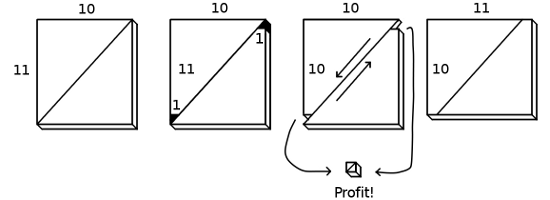
From Martin Gardner, via Michael Stueben: Obtain a slab of gold measuring 10″ x 11″ x 1″. Divide it diagonally and then cut a triangular notch in two corners as shown. Remove these notches as profit, and slide the remaining halves together to produce a new 10″ x 11″ x 1″ slab. The process can be repeated to yield any amount of money you like!

02 May 11:21

xkcd Phone

Presented in partnership with Qualcomm, Craigslist, Whirlpool, Hostess, LifeStyles, and the US Chamber of Commerce. Manufactured on equipment which also processes peanuts. Price includes 2-year Knicks contract. Phone may extinguish nearby birthday candles. If phone ships with Siri, return immediately; do not speak to her and ignore any instructions she gives. Do not remove lead casing. Phone may attract/trap insects; this is normal. Volume adjustable (requires root). If you experience sudden tingling, nausea, or vomiting, perform a factory reset immediately. Do not submerge in water; phone will drown. Exterior may be frictionless. Prolonged use can cause mood swings, short-term memory loss, and seizures. Avert eyes while replacing battery. Under certain circumstances, wireless transmitter may control God.
02 May 01:15

Separate Quarters

by Greg Ross

separate quarters puzzle

Nine wolves share a square enclosure at the zoo. Build two more square enclosures to give each wolf a pen of its own.

Click for solution …

02 May 01:13

Diagnosed With Homelessness

by Andrew Sullivan

Bryan Walsh spotlights a study on the correlation between traumatic brain injuries (TBIs) and homelessness:

Jane Topolovec-Vranic, a researcher in trauma and neurosurgery at St. Michael’s Hospital in Toronto, surveyed 111 homeless men recruited from a city shelter to see whether they had suffered a TBI sometime in their past. She found that 45% of them had experienced a traumatic brain injury at some point in their life. (Sadly, most of her subjects’ TBIs resulted from assault.)

“You could see how it would happen,” she says. “You have a concussion, and you can’t concentrate or focus. Their thinking abilities and personalities change. They can’t manage at work, and they may lose their job, and eventually lose their families. And then it’s a negative spiral” — a spiral that, for the men in Topolovec-Vranic’s study, ends up in a homeless shelter.

Charlotte Lytton adds:

The findings are important in demonstrating that homelessness can often be created by medical—as opposed to lifestyle—deviations. “Recognition that a TBI sustained in childhood or early teenage years could predispose someone to homelessness may challenge some assumptions that homelessness is a conscious choice made by these individuals, or just the result of their addictions or mental illness,” Dr. Topolovec-Vranic explains.

02 May 00:24

How to Defend Your Position

by Scott Meyer

As always, thanks for using my Amazon Affiliate links (USUKCanada).

01 May 01:04

An Effort To Eradicate Education

by Andrew Sullivan
Adam Victor Brandizzi

Eu já tinha ouvido falar de Boko Haram mas não tinha ideia do horror da coisa :-(

Two weeks after Boko Haram militants abducted as many as 234 teenage girls from a government school in northern Nigeria, many of the girls’ fates remain unknown. Several of them escaped, but most were not so lucky:

Pogo Bitrus, leader of a Chibok elders group, told AFP that locals had been tracking the movements of the hostages with the help of “various sources” across the northeast. “From the information we received yesterday from Cameroonian border towns our abducted girls were taken… into Chad and Cameroon,” he said. The girls were then sold as brides to Islamist fighters for 2,000 naira ($12) each, Bitrus added.

Terrence McCoy looks back at other times Boko Haram (whose name translates roughly to “Western education is forbidden”) has targeted schools in the past:

In July 2013, 29 students were burned alive at a school in northern Nigeria. Days later, [Boko Haram leader Abubakar] Shekau said, “Teachers who teach western education? We will kill them! We will kill them in front of their students, and tell students to henceforth study the Qur’an.” Boko Haram massacred 40 more students two months later. In February of this year, 59 boys attending boarding school were shot dead, and their school razed.

Eliza Griswold explains how the collapse of education – and civil society in general – in Nigeria has fueled the rise of the militants:

Paradoxically, many of the young members of Boko Haram are also victims.

They attack the kind of schools that they never had the chance to attend. Boko Haram’s swelling ranks are filled with boys and young men who attended almajiri schools, West African madrassas. An estimated 23 million boys and girls in Nigeria alone are educated in these Islamic schools. Unlike Nigeria’s government schools, which require payment for tuition, almajiri schooling is free, so even the poorest could attend. The northeastern city of Maiduguri, the center of Boko Haram, used to be a seat of some of the finest Islamic education in Africa. The teachers taught students in exchange for the students’ work on their farms.

As a result of the expansion of the Sahara Desert and the extreme flooding and drought linked to climate change, these teachers can no longer sustain those farms in northern Nigeria where whole villages have been overrun by sand dunes. Instead, the teachers and students have been forced to move south to the slums at the edges of large cities, including Abuja, where instead of tending crops for their teachers, the students are reduced to begging on their behalf. … In the slums, many of these boys sleep with their begging bowls under their heads for safekeeping.  To make money, corrupt teachers rent out their students to commit acts of violence. In this way, many have become foot soldiers for Boko Haram.

30 Apr 20:08

¡Así sí que aprendo! por @modernicidio


30 Apr 19:53

Como trocar 2 pneus ao mesmo tempo.

by Wagner Brenner

O negócio agora na Arábia Saudita é andar em 2 rodas.
E eles fazem isso sem nenhuma rampinha, só no braço mesmo.

Ainda não está impressionado?
Bom, eles trocam pneus sem usar o macaco. Dois.

30 Apr 19:50

Type Talk

by Greg Ross

http://commons.wikimedia.org/wiki/File:Emoticons_Puck_1881.png

In 1881 Puck published four faces assembled from printing characters and announced that its compositors intended to surpass “all the cartoonists that ever walked.”

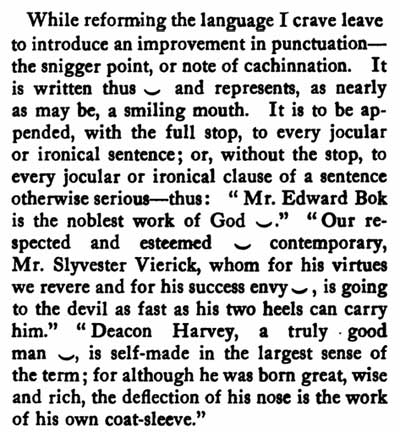
Six years later, in an essay entitled “For Brevity and Clarity,” Ambrose Bierce offered a character to make irony clear in written text:

2014-04-30-type-talk-2

In April 1969, New York Times interviewer Alden Whitman asked Vladimir Nabokov, “How do you rank yourself among writers (living) and of the immediate past?” He answered, “I often think there should exist a special typographical sign for a smile — some sort of concave mark, a supine round bracket, which I would now like to trace in reply to your question.”

(Thanks, Justin.)

30 Apr 18:42

Man Cannot Live on Soylent Alone

by Gracy Olmstead

Rob Rhinehart has created a beverage that is “nutritionally complete”: in other words, if you want to, the only substance you will ever have to consume—for the rest of your life—is “Soylent,” his chalky-colored liquid concoction. In his Atlantic piece “The Man Who Would Make Food Obsolete,” Roc Morin interviewed Rhinehart, and asked him about the genesis and motivation of the Soylent project. The interview revealed some interesting insights into Rhinehart’s understanding of the “natural,” and his rather Hobbesian understanding of the created world. He told Morin:

Mostly I think there’s just an emotional attachment to culture and tradition. People have this belief that just because something is natural it’s good. The natural state of man is ignorant, and starving, and cold. We have technology that makes our lives better. It doesn’t make sense that you would keep technology out of this very important part of life.

His line about the “natural state of man” can’t help but call to mind Thomas Hobbes’ similar definition: that in the state of nature, man’s life is “solitary, poore, nasty, brutish, and short.” According to Rhinehart’s point of view, food is a basic and practical function that we employ to stay alive. The natural hearkens back to a time of frightening aggression in the created order, and technology is supposed to save us from this natural order of things.

But what of those who believe that “natural” is better? That biting into a fresh, ripe tomato is, in fact, the best thing you can do for both your body and soul? Rhinehart argues that our understanding of such things is skewed by cultural and social precedent. In actuality, he argues, plants are not our friends:

I mean, honestly, nutritionally speaking, canned vegetables are better than fresh ones because fresh ones are decaying. They’re out in the air being oxidized. Bacteria are feasting on them. But if you can them, you seal them at the peak of freshness and the nutrients stay intact. So, it seems kind of backwards I think, actually, to go for fresh. Why are these foods seen as healthy? Looking at all of these hundreds of different plant metabolites, that’s kind of missing the point because a lot of those things that have been tested are harmful. It’s just intuitive on principle, these plants are not on our side. These plants did not evolve to feed us. If they could kill us, they probably would. It’s competition.

This point of view negates two important viewpoints: first, the perspective of Christians and other religious people who believe in an intelligent and ordered creation. Second, it undermines the perspective of biologists who believe that nature has evolved to work in conjunction as well as in competition. Food commentator Michael Pollan argues that our social traditions regarding food aren’t bad—in fact, they have historically kept us healthy: before the days of nutrition experts and diet websites, “We relied on culture, which is another way of saying: on the accumulated wisdom of the tribe … All of us carry around rules of thumb about eating that have been passed down in our families or plucked from the cultural conversation.” Additionally, Pollan argued in a 2007 article that evolution has created a symbiotic system between plants, animals, and people—and that we should think of food consumption as a “relationship”:

Species co-evolve with the other species they eat, and very often a relationship of interdependence develops: I’ll feed you if you spread around my genes. A gradual process of mutual adaptation transforms something like an apple or a squash into a nutritious and tasty food for a hungry animal. Over time and through trial and error, the plant becomes tastier (and often more conspicuous) in order to gratify the animal’s needs and desires, while the animal gradually acquires whatever digestive tools (enzymes, etc.) are needed to make optimal use of the plant.

In other words, the evolution of plant, animal, and human life has created interlocking compatibility—a system that helps keep our world, and ourselves, healthy. What Rhinehart is actually arguing for, Pollan makes clear, is “nutritionism”:

In the case of nutritionism, the widely shared but unexamined assumption is that the key to understanding food is indeed the nutrient. From this basic premise flow several others. Since nutrients, as compared with foods, are invisible and therefore slightly mysterious, it falls to the scientists (and to the journalists through whom the scientists speak) to explain the hidden reality of foods to us. To enter a world in which you dine on unseen nutrients, you need lots of expert help.

But expert help to do what, exactly? This brings us to another unexamined assumption: that the whole point of eating is to maintain and promote bodily health. Hippocrates’s famous injunction to “let food be thy medicine” is ritually invoked to support this notion. I’ll leave the premise alone for now, except to point out that it is not shared by all cultures and that the experience of these other cultures suggests that, paradoxically, viewing food as being about things other than bodily health — like pleasure, say, or socializing — makes people no less healthy; indeed, there’s some reason to believe that it may make them more healthy.

Even Rhinehart can’t cast aside these food benefits entirely. In his interview, he tells Morin that he’s looking forward to a time when “people make food just because it’s beautiful—like gardening, or painting. I’m looking forward to the point where food can just be art.”

It’s interesting: Rhinehart can deny any sort of natural dependency that we have on food. But he can’t deny our aesthetic dependency on it: the way our souls starve for its color, texture, and diverse assortment of tastes. He only confirms the fact that our souls hunger and thirst in a way that can’t be quenched with Soylent. Why? Why is it that we can’t “evolve” past our love of food?

Perhaps we could. Perhaps, with time, we could learn to love the milky nourishment of Soylent, and wean ourselves off of solid substances. But honestly, I know very few who would want to undergo this sort of evolution. In our hearts and souls, we love the beauty of the fruits of the earth. And, in this sense—regardless of Rhinehart’s claims—natural food is truly good for us.

Follow @gracyolmstead

30 Apr 17:36

Quote For The Day

by Andrew Sullivan

“My girls and I make a lot of dark jokes together. In the upcoming season [of Louie], there’s a line from a conversation I had with my older girl. She was saying how whenever she sees a three-legged dog, it lifts her spirits, because three-legged dogs are wonderfully unaware that they have a malady. They just walk around, and they don’t give a shit. And I said, ‘You know, honey, they are lucky. But do you know the only thing luckier than a three-legged dog? A four-legged dog.’ And she really laughed. Whenever she laughs that hard at something dark? I know it’s good,” – Louis CK.

Previous Dish on some very lucky tripods here, here, and here.

30 Apr 17:12

reblog-gif: ♥ Funny Gif Blog ♥

30 Apr 17:10

Anésia # 164

29 Apr 17:12

April 29, 2014


Thanks to the geeks in the SMBC facebook group for convincing me to do this one.
29 Apr 15:03

Collaborating with UX team

by sharhalakis

by rockstarcode

29 Apr 14:09

Conservative Sentencing Reform: Politically Savvy, Morally Right

by Casey Given

Darlene Eckles was not a drug user or dealer when she was indicted in 2004. After her troubled brother Rick used her house to sell crack cocaine against her wishes, Darlene was arrested as a co-conspirator and offered a plea bargain of 10 years in prison. She rejected the deal in attempt to clear her name in court. But, after it was revealed that she counted Rick’s drug money in exchange for paying her electricity bill, Darlene was sentenced to nearly 20 years in prison as a first-time, nonviolent drug offender.

While Darlene’s story may seem exceptional at first glance, she is just one of the countless victims of mandatory sentences that oblige judges to deliver often lengthy prison terms to convicted criminals. While the practice has received harsh criticism over the past two decades, convicts like Darlene have an unexpected new allies. Fiscally conservative elected officials like Sens. Rand Paul and Mike Lee are leading the charge in Congress for federal sentencing reform, reforming the GOP’s stance on criminal justice in a way that could potentially attract new supporters.

This turn in conservative politics is rather surprising considering the history of mandatory minimums. Although its roots in American jurisprudence trace back to the 19th century, it was not until the height of the War on Drugs during Ronald Reagan’s presidency that mandatory sentencing started gaining steam. The Sentencing Reform Act of 1984 directed the United States Sentencing Commission to reduce the discretion district judges had on sentencing terms, through strict guidelines. Two years later, the Anti-Drug Abuse Act of 1986 imposed specified mandatory minimums for violations of federal controlled substance laws.

Like most policy pushes, mandatory minimums were undoubtedly passed with good intentions. Given the high drug crime rates of the 1980s, it’s understandable why legislators would want to tackle the problem with a no-nonsense sentencing approach. Furthermore, mandatory minimums even had an egalitarian appeal. Under the previous sentencing regime, judges had wide discretion in determining the length of prison terms, giving rise to arbitrary inequalities in sentences for people convicted of the same crime.

Unfortunately good intentions do not always give rise to good policy. Mandatory minimums’ attempt to rein in judges’ discretion only shifted the discretion to prosecutors, resulting in no significant decrease of sentencing inequality. In fact, many mandatory minimums seem as arbitrary as the previous legal regime. Most infamously, the Anti-Drug Abuse Act was criticized for discriminating against African-Americans by mandating a five-year sentence for possessing five grams of crack cocaine while imposing the same sentence for possession of 500 grams of powder cocaine.

As a result of these lengthy and inflexible sentencing requirements, America’s prison population has skyrocketed, turning the criminal justice issue into a fiscal one. Over the past three decades, the cost of operating state correctional facilities have roughly tripled, giving rise to conservatives’ ire and the current Congressional push for reform.

There are currently two bipartisan sentencing reform bills on Capitol Hill’s docket: the Justice Safety Valve Act of 2013, introduced by Sens. Rand Paul (R-Ky.) and Patrick Leah (D-Vt.), and the Smarter Sentencing Act of 2014, introduced by Sens. Mike Lee (R-Utah) and Dick Durbin (D-Ill.). The former would allow district judges to depart from any mandatory minimum sentence “if the court finds that it is necessary to do so in order to avoid imposing” an unjust sentence. The latter would do the same with a significantly narrower scope, only applying to nonviolent drug crimes for defendants with less than two criminal history points as defined by the U.S. Sentencing Guidelines.

While Paul’s bill would have a wider effect, Lee’s is undoubtedly the more politically practical. Indeed, it already passed the Senate Judiciary Committee in January. But does either proposal have a realistic chance of enactment? Certainly the Obama Administration has made criminal justice reform one of its priorities of late, paving the way for a successful bipartisan effort. Besides the Department of Justice’s Smart on Crime criminal justice review launched last August, Attorney General Eric Holder made numerous pleas for Congressional action on reform.

However, with elections around the corner in November, it remains to be seen if Drug War rhetoric could scare incumbents up for reelection (particularly in the House) afraid of appearing “soft on crime.” The law enforcement lobby is already applying pressure on key legislators. These candidates should keep in mind one notable poll conducted by Families Against Mandatory Minimum that found “more than three-quarters of Americans (78 percent) feel the court, not Congress is best qualified to determine sentences.” Red states like Texas, Georgia, Missouri, and Oklahoma have also passed successful criminal justice reform without any repercussions to their conservative leadership.

Instead, Congressional Republicans should see sentencing reform as an opportunity to attract support from demographic groups outside their base. Like Gov. Jeb Bush and Sen. Marco Rubio’s outreach to the Hispanic community through calling for immigration reform, Sens. Paul and Lee’s push to reducing mandatory minimums has the potential to improve the GOP’s appeal to African-Americans.

Politics aside, sentencing reform is simply the right thing to do. Any system that allows people like Darlene Eckles to slip through the cracks with unfair sentences that do not fit their crime is morally bankrupt.

Casey Given is an editor at Young Voices, a project aiming to promote Millennials’ policy opinion in the media.

29 Apr 12:11

dirtyhippieproductions: Word Of The Week  Komorebi ~ Sunlight...


dirtyhippieproductions:

Word Of The Week 

Komorebi ~ Sunlight that filters through the leaves of trees.

☮  ❤ ॐ 

29 Apr 11:51

Why Net Neutrality Matters

by Andrew Sullivan

Alexis Madrigal and Adrienne Lafrance explain why advocates of net neutrality approach the issue with such great passion:

This idea of net neutrality—this cherished idea, even, among Internet entrepreneurs and activists—has a long history, roughly as long as the commercial world wide web. It is, Harvard law professor Lawrence Lessig has argued, what makes the Internet special. He used to call the principle e2e, for end to end: “e2e. Not b2b, or b2c, or c2b, or b2g, or g2b, but e2e. End to end. The core of the Internet, the core value that defined its power, the core truth that made innovation around it possible, is this e2e,” Lessig said in a 1999 talk. “The fact – a fact – that the network could not discriminate in the way that AT&T could.”

Comcast couldn’t privilege its own content over Netflix’s or PBS’ or Disney’s or your blog’s. He explained: “The network was stupid; it processed packets blindly,” he said. “It could no more decide what packets were ‘competitors’ than the post office can determine which letters criticize it.”

This was not just a nice thing, it was the very nature of the Internet. Without it, the Internet will become, as Tim Wu put it, “just like everything else in American society: unequal in a way that deeply threatens our long-term prosperity.”

But Jimmy Wales, the founder of Wikipedia, tells Jemima Khan that he’s not that worried about it:

I differ from many of my colleagues, in that I don’t think net neutrality is super-important. The fear is that companies which control the “last mile” to the consumer will leverage that choke point to stifle innovation (unless they get paid extra for it happening). And that’s not an entirely crazy thing to fear, particularly because much last-mile infrastructure remains under inappropriate, government-granted monopoly privileges—or derived from those privileges in the first place years ago.

But if we are worried about a handful of companies getting control of a choke point and using it to squeeze out competitors and make massive profits, we don’t need to look at the layer of network infrastructure and network neutrality. We just need to look at the Apple App Store (and similar), where everything that runs on your iPhone or iPad has to be approved by Apple, with them taking a huge cut of the revenue at every step, with no real competition in sight. Consumers should be very worried about that.

Can you imagine the outcry if 20 years ago Microsoft had decreed that no third-party software could run on Windows without being approved by them, and bought through their proprietary stores? Yet today we accept this model on mobile devices (and soon, I fear, on our computers) without blinking.

Barbara van Schewick discusses some of the dangers she sees in imposing access fees for Internet content:

Why should we care if start-ups or other innovators without significant outside funding cannot pay these fees and therefore lose the ability to innovate? Throughout the history of the Internet, innovators with little or no outside funding have developed many important innovations (including E-Bay, Facebook, Yahoo, Google, Apache Web Server, the World Wide Web, Flickr and Blogger), and there is no reason to believe this would change in the future. Thus, removing (or at least impeding) the ability of this important subgroup of innovators to develop new applications will significantly reduce the overall amount and quality of application innovation.

Finally, access fees may impose serious collateral damage on values like free speech or a more participatory culture by making it more difficult for individuals or non-profits to be heard or to find an audience for their creative works.

And Timothy B. Lee blames Congress for tying the FCC’s hands on net neutrality, noting that the relevant law predates the concept:

The 1996 Telecommunications Act prohibits the FCC from imposing common carrier regulations on “information services,” which (according to the FCC) includes broadband internet access. The law says that information services can’t be subject to common carrier regulations. In its January ruling, the court said that the FCC’s 2010 net neutrality rules constituted common carrier regulation and was therefore illegal. But the court signaled that it would accept a revised set of rules that only prohibited discrimination if it was “commercially unreasonable.”

Is that the result Congress intended? No one really knows. The term “network neutrality” hadn’t been coined yet in 1996. Cable modems and fiber optic services like FiOS were still in the future. Unsurprisingly, Congress wasn’t clear about how to handle concepts and technologies that didn’t exist yet, so the courts have had to make up the rules as they went along.

29 Apr 11:32

Black Like Me

by Greg Ross
Adam Victor Brandizzi

Um livro que deve ser deveras interessante de ler (e uma experiência deveras interessante de se repetir aqui.)

john howard griffin

In 1959, Dallas journalist John Howard Griffin used drugs and sunlamps to darken his skin and then traveled through Louisiana, Mississippi, Alabama, and Georgia posing as a black man and keeping a diary of his experiences. He found it to be “the story of the persecuted, the defrauded, the feared and the detested.” When he applied for work at a plant in Mobile, the foreman told him, “No, you couldn’t get anything like that here.”

His voice was not unkind. It was the dead voice one often hears. Determined to see if I could break in somehow, I said: ‘But if I could do you a better job, and you paid me less than a white man …’

‘I’ll tell you … we don’t want you people. Don’t you understand that?’

‘I know,’ I said with real sadness. ‘You can’t blame a man for trying at least.’

‘No use trying down here,’ he said. ‘We’re gradually getting you people weeded out from the better jobs at this plant. We’re taking it slow, but we’re doing it. Pretty soon we’ll have it so the only jobs you can get here are the ones no white man would have.’

‘How can we live?’ I asked hopelessly, careful not to give the impression I was arguing.

‘That’s the whole point,’ he said, looking me square in the eyes, but with some faint sympathy, as though he regretted the need to say what followed: ‘We’re going to do our damnedest to drive every one of you out of the state.’

In a Mississippi bus station he felt a “hate stare” that would grow familiar. “It came from a middle-aged, heavyset, well-dressed white man. He sat a few yards away, fixing his eyes on me. Nothing can describe the withering horror of this. You feel lost, sick at heart before such unmasked hatred, not so much because it threatens you as because it shows humans in such an inhuman light. You see a kind of insanity, something so obscene the very obscenity of it (rather than its threat) terrifies you. It was so new I could not take my eyes from the man’s face. I felt like saying: ‘What in God’s name are you doing to yourself?’”

29 Apr 11:29

swagonmydick4000000000: lmao what the fuck these are small...


swagonmydick4000000000:

lmao what the fuck these are small water balloons 

28 Apr 22:50

The Soaring Suicide In South Korea, Ctd

by Andrew Sullivan
Adam Victor Brandizzi

O último comentário é muito interessante, compara o luto sul-coreano com o luto americano.

South Korean prime minister resigns over ferry disaster: http://t.co/4ZFL9epSxf #c4news pic.twitter.com/CuEUbKQnwS

— Channel 4 News (@Channel4News) April 27, 2014

A reader is put off by this post:

I’m staggered that you used the South Korean ferry tragedy as an excuse to run an unhinged rant by an entitled Westerner about the alleged lack of professionalism in “Korean business culture at large”. The Asiana crash was possibly human error – so were plenty of crashes in the West. Korean firms cut corners? General Motors is currently in the news for ignoring a critical problem for years while people were dying. Didn’t your reader wonder for a moment how such an unprofessional bunch of losers, in a country smaller than many American states, managed to build companies like Samsung, LG, Hyundai, Kia, Lotte, that are household names the world over?

The supposed “entitled Westerner” clarified where he’s coming from:

I am Korean-American-British. My family immigrated before I was born from Korea to the US. I spent most of my 20s in the UK where I got naturalized, and then moved to Seoul a year ago. Over the past year I’ve been cataloging a variety of facets of Korean culture that are in need of reform, the biggest areas being sex, business, and education. One thing I’ll give to Koreans is they are very good at introspection when they are put under the spotlight. The chapter on Korean Air in Malcolm Gladwell’s Outliers caused a big stir, but now one of the biggest hagwons (after-school academy) uses it as a source text.

By the way, I should clarify that the comparison to 9/11 is not something I’ve heard on the Korean press; it’s a purely personal observation based on:

  • the level of media saturation
  • anguish due to the man-made nature of incident
  • innocence of victims (high school kids going on vacation!)
  • high numbers of missing, presumed dead but not confirmed
  • logistical difficulty of the rescue effort
  • numbers relative to population (about 300 out of 50 million)

Also, I was half a mile from Ground Zero on 9/11, so it jumps more readily to my mind.

Another reader:

I wanted to give you a slightly different take on what is happening in S. Korea at the moment.

I’ve been teaching English here for the past three years, and I’ve had my share of ups and downs with the people and the culture. Sure, they work too hard, and it’s from start to finish. The kids have homework on every single vacation, which kind of misses the point of vacation, and by the time they hit middle school most of them go to school and academies from 8 in the morning to 8 or 9 at night.

Once they become adults, as your other reader said, face-time is what counts. It’s quite normal to work 6 days a week here for 10 hours a day, no matter your position. Most people are lucky to get one full week of vacation, and good luck with sick days.

Still, one must marvel at what they’ve accomplished here in such a short time. Since the opening up of the economy in the ’60s and ’70s, Korea has served as a model for what is possible. The technological capacity on display here would put most of America to shame. Honestly, you can’t blame them for how hard they work either. My bosses saw their world destroyed during the Korean War. To go from being a citizen of a war-torn, underdeveloped nation to a citizen of modern-day Korea, well one could understand why Koreans value a good work ethic.

That said, they are reeling as a country right now. It’s ironic when you think about it. This is a country that has been at war for roughly 60 years. They have an unpredictable, nuclear-obsessed neighbor to the north that likes to remind them of their situation from time to time. I was here when N. Korea bombed the western island of Yeonpyeong in 2010. It was both tragic and important, but this is so much bigger. Let’s put it this way: think about the firestorm of media coverage that happens every time N. Korea does something provocative compared to the coverage of the sinking of the ferry, and reverse it. That’s what the coverage is like here.

After living here for a few years, I feel as though I can understand why it’s that way too. Children are everything here (I know they are everywhere, but hear me out). When you look at the amount of money parents spend on their children in S. Korea as a percentage of their overall income, it’s staggering. So much is put into providing children with every possible advantage. It’s super competitive and failure isn’t viewed as an option. In turn, the children (specifically first-born sons) are expected to return the favor once parents are ejected from the work force. Children are very sheltered to the dangers of the outside world. It’s extremely safe here (even with N. Korea lurking), and when that illusion of safety gets shattered by an event such as this, it can be very difficult to deal with the feelings afterwards.

Event after event has been and is being cancelled (festivals, races, trips). I was talking to some middle-schoolers today as a matter of fact, and they said all of their school trips for the rest of the year (the school year just started in March) are cancelled. Not only is everything currently being cancelled, but there is the issue of suicide. It isn’t surprising at all to me that the assistant principal killed himself, and don’t be surprised if any of the surviving crew members, especially the captain, do so as well. For Koreans, this is taking responsibility (in fact, this is what the principal said in his note).

As an outsider with a Western point of view, it’s very sad to watch everything unfold. The idea that suicide is a way out is so difficult to grasp. How is killing yourself taking responsibility for the deaths of so many students? Be there for the families and the rest of your students. Help people get through this tragedy. Don’t take the easy way out and leave the survivors to deal on their own. Now is when you should be coming together. Stop canceling events. Do them in memory of those lost. Dedicate everything you do to those people who lost their lives. You are still here, so embrace it.

Another:

Sorry I’m late to this conversation, but I live in South Korea, so I get your posts late. I was a journalist here, and now I’m a lawyer here. I speak Korean fluently. I went to college here. I like to think I know Korea pretty well, and the stuff your readers have submitted strikes me as totally wrong.

Yes, there is a problem with Korean culture that is absolutely behind the rash of accidents and poor responses that plagues Korea, and it’s not Confucianism or bad business practices. It’s a complete lack of safety. This is something so deeply ingrained in Korea that it permeates the culture. I doubt Koreans themselves are aware of how incredibly reckless they are compared to people elsewhere.

People in Korea do not look where they are going when walking. If they bump into someone, they keep walking without saying a word. When they drive, it is a mad rush to get in front of everyone, to the point that newcomers are advised to run red lights just to avoid being rammed. Builders cut corners; investors leap before looking; the South’s generals go golfing when the North threatens apocalypse Everything here is done “bbali bbali,” meaning “fast fast,” which they are very proud of. It is easy to see how that runs the gamut from not looking where you’re going to cutting corners in order to get that ferry to port, ASAP.

For that reason, I chuckled when I saw your reader describe Korea as “safe.” The fact that there is very little visible violent crime does not make Korea “safe.” It is, in fact, very dangerous if you drive, live in or near tall buildings, fly airplanes, take ferries, invest your money, or come within artillery range of the DMZ.

As I was pondering this coming back from the morning workout, I almost creamed a man with my car. I was driving down a narrow curving ramp into my building’s parking lot. He was walking up the middle of it, because … hey, it’s a short-cut.