Pizza Hamburger
In order to establish the extent to which digitized public domain books are being restricted, a sample of 100 pre-1890 books was selected from the New Zealand National Bibliography (NZNB). This sample was chosen on the assumption that these works had entered the public domain under New Zealand copyright law. Each book in the sample was searched for within six online repositories: Google Books, Hathi Trust, Internet Archive, Early New Zealand Books (ENZB), New Zealand Electronic Text Collection (NZETC) and Project Gutenberg. In addition, Google and Bing searches were conducted for all sample books that could not be located within these repositories.Here's what the researchers discovered:
The findings of this research suggest that a high proportion of digitized public domain books are being restricted by online repositories. Out of a sample of 100 public domain books, only three are hosted by repositories that do not impose any form of usage restriction. Furthermore, 48 percent (24) of all digitized books [50 out of the 100 public domain sample] are hosted by a repository that restricts or blocks access, with the most restrictive repository limiting or blocking access to 91 percent (21) of sample books within its collection.They also managed to pinpoint the key problem:
Almost all access restrictions applied to public domain books within the sample were the result of repositories using a process of estimation to assess copyright status. Within the sample, a one-minute search located accurate biographical information about authors two-thirds of the time. This task takes a fraction of the time required to digitize a book, which involves 30 minutes to scan 500 pages (Kelly, 2006).A solution is the following:
Digitizers should incorporate the sourcing of copyright information within the overall process of digitization, and copyright estimation should only be used as an option of last resort. Furthermore, copyright estimation periods should better reflect statistical norms regarding the actual duration of copyright protection. The current estimation period of 140 years, used by Google Books and Hathi Trust, is far too conservative. If hosted under this policy, 47 percent of sample books would be restricted. This is despite the fact that all books with locatable biographical information were confirmed as being in the public domain for between 30 and 132 years.This goes back to the problem of determining whether a work is in the public domain or not. Because that can be complex, those carrying out the digitization of works simply assume the worst, just to be on the safe side. That's something that needs to change, otherwise we risk losing not just the benefits of digitized public domain works, but also our undoubted rights to access them freely.

ArnvidrNow, I don't use skype, and I don't have a cam on my linux machine anyway, but dropping support for ALSA seems typically stupid.
Anonymous Coward writes:
A new Skype for Linux update has been released by Microsoft ... the developers have explained that, starting with this version of Skype 4.3, the direct ALSA support has been dropped and users will need to use PulseAudio 4.0 for the best audio experience.
According to the changelog, the new cloud-based Group Chat experience has been implemented into the software, the file transfer support is now much better when using multiple devices at once, the accessibility for blind and visually impaired users has been improved, PulseAudio 3.0 and 4.0 support has been added, and numerous bug fixes have been implemented.
--
[Ed's Note: The AC also included the following - I decided to leave it in.]
The cynic inside me finds it hard to swallow the words "best audio experience" just because Microsoft said so. If I was to add a group of tags to my story submission, I would include:
Linux-Audio | Microsoft | Lennart-Poettering | RedHat | DoD | Skype | Backdoor | Walled-Garden | NSA | Cloud | Elitist-Development-Model | Faithful-Brownshirt-Of-The-Oligarchy | If-Infiltrated-EQ-1-Then-Manipulate
Read more of this story at SoylentNews.
ArnvidrScrew you existential crisis, I tattooed a dragon with a t-rex head onto my body today and then went to see a Joe Satriani concert. You're not allowed to be here.

ArnvidrThe most important object in the house.
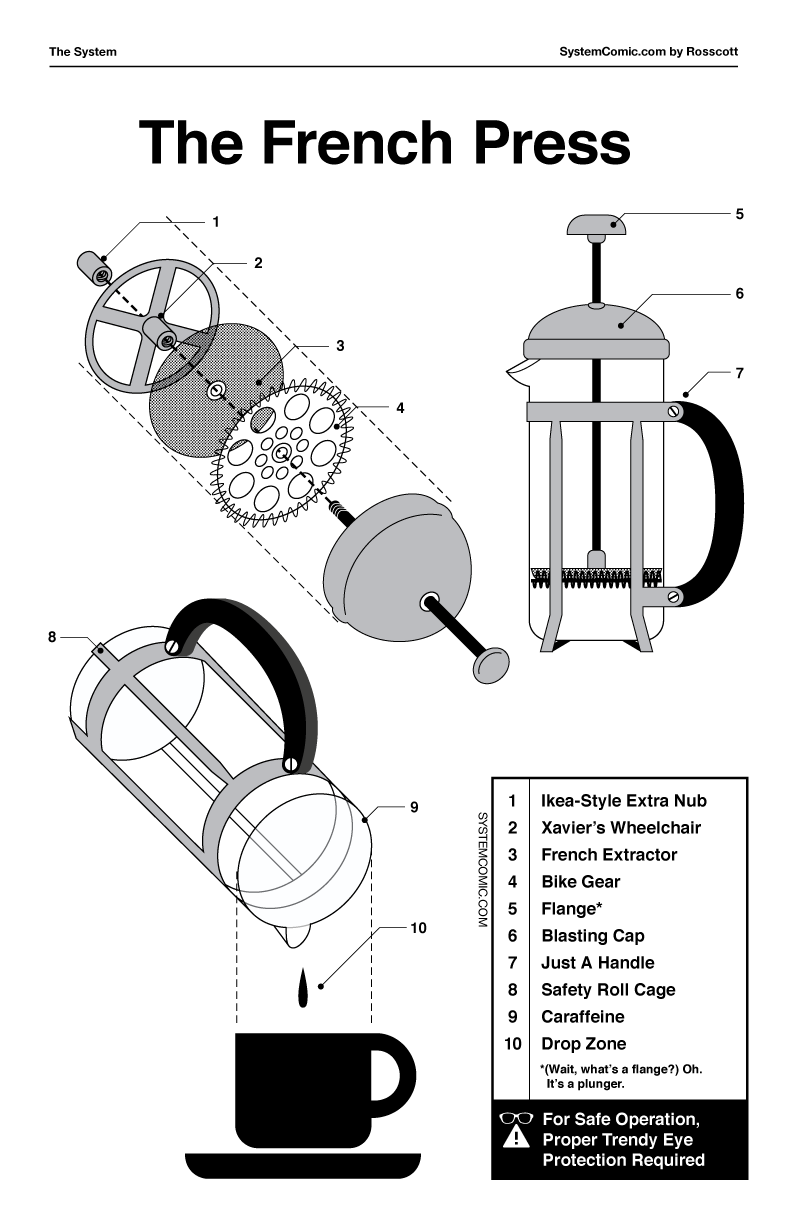
This one was last week’s Medium post, but I added some details and tweaked it into a poster design. It’ll be for sale at HilariAwesome.com soon.
Speaking of which, this week’s Medium post is pretty awesome. It’s called “What is the best gift to get someone?” and here’s an excerpt:
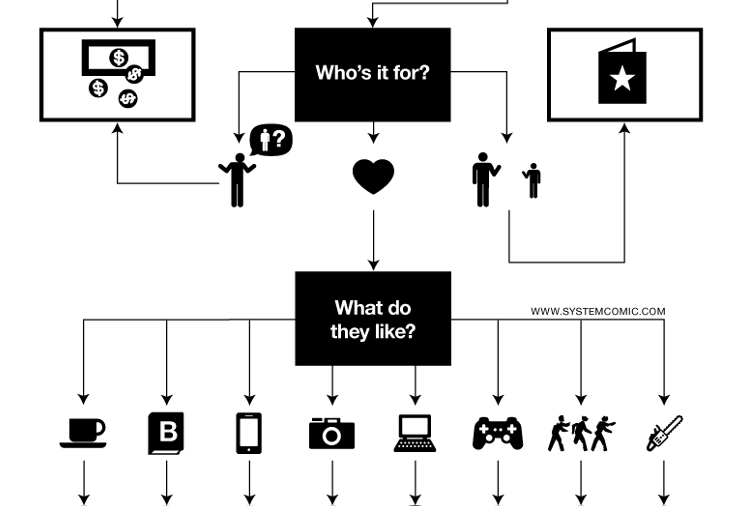 You can read the rest here »

We’d like to be voted Best of Baltimore, and with your help, we can make it happen!
Every year, Baltimore Magazine does a Readers Poll for the Best of Baltimore.
We’d like your help getting voted in. Just vote for us under Arts & Fun, under the Play or Performance heading.
We realize, there’s a remarkable Baltimore arts scene, so you’ll probably be split – but it’d make our day to make this happen for us!
ArnvidrSometimes you get lucky....
This is a bizarre story of an almost-happened $10 million scam. It reads like an obviously phony Nigerian 419 scam, but it actually fooled what seem to be smart people. What's amazing to me is that there was no face-to-face interaction at all.
ArnvidrThe DOJ does not like J.
The judge appears to have believed that adversary procedure is always essential to resolve contested issues of fact. That is an incomplete description of the American judicial system in general and the federal judicial system in particular. There are ex parte or in camera hearings in the federal courts as well as hearings that are neither or both. And there are federal judicial proceedings that though entirely public are nonadversarial, either partly or entirely.Posner basically says that the district court judge herself should have looked over the materials first, to determine if it makes sense to pass them on, rather than defaulting to saying that they should be shared with the lawyers. As such, he basically reveals that the "secret hearing" that was held was to go over the material with the appeals court judges, and they're satisfied that nothing needs to be revealed to Daoud's attorneys.
...our study of the materials convinces us that the investigation did not violate FISA. We shall issue a classified opinion explaining (as we are forbidden to do in a public document) these conclusions, and why therefore a remand to the district court is neither necessary nor appropriate.Posner also, not surprisingly, rejects the objection by Daoud's lawyers to that secret hearing, noting that it was necessary to determine if the DOJ lawyers were being fully honeset with the court:
Their objecting to the classified hearing was ironic. The purpose of the hearing was to explore, by questioning the government’s lawyer on the basis of the classified materials, the need for defense access to those materials (which the judges and their cleared staffs had read). In effect this was cross-examination of the government, and could only help the defendant.And, voila, the secret law and secret courts and secret evidence continue unabated...
Defense counsel’s written motion cites no authority for forbidding classified hearings, including classified oral arguments in courts of appeals, when classified materials are to be discussed. We don’t think there’s any authority it could cite.
The problem, from Judge Coleman’s perspective, is that it may not always be possible for a district judge to determine whether disclosure is necessary (as opposed to whether it “may be necessary”) without the benefit of adversarial presentation. That is to say, § 1806(f) conditions the disclosure of classified FISA materials to a defendant (or, at least, his security-cleared counsel) upon a finding by the district judge that may, in some cases, only be possible with defense counsel’s participation. This is why, in her order mandating disclosure, Judge Coleman devoted so much of her energy to the importance of adversarial proceedings, especially in criminal cases—not because all proceedings in U.S. courts are adversarial (they’re not), but because, in this context specifically, adverse-ness makes it easier for a judge to have faith that she is comporting with her statutory and constitutional obligations.
But rather than accept—or at least sympathize with—Judge Coleman’s efforts to square a circle, Judge Posner derided them by suggesting that the government has a right to keep these materials secret, repeatedly criticizing calls (one is left to wonder from where) for “openness.” “Not only is federal judicial procedure not always adversarial,” Posner wrote; “it is not always fully public.” This is true, but entirely beside the point; Judge Coleman wasn’t seeking to open the proceedings; she was seeking to provide security-cleared defense counsel (who, just like everyone else, are subject to the Espionage Act) with access to classified information.

ArnvidrWhat's the upcoming fight alluded to here? Probably Mickey Mouse (1928)?
We cannot find any basis in statute or case law for extending a copyright beyond its expiration. When a story falls into the public domain, story elements—including characters covered by the expired copyright—become fair game for follow-on authors...Posner notes that while the ten stories published after 1923 (it's not fair to call them "new") are derivative works of the original, and the only thing protectable in those are the "original elements added" in those later stories. Everything done before that is public domain.
The estate offers the hypothetical example of a mural that is first sketched and only later completed by being carefully painted. If the sketch is allowed to enter the public domain, there to be improved by creative copiers, the mural artist will have a diminished incentive to perfect his mural. True; but other artists will have a greater incentive to improve it, or to create other works inspired by it, because they won’t have to pay a license fee to do so provided that the copyright on the original work has expired.Posner also destroys the rationale of the Doyle Estate in which they have a made up concept of "flat" and "round" characters, where "round" characters are continually added to through newer and newer works, and the characters are never fully complete because of all that adding. Posner notes that this whole thing has nothing to do with copyright law:
The estate defines “flat” characters oddly, as ones completely and finally described in the first works in which they appear. Flat characters thus don’t evolve. Round characters do; Holmes and Watson, the estate argues, were not fully rounded off until the last story written by Doyle. What this has to do with copyright law eludes us.Posner further points out that, for all the talk that the Estate is worried about the harm of "new" versions of Holmes it doesn't like, in truth it seems clear that the Estate just wants to get paid. Finally, Posner notes that this appears to be an attempt to create a perpetual copyright, which violates the "limited times" aspect of the Constitution:
With the net effect on creativity of extending the copy-right protection of literary characters to the extraordinary lengths urged by the estate so uncertain, and no legal grounds suggested for extending copyright protection beyond the limits fixed by Congress, the estate’s appeal borders on the quixotic. The spectre of perpetual, or at least nearly perpetual, copyright (perpetual copyright would vio-late the copyright clause of the Constitution, Art. I, § 8, cl. 8, which authorizes copyright protection only for “limited Times”) looms, once one realizes that the Doyle estate is seeking 135 years (1887–2022) of copyright protection for the character of Sherlock Holmes as depicted in the first Sherlock Holmes story.That seems like a rather useful line given the likelihood of a copyright term extension fight coming up in the next few years...

ArnvidrKilling yourself to live. But failing.
[A]ccording to a source inside City Hall, the officials who aggressively pursued Daniel, the creator of the account, were also wrong in a much more mundane way: They thought I was behind @peoriamayor and assumed I worked for the local paper, the Journal Star...This adds a bit more background to the mayor's apparent disdain for the media. Glawe also points out that the braintrust behind the account shutdown not only seemed to have a poor grasp of the law (perhaps intentionally), but was also mystified by the technical aspects of dealing with an online social media platform.
In an email that was released because of a Freedom of Information Act request, Ardis asked his subordinates what “JS reporter” lived with Daniel, and a police official said he didn’t know. If the source in City Hall is correct, Ardis was convinced that reporter was me, and likely thought that by exposing me as the foul-mouthed fiend behind @peoriamayor he’d ruin my reputation as a journalist and that of the Journal Star in the process.
At one point, some city officials and cops thought they could call Twitter to have @peoriamayor shut down, so it’s no surprise that they apparently couldn’t be bothered to google my name and find out who I was and whom I work for.In related news, Peoria Police Chief Steve Stettingsgaard has stepped down to take a job with Caterpillar, Inc. While his entire tenure at the head of the PPD has been marked with controversy, there's no doubt this latest incident played a part in convincing him to exit the law enforcement business.
Mayor/Manager, I reviewed this matter with Detective Feehan. He is in the process of shutting down the account as you saw from my last email. This phony Twitter account does not constitute a criminal violation in that no threats are made. I'm not sure if it would support a civil suit for defamation of character. I'm not an expert in the civil arena but my recollection is that public officials have very limited protection from defamation.If Ardis decides to pursue this, he'll just be adding to his list of highly-public debacles. His defensive press conference indicates he's unable and unwilling to learn from his mistakes. There's no case to be made here, especially if Ardis decides to go after Twitter itself for the actions of one of its users. But it appears Ardis has dignity to burn, even if most of it is riddled with self-inflicted wounds.


Read more of this story at Slashdot.

ArnvidrDinosaurs!
azrael writes:
The BBC reports on an answer to what might be the last big question about the biological system that underpinned the lumbering success of the dinosaurs.
Scientists compared the growth rates of hundreds of living and extinct species, using growth rings and bone size to calculate the [metabolic] rates for dinosaurs.
A paper by John Grady, the study's first author and a PhD student at the University of New Mexico, suggests that dinosaurs were mesothermic: neither cold nor warm blooded, but somewhere in between. This research provides fresh evidence to add to the debate.
Professor Roger Seymour, a reptile physiologist at the University of Adelaide in Australia, is not convinced.
"It would be disadvantageous to be in the middle," Prof Seymour told BBC News. He remains convinced that only powerful, genuinely endothermic dinosaurs would have wielded sufficient energy to remain dominant for 150 million years.
"You have to realise that this group of dinosaur physiologists, including me, are very hesitant to change our minds. Each one of us has the smoking gun, we think, that proves one thing or another."
Read more of this story at SoylentNews.
What's most striking in that video to me is the clear and obvious passion with which composer Austin Wintory speaks about working on game music. Still, the back story here is what makes it so ridiculous. AFM management constructed a contract for video game composers without the input of the union's own membership, a contract that is so one-sided that not a single game developer even hesitated to reject it completely, and constructed an ecosystem in which no AFM member could be hired with union sanction to perform his or her craft. For two years, the music in games was either made by composers not in the AFM or by composers who just ignored the AFM's rules. The union failed to benefit in any way. Then, when it discovered that one of its members, who had been vocally critical of the contract, had the gumption to actually make a living, the union threatened to levy a $50,000 fine against him.
Unions have a terrible reputation in this country because of stories like this, which is a shame. This union is an example of how not to behave, in making demands that will never be accepted, refusing to consult its own membership, actually coming out and suggesting that it chiefly operates through fear and intimidation, and going after its own members for daring to make a living doing what they do best (the kind of thing a union should be supporting, not hindering).
"Unfortunately employers have not signed the current agreement," admits AFM Local 47 Vice President John Acosta who represent the recording musicians of Los Angeles, "and the limited work we were doing before has all but vanished into non-union land."And the solution to that is to levy fines against one of your members instead of negotiating a contract that will actually get composers back to work under the union umbrella? Please.

ArnvidrAnd another politician.
While I'm on my soapbox, we should be really mad at Google and Facebook and Microsoft, because they're doing a very interesting, and I think, very dangerous thing. They've decided to come out and say "we oppose this new FISA bill, because it doesn't go far enough." And when you peel that onion back a bit and say "Why are you doing this? This is a good bill, it's safe, it's bi-partisan, it's rational. It meets all the requirements for 4th Amendment protections and privacy protection and allowing the system to work."This is wrong and ridiculous on so many levels, but let's just jump to the biggest one and then circle back later to the rest. Less than 15 minutes later (at about 2 hours 25 minutes into the video), Rogers was arguing how important the internet is to our economy, and how a cyberattack might destroy it. He's basically discussing his beloved CISPA and its "information sharing" components, which is really a backdoor way to "legalize" companies handing over all their data to the NSA without warrants.
And they say, "Well, we have to do this because we're trying to make sure we don't lose our European business." I don't know about the rest of you but that offends me from the words "European business." Think about what they're doing. They're willing to, in their mind, justify the importance of their next quarter's earnings in Europe versus the national security of the United States. Everybody on those boards should be embarrassed and their CEOs should be embarrassed and their stockholders should be embarrassed. That one quarter cannot be worth the national security of the United States for the next ten generations."
One sixth of our economy now, is through the internet! One sixth! So this notion that we're all going to say "well the government should do nothing and just completely keep away" -- and I'm not for regulation, by the way, that's not what I mean, but I mean in some way to... to help defend these private networks or allow them to defend themselves -- if we don't get it right, one-sixth of our economy is going to go away. Like that (*snaps*). If every time you turn it on, you lose money, how many times are you going to turn it on and use the internet for commerce? You're not!Right. Did you get that? If the NSA is violating all of your privacy, no big deal, and people will continue to use the internet and contributing to the economy -- and if it hurts the economy, well that's just the price we pay for national security. But, if those evil foreign governments violate your privacy, well, then all of you will stop using the internet and it will destroy our economy.
If one financial institution -- we have one particular financial institution that clears somewhere about $7 trillion in global financial transactions every single day. Imagine if tomorrow that place gets in there, and through an attack of which we know does exist -- the potential does exist -- where the information is destroyed and manipulated. Now you don't know who owes what money. Some of that, they have lost transactions completely, forever. Imagine what that does to the economy? $7 trillion. Gone. Right? Gone! It's that serious!So, profits of Wall Street banks are patriotic. But profits of Silicon Valley companies... well, they can be sacrificed for national security.

ArnvidrPoliticians....