Submitted by: (via yingsin)
Shared posts
20 Nov 01:47
73,012 Unsecured Security Cameras You Can Watch
by Kevin Murray
A site linked to 73,012 unsecured security camera locations in 256 countries – all because they are using default passwords.
 from the website...
"Sometimes administrator (possible you too) forgets to set the default password on security surveillance system, online camera or DVR. This site now contains access only to cameras without a password and it is fully legal. Such online cameras are available for all internet users. To browse cameras just select the country or camera type.
This site has been designed in order to show the importance of the security settings. To remove your public camera from this site and make it private the only thing you need to do is to change your camera default password." (more)
"Sometimes administrator (possible you too) forgets to set the default password on security surveillance system, online camera or DVR. This site now contains access only to cameras without a password and it is fully legal. Such online cameras are available for all internet users. To browse cameras just select the country or camera type.
This site has been designed in order to show the importance of the security settings. To remove your public camera from this site and make it private the only thing you need to do is to change your camera default password." (more)


16 Nov 18:07
FTC Questioning Apple About Health Data Protection Policies
by Juli Clover
The United States Federal Trade Commission has met with Apple representatives several times over the past few months to discuss Apple's privacy practices covering health data collection, reports Reuters. The FTC is reportedly seeking assurance that Apple will prevent health data collected by the Apple Watch and other iOS devices via the Health app from being used without express user consent.
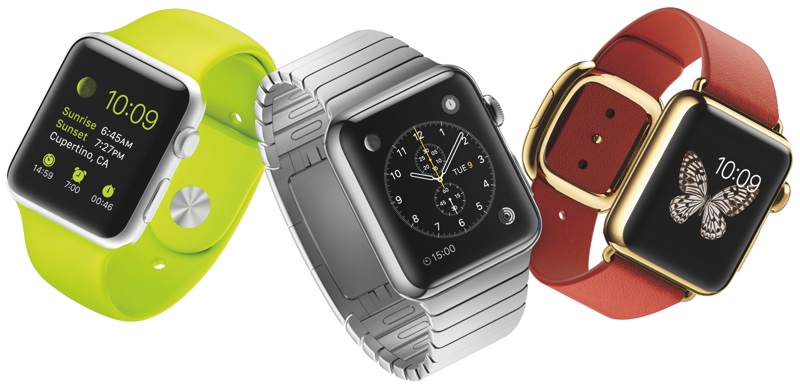
While the FTC declined to comment, Reuters does not believe that the government agency will launch a formal inquiry into Apple's data protection policies, though it is clearly taking a great interest in the Apple Watch, which collects data like heart rate and movement, and HealthKit, which allows Apple's Health app to aggregate health-related data from various apps and accessories.
Though it hasn't even hit the market, other government officials have also taken an interest in the Apple Watch. In September, Connecticut Attorney General George Jepsen sent a letter to Apple CEO Tim Cook asking for information on what data Apple plans to collect with the device, how the information will be stored, and what Apple's policies are for apps that access health information.
Earlier this year, ahead of the Apple Watch's debut, Apple released new guidelines for HealthKit APIs, which also applies to the Apple Watch. In the document, Apple explains that HealthKit information will not be stored in iCloud and that apps attempting to store health-related data in iCloud will be rejected. It also clearly states that apps will not be able to share data with third parties without express user consent.
In recent months, Apple has attempted to make its privacy policies more transparent, creating a comprehensive new privacy site that details all of its privacy practices. Tim Cook also spoke on privacy in a recent interview, stating that users "have a right to privacy" and that the company "tries not to collect data." "Our business is based on selling [products]," he said. "Our business is not based on having information about you. You are not our product."


The two people, both familiar with the FTC's thinking, said Apple representatives have met on multiple occasions with agency officials in recent months, to stress that it will not sell its users' health data to third-party entities such as marketers or allow third-party developers to do so.An Apple spokesperson told Reuters that the company "works closely with regulators around the world" to make its built-in data protections clear. "We've been very encouraged by their support," she said, adding that Apple's new health-focused initiative, HealthKit, had been designed "with privacy in mind."
While the FTC declined to comment, Reuters does not believe that the government agency will launch a formal inquiry into Apple's data protection policies, though it is clearly taking a great interest in the Apple Watch, which collects data like heart rate and movement, and HealthKit, which allows Apple's Health app to aggregate health-related data from various apps and accessories.
Though it hasn't even hit the market, other government officials have also taken an interest in the Apple Watch. In September, Connecticut Attorney General George Jepsen sent a letter to Apple CEO Tim Cook asking for information on what data Apple plans to collect with the device, how the information will be stored, and what Apple's policies are for apps that access health information.
Earlier this year, ahead of the Apple Watch's debut, Apple released new guidelines for HealthKit APIs, which also applies to the Apple Watch. In the document, Apple explains that HealthKit information will not be stored in iCloud and that apps attempting to store health-related data in iCloud will be rejected. It also clearly states that apps will not be able to share data with third parties without express user consent.
In recent months, Apple has attempted to make its privacy policies more transparent, creating a comprehensive new privacy site that details all of its privacy practices. Tim Cook also spoke on privacy in a recent interview, stating that users "have a right to privacy" and that the company "tries not to collect data." "Our business is based on selling [products]," he said. "Our business is not based on having information about you. You are not our product."
firehose likes this
16 Nov 18:07
GT Advanced's Failure Reveals the High Stakes Risk of Becoming an Apple Supplier
by Kelly Hodgkins
Apple and manufacturer partner GT Advanced parted ways after the sapphire supplier filed for bankruptcy earlier this year. While most Apple supplier relationships are kept secretive, the background story behind the GT-Apple partnership was revealed in a series of court documents filed by GT that were recently made public.
A follow-up report by The Guardian provides an interesting look at how a deal with Apple often can make and sometimes break a supplier. While the report does not introduce any significant new information, it is a good summary of the chain of events and may help some readers get caught up on the story.

In the case of GT, the outcome of its partnership with Apple was not favorable, with the supplier filing for bankruptcy in order to sever the ties between the two companies.
In the end, GT failed to produce sapphire in suitable quality and sufficient quantity to meet Apple's demands. Instead of a success story, GT is an excellent example of what happens when a supplier goes all in with Apple and fails to scale its production technology fast enough.


A follow-up report by The Guardian provides an interesting look at how a deal with Apple often can make and sometimes break a supplier. While the report does not introduce any significant new information, it is a good summary of the chain of events and may help some readers get caught up on the story.
In the case of GT, the outcome of its partnership with Apple was not favorable, with the supplier filing for bankruptcy in order to sever the ties between the two companies.
On 9 September Cook showed off the new phones - without sapphire screens. By 10 September GTAT stock was down 25% to $12.78; by Friday 3 October it stood at $11.05. On Monday 6 October, GTAT filed for Chapter 11, and its stock plummeted to $0.80. Trading ceased on 15 October.The narrative of the relationship by GT paints a bleak picture of Apple and includes allegations of deceptive "bait and switch" business practices on Apple's part and onerous contract terms that led to productions delays. When GT questioned the contract it was about to sign, Apple reportedly confirmed "similar terms are required for other Apple suppliers" and told GT to "put on your big boy pants and accept the agreement."
Squiller says in the deposition that GTAT put itself into Chapter 11 bankruptcy (which protects a company from its creditors) simply to release itself from the Apple deal - and hence save the company.
In the end, GT failed to produce sapphire in suitable quality and sufficient quantity to meet Apple's demands. Instead of a success story, GT is an excellent example of what happens when a supplier goes all in with Apple and fails to scale its production technology fast enough.
16 Nov 18:05
 In late October, researchers discovered that AT&T and Verizon had been engaging in some unsavory customer tracking methods, using unique identifying numbers or "perma-cookies" to track the websites that customers visited on their cellular devices to deliver target advertisements.
Following significant negative attention from the media, AT&T today told the Associated Press that it is no longer injecting the hidden web tracking codes into the data sent from its customers' devices.
While AT&T has opted to stop using the invasive tracking method, Verizon is continuing to utilize perma-cookies to track the web activity of its customers. Unlike AT&T's experimental program, Verizon has been using Relevant Advertising techniques for approximately two years.
While Verizon customers can opt out of tracking on the Verizon website, that does not stop the identifying code from being inserted into the URLs of the websites that they visit.


AT&T Stops Using 'Perma-Cookies' to Track Customer Web Activity
by Juli Clover
In late October, researchers discovered that AT&T and Verizon had been engaging in some unsavory customer tracking methods, using unique identifying numbers or "perma-cookies" to track the websites that customers visited on their cellular devices to deliver target advertisements. Following significant negative attention from the media, AT&T today told the Associated Press that it is no longer injecting the hidden web tracking codes into the data sent from its customers' devices.
The change by AT&T essentially removes a hidden string of letters and numbers that are passed along to websites that a consumer visits. It can be used to track subscribers across the Internet, a lucrative data-mining opportunity for advertisers that could still reveal users' identities based on their browsing habits.AT&T's customer tracking practices, called "Relevant Advertising," were the result of a pilot program the company had been experimenting with, which has apparently come to an end.
While AT&T has opted to stop using the invasive tracking method, Verizon is continuing to utilize perma-cookies to track the web activity of its customers. Unlike AT&T's experimental program, Verizon has been using Relevant Advertising techniques for approximately two years.
Verizon Wireless, the country's largest mobile firm, said Friday it still uses this type of tracking, known as "super cookies." Verizon spokeswoman Debra Lewis said business and government customers don't have the code inserted. There has been no evidence that Sprint and T-Mobile have used such codes.Verizon and AT&T customers are able to check whether their devices are sending identifying codes by visiting a website created by Kenneth White, one of the security researchers who discovered the tracking methods.
"As with any program, we're constantly evaluating, and this is no different," Lewis said, adding that consumers can ask that their codes not be used for advertising tracking. But that still passes along the codes to websites, even if subscribers say they don't want their data being used for marketing purposes.
While Verizon customers can opt out of tracking on the Verizon website, that does not stop the identifying code from being inserted into the URLs of the websites that they visit.
16 Nov 18:04

When you gotta get up for school and you sit on the bed for...
When you gotta get up for school and you sit on the bed for 20min like this… #9gag


16 Nov 13:49
Guest comic by Chris Hallbeck
by Doug

My final guest for Guest Cartoonist Week is the busiest man in cartooning, Chris Hallbeck!
I’ve done a couple of guest comics over the years for Chris’s The Book of Biff comic, so it’s great to have him as a guest here on Savage Chickens. Not content with creating just one fantastic comic, Chris now has three fantastic comics: The Book of Biff, Maximumble, and Minimumble. Go, read them all!!
I hope everybody enjoyed this week of guest artists – it’s been a lot of fun for me to see what other people do with my characters. I’ll be back at the drawing board this weekend when I get back from Halifax, so I’ll see you all on Monday!
RaptoR, Adam Victor Brandizzi and one other like this
13 Nov 22:37
Casal se conheceu, casou e teve dois filhos na fila do Outback
by @sensacionalista
Um curioso caso de amor na fila de um restaurante da moda ganhou as páginas de sites internacionais. Um casal brasileiro se conheceu, casou e teve filhos – tudo isso na fila de um Outback. Édson Pereira da Silva e Silvana Pereira se conheceram enquanto esperavam para um almoço de trabalho. Enquanto isso a empresa na qual eles trabalhavam faliu, o prédio onde ficava a sede foi demolido e outro foi construído.
O casal passou por uma crise quando um deles jurou que o dispositivo entregue pelo restaurante vibrou, enquanto o outro jurava que aquilo tinha sido uma alucinação. Mas nem tudo é amor na fila do Outback. O ministério público já abriu uma investigação para punir os responsáveis pela morte de um homem por inanição enquanto aguardava seu prato.
Édson e Silvana alcançaram um feito incrível enquanto esperavam na fila do Outback: eles conseguiram cancelar a Net.
Desiree Aparecida e Otileno Junior
Lucioc likes this
13 Nov 18:08
The mathematician who proved why hipsters all look alike
Jonathan Touboul is a mathematician and a neuroscientist. He holds a PhD in math from France’s prestigious École Polytechnique, where he won a prize for his thesis on how to simulate neurons in the brain. He publishes papers with titles like “Pulsatile localized dynamics in delayed neural-field equations in arbitrary dimension” and “The propagation of chaos in neural fields.”
Recently, though, Touboul has been thinking about hipsters. Specifically, why hipsters all seem to dress alike. In his line of work, there are neurons that also behave like hipsters. They fire when every neuron around them is quiet; or they fall silent when every neuron around them is chattering.
Because he is a mathematician, Touboul began to look for a way to explore this idea using equations. In other words, he constructed a mathematical model. His key insight is that people (and neurons) do not instantly perceive what is mainstream. There’s a delay. And in situations where the delay is large enough, the contrarians can inadvertently synchronize with each other.
“In wanting to oppose the trends, there actually emerges some sort of hipster loop,” Touboul said.
A day before Halloween, Touboul put a draft of his paper on the arXiv, calling it “The hipster effect: When anticonformists all look the same.”
The paper was catnip, of course, for the hipster blogosphere, which loves all objets highbrow/lowbrow, the more meta the better. But this is a whimsical analogy for a serious topic. Widespread synchronicity in the brain is considered harmful, Touboul noted. It’s a feature of epileptic seizures, which can occur when groups of neurons fire together in abnormal ways.
To help us better understand his mathematical argument, Touboul walked us through parts of his paper, which he is submitting to a physics journal.
Trying to unpack one of these models can be like describing a work of Cubism: The art is lost. To his credit, Touboul keeps the math in his paper light and graceful. A background in nonlinear dynamics certainly helps, but with a sprinkle of imagination, anyone can grasp the story that his equations tell.
Touboul begins by envisioning a world where people choose between just two styles: Call them punk or normcore. There are two kinds of people in this world: those who like to go with the flow, and those who do the opposite — hipsters, in other words. Over time, people perceive what the mainstream trend is, and either align themselves with it or oppose it.
Here are some examples with a population of three conformists and one hipster. How the world evolves over time depends on who starts off in the majority and who starts off in the minority. Take white to be normcore, and black to be punk (obviously).

In example A1, the two conformists start off with the same style; the nonconformist is different. This world is stable. The conformists are happy because they are the majority. The hipster is happy because she’s in the minority. People stick with their current style.
In example A2, it takes some shuffling around before the world settles down. Two of the conformists start off normcore; the other conformist is punk; the hipster is also punk. From the perspective of each normcore conformist, the consensus seems to be punk (they don’t count themselves). They both decide to be punk in the next turn.
Eventually, after a few more switches, the system settles into stability: three punk conformists, and one normcore hipster.
What if this world contained equal numbers of conformists and hipsters? No matter how the population starts out, it will end up in some kind of cycle, as the conformists try to catch up to the hipsters, and the hipsters try to differentiate themselves from the conformists.

Now the real fun begins. Let’s look at a world with just hipsters, and let’s make the population bigger. Touboul lent us some of his simulation code, so we can see what happens with 5,000 hipsters. We randomly assign each to be either punk or normcore. The result is a field of noise. The hipsters cannot reach a consensus; they fight vigorously to be in the minority, but collectively, they act like a dog trying to chase its tail. (Touboul’s model, by the way, includes bit of randomness at each turn — a dash of realism.)

Here comes the crucial twist. In all of the examples so far, we assumed that everyone had instant knowledge of what everyone else was wearing. People knew exactly what the mainstream trend was. But in reality, there are always delays. It takes time for a signal to propagate across a brain; likewise it takes time for hipsters to read Complex or Pitchfork or whatever in order to figure out how to be contrarian.
So Touboul included a delay into the model. People would base their decisions not on the current state of affairs, but on the state of affairs some number of turns prior.
What Touboul noticed is that if you increase the delay factor past a certain point, something amazing happens. Out of what appears to be random noise, a pattern emerges. All of the hipsters start to synchronize, and they start to oscillate in unison.
Here is an example of what happens when the delay gets longer and and longer:

As Touboul described it:
Indeed, a random imbalance will be detected after some time and all anticonformist individuals will tend to disalign to this trend, regardless of the fact that an increasing proportion of them do and therefore yield a clear bias towards the opposite trend. This will be detected at later times, leading to a reciprocal switch, and these oscillations will periodically repeat. Despite their efforts, at all times, anticonformists fail being disaligned with the majority.
Translation: The hipsters are still recoiling from the mainstream, but each holds an outdated concept of what the mainstream is. Because they are slow to react, they end up all looking alike, and all changing fashions at the same time. (Irony of ironies!)
Here is where you might object that Touboul’s model oversimplifies something. In real life, there are a million ways to be nonconformist. You can be goth; you can be preppy; you can be grunge. Touboul’s model doesn’t quite explain the current hipster obsession with scraggly beards and undercuts. He admits as much. “The brain is more complex than the model I looked at, and of course hipsters are more complex,” he said.
But the beauty of Touboul’s model, which he sketches out in a meager four pages, lies in its succinctness. He doesn’t aim to explain everything. His goal is to express a single idea about how nonconformists might synchronize, and he does so in the most concise way possible. Touboul belongs to a breed of theoreticians who see themselves as storytellers working in numbers. They value tight pacing; a plot that’s boiled down to its essence.
Many economic theorists subscribe to the same view. Economic models often fall victim to the critique that they are insufficiently realistic. But to complain that a model does not reflect all facets of reality misses the point of model-making, which is to create tools for people to understand complex ideas. This is true whether the model is made out of wood, or out of equations.
“That’s the real role of mathematics,” Touboul said. “To abstract things. To see what is really important.”
13 Nov 18:03
When will China reverse its carbon emissions?
by Tyler Cowen
No one knows for sure, you will find a brief survey of some estimates here. Let’s start with a few simpler points, however.
First, China is notorious for making announcements about air pollution and then not implementing them. This is only partially a matter of lying, in part the government literally does not have the ability to keep its word. They have a great deal of coal capacity coming on-line and they can’t just turn that switch off. They’re also driving more cars, too.
Second, China falsifies estimates of the current level of air pollution, so as to make it look like the problem is improving when it is not. Worse yet, during the APEC summit the Chinese government blocked the more or less correct estimates coming from U.S. Embassy data, which are usually transmitted through an app. A nice first step to the “deal” with the United States would have been to allow publication (through the app) of the correct numbers. But they didn’t. What does that say about what one might call…”the monitoring end”…of this new deal?
Third, a lot of the relevant Chinese regulatory apparatus is at the local not federal level (in fact it should be more centrally done, even if not fully federalized in every case). There are plenty of current local laws against air pollution which are simply not enforced, often because of corruption, and often that pollution is emanating from locally well-connected, job-creating state-owned enterprises. Often the pollution comes from one locality and victimizes another, especially in the north of the country. Those are not good local regulatory incentives and it will take a long time to correct them. Right now for instance Beijing imports a lot of its pollution from nearby, poorer regions which simply wish to keep churning the stuff out. The Chinese also do not have anything close to a consistently well-staffed environmental bureaucracy.
Fourth, if you look at the history of air pollution, countries clean up the most visible and also the most domestically dangerous problems first, and often decades before solving the tougher issues. For China that highly visible, deadly pollutant would be Total Particulate Matter, which kills people in a rather direct way, and in large numbers, and is also relatively easy to take care of. (Mexico for instance has been getting that one under control for some time now.) The Chinese people (and government) are much more worried about TPM than about carbon emissions, which is seen as something foreigners complain about. Yet TPM is still getting worse in China, and if it is (possibly) flat-lining this year that is only because of the economic slowdown, not because of better policy.
When will China cap carbon emissions? “Fix TPM and get back to me in twenty years” is still probably an underestimate. Don’t forget that by best estimates CO2 emissions were up last year in China by more than four percent. How many wealthier countries have made real progress on carbon emissions? Even Denmark has simply flattened them out, not pulled them back.
The Chinese really are making a big and genuine effort when it comes to renewables, it is just that such an effort is dwarfed by the problems mentioned above.
The media coverage I have seen of the U.S.-China emissions “deal” has not been exactly forthcoming in presenting these rather basic points. It’s almost as if no one studies the history of air pollution anymore.
I understand why a lot of reporters want to “clutch at straws” — it’s good for both clicks and the conscience — but a dose of realism is required as well. The announced deal is little more than a well-timed, well-orchestrated press release.
13 Nov 18:01
How the Chinese view their own climate agreement
by Tyler Cowen
Both sides put out their joint statement, the U.S. issuing it via the White House and China releasing it through the official Xinhua News Agency. But whereas one side gave it a high gloss, the other seemed to be trying to bury it under the rug. The top story on the website affiliated with the Communist Party flagship paper The People’s Daily was about Xi and Obama meeting the press – but the article made no reference to the climate agreement. Other stories on the homepage touched on the climate statement but tended to relegate it to the latter half of the article, and omitted the American-style superlatives. The popular Beijing News, a state-run paper known for gently testing the editorial boundaries, also didn’t mention the climate deal in its Nov. 12 cover story on the APEC meeting that brought Obama to China. It focused instead on the meeting’s anti-corruption accord and progress on plans for a pan-Asian free trade zone spearheaded by China.
Here is one reason why:
Beijing is under fire domestically for its unsuccessful efforts to curb local air pollution, noting that people were furious that authorities managed to clear the air for the visiting APEC dignitaries but can’t do it on a daily basis for their own citizens. ” There may be worries that focusing on climate change rather than air pollution doesn’t meet the public’s main concerns,” Seligsohn said via email.
That is all from a good piece by Alexa Olesen at Foreign Policy.
13 Nov 17:45

deadliftsandredlips: lifeweightsandpavement: Way too powerful...
Way too powerful an image here…
This speaks volume about the standards expected in society on how one should look. And how young we begin to be bombarded with these standards…
Picture by Meg GaigerI can’t remember the amount of times of cried while grabbing at my fat and wishing I could cut it off. It started when I was eight. This picture and the meaning behind it is so, so important.
13 Nov 17:38
Americans know about digital snooping but can’t stop it, survey finds
by Cyrus Farivar

It's widely known that the US government is undertaking digital surveillance and that companies are starting to watch us in similar ways. But, surprisingly, Americans feel mostly powerless to do anything about it.
According to a Pew Research study released Wednesday, a substantial portion (87 percent) of over 800 American adults surveyed online have heard at least something about the government's efforts to conduct online spying in the wake of the Edward Snowden leaks.
Even more notable is that an even higher percentage (91 percent) of those surveyed also said they agreed or strongly agreed with the sentiment that “consumers have lost control over how personal information is collected and used by companies.”
13 Nov 17:38

Android 5.0 Lollipop, thoroughly reviewed
by Ron Amadeo
Android updates don't matter anymore—or at least that's what many people think. Back-to-back-to-back Jelly Bean releases and a KitKat release seemed to only polish what already existed. When Google took the wraps off of "Android L" at Google I/O, though, it was clear that this release was different.
Android 5.0 Lollipop is at least the biggest update since Android 4.0, and it's probably the biggest Android release ever. The update brings a complete visual overhaul of every app, with a beautiful new design language called "Material Design." Animations are everywhere, and you'd be hard-pressed to find a single pixel from 4.4 that was carried over into 5.0—Google even revamped the fonts.
5.0 also brings a ton of new features. Notifications are finally on the lock screen, the functionality of Recent Apps has been revamped to make multitasking a lot easier, and the voice recognition works everywhere—even when the screen is off. The under-the-hood renovations are just as extensive, including a completely new camera API with support for RAW images, a system-wide focus on battery life, and a new runtime—ART—that replaces the aging Dalvik virtual machine.
13 Nov 17:36
Windows Phone security sandbox survives Pwn2Own unscathed
by Dan Goodin
Microsoft's Windows Phone emerged only partially scathed from this year's Mobile Pwn2Own hacking competition after a contestant failed to fully pierce its defenses.
A blog post from Hewlett-Packard, whose Zero Day Initiative organizes the contest, provided only sparse details. Nonetheless, the account appeared to show Windows phone largely surviving. An HP official wrote:
First, Nico Joly—who refined his competition entry on the very laptop he won at this spring’s Pwn2Own in Vancouver as part of the VUPEN team—was the sole competitor to take on Windows Phone (the Lumia 1520) this year, entering with an exploit aimed at the browser. He was successfully able to exfiltrate the cookie database; however, the sandbox held and he was unable to gain full control of the system.
No further details were immediately available. HP promised to provide more color about hacks throughout the two-day contest in the coming weeks, presumably after companies have released patches.
13 Nov 17:35
Disconnect’s new app pulls the plug on supercookies, other tracking
by Sean Gallagher
Disconnect
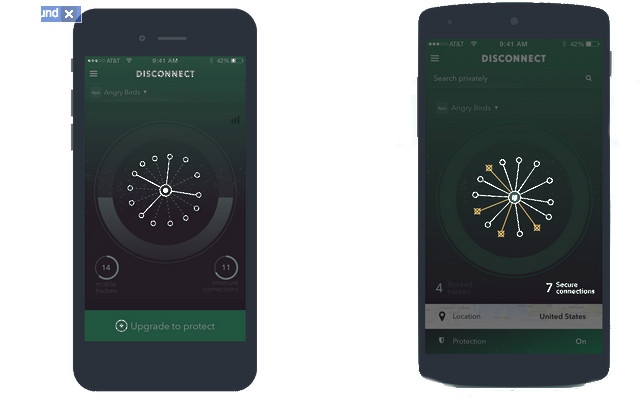
Disconnect, the public benefit corporation behind the eponymous online privacy tool and “malvertising” blocking service, released a new version of its virtual private networking and privacy protection service for iOS, Android, Windows, and Mac OS X this morning. Disconnect has offered versions of its service on these platforms in the past, but the latest edition is the first to bring an enhanced version of what the company first introduced on the privacy-oriented Blackphone to these other operating systems.
The service is available through Apple’s App Store and the company’s website (not the Google Play or Windows stores), and it adds filtering of cell provider “supercookies” and other common tracking data captured by websites and mobile applications. Disconnect has also inked a deal with Deutsche Telekom to offer its software and services as a promotional bundle to DT customers.
The new Disconnect app and service comes in free and premium versions. The free application simply provides the user with a visualized record of tracking performed by websites and mobile applications, showing what tracking cookies are used and whose cookies they are. It also shows any unsecured connections within sites using otherwise secure HTTPS connections.
firehose and -1 others like this
13 Nov 16:23
How to Enable Family Sharing in iOS 8 and OS X Yosemite [iOS Blog]
by Richard Padilla
With the release of iOS 8 and OS X Yosemite, Apple has included a new Family Sharing feature that allows multiple users to easily share content and interact with each other. Most notably, Family Sharing allows up to six family users to share purchases made from the iTunes, iBooks, or App Store. The feature also allows families to contribute to a unified photo album or calendar, share locations, use Find My iPhone to find a lost device, and set parental controls for children.
Prior to the debut of Family Sharing, a user looking to share a downloaded app with someone else would have to give out their Apple ID account information. That information would also have to be entered when updating an app, requiring users of shared apps to log out of their own Apple ID and log into the original Apple ID used to download the app. With Family Sharing, users have immediate access to each other's music, movies, TV shows, books, and apps, as content can be downloaded with a single tap.
A user needs to be running iOS 8 or higher and have a valid iCloud account in order to use Family Sharing, with OS X Yosemite required for Mac access. Prior to turning on Family Sharing, ensure that you are ready to designate yourself or another user to be the Family Organizer in the Family Sharing group. The Family Organizer will be responsible for all iTunes, iBooks, and App Store purchases made by the Family users in the group.
Also, ensure that the Family Organizer has a valid payment method linked to their iTunes account. In the desktop iTunes application on the Mac, this can be done by going to Menu Bar -> Store -> View Account. On an iOS device, this can be done by going to App Store -> Scroll to Apple ID on bottom of "Featured" tab -> Tap on Apple ID -> View Apple ID -> Payment Information. Only the Family Organizer needs to have a valid payment method attached to their iTunes account.
1. Go to Settings -> iCloud -> Set Up Family Sharing to begin setup as the Family Organizer.
2. Tap on Get Started. Ensure that the email listed on the Share Purchases screen is correct.
3. Ensure that the information listed on the "Payment Method" is correct. If it is not, change the payment method by going to App Store -> Featured tab -> Apple ID -> View Apple ID -> Payment Information.
4. Choose to share your location with your family users by tapping "Share Your Location" or decline the option by tapping "Not Now".
You have now enabled Family Sharing for the Family Organizer. To begin adding users to the Family Sharing group, follow the steps below.
1. To add a Family Member, tap on "Add Family Member" in the main menu.
2. From the Add Family Member screen, you can send an invitation to another user's iCloud account to join a group. Alternatively, you can ask another user to enter the Family Organizer's iCloud password to join a group.
3. If you have chosen to send an invitation, the invited user will see a push notification on their iOS device asking them to join a Family Sharing group. Once a user accepts the invite, they will be prompted to share their purchases and location. The user will also appear in the Family Sharing main menu.

4. By default, users invited to Family Sharing will be recognized as adults and will not need permission to purchase content. However, the Family Organizer can also create an Apple ID for a child by tapping the highlighted option at the bottom of the Family Sharing menu.
5. Creating an Apple ID for a child will ask the Family Organizer to input a birthday and accept a Parent Privacy Disclosure. The Family Organizer will also be required to input the security code for the primary card being used.
6. Next, the Family Organizer will be able to enter a name and create an email address, password and security questions as seen in a typical iCloud setup process.
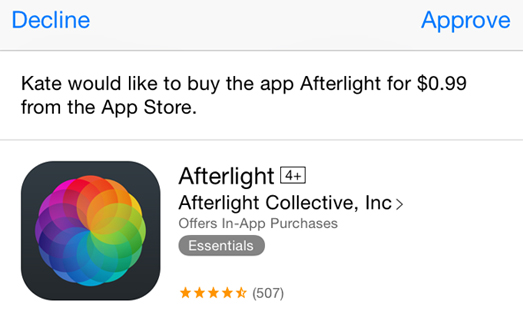
7. Afterward, the Family Organizer will be able to turn on Ask to Buy. Ask to Buy allows a child user to send a purchase request for an app, song or book to the Family Organizer, who can then approve or deny the request. The Family Organizer can also choose whether to share the location of the child's device. Once setup is completed, the child user will appear in the Family Sharing menu.
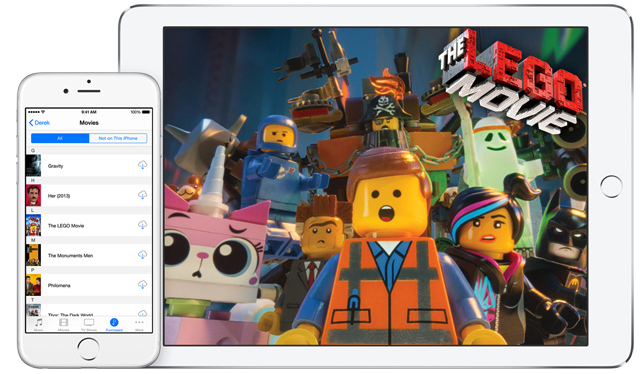
Family members can access each other's apps, books, songs, movies, and TV shows and download content to their own devices. To download a family member's shared content, users can head to the Purchased tab in the iTunes Store app, the iBooks app, or the App Store app. From there, users can select a family member and view a list of purchased content that is available for download. To hide a purchase, go into the Purchased tab, swipe the content you want to hide to the left, and select "Hide".
Apple notes that there are certain types of content that cannot be downloaded by other users in a Family Sharing group. Non-shareable content includes songs added to iTunes Match from outside of the iTunes Store, in-app purchases, items that are no longer available on the iTunes Store, and apps that are marked as non-shareable in their App Store descriptions.

In addition to allowing purchased content to be shared, Family Sharing allows multiple users to contribute to a single calendar or photo album. To add to the calendar, family members can go to the Calendar app and select "Family Calendar" in the list of options before creating an event. The Family Organizer can also view and edit the calendar permissions of each family member by selecting "Calendars" and tapping the "I" symbol next to the Family Calendar.
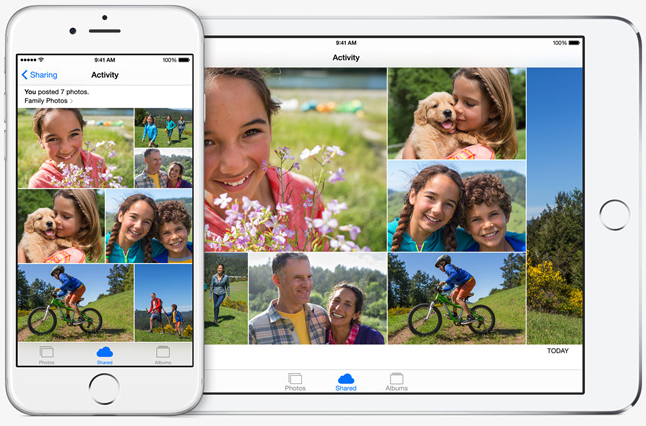
To enable shared photo album functionality, all family members must have iCloud Photo Sharing turned on in Settings -> iCloud -> Photos -> iCloud Photo Sharing. Once that setting is enabled, the Family photo album can be viewed in Photos -> Shared -> Sharing -> Family. A user can add photos to the shared album by tapping the + sign in the upper right corner, and all family members receive a push notification when a new image is added.
Users in a Family Sharing group can also keep track of each other's locations through the Find My Friends or Messages app. The Find My Friends app will display the location of all family members on a map and give details on their current city and distance.
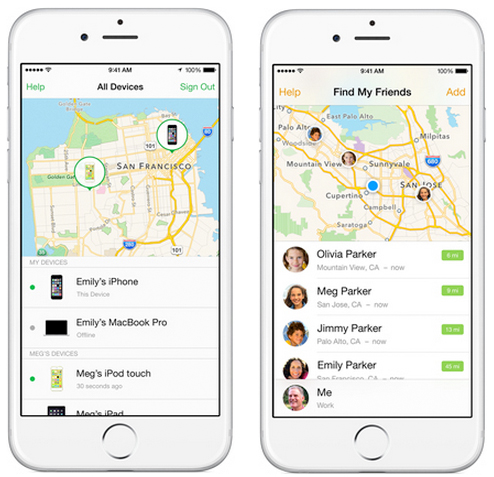
Similarly, if a family member's Mac, iPhone, iPad, or iPod touch is lost and needs to be tracked down, other users in the group can see the whereabouts of each device in the Find My iPhone app. Once a device is selected, users can choose to play a loud sound on the device, enable Lost Mode to lock the device, or choose to erase the entire device.
While the ability for a Family Sharing group to track down a lost device with the Find My iPhone app is useful, there are a few issues to be aware of. For example, any user in the Family Sharing group, including child users, can choose to lock a device with their own passcode or erase a device entirely without needing permission from other users. Any user can also choose to play a loud sound on a selected device which cannot be automatically silenced even with the "Do Not Disturb" feature turned on.
Though all three options are useful in the event of a device becoming lost, each could also be turned on accidentally, resulting in lost data or unexpected disturbances. Because of these potential oversights, it is recommended that you ensure that each member of your Family Sharing group uses the Find My iPhone app responsibly.
Another factor worth considering is that all Family Sharing members must use a single credit card or debit card for all App Store purchases, which is controlled by the Family Organizer. If App Store credit is applied to the account of a Family Sharing member, the credit will be used before the Family Organizer is billed for a purchase.
It's also worth noting that in order to secure an Apple ID for a child, the parent or Family Organizer must have a credit card on file in order to verify that the person creating the child's Apple ID is an adult. Apple will not accept a debit card.
Since its debut with iOS 8, a number of users have had issues with Family Sharing and shared app purchases. Most problems have centered around a message stating "Redownload Unavailable with This Apple ID" when trying to download apps or other content. Members on Apple's Support Communities and CNET's Jason Cipriani have reported that logging out and back into iCloud has fixed the problem.
Other users have also found out that the designated Family Organizer needs to have the same Apple ID logged into iCloud and the App Store for purchases to be shared. Also, keep in mind that not all apps support Family Sharing, and specify whether they do in their App Store description. If users are unable to download shared purchases, it is also important to ensure that the payment method on the Family Organizer's account is up to date by going to App Store -> Featured tab -> Apple ID -> View Apple ID -> Payment Information.


Prior to the debut of Family Sharing, a user looking to share a downloaded app with someone else would have to give out their Apple ID account information. That information would also have to be entered when updating an app, requiring users of shared apps to log out of their own Apple ID and log into the original Apple ID used to download the app. With Family Sharing, users have immediate access to each other's music, movies, TV shows, books, and apps, as content can be downloaded with a single tap.
Before You Start
A user needs to be running iOS 8 or higher and have a valid iCloud account in order to use Family Sharing, with OS X Yosemite required for Mac access. Prior to turning on Family Sharing, ensure that you are ready to designate yourself or another user to be the Family Organizer in the Family Sharing group. The Family Organizer will be responsible for all iTunes, iBooks, and App Store purchases made by the Family users in the group.
Also, ensure that the Family Organizer has a valid payment method linked to their iTunes account. In the desktop iTunes application on the Mac, this can be done by going to Menu Bar -> Store -> View Account. On an iOS device, this can be done by going to App Store -> Scroll to Apple ID on bottom of "Featured" tab -> Tap on Apple ID -> View Apple ID -> Payment Information. Only the Family Organizer needs to have a valid payment method attached to their iTunes account.
Steps to Enable Family Sharing
1. Go to Settings -> iCloud -> Set Up Family Sharing to begin setup as the Family Organizer.
2. Tap on Get Started. Ensure that the email listed on the Share Purchases screen is correct.
3. Ensure that the information listed on the "Payment Method" is correct. If it is not, change the payment method by going to App Store -> Featured tab -> Apple ID -> View Apple ID -> Payment Information.
4. Choose to share your location with your family users by tapping "Share Your Location" or decline the option by tapping "Not Now".
You have now enabled Family Sharing for the Family Organizer. To begin adding users to the Family Sharing group, follow the steps below.
Steps to Add Family Members
1. To add a Family Member, tap on "Add Family Member" in the main menu.
2. From the Add Family Member screen, you can send an invitation to another user's iCloud account to join a group. Alternatively, you can ask another user to enter the Family Organizer's iCloud password to join a group.
3. If you have chosen to send an invitation, the invited user will see a push notification on their iOS device asking them to join a Family Sharing group. Once a user accepts the invite, they will be prompted to share their purchases and location. The user will also appear in the Family Sharing main menu.
4. By default, users invited to Family Sharing will be recognized as adults and will not need permission to purchase content. However, the Family Organizer can also create an Apple ID for a child by tapping the highlighted option at the bottom of the Family Sharing menu.
5. Creating an Apple ID for a child will ask the Family Organizer to input a birthday and accept a Parent Privacy Disclosure. The Family Organizer will also be required to input the security code for the primary card being used.
6. Next, the Family Organizer will be able to enter a name and create an email address, password and security questions as seen in a typical iCloud setup process.
7. Afterward, the Family Organizer will be able to turn on Ask to Buy. Ask to Buy allows a child user to send a purchase request for an app, song or book to the Family Organizer, who can then approve or deny the request. The Family Organizer can also choose whether to share the location of the child's device. Once setup is completed, the child user will appear in the Family Sharing menu.
Sharing Purchased Content
Family members can access each other's apps, books, songs, movies, and TV shows and download content to their own devices. To download a family member's shared content, users can head to the Purchased tab in the iTunes Store app, the iBooks app, or the App Store app. From there, users can select a family member and view a list of purchased content that is available for download. To hide a purchase, go into the Purchased tab, swipe the content you want to hide to the left, and select "Hide".
Apple notes that there are certain types of content that cannot be downloaded by other users in a Family Sharing group. Non-shareable content includes songs added to iTunes Match from outside of the iTunes Store, in-app purchases, items that are no longer available on the iTunes Store, and apps that are marked as non-shareable in their App Store descriptions.
Family Calendars and Photo Albums
In addition to allowing purchased content to be shared, Family Sharing allows multiple users to contribute to a single calendar or photo album. To add to the calendar, family members can go to the Calendar app and select "Family Calendar" in the list of options before creating an event. The Family Organizer can also view and edit the calendar permissions of each family member by selecting "Calendars" and tapping the "I" symbol next to the Family Calendar.
To enable shared photo album functionality, all family members must have iCloud Photo Sharing turned on in Settings -> iCloud -> Photos -> iCloud Photo Sharing. Once that setting is enabled, the Family photo album can be viewed in Photos -> Shared -> Sharing -> Family. A user can add photos to the shared album by tapping the + sign in the upper right corner, and all family members receive a push notification when a new image is added.
Sharing Locations and Find My iPhone
Users in a Family Sharing group can also keep track of each other's locations through the Find My Friends or Messages app. The Find My Friends app will display the location of all family members on a map and give details on their current city and distance.
Similarly, if a family member's Mac, iPhone, iPad, or iPod touch is lost and needs to be tracked down, other users in the group can see the whereabouts of each device in the Find My iPhone app. Once a device is selected, users can choose to play a loud sound on the device, enable Lost Mode to lock the device, or choose to erase the entire device.
Things to Be Aware of
While the ability for a Family Sharing group to track down a lost device with the Find My iPhone app is useful, there are a few issues to be aware of. For example, any user in the Family Sharing group, including child users, can choose to lock a device with their own passcode or erase a device entirely without needing permission from other users. Any user can also choose to play a loud sound on a selected device which cannot be automatically silenced even with the "Do Not Disturb" feature turned on.
Though all three options are useful in the event of a device becoming lost, each could also be turned on accidentally, resulting in lost data or unexpected disturbances. Because of these potential oversights, it is recommended that you ensure that each member of your Family Sharing group uses the Find My iPhone app responsibly.
Another factor worth considering is that all Family Sharing members must use a single credit card or debit card for all App Store purchases, which is controlled by the Family Organizer. If App Store credit is applied to the account of a Family Sharing member, the credit will be used before the Family Organizer is billed for a purchase.
It's also worth noting that in order to secure an Apple ID for a child, the parent or Family Organizer must have a credit card on file in order to verify that the person creating the child's Apple ID is an adult. Apple will not accept a debit card.
Troubleshooting
Since its debut with iOS 8, a number of users have had issues with Family Sharing and shared app purchases. Most problems have centered around a message stating "Redownload Unavailable with This Apple ID" when trying to download apps or other content. Members on Apple's Support Communities and CNET's Jason Cipriani have reported that logging out and back into iCloud has fixed the problem.
Other users have also found out that the designated Family Organizer needs to have the same Apple ID logged into iCloud and the App Store for purchases to be shared. Also, keep in mind that not all apps support Family Sharing, and specify whether they do in their App Store description. If users are unable to download shared purchases, it is also important to ensure that the payment method on the Family Organizer's account is up to date by going to App Store -> Featured tab -> Apple ID -> View Apple ID -> Payment Information.
13 Nov 16:23
12.9-Inch 'iPad Pro' Production Rumored for Q2 2015 Amid Manufacturing Difficulties
by Juli Clover
Apple's 12.9-inch "iPad Pro" may not enter mass production until the second quarter of 2015, according to new predictions from often-reliable KGI Securities analyst Ming-Chi Kuo. He believes that the iPad Pro will use an oxide panel to achieve a "high resolution, quick response, and high color saturation," and that the time needed for component yield and assembly to improve will push back production until 2Q 2015.
Earlier this year, a report from Bloomberg suggested the iPad Pro might be released in early 2015, but an October report from The Wall Street Journal indicated Apple had delayed its planned December mass production of the tablet in order to focus its attention on producing more iPhone 6 Plus units, leaving a potential iPad Pro release date up in the air.
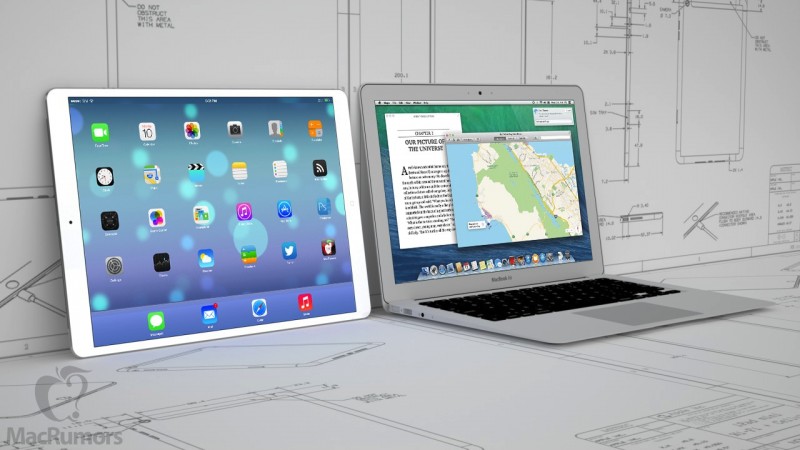 Mockup of 12.9-inch iPad Pro next to 13-inch MacBook Air
Little is known about the iPad Pro aside from its 12.2 to 12.9-inch display size, which dwarfs the smaller 9.7-inch iPad Air 2 and the 7.9-inch iPad mini 3. Rumors have also suggested that it will offer the same A8X processor introduced with the iPad Air 2 along with an ultra high resolution display and a 7mm-thick form factor that's similar to existing iPads.
Kuo's report also focuses on forecasting iPad shipments, which he believes will fall 54.5 percent quarter over quarter to just 9.8 million units during the first calendar quarter of 2015. He points towards the lack of new applications and a saturation of the tablet market as the basis for his prediction.
According to Apple CEO Tim Cook, the drop in iPad sales is just a "speed bump" that the company will overcome. He told investors earlier this year that "significant innovation can be brought to the iPad," and suggested Apple was working on such improvements. The upcoming 12.9-inch iPad Pro may be Apple's first step towards bolstering its iPad lineup, and the company is also said to be working on new iPad features, like split-screen multitasking.


Earlier this year, a report from Bloomberg suggested the iPad Pro might be released in early 2015, but an October report from The Wall Street Journal indicated Apple had delayed its planned December mass production of the tablet in order to focus its attention on producing more iPhone 6 Plus units, leaving a potential iPad Pro release date up in the air.
Mockup of 12.9-inch iPad Pro next to 13-inch MacBook Air Little is known about the iPad Pro aside from its 12.2 to 12.9-inch display size, which dwarfs the smaller 9.7-inch iPad Air 2 and the 7.9-inch iPad mini 3. Rumors have also suggested that it will offer the same A8X processor introduced with the iPad Air 2 along with an ultra high resolution display and a 7mm-thick form factor that's similar to existing iPads.
Kuo's report also focuses on forecasting iPad shipments, which he believes will fall 54.5 percent quarter over quarter to just 9.8 million units during the first calendar quarter of 2015. He points towards the lack of new applications and a saturation of the tablet market as the basis for his prediction.
We believe that, in a major shift, while Apple (US) used to be able to use new form factor designs to boost demand, it has failed to do so this time around. The lighter and thinner iPad Air 2 will face strong headwinds in increasing sales in 1Q15, we believe; we also hold that this means that iPad, along with the entire tablet market, is faced with structural challenges characterized by a lack of new applications and market saturation. We don't think these challenges will be easily overcome by upgraded specs, new form factor designs or lower prices.Kuo's estimate is rather low, considering Apple sold 16.35 million million iPads during the first calendar quarter of 2014, but iPad sales have been down for the past three quarters in a row. During the fourth fiscal quarter of 2014, Apple sold 12.3 million iPads, down from 14.1 million units in 2013.
According to Apple CEO Tim Cook, the drop in iPad sales is just a "speed bump" that the company will overcome. He told investors earlier this year that "significant innovation can be brought to the iPad," and suggested Apple was working on such improvements. The upcoming 12.9-inch iPad Pro may be Apple's first step towards bolstering its iPad lineup, and the company is also said to be working on new iPad features, like split-screen multitasking.


13 Nov 15:06


You can’t say a judge is not God in Brazil (according to judges themselves)
by Mauricio Savarese
“Do you know who you are talking to?” That is one of the most common statements one can hear from a Brazilian authority that is caught red-handed. An ongoing case shows how bizarre that can be. Traffic officer Luciana Tamborini was fined in about US$ 2,000 because she stopped a man that had no documents at all and whose car wasn’t bearing any plates. When the offender told the agent that he was judge José Carlos Paes, she replied: “a judge is not God.” So he held her for exceeding her powers and for contempt of court. The decision was confirmed by three other judges of Rio’s Court. The officer will appeal.
What is most interesting about this case is that for the first time in a while there was a revolt against Brazil’s baroque and shadowy Judiciary. Thanks to lawyer Flávia Penido, about US$ 8,000 were raised to pay the allegedly heavy damages suffered by poor judge Paes. Although many judges insist there is no mistake in the decision against the traffic officer who denied them Godly powers, even members of the highest court in the nation noticed the gap between them and average Brazilians was widening because of that case. So some of them came out with a very bold thesis: judges are like everyone else.
No doubt Brazil’s Supreme Court is very open if compared to international peers. We see their trials on TV and that has even sparked accusations of exhibitionism of some Justices. But the lower branches are poorly covered by the press, face little interference from their ombudsmen and even less from Brazil’s attorney’s bar. In those lower branches there is loads of decisions just like that one of Judge Paes — but few hit the news. Such leeway to act strongly discourages any willingness to reform, since Brazil’s endless appeal system keeps judges, law firms and authorities happy enough.
Another sign Brazil’s Judiciary truly believes they can be God is how little they care about budgets and excessive spending. Every Justice in the Supreme Court gets the same pay of President Dilma Rousseff: about US$ 10,000 a month. In the lower courts, bonuses, allowances and extras are so intere$ting that judges sometimes make more than the head of State. Recently all key members of the Judiciary decided they would get a US$ 1,500 extra to pay for their rent. That is about 20 times the average paid to members of social program Bolsa Família, which feeds poor families despite criticism of many of those judges.
Judges that are uneasy with the system could be punished
A judge in São Paulo went on TV to admit that the housing allowance was just a way to raise their salaries, since they needed to go to Miami and buy nice suits to be fit for their job. When President Rousseff rejected the budget sent by the Judiciary a couple of years ago, Justices of the Supreme Court went on camera to cry foul: it was unacceptable interference from the Executive. Despite rejecting that intrusion, Justices are usually glad in reinterpreting the Constitution to bypass Congress in matters that are allegedly in grey areas. No wonder it is so difficult for these guys to believe they are not a deity. Brazil allows them to.
Damiani.guilherme, Tadeu and one other like this

13 Nov 10:28


The Big Idea: Cixin Liu
by John Scalzi
Albener Pessoavia Firehose

The name Cixin Liu is largely unfamiliar to English-speaking science fiction readers, but to Chinese science fiction fans, he’s a superstar of the genre, amassing the sort of award tally and name recognition — and sales! — that would be the envy of any writer in the world. Now for the first time his novel The Three-Body Problem is available in English, translated by Ken Liu, himself a multiple award winner in the genre. With the help of Ken, Liu is here now to tell you his acclaimed work, and how it cuts against the grain for Chinese science fiction.
CIXIN LIU:
As a longtime scifi fan—I’m probably among China’s first generation of scifi enthusiasts—I’ve always believed in the existence of a large number of intelligent species and civilizations in the universe. If some of these civilizations discovered each other and could communicate with each other, they would form a cosmic society of civilizations. I’ve always wondered about the form of such a cosmic society and the kinds of relationships between its members.
In Chinese science fiction, extraterrestrial civilizations were usually imagined as benevolent and wonderful. This set off the contrarian in me, and I decided to imagine a worst-case scenario.
The only reference point we have in the study of cosmic society is human society. There are many different civilizations on Earth itself, each with its own internal complexities and relating to each other in complicated ways. Politics, economics, culture … feed into each other in an intractable knot. It’s very difficult to come to any clear conclusions about cosmic society based on this example.
But a soccer match inspired me. It was the first big-stadium match I’d ever been to: a game between the Chinese national team and UC Sampdoria of Italy at the Beijing Workers Stadium. I had just started my job back then, and all I could afford was one of the cheap nosebleed seats all the way in the last row. From that distance, the complicated technical moves the players made on the pitch were filtered away, leaving behind only a shifting matrix of 23 dots—one of the flitting dots being the soccer ball. Even the brightest star of the match, Ruud Gullit, was just another roving spot in my eyes. I regretted not bringing binoculars with me, but I also realized that the elimination of details revealed the clear mathematical structure of the game.
This is just like the stars, I realized.
Interstellar distances hid and made inaccessible the internal complexities of each civilization. In the eyes of observers like us, extraterrestrial civilizations appear as only points of light. The complicated internal structures and forces within each civilization are reduced to a limited set of variables and parameters associated with each dot. This also revealed a clear mathematical structure for cosmic society.
I came up with a set of axioms as the foundation of this approach to cosmic sociology:
- Survival is the primary need of civilization.
- Civilization continuously grows and expands, but the total matter in the universe remains constant.
Axiom number one should be self-evident, but the second half of axiom number two has not yet been proven by cosmologists. However, as a premise for a science fiction novel, I thought it was logically sound.
I also came up with three conjectures based on the facts as we know them:
First: barriers to communication. It is very difficult for civilizations to communicate with each other and to understand each other across the universe. This is due to 1) the insurmountable time delay imposed on all communications across interstellar distances (at least based on known physical laws); and 2) the vast biological differences between the two sides in any attempt at communications. On Earth, biological organisms are classified into domains, kingdoms, phyla, classes, orders, families, genera, species—the higher you go in the hierarchy, the larger the differences between taxa in the same rank. Humans cannot communicate effectively even with animals in another genus. At the cosmic level, if one takes into account the possibility of non-carbon-based life forms, the differences between them and humans may be greater even than the differences between domains on Earth.
Second: technological explosion. It took humans about a hundred thousand years to advance from stone tools to the age of agriculture, but only two hundred years to go from the steam age to the information age. Explosive advances in technology could occur at any moment in any civilization in the universe. Thus, even a primitive civilization that appears as harmless as a baby or a sprout is full of potential danger.
Third: detection reversibility. This concept is based on the Principle of Reversibility in optics. If one civilization can detect the existence of another in the universe, sooner or later, the second civilization can also detect the existence of the first.
Based on these axioms and conjectures, one can deduce a possible shape for cosmic society, and it is indeed a worst-case scenario, which sits at the foundation of my Three-Body series. The details of the deduction process is set out in the second book in the series, The Dark Forest, and as the title hints, the universe is a dark place where only one kind of relationship is possible between different worlds: as soon as one civilization has detected another, it must do all it can to destroy it. This has nothing to do with the moral conditions of the civilizations involved—as long as one accepts the two axioms, all civilizations must behave in this manner. Chinese readers dubbed this conclusion “The Dark Forest Hypothesis.”
This is also an answer for the Fermi Paradox, a very dark answer. If any civilization exposed itself in the universe, it would soon be destroyed. This is why the universe is so silent.
Of course, this is just a possibility explored in fiction. Faced with the eerie silence of the universe, right now we have no way to prove or disprove this hypothesis.
There is something to the old saw about science fiction being the literature of possibilities. It presents various possibilities for the reader, and sometimes the possibilities that exert the most attraction are also the least likely. But in this wondrous universe, anything that seems impossible also has the potential to be reality. As G.R. Burbidge once said, “If stars did not exist, it would be easy to prove that this is what we expect.”
At the very least, it would be irresponsible to not consider the worst of all possible worlds as one possibility for the reality of our universe.
—-
The Three-Body Problem: Amazon|Barnes & Noble|Indiebound|Powell’s
Read an excerpt. Visit Tor.com’s collection of material on the book, including commentary and further excerpts. Translator Ken Liu’s Twitter feed is here.
Sbkr.sbkr.sbkr, Luke.stirling and one other like this
13 Nov 00:54

Gargamel, the early days. Have fun and keep rocking #Halloween...
Gargamel, the early days.
Have fun and keep rocking #Halloween #9gag 😈