É normal: aos pouquinhos começam a aparecer os updates para o Android 5.0 Lollipop em diversos dispositivos, mas é evidente que o Google segura os momentos iniciais e privilegia seus próprios aparelhos num primeiro momento. Em primeiro lugar foi a linha Nexus, que começou a ser atualizada pouco tempo depois da chegada do novo SO. A sequência óbvia seria a linha Moto, já que os aparelhos da Motorola até o presente momento foram desenvolvidos sob o guarda-chuva de Mountain View, e possuem experiência de uso próxima do Android puro.
Só que as atualizações já estão rolando pontualmente lá fora e aqui nada, até agora: a Motorola Brasil oficializou que nas próximas semanas todos os dispositivos receberão pirulitos de presente.
O anúncio foi feito na página oficial da Motorola, onde a companhia norte-americana atenta para os futuros updates. Todos os aparelhos vendidos no Brasil foram contemplados: Moto E, Moto G, Moto G 4G, Novo Moto G, Moto X, Novo Moto X e Moto Maxx. O primeiro a ser beneficiado é sem muita surpresa o Moto X de 2ª geração, que é o carro-chefe da linha Moto.
As atualizações serão disponibilizadas via OTA e basca checar em seus aparelhos se eles já são elegíveis. Como é de praxe isso vale para smartphones desbloqueados; aqueles que adquiriram seus gadgets junto a operadoras terão que esperar um pouco mais, mas a Motorola avisa que mesmo eles receberão os updates em breve.
De qualquer forma é bom ficar esperto: se o update ainda não saiu para você, é bom esperar mais um pouquinho já que a Motorola não definiu datas para cada modelo. E é bom lembrar, a lista de devices elegíveis para o Android 5.0 Lollipop irá aumentar com o tempo.
Eu tenho uma máquina de escrever em casa. Meu pai me deu uma Olivetti College quando eu tinha uns 11 anos, na esperança de que eu pudesse aprender a datilografar por conta própria. Numa época em que cursos de informática já estavam suplantando as escolinhas de datilografia, desnecessário dizer que em poucos anos ela foi encostada, porém eu a guardo muito bem e está praticamente impecável.
Embora máquinas de escrever tenham lá seu charme, elas pertencem a um tempo que passou, não possuem mais lugar no mundo de hoje. Claro, a não ser para os hipsters que acham um PC muito mainstream, mas mesmo eles reconhecem que depender de papel e Liquid Paper é um saco. E talvez para eles a Hemingwrite seja uma opção interessante, embora eu continue de nariz torcido.
Adam Leeb e Patrick Paul desenvolveram um gadget no mínimo curioso: uma máquina de escrever com teclado mecânico e uma tela e-ink, o que a startup clama ser “a ferramenta ideal para evitar distrações quando se está escrevendo”. Os componentes são ditos como os melhores possíveis a fim de proporcionar ao escritor uma experiência agradável ao redigir seus textos, e tão somente isso que ele poderá fazer.
A Hemingwrite pode ser carregada via USB e os arquivos podem ou ser baixados para o computador, ou automaticamente sincronizados com a nuvem (Dropbox, Google Drive, Evernote). A máquina permite editar três textos simultaneamente e sempre voltará para o ponto onde você parou.
Se você acha que é uma boa, US$ 399 garantem uma Hemingwrite para você, cuja previsão de lançamento é para setembro de 2015. Eu particularmente não acho uma boa ideia, se eu já tenho uma ferramenta onde eu posso fazer tudo ao mesmo tempo agora, por que eu daria um passo atrás com uma máquina escrever cujo diferencial é trocar o papel por e-ink?
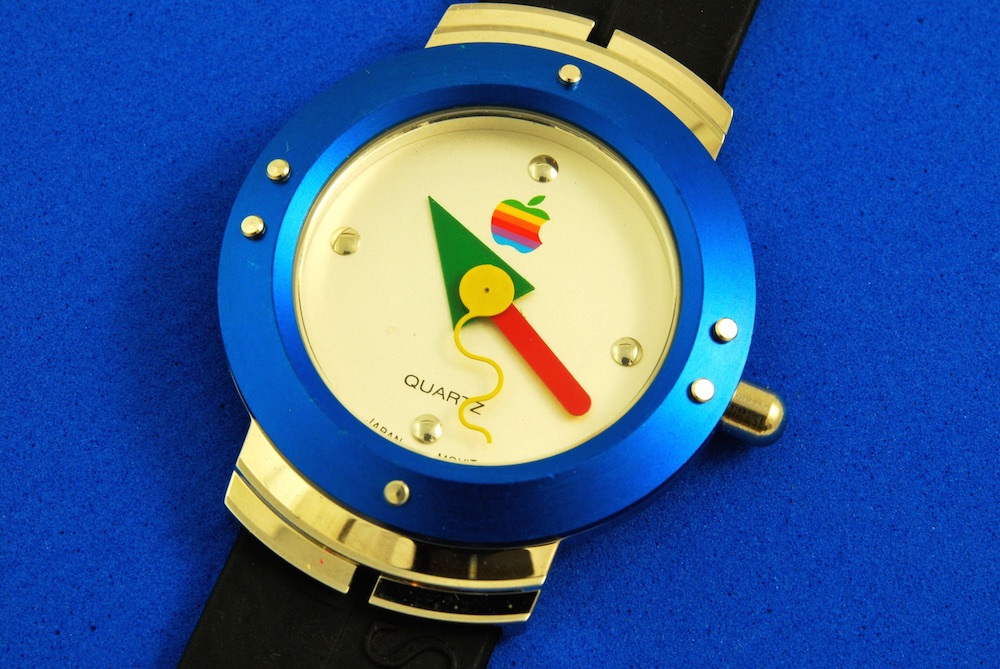
While customers are looking forward to the launch of the Apple Watch early next year, there have been several other Apple-branded watches over the years typically offered as promotional items, and one of those items from nearly 20 years ago is making a comeback.
A limited number of these Apple watches from 1995 were kept by a distributor and have now been made available for sale, priced from $99-$129 depending on condition, and all watches come with a new battery. While they lack any advanced features, the watches with their quirky design may be of interest to some collectors.
The 1995 Apple-branded watch was originally offered as a promotional item to encourage users to upgrade their Macs to System 7.5. In an offer running from May through July of 1995, users purchasing System 7.5 could receive an Apple watch or a copy of third-party extensions and control panel manager Conflict Catcher 3 as a free gift. System 7.5 had debuted in September 1994 and with bug fixes served as the Mac operating system until the release of Mac OS 7.6 in early 1997.
Two decades later, the watches are back with limited launch-week pricing through the weekend starting at $99 for units with minor blemishes and ranging up to $129 for those considered "flawless". The launch-week promo includes free shipping in the U.S. with delivery by Christmas, and discounted shipping internationally.
Update: Stock of the "flawless" units appears to be quickly running low, with pricing now at $199.
Papers Please launched last year to both critical and commercial
success, and placed you in the role of a border inspector working
for a totalitarian regime. The demands on exactly what is required
for entry into your country grow over the course of the game,
until you implement a full body scanner to check for explosives
and contraband.
It’s this scanner that Apple has deemed to be “pornographic
content,” according to Lucas Pope, the games developer.
So here’s an App Store rejection that many disagree with, but which is easy to understand from Apple’s perspective. Apple tends to err on the side of running the App Store with Disney-esque family values. The company places inordinate value in its family-friendly reputation.
But:
Pornography usually involves nudity, but nudity is frequently not pornographic. Pornography is famously difficult to define, but I think one aspect almost everyone would agree with is that pornography is intended to create sexual arousal. I haven’t played Papers Please, but by all accounts, it’s a serious game attempting to create a dystopian police state. The nudity seems to be oppressive and invasive, not pornographic.
This case highlights the way Apple holds games (and apps in general) to a different standard than other iTunes content. Movies, music, and books are not held to the same PG-13-ish standards that apps are. I can buy A Clockwork Orange from iTunes, but if I made a game that showed the exact same things that are depicted in that film, it’d have little chance of being approved. Conversely, an R-rated movie version of Papers Please could depict this scene without a hitch when it comes to iTunes.
Update, 13 December:Developer Lucas Pope says Apple has asked him to resubmit the app with the nudity intact.
Suffragette City: Propaganda posters reveal the horrors of women’s rights!
A lotta guys would pay good money for that.
The panic surrounding women’s suffrage managed to exacerbate masculine anxieties to such a perverse degree that you have to wonder just how terrified of women men actually were. They seemed to believe that all it took to upset the apple cart was access to bourgeois politics, then, we’d wreak havoc! Soon enough, reactionaries predicted, womenkind would be enslaving their husbands, abandoning their children and domestic duties, assaulting men on the street, invading political institutions and… wearing pants! Clearly, this made for amazing propaganda.
More insidious than the fear of masculine ladies and feminized men is a single depiction of a huger-striking suffragette being force-fed. There is a gleeful look in the eyes of the posh man pouring soup down her throat, and a menacing one in the eyes of the cop holding down her legs. Force-feeding is a torture that was administered to suffragettes like Alice Paul, much to the glee of misogynistic sadists. One would hope that such a barbaric practice would be abandoned by now—especially considering how ineffective torture actually is—but it appears the US remains reluctant to give up on the tradition.
Timothy Taylor has a superb blog post on that topic, here is one choice passage out of many:
A final example looks at mental models that development experts have of the poor. What do development experts think that the poor believe, and how does it compare to what the poor actually believe? For example, development experts were asked if they thought individuals in low-income countries would agree with the statement: “What happens to me in the future mostly depends on me.” The development experts thought that maybe 20% of the poorest third would agree with this statement, but about 80% actually did. In fact, the share of those agreeing with the statement in the bottom third of the income distribution was much the same as for the upper two-thirds–and higher than the answer the development experts gave for themselves!
I loved this book, which is written by a neurosurgeon with a knowledge of behavioral economics (he even has designed a talk “All My Worst Mistakes,” based on Daniel Kahneman’s work). The subtitle is Stories of Life, Death, and Brain Surgery and the author is Henry Marsh. Here is one bit:
…as the brain has the consistency of jelly a sucker is the brain surgeon’s principal tool.
Here is another:
All that really matters is that I am as sure as I can be that the decision to operate is correct and that no other surgeon can do the operation any better than I can. This is not as much of a problem for me now that I have been operating on brain tumours for many years, but it can be a moral dilemma for a younger surgeon. If they do not take on difficult cases, how will they ever get any better? But what if they have a colleague who is more experienced?
And another:
Few anaesthetists believe what surgeons tell them.
How about this one?:
‘There are operations where one really doesn’t know what’s going to happen,’ I muttered to Mike.
Did you know by creating an account you can favorite comics and shorts, automatically bookmark the last one you saw, and more? Learn more about it here!
Did you know by creating an account you can favorite comics and shorts, automatically bookmark the last one you saw, and more? Learn more about it here!
A população mineira sofre mais de depressão do que o restante do Brasil. Esse dado foi revelado pela Pesquisa Nacional de Saúde (PNS), divulgado ontem pelo Ministério da Saúde. Enquanto a média brasileira é de 7,6%, em Minas, o número é de 11,1%. A pesquisa foi feita entre agosto de 2013 e fevereiro de 2014, e 63 mil pessoas foram entrevistadas.
A advogada Izabella, 29, está nas estatísticas de depressão. Ela foi diagnosticada há cerca de quatro meses e, desde então, está em tratamento. “Meu ex-namorado começou a ‘ficar’ com uma menina, e ela me mandava mensagens o tempo todo. Isso foi a gota d’água para vir à tona um problema que, depois, eu descobri que já tinha havia muito tempo”, conta. Ela diz que começou a ter vários sintomas: além de uma tristeza profunda, ela não sentia vontade de fazer nada, não queria sair de casa, chorava muito e se sentia irritada com muita frequência.
De acordo com o psiquiatra Maurício Lobo de Rezende, presidente da Associação Mineira de Psiquiatria, esses sintomas são o que diferencia a depressão de quadros de tristeza. “Para se diagnosticar a depressão, é preciso que haja irritabilidade, intolerância, nervosismo, desânimo, cansaço, perda da capacidade de sentir prazer, dores pelo corpo e, algumas vezes, tonteiras, insônia, esquecimento. A tristeza é um dos sintomas da depressão e, em alguns casos, ela pode nem estar presente”, explica.
A frequente confusão entre depressão e tristeza, aliás, é como Rezende explica os números da doença em Minas. “Em se tratando de depressão, entrevistas com respostas espontâneas dos participantes podem registrar sentimentos de tristeza como depressão. Isso pode causar confusão nos dados”, afirma ele, observando que os dados epidemiológicos do país apontam que a incidência de depressão, na verdade, costuma girar em torno de 20%.
Outras doenças. A PNS revelou também que 24% dos mineiros sofrem de hipertensão, contra 21,4% da média brasileira. Quando se trata de colesterol alto, o Estado tem 14,8% de casos – quando o Brasil tem média de 12,5%. A incidência de diabetes também se mostrou levemente superior aqui: 6,4%, contra 6,2% da média Brasil. Minas só ficou atrás nos problemas de coluna, em que tivemos média de 17,6%, enquanto o Brasil tem 18,5%.
Procedimento
Coleta para exames. A pesquisa de saúde divulgada ontem é a primeira em âmbito nacional a coletar amostras de sangue e de urina da população entrevistada, o que confere mais precisão aos resultados.
21,4% afirmam ter hipertensão
Rio de Janeiro. A hipertensão, importante fator de risco para doenças cardiovasculares, atinge um em cada cinco brasileiros – 31,3 milhões de pessoas relataram ter sido diagnosticadas com pressão alta. Deste total, 14,1% foram internados por complicações provocadas pela doença.
As mulheres foram mais diagnosticadas do que os homens, 24,2% delas ante 18,3% deles. A proporção de homens e mulheres que sofre de pressão alta é maior conforme aumenta a idade – a partir dos 65 anos, a enfermidade afeta mais da metade da população.
Muita gordura
Maus Hábitos. A pesquisa revelou ainda dados sobre o estilo de vida do brasileiro. 37,2% das pessoas de 18 anos ou mais de idade consomem carne ou frango com excesso de gordura no país, sendo a maioria na região Centro-Oeste (45,7%) e a minoria do Nordeste (29,7%). Deste total, quase a metade (47,2%) dos homens ingerem gordura nesses alimentos, contra 28,3% de mulheres.
Poucas frutas
Abaixo do ideal. O percentual de pessoas com 18 anos ou mais que consumiam a porção recomendada de hortaliças e frutas chegava a 37,3% – sendo a maioria mulher (39,4%), contra 34,8% de homens. A maioria com idade de 60 anos ou mais (40,1%). Outro dado é que as pessoas com menos instrução (33%) consomem menos desses alimentos que os graduados (45,9%).
O juiz Everaldo Santana, da nonagésima quinta Vara de Família do Rio, deu voz de prisão ontem a um primo por não gostar do presente de amigo oculto. Ele ganhou meias e ficou revoltado. De acordo com testemunhas, o juiz começou a brigar com o primo assim que abriu a caixa de presente. “Você me dá esse presentinho merdinha, baratinho, feinho? Tá pensando que eu sou bobinho? Está presinho!”, teria dito o juiz, que tem o hábito de falar tudo no diminutivo.
O delegado Matheus Andrade, que registrou o caso, disse que o primo acabou sendo liberado logo em seguida. O rapaz, porém, vai ter que prestar esclarecimentos porque também é acusado de contar a piada do Pavê na festa de amigo oculto.
Hoje foi um dia especial para o motorista Fernando Gonçalves. Ele começou a procurar uma vaga num shopping do Rio em 1989 e só agora conseguiu achar. Fernando foi beneficiado por uma vaga para idosos. Como fez 65 anos procurando um lugar para estacionar, ele pôde usufruir do benefício. “Eu estava quase desistindo”, disse ele, que estacionou sob aplausos da família.
A alegria, porém, não foi completa. Fernando tinha ido ao shopping comprar um presente de Natal para o seu irmão mais velho, que morreu antes que ele conseguisse estacionar.
O Núcleo de Pesquisas da América Latina (NuPAL) quis entender como um livro com meia-dúzia de páginas e pegada infanto-juvenil conseguiu gerar três filmes de quase três horas de duração: a pesquisa foi um sucesso descobriu que o filme O Hobbit é uma mistura de Game of Thrones, Senhor dos Anéis e Titanic e inclui todas as histórias que Tolkien pensou em escrever um dia.
Segundo o adolescente Alexandre Passos, o mais recomendado é ler o livro, primeiro porque com o dinheiro da entrada do cinema dá pra comprar toda a obra do Tolkien; segundo porque o filme é tão grande que é possível ler não só O Hobbit, mas até o Senhor dos Anéis durante a exibição. Há quem diga que ainda é possível ouvir uma música inteira do Pink Floyd durante a sessão.
Os magistrados brasileiros já poderão dar carteirada com muito mais estilo. Uma das maiores griffes do mundo vai lançar uma carteira exclusiva para eles. A Louis Vuitton anunciou ontem em Paris as carteiras para juízes.
Além do símbolo da Justiça, elas serão também mais fundas para que o salário é todos os benefícios possam caber.
A marca também fará carteiras para políticos, com um compartimento secreto para guardar dólares, eliminando o uso da cueca, que deixava o dinheiro ainda mais sujo.
Around 39 million people in the world are blind, with another 256 million suffering from visual impairments. The World Health Organization estimates that about 80% of these cases could be prevented or reversed if these people had adequate access to visual care. Bringing the necessary ophthalmological equipment to poor and remote areas could soon become a lot easier with the development of Peek Retina: the Portable Eye Examination Kit. This device, currently in development by Peek Vision, connects to smartphones and will allow doctors to easily and affordably complete eye exams.
Peek Retina clips onto the camera of smartphones and allow physicians to examine the retina, using the appropriate amount of light intensity pointed at the necessary angle. Because it is combined with a camera, it produces high-quality images that can be referred to later in order to get a second opinion or to track progress if needed.
The device assists in identifying conditions like glaucoma and cataracts, allowing patients to receive treatment to slow or reverse the disease. This can also be used to identify complications of diabetes, malaria, and meningitis which can impact vision and indicate swelling of the brain. Understanding the full scope of a patient’s health can impact how doctors proceed with treatments and therapies.
Over the last two years, physicians have been testing a prototype of the device in remote locations such as Mali, Botswana, and Kenya, with encouraging results. The company predicts that health care workers could perform about 1,000 eye exams per week with this technology. In addition to using Peek Retina in remote locations, the device is also great for use in industrialized areas at prisons or nursing homes, and by non-health professionals at home.
The company is currently undergoing a crowdfunding campaign, seeking to raise £70,000 (US$110,000) to develop the tools needed to manufacture Peek Retina on a larger scale. They hope to begin distribution by October of 2015. Initially, each unit will cost about £60 (US$95), but the price will likely go down over time as more units get manufactured.
Agora é oficial: o queijo da ‘Região da Canastra’ virou marca, que foi lançada nesta quarta, em São Roque de Minas, no Centro-Oeste do Estado. Além de São Roque, a iguaria, produzida 100% artesanalmente, é tombada como Patrimônio Cultural e Imaterial Brasileiro, e certificada pelo Instituto Nacional de Propriedade Industrial (INPI) com o selo Indicação Geográfica (IG), na modalidade Indicação de Procedência (IP), que garante sua origem.
Segundo o analista do Sebrae Minas, Ricardo Boscaro, responsável pelo projeto, a marca é apenas um primeiro passo para abrir mercado para um produto genuinamente mineiro, junto a consumidores dispostos a pagar preços justos. “Os produtores já tinham os conhecimentos de higiene e produção. O que fizemos foi a organização. E há quem já tenha conseguido agregar até 100% no preço final”, conta Boscaro.
Segundo ele, o queijo que era vendido por R$ 12, hoje chega a ser comercializado de R$ 25 a R$ 30.
Ao todo, são 800 produtores distribuídos em São Roque de Minas, Bambuí, Delfinópolis, Medeiros, Piumhi, Tapiraí e Vargem Bonita. “Desses, 25 fazem parte do projeto que tem como foco trabalhar com produtos especializados em mercados específicos”, detalha.
De acordo com levantamento do Sebrae e da Associação dos Produtores de Queijo da Canastra (Aprocan), a produção diária chega a 16 mil quilos por dia. A altitude e o clima são determinantes para as características do produto.
As ações do Sebrae Minas começaram em 2013. Os produtores foram orientados sobre a importância do trabalho em grupo, o fortalecimento do associativismo, a revisão do regulamento de uso da Indicação de Procedência (IP) e a análise do mercado.
“É o desenvolvimento da região a partir do queijo, da valorização das tradições e do modo de vida da sua gente”, destaca o analista. Novas ações serão desenvolvidas a partir de 2015.
Curiosidades
Produtores
São 800, distribuídos em sete cidades mineiras. Por dia, são 16 toneladas de queijo
Processo
Consome, na sua produção, de dez a 12 litros de leite, coalho e fermento lácteo natural, tirado do próprio soro
Maturação
Uma vez pronto, o queijo entra em maturação por cerca de 22 dias
Tech Gifts The Little Kano That Could: A $150 Computer for Kids By Ashlee Vance December 04, 2014
The Little Kano That Could: A $150 Computer for Kids Photograph courtesy Kano It’s about three weeks until Christmas, and you’ve neglected the wants and aspirations of your children. Fear not. I’m here to help.
A company in London called Kano Computing has produced an intriguing device aimed at children. The product, as you might imagine, is called the Kano. It’s a computer about the size of an elf’s shoebox, and it costs $150. Like a regular computer, the Kano can get onto the Internet and play music and games. The device, however, is really intended to introduce kids to programming skills and some basics about computer software and hardware. It’s like a Computing 101 course in a fun, nifty package.
The computer arrives as a sort of DIY kit with a plastic case, orange keyboard, wireless dongle, motherboard, memory, speaker, and various cables. The first challenge with the Kano is to turn these parts into a working computer. It took my six-year-old son about 30 minutes to complete this job with minimal help from me. (My primary task was acting as the Muscle, cramming bits of plastic together when my son didn’t want to push them together too forcefully and break them. Wuss.) Along the way, my son learned what a motherboard looks like, got to fasten some wires for the speaker, and generally left the exercise with a feeling of accomplishment. Take note, parents. This is a job that can be accomplished on Christmas Day while inducing minimal trauma.
STORY: Steve Wozniak on Apple, the Computer Revolution, and Working With Steve Jobs
Photograph courtesy Kano
It’s worth issuing a major warning here. The Kano costs only $150 because it does not come with a monitor or any type of screen. You’re meant to provide that on your own. You can hook the device up to your TV with an HDMI cable, which is included, or do something similar with an old computer monitor. You can also turn an iPad into the screen for the device, but that requires a bit of familiarity with the product. So to keep the happy times going on the day, you’ll want to think through this screen issue ahead of time.
After building the computer, the fun really begins. You turn the Kano on, and it goes through a boot sequence that will be familiar to any true nerd. The machine runs a version of the Linux operating system, which means that various instructions and checks flow across the screen in a command-line interface rather than a graphical interface, such as Windows. Then, after 30 seconds or so, a graphical interface does pop up, accompanied by a short, catchy tune. It’s got a bright orange background and a handful of large, cartoonish icons.
My son naturally went right for the Minecraft icon, and he got a bit of a surprise. Instead of simply playing Minecraft, he was asked to code it. The Kano guided him through a series of programming tutorials in which he could issue commands to make buildings and other structures instantly instead of assembling them virtual stone by virtual stone. There were about 15 coding lessons, and they got progressively harder and taught fundamental concepts about variables, if/then statements, and repeating loops. My son went at this for about 90 minutes or so, until all the lessons were completed, and his enduring interest in the lessons were what really sold me on the product.
STORY: The Internet Knows What Gifts You Really Want There are similar coding lessons for Pong and other games. There are tutorials for using commands to make the computer say particular things and other CLI jobs. There are apps to download and the full Internet to explore. Along the way, your child will rack up points for accomplishing tasks and level up to do more things with the system.
The Kano product has done a remarkable job of making Linux usable by mortals. Many companies have tried and failed to produce a decent Linux desktop for adults; Kano has made something functional for kids. The software updates on its own, it detects different types of screens automatically and configures the display for them, and it has a unique look and feel aimed at youngsters. “The big challenge was that we were building around a platform traditionally aimed at hobbyists [Linux and the Raspberry Pi motherboard] and had to make this feel like a fun, fluid, mainstream consumer experience,” says Alex Klein, a co-founder of Kano.
Photograph courtesy Kano
It’s about three weeks until Christmas, and you’ve neglected the wants and aspirations of your children. Fear not. I’m here to help.
A company in London called Kano Computing has produced an intriguing device aimed at children. The product, as you might imagine, is called the Kano. It’s a computer about the size of an elf’s shoebox, and it costs $150. Like a regular computer, the Kano can get onto the Internet and play music and games. The device, however, is really intended to introduce kids to programming skills and some basics about computer software and hardware. It’s like a Computing 101 course in a fun, nifty package.
The computer arrives as a sort of DIY kit with a plastic case, orange keyboard, wireless dongle, motherboard, memory, speaker, and various cables. The first challenge with the Kano is to turn these parts into a working computer. It took my six-year-old son about 30 minutes to complete this job with minimal help from me. (My primary task was acting as the Muscle, cramming bits of plastic together when my son didn’t want to push them together too forcefully and break them. Wuss.) Along the way, my son learned what a motherboard looks like, got to fasten some wires for the speaker, and generally left the exercise with a feeling of accomplishment. Take note, parents. This is a job that can be accomplished on Christmas Day while inducing minimal trauma.
Photograph courtesy Kano
It’s worth issuing a major warning here. The Kano costs only $150 because it does not come with a monitor or any type of screen. You’re meant to provide that on your own. You can hook the device up to your TV with an HDMI cable, which is included, or do something similar with an old computer monitor. You can also turn an iPad into the screen for the device, but that requires a bit of familiarity with the product. So to keep the happy times going on the day, you’ll want to think through this screen issue ahead of time.
After building the computer, the fun really begins. You turn the Kano on, and it goes through a boot sequence that will be familiar to any true nerd. The machine runs a version of the Linux operating system, which means that various instructions and checks flow across the screen in a command-line interface rather than a graphical interface, such as Windows. Then, after 30 seconds or so, a graphical interface does pop up, accompanied by a short, catchy tune. It’s got a bright orange background and a handful of large, cartoonish icons.
My son naturally went right for the Minecraft icon, and he got a bit of a surprise. Instead of simply playing Minecraft, he was asked to code it. The Kano guided him through a series of programming tutorials in which he could issue commands to make buildings and other structures instantly instead of assembling them virtual stone by virtual stone. There were about 15 coding lessons, and they got progressively harder and taught fundamental concepts about variables, if/then statements, and repeating loops. My son went at this for about 90 minutes or so, until all the lessons were completed, and his enduring interest in the lessons were what really sold me on the product.
There are similar coding lessons for Pong and other games. There are tutorials for using commands to make the computer say particular things and other CLI jobs. There are apps to download and the full Internet to explore. Along the way, your child will rack up points for accomplishing tasks and level up to do more things with the system.
The Kano product has done a remarkable job of making Linux usable by mortals. Many companies have tried and failed to produce a decent Linux desktop for adults; Kano has made something functional for kids. The software updates on its own, it detects different types of screens automatically and configures the display for them, and it has a unique look and feel aimed at youngsters. “The big challenge was that we were building around a platform traditionally aimed at hobbyists [Linux and the Raspberry Pi motherboard] and had to make this feel like a fun, fluid, mainstream consumer experience,” says Alex Klein, a co-founder of Kano.
The other item of real note with the device is its keyboard. It’s a wireless device that talks to the computer via Bluetooth and has a large touchpad on its right side. The clever thing about this is that kids can sit back on the couch, using their TV as a display, and accomplish most tasks by gliding around the touchpad. “There would have been too much to fiddle with if we had done a keyboard and a mouse,” says Klein. The Kano team found the keyboard while tooling around Shenzhen looking for cool bits and bobs for their machine. A manufacturer there had designed a version of the keyboard originally for helping people go through presentations during corporate meetings. Kano worked with the company to shrink the device and add the Bluetooth functions.
The fact of the matter is that for $150 you’re getting a computer with limited horsepower. Kids can and will get frustrated when they click on an icon and it takes a few seconds for the computer to do anything. Kano has tried to get around this in a couple of ways. When you click on an app, the computer makes a noise to let you know that it’s on the job. Since the device runs Linux, the company has also hired people who can tune the software for top performance, and Kano has set some high scores on benchmarks. These measures don’t quite make up for the slowness, though, especially among kids used to poking at apps on tablets and smartphones and watching them spring into action.
The purpose of Kano, though, can overcome its limitations. If your child is at all into solving puzzles or creating his or her own world via something like Minecraft, he or she is likely to take to this device—at least for a while.
You’ve heard of internet celebrities getting paid to mention a product in a tweet or shoot out an Instagram with a brand in the shot. Now a hotel in Sweden is taking social media marketing to a new level by offering a free stay to anyone with a serious online following.
In the words of Stockholm’s Nordic Light Hotel, it “accepts personal social networks as currency.”
Anyone with more than 2,000 personal Facebook friends or 100,000 followers on Instagram gets a free seven-night stay at the luxury hotel, which usually costs $360/night. All you have to do is post when you make the reservations, when you check in, and when you check out, all with the requisite hotel tags. (“If the guest does not shares the posts that are necessary to take part of the discount/ free nights, the guest will be charged full price for the stay,” the hotel warns.)
The full article is here, and for the pointer I thank Bryan Lassiter, a loyal MR reader.
We live in a golden age of technological, medical, scientific and social progress. Look at our computers! Look at our phones! Twenty years ago, the internet was a creaky machine for geeks. Now we can’t imagine life without it. We are on the verge of medical breakthroughs that would have seemed like magic only half a century ago: cloned organs, stem-cell therapies to repair our very DNA. Even now, life expectancy in some rich countries is improving by five hours a day. A day! Surely immortality, or something very like it, is just around the corner.
The notion that our 21st-century world is one of accelerating advances is so dominant that it seems churlish to challenge it. Almost every week we read about ‘new hopes’ for cancer sufferers, developments in the lab that might lead to new cures, talk of a new era of space tourism and super-jets that can fly round the world in a few hours. Yet a moment’s thought tells us that this vision of unparalleled innovation can’t be right, that many of these breathless reports of progress are in fact mere hype, speculation – even fantasy.
Yet there once was an age when speculation matched reality. It spluttered to a halt more than 40 years ago. Most of what has happened since has been merely incremental improvements upon what came before. That true age of innovation – I’ll call it the Golden Quarter – ran from approximately 1945 to 1971. Just about everything that defines the modern world either came about, or had its seeds sown, during this time. The Pill. Electronics. Computers and the birth of the internet. Nuclear power. Television. Antibiotics. Space travel. Civil rights.
There is more. Feminism. Teenagers. The Green Revolution in agriculture. Decolonisation. Popular music. Mass aviation. The birth of the gay rights movement. Cheap, reliable and safe automobiles. High-speed trains. We put a man on the Moon, sent a probe to Mars, beat smallpox and discovered the double-spiral key of life. The Golden Quarter was a unique period of less than a single human generation, a time when innovation appeared to be running on a mix of dragster fuel and dilithium crystals.
Today, progress is defined almost entirely by consumer-driven, often banal improvements in information technology. The US economist Tyler Cowen, in his essay The Great Stagnation (2011), argues that, in the US at least, a technological plateau has been reached. Sure, our phones are great, but that’s not the same as being able to fly across the Atlantic in eight hours or eliminating smallpox. As the US technologist Peter Thiel once put it: ‘We wanted flying cars, we got 140 characters.’
Economists describe this extraordinary period in terms of increases in wealth. After the Second World War came a quarter-century boom; GDP-per-head in the US and Europe rocketed. New industrial powerhouses arose from the ashes of Japan. Germany experienced its Wirtschaftswunder. Even the Communist world got richer. This growth has been attributed to massive postwar government stimulus plus a happy nexus of low fuel prices, population growth and high Cold War military spending.
But alongside this was that extraordinary burst of human ingenuity and societal change. This is commented upon less often, perhaps because it is so obvious, or maybe it is seen as a simple consequence of the economics. We saw the biggest advances in science and technology: if you were a biologist, physicist or materials scientist, there was no better time to be working. But we also saw a shift in social attitudes every bit as profound. In even the most enlightened societies before 1945, attitudes to race, sexuality and women’s rights were what we would now consider antediluvian. By 1971, those old prejudices were on the back foot. Simply put, the world had changed.
Get Aeon straight to your inbox
Daily
Weekly
But surely progress today is real? Well, take a look around. Look up and the airliners you see are basically updated versions of the ones flying in the 1960s – slightly quieter Tristars with better avionics. In 1971, a regular airliner took eight hours to fly from London to New York; it still does. And in 1971, there was one airliner that could do the trip in three hours. Now, Concorde is dead. Our cars are faster, safer and use less fuel than they did in 1971, but there has been no paradigm shift.
And yes, we are living longer, but this has disappointingly little to do with any recent breakthroughs. Since 1970, the US Federal Government has spent more than $100 billion in what President Richard Nixon dubbed the ‘War on Cancer’. Far more has been spent globally, with most wealthy nations boasting well-funded cancer‑research bodies. Despite these billions of investment, this war has been a spectacular failure. In the US, the death rates for all kinds of cancer dropped by only 5 per cent in the period 1950-2005, according to the National Center for Health Statistics. Even if you strip out confounding variables such as age (more people are living long enough to get cancer) and better diagnosis, the blunt fact is that, with most kinds of cancer, your chances in 2014 are not much better than they were in 1974. In many cases, your treatment will be pretty much the same.
After the dizzying breakthroughs of the 20th century, physics seems to have ground to a halt
For the past 20 years, as a science writer, I have covered such extraordinary medical advances as gene therapy, cloned replacement organs, stem-cell therapy, life-extension technologies, the promised spin-offs from genomics and tailored medicine. None of these new treatments is yet routinely available. The paralyzed still cannot walk, the blind still cannot see. The human genome was decoded (one post-Golden Quarter triumph) nearly 15 years ago and we’re still waiting to see the benefits that, at the time, were confidently asserted to be ‘a decade away’. We still have no real idea how to treat chronic addiction or dementia. The recent history of psychiatric medicine is, according to one eminent British psychiatrist I spoke to, ‘the history of ever-better placebos’. And most recent advances in longevity have come about by the simple expedient of getting people to give up smoking, eat better, and take drugs to control blood pressure.
There has been no new Green Revolution. We still drive steel cars powered by burning petroleum spirit or, worse, diesel. There has been no new materials revolution since the Golden Quarter’s advances in plastics, semi-conductors, new alloys and composite materials. After the dizzying breakthroughs of the early- to mid-20th century, physics seems (Higgs boson aside) to have ground to a halt. String Theory is apparently our best hope of reconciling Albert Einstein with the Quantum world, but as yet, no one has any idea if it is even testable. And nobody has been to the Moon for 42 years.
Why has progress stopped? Why, for that matter, did it start when it did, in the dying embers of the Second World War?
One explanation is that the Golden Age was the simple result of economic growth and technological spinoffs from the Second World War. It is certainly true that the war sped the development of several weaponisable technologies and medical advances. The Apollo space programme probably could not have happened when it did without the aerospace engineer Wernher Von Braun and the V-2 ballistic missile. But penicillin, the jet engine and even the nuclear bomb were on the drawing board before the first shots were fired. They would have happened anyway.
Conflict spurs innovation, and the Cold War played its part – we would never have got to the Moon without it. But someone has to pay for everything. The economic boom came to an end in the 1970s with the collapse of the 1944 Bretton Woods trading agreements and the oil shocks. So did the great age of innovation. Case closed, you might say.
And yet, something doesn’t quite fit. The 1970s recession was temporary: we came out of it soon enough. What’s more, in terms of Gross World Product, the world is between two and three times richer now than it was then. There is more than enough money for a new Apollo, a new Concorde and a new Green Revolution. So if rapid economic growth drove innovation in the 1950s and ’60s, why has it not done so since?
In The Great Stagnation, Cowen argues that progress ground to a halt because the ‘low-hanging fruit’ had been plucked off. These fruits include the cultivation of unused land, mass education, and the capitalisation by technologists of the scientific breakthroughs made in the 19th century. It is possible that the advances we saw in the period 1945-1970 were similarly quick wins, and that further progress is much harder. Going from the prop-airliners of the 1930s to the jets of the 1960s was, perhaps, just easier than going from today’s aircraft to something much better.
But history suggests that this explanation is fanciful. During periods of technological and scientific expansion, it has often seemed that a plateau has been reached, only for a new discovery to shatter old paradigms completely. The most famous example was when, in 1900, Lord Kelvin declared physics to be more or less over, just a few years before Einstein proved him comprehensively wrong. As late as the turn of the 20th century, it was still unclear how powered, heavier-than-air aircraft would develop, with several competing theories left floundering in the wake of the Wright brothers’ triumph (which no one saw coming).
Lack of money, then, is not the reason that innovation has stalled. What we do with our money might be, however. Capitalism was once the great engine of progress. It was capitalism in the 18th and 19th centuries that built roads and railways, steam engines and telegraphs (another golden era). Capital drove the industrial revolution.
Now, wealth is concentrated in the hands of a tiny elite. A report by Credit Suisse this October found that the richest 1 per cent of humans own half the world’s assets. That has consequences. Firstly, there is a lot more for the hyper-rich to spend their money on today than there was in the golden age of philanthropy in the 19th century. The superyachts, fast cars, private jets and other gewgaws of Planet Rich simply did not exist when people such as Andrew Carnegie walked the earth and, though they are no doubt nice to have, these fripperies don’t much advance the frontiers of knowledge. Furthermore, as the French economist Thomas Piketty pointed out in Capital (2014), money now begets money more than at any time in recent history. When wealth accumulates so spectacularly by doing nothing, there is less impetus to invest in genuine innovation.
the new ideal is to render your own products obsolete as fast as possible
During the Golden Quarter, inequality in the world’s economic powerhouses was, remarkably, declining. In the UK, that trend levelled off a few years later, to reach a historic low point in 1977. Is it possible that there could be some relationship between equality and innovation? Here’s a sketch of how that might work.
As success comes to be defined by the amount of money one can generate in the very short term, progress is in turn defined not by making things better, but by rendering them obsolete as rapidly as possible so that the next iteration of phones, cars or operating systems can be sold to a willing market.
In particular, when share prices are almost entirely dependent on growth (as opposed to market share or profit), built-in obsolescence becomes an important driver of ‘innovation’. Half a century ago, makers of telephones, TVs and cars prospered by building products that their buyers knew (or at least believed) would last for many years. No one sells a smartphone on that basis today; the new ideal is to render your own products obsolete as fast as possible. Thus the purpose of the iPhone 6 is not to be better than the iPhone 5, but to make aspirational people buy a new iPhone (and feel better for doing so). In a very unequal society, aspiration becomes a powerful force. This is new, and the paradoxical result is that true innovation, as opposed to its marketing proxy, is stymied. In the 1960s, venture capital was willing to take risks, particularly in the emerging electronic technologies. Now it is more conservative, funding start-ups that offer incremental improvements on what has gone before.
But there is more to it than inequality and the failure of capital.
During the Golden Quarter, we saw a boom in public spending on research and innovation. The taxpayers of Europe, the US and elsewhere replaced the great 19th‑century venture capitalists. And so we find that nearly all the advances of this period came either from tax-funded universities or from popular movements. The first electronic computers came not from the labs of IBM but from the universities of Manchester and Pennsylvania. (Even the 19th-century analytical engine of Charles Babbage was directly funded by the British government.) The early internet came out of the University of California, not Bell or Xerox. Later on, the world wide web arose not from Apple or Microsoft but from CERN, a wholly public institution. In short, the great advances in medicine, materials, aviation and spaceflight were nearly all pump-primed by public investment. But since the 1970s, an assumption has been made that the private sector is the best place to innovate.
The story of the past four decades might seem to cast doubt on that belief. And yet we cannot pin the stagnation of ingenuity on a decline in public funding. Tax spending on research and development has, in general, increased in real and relative terms in most industrialised nations even since the end of the Golden Quarter. There must be another reason why this increased investment is not paying more dividends.
Could it be that the missing part of the jigsaw is our attitude towards risk? Nothing ventured, nothing gained, as the saying goes. Many of the achievements of the Golden Quarter just wouldn’t be attempted now. The assault on smallpox, spearheaded by a worldwide vaccination campaign, probably killed several thousand people, though it saved tens of millions more. In the 1960s, new medicines were rushed to market. Not all of them worked and a few (thalidomide) had disastrous consequences. But the overall result was a medical boom that brought huge benefits to millions. Today, this is impossible.
The time for a new drug candidate to gain approval in the US rose from less than eight years in the 1960s to nearly 13 years by the 1990s. Many promising new treatments now take 20 years or more to reach the market. In 2011, several medical charities and research institutes in the UK accused EU-driven clinical regulations of ‘stifling medical advances’. It would not be an exaggeration to say that people are dying in the cause of making medicine safer.
Risk-aversion has become a potent weapon in the war against progress on other fronts. In 1992, the Swiss genetic engineer Ingo Potrykus developed a variety of rice in which the grain, rather than the leaves, contain a large concentration of Vitamin A. Deficiency in this vitamin causes blindness and death among hundreds of thousands every year in the developing world. And yet, thanks to a well-funded fear-mongering campaign by anti-GM fundamentalists, the world has not seen the benefits of this invention.
Apollo couldn’t happen today, not because we don’t want to go to the Moon, but because the risk would be unacceptable
In the energy sector, civilian nuclear technology was hobbled by a series of mega-profile ‘disasters’, including Three Mile Island (which killed no one) and Chernobyl (which killed only dozens). These incidents caused a global hiatus into research that could, by now, have given us safe, cheap and low-carbon energy. The climate change crisis, which might kill millions, is one of the prices we are paying for 40 years of risk-aversion.
Apollo almost certainly couldn’t happen today. That’s not because people aren’t interested in going to the Moon any more, but because the risk – calculated at a couple-of-per-cent chance of astronauts dying – would be unacceptable. Boeing took a huge risk when it developed the 747, an extraordinary 1960s machine that went from drawing board to flight in under five years. Its modern equivalent, the Airbus A380 (only slightly larger and slightly slower), first flew in 2005 – 15 years after the project go-ahead. Scientists and technologists were generally celebrated 50 years ago, when people remembered what the world was like before penicillin, vaccination, modern dentistry, affordable cars and TV. Now, we are distrustful and suspicious – we have forgotten just how dreadful the world was pre-Golden Quarter.
we could be in a world where Alzheimer’s was treatable, clean nuclear power had ended the threat of climate change, and cancer was on the back foot
Risk played its part, too, in the massive postwar shift in social attitudes. People, often the young, were prepared to take huge, physical risks to right the wrongs of the pre-war world. The early civil rights and anti-war protestors faced tear gas or worse. In the 1960s, feminists faced social ridicule, media approbation and violent hostility. Now, mirroring the incremental changes seen in technology, social progress all too often finds itself down the blind alleyways of political correctness. Student bodies used to be hotbeds of dissent, even revolution; today’s hyper-conformist youth is more interested in the policing of language and stifling debate when it counters the prevailing wisdom. Forty years ago a burgeoning media allowed dissent to flower. Today’s very different social media seems, despite democratic appearances, to be enforcing a climate of timidity and encouraging groupthink.
Does any of this really matter? So what if the white heat of technological progress is cooling off a bit? The world is, in general, far safer, healthier, wealthier and nicer than it has ever been. The recent past was grim; the distant past disgusting. As Steven Pinker and others have argued, levels of violence in most human societies had been declining since well before the Golden Quarter and have continued to decline since.
We are living longer. Civil rights have become so entrenched that gay marriage is being legalised across the world and any old-style racist thinking is met with widespread revulsion. The world is better in 2014 than it was in 1971.
And yes, we have seen some impressive technological advances. The modern internet is a wonder, more impressive in many ways than Apollo. We might have lost Concorde but you can fly across the Atlantic for a couple of days’ wages – remarkable. Sci-fi visions of the future often had improbable spacecraft and flying cars but, even in Blade Runner’s Los Angeles of 2019, Rick Deckard had to use a payphone to call Rachael.
But it could have been so much better. If the pace of change had continued, we could be living in a world where Alzheimer’s was treatable, where clean nuclear power had ended the threat of climate change, where the brilliance of genetics was used to bring the benefits of cheap and healthy food to the bottom billion, and where cancer really was on the back foot. Forget colonies on the Moon; if the Golden Quarter had become the Golden Century, the battery in your magic smartphone might even last more than a day.






 Expanded from

 Photograph courtesy Kano