roomman posted a photo:

roomman posted a photo:
 Need proof that Neil deGrasse Tyson has a knack for explaining complex astrophysical concepts in simple terms? You don't have to spend the better part of an hour watching a Cosmos episode -- in fact, a short work break will do the trick. The famed as...
Defunct newspaper distribution boxes are being repurposed and finding a second life as Little Free Libraries. Southern Indiana will be receiving 24 new Little Free Libraries made from News and Tribune boxes no longer in use for the newspaper. The libraries will be designed by local artists and schools.

Katie Hudnall, model for “Untitled” (2015) (all images courtesy the Public Collection)
With the rise of e-books challenging public interest in printed matter, some community libraries have scaled down their collections while others are championing physical tomes through unexpected creative endeavors. This summer, micro-libraries will spring up in public spaces in Indianapolis as site-specific works of art, designed by a curated group of local artists. Books will nestle in the hull of a boat-shaped shelf, line the interior of a wooden refrigerator, go mobile on a lego-covered bookcase atop a classic Radio Flyer red wagon, and fill the hollow interior of a large question mark. Developed by artist Rachel M. Simon, the Public Collection aims to make books more available and accessible to all while advocating literacy as a basic human right.
“Unfortunately, illiteracy, lack of access to books, and gaps in education are prevalent in every state of this country,” Simon told Hyperallergic. “I think that housing books inside public art places value on education in a very visual way.” The books, provided by the Indianapolis Public Library, will include diverse selections for readers of all ages, and, like permanent lending libraries, will be freely available.

Eric Nordgulen, model for “Topiary” (2015) (click to enlarge)
Designated for Eskenazi Health hospital, Katie Hudnall‘s lending post recalls a boat washed over by the curl of a wave, intended to remind people of the power of books to transport their readers. The graceful, multi-toned structure came together from lumber Hudnall sourced from buildings around Indianapolis and from crates that transported the hospital’s historic art collection from its old location. Along the southeast corridor of the Indianapolis Cultural Trail, an eight-mile route already dotted with a range of public works, artist Eric Nordgulen will add his book share structure, “Topiary.” White, vine-like forms weave together, creating nests that support the volumes in an organic structure that itself will wrap around the greenery of the trail. One mile away at White River State Park, woodworker Kimberly McNeelan will install “Evolution of Reading,” a cave-like book-sharing station. Its interior wall features a timeline referencing cave paintings to highlight the historical significance of the written word as a form of communication.
“The concept is to convey the development in reading and writing in our history as a progression, which has resulted in the current goal to make books and information accessible to everyone,” McNeelan wrote.
Other designs are more traditional, keeping the familiar, rigid linearity of a bookshelf and applying it to more playful forms. Tom Torluemke‘s “Cool Books, Food for Thought,” which will stand in the lobby of the Indianapolis Museum of Art, slots titles into the shelves of a wooden refrigerator, complete with a sculpted cat lying above the freezer. Resembling a telephone booth, Brose Partington‘s design at Indianapolis City Market is inspired by agricultural equipment and contains a watermill-like mechanism with books balanced in spokes. Viewers may browse the selection by turning an exterior wheel, picking information “much like food and, as such, harvest knowledge,” as Partington said. By Monument Circle, people may choose tomes from shelves that support a large sculpture of a quote by Mark Twain from 1984: “A public library is the most enduring of memorials, the trustiest monument for the preservation of an event or a name or an affection; for it, and it only, is respected by wars and revolutions, and survives them.” The sculpture’s artist, Brian McCutcheon, chose the area in hopes to bring more foot traffic to it, reflecting the Public Collection’s firm belief that interest in libraries will never fizzle out in spite of our turn to the digital.
“Libraries are sacred institutions, and the value of physical books is timeless,” Simon told Hyperallergic. “The need and desire for physical books and libraries will always exist.”

Kimberly McNeelan, model for “Evolution of Reading” (2015)

Tom Torluemke, model for “Cool Books, Food for Thought” (2015)

Brose Partington, model for “Untitled” (2015)

Brian McCutcheon, model for “Monument, 2015″ (2015)


Designer Danit Peleg has put together a fashion line of clothing that can be made with domestic 3D printers:
In September 2014 I started working on my graduate collection for my Fashion Design degree at Shenkar.
This year, I decided to work with 3D printing, which I barely knew anything about. I wanted to check if it’d be possible to create an entire garment using technology accessible to anyone.
So I embarked on my 3D printing journey, without really knowing what the end result would be.
My inspiration was Eugène Delacroix’s Liberty Leading the People. I modified it so it would look like a 3D picture. I was inspired to work with the many triangle present in the painting’s composition.
The first piece I focused on was the “LIBERTE” jacket. I modeled the jacket using a software called Blender and produced 3D files; I could now start to experiment with different materials and printers.
You can find out more about the project here, and more background of the process here

Fragments of the Koran (Image courtesy Cadbury Research Library, University of Birmingham)
A 1,370-year-old section of the Koran possibly dating back to the life of Mohammed has been discovered in central England, according to the Irish Times. The ancient leaves were found at the University of Birmingham’s Cadbury Research Library, where they had been mistakenly bound together with a 16th century manuscript of the Koran [Qur’an] — perhaps because both were written in the same angular Hijazi script.

Fragments of the Koran (Image courtesy Cadbury Research Library, University of Birmingham)
The library had the parchment fragments radiocarbon dated at a University of Oxford laboratory. The analysis revealed they came from the skin of an animal that lived between 568 and 645 CE. Though it’s unclear whether the ink itself was also dated, experts say that whoever wrote the manuscripts might have actually known Muhammad or heard him speak, as the Islamic prophet himself lived from 570 to 632.
“This means that the parts of the Qur’an that are written on this parchment can, with a degree of confidence, be dated to less than two decades after Muhammad’s death,” said David Thomas, Professor of Christianity and Islam at Birmingham, in a statement. “These portions must have been in a form that is very close to the form of the Qur’an read today, supporting the view that the text has undergone little or no alteration and that it can be dated to a point very close to the time it was believed to be revealed.”

Fragments of the Koran (Image courtesy Cadbury Research Library, University of Birmingham)
That’s incredible news, considering that no other manuscripts have been found to date to earlier than 100 years after Muhammad’s death. In 1972, archaeologists found several Koran codices in Yemen written on parchment dating between 645 and 690 CE, but the actually text itself was written between 710 and 715 C.E. Another early manuscript was the Codex Parisino-petropolitanus, but it still only dates to the late 7th century.

Fragments of the Koran (Image courtesy Cadbury Research Library, University of Birmingham)
Muslim tradition holds that the Koran was revealed to Muhammad between 610 and 632 CE. In the years that followed, parts of it were written down on stones and pieces of animal skin, as was the case with the recently revealed fragments. These cover three Suras — or chapters — from the Koran that include stories like that of the People of the Cave, who fled persecution and slept for 309 years; the Islamic version of the birth of Jesus, who Muslims do not believe was God’s son as Christians do; and the exodus of the Israelites from Egypt. It wasn’t until 650 CE, during the rule of the third caliph Uthman, Muhammad’s revelations were compiled into a single book.
The ancient fragments will go on display at The Barber Institute of Fine Arts on October 2, and it’s likely to attract a flood of visitors. As Muhammad Afzal, chairman of Birmingham Central Mosque, said in a video, “All the Muslims in the world would love to see this manuscript.”

Fragments of the Koran (Image courtesy Cadbury Research Library, University of Birmingham)
I’ve been reading Ta-Nehisi Coates’ Between the World and Me
Then this morning I get up and the first news I see is that the dash-cam video of Sandra Bland’s arrest has been released.
Holy shit.
She was pulled over for failing to signal during a lane change. When he walks up to the window to give her a warning, he asks her what’s wrong — I presume she looked annoyed — and she is blunt and tells him why. Then he tells her to put out her cigarette, and she refuses. And for that, he arrests her, manhandles out of her car, and roughs her up offscreen.
She’s put in jail, and is dead three days later, they say because she hanged herself.
This is unbelievable. Three days in jail and dead, for failing to signal a lane change? By what right is that policeman telling her she can’t smoke in her own car? What was he arresting her for? For being uppity? What was the cause for threatening to tase her, for handcuffing her, for putting her in jail?
There’s nothing in the video to show that Bland was in the wrong. She was angry but calm until the cop decided that a civilian disagreeing with him was cause to open the door and physically drag her out and arrest her. If you watch through the whole thing, the cop spends a fair amount of time justifying his actions to the camera: he was just trying to “calm her down”, and that she was “resisting arrest”. It was all her fault! She was assaulting him!
It was chilling to listen to him rationalize the event immediately after the fact — and nothing he said made his actions OK. This is a man who does not question his power to do great harm to the people he’s supposed to protect.
Coates is right. Read his book. It’ll change how you see the world.

@Staff delete this
Lololol
A good use of Congress’ time in 1975.
On this date, Congress voted to restore U.S. citizenship to Confederate Gen. Robert E. Lee.
On this date, in 1975. pic.twitter.com/TAZjBEN3os
— Kevin M. Kruse (@KevinMKruse) July 22, 2015
I’m glad the nation can’t issue a national official apology for slavery but can find time to rehabilitate the architects of the South’s treasonous war for slavery. But hey, civil rights and true equality were totally achieved by 1975, so why not give the neo-Confederates a sop….

Here’s a fun fact: This week marks the 10th anniversary of the print release of Agent to the Stars. It was released in a limited edition hardcover from Subterranean Press, which makes it to date, and likely for the next decade at least, the only novel of mine released first by a publisher other than Tor Books (Tor later released it in trade, mass market and paperback editions, and Audible has in audiobook). Only 1,500 of these hardcovers (plus a few publisher copies) exist, making it the smallest and rarest of my first edition hardcover releases. I’ve seen it on rare book sites listed for over $1,000, although right at the moment on alibris you can get one for just $130. I have several. I’m saving them to pay for Athena’s college.
Although the print edition of Agent is a decade old this week, the novel itself is rather older. In fact it’s the first novel I wrote — it’s my “practice novel,” the novel I wrote to see if I could write a novel (the answer: apparently!). I wrote it mostly on nights and weekends in 1997 in my apartment in Sterling, Virginia, on a desk shoved against the wall in our bedroom, using Microsoft Works, the company’s off-brand word processor. Before I started writing the novel, I was trying to decide whether to write a science fiction novel or a mystery/crime novel, as I enjoyed both genres equally; I ended up flipping a coin, and science fiction it was. If the coin landed in the other direction, I might have had both a vastly different writing career, and a very different life overall.
At least some of you know that once I wrote Agent I made no real effort to sell it to publishers; as a “practice novel” the point was not to write something salable, but to write something that was novel-length, and then use that to see what things I did well, what things I should improve on, and what things I shouldn’t do. So when the novel was done, I showed it to Krissy (who was immensely relieved when she liked it — she was married to me, after all, it would be awkward if she thought I was a crap writer), my friends Regan and Steven and a couple of others, and then otherwise pretty much kept it in a drawer for a couple of years.
Then in March of 1999, I decided, what the heck, I needed stuff on my Web site, and the novel wasn’t bad. So I put it up here as a “shareware novel” — people could read it and if they liked it, could send me a dollar in the mail. Over the next five years I ended up getting around $4,000 sent along, a not bad sum for a time when people had to actually make an effort to physically mail you money in an envelope (this also makes me an old school indie author, which is one reason my response to people who think there is some manifest division between “traditional authors” and “indie authors” is one of, well, amusement). It did well enough that when I wrote Old Man’s War, I didn’t think too hard about whether to post it up on the site, either. I did, and then it was found here by Patrick Nielsen Haden of Tor. He made an offer on it, and the rest is history.
But note that Patrick didn’t make an offer on Agent, despite the fact that it was on the site, available and not bad, in Patrick’s estimation (he read it after he read OMW), and despite the fact that Tor offered me a two book deal when he bought OMW, the second book of which would become The Android’s Dream. When I ask Patrick why he didn’t want Agent, he said, in characteristic pragmatic bluntness, that it would be difficult to sell, in part because it was humorous and in part because it didn’t easily slot into a category for booksellers. It wasn’t military science fiction, it wasn’t space opera, it wasn’t “new weird,” which was a thing at the time, etc. I appreciated Patrick’s pragmatic bluntness — and I was getting a two book deal out of him anyway — so I didn’t worry about it. And besides, Agent was doing fine hanging out on the Web site.
Fast forward a couple of years, to January 2005. Old Man’s War’s been published and is doing well, and I get an email from Bill Schafer, the publisher of a small press in Michigan called Subterranean Press. He’s read Agent to the Stars on the Web site and wants to know if it’s available to be bought. Well, I’ve never heard of Subterranean Press, so the first thing I do is check it out to see if it’s something more than a guy with a mimeograph machine (it was) and that this Schafer dude isn’t just some creep trying to take advantage of newer writers (he wasn’t).
So I let Bill buy the book for a limited hardcover release. We asked Mike Krahulik of Penny Arcade to do the cover; I’d advertised Agent on Penny Arcade waaaaaaay back when, so he was a friend I could throw some money to, I liked his work a ton, and (because I wasn’t stupid) I was aware that as the first book cover Mike would ever do, the book would have collector value to fans of Penny Arcade even if they had no idea who I was. He said yes, turned in a really nice piece of art, and in July of 2005, the book — by that time almost sold out on pre-orders — went out into the world. It sold out entirely shortly thereafter.
Here’s why, today, I’m happy the Agent was released then. First, because it started my relationship with Bill Schafer and with Subterranean Press, which is a relationship that continues to this day — SubPress publishes my limited editions and most of my shorter fiction. Bill and SubPress did well by me when I was just starting out, and I’m happy to keep working with them today. Relationships matter. Second, because Agent being published in print gave it an additional life: We sold it into foreign markets and to Tor for paperback (Patrick, again with his pragmatic bluntness, could buy it in 2008 because I had become a name, and readers would buy it because they already liked my stuff. I found this to be a delightful reason) and into audio. We get the occasional film/tv query about it, too, which is nice.
Third, because it allowed me to not worry about “the sophomore slump” — that is, whether my second book would sell as well as the first or be appreciated as much, among the other bits of anxiety authors have about their second book. Agent was a small press limited edition, so I didn’t have to worry about whether it would sell as well or better; we already knew how many copies we were going to sell. It was going into a collector’s market where “quirky and humorous” was not a problem for sales. It was already written, so I didn’t have tie myself up in knots about it or freak out about deadlines. Basically, it was a really optimal “second novel” experience.
Occasionally at signings, people will come up with a copy of Agent and confide that it’s their favorite novel of mine, as if that’s something weird, because OMW or Redshirts are the usual suspects for that title. But I like it when they tell me they like Agent. It’s my firstborn (if second-published), and it was written not because I wanted to sell, but because I wanted to learn. Writing it was a joy, if for no other reason than the dawning awareness I had writing it that, yes, in fact, I could do this thing, and I liked doing it, and that I wanted to do more of it if I could. That’s what Agent gave me that no other novel could, or will. It’s special to me. I’m glad when it’s special for other people too.
So: Happy print anniversary, Agent to the Stars. And thanks, Bill and Subterranean Press, for publishing it. Here’s to more work together.


By Philip Cohen. Originally posted at Family Inequality (here). The piece is cross-posted with permission.
Please don’t give (or take) stupid advice from analyses like this.
Since yesterday, Nick Wolfinger and Brad Wilcox have gotten their marriage age analysis into the Washington Post Wonkblog (“The best age to get married if you don’t want to get divorced”) and Slate (“The Goldilocks Theory of Marriage”). The marriage-promotion point of this is: don’t delay marriage. The credulous blogosphere can’t resist the clickbait, but the basis for this is very weak.
Yesterday I complained about Wolfinger pumping up the figure he first posted (left) into the one on the right:
 Today I spent a few minutes analyzing the American Community Survey (ACS) to check this out. Wolfinger has not shared his code, data, models, or tables, so it’s hard to know what he really did. However, he lists a number of variables he says he controlled for using the National Survey of Family Growth: “sex, race, family structure of origin, age at the time of the survey, education, religious tradition, religious attendance, and sexual history, as well as the size of the metropolitan area.”
The ACS seems better for this. It’s very big, so I can analyze just the one-year incidence of divorce (did you get divorced in the last year?), according to the age at which people married. I don’t have family structure of origin, religion, or sexual history, but he says those don’t influence the age-at-marriage effect much. He did not control for duration of marriage, which is messed up in his data anyway because of the age limits in the NSFG.
So, in my model I used women in their first marriages only, and controlled for marriage duration, education, race, Hispanic ethnicity, and nativity/citizenship. This is similar to models I used in this (shock) peer-reviewed paper. Here are the predicted probabilities of divorce, in one year, holding those control variables constant.

Yes, there is a little bump up for the late 30s compared with the early 30s, but it’s very small.
Closer analysis (added to the post 7/19), generated from a model with age-at-marriage–x–marital duration interactions, shows that the late-30s bump is concentrated in the first five years of marriage:

This doesn’t much undermine the “conventional wisdom” that early marriage increases the risk of divorce. Of course, this should not be the basis for advice to people who are, say, dating a person they’re thinking of marrying and hoping to minimize chance of divorce.
If you want to give advice to, say, a 15-year-old woman, however, the bottom line is still: Get a bachelor’s degree. You’ll likely earn more, marry later, and have fewer kids. If you or your spouse decide to get divorced after all that, it won’t hurt that you’re more independent. For what it’s worth, here are the education effects from this same model:
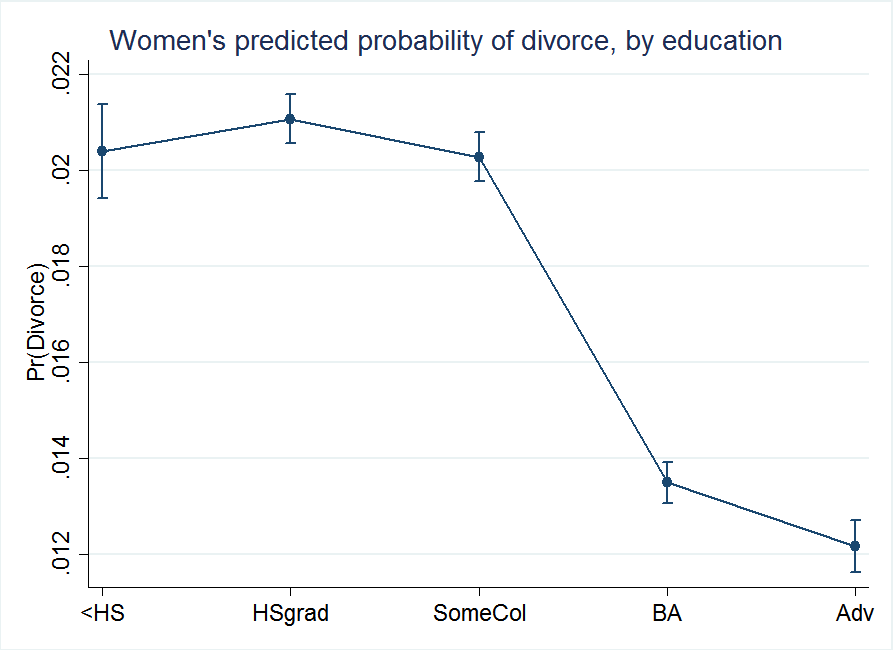
(The codebook for my IPUMS data extraction is here, my Stata code is here.)
Anyway, it’s disappointing to see this in the Wonkblog piece:
But the important thing, for Wolfinger, is that “we do know beyond a shadow of a doubt that people who marry in their thirties are now at greater risk of divorce than are people who wed in their late twenties. This is a new development.”
That’s just not true. I wouldn’t swear by this quick model I did today. But I would swear that it’s too early to change the “conventional wisdom” based only on a blog post on a Brad-Wilcox-branded site.
Aside
One interesting issue is the problem of age at marriage and education. They are clearly endogenous — that is, they influence each other. Women delay marriage to get more education, they stop their education when they have kids, they go back to school when they get divorced — or think they might get divorced. And so on. And, for the regression models, there are no highly-educated people getting married at really young ages, because they haven’t finished school yet. On the other hand, though, there are lots of less-educated people getting married for the first time at older ages. Using the same ACS data, here are two looks at the women who just married for the first time, by age and education.
First, the total number per year:

Then, the percent distribution of that same data:
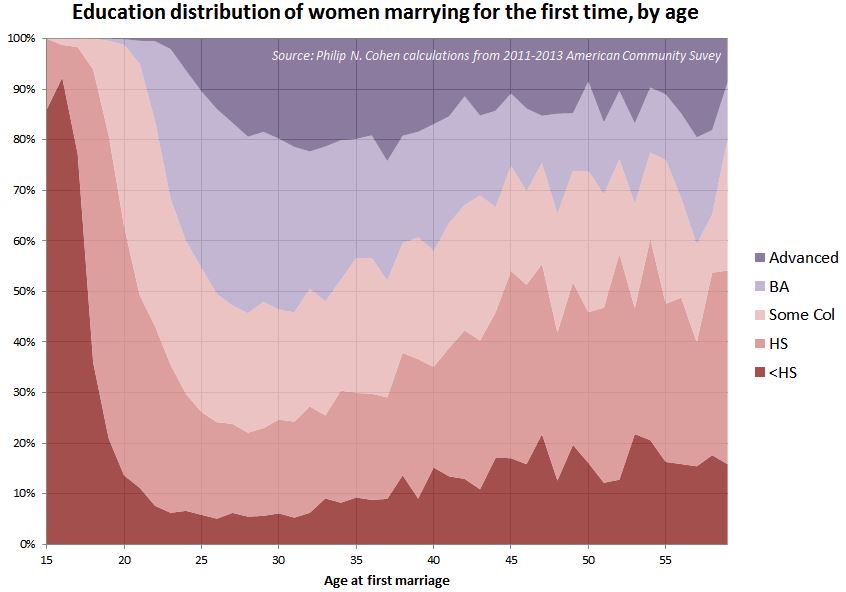 Interesting thing here is that college graduates are only the majority of women getting married for the first time in the age range 27-33. Before and after that most women have less than a BA when they marry for the first time. This is also complicated because the things that select people into early marriage are sometimes but not always different from those that select people into higher education. Whew.
It really may not be reasonable to try to isolate the age-at-marriage effect after all.


Continuation of project by Fuzzy Wobble takes the dancing GIF website into real world, turning real people dancing into GIFs to be part of a projected collage of fun:
Created with lots of love/code by Fuzzy Wobble, Wes, and Matt in an effort to bring an experiential party installation that goes far beyond the hopelessly dated photo/gif booth. We have ventured into a world of interactive / looped / reversed / cloned / collaborative / pelvic-thrusting / dancing / comical / chaos – creating a memorable party experience for everyone. This project was released recently, in May 2015, and stems from the hyper-viral website http://gifdanceparty.giphy.com/ created by Fuzzy Wobble back in 2012.
Sophianotlorenvia Burly.Thurr && firehose && Osiasjota and I am cracking up (also grateful that my LCS has never had "the grumpies" -- just awesome staff!)

“once, you told me to ‘break my neck in a mexican sewer’ because i tweeted that you charged my card twice by mistake”
Oops! We must have had the grumpies that morning. Thanks for letting us know! :) #starwars

Sabeel Rahman has a piece in the The Nation that reviews some of the journal’s classic essays from the Progressive Era as a way for us to learn about that period today as we deal with the New Gilded Age. Do the Progressives offer a way forward for us? Rahman suggests yes in a piece titled “How to Revive Progressive Era Economics for the New Gilded Age, including around issues of public utilities. And that’s fine, I don’t disagree. However, it’s worth noting here just how limited Progressives’ visions were for the government and how little power they actually took from corporations. Yes, a few trusts were busted here and there and some forests kept out of private control. But for the most part, the Progressives wanted to work with capitalists to save them from their own excesses. And in a period without a strong radical movement and where we are engaging in full givebacks to corporate control around previously untouchable parts of American life like public schools, these sort of moderate arguments of the Progressives might be as far as we can push.
But we should also note that Progressive Era economics largely failed on their own terms. The Panic of 1907 was averted only through appealing to J.P. Morgan to bail out the government for instance. And the challenges of the 20th century economy were far too great for Progressivism. In any essay on the period and its lessons, I think it has to be noted that the ultimate Progressive was Herbert Hoover. He brought those Progressive Era ideas into the presidency and of course they completely failed in dealing with the Great Depression. The voluntarism, mild government interventions, and public-private partnerships so valued by Hoover and other Progressives were no match for real government regulation. And that’s why the New Deal offers far more lessons on how to tame the overreach of corporate capitalism than the Progressives. It’s not as if the New Deal was overtly anti-capitalist. The NRA was openly pro-capitalist, bringing corporate ideas into the government, largely to protect the companies from the cutthroat competition than industrial leaders thought was at the root of their economic problems. Ultimately, only widespread direct government intervention in the economy and the creation of a relatively powerful regulatory state has created a fair playing field for everyday people in U.S. history. So while there may be useful lessons from the Progressives for us today, we have to note their real limitations as well.

Above: The Republican ideal of workplace safety
Some companies just don’t care about workplace safety, even when they receive OSHA fines. One of those companies is Wisconsin’s Ashley Furniture.
Ashley Furniture Industries Inc., already facing a possible $1.7 million fine for alleged safety violations at its massive factory in Arcadia, was accused Tuesday of new infractions and of failing to report worker injuries.
The Occupational Safety and Health Administration said a 56-year-old employee of the giant furniture maker lost his right ring finger after a March 11 accident on a machine that the agency had cited as unsafe just one month earlier.
Ashley also failed to report the injury as required, OSHA said. The agency learned of it from a family member of the victim, an OSHA spokeswoman said.
Another Ashley employee was similarly injured in January on the same type of machine, OSHA said. The company also failed to report that injury as required, the agency spokeswoman said.
The latest citations carry proposed fines totaling $83,200. The bulk of that stems from two alleged violations that OSHA deems “willful,” meaning that they were committed “with intentional, knowing or voluntary disregard for the law’s requirement, or with plain indifference to employee safety and health.”
“Workers at Ashley Furniture cannot count on their company to do what’s right when it comes to safety,” Mark Hysell, OSHA’s area director in Eau Claire, said in a statement. “These workers are at risk because this company is intentionally and willfully disregarding OSHA standards and requirements.”
In February, OSHA accused Ashley of 38 safety violations and said the firm was emphasizing profit over worker safety.
Of course this company has very close ties to Scott Walker. So close that one wonders about the legality of those ties. Last year, Walker appointees gave Ashley Furniture a $6 million tax credit that included a provision allowing it to lay off half its in-state workforce. Ashley executives then paid Walker back with $20,000 in campaign donations.
This is what a Walker presidency would look like on a national scale. Gutted workplace safety laws and a whole mess of corporate giveaways in exchange for campaign money. That’s Republican economic ideology in a nutshell.

I’ve already taken a few whacks at Michael Cannon’s unique theory that if a party wins a special Senate election that party’s platform must therefore be enacted by the Supreme Court of these voters have been disenfranchised. In a new piece, I observe that this argument also happens to be self-refuting:
The idea that the Supreme Court is required to follow the returns of special Senate elections in Massachusetts is…novel. The idea that the court is required to allow these results to trump the results of national elections is even dumber.
But it’s even worse than this. With this sentence, Cannon is spitting out his own snake oil. Remember that the premise of the King v. Burwell lawsuit was that the plaintiffs were allegedly just asking the court to enforce the law that Congress wrote. Cannon was the most aggressive proponent of the ludicrous, dystopian science fiction version of the ACA, claiming not just that the letter of the law required that subsidies not be available on federal exchanges, but that Congress also fully intended to establish federal backstops that it knew would fail.
In a refreshing, if inadvertent, moment of honesty, Cannon is conceding the obvious: the King lawsuit wasn’t designed to uphold the statute passed by Congress in 2010. It was intended to “enfranchise” the people who voted against the bill. And this is something that should always have been obvious from the fact that Cannon could not find any supporter of the ACA who could back his irrational reading of the law. In a constitutional case, this might not tell us much. But in a case involving statutory interpretation, the uniform rejection of the theory advanced by the bill’s opponents — both contemporaneously and in 2015 — should have been dispositive.
The fact that King was based on an almost comically transparent historical sham surely helps to explain why Roberts rejected the argument of the plaintiffs so forcefully. He declared that “Congress passed the Affordable Care Act to improve health insurance markets, not to destroy them,” and foreclosed a different interpretation of the law by a future Republican administration. It also helps to explain why Justice Anthony Kennedy joined the majority even though he voted in 2012 to strike down the law in its entirety. The contempt the court showed for the people who brought the suit certainly wasn’t the product of any love for the ACA.
Although it must be admitted that if someone is going to make up a massive historical lie, it should be in the service of a truly noble cause, like stripping millions of people of their health insurance.
This would all just be black comedy…except that this crap actually got three votes from Supreme Court justices.


Coding project by Zach Rispoli uses face tracking and a webcam to replace your eyes with your mouth in real time for surreal effect:
a little weekend webcam project i did with the little ones.
most of the code is taken directly from Kyle McDonald’s FaceOSC. check it out !! be careful, code is a mess
The code for the project can be found here

Lucas Abela, “IV:BPM” (2015) at ‘Anxious Spaces: Installation As Catalyst II’ (photo by Luis Nieto Dickens, courtesy Clocktower)
For decades, Lucas Abela played turntables hooked up to all sorts of objects, from swords to meat skewers to amplified trampolines. Since 2003, however, the Australian experimental sound artist’s instrument of choice has been a large shard of glass. Pressing his face against the broken pane, Abela hums and blows into it during his performances, with a contact microphone amplifying the sounds, warped by a series of effects pedals. The resulting noise resembles the high-pitched, grating yowl of a circular saw or of a high-speed drill boring into your jaw courtesy of your dentist; still, the layered screams that the mundane glassware emits are as alluring as they are jarring. This tension is what drew Abela to the material in the first place.
“The tone was so much more beautiful than any of the metal I’d been playing, and I could get so much more richer sounds from it,” he told Hyperallergic.”It’s kind of like a reverse trumpet, like a cross between a raspberry and throat singing.” Abela usually plays his glass in dark rooms or in basements, but the audience at his recent performance in Queens saw the artist shredding in broad daylight, in the center of the expansive Knockdown Center.

Lucas Abela, “IV:BPM” (2015) at ‘Anxious Spaces: Installation As Catalyst II’ (all photos by the author for Hyperallergic unless noted otherwise)
The set was part of Anxious Spaces: Installation as Catalyst, the second annual group show presented by Clocktower, which closes Sunday. Featuring artists whose work “incorporates dynamic and time-based elements,” this year’s lineup also included pieces by Molly Lowe, Tim Bruniges, and Prince Rama. Abela’s performance occurred against the backdrop of his site-specific and interactive installation, “IV:BPM” (2015), which also engages with experimental noise and, like Abela’s always-improvised shows, creates an intense experience grounded in chance and freeform. “IV:BPM” consists of 18 intravenous drips each affixed with a contact mic that records the pulse of liquid hitting an attached container; the sound is then fed through audio effects with the results blaring from a small amplifier balanced at the very top of each drip. Visitors are invited to play these alternative single-beat drum machines — part instrument, part sculpture — and manipulate the output by tweaking knobs and sliders so the collection of drips come together as one “participatory instrument,” as Abela called it.
“The installation is basically a large-scale instrument that can be played by the audience,” he said. “I’ve always felt like noise music and effect pedals and all that stuff is more fun to play with than it is to watch, and so I wanted to create experiences where people would get to play with audio effects.”
Housed in one of Knockdown Center’s darkest rooms, the drips are also rigged with colorful LED strips that react to the beats, connected to a circuit that converts the audio signals into light effects. The frenzy of the raw, modulating noise is thus paired with intermittent flashes to create an experience that immerses visitors in unformalized groupings of sounds and electroluminescence. This disorder is heightened since the beats “IV:BPM” emits are completely dependent on visitors who become performers as they react to Abela’s original effects — it borrows this frame from Abela’s own shows, for which he never prepares arrangements, instead feeding off the energy of his audience.
A video posted by claire (@clairevoon) on Jul 5, 2015 at 4:17pm PDT
Visitors may alter the beats on an individual drip in three ways, making each one a unique and autonomous instrument in the installation’s ever-changing composition: playing with the audio effects bends the sounds so the drops can produce blips or thud like a heartbeat; adjusting the IV nozzles changes the drip speed — and thus the beats per minute (BPM); and rolling the slender stands through the room shifts amplitudes within the communally created score. The vast mobility of noise is boosted by the responsive nature of each drip stand, which, though designed as a mechanized drum machine, does not actually have the stability or predictability of a metronomic beat.
“The IV drips are slightly off, like a human drummer,” Abela said. “They also have the environmental elements; like the sway of the bag would make the drips hit the drum elements at different places, which would change the timbre of each beat as well, each and every beat that was played.” The “drum elements” are various types of containers affixed to each stand that collect the drops, from paint cans and metal trays to a dog bowl and even a child’s wooden paddle. The impact of water against each object thus creates distinct sounds so each IV stand exists as a different instrument; the variations are subtle, calling for close listening. That’s a challenge, as the result can be sonically schizophrenic and often harsh, but part of the pleasure of the seemingly mechanized is that it holds unexpected, organic tones and textures.
“I think there are intricate details you can find in layers and layers and layers of noise,” Abela said. “It can be just as soothing as a symphony to the ear.”

Lucas Abela, “IV:BPM” (2015) at ‘Anxious Spaces: Installation As Catalyst II’

Lucas Abela, “IV:BPM” (2015) at ‘Anxious Spaces: Installation As Catalyst II’

Lucas Abela, “IV:BPM” (2015) at ‘Anxious Spaces: Installation As Catalyst II’

Lucas Abela, “IV:BPM” (2015) at ‘Anxious Spaces: Installation As Catalyst II’

Lucas Abela, “IV:BPM” (2015) at ‘Anxious Spaces: Installation As Catalyst II’

Lucas Abela, “IV:BPM” (2015) at ‘Anxious Spaces: Installation As Catalyst II’
Anxious Spaces: Installation As Catalyst II continues at the Knockdown Center (52-19 Flushing Avenue, Maspeth, Queens) through July 26. A processional performance with “IV:BPM” will occur at the closing event.
 Second Sight's Argus II bionic eye has already helped hundreds of patients around the globe with a rare disease called retinitis pigmentosa (RP) to see again. And yes, that includes several Americans who've gotten the system after it was approved by ...


As part of a reference photoshoot for an illustration project by Warsaw-based creative studio Ars Thanea, a bouquet of roses was set on fire and photographed as they smoldered in the dark. The glow of the dying embers is strangely evocative, it would be amazing to see an entire series of different flowers photographed like this. You can see the final illustration and how they caught the images over on Behance. (via Boing Boing)
SophianotlorenOooooh!
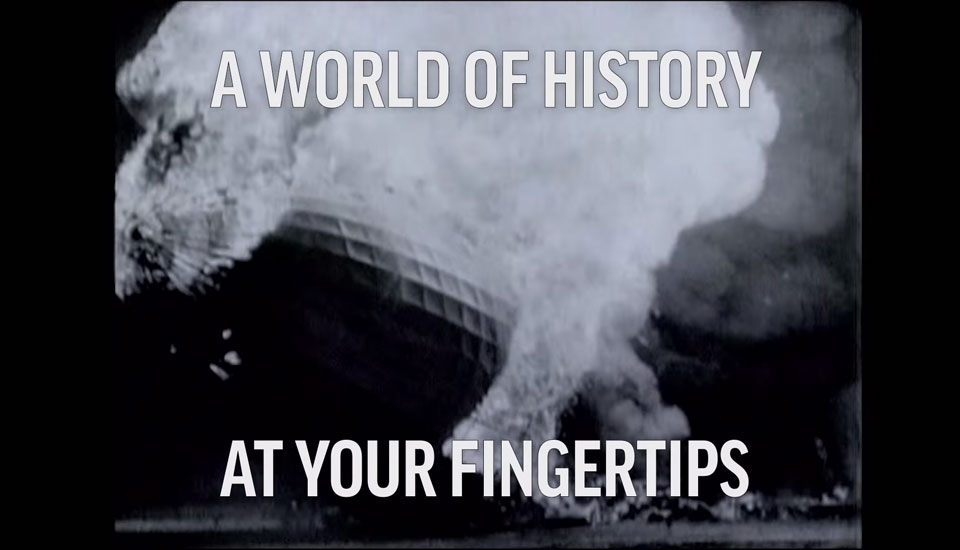 The Associated Press has teamed up with British Movietone to share more than a century's worth of newsreel footage with the denizens of the internet. The pair will upload more than a million minutes of archival clips to YouTube with the intention of ...

I think Matt Breuning’s defense of Bernie Sanders at Netroots Nation is very misguided. A few points:
Sanders screwed up. That doesn’t make his a bad person, or mean that his primary campaign is worthless. As Bouie says, he seems to be learning, and his strongest supporters should follow his lead.
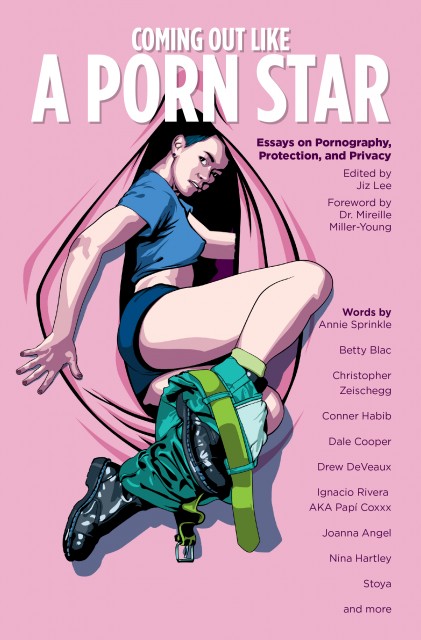
This isn't a picture of Time's 'perfect body' from 1955; it's adult film star Aria Giovanni: http://t.co/6QcYlbK7Y1 pic.twitter.com/G9rA7jumbf
— snopes.com (@snopes) July 21, 2015
Has anyone already said that Ashley Madison hack is likely to be the work of North Korea ? :) pic.twitter.com/FRl4ipxJoH
— codelancer (@codelancer) July 21, 2015
The post Sex News: Instagram bans #curvy, MSNBC’s exploitative Sex Slaves In America, porn stars on monogamy appeared first on Violet Blue ® :: Open Source Sex - Journalist and author Violet Blue's site for sex and tech culture, accurate sex information, erotica and more..
SophianotlorenAm I a bad person for immediately thinking "Oh, exploitable!" when I saw this? Has anyone set up a throwaway Instagram account and posted goatse, lemonparty, etc until the account got nuked... all hashtagged to display on this F21ThreadScreen?


Project by Breakfast NY is a visual display using an array of thread to display Instagram images in real-time:
Forever 21 and BREAKFAST (agency) are excited to unveil the F21 Thread Screen, a 2000 pound machine that uses 6,400 spools of thread to display Instagrams that are hashtagged with #F21ThreadScreen.
There is a livefeed on the project website which can display Instagram images which are tagged #F21ThreadScreen (and some maybe documented on their specific YouTube channel).
You can see the live stream or find out more here

When people exercise with headscarves, they can become soaked with sweat, just like the rest of our workout clothes. Besides perspiration, scarves need to withstand the elements, such as rain or heat. Veil Garments is the first line of performance-geared hijabs attempting to fill that void. The hijab replaces traditional fabrics like silks, chiffons and cottons and opts for nylon, which readily wicks away sweat and is almost fully waterproof.
“There are a billion Muslims around the world and the population is only getting bigger… I don’t know why no other sports brand has done this before.“ [via]
This is badass, every one should have access to cool techwear.
Sophianotlorenvia Rosalind. I
groan-tastic puns like this!


Glass artist Ben Young (previously here and here) just shared a glimpse of his latest sculptural works made from layers of cut laminate window panes. The bodies of water depicted in Young’s work are usually cut into cross-sections akin to textbook illustrations, creating translucent geometric islands that can appear both monolithic or chamsic.
“I hope viewers might imagine the work as something ‘living’ that creates the illusion of space, movement, depth and sense of spatial being,” Young says. “I like to play with the irony between the glass being a solid material and how I can form such natural and organic shapes.” The self-taught artist, furniture maker, and surfer has explored the properties of cut glass for over a decade at his Sydney studio. Here’s a bit more about his processes via Kirra Galleries:
Each of Young’s sculptural works are hand drawn, hand cut and handcrafted from clear sheet float glass made for windows, then laminated layer upon layer to create the final form. He constructs models, draws templates, makes custom jigs and then cuts the layers with a glazier’s hand-tool. The complexity comes from the planning phase, where he says “I do a lot of thinking before I even start to draw or cut.” He then sketches the concept by hand and creates a plan using traditional technical drawing techniques: “I work with 2D shapes and have to figure out how to translate that into a 3D finished piece. Sometimes my starting point changes dramatically as I have to find a way to layer the glass to create certain shapes.” The texture and colour of the glass varies in every piece according to its thickness and arrangement.
Young opens a new exhibition of work along with artist Peter Nilsson titled Float at Kirra Galleries this evening in Melbourne.





 groan-tastic puns like this!