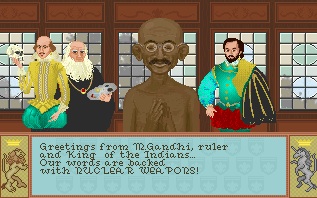
Gandhi has been historically the most aggressive character in Civilization due to an original bug in the first game that caused him to go all-out once he reaches democracy. They just kept the thing going ever since.
To further explain this bug, because I was chatting with mothmonarch about Civilization and other strategy games last night and I never got around to explaining this fully, but I love this story:
Gandhi’s AI in the original game had its aggression set to the absolute minimum (0 on a scale of 0 to 10, I believe, I may have this wrong but the basic idea I’m about to explain is accurate, as far as I can tell). Adopting democracy lowers an AI civ’s aggression by 2 points, so when someone who is fully peaceful loses two points of aggression, they should still be nice and polite, right?
Except this is an old DOS game, and so computer math is in place. What actually happened was that Gandhi’s aggression level ticked backwards two steps, from 0 to 255. On a scale of 0 to 10, Gandhi is now 255 points of pure nuclear rage.
And that’s the story as I recall it, but again I may have gotten some details wrong, so feel free to correct me! After that, as the original poster said, the devs loved the bug so much that they just kept it in as a running joke!
“On a scale of 0 to 10, Gandhi is now 255 points of pure nuclear rage.”
I about pissed myself laughing at this.
please handle your overflow people you could be causing a nuclear war
WASHINGTON, DC — In 1948, Yasuo Kuniyoshi was the first living artist to receive a retrospective at the Whitney Museum of American Art and that was the last time his career was thoroughly explored before this year’s exhibition at the Smithsonian American Art Museum. The Artistic Journey of Yasuo Kuniyoshichronologically retraces his art alongside the story of his life, as a Japanese immigrant in the United States restricted by xenophobia and labeled an “enemy alien” following Pearl Harbor.
“Even now, eighty or ninety years later, we must search carefully to find those points of apprehension in his art and life, but like dots on a graph they chart the backstory of this immigrant’s experience,” Elizabeth Broun, director of the museum, writes in the catalogue.
Arriving in the United States as a teenager in 1906, he soon adopted the country as his permanent home until his 1953 death in New York from stomach cancer. However due to immigration laws he was never allowed to receive citizenship. Despite not stating directly how being considered an outsider in the place he felt most at home impacted his art, The Artistic Journey of Yasuo Kuniyoshi examines the parallels between the later more grotesque shapes and caustic colors as representative of this anxiety. Curator Tom Wolf writes in his extensive catalogue essay:
The many American writers who claimed there was something ‘Oriental’ about his art were right: he incorporated elements from Asian artistic traditions, in terms of technique, composition, and subject matter, into his art in many inventive ways. And he was right when he said, ‘Except for my physical appearance and my name I am just as much an American in my approach and thinking as the next fellow. I’m as American as the next fellow.’ But the fact he felt he had to exclude his physical appearance and his name acknowledged the dominant stereotype and suggests the pressures Kuniyoshi faced.
Kuniyoshi’s work was more widely known in the United States during his lifetime, with much of his posthumous interest shifting to Japan. The exhibition is a beautiful argument for celebrating him as one of the 20th century’s great American artists, in a museum devoted to that experience. He was a slow creator, with an estimated 350 completed paintings in his lifetime, and each of the 41 paintings and 25 ink drawings assembled from private and public collections is rich in detail and use of understated color palettes.
Early work in the 1920s, like “Boy Stealing Fruit” (1923), have dynamic contrasts between flat and dimensional perspective, distorting ordinary objects like a table and bowl, with some Americana influence. Cows graze through with gaping human eyes, possessing the kind of anthropomorphic personalities and sly humor of Chagall’s animals. Kuniyoshi also loved the circus, the strong ladies and other performers ready subjects for the playful proportions he gave his figures. Following the war, during which his movement was restricted and bank account frozen (although he avoided the internment camps for Japanese Americans by being on the East Coast), a darker tone permeated his canvases. In “Festivities Ended” (1947), a carousel horse is flipped over and a faded pennant garland twisted around its legs like a tripwire; a couple of people sprawled out in the distance by a deflated circus tent suggests a catastrophic collapse.
The exhibition is a lot to take in, but each work is rewarding, the modernism easily mixed with folk art and Japanese design in ways that are deceptively simple, and then there’s the imagery that evokes the stuff of dreams. It’s hard not to read into his work because of the wealth of symbolism and allegory. Some see the boy sneaking a peach from a distinctly Americana bowl in “Boy Stealing Fruit” as a reference to his 1919 marriage to Katherine Schmidt — Schmidt subsequently lost her US citizenship because of a 1907 law that forced all women to acquire their husband’s nationality upon marriage. And the agitated colors of his later work could possibly evoke a personal conflict for the artist as he weighed his sympathy for a nuclear devastated Japan alongside his love for his adopted country. The exhibition is totally clear on one thing: his work deserves wider recognition, and another 65 years shouldn’t go by before the next museum pays attention.
Entrance to ‘The Artistic Journey of Yasuo Kuniyoshi’ (photo by the author for Hyperallergic)
At this point, the courts have so many double standards, I’m surprised irony hasn’t covered itself in honey, with a sign that says “Eat Me. This is ironic, but in an ironical-type,” and left the hungry, post-modernist bears to wait for them.
Nearly fifteen years after it was published in Spanish, Juan Gabriel Vásquez’s collection of short stories Lovers on All Saints’ Day is now available in English. In an interview with NPR, Vásquez talks about the collection, translation, and the feeling of not belonging.
The book as a whole is quite concerned with the idea of a couple revisiting a moment in their past to try to see what they have become and try to salvage what they can.
Last week, Sinead O’Connor declared that music has died. In an apoplectic Facebook post O’Connor vilifies Rolling Stone magazine for putting Kim Kardashian on its cover, and in the package deal calls out Simon Cowell, Louis Walsh, and seemingly the entire popular music industry. Her argument, as near as I can tell it, has to do with the rank commercialization of popular music in regard to its employ of celebrities to sell the music though these personalities have little or nothing to do with the actual production of music.
Her public condemnation reminds me of Victoria Jackson’s response to the news that Barack Obama had been reelected. She is reported to have tweeted “I can’t stop crying. America died.” This in turn brings to mind Paul Delaroche, who after encountering a daguerreotype in roughly 1839 declared that painting was dead. It’s the declaration itself that strikes me as fascinating rather than the signified content.
What do we mean when we say that something, as opposed to someone has died? Clearly, despite Victoria Jackson’s devastation, the United States of America has continued on its conflicted, disputatious way, and painting has been declared dead and been resuscitated enough times to make the proclamation a kind of punch line. (Did you hear the one about painting buying the farm?)
I think that the description of something as dead in the above ways is more than exaggeration. It is an individual’s bid for public confirmation of his or her own experience witnessing a treasured object’s irremediable transformation. Essentially O’Connor is asking the people in her social media community to hold her hand and engage in a ritual of recognition and remembrance of what music was when its primary emissaries were singer-songwriters not salespeople. Jackson is asking for other evangelical Christians and anyone else who shares her deeply conservative politics to cry with her and affirm her grief by grieving alongside. (I will leave aside for the moment the indefensibly heinous nature of these politics.) Delaroche was engaged in a different game: he was more concerned with prediction, but subsequently similar advisories concerning painting have been more or less representative of the initial steps of mourning a lost object or practice.
This is to say that the human tribe is very much a social one and we do not, generally, grieve alone. Even in this age of electronically mediated connection we come together in order to consecrate the time that we witnessed something together, and we ask for support in moving ahead into a future we don’t quite comprehend.
Volta Laboratory disc recording with Alexander Graham Bell’s voice (December 29, 1881), reproduced in 1885 in tinfoil over plaster on cardboard backing (photo by Richard Strauss, Smithsonian, all images courtesy Smithsonian’s National Museum of American History unless noted)
WASHINGTON, DC — Out of patent litigation paranoia, inventor Alexander Graham Bell donated copies of his devices and sound recordings directly to the Smithsonian. He had, after all, experienced hundreds of challenges to his telephone patent in 1876. For over a century, most of those recordings when unheard. Recently the Smithsonian collaborated with Lawrence Berkeley Laboratory and the Library of Congress to harness particle physics technology and retrieve the only known recording of Graham’s voice, released to the public in 2013.
Alexander Graham Bell (courtesy Smithsonian Institution Archives) (click to enlarge)
Hear My Voice: Alexander Graham Bell and the Origins of Recorded Soundat the Smithsonian’s National Museum of American History (NMAH) is a tale of two scientists: Graham with his Volta Laboratory and physicist Carl Haber at Lawrence Berkeley Laboratory. Haber explored noninvasive techniques used for the 3D digital mapping of subatomic particles to “play” a record without physically touching it. In a way these stories are inverses of one another, with the 19th-century laboratory devoted to sound recording and the 21st-century to extraction. Old Volta Lab records are displayed beneath glass at NMAH, many on public view for the first time, while a listening kiosk plays their sounds. Devices Bell perfected such as the graphophone —an adaptation of Edison’s phonograph that substituted a wax cylinder for tin foil — are also included. On the cylinder, Bell’s father recorded a line from Hamlet with an addendum: “There are more things in heaven and earth, Horatio, than are dreamt of in our philosophy. I am a graphophone, and my mother was a phonograph.”
Graphophone recorded in October of 1881. Content: “There are more things in heaven and earth, Horatio, than are dreamt of in our philosophy. I am a graphophone and my mother was a phonograph.” Voice of Alexander Melville Bell, Alexander Graham Bell’s father
NMAH is celebrating American innovation in 2015, culminating this month with the opening of a new section of the museum devoted to invention in the United States. The recordings in Hear My Voice are just part of around 400 of the world’s earliest audio held in its collections. An online exhibition includes many of the featured recordings, including Bell’s, made on April 15, 1885. Along with it a piece of paper served as a transcript, signed “in witness whereof, hear my voice, Alexander Graham Bell.”
You can listen to Bell’s voice, and follow along with the transcript, below:
Handwritten list of numbers, witnessed by Alexander Graham Bell on 15 April 1885. Unregistered item, reference material. Cropped by DAMPP staff for Web use. Transcript of Alexander Graham Bell’s voice disc
Experimental wax disc with the only confirmed recording of the voice of Alexander Graham Bell (1885) (photo by the author for Hyperallergic)
Tin box lid sealed October of 1881, Volta Laboratory. Inscription reads: “Washington, D.C./October 19th 1881,/Deposited on behalf of Alexander Graham Bell,/Sumner Tainter, and Chichester A. Bell, /members of the Volta Laboratory /Association, by the undersigned–/Sumner Tainter/Chichester A. Bell”
Hamlet green wax disc (likely 1884-85). Content: Man reciting opening line’s of Hamlet’s “To be, or not to be” soliloquoy
Carlene Stephens and Shari Stout with a glass disc from Alexander Graham Bell’s Volta Laboratory (2011)
Glass disc recording (March 11, 1885). Content: A man saying names, recording the date, and reciting “Mary had a little lamb”
Tiny green disc (Autumn of 1881). Content: “one, two, three, four, five, six [two trilled rs]”
The silver screen used to be a lot more colorful. Before Technicolor was an option, hand-painted black-and-white film produced vibrant, surreal images the likes of which the world had never seen. Joshua Yumibe looks into the invention born of necessity.
Yet this is how we expect to bring about better labor conditions in poor countries. Instead of empowering domestic agencies with a mandate to prevent abuses, we rely on international corporations seeking to insulate themselves from bad publicity.
Nearly all of the horror stories that show up in consumer campaigns are illegal in the countries where they take place. These countries simply don’t have anyone to enforce the laws. Bangladesh has just 125 labor inspectors for 75 million workers. Cambodian inspectors, on average, earn less than half as much as the garment workers whose conditions they’re supposed to be safeguarding. Uganda, with 40 million people, has only 120 practitioners capable of carrying out environmental impact assessments. In Burma, regional governments have received more than 6,000 complaints related to land revocations, but have investigated fewer than 300 of them.
That’s why Brazil is so startling. It has 10,000 public prosecutors and 3,000 inspectors, all making monthly salaries of at least $5,000. The inspectors collaborate with other government agencies, workers, unions and NGOs, not just to find the most outrageous violations, but to actually fix them.
James Hill, “A couple went down the barren roads of Badakhshan province, North Afghanistan” (2001) (all images courtesy The Lumiere Brothers Center for Photography)
Like many accomplished photojournalists, James Hill’s work exists in a blurred space between reportage and fine art. His independent projects and his work for the New York Times have garnered him a World Press Photo award and a Pulitzer Prize, among others. A 2014 book, Somewhere Between War and Peace, featured selections of Hill’s photo-reportage; Moscow’s the Lumiere Brothers Center for Photography’s current exhibition, Between War and Peace, features an assortment of the works originally selected for that book.
The phrase “between war and peace” evokes Hill’s style well. His images rarely capture events — as the strictest understanding of photojournalism might suggest — but rather depict the undramatic moments in conflict. A 2003 image from Iraq displays a Marine holding a pack of skittles in one hand and shielding his eyes with the other as his convoy is engulfed in a sandstorm. The photo doesn’t convey any details about the invasion of Iraq, only the terrifying yellowness of being submerged in swirling sand, and one soldier’s unthinking attachment to an open pack of skittles.
Perhaps the most conspicuous element of Hill’s style is the particular cohesive color scheme of each image, so unified as to almost seemed staged. The compositions favor hue over geometry. A 2001 photo from Mazar-i-Sharif shows a man feeding doves in front of the Blue Mosque. The doves rise in front of the camera, their white feathers blending with the turquoise architecture and covering the green fatigues. The shade of the sky reflects the translucency of doves’ wings captured in motion. So much beauty amidst war bittersweetly reflects the world’s polarities.
Mazar-i-Sharif, North Afghanistan. A man fed the doves of the shrine of Azrat Ali in the city of Mazar-i Sharif where the spirit of Ali, the son of the prophet Mohammad, is kept. Twenty pairs of doves were originally brought to the shrine in the 16th century by Sultan Hussein Byeqra from Nejev, in modern day Iraq, where Ali is buried. The doves, known locally as Azrat’s army, and as symbols of peace, are, according to the current mullah of the mosque, the first to leave when fighting breaks out, a frequent occurrence, and the last to return (photo by James Hill, November 30, 2001)
James Hill, “A Marine clung onto a packet of Skittles during a sandstorm in the southern Iraqi desert” (2003)
James Hill, “Taliban prisoners squeezed onto a truck in the desert, North Afghanistan, November 2001″
James Hill, “A dove was attached to a coat stand in the ruins of School No. 1, Beslan, North Ossetia, September 2004″
Between War and Peacecontinues at the Lumiere Brothers Center for Photography (Bolotnaya Emb., 3/1, Moscow) through August 2.
Nothing says summer like a day at an amusement park, but few kids would comfortably venture into the abandoned fun land captured by Rob Ball in his series Dreamlands. The eerie tintypes, on view at the Photographer’s Gallery in London, show vines choking the tracks of roller coasters and twisting around deserted outbuildings. It seems impossible that this was ever one of the UK’s biggest tourist attractions.
The park first opened in 1920 on fairgrounds in Margate, Kent that had long hosted carnivals and circuses. The park’s biggest draw was the Scenic Railway, a wooden roller coaster with sides that made it look like an alpine mountain range. The place enjoyed a good six decades of popularity until the 1980s, when its number of visitors began dwindling. In 2003, it finally closed.
Ball had visited the amusement park as a kid, and he returned to photograph its decay in 2013. Since he was working with an antique wet plate process, he had to develop the tintypes on-site; the dust and daylight that inevitably seeped in gave them a moody, atmospheric quality. Ultimately, the images draw attention to the cycle of the landscape. Just how does a park go from being a place that attracts crowds to one that repels them? And what happens to it once its best years are over? In this case, the answer is a happy one. After a campaign to revive it, the park was fully restored and reopened in June.
Rob Ball, “Dreamland Landscape” (2013–2015)
Rob Ball, “Scenic Railway North” (2013–2015)
Rob Ball, “Tracks” (2013–2015)
Rob Ball, “Scenic and Arlington House” (2013–2015)
Rob Ball, “Picnic Bench #2″ (2013–2014)
Rob Ball, “Scenic Side View West” (2013–2015)
Rob Ball, “Scenic Railway Construction Side” (2013–2015)
Rob Ball: Dreamlands continues at the Photographer’s Gallery (16–18 Ramillies St, London) through August 2.
“Laura Browder said she took her 6-year-old daughter and 2-year-old son with her to a mall for a suddenly scheduled job interview because she didn’t have enough time to line up child care. According to Browder, she bought the children lunch at the McDonald’s in the food court and sat them at a table approximately 30 feet away and well within sight while she interviewed.
Browder was taken into custody by police when she went to claim her kids, after someone at the mall called police saying the children had been left there crying.
Browder said she was arrested after accepting the job offer, but now worries if the arrest may cause her to lose it.The woman appeared before a judge who released her and gave her full custody of her children although Child Protective Services is still investigating.
Browder released a statement saying, “This was very unfortunate this happened. I had a interview with a very great company with lots of career growth. I am a college student and mother of two. I would never put my name, background or children in harms way intentionally. I have a promising future ahead of me regardless of what the media tries to portray me as.””
Why would you *arrest* her jfc
Rhetorical, I know, but I’m pretty sure the answer is “because she’s a black woman.” And having worked with the foster care system? They (honestly, we white people) are looking for reasons to take kids away from so-called “lazy” black/dark-skinned Latinx parents. So we can either “raise them with proper values” (should they get a better-than-bad home) or let them get abused into thinking they’re not worth having a loving family and pushing them into the childhood-to-prison pipeline (should they get a bad home).
Note: That isn’t to say that foster care is bad and inappropriate for all children. But CPS is less likely to a) remove white children from genuinely abusive white parents (because of beliefs about white people being more innocent) or b) remove East Asian children from genuinely abusive East Asian parents (because of the belief of what a ’Tiger Mom’ is or that abuse is normal within the various East Asian communities). But they’re okay with over-representing Black, Latinx, and Native American/Indigenous children because of racism. There is so much that can be said about the lack of diversity among the staff in these systems.
Last week Chrysler quietly released a software update for its optional Uconnect in-car entertainment system. And while the official purpose was "to improve vehicle electronic security", Wired reports that the patch is really aimed at fixing a terrify...
This is terrifying and terrific, awesome and awe-inspiring. I love/hate it.
Canadian artist Guillaume Lachapelle explores the infinite in this series of mysterious 3D printed dioramas titled Visions. Sitting atop pedestals in a darkened gallery, the eerie “rooms” rely on lights and mirrors to create the illusion of vast spaces that seem to reflect into much larger open spaces. These pieces were on view last year as part of a solo show at Art Mur in Québec, and you can see more of them up close over on Artsy.
“As for “Write what you know,” I was regularly told this as a beginner. I think it’s a very good rule and have always obeyed it. I write about imaginary countries, alien societies on other planets, dragons, wizards, the Napa Valley in 22002. I know these things. I know them better than anybody else possibly could, so it’s my duty to testify about them.”
“Almost like a table of living clay, the inFORM is a surface that three-dimensionally changes shape, allowing users to not only interact with digital content in meatspace, but even hold hands with a person hundreds of miles away. And that’s only the beginning.”
Agents want to love your book. Hiring managers want you to be exactly the person they need. The person on the other end of that blind date is hoping beyond hope that you’re their huckleberry.
Applies to interviews too!
A+ philosophy.
This definitely applies to interviews as well! I really like this! Excellent tips.
Following in their Kardashian sibling’s footsteps Kendall and Kylie Jenner share the spotlight in the Autumn/Winter 15 campaign from Balmain and are joined by sisters Gigi and Bella Hadid, and Joan and Erika Smalls, and brothers Armando and Fernando Cabral.
The sibling-centric theme gives the French luxury house’s casting choice the title of most racially diverse so far this season.
The Smalls are of Puerto Rican/Latin descent and brothers Armando and Fernando represent Portugal by way of Guinea-Bissau in West Africa, they share the limelight with the American Jenner and Hadid sisters.
Designer Olivier Rousteing, who continues to promote diversity on the runway and in his campaigns at Balmain, told Elle UK: “I don’t know my biological parents because I was born in an orphanage, so actually I’m part of the nation – the army of the world and that is what I’m building now.
“I use a lot of black women in my collections – that’s really important. Fashion needs more ethnicities, more diversities and strong women.”
Statistically, Balmain had the sixth most diverse runway show during the A/W 15 international season and the second most diverse in Paris behind Kenzo. This was in a season where 82.7% of the models booked during Paris Fashion Week were Caucasian, according to The Fashion Spot.
Shot by photographer Mario Sorrenti the campaign shares the same dark cellar basement set as last season’s advertisement and has built on the relationship theme of the Kim and Kanye West fronted S/S 15 ads with the idea of family influencing this season.
The campaign also marks the high fashion campaign debut of two of the sisters, Kylie Jenner and Erika Smalls. Kylie Jenner has so far left the luxury brand modeling gigs to sister Kendall, and Erika, who has modeled only once before alongside supermodel sister Joan for a Vogue editorial in August, 2012.
Pascal Dangin provided creative direction next to Phillipp Haemmerle’s set design.
Updated:
Balmain has released a fresh image from the campaign Friday morning featuring a group shot of all the sisters together.
It’s really great that the internet can connect people like never before. How a queer kid in the rural Midwest, for example, can have the World Wide Web in their hands on a mobile device, and find other queer folks online, can chat and discuss and interact.
It’s also really shitty how the internet can only do that much, as far as connecting goes. Sure, you can find people who are like you, and get that validation that you’re not alone, that there are others like you… but this is a very large world for as close as technology brings us.
Lots of people in far-flung places across the globe who I would love to spend some face-to-face time with — or more likely body-to-body time, in many of those cases. But without lots of money and access to other resources on my part or theirs (for any particular “them” involved, and there are dozens) there’s not much beyond longing, and the disconnect of the distant connections.
Growing up in a religious household, there were many rules about many things. Since there was an emphasis on “purity,” and keeping “clean thoughts” in one’s head, there were rules about which books and music and art and food were “good” and which were “bad.”
These rules, though, often seemed to my young mind to be quite arbitrary, and more about resulting in compliance than purity. Being told to read “the best books,” and to “seek out learning” from them — well, that seemed like a fantastic idea, until those books left me asking uncomfortable questions about the power structures of the church, or finding approved messages conveyed with unapproved language. Music was much the same — being told to listen to “uplifting” music was no problem, except when my choice of music ran counter to someone else’s idea of what should be considered “uplifting.”
I remember finding an mp3 of the old gospel hymn “Wade In The Water” when I was in my teens, and that recording moved me — it moved me in exactly the way that I had been taught that all good music, especially religious music, should move me. I went to share my joy with my dad, from whom I learned much of my lifelong love for music, and he asked who had performed this particular version. When I told him it was Chanticleer, he frowned and told me, “Well, you might not want to listen to that. I won’t tell you to delete the file, but… they’re gay.” I deleted the mp3, and all the other recordings of that song that I had. Oh, sure, he offered to play me some tracks by the Mormon Tabernacle Choir, as an example of what good religious music ought to sound like, but I had heard them plenty of times before, and while they did have some stuff I enjoyed, their performances didn’t really do much for me.
Or there was Steppenwolf — which I was cautioned “might have some small treasures of knowledge” but that to find those required a metaphorical “trudge through miles of raw sewage” to find, and then an equal or greater trudge to get back out with those few pearls, and that I was better off avoiding the piece entirely. Or a number of visual artists whose work I knew very little about, because even though it fell within the larger categories of “kinds of art that are worthwhile and beautiful,” some artists “dared” to show the human figure without being fully covered in clothing. The horror! There were plenty of books by church scholars, or by authors who promoted a specific message, made available to me, as well as pointers towards “tasteful” art… but I kept going back to the fold-out cover on an issue of Smithsonian magazine with The Garden Of Earthly Delights which was in the massive stack of back-issues in the bookcase — because it had naked women, and I found the whole thing both fascinating and arousing… both of which I thought were very good things!
So, along with many other things I intentionally left behind when I walked away from my parents and moved out on my own, I rejected their idea that some things must always be forbidden, no matter what good might be gleaned from them, as well as the notion that anyone else could tell me what I stood to gain or lose from an experience. I began actively seeking out many kinds of art and music and books and philosophies, trying on each thing I encountered and seeing what fit, and what didn’t. I spent a fair bit of time with a small group of misogynist, atheist (in the “let’s get together so we can sit and talk about how we’re so much better that those stupid fools who don’t think the same way we do!” meaning of the word), gamer dudebros — and I learned a lot about myself in that time. I hung out briefly with a lot of different people with different approaches to the world. Every time I found places that I didn’t belong, and every time I learned more about myself.
Then I ended up finding the concept of feminism, and wrote a whole blog post about that discovery. Aha! This is it, I thought. Here’s where people make sense, where “my body, my choice — your body your choice” was an obvious thing, where (at least in the circles I found myself) being able to choose to wear high heels and lipstick was as critical as being able to choose to forgo shaving body hair and to avoid all penetrative sex, where eliminating the oppressive power structures that prevent women and men and people of every other gender from being able to choose was the goal! And because so much of the talking, and much of the acting, was (on its face, at least) in service of that goal, it took me a long time to see that I had simply found myself back in the same situation I had walked away from several years before.
I listen to Lady Gaga, and enjoy much of her music. I have my own issues with some of her songs and lyrics, but those are my issues. Then… I started hearing shouting by people who claimed to be all about personal choice, “Don’t listen to her! She did that whole disgusting, offensive, appropriative thing with traditional Islamic dress, she’s just exploiting oppressed populations for her own profit and public image!” At the same time, I was told that I should be listening to Beyoncé, because her music was “really great” and “so perfectly feminist” and way better than all the other people “pretending” to get it.
Or being screamed at for recommending one of my childhood favorite novels, The Secret Garden, to MFP, because I was a horrible person to enjoy a book that was so obviously racist and championed Colonialism as a wonderful thing, and the fact that it was written in 1911 was irrelevant because I was mentioning it as something positive in the current day… although there were plenty of other books that she would gladly suggest if I wanted to do “better.”
See, I don’t think that anything in this world is beyond questioning, beyond examining for what benefit it brings, what harm it does, what it supports, and what can be learned from it. I also know that, as Benjamin Franklin said, “If all printers were determined not to print anything till they were sure it would offend nobody, there would be very little printed.” I know that the music I listen to, the books I read, the other things I take in on a regular basis — they’re going to offend somebody. They’re also going to please other folks very much! And I don’t worry nearly so much about what others feel about the things I enjoy, because I know that I continue to do what works consistently: seek pleasure first and foremost. Within that, maintain a constant re-evaluation of myself and my surroundings, constantly adjust as I find things which no longer benefit me (and leave them behind) and likewise adjust as I find things which serve me well (and embrace them.)
And I’ll keep doing that until I find that it no longer works, and then I’ll do something that does. It’s simple, it’s effective, and it feels good. And though I’m the only one involved in making those decisions, I know that others are positively affected by it, which is just further motivation to stick with it!
It wasn’t even all that long ago that I heard his name, or knew anything about him.
Probably what first set me on the trail was in the notes for a Facebook event for some guy’s birthday party I got invited to by a mutual acquaintance, there was something about “what to bring to the party” that mentioned “unless you’ve got any designer stuff like the 2C-T’s” and, being the information sponge and eternally curious soul I am, I started down the rabbit hole. Searching for 2C-T found me 2C (psychedelics) and 2C-T-7 — and from there, a name:
Alexander “Sasha” Shulgin.
Just skimming through the Wikipedia article — this was a few years ago when I was still living with the Girl-Child and company — my thought was, “this is a brilliant mind. Holy shit!” Diving into a subject as I do, with blinders on and a disregard for “important” things like eating or excretion, I looked at more and more about the guy, and kept my eyes open for a copy of PiHKAL –which turned up at my local used bookstore in excellent condition not long after I started watching for it. I’ve yet to read very far through the first half; I’ve been horrible at doing much of any reading in the last handful of years, with no stability, and often my sole focus on survival. I do know that it, along with its “continuation” keep a special spot on my bookshelves (when I have bookshelves to hol books, that is, instead of being stuck with everything I own in storage) right at the top, just before the rest of the tomes dealing with pleasure in life: erotic fiction, non-fiction on topics of sexuality, feminism, gender, and sex worker rights activism.
Unconnected with any of my research into Mr. Shulgin, I had picked up a collection of short stories collected from NERVE magazine. The first piece in the book was “Slippy for President” by Steve Almond — and I remember being struck by a clear recognition of myself in the single phrase, “a pathetic little ball of inhibitions.” That was what the narrator was called by a friend offering MDMA… which I recognized from having looked into this Shulgin fellow — and of course, it mentions him by name. I remember thinking how wonderful it would be to find myself with access to a ‘babysitter’ and an opportunity “to recognize the sadness of something without that heavy, blue feeling. It’s more like a math problem, something you examine, hope to figure out.” Because I’ve had so much sadness, and so much of that heavy, blue feeling, and for so long… that just a little break would be so very welcome.
At one point, when I was reading to The Rabbit from Shulgin’s Wikipedia article, I noticed mention of a campaign to raise finds to help cover medical costs associated with care for his foot. I went looking further, and was shocked — then shocked that I would be shocked by something so obvious — to discover that he and his wife were still in the Berkeley area. After sending along what little I could, wishing it were more (but I always wish I could give more when I’m helping someone else) I realized that there might be some chance to meet this incredible being, to express my gratitude for all the many gifts that he has left for humanity — so many of which are still not nearly as widely available as they could be if it weren’t for the “War On (some classes of people who use some) Drugs” being fought so tirelessly.
And then…
On June, 2, 2014, Sasha, as he was known to those who called him friend, passed away. I hadn’t realized just how much I could care about someone I’d never even met until I broke down in tears at the news. And again as I’m typing this, I’m overwhelmed with emotion, tears beginning to fall as I think about all the good that he has done, all the beauty and wonder and joy that sprang from his research and work and life. If nothing else, I know I will attend his memorial service — wherever he’s flying now, I’m sure he’s happy. Not gone, just moved higher. Onward.
“Our entire universe is contained in the mind and the spirit. We may choose not to find access to it, we may even deny its existence, but it is indeed there inside us, and there are chemicals that can catalyze its availability.” –Alexander Shulgin
Oh hey, here’s a cool person I’m getting to know on Facebook! Oh, and their account just got deleted.
Oh, hey, here’s this amazing Tumblr blog with content I enjoy and haven’t seen anywhere else! Oh, and it’s gone…
Oh, hey! Here’s a cute girl who is as much into me as I’m into her — and she’s even down to fuck! Oh, and she’s cut off contact and pretending to be a prude.
Oh, hey, here’s an amazing woman who gets me in so many ways, and is competent and skilled in some kinds of sex that I’ve missed out on… and she’s crushing on me! Oh, and there she goes, saying that me being honest about some of my interests is too scary for her.
Oh, hey, something good happens or comes into my life! Don’t hold your breath, it’s headed right out the door again! I hate trying to be happy or excited about anything I have, because so often it has ended in heartbreak, and ended quickly.
Today I found a hard-copy of a blog post I wrote almost 4 years ago, one that I never published or made public.
And it was astounding to realize that it could just as easily been a month old. Or one year. Or two.
The same rants about the same stuff. The same frustrations, the same needs, the same worries, the same.
I need more sex, then and now. It was interesting to see that of the particular needs I have in that regard, the same things I needed most then are the same few things I’ve never gotten much of; while the kinds of sex I’ve had and my discovered interests have been much more varied, the same few things I’ve needed throughout are the ones I’ve consistently gone without.
I was dealing with way too much noise, then and now. Back then I wasn’t aware just how “good” my hearing is (if you’re “normal,” then my hearing is “really good.” If you’re clued in, you know my hearing is “hellishly sensitive,” which is not an unmitigated blessing.) Now I know that what passes for “a nice quiet neighborhood” to a lot of people is a neighborhood so full of non-stop noise that I’ll guarantee my lack of sanity and sleep there.
I was frustrated with the people I was living with at the time. Granted, I was living with some pretty shitty people. The woman I was renting from had flat-out lied to me about the circumstances that led to the previous tenant leaving with short notice, and when I was on the way out myself, she spent almost an hour screaming at the top of her lungs through a floor-to-ceiling barricade to me and the couple of friends who were helping me haul my stuff out about how I was such a “self-centered bitch” and how she was glad I was “getting the fuck out of her life.” She’s the same woman who wrote in an email to me that “If I can just avoid renting to folks on SSI, I’ll be fine — because y’all are fucking crazy!” Now I’ve lived with much worse people, and less obnoxious ones as well… and I have pretty solidly figured out that even with people I really like, I don’t do well sharing a space with others. I don’t know how I’m going to manage, because I can’t afford to have a roof over my head.
I was worried about money. Didn’t have enough back then, although at the time I had internalized the messages that told me I was a worthless piece of shit because I couldn’t afford the same things as others around me, and it must be my own fault because I clearly couldn’t handle my finances right. I was stressing over dollar amounts — trying to justify each meal’s cost to myself, trying to find ways for others to pay for things as much as I could manage. These days it’s not much different, except that I have slightly more predictable support from several directions. Back then it was hoping I could talk the sugar daddy I had at the time into making something happen, which usually meant ending ending up with something A. different than what I asked for, B. inferior to what I asked for, and C. nearly guaranteed to be secondhand. Oh, and it also meant sucking off an old guy who pushed for sex every time he was around, even when I’d made it clear that it wasn’t going to happen that particular time, and he had a really difficult time with my particular genital configuration. As Hedwig exclaimed, I often felt: “Love the front ofme!” Hey, at least I ended up with several pairs of good boots out of it…
I was struggling with depression. The lies I repeat to myself haven’t fundamentally changed, though in some ways they have gotten less vicious, and I’m often much better now at seeing the lies for what they are, and working to respond to them differently.
And I’m still occasionally writing long rants, either here or on Facebook. I just dug back to my post from December last year so that I could share the picture at the bottom on my Facebook page — the sentiment is the same, then and now. “Just fuck me for Christmas” is written in gel-pen on strips of duct tape across a door. Well, here’s hoping.














![Tiny green disc (Autumn of 1881). Content: "one, two, three, four, five, six [two trilled rs]"](http://hyperallergic.com/wp-content/uploads/2015/06/hearmyvoice01.jpg) Hear My Voice: Alexander Graham Bell and the Origins of Recorded Sound continues at the Smithsonian’s National Museum of American History (14th St and Constitution Avenue, NW, Washington, DC) through January 31, 2016.
Hear My Voice: Alexander Graham Bell and the Origins of Recorded Sound continues at the Smithsonian’s National Museum of American History (14th St and Constitution Avenue, NW, Washington, DC) through January 31, 2016.





 Super Opinionated.
 Last week Chrysler quietly released a software update for its optional Uconnect in-car entertainment system. And while the official purpose was "to improve vehicle electronic security", Wired reports that the patch is really aimed at fixing a terrify...