Shared posts

27 Jul 19:08

Yes, all cis people.

tic-tac-bergerac:

tic-tac-bergerac:

I do not care who you are. I do not care how long you’ve known the person. I do not care that it’s so hard for you. If you do not use a trans person’s correct name and pronouns, you can fuck right off. I do not have time for this shit anymore.

cis ppl i see u not reblogging this

Dear trans folks I know - if I screw up on your name and pronouns, TELL ME. I will be horribly embarrassed, but I will do my best to not screw up again.

27 Jul 19:07

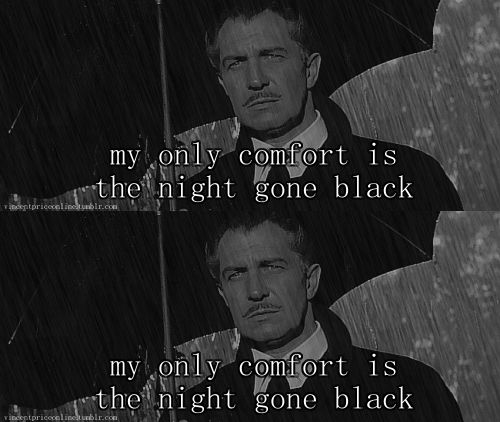
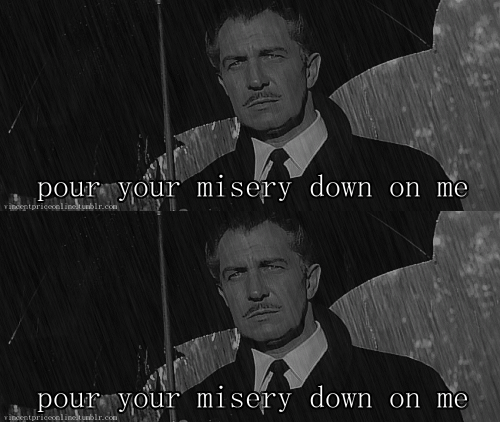
vincentpriceonline: Vincent Price || Garbage’s “Only Happy When...


vincentpriceonline:

Vincent Price || Garbage’s “Only Happy When It Rains” lyrics edit || “Return Of The Fly” || 1959 || 8 gifs

Because I relearned how to make rain in PSP, lol!

This is perfect. Just … yes. 

27 Jul 19:07

fashion-runways: RAMI KADI Couture Fall/Winter 2016 – Light /...


fashion-runways:

RAMI KADI Couture Fall/Winter 2016 – Light / Dark

::shrieks::

JAY. JAY. INFAMOUS BLUEJAY. WE NEED THIS FABRIC.

27 Jul 19:07

It’s rare to be home so much.  But Malcolm is here.  MALCOLM 


It’s rare to be home so much.  But Malcolm is here.  MALCOLM 

27 Jul 19:05

barbara-stanwyck: A 1933 instructional self-defense film...


barbara-stanwyck:

A 1933 instructional self-defense film entitled The Weaker Sex (Sayest Thou!)  [X]

27 Jul 19:05

vintagegal: Photography by William Eggleston


vintagegal:

Photography by William Eggleston

27 Jul 19:05

vintagegal: “The first thing a Cry-Baby girl learns: our...


vintagegal:

“The first thing a Cry-Baby girl learns: our bazooms are our weapons!” Cry-Baby (1990) dir. John Waters

27 Jul 19:04

bonerh: x


bonerh:

x

27 Jul 19:04

thelingerieaddict: skeletonsintheclosetcostumes: Model:...


thelingerieaddict:

skeletonsintheclosetcostumes:

Model: Whitney Photographer: Josefien Hoekstra Mua: Ashley Corset by Skeletons in the Closet

Beautiful.

wow, the corset and the makeup and the model go so perfectly together!

27 Jul 18:56

General Wesley Clark: Some WWII-Style Internment Camps Are Just The Thing We Need To Fight Domestic Radicalization

mostlysignssomeportents:


General Wesley Clark has a solution. In an interview with Thomas Roberts on MSNBC, General Clark (who was last seen at Techdirt telling Congress that P2P software was a threat to national security) suggests a return to the WWII good old days might be the only way to stamp out the threat of self-radicalizing “lone wolves.” (via Crooks and Liars)

We have got to identify the people who are most likely to be radicalized. We’ve got to cut this off at the beginning. There are always a certain number of young people who are alienated. They don’t get a job, they lost a girlfriend, their family doesn’t feel happy here and we can watch the signs of that. And there are members of the community who can reach out to those people and bring them back in and encourage them to look at their blessings here.

So, the nation’s intelligence agencies need to be looking for underemployed weirdos who can’t maintain a relationship or exude positivity about their current situation. Then they need to do something about these potential “lone wolves.” Like, put them all in one place where we can keep an eye on them.

But I do think on a national policy level we need to look at what self-radicalization means because we are at war with this group of terrorists. They do have an ideology. In World War II if someone supported Nazi Germany at the expense of the United States, we didn’t say that was freedom of speech, we put him in a camp, they were prisoners of war.

Free speech for some, indefinite detainment for others! USA! USA! USA!

So, if these people are radicalized and they don’t support the United States and they are disloyal to the United States, as a matter of principle fine. It’s their right and it’s our right and obligation to segregate them from the normal community for the duration of the conflict. And I think we’re going to have to increasingly get tough on this, not only in the United States but our allied nations like Britain, Germany and France are going to have to look at their domestic law procedures.

Nothing says “you’re never getting out of here” like “for the duration of the conflict.” Does anyone foresee an end to the War on Terror in their lifetime? (You youngsters milling around towards the back waiting for your Ubers and Amazon drone deliveries are encouraged to speak up.) How about in their kids’ lifetimes? There is no endgame. There is only constant wariness and the endless grasping for more control and power.

Read the rest…

Um. Wow.

27 Jul 18:55

This Portable Salt-Powered Lamp Stays Illuminated for 8 Hours on a Glass of Seawater

by Johnny Strategy

salt-1

salt-2

salt-3

salt-5

salt-4

First the sea gave birth to life. Now, thanks to a trio of Philippine-based inventors, it is giving birth to light as well. Led by engineer Lipa Aisa Mijena, the team has developed a lamp that’s capable emitting light for 8 hours on just 1 cup of saltwater. Not only are the Philippines prone to natural disasters like typhoons and earthquakes but the country is made up of over 7,000 islands, most of which do not have access to electricity, says the team. But one thing they do have is the sea, an abundant source of saltwater that can now be used to light homes and, in emergencies, power cell phones.

The saltwater-powered lamp uses the same science that forms the basis of battery-making. Where they differ from batteries is that the entire reaction is safe and harmless. Moreover, there are no flammable materials or components that go into lamp. Used 8 hours a day, every day, the team says the lamp can provide light for 6 months (or even over a year if used more efficiently) without having to replace any parts.

Over the past year or so SALt (Sustainable Alternative Lighting) has won 7 different sustainability and entrepreneurial awards. If interested, you can enter your name and email on their website to receive product updates but right now the team is focusing on building lamps for their target communities. (via Web Urbanist)

27 Jul 18:54

Remake: Master Works of Art Reimagined, a New Book by Jeff Hamada

by Kate Sierzputowski
Salvador Dali, "The Ship," 1942-43, watercolor on paper, remake by Justin Nunnink

Salvador Dali, “The Ship,” 1942-43, watercolor on paper, remake by Justin Nunnink

replace

Dante Gabriel Rossetti, “The Day Dream,” 1880, oil on canvas, remake by Tania Brassesco and Lazlo Passi Norberto

Four years ago, Booooooom creator Jeff Hamada asked the internet to join in on an art challenge to recreate their favorite old master paintings as contemporary photographs. The Remake Project sparked many professional and amateur artists to create elaborate sets, paint their bodies, paint their friends’ bodies, and take their own shot at works by artists from Dali to Magritte. This collection of original paintings and their contemporary counterparts has now taken the form of a book released through Chronicle Books titled Remake: Master Works of Art Reimagined.

The book features side-by-side page layouts of a selection of works from the original contest, displaying the photographic re-interpretations next to their old-world inspiration. Photographs range from the strikingly similar to loose interpretations, a grand spectrum of re-creations represented from the project’s open call. Remake: Master Works of Art Reimagined is now available in the Colossal Shop.

Rene Magritte, "The Lovers," 1928, oil on canvas, remake by Linda Cieniawska

Rene Magritte, “The Lovers,” 1928, oil on canvas, remake by Linda Cieniawska

Ramon Casas i Carbo, "After the Ball," 1895, oil on canvas, remake by Tania Brassesco and Lazlo Passi Norberto

Ramon Casas i Carbo, “After the Ball,” 1895, oil on canvas, remake by Tania Brassesco and Lazlo Passi Norberto

Jacques Louis David, "The Death of Marat," 1793, oil on canvas, remake by Adrianne Adelle

Jacques Louis David, “The Death of Marat,” 1793, oil on canvas, remake by Adrianne Adelle

Edward Hopper, "Nighthawks," 1942, oil on canvas, remake by Bastian Vice and Jiji Seabird

Edward Hopper, “Nighthawks,” 1942, oil on canvas, remake by Bastian Vice and Jiji Seabird

cover_01

27 Jul 18:53

Wells Fargo Moves to Sell Nonprofit Art Space’s Home Out from Under It

by Claire Voon
The John Slade Ely House (photo courtesy Jeanne Criscola)

The John Slade Ely House (photo courtesy Jeanne Criscola)

After supporting and promoting local artists’ work for over 54 years, a nonprofit contemporary art center in a converted Elizabethan-style home in New Haven, Connecticut, will likely shut down this week, despite months of pleading and organizing by its supporters. On July 31, the John Slade Ely House (JSEH) will close in preparation for sale by its trustee, the bank Wells Fargo, which announced the news in early March, as the New Haven Independent first reported. The bank cites costly restorations that are beyond the trust’s budget to undertake as the reason for its decision to sell. But the Ely House’s caretakers dispute those claims, contending that the building is well maintained and in stable condition. Supporters of the historic home, built in 1905 by Alfredo S. G. Taylor, are now rallying to halt the sale and save the Ely House, whose future and continued role as a space for local art are now unclear.

The house’s last resident, Grace T. Ely (John Slade’s widow), had arranged in her will for the creation of a trust to support her home as a center “for exhibiting works of art, holding art classes, lectures, and recitals, and as a meeting place for organizations interested in any form of art.” In 1961, one year after her death, the Ely House opened its first exhibition and has since hosted many more, from its annual show that partners with a prison arts program to an exhibition of Chinese protest calligraphy held in support of students at Tiananmen Square. Ely had designated New Haven’s Union Trust Company as the eventual sole trustee once its individual trustees retired or passed away, but the company later merged with Wachovia, which was acquired by Wells Fargo in 2008. In its official statement regarding the fate of the JSEH, Wells Fargo said a trust will still exist to nurture the local creative community.

“In keeping with Ms. Ely’s understanding that over time, Ely House may need to be sold, Wells Fargo is preparing the house for sale, and converting the Trust from an operating to a non-operating private foundation,” Wells Fargo spokesperson Vince Scanlon said. “This trust will continue to support the fine arts in and around New Haven through grants to charitable organizations.”

“We have heard the community’s concerns,” Scanlon later told Hyperallergic in an email, noting that the bank had pushed back the Ely House’s original date of closure to accommodate spring and summer exhibitions that had already been scheduled.

Spearheading the efforts to stop the sale is the group Friends of the John Slade Ely House, an ad hoc committee formed by three former JSEH curators: Jeanne Criscola, Raymond Smith, and Anna Bresnick. Friends of the JSEH considers the bank’s plan a poor continuation of the Ely House’s ongoing, dedicated outreach to its community. Actions taken by a national corporation working remotely, the group argues, are incomparable to efforts by locals familiar with the art scene like the House’s widely lauded, longtime curator Paul Clabby. (Because of a confidentiality agreement with Wells Fargo, Clabby was not able to comment on this story.)

“It may sound like a good alternative, but they’ve indicated no particular talent in running the John Slade Ely House of Contemporary Art,” Criscola told Hyperallergic. “How can they be trusted to run a grant-giving foundation for the arts from thousands of miles away?” (The corporate headquarters of Wells Fargo are in San Francisco.) Scanlon said that Wells Fargo has offices “in the New Haven area with employees in the Trust area,” but according to Friends of the JSEH, trust representatives have never visited the house.

Ely’s will also stipulated that if the property is sold, those in charge of the trust must find a replacement space, “something Wells Fargo has not even contemplated,” Criscola said. “It is clear from her will and bequest that an art center was uppermost in Ely’s wishes.”

But many value the Ely House specifically for its unique architecture, including artist Peter Waite, who has shown there on multiple occasions and finds the building “a refreshing alternative to some of the more traditional spaces to view art, particularly in New Haven and the region.

“The very physical structure is unique and slightly quirky and offers a kind of ‘level playing field’ for all the diverse art that has been presented over the years,” Waite told Hyperallergic. “I think the very place itself helps the art that is shown there because it removes a certain uniform formality that most museums and galleries have.”

Three weeks ago, Friends of the JSEH launched an online petition to protect the House from sale until it received a complete accounting from Wells Fargo to justify putting it on the market. The petition, which the group presented to the office of Connecticut’s Attorney General last week, currently has over 900 signatures and has garnered messages of support from places as far away as Cambodia and Brazil.

“A very historical and valuable establishment for the Arts in our region,” local painter William Meddick wrote. “I hold Wells Fargo and their trustees responsible for what I consider ‘a crime by big industry’ against the community and be held accountable.”

“As an artist, the Ely House has been more than just a place to exhibit,” Joan Fitzsimmons, who also signed the petition, told Hyperallergic. “It has fed me. It has fed me with astutely curated programming, by Paul Clabby … and with the programming of others that he has supported.”

Yesterday, the Friends of the JSEH announced that the Connecticut Attorney General’s office will meet with the bank on July 30 — just one day before the House’s planned closure — to discuss leaving the building open “until a fair and impartial assessment can be made of Wells Fargo’s exaggerated claims that the building is in such disrepair that it will take all the funds in the trust to fix it.” The group also wants to preserve the House’s archive of photographs, exhibition releases, catalogues, and more, which it says will be thrown out after July 31.

Martha Lewis, "Ligeia" (2012) from the exhibition "Exploded Views"  (photo courtesy the artist)

Martha Lewis, “Ligeia” (2012) from the exhibition ‘Exploded Views’ (photo courtesy the artist) (click to enlarge)

The specifics of the Ely House’s current condition are murky and unconfirmed by all involved. Former curator Raymond Smith told Hyperallergic that Wells Fargo had estimated the building needed $500,000 worth of repairs, mostly to fix an allegedly leaky roof, but an experienced, licensed contractor Smith hired last week gave him a quote of just $30,000 to $40,000 and failed to observe any major damage. Smith, who alongside Clabby has taken care of the House for 37 years, said it is sturdy and has weathered hurricanes and blizzards. He suspects that Wells Fargo never conducted an inspection on site since it never presented Friends of the JSEH with any contractor estimates or final assessments. The bank, he added, also does not manage the trust as efficiently as possible, allegedly turning day-to-day maintenance responsibilities that had been carried out by Smith and Clabby — such as shoveling snow and raking leaves — over to a third-party group “at substantial unnecessary cost.” One such outsourced project, he said, resulted in “atrocious work” on the back porch that consequently is now no longer accessible for the disabled.

Hyperallergic asked Scanlon about the specifics of Wells Fargo’s inspections and maintenance of the House and received the following statement:

As part of our fiduciary duties our real estate team monitors and manages trust assets like the Ely House. This includes inspecting the property and engaging third parties as appropriate to determine the needs of the Ely House.

The Ely House, Scanlon anticipates, will enter the market “in the near future,” but Wells Fargo has “no specific dates at this point.” Suspension of its closure rests on the outcome of Thursday’s meeting between the bank and the office of Connecticut’s Attorney General. If Friends of the JSEH successfully halts the sale, the group wants the Ely House to remain a gallery and meeting place during investigations into Wells Fargo’s management.

“No other institution is like it or compares,” Friends of the JSEH said. “It is beloved by the community and valued by the entire arts community because it is so inviting and accessible to all.”

27 Jul 18:52

♡ J E N N Y s ♡

by djchroma
27 Jul 18:51

Teamvesting

When an investor puts money in a startup based on the team and not the idea, product, or traction.
27 Jul 18:51

Zuckerberging

The action of equating technical genius with young white males that are college dropouts.
27 Jul 18:47

Sleek New Short by the FBI Warns of Chinese Espionage

by Laura C. Mallonee
Still from 'The Company Man: Protecting America's Secrets' (screenshot via YouTube)

Still from ‘The Company Man: Protecting America’s Secrets’ (screenshot via YouTube)

The Federal Bureau of Investigation (FBI) has inspired countless hours of television and cinema, from X-Files to Silence of the Lambs. But, as it turns out, the bureau’s own directing chops aren’t too bad either.

On Thursday, the FBI released a cheesy but surprisingly well-made short film, The Company Man: Protecting America’s Secrets. It tells the true story of Robert Moore, a stressed-out father and engineer who’s worried about paying for his kids’ college tuition when he’s approached by two conniving Chinese businessmen. They offer him $200,000 for his company’s insulation technology secrets, but Moore — made of tougher stuff than he seems — turns down their offer. He tells his bosses, they go to the FBI, and the agency sets up a successful sting operation to catch the crooks.

It follows last year’s Game of Pawns, a half-hour film warning college students about the dangers of being recruited to become Chinese spies while studying abroad. That film tells the true story of Glenn Duffie, who was spending a year in Shanghai when Chinese government agents coerced him into applying for a job at the CIA and becoming a double agent. Duffie, of course, ended up in a federal prison. The movie is enough to scare anyone straight.

If you had no idea the FBI made films, you’re not alone. The concept seems somehow dated, conjuring up memories of Red Scare propaganda from the 1950s and ‘60s. But media has a powerful hold on life in the US, with countless hours being clocked on Netflix, Hulu, and Amazon. The agency apparently recognizes that.

Both films were directed by Tom Feliu — who was also behind the bureau’s 2011 film Betrayed — and produced by Jan Garvin at the FBI Academy’s Training Development Unit in Quantico,Virginia. According to Creative Planet, the multi-million dollar facility has all the bells and whistles of a Hollywood studio, though a much smaller budget — between $500,000 and $800,000 per year. It seems to do well on that, though. Its YouTube channel is filled with educational and training films, some of them just as slick as Company Man and Game of Pawns.

That the FBI’s biggest budget films have all been directed against Communist China seems to support suspicions that a new Cold War might be brewing. They also reflect a sentiment held by many security analysts that it’s China — not Russia — that poses the biggest threat to US security. Economic espionage, much of it from China, costs the US billions every year. “We’ve had cases, and it’s outlined in the video, where we have people literally walking into warehouses and factories attempting to steal secrets,” said FBI official Randall Coleman in a statement. “It’s actually shocking the lengths they will go to try and steal information.”

27 Jul 18:46

Slave Labor in Fishing

by Erik Loomis

OCEANS-SLAVES-02-master1050

I’ve talked about this several times before and I discuss it in Out of Sight, but slave labor in the southeast Asian fisheries is endemic and basically no one cares. This is an outstanding report on that slave labor. Almost all of the fish in the southeast Asian seas goes to the United States in Europe–for pet food, for farm animal feed, for fish farming, and sometimes directly onto U.S. plates. It’s totally unsustainable from an environmental angle and the long-term overfishing of these waters makes the future of much of the U.S. meat supply in serious question, but that’s a secondary question to the sheer brutality these laborers face, which you can read about in great and disturbing detail at the link. It simply isn’t a priority of the federal government and certainly not of the American companies buying from these sources to make sure the fish are harvested within a basic framework of human rights for the laborers. And in fact, there are no human rights on these boats.

This is why we need real international frameworks that place the burden of proof on the American companies buying this stuff. How does this end? That’s a complex question, but American companies canceling contracts with the suppliers who buy from these boats is a necessary step. That will only happen if we make those American companies legally liable for these conditions. Simply put, the global supply chain exists in no small part to separate big western companies from any responsibility for global labor conditions. They don’t want to know and mostly they don’t have to know. That’s not acceptable. We can publish all the articles we want about these labor conditions on the boats and we can feel bad for those workers. But when you start looking at what to do, only by demanding that we hold western companies legally accountable for the conditions can we the consumer make a difference. Otherwise, we aren’t doing anything useful at all and that’s not OK either.

In other words, when you feel Fido or Fluffy today, think a little bit about where their pet food comes from and consider how you can ensure that their food isn’t produced on the backs of slaves.

27 Jul 18:46

That New York Magazine Cover

by John Scalzi

So, that’s a hell of a magazine cover. As of this writing the New York magazine site itself is down because of a hacker attack; the hacker in question alleges this has nothing to do with Bill Cosby. Interesting timing nonetheless. Here’s the link to the story package when it goes back up. You should read it. If it’s still down, Vox has a write-up on it.

A friend of mine tweeted a comment last night that said “power corrupts” and I tweeted back something snarky about that; turns out she was tweeting about Bill Cosby and I missed the context, so I apologized and deleted my tweet. Turns out I am just as susceptible to the failure mode of clever as anyone else.

But I had additional thoughts on her comment. I think it’s true that power corrupts, or that it can. I also think it’s true that power reveals — which is to say, that with some men and women, it’s not that having power weakens their will or leads them into temptation, but rather that power allows them to indulge in the things that they’ve always wanted to do. They didn’t need to be corrupted. They needed only the means to do what they willed, which power provided.

Ultimately, however, it doesn’t matter if power corrupted or revealed Bill Cosby’s nature. I don’t imagine it matters to the women who were sexually assaulted whether Cosby gave into temptation or indulged in his will, or both. At the end of the day they were still raped by him. And at the end of the day, for decades, they were told there was no point in telling anyone about it because no one would believe them. Corrupted or revealed, Bill Cosby’s power protected him, until it didn’t. I am absolutely sure that the irony of what kicked the Fall of Cosby into high gear was Hannibal Buress, another man, calling Bill Cosby out on stage was not lost on these women, or women in general. The information was out there; women had been saying these things for years. They still needed a man to say it in order to have the world pay attention.

I’m not sad for Bill Cosby. He raped women, he did it for decades, and now everyone knows he did it. He deserves condemnation for it, and he deserves to see his reputation destroyed (he also deserves jail time, which at this point he is unlikely to receive. But I think for a person like Bill Cosby, the destruction of his reputation is probably no less painful than time in a cell). The man was and is a genius, and his comedy mattered to me; I remember being a kid listening to his comedy albums at the West Covina public library and trying (and failing) not to laugh out loud in a place where you weren’t supposed to make a lot of noise. Bill Cosby: Himself was one of my favorite comedy concert films. And by the time Himself was released, Cosby had assaulted 22 of the 35 women featured on that New York cover. Bill Cosby is a genius; Bill Cosby is a rapist of women. The former does not excuse the latter and never should have.

I am sad we are still in a place where women aren’t believed when they come forward about sexual assault, and that it’s such a matter of fact of our culture that The Onion can satirize it. I’m sad and sorry for the women who had to wait until a man came forward to call out Cosby in order for the cultural tiller to shift in their direction. Anita Sarkeesian — who knows something about the bullshit women have to put up with in order to speak — and others have said that one the most radical things you can do is believe women when they talk about their experiences. It seems like a dramatic statement until you take a hard look at that New York magazine cover, and the thirty five women there, bearing witness to sexual assaults over four decades, finally being believed in some cases fifty years later. You realize it’s not dramatic at all.


27 Jul 18:44

Stretching the Possible

by weeklysift

For too long our leaders have used politics as the art of the possible. And the challenge now is to practice politics as the art of making what appears to be impossible, possible.

— Hillary Rodham, Wellesley commencement speech (1969)

This week’s featured post is: “The 2016 Stump Speeches: Hillary Clinton“.

This week everybody was talking about Sandra Bland

Unsurprisingly, Larry Wilmore has it right: We don’t know why Bland wound up dead — so far the evidence seems to back the original story of suicide, which raises the next question of what happened to her in jail — but we have the dashcam video of the arrest, and it’s messed up.

The video validates a lot of what the black community has believed about the recent series of high-profile black deaths at-the-hands-of or in-the-custody-of police: While Sandra isn’t as meek and mild as she might be, it is the officer who consistently escalates the situation, until he is waving a taser in the face of a woman who is doing nothing more threatening than sitting in her car, smoking a cigarette, and asking why she’s being detained. As Wilmore points out: It is the officer who is supposed to be the professional. He is the one who sees this situation every day, and whose behavior should be judged by a higher standard.

The question everyone ought to be asking is: How typical is this behavior among police in general, and particularly among police dealing with black people?

Salon‘s Brittney Cooper writes:

On three occasions I have given “attitude” to police, asked questions about unfair harassment and citations, and let the officers know that I didn’t agree with how they were doing their jobs. I have never threatened an officer or refused an order. But I have vigorously exercised my right to ask questions and to challenge improper shows of force.

I have had the police threaten to billyclub me, write unfair tickets, and otherwise make public spaces less safe, rather than more safe, for me to inhabit, all out of a clear lust for power. On the wrong day, I could have been Sandra Bland.

… Black people, of every station, live everyday just one police encounter from the grave. Looking back over my encounters with police, it’s truly a wonder that I’m still in the land of the living.

Am I supposed to be grateful for that? Are we supposed to be grateful each and every time the police don’t kill us?

There is a way that white people in particular treat Black people, as though we should be grateful to them — grateful for jobs in their institutions, grateful to live in their neighborhoods, grateful that they aren’t as racist as their parents and grandparents, grateful that they pay us any attention, grateful that they acknowledge our humanity (on the rare occasions when they do), grateful that they don’t use their formidable power to take our lives.

Everyone melted at the quick forgiveness that relatives of his victims offered to Dylan Roof. But Sandra’s mom reacted with the kind of anger I think most of us would feel: “Once I put this baby in the ground, I’m ready. This means war.”

When violence broke out in Ferguson and Baltimore, many whites were mystified. They could get a clue from the season opener of AMC’s Hell on Wheels, particularly the scene where ex-slave-owner Cullen Bohannon warns his bosses on the railroad that the abuse of the Chinese workers will lead to trouble. “Sooner or later,” he says, “a beat dog’s gonna bite.”

and Clinton’s emails

What initially looked like a smoking gun now looks gross journalistic incompetence on the part of The New York Times. This is kind of typical. For decades, opposition research has generated a continual haze of mistrust around Hillary, but when you look back at the accusations after they’ve been investigated, there’s nothing there.

a Louisiana shooting and new details in the Chattanooga shooting

These days you can’t tell the mass shootings without a scorecard. The Chattanooga shooting is confusing the media, because the shooter is a Muslim, but he fits the disturbed-young-man frame more than the ISIS-inspired-terrorist frame.

Thursday we had another theater shooting, this one in Lafayette, Louisiana. Governor Jindal said that “now is not the time” to discuss gun control, and Donald Trump assured the public that “this has nothing to do with guns”.

and Medicare

Jeb Bush has his brother’s knack for mis-turning a phrase, so he drew a lot of attention when he called for “phasing out” Medicare. He walked that back a little, but Paul Waldman pulls the context together on WaPo’s Plum Line blog.

Bush’s choice of words made headlines, but his likely position is in the Republican mainstream: Medicare’s costs are going out of control, so it will eventually be bankrupt. So it needs to be replaced with a cost-controlled voucher plan like the one Paul Ryan proposed a few years ago.

Waldman makes two important points: First, that while Republicans use cost as an argument to do away with Medicare as we know it, they oppose any attempt to control costs within Medicare.

For instance, they’re adamantly opposed to comparative effectiveness research, which involves looking at competing treatments and seeing which ones actually work better.

Also, private insurance has far higher overhead costs than Medicare, so privatization would push costs up, not down. Government could save money for itself by limiting the size of the voucher, but that would just shift the higher costs to the individual.

Kevin Drum points out that under the most recent projections, it wouldn’t really be that hard to maintain both Social Security and Medicare as they currently exist.

So this is what Jeb is saying: Right now the federal government spends about 20 percent of GDP. We can’t afford to increase that to 23 percent of GDP over the next 30 years. That would—what? I don’t even know what the story is here. Turn us into Greece? Require us to tax millionaires so highly they all give up and go Galt? Deprive Wall Street of lots of pension income they can use to blow up the world again?

Beats me. This whole thing is ridiculous. Over the next 30 years, we need to increase spending by 1 percent of GDP per decade. That’s it.

Jeb is absolutely right that liberals won’t “join the conversation” about gutting Medicare. Because it’s just not necessary.

and Planned Parenthood

You may have missed this if you restrict your attention to legitimate news sources, but it’s been echoing all over Fox News and the rest of the conservative bubble: Not just one, but two (!) highly-edited hidden-camera videos supposedly show Planned Parenthood officials haggling to sell organs from aborted fetuses. In response, Republicans in Congress and on the campaign trail are calling for investigations and cutting off any federal funds that go to Planned Parenthood. (It’s already true that none of those funds pay for abortions. Vox details where the money goes.)

In short, it’s the James O’Keefe ACORN sting all over again. In those more innocent days, O’Keefe’s video steamrolled Congress into defunding the community-organizing group ACORN, effectively destroying it. Only later did anybody ask “What are we really seeing here?”, examine the unedited footage, and figure out that it was all a con. (O’Keefe wound up paying a $100K settlement to an ACORN employee he smeared.)

Observing the effectiveness of the tactic, Rachel Maddow wondered: “Who do you think is next on their list?” Well, now we know: Planned Parenthood.

Background: A woman who has an abortion can decide to donate the fetus to science, and the scientific groups that study those fetuses can reimburse the costs involved in preserving and delivering the fetuses to their labs. That’s all legal and well understood in the medical research community.

So anti-choice activists created a front group, the Center for Medical Progress, which registered with the IRS as something they aren’t: a “biomedicine charity”. In that guise, they talked to Planned Parenthood about obtaining tissue from aborted fetuses. The conversations were secretly video-taped — which also appears to be illegal — and the CMP actor manipulated the conversation into areas that could be re-edited to look like the Planned Parenthood officials were trying to make a profit by selling body parts. (One part that got edited out was the Planned Parenthood official saying, “nobody should be ‘selling’ tissue. That’s just not the goal here.”)

Meanwhile, the reason Republicans in Congress were able to jump on the video so quickly is that some of them had seen it weeks in advance. But none of them alerted the appropriate authorities or called for an investigation until the first video was made public. In other words, their behavior was consistent with people participating in a propaganda exercise, not an investigation of any actual law-breaking. When questioned, Rep. Tim Murphy responded like this:

Asked afterward why he and others waited until this week to take action, Murphy struggled for an answer before abruptly ending the interview with CQ Roll Call, saying he should not be quoted and remarking, “This interview didn’t happen.”

and Trump vs. McCain

It’s very tacky to disparage somebody’s military service, particularly when it involved physical suffering and loss. But let’s put this in context.

The NYT’s Timothy Egan has the GOP’s overall hypocrisy nailed:

Trump is a byproduct of all the toxic elements Republicans have thrown into their brew over the last decade or so — from birtherism to race-based hatred of immigrants, from nihilists who shut down government to elected officials who shout “You lie!” at their commander in chief. It was fine when all this crossing-of-the-line was directed at President Obama or other Democrats. But now that the ugliness is intramural, Trump has forced party leaders to decry something they have not only tolerated, but encouraged.

Trump is not some aberration, he represents the current moral state of the Republican Party. They have no cause for complaint.

and you also might be interested in …

You’ll never guess what’s happening as the EPA’s new rules to reduce the carbon emissions of power plants get closer to implementation: The disaster predicted by Republicans is nowhere on the horizon, not even in Mitch McConnell’s Kentucky. The WaPo reports:

But despite dire warnings and harsh political rhetoric, many states are already on track to meet their targets, even before the EPA formally announces them, interviews and independent studies show.

And Kevin Drum draws the lesson:

Whenever a new environmental regulation gets proposed, there’s one thing you can count on: the affected industry will start cranking out research showing that the cost of compliance is so astronomical that it will put them out of business. It happens every time. Then, when the new regs take effect anyway, guess what? It turns out they aren’t really all that expensive after all. The country gets cleaner and the economy keeps humming along normally. Hard to believe, no?

The point of regulation is to reduce what economists call externalities: real costs that the market economy ignores because they aren’t borne by either the buyer or the seller. Carbon emissions are a classic example: If burning coal in Kentucky causes a hurricane in New Jersey, the market doesn’t care. So the apparent “cheapness” of that coal-fired electricity doesn’t reflect reality; it’s an illusion of the market economy.

That’s why talk about the “cost” of regulation is usually off-base. When you look at the whole picture, good regulations don’t cost money, they save money.


It turns out there’s a downside to the computerization of cars. In Wired, Andy Greenberg reports on an experiment “Hackers Remotely Kill a Jeep on the Highway — With Me in It“.


John Kasich and Jeb Bush represent the “moderate” Republican view of climate change: It’s happening, but we shouldn’t do anything about it. The rhetoric softens, but the plan remains the same.

and let’s close with something I wish I’d thought of

Under the right circumstances, even a little white ball can play classical music.


27 Jul 18:38

Different Dreams for Different Decades

by Edie Everette

EEDrreamsHyperSize-1280

27 Jul 18:38

Today In Editorial Misjudgment

by Scott Lemieux

nb-1a

I love the NYRB in general, but…publishing a self-serving, fact-challenged defense of the nail salon industry that didn’t meet the standards of the New York Post (!) (No, really, !) is a doozy of a blunder. Hopefully, this is is an aberration — if I see “Massey Energy: The World’s Safest Workplaces” by Don Blankenship next week I’ll have to cancel my subscription.

27 Jul 18:38

It’s Okay that You Haven’t Read Finnegans Wake (Really)

by Kyle Williams

Over at Hazlitt, Sarah Galo has cornered a handful of authors, from Renata Adler to Celeste Ng, into admitting their literary gaps, from Finnegans Wake to To Kill a Mockingbird. Something we should keep in mind is that there is more work produced every day than a single person can get to in their lifetime; it’s harder now than it was for Milton—let that soothe you when you feel a pang for having never got to Don Quixote.

Related Posts:

27 Jul 18:38

An Exhibition of Fractured and Mended Art

by Allison Meier
Gourd  from South Sudan with a stitched plant fiber repair incorporating glass beads (1979) (courtesy Pitt Rivers Museum, University of Oxford)

Gourd from South Sudan with a stitched plant fiber repair incorporating glass beads (1979) (courtesy Pitt Rivers Museum, University of Oxford)

The conservation of artifacts already in museum care is highlighted more often than the repairs creators make to their own objects. Preserving What is Valued, a small display that opened last month at the University of Oxford’s Pitt Rivers Museum, focuses on the global history of material culture’s care.

Gourd vessel from Kenya or Tanzania  with a long, vertical, crack in the neck repaired with metal staples (courtesy Pitt Rivers Museum, University of Oxford)

Gourd vessel from Kenya or Tanzania with a long, vertical, crack in the neck repaired with metal staples (1996) (courtesy Pitt Rivers Museum, University of Oxford) (click to enlarge)

“Our collections illustrate the diversity of technological solutions to the same universal problems, encouraging visitors to reflect upon what unites us as humans, as much as on what separates us by culture,” Heather Richardson, the museum’s head of conservation, told Hyperallergic. “Focusing on the original repairs is just one more way of doing this.”

Preserving What is Valued was curated by the museum’s conservation department, concentrating on objects in its reserve collections. “The ways of mending are actually quite limited, but the materials used to achieve the mend can tell you about what was readily available in each place,” Richardson explained.

A netted bag from Papua New Guinea was stitched with marsupial hair, contrasting in gray against the original pink and green fiber, while a Canadian Inuit knife made of walrus ivory and whalebone was stitched with either seal or walrus sinew. A ladle from Haida Gwaii, British Columbia, was bound with highly valued copper, while recycled tin — the warning “highly inflammable” still visible — fixed a broken, wooden food dish from Southern Sudan.

Netted bag from the Western Highlands Province of Papua New Guinea. The bag was darned with string made of grey marsupial hair (2001) (courtesy Pitt Rivers Museum, University of Oxford)

Netted bag from the Western Highlands Province of Papua New Guinea. The bag was darned with string made of gray marsupial hair (2001) (courtesy Pitt Rivers Museum, University of Oxford)

Ivory and bone knife (Inuit, Canada) demonstrating damage to the ivory repaired with animal sinew (courtesy Pitt Rivers Museum, University of Oxford)

Ivory and bone knife (Inuit, Canada) demonstrating damage to the ivory repaired with animal sinew (1886) (courtesy Pitt Rivers Museum, University of Oxford)

“The repairs give an extra dimension to the object’s life, often helping to explain how it was used, while also telling you something about the person who owned it,” Richardson stated. Most repairs are aimed at keeping an object useful, but aesthetics are sometimes considered, such as an African gourd with glass beads in different colors wound into its binding, while another gourd has orderly staples winding along the break. And then there are examples of Japanese kintsugi ceramics, on loan for the display, where gold powder in urushi lacquer accents, rather than hides, its scars.

“From early times, imperfection has been the subject of aesthetic appreciation in Japan, particularly with regard to the repair of valued items that have suffered in the course of their daily use,” Richardson said. With examples from across all continents, Preserving What is Valued asks viewers to consider why an object was kept rather than replaced, whether that was spiritual or out of necessity, those repairs adding to the item’s intangible history. As Richard stated: “As conservators working with anthropological collections when we find examples of repairs from originating communities we feel it gives the object a deeper resonance and is something we strive to preserve.”

Three arm ornaments from Africa demonstrating different repair methods. (1930, 1939, & 1903) (courtesy Pitt Rivers Museum, University of Oxford)

Three arm ornaments from Africa demonstrating different repair methods (1930, 1939, & 1903) (courtesy Pitt Rivers Museum, University of Oxford)

Preserving What is Valued continues at the Pitt Rivers Museum at the University of Oxford (South Parks Road, Oxford, England) through January 3, 2016. 

27 Jul 18:37

Me, all summer with the watermelons from my garden…


Me, all summer with the watermelons from my garden…

27 Jul 18:37

Photo


27 Jul 18:37

America Has Become a Second Amendment Death Cult

by Rude One
You can remember learning in school or at a museum or maybe on the Discovery Channel about human sacrifice in ancient or distant cultures, whether it was the temples of the Aztecs and Incans down south or the bogs of the British Isles, where the Celts performed their rituals. You can remember how you felt: the gruesome fascination followed by disbelief at the stupidity of the reasons. Killing the slaves of a dead master? Ludicrous. And the tribes and nations that sacrificed children, virgins, whoever to appease angry gods just seem insane in retrospect. The circular logic was mind-boggling: We must cut out the hearts of these kids so the gods will make the crops grow and keep away the storms or volcanoes. But if there is a storm or volcano and the crops all die, we'll just sacrifice more kids because obviously we didn't please our mad deities last time.

You know that there were many people in Incan villages in Peru who thought the whole thing was bullshit, that slitting the throat of the woman who lived down the road was entirely unnecessary, that maybe they could spend more time learning about weather and crop rotation. But they didn't dare say anything because they didn't want to piss off the priests and their most devoted followers who might decide that they needed to be sacrificed next. People die all the time because cowards don't speak up.

The mass shooting in Lafayette, Louisiana, hit home, literally, for the Rude Pundit. That's where he grew up. It's where he went to college. It's where his family lives and where he visits twice a year. He can't count the number of times he has been to the Grand movie theater on Johnston Street, right across from the Judice Inn and its delicious Cajun hamburgers. From the Grand, you go northeast on Johnston and make a left on Jefferson Street to get to Parish Ink, the t-shirt and design shop where he regularly bought souvenirs from home to give as gifts, where family bought gifts for him. He spoke a few times to co-owner and designer Jillian Johnson, praising her work and laughing at the puns on the shirts. Johnson was one of two women who were shot and killed by John Russell Houser while they watched the film Trainwreck in the bone-chilling air-conditioning that makes the Grand an oasis in the smothering Lafayette summer.

Many on the left have focused on Houser's despicable beliefs, which are not really that far out of the conservative mainstream anymore. It's an awfully short journey from Scott Walker to Stormfront. On the right, they're more concerned about Houser's mental illness, which is what they always talk about when a white Christian is the one doing the shooting, as if a Muslim man can't have depression exacerbated by drug use that is exploited by a radical ideology to inspire him to violence that ultimately ends his life, as he had wanted.

The Rude Pundit thought about the Inca, the Mayans, the savage tribe of Skull Island when he began trying to piece together something to say about the Lafayette shooting. It's long been apparent that the United States is now a death cult built around the worship of guns. The dead in each shooting, whether it's gang-related in Los Angeles, accidental in Virginia, or mass shooting after mass shooting, are treated as a necessity in order for us to stay safe. How is Sandy Hook any different than the Aztecs stabbing a child to keep the city from destruction? How did that work out for them?

Multiple massacres ago, the Rude Pundit could say he knows someone who knew one of the kids murdered at Sandy Hook. Now he can say he actually met one of the murder victims in Lafayette. What's next in this macabre progression? At some point, despite your faithful devotion, the priests come to sacrifice your family members. Or you.

Our firearm-centered death cult is based on a deliberate misinterpretation of the Second Amendment. No matter what courts or lobbyists or corporate-manipulated citizen-tools say, the Second Amendment has a conditional phrase, "A well-regulated militia, being necessary to the security of a free State." You can pretend that that doesn't matter or you can lie about what it means, but "well-regulated" is in there, and we live in a country that is far, far from regulating guns, let alone militias, well. The Second Amendment wasn't meant to be a murder-suicide pact. It was meant to deal with a widely-spread, small population that wanted to kill the British and some Indians. A rational nation would revisit it to clarify or change it. In the United States, that would probably just mean craven politicians frightening Americans into taking out the opening phrase so no one can bring up the argument against more guns anymore.

In Louisiana, the death cult is practically having a blood orgy on a constant basis. Writes Adam Duvernay in the Lafayette Daily Advertiser, "In 2013, 446 people in Louisiana were killed with with guns, according to statistics collected by the U.S. Center for Disease Control and Prevention. By body count, that placed Louisiana 7th in the nation. In terms of murders per 100,000 residents — 9.6 — the Bayou State was 1st." This is in an article titled, mournfully, obviously, "Analysis: Theater shooting won't change a thing."

If we continue to do nothing, we are all mentally ill and we are all extremists. We are just another bunch of Mayans, watching the high priest politicians cut out the hearts of the children in Newtown, the churchgoers in Charleston, the women in Lafayette, all to appease the malicious gods of the NRA, holding the gore aloft so all may see it, hoping that our  sacrifices are deemed worthy, not realizing that the gods are illusions and that we're just killing our way into oblivion.
27 Jul 18:36

bbseamonster: bitterglitterqueer: electricorchid: Some...

by villeashell


bbseamonster:

bitterglitterqueer:

electricorchid:

Some succulents have translucent leaves to allow sunlight to penetrate deep inside their tissues.The glass-like Haworthia cooperi ‘Dodson’ has taken this phenomenon to the extreme.

!!!!!! bbseamonster bby-plant hybridic

woooooahhhh

27 Jul 18:35

Tumblr | 656.png

656.png
27 Jul 18:32

The Lost Art of Canada’s Doomed Pre-Internet WebShort...


The Lost Art of Canada’s Doomed Pre-Internet Web

Short video from motherboardtv looks at Telidon, a Canadian networking technology which artists used as a creative medium:

Before GIFs and net art, there was Telidon. Telidon was a protocol invented in Canada in the late 1970s that let people dial in to central servers over the phone lines to view computer graphics on their TV sets. Telidon was mainly meant for online shopping and banking, but it wasn’t all business. Artists in Toronto obtained one of the desk-sized computers used to create Telidon graphics and formed a thriving community around it before Telidon disappeared in the mid 80s. We catch up with the original Telidon artists and find out what it was like to be a true pioneer in the world of art made with machines.

Motherboard has also put together an article on the Telidon system, which you can read here