Privilege Reminder

Kehinde Wiley’s “Prince Albert, Prince Consort of Queen Victoria” in Fox’s ‘Empire’ (all screenshots by the author for Hyperallergic)
Not 10 minutes into the pilot episode of Fox’s TV drama Empire, Kehinde Wiley’s bright yellow portrait “Prince Albert, Prince Consort of Queen Victoria” looms into view above the dining room table where the men of the Lyon family are gathered: Lucious Lyon and his three sons, Andre, Jamal, and Hakeem, the scions of Empire Records. The portrait’s subject, a young Jamaican man, appears like a fourth son, looking on attentively from his frame, a prince among princes.

A portrait of a black man on the face of a quarter (click to enlarge)
On the show, art fills the Lyon family interiors, nearly all of it by African Americans. Some pieces are instantly recognizable — most prominently works by Wiley, Jean-Michel Basquiat, and Kara Walker — but unlike the show’s overt references to King Lear, Machiavelli, James Brown, and Diana Ross and the Supremes, the visual art is a more esoteric allusion, and easier to miss. Even watching the season with one eye on its walls, I was unable to identify some of the most arresting pieces; art is frustratingly difficult to Google.
But, wall labels or no, many of the pieces speak for themselves — a large-scale portrait of a black man on the face of a quarter, from Sylvia Maier’s Currency series; another of a man with hair in the shape of Africa. In these and other pieces, the art of Empire reflects the contemporary American blackness at the show’s core.

A Basquiat crown hovering over the head of one of the Lyons
“Prince Albert” is part of Wiley’s World Stage series, which features men from around the world painted into historical artworks of their choosing. Like much of Wiley’s work, the series subverts European art history by replacing white subjects with non-white ones, often without changing the title. Empire makes a similar switch, casting a self-made American dynasty — with all the drama of Dynasty, let it be said — not as Trumps or Kochs or Vanderbilts, but as moguls of color. Wiley’s Napoleon Bonaparte is a black man in camouflage pants and Timberland boots; Empire co-creator Lee Daniels’s businessman is played by Terrence Howard instead of Jon Hamm.
In the context of an office, a Basquiat is as much a piece of art as it is a sum of money on display. But in the context of the office of a rapper–turned–record executive poised to become the CEO of the first black-owned entertainment company on the New York Stock Exchange, even a fake Basquiat takes on a more multifaceted significance. More than once, the camera carefully pans a painted crown onto the head of one of the Lyon men, underscoring the show’s Shakespearean soap-opera mash-up. It’s almost too much when, in a particularly monarchical moment in Lucious’s office, we see a fourfold portrait of him, crown cocked to the side in a visual triple entendre that references Warhol, Basquiat, and the Notorious B.I.G.

A visual triple entendre in ‘Empire’
One of the fullest examples of Empire‘s use of art to underscore and outline American blackness is Jamal Lyon’s expansive, Rent-style loft. Its wall and tables are dotted with traditional African art, including a painted calabash, a carved door, and several Dogon ladders. He also has a number of works by contemporary artists, including Michael Savoie, an African American painter based in Dallas, whose work can be seen in the homes of Cookie, the Lyon matriarch, and Hakeem and Lucious as well. More than any other interior in the show, the apartment of Jamal, the gay, African American heir to a cultural empire, pairs traditional African objects with contemporary black artists’ work to create a rich layering of visual identity politics.

Dogon ladders in Jamal’s apartment
In contrast, Andre, Lucious’s eldest son, lives with his blonde, white wife in a townhouse full of dull landscape paintings and a color palette that runs from eggshell to ecru. Andre Lyon is an outsider within the family, having finished an Ivy League MBA instead of a chart-topping album. In their first meeting after Cookie’s release from prison, she asks Andre frankly, “Why’d you marry that white girl?” The spaces he occupies are cold and dull, with none of the color of Wiley or Savoie, further distancing him from the rest of his family.
But Lucious Lyon’s identity politics may be the most fraught. Throughout the series, he struggles to reconcile his rapping, drug-dealing past with his opulent present, weighing the ways his choices have both hurt and fed his family. The foyer of his palatial residence features a large, colorful Wiley, “Naomi and Her Daughters,” based on a comparatively khaki-colored 1804 work by the English painter George Dawe, as well as Gustav Klimt’s Symbolist “Hygieia” and Auguste Rodin’s sculpture “The Cathedral,” of two hands nearly touching. Other European artists hang elsewhere in the house, including a van Gogh vanitas, “Skull of a Skeleton with Burning Cigarette,” Monet’s “Houses of Parliament,” and Georges Seurat’s “Can-Can.” These works don’t have much to do with one another, except that their creators are long-dead white European men. The three French artists, Rodin, Monet, and Seurat, enriched the cultural heritage of the same former colonial power that once controlled Mali, the source of the Dogon ladders that dot Jamal’s apartment.

A Kara Walker in a child’s bedroom
As we move deeper into Lucious’s house, to the family’s rooms, the Europeans fall away. A Kara Walker hangs in a child’s bedroom upstairs, Wiley’s “Prince Albert” is later moved from the dining room into the living room, and his “Princess Victoire of Saxe-Coburg-Gotha” commands another room, hanging above a small sculpture of the ancient African image of a Sphinx. At the far end of Lucious’s living room is “Wings Not Meant to Fly,” a mixed-media portrait of an angelic young black girl by Jamea Richmond-Edwards, a contemporary African American artist with an MFA from historically black Howard University.

Jamea Richmond-Edwards’s “Wings Not Meant to Fly” in Lucious’s house (click to enlarge)
That an artist has an MFA from an HBCU may seem a minor point to make about a painting with probably fewer than 15 seconds of screen time in the entire season, but it is precisely these small, meaningful strokes of intention that make the visual landscape of Empire so subtly atmospheric. The most prominent visual artists of Empire are not only black but American-born, paralleling the cultural importance of American black music throughout the last century. In this sense, the Lyons’ homes are thoroughly African American spaces; the viewer’s access to their richness is deepened by his or her own knowledge and awareness.

Work by Michael Savoie in Cookie’s apartment

In the background, a portrait of a man with hair in the shape of Africa

Basquiat in the office

Wiley in the dining room
Episodes of Empire can be viewed on the show’s website and on Hulu.

In her latest series of paintings, Barcelona-based artist and illustrator Cinta Vidal Agulló defies gravity and architectural conventions to create encapsulated scenes of intersecting perspectives. Painted with acrylic on wood panels, Vidal refers to the paintings as “un-gravity constructions” and says that each piece examines how a person’s internal perspective of life may not match up with the reality around them. The intersecting planes on many of her paintings are somewhat reminiscent of drawings by M.C. Escher, where every angle and available surface is inhabited by colorful characters going about their daily lives. She shares in a new interview with Hi-Fructose:
With these un-gravity constructions, I want to show that we live in one world, but we live in it in very different ways – playing with everyday objects and spaces, placed in impossible ways to express that many times, the inner dimension of each one of us does not match the mental structures of those around us. The architectural spaces and day-to-day objects are part of a metaphor of how difficult it is to fit everything that shapes our daily space: our relationships, work, ambitions, and dreams.
Vidal just opened a new exhibition of work at Miscelanea BCN in Barcelona and you can read an in-depth conversation with the artist on Hi-Fructose.


Read more of this story at Slashdot.


HP Virtual Museum: Hewlett-Packard-01 wrist instrument, 1977.
The HP-01 wrist instrument looked like a digital watch but was smarter than many pocket calculators. It performed more than three dozen functions to manipulate and interrelate time, calendar and numeric data. With six interactive functions (time, alarm, timer/stopwatch, date/calendar, calculator and memory) the HP-01 had 28 tiny keys that the user operated with a stylus built into the bracelet.
The HP-01, code-named “Cricket,” was not a successful product for HP. It was too bulky and heavy, and HP sold it though upscale jewelry stores. But miniaturizing the math functions was quite an engineering feat, and when HP discontinued manufacturing the HP-01, its inner workings were destroyed so no one would copy the extraordinarily small package engineering. The HP Archives has a few of the remaining elements.
The HP-01 currently is one of the most sought after collectibles in the antique electronics market, often fetching two or three times its original price ($650 for the silver color, $750 for the gold version).
 |
Courtney
shared this story
from  Super Opinionated. Super Opinionated.
|
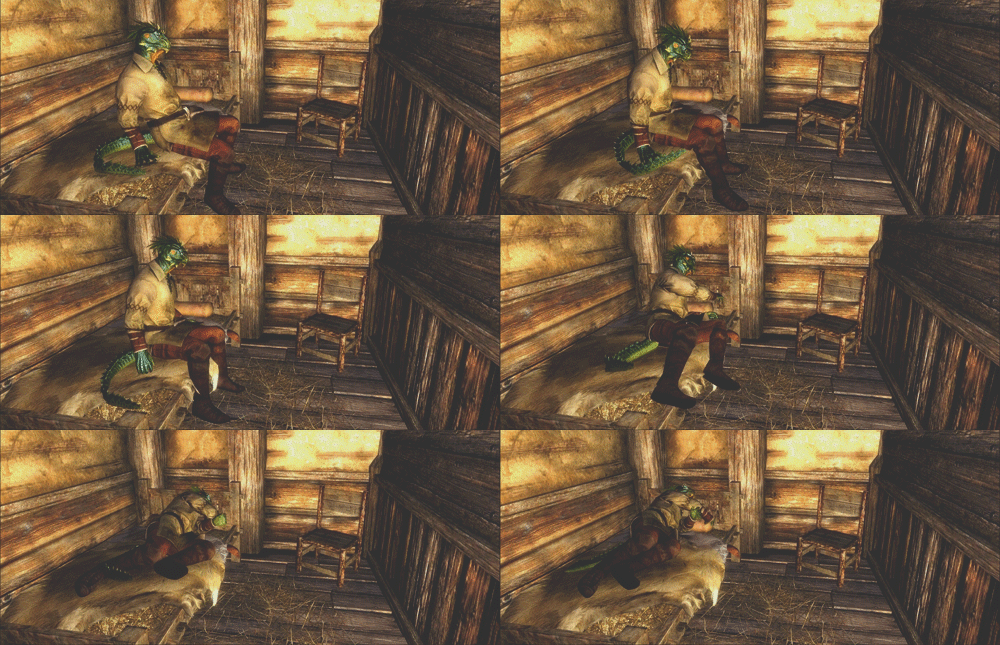
This is the type of cat that would try to sell me magical potions in the woods.
I’d buy them all.
khajiit has wares
Com tantas referências disponíveis no universo da bazingagem cultura pop, o que aconteceria se um artista talentoso decidisse servir uma salada com as misturas mais inusitadas de filmes, desenhos, quadrinhos, etc.? Pois o ilustrador Marco D’Alfonso fez as honras:



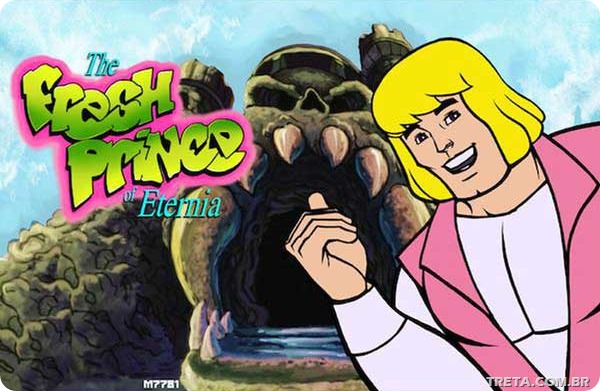


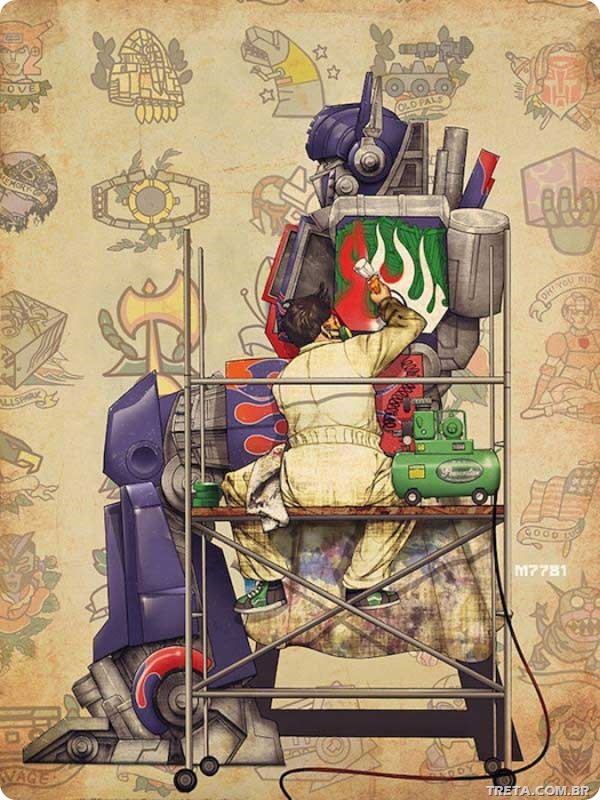


CLIQUE AQUI para ver todas mais ilustrações da série!
Salada de cultura pop foi publicado originalmente no TRETA.
Shorter Republicans 2010-2014: “The ACA will not reduce the number of people without health insurance. Indeed, it might make this problem we don’t consider a problem worse.”
Shorter Republicans 2015: “Everyone knew that the ACA would result in a huge drop in the number of people without health insurance — what does that prove? Besides, how can we really know that it all isn’t a big coincidence?”

We’re getting close to the time of year when Matt Miller and Tom Friedman will start writing a column every couple of weeks arguing that there needs to be a third party and/or independent candidate that agrees with him about everything. But in case you can’t wait, Taegan Goddard has decided to fill the void:
This unbundling trend gives consumers more choices at lower cost. And it raises an intriguing question: What if our politics could also be unbundled?
The start of the piece seems particularly appropriate. The column is not merely appropriating Tom Friedman’s ends, but his hilariously illogical argumentative means. “There’s a stock market bubble. There’s bad corporate governance, which is not really a bubble. Then there’s terrorism, which is nothing like a financial bubble at all. In conclusion, let’s blow a lot of stuff up, which I believe is how the Dutch stopped the tulip bubble.”
Similarly, this “unbundling” stuff is irrelevant to anything. Parties are coalitions. Even a PR system wouldn’t guarantee that you could vote for a viable party that agreed with you about everything, and they would still need to form alliances with parties you don’t agree with about other things to exercise power. And since we don’t have a PR system, the fact that you can now stream baseball games over the intarwebs does not mean that you’re going to be able to vote for a viable “What a Special Snowflake You Are” party.
What constituency, precisely, does Goddard think needs to be represented by another party? Culturally traditionalist economic populists? Haha no:
After all, most Americans don’t want the complete package of candidates and public policies offered by the two major political parties. They might like to pick and choose — a more liberal position on gay marriage, a more libertarian stance on drones, a rather conservative take on taxes, and so on…
[…]
If a voter agrees with Democrats on social issues but with Republicans on tax and budgetary issues, it’s unlikely there will be a good choice on Election Day. The two major political parties are putting forth precious few candidates who fit that profile.
As is almost always the case, when mainstream pundits call for a third party, they want a party that reflects a combination of views that is massively overrepresented among elite journalists but have little public constituency. The fact is, there just aren’t that many people who strongly support same-sex marriage and reproductive rights and believe that spending for the poor should be massively slashed to pay for upper-class tax cuts. If you want one of the parties to reflect these views, then you need more adherents.
So what’s the mechanism by which Goddard wants to use to establish a “let them eat same-sex marriage” party? Electoral reform?
So how could we unbundle American politics? Interestingly, it’s super PACs — those secretive, big-money groups widely accused of ruining our politics — that could help with the Great Unbundling.
We’re already seeing super PACs beginning to erode the power of the political parties. Some super PACs are taking over major functions of campaigns. And it may soon be possible that a super PAC could run the entire campaign with the candidate not needing a party at all. It’s not outlandish to imagine a super PAC whose interests aligned with a millennial-friendly, libertarian-lite candidate who was liberal on social issues, dovish on foreign policy, and conservative on economics.
1)Rich people swamping politics with money — what could possib-lie go wrong? 2)Parties are pretty much stronger than ever.
Now, admittedly, the near-end of campaign finance regulation in America will have the net effect of pushing politics in the more libertarian direction that Goddard prefers, but this has nothing to do with “unbundling” or offering voters more choice. It reflects the fact that when rich people can spend as much money to influence politics as they want political outcomes will be more consonant with the preferences of rich people. But Chromecast amirite?
The floor plan of the White House recently made headlines because of a subtle change that’s caused a bit of a stir: it now features a gender-neutral restroom. Just one. But one was enough to make headlines. Many people don’t think twice about which restroom to use in public. Some people’s choice, however, is more of a dilemma than you might assume. Many transgender individuals struggle with the restroom issue in public settings. And this is an issue that forces cis-gender folks to confront deeply held beliefs about a gender-segregated setting—beliefs some may not fully realize they hold and many may be ill-equipped to discuss.
Making use of a public restroom is not often understood as a political act. Yet, a group of transgender folks in the U.S. and Canada are participating in a bit of digital activism by doing just that. It’s a quiet social movement, but it’s already gained some media attention. Pictures posted alongside the hashtags #Occupotty, #WeJustNeedToPee, and less often #LetMyPeoplePee on all manner of social media are starting a much-needed conversation about gender in and around public restrooms.

Brae Carnes, a transwoman in Victoria, depicted here using a men’s public restroom to raise awareness about what discriminatory legislation associated with “bathroom bills” would actually look like in practice.
Brae Carnes is a transgender woman living in Victoria, Canada whose photo-activism went viral when she posted an image of herself applying lipstick in a public restroom with a line of urinals against the wall behind her (see left). Brae told reporters at the Times Colonist, “I’m giving them what they want… I’m actively showing them what it would look like if that became law and how completely ridiculous it is” (here). And Brae is not alone. Michael Hughes, a transgender man living in Minnesota, also caused some digital waves when he posted a series of pictures of himself in women’s restrooms with captions like: “Do I look like I belong in women’s facilities?” (see below). Brae and Michael are part of a vocal group of trans* rights activists opposing legislation that would force transgender people to use the public restroom facilities associated with their birth gender (the sex they were assigned at birth). So-called “bathroom bills” are being introduced in the U.S. and abroad, and #Occupotty is an important challenge to the proposed legislation.
 Those introducing bathroom bills most often justify them as being about “protection,” “public safety,” and as attempts to reduce violence and assault. The bills rely on the transphobic myth that transgender individuals are sexually perverse and that they are likely to be sexual predators. Thus, defenders of these bills often claim that they are about protecting cis-gender people. This avoids the troubling truth that transgender individuals are far more likely to have violence committed against them than they are to commit this kind of violence against others. Indeed, Media Matters found no evidence to substantiate the claim that restroom sexual assaults were higher in trans-inclusive jurisdictions. One survey of transgender and gender non-conforming individuals in Washington D.C. found that 70% of respondents reported having been either harassed in, assaulted in, or denied access to public restrooms (see here). It’s an important issue and Brae Carnes and Michael Hughes are helping to draw more attention to the lives that hang in the balance.
Bathroom bills portray trans* persons as sneaky and deviant and as attempting to trick the rest of us into using a restroom with them. But, as Mic.com reported, there have been zero reported attacks on cis-gender people by transgender people in public bathrooms. All of the documented attacks victimized trans* persons. So, why is the conversation about transgender people committing violence rather than about protecting transgender folks from cis-gender violence?
This is an instance of what Laurel Westbrook and Kristen Schilt call a “gender panic”—situations in which people collectively react to challenges to biology-based ideologies about what gender is and where it comes from by attempting to reassert those ideologies. Bathroom bills produce just this type of ideological collision where biology-based ideologies and identity-based ideologies are pitted against each other in public discourse. Inside this ideological discord, we gain new information about the gender binary, gender inequality, and how our beliefs about gender difference take a lot more work to uphold than we may assume.
Bathrooms are intensely gendered spaces. The belief that men and women, boys and girls, ought to relieve themselves in separate rooms is a powerful illustration of our collective investment in gender differences. But, sex-segregated bathrooms are a matter of social preference and organization rather than being recommended by our biology. And when we attempt to resolve this gender panic by resorting to biology (such as introducing legislation mandating the criteria of “birth gender” for public restroom use), we continue an awful tradition of putting transgender people at risk of violence under the guise of protecting “us” from “them.” But, social scientific research shows that we are in far greater need of policies that protect “them” from “us.”
Bathroom segregation is a political issue and one that deserves academic and public feminist support. The proposed legislation relies on myths associated with cis-gender and transgender people alike. Whether motivated by hate or misunderstanding, these laws fail to acknowledge well-documented facts about violence against transgender people, and in doing so, play a role in perpetuating continued violence and discrimination against transgender people. #Occupotty is a political statement and a request for recognition and rights. But these brave digital activists are doing more than that, too. They are exposing a set of myths that also work to justify gender and sexual inequality. Whether openly acknowledged or not, it is for this reason that #Occupotty meets resistance and it is for this reason that it deserves more support.
#TransLivesMatter


Protests for Freddie Gray in Baltimore (photo by Manon Wilkes/Instagram)
One photojournalist was beaten by Baltimore police and another detained on Saturday night during protests in the wake of the death of Freddie Gray. Gray, 25, was violently arrested on April 12 and died a week later in police custody; Baltimore police have acknowledged their mistakes in the handling of Gray but still have not answered key questions about the incident — like how Gray’s spine became “80 percent severed at his neck.”
J.M. Giordano, photo editor for the Baltimore City Paper, was tackled by police officers on Saturday night while covering the protests, after someone nearby threw a rock at the police line. “They just swarmed over me. I got hit. My head hit the ground. They were hitting me, then someone pulled me out,” he told the City Paper. Several police officers hit Giordano in the head with their shields, and his “face [was] pretty much smushed down on the ground,” the Baltimore Sun reported.
In a video of the incident shot by City Paper Managing Editor Baynard Woods, you can see police manhandling and hitting Giordano, who wears a green jacket, while Woods yells, “He’s a photographer! He’s press!” While at the time the desperate yelling asks police to recognize Giordano as an exception, watching the video after the fact seems to chillingly underscore that no one should be treated by the police that way — neither a photographer nor a protester.
Photojournalist Sait Serkan Gurbuz, who was covering the protest for Reuters, was also detained by the Baltimore police around the same time as the incident with Giordano — perhaps even for photographing it, according to the Baltimore Sun. Gurbuz was released but issued a citation for “failure to obey orders.”
“Serkan was on a public sidewalk and the events were happening in plain view. We do not agree with the police’s citation for ‘failure to obey orders,’ as Serkan backed away from the scene when the police demanded that he do so, or with the way in which he was treated by the police,” a spokeswoman for Reuters told the Sun.
A spokeswoman for the Baltimore Sun Media Group, which owns the City Paper, took a somewhat lighter tone in her statement regarding Giordano: “We take seriously the right of the press to fairly and accurately cover events such as the protests that occurred yesterday in Baltimore. We are looking into the incident and are reaching out to the Baltimore Police Department to begin a constructive dialogue to express our concerns about what happened to our photographer.”
Although much national news coverage of the Freddie Gray protests in Baltimore has focused on a narrative of “chaos” and “violence,” photographs of this past Saturday’s protest that were published on Bmore Art show a completely different view — one of hundreds of people marching peacefully as they demand justice.

(gif via Giphy)
The Obama administration is looking into ending a tax break that has been heavily exploited by buyers and sellers of art. Referred to as a like-kind or 1031 exchange, for the section of the United States Internal Revenue Code section in which it appears, it enables investors in assets like real estate, art, and other collectibles to put off paying state and federal gains taxes on income from the sale of a property by immediately reinvesting it in a similar asset.
So, for instance, a collector who made $10 million on the sale of a Georgia O’Keeffe painting would normally owe $2.8 million of that gain to the government. However, by reinvesting those $10 million in a Cy Twombly painting (within the 180-day window for like-kind exchanges), the collector would defer paying any taxes on the gains from the sale of the O’Keeffe. The exchanges and deferrals can be compounded across multiple sales — our hypothetical collector could continue to avoid paying taxes on the gains from the O’Keeffe by immediately using funds from the sale of the Twombly to buy a Jasper Johns. (Interestingly, the law is considered to be medium-specific, and would not apply if gains from the sale of an O’Keeffe painting were used to buy an Alberto Giacometti sculpture.) Collectors may avoid paying capital gains taxes on sales of art entirely by keeping the works bought with the proceeds from an earlier sale until they die, or donating them to museums.
As the New York Times reports, the Obama administration’s revision of the law in its proposed budget for the fiscal year 2016 would limit the amount of capital gains from the sale of real estate on which tax payments could be deferred to $1 million and do away completely with the tax break for sales of art and other collectibles. The administration estimates that this change to the revenue code could bring in a total of $19.5 billion over the next decade in taxes that would otherwise be deferred or avoided.
“What we are seeing is yet another sophisticated federal tax avoidance scheme,” Ron Wyden, the Senator from Oregon and the Senate Finance Committee’s top-ranking Democrat, told the Times. “Some people are exploiting this tax provision as an estate planning tool to help them transfer wealth.”
There are no specific numbers for the taxes that art collectors avoid paying through the like-kind exchange scheme, but Suzanne Goldstein Baker, a lawyer for Investment Property Exchange Services and former president of the Federation of Exchange Accommodators (FEA), told the Times she handles exchanges involving hundreds of artworks every year. According to a study by Ernst & Young commissioned by the FEA, repealing the 1031 exchange law would result in an $8.1-billion drop in US gross domestic product (GDP) and “is at cross-purposes with some of the objectives of tax reform.”


 facebook
 reddit
 I now return to the critical project of covering the often-ridiculous official stuff of all 50 U.S. states, and, I have now decided, all our non-states as well. This time, it's the District of Columbia. Although D.C. only has four official things (at most), each one deserves some explanation.
As you probably know if you don't work for the TSA, the District of Columbia is a part of the United States although it is not itself a state (for some purposes). What is it exactly? Well ... it's a district. Um ... it's like a state, but not represented in Congress. Well, they have a representative but she doesn't get to vote. What? Yes, they have to pay taxes. No, I see nothing incongruous about subjecting residents of the U.S. capital district to taxation without representation. Now, move along, please. Nothing to see here.
It's nice. It is said to be modeled on the Washington family's coat of arms, back when they lived in England, a place where they had a civil war once over the issue of taxation without representation (among other things). Speaking of which, D.C. passed a bill a while back that would have added the slogan "No Taxation Without Representation" to the flag, said slogan to be removed from said flag when D.C. voters "are able to vote for 2 Senators and one Representative with full rights and privileges in the Congress of the United States." D.C. Code § 152(d). Evidently the mayor chickened out and wouldn't approve it, so the act never took effect. It's in the code, though.
D.C. did propose "No Taxation Without Representation" for the motto that would be on its quarter—you remember how all the states got one of those and could put whatever they wanted on it? Yeah, not happening, said the U.S. Mint. Too "controversial." Man, bad enough that you aren't a state and can't vote, but then your quarter gets vetoed by the Mint? Depressing.
Also, at least for now they have let D.C. put the slogan on its license plates. So there is that.
In 1898, workers found a dinosaur bone when digging near 1st and F Streets SE, and gave it to the Smithsonian. It is only part of a vertebra and apparently does not fit any known species, and although somebody did give it a Latin name in 1911 (Creosaurus potens), the official scientific position is that it is "either an indeterminate theropod or some [other] form of saurischian dinosaur." It remains in the Smithsonian Museum of Natural History today.
One hundred years after its discovery, some grade-schoolers decided that it would be cool if this dinosaur was called "Capitalsaurus" and was D.C.'s official dinosaur. The D.C. Council promptly caved, and the "Official Dinosaur Act of 1998" declared Capitalsaurus to be just that. See D.C. Code § 1-161.
Problem: at the time, there was no "Capitalsaurus." There was a bone that might or might not belong to an Indeterminate Theropod, but whatever it was there was no dinosaur by that name. So, back to the drawing board. In this 2001 resolution, the D.C. Council formally named the Unknown Dinosaur "Capitalsaurus," made it an official symbol, and decreed that the 100 block of F Street SE would be known as "Capitalsaurus Court." I fully expected to find that the Council had totally blown off this last part, but I stand corrected:
Problem: the D.C. Council is not exactly a recognized official scientific dinosaur-naming group. That might not bother you, but the the killjoy scientists over at the Smithsonian are clearly quite miffed about the whole thing:
The [1898 bone] consists only of the centrum (base) part of a vertebra of what is now considered to be either an indeterminate theropod, or some form of saurischian dinosaur. Unfortunately this specimen was used to try and name a new genus, “Capitalsaurus,” in honor of the nation’s capital. This is not scientifically justified and the name “Capitalsaurus” has no validity.
Oh, pooh. Well, sorry, kids. You can't have the dinosaur, or the quarter, but you know what you can have? Taxation without representation. Ask your parents.
The statute that establishes this one (D.C. Code § 1-171) notes that the cherry is "symbolically associated" with George Washington because of the story about the cherry tree (a story that isn't true, told to make a point about honesty), the Cherry Blossom Festival every spring, and the opinion of Mr. Bunton's class at Bowen Elementary School.
As far as I can tell, nobody has shot this one down yet.


Gender is socially constructed – I guess anyone wanting to read a blog with “feminist” in the title is probably going to agree to some extent with that statement. But what exactly does that mean?
I’m going to put my child development head on, and draw from my learning as a children’s counsellor, to help bust through some of the false assumptions that arise about “social construction”.
The most important thing to know about children’s social learning can be exemplified by how to teach a child to say “thank you”. It turns out that one of the best ways to teach them is to say thank you to them, and in front of them, as much as possible. Telling children to say it without modelling it to them, turns out to be a really poor way of teaching them. In other words, children learn best by watching what others do, not by being informed what they should do.
How is this relevant to gender? Because likewise, children learn how to “do” gender via their social interactions, not by being told. So, as many trans people will attest, telling a female-identifying child who was assigned male at birth how to perform her gender, will have less effect on her than you might think – she may be told to “man up” by the people around her, but meanwhile, she is watching the women and girls around her, and as someone who identifies with that gender, she will be influenced by them as much if not more than she will by direct messages about how she should behave.
Trans girls often want to wear pink and purple, for example, because society is modelling to them an image of pink and purple girlhood.

This is why it is important not to make an essentialism out of gender construction. When we argue there is something fundamental and essential in itself about having been raised a boy or girl, we are suggesting that gender socialisation is universal and uniform. This would lead to an absurd conclusion: in a society that treats women as inferior, if childhood socialisation is absolute, strictly follows our (assumed) chromosomes, and is irreversible, then women can never overcome their social programming.
This is nonsense, of course. Our socialisation is varied and changeable, not fundamental. If this were not true, all people would be walking stereotypes of their assigned gender.
As feminists we might be drawn to a compromise position where female socialisation is partial and can be overcome, but male socialisation is insurmountable. But that would simply be bad science.
Trans children also have a very different socialisation experience from cis children because they are often gender non-conforming. Their vulnerability and social exclusion as a result of this is evidenced by the fact a higher proportion of trans children are sexually abused than the already alarming percentage of cis girls. Socially marginalised kids are vulnerable to being targeted by bullies and predators; a trans girl’s childhood is therefore unlikely to be one of typical cis male privilege.
The inequality and misogyny in our society also ensures that assigned male children who are are attuned to women’s social cues rather than men’s will be punished far more severely than “tomboys”. Trans girls and feminine non-binary people often face transmisogynistic violence because of this.
Most trans women I know accept that at times they have benefited from male privilege pre-transition for passing as male, but equally a person with black African heritage and pale skin can pass as white and benefit from white privilege, but this does not make them white. The psychological experience of that person and the impact of the racism that they see in the world will be entirely different than for a white person. We can’t equate one civil rights issue with another, but there is a comparison to be made here with trans women, who experience themselves as women and are bombarded with misogynistic messages they internalise, just like other women.
Why do trans people perceive ourselves the way we do? We don’t know for sure. We suspect it is a hormonal effect, but we have no conclusive proof yet of how or why we exist. But we do exist. That there have been people wanting to live as a gender different from their assigned sex throughout history and across many cultures is a fact we cannot deny. How we understand ourselves is ever-evolving.
Let us settle this – trans people do not experience a socialisation process that is normative for their assigned sex, and very often trans people have a considerable amount of socialisation patterns in common with the opposite sex to the one they were assigned. Because these socialisation patterns bed in very early in our lives, while our brains are still forming, they are very much a part of who we are as people.
Where we get stuck, of course, is that nobody is a walking stereotype, and trans people, just like everyone else, will have a blend of gendered characteristics. Sometimes, it is easy to say that the behaviours that match their assigned sex are more “essential” and those of their identified sex more “performed” but this erases the fact that all people are performing gender, and we are all constantly renegotiating our relationship with the rules of gender handed to us by society. We cannot hold trans people to a higher account than we hold the rest of humanity.
We all need to be constantly questioning and examining our relationship with gender, and the assumptions we make. Trans people are as capable as anyone else of both confounding and perpetuating gender stereotypes. Changing the way we “do” gender is about how we challenge the ideas we advertise and model to all children – we do not need to put trans kids under any special scrutiny as they will simply reflect norms in gender socialisation that all other kids of their identified sex will be experiencing.


Excellent points from Michael Cohen about the Wikileaks posting of private data from Sony Pictures:
What a victory for transparency that these critically important stories are now in the public domain!
That’s what Wikileaks and its click-obsessed enablers in the media would like you to believe. But in reality, data dumps like these represent a threat to our already shrinking zone of privacy.
Wikileaks justifies its actions by arguing, on its website, that “the Sony Archives offer a rare insight into the inner workings of a large, secretive multinational corporation.” Sony has “ties to the White House,” the group claims, and “connections to the US military-industrial complex.” The company even lobbies on issues like “Internet policy, piracy, trade agreements, and copyright.”
This flimsy rationale, which could apply to any company in America whose businesses intersect with public policy, could potentially put millions of Americans at risk.
If Wikileaks were merely revealing hidden truths about a company’s vast influence on politics, perhaps the group would be on solid ground. Some media outlets, including the Globe, have noted ways the leaked e-mails shed light on our relationship with history and race. The problem is that surrounding these needles of information is a giant haystack of Sony employees, whose private information is now being splashed all over the Internet.
Using these links to launch sexist insults at people compounds the problem. (And to state what should be obvious, sexist attacks on wealthy women are nonetheless sexist.)

Naming your kids after John Wilkes Booth. Now that takes some hate.
Dozens of Lincoln’s enemies honoured his assassin in the same manner as the Devrees family. A quick search via the Federal census records on the Ancestry website reveals roughly a hundred American families who appear to have named children after Booth in the post-war years. Unsurprisingly, about 90% heralded from the southern states, but a small handful, like the Illinoisans, were northerners – probably ‘Copperhead’ opponents of the Union cause seeking solace in small acts of defiance. Most of the northern Booths came from counties close to slaveholding areas – places where sympathies for the Confederate cause ran deep – and I haven’t found a single instance of a postwar New Englander (citizens of the old antislavery heartland) sharing a name with Lincoln’s killer. Notably, in borderlands like Missouri – where neighbour clashed with neighbour and the Federal government fought to contain dissent – the practice was particularly common. Some of the records leave little to the imagination when it comes to the parents’ political loyalties (John Wilkes Booth Sharp, born in Georgia, circa 1871), but others (Washington Booth Stamton, born in Baltimore, circa 1871) hint at an attempt to induct Booth into a pantheon of American heroes. The true heir to the father of the republic, the latter implied, was the actor-assassin, and not the martyred president.
These families, in preserving the memory of Lincoln’s killer, were writing a history of the Civil War in which liberty was the victim rather than the victor. As late as the 1890s the odd new-born in the South was given Booth’s name, though the practice seems to have become less common after the restoration of white supremacy in the 1870s. This may be a result of changing enumeration practices, but it might owe something also to the late nineteenth-century “reconciliationist” remembering of the Civil War as a noble struggle between two valiant adversaries, and not as an ideological conflict over slavery, race, and citizenship. The first professional historians writing around the turn of the century cast Lincoln as a magnanimous commander-in-chief whose slaying served as an excuse for the imposition of a supposedly Carthaginian peace on the Confederacy. Booth here was no longer the defender of liberty but a man whose rash crime ushered in the phantom horrors of Reconstruction. It might have been unwise to use his name.
I’d love to know how many–if any–went by their names in adulthood. One has trouble imagining being named after John Wilkes Booth being good for one’s employment prospects or social connections.
A comment from elsewhere on the Internet:
“Certainly the most puzzling part of the Sad Puppies campaign is the claim that Scalzi’s works are too literary to represent the mainstream of SF. That’s like saying a group of food critics are too snobbish because they ranked Arby’s above McDonalds.”
Reader, I LOLed.


We all understand that if a dominant top doesn’t like the way their scene is going it’s on them to steer it in a direction that makes them (and obviously everyone they’re playing with) happier, right? They’re the one running the show, it would be ridiculous for them to blame the sub for not magically knowing what they wanted, wouldn’t it? And if they did, the sub would probably not bother speaking to them again because they’re obviously a complete fucking tool.
So why do we let dominant bottoms get away with blaming their partners because they’re incompetent at running a scene? Okay, stupid question. We let them get away with it because so few dominant bottoms are self aware enough to know they’re dominant and it’s so easy for women in particular to be manipulated into thinking it’s our fault when things go wrong. Maybe I’ll reach douchebag dominant bottoms with this post and maybe I won’t, but I’m hoping this will at least be comforting to the tops who are being blamed for not dominating “correctly” when the problem is the supposed “submissive” doesn’t actually want to be dominated at all.
Dominant bottoms have no one to blame but themselves if the scene doesn’t go the way they were hoping. You’re the fucking dom. If the scene isn’t doing it for you, learn to fucking steer. Making your sub (let’s be honest, if you want to run the scene to your exact specifications you need a submissive partner or a very well paid professional) try to read your mind is mean, lazy, and setting them up for failure in the non-fun way. This is what I mean by “incompetent at running a scene.” I’ll freely admit that steering a scene while making it look like you’re not in control is more complicated that simple domination from the top, but you still don’t get to blame other people for your failings.
On the upside, the fact that it’s your fault your scenes aren’t working the way you’d like means you have the power to fix it. First of all, you have to admit that expecting someone to read your mind is total douchebag behaviour. If having a scene play out the exact way you fantasized about is really important to you, write it down and give your partner the fucking script ahead of time. I am absolutely serious: write it down, give your partner the script, and rehearse (and, uh, date a theatre geek if at all possible). While you’re writing down that script and rehearsing it, you might also spare just a second or two to think about how much work you’re asking your partner to do and how utterly unreasonable it would be to expect them to magically intuit the pages and pages of dialog and actions that they’re trying to memorize.
If you’re not as attached to acting out a pre-scripted fantasy, you can teach your partner to read you/which types of interactions do it for you/what sort of persona does it for you. This will be a lot of work for both of you and you’ll probably have to spend huge amounts of time talking out what worked and what didn’t, but working with your partner to teach them how to play their role in a way that works for you is pretty much the only way you’re going to get what you want. I mean, you can hold out for the woman who, by some amazing coincidence, just happens to like topping in the exact way you like, but that’s about as likely to work as planning to retire by winning the lottery.
Sure, this all goes against the fantasy that you’re actually submissive, but do you want to cling to the fantasy or do you want to have scenes that you really enjoy? This actually isn’t that different from what people who are actually submissive go through when they negotiate a higher-risk scene like a take-down. Any responsible dom will insist on very thorough negotiation before doing anything that could go horribly wrong, even up to the point where the submissive starts worrying that they’re dictating exactly what the dom is going to do. If submissive people can negotiate a scene that works for them, you can goddamn well do it too.
The one thing I really want to say to unaware dominant bottoms is stop fucking blaming the sub when you didn’t teach them how to please you! If you can’t have fun unless things are going your way (which is totally normal, I’m a control freak too), then it’s your job to make things go your way. It’s not exactly unheard of for people to enjoy getting a reaction out of their play partner – if you can tell them exactly how to get that reaction, you’re actually saving them a lot of stumbling around in the dark. You do need someone who’s willing to take orders, but I hear there are a few of those people in the kink community 
For people who are trying to make an unaware dominant bottom happy, the one thing I really want you to know is it’s not your fault. You’re not a bad top, you’re not stupid, you’re not doing it wrong. If your partner isn’t fully honest with you about what they want, how the fuck are you supposed to give it to them?
Content warning: This short film contains extreme transmisogyny, a hostile mob, violence, and is disturbing.
The film has a style of editing that makes it difficult to watch, even apart from the content; if the editing makes it hard to watch for you, turning the volume down or off may help. (It’s subtitled.) If the content makes it hard to watch, well, then you’re a decent person.
Tom Hawking of Flaverwire summarizes the film:
“…A camera [follows] a woman as she walks through a public space, recording the reactions of the members of the public she encounters. In this case, the woman is Pierce and the space is Myrtle Beach, South Carolina. Pierce certainly cuts a striking figure. She’s wearing a skimpy blue dress and neon yellow heels, and most strikingly, her face is entirely covered by a reflective mask. She’s also of apparently indeterminate gender; much of the video involves passersby trying to work out if she’s a cisgender man or woman, or a trans woman, or what. (I actually have no idea what Pierce’s gender identity is, which is kind of the point.)
The results are, as one might expect, pretty depressing. People seem genuinely terrified by her — several times groups of people scatter as she walks toward them, and at one point a girl shouts, “Oh hell no, don’t walk this way!” As the film progresses, the reactions become more violent — she has water thrown on her, someone attempts to trip her, and eventually she is pushed head-first into the pavement. Notably, all the acts of violence against her are carried out by women. The film ends with a sort of survey of her body, lingering on the blood streaming from the knee she gashed open when she hit the ground.
And a statement from the creators:
American Reflexxx is a short film documenting a social experiment that took place in Myrtle Beach, South Carolina. Alli Coates filmed performance artist Signe Pierce as she strutted down a busy oceanside street in stripper garb and a reflective mask. The pair agreed not to communicate until the experiment was completed, but never anticipated the horror that would unfold in under an hour.
The result is a heart wrenching technicolor spectacle that raises questions about gender stereotypes, mob mentality, and violence in America.
A few points:
1) In the comments at Pharyngula, “Janine” comments:
Just watched the film and I am still processing it. But I will say this, while I do not dress to call attention to myself and while I never had a crowd of people howling at me like that; I have heard everything shouted in that video shouted at me at some point.
Every single one.
… the editing, the stutter shots and the slowed down version of that rape anthem is all an attempt to show the disassociation that the person was feeling. When one is being yelled at and being assaulted, one sense of time and perception becomes distorted.
2) And in the same comments, “Caitiecat” writes:
And before anyone gets all righteous about how crappy the US is, you could shoot that same video in almost any city in the world, and it’d go the same way. I’ve encountered this kind of abuse in Canada, the US, the UK, France, Hong Kong and Thailand, also known as “every country I’ve been to since transition”.
3) The mirror-mask is interesting. It serves a bunch of functions: It implicitly says “you are the subject of this film, not me,” both to the people Pierce encounters, and to the viewers watching the film. It makes Pierce more gender-ambiguous. It draws attention to Pierce. A writer at Nylon comments, “Only after the deeply unsettling climax does the crowd begin to back off — away from themselves, really, considering the mirrored mask.”
4) In the sequence with the street preacher, I can’t tell if the preacher is responding to her, or is not reacting at all to her and just screaming what he would have been screaming regardless.
5) How different would the crowd have acted if there wasn’t a woman with a camera obviously filming their actions? Maybe some of them were performing for the camera, but I’m sure some would have acted worse if they hadn’t known they were being recorded.
6) The people we see physically attacking Pierce are all women or girls, apart from the guy who paws her right at the start of the video. One girl attacks Pierce three escalating times – first trying to slap her when running by (“I missed!”), then throwing water on her, then trying to trip her. But we can hear at least one man (and maybe multiple men) being warned not to attack her by their friends (“Don’t get arrested for her, man”).
7) “Goblinman,” in Pharyngula’s comments, had an interesting theory as to why the men in the crowd didn’t get violent:
I don’t think the women in the crowd were actually responding more negatively than the men. I think the men were holding back. It means something different, culturally-speaking, when men attack compared to when women attack (especially if we’re talking about a mob mentality). Women attacking someone doesn’t seem as “serious”: Men are “supposed” to be fighters. If the men had started attacking the person in the mask it would have been nearly the equivalent of someone drawing a weapon. It would have escalated things to a much more violent level.
8) A fun fluff-piece about the home of the film’s creators: PAPERMAG Galleries: Inside the Hot Pink Barbie Bungalow of Artists, “Cyberfeminists” and Real-Life Couple Signe Pierce and Alli Coates.
Tell me you’re mine
While you fall asleep
Thoughts scattered,
Mind adrift
Whisper it, with a kiss
And my name
Tell me you’re mine
When passion throws you to the ground
Let it come out, unbridled and unbidden
Escaping your mouth,
A release,
Much-needed.
Tell me you’re mine
As I start to slip away
And the distance is too much
And you feel lost
Use it as a call, to find me,
Seeking you
Tell me you’re mine
In the space between the fights
The bitter puncta that blossom into an ellipsis
Say it!
One last time–
Lie, if you must–
Just.
Tell me?