Shared posts

27 Apr 08:10

Louie, you disappoint me

by SEK

louie8

I can’t think of a better way to win friends on social than to write an article in which I bag on Louie and defend beat cops:

As any television critic will tell you, there are two constants when it comes to televised drama, “cops” and “doctors,” and the current moment is no exception. For example, you have a wide selection of police procedurals to choose from: old hats like “Law & Order: Special Victims Unit”; more family-oriented fare like “Blue Bloods”; shows that are only tangentially about cops, but are still police procedurals, like “Elementary” or “Person of Interest” or “Bones”; and you even have comedies that work within the trappings of the police procedural, like “Brooklyn 99.”

Except none of those are actually “cop shows,” because they’re all about detectives. (Which is, yes, technically a rank, but is conventionally depicted as entirely different profession.) In fact, the majority of shows aren’t about cops at all — they’re about individuals too intelligent or talented to be lowly patrol officers, who have transcended the beat and work in the rarefied world of investigation. That is not to say that uniformed officers don’t make an appearance on these series, because they do, but when they’re not relegated to bit players at crime scenes — the blue drones in the background collecting evidence or being asked to canvas a neighborhood — they’re inevitably fucking up.

This dynamic was neatly encapsulated on a recent episode of “Elementary” — CBS’ loose adaptation of Arthur Conan Doyle’s Sherlock Holmes– in which Joan Watson (Lucy Liu) is asked by the daughter of the New York Police Department’s Captain Thomas Gregson (Aidan Quinn) to assist her in breaking up a ring of thieves hitting up local drug stores. Hannah Gregson (Liza Bennett) is just a lowly uniformed officer, so she seeks out Watson’s help — and Watson isn’t even an actual detective, she’s an assistant “consulting detective” — in order to discover the identity of the thieves, a problem that’s been vexing Officer Gregson for weeks.

Two scenes later, Watson has not only discovered who the thieves are, but how to use them to infiltrate a much larger prescription drug smuggling operation. She hands Officer Gregson a file containing everything she needs to initiate what could be a career-making bust, and what does the beat cop do? She immediately arrests the low-level operators, thereby allowing those running the criminal enterprise to go to ground. Why does she do this? According to her own father, Captain Gregson, it’s because she’s not that bright — she settled for the small score because her beat-cop-brain isn’t capable of conceptualizing the abstract connections required to take down a smuggling ring.

“She is what she is,” Captain Gregson tells Watson. “I love her, but I love this job too, the people who can actually do it.” And on that note, the episode fades to black, as if it’s a fact of precinct life that current uniformed officers just don’t have what it takes to make detective. There is a reason that television prefers its “cop shows” to follow detectives, and that’s because there’s an inherent narrative to the life of a detective, especially when they work in homicide — a life is taken, an investigation into who took that life ensues, discoveries of varying relevance are made and, if everything works out, a criminal or criminals with their own tales to tell is sussed out…

Believe it or not, that is just the beginning.

27 Apr 08:08

Homophobia, Racism and Misogyny–3 Crappy Tastes that Taste Crappy Together

by bspencer

Often we like to think that when it comes to LGBT rights we’ve come a long way and done so relatively quickly. But these links should remind us that we have to stay vigilant in fighting for those rights.


Ryan T. Anderson has that not-so-fresh feeling.

27 Apr 08:07

Black Widow

by Robert Farley

Here are Chris Evans and Jeremy Renner talking about how much of a slut Black Widow is:

And here is my five year old daughter in her Black Widow costume, from last Halloween:
IMG_2798

And so yes, Mr. Evans and Mr. Renner; I acknowledge that your apology was necessary.  It would surely be helpful if Marvel, and the actors associated with Marvel, recognized the possibility that young women might enjoy their product as much as young men. It would also be nice if the people associated with Marvel would come to grasp that there are many interesting things to say about female superheroes beyond their ability to sexually service male superheroes. Let’s hope that some kid in a Captain American costume doesn’t see this and think it’s appropriate to refer to a girl in a Black Widow costume as a slut.

27 Apr 08:06

Explore a Surreal Performance Parody of Google Street View

by Allison Meier
A curious scene on Rue de la Biche (Doe Street) in 'Mons Street Review'

A curious scene on Rue de la Biche (Doe Street) in ‘Mons Street Review,’ an online art experience using the technology of Google Street View (all screenshots by the author for Hyperallergic)

Over the course of six weeks and with a cast of hundreds, a Belgian theater company seized control of over six miles of streets in the city of Mons to stage surreal spectacles including flying kayakers, crowds of angels, and a taxidermy deer transforming into a donkey. The resulting work, Mons Street Review, is an online experience sourced from these performances, all captured with a 360-degree camera riffing on the style of Google Street View.

Mons is the 2015 European Capital of Culture, and Mons Street Review was launched in January. Created by Ludovic Nobileau with his Xtnt theatre, it references the city’s mining past, history that goes back to the Middle Ages, and its future as the location of a Google data center, while also celebrating public space. As Nobileau told Le Soir, it was important that they show the streets’ “democracy, that they’re for everyone.”

Map overview of 'Mons Street Review'

Map overview of ‘Mons Street Review’

Kayakers flying in 'Mons Street Review'

Kayakers flying in ‘Mons Street Review’

Xtnt specializes in playful but bold street interventions, such as bravely marching into the terrifying traffic circle around the Arc de Triomphe in Paris to create a human crosswalk so pedestrians didn’t have to take the underground passage. They had an almost obscene amount of fun with Mons Street Review, and as you click through the interface, narratives progress in which people in ghillie suits crawl through grass installed on La Rue Verte (“the Green Street”) or a deer appears in the night on the Rue de la Biche (“Doe Street”). All the materials are simple, whether flying feathers, a river made of bubbles for a boat, umbrellas opening and closing, or people holding up words on the street, but each digital step forward reveals something surprising and strange. The collapse of one of Mons’s marquee installations for its 2015 capital year — “The Passenger” by Arne Quinze” — has the kind of grandiose absurdity that actually would fit in perfectly with Xtnt’s hijinks.

This Belgian parody of Google’s ubiquitous online navigation tool is a little reminiscent of Jon Rafman using it to catalogue candid and really bizarre moments. Mons Street Review is intended as a portrait of the city, with a miner appearing amid the modern streets and Renaissance soldiers on the move. It’s also a delirious way of discovering a city through the strange scenes unfolding in its public spaces.

Foil flag waving in 'Mons Street Review'

Foil flag waving in ‘Mons Street Review’

Pink and white color action in 'Mons Street Review'

Pink and white color action in ‘Mons Street Review’

Reflections in 'Mons Street Review'

Reflections in ‘Mons Street Review’

A miner appears in the streets in 'Mons Street Review'

A miner appears in the streets in ‘Mons Street Review’

Boating on a bubble river in 'Mons Street Review'

Boating on a bubble river in ‘Mons Street Review’

Feathers flying in 'Mons Street Review'

Feathers flying in ‘Mons Street Review’

A curious scene on Rue de la Biche (Doe Street) in 'Mons Street Review'

A curious scene on Rue de la Biche (Doe Street) in ‘Mons Street Review’

Access Mons Street Review online.

h/t Pop Up City

27 Apr 08:05

Oh, So That’s What’s the Matter With Kansas

by Scott Lemieux

Sam-Brownback-Jose-Luis-Magana-AP

So you’ve wrecked your state with a disastrous experiment in crackpot supply-side economics. What are you going to do now? Why, target the poor, women, and gays and lesbians with gratuitous, discriminatory, and irrational legal disabilities of course.

With respect to the recent Kansas ban on dilation and evacuation abortions, what Justice Stevens said about bans on D&X abortions applies equally to this statute:

Although much ink is spilled today describing the gruesome nature of late-term abortion procedures, that rhetoric does not provide me a reason to believe that the procedure Nebraska here claims it seeks to ban is more brutal, more gruesome, or less respectful of “potential life” than the equally gruesome procedure Nebraska claims it still allows. Justice Ginsburg and Judge Posner have, I believe, correctly diagnosed the underlying reason for the enactment of this legislation–a reason that also explains much of the Court’s rhetoric directed at an objective that extends well beyond the narrow issue that this case presents. The rhetoric is almost, but not quite, loud enough to obscure the quiet fact that during the past 27 years, the central holding of Roe v. Wade has been endorsed by all but 4 of the 17 Justices who have addressed the issue. That holding–that the word “liberty” in the Fourteenth Amendment includes a woman’s right to make this difficult and extremely personal decision–makes it impossible for me to understand how a State has any legitimate interest in requiring a doctor to follow any procedure other than the one that he or she reasonably believes will best protect the woman in her exercise of this constitutional liberty. But one need not even approach this view today to conclude that Nebraska’s law must fall. For the notion that either of these two equally gruesome procedures performed at this late stage of gestation is more akin to infanticide than the other, or that the State furthers any legitimate interest by banning one but not the other, is simply irrational. See U.S. Const., Amdt. 14.

Alas, majority of the Supreme Court thinks that regulations that negatively burden the health and fundamental rights of women without any rational justification whatsoever is perfectly OK, because women are kind of irrational themselves — ask this scientician!

27 Apr 08:04

The Trans-Pacific Partnership and the Democratic Party

by Erik Loomis

TPP_final

Since Obama conned enough Democrats in the Senate to work with the capitalists for fast track authority on the Trans-Pacific Partnership, the debate over the TPP within the Democratic Party has been interesting because other than Obama and senators who are not particularly influential to the public debate like Ron Wyden, there has been almost no support for it. Of course there are very good reasons why most Democrats oppose fast track. Eric Schneiderman, attorney general of New York, discusses one of them in detail, which is the TPP’s potential to undermine state and national laws through the Investor State Dispute Settlement provision.

One provision of TPP would create an entirely separate system of justice: special tribunals to hear and decide claims by foreign investors that their corporate interests are being harmed by a nation that is part of the agreement. This Investor-State Dispute Settlement provision would allow large multinational corporations to sue a signatory country for actions taken by its federal, state or local elected or appointed officials that the foreign corporation claims hurt its bottom line.

This should give pause to all members of Congress, who will soon be asked to vote on fast-track negotiating authority to close the agreement. But it is particularly worrisome to those of us in states, such as New York, with robust laws that protect the public welfare — laws that could be undermined by the TPP and its dispute settlement provision.

To put this in real terms, consider a foreign corporation, located in a country that has signed on to TPP, and which has an investment interest in the Indian Point nuclear power facility in New York’s Westchester County. Under TPP, that corporate investor could seek damages from the United States, perhaps hundreds of millions of dollars or more, for actions by the Nuclear Regulatory Commission, the New York State Department of Environmental Conservation, the Westchester Country Board of Legislators or even the local Village Board that lead to a delay in the relicensing or an increase in the operating costs of the facility.

The very threat of having to face such a suit in the uncharted waters of an international tribunal could have a chilling effect on government policymakers and regulators.

This simply cannot stand. Given how aggressive corporations are increasingly becoming in going after nations who restrict their profits, it’s very much something to worry about. Elizabeth Warren:

Those justifications don’t make sense anymore, if they ever did. Countries in the TPP are hardly emerging economies with weak legal systems. Australia and Japan have well-developed, well-respected legal systems, and multinational corporations navigate those systems every day, but ISDS would preempt their courts too. And to the extent there are countries that are riskier politically, market competition can solve the problem. Countries that respect property rights and the rule of law — such as the United States — should be more competitive, and if a company wants to invest in a country with a weak legal system, then it should buy political-risk insurance.

The use of ISDS is on the rise around the globe. From 1959 to 2002, there were fewer than 100 ISDS claims worldwide. But in 2012 alone, there were 58 cases. Recent cases include a French company that sued Egypt because Egypt raised its minimum wage, a Swedish company that sued Germany because Germany decided to phase out nuclear power after Japan’s Fukushima disaster, and a Dutch company that sued the Czech Republic because the Czechs didn’t bail out a bank that the company partially owned. U.S. corporations have also gotten in on the action: Philip Morris is trying to use ISDS to stop Uruguay from implementing new tobacco regulations intended to cut smoking rates.

ISDS advocates point out that, so far, this process hasn’t harmed the United States. And our negotiators, who refuse to share the text of the TPP publicly, assure us that it will include a bigger, better version of ISDS that will protect our ability to regulate in the public interest. But with the number of ISDS cases exploding and more and more multinational corporations headquartered abroad, it is only a matter of time before such a challenge does serious damage here. Replacing the U.S. legal system with a complex and unnecessary alternative — on the assumption that nothing could possibly go wrong — seems like a really bad idea

If you like corporate control over the world, you’ll LOVE the Trans-Pacific Partnership. The pushback among the Democratic base has some really interesting facets to it because of the question of what Hillary Clinton is going to do here. There is no realistic wedge issue in the primary because there is no meaningful primary regardless of how much Martin O’Malley hopes this can be a wedge issue. But there really could be a real battle within the party over the TPP. Even people such as Matthew Yglesias are noting that all the arguments the administration is making for the agreement don’t really make sense (as for the unions’ opposition which he also says doesn’t make sense, it’s certainly true that there’s nothing keeping the remnant industrial jobs in the U.S. at this point anyway, but unions have to try and stop the bleeding somehow. What else are they going to do? Plus the ISDS provisions could theoretically be used against labor agreements nationally and internationally). So one question worth asking is whether it makes political sense for Hillary Clinton to come out against the deal instead of trying not to provide any meaningful answers about her positions? Certainly doing so would enamor her to the base and really put a stake in any potential primary difficulties. On the other hand, she almost certainly supports the deal and doesn’t want to make Wall Street mad. So I think she’ll probably keep doing what she’s doing. But there is a real risk here because leading senators with national consistencies like Warren and Sanders are going to keep the attack going.

So just from a political perspective this is going to be interesting. As for Obama, he is now engaging in a full attack on his own party over the TPP. The White House blog has been nothing but hatchet jobs in favor of the TPP for a long time, but who really reads that anyway. Obama is now calling up favored reporters to attack Elizabeth Warren and other leading Democrats who oppose the bill. To no small extent, he is wrapping a major part of his legacy up in this bill and he is simply out of touch with working class Americans and the people who elected him president. Obama hasn’t done anything in this agreement to protect everyday Americans. And he deserves the criticism he is getting.

I borrowed the image above from the 350.org petition against the TPP which you can sign here.

27 Apr 08:03

The JVTA: Not Just Bad For Trafficking Victims

by Kate Zen
On Wednesday,the Justice for Victims of Trafficking Act of 2015 [S. 178] passed through the Senate by a unanimous vote of 99-to-0. It is being celebrated as a heroic example of bipartisan cooperation for humanitarian advancement. However, if the bill continues to pass through the House, it will be delivering its system of protection over […]
27 Apr 08:03

sexually broken aj applegate

by admin

Anikka_Albrite-SexuallyBroken_2014-07-19-10_46_21Anikka_Albrite-SexuallyBroken_2014-07-19-10_46_34Anikka_Albrite-SexuallyBroken_2014-07-19-10_46_51Anikka_Albrite-SexuallyBroken_2014-07-19-10_47_02Anikka_Albrite-SexuallyBroken_2014-07-19-10_49_17

Originally posted 2015-04-24 15:57:17. Republished by Blog Post Promoter

sexually broken aj applegate source: droolingfemme.

27 Apr 08:03

Student Accused of Rape by Mattress-Carrying Artist Sues Columbia University

by Jillian Steinhauer
Emma Sulkowicz discussing her project with New York Times art critic Roberta Smith at the Brooklyn Museum (photo by Raíssa Paes/Instagram)

Emma Sulkowicz discussing her project with New York Times art critic Roberta Smith at the Brooklyn Museum (photo by Raíssa Paes/Instagram)

When Columbia University student Emma Sulkowicz began carrying a dorm mattress around campus last September, as both her senior art thesis and a form of protest against the way the school handled her rape claim, she couldn’t have known quite how viral her story would go. Within two weeks, reporters were surrounding her on campus; media in 35 countries covered her and her project, titled “Mattress Performance, or Carry That Weight”; and in January of this year, Senator Kirsten Gillibrand invited Sulkowicz to attend President Obama’s State of the Union address as her guest.

Throughout this all, the proverbial elephant in the room has been Paul Nungesser, the fellow Columbia student who Sulkowicz says raped her but who was cleared in a school adjudication process. Although Nungesser wasn’t named at first, people on campus knew he was the accused, and in December he spoke publicly to the New York Times. That was followed by an extensive piece in the Daily Beast detailing his claims of innocence. Now, Nungesser has filed a lawsuit against Columbia, its board of trustees, Columbia President Lee Bollinger, and art professor Jon Kessler, the AP reports.

According to the full complaint, which Jezebel has obtained and posted online, the lawsuit:

is an action for damages, injunctive relief and declaratory relief against [the defendants] … for their acts and omissions with regard to Paul Nungesser in violation of both federal and state law which have significantly damaged, if not effectively destroyed Paul Nungesser’s college experience, his reputation, his emotional well-being and his future career prospects. This case exemplifies the types of student-on-student and teacher-on-student gender based harassment and misconduct that the Supreme Court has held is prohibited by Title IX of the Education Amendments of 1972 …

Title IX, which prohibits discrimination based on gender, has historically been used to protect the rights of women. In both that passage and the language throughout, the 56-page complaint reads like an effort to rewrite the Sulkowicz story with Nungesser as the central victim. It goes on to allege that Columbia University “knew about the harassment from the beginning, and had the power, as well as the legal and contractual obligation, to protect” Nungesser. Columbia “first became a silent bystander and then turned into an active supporter of a fellow student’s harassment campaign by institutionalizing and heralding it.”

As evidence, the complaint cites the school’s support of the project, including a Columbia-owned website that reproduces Sulkowicz’s assault claim as fact and Bollinger’s personal response to the project. It also reserves special criticism for Kessler, stating that the artist and professor “reignited” Sulkowicz’s “efforts to wreak havoc on Paul’s life.” Kessler “guided Emma in developing the Mattress Project, knowing that her piece was targeted at a fellow Columbia student” — and here the cited evidence is in fact a comment from Kessler published in a previous Hyperallergic story — and “publicly endorsed her harassment and defamation of Paul.”

“Professor Kessler directed Emma to transform her personal vendetta against Paul into a Columbia-sponsored calumny. Under the guise of ‘performance art,’ Professor Kessler and Emma jointly designed her senior thesis project,” the complaint says.

Sulkowicz is not named as a defendant in the lawsuit — “Emma Sulkowicz is merely a footnote to this story,” Nungesser’s lawyer told Jezebel — but she did write to the Times, saying, “I think it’s ridiculous that Paul would sue not only the school but one of my past professors for allowing me to make an art piece.” Hyperallergic reached out to Kessler, who declined to comment. Columbia has offered no comment to the AP or the New York Times.

27 Apr 08:01

[Re-Post from TAS] Why You Shouldn’t Study Sex Workers

by sarah m

Before I finished my B.A., I encountered a social worker who was working on her M.A. Her politics were generally pro-decriminalization, but she also liked to trade in horror stories about women whose vaginas fell out from having too much sex. She had secured the cooperation of a rescue organization that collaborated with police to be allowed to study their Very Marginalized Whores. She wanted my help nailing down her research question.

“Don’t do this study,” I said. “Find something else to research.”

“OMG why are you so mean?” was more or less her answer.

Read the rest of the post here. 

27 Apr 08:01

It "May Appear to Some to Be a 'Rant' of Sorts"

by Kevin

In this Facebook post, Tamah Jada Clark, the author of the now-legendary pleading entitled "To F— This Court And Everything That It Stands For," expresses puzzlement as to why that pleading "has now, apparently, become a 'big deal.'" She also suggests that "there is a lot of ambiguity and confusion as to what exactly has taken place heretofore to provoke what may appear to some to be a 'rant' of sorts."

That may appear to some to be an understatement of sorts.

Clark suggests in the post that she "will take time to address the matter" in the near future, and I'm certainly looking forward to that, but she does offer a couple of justifications. First, she argues that the incident is being exaggerated, saying that the "Notice [To F— This Court And Everything That It Stands For] is one of MANY documents I filed with the court and it only represents less than 1% of what has taken place." I know what you mean. You do everything right and then just ONCE you snap and file a nine-page profanity-filled diatribe telling a federal judge that he "sucks nuts" and should "die," and then they never let you live it down.

Second, she claims that the judge has treated her unfairly all along and, oddly, that the judge has not allowed her to express herself. "This case consists of literally HUNDREDS of pages, that I, myself wrote. But the court will not allow me to say anything on record." Not sure what that means—she has said lots of things on record in other filings, too, and of course she was permitted to file the Notice To F— This Court And Everything That It Stands For. That is on the record.

The record also seems to show that the court was right (or will be) to toss her case anyway. What happened, according to the magistrate's recommendation, was that Clark filed a petition seeking a writ of habeas corpus on behalf of her husband, who is currently in Smith State Prison in Georgia. But she is not a lawyer and so can't represent another person in court. The court pointed this out to her, advised Mr. Clark that he could file a petition on his own behalf, and sent him the form to do so.

The court got back a notice saying that Mr. Clark "[does] not seek a writ ... from this Court" and "[does] not wish to be made party to this or any other habeas corpus action at this time," a notice that was signed by Mrs. Clark and with Mr. Clark's name "By Power of Attorney." It is not clear, the court said "if Mr. Clark personally signed the notice or if [Mrs. Clark] signed his name." This is puzzling, because I'd think most prisoners would be in favor of getting out of prison if possible, and if she did this without his knowledge, why would she torpedo her own petition?

Anyway, Mr. Clark never did file a petition of his own, Mrs. Clark has no basis for habeas relief because she isn't locked up, and she can't represent him because she isn't a lawyer. Case dismissed (without prejudice). Why that warrants what may appear to some to be a "rant" of sorts is hard to explain, but might have something to do with the judge having previously dismissed her $10 billion claim against state officials for wrongfully incarcerating her husband. (She let the statute of limitations expire, among other reasons.) That can make you mad too.

NBC News reports today that rather than calling Mrs. Clark in to explain what "contempt of court" actually means, Judge Hunt has recused himself from the matter "in light of Plaintiff's decidedly vitriolic pleading." But I have no doubt that the judge who has replaced him will adopt the recommendation to dismiss, and that there is another court date in Mrs. Clark's future.

27 Apr 08:01

Steven Pressfield and Impostor’s Syndrome

by Chris Hall

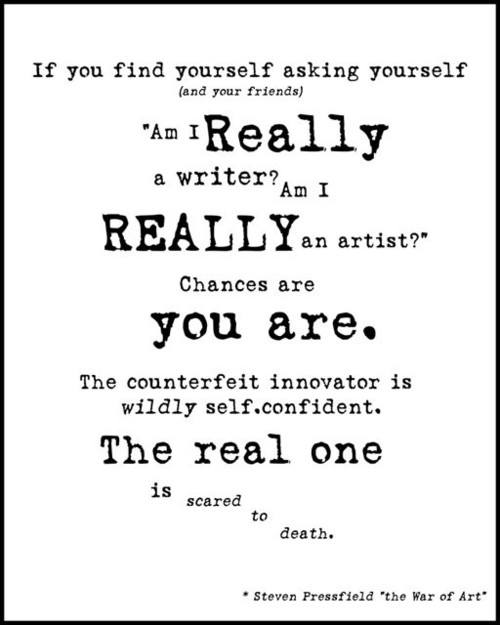
I don’t actually know who Steven Pressfield is, but this quote sums up a lot of my deepest fears, and the monologues that go through my head all the time. Frankly, I often have a hard time believing that anyone looks at my writing with anything other than kind indulgence. I do ask myself this question — Constantly. The trick is that although my brain understands the truth of Pressfield’s quote, my gut doesn’t quite buy it.

Steven Pressfield quote: "If you find yourself asking yourself (and your friends) 'Am I REALLY a writer? Am I REALLY an artist?' Chances are you are. The counterfeit innovator is *wildly* self confident. The real one is scared to death."

“If you find yourself asking yourself (and your friends) ‘Am I REALLY a writer? Am I REALLY an artist?’ Chances are you are. The counterfeit innovator is *wildly* self confident. The real one is scared to death.” — Steven Pressfield “The War of Art”

-30-

The post Steven Pressfield and Impostor’s Syndrome appeared first on Literate Perversions.

27 Apr 08:00

Untitled Update

by Professor Chaos

I am far too fond of alliteration for my own good.

I really appreciate everyone’s comments on my last post. They mean so much to me. I’m sorry I haven’t been able to reply. I don’t have the mental capacity to do so just yet.

It’s been a month since I was released from the hospital, and I’m only doing marginally better, physically. I still can’t tolerate much by mouth. Moderate to large quantities of clear liquids make me very sick and I can only handle a little “full” liquids at a time. My doctor tells me not to push it, to take it easy on my gut. But my stomach frequently complains how hungry it is, and that’s hard to ignore. Plus, I miss food.

I miss all the things I used to be able to do. Not just eating. I miss the things I used to do for stress or pain relief–baking, weight-lifting, taking baths.

Consequently, I’m doing much worse mentally. “For now” has, in my mind, stretched into “forever” and that’s hard to ignore. I’m still grieving. Others have projected an image of “toughness” onto me, and I’ve adopted it for myself, stubbornly trying to hold onto some vestige of emotional, if not physical, strength. So I project an air of “I’m doing fine” when I’m shattered inside. I’m still not able to work properly, and my supervisor is frustrated with me, which only makes me more angry with myself.

I’m falling into a lot of the same unhealthy patterns as the last time I was on TPN. This includes distraction from my grief–when I can’t work, I constantly occupy my mind with puzzles and music, audiobooks, or TV. This is not a thing I like to do. It feels empty, so I punish myself later.

And I’m also falling into the same relationship patterns I was as last time. And it kills me. Peroxide is a doll. He wants, desperately, to make things better. I recognize that he can only make things easier. I feel bad that this has come down not only on my shoulders, but his. And so, whether to punish myself or through a misguided attempt to “protect” him from the same pain that I’m experiencing, I push him away.

I did this with Shadow, before. And Peroxide’s feelings for me are much stronger than Shadow’s (and so are mine), so he’s willing to put up with more crap from me, and he won’t allow me to push. But he can’t keep me from withdrawing, so I do. Even though I don’t want to, I do. Even though it hurts me, quite possibly as much as it hurts him, I do. Because I don’t know how to do anything else.

Yes, I am in therapy. Yes, I’m trying to process. But trying is all I can do. The wheels are just spinning.

27 Apr 07:59

Slicing Up Eyeballs in a Surrealist Game

by Allison Meier
'The Tender Cut' (screenshot by the author for Hyperallergic)

Scene from ‘The Tender Cut’ (screenshot by the author for Hyperallergic)

The startling 1929 surrealist silent film Un Chien Andalou made by Luis Buñuel in collaboration with Salvador Dalí is now a deeply unsettling video game. If the infamous eye slicing scene makes you recoil at its memory, wait until a digital moon soundtracked by hideous stretching noises morphs into a gaping oculus, and your only release from its revolting gaze is to slash it down the pupil.

Scene from 'The Tender Cut' (courtesy No, Thanks Games)

Scene from ‘The Tender Cut’ (courtesy No, Thanks Games)

The Tender Cut by No, Thanks Games was released for free this month for Mac and Windows. Developed by the Russian team of Ilya Kononenko and Yuliya Kozhemyako, The Tender Cut was started at a game jam last year built around the theme of phobias. Now with music by Shawn Claude Jones inspired by the original Richard Wagner accompaniment, the game takes eerie elements from the claustrophobic apartment and balcony “il était un fois” scenes in the film and turns them into an adventure into the odd. A death’s-head moth flutters out from a checkered box, ants crawl from a hole in the wall, and a rotting severed hand appears where you least want it.

As Kononenko and Kozhemyako explained to Hyperallergic over email, the interactive format forces you to be an actor in the story instead of a viewer, experiencing it from the other side. They also emphasized that projects like this one can be bridges between gaming and the arts, noting that they’ve gotten a lot of “let’s play” gamers on YouTube who had never heard of the film. However, they stated that they’re not trying to explain or expand on Buñuel’s work, rather to make something that’s self-contained that can be a different experience.

The small details of The Tender Cut are impressive, including the furniture and design of the balcony echoing that of Un Chien Andalou, and the queasy conclusion taking you to the deceptive calm of a beach. At the end, fuzzy television screens show what you missed while clicking and experimenting with objects like a key trapped behind a painting, a cigarette lighter, and yes, a razor that you can restlessly sharpen. It only takes about 20 minutes to play — roughly the length of the film — but in the monochrome world you gradually feel more off-balance, more unwell, until that abominable eye emerges and through a repellant blade you are free. Maybe it doesn’t leave you understanding Buñuel’s film anymore than when you started, but it does show how his imagery is still formidable almost a hundred years later.

Scene from 'The Tender Cut'; still from 'Un Chien Andalou' (screenshots by the author for Hyperallergic)

Scene from ‘The Tender Cut'; still from ‘Un Chien Andalou’ (screenshots by the author for Hyperallergic)

Scene from 'The Tender Cut'; still from 'Un Chien Andalou' (screenshots by the author for Hyperallergic)

Scene from ‘The Tender Cut'; still from ‘Un Chien Andalou’ (screenshots by the author for Hyperallergic)

Scene from 'The Tender Cut'; still from 'Un Chien Andalou' (courtesy No, Thanks Games, and a screenshot by the author for Hyperallergic)

Scene from ‘The Tender Cut'; still from ‘Un Chien Andalou’ (courtesy No, Thanks Games, and a screenshot by the author for Hyperallergic)

Scene from 'The Tender Cut'; still from 'Un Chien Andalou' (screenshots by the author for Hyperallergic)

Scene from ‘The Tender Cut'; still from ‘Un Chien Andalou’ (screenshots by the author for Hyperallergic)

Scene from 'The Tender Cut'; still from 'Un Chien Andalou' (screenshots by the author for Hyperallergic)

Scene from ‘The Tender Cut'; still from ‘Un Chien Andalou’ (screenshots by the author for Hyperallergic)

The Tender Cut by No, Thanks games is available to play for free on Mac or Windows.

h/t Engadget

27 Apr 07:58

Why the U.S. Is Going Forward on SSM and Backwards On Reproductive Rights

by Scott Lemieux

Many great points from Pollitt here. Two points are particularly worthy of emphasis. First, the extent to which SSM meshes better with traditionalist conceptions of the family:

Marriage equality is about love, romance, commitment, settling down, starting a family. People love love! But marriage equality is also about tying love to family values, expanding a conservative institution that has already lost most of its coercive social power and become optional for millions. (Marriage equality thus follows Pollitt’s law: Outsiders get access when something becomes less valued, which is why women can be art historians and African-Americans win poetry prizes.) Far from posing a threat to marriage, as religious opponents claim, permitting gays to marry gives the institution a much-needed update, even as it presents LGBT people as no threat to the status quo: Instead of promiscuous child molesters and lonely gym teachers, gays and lesbians are your neighbors who buy Pottery Barn furniture and like to barbecue.

Reproductive rights, by contrast, is about sex—sexual freedom, the opposite of marriage—in all its messy, feckless glory. It replaces the image of women as chaste, self-sacrificing mothers dependent on men with that of women as independent, sexual, and maybe not so self-sacrificing. It doesn’t matter that contraception is indispensable to modern life, that abortion antedates the sexual revolution by thousands of years, that plenty of women who have abortions are married, or that most (60 percent) who have abortions are already mothers. Birth control and abortion allow women—and, to a lesser extent, men—to have sex without punishment, a.k.a. responsibility. And our puritanical culture replies: You should pay for that pleasure, you slut.

And, second, the class dimensions of abortion rights:

Marriage equality has cross-class appeal: Anyone can have an LGBT child, and parents across the political spectrum naturally want their kids to have the same opportunities other children have. Any woman might find herself needing an abortion, too, but she may not realize that. Improvements in birth control mean that prosperous, educated women with private doctors can control their fertility pretty well—certainly better than women who rely on public clinics—and if they need an abortion, they can get one. It’s low-income women who suffer the most from abortion restrictions—and since when have their issues been at the top of the middle and upper classes’ to-do list?

This is a longstanding hobbyhorse of mine, but the fact that affluent women in urban centers will have access to safe abortions under virtually any legal regime is crucial to abortion politics. I don’t think it’s a coincidence that when the Court hacked away at Roe in Casey, the one form of arbitrary regulation that it struck down (spousal notification) was the one that would impose a roughly equivalent burden to women similarly situated to Sandra Day O’Connor.

27 Apr 07:56

On Hugos and the No-Award Option

by Ampersand
The rules don't explicitly forbid it!

The rules don’t explicitly forbid it!

Winning the Hugo requires winning a two-stage process of voting. First a work is one of five winners of the nomination stage, and then one of those five wins the final stage.

The Puppy-nominated works did not legitimately win the first round of voting; therefore it is impossible for them to legitimately win the Hugos. Therefore, I intend to vote “no award” over any slate-nominated work, including works I personally enjoyed.

Imagine a race that’s in two stages. In stage one, the athletes run an obstacle course, each in their own lane, leaping over hurdles. The athletes who make it through the obstacle course fastest then compete in a footrace to determine the winner.

The Puppies noticed that there’s no rule explicitly forbidding spectators knocking down hurdles, and so they knocked down the hurdles in their favorite athlete’s lanes. And of course, those athletes ran the obstacle course the fastest.

Now we’re at the start line of the second stage. And now the puppies are telling me that how these athletes ended up reaching the second stage of the race doesn’t matter.

With all due respect, ARE YOU FRAKKING KIDDING ME?

27 Apr 07:55

Oakland Is The New Everything

by Brian Hurley

The lineup for the first annual Oakland Book Festival has just been announced. But you don’t have to wait until the festival—on May 31st—to put on a tweed jacket and tell your favorite Jack London story on Telegraph Avenue.

On Thursday, April 30th, Greil Marcus and Justin Desmangles (of the Before Columbus Foundation) will hold a public discussion about “multicultural literary work focused on the Bay Area” at Laurel Book Store on Broadway. Consider it a warm-up for the main event.

As its more famous sibling across the Bay continues to mutate in startling ways, it’s tempting to focus on everything that has changed in Oakland, too. But Oakland’s literary tradition—with its working-class roots and its emphasis on political action—is as old as the city itself. Oakland may be the new everything, but literature is the old Oakland.

Related Posts:

27 Apr 07:54

The Whiniest Race

by Erik Loomis

really-stupid-pathetic-white-people

I don’t usually like to use racial stereotypes but I’m going to make an exception here and say that white people are the whiniest damn race. Because it is just so freaking hard to be a white on a university campus in 2015.

The bulletin board aimed to get passing students to reflect on whether they benefit from white, male, class, Christian, cisgender, heterosexual or able-bodied privilege. Strikingly, news of the bulletin board bubbled up through the conservative blogosphere and made its way to Fox News before it came across the National Youth Front’s radar. The group set its sights on the “problem of whiteness” class after conservative media shined a spotlight on it, too.

The National Youth Front’s leader, Angelo John Gage, told TPM in a phone interview Thursday that he believes the bulletin board amounted to discrimination. He repeatedly took issue with the portrayal of white people and Christians as having “privilege.”

“State and federal law says you must keep the school discrimination-free. They’re not doing that,” Gage said. “The Civil Rights Act says you can’t have discrimination based on race, sex, gender — all that stuff. Here comes a board that discriminates against people for their race, sex, gender, religion. It’s the complete opposite.”

He defined privilege instead as something “handed to you.”

Like all the many many things whites get handed to them like better police treatment and hundreds of years of preferential treatment that gets replicated in all facets of society.

27 Apr 07:53

The world’s languages, in 7 maps and charts — The Washington Post

by richnewman

This series of graphs, maps, and charts from the The Washington Post illustrates some fascinating information about the world’s languages. It’s not surprising that English is the most studied language in the world:

But I did find this chart illustrating how many countries a given language is spoken in to be worth thinking more deeply about:

The reach of English is due, of course, first to British colonialism and imperialism and, second, to the dominance of the United States, but it’s interesting to set English’s reach in comparison to these other languages next to the numbers of people who speak each language:

Just putting these numbers up against each other, of course, doesn’t tell us very much, but it does provide an interesting starting point for thinking about how the politics of language shape the world we live in.

27 Apr 07:35

Things I read this week that I found interesting

by stavvers

Round-up time. I’m thinking these are kind of officially becoming fortnightly, aren’t they? Anyway, I found these articles interesting and maybe you will too.

Resist! Against a Precarious Future (edited by Ray Filar)- A whole goddamn ebook, for free! A collection of essays on precarity and solutions.

The ‘transferable skills’ paradigm is cover for the creation of transferable people (Nina Power)- A look at what’s going on beneath the surface with that popular training mantra.

What the Suffragettes did for us (Anarchist Federation)- The suffragettes are always trotted out to try to guilt women into voting. Here’s why that’s bullshit.

The British State’s Willful Negligence Is Killing Immigrants in the Mediterranean (Wail Qasim)- Blame laid where blame is due for the deaths.

Letting migrants drown in the Mediterranean, is this what the Tories mean by ‘British values’? (Maya Goodfellow)- Examining the ideologies that kill.

Open Letter in Solidarity with Bahar Mustafa, Welfare and Diversity Officer, Goldsmiths. (Goldsmiths Solidarity)- The national media are lying about Bahar. Read and support the truth.

Remnants of the British Black Panther’s Lost Legacy (Bruno Bayley)- Beautiful photos and history.

This Is Fucking Vandalism, London’s History And Culture Are Being Destroyed In The Name Of Greed (johnny void)- A stark look at the state of London and development.

George Galloway’s comments on forced marriage are a dangerous abuse of power (Huma Munshi)- A forced marriage survivor takes down Galloway’s latest misogynistic nonsense.

What trans people of color fear after the Bruce Jenner media circus (Kay Ulanday Barrett)- Bruce Jenner’s coming out could have consequences for trans people of colour. Find out why.

we must unite inside her walls or we’ll crumble from within (dirgewithoutmusic)- I don’t usually do fanfic recs, but this is too fucking good (and it totally counts as feminist). Examining and defending Harry Potter fan unfavourites like Cho Chang and Pansy Parkinson, beautifully and movingly. ALL OF THE FEELS THEY ARE HERE.

And finally, here’s some lessons learned about heterosexual female desire from reading.


27 Apr 07:34

Towards the aetiology of paedophobia

by tomocarroll

Heretic TOC began an exploration of deep waters recently in Whither the punitive state?, which delved into some fundamental questions about the kind of society we are and how we might live better. A lively debate ensued. One contributor, Lensman, outlined a green vision of the future. As I requested, he now takes this further in the first of two guest blogs. He begins with an analysis of our present situation, especially the economic context of paedophobia*; his second piece will set us upon a Deep Green course.    

Lensman tells me he is a “psychogeographer” and artist, whose work is informed by such issues as stigma, alienation and longing. He is an avid reader, music-lover, an intrepid explorer of the shabby edges of cities, friend to fungi and an all-round culture vulture. He writes the occasional short story, essay, and poem. Growing up in a political family taught him early on the value of discussion, debate and critical thinking. At the same time, a childhood spent living in, playing in and exploring wild places has nurtured a life-long interest in natural history, science and ecology.


My first inkling that not all societies were paedophobic came in my mid-teens when I read Humbert Humbert’s observation of how “Lepcha old men of eighty copulate with girls of eight, and nobody minds”. Later, as a student, I read accounts of sex-positive societies in the writings of anthropologists such as Bronislaw Malinowski, Margaret Mead and Claude Levi-Strauss, and the observations of explorers such as Captain Cook’s in Tahiti. More recently I have discovered the “Growing Up Sexually” corpus: a compendious thesaurus of the sex-lives of children in a wide variety of cultures.

From which it seems clear that whilst there have been many societies that have accepted child sexuality and child-adult sexual relationships, none of these have been capitalist.

Working out why should be a priority for the heretical community, since how can we propose a cure without some understanding of the disease? Indeed, so long as we don’t address the aetiology of paedophobia we’re tacitly conceding that the problem lies in us, not in those who fear us.

I will argue that   paedophobia is an unintended consequence of a range of economic factors that occur under what, for brevity’s sake, I’ll call “Capitalism” (but which might include Industrialism, Urbanism, Consumerism, and even Industrial Communism).

However, saying that capitalism causes paedophobia is a bit like saying puberty causes pregnancy: the grain of truth in the statement is overwhelmed by the many contingencies which separate the cause from the effect. The challenge is to fill in the gaps: what exactly connects an abstraction like “capitalism” to the attitude of someone who refuses to let his daughter walk to school because of Stranger Danger?

“Attitudes” may be understood as attempts by individuals to make sense of the “givens” of their world, their culture and their personal circumstances. Living in harmony with these “givens” generally makes for an easier, more successful life. Consequently “attitudes” will tend to converge according to a population’s circumstances, culture and interests.

The following are some of the “givens” of capitalism that tend towards paedophobic attitudes.

The Nuclear Family

The nuclear family solves capitalism’s need for a mobile and flexible work force. Under consumer capitalism a wage earner may have to change job and move house three, four or five times during his working life, taking his family with him. A cheaper and easier task if that family is small.

Nuclear families tend to implant themselves into a “place” but not into a “community”. Neighbours are often barely on nodding acquaintance with each other and may change so often that efforts to socialise may seem hardly worth the trouble. The child has to adapt and form its personality in relation to only one or two people. Consequently, parents become as emotionally dependent on their children as the children are on their parents, creating very intense, exclusive relationships and a strong sense of possessiveness in the parents. The child has only “one basket” in which to put all its “emotional eggs”. A considerable burden is placed on very few relationships, especially in single-parent families, which are becoming all the more common as the nuclear family is put under more stress.

Children can’t opt out of the parent-child relationship as they can with non-familial relationships.

There is greater asymmetry in the child-parent relationship than with non-familial adults. Many paedophiles who are also parents will have experienced the different quality of relationship one shares with a child-friend and with one’s own children – the former, at its best, feels “equal”, the latter not.

A society’s predominant family structure will deeply entrench and perpetuate its conception of childhood since the family is where we learn our most fundamental concepts of kinship, love, intimacy, privacy, authority, etc.

Where have the children gone?

Over the past three or four decades children have disappeared from public spaces. Allowing one’s child to roam unsupervised is now considered to be a sign of bad parenting, and children who enjoy this freedom are demonised as “feral”. The growth of suburban housing means that children’s outdoor play now takes place in private gardens, fenced-off from the wider community.

This is understandable when one considers the extent to which cars have appropriated public space making it dangerous and unpleasant. This has led to many children only ever venturing into public space in a car, their parents trading their child’s security against an increased danger to others (the “school-run” paradox).

There are also major changes in the nature of Play: the explosion of screen-based home entertainment, and a children’s leisure industry that is usually indoors and highly supervised.

The nuclear family’s tendency to miniaturise and sequester resources has impacted on communal resources such as village water pumps, traditionally, and more recently libraries, markets, laundrettes, cinemas, concerts, playing fields, public transport, etc.

As children (and adults) have disappeared from public spaces so has the fear of public spaces increased – adults are now as afraid of interacting with unknown children as children are of unknown adults.

Probably the most significant factor is the exclusion of children from the workplace. Pre-industrial families expected children to contribute their labour to the family finances, and it was often necessary for children as young as six to work in the same factories as their parents to make ends meet. Child-labour has more or less disappeared from the West.

Education

Schools are a major factor in removing children from the community. School reflects wider society in that all its child-adult interactions are defined by the adult’s role, providing little opportunity for intense, free, emotional, engagement with the child, this now being the exclusive preserve of the nuclear family (it could be argued that teachers, when in loco parentis, are subject to the same incest taboo as applies to biological parents).

Capitalism’s demand for a highly educated workforce, based on rapid technological changes, the growing workplace requirement for interpersonal and communication skills and the reduced number of unskilled jobs (due to outsourcing to poorer countries), has led to a prolongation of education. The UK has seen a ten-fold increase in participation in higher education between 1950 and 2000.

Given that one of the criteria of “adulthood” is “entry into the world of work”, this contributes to a prolongation of the concept of childhood (could the current panic about “campus rape” and “enhanced consent” be a sign of the infantilisation of this age-group? That society feels, deep down, that the current age of consent is too low?)

Privacy

With increasing affluence there’s been both a steady increase in the size of homes and a decrease in the size of the family. This has largely put an end to communal sleeping. Till recently children would share a bedroom, and sometimes a bed, into late childhood. All but the wealthiest families would sleep communally. This was one of the causes of the moral panic surrounding slum housing in 19th century Britain: reformers realised that such sleeping arrangements carried with them a high risk of “premature sexualisation”.

The Innocent Child archetype

The above factors create a situation where the only intense relationships children can have with adults are with their parents (and other adults to whom the incest taboo applies, such as grandparents, uncles, older siblings etc).

The de-sexualisation of children is essential if the incest taboo is not to disrupt the nuclear family. The intimacy of parenthood combined with the authority, control and exclusivity parents hold over pre-adolescent children means that if children were to be understood as sexual it would create too many desires, conflicts, jealousies, anxieties, etc. for the family to function. The pressure cooker that is already the nuclear family would explode.

As there are no outlets for children’s sexuality other than with parents or siblings it is better that such sexuality be discouraged and repressed. Likewise, teenagers’ sexuality only becomes tolerated once they have the social skills and independence to take that sexuality outside the orbit of the home.

There are, of course, a child’s peers. Inter-child sexuality has been grudgingly tolerated in capitalist societies during periods of enlightenment, though usually defused by labelling it as “play” or “curiosity” rather than “desire” or “pleasure”. However consumer capitalism seems to be withdrawing even that tolerance.

The question is whether a paradigm which conceives of the child as actively sexual can work in the closed, emotionally intense context of the nuclear family, especially a child who, for the first six or seven years of its life, is not quite old enough to have entirely internalised sexual shame. The Innocent Child archetype protects the family, not the child.

It may also be that parents subconsciously fear their child’s reciprocal and exclusive love may be diverted towards someone who, not restricted by the incest taboo, is able to offer a kind of love forbidden the parents. A fear maybe that finds its most potent embodiment in “the paedophile”.

The Consumer Child

It’s no coincidence that virulent paedophobia emerged in the UK in the late 70s and 80s – a period when, under Thatcherism, a paradigm shift occurred in the way capitalism understood itself:  the UK became a “property-owning democracy” and “citizens” were replaced by “consumers”. Manufacturing industries were symbolically defeated and emasculated, having already lost a great deal of their importance through increased outsourcing of work to poorer countries and importation of manufactured goods.

In the previous decade capitalism had seemed in crisis: the essential needs of the family (food, clothing, housing) were being met by a smaller and smaller proportion of the family’s income and the necessity of the “work and spend” paradigm was increasingly called into question – most notably by the counter-cultural movements of the 60s.  (Statistics for the USA show that in 1901 80% of an average family’s income was spent on food, housing and clothing; by 2003 only 49%.)

Capitalism’s dependence on growth meant that it had to employ some motivation other than “necessity” for keeping us working and spending.  Consumerism achieves this by getting us to work as much for the satisfaction of fabricated “wants” as “needs”.

Children are first of all consumers through the intermediary of their parents. But children will also become the consumers of tomorrow and so must be educated into the right mind-set. This process starts early – and is probably most visible in how, early in the 19th century, Christmas changed from being a festival of communal feasting to one centred round the buying and giving of gifts. Can anyone who has witnessed the frenzied avidity of children in the run-up to Christmas doubt its effectiveness as a teacher of consumer values?

Our culture, dense with marketing, advertising, product placement and countless other strategies, creates a paradigm in which activities connected with consumption are labelled as “cool”, whilst low-consumption, community or nature-based activities (twitching, train-spotting, reading, nature study, scouting, etc.) are labelled as “nerdy”, “sad” or “uncool”. A child learns that fulfilment comes from what one owns, not from one’s relationships with others and the world.

And the most potent marketing tool is, of course, sex. Commercial popular culture, like the tobacco industry, whilst paying lip-service to age-limits in the targeting of its products, knows that the game is won by those who “catch them early”.

It may seem odd for a paedophile to appear to be criticising the sexualisation of children. Well, I’d argue that consumer sexualisation is a distortion of child sexuality: targeting especially little girls and teaching them that they are attractive in proportion to how much they spend on, or have done to, themselves.

The Toddlers-in-Tiaras child is a telling archetype of this – a child who has adopted the most extreme sexual paraphernalia of womanhood. This archetype is in conflict with the more established Innocent Child archetype outlined in the previous section, the conflict mitigated by it being a sexuality of display and disguise, which demands spectators rather than participants.

(Compare this to another archetype: the Wild Child – Huckleberry Finn, Pippi Longstocking, the children in Sally Mann’s Immediate Family – whose identities come from their relationships to others and to nature, whose nails are more likely to be broken than manicured, whose clothes, if worn at all, are torn and dirty from falling out of trees and playing in the mud.)

This conflict between the Innocent Child archetype and the need to access new markets and educate new consumers seems inherent within consumer capitalism and creates a perception amongst parents that their children are being “sexualised” against their (the parents’) will by forces beyond their control (popular culture, television, internet, fashion and pornography). Such fears, rather than being directed against something as nebulous as an “economic system” (an economic system that most adults are otherwise happy with and culturally embedded in) are perhaps more easily projected onto paedophiles.

Conclusion

At the start of this essay I suggested that, for the heretical community, working out why paedophilia is so feared and reviled must be the first step towards finding a stratagem which might lead to an improvement in our situation, and that of children.

My hypothesis has been that a society’s acceptance of child sexuality is a function of (1) how well integrated its children are within a wide-ranging communal life; and (2) what proportion of adult-child emotional relationships involve adults covered by the incest taboo. Paedophobia is a result of societies where children are effectively isolated in relationships that thrive only if those children are considered as asexual.

A non-systematic perusal of the Growing up Sexually corpus seems to confirm the general drift of this hypothesis, whilst supplying enough counter-examples to undermine any hopes of it being a complete explanation. Undoubtedly, culture has a part to play: have contemporary Tahitians preserved anything of the sex-positive attitudes that Captain Cook witnessed? If not, were they lost because of the imposition of Western values or because of the economic and structural changes colonisation brought with it? Such questions arise at every turn.

But I hope the explanation I have outlined represents a start, or at least indicates the kind of questions we should be asking.

If all the above factors do amount to an explanation for paedophobic attitudes in the West, if paedophobia is deeply embedded in the most fundamental structures of our society, then the question becomes “what next?” Does a fundamental restructuring of society have to take place before things improve?

I suspect that the solution already exists amongst the political options available in the West, (though, understandably, the pro-child-sexuality aspect of it is one that has been suppressed in recent decades). That solution is, I believe, to be found in the Deep Green vision of society and economics.


* Lensman and I are both uneasy about this term. It implies that those who have a problem with paedophilia are not right in the head. This may actually be true to the extent that fear of paedophilia is indeed irrational; but, like comparable forms of pathologising (“homophobia”, “Islamophobia”), it runs the risk of dismissing people’s views without addressing their arguments; it may amount merely to name-calling against those who disagree with us. The word is used here and in Lensman’s article really just as a convenient shorthand for “hyper-hostile anti-paedophilia”, an attitude fostered by a set of social and economic conditions rather than an individual’s mental illness.


27 Apr 07:33

karmen karma down the throat

by admin

karmen-karma_down-the-throat-2_2013-05-17-00_14_33karmen-karma_down-the-throat-2_2013-05-17-00_14_43karmen-karma_down-the-throat-2_2013-05-17-00_14_57karmen-karma_down-the-throat-2_2013-05-17-00_15_05

Originally posted 2015-04-26 07:58:46. Republished by Blog Post Promoter

karmen karma down the throat source: droolingfemme.

24 Apr 10:50

Cars Cara Pink Navel Oranges colouring up nicely. The crop is looking great so i...

by Fresh Citrus Direct
Cars Cara Pink Navel Oranges colouring up nicely. The crop is looking great so it should be a top year for the #caracara #pinkoranges #freshcitrusdirect #pink


24 Apr 10:50

thursdaysangel-tuesdaysdemon: ceruleancynic: foodstain: that’s...


thursdaysangel-tuesdaysdemon:

ceruleancynic:

foodstain:

that’s a weird banana

that is the best banana

bananaconda 

24 Apr 08:10

Watch these DIY-ers send a donut to the edge of space

by Xeni Jardin

Stratolys of Sweden posts this video, and explains: “On the 9 April 2015 we sent a Donut to the edge of space (32km up) with a weather balloon, from Askim Norway. We spent many months planning this, and we are happy with the outcome of this project. We had permission do this, do not try to do this without a permit.”

vJWan8

24 Apr 08:07

"I long for resources and discussion on polyamory that include mental health issues. I want to talk..."

“I long for resources and discussion on polyamory that include mental health issues. I want to talk about how polyamory intersects with trauma and madness. I want to talk about c-ptsd panic attacks and jealousy, hyper vigilance and fear of abandonment, depression and your partner’s other partners. I would like to imagine a polyamory that makes space for this, partners and metamours who make space for this, community that makes space for this. I want to imagine a polyamory that honours interdependence instead of the neo-liberal idea that everyone is only responsible for themselves and their own feelings. I want to dismantle the idea that asking for what we need is shameful.”

-

http://clementinemorrigan.com/2015/02/12/can-crazy-people-be-poly-on-polyamory-and-madness/
(via autistpsyche)

This discussion is pretty much exactly what my current comic Polyamory Isn’t For Everyone is about - the complications that arise from trying to have a healthy polyamorous relationship when one (or both) partner(s) suffer from a mental illness and need ongoing support. 

24 Apr 08:07

caseworkproductions: eunnieboo: so a few days ago i sat down for dinner and my mom handed me the...

caseworkproductions:

eunnieboo:

so a few days ago i sat down for dinner and my mom handed me the camera with a strange look on her face. all she said was “you need to see this” and i was like ?? okay

but then

image

that is my dad with a pigeon on his head.

SO OF COURSE MY REACTION WAS JUST “WHAT?! HOW??? HOW” and APPARENTLY when my dad was outside gardening, he saw it land on the roof of our house. and then it just. flew down. and landed on his head

BUT NOW IT WON’T LEAVE

image

like the other morning i stepped outside to call my dad in for lunch and the pigeon was just sitting on the front porch watching him work

image

best friends forever

image

I feel like this is something that would happen to my dad. It is, essentially, how we ended up with a pet squirrel when I was a child…

24 Apr 08:07

'X Files' goes HD on Netflix ahead of new episodes

by Timothy J. Seppala
Been itching to prep for The X Files' return by binge-watching the series from the beginning? Given that Netflix has just flipped the switch on an HD upgrade of the first season, that's gotten a little easier on the eyes. As Bloody Disgusting reports...
24 Apr 08:06

So You’ve Been Publicly Wrong: Anatomy of a Good Apology

by Julia Burke

After making utterly distasteful comments during an interview regarding Black Widow, actors Chris Evans and Jeremy Renner offered two very different apologies today. From Entertainment Weekly:

“Yesterday we were asked about the rumors that Black Widow wanted to be in a relationship with both Hawkeye and Captain America,” Evans said in a statement provided to EW. “We answered in a very juvenile and offensive way that rightfully angered some fans. I regret it and sincerely apologize.”

“I am sorry that this tasteless joke about a fictional character offended anyone,” Renner also said in a statement provided to EW. “It was not meant to be serious in any way. Just poking fun during an exhausting and tedious press tour.”

The words aren’t all that different, but the meanings represent a near-perfect “Do and Don’t” for the public mea culpa. In an age when our private gaffes, failed jokes, and ill-considered actions are on display for the world to see via social media, many think pieces have been written about call-outs, problematic faves, and even accountability as “public shaming.” But much less has been said about a practice much older and yet apparently much harder to perfect: the art of the apology. I don’t expect anyone to be perfect, but a respectable apology is a must if I’m going to continue to support someone who’s disappointed me.

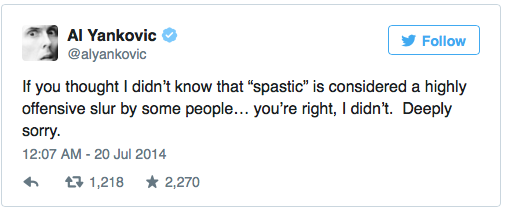
As far as white dudes go, my gold-standard apology comes from Jason Alexander, surprisingly enough, after he called cricket a “gay” sport. Alexander wrote a sizeable and heartfelt essay after being criticized for his homophobic behavior. But there’s no need for long-windedness, I’d argue: Weird Al Yankovic met with criticism last year after using an ableist term in a song, and accomplished key apology criteria in a single tweet.

Over years of observing celebrity mistakes and being on both the acting and receiving end of poorly thought-out marginalizing humor, I’ve come to identify a good apology by three main components. When I think about the public apologies that have been best received, the private apologies that have meant the most to me, and the apologies I’ve made that have been most acceptable to the offended party, they all boil down to the steps that follow.


Step 1: Provide Context.

This first step is the trickiest, and where I think most bad apologies get stuck: intent is offered up as an excuse, an argument, or a way to undermine the offended party’s experience, when it’s actually no more than context. It’s okay to explain what you thought you were doing when you made the offending remark, and it’s okay to list mitigating factors: you were tired, ill, distracted, upset. It’s not okay to consider this the apology itself.

Jason Alexander’s context is presented in a self-deprecating manner. He needed a joke; he thought it was funny at the time; he has so many friends in the industry who are gay that he forgot that homophobia is alive and well. Notice that as he moves into the next part of his apology, below, he explains how he reexamined this assumption and learned from others.

But what we really got down to is quite serious. It is not that we can’t laugh at and with each other. It is not a question of oversensitivity. The problem is that today, as I write this, young men and women whose behaviors, choices or attitudes are not deemed “man enough” or “normal” are being subjected to all kinds of abuse from verbal to physical to societal. They are being demeaned and threatened because they don’t fit the group’s idea of what a “real man” or a “real woman” are supposed to look like, act like and feel like.

For these people, my building a joke upon the premise I did added to the pejorative stereotype that they are forced to deal with everyday. It is at the very heart of this whole ugly world of bullying that has been getting rightful and overdue attention in the media. And with my well-intentioned comedy bit, I played right into those hurtful assumptions and diminishments.


On the other hand, think of the poor “apologies” you’ve heard before: “I have black friends, so there’s no way I’m a racist”; “I didn’t mean it that way”; etc. They stop there, treating the context as the response.


Step 2. Show Understanding.

This is the part where you admit that your lived experience isn’t the only one that matters. The context part of your apology should be the setup to a moment of clarity and learning in which you acknowledge that your intent does not negate the result. Understanding is what turns an apology from an awkward moment to a cathartic, positive experience––the best possible result from an offense. When someone takes the time to educate you about why something you said or did was hurtful, and you take the time to listen and learn, show respect for them, and for your own personal growth, by telling that story. Make sure you’re clear on what was offensive and why, and then repeat it back so everyone knows you get it. And that you won’t do the thing again. Then, try not to do the thing again.


Step 3. Assume Accountability.

Apology statements should be “I” statements. You said/did the thing; if you don’t take responsibility for it, you shouldn’t be apologizing at all. This is why statements like “I’m sorry you were offended” sound like “I’m sorry I got caught”: it doesn’t sound like you actually care so much as you’re annoyed that you have to say anything at all. A plain and simple “I’m sorry,” period, is the perfect way to show that you hold yourself accountable for your actions even if you didn’t intend for the reactions that followed. That’s what makes Evans’s apology so different from Renner’s: note the difference between the straightforward “I regret it and sincerely apologize” and the passive-aggressive, blame-shifting “I am sorry that this tasteless joke about a fictional character offended anyone.”

Weird Al’s tweet combined all three of these criteria with grace:

Weird Al says, "If you thought I didn't know that "spastic" is considered a slut by some people... you're right, I didn't. Deeply sorry."


So, Jeremy Renner, I’m sorry you were inconvenienced, but you’re just going to have to do better if you want to keep this former fan interested.


Featured image: tumblr

24 Apr 08:03

The new 'Call of Duty Black Ops 3' trailer looks... familiar

by Jessica Conditt
The latest teaser trailer for Call of Duty Black Ops 3 -- this year's installment from Black Ops creator Treyarch -- depicts a future ruptured by the onset of technologically enhanced and weaponized humans. There are riots in the streets and ominous ...