Yuval Pinter
Shared posts
Scots words for snow
Several people have sent this in: "Scots 'have 421 words' for snow", BBC News 9/23/2015:
Academics have officially logged 421 terms – including "snaw" (snow), "sneesl" (to begin to rain or snow) and "skelf" (a large snowflake).
The study by the University of Glasgow is part of a project to compile the first Historical Thesaurus of Scots, which is being published online.
The research team have also appealed for people to send in their own words.
Despite the source being BBC News, the article is only slightly misleading.
The Historical Thesaurus of Scots does exist, and is a laudable project with both scholarly and popular cred, and the cited words for aspects of frozen precipitation are really in it.
I was not able to find the "421 words for snow" in the online thesaurus — the link provided in the article leads to a search result with eight items, three of which are forms of "snaw", and offers further links to "Snow idioms" with six items, and "v(Snow/begin to snow)" with seven items, one of which is "snaw" again. There are some other snow-word subcategories indirectly available from the same page, like "Type of snow" (with two items), and "Snowball/action of thowing snowballs" (with four items, three of which are alternative spellings of snowball), but I didn't come near to 421 items (much less distinct "words") in a quick perusal of these links.
The 421-word total presumably came from Dr. Susan Rennie at the University of Glasgow, who is the P.I. of the team compiling the thesaurus, and who can presumably be relied on to provide a count with no more than a modest PR overlay. (Though I would not be shocked to learn from her that the article misconstrues something she told the reporter.)
But in any case, the usual Whorfian Words for X implication — that the Scots have subdivided the space of frozen-precipitation concepts especially finely, due to the pressures of their meteorological environment — is, as usual, not very well supported by the evidence provided. Excellent click bait, though.
For an earlier discussion of related issues, see Stan Carey, "Scottish Words for Snow", Sentence First 8/27/2013, which includes this picture of an art installation that features "31 words and phrases […] from a glossary of ‘conditions of snow and ice in Scots, Gaelic, and travellers’ cant’".
The BBC article also includes an obligatory gesture in the direction of the Eskimo snow-words meme:
It is often said that the Inuit have 50 different words for snow.
But at least it's reported as something that "is often said", rather than as a well-known fact.

Saturday Morning Breakfast Cereal - Subconscious
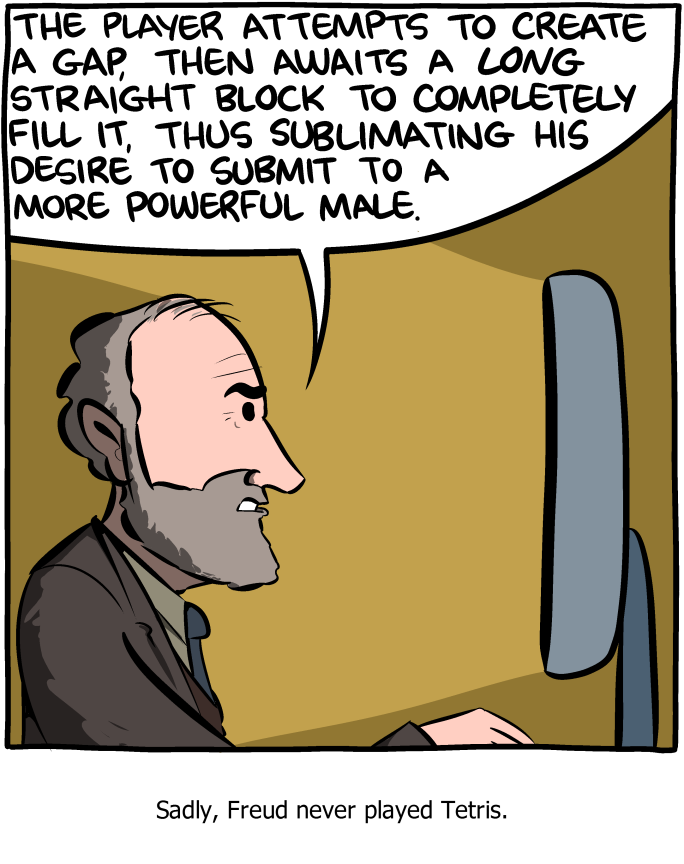
Trailing and Trolling.
Yuval Pinterהחצי הראשון
I’m still reading Jane Eyre, and in Chapter 17 I was amused by a chance resemblance to a modern usage. Jane’s employer (and heartthrob) Mr. Rochester has arrived with a bunch of fancy house guests, and after dinner she is observing the darkly beautiful Miss Ingram, whom she fears Rochester may have a fancy for:
She entered into a discourse on botany with the gentle Mrs. Dent. It seemed Mrs. Dent had not studied that science: though, as she said, she liked flowers, ‘especially wild ones’; Miss Ingram had, and she ran over its vocabulary with an air. I presently perceived she was (what is vernacularly termed) trailing Mrs. Dent; that is, playing on her ignorance: her trail might be clever, but it was decidedly not good-natured.
“She’s trolling that poor woman!” thought I with delight. The OED has this as sense 3b (though it should really be divided in two, with the “draw on” sense of the first two citations separated from the slangy one of the last two):
b. To draw as by persuasion or art; to draw on; hence colloq. ‘to quiz, befool’ (Farmer Slang).
a1717 T. Parnell Fairy Tale 158 Then Will, who bears the wispy fire, To trail the swains among the mire.
1748 S. Richardson Clarissa VII. x. 48, I sometimes was..so long trailed on between hope and doubt.
1847 C. Brontë Jane Eyre II. ii. 42, I..perceived she was (what is vernacularly termed) trailing Mrs. Dent; that is, playing on her ignorance: her trail might be clever, but it was decidedly not good-natured.
1900 C. Kernahan Scoundrels & Co. xxi, To see the Ishmaelites ‘trail’ a sufferer from ‘swelled head’ is to undergo inoculation against that fell malady.
Incidentally, I have another issue with punctuation (to follow up on this post): twice within as many pages Brontë uses quotation marks in a way that makes me twitch. When the guests arrive, she writes: “I should not be called upon to quit my sanctum of the schoolroom; for a sanctum it was now become to me,— ‘a very pleasant refuge in time of trouble’.” This is an allusion to the beginning of Psalm 46, “God is our refuge and strength, a very present help in trouble,” and a very clever allusion it is too (I love the switch from “present” to “pleasant”) — but it is not a quote. And on the next page, when Jane tells little Adèle that “she must not on any account think of venturing in sight of the ladies, either now or at any other time, unless expressly sent for,” Brontë adds: “‘Some natural tears she shed’ on being told this; but as I began to look very grave, she consented at last to wipe them.” This is a reference to the magnificent passage that ends Paradise Lost, when Adam and Eve are expelled:
Some natural tears they dropt, but wip’d them soon;
The world was all before them, where to choose
Their place of rest, and Providence their guide.
They, hand in hand, with wand’ring steps and slow,
Through Eden took their solitary way.
Again, not a quote. I realize conventions were different, and the quote marks are just signaling “Hey, I’m referring to something well known here,” but I’ve spent so much time and effort correcting misquotes in modern texts that I can’t seem to take it in stride.
Saturday Morning Breakfast Cereal - Cross Product
Yuval Pinterככה כותבים אלט-טקסט.
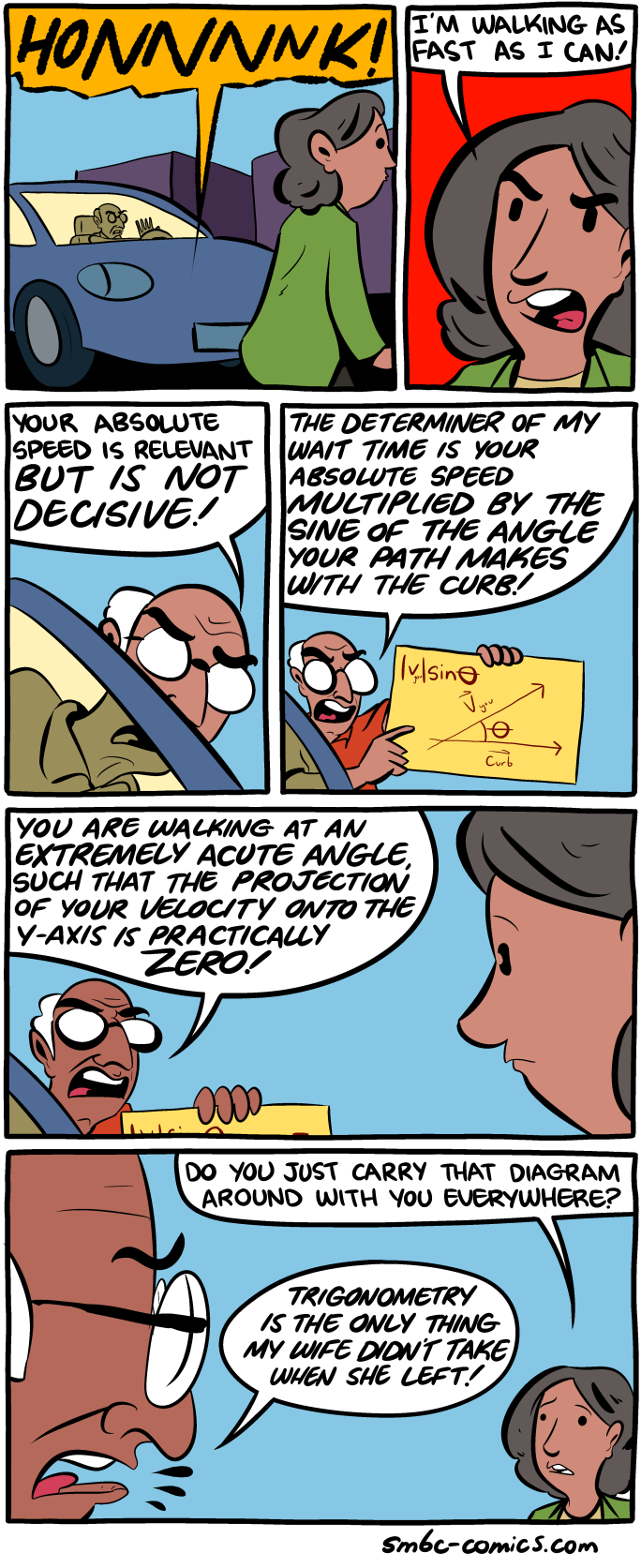
Hovertext: I would be more open to your critique if it were expressed in radians.
New comic!
Today's News:
Thanks for a wonderful BAHFest East, everyone. I've never seen that auditorium so packed!
Turns out this protein isn't a good model for Alzheimer's disease after all; still has its own rare disease at least
Yuval Pinterא. תראו מי חזר באמת
ב. לא חשבתי שהאתר הזה יהיה מקור לסקירת ספרות אפשרית של מורן
Biochemistry, The Scripps Research Institute
Understanding Transthyretin Amyloid Formation to Promote Therapeutic Development

Comic for September 20, 2015
Yuval Pinterהסוף של הסוף מצחיק
דגל הדיו
Juglandine Linguistics.
Yuval Pinterהז'ורנל הזה קפץ את הכריש כל כך מזמן
Brian Wallheimer reports for Phys.org on what I must consider a dubious hypothesis:
Purdue University research shows that ancient languages match up with the genetic codes found in Persian walnut (Juglans regia) forests, suggesting that the stands of trees seen today may be remnants of the first planned afforestation known in the world.
In a paper published in the journal PLoS One, Keith Woeste, a research geneticist for the U.S. Department of Agriculture’s Forest Service and a Purdue adjunct assistant professor of forestry, found that the evolution of language and spread of walnut forests overlapped over wide swaths of Asia over thousands of years. He believes as traders traversed the Silk Roads, connecting Eastern Europe and Africa with far-East Asia, they purposely planted walnut forests as a long-term agricultural investment.
The paper is “Ancient Humans Influenced the Current Spatial Genetic Structure of Common Walnut Populations in Asia,” by Paola Pollegioni, Keith E. Woeste, Francesca Chiocchini, Stefano Del Lungo, Irene Olimpieri, Virginia Tortolano, Jo Clark, Gabriel E. Hemery, Sergio Mapelli, and Maria Emilia Malvolti (not, n.b., by Woeste alone). One thing that gives me pause is that none of the authors has any connection to linguistics. But I do love walnuts, and I couldn’t resist using the word “juglandine” (which I created on the basis of Latin juglans, jugland- ‘walnut (tree)’ before discovering that it actually exists — but only, so far as I can tell, as a noun meaning “An alkaloid found in walnut leaves,” and thus I am staking my claim to it as an adjective), so here it is for your delectation. Shell and enjoy. (Thanks again go to Trevor for the link.)
אין לי רגע דל
לא כתבתי פה פוסט כבר כמעט חצי שנה*? סמכו על עיריית חיפה שתעיר אותי מהמתים.
אתר פסטיבל הסרטים ה-ל"א עלה לאוויר בשעה טובה. אפילו שמו תוכניה ברמה היומית של הסרטים עם חלוקת שורות לאולמות.
את ציר הזמן, לעומת זאת, פקדה פשרה מוזרה (שלא לומר מבלבלת שועלים): הימים מסודרים מימין לשמאל. השעות בתוך כל יום מסודרות משמאל לימין. ובתוך כל משבצת זמן, הס פן תעיר, נכתב שם הסרט בכתב אשורי מימין לשמאל. מבולבלים? חכו שתראו את צילום המסך.

פינת סטירה
*בדגש דווקא כתבתי פה ושם: הנה והנה והנה והנה והנה והנה והנה והנה והנה והנה והנה והנה והנה והנה והנה והנה. והצגתי ביסקול וארגננו בהמעבדה טרעק צ'אלאנג'. ועוד ועוד.
** אגב, יש לי גם טאמבלְר. אותו שם משתמש.
When CARLY is not Carly
Rebecca Ballhaus, "CARLY, not Carly, Made This Popular Carly Fiorina Video", WSJ 9/14/2015:
A new video in which Carly Fiorina embraces her age and her gender has drawn wide attention, and was praised by a prominent blogger as one of the best spots of the 2016 race so far. But in a wrinkle fitting this modern campaign age, Ms. Fiorina’s campaign had nothing to do with it.
The new video opens by telling viewers it’s a “message from Carly.” It features a clip of the former business executive addressing a cheering crowd as she rebuts disparaging comments from GOP frontrunner Donald Trump about her looks. “This is the face of a 61-year-old woman. I am proud of every year and every wrinkle,” Ms. Fiorina says in the video, shot last week at a speech in Phoenix. Interspersed are pictures of other women, young and old.
The video beckons viewers to “join us” at “www.CARLYforAmerica.com,” and closes with the words “CARLY for AMERICA” across the screen.
The twist: The maker of the video, “CARLY for America,” isn’t the Fiorina campaign, which is called “Carly for President.” CARLY for America is instead a pro-Fiorina super PAC formally known as Conservative, Authentic, Responsive Leadership for You and for America. The super PAC adopted the acronym earlier this year after the Federal Election Commission said it wasn’t allowed to explicitly include Ms. Fiorina’s name.
So "CARLY for America" is "Conservative, Authentic, Responsive Leadership for You and for America", not "Carly for America".
This trick is too much fun to leave to Ms. Fiorina alone. What should "JEB! for America", "TRUMP for America", "HILLARY for America", etc., stand for? We need a list of politically evocative adjectives and nouns, organized by initial letters, and a set of expandable syntactic templates, like MODIFIER* NOUN (PREPOSITION ADJECTIVE* NOUN)*, and …
Maybe some branding company is already on the case?
Comic for 2015.09.15
The Meditating Pirate

Time for my annual batch of pirate chickens as I count down the days until Talk Like A Pirate Day! Here be a shipload of previous pirate chickens fer ye hearty enjoyment.
Is Duer a doer?
Mary Constance Parks called to my attention a short post about a "virtual assistant" announced on Tuesday by Baidu, China's largest search engine.
Five years ago, we looked into the nuances of the name "Baidu":
"Soon to be lost in translation" (7/11/10).
Now Baidu is expanding its services with the launching of this new assistant, "Duer", and Mary is eager to know more about the name.
Here is the article:
"Baidu unveils a voice-activated, AI-based smartphone assistant" (9/10/15)
Snippet: "The program is called 'Duer', which roughly translates into 'Du Secretary'…".
Something doesn't sound right here. I don't know of any word in Mandarin pronounced "er" that means "secretary". Furthermore, according to People's Daily and to Baidu itself, the name of the new product is "Dumi", not "Duer", and the former would indeed mean "Du Secretary" — dùmì 度秘, where mì 秘 ("secret") is short for mìshū 秘書 ("secretary").
I asked Kaiser Kuo, who is director for international communications at Baidu, what gives. He replied:
It's called Duer in English (not my call) and 度秘 in Chinese. They didn't want "Do Me" as the name for a female-voiced secretary, I guess—but something close to "Do Her" was apparently okay!
Not knowing what O2O meant, I looked it up and found that it stands for "Online to Offline". Intrigued, I did a Google search on O2O, from which I learned that, although this is a fledgling type of ecommerce, it is rather vexed, as is Baidu's involvement in it.
"O2O is our industry’s stupidest acronym" (10/3/14) (watch the hilarious GIF of a panda destroying an office)
"Fear and greed drive China’s online to offline commerce craze" (8/6/15)
I'm not sure that I understand the basis for the animosity and negativity toward O2O services. If you can use them to order dinner or get your dog groomed, it seems like they have the potential to fill a need felt by some consumers. The question, though, is whether they can really Du what they promise.
[Thanks to Brendan O'Kane]
Antedating Gxddbov.
Yuval Pinterחשוב
Back in 2007 I wrote about what was then the earliest known occurrence of the protean word fuck, in the late-15th-century macaronic/cipher line “Non sunt in coeli, quia gxddbov xxkxzt pg ifmk”: ‘They are not in heaven because they fuck wives of Ely.’ Now, in breaking profanity-related news, Medievalists.net reports:
An English historian has come across the word ‘fuck’ in a court case dating to the year 1310, making it the earliest known reference to the swear word.
Dr Paul Booth of Keele University spotted the name in ‘Roger Fuckebythenavele’ in the Chester county court plea rolls beginning on December 8, 1310. The man was being named three times part of a process to be outlawed, with the final mention coming on September 28, 1311.
Dr Booth believes that “this surname is presumably a nickname. I suggest it could either mean an actual attempt at copulation by an inexperienced youth, later reported by a rejected girlfriend, or an equivalent of the word ‘dimwit’ i.e. a man who might think that that was the correct way to go about it.”
You can see a nice clear reproduction of that section of the rolls, as well as further discussion, at the link; all I can say is, Fuck yeah!
Update. Piotr Gąsiorowski says The Middle English Dictionary Needs a Fucking Update and gives what to me sounds like a very convincing PIE etymology of fuck. Don’t miss it.
Pope-pocalypse
Yuval Pinterוואו
In a couple of weeks, Pope Francis will be visiting Philadelphia, and the associated security precautions are basically shutting down the city and the region around it.
Major area roads and bridges will be closed, and a "traffic box" will exclude all incoming vehicles in the central part of the city, with on-street parking banned for up to a week in advance. Most regional rail stations will be closed, and "ONLY customers traveling with either a Special One Day Regional Rail Pass or Special One Day Regional Rail Reduced Fare Pass, with the name of the station stamped on the back, will be eligible to travel" from those stations that are open. Many subway and trolley stations will be closed, and because these will include all of the stations in the central city area, transfer between the major east-west and north-south lines will be impossible.
The warnings have been so draconian that most of the special transit passes are still unsold, and a significant fraction of center-city hotel rooms are still unbooked.
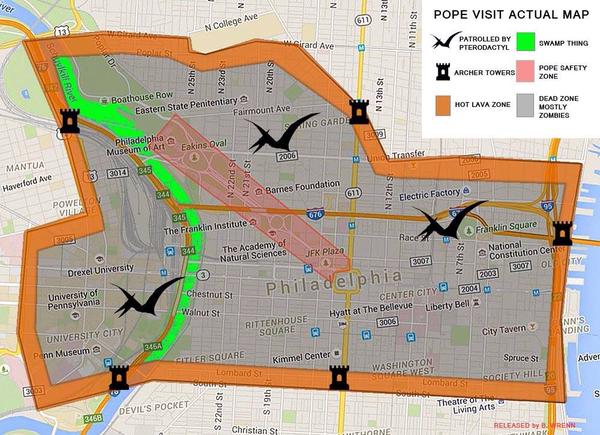
I live on the southwestern edge of the "Dead Zone, Mostly Zombies" region, just inside the "Hot Lava Zone" boundary.
The linguistic angle? All the obvious blend recipes have been re-used. It's the Pope-pocalypse! Pope-mageddon! Pope-nado! Pope-zilla is coming! Hurricane Francis! Nightmare on Pope Street! This whole enterprise suggests to me that the Security Theatre era has reached the Grand Guignol stage.
My favorite Pope-visit spin-off is non-linguistic, though — the Pope Toaster. You can add this to the your collection of graphical toasting products, including the Selfie Toaster and the Grilled Cheesus Sandwich Press.
Comic for 2015.09.13
Yuval Pinterשווה לכל הפחות חיוך דבילי
ניצחון פרוצדורלי מסתמן
Yuval Pinterאני אומר לכם, אין על הקורא יובל פינטר הזה
Llanfairpwllgwyngyllgogery…
Yuval Pinterאני שם את הוידאו הזה על ריפיט
Again, not a weighty post, but the weather’s been miserable and I’m editing two books at once, so I trust you’ll cut me some slack. Lori Dorn reports that Welsh Weatherman Correctly Pronounces a 58-Letter Town Name Without Batting an Eye:
While reporting on the warm weather in Wales, broadcaster Liam Dutton correctly pronounced the name of the 58-letter town Llanfairpwllgwyngyllgogerychwyrndrobwllllantysiliogogogoch without batting an eye or breaking a sweat. In fact, Dutton announced on Twitter that he’d be talking about the town in his broadcast and was really appreciative of the growing admiration for his performance.
It’s a very enjoyable 19 seconds.
I’ll pad out the post with a couple of links that have, strictly speaking, nothing to do with LH but which some readers may enjoy as much as I do:
The End of the Gospel of Jesus’ Wife Forgery Debate, by Andrew Bernhard (spoiler: it’s a forgery!)
New York Public Library Puts 20,000 Hi-Res Maps Online & Makes Them Free to Download and Use: Twenty thousand hi-res maps! What are you waiting for?
Comic for September 11, 2015


Particitrousers of the revolutionary movement
Making the rounds on Twitter is this discovery by @KingRossco, from the UK Kindle edition of The Great Leader and the Fighter Pilot by Blaine Harden:
There's clearly been an auto-replace in this book to remove Americanisms. Participants -> Particitrousers. pic.twitter.com/GjaIebh5TO
— Your pal Rossco (@KingRossco) September 6, 2015
We can surmise that when the UK edition of Harden's book came out for the Kindle, an editor felt the need to screen it for Americanisms that might not translate well across the pond. Pants, understandably, would be one such Americanism to flag, since in British usage pants more typically refers to underwear. The pants/trousers divide was evident in Samuel Butler's 1875 poem, "A Psalm of Montreal: "Thou callest trousers 'pants', whereas I call them 'trousers', Therefore thou art in hell-fire and may the Lord pity thee!" (For more, see my 2006 post, "Pioneers of word rage.")
Using the Google Books version of Harden's book, we can locate six instances where American pants usage could safely be swapped out for trousers. But the search-and-replace mission went too far, finding the substring pants in the sentence beginning, "When the participants of the revolutionary movement in Korea…"
This isn't the first time that sloppy e-book editing has led to search-and-replace follies. A few years ago, we learned of an edition of War and Peace for Barnes & Noble's Nook e-reader in which all instances of Kindle were replaced with Nook, leading to sentences like "It was as if a light had been Nookd…"
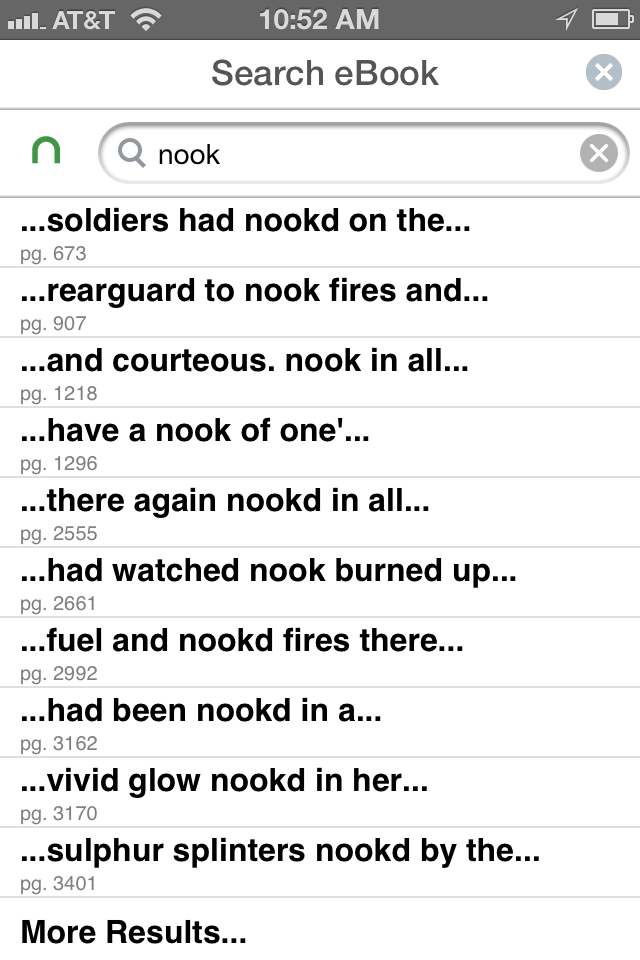

And even before the advent of e-readers, we've observed the perils of global search-and-replace — for further examples, see these posts:
- "Incorrections in the newsroom: Cupertino and beyond" (BZ, 2/1/08)
- "U.S. sprinter undergoes search-and-replace" (BZ, 7/1/08)
- "More clbuttic idiocy from lexical censors on the web" (GKP, 9/2/08)
- "Walter Leland Mr. Cronkite" (BZ, 7/17/09)
- "Oops: a listening guide" (BZ, 6/28/10)
On Twitter, Julia M. Wright noted that the search-and-replace artifact particitrousers also appears in a gobbledygook blog post from "Education Expert ON-LINE." That's a case of inartful "article spinning," automated synonymization performed on text so as to render it distinct enough to get past the search engines. (See my 2013 post, "Anatomy of a spambot.") In the same blog post we see other errant substitutions such as advanlabeles for advantages and giftations for presentations, so the change isn't specifically caused by pants avoidance.
A couple of Twitter commenters mentioned occutrousers as another possible result of textual depantsification. Interestingly enough, occutrousers served as the punchline of a joke more than a century ago. The following item appeared in the Mar. 29, 1904 edition of the Washington Star (also reprinted in the May 1904 issue of The American Tailor and Cutter):
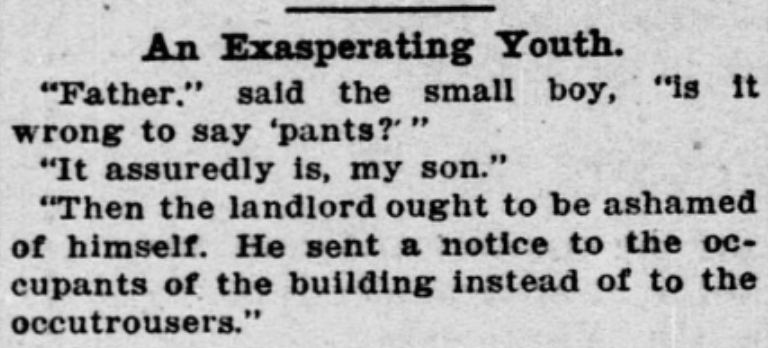
As the joke indicates, the trousers/pants distinction was a source of anxiety at the turn of the 20th century, at least among Anglocentric Americans who recognized pants as an inappropriate word. (Pants started off perfectly innocuously as a chiefly US shortening of pantaloons in the early 19th century, well before the UK "underpants" usage complicated matters.) Americans these days don't worry too much about pants getting misinterpreted, but the usage disparity is still creating headaches for trans-Atlantic editors.
היזהרו מטרחנים לאומיים
Yuval Pinterלראשונה בחיי עברתי יותר מ-5 שניות על טור של שלמה ארצי והנה, מסתבר כי קלעתי לדעת גדולים
G. M. Trevelyan
Yuval Pinterלא, כי קודם