מפר סדר פלסטיני נהרג בנסיבות שהפלסטינים העדיפו להסתיר. ספק אם האמינו שהלוקש שמכרו ל'הארץ', לפיו "מתנחל" הרג אותו, יהפוך מיד לעובדה בכותרת ראשית, בעברית וגם באנגלית. אבל יש הפתעות בחיים
הכותרת הראשית באתר 'הארץ' ביום שישי האחרון אחר הצהריים, לא הותירה מקום לספק:
הכותרת, שלמעשה תיארה הוצאה להורג שרירותית בירייה של "פלסטיני" בידי "מתנחל", לא סויגה כ"דיווח" וגם לא יוחסה למקורות כלשהם. היא דווחה כעובדה שאינה נתונה במחלוקת. וכדי להגביר בלבבות הקוראים את המיאוס והגועל מאותו "מתנחל", צורפה לדיווח תמונה מקציפת דם: קנה רובה שמכוון ישראלי לגבם של אזרחים נמלטים.
רק בעברית? הצחקתם את 'הארץ'. אלו היו שעות הבוקר בצפון אמריקה וגם למאות אלפי הגולשים לאתר העיתון באנגלית, הגיע לקבל עם הקפה שלהם את דבר הדיבה הנורא על ישראל בכותרת הראשית:
כל פרח עיתונות יודע: לא מפרסמים ידיעה כעובדה, אלא לאחר שהוצלבה והוכחה. יותר מזה – לא מפרסמים ידיעה שהתקבלה ממקורות פלסטיניים, אלא לאחר שהוצלבה עם גרסת ישראל. ואם נוטים לקבל את גרסת הפלסטינים, (מעשה שגרה ב'הארץ' כידוע) מביאים גם את עמדת ישראל בתוך הדיווח.
כך שהכישלון המקצועי המחפיר של 'הארץ' משולש: גם דיווחו ידיעה לא מוצלבת ולא מאומתת כעובדה, גם נשענו על מקורות שמהימנותם מפוקפקת והאינטרס שלהם ברור, וגם לא טרחו לצרף לדיווח את גרסת ישראל.
מיותר לציין את שהיה ברור מהרגע הראשון: זה היה שקר גס ונתעב שמיהרו הפלסטינים למכור ל'הארץ', שמצדו קנה אותו מיד בלהיטות.
מחקירת המשטרה עלה שמדובר במוחמד שרף בן 19, שפונה עצמאית לבית החולים אל מקאסד במזרח ירושלים עם פציעה בצווארו. בוידאו שפרסמו הפלסטינים בפייסבוק הוא נראה מפונה מהזירה ברכב פרטי. לכל אורך הפינוי לא נראה בסביבה כל סימן לעימות כלשהו או לנוכחות של כוחות ביטחון או "מתנחל". כשהגיעו כוחות המשטרה לבית החולים אליו פונה כדי לחקור את נסיבות מותו, כבר היה מאוחר מדי. בהתנהלות שאותה הגדירה המשטרה כ"לא רגילה להלוויות שהידים", הבחור נקבר מיד ובכך נחסמה האפשרות לברר ממה מת.
חקירת המשטרה הובילה למאבטח בשכונת מעלה הזיתים היהודית, עליו טפלו הפלסטינים את עלילת הריגת הצעיר. לאחר חקירת המאבטח, כזכור אותו "מתנחל" מהכותרות הראשיות ביום שישי, קבעה המשטרה חד משמעית שאין לו קשר לאירוע.
מאוחר יותר, עקב ביקורת גולשים, סייג 'הארץ' את הדיווח וייחס אותו למקורות פלסטיניים. הוא המשיך לדווח על אותה הוצאה להורג בירייה של הפלסטיני בידי המתנחל גם בשבת וגם ביום ראשון, תוך ייחוסה למקורות פלסטיניים, על אף שכבר נודע שהגופה נחטפה ונקברה טרם חקירה, ושלמשטרה לא ידוע על אף "מתנחל" שלכאורה ביצע את הפשע הזה.
איך נוחל 'הארץ' כישלון מקצועי ואתי כה מחפיר, בפרסמו כותרות כאלה בעברית ומיד גם באנגלית?
מה גורם לכל מנגנוני הזהירות, האחריות והבקרה לקרוס ולהיעלם, בשעטת הקרנפים של העיתון בדרך לפרסום דבר הדיבה השקרי והמופרך הזה?
האם יהיה מי שיתן את הדין על הכישלון המקצועי האומלל שאירע במערכת 'הארץ' ביום שישי?
ועוד שאלה: הפרסום הכוזב והרה המשמעות הזה, המשמש כמעין מגבר (אמפליפייר) לשנאת יהודים, האם בכלל הוא נחשב ב'הארץ' לכישלון?
נכון תמיד שאלתם את עצמכם "בלוגר הצמרת הזה, יובל פינטר, על מה בעצם הוא כתב את תזת המאסטר שלו?" ובכן, שאלו את עצמכם לא עוד! הודות לבלוג של עמית סגל, תוכלו לשזוף את עיניכם בסוג הדבר שהוא הדבר עצמו! עוד סימן קריאה!
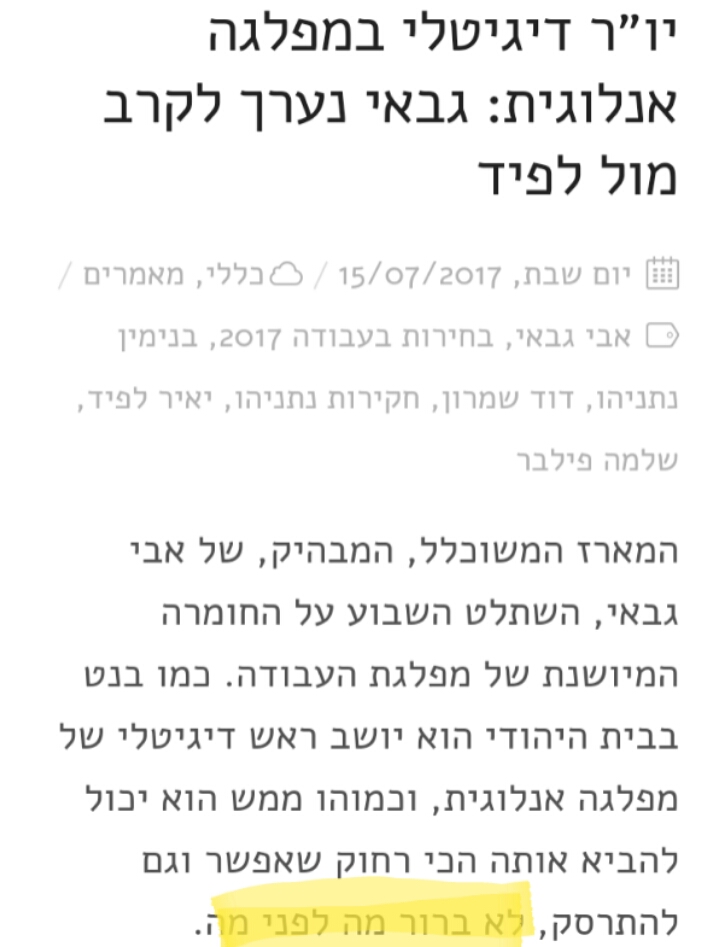
כמו בנט בבית היהודי הוא יושב ראש דיגיטלי של מפלגה אנלוגית, וכמוהו ממש הוא יכול להביא אותה הכי רחוק שאפשר וגם להתרסק, לא ברור מה לפני מה.
וצילומסך למתעקשים, הפעם מהסלולר לתפארת הגיוון:
רשומת אחרונה נושקת לשלישית
ובכן, נשאלת השאלה. להביא אותה רחוק ואז להתרסק, זה בסדר. קרה, קורה, יקרה, ואיקרוס. אבל האם אפשר לרסק מפלגה (בהנחה שריסוק = פירוק טוטאלי) ואז להביא אותה הכי רחוק שאפשר (בהנחה שהמכתם בהוראתו המקובלת, כלומר בקטע חיובי)? נניח גם לניסוח הקצת מוזר של ו"ו החיבור במקום "או". אני חושב שהקורא הסביר הבין למה סגל התכוון. והתשובה הפשוטה היא "לא". אבל יש כאן יותר מזה.
אז מה יובל כתב שיאפשר לו להתפאר שנים מאוחר יותר בתואר מגיסטר לבלשנות? יובל חקר את שימושה הטמפורלי (=קשור לזמן) של מילת הקישור before באנגלית. ספציפית, בדקתי את התנאים בהם מותר להשתמש בה מבלי שהדבר שאחריה באמת קרה ושהדבר יישמע הגיוני. נסו ותהנו:
(1) Yuval cried before he finished his thesis.
(2) Yuval died before he finished his thesis.
(3) # Yuval died before he set the world record in the 100-meter dash.
הראשון פשוט וקל. שני הדברים קרו (בפועל, אגב), והראשון קדם לשני. (2) מורבידי אבל בסדר. החלק הראשון קרה ומנע מהשני להתקיים. לכאורה, גם (3) בסדר מבחינת תנאי אמת פרופר, אם נאמץ אותם סטנדרטים שאפשרו לנו לקבל את (2). המוות של יובל גרם לכך שלא קבע שיא עולם במאה מטר, לכן המשפט אמור להיות תקין. אבל הוא לא (לדוברים ילידיים. בעברית כבר השני מתחיל לרומם גבות). מדוע ולמה? כל זאת ועוד, בכ-80 עמודים שאין לכם שום סיבה לקרוא. בגדול אני חושב שיש לכם אינטואיציה. לקבוע שיא במאה מטר זה לא דבר שהייתי עושה גם אלמלא מתתי כשמתתי. אבל נכנסים לניואנסים וזה נהיה מעניין (עבור הגדרות מסוימות של "מעניין").
אז מה סגל עשה פה בשונה מהפורמט האנגלי הלז? הוא פירק את התחביר לגורמים באופן ש, לפחות לשיפוטי, יצר את הפרשנות האנגלית (ממשפט (2)) באופן ששומר על דקדוקיות בעברית. להביא את המפלגה רחוק ואז לרסק אותה – מקביל למשפט (1). לרסק אותה לפני שהביא אותה הכי רחוק – בדיוק משפט (2). ואני חושב שלזה גם סגל מתכוון בהקשר – מהות ההימור שבבחירתו של גבאי ליו"ר המפלגה זה שאת הפוטנציאל (שקיים אצלו) להביא את המפלגה רחוק הוא עשוי לא לממש כי הפוטנציאל (שקיים אצלו) לרסק אותה עלול לגבור, ואז ההזדמנות ללהביא רחוק תתנדף.
(אגב, אם כבר פולחן אישיות עצמי חסר בושה. מה אני עושה בדוקטורט? בין היתר את זה.)
Look at this net, isn't it neat?
Wouldn't you say that it’s Turing-complete?
Wouldn't you say that this net
This net can learn anything?
Look at this graph, tensors unfold
How many layers can one network hold?
Lookin' round here you would think
Sure, it can learn everything
I've got ReLUs and batch-norms aplenty
I've got convos and poolings galore
You want GPU stacks?
I got twenty
But who cares?
No big deal
I want more
I want to know what the people know
I want to see
Wanna see 'em dancing
Walking around on those
Whadd'ya call 'em? Seriously, label it for me
End-to-end training gets you eerily far
But more is required for safely driving
Hurtling along down a
What's that thing again? Street?
Out where they walk
Out where they run
Out where they do more than classification
Wandering free
Wish I could be
Part of that world
What would I give
If I could live
Out of this arXiv
What would I pay
To spend a day
Not fine-tuning grads
Betcha a GAN
Can't understand
That you can overfit your data
Bright non-humans
Sick of training
Ready to test
And ready to know what the people know
Ask 'em my questions
And get some answers
What is a child and how does it
What's the word? Learn?
When's it my turn?
Wouldn't I love
Love to be more than ‘intelligent, sort of'?
Out of the hype
Free from the gripe
Part of your world
חברים, אנו חוזים בימים גדולים למגבלותיו של הכתב העברי! זה אך סיימנו ללעוג על האקדמיה ללשון עם הצוהוריים שלה וכבר באו לא אחת אלא שתי פרשיות שהזכירו לנו כמה הכתב שלנו חסר, ויש שיגידו, מצ'וקמק, ויש שירצו בערב דורבנות לפני כמה שנים, דרוש החלפה.
דוגמא ראשונה: לפני כחודש הפכו עיתונאים שרצים (נעים בריצה) בשרשרת דיבות אליבא דשרה נתניהו, לשרצים (רמשים) בדיווחה של יונית לוי. העין עם הפרטים.
והשני, טרי מהתנור, אך היום חדשות התאגיד בהרצה דיווחו על קו הגנה דומה של נאמני השר חיים כץ, במיטב מסורת ה"שלופים": לא כתבנו מתפקדים, כתבנו מתפקדים! ומה היינו עושים בלי ניקוד שגוי של דסק כאן שיאפשר לנו כמעט להבין מה רצו מאיתנו המקורבים. אחרי הכל, מחורבנותו של הכתב לא מצומצמת רק לרוב-משמעות תדירה בהרבה מהנחוץ, אלא גם לכך שאנשים לא יודעים לנקד, אפילו אם הם נזקקים לכך.
תמונה, כי זה קרה
מה שנחמד כאן הוא, כמובן, שלשינויים שהגדירה האקדמיה אין שום השפעה על המקרים הללו. כל שפצורי אותיות אהו"י הינם כפלסטער על רגל גדומה. הבה נבנה לנו תותבת תחתיו!
If you follow me on Twitter (@rctatman) you probably already know that I defended my dissertation last week. That’s right: I’m now officially Dr. Tatman! [party horn emoji]
I’ve spent a lot of time focusing on all the minutia of writing a dissertation lately, from formatting references to correcting a lot of typos (my committee members are all heroes). As a result, I’m more than ready to zoom out and think about big-picture stuff for a little while. And, in academia at least, pictures don’t get much bigger than whole disciplines. Which brings me to the title of this blog post: computational sociolinguistics. I’ve talked about my different research projects quite a bit on this blog (and I’ve got a couple more projects coming up that I’m excited to share with y’all!) but they can seem a little bit scattered. What do patterns of emoji use have to do with how well speech recognition systems deal with different dialects with how people’s political affiliation is reflected in their punctuation use? The answer is that they all fall within the same discipline: computational sociolingustics.
Computational sociolinguistics is a fairly new field that lies at the intersection of two other, more established fields: computational linguistics and sociolinguistics. You’re actually probably already familiar with at least some of the work being done in computational linguistics and its sister field of Natural Language Processing (commonly called NLP). The technologies that allow us to interact with computers or phones using human language, rather than binary 1’s and 0’s, are the result of decades of research in these fields. Everything from spell check, to search engines that know that “puppy” and “dog” are related topics, to automatic translation are the result of researchers working in computational linguistics and NLP.
Sociolinguistics is another well-established field, which focuses on the effects of social context on language how we use language and understand. “Social context”, in this case, can be everything from someone’s identity–like their gender or where they’re from–to the specific linguistic situation they’re in, like how much they like the person they’re talking to or whether or not they think they can be overheard. While a lot of work in sociolinguistics is more qualitative, describing observations without a lot of exact measures, of it is also quantitative.
So what happens when you squish these to fields together? For me, the result is work that focuses on research questions that would be more likely to be asked by sociolinguistics, but using methods from computational linguistics and NLP. It also means asking sociolinguistic questions about how we use language in computational context, drawing on the established research fields of Computer Mediated Communication (CMC), Computational Social Science (CSS) and corpus linguistics, but with a stronger focus on sociolingusitics.
One difficult thing about working in a very new field, however, is that it doesn’t have the established social infrastructure that older fields do. If you do variationist sociolinguistics, for example, there’s an established conference (New Ways of Analyzing Variation, or NWAV) and journals (Language Variation and Change, American Speech, the Journal of Sociolinguistics). Older fields also have an established set of social norms. For instance, conferences are considered more prestigious research venues in computational linguistics, while for sociolinguistics journal publications are usually preferred. But computational sociolinguistics doesn’t really have any of that yet. There also isn’t an established research canon, or any textbooks, or a set of studies that you can assume most people in the field have had exposure to (with the possible exception of Dong et al.’s really fabulous survey article). This is exciting, but also a little bit scary, and really frustrating if you want to learn more about it. Science is about the communities that do it as much as it is about the thing that you’re investigating, and as it stands there’s not really an established formal computational sociolinguistics community that you can join.
Fortunately, I’ve got your back. Below, I’ve collected a list of a few of the scholars whose work I’d consider to be computational sociolinguistics along with small snippets of how they describe their work on their personal websites. This isn’t a complete list, by any means, but it’s a good start and should help you begin to learn a little bit more about this young discipline.
“My research combines machine learning and linguistics to build natural language processing systems that are robust to contextual variation and offer new insights about social phenomena.”
“My research focuses on the quantitative analysis of language variation and change. I am especially interested in grammatical and lexical variation in the English language across time and space and the development of new methods for collecting and analysing large corpora of natural language.”
“My research can be summed up by the question: How do we convey tone in text messaging? In face-to-face conversations, we rely on vocal cues, facial expressions, and other non-linguistic features to convey meaning. These features are absent in text messaging, yet digital communication technologies (text messaging, email, etc.) have entered nearly every domain of modern life. I identify the features that facilitate successful communication on these platforms and understand how the availability of digital technologies (i.e., mobile phones) has helped to shape urban spaces.”
Dong Nguyen at the University of Edinburgh & Alan Turing Institute
“I’m interested in Natural Language Processing and Information Retrieval, and in particular computational text analysis for research questions from the social sciences and humanities. I especially enjoy working with social media data.”
“My recent interests center around computational sociolinguistics and the intersection between natural language processing and privacy. In the past, I have worked on unsupervised learning, pronunciation modeling, and applications of NLP to creative language.”
“I’m interested in how people make meaning with language. My PhD is from Stanford’s Department of Linguistics (my dissertation was on language and emotion). I’ve also founded a natural language processing start-up (four years), did UX research at Microsoft (ten years) and ran the features desk of a national newspaper in Pakistan (one year).”
“My research interests span computational linguistics, natural language processing, cognitive modelling, and complex networks. I am currently using computational methods to identify social and individual factors that condition linguistic variation and change on social media, under the supervision of Sharon Goldwater and James Kirby.”
(Ph.D. Candidate) Sean Simpson at Georgetown University
“My interests include computational sociolinguistics, sociophonetics, language variation, and conservation & revitalization of endangered languages. My dissertation focuses on the incorporation of sociophonetic detail into automated speaker profiling systems.”
Ferris Jabr recently published in the New York Times Magazine an interesting article about the field research of Con Slobodchikoff, professor emeritus of biology at Northern Arizona University, on prairie dog alarm calls. The article title is “Can Prairie Dogs Talk?”
It is an interesting question. People who have read my earlier posts on animal communication have been pressing me to say something about my reaction to it. In this post I will do that. I will not be able to cover all the implications and ramifications of the question, of course; for one interesting discussion that has already appeared in the blogosphere, see this piece by Edmund Blair Bolles. But I will try to be careful and scholarly, and in an unusual departure (disappointingly, perhaps, to those who relished my bitterly sarcastic remarks on cow naming behavior), I will attempt to be courteous. Nonetheless, I will provide a clear and explicit answer to Jabr’s question.
That all goes into tax reduction. Tremendous savings.
But beyond that it’s OK if the tax plan increases the deficit?
It is OK, because it won’t increase it for long. You may have two years where you’ll…you understand the expression “prime the pump”?
Yes.
We have to prime the pump.
It’s very Keynesian.
We’re the highest-taxed nation in the world. Have you heard that expression before, for this particular type of an event?
Priming the pump?
Yeah, have you heard it? Yes. Have you heard that expression used before? Because I haven’t heard it. I mean, I just…I came up with it a couple of days ago and I thought it was good. It’s what you have to do.
It’s…
Yeah, what you have to do is you have to put something in before you can get something out.
The OED’s entry for prime, v.1, sense 5.a, glossed as
To prepare a pump for use by pouring water into it. Also fig., esp. in to prime the pump: to stimulate or support (esp. economic) growth or success by supplying initial investment, encouragement, etc.
The OED’s earliest citation is a little while before May 2017:
1916 Everybody’s Mag. 35 131 When the waters of business are stagnant, gentlemen, it becomes necessary, if I may say so, to prime the pump.
The stimulation of economic activity by investment, esp. by government investment or spending; an instance of this.
And the earlier citation is somewhat later than 1916, but still a bit earlier than May 2017:
1933Wall St. Jrnl. 16 May 1/2 To carry the pump-priming analogy a step further, it is suggested that a small portion of the expected flow of restored industrial income be directed to the reservoir from which the original ‘prime’ was borrowed.
The term is most closely associated with the economic theories of John Maynard Keynes, who advocated energetic intervention to try to arrest the depression. By the time Mr. Trump was in school in the 1950s and 1960s, it was widely taught in history and economics courses as part of the story of how the United States emerged from the depression.
The concept was widely discussed again in 2009 and subsequent years in the context of the Obama administration’s stimulus package, which aimed to jolt the United States out of the deep recession. A Nexis search shows the phrase “pump priming” or its variants appeared in 1,073 news articles in major publications in 2009 alone, and they are almost all referring to economics, not water pumps.
My first thought was that when President Trump said “I came up with it a couple of days ago and I thought it was good”, he meant that he heard it and thought it was good. This is slightly less embarrassing than claiming credit for inventing the phrase, though this lexicographical gap in its most famous graduate is something that the Wharton school might worry about.
But the trouble with this explanation is that Trump has used the phrase himself several times over the past few years, for example at this rally in Des Moines on 12/8/2016:
We’re also going to lower our business tax rate
from thirty five percent all the way down to fifteen percent.
That’s gonna be great.
((It’s) gonna prime the pump.
Gotta prime the pump, gotta get the jobs.
So the whole thing is deeply puzzling. As Winston Churchill said in a broadcast in 1939,
It is a riddle wrapped in a mystery inside an enigma.
However, this is surely one case at least where Churchill’s next words are not relevant:
…but perhaps there is a key. That key is Russian national interest.
Here's the path I took, as a non-US-citizen, before moving to the US and starting a CS PhD program. I took the GRE and TOEFL around summer of 2015 and moved in August 2016.
I provide it as a reference for similar-minded folk, but keep in mind times change, circumstances vary, and I may have forgotten crucial steps. In any case, enjoy.
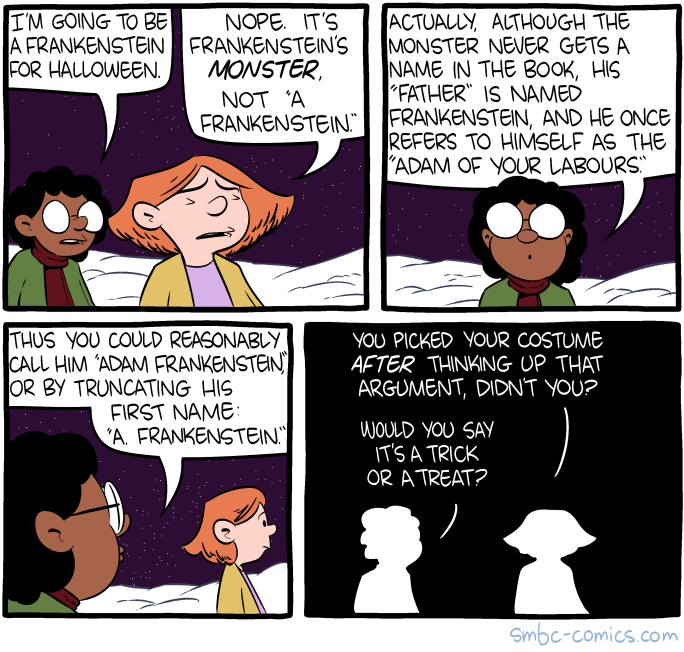
True story - long ago when I was on the dating market, every time I talked to a grad student who found out I was a cartoonist, she'd say "ARE YOU JORGE CHAM?" More and more, I regret that I always said no.



.png)





.png)




.png)


