Shared posts

18 Sep 16:07

The Tower Infinity, South Korea's Forthcoming 'Invisible' Skyscraper

0tower-infinity-01.jpg

Skyscrapers have always been symbols of architectural, economic and national might, the taller the better. They are meant to be seen from miles around. But a new tower slated to go up outside of Seoul, South Korea, has been designed with a twist: It is meant to be seen--and then not seen. The Tower Infinity, designed by the multinational GDS Architects, uses technology to render itself "invisible," or at the very least, optically camouflaged.

0tower-infinity-02.jpg

Clad in a surface of both cameras and image-producing LEDs, the 450-meter-tall tower will visually capture its surrounding environment and transmit those images to the opposite face of the building from which they were shot. With a building manager's finger on a dimmer switch, the opacity of the building could be adjusted.

0tower-infinity-03.jpg

(more...)


18 Sep 16:02

Knitted Accordion

by Andrew Salomone
knitted_accordion_1Katie Boyette of Caffaknitted created this marvelous knitted accordion.

Read more on MAKE

18 Sep 16:02

Upside down work lamp as a bedside lamp

by Jules IKEAHacker

IMG_6501

Materials: Forså and Lack shelf

Description: We had two set of PAX wardrobes in our bedroom side wall but we wanted to do something different. We decided to use straight timber panels and put the PAX wardrobes one each side of the bed.

The space between the wardrobes and bed was so narrow that we didn’t want to put lights on nightstands. Instead we used two Forså work lamps attached to Lack shelf above the bed. And it worked even better than we thought.

IMG_6494

IMG_6512

First you need to take the metal weight out from the base of Forså. There’s one nut under the base that holds the weight and lamp together. Use ratchet to get it of.

Then drill three holes to the base and three holes to the Lack shelf in the same pattern as you drilled the base. Attach the lamps to the shelf with long enough bolts, wingnuts and washers.

See more of the upside down bedside lamp.

~ Kun Itse, Finland

16 Sep 08:43

Anatomy Book Illustration Sweatshirt

by Andrew Salomone
anatomy-book-sweatshirt-1Keep an eye on your internal organs whilst keeping warm in this quirky appliquéd anatomy illustration sweatshirt from Etsy seller Great White Vintage.

Read more on MAKE

16 Sep 07:38

'Phonebloks' pitch video describes LEGO-like modular smartphone concept

by Xeni Jardin
I'm skeptical that Dave Hakkens' Phonebloks idea would work in the real world from an engineering standpoint, but it's a marvelous concept. [Video Link + website]

(Thanks, Joe Sabia)


08 Sep 20:18

Starry Light by Anagraphic ~ handcrafted...

by anagraphic


Starry Light by Anagraphic ~ handcrafted constellation lamp collection ~ at Tent London.

(Want more? See NOTCOT.org and NOTCOT.com)
01 Sep 09:18

Mobius Interlocking Bagels

by kram01
Ok, so the mathematicians among you will point out that they're not quite Mobius bagels, but they are interesting from a geometry and topological viewpoint. And tasty. We're going to make two inter-locking half bagels, which look quite impressive, just from a plain old normal bagel. They key is cut...
By: kram01

Continue Reading »
23 Aug 13:35

Two Denmark architects have designed a concept...

by KateAndrews


Two Denmark architects have designed a concept for narrow apartments that fill tiny gaps between existing buildings.

(Want more? See NOTCOT.org and NOTCOT.com)
12 Aug 10:48

Ancient Grumpy Cat LOLs

by Maggie Koerth-Baker

Yesterday, guest blogger Madeleine Johnson had a story here about a piece of ancient Peruvian pottery — in the shape of a very grumpy little cat. If you haven't read her story, you really should. It's all about the great cat memes of ancient history and how archaeologists can use clues from an artwork to track down who made it, where, and when.

My friend Andrew was kind enough to adapt Ancient Grumpy Cat into the form of a modern cat meme. That's his picture above. Madeleine and I also put together another one, based on Ancient Grumpy Cat's probable history as a ceremonial mug for drinking a corn beer called chicha:

Chicha refers to a wide range of different beverages, but some of them were (and are) made using human saliva as a way to kick off the fermentation process. The good news: If you want to try to make your own chicha, the spit is optional.


12 Aug 06:15

Fire Escape Mini Shelf!

by NOTCOT


Fire Escape Mini Shelf!

(Want more? See NOTCOT.org and NOTCOT.com)
04 Aug 15:25

How-To: DIY Grumpy Cat Shorts

by Haley Pierson-Cox
ilovetocreate_grumpy_cat_shorts_02Three words: Grumpy. Cat. Shorts. (No, seriously.)

Read more on MAKE

04 Aug 15:22

Sonic Prints is a software project that creates...

by laserpilot


Sonic Prints is a software project that creates 3D printable meshes from live audio input. 3D Print your favorite songs.

(Want more? See NOTCOT.org and NOTCOT.com)
04 Aug 15:15

A handy guide for creating a hipster logo.

by tdelger


A handy guide for creating a hipster logo.

(Want more? See NOTCOT.org and NOTCOT.com)
03 Aug 14:39

Meet Ancient Peru's own Grumpy Cat

by Madeleine Johnson

Grumpy Cat, Shocked Cat, Lil Bub – their images are the currency of the web, passed between friends, family, and co-workers. When they go viral, funny cat pictures heal daily drudgery with a dose of furry, cuddly cheer. But, in terms of the reverence they receive, these cats are hardly the first of their kind. Ancient cultures had cat memes too, and archaeologists have their own term for them: feline motifs.

The word meme, itself a meme, feels ultra-modern, but was coined in the 1970s by Richard Dawkins to refer to any non-genetic unit of replicated information. And it would be chronocentric to presume this term applied only to the proverbial Caturdays following its contemporary articulation. Some archaeologists, known as evolutionary archaeologists, incorporate memetics into their explanations of cultural transmission and change. In their view, cultural evolution, or the speciation of different cultures, happens by selective forces acting on cultural memes, motifs and styles.

We can look back about two thousand years and see cat memes on objects made in the Americas before Columbus set boot here. In fact, the feline motif is a powerful point of acccess to Pre-Columbian cultures, as it was a common from the Mississippi to the tip of South America.

MEET OLD GRUMPY CAT

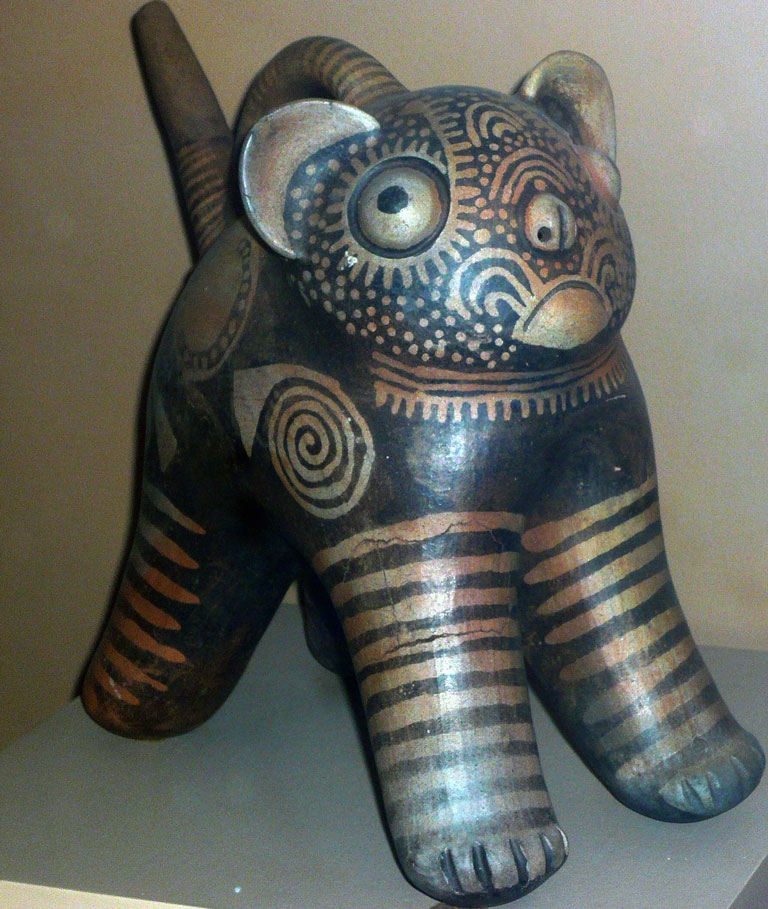
Take a dour little kitty artifact that resides in the American Museum of Natural History. He is Grumpy Cat’s distant cousin. Let’s call him Old Grumpy Cat, or OGC. Museum officials call him a ceramic bottle, and say he probably came from Northern Peru. Created about 2,000 years ago, he was likely used for special ceremonies, then part of a burial. Centuries later, he was dug up by grave looters and sold to collectors, ultimately making his way to his museum home and an afterlife of staring at the world from behind glass.

The vessel was not excavated by academics, so we don’t know exactly where, or when, he is from. Since soil accumulates in layers year after year, archaeologists usually determine age of objects that can’t be carbon-dated by their relation to other objects within the same depositional. No such luck with Old Grumpy.
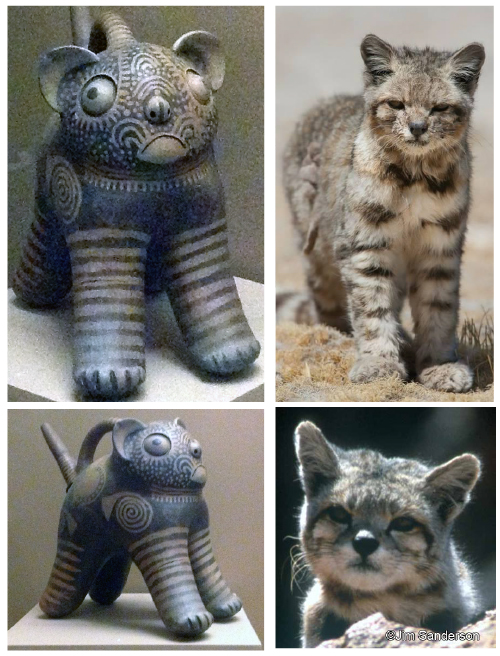

LEFT: Old Grumpy Cat at the American Museum of Natural History. Photo: Kevin Wiley. RIGHT: Andean cats. (TOP RIGHT: Antonio Nuñez-Lemos / BOTTOM RIGHT: Jim Sanderson)

Knowing what species is represented could offer a critical clue, but Old Grumpy is ambiguous. This line of thought, however, can still lead to useful insights.

For example, wild cat conservationists in South America point out that historically-rooted feline reverence makes cat-hunting less likely, helping preserving the ecosystems they inhabit. Even if not sacred per se, cats can be symbols of the regions they inhabit, a source of pride, which, conservationist argue, can save cats’ lives.

Archaeology can also provide data for biologists, as in a recent case in Mediterranean fish biology. Conservationists identified groupers, a species now endangered in the area, in pre-Christian mosaic art. This allowed estimates of the size of ancient groupers and their historic ranges, thus putting an endangered species into a bigger timeline.

SO, WHERE IZ I FROM?

Archaeologists like to group cultures by their ceramics. In Northern Peru, steep mountain ranges abut Pacific beaches. Ancient peoples thrived along rivers that run perpendicular to this coastline. Coastal cultures rose and fell in these valleys over thousands of years, each with a signature style of pottery.

Nearly a dozen archaeologists that I spoke with agreed that the color and pattern of Old Grumpy Cat suggest the Virú river valley in Northern Peru.

OGC’s creators used a technique called resist glazing, in which wax was pressed onto a fired pot to make a design. It was then dipped into liquid glaze, which could not adhere to the waxed areas. When the pot was fired, the glaze became glassy and the wax melted away, leaving behind the design. Archaeologists most often attribute resist style to a group that inhabited the Virú valley between 500BC and 1000AD; however, there is ambiguity. On the North coast, resist style was also used by a slightly earlier culture called the Salinar, the later cultures of Chavín and Moche, as well as a culture up the coast called Vicús.

Beyond this decorative style, the people of the Virú valley are known also to have used small, not so fierce looking feline motifs in their ceramics. OGC represents a small spotted cat with striped front legs. This motif had wide currency in the region, as it is also found far to south in petroglyphs associated with the Wari people.

The feline meme evolved, and the time of the Inca (about 1400AD), the most commonly depicted cat was a jaguar, whose meme was so stylized it could be represented by its fangs alone. Some archaeologists propose that meditation on the jaguar meme became a shamanistic ritual, in which ceramic bottles held corn beer called chicha: OGC’s little tail is actually a drinking spout.

SPEESHEEZ, PLEEZ?

Old Grumpy Cat was probably not meant to be a realistic portrait. Even 2,000 years ago, it’s unlikely there were cats with spiral spots. There were no housecats (domesticated Felis sylvestris) in the Americas then, but there were small wild cats. Was Old Grumpy Cat meant to depict one in particular?

There are now ten species of wild cat in South America, eight found in Peru. Each species can look a little different depending on age and location. So, although he doesn’t look much like an adult jaguar (Panthera onca), for example, OGC could be a jaguar kitten. Or a puma (Felis concolor), an ocelot (Leopardus pardalis), or even a margay (Leopardus weidii).

However, the striping on his front legs of suggests one of two species in particular.

The Andean mountain cat (aka Leopardus jacobita) is the rarest small wild cat in the world, and the only endangered wild cat in the Americas, according to the International Union for Conservation of Nature. If Old Grumpy Cat was modeled on this species, he might now have good reason to be frowning. The very existence of living L. jacobita was only confirmed in the past 20 or so years, and its high and dry mountain habitat is very rapidly disappearing as climate change melts the glaciers of the Andes.

DNA evidence confirms modern Andean cat scat about 200km south of the Virú valley, near the scene of the meme.

The other possible species is the Andean cat’s cousin, the Pampas cat (aka Leopardus colocolo). Pampas’ appearance is more variable than the Andean cat, but at the Northernmost reaches of their range Pampas cats tend to have striped legs and tails, with some spots on the back, just like OGC. Indeed, biologists often use genetic tools to definitively distinguish between Andean and Pampas cats, by analyzing DNA that is sloughed off from the cats’ intestines into their droppings.

Even if their historic ecological range brought them near the Virú valley, could the makers of Old Grumpy cat have distinguished Andean cats from Pampas cats by eye?

Besides the handful of biologists who have seen them in the wild, local herders and villagers in the Andean mountains know the difference.

From 1998 to 1999 and 2001 to 2002, a conservation study in Bolivia quizzed mountain residents with photos of the two cats. They lump all small wild cats together into a group they call “titi,” but researchers found that about 18 percent of people considered there to be two different kinds of titi. Moreover, they had different names for the two titis, and described them as living in different habitats with distinct mannerisms.

The Pampas cat was called gato chaskoso, or scruffy cat, while the Andean cat was called gato sonso, or silly cat. The rare sighting of either cat is considered to bring good fortune, but seeing scruffy cat is good luck in general while silly cat brings a good harvest and protects livestock. In fact, according to researchers, locals believe that accidentally killing a silly cat creates a debt to nature that must be atoned annually, and the stuffed pelt is decorated with streamers and kept as household talisman. This modern cat reverence tracks with archaeological hypothesis about the roots of cat worship. Ancient farmers observed that small wild cats killed rodents that would otherwise eat up their crops. Cat health and well-being was a concern of these early agricultural societies.

I IZ WHAT I IZ.

Taxonomy is a way of charting relationships between things. It is a modern and scientific way of seeing the world. In terms of the lumping and splitting of ancient cultures or modern cat species, descendants of Andean cultures might have another perspective. When asked what species OGC is, archaeologist Nick Saunders points out that the Western urge for taxonomy is not always in sync with indigenous reality.

In ancient, and modern, Andean cultures, “either a one-for-one identification is inappropriate, or different features of different felines (and/or other animals) are recombined in ways which made eminent sense to their creators but totally confuse us,” he wrote.

For example, jaguar spots could be painted on a depiction of another animal, to endow that animal with jaguar powers.

Taxonomy means saying an object or animal is THIS and NOT THAT. In modern Andean cultures, there’s evidence of a less binary way of thinking. The Aymara language (spoken by about two million people throughout Peru and Bolivia) conceptualizes time with the future behind and the past is laid out in front of a person, analogous to being a passenger in a rear-facing train seat. Speakers point to their back when gesturing about future events, and forward when describing the past.

Aymara also uses a three-part, or ternary, logic system. In addition to TRUE and FALSE there is a third, equally valid option, meaning something similar to "not enough information." This has also been called Andean logic. Ternary logic systems can be really useful in describing the universe, be it the universe of perception or a set of data: consider the NULL state, used in databases to distinguish an entry that does not exist from one that represents nothing.

It is only fitting, then, that Old Grumpy Cat defies categorization. He pops out of his museum case, suddenly seeming more relevant because of his resemblance to Grumpy Cat. Maybe he has something to say about climate change effects on wild cats of the Andes, or maybe he tells of sophisticated and underappreciated indigenous people of the Americas, both ancient and modern. Maybe the spiral on the side of Old Grumpy Cat represents time, and overlap of culture and generations in the same physical space. If we assume time will continue into the future (whether we envision that as in front or behind us), perhaps future archeologists will find a Grumpy Cat coffee mug 2,000 years from now and wonder about us.


28 Jul 06:57

Wedding Logic at its Finest

Wedding Logic at its Finest

Submitted by: Unknown

Tagged: genius , logic , weddings , funny , g rated , dating
18 Jul 12:09

Below the Fold: Jule Waibel's Mary Poppins-Inspired, Accordion-Like 'Entfaltung' Collection

JuleWaibel-Entfaltung-hero.jpg

For her Master's thesis in the Design Products program at the Royal College of Art, Jule Waibel cleverly employed the multiple meanings of her native language, German: Entfaltung may be translated as "unfold," "expand" or "develop," all of which describe the collection of three items that comprise the project. "Collapsible structures reflect how our world is constantly changing," she writes. "My response is to use folding as part of my design process."

A particular folding technique can transform simple sheet materials into three-dimensional objects, with the additional capability that they can expand and contract. [The] dress [that] changes its shape according to the movement of the body, an expandable bag and an umbrella are all made of Tyvek®, a lightweight water- and tear-proof synthetic paper.

And although the results express the simple metaphor with geometric elegance, Waibel cited a surprising—albeit equally fantastical—source of inspiration: Mary Poppins and her magical bag. Captivated by the way "everything seems to fit inside—a mirror, a hatstand, a plant..." she set out to design a bag that shows "the minimum and maximum possibilities." The umbrella embodies "the beauty and aesthetics of folding," while the dress illustrates transformation, motion and flexibility "in a playful way."

JuleWaibel-Entfaltung-bagx3.jpg

JuleWaibel-Entfaltung-umbrella.gif

JuleWaibel-Entfaltung-dress.jpg

(more...)


04 Jul 07:55

Twitter to allow advertisers to target your browsing history, email addresses; here's how to opt out

by Xeni Jardin
Twitter announced today that it will now allow advertisers to tailor ads for you based on your activities off of Twitter (for instance, browsing third-party websites), and will also use personal information like email addresses to target the ads you see.

"Users won’t see more ads on Twitter, but they may see better ones," says Twitter, touting the change as a way to make the service "more useful" to users. Privacy-minded folks won't be too happy.

Advertising Age has more. As Twitter's official announcement explains, you can opt out by checking off these boxes, or enabling Do Not Track (DNT) in compatible browsers.

Here's how to opt out, if you are so inclined:

1) Log in to your Twitter account.
2) Under "Settings," uncheck the boxes shown above.
3) Enable "Do Not Track" in your browser (FF, Chrome, IE are all compatible).
4) Follow @boingboing. Hah, I made that part up. But you should.


27 Jun 06:18

Putting party hats on CCTVs to celebrate Orwell's birthday

by Cory Doctorow

Yesterday was George Orwell's birthday, and to celebrate, people in Utrecht perched little party hats atop CCTV cameras in public places.

By making these inconspicuous cameras that we ignore in our daily lives catch the eye again we also create awareness of how many cameras really watch us nowadays, and that the surveillance state described by Orwell is getting closer and closer to reality.

No one tried this in London, because there are not enough party hats in the universe.

George Orwell’s Birthday Party (via Making Light)


27 Jun 06:16

Tic-Tac-Toe squared

by Cory Doctorow


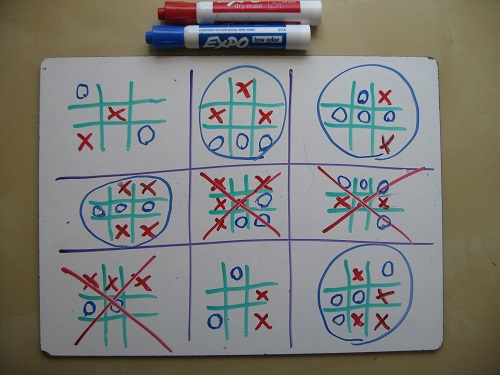
Want to play a game of Tic-Tac-Toe that's genuinely challenging and hard? Try "Ultimate Tic-Tac-Toe," in which each square is made up of another, smaller Tic-Tac-Toe board, and to win the square you have to win its mini-game. Ben Orlin says he discovered the game on a mathematicians' picnic, and he explains a wrinkle on the rules:

You don’t get to pick which of the nine boards to play on. That’s determined by your opponent’s previous move. Whichever square he picks, that’s the board you must play in next. (And whichever square you pick will determine which board he plays on next.)...

This lends the game a strategic element. You can’t just focus on the little board. You’ve got to consider where your move will send your opponent, and where his next move will send you, and so on.

The resulting scenarios look bizarre. Players seem to move randomly, missing easy two- and three-in-a-rows. But there’s a method to the madness – they’re thinking ahead to future moves, wary of setting up their opponent on prime real estate. It is, in short, vastly more interesting than regular tic-tac-toe.

Ultimate Tic-Tac-Toe (via Kottke)


22 Jun 20:11

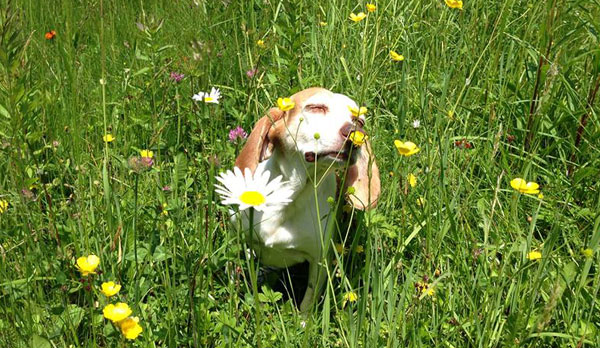
"Jerry (rescued from kill shelter) loves to smell flowers"

by Xeni Jardin
A Reddit thread of greatness. (Thanks, Tara)


21 Jun 22:43

Bottle Design Brain Melter: The Handle is the Spout, the Opening is on the Bottom, the Inside and the Outside Are the Same Surface

Denise1987

לא חדש אבל תמונות יפות

klein-bottle-01.jpg

That there is the Klein Bottle, first conceived of in 1882 by German mathematician Felix Klein. Klein's "non-orientable surface," as it's called in the math community, is like a Möbius strip in that you cannot distinguish inside from outside; follow it with your eyes and you'll see one turns into the other, which makes me very, very uncomfortable.

klein-bottle-03.jpg

I'm told that the Klein Bottle is, in essence, two Möbius strips connected together. I'd like to start sketching that to work out how it goes together, but I can't because I'm too stupid.

klein-bottle-02.jpg

(more...)


14 Jun 15:21

Hell is Other People, an experiment in...

by scottgarner


Hell is Other People, an experiment in anti-social media. It uses FourSquare to track your 'friends' and calculates optimal locations for avoiding them.

(Want more? See NOTCOT.org and NOTCOT.com)
10 Jun 17:03

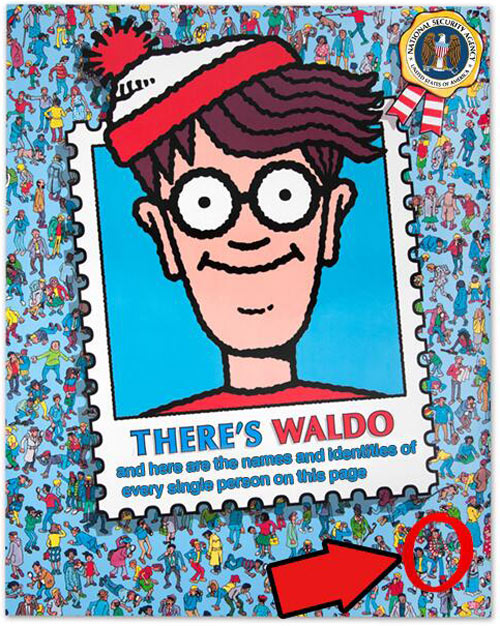
Surveillance-oriented kids' book remixes

by Cory Doctorow


Twitter user Darth polled followers for satirical, surveillance-oriented kids' book parodies, and created illustrations for the best. They're collected by the Guardian.

NSA surveillance as told through classic children's books


07 Jun 13:15

Pastime

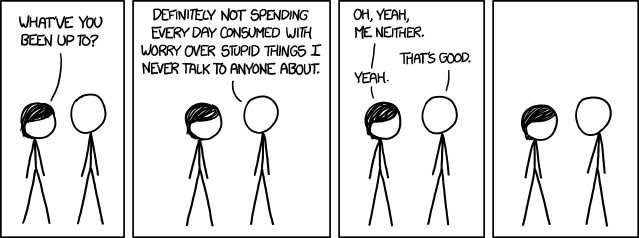
Good thing we're too smart to spend all day being uselessly frustrated with ourselves. I mean, that'd be a hell of a waste, right?
14 May 07:19

If you do a Google Image search for Atari...

by NOTlabs


If you do a Google Image search for Atari Breakout the results turn into the game.

(Want more? See NOTCOT.org and NOTCOT.com)
20 Mar 16:58

Knitted Grumpy Cat Pillow

by Andrew Salomone
Denise1987

תראה גם לנעה?

knitted-grumpy-cat-pillow-1Tracy Widdess of Brutal Knitting created this fantastic knitted grumpy cat pillow with her electronic knitting machine.

Read the full article on MAKE