Submitted by: (via Nuke Fudge)
Shared posts
05 Jun 17:09



If Super Mario Bros. Was Made Today
Preorder the Super Mario Bros. Legendary Edition and receive a FREE download code for EXCLUSIVE World 9 DLC!
Submitted by: lsiwik
Tagged:
video games
, Super Mario bros
Tadeu, Damiani.guilherme and -1 others like this




13 May 18:16
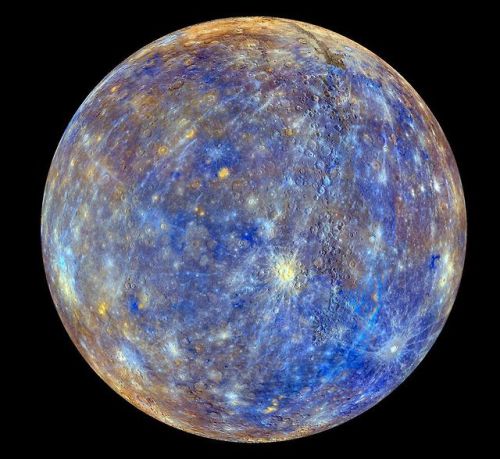
becomming: xlizardx: Apparently this is "The clearest photo of...
Barciella, Damiani.guilherme and 5 others like this
13 May 18:16

The Parsons Code
by Greg Ross
In 1975 Denys Parsons devised a surprisingly simple way for nonmusicians to record melodies — write an asterisk for the first note, then hum the tune and decide whether each subsequent note goes up (U), down (D), or repeats (R). The first two phrases of “Happy Birthday,” for instance, look like this:
*RUDUDDRUDUD
(“* repeat up down up down down repeat up down up down”)
This is surprisingly effective — Parsons, who spent five years indexing practically every well-known classical theme from the 16th century onward, wrote, “I continue to be astonished that such a simple test, taken to the sixteenth note (or less), should be adequate to distinguish more than 10,000 classical themes.” Can you identify the eight famous classical melodies below?
- *RRDURRD
- *RUURURDRDRUURURDR
- *RUURDDDDRUURDRURUURDDDDRUUDDR
- *DUDUDUUUDDUDUDDUD
- *DUDDDDDUDDUDUDU
- *UDUUDUDUUDUDUUDUDUU
- *DUDUDUDURRRRRRRRDUDU
- *RRRRRRRUUUDRRRRUURDDD
Tadeu, Adam Victor Brandizzi likes this
13 May 16:59

Where do we all live? It’s a bit of a vision test, but...
Where do we all live? It’s a bit of a vision test, but each colour is home to a billion people.
Tadeu, Sofía Henao likes this
13 May 16:59


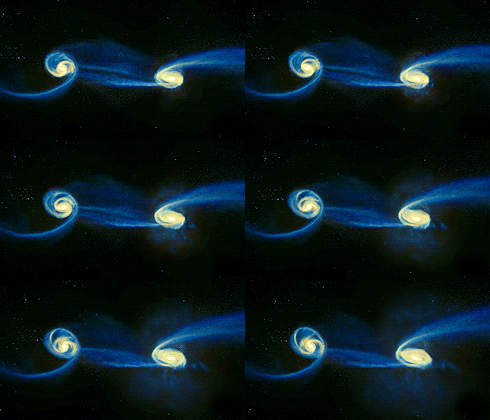

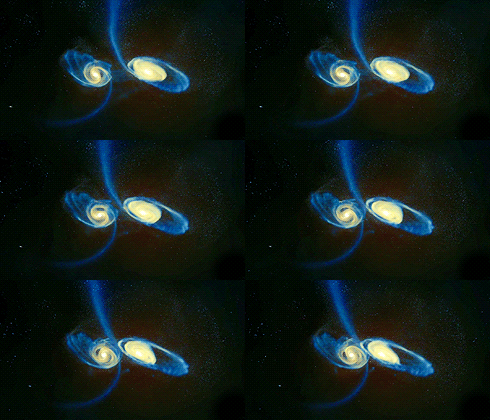
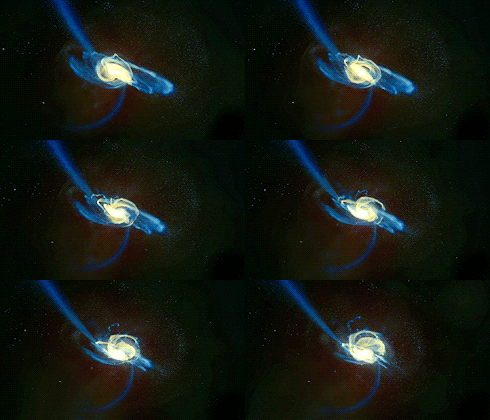
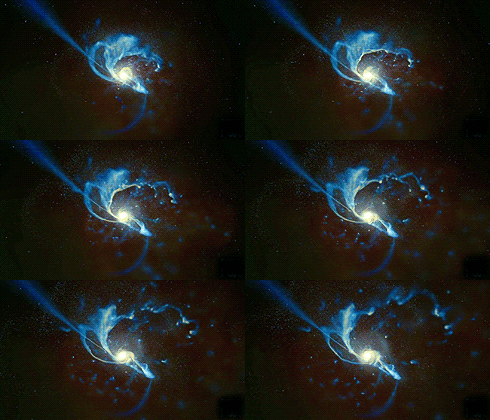
using nothing more than newton’s laws of gravitation, we...
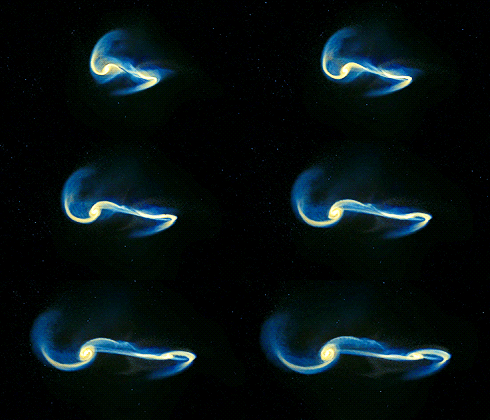
using nothing more than newton’s laws of gravitation, we astronomers can confidently predict that several billion years from now our home galaxy, the milky way, will merge with our neighbouring galaxy, andromeda. because the distances between the stars are so great compared to their sizes, few if any stars in either galaxy will actually collide.
any life on the worlds of that far off future should be safe, but they will be treated to an amazing billion-year-long lightshow.
a dance of a half a trillion stars, to music first heard on one little world, by a man who had but one true friend.
13 May 16:42

Internal Landscapes: Sweeping Abstract Oceans by Samantha Keely Smith
by Christopher Jobson


Artist Samantha Keely Smith paints abstract oceanic landscapes that are at once menancing and serene, a clash of light and color that she refers to as “internal landscapes.” Using oil paint, enamel, and shellac, Smith uses an additive and subtractive process by partially destroying her progress several times before completion. This cyclical process, much like the timeless crash of ocean tides against the shore, adds an additional level of texture to her work. She shares in a 2013 interview with NeverLazy Magazine:
My images are not at all real places or even inspired by real places. They are emotional and psychological places. Internal landscapes, if you will. The tidal pull and power of the ocean makes sense to me in terms of expressing these things, and I think that is why some of the work has a feel of water about it. My work speaks of things that are timeless, and I think that for most of us the ocean represents something timeless.
Currently based in New York, Smith generally doesn’t work with galleries but instead interacts directly with collectors. You can see more recent work on Tumblr and Facebook. (via My Modern Met, Incomplete)
Damiani.guilherme, Mbanfi and 2 others like this
13 May 16:41


dreadpirateekre: I’M SCREAMING THESE ARE ACTUAL ADS IN THE...
I’M SCREAMING THESE ARE ACTUAL ADS IN THE SWEDISH SUBWAY AND THEY ARE EVERYWHERE IS THIS REAL LIFE
Damiani.guilherme, rnas and 4 others like this

08 May 18:17

A totally simply way Google could have avoided f***ing up Google+
I’ve been meaning to write this blog post for a year, and I might as well get it out there now that I’ve just read that Google is backing away from Google+.
It’s not surprising that Google is getting away from Google+. It was actually a really good product, but the thing has had zero traction with real people.
But, I have to be honest, the way Google has handled Google+ has totally pissed me off. No, I’m not among the legions who have been unhappy about Google integrating Google+ into all of their other products.
I’m pissed because Google blew an amazing opportunity. Google possessed a totally simple and easy way to make Google+ practical and relevant, but somehow, I don’t know how, they f***ed it up.
What am I talking about? Let’s rewind to March 13, 2013:
We have just announced on the Official Google Blog that we will soon retire Google Reader (the actual date is July 1, 2013). We know Reader has a devoted following who will be very sad to see it go.
Naturally, there was a lot of reaction and angry Reader users.
But, Google could have avoided angry Reader users and given Google+ a massive boost by simply integrating Reader into Google+.
Yes, just that simple…make it so that you could follow an RSS feed as though it were another user in G+. Make it so that you could put RSS feeds into circles, and share them, just like you do with other G+ users.
If Google would have done that G+ would have taken off like wildfire and nobody would have ever looked back. I have no idea why they didn’t, but for some reason the lost potential has irritated me for a year. And, here we are now, with the whole effort going down the tubes.
What a waste.
Damiani.guilherme, Luis.barreira and 12 others like this
24 Apr 19:31
The Game Everyone Needs - Flappy2048, A Combination of Flappy Bird and 2048
Damiani.guilhermeNOOOO
Barciella, Damiani.guilherme likes this
24 Apr 19:20
Ad giants enforcing web standards? Hmmph.
Damiani.guilherme"Critics have said that RSS has not always been as consumer-friendly as social media. But what is more user-friendly than giving you exactly what you want to see, and not what a single company wants you to see? That’s how the Internet is supposed to work."
The Wall Street Journal says Google is considering giving a boost in its search-engine results to websites that use encryption.
Is Google being a bully? Are they a force for good? I’m not sure it matters. What concerns me is the idea that a company is now so powerful and influential that it can force the rest of us on the internet to make decisions that may or may not be in our best interests.
I know a lot of people lost their faith in the company when they dropped Google Reader. But I think we all more or less understand why it happened. I recently got one of those calls confirming recent credit card transactions and they described Google as an advertising company. Nothing about technology or the internet.
Google’s power comes from the fact that, to a very large extent, they control what people see on the Internet. They create the system and they game the system to their own ends. They offer a service for free to the end user- provided they can make money off that service.
It is probably inevitable that almost all technologies we depend on for our online experience will be heavily influenced by a few powerful organizations. The question is, where does that influence and control end?
Here’s a useful thought experiment. Imagine that Google takes away search results. Search may seem like the company’s essential function. But why does Google have to keep serving up search results from the Internet? Very few people look beyond the first couple results anyway.
Why wouldn’t a company in a position of almost total control serve up nothing but sponsored content if they could? Or just content only from sites that jump through their hoops. (Content from unencrypted sites would almost never be seen if Google changes its algorithm to de-value their content.)
In fact, Google would probably make more money than they already do if they took this approach. The idea that a search engine doesn’t show search results isn’t too far fetched once you think about it. No different than Facebook neglecting to show you posts from a person or company that you follow.
I don’t expect everyone to trust me or assume that we have their best interests at heart. We want people to gravitate to the Old Reader because it gives them what they ask for. It’s not altruism- it’s just how the open web works. We will certainly make decisions about how to run the service that not everyone will agree with.
Critics have said that RSS has not always been as consumer-friendly as social media. But what is more user-friendly than giving you exactly what you want to see, and not what a single company wants you to see? That’s how the Internet is supposed to work.
By its very nature, The Old Reader is not a closed system and will never have the kind of concentrated market power to control what you see. The very nature of RSS is that it delivers the content that you request.
We don’t need some Advertising firm telling us how to consume or construct our web. Do we?
Theagingcajun, Garrett and 32 others like this
24 Apr 19:15
Working to Make the World Stronger
Randy Laue, Rtersieva and 7 others like this
24 Apr 19:13
Face Recognition Algorithm Finally Outperforms Humans
by Unknown Lamer
KentuckyFC (1144503) writes "Face recognition has come a long way in recent years. In ideal lighting conditions, given the same pose, facial expression etc, it easily outperforms humans. But the real world isn't like that. People grow beards, wear make up and glasses, make strange faces and so on, which makes the task of facial recognition tricky even for humans. A well-known photo database called Labelled Faces in the Wild captures much of this variation. It consists of 13,000 face images of almost 6000 public figures collected off the web. When images of the same person are paired, humans can correctly spot matches and mismatches 97.53 per cent of the time. By comparison, face recognition algorithms have never come close to this. Now a group of computer scientists have developed a new algorithm called GaussianFace that outperforms humans in this task for the first time. The algorithm normalises each face into a 150 x 120 pixel image by transforming it based on five image landmarks: the position of both eyes, the nose and the two corners of the mouth. After being trained on a wide variety of images in advance, it can then compare faces looking for similarities. It does this with an accuracy of 98.52 per cent; the first time an algorithm has beaten human-level performance in such challenging real-world conditions. You can test yourself on some of the image pairs on the other side of the link." 


Read more of this story at Slashdot.
24 Apr 19:13


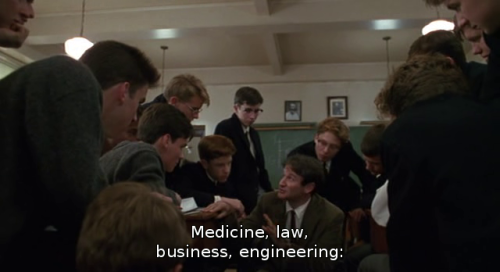


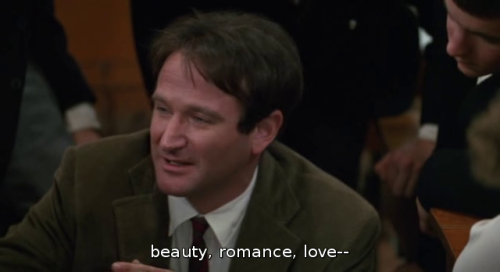
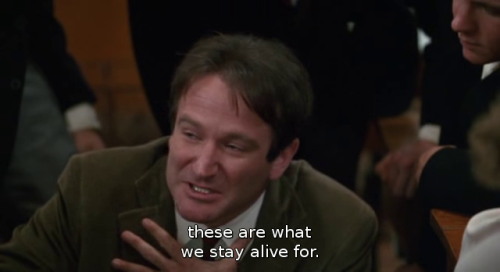
as-cool-as-an-attempted-suicide: wallflowerbloom: No matter...
Damiani.guilhermeTem beleza em ciência tbm. Ciência for realz.
as-cool-as-an-attempted-suicide:
No matter what anybody tells you, words and ideas can change the world.
We don’t read and write poetry because it’s cute. We read and write poetry because we are members of the human race. And the human race is filled with passion. And medicine, law, business, engineering, these are noble pursuits and necessary to sustain life. But poetry, beauty, romance, love, these are what we stay alive for.
(Dead Poets Society, 1989)
Me
David Pelaez, Tadeu and 2 others like this
24 Apr 16:31

And the witch starved to death, but she kinda deserved it. The...
And the witch starved to death, but she kinda deserved it. The cabin was made of Neil Diamond albums.
24 Apr 16:23

You can order a poster of this comic (and all the other comics for National Poetry Month) by following the instructions at my shop.
Writing a Poem
by Grant
You can order a poster of this comic (and all the other comics for National Poetry Month) by following the instructions at my shop.

Adam Victor Brandizzi, Damiani.guilherme and -1 others like this