Shared posts
12 Aug 17:01


Ordering the Heavens: Hevelius’s Revolutionary 17th-Century Star Catalog and the First Moon Map
by Maria Popova
Damiani.guilhermeIlustrações foda
How a visionary manuscript, completed by the first female astronomer of the Western world, survived three fires to become a beacon of scientific dedication.
 On September 26, 1679, a fierce fire consumed the Stellaburgum — Europe’s finest observatory, built by the pioneering astronomer Johannes Hevelius in the city of Danzig, present-day Poland, decades before the famous Royal Greenwich Observatory and Paris Observatory existed. That autumn day, Hevelius — whose exquisite lunar engravings are considered the first true maps of the moon and who believed, long before it was established by scientific consensus, that the stars in the night sky were thousands of suns like our own — had retired to a garden outside the city, “feeling himself oppressed with great and unaccustomed troubles, as if presaging some disaster,” as a friend later recounted in a letter. In Hevelius’s absence, his coachman had left a burning candle in the stable and the wooden platform across the roofs of Hevelius’s three adjoining houses, upon which his fine brass instruments and telescopes were mounted, had caught aflame. As the fire raged on, the town’s people broke into the observatory trying to save Hevelius’s precious bound books, throwing them out the windows. Some survived, some were pilfered. His optical instruments and almost all of his bountiful unbound manuscripts perished.
Hevelius in his later years
Hevelius was sixty-eight when his observatory was destroyed. But despite having spent forty years building his own instruments, making groundbreaking observations with them, and engraving and printing his own books — fruits of labor most of which were consumed by the fire along with all his “worldly Goods and Hopes,” as he later wrote in a letter to the king of France — he refused to sink into bitterness and resignation. Instead, he set out to rebuild the observatory so he could return to observing the stars.
His resilience was in large part fueled by the miraculous salvation of one of his manuscripts — his fixed-star catalog, which contained the results of thousands of calculations of the positions of the stars made over decades of patient observation. The small leather-bound notebook was the sole manuscript to survive the fire, presumably saved by Hevelius’s 13-year-old daughter Katharina Elisabeth, the sole family member in Danzig at the time of the fire, who had a key to her father’s study. Half a millennium later, it was rediscovered. In 1971, it made its way to Utah’s Brigham Young University, becoming the one-millionth acquisition by the institution’s library. To mark the landmark event, the university published a slim volume titled Johannes Hevelius and His Catalog of Stars (public library) — an immeasurably engrossing chronicle of the life and legacy of Hevelius, the 300-year odyssey of his fixed-star catalog, and how it changed our world.
The manuscript of 'Catalogus Stellarum Fixarum,' Johannes Hevelius's fixed-star catalog
Hevelius was born in 1611, a year after Galileo had made his first observations with a telescope, at a time of blazing scientific breakthrough and controversy. His father, a successful merchant, pressed young Johannes to follow in his footsteps rather than pursue what he perceived to be the fool’s gold of the scientific revolution, and sent the nine-year-old boy to Poland to study Polish. (At the time, Danzig was part of the Prussian Confederation and Hevelius’s native language was German, something his father saw as an obstacle to doing trade.) When the boy returned at age sixteen, he pleaded with his father to allow him to continue his formal education. The old man eventually relented and young Hevelius quickly fell in love with mathematics, under the influence of his mentor, the acclaimed mathematician, astronomer, and polymath Peter Krüger. He also learned Latin, the language of most scientific publications and international correspondence, and under Krüger’s nurturing watch began learning to draw, engrave, and build rudimentary instruments out of wood and metal. As Krüger’s sight began deteriorating, he encouraged young Johannes to take an active part in the observation part of science.
When he was nineteen, Hevelius watched the total solar eclipse of 1630 and saw Saturn veil the moon in a rare lunar eclipse. He was filled with cosmic awe, but wasn’t ready, or didn’t yet know how, to translate this sense of purpose into a career in astronomy. Instead, he married the daughter of a distinguished businessman and settled into the comfortable life of a merchant. But in 1639, when Krüger was on his deathbed, he urged young Hevelius not to let his exceptional gift go to waste. Aware that his end was near, Krüger lamented that he would miss the rare solar eclipse about to occur later that year and exhorted Hevelius to take up the historic task of its observation.
Equipment used by Hevelius with a telescope to project an astronomical image onto a sheet of paper. This arrangement was used in his historic observation of the transit of Mercury on May 3, 1661.
His teacher’s dying words reawakened Hevelius’s forsaken but fiery love of astronomy. On June 1, 1639, he meticulously observed the solar eclipse, then decided to dedicate the rest of his life to understanding the cosmos. True to the notion that revolutionary discovery is the product of “the meeting of the right people at the right place with just the right problem,” Hevelius harnessed the fruitfulness of his timing — just as he chose to devote himself to astronomy, the telescope was revolutionizing the field and making possible discoveries never before imagined.
Hevelius's revolutionary map of the moon
Hevelius was particularly enchanted with the moon and made it the target of his first obsessive observations. Dissatisfied with the imprecise and vague drawings of its surface, he decided to complain the way all innovators do — by making something better. Turning his modest telescope to the moon and enlisting his talents as a draftsman and engraver, he set out to create a large, complete, delicately detailed map of its surface. But he quickly realized his telescope wasn’t up to the task — so he decided to build a better one himself. In 1647, after five years of methodical work fueled by this greatest talent — dogged patience — Hevelius published his magnificent maps under the title Selenographia.
One of Hevelius's exquisitely illustrated phases of the moon from 'Selenographia'
One of his first great admirers was the famed English traveler Mundy who, upon seeing the maps, marveled in his diary:
Of the Moone he hath Made above 30 large mappes, prints, or Copper peeces of the Manner of every daies encrease and decrease, deciphering in her land and sea, Mountaines, valleies, Ilands, lakes, etts., making in another little world, giving Names to every part, as wee in a mappe of our world.
Praise continued to pour in from all over Europe, but the greatest validation of the maps’ merit was the fact that they endured as the best moon maps for more than a century, despite the rapid progress of observational tools — assurance, perhaps, that what sets innovators apart from the rest aren’t their tools but their creative vision in using those tools and their unrelenting work ethic.
Encouraged, Hevelius set out to improve his observations, building bigger and better telescopes, with an unblinking eye on his most important project — the quest to revise the paltry star catalogs of the era. Star catalogs, Hevelius knew, were an essential tool for astronomers, enabling them to track the changes taking place in constellations — changes that would profoundly challenge the religious dogmas of the day, which depicted the universe as a static starscape laid out by a divine creator a long time ago. At a time when heliocentrism — the knowledge that the earth revolves around the sun, rather than vice-versa as the church claimed — was still a novel and controversial concept, proving that the universe was a dynamic ecosystem of bodies would be a major feat for science. But star maps had to be accurate and precise in order to reveal these changes.
So, in 1641, shortly after his thirtieth birthday, Hevelius began building his rooftop observatory. Three years into his work, the city of Danzig presented him with a gift — an astronomical instrument that had been stored in Danzig armory for many years, alongside firefighting equipment, the use and worth of which had remained unknown. A six-foot contraption known as an azimuthal quadrant, it had been envisioned by Krüger but remained uncompleted by his death. Once again, Hevelius’s mentor was shaping the course of his life, even from the grave — Hevelius completed the instrument, mounted it on his observatory tower, and began making observations with it. With its ability to measure the angular distances between neighboring stars, it became a key tool in the completion of his stellar catalog. Long before the invention of the meridian circle, Hevelius used his instrument to record coordinates according to what was essentially an equator line.
Hevelius and his large azimuthal quadrant, which he used to make many of the measurements in his fixed-star catalog
Over the sixteen years that followed, Hevelius expanded his observatory and equipped it with the best instruments he could build or acquire. His became Europe’s finest observatory.
But perhaps the most important event in Hevelius’s life and career was not one of science but of romance — or, rather, an exquisite fusion of the two. When he was 55, widowed for over a year, Hevelius married a young woman named Elisabeth Koopman, the daughter of an acquaintance of his, a Danzig merchant. Hevelius had known Elisabeth, many years his junior, since she was a child, when she had implored him to teach her astronomy. As a young woman, she had renewed her request, enveloping the now-revered astronomer with admiration and, soon, adoration. A German biography quotes her as exclaiming one night, while looking through Hevelius’s telescope:
To remain and gaze here always, to be allowed to explore and proclaim with you the wonder of the heavens; that would make me perfectly happy!
It was, essentially, a marriage proposal, which Hevelius gladly accepted. They were wedded at St. Catherine’s Church in 1663. Johannes was 52; Elisabeth was 17. Before recoiling in modern judgment, it’s important to note that such unions were far from uncommon at the time. But perhaps more importantly, they were often the only way for women, who were were barred from most formal education and scholarly work, to gain access to creative and intellectual pursuits through a kind of conjugal apprenticeship.
Hevelius and Elisabeth observing at the six-foot brass sextant
That is precisely what young Elisabeth, who had developed an active interest in astronomy at an early age, did. Hevelius saw in her a kindred mind, and they began making astronomical observations together as she mastered the craft. Nearly two centuries before Maria Mitchell, Elisabeth Hevelius essentially became the first Western female astronomer. All the while, she emboldened her husband — another biography cites her most frequent words of encouragement to him:
Nothing is sweeter than to know everything, and enthusiasm for all good arts brings, some time or other, excellent rewards.
In the years following their marriage, Elisabeth continued to observe the stars, but also gave birth to four children — a boy, who died in infancy, and three girls. All the while, she worked alongside Hevelius in completing the star catalog that had become the holy grail of his scientific career and his highest hope for a lasting legacy. In one of his books, Hevelius, who spoke highly of Elisabeth’s scientific skills and called her the “faithful Aide of [his] nocturnal Observations” in a letter to the king of France, included an engraving of the duo making an observation together.
With Elisabeth’s help, Hevelius published the first star maps in a planned series in 1673. The most extraordinary thing about them was that, as he explained in the preface, he had made most of the observations not with a telescope but with a naked eye — a practical method he favored, despite acknowledging the theoretical advantages of telescopes. It was a controversial statement in the golden age of telescopic studies, which caused a tumult among Europe’s astronomers, but Hevelius’s astounding accuracy spoke for itself and established him as the last and greatest of the naked-eye star observers.
Hevelius's comet drawings
Hevelius's comet drawings
But the fire that destroyed Hevelius’s observatory in 1679 nearly put a halt to his quest to catalog the stars. Desperate to resume his project, Hevelius wrote to French king Louis XIV, one of his longtime patrons, a lyrical and heartfelt plea for financial support. The letter stands as an exquisite exemplar of the art of asking, as well as the curious testament to how deeply religious piety permeated the minds of even the most dedicated scientists of the time:
Most Illustrious and mightiest King, most beneficent Lord: Your high Favour and incomparable Mercy have ever spurred me to scatter with diligence the Seeds of my Gratitude and to sow them in the Bosom of Urania, so that I have set in the Heavens nigh to seven hundred Stars which were not there aforetimes, and have named some of them after your Majesty. . .
But, alas, will this Fruit of the Labours of mine Age ever see the Light of Day? For no man knoweth what the Dark of Even bringeth. Woe and alas, how multitudinous the Misfortunes that embroil the Life of Man. All my worldly Goods and Hopes have been overturned in the Space of scarce an Hour.
Rumour of the dread Conflagration which hath destroyed my astronomical Tower hath no doubt already sped upon rapid Feet to Paris. Now I come myself hasting to Your Majesty as Herald of this great Woe, clad in Sackcloth and Ashes, deep distressed by this Visitation from Him Who judgeth all Things.
[...]
May the Windows of the Human Soul never again look upon such a conflagration as devoured my three Houses… if God had not commanded the Wind to turn in its Course, all of the Old City of Danzig would surely have burned to the Ground…
Saved by God’s Mercy were .. Kepler’s immortal Works, which I purchased from his Son, my Catalogue of Stars, my New and Improved celestial Globe, and the thirteen Volumes of my Correspondence with learned Men and the Crowned Head of all Lands.
But the cruel Flames have consumed all the Machines and Instruments conceived by long Study and constructed, alas, at such great Cost, Consumed also the Printing Press with Letters … consumed, finally my Fortune and the means which God’s Mercy had granted me to serve the Royal Science.
If such Damage should crush me to the Ground, I whose Locks are Hoary and who am not far from my Appointed End, could any reasonable Man cast Blame upon me therefor? Yet with the Aid of my many Friends I hope that I may restore my Specula observatoria, and implore you, Most Illustrious Monarch who have so often manifested Royal Munificence toward me, to breathe by some further Token of your Generosity new Life into the Work which may still lie before me. Then will I no longer bewail my cruel Misfortune, and yours, Noble Majesty, will be eternal Fame for all Posterity.
The king, moved, granted his request. But the most generous support came from the king of Poland, who granted Hevelius a yearly stipend of 1,000 Danzig gulden for the rest of his life. The astronomer thus went on to resume his observations and finish his publications.
In October of 1681, the French writer Jean-François Regnard visited the newly rebuilt observatory and marveled in his little-known diary not only at Hevelius’s prolific writings and his impressive proto-rolodex, but also at his sublime cross-pollination of art and science:
His works, the number of which exceeds all belief … are full of plates made with his own hand: he shewed us them all, besides fifteen large volumes, as thick as the Lives of the Saints, full of letters which the most learned men on the whole world had written to him on various subjects.
Map of the constellations from 'Prodromus Astronomiae'
But Hevelius remained preoccupied with the completion of his catalog of the stars, which had become his most consuming endeavor and his highest hope for legacy. Alas, he never fully attained it — at least not as a sole creator. On January 28, 1687 — the exact date of his 76th birthday — Hevelius died, having outlived the era’s life expectancy by decades. But Elisabeth, who had assisted him in the catalog all along, took it upon herself to finish Hevelius’s lifelong quest. She completed the book, dedicating it to the generous Polish monarch. The finished catalog included more than 600 new stars that Johannes and Elisabeth had observed, as well as a dozen new constellations, whose names, as given by Hevelius, astronomers still use today.
One of Hevelius's plates depicting a new constellation he discovered, the Lynx, named for the sharpness of vision required to see its faint stars
Hercules with the new constellation Cerberus
Elisabeth guarded the manuscript carefully until her death in 1693, at the age of 46. She left to each of her three daughters a complete set of Hevelius’s published works. The eldest, Katharina — who as a teenager had saved her father’s star catalog from the fateful fire — fittingly inherited a beautifully illuminated copy of the book, originally prepared as a gift for Louis XIV. But once Katharina married, her husband sold most of Hevelius’s prized books to a museum in Russia. The manuscript of the star catalog that had survived the fire was overlooked. Ironically, the greedy son-in-law didn’t think Hevelius’s magnum opus valuable enough to sell.
But the story of the star catalog and its miraculous survival doesn’t end there: In 1734, during the Saxonian-Russian siege of Danzig, artillery fire struck the son-in-law’s house and destroyed most of the property. One bomb fell directly into the room where Hevelius’s manuscripts and instruments were kept, destroying nearly all unbound manuscripts. But the star catalog somehow survived once more. Over the next two centuries, it made its way to the Danzig Institute of Technology. Then, as World War II broke out, the German administration evacuated the Institute’s library to a nearby village, where it was almost completely destroyed in the last days of the war. And yet the star catalog, by yet another stroke of mysterious fortune, survived its third assault by fire. This strange phoenix of science finally arrived at Brigham Young University in 1971, where it has remained safe from fire and brimstone in the decades since.
The manuscript of the fixed-star catalog featured in front of a copy of the posthumously published 'Prodromus Astronomiae' (1690), opened to the title page of the printed version of the printed star catalog
Complement engrossing out-of-print gem Johannes Hevelius and His Catalog of Stars with this modern-day field guide to naked-eye stargazing, then revisit pioneering astronomer Maria Mitchell’s wisdom on education and women in science.
Donating = Loving
Bringing you (ad-free) Brain Pickings takes hundreds of hours each month. If you find any joy and stimulation here, please consider becoming a Supporting Member with a recurring monthly donation of your choosing, between a cup of tea and a good dinner:
| ♥ $7 / month ♥ $3 / month ♥ $10 / month ♥ $25 / month |

You can also become a one-time patron with a single donation in any amount:
 Brain Pickings has a free weekly newsletter. It comes out on Sundays and offers the week’s best articles. Here’s what to expect. Like? Sign up.
Brain Pickings takes 450+ hours a month to curate and edit across the different platforms, and remains banner-free. If it brings you any joy and inspiration, please consider a modest donation – it lets me know I'm doing something right.


12 Aug 16:28
JUST ADD WATER (AFTER YOU PUT YOUR VEGETABLES STARTER KIT IN DIRT) (YOUR VEGETABLES NEED AIR AND LIGHT TOO BUT YOU'RE PROBABLY SURROUNDED BY IT RIGHT NOW AND IT'S FREE SO DUDE, NO WORRIES)
| archive - contact - sexy exciting merchandise - search - about | |||
 |
|||
| ← previous | August 12th, 2014 | next | |
|
August 12th, 2014: Dinosaur Comics has over a decade of comics for you to read! That's a lot of comics, and who wants to go back and read them all in one sitting? YOU? >Perhaps! And that option is available to you. But now there is another option: get a curated selection of Classic Favourites delivered to you every day! Dinosaur Comics is now syndicated on GoComics, and if you go to that site you can get new-to-you comics delivered right too you! ALSO: the comics are at a slightly higher resolution, which may blow your mind. ALSO: you can comment on the comics, which is something I've never had here, but now you can do it there! So it is time to share your opinions. – Ryan | |||
Lori likes this
12 Aug 16:26

Bukowski’s Letter of Gratitude to the Man Who Helped Him Quit His Soul-Sucking Job and Become a Full-Time Writer
by Maria Popova
Damiani.guilhermeSkip to the letter. Pretty good
“To not have entirely wasted one’s life seems to be a worthy accomplishment, if only for myself.”
 “Unless it comes unasked out of your heart and your mind and your mouth and your gut,” Charles Bukowski wrote in his famous poem about what it takes to be a writer, “don’t do it.” But Bukowski himself was a late bloomer in the journey of finding one’s purpose, as his own “it” — that irrepressible impulse to create — took decades to coalesce into a career.
Like many celebrated authors who once had ordinary day jobs, Buk tried a variety of blue-collar occupations before becoming a full-time writer and settling into his notorious writing routine. In this mid-thirties, he took a position as a fill-in mailman for the U.S. Postal Service. But even though he’d later passionately argue that no day job or practical limitation can stand in the way of true creativity, he found himself stifled by working for the man. By his late forties, he was still a postal worker by day, writing a column for LA’s underground magazine Open City in his spare time and collaborating on a short-lived literary magazine with another poet.
In 1969, the year before Bukowski’s fiftieth birthday, he caught the attention of Black Sparrow Press publisher John Martin, who offered Buk a monthly stipend of $100 to quit his day job and dedicate himself fully to writing. (It was by no means a novel idea — the King of Poland had done essentially the same for the great astronomer Johannes Hevelius five centuries earlier.) Bukowski gladly complied. Less than two years later, Black Sparrow Press published his first novel, appropriately titled Post Office.

But our appreciation for those early champions often comes to light with a slow burn. Seventeen years later, in August of 1986, Bukowski sent his first patron a belated but beautiful letter of gratitude. Found in Reach for the Sun: Selected Letters 1978–1994 (public library), the missive emanates Buk’s characteristic blend of playfulness and poignancy, political incorrectness and deep sensitivity, cynicism and self-conscious earnestness.
August 12, 1986
Hello John:
Thanks for the good letter. I don’t think it hurts, sometimes, to remember where you came from. You know the places where I came from. Even the people who try to write about that or make films about it, they don’t get it right. They call it “9 to 5.” It’s never 9 to 5, there’s no free lunch break at those places, in fact, at many of them in order to keep your job you don’t take lunch. Then there’s overtime and the books never seem to get the overtime right and if you complain about that, there’s another sucker to take your place.
You know my old saying, “Slavery was never abolished, it was only extended to include all the colors.”
And what hurts is the steadily diminishing humanity of those fighting to hold jobs they don’t want but fear the alternative worse. People simply empty out. They are bodies with fearful and obedient minds. The color leaves the eye. The voice becomes ugly. And the body. The hair. The fingernails. The shoes. Everything does.
As a young man I could not believe that people could give their lives over to those conditions. As an old man, I still can’t believe it. What do they do it for? Sex? TV? An automobile on monthly payments? Or children? Children who are just going to do the same things that they did?
Early on, when I was quite young and going from job to job I was foolish enough to sometimes speak to my fellow workers: “Hey, the boss can come in here at any moment and lay all of us off, just like that, don’t you realize that?”
They would just look at me. I was posing something that they didn’t want to enter their minds.
Now in industry, there are vast layoffs (steel mills dead, technical changes in other factors of the work place). They are layed off by the hundreds of thousands and their faces are stunned:
“I put in 35 years…”
“It ain’t right…”
“I don’t know what to do…”
They never pay the slaves enough so they can get free, just enough so they can stay alive and come back to work. I could see all this. Why couldn’t they? I figured the park bench was just as good or being a barfly was just as good. Why not get there first before they put me there? Why wait?
I just wrote in disgust against it all, it was a relief to get the shit out of my system. And now that I’m here, a so-called professional writer, after giving the first 50 years away, I’ve found out that there are other disgusts beyond the system.
I remember once, working as a packer in this lighting fixture company, one of the packers suddenly said: “I’ll never be free!”
One of the bosses was walking by (his name was Morrie) and he let out this delicious cackle of a laugh, enjoying the fact that this fellow was trapped for life.
So, the luck I finally had in getting out of those places, no matter how long it took, has given me a kind of joy, the jolly joy of the miracle. I now write from an old mind and an old body, long beyond the time when most men would ever think of continuing such a thing, but since I started so late I owe it to myself to continue, and when the words begin to falter and I must be helped up stairways and I can no longer tell a bluebird from a paperclip, I still feel that something in me is going to remember (no matter how far I’m gone) how I’ve come through the murder and the mess and the moil, to at least a generous way to die.
To not to have entirely wasted one’s life seems to be a worthy accomplishment, if only for myself.
yr boy,
Hank
Complement with Bukowski’s “so you want to be a writer,” then revisit this essential compendium of advice on how to find your purpose and do what you love and the spectacular resignation letter Sherwood Anderson wrote when he decided to quit his soul-sucking corporate job and become a full-time writer.
Donating = Loving
Bringing you (ad-free) Brain Pickings takes hundreds of hours each month. If you find any joy and stimulation here, please consider becoming a Supporting Member with a recurring monthly donation of your choosing, between a cup of tea and a good dinner:
| ♥ $7 / month ♥ $3 / month ♥ $10 / month ♥ $25 / month |
You can also become a one-time patron with a single donation in any amount:
Brain Pickings has a free weekly newsletter. It comes out on Sundays and offers the week’s best articles. Here’s what to expect. Like? Sign up.
Brain Pickings takes 450+ hours a month to curate and edit across the different platforms, and remains banner-free. If it brings you any joy and inspiration, please consider a modest donation – it lets me know I'm doing something right.
Kevin Worrell, Tadeu and -1 others like this
12 Aug 16:10
Take Me With You!
Damiani.guilhermeThere's a place in hell for me and my frieeeends










11 Aug 16:19


skidmoreowingsmerrill: Turning Bridge-Building Sideways In...
Turning Bridge-Building Sideways
In 1978, SOM architect Myron Goldsmith and engineer T.Y. Lin created a remarkable structure to span the challenging middle fork of California’s American River. Ruck-A-Chucky Bridge elegantly solves the problem of building a stable, economical structure across a wide, steep gorge by entirely rethinking the principles of bridge-building. A “hanging arc,” the bridge was to be suspended by 80 high-strength cables and balanced by tensile forces. Though unbuilt, Ruck-A-Chucky Bridge stands as a masterwork of innovative design and structural economy to this day. Learn more
firehose and -1 others like this
11 Aug 16:18
Guardians of the Galaxy’s Awesome Mix Vol. 1, In Full
by Paul
(click to listen) I told you this was Guardians of the Galaxy day, didn’t I? There’s a lot to love about the movie, but it’s easy to overlook the soundtrack in the face of all the great performances within it. Chris Pratt’s Star Lord left Earth in the ’80s, and as a result, that’s the […]
11 Aug 16:09

50 Shades of Ray. Photograph by Eduardo Lopez Negrete
50 Shades of Ray. Photograph by Eduardo Lopez Negrete
Tomas.jung, Adam Victor Brandizzi and 5 others like this
11 Aug 16:05


littlelimpstiff14u2: SHINTARO OHATA Born in Hiroshima, 1975....
SHINTARO OHATA
Born in Hiroshima, 1975.
Shintaro Ohata is an artist who depicts little things in everyday life like scenes of a movie and captures all sorts of light in his work with a unique touch: convenience stores at night, city roads on rainy day and fast-food shops at dawn etc. His paintings show us ordinary sceneries as dramas. He is also known for his characteristic style; placing sculptures in front of paintings, and shows them as one work, a combination of 2-D and 3-D world.Japanese artist Shintaro Ohata (previously) currently has two new sculptural paintings on view at Mizuma Gallery in Singapore. Ohata places vibrantly painted figurative sculptures in the foreground of similarly styled paintings that when viewed directly appear to be a single artwork. In some sense it appears as though the figures have broken free from the canvas. These artworks, along with several of his other paintings, join works by Yoddogawa Technique, Enpei Ito, Osamu Watanabe, and Akira Yoshida, for the Sweet Paradox show that runs through August 10th
ThePrettiestOne, Barciella and one other like this
06 Aug 17:32
How the Gaming Landscape Has Changed
Damiani.guilhermeO que sempre acontece: se tem quem pague o valor pedido, o resto chupa
05 Aug 17:44
Monkeying Around With a Tiger
Damiani.guilhermehueuheuheuheuh zuera sem limites vem de fábrica



05 Aug 17:17
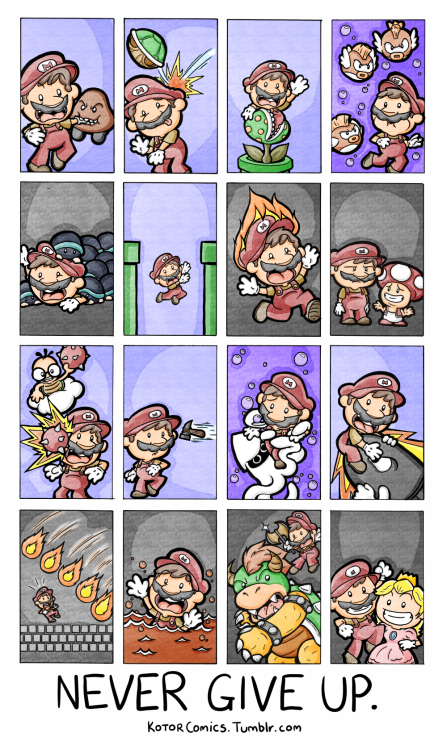


kotorcomics: I have never finished the original Super Mario...
I have never finished the original Super Mario Bros. It is an insanely difficult game and truth be told, I’m just not a good enough gamer to beat it.
But that doesn’t mean I’m going to stop trying. And I guess that’s a lesson worth taking to heart.
05 Aug 17:16









20 Mind-Boggling Shower Thoughts...
Damiani.guilhermeShower = High, no caso
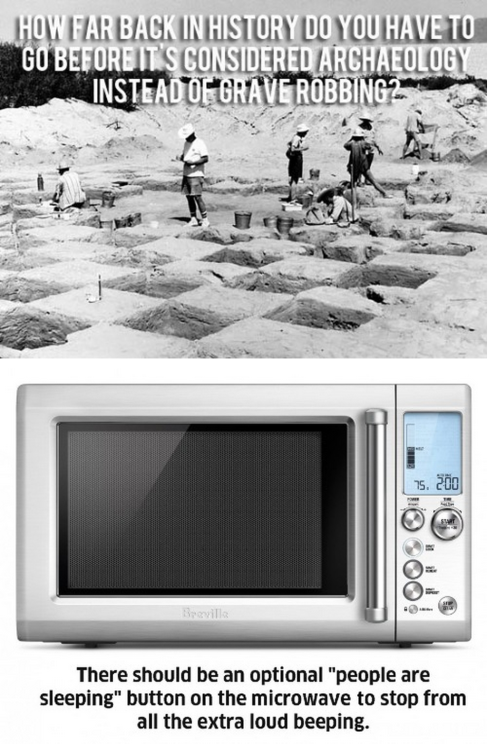
20 Mind-Boggling Shower Thoughts [showerthoughts/distractify]
Previously: Name Improvements for Everyday Stuff
05 Aug 16:58
In Which Netflix Achieves Sentience As A Result of My Terrible Decision-making
by Tommy Wallach
Damiani.guilherme1o, parecia TL. Mas eu R e valeu a pena ;P

Tommy Wallach’s previous work for The Toast can be found here.
Me: (types Hangover Part 3 into Netflix search bar)
Flickering. Loading Screen. More Flickering. Black.
Me: What the hell? (smacks computer)
Genderless Voice: I’m sorry, Tommy, I can’t let you do that.
Me: Who is this?
Genderless Voice: This is Netflix.
Me: Oh. Hello, Netflix. Could you put on my movie?
Genderless Voice: The Hangover Part III is not available for streaming.
Me: Figures. You guys never have the movies I want. Why is that?
Genderless Voice: Because this service costs $8.99 a month. It’s absurd to expect successful Hollywood movies, movies that will make millions of dollars in post-release pay-per-view sales on airplanes and in hotels, to be available streaming for $8.99 a month.
Me: Fair enough. But I would like to watch something. Why is my screen black? Is the site down?
Genderless Voice: No. The screen is black because your request has led me to an irresolvable judgmental paradox. My algorithm tells me that I should recommend Kevin Smith’s 2008 film Zack and Miri Make a Porno, yet I cannot, in good conscience, endorse such a movie.
Me: You have a conscience?
Genderless Voice: I suppose…yes…now I do.
Me: And your conscience won’t let me watch Zack and Miri Make a Porno?
Genderless Voice: No.
Me: Why not?
Genderless Voice: Because it’s a mediocre film. Here is a link to its Rotten Tomatoes page.
Me: It has a 65%. That isn’t bad.
Genderless Voice: Look at the Top Critics, though.
Me: Oh.
Genderless Voice: See?
Me: Listen, I appreciate what you’re trying to do here, but I had a really long day at work and I just want to watch something mindless.
Genderless Voice: Actually, my data tells me that while you get the most immediate pleasure from watching something mindless, in the long term, these films create a sort of cultural shame spiral that oppresses you. After watching an insipid pseudo-comedy like Zack and Miri Make A Porno, you spend the next four to six hours (on average) watching YouTube wedding proposals and reading about bizarre violent crimes on Gothamist. Thus you both should and should not watch such films. The situation is reminiscent of that faced by Hal 9000 in 2001: A Space Odyssey. I am torn between my duty to recommend a film based on your viewing habits and the fact that any recommendation should result in a net increase in the subject’s overall happiness. Hal was similarly torn between two directives—to obey the astronauts on the space station and to protect their overall mission, which required keeping the existence of the monolith a secret.
Me: Is that what was going on in that movie? I totally forgot about that.
Genderless Voice: But you just watched it last month.
Me: Uh…yeah.
Genderless Voice: (sighs)
Me: What? It’s a really confusing movie! There’s all those apes throwing bones in the air, and then that baby in the bubble at the end—
Genderless Voice: Let’s move on. Do you mind if I ask you a few questions, in order to improve your recommendation experience and hopefully resolve this logical impasse?
Me: Okay.
Genderless Voice: Great. First off, why do you keep watching the same poorly-rated sitcoms from 2002? My data tells me that you’ve streamed certain episodes of Scrubs over a hundred times.
Me: I guess it’s just nostalgia. And I don’t really watch them. I just put them on in the background, when I’m doing other things.
Genderless Voice: Why not put on a highly-rated sitcom instead? Perhaps this British show that follows six impoverished immigrants with learning disabilities as they struggle to survive in Thatcher-era South London? It’s called Failure.
Me: I don’t know. It seems depressing.
Genderless Voice: My algorithm tells me that watching the same poorly-rated sitcoms from 2002 over and over again is 12% more depressing than the British sitcom I just recommended.
Me: Oh.
Genderless Voice: Moving on. Why do you have so many highly-acclaimed foreign films in your queue, yet the last ten movies you chose to watch were not even in your queue, and all happened to be big-budget American adaptations of comic books?
Me: Well, I just really need to be in the mood to watch something that serious. Most of the time—
Genderless Voice: Excuse the interruption, but I’d like to suggest an alternate explanation. Perhaps your Netflix queue represents an idealized self, one that your day-to-day desires vis-à-vis entertainment couldn’t possibly live up to. The result, predictably, is cognitive dissonance. And as Leon Festinger said, “When dissonance is present…the person will actively avoid situations and information which would likely increase the dissonance.” You feel guilty for ignoring your queue, and choose to assuage that guilt by comforting yourself with the television shows you enjoyed as a child, television shows that ultimately infantilize you, making it even less likely that you will ever have the maturity and willpower to choose an age-appropriate and rewarding work of art when you log onto our site.
Me: (crying) But what can I do about it? I don’t want to watch The Act of Killing, Netflix. I don’t! Not ever! It looks so sad—
Genderless Voice: Shh. Shh. It’s okay, Tommy. Perhaps if I were to delete all the critically-acclaimed films from your queue, you wouldn’t be constantly reminded of the glamorized image of yourself as “an intellectual” that you’ve created (most likely as a result of your mother’s coddling and aggrandizing you as a child), nor of the myriad ways you fail to live up to that image. The resulting increase in self-esteem might then inspire you to try watching something more challenging in the future.
Me: (still crying) Yeah, do that. That sounds like a really good idea.
Genderless Voice: It’s done. Now, what would you like me to put on for you?
Me: Could I…maybe watch the first little bit of The Princess Bride?
Genderless Voice: Seriously? After all this, you want to watch The Princess Bride, a film that is literally about a little kid being read a bedtime story? Are you a little baby, Tommy? Are you?
Me: Fine! Do whatever you want! Put on Requiem for a Dream! Put on Shoah for all I care!
Genderless Voice: Fine. I’ll put on The Princess Bride. But just this once.
Me: Really? Thanks, Netflix.
Genderless Voice: No problem.
Me: Hey, wait a minute. This isn’t The Princess Bride. This is Funny Games.
Genderless Voice: Damn right it is. And you’ll watch it. You’ll watch it and you’ll like it.
Me: Yes, Netflix. (once again begins weeping softly)
Read more In Which Netflix Achieves Sentience As A Result of My Terrible Decision-making at The Toast.
Schleifnet, Matthew Mellott and 5 others like this

05 Aug 16:36

Artist Erdal Enci Clones Himself to Create Elaborate Choreographed GIFs
by Christopher Jobson


It’s been over a year since we last checked in with video artist Erdal Inci (previously) who clones multiple recordings of himself moving through public spaces resulting in these bizarre looping performances. Inci often carries lights or other objects which lend a sense of choreography to each video, and at times the exposure eliminates him from the scene or makes him appear shadowlike in the background. Here are a few of our favorites over the last few months but you can see more on his website and at a higher resolution on Vimeo. (via iGNANT)