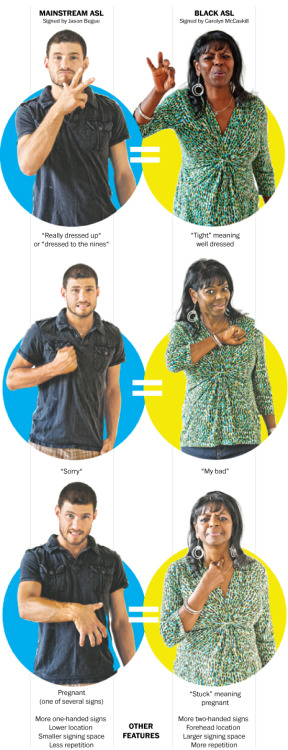
Reader Chris passes along an article about differences in American Sign Language usage between white and African-American signers. Researchers investigating what they call Black ASL found significant variations in signs, signing space, and facial cues. They explain:
Black ASL is not just a slang form of signing. Instead, think of the two signing systems as comparable to American and British English: similar but with differences that follow regular patterns and a lot of variation in individual usage.
They hypothesize that these differences began in segregated learning environments, and continue to evolve in Black social spaces. The whole article is worth a read.
Thanks, Chris, and remember — you can submit Wonk-worthy links through our ask or via email!
ETA, 9/24/12: Many of you have brought up the use of the word “mainstream” in this infographic. Better choices definitely exist, since this word rings of othering. We appreciate your nuanced and attentive readership!
This is really cool!
this is awesome i was not aware of this
If you want more information, Dr. Joseph Hill has it: He’s Deaf himself and has a PhD in Linguistics from Gallaudet University, too, and created a really informative video about the history and structure of Black ASL: https://www.youtube.com/watch?v=y7ooYqdEdUY
(turn on Closed Captionings to understand the signs)
I mean, I guess? But not really. Here’s a few things about when people say stuff like “cis het guys are fucking disgusting.”
1. When it comes to harmful comments, being told that cis heterosexual guys are shitheads is the bottom of the barrel.
Do you know why it doesn’t really bother me when I hear shitty things about cishet guys? Because on the wide fucking spectrum of gender and sexuality, we have it easiest by a fucking MILE.
We have the most privilege and the least resistance in a LOT of things. We never have to deal with our actions being called into questions and we’re allowed a stupid and ridiculous amount of wiggle rooms with ideas like “boys will be boys.”
We can do things women would get crucified for doing. Sleeping around doesn’t make us “slutty,” it makes us “studs.” Spending a lot of time focusing on our look and style doesn’t make us “shallow,” it makes us “classy,” even though neckbeard fedora MRA dickheads have ruined that word.
So if a woman wants to call cishet guys gross, it’s kinda like calling a white dude a cracker. You can’t be racist or sexist to the people who are in power, because it’s an institutionalized thing.
2. Here’s the thing. Straight guys are kiiiinda the worst.
I’m sorry, but have you SEEN other dudes? Jesus christ, we’re fucking awful.
It’s gotten so bad that literally like 80 percent of the time I’ve begun to talk to a new girl through the internet, dating sites, tumblr or texting, they seriously make a point to say something like “holy fuck I’m so glad you can have an actual conversation.”
When I see screenshots of dudes texting it’s so fucking terrible. This “what would u do if I was there right now lol” bullshit is so disgusting, charmless, lame and fucking pathetic, it reminds me of me when I was like 18 and I fucking hate 18 year old me. He’s a sexist and a dipshit.
And that’s not even the worst of it. This isn’t even touching the sort of hatred and hostility that a LOT of men have when it comes to rejection. I’ve SEEN conversations women have had with men where, once the woman rejects the guy as politely as she can, he immediately turns on her.
As soon as he has to fathom the idea of a woman not wanting him to shove his terrible dick inside her for 20 seconds, he gets fucking furious. He insults her weight, appearance, anything he knows she might be insecure about. It’s horrible and disgusting.
This is just a SMALL part of the shitty things that cishet guys are capable of because we’re taught to think of ourselves as kings who, if the women are lucky enough, will bestow our kingly dick and balls upon them.
This isn’t even TOUCHING the dangerous ideas of the friend zone or how dehumanizing and manipulative it is, but I’ve talked about that before, mostly because I used to be one of those white knight dudes and I feel horrible about it to this day.
3. The most terrible thing to men? IS MEN.
Somehow, MRAs got this idea that feminism is about killing men and taking their place or something. That just goes to show why feminism has to exist, because somehow men’s rights activists took a movement about women and made it about them.
But here’s the thing. The terrible shit that happens to men? We pretty much do all of it to ourselves.
First of all, there’s the idea of toxic masculinity. We raise boys to believe that they have to be tough. “boys don’t cry,” we try and tell them. And because of this, they feel pressured to be tough and to feel nothing, so they’re emotionally stunted and filled with anger.
Second of all, we throw out dangerous ideas that grant them more freedom to be shitty to each other. “boys will be boys,” we say as we write off bad and violent behavior.
Let’s look at that mixture. We’re telling young boys that they aren’t free to express their emotions in the natural way, so they end up bottling up everything. Then, we grant them the freedom to be physically and verbally aggressive to other people.
That’s a dangerous mixture.
Even beyond that, MRAs are so quick to shout “things are bad for men too” at so many things, then when presented with those ideas, they write them off as invalid.
Whenever we talk about the statistics of women who are raped and how it’s a problem and a crime of aggression, men are so quick to say things like “Men get raped too!”
But if you look on Facebook, as soon as someone posts an article about some 35 year old teacher who raped a 17 year old boy, it’ll literally only be the men who say things like “heh, that boy is so lucky” or “wish I had a teacher like that!”
do you know what it means to claim that men are also raped, and then immediately joke about how lucky it is for a man to be raped by a woman?
It means that you don’t give a fuck about other men. It means that you don’t give a fuck about other human beings. It means that literally the only reason that you said it, without caring about the men who are hurt in those crimes, is because you want to take attention away from the VASTLY higher number of women who are raped and make it about you.
That is why women need feminism.
And that is why I don’t mind seeing jokes about straight(ish) dudes like me on tumblr.
Roman Bystrianyk and Suzanne Humphries have a cherry to pick with proponents of vaccination. Their article on the measles vaccine was recently published on Health Impact News’s Vaccine Impact website under a heading promising us a mouthful of impacted truth: The Truth About Measles the Mainstream Media is Suppressing.
The actual article by Bystrianyk and Humphries is titled “Was the Introduction of the Measles Vaccine Responsible for Wiping Out Measles?” although the article barely even touches on that question, which is related to incidence of measles. Instead, the authors begin with a focus on mortality rates, which makes sense if you believe vaccines fight death, not disease.
Maybe Big Pharma and the mainstream media are in cahoots to suppress the TRUTH about a vaccine against death! I bet Big Funeral is in on it as well. It explains so much.
What it doesn’t explain is why the authors of this article felt compelled to go on at length about how mortality rates from measles were decreasing before the introduction of the measles vaccine as though this has anything to do with the effectiveness of the vaccine against measles. Of course people were less likely to die from multiple diseases with improvements in public health, hygiene, nutrition, and other factors.
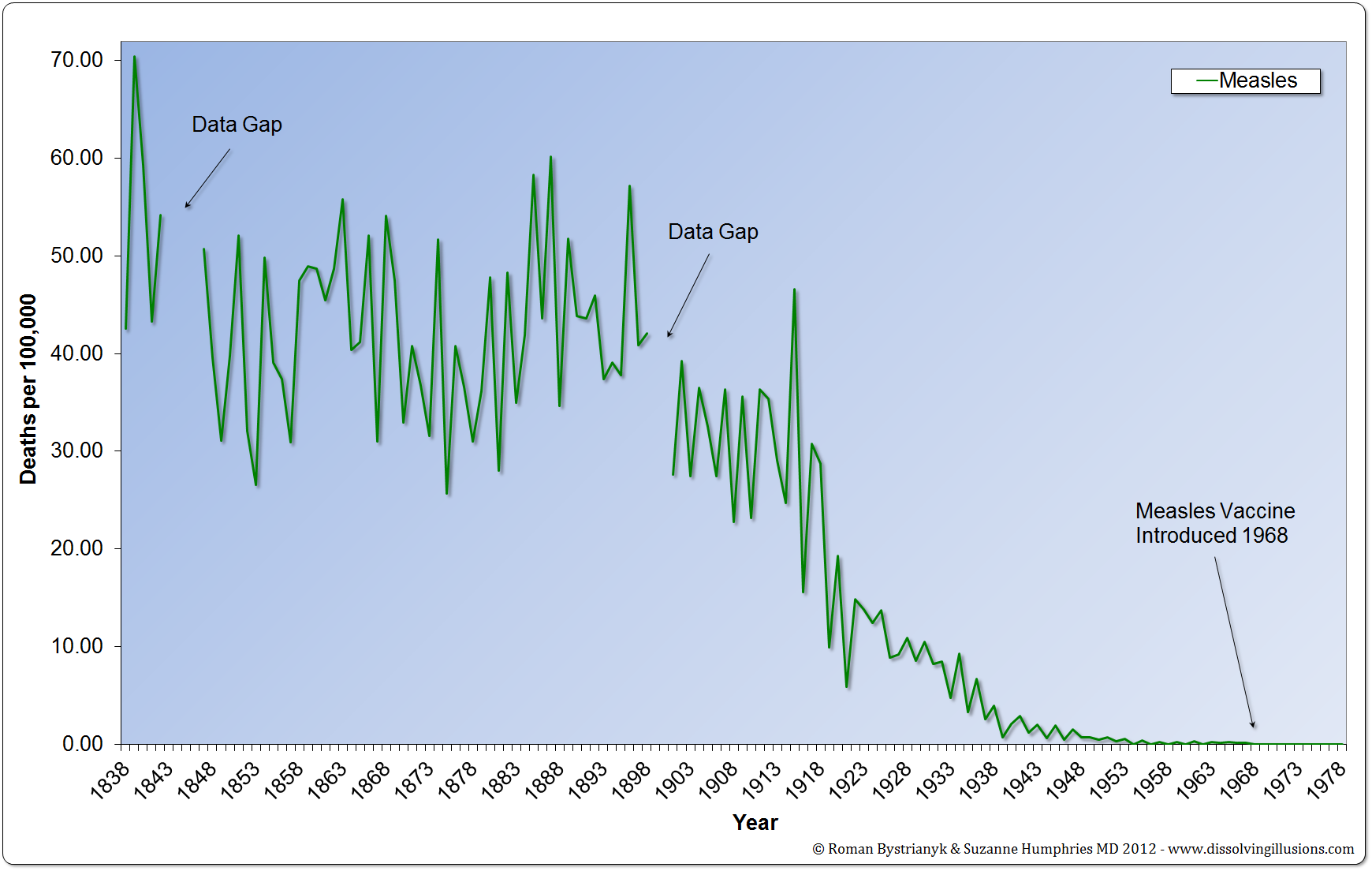
But let’s not allow a firm grasp of the obvious get in the way of enjoying the first in a series of painfully bad charts:
There’s only one reason to start this graph in 1838: to increase the scale so that the death rate appears even smaller in the years before the vaccine was introduced than it would if the graph focused on a relevant time frame. It’s not like anyone looking at this doesn’t already know that mortality from all causes was much higher in the 19th century than in the 20th. Noting the data gaps is a nice touch that almost makes it seem as though the authors are paying careful attention to detail and honesty, but that impression is quickly dashed by the incorrect year for the vaccine introduction, which was 1963, not 1968.
When I first saw that year in the chart, I thought I might have misunderstood this article as focusing on the United States. Perhaps the data came from another country’s mortality rates. I tried checking the references, but the source for this graph was unclear. The note numbers in the article start with 5, not 1. I think we’re supposed to assume that reference 4 applies to this chart, citing historical US census statistics, but when I tracked down the chart on the website given in the graph note, I discovered that this chart and the subsequent chart are based on UK statistics. But then the later charts in the article are based on US statistics. And at no point do the authors explain this or even note it. Regardless, 1968 is the incorrect year for the UK as well. As in the US, the vaccine was first introduced in 1963.
The next chart shows mortality rates for scarlet fever, again from the UK and again starting with 1838. The purpose is to show the declining mortality rate of a disease that is not vaccinated against to make the point that mortality rates have been decreasing over time. I won’t bother reproducing it here because it’s similar to the above and already a waste of space in the original article.
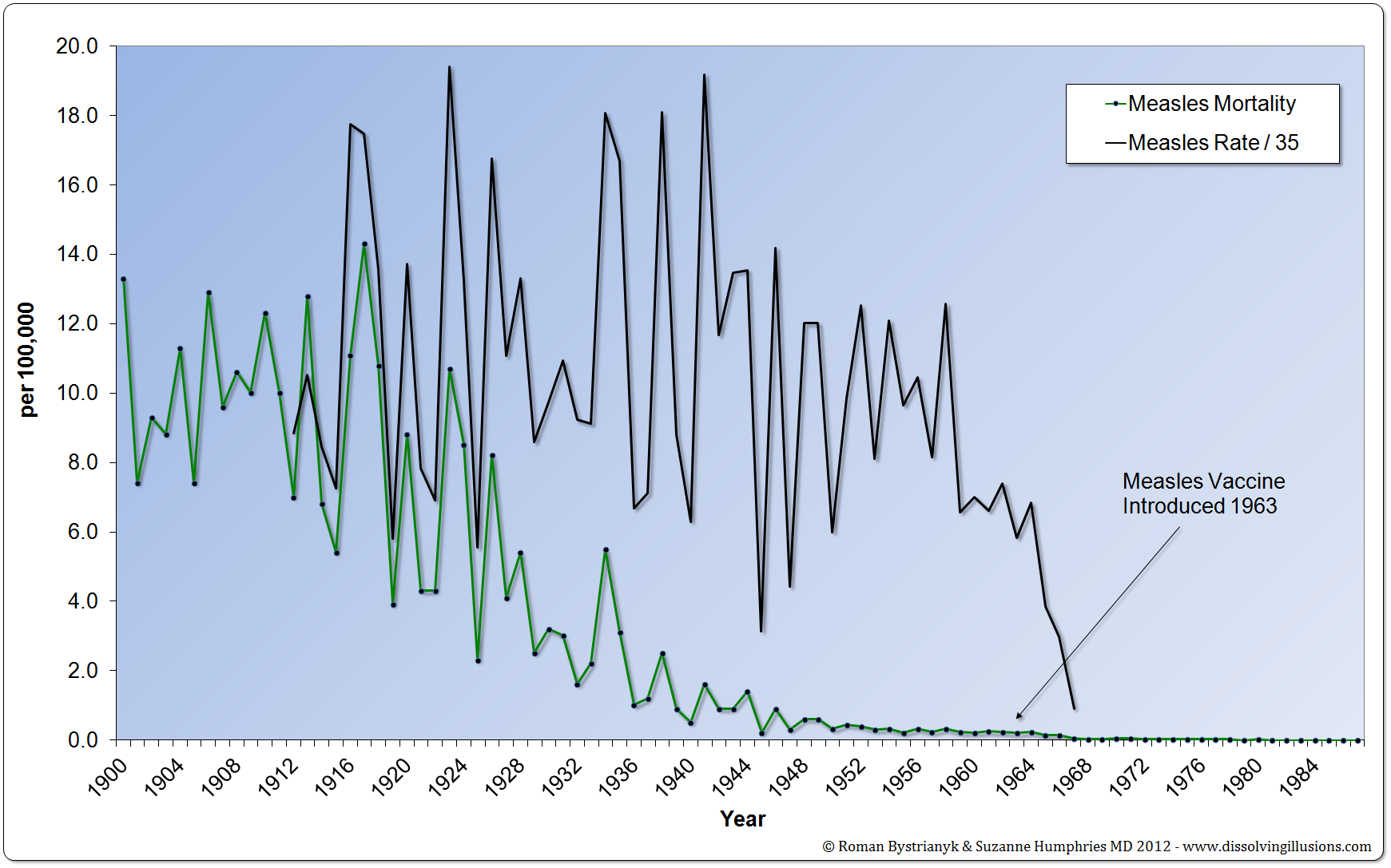
Finally, we get to the chart and discussion that has any bearing whatsoever on effectiveness of the measles vaccine: a chart showing incidence along with mortality rate, this time in the US.
Instead of showing the actual incidence, they show it divided by 35 per 100,000, making the incidence seem much lower than it actually was. But hey, they got the year right this time for the vaccine introduction.
Even with this blatant manipulation, the drop in incidence after vaccine introduction is so clear that the authors have to admit, “Measles incidence did apparently dramatically drop after 1963.” So after slogging through irrelevant discussion of mortality rates and other diseases, such as pertussis, as though they are interchangeable with measles, we get to a relevant point and the authors’ own jury-rigged chart still shows the clear benefit of measles vaccination.
OR DOES IT?
The authors then ask, “But can this drop be completely attributed to the success of the measles vaccine?” And I’m thinking they are going to present other possible explanations for the drop, but no. They describe some reported problems with the early vaccines and the subsequent improvement in both vaccine and vaccination schedule to make the immunization safer and more effective. The horror. Scientific learning, correction, and progress are THE WORST. But none of this provides any alternative explanation for the drop in measles rates after the vaccine introduction.
At long last, after much hand waving and many detours along Non Sequitur Boulevard, the authors answer the question they ask in the title: Was the introduction of the measles vaccine responsible for wiping out measles?
Are you ready for it? I mean, after coming this far, this has to be good, right? Can you hear the orchestra’s crescendo, the drum roll, the FINAL COUNTDOWN?
Here it is. The BIG EXPLANATION.
Measles went away on its own.
Yep. That’s it. It was already declining. *shrug*
No explanation for the extreme drop right after vaccination started. No evidence that vaccines weren’t the cause of the drop to suggest considering alternative explanations. It’s like they’re not even TRYING.
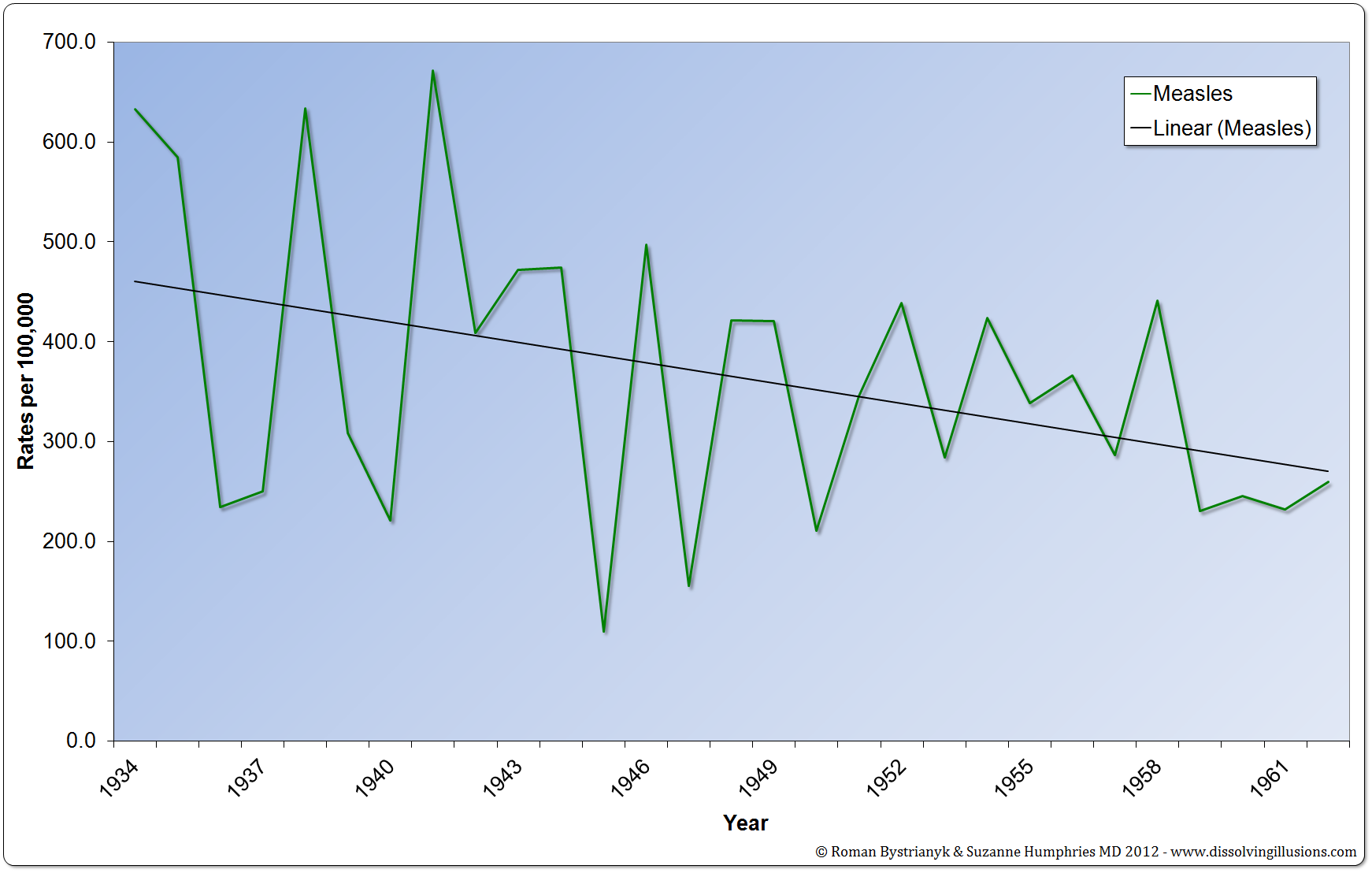
All they provide is this last sad little chart with a trend line and the claim that if the “trend line held, measles incidence would have hit zero by around the year 2000.”
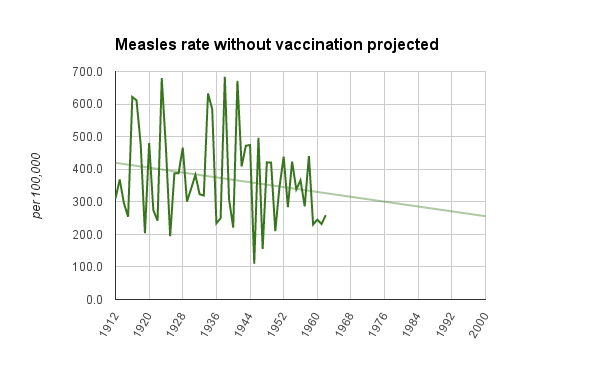
For some reason, they start the graph at 1934, instead of 1912, the starting year they use in the chart above. I wonder how many tries it took them to find a year that would make their trend line angle where they wanted it?
Using the same data but starting at 1912, here’s where measles ends up in 2000 without vaccination:
Neither trend-line chart is adjusted for population growth or anything along those lines, but the point is clear. The only actual argument against the effectiveness of measles vaccines that the authors make is supported by deliberately manipulating the trend line.
But yeah, the mainstream media is suppressing this “truth.” Makes perfect sense.
H/t to Abby D. for the link to this article and its bounty of bad charts.
The Western world’s century-old love affair with the automobile is coming to an end.
People are driving less than they did before the recession, and there are fewer cars on the road. In the US, the number of vehicles per driver has fallen from a peak of 1.2 in 2007 to 1.15 today, according to data compiled by Schroders, an asset management firm. Young Americans are getting their drivers’ licenses later than they did in 1983, or even in 2008. Fewer Britons under the age of 30 have licenses today than in the 1990s. And many young people on both sides of the Atlantic are not getting licenses at all.
Driving licence penetration by age, United States(Schroders)
This could very well be the end of the road, writes Katherine Davidson, automotive analyst at Schroders, in a fascinating note that makes the argument that car sales may never recover to their pre-recession peak. And it comes down to two things: urbanization and smartphones.
A status symbol no more
The majority of the world’s population now lives in cities. And young people are increasingly willing to stay there, unlike their parents, who flocked to the suburbs as their families grew. Nearly two-thirds of American “millennials,” or people born after 1984, live in cities today and some 40% say they’re not leaving. For them, “cars are not as relevant as a status symbol, and getting a license is no longer a ‘rite of passage’ in the way it once was,” writes Davidson.
Urban centers, of course, are less pleasant and more expensive to drive in, thanks to congestion charges, lots of traffic lights, and pricey parking. And the proliferation of smartphones—with apps that let city residents access real-time information on public transport and capabilities that have given rise to private taxi services like Uber—add to the sense among city dwellers that owning a car is an unnecessary expense.
This chart shows that interest in car ownership has increased from recession-era lows. But only one age bracket, consumers 55-64, shows more interest now than in 2007—and note the flattening out of the trend line for consumers in the 25-34 age bracket.
Propensity to buy a vehicle by age, United States(Schroders)
A new object of desire
Smartphones cut car use in other ways, too. By allowing people to easily stay in constant contact, smartphones have reduced the number of trips people take. Danah Boyd, a researcher at Microsoft, noted this phenomenon in her 2014 book, It’s Complicated, which looked at the use of communications tools among teenagers. “What the drive-in was to teens in the 1950s and the mall in the 1980s, Facebook, texting, twitter, instant messaging and other social media are to teens now,” she writes (pdf, p.20).
E-commerce also has detrimental effects on car ownership. If your supermarket delivers a hefty order to your home every weekend, trips to the out-of-town hypermarket suddenly become unnecessary. Ditto bulky items from Amazon.
What does all this mean for car companies? “Our base case is that there will be a structural stagnation in the developed world auto industry, with no further gains in density and all future vehicle sales driven by replacement demand,” writes Schroders’ Davidson.
Nigel Griffiths, chief automotive economist with the research firm IHS, is somewhat more sanguine: “We do believe there is a structural change occurring. The question is how significant that is and how pervasive that will be in the long term,” he says, adding, “We are being very cautious in our forward-looking models.”
One reason is for that is the difficulty in reading structural changes amid a lot of cyclical noise. Gas prices are falling. Exchange rates are volatile. It’s not clear where car ownership levels will settle out, post-recession. All of that has “really clouded the issue,” says Griffiths.
Emerging markets don’t offer much cause for optimism. Modest increases in car ownership in developing countries have already led to gridlocked cities, thanks to terrible (or, in many cases, a complete absence of) urban planning. From Mumbai to Nairobi, and certainly all over China, vast amounts of money are being poured into public transport. While there remains much room for growth in car ownership in these markets, signs are that emerging economies will learn from the west, adopt new technology, and avoid building their cities around the automobile.
These rich, super fudgy brownies are topped with generous dollops of homemade dulce de leche and a generous sprinkle of sea salt. The thick layer of dulce de leche has the same fudgy texture as the brownie underneath, and the salt wakes the whole thing up. Consider yourself warned, because you're gonna want to make these every day.
Read More
There’s no known antidote to the toxicity of Gamergate, but one good way to recuperate is by directing your attention to the teenage creators behind a game called Tampon Run. Sophie Houser, 17, and Andrea Gonzales, 16, met during a summer program run by the non-profit Girls Who Code. For their final project, the New York City high school students built a game to try to de-stigmatize menstruation by letting players shoot tampons (not guns) at their enemies. The game brought so much attention to its precocious creators (and the taboo subject) that the pair is launching new-and-improved mobile version in the Apple App Store today.
Not unconvinced getting your period is all that taboo? Try walking through your office carrying a tampon in plain sight. Stop and chat with male colleague on your way to the restroom, while you're at it. Then imagine the middle school version of that exchange. "Something most women get for a majority of their lives, is embarrassing, crude and shameful," Houser explained in a TEDx talk about gender and tech from December.
Their equality agenda also includes a game about catcalls, built at a Stanford hackathon
But the duo’s equality agenda doesn’t end there. After launching Tampon Run, Houser and Gonzales were named finalists at a Stanford hackathon for a game called Catcall Run. In that rapidly strung together version, the player flings "tools of empowerment" like pencils, computers, and notebooks at oncoming catcallers, who then switch over into "graduation garb because they had been educated," Houser told The Verge. In fact, a shared interest in women’s issues is what brought the pair together. When it came time to find a partner for the final project at Girls Who Code, "I was in the social activist corner and Andy was in the art corner," said Houser. Gonzales pitched a project about "the hyper-sexualization of women in gaming" and Houser "made a beeline" for Gonzales because she loved the idea of using code as a creative tool for activism.
They eventually settled on Tampon Run, an old school 8-bit online game. In it, the girl character throws tampons to destroy her enemies, who will confiscate the tampons if she lets them pass by. The notion of weaponized tampons is a reference to a 2013 incident where Texas state troopers confiscated tampons (as potential projectiles), but not guns, from visitors who were trying to get inside the Texas State Capitol to observe a controversial vote on abortion restrictions.
Weaponized tampons is a reference to a real-life incident in Texas
The online version of Tampon Run is simple, literal, and light-hearted, but that's what they were able to do with limited training and time. The iOS version of Tampon Run gets more challenging over time, and includes a flying enemy and leaderboard.
In the TEDx talk from last month, Houser and Gonzales said their larger goal was to encourage more girls to experiment with coding. "I don’t think a guy would have made Tampon Run and I don’t think Andy or I would have made it if we were in a co-ed computer camp," Houser told the crowd, lighting up when she described how great it felt to get the character to jump after two days frustrating days of coding. Continually overcoming those difficulties is what makes you feel successful, she explained.
The iOS version of the game, which launches today, was built with help from Pivotal Labs, which volunteered its expertise pro bono for seven weeks. Pivotal, a development consultancy, typically works on projects for clients like Twitter, Groupon, and Best Buy.
Houser readily admits that she and Gonzales have caught some lucky breaks. For example, they were introduced to Pivotal through investor and entrepreneur Nihal Mehta, the husband of Girls Who Code founder and CEO Reshma Saujani. Mehta is a member of the non-profit's "Brain Trust." Houser thought they were going to Pivotal for a "scoping session." The girls answered questions about what they wanted to build and how long that would take. "We couldn’t be at Pivotal all day. High school," Houser said, with what sounded like a shrug. Pivotal decided to offer up a dedicated team for seven weeks. In a statement, Catherine McGarvey, NYC Office Director at Pivotal Labs said: "Pivotal values diversity and enjoyed supporting an initiative that fosters inclusiveness in the tech industry."
All the good-intentioned attention hasn't yet translated into traffic for the game, which has had 232,000 unique visitors since it launched last September. Houser said the numbers were "surprisingly low based on the media coverage." (They've been featured everywhere from Fast Company to Teen Vogue.) Perhaps "people were sharing the news articles and maybe not clicking and playing the game." If the app doesn’t get traction, there's a chance a book will fare better. Houser and Gonzales are talking to agents about writing something "that would encourage girls to code."
"I want to stand here like a woman"
Houser, who only learned to code this summer, is committed to majoring in Computer Science. She and Gonzales pay close attention to the gender gap in the tech industry and have been carefully observing women harassed by Gamegate. "It's definitely scary and we were very lucky," she said, that Tampon Run has only received "some hate mail from people who were anti-gun control because we had a little message about violence in video games."
Watching Gamergate unfold "was horrible to see and to hear about," said Houser. "But it strangely made me want to be here more. I want to stand here like a woman. I want to hold my ground."
Everybody loves creamed spinach, even folks who hate spinach! Here’s a luxurious baked version that I love serving with oven-roasted pork tenderloin, though it pairs just as well with steak, pork chops, or any other protein on your plate. Splurge on a little mid-week comfort food and make this with your dinner tonight!
This hearty soup – loaded with chicken, kale, sweet potatoes and veggies, will warm your bones on this cold winter we are having! And the leftovers are perfect for heating up for lunch the next day and can also be frozen for another night.
I'm not a fan of sweet potatoes unless they are savory, so I loved them in this soup! There's no grains in here, but a large bowl is very satisfying. The jalapeño adds the perfect flavor, and just a trace of heat. Of course if you like your food spicy, you could add more! This is naturally gluten-free, Paleo and a great One-Pot meal – enjoy!
On Monday, Elite Daily’s Clementine Ford tweeted out out an innocuous, albeit pointed, question about sexism. She asked
men if they received blowback for vocally expressing their thoughts on
social media. The question was based off her own experience that has little to do with the merits of her work but
everything to do with her gender.
People on the streets of San Francisco react with astonishment as they read aloud the app permissions on their smartphones in this amusing video from encrypted communications company Silent Circle. The video was created by filmmaker Ivan Cash as part of the #PrivacyProject, a campaign by Silent Circle and Blackphone, maker of an encrypted Android smartphone.
alphadogg writes: A deadly air crash that killed a pilot and passenger in Colorado last year was likely due to a loss of spatial awareness brought on in part by taking of selfies while in flight, the National Transportation Safety Board has concluded. An examination of the aircraft revealed no apparent problems that would have caused the accident so, based on the previous patterns of behavior, the NTSB concluded that "it is likely that cell phone use during the accident flight distracted the pilot and contributed to the development of spatial disorientation and subsequent loss of control."













 Super Opinionated.
