Luke.stirling
Shared posts
alphameow: Most important picture I’ve seen lately

Unnecessary automation

by sidusnare and Mesh

The Myth of SF/F Publishing House Exceptionalism
(This is not specifically Hugo neepery, but it is related, so again, ignore if the subject bores you.)
 Recently author John Ringo (in a Facebook post previously available to the public but since made private) asserted that every science fiction house has seen a continuous drop in sales since the 1970s — with the exception of Baen (his publisher), which has only seen an increase across the board. This argument was refuted by author Jason Sanford, who mined through the last couple of years of bestseller lists (Locus lists specifically, which generate data by polling SF/F specialty bookstores) and noted that out of 25 available bestselling slots across several formats in every monthly edition of Locus magazine, Baen captures either one or none of the slots every month — therefore the argument that Baen is at the top of the sales heap is not borne out by the actual, verifiable bestseller data.
(This is all related tangentially to the current Hugo nonsense, as Ringo wanted to make a point about Social Justice Warriors and how they’ve tainted science fiction in general, except for Baen, apparently the lone SJW-free SF/F publisher, whose political/social purity is thus being financially rewarded.)
Sanford is correct in his point that as a matter of books from Baen whose individual sales can compete with the sales of individual books from other science fiction publishers on a month-to-month basis, as charted by the Locus list, Baen’s showing is modest (the May Locus lists, incidentally, show no Baen books, whereas Tor shows up five times, Orbit five times, DAW four times, Del Rey three times, Ace and Harper Voyager once each, and non-genre-specific publishers like Bantam and Morrow taking the rest of the slots).
But does that mean Ringo’s larger assertion (sales of SF/F publishing houses are down since the 70s except for Baen) is false? Not necessarily! Here are some reasons Ringo might still be right:
1. Ringo’s first assertion (SF/F publishing houses sales down since the 70s) is independent of how any individual title by any publishing house stacks up against any other title by any publishing house in the month-to-month or week-to-week horse races known as the best-seller lists. That a book is #1 on the Locus list one month does not mean it sold the same number of books as any previous #1; nor does it speak to the overall sales of any particular publishing house.
2. Bestseller lists don’t (generally) track backlist sales or month-to-month sales of books that don’t hit the lists but nevertheless sell steadily. A book that initially sells modestly but keeps selling regularly can (and sometimes does) eventually sell more than a book that cracks the bestseller lists but then falls off precipitately. If Baen books are good backlist sellers — and better so than other publishers’ books — then Ringo’s assertion could be correct.
3. Publishing houses expand and contract all the time, and some years are better than others. If you’re charting the existence of a publishing house over 40 years — genre or otherwise — then its sales history is going to reflect that. It’s possible Baen’s own history has been one of consistent (although, if so, I would suspect very modest) growth, as it’s stuck to its knitting, specializing largely but not exclusively in specific sub-genres of science fiction and fantasy.
Now, in order for Ringo’s assertion to be proven true, he’d need to provide actual data that show all of these things, otherwise, he’s just asserting. Does he have that data? Well, hold up for a moment, because I have some other things I want to get to first.
Ringo’s assertion could be correct. But here are some various ways that Ringo could be — intentionally or otherwise — putting his thumb on the scale:
1. Baen has only been in business since 1983; comparing its sales history to a house like, say, Ace, which was founded 30 years prior and whose own sales history went through a couple of boom-and-bust cycles (not to mention changes in ownership) before Baen even came into being, not to mention other publishers who participated in the business cycles of the 70s that Baen did not, might be misleading.
2. If Baen’s initial sales were modest, then growth from that modest number would not necessarily be all that impressive; one can grow from modest numbers to only slightly less modest numbers and still see significant growth, percentage wise. Likewise, continued growth can be fractionally modest and still be growth. “Growth” without context is not a useful metric.
3. Additionally, “growth” in itself doesn’t necessarily mean that what Baen publishes does particularly well in sales, either by itself or in competition with other publishers. Scale is important. If Baen sells “X” books one year, and another publisher sells 3X, and then next year Baen sells X+1% while the other publisher sells 3X-1%, then Baen has experienced growth where the other publisher hasn’t — and the other publisher is still selling a healthy multiple of Baen.
4. Likewise, “growth,” while a nice thing, does not necessarily directly equate to success as a publisher. A publisher could shrink the number of titles it sells but end up making more money than it did with a larger list by focusing on core titles, paring off costs associated with selling an extended list (marketing, touring, advances, etc) and negotiating better deals with retailers, etc. Whereas growth, unchecked and unplanned, can lead to ruin; off the top of my head I can think of at least a couple of publishers in the genre who experienced enviable growth and then fell on their ass because their businesses didn’t scale.
5. Ringo’s focus on SF/F publishers elides that other non-SF specific houses have done a very good job selling science fiction and fantasy in recent years. The Martian, arguably the best-selling adult science fiction book of the last year, is published by Broadway. Ernie Cline, whose Ready Player One sells very well, is published by Crown. Neil Gaiman is published by Morrow. George RR Martin is published in paperback by Bantam. Lev Grossman is published by Viking. It also elides the entire YA market, which is a huge market for SF/F, almost all of which is published by YA-specific imprints rather than SF/F-specific imprints. So even if Ringo’s claim were broadly true, with regard to specific SF/F houses, the claim is so narrowly tailored with regard to how SF/F written work sells today — and by whom, and to whom — that it is of dubious utility.
6. Finally, Ringo appears to fall prey to the old “correlation is not causation” thing, in that even if Baen is experiencing growth where other SF/F houses are not, it’s not necessarily the case that it’s because its authors (or stories) are “SJW-free.”
Ringo appears wants to make to two arguments: One, that Baen has experienced consistent, across-the-board growth in its sales where other SF/F publishers have not. Two, that this is due to Baen not publishing authors or tales that are “SJW”-y; only “cracking good tales” allowed, the definition of which apparently preclude any Social Justice Warrior-ness (although apparently may include any number of conservative/reactionary tropes).
The first of these, naturally, would appear to be the easiest to prove or disprove. Here’s what you would need: Baen’s complete sales numbers from 1983 onward, and every other publisher’s sales numbers, since 1970 (or whenever they started business).
You’d need the first to establish that Baen’s sales have indeed always shown an upward trajectory of growth, which is to say 32 years of absolutely unbroken sales increases (and you’d need to make sure that sales were actual sales — i.e., exchange of money as opposed to downloading freely available ebooks, which Baen laudably offered well before anyone else). I’m going to go on record saying that while this is certainly possible, I suspect it’s unlikely; if nothing else there’s likely to have been a divot in 2008/2009, when the world economy crashed and everyone freaked out. But it could be true! And if so, good for them.
Then you’d need the second to establish that every other publisher in the genre has seen continuous decreased sales since the 1970s. This will be more difficult. Some of the most prominent publishers in the genre weren’t around in the 1970s; Tor, the largest US SF/F publisher, as an example, wasn’t founded until 1980. Others have almost certainly seen their sales expand as their reach has expanded; for example Orbit, which was founded in 1974 in the UK but which is now an international house with the distribution might of Hachette behind it. Still others have probably seen their sales grow since their founding simply because they are new houses; Saga Press, Simon and Schuster’s new SF/F imprint, will see infinite percentage sales growth this year because it literally did not exist last year. That alone, I would note, would invalidate Ringo’s assertion.
(And in all cases, again, you would have to show that the drop was continuous — that is, no uptick in sales at any point by any of these publisher in at least 35 years. Which seems, well. Unlikely.)
This is of course where the quibbles and caveats would come, but, you know. Words do mean things. If you’re going to say without qualification that every single SF/F publisher except one has seen continuous sales drops for decades, while that lone exception has seen a continuous increase in the same timeframe, it’d be nice to see the evidence of that assertion. Actual data, please!
Which might be hard to come by, as several SF/F publishers are owned by, or are themselves, privately owned companies. Baen is; so is, if memory serves, Tor Books. They are under no obligation to offer sales data to the public. Also, what sales data is publicly available is often incomplete — Bookscan, the most prominent book sales tracking apparatus in the US, does not track all sales (I’ve noted before that it tracks only a small percentage of my own overall sales). Authors can eventually learn their own total sales, but the key word here is “eventually,” as royalty statements can arrive semi-annually, and record sales with a six month lag. And of course authors themselves have no requirement to accurately report their specific sales to anyone.
All of which is to say that I wish John Ringo joy in actually proving his assertion. It’s rather easier to disprove.
The second part of Ringo’s assertion, the implication that Baen’s continuous sales upswing is due to cracking good SJW-free tales, I’m not going to bother to address seriously, because what a “Social Justice Warrior” is at this point is something of a moving target, the most consistent definition of which appears to be “Anyone left of Ted Cruz who certain politically conservative authors want to whack on in order to make whatever dubious, self-serving, fact-free point they wish to make at the moment.” I believe George RR Martin has recently been relegated to SJW status for being upset with the action of the Puppy slates and the Hugos; this is a curious maneuver if we’re talking “cracking good tales” and sales numbers as a proxy for… well, whatever they’re meant to be a proxy for.
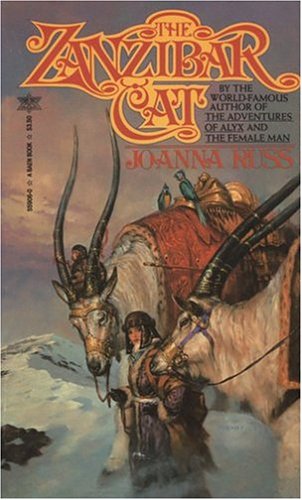 It’s also bunk because while Baen is being used by Ringo as a synecdoche for a certain subgenres of science fiction (and the non-SJW agendas of the authors who produce it and the readers who read it), I have to wonder whether Baen itself wants that responsibility or affiliation. I mean, as just one example, we’re all aware that Baen published Joanna Russ, yes? More than once? Joanna Russ, part of the “new wave” of science fiction that Ringo identifies as a proto-SJW movement? Joanna Russ, who was the very definition of what is labeled a Social Justice Warrior before any conservative or reactionary person even thought to spit such an epithet from out between their lips? That Joanna Russ? The only way that Joanna Russ does not fully qualify for retroactive SJW status is if the definition of “SJW” actually includes “cannot be published by Baen Books.” And yet, apparently, she could tell a “cracking good tale,” because that’s what Baen publishes. Strange!
You know, here’s a thing. I am published by, and frequently associated with, Tor Books. I have a pretty good idea of how the place works. I do not presume to talk for them, or to suggest how they might proceed with their business, other than in the most general terms of “They’re going to mostly buy and sell science fiction and fantasy.” Why? Because that’s not my gig. I think if I started to tell people what sort of science fiction Tor is only going to sell, or who it will publish and who it will not, it might eventually get back to me that I should maybe not do that. Because who knows how that would play out? What authors who might be a great success at Tor — and for whom Tor could do a great job — would shy away from the house because I flapped my gums in apparent certain knowledge of what my editor and publisher wanted? What damage might I do associating the publishing house with politics and personalities they might wish to stay far away from? How uncomfortable might I make other authors my publisher works with by asserting what will and will not be published there? And how foolish would I look if I asserted something about what the publishing house would never do — and then the publishing house went and did it?
That previous paragraph is not entirely directed at Ringo, incidentally. I’ve seen a number of authors published by Baen asserting what the house would or would not do, with regard to stories and books and authors, and what is and would be published, and what is and would not, and to whom any of the above is sold. I can’t help wonder how many of them will be surprised one day. Baen is a house that publishes some very good science fiction, mostly of a certain type, and, one presumes, largely to a certain audience. But I would submit that the type of science fiction, and the audience for it, is rather more varied than is currently being asserted. I can scan my own shelves and find at a whole lot of Baen, and a whole lot of other publishers. It all goes into the pot for me. I suspect that it might irritate or annoy certain folks (not Ringo, but some others, I feel sure) that I like, read and promote Baen Books, but you know. The hell with that stupidity. Being a “social justice warrior” means I get to read (and incidentally, vote for on award ballots) what I want, rather than waiting to be told by someone else what I should like and what I shouldn’t.
In any event: Let’s put to rest the myth of exceptionalism of Baen Books. It’s like Tor, or Ace, or Orbit or Del Rey or lots of other SF/F houses (and other publishers) you might care to name. It’s in the businesses of selling books. Sometimes it has good years, sometimes it has less good years. Sometimes its authors win awards, sometimes they don’t. At the end of the day, however, it does the same thing as any publisher: It publishes books that it hopes, when you get to the end of them, you say “I’d like to read more like that.” Good for them. Good for any publisher who does that.


acnl-sparkle: pulpfanfiction: is this grand theft auto...


Selfie Arm: very strange parody of the selfie stick

 The "Selfie Arm" is a fantastically bizarre improvement over the traditional selfie stick. Read the rest

The Prettiest Tyranny
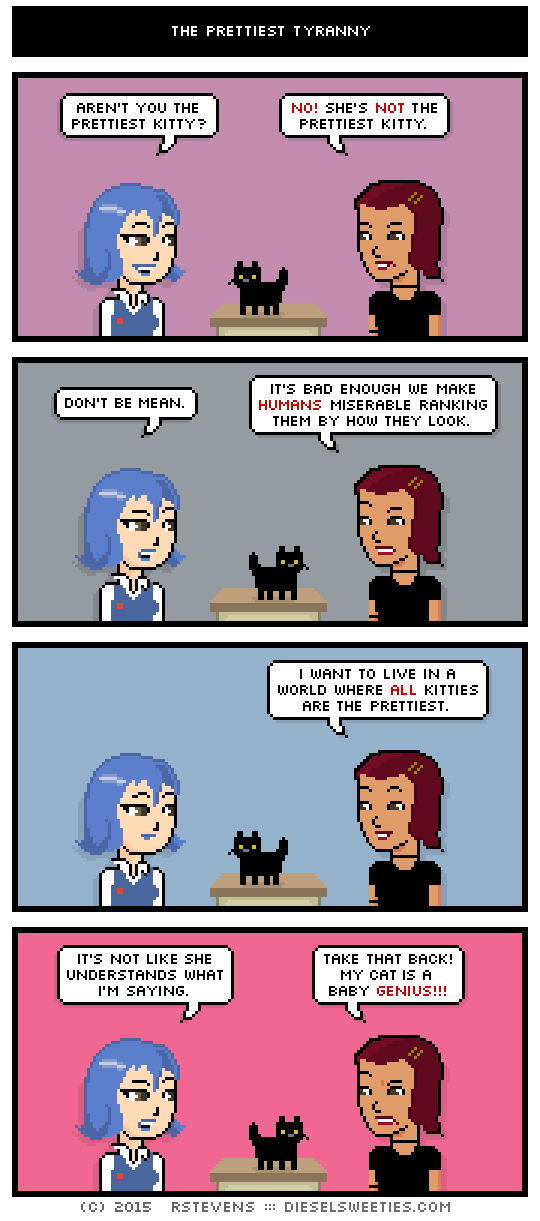
Being the prettiest kitty is its own kind of tyranny.
“We must always take sides. Neutrality helps the oppressor,...

“We must always take sides. Neutrality helps the oppressor, never the
victim. Silence encourages the tormentor, never the tormented.”
―
Elie Wiesel
New Astonishingly Realistic Miniature Food by Shay Aaron

Rainbow cake
Tel Aviv-based miniaturist Shay Aaron has sculpted many new pieces of astonishingly realistic miniature food since our last post about his work. Each adorable piece is meticulously handcrafted in a 1:12 scale, sometimes using very tiny tools, such as a sewing needle.
Aaron sells the pieces as minatures or as jewelry at his Etsy store. More of his work can be seen on his Instagram feed.

Chips and guacamole

Girl Scout cookies

Fruit tart

Bananas

Fourth of July berry tart
via Instagram Blog, DesignTAXI
Dam Curry Rice, A Fun and Functional Wall of Rice Holds Back Delicious Curry Sauce

photo via 38beem
Restaurants and cooks at homes in Japan are serving curry rice in a functional and eye-catching way: by building a wall of rice that acts as a dam holding back curry sauce. Not only does the architectural fare look adorable, but it keeps sauce from getting all over the plate and mixing into other foods.

photo via 38beem

photo via 38beem

photo via tsuna_wo

photo via xxxa101
????????
?????????(???????) pic.twitter.com/JymqJHdtSG
— ??????????? (@dam_namasu) March 26, 2015
via Naver Matome, RocketNews24

Saturday Morning Breakfast Cereal - Pre-Emptive War

Hovertext: As far as I know, the real Dr. Munger has not publicly made this argument.
New comic!
Today's News:
I'm just saying.



You’re so added value, baby

You’re so added value, baby
Tap O’ the Mornin’
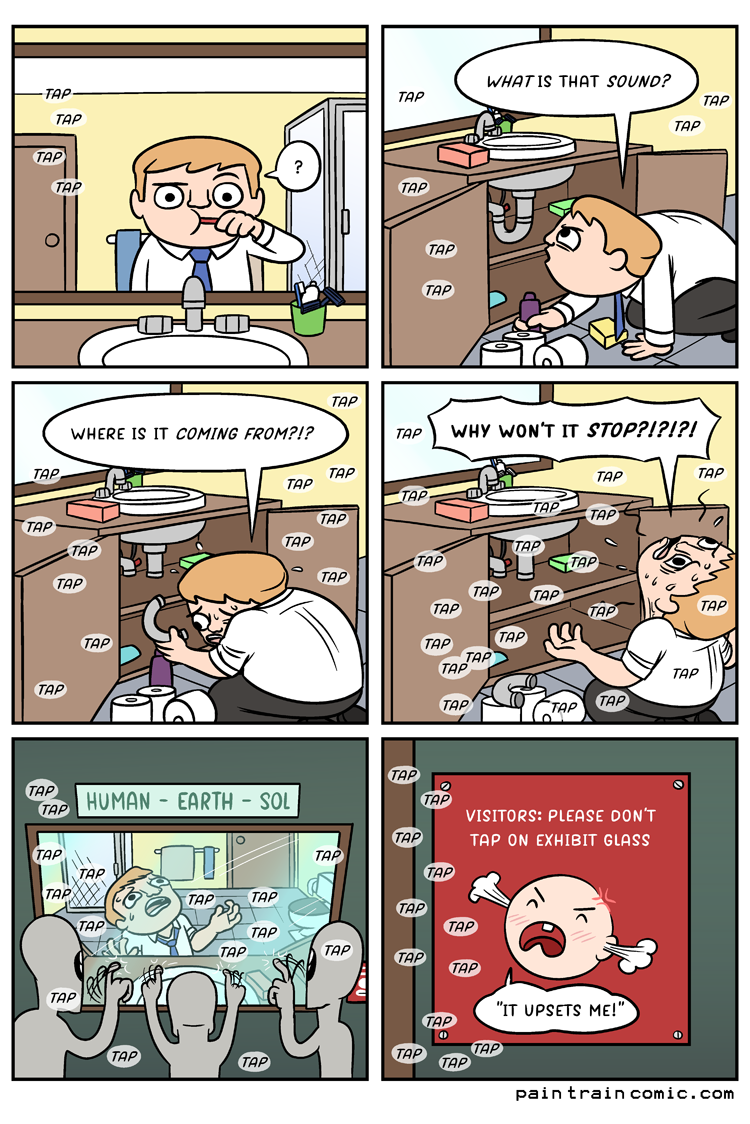
Another bathroom setting!! Bathrooms on the brain, wash me down the drain~ :^)
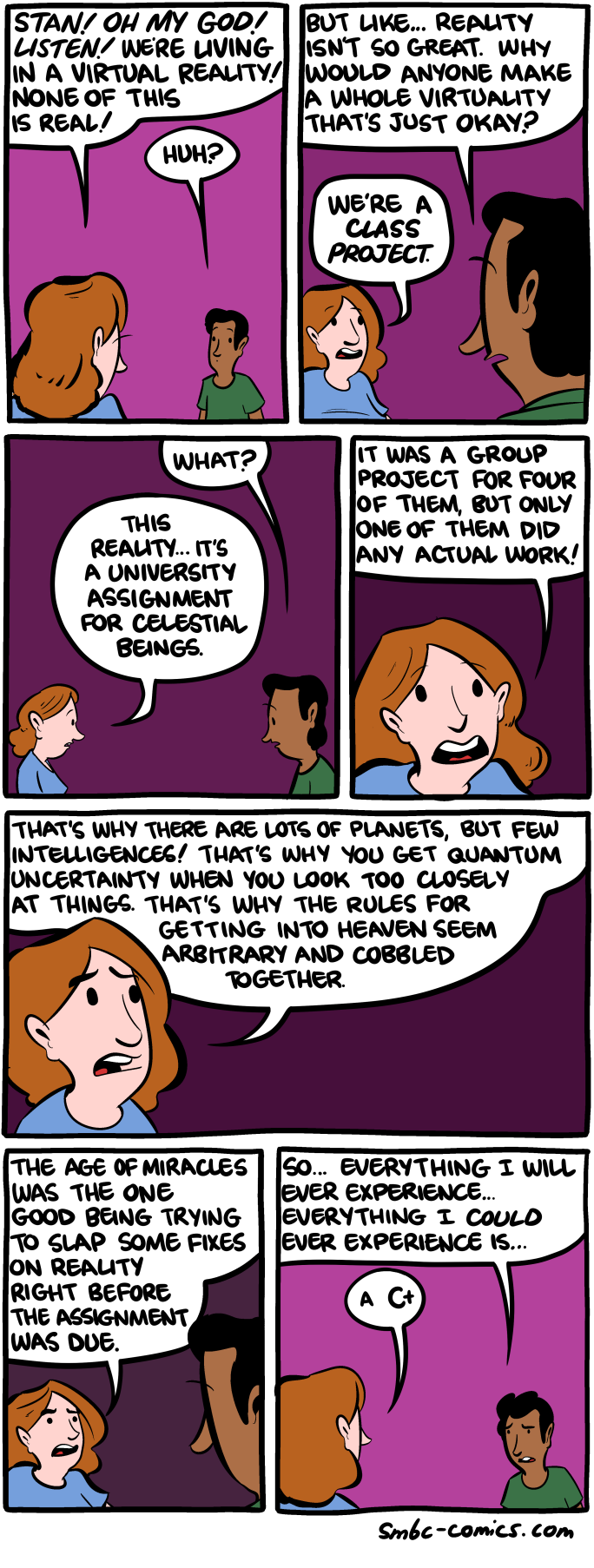
Saturday Morning Breakfast Cereal - A Group Project
Redshirts as a Social Justice Cabal Hugo Pick
Posting this Twitter rant here for posterity. This is Hugo neepery, but not of the usual sort I’ve been neeping about recently.
Multitweet comment coming. Be ready.
— John Scalzi (@scalzi) April 29, 2015
1. It's been recently suggested that I should be ashamed for getting the Hugo for Redshirts (by an author who hasn't himself read the book).
— John Scalzi (@scalzi) April 29, 2015
2. To be clear: I am not. I am deeply pleased it won, and I think it was entirely deserving of the award, and the other awards it won.
— John Scalzi (@scalzi) April 29, 2015
3. It's funny and an easy read, and if you think that's easy to accomplish as a writer — and still pack an emotional punch — well, try it.
— John Scalzi (@scalzi) April 29, 2015
4. The same author suggested (again without reading it), that it was a "social justice" sort of book, which lent itself to winning.
— John Scalzi (@scalzi) April 29, 2015
5. It is, in fact probably the least racially/sexually diverse book I've written BECAUSE the characters were supposed to reflect a BAD show.
— John Scalzi (@scalzi) April 29, 2015
6. Indeed, when the TV script for it was written, they CHANGED the sex of a couple of characters to make it more diverse! This is true.
— John Scalzi (@scalzi) April 29, 2015
7. So it really is a bad example of a Social Justice-y sort of book. Much worse, in fact, than my OMW series in general.
— John Scalzi (@scalzi) April 29, 2015
8. Also, if the "SJWs" vote en bloc, why would they award me, SWM, when Saladin Ahmed and Mira Grant were on the ballot?
— John Scalzi (@scalzi) April 29, 2015
9. The only answer here would be because the SJWs secretly crave straight white male leadership, which would be kinda not SJW-y at all.
— John Scalzi (@scalzi) April 29, 2015
10. I'm happy with the politics I have and I try to be a good human, which is apparently what makes me an SJW. But Redshirts is, in fact…
— John Scalzi (@scalzi) April 29, 2015
11. … a genuinely TERRIBLE example of a book to show influence of the SJW cabal, both in content, and in its year. It's a bad argument.
— John Scalzi (@scalzi) April 29, 2015
12. The book won for a number of reasons, including people just liked it. But because of an SJW cabal? Really, no. That's dumb.
— John Scalzi (@scalzi) April 29, 2015
13. I'm done.
— John Scalzi (@scalzi) April 29, 2015


mashable: Protein World’s ad campaign, which features a woman...





Protein World’s ad campaign, which features a woman in a bikini and various products in the company’s “weight loss collection,” asks the question: Are you beach body ready? This has sparked an online backlash in which more than 40,000 people have signed a petition calling for the removal of the ad that’s been deemed body shaming.
The company has insisted there’s nothing wrong with their posters and has “absolutely no intention of removing the adverts because of a minority making a lot of noise.” CEO Arjun Seth said that the people defacing his posters are “terrorists” and that he would only take notice of the petition if it gained one million signatures. [via]
Oh, Protein World. You’re a steaming pile of fail.
salon: In an impressive game of twisted current events mad...


In an impressive game of twisted current events mad libs, a Texas GOP lawmaker has managed to tie the Baltimore riots over police brutality to this week’s Supreme Court case debating the future of same-sex marriage, blaming LGBT rights for the disintegration of the family and, subsequently, the violent protests ravaging American communities.
Dear Bill Flores: You’re a pandering asshole, and if you actually believe this, you’re too goddamn stupid to breathe.
Big gay hugs,
Wil
proletarianrevenge: Melanie from Baltimore laying down the...
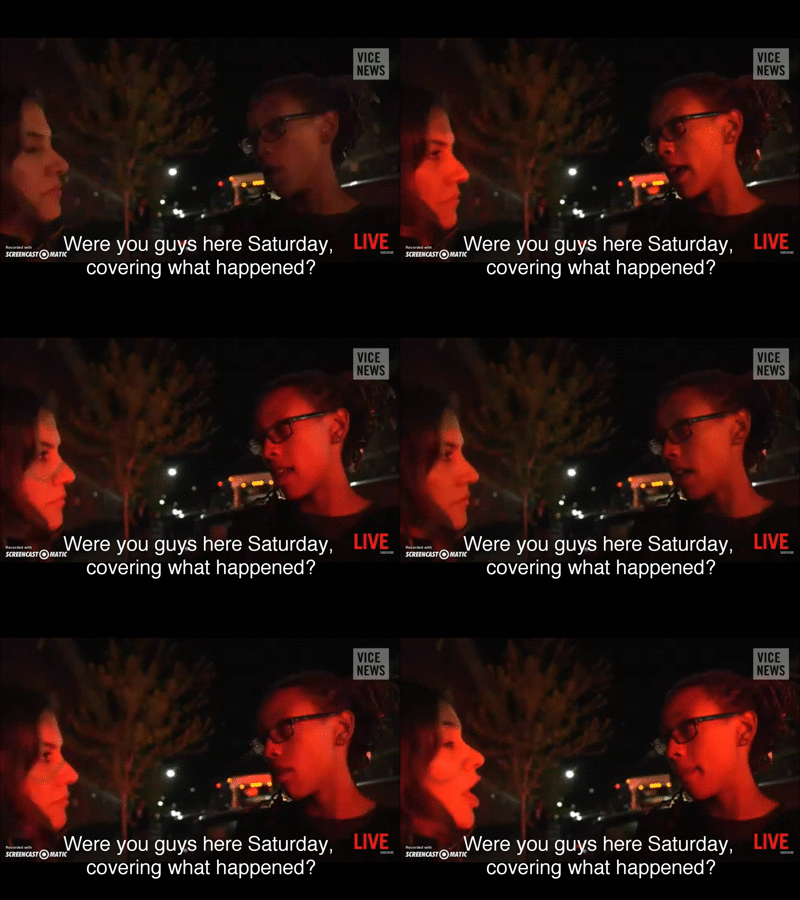


Melanie from Baltimore laying down the truth to Vice reporters during a livestream.


All that needs to be said

The people now calling for nonviolence are not prepared to answer these questions. Many of them are charged with enforcing the very policies that led to Gray’s death, and yet they can offer no rational justification for Gray’s death and so they appeal for calm. But there was no official appeal for calm when Gray was being arrested. There was no appeal for calm when Jerriel Lyles was assaulted. (“The blow was so heavy. My eyes swelled up. Blood was dripping down my nose and out my eye.”) There was no claim for nonviolence on behalf of Venus Green. (“Bitch, you ain’t no better than any of the other old black bitches I have locked up.”) There was no plea for peace on behalf of Starr Brown. (“They slammed me down on my face,” Brown added, her voice cracking. “The skin was gone on my face.”)
When nonviolence is preached as an attempt to evade the repercussions of political brutality, it betrays itself. When nonviolence begins halfway through the war with the aggressor calling time out, it exposes itself as a ruse. When nonviolence is preached by the representatives of the state, while the state doles out heaps of violence to its citizens, it reveals itself to be a con. And none of this can mean that rioting or violence is “correct” or “wise,” any more than a forest fire can be “correct” or “wise.” Wisdom isn’t the point tonight. Disrespect is. In this case, disrespect for the hollow law and failed order that so regularly disrespects the community.

FBI's crypto backdoor plans require them to win the war on general purpose computing

The FBI wants backdoors in all your crypto, and UK Prime Minister David Cameron made backdoors an election promise, but as Stanford lawyer/computer scientist Jonathan Mayer writes, there's no way to effectively backdoor modern platforms without abolishing the whole idea of computers as we know them, replacing them with an imaginary and totalitarian computing ecosystem that does not exist and probably never will.
Read the rest

Who created Caitlin Snow on #TheFlash? According to @DCComics, nobody
Who created Caitlin Snow, the alter ego of Firestorm super-villain Killer Frost, who appears regularly on The Flash?
According to DC Entertainment, nobody.
That’s right. Caitlin Snow, the brilliant scientist working for Harrison Wells, fiancée of Ronnie Raymond and friend of Barry Allen, aka The Flash, sprang fully formed into existence without a creator or creators.
But that’s okay, because, by the logic employed by DC Entertainment, nobody created Barry Allen either.
Let me explain. See if you can follow me here.
As I’ve described elsewhere (http://comicsequity.blogspot.com), many years ago DC Comics established the first program to provide comic book creators with a share in the revenues generated by their creations in other media. This concept became known as “creator equity participation” and it was a small but significant step toward compensating creators for their work beyond a simple page rate. For me, personally, it’s been moderately lucrative (thank you, Bruce Timm, for putting Killer Croc in the animated Batman) but in recent years it’s also become an increasingly frustrating and, lately, infuriating process.
The reason, I believe, is the shift of corporate culture at DC Comics that occurred around the time Paul Levitz left his position as publisher.
As a comic book creator himself, Paul displayed a protective empathy for creators. Once the creator equity concept became policy, Paul applied it liberally and proactively– often notifying writers and artists their creations were due to receive equity participation when creators would otherwise have no idea. For thirty plus years, under Paul, creators were valued and supported as equity partners. (We can argue about the level of support, whether the percentage creators received was commensurate with their contributions, but we can’t deny that the support was there, and it was consistent.)
All of that changed when Paul left, and DC Comics became, officially, DC Entertainment, a fully subsumed cog in the Warners Entertainment wheel.
I first learned how this change would effect DC’s approach to creators equity when I received a letter from DC Entertainment’s new president, Diane Nelson, informing me I would no longer receive equity payments for Power Girl because she was now considered a “derivative” character. To soften the blow and show “appreciation” for my “contribution” she enclosed a check for $1000.
Thank you, Diane.
The next thing I learned about DC Entertainment’s new approach to their comic creators equity program was just as distressing, given how many characters I created for DC over the decade-plus I wrote for the company: if I wanted to receive an equity participation contract for a character I created, I had to request one, in writing, for each character, before that character appeared in another media, because DC would refuse to make equity payments retroactively.
By a rough guesstimate, I probably created over five hundred characters for DC between 1969 and 1985. Most of them were minor one-shot creations, and some of them, like Felicity Smoak (now a regular on Arrow) were minor supporting characters who’ve taken on a new life in other media. Unless I’m willing to commit a large chunk of my life to tracking down each character and filing a separate equity request in anticipation that somehow, some day, one of these characters might end up on a TV show, I risk being cut off from any share in the fruits DC enjoys from the product of my labor. A share which DC acknowledges I’m due– but which DC refuses to assist me in receiving.
Thank you, DC.
But now we come to the catch-22 of DC’s new approach to creator equity agreements. Assuming I perform my due diligence (which should really be DC’s due diligence) and dig up references to characters I’ve created that might soon be appearing in other media (maybe as a chess piece, or a Heroclix figure, or a recurring character on The Flash), and assuming I file the necessary request form in a timely fashion– DC can still decide, unilaterally, that my creation is “derivative” and they don’t owe me a dime.
What, exactly, is DC’s definition of a “derivative” character?
It’s a character that DC decides was “derived” from some other previously existing character.
For example, Power Girl– “derived” from Superman, because, like Supergirl, she’s a relative of Superman. Which means I can’t claim to be her co-creator because Superman is a pre-existing character. Fair enough, I suppose. The logic here is that Superman is the original creation, so Power Girl is derived from that original creation, so in effect, Power Girl is an extension of Superman, which means, by this tortured logic, that Power Girl was more or less created by Jerry Siegel and Joe Shuster.
Uh, no.
This was the tortured logic National Periodical Publications tried to use back in the 1940s when Siegel and Shuster sued National for the rights to Superboy. National (the company that preceded DC) argued that Superman was the original creation, which Siegel and Shuster sold to National, and that Superboy was just a “derivative” creation. A court-appointed legal referee found that Superboy was in fact a unique creation and that National was guilty of copyright infringement. Sadly for Siegel and Shuster (and for creators everywhere), legal expenses forced the creators to sell National the rights to Superboy in a consent decree that obscured this fundamental finding. But the finding is pretty clear:
Characters “derived” from other characters are legally unique, and DC’s claim that “derivation” deprives creators of any equity participation rights in those characters is nothing more than an immoral, unethical, deceitful and despicable money grab.
Yet, it gets worse.
Let’s say DC agrees you created a character, like, for example, Killer Frost. In your original creation, Killer Frost had a secret identity named Crystal Frost. Later, a “new” Killer Frost is created for the New 52, and this new Killer Frost has a secret identity named Caitlin Snow.
You’ll be pleased to hear (I hope) that DC agrees I and Al Milgrom are the co-creators of all manifestations of “Killer Frost.” We are also considered the co-creators of Crystal Frost. And, of course, by the twisted logic that credits Power Girl as a derivation of Superman, Al and I must also be the creators of Killer Frost’s New 52 secret identity, Caitlin Snow.
Right?
No. We’re not. And DC insists we are not. And I agree with DC.
Caitlin Snow was created by Sterling Gates and Derlis Santacruz.
Except, according to DC Entertainment, she wasn’t. Because she was “derived” from the original creation of Killer Frost.
Which means Al Milgrom and I created her.
Except, according to DC Entertainment, we didn’t.
Nobody created her.
Or, rather, nobody gets credit and creator equity participation for creating her.
And that, my friends, is truly obnoxious and despicable.
DC Entertainment has created a marvelous catch-22 that allows them to cheat creators by using both sides of an argument to serve DC’s interests.
According to DC, Sterling Gates and Derlis Santacruz didn’t create Caitlin Snow. Don Newton and I didn’t create Jason Todd. Ric Estrada and I didn’t create Power Girl. Jerry Siegel and Joe Shuster didn’t create Superboy. Bob Kanigher and Carmine Infantino didn’t create Barry Allen.
These characters just appeared out of nowhere.
But the money for their exploitation goes directly into DC’s bank account.


