Shared posts

17 Jun 02:43

The Edge

by submission

Author : Ellie Snyder

We arrived at the edge of the universe yesterday.

I don’t know exactly what I expected to see but it wasn’t this. I guess I figured it would be blackness—that the last tendrils of matter that had worked their way here would dissipate into the void. Until the universe’s expansion pushed them further out and extended the boundary.

Hardy said he knew it was stupid but he always thought we would end up looking across a sort of boundary into the celestial realm. Off in the distance we would see where heaven started, and the black would fade into golden light and there would be this perfect city and God and everything. That was stupid but we were all pretty shaken up so no one laughed. Any theory seemed more plausible than the reality.

O’Connor said she didn’t think we’d ever reach a real end. She thought the galaxies and everything would thin out but never stop, that there would never actually be nothing. And if there ever was nothing she thought we would just keep going anyway to see if anything else started up.

Rees said he thought along the same lines as O’Connor, that it would never end, except he thought there would be infinite galaxies and stars and planets. He said he read about this theory where the universe is infinite so every possible scenario of anything that could ever happen would happen. There would be infinite Earths with infinite different people experiencing every possible scenario. He thought we might even meet up with a ship of other Us’s, also looking for the boundary of the universe. No one really knew what to say to that.

Thomson said he thought we would hit a wall. He thought there would be a boundary and one day we would just smack into it and rebound. He said he pictured it like The Truman Show, but instead of Truman’s boat hitting the edge of the dome it would be a spaceship hitting the inside of a sphere. He came the closest of all of us, I guess.

Here’s what the edge of the universe looks like. There is a solid boundary, or we think it’s solid, we haven’t tried touching it yet. It’s sort of glassy looking, but with bright waves of energy wavering all over it, and it stretches on forever on every side of us.

What’s on the other side is what’s really astounding. There are bubbles. They honestly look like giant bubbles with the same type of shells as ours. And they contain whole universes. It’s just like you would imagine, there are webs of galaxies inside, all miniscule, like ships in bottles. Some look more densely packed than others, and they all just float around out there and bounce into each other. When they bounce into ours the boundary lights up a little brighter and nudges in and then ripples away. It looks like the bubbles go on forever, or at least there’s no reason to believe they don’t.

Tomorrow we’ll try touching the boundary. I wonder if it’ll just obliterate us or if we’ll approach it all dramatic and slow and then just bump into it and make a little ripple like all the bubbles out there.

If we can we’re going through. No one wants to go back. For all we know there’s nothing to go back to. So through the edge of the universe it is and into a new one!

Maybe we’ll pass someone else on their way out, exchange addresses.

Discuss the Future: The 365 Tomorrows Forums
The 365 Tomorrows Free Podcast: Voices of Tomorrow
This is your future: Submit your stories to 365 Tomorrows

15 Jun 15:28

Water Shamans

by featured writer

Author : Gray Blix, Featured Writer [ bio ]

She released her grip on the yoke of her De Havilland, and the pain in her hands eased. Even with a quarter century of experience flying to remote locations in Alaska, no medical emergency could compel her to try a night landing on a pitch black lake. Yet she had often done so for this native village, when called by the Water Shamans, who took control of her floatplane and skillfully landed it, as they did this night, no matter the darkness or conditions in the air or on the water’s surface.

She imagined them focusing their minds to take telekinetic control, or beaming a force field from their alien craft submerged below. She assumed it must be there, since they were said to have emerged from the water generations ago after an explosion that left the lake glowing green and fish floating dead. Some systems onboard must be functioning, since the aliens were often seen returning to the waters and re-emerging days later. She had never seen them, however, so she had only the occasional irresistible need to fly to a village that appeared on no map and the spooky remote control night landings as evidence that they were more than superstitious tales of this lost tribe.

A dozen villagers awaited her on the shore, warmed by a fire that illuminated a huge totem pole which told the story of the Water Shamans. As always, they gave her hugs and escorted her to the largest structure in the village, where she was to perform surgery. Upon entering she saw a man lying on a table she’d had them fashion from halved logs, surrounded by three women she’d trained to assist her. As always, there were no Water Shamans present.

Villagers had told her the Water Shamans could cure any health condition, no matter how serious, but early experiences exposing the aliens to the sight of blood had turned out badly. Something uncontrollable within them was triggered. The totem showed a Water Shaman consuming a human.

Quickly examining the patient, she confirmed the diagnosis planted in her mind earlier that evening: acute appendicitis. The organ would have to be removed immediately. An assistant administered a local anesthetic while another helped her glove, gown, and mask. But instead of beginning surgery, she paused to think about her worsening arthritis, which would make delicate movement of her hands impossible before long, and would cause her to lose her pilot’s license, and would condemn her to retirement before her time. She was trying to communicate with the Water Shamans, to bargain with them. They cared for the people in this village. Her medical skills had saved many over the years and could save another tonight. For their sake and for hers, she needed help with her own medical problem.

She imagined them curing her arthritis and herself performing the appendectomy. She didn’t know if they were monitoring her thoughts, or if they could cure her arthritis, or if they could understand the bargain she proposed, or if they would allow themselves to be coerced into healing a non-resident of the village. She only knew that for the first time she needed the Water Shamans as much as they needed her.

A sensation of warmth coursed through her body and she staggered momentarily. One of her assistants gasped and mopped beads of sweat from her brow. She regained her balance and realized she was pain-free. Cutting into her patient with a sure stroke, she smiled. I am the one human the Water Shamans respect as an equal, she thought. Until later, when she got a look at herself in a mirror.

Discuss the Future: The 365 Tomorrows Forums
The 365 Tomorrows Free Podcast: Voices of Tomorrow
This is your future: Submit your stories to 365 Tomorrows

14 Jun 15:30

The Garbage Approaches

by Clint Wilson

Author : Clint Wilson, Staff Writer

The garbage approaches. I yell at the family to get down as I swing the schooner around in a tight arc, heading away from the massive undulating island. The strong afternoon wind fills our sails yet I am nowhere near satisfied yet.

With a loud crack some hundred meters back, a tendril breaks away from the island and lashes out across the murky ocean towards us. It is made from the same things as the rest of the writhing floating mass beyond. The collective countless castaways of humankind have somehow congealed, come to life, and are now quickly gaining intelligence, their hunting methods improving constantly.

I check the nitrous supply and see that we maybe have two good blasts left. However conservation matters not now. The tendril is stretching ever forward, as great lumps of organic slime mixed with billions of shards of plastic snake towards us, ever gaining, ever hungry, I must act now. Firing up the ancient gasoline engine I grab the valve and crack it halfway open. “Hold on!” I yell.

Suddenly we are looking at the sky as the schooner bursts forward at incredible speed. I quickly close the valve and our nose gradually drops back down. Soon we’re over a kilometre away. I hope it can’t smell that far.

I look forward toward the open sea, my hair and beard blowing back as our sails fill once again. That was close. It had really snuck up on us there, laying nearly flat against the water until it was almost within reach. I must arrange twenty-four hour watches. We can never let our guard down again. But we’re running out of supplies, and dangerously low on fuel. Hopefully soon we will stumble upon some useful land still unencumbered by the garbage. But as we dart in and out from the coastline such places are getting fewer and farther between.

Suddenly a tendril bursts from the water ahead. “Tricky bugger!” I yell aloud. It appears that our pursuer has taught itself a diving and flanking manoeuvre. I crank the wheel hard to starboard. The ten ton tendril of writhing living garbage rears up and then slaps down hard towards us. I once again fire up the ancient engine and reach back for the nitrous valve. This is our last chance.

Discuss the Future: The 365 Tomorrows Forums
The 365 Tomorrows Free Podcast: Voices of Tomorrow
This is your future: Submit your stories to 365 Tomorrows

12 Jun 23:04

Incurable Optimist

by submission

Author : Bob Newbell

“We’re almost ready,” said Olav to his companion, Isak. “Are the others out of range?”

“Yes, all the ships are gone,” replied Isak. “It’s just us now.”

The two of them watched UY Scuti waver on their ship’s display like a reflection in water distorted by ripples. But UY Scuti was no reflection. It was a red supergiant star with five billion times the volume of Sol. The great artificial rings that surrounded the enormous sun were far too small to be visible. But they were there, spinning around the great star faster and faster, distorting the fabric of spacetime. If UY Scuti replaced Sol, the former’s photosphere would extend beyond the orbit of Jupiter. In a few moments, the star would be compressed to the dimensions of a proton.

“Think we’ll survive?” asked Isak.

“We both made backup copies of our minds,” responded Olav matter-of-factly.

“I know. But I mean…us.”

“There’s a good chance we won’t,” said Olav. “No one’s ever tried to punch a hole out of our D-brane and into another dimension.”

“Assuming our universe is a very large D-brane extended over three spatial dimensions,” remarked Isak. “If that’s the case and all material objects are just open strings bound to this D-brane and gravity is the result of closed strings exerting their force from ‘outside’ our universe…”

“We’ll know either way soon enough,” said Olav.

The ship’s computer started moving the vessel closer to the imploding star.

“I hope opening a hyperspace tunnel out of our brane-space doesn’t do any harm,” said Isak.

“The government approved this. Even if it did cause something catastrophic, in the long run the race would benefit from it,” said Olav.

“Well, that’s taking optimism a bit far,” replied Isak.

“But it’s true. Look at history. Back in 2758, when Eta Carinae went supernova, the gamma ray burst destroyed Earth’s ozone layer. Muon radiation killed almost everything and ultraviolet radiation killed what was left. But the humans in underground colonies on Earth’s Moon and Mars and inside hollowed-out asteroids survived. The survivors were a select population: Intelligent, highly motivated, physically and emotionally tough. It was from this adventurous stock that the human population was restored.”

Isak looked at his companion in disbelief. “It was the worst mass extinction event in history!”

“Oh, certainly it was a horrific nightmare. But without it, mankind would have remained confined to one solar system.”

“Next you’ll be telling me the Plague of Tau Ceti IV was a great leap forward.”

“It was. After the plague, legislation blocking experiments in transhumanism was relaxed and later repealed. The transhuman meta-race wouldn’t exist across the Milky Way if the Tau Ceti plague hadn’t happened. I know it seems grotesque that that’s how progress is made, but–”

Olav was interrupted by the sound of alarms. UY Scuti seemed to suddenly iris down like the image on an ancient television set that had been switched off. The ship lurched forward at high speed toward the narrow tunnel that was opening.

“I sincerely hope this doesn’t turn out to be one of your great moments in the history of progress,” said Isak as the small ship disappeared into higher dimensions.”

Discuss the Future: The 365 Tomorrows Forums
The 365 Tomorrows Free Podcast: Voices of Tomorrow
This is your future: Submit your stories to 365 Tomorrows

10 Jun 05:35

After Life

by submission

Author : Hannah Jenkins

What is the nature of the human soul? That old favourite after-dinner topic of philosophers and theologians has suddenly become much more important, as it is dragged out of the hypothetical realm into cold, hard reality.

What is the soul made of? Where does it go after death? Where is it now? Does it sit in the stomach, undetectable until it leaps with excitement or sinks with despair? Is it in the heart, providing the energy and inspiration behind every beat? Is it in the brain, held in a net of glittering neurons? Or does it roam the body freely, flowing in our blood and dancing along our nerves? Can it break free of the flesh altogether, travelling beyond us into our dreams and imaginings?

So why am I asking all this? Because it is a matter of life and death. Literally. The question I ask is simply this; am I alive, or am I dead? And, despite what else you may have been told, this is the question you are here to answer.

If the soul is contained within the body, before moving on to your choice of afterlife, then my soul fled the shell of my body as it burnt on board the Caracal. It is gone, I am dead, and the person speaking to you now is little more than an imitation, an echo, a literal “ghost in the machine”.

But what if the soul is capable of more than that? What if life is far more fantastic, wild and strange than we ever thought possible? What if my soul remained when my body died? What if…I am alive?

What if, when my mind was uploaded into the computer of the Caracal, my soul went with it?

What if – when the ship was attacked at the edge of the Empire’s territory, when it exploded and the crew died in screaming agony – what if my soul remained, protected deep in the computer core?

You all know what happened next. Twenty-three ships were lost that day. One thousand, two hundred and eighty-eight names were added to the monument on Capitol Hill. The relief ships trawled the debris field for the bodies of the fallen, and anything else that could be saved. The Pallas found a computer core, drifting in the remains of the Caracal. They linked it up to a power source and reactivated it, hoping to retrieve some useful data on the battle. Instead, they found me. The intact consciousness of the pilot, held in a net of circuitry. Nobody thought it was possible. Some people maintain that it still isn’t. I died, they say. My name is on the monument. My next of kin have been informed. End of story.

Of course, if it was that simple, you wouldn’t be here.

The Pilots’ Union has fought for over a year to bring about this hearing, and for that they have my immense gratitude. They believe that I am alive, which means that I have kept my rights as a citizen of the Empire. These include the right to speak freely, the right to a fair trial, and, of course, the right to life.

For this hearing the computer containing me has been connected to a portable generator. That’s the grey box next to the platform. You can see that on the front is an on/off switch. Ladies and gentlemen and uncategorised, I invite you to make your decision. Is pressing that switch no different from turning off an interactive entertainment vid, or is it murder? Your choice.

Discuss the Future: The 365 Tomorrows Forums
The 365 Tomorrows Free Podcast: Voices of Tomorrow
This is your future: Submit your stories to 365 Tomorrows

25 May 00:21

Business

http://oglaf.com/business/

23 May 20:00

Who needs poppies? Ordinary yeast can now produce opioids

by Diana Gitig

Opioid analgesics—pain killers like morphine and codeine—are indispensable to modern medicine; they make recovery from surgical procedures slightly more bearable, and they alleviate pain in cancer patients. Opioid chemical relatives are also hugely important and include antibiotics, muscle relaxants, and cough suppressants.

But these compounds are complex and difficult to synthesize, and labs can't make them nearly as well as biological systems—specifically poppies—can. Manufacturing opioids would be so much easier if we could simply engineer microbes to just spit them out, as we've done for insulin and artemisin.

Now, researchers have done exactly that.

Read 9 remaining paragraphs | Comments

22 May 21:18

Mario Kart With a Jazzier Side

by Ari Spool
D0c

Next time your friends are all hanging out watching you play video games, perhaps you should put them to work creating a live soundtrack for your playtime enjoyment.

22 May 16:55

This comic makes privilege incredibly easy to understand

by Laura Hudson
Screen Shot 2015-05-22 at 8.58.23 AM

The idea of "privilege" can be a difficult concept to grasp for a lot of people, especially when advantages seem small and invisible to people on the receiving end. In the comic "On a Plate," cartoonist Toby Morris breaks down how the subtle differences afforded to some people—in this case, on the basis of class and money—can make huge differences in their opportunities over time. Head to The Wireless to read it and make sure you make it all the way to the end—it's worth it.

02

This entry passed through the Full-Text RSS service - if this is your content and you're reading it on someone else's site, please read the FAQ at fivefilters.org/content-only/faq.php#publishers.

22 May 14:19

In Russia...

by Brad
6e5
22 May 02:38

NSA Planned to Hijack Google App Store to Hack Smartphones

by Ryan Gallagher

The National Security Agency and its closest allies planned to hijack data links to Google and Samsung app stores to infect smartphones with spyware, a top-secret document reveals.

The surveillance project was launched by a joint electronic eavesdropping unit called the Network Tradecraft Advancement Team, which includes spies from each of the countries in the “Five Eyes” alliance — the United States, Canada, the United Kingdom, New Zealand and Australia.

The top-secret document, obtained from NSA whistleblower Edward Snowden, was published Wednesday by CBC News in collaboration with The Intercept. The document outlines a series of tactics that the NSA and its counterparts in the Five Eyes were working on during workshops held in Australia and Canada between November 2011 and February 2012.

The main purpose of the workshops was to find new ways to exploit smartphone technology for surveillance. The agencies used the Internet spying system XKEYSCORE to identify smartphone traffic flowing across Internet cables and then to track down smartphone connections to app marketplace servers operated by Samsung and Google. (Google declined to comment for this story. Samsung said it would not be commenting “at this time.”)

As part of a pilot project codenamed IRRITANT HORN, the agencies were developing a method to hack and hijack phone users’ connections to app stores so that they would be able to send malicious “implants” to targeted devices. The implants could then be used to collect data from the phones without their users noticing.

Previous disclosures from the Snowden files have shown agencies in the Five Eyes alliance designed spyware for iPhones and Android smartphones, enabling them to infect targeted phones and grab emails, texts, web history, call records, videos, photos and other files stored on them. But methods used by the agencies to get the spyware onto phones in the first place have remained unclear.

The newly published document shows how the agencies wanted to “exploit” app store servers — using them to launch so-called “man-in-the-middle” attacks to infect phones with the implants. A man-in-the-middle attack is a technique in which hackers place themselves between computers as they are communicating with each other; it is a tactic sometimes used by criminal hackers to defraud people. In this instance, the method would have allowed the surveillance agencies to modify the content of data packets passing between targeted smartphones and the app servers while an app was being downloaded or updated, inserting spyware that would be covertly sent to the phones.

But the agencies wanted to do more than just use app stores as a launching pad to infect phones with spyware. They were also keen to find ways to hijack them as a way of sending “selective misinformation to the targets’ handsets” as part of so-called “effects” operations that are used to spread propaganda or confuse adversaries. Moreover, the agencies wanted to gain access to companies’ app store servers so they could secretly use them for “harvesting” information about phone users.

The project was motivated in part by concerns about the possibility of “another Arab Spring,” which was sparked in Tunisia in December 2010 and later spread to countries across the Middle East and North Africa. Western governments and intelligence agencies were largely blindsided by those events, and the document detailing IRRITANT HORN suggests the spies wanted to be prepared to launch surveillance operations in the event of more unrest.

The agencies were particularly interested in the African region, focusing on Senegal, Sudan and the Congo. But the app stores targeted were located in a range of countries, including a Google app store server located in France and other companies’ app download servers in Cuba, Morocco, Switzerland, Bahamas, the Netherlands and Russia. (At the time, the Google app store was called the “Android Market”; it is now named Google Play.)

Another major outcome of the secret workshops was the agencies’ discovery of privacy vulnerabilities in UC Browser, a popular app used to browse the Internet across Asia, particularly in China and India. Though UC Browser is not well-known in Western countries, its massive Asian user base, a reported half billion people, means it is one of the most popular mobile Internet browsers in the world.

According to the top-secret document, the agencies discovered that the UC Browser app was leaking a gold mine of identifying information about its users’ phones. Some of the leaking information apparently helped the agencies uncover a communication channel linked to a foreign military unit believed to be plotting “covert activities” in Western countries. The discovery was celebrated by the spies as an “opportunity where potentially none may have existed before.”

Citizen Lab, a human rights and technology research group based at the University of Toronto, analyzed the Android version of the UC Browser app for CBC News and said it identified “major security and privacy issues” in its English and Chinese editions. The Citizen Lab researchers have authored their own detailed technical report outlining the many ways the app has been leaking data, including some users’ search queries, SIM card numbers and unique device IDs that can be used to track people.

Citizen Lab alerted UC Browser to the security gaps in mid-April; the company says it has now fixed them by rolling out an update for the app. A spokesperson for UC Browser’s parent company, Chinese e-commerce giant the Alibaba Group, told CBC News in a statement that it took security “very seriously and we do everything possible to protect our users.” The spokesperson added that the company had found “no evidence that any user information has been taken” — though it is not likely that surveillance of the leaking data would have been detectable.

The case strikes at the heart of a debate about whether spy agencies are putting ordinary people at risk by secretly exploiting security flaws in popular software instead of reporting them so that they can be fixed.

According to Citizen Lab Director Ron Deibert, the UC Browser vulnerability not only exposed millions of the app’s users to surveillance carried out by any number of governments — but it could also have been exploited by criminal hackers to harvest personal data.

“Of course, the security agencies don’t [disclose the information],” Deibert said. “Instead, they harbor the vulnerability. They essentially weaponize it.” Taking advantage of weaknesses in apps like UC Browser “may make sense from a very narrow national security mindset,” Deibert added, “but it’s at the expense of the privacy and security of hundreds of millions of users worldwide.”

The revelations are the latest to highlight tactics adopted by the Five Eyes agencies in their efforts to hack computers and exploit software vulnerabilities for surveillance. Last year, The Intercept reported that the NSA has worked with its partners to dramatically increase the scope of its hacking attacks and use of “implants” to infect computers. In some cases, the agency was shown to have masqueraded as a Facebook server in order to hack into computers.

The Intercept and CBC News contacted each of the Five Eyes agencies for comment on this story, but none would answer questions on record about any of the specific details.

A spokesperson for Canada’s Communications Security Establishment said that the agency was “mandated to collect foreign signals intelligence to protect Canada and Canadians from a variety of threats to our national security, including terrorism,” adding that it “does not direct its foreign signals intelligence activities at Canadians or anywhere in Canada.”

British agency Government Communications Headquarters said that its work was “carried out in accordance with a strict legal and policy framework, which ensures that our activities are authorised, necessary and proportionate.”

Australia’s Signals Directorate said it was “long-standing practice” not to discuss intelligence matters and would not comment further.

New Zealand’s Government Communications Security Bureau said that it has “a foreign intelligence mandate” and that everything it does is “explicitly authorised and subject to independent oversight.”

The NSA had not responded to repeated requests for comment at time of publication.

The post NSA Planned to Hijack Google App Store to Hack Smartphones appeared first on The Intercept.

21 May 15:52

GTA Short Turns Assassination Gone Wrong into Awesome Chase Scene

by Evan Narcisse

GTA Short Turns Assassination Gone Wrong into Awesome Chase Scene

Listen: contract killings can go wrong sometimes, okay? It’s just something that happens. But, in Los Santos, chasing down the guy you’re supposed to kill isn’t always that easy.

Crafted by YouTuber Boris the Blade using the Editor in the PC version of GTA V, The Hit is a stylish action sequence that keeps you guessing just how the two hunters will catch their prey. With a bunch of players performing every action you see, it’s also a great illustration of how games like GTA V can turn their users into virtual stuntmen.

This entry passed through the Full-Text RSS service - if this is your content and you're reading it on someone else's site, please read the FAQ at fivefilters.org/content-only/faq.php#publishers.

21 May 15:49

How America became the most powerful country on Earth, in 11 maps

by Max Fisher
Bewarethewumpus

Via lbstopher

We take it for granted that the United States is the most powerful country on Earth today, and perhaps in human history. The story of how that came to be is long, fascinating, complex — and often misunderstood. Here, excerpted in part from "70 maps that explain America," are maps that help show some of the key moments and forces that contributed to the US's rise as sole global superpower.

1

Because of a war that left North America vulnerable to British and America conquest

So much of America's power comes from its size: it is one the largest countries on Earth by population and area, and is rich in natural resources and human capital. It is also in many ways an island nation; because it faces no major threats on its borders, it is freer to project power globally.

There was no reason that North America's borders had to become what they are. A key moment in how that happened came with the French and Indian War, at the time just a sideshow in the larger Seven Years' War in Europe. The war ended with France giving up its vast territory on the continent to Britain and Spain. Napoleon would seize back Louisiana and sell it to the US in 1803, but New France was lost forever. With the Spanish Empire already declining, the continent was left open to conquest from the British Empire and its successor, the United States.

Image credit: University of Maine

2

By stealing Native Americans' land for an entire century

Of course, North America was not empty when European explorers and settlers arrived — it was filled with diverse, long-established societies. They may well have become sovereign nation-states had the US not sought to purge them from their lands, deny them self-rule, and, once they had been reduced to a tiny minority, forcibly assimilate them and their land. These acts are the foundation upon which American dominance of North America, and thus American global power, was built.

This map begins by showing Native Americans' land in 1794, demarcated by tribe and marked in green. In 1795, the US and Spain signed the Treaty of San Lorenzo, carving up much of the continent between them. What followed was a century of catastrophes for Native Americans as their land was taken piece by piece. By the time the US passed the Dawes Act in 1887, effectively abolishing tribal self-governance and forcing assimilation, there was very little left.

Image credit: Sam B. Hillard/Sunisup

3

By taking land from Mexico in another war

American expansionism could only go so far. Upon Mexico's independence in 1821, it gained vast but largely unincorporated and uncontrolled Spanish-claimed lands from present-day Texas to Northern California. American settler communities were growing in those areas; by 1829 they outnumbered Spanish speakers in Mexico's Texas territory. A minor uprising by those American settlers in 1835 eventually led to a full-fledged war of independence. The settlers won, establishing the Texas Republic, which they voluntarily merged with the United States in 1845.

But Mexico and the US still disputed the Texas borders, and President James K. Polk wanted even more westward land to expand slavery. He also had designs on Mexico's California territory, already home to a number of American settlers. War began in 1846 over the disputed Texas territory, but quickly expanded to much of Mexico. A hard-line Mexican general took power and fought to the bitter end, culminating in the US invading Mexico City and seizing a third of Mexico's territory, including what is now California, Utah, Nevada, Arizona, New Mexico, and Texas. Had the war gone differently, or had Polk not sought these Mexican lands, the US would today be a much smaller country — and perhaps with no Pacific coast — making it less powerful globally, and particularly in the increasingly important Pacific region.

Image credit: Kaidor/Wikipedia

4

By choosing to become a European-style imperial power

If there were a single moment when the US became a global power, it was the war with Spain. The Spanish Empire had been crumbling for a century, and there was a ferocious debate within the US over whether America should become an imperial power to replace it. This centered on Cuba: pro-imperialists wanted to purchase or annex it from Spain (pre-1861, the plan was to turn it into a new slave state); anti-imperialists wanted to support Cuban independence.

In 1898, Cuban activists launched a war of independence from Spain, and the US intervened on their side. When the war ended in Spanish defeat, US anti-imperialists blocked the US from annexing Cuba, but pro-imperialists succeeded in placing it under a quasi-imperialist sphere of influence; the US base at Guantanamo Bay is a relic of this arrangement. The war also ended with the US taking three other Spanish possessions: Puerto Rico, Guam, and the Philippines, a massive and populous island nation in the Pacific. The US had become a European-style imperial power. While this experiment in colonialism was short-lived and controversial at home, it began America's role as a major global power.

Image credit: Anand Katakam

5

Through colonialism in the Pacific — and by stealing Hawaii

America's brief experiment with overt imperialism came late in the game, and mostly focused on one of the last parts of the world carved up by Europe: the Pacific. This began in Hawaii, then an independent nation. American businessmen seized power in an 1893 coup and asked the US to annex it. President Cleveland refused to conquer another nation, but when William McKinley took office he agreed, absorbing Hawaii, the first of several Pacific acquisitions. Japan soon entered the race for the Pacific and seized many European-held islands, culminating in this 1939 map, two years before America joined World War II.

Image credit: Emok

6

Because World War I devastated Europe — and not the US

For centuries, the world had been divided among several competing global powers. No one country had hope of becoming the sole global superpower in such a system. World War I was the beginning of the end of that era. These six dots represent not just the major participants in the first World War, but the countries that, at the time, were the world's great powers. A seventh great power, the Ottoman Empire, was dismantled outright as a result of the war. (China, perhaps another great power, had been declining for some time.) As you can see, the destruction of the war and the massive war debts absolutely devastated the economies of the great powers — except, that is, for the United States and the still-mighty British Empire.

Image credit: Stephen Broadberry/Mark Harrison

7

Because World War II devastated Europe and Asia

It is impossible to fully capture the toll of the second world war in any one metric, but this map of military deaths can serve as a telling shorthand. While the war was terribly costly for all involved, the human cost was disproportionately felt by the two primary Axis powers — Germany and Japan — and particularly by the Soviets and Chinese, as well as by other countries in Eastern Europe and East Asia caught in the war machines. These military deaths merely hint at the much larger death toll in both continents from war, famine, and genocide, as well as economic and ecological devastation. While Americans paid dearly, as well — enduring the deaths of 400,000 military personnel — the US came out of the war far more powerful by virtue of everyone else's decline.

Image credit: Tyson Whiting

8

Because European colonialism collapsed — but not the American or Russian empires

This animated map showing the rise and fall of European (as well as Japanese and Ottoman) imperialism is fascinating all the way through, but things get really interesting from 1914 through the end. In just a few years after World War II, the centuries-long project of European colonialism collapses almost entirely. The reasons for this were many: the rise of independence movements in Latin America, then in Africa and Asia; the collapse of European economies that drew them back home; and, with postwar colonial misadventures like the 1956 Suez Crisis, a sense that the new world order was not going to tolerate colonialism anymore. In any case, the world was left with two enormous land empires that happened to have European roots: the United States and the Soviet Union.

Image credit: Asuros

8

By dividing up the world in the Cold War

After the world wars and the end of colonialism, the global system went from many competing powers to exactly two: the US and the Soviet Union. Both had competing ideologies, competing interests in Europe and Asia, and deep mutual distrust. While that might have normally led to war, the horrifying power of nuclear weapons kept them from fighting outright. Instead, the US and Soviet Union competed for global influence.

American and Soviet fears of a global struggle became a self-fulfilling prophecy: both launched coups, supported rebellions, backed dictators, and participated in proxy wars in nearly every corner of the world. Both built up systems of alliances, offshore bases, and powerful militaries that allowed each to project power across the globe.

By 1971, the US and the Soviet Union had settled into a stalemate; this map shows the world as it had been utterly divided. In 1979, the Soviets invaded Afghanistan; a year later, Ronald Reagan ran for president, promising to end the détente and defeat the Soviet Union. The Soviet Union, along with many of its trappings of global power, disintegrated — leaving the United States with a vast global architecture of military and diplomatic power that was suddenly unchallenged.

Image credit: Minnesotan Confederacy

9

Because Europe unified under American-dominated NATO

In 1948, the Soviet Union blockaded Berlin from Western Germany. The next year, the powers of Western Europe joined with the US and Canada in signing a collective defense — the North Atlantic Treaty Organization — meant to deter Soviet aggression and counterbalance the Soviet Union in Europe. It expanded during the Cold War to include virtually every European country west of the Soviet bloc. This may have staved off another war in Europe by pledging that the US would defend any member as it would its own soil. It also left Western Europe, once full of independent powers that jostled against one another and against the United States, unified against a common threat — and led by its most powerful member, the United States.

That dynamic did not really change after the Cold War ended. NATO expanded, acquiring new members in Central and Eastern Europe that still feared Russia. NATO ensures the stability of Europe and the security of its members, but at a cost: Europe's nations are now reliant upon, and thus yoked to, American power. This dynamic has played out in several places across the globe — South Korea and Japan are similarly tied to the US through security agreements and American military bases, for example — but it is most clearly pronounced in Europe.

Image credit: Arz

10

By outspending the next dozen countries combined on defense

Another way to show America's status as the sole global superpower is its military budget: larger than the next 12 largest military budgets on Earth, combined. That's partly a legacy of the Cold War, but it's also a reflection of the role the US has taken on as the guarantor of global security and the international order. For example, since 1979, the US has made it official military policy to protect oil shipments out of the Persian Gulf — something from which the whole world benefits. At the same time, other powers are rapidly growing their militaries. China and Russia in particular are rapidly modernizing and expanding their armed forces, implicitly challenging global American dominance and the US-led order.

Image credit: International Institute for Strategic Studies/Agence France-Presse

11

By virtue of America's scientific edge — and its democracy, creativity, and draw for immigrants

The US is so powerful for reasons other than its size, its military might, and its global system of alliances and bases — although those are certainly important. There is also America's tremendous advantage in scientific research, which both furthers and is an expression of its technological and economic lead on much of the rest of the world; it's also an indicator of innovation more broadly. An imperfect but revealing shorthand for that is the US's tremendous lead in Nobel prizes from its 1901 inception through 2013, when I made this map (the US has not lost its Nobel lead since then). The US has won 371 Nobels, mostly in the sciences; the US thus accounts for 4 percent of the world population but 34 percent of its Nobel laureates. This is the result of many factors: wealth, a culture and economy that encourage innovation, education, vast state- and private-funded research programs, and a political culture that has long attracted highly educated migrants. All of those factors contribute to American wealth and thus power in more ways than just Nobel prizes, but the sheer number of US laureates is a sign of the American advantage there.

Image credit: Max Fisher

21 May 02:46

Spaceship launch today: reusable, built by Boeing for NASA, now...


Spaceship launch today: reusable, built by Boeing for NASA, now long operated by the United States Air Force​.

http://www.space.com/29423-x37b-space-plane-mystery-mission-otv4.html

20 May 21:05

TrackingPoint in trouble—smart gun company stops orders, lays off staff [Updated]

by Lee Hutchinson

Just a few months after announcing a 107 percent year-over-year increase in sales and $20 million in revenue for 2014, Pflugerville, Texas-based TrackingPoint appears to be on the verge of shutting down. "Due to financial difficulty TrackingPoint will no longer be accepting orders," reads the banner atop the company’s homepage. "Thank you to our customers and loyal followers for sharing in our vision."

TrackingPoint makes "precision guided firearms"—rifles and carbines fitted with complex computerized scopes that can hit targets at more than a thousand yards out, even when fired by inexperienced shooters. Ars has covered the company’s technology several times since 2013, most recently looking at its "Mile Maker" 1,800-yard prototype weapon at the 2015 Consumer Electronics Show. The company has gone through a number of personnel changes since our coverage began, including a major reshuffling of employees last year.

Sources familiar with the matter tell Ars that TrackingPoint has laid off more than 60 employees in 2015. Guns.com says its own sources claim the company laid off "more than 20 people" just this week, which when coupled with other cuts, would reduce the company’s headcount to about a dozen people (down from a bit under 100 at the beginning of the year). The Truth About Guns reports via an anonymous tipster claiming to be a former employee that as of Monday morning, CEO Frank Bruno was allegedly fired by owner John McHale (Bruno was brought on as CEO after the February layoffs and restructuring). The expectation from a number of different sites is that TrackingPoint will soon be filing for bankruptcy.

Read 2 remaining paragraphs | Comments

20 May 20:04

GM: That Car You Bought? We’re Really The Ones Who Own It.

by Kate Cox

Congratulations! You just bought a new Chevy, GMC, or Cadillac. You really like driving it. And it’s purchased, not leased, and all paid off with no liens, so it’s all yours… isn’t it? Well, no, actually: according to GM, it’s still theirs. You just have a license to use it.

At least, that’s what an attorney for GM said at a hearing this week, Autoblog reports. Specifically, attorney Harry Lightsey said, “It is [GM’s] position the software in the vehicle is licensed by the owner of the vehicle.”

GM’s claim is all about copyright and software code, and it’s the same claim John Deere is making about their tractors. The TL;DR version of the argument goes something like this:

  • Cars work because software tells all the parts how to operate
  • The software that tells all the parts to operate is customized code
  • That code is subject to copyright
  • GM owns the copyright on that code and that software
  • A modern car cannot run without that software; it is integral to all systems
  • Therefore, the purchase or use of that car is a licensing agreement
  • And since it is subject to a licensing agreement, GM is the owner and can allow/disallow certain uses or access.

The U.S. Copyright Office is currently holding a series of hearings on whether or not anyone other than the manufacturer of a car has a right to tinker with that car’s copyrighted software. And with the way modern design goes, that basically means with the car, at all.

Folks who like to tinker with their cars, as well as independent (non-dealer) mechanics say they need the copyright exemption in order to be allowed to continue repairing their own cars, or keeping their businesses open. Manufacturers, like GM, say that it’s a safety issue: if people who aren’t authorized mess with any one piece of software, they could make the entire ecosystem of connected code unsafe.

An attorney from the Electrnnic Frontier Foundation also testified at the hearing, telling the Copyright OFfice that restricting access to onboard computers in vehicles drives up costs, hurts competition, and stifles innovation. It also prevents third party researchers from conducting independent safety and security research without becoming lawbreakers.

The first of the two sessions of hearings started yesterday in Los Angeles. The other will take place next week, in Washington, DC. The Copyright Office is expected to issue a ruling in July determining just what you can and can’t do with the things you thought you bought.

General Motors says it owns your car’s software [AutoBlog]

20 May 19:12

The Journey to Becoming a Nintendo World Champion Starts Here (or There)

by Evan Narcisse
Bewarethewumpus

I like how the "World" Championships is taking place entirely within the lower 48 United States.

The Journey to Becoming a Nintendo World Champion Starts Here (or There)

You know how Nintendo’s bringing back their old-school World Championship competition? Well, they’ve just announced the eight U.S. locations where players can go to qualify and earn a chance to go to the big showdown at this year’s E3. Get pumped.

Folks who want to try and grab at Nintendo glory will be playing the Championship mode in Ultimate NES Remix and trying to notch high scores in Super Mario Bros., Super Mario Bros. 3 and Dr. Mario. Hopefuls will be able to do so at eight Best Buy locations throughout the country on May 30th:

1717 Harrison St.
San Francisco, CA

3675 Pacific Coast Highway
Torrance, CA

10760 NW 17th St.
Miami, FL

900 E. Golf Road
Schaumburg, IL

12905 Elm Creek Blvd. N
Maple Grove, MN

5001 Northern Blvd.
Long Island City, NY

9378 N. Central Expressway
Dallas, TX

2214 S. 48th St.
Tacoma, WA

The high score winners from each location will get flown out to E3 to play a bunch of other games against eight other mystery opponents. Let’s put money down that at least one of them will be Fred Savage.


Contact the author at evan@kotaku.com.

This entry passed through the Full-Text RSS service - if this is your content and you're reading it on someone else's site, please read the FAQ at fivefilters.org/content-only/faq.php#publishers.

20 May 15:13

TOM THE DANCING BUG: On Iraq - W.W.J.H.D.? (What Would Jeb Have Done?)

by Ruben Bolling

[unable to retrieve full-text content]

FOLLOW @RubenBolling on Twitter and Facebook.

And, for sure, JOIN the fun to be had in Tom the Dancing Bug's subscription club, the INNER HIVE.

More Tom the Dancing Bug comics on Boing Boing! (more…)

20 May 15:08

Photo


20 May 14:53

Doc Brown Comes Back To The Future To Hype LEGO Dimensions

by Mike Fahey

Doc Brown Comes Back To The Future To Hype LEGO Dimensions

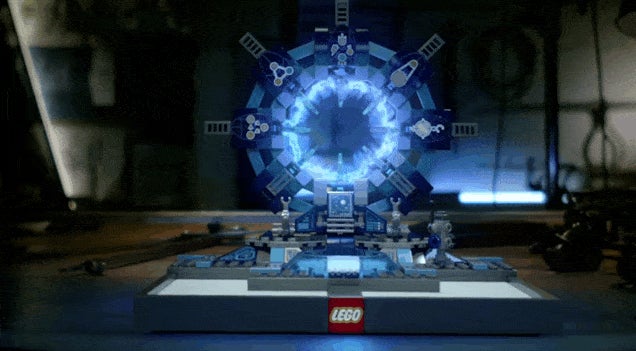
Christopher Lloyd is a man who’ll jump at any chance to don a Hawaiian shirt, stand in front of a wind machine and shout “Great Scott!” A new LEGO Dimensions trailer is as good a reason as any.

Good old Doc Brown is getting his own Fun Pack when LEGO Dimensions launches this September, adding $9.99 or so to the large amount of cash LEGO fans need to stockpile for the September release. He’ll join Back to the Future’s Marty McFly as well as characters from Scooby Doo, DC Comics, Portal, Doctor Who, Jurassic World, The Simpsons, The LEGO Movie, Ninjago, Chima, Lord of the Rings and whatever other properties WB and LEGO can scrounge up for their toys-meets-games jam.

Where we’re going we’ll just need our wallets.

This entry passed through the Full-Text RSS service - if this is your content and you're reading it on someone else's site, please read the FAQ at fivefilters.org/content-only/faq.php#publishers.

20 May 01:27

Retro Console Promises To Play ALL The Games

by Luke Plunkett

Retro Console Promises To Play ALL The Games

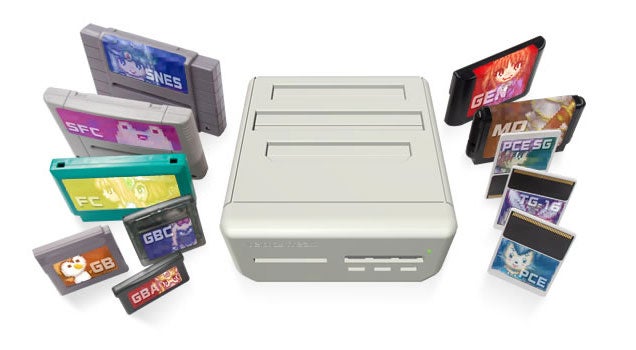
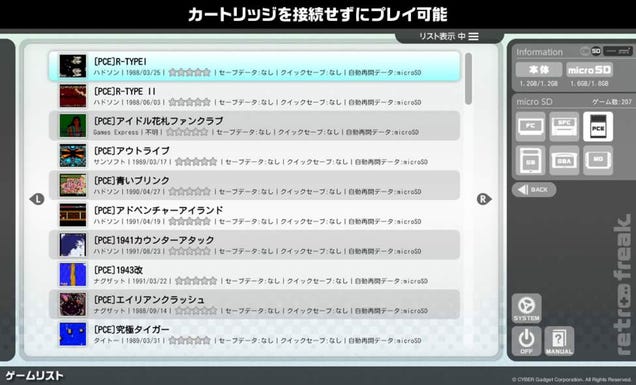
This is the Retro Freak. It’s promising to play games from the Famicom. SNES. Genesis. PC Engine. TurboGrafx-16. Game Boy. Game Boy Advance. Game Boy Color. And even the Supergrafx. Holy shit.

Retro Console Promises To Play ALL The Games

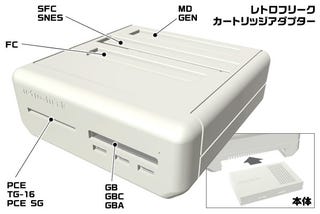
It comes in two parts; there’s the actual console, which is a small box that takes care of all the actual work, then there’s a giant “adapter” which is where you plug all the cartridges in (the console slides in under the adapter). The console has various settings that let you change video (and conversion/upscale) options, as well as built-in cheat support. It also supports USB controllers, so you can plug just about anything in there.

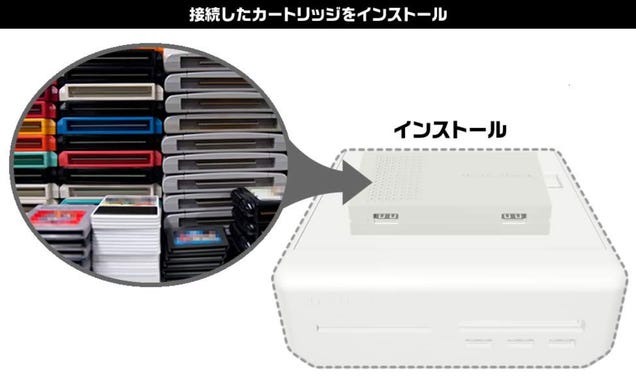
Most interesting, though, is the fact it’ll let you install games from a cartridge onto the console (which looks like it’ll let you use a microSD card).

Retro Console Promises To Play ALL The Games

Retro Console Promises To Play ALL The Games

Currently announced only for Japan, if there is a Video Game God, it is time to pray to him/her/it, and ask for a Western release (or at least a semi-affordable import and some language FAQs).

(via Tiny Cartridge)

This entry passed through the Full-Text RSS service - if this is your content and you're reading it on someone else's site, please read the FAQ at fivefilters.org/content-only/faq.php#publishers.

20 May 01:24

Kid Arrested For DDOSing Entire School District

by Luke Plunkett
Bewarethewumpus

They should hire this kid (or the person he hired) to secure the school's system. There is nothing in the article that assures me that someone launching the same type of attack won't do the same or more damage.

Kid Arrested For DDOSing Entire School District

An unnamed 17 year-old kid has been arrested, and may face felony charges, after being caught organising a DDOS attack against the West Ada School District in Idaho, which has 52 schools and 32,000 students.

The attacks took place earlier this month, reports KTVB (via Daily Dot), and resulted in the schools being unable to reliably access the internet for over a week. The attacks took place while students were taking their Idaho Standard Achievement tests; a District spokesperson says kids “lost all their work, and some had to take the tests multiple times this week.”

Multiple times? Sheesh.

The absurd thing is he didn’t even do the job himself; the accused paid someone else to do it, which didn’t stop police from being able to track him down regardless.

If the boy is charged with a felony (for computer crime), he’s looking at up to 180 days in juvenile detention. And his parents will be handed the bill “for any financial restitution suffered by the school district.”

This entry passed through the Full-Text RSS service - if this is your content and you're reading it on someone else's site, please read the FAQ at fivefilters.org/content-only/faq.php#publishers.

20 May 01:20

Raiders of the Lost Ark's Hovitos fertility idol

by Jason Weisberger
Bewarethewumpus

Wow, the Hovitos Fertility Idol + Staff of Ra headpiece, AND the Holy Grail, can all be had for $199. What a bargain!

Replica Hovitos fertility idol

This Hovitos fertility idol is a replica, it does not belong in a museum.

I will be keeping it next to my replica headpiece to the replica staff of Ra... and I don't even need to speak Hovitos!

This entry passed through the Full-Text RSS service - if this is your content and you're reading it on someone else's site, please read the FAQ at fivefilters.org/content-only/faq.php#publishers.

20 May 01:17

Watch: Excellent animation about Net Neutrality

by David Pescovitz

[unable to retrieve full-text content]

From the team behind Kurz Gesagt (In a Nutshell), this terrific animation about Net Neutrality that premiered at last night's Webby Awards in New York City.

19 May 15:04

Hot lava flows in a parking lot—in upstate NY

by Scott K. Johnson
Bewarethewumpus

Banana for scale.

Scott K. Johnson

The steel pipe is a stand-in for a lava tube— the conduits that form within large lava flows as the outer skin solidifies. The banana is a stand-in for a banana.

47 more images in gallery

Back in 2012, we pointed you to an awesome project at Syracuse University that creates artificial lava flows for science, art, and outreach. They don’t use some mild, room-temperature stand-in for lava, they do it the artisanal way:  melting small batches of basalt in a serious furnace and pouring out the incandescent results. I’ve been hoping to see it for myself ever since, and recently I got the chance to tag along with a group of volcanology students from Colgate University, who were designing and running their own lava experiments for class.

The furnace is surprisingly well-insulated, disguising the fact that it holds molten rock heated to over 1,200 degrees Celsius. It does emit a low, ominous roar, however, as it consumes natural gas to feed its fire. Once poured out, the lava quickly loses heat—it solidifies in just a minute or so, though it still remains incredibly hot long after. Because it solidifies so quickly, it forms amber-black volcanic glass riddled with bubbles of gas that were unable to escape.

The lava pours are as mesmerizing and beautiful as they are geologically exciting. And they’ve probably shocked many a bus rider staring dully out the window while passing the art building.

Read 1 remaining paragraphs | Comments

19 May 04:56

wiselwisel:

19 May 01:52

Texas trooper’s viral photo with Snoop Dogg draws reprimand, lawsuit

by David Kravets

A Texas state trooper on the job for nearly 20 years is being reprimanded for posing in a photo with Snoop Dogg that went viral on the rapper's Instagram account in March.

Billy Spears, the trooper, is suing (PDF) the Texas Department of Public Safety (DPS) who dinged him for being in "a photo with a public figure who has a well-known criminal background including numerous drug charges. The public figure posted the photo on social media and it reflects poorly on the Agency," according to the reprimand.

"They kinda made this up on the fly," the trooper's attorney, Ty Clevenger, told Ars in a Tuesday telephone interview. "They could not point to any policy, rule, order, or law."

Read 10 remaining paragraphs | Comments

18 May 19:10

Supreme Court Says Convicted Felons Have A Right To Sell Their Guns

by Chris Morran

Plenty of Americans legally own firearms. If any of them are later convicted of a felony (that isn’t related to the weapons) and can no longer own a gun, should they have the right to have some input on where their former firearms go? According to the U.S. Supreme Court, yes.

The matter before the court in Henderson v U.S. involved a U.S. Border Patrol agent who was arrested on marijuana distribution charges. As a condition of his bail, the FBI took possession of his firearms. He later entered a guilty plea to a felony charge.

Under 18 U.S.C. §922(g), convicted felons are prohibited from possessing a firearm. So the man requested that the FBI transfer ownership of his guns to a friend. However, the FBI refused.

A federal court denied his request saying that the transfer of the weapons to a friend could effectively allow him to retain possession of the guns through the friend. An appeals court affirmed this decision.

In arguing before the Supreme Court, the government had maintained that the law prevents all transfer of convicted felons’ weapons to third parties, even in cases where a court approves the recipient, except to licensed firearms dealers who will sell them on the open market.

But in today’s SCOTUS ruling [PDF], Justice Elena Kagan explains that this is too oversimplified a view of the law.

She writes that the government is conflating the right to possess an item with the right to “sell or otherwise dispose of that item.”

Taking away a felon’s right to own a gun does not necessarily mean the felon gives up all his rights to decide where that gun ends up. Likewise, giving the felon the ability to determine the disposition of his guns doesn’t put him in possession of the weapons.

Kagan notes that in the Henderson example, where the felon turned over his guns to the FBI before he was even convicted, “The felon has nothing to do with his guns before, during, or after the transaction in question, except to nominate their recipient.”

So if the felon nominates a recipient, a judge approves that recipient, and law enforcement handles the transfer, Kagan writes that this is just doing exactly what the law is supposed to — getting the weapons out of the hands of a convicted felon.

“Such a felon exercises not a possessory interest (whether directly or through another), but instead a naked right of alienation—the capacity to sell or transfer his guns, unaccompanied by any control over them,” she explains.

The appeals court had held that Henderson had no standing on which to request equitable relief for his weapons being held by the FBI because of “unclean hands.” But in a footnote to the SCOTUS ruling, Kagan dismisses this line of thought, pointing out that the while the “unclean hands doctrine proscribes equitable relief,” that is only in instances where the felon’s misconduct has “immediate and necessary relation to the equity that he seeks.”

Because Henderson’s conviction had nothing to do with firearms, this doctrine doesn’t apply, explains Kagan.

SCOTUS believes that courts have the authority to review firearm transfer requests from felons. The trial court “may properly seek certain assurances: for example, it may ask the proposed transferee to promise to keep the guns away from the felon.” If the court doesn’t believe that this transfer or sale will prevent the felon from exercising possession, it can deny the request.

Today’s ruling could have farther reaching implications for convicted felons who have been denied requests to transfer or sell property that was seized but unrelated to the crime for which they were committed.

[via SCOTUSblog.com]

17 May 23:11

WATCH: The Louis C.K. SNL monologue that has everyone asking, “too far?”

by Xeni Jardin
Bewarethewumpus

I'm not a fan to begin with, his humor just tends to grate on me.

Last night’s Saturday Night Live season finale featured comedian Louis C.K., who joked that this could be his last time hosting the show. His opening stand-up set showed why.

KdaV3k

He opened with a bit about how growing up in the 1970s means he suffers from “mild racism,” then joked about how his two daughters fight like Israel and Palestine, then examined how child molesters must love raping children as much as he enjoys eating Mounds bars, because why else would they take the risk.

Too far? Or just right?

[via Mediaite]

This entry passed through the Full-Text RSS service - if this is your content and you're reading it on someone else's site, please read the FAQ at fivefilters.org/content-only/faq.php#publishers.

17 May 15:28

UK government quietly rewrites hacking laws to give GCHQ immunity

by Sebastian Anthony

The UK government has quietly passed new legislation that exempts GCHQ, police, and other intelligence officers from prosecution for hacking into computers and mobile phones.

While major or controversial legislative changes usually go through normal parliamentary process (i.e. democratic debate) before being passed into law, in this case an amendment to the Computer Misuse Act was snuck in under the radar as secondary legislation. According to Privacy International, "It appears no regulators, commissioners responsible for overseeing the intelligence agencies, the Information Commissioner's Office, industry, NGOs or the public were notified or consulted about the proposed legislative changes... There was no public debate."

Privacy International also suggests that the change to the law was in direct response to a complaint that it filed last year. In May 2014, Privacy International and seven communications providers filed a complaint with the UK Investigatory Powers Tribunal (IPT), asserting that GCHQ's hacking activities were unlawful under the Computer Misuse Act.

Read 3 remaining paragraphs | Comments